The Pursuit—The Fight and Victory—We dispose of our Prisoners—The Black Dwarf—The City of Themistocles—We part Company—I go with Peter and Ready aboard the wondrous Highflier. (continued 4)
Reading edition
We repaired the weir before dark, and, camping near it, after supper set to work to catch fish in this, to us, novel manner. We divided the party into watches, so that fish-catching and cleaning went on all night. I began, with Swiftfoot to assist me. I knocked the fish on the head, and he threw them out, while a whole gang were employed in splitting and cleaning them. No sooner were the shades of evening cast over the river than the hapless fish began to dash into our trap. The masque-alonge, a huge pike, first made his appearance, his further progress being effectually stopped; and he was soon on the grass in the hands of the cleaners. Five or six gold-eyes next appeared, and then a sucking-carp and three perch, or, more correctly, well-eyed pike. The voyageurs had lighted a fire, and those not engaged in fishing sat up to eat the fish caught by their companions as fast as they could cook them. Ready, who had been on short commons lately, especially relished his share. As we had formed two pounds, one on each bank of the river, and had relays of fish-catchers, we entrapped between three and four hundred fish of the sorts I have mentioned. Had we possessed a sufficient supply of salt, we might have effectually preserved them. We pickled all we could, and dried in the sun and with smoke those we did not immediately eat.
The lake being calm, the following day we continued our voyage to the mouth of the Little Saskatchewan River, which, it will be seen, communicates with Lake Manitobah, close to which there are some valuable salt works. The wind was fair up the river, but foul for proceeding to the works by the lake. Setting sail, we ran merrily along under sail, overtaking a fleet of Indian canoes belonging to a tribe of Swampies, each with a birch-bark sail. At night we camped, and our Swampy friends coming up with us, did the same near a rapid, where they immediately began to fish. This they did from their canoes. One man paddled and another stood in the bow of the canoe with a net like a landing net at the end of a long pole. As his quick eye detected a fish he dipped his net as a scoop or ladle is used, and each time brought up a fish three or four pounds weight. I may safely say that I saw an Indian, in the course of a few minutes, catch twenty-five white fish. If these people better knew the method of preserving their fish they need never suffer, as they often do, from hunger.
That morning, the wind being foul, the poor squaws were employed in tracking the canoes along the banks of the river. After watching them for some time as they came up towards our camp Peter went forward, and in dumb show, offered to help them, whereat he was treated by the ladies with silent contempt, while his companions saluted him with shouts of hearty laughter. I cannot describe the scenery fully of this curious mixture of lake and stream through which we passed. The banks are generally low—now the water rushed through a narrow passage formed of huge boulders of rocks—now it expanded into a fine lake. Once we forced our way through a vast natural rice field extending for miles, affording food for birds innumerable, and to as many Indians as took the trouble to collect it. They run their canoes into the midst of a spot where the rice is the thickest, and bending down the tall stalks, shake them till they have a full cargo. At length we reached, what we little expected to find in that remote region, a large comfortable cottage in the midst of a well-cultivated and productive farm, surrounded by a number of smaller but neat dwellings. This was an Indian missionary station, where upwards of a hundred and fifty Indian men, women, and children, permanently reside under the superintendence of a devoted English missionary and his wife, assisted by a highly-educated young lady who had lately come out from England to join them. She has learned the Ojibway language, so as to devote her attention most profitably to the education of the children. We visited the school, and it was interesting to see the way in which the little dark-skinned creatures listened to the words which came from the young lady’s lips, and the intelligent answers they gave, as our interpreters translated them, to the questions she put.
There was a service in Ojibway, consisting of prayers, a chapter in the Bible, singing, and a short address, which we attended. The congregation was most attentive, and a considerable number of heathen Indians came in to listen. The service was rather short, but I have no doubt that the excellent missionary considered it wiser to send his hearers away wishing for more, and resolved to come again to listen, than with a feeling of weariness, and declaring that it should be the last time they would set foot within those walls. The missionary’s own cottage was excessively neat and pretty, both inside and out, he feeling, evidently, that it must serve as a model, as he himself, in a degree, was to his converts. Their abodes were, indeed, very superior to those of heathen Indians, while their fields, cultivated in a much better manner than are those found generally among the Indian tribes, are made to produce Indian corn, potatoes, and a variety of other vegetables. There was nothing very curious or romantic in the short visit we paid to this missionary station in the wilderness, yet it was truly one of the most really interesting, thus to find a church in the wilderness performing its duty effectually of converting the heathen from their gross ignorance and sin to a knowledge and practice of the truth. Not far off was a Hudson’s Bay Company’s post, and, like some previous travellers we afterwards met, we had to complain of the scenes of drunkenness and vice which took place among the heathen Indians encamped outside it. The Company prohibits the sale of liquor to Indians; but notwithstanding this large quantities are given away to induce them to sell their peltries cheap, and to gamble away their property, so that they must go forth again to hunt. Thus the missionaries are unable to obtain an influence over them, and the unhappy race are dying from three causes—from drunkenness, from hardships, and from scarcity of food, which, as hunters for fur-bearing animals, they are unable to provide for themselves and families. In my opinion, by means of missionaries who can impart Christian knowledge, and instruction in agricultural and other useful arts, with the opening up of markets for the result of their industry, can alone the rapid decrease of the Indian race be arrested.
After a pleasant stay of a couple of days at this promising station, we proceeded on our voyage to the Salt Springs. After passing into Lake Winnepegosis, we reached the springs, which are situated about four hundred yards from the lake shore, on a barren area of about ten acres of extent, but a few feet above the level of the lake. The whole shore of the lake is said to contain salt springs. At this spot there are some forty or fifty springs, though rather less than thirty wells have been dug by the manufacturers, whose works consist of three log-huts, three evaporating furnaces, and some large iron kettles or boilers. When a fresh spring is discovered a well five feet broad and five deep is excavated and a hut and furnace erected near it. The brine from the wells is ladled into the kettles, and as the salt forms it is scooped out and allowed to remain a short time to drain before it is packed in birch-bark baskets for transportation to the settlements. The brine is so strong that thirty gallons of brine produce a bushel of salt; and from each kettle, of which there are eight or nine, two bushels can be made in a day in dry weather. Some freighters’ boats were taking in cargo at the portage on Lake Manitobah for the Red River as well as for other parts, and we here also took on board as much as we could carry; having purchased several bushels besides, to be brought on to the mouth of the Little Saskatchewan, that we might salt some white fish to serve us for future use.
We might have proceeded by a more direct route—through Lake Winnepegosis—to the mouth of the Great Saskatchewan, but we wished to navigate the large lake from one end to the other. We accomplished all we proposed in five days—reached the mouth of the rapid and gold-bearing Great Saskatchewan. Near the entrance is a long and fierce rapid, which it was necessary for us to mount, before we could again reach water on which we could navigate our canoes. It is nearly two miles in length. The water from above comes on smoothly and steadily; then, suddenly, as if stimulated to action by some sudden impulse, it begins to leap and foam and roll onward till it forms fierce and tumultuous surges, increasing in size till they appear like the rolling billows of a tempestuous sea, ready to engulf any boat venturing over them. In the one case, on the ocean, the movement is caused by the wind above; in the present instance by that of the water itself passing over an incline of rough rocks beneath.
Having partly unladen our canoes, leaving two men in alone, one to steer and the other to fend off the rocks, the rest of us harnessed ourselves to the end of a long tow line, with straps round our bodies, and commenced tracking them up the rapid along a path at the top of the cliffs. It was very hard work, as we had to run and leap and scramble along the slippery and jagged rocks alongside the cataract.
It was curious to know that we were still in the very heart of a vast continent, and yet to be navigating a river upwards of half-a-mile in width. After proceeding twenty miles we passed through Cross Lake, and soon afterwards entered Cedar Lake, which is thirty miles long and twenty broad. We had now to proceed for some hundred miles up this hitherto little-known river, which, rising in the Rocky Mountains, is navigable very nearly the whole distance from their base. As we were sailing we were agreeably surprised, on turning a point, to see before us on the right bank of the river, in the midst of fields of waving corn, a somewhat imposing church, whose tall spire, gilt by the last rays of the evening sun, was mirrored in the gliding river; a comfortable looking parsonage; a large and neat school-house, and several other dwelling-houses and cottages. This proved to be the Pas Mission, one of the many supported by the Church Missionary Society. Here we were most liberally and hospitably received. Above it is Fort Cumberland, a trading post of the Hudson’s Bay Company. An upward voyage of a hundred and fifty miles, aided by a strong breeze, brought us to Fort à la Carne, another Hudson’s Bay Company’s post, where we found Stalker and our carts, and were joined by Pierre Garoupe, who had come across the country from Red River with a further supply of provisions and stores.
Chapter Eighteen.
The Winter in Camp—Our Log-house and Huts—Hunting and Fishing—Buffalo Stalking—Supper and a Dance, and Supper again—How we fared in Camp—Indian Stalking—Winter Pastime.
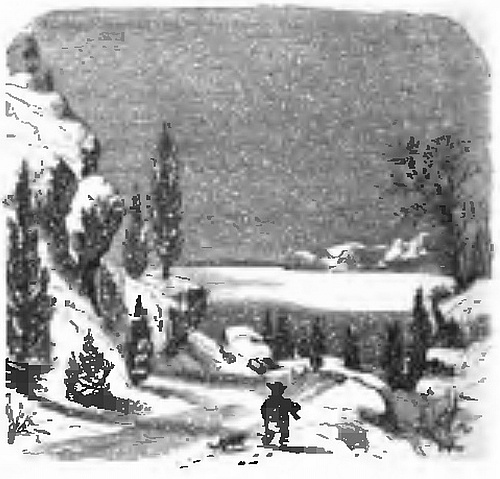
We found that although the weather was still very warm in the day-time, that the comparatively short summer of those regions was already too far advanced to allow of our pushing our way across the Rocky Mountains in the present wild state of the country; a feat, however, which my friend Paul Kane performed some years ago; but then boats were in waiting on the upper branch of the Columbia to convey him and his party to the south. We therefore agreed to employ ourselves in hunting, and in preparing our winter quarters till it was time to go into them. As I have already described a summer buffalo hunt, I will pass over those we at this time engaged in, and proceed to an account of our life in the winter.
Our canoes and such articles as we no longer required we exchanged for horses—such as were likely to prove of value to us in our onward journey in the spring. We had selected a beautiful spot near a lake and in the neighbourhood of a tribe of peaceably-disposed Indians, for the erection of our residence, about fifty miles from the forts; and we now set out for it, with our carts, horses, stores, and cattle in the true patriarchal style, only the women and children were fortunately wanting.
Having reached our location we pitched our tents, and having unpacked such provisions and goods as we required for our immediate use, placed the carts together, and covered the whole with tarpaulins. Our horses we turned out, as they would be able to exist through the whole winter, sheltered by the woods, and feeding on the rich grass which they could get at by digging with their noses under the snow. Our first business was then to cut down the trees necessary for the erection of our abodes. We all took axes in our hands, and in the course of a couple of days had trees enough felled for our purpose. There they lay around in all directions, but it puzzled Trevor and Peter not a little to say how they were to be made to answer the purpose of sheltering us during a winter of almost arctic severity. John Stalker was the chief builder, and I was architect; that is to say, I designed the plan of the buildings, and he directed the way in which they were to be put up, while the rest of the party lopped off the branches and dragged the logs up to the spot. I had studied the way to construct a log-house while recovering from the wounds I received in our skirmish with the Comanches, and now I found an opportunity of turning my knowledge to account. The chief residence was to be oblong; so we cut two long and two short trunks, making deep scores at each end that they might fit into each other. Above these were placed others also scored at the ends, till four thick walls had been erected about seven feet high, without a roof and without doors and windows. Trevor looked at it with astonishment, and Peter walked round and round it till, stopping short near the builder, he remarked—
“Well, Master Stalker, that’s a rum house! I’ll be bold to ask, are we to be shut up all winter, so that we don’t want a door to go in and out at? And is it so dark that we don’t want a window to see out of?”
“Wait a bit, and you’ll see what we’ll do, lad,” answered Stalker, laughing. “Light enough, day and night, when the snow’s on the ground; and you’ll be as much out of doors as in doors when the sky’s clear.”
Peter waited and wondered, for Stalker insisted on getting up all the walls of the huts before proceeding to other portions of the work.
Besides ours, in which were to be deposited the stores for greater safety, there were to be two of smaller size for the men. The walls, when only thus far completed, looked in no way fitted to keep out the cold, as we could see through the interstices on every side. “Wait a bit,” was Stalker’s remark. “Now, lads, some on you go and dig the stiffest clay you can find, and others chop up some grass.” This order was speedily obeyed, and, with a mixture formed of the two, every cranny was completely stopped up; and in the inside the walls were made so perfectly smooth that the logs were almost concealed. “There!” exclaimed Stalker, as he surveyed his work; “I doubt if Jack Frost, though he is pretty sharp in these parts, will ever get through that.” With their hatchets, he and two of the other men literally chopped out a doorway and a window in each hut. The doors were formed from some boards taken from the carts, and the windows with sheets of parchment nailed tightly over the aperture, so that they served the double purpose of drums and windows. As yet there were no roofs; but the men had been set to work to cut a number of tall, thin young pine-trees, which served as rafters placed close together, while a quantity of marsh grass, over which was spread a heavy layer of clay, formed a thatch which no storm could remove.
We began to talk of putting up our bedsteads, and making ourselves comfortable inside our huts.
“Not much comfort you’ll get by-and-by, gentlemen, if you was not to do something more than you have done,” observed Stalker.
“What can that be?” asked Trevor.
“I’m sure I don’t know,” muttered Peter. “To my mind the houses are pretty comfortable for poor men, though not much for gentlemen like master and Mr Trevor.”
“I guess Jack Frost would pretty soon remind you when he comes,” observed Stalker, with a grin.
“Ma foi!” exclaimed Pierre Garoupe. “Monsieur Jaque Frost make his way through de key-hole.”
“Oh, how stupid—a fire-place!” I cried out.
“That’s it,” cried Stalker. “And now let’s set about it.”
I suggested that, instead of the ordinary clay of which fire-places are built, that ours should be constructed of stone of which there was no lack, in the shape of boulders, near the lake. These we collected in the carts, and by cementing them by mortar supported by a frame of wood outside, we formed a substantial fire-place and chimney suited for such a fire as we expected to require. By Stalker’s advice we sunk the floor three feet deep, and piled the earth we dug up outside; thus adding much to the warmth of our abode. A trench was also dug outside, at some little distance, to take off any water which, during a casual thaw, might be inclined to run in. Then, to keep off the wind—the primary object—any grizzlies which might be wandering our way, or any Indians who might prove hostile, we surrounded our whole station with a strong palisade, so that it was almost as strong as one of the Company’s Posts. Never sleep on the ground. To obviate that necessity we stuck some short posts into the ground, and on them formed a framework, over which we stretched some buffalo hides, and so got first-rate bedsteads. Trevor laughed at me for what he called my effeminacy, but I suggested that, after a hunting tramp of thirty or forty miles, we might not be sorry to turn into a comfortable bed. Our lads’ labour was stacking all the wood we had cut for burning, and then storing our goods and provisions. We put off making the furniture for our huts till we should be kept in by bad weather. A further supply of firewood could also be procured at any time after the snow covered the ground. Writers of romances make their heroes and heroines wonderfully independent of food and rest; but we, being ordinary mortals, were aware that we could not exist in comfort without a good supply of provisions, and Trevor and I therefore formed two parties of the men—one to remain in charge of the huts to fish, and to cure what they caught, besides trapping or shooting any animals; while the other was to accompany us in search of buffalo and any other game to be found.
Scarcely were our arrangements completed when the snow fell, and all nature assumed her wintry garb, not to be put off till the following spring.
Trevor and I, with John Stalker, Swiftfoot, and two other Indians, formed the hunting party. We first constructed four horse-sleighs to carry the flesh of the buffaloes we intended to kill, each dragged by a single horse. We were all mounted, also, on small, but active and hardy steeds, with our blankets, cloaks, tin-cups, pemmican, tea and sugar, and a few other articles, strapped to our saddles. We each had our rifles, axes, and hunting-knives, while an iron pot and a frying-pan were the only articles in our camp equipage. The snow, however thick, was no impediment to our horses in finding their food, for, without difficulty, they dug down through it with their noses till they reached the rich dry grass beneath, which seems, thus, in this apparently inhospitable region, to be preserved for their especial use. We found that horses, cattle, and pigs lived out through the winter without any charge being taken of them, except towards the end of spring, when an occasional thaw melts the surface of the snow, which, freezing again at night, forms so hard a crust that even their tough mouths cannot break through it.
We had no tents or covering beyond our cloaks and blankets. As night approached we camped near some copse of willow or birch, which would afford us wood for our fires—rarely even putting up a screen of birch-bark which would shelter us from the icy blast. With a fire in the centre, as large as we could keep up, we lay in a circle, our feet towards it, and our bodies, like the spokes of a wheel, wrapped in our blankets, and our heads on our saddles. This was our most luxurious style of camping. At other times we were not nearly so well off, as I shall have to recount.
We had travelled about a hundred miles south of our station over a hilly, well-watered, and well-wooded country, which must, in summer, be highly picturesque, when Stalker announced, from the traces he had seen in the snow, that buffalo were near. We, therefore, immediately camped, but dared not light a fire for fear of frightening the animals, so we had to make a meal off dry pemmican and biscuit, washed down with rum and water—very sustaining food, at all events. In winter the buffalo must be stalked like deer, and cannot be ridden down as in summer, when the hard ground allows the horses to approach at full gallop. We consequently left our horses and rugs and cooking utensils—and, indeed, everything that would encumber us—in camp, under charge of the two Indians, and advanced on foot. We had to keep to leeward and to conceal ourselves behind any bush or inequality of ground we could find. “Too many cooks spoil the broth”—too many sportsmen do the same thing, or rather lose it altogether. We advanced cautiously enough, when once we got sight of the herd, for about two miles or more, each man taking up his station properly; but it had not been arranged who should fire first, or when each person should fire. There appeared directly before me a dozen or more fine bulls, rather too far for a certain aim. I was creeping on slowly and cautiously to get a better aim, when one of the party, in his eagerness, showed himself. We all said it was Peter, and scolded him accordingly, for off set the buffaloes at full gallop. Then we all let fly at the ends they exposed to us; but not a shot took effect, and we soon afterwards met in the open space, where they had been, looking very foolish at each other. Peter bore his scolding without complaining, and our good humour was restored when Stalker assured us that we were sure to come up with the animals if we did not mind a good walk. Were we not bold hunters? so of course we did not, and off we set.
We trudged on for many a long mile, when Stalker called a halt, and told us that we were again close to the herd, on their leeside, and that if we were cautious we should certainly bag some game. We had spent two or three hours gaining our present position; evening was coming on, and if we did not kill some beasts now, we might miss them altogether. This made us more than usually anxious, as we crept on towards the unconscious animals, which kept busily cropping their afternoon meal. Now I saw one of them look up. Something had startled him. He communicated his fears to the rest. I was certain that in another moment they would be off. One of them, a fine bull, turned his shoulder towards me. The opportunity was not to be lost. I fired. The animal dashed on with the rest. I thought that I must have missed him; but in a few seconds he stopped, rolled over, and his life-blood stained the pure snow. Three other shots were fired in quick succession, two of them followed by the fall of an animal; at considerable distances, however, from each other. We pursued the rest, eager for more. We were hunting for the pot—indeed, our very existence might depend on what we should kill; but, after a hard run of a mile or more, the rest of the buffaloes broke from us and scampered off into the boundless prairie.
We now called a bait, and came to the conclusion that, if we did not hurry back, we should find but a Flemish account of the animals we had already killed, as that moment the howl of wolves struck on our ear, telling us that they had scented out the carcasses. Though they are much less ferocious than are those of Siberia and Russia, they have equally large appetites, and we knew that they would have no respect for our requirements of winter provender. We therefore divided parties. One half to remain by the animals last killed, while the others, that is to say, Peter and I, went back to the spot where I had killed the bull. We ran as fast as we could over the snow, and were only just in time to scare away a whole herd which was about to make an onslaught on our property; for so, in that region, the hunter considers every animal he kills, a point disputed only by the wolves, who believe themselves to possess an equal right to it.
We now began to reflect seriously how we were to pass the night. We had left our blankets and cloaks at our camp, and the thermometer, if we had possessed one, would have sunk below zero. Wood was scarce, and shelter of any sort there was none, as the snow was not deep enough to dig a hole in it, cold comfort even as that would have been. We espied a copse of arbor-vitae, the close foliage covered pretty well with snow, at a distance, near a small pond, and from it we collected dry sticks sufficient only for a small fire. Having lighted it, we commenced skinning the buffalo, taking his hump and tongue for our supper, intending to broil the one and bake the other in a coat of clay. I had a little tea in my pocket, and Peter had a tin mug, in which we managed to melt some snow and boil it sufficiently to infuse the fragrant herb; but, in spite of the warm beverage and hot meat, which we relished, we felt the cold bitterly. To keep off the chilling blast we scraped the snow up into a circular wall. I then bethought me of the buffalo skin, of which we soon denuded the beast, dragged it to our fire, and crept under it. How warm and cozy we found it! and all our fears for our comfort during the night vanished. Having made up the fire, with our rifles by our sides, we went to sleep. I was awoke by a sensation of cold, and hearing Peter exclaim—
“Oh, sir, I wonder what has come over the buffalo skin?”
On sitting up I found that the lately soft and warm hide had formed a frozen arch over us, as hard as iron, and that our fire was nearly out. We could do nothing but spring to our feet, make up the fire, and then jump about before it to restore the circulation. Though this employment was satisfactory for a time we began, at length, to find it very irksome and fatiguing, and it seemed impossible to keep it up the whole night, yet I could think of no other way of escaping being frozen to death.
Peter proposed, as a variety, that we should eat some more beef and drink some more tea, a bright idea, to which I acceded; and when that midnight meal was over, we took to dancing again. We knew that Trevor and his party would be as badly off, and we only hoped that they would have thought of similar means of keeping body and soul together. Peter diversified the amusement by singing and playing all sorts of antics, while I contemplated the stars overhead; but instead of rest we only became more and more fatigued, and I was truly glad when at length the wolves set up a hideous chorus, announcing the approach of dawn. A superstitious man, unaccustomed to the sound, might have supposed them to be a band of evil spirits, compelled at the return of the bright luminary of the day to revisit their abodes of darkness.
Having eaten so many suppers we had no appetite for breakfast, and instead of taking any we cut up the carcasses ready for the sleighs which Trevor was to send Swiftfoot to fetch. They arrived at length, when we found that our friends had passed the night exactly as we had done. The beef being sufficient only partly to fill the sleighs, Trevor and Stalker set off in search of more buffalo, while we followed slowly, intending to return to the camp in the evening. The result was that we killed four more bulls, and found ourselves, as night approached, far away from our camp. As, however, we had no desire to spend another night like the previous one, we set forth in search of it. We have heard of looking for a needle in a bundle of hay, and ours seemed a very similar undertaking; still both Stalker and Swiftfoot asserted that they could guide us to the camp by the stars; so on we travelled hour after hour, till they called a halt, and owned that we ought to be there, but that they were at fault as to the exact spot. Some thought that it was farther on, some to the right, and some to the left. The only point in which we were all agreed was that we were not at it, and that we must make up our minds to spend as disagreeable a night as the last.
There was a crescent moon, but that was about to set; by its faint light we discovered a small copse not far off. On the leeside of it we lighted our fire, round which we tramped for the remainder of the night, the trees not allowing us sufficient shelter to enable us to lie down without a great risk of being frozen to death. It was a weary and uninteresting employment after a hard day’s work, and while I went round and round the fire I began to consider whether I might not have been more pleasantly occupied in shooting pheasants and partridges at home, with a good night’s rest in a comfortable bed at the end of each day. “Begone such lazy thoughts,” I, however, exclaimed; “I left home in search of adventures, and I am finding them.”
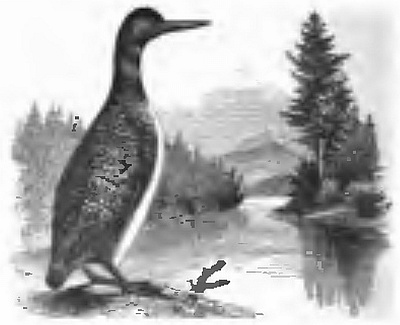
When daylight came, it was, I confess, rather provoking to find that the camp was only three or four hundred yards off, where we had our supply of blankets and other creature comforts. As we had now our sleighs loaded to the utmost, and three buffaloes besides en cache, or hidden, that is from the wolves, we turned our faces homewards. The ground was hilly, and as the sun had still considerable power the surface of the snow had been melted, and when frozen again was exceedingly slippery. The consequence of this was that, one of the horses slipping on the side of a hill, the sleigh broke away and rolled over and over to the bottom. We ran down, expecting to see the horse killed or seriously injured, and the sleigh broken to pieces, but neither was the worse for the occurrence, and the horse being set on his legs, trotted on as bravely as before. We were not sorry to get back to our winter quarters, which appeared absolutely luxurious after the nights we had spent out in the snow without shelter. How we did sleep, and how we did eat! Hunter’s fare, indeed, is not to be despised. We had for breakfast fried fish, buffalo tongues, tea, sugar, dampers, and galettes—cakes of simple water and flour, baked under the ashes, and which are very light and nice. For dinner we had, say a dish of boiled buffalo hump, a smoked and boiled buffalo calf whole, a mouffle or dry moose nose, fish, browned in buffalo marrow, loons or other wild ducks, and goose, potatoes, turnips, and abundance of bread.
We had no necessity to dry the meat we had brought, as it would keep frozen through the winter. Near the forts the flesh of the buffaloes killed in winter is preserved through the summer in the following way:—An ice-pit is made, capable of containing the carcasses of six or seven hundred buffaloes. Ice, from a neighbouring river, is cut into square blocks of a uniform size with saws, like the blocks sent over to England from Wenham Lake. With these the floor and sides of the pit are lined, and cemented together with water thrown on them, which freezes hard. Each carcass, without being skinned, is divided into four quarters, and they are piled in layers in the pit till it is filled up. It is then covered with a thick coating of straw, which is again protected from the sun and rain by a shed. In this way the meat is kept perfectly good through the summer, and is more tender and of better flavour than when fresh.
We entered into friendly relations with a tribe of Indians, who had taken up their winter quarters in a wood five or six miles off, and from them we learned many devices for catching game, which our own people were not accustomed to practise. We had won their hearts by supplying them with meat, and as they discovered that we could kill buffalo with our rifles with more certainty than they could with their old firearms, or bows and arrows, they were anxious to get us to accompany them in any hunting expedition, knowing that their share of game would be larger than any amount they could catch alone.
The three chief men were called by us, Eagle-eye, Quick-ear, and Wide-awake. Eagle-eye came to us one day to say that some buffalo had been seen very near the station, and invited us to go out and shoot them. The Indians undertook to shoot too, if we would go to a distance and kill the rest as they ran off. Our party was quickly ready, and off we set—the Indians carrying some skins, the object of which we did not understand. After walking eight or ten miles, Eagle-eye called a halt. Quick-ear produced the skin of a buffalo calf, and Wide-awake that of a wolf, into which they respectively got; while Eagle-eye, telling us to imitate him, led away to the right.
“There, you see, we make one big snake,” he observed, as we prepared to follow his footsteps. “The buffalo see us long way off; think we snake among grass.”
What the buffalo thought I do not know, but certainly they took no notice of us—indeed we were a long way off, and perhaps they were engaged in watching the proceedings of Quick-ear, who was representing the antics of an innocent little buffalo calf. Nearer and nearer the little calf they drew; now they stopped, rather doubtful; then they advanced a little and stopped again. Suddenly a wolf, represented by Wide-awake, appeared on the scene, and the calf bellowed piteously; the wolf sprang savagely on him; the kind-hearted buffaloes could stand it no longer, but rushed forward to rescue their young fellow-creature, when Quick-ear and Wide-awake, jumping up with their rifles, which had been lying by their sides, in their hands, let fly, and brought down two of them. The rest scampered off towards where we were posted, nor did they appear to notice us till four more of their number had fallen, when the survivors turned, and were soon out of reach of our rifles.
The Indians, on seeing the success of their stratagem, sprang forward, shouting and leaping with joy, and soon had the animals cut up and ready for transportation to their lodges and our huts. Our horse-sleighs soon after appeared, followed by theirs, dragged by dogs, and guided by their squaws. Before moving, a feast was held by our Red friends; the men eating first, and enjoying the tit bits, then the hard-worked women were fed, and lastly the dogs came in for their share. When the variety of ways employed to kill buffalo is remembered, it will not appear surprising that their numbers are rapidly decreasing.
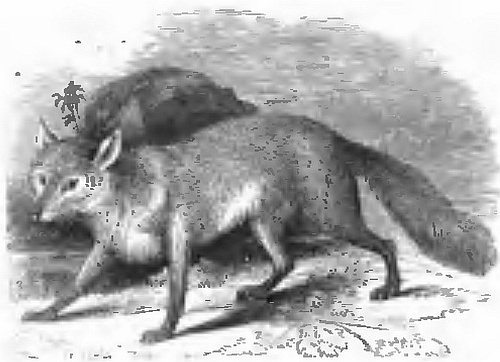
The winter seemed to pass far more speedily away than we could have expected, with a very limited supply of books, and with no society except such as our savage visitors afforded us. The fact was, however, that we were never idle, though it must be confessed that we took a very large share of sleep, and ate large amounts of meat and fat, for the sake of generating heat in our system. Day after day we were out in the woods trapping, and soon became very expert trappers. We caught the fox, the wolverine, the pokan or fisher, marten, otter, and other animals, for the sake of their skins, and occasionally fell in with the loon and other wild fowl. Our equipment was very simple. Doubling up our blankets, and uniting the four corners, we formed a pack to contain our pemmican, frying-pan, tin kettle and cup, tea, sugar, and salt, pepper, garlic, and any other small luxury. We had also brought with us from Red River some steel traps; a rifle, ammunition, axe, knife, fire bag and lucifer matches, completed the equipment of each man. Indeed, these last should never be overlooked by those who have to traverse wild countries; a single tin box is easily stowed away handy, and will last a long while. We carried our blankets—as an Irish woman or a gipsy does her child and other worldly goods, at our backs, with a strap across the breast. Well secured from cold, with snow shoes on our feet, we sallied forth into the pathless forest, trusting to our faithful pocket-compass to find our way back again, or to the guidance of our Indians.
The plan was to set our traps as we went out, and to visit them on our return. The steel traps made to catch wolves are of necessity heavy and strong, so that we could only carry a few of them, and had therefore to make others on a more primitive plan. When the beaver was less scarce than now, the beaver-trap was the usual mode of taking the creature; but beavers are now all but extinct, so we spared the few which got into the traps, and let them loose again. The steel traps are like our rat traps, but have no teeth, and require a strong man to set them. They are secured by a chain to a long stick laid on the ground, and are covered over with snow, pieces of meat being scattered about to tempt the animals to the neighbourhood. The wolf, as he goes prowling about, is nearly certain to get a foot into the trap. Off he goes with it, but is soon brought up by the chain and log, and they seldom had got far when we found them. The wooden trap is formed by driving a number of stakes, so as to form a palisade, in the shape of a half oval. The enclosure is large enough to allow an animal to push in half its body, but not to turn round. A heavy log is supported by a perpendicular stick, with another horizontal, having the bait at the end of it, much as the brick is in a boy’s bird-trap at home. The animal, if he touches the bait—a piece of tough meat or a bird—brings the log down on his shoulder and is crushed to death. We could, after a time, construct thirty or forty of these in a morning, so there was ample interest and excitement in ascertaining, as we walked back, whether our traps had caught anything. Our greatest enemy was the glutton, or wolverine, or as Garoupe called him, the carcajou. He is rather larger than an English fox, with a shaggy coat and very broad feet, armed with sharp claws. He is the most cunning and inquisitive of animals. Nothing escapes his notice as he ranges his native wilds, and he can climb a tree or dig a hole with his claws. He used to take the baits out of our traps by digging through the back, and so getting at it. He was not to be caught by poison, and he could select pieces without it, and bite in two those he suspected contained any. Now and then, though, he is caught by poison, but only when very severely pressed by hunger. When he gets his foot in a steel trap he drags it off, though heavy enough to catch a wolf, and instead of biting off the limb, as the mink and fox will do, he retires to some secluded spot and there endeavours to withdraw it, in which he often succeeds.
Hunting and trapping in winter, though very interesting and exciting, are not to be followed without considerable hardships. Often the cold was so intense that though sitting close to a blazing fire, and thickly clothed, it was impassible to keep warm. Our usual dress was three flannel shirts, one of duffel, and another of leather, over all; fur caps, protecting our ears and necks, mittens of moose-skin without fingers, easily pulled off; and secured by a string round the neck, and large moccasins over numerous pairs of socks.
Chapter Nineteen.
Across the Rocky Mountains—The Saskatchewan—A coracle, and how to make it—Fort Edmonton—Encounter with a Grizzly—A Banquet in the Wood—We are joined by a Party of Seven.
The winter at length came to an end. The snow began rapidly to disappear, and we commenced preparations for our journey across the Rocky Mountains and British Columbia to Vancouver’s Island. We busied ourselves in getting our carts and stores in order, while Stalker and Garoupe went out in search of the horses, which we knew had not strayed far. The following day they appeared, driving the whole mob before them, every animal looking as fat as if stall-fed, and in far better condition for travelling. Our men we believed were stanch and true. Our party consisted of Stalker, Garoupe, Swiftfoot, the Indian, and Quick-ear, who professed to know the whole country down to the mouth of the Frazer. Thus we had four natives and three Englishmen—Trevor, myself, and Peter—with our faithful four-footed follower, Ready: a number not so great as to provoke attack, yet sufficient to resist wanton aggression. On the last day of March we were up before daybreak, took our last meal in our winter abode, packed our carts, and then—carefully closing up the doorways and windows, so as to preserve the buildings for the use of future travellers who might have to spend a winter in that region—with a feeling of regret bade farewell to the spot, knowing the improbability that we should ever again revisit it.
We had four carts, and each of us was mounted, having a spare horse apiece, so that we formed no inconsiderable a cavalcade. We pushed on as fast as the nature of the ground—wet from the melting snow—would allow till we came to the north bank of the Saskatchewan River. For two days we continued along it till it became necessary to cross for the sake of the more beaten track on the opposite bank. How was this to be accomplished? The water was far too cold to make swimming pleasant. I bethought me of the ancient British water conveyances, still in use in Wales. Having seen an abundant supply of dry reeds and rushes in a creek a little way off, we unloaded a cart, and sent the men to bring it full of them. Meantime, I employed myself in making a framework of green willows, and in well greasing a buffalo hide, so as to prevent the water getting through it. While I worked at the boat, Trevor manufactured a pair of paddles and a third for steering. By the time the cart returned, we had done so much that all that remained was to make the reeds and rushes up into bundles and to fasten them outside the framework on which I had stretched the buffalo skin.
In this somewhat frail though buoyant canoe, resembling somewhat a Welsh coracle, we conveyed all our goods across the river, though with a very moderate freight; it would only carry two people at a time. The carts, which were entirely of wood, floated easily, and were towed across at the tails of the horses. All the party having got safe across, we again loaded and pushed on for another ten miles over a well-beaten track till we camped for the night. The difficulties we encountered in travelling across the country were wonderfully few, and Trevor was constantly exclaiming—
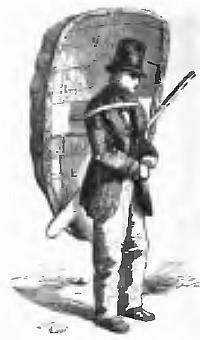
“What a pity people at home don’t know of this! A few thousand hardy fellows like us, who can stand cold and heat, would soon change the face of the country, and make comfortable houses for themselves into the bargain.”
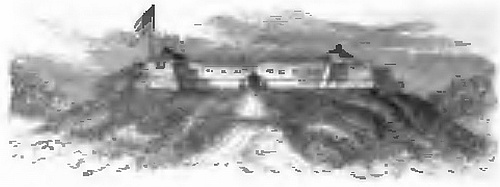
We stopped for two days at Edmonton, a large trading port or fort of the Hudson’s Bay Company. It stands on high ground above the Saskatchewan, is formed of rough palisades, with flanking towers, sufficiently strong to resist an attack of Indians, and contains a blacksmith’s forge and carpenter’s shop, and some thirty families; while attached to it is a large body of hunters, employed in collecting furs for the Company, or in killing buffalo for food. Bound the fort, wheat, potatoes, and vegetables of all sorts, are produced in abundance; indeed, the whole of the Saskatchewan district through which we passed is capable of supporting a dense population. I can state also, once for all, that the scenery, though not grand, is highly picturesque and beautiful, with wooded slopes, green meadows, sunny uplands, lakes, streams, groves, and distant hills, yearning for an industrious population to give it life, and to fulfil the object of the beneficent Creator who formed it thus.
At Edmonton we exchanged our carts for packs and pack horses, as with those alone could we hope to pass over the Rocky Mountains, or, at all events, traverse the region on the other side of them. We did not, however, travel faster, as the delay, when we had to cross rivers, in building rafts to ferry over our goods, was greater.
There was no great probability of our having to encounter any formidable enemies during our journey. We might, however, meet with Indians who would perhaps set envious eyes on our horses, or with grizzlies, which would dispute our progress, or wish to appropriate our provisions. Of course, we should have rivers to cross, floods from melting snow to encounter, thunderstorms, or prairie fires, maybe; perhaps even avalanches and whirlwinds to battle with; or, at least, to reckon upon overturns, breakdowns, and similar incidents, to which all exploring parties are liable. Indeed, I will not attempt to describe how we had to cross and recross some of the rivers, or to follow through the prairie a track which only the practised eye of an Indian could distinguish.
We had been travelling along the banks of a wide stream, which, with the breaking up of the ice, had become too rapid to be navigable for our canoes, and had reached a small lake, on the shore of which we resolved to camp before continuing our ascent. While supper was preparing, I took my gun and strolled on by the shore of the lake, with Ready, hoping to get a shot at some wild fowl, or, if in luck, perhaps at a prong buck, a big horn, as the sheep of the mountains are called, or at a Rocky Mountain goat—all three most difficult to hunt. The scenery was magnificent—high mountain ranges rose on either hand, some directly out of the lake, with snow-capped peaks above standing out against the deep-blue sky, their images reflected in the mirror-like water. I strolled on; now glancing at the lake, now at the height nearest hand, where I fancied that I saw a fine mountain goat feeding. This was the first I had seen. It is the most wild, solitary, and unsocial of all animals, and seldom found but at the summit of the Rocky Mountains. All at once I was startled by the rustling of leaves near me, and wishing to ascertain what animal was there, I climbed to the top of the fallen trunk of a tree which lay in my path. Bending aside the branch of a tree before me, I saw—what I would rather not have seen so close at hand—a huge brown creature, a monster grizzly, busily employed in tearing open the rotten trunk of a tree for the sake of the insects therein contained. I retreated, hoping that I had not disturbed the gentleman in his entomological researches. I was mistaken, however, for as the bough sprang back to its former position, he looked up, and before I could jump down, his quick eye had discerned me.
To escape by flight was impossible. Had I attempted to run over the rough ground he would have overtaken me, and as certainly squeezed the life out of my body; so I stood still where I was, threw up my arms, and prepared to bring my rifle down to my shoulder to fire. I had heard that the action I performed had usually the effect of making a grizzly bear stop and stand up on his hind legs, or rather sit down with his fore paws up. This, to my infinite satisfaction, my friend did; but he curled his lips, showing his teeth, and opening his huge mouth in a most unpleasant manner. My safety depended on my putting a bullet into a vital part. Should I only wound him, I knew that he would be upon me in a moment. It is not surprising that I hesitated. While I did so I heard a loud rustling among the branches behind him, and from out of the brushwood two other rather smaller bears appeared, squatting down by the side of their big companion, and looking at me savagely.
Had there been only two of them I might, I thought, possibly kill one with one barrel, and one with the other; but how could I hope to dispose of three? Even should I shoot two, the survivor would certainly pursue and attack me. All this time, Ready, who had jumped upon the log, stood, like a well-trained dog, by my side. There was not a particle of fear in him. A word from me would have made him attack the bears, and proved his certain destruction. There they all three sat looking at me and grinning, and with Ready alongside I stood looking at them, thinking how I could best turn them into meat fit to be eaten. At last I determined to risk a shot, or rather two shots. I levelled my rifle. The hammer came down as I pulled the trigger, but there was no report. The cap split and missed fire. The bears growled more fiercely than ever, and I thought were about to make a rush on me. I dared not attempt to fire the second barrel; for should that go off, I should have been entirely unarmed. I therefore gently lowered my rifle till I could put on a new cap. The bears did not like the movement, and showed signs of advancing. I was afraid that Ready would have flown at them. It would have been all up with him and me had he done so. I stood stock still for a moment; so did the bears. Then I rapidly capped my rifle—fired first at the big fellow, with a steady aim, and then at one of his companions, and not stopping an instant to ascertain what effect my shots had taken, leaped down off the log, and ran off as fast as my legs would carry me, calling Ready to follow, loading my gun as I went. A loud growl told me that I was pursued, and I then felt that I had done a very foolish thing in firing, and that I should be fortunate if I escaped with life and limb. Had it not been for the tree, my escape would have been impossible.
The growls grew louder and fiercer. They were answered by a sharp bark. I turned my head. Two bears were following me—the large fellow and a smaller one. From the neck of the first the blood was trickling down. My faithful Ready, seeing my danger, was trying to draw off their attention from me. He succeeded sufficiently, at the great risk of his life, to enable me to load one barrel of my rifle. “Which of the two shall I shoot?” I asked myself. I selected the one already wounded. I fired. He stopped a second, and then came on more savagely than ever. He was close upon me—the other being only a little way behind. I must kill the big one or be destroyed. I stopped, faced him boldly—as dangers should always be faced—and fired. Not another inch did he advance, but immediately rolled over—shot through the heart. Still his companion remained unhurt. He continued to advance towards me, growling fiercely. In vain did Ready, with wonderful activity, endeavour to distract his attention. Had I attempted to fly he would have been on me in a moment. My only chance was standing still and keeping him at bay. I threw up my arms as before—made as if I would run at him—though I felt much more inclined to leap backwards—and shouted at the top of my voice, hoping to frighten him, but all to no purpose. On he came, and in another instant I should have been made into mincemeat, or into a perfect hash, at all events, when, just as the beast, having sent Ready flying on one side, was about to seize me in his terrible paws, a bullet whistled past my ear, the powder almost singeing my whiskers, and over he went, shot through the heart. I was safe, but so sensible was I of the danger I had incurred, that for a time I felt my knees trembling under me. On recovering myself I looked round to see who was my deliverer.
About a dozen yards behind me stood Swiftfoot, leaning quietly on his rifle, with true Indian calmness, as if he had been there for the last few hours, his countenance expressive of utter indifference to what had occurred. He knew the danger I might incur should my path be crossed by bear or panther, and had most considerately followed in my wake, keeping just within earshot without letting me know, and had heard my loud shouting at the grizzly. No words were spoken by either of us at the moment. A shake of the hand was all that passed; but it expressed far more than words could then have done. It took some little time to still my nerves, and with excellent tact Swiftfoot set to work to cut up the game which had thus fallen to our share, going about it as if nothing had happened out of the common, in a businesslike manner carefully selecting all that was to be carried into camp. Ready seemed to think the operation excellent fun; indeed, he was able practically to enjoy it till I was compelled to call him off from his banquet for fear that he would over-eat himself. All this time I kept eyeing the neighbouring thicket lest the third bear might come to look for his companions and catch us engaged in a manner which he might think fit to resent. Having cut up the two bears, Swiftfoot made a number of thongs out of their skins, and with these he slung as much of the bears’ flesh as he could carry over his shoulders. I followed his example, and the remainder we hung up in a tree, that we believed we could again easily find when we returned to fetch it.
Our arrival at camp was heartily welcomed by our friends—not the less so that we brought a handsome supply of fresh meat for all the party. The announcement that there was still more made our companions hurry off, not waiting for their suppers, to bring it into camp.
“If we don’t make haste there’ll be little else but the bones left for us to suck,” observed Swiftfoot. “The eagles and vultures will soon scent it out, not to speak of those cunning little critters the wolverines.”
He then led the party back to the spot, whilst Trevor proposed that he and I should try to add some fish to the dainty banquet with which we determined to close the day. Leaving, therefore, Peter, assisted by Ready, to guard the camp—the former being directed also to watch the pot boiling and the roast of bear’s flesh—Trevor and I took our rods to try and catch some fish out of the lake. So full are these lakes of fish that we soon caught a dozen fine trout and several other fish. We had time to prepare our supper before the return of Swiftfoot and the others with the remainder of the bears’ flesh.
We had a most sumptuous supper, washed down by copious draughts of tea, added to which—“The feast of reason and the flow of soul” made the hours pass so quickly away that it was long past midnight before we went to rest.
The next day we met a party of seven men, well-armed, who had wintered at the foot of the Rocky Mountains, some distance to the south, and were now on their way to the Saskatchewan to prospect for gold, of which they had heard there was an abundance. They had been very successful in their buffalo hunting, and had also caught a large supply of fish before the stream froze over, so that they were all in good condition and high spirits. They camped with us, and as we all sat round our fire at night, and song, tale, and anecdote succeeded each other, amid hearty shouts of laughter, no one would have supposed that tea was the strongest beverage in which we were indulging, and that we all had passed through and were about to plunge again into perils and hardships of no ordinary kind.
Chapter Twenty.
Habakkuk Gaby is hugged by a Grizzly—A Rattlesnake follows suit—The Rocky Mountains—The Frazer River—We form Three Exploring Parties—I construct a Raft, and what followed—All Safe at Last.
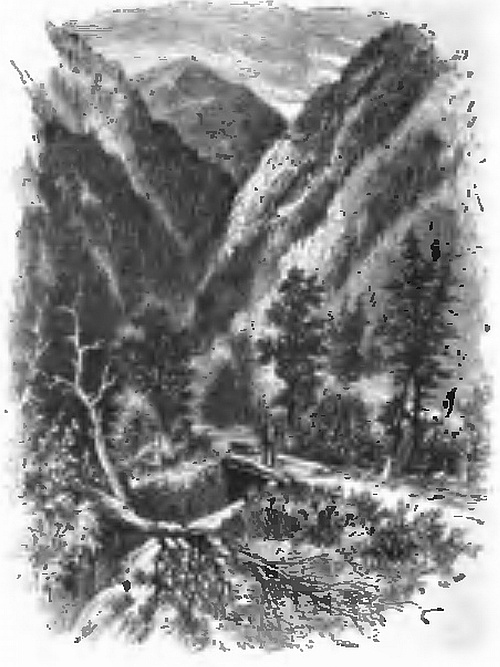
We were seated round the fire discussing a hearty supper, of which bears’ flesh formed a substantial part, and Habakkuk Gaby, a Yankee, half trapper and half gold-digger, one of our new friends, who was seated a little way back on account of the heat, had got on the point of his knife a huge slice, which he was eating with evident enjoyment, though in no very refined fashion. Suddenly, from behind a neighbouring tree, a huge monster, his size increased threefold in the gloom, darted out towards us.
“Un ourse! a grizzly—a bear! a bear!” shouted out our party, one after the other; but before any of us could rise to our feet the creature, seizing poor Mr Gaby round the waist, began to waddle off with him at great speed.
He had got, indeed, nearly fifty yards before we well knew what had happened: neither, indeed, did Habakkuk himself, very clearly. He kept shouting out—
“Let me go, you brute!—let me go, I say, or I’ll—”
The bear put a stop to any further remark, and he could only shriek out “Oh! oh! oh! Shoo—shoo—shoot!” Had anybody acted on his request he would inevitably have been hit, as the bear kept him between himself and our rifles. Trevor actually lifted his gun with the intention of firing, but I drew back his arm.
“Our best chance of saving the poor fellow is to rush in and stab the bear,” I said.
Fortunately, bruin’s immediate object was to get hold of the luscious steak Gaby had been eating. Putting him down, therefore, and keeping him pinned to the ground with his hind feet, the bear seized the steak and began greedily to devour it. Poor Habakkuk thought this would be a good opportunity to make his escape. No sooner, however, did he begin to move than bruin stopped eating, and gave him a look which clearly meant “You’d better not try that again.” Gaby remained perfectly quiet for a minute, and Stalker, Garoupe, and the Indians began moving round to either side that they might have a better chance of hitting the bear without killing the man. Trevor and I stood ready to fire if we had an opportunity. Again, Habakkuk thought that he could do the bear, and, springing up, made a leap forward; but bruin, who had just finished his steak, was too quick for him, and seizing him round the waist, gave him a most fearful hug. Poor Gaby’s features exhibited his very natural terror and the agony he was enduring. Uttering horrible shrieks, he shouted out—
“Fire! fire, friends! fire! Don’t mind who you hit so that you kill this infernal brute.”
I felt that something must be done to prevent such another hug, or poor Gaby would scarcely have a chance of escape with life; so, running up, I got within a few yards of the bear’s head, when, stopping, I took a steady aim and fired. As the monster rolled over on his back, poor Gaby fell forward in the opposite direction. While the rest of the party quickly despatched the bear I lifted up Habakkuk, whom I expected to find dead. However, to my great satisfaction, he slowly opened his eyes, and when he discovered that it was not the bear but I who was standing over him, and that bruin was killed, he drew a deep breath, as if to get back the wind which had been squeezed out of his body, and sat upright.
“Well, I guess that’s more than I ever went through afore, or ever wish to go through again,” he exclaimed. “It was mighty unpleasant—that it was!”
Besides this, he said very little on the subject. As to remarking that I had shot the bear and saved his life, that never entered his head. On examining the bear we found that he was wretchedly thin—all skin and bone. This was curious, as the bears we killed in the afternoon were tolerably fat. Stalker was of opinion that he had either come from a distance, and had no connection with them, or that he was an outcast bear—conquered by the gentlemen, perhaps, whom we were eating.
The night passed off without any further adventure. During the first part of it we cut up the bears’ flesh into thin strips to dry in the sun, that we might save our pemmican and more portable food as much as possible; and then we went to sleep with our feet to the fire, for the nights were still cold—one of the party keeping watch at a time. The next day we moved forward, but the ground was hard and rough, and our way lay across forests and over fallen trees, up rocky hills and across swampy valleys, whilst the heat of the sun during the day was very oppressive. So we encamped, rather earlier than usual, in a somewhat rocky place. After we had arranged our camp, and as Trevor and I were starting with our guns to kill a deer for supper, and while the rest of the men were variously occupied, as I passed Mr Gaby, who was fast asleep, what was my horror to see a large rattlesnake creeping slowly from his side to his bosom! I was on the point of shouting out to awaken him, but Stalker, who had come up, begged me to remain quiet, and that perhaps the snake would merely crawl over the man’s body and move away. The serpent, however, had no intention of doing any such thing, but quietly coiled itself under the Yankee’s left shoulder. Had he moved in his sleep the creature would, in a moment, have stung him in the neck, and no human power could have saved his life. We looked on with horror, not knowing what course to pursue. Immediately, however, that Garoupe saw the state of the case he hurried off to the nearest thicket, and returning with a long thin stick, told Stalker and Swiftfoot to go in front and draw the attention of the snake to themselves. As soon as the creature saw the men in front it raised its head, darted out its forked tongue and shook its rattles, showing that it was highly irritated.
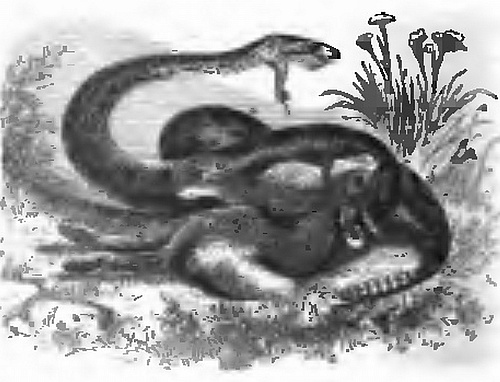
Habakkuk’s danger was now greatly increased, for should the noise close to his ear awaken him, a movement of his arm might make the snake bite him. While all of us were in a state of dread for poor Gaby, Garoupe got behind the creature with his long stick, and, suddenly placing it under the coiled reptile, by a dexterous movement sent it flying a dozen paces off. A shout of satisfaction burst from our lips at Gaby’s safety. The sound awoke him, and little dreaming of the fearful danger he had escaped, he looked up, and merely said—“Well, now! What’s it all about? Do I look so very funny?”
He was serious enough, however, when Garoupe, who had gone after the snake and killed it with his stick, returned and exhibited it to him.
On searching about we found a number of the reptiles in holes in the rocks and under big stones. We armed ourselves with sticks and quickly despatched them. This we had no difficulty in doing, as they can only spring their own length, and a smart blow on the tail at once disables them. The first killed was three feet three inches long, and nine years old, which we knew by the number of rattles in his tail. At supper, off game which Trevor and I had shot, Gaby told us that he once formed one of a party in Vermont which went out rattlesnake hunting, and that they found a vast number of rattlesnakes in holes with their tails sticking out; that they pulled them out by their tails, and flung them far on one side, where they quickly were despatched. It is quite as well not to repeat how many hundreds he declared were killed in the course of the hunt, for Mr Gaby was not wanting in that quality so conspicuous in others of his countrymen, of speaking without much regard to exactness—which I candidly believe to be an infirmity, rather than a desire to exaggerate, which is common enough amongst the uneducated classes all over the world.
The Rocky Mountains consist of a lofty range extending from the north of the continent to its southern end, at a distance from the Pacific of from fifty to three hundred miles. The summits of the range are covered with perpetual snow, and, till lately, the generally received notion was that they formed an almost impassable barrier between the Pacific and the interior. To the east the country is mostly level and easily travelled over, especially the fertile belt along which we had come; while to the west, that is, between the range and the Pacific, it is mountainous in the extreme, as is also the case in British Columbia, across which we were now to force our way. There are, however, numerous passes through which roads can be cut out without much difficulty. The surveyors, indeed, reported one of the passes to require only the trees to be cut down to allow waggons, if not a coach and four, to be driven through it. It is called the Vermilion Pass.
We did not take it, because the distance through a mountainous and lake region is much greater than the pass we selected further to the north. When, however, the settlers in British Columbia cut a road across parts of the country, and place steamers on certain lakes and rivers, there will be no difficulties to prevent ordinary travellers from passing from Lake Superior, by the way of the Red River, through the Fertile Belt and over the Rocky Mountains, to New Westminster, the capital of the province.
We had been journeying on through forests, and should scarcely have noticed the ascent we were making, had it not been for the increased rapidity of the streams in our course flowing to the east, when reaching a small lake we found that the water which flowed from it ran to the westward, and that we were on what is called the watershed, or highest part of the pass. Still, as we looked westward, we had range beyond range of rocky mountains, the peaks of many covered with snow. This region was a part of British Columbia, but it must be remembered that between these mountains were valleys, and rivers, and lakes, and streams, and that it was by the side of these streams and lakes we expected to make our way across the country. I had thought, when I first planned the expedition, that all we had to do was to climb up the Rocky Mountains, and then to descend into well-watered plains. We found in reality that our chief difficulties had only now begun. We had certainly mountains to descend, but then we had also others to ascend; we had rivers to cross and recross, either by wading or on rafts, which we had to construct; trees to cut down, and brushwood to clear away; recumbent trees to climb over, and rotten trees to force our way through. Still people had done the same thing before, and Stalker and Swiftfoot asserted that we could do it, and were ready to stake their credit on the success of the undertaking.
We now formed fresh arrangements for crossing the country. Swiftfoot and Quick-ear were to devote themselves to hunting, to supply us with food. Stalker and Garoupe were to clear the way with their axes, while Trevor, Peter, and I conducted the horses. From the summit of a high mountain we reached, Quick-ear pointed out the hills (he said) of Cariboo, with the Frazer flowing away towards them. That now far-famed river has its sources in the region in which we then were. It runs nearly north-west for a hundred and fifty miles or more, and then, sweeping round the Cariboo region, flows due south for several hundred miles, down to Port Hope, and then on west to New Westminster and the sea, there being, however, some picturesquely beautiful, but practically ugly rapids, in its course. We made good our necessary westing, but after cutting our way to the banks of the Frazer we found that the country was almost impracticable towards Cariboo, and that the river swept so far round to the north of it that we should have to make a very long voyage if we went that way. We therefore turned round, with our faces to the southward, determined to make our way down the Thompson River to Port Kamloops, a trading post of the Hudson’s Bay Company, with which, and the town of Lytton, then was, we knew, a constant communication. High snowy peaks appeared more or less near on every side, broken hills, and rounded hills, and rocks, and precipices, and dense forests, wherever trees could find soil for their roots. The crossing streams and small lakes caused us considerable difficulty, but it was not so great as that we encountered when we had to cut our way, foot by foot, through the forest. The river our horses could swim across with ease, though they had some difficulty in getting up the banks. Our baggage was ferried over on rafts, for forming which we had plenty of materials at hand. Gaby was no despicable backwoodsman, and with his sharp axe he gave us efficient help in felling trees, while he was an adept also in fastening them together. As we advanced, however, our difficulties increased, and game became scarce. We agreed to separate for a few days Trevor was to take Swiftfoot and to ascertain if any navigable stream ran towards Lake Quesnelle, as we believed that if we could once reach its waters we could easily get to Cariboo. Stalker and Quick-ear were to continue to hunt, and to keep up a communication between us, while Gaby and I, accompanied by Peter and Ready, were to make our way to the head waters of the Thompson. A camp was to be formed in some eligible position, where pasture for the horses could be found, and here we were to leave our heavier goods and provisions, to be brought on in the direction which might prove most promising.
After a hurried breakfast, at daybreak we started on our respective courses. My party of three and the dog had not got far when we came to a broad stream, which it was necessary to cross. We quickly made a small raft, on which two persons could sit with a portion of our goods; we had a long line secured to it, so that the raft could be dragged backwards and forwards, while the horses swam across. Gaby and I crossed first, and I found the water deeper than I expected. Not without some difficulty did we reach the opposite bank in time to help up the horses, and to keep them together till their cargoes were again ready for them. Peter then drew back the raft, and embarked on it with the remainder of our provisions. He poled on the raft tolerably well till he got into the middle of the stream, when, by some means, the lad’s foot slipped, and overboard he went, letting go his pole. He was but a poor swimmer, and his destruction seemed certain, unless I could manage to get him out. I was throwing off my clothes to plunge in to his rescue, when I saw that the raft had swung round and that he had happily caught hold of it. I did not, however, at first observe that the rope had snapped, or got loose from its fastening, and that the raft was drifting rapidly down the stream. After a while he got up and seated himself composedly on it, wondering apparently what next would happen. It took a good deal to put him out. As soon as I discovered that the raft was really adrift, I ran along the bank, hoping that the current would send it in either on one side or the other, but instead of that it kept steadily in the middle, and as I looked ahead, I saw that precipitous rocks formed the banks, over which it would not be possible to scramble. Peter, too, turned round, and now, for the first time it seemed, comprehended his danger. He held out his hands imploringly towards me, crying out, “Oh, sir, oh, sir!—pray save me, save me!” The water was icy-cold, from the rapidly melting snow, and I had some reasonable dread of cramp. Still I was about to run every risk to save the poor lad, when I bethought me that Ready, who had crossed with me, would lend his aid. I told Peter to call him, and beckoned the dog to go towards the raft. After a little hesitation, and a few sharp barks, as if he was not quite certain what I wanted him to do, he plunged boldly in and swam towards the raft.
Peter had meantime hauled in the slack of the rope, and coiled it neatly down on the raft. Ready swam quickly up to the raft. He seemed clearly to comprehend the object of his enterprise, and opening his mouth to receive the end of the rope, which Peter put into it, swam triumphantly back towards the shore. I gave him an approving pat, as he landed, and taking the rope, with Gaby’s aid, I began to haul the raft towards the land. At length I got it safely to shore, where we landed the freight, and securing the raft, ready for our return, we pushed on towards the south. We encamped at night by the side of the river, which we believed ran into the Thompson.
As we sat round our camp fire, I became better acquainted with Mr Gaby and the very high opinion which he entertained of his own talents and powers. He informed me that he intended to settle in British Columbia, as he hoped to rise to the highest position if he did.
“I guess your Queen will be a lucky woman if she gets me as her subject to manage her affairs out here. I’m in no wise prejudiced. I’m a free and independent citizen of the greatest republic the world ever knew; but nevertheless I’m ready to give my services to any one who is able and willing to pay me properly.”
Chapter Twenty One.
The Thompson River—Our Parties re-unite—Hippophagous Stores—Indian Revenge—We build a Raft and two Canoes—The Rapids, and our Dangers—Indians in Ambush.
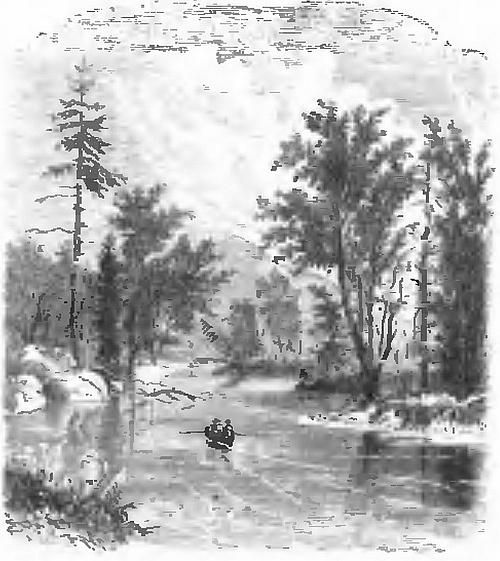
We had reached the banks of the Thompson, and were contemplating the possibility of descending it on a raft, when Stalker arrived and informed us that he had met an Indian who told him that, though we might possibly cut our way through the forest, we should find it a very arduous undertaking; that we might descend the Thompson by water, but that there were some fierce rapids on the way, into which, if we once plunged, we should inevitably be lost, and that we should in a much shorter time reach Cariboo if we went down the Frazer than by any other way. I agreed to his suggestion, though I still held to the opinion that one of the shortest roads from Red River to New Westminster will be found by the way we came and down the Thompson, and that with the aid of small steamers and ferry boats, and a gang of navvies and lumberers, it might speedily be made practicable. Yet, as we wished to get to Cariboo, we followed the Indian’s advice.
Some days passed before we all again met on the banks of the Frazer River. Trevor and his party had met with numerous adventures, the most serious of which was the loss of one of our horses, laden with numerous valuables. Three horses had fallen over a cliff into the river. Two, after great exertions, had regained the bank; but the third was swept down the stream and never seen again. Our provisions were growing short, and though game was occasionally shot, it was not in quantities sufficient to make amends for the amount we exhausted, and we were unwilling to go on short allowance—thereby lessening our strength and power of endurance and impeding our progress. We accordingly determined to go on till we found some place where there was sufficient pasturage for our horses to give them a chance of life, to kill and dry the flesh of some of them to replenish our stock of meat, and, with ample provisions for the voyage, to commence our descent of the Frazer.
The matter was earnestly discussed over our camp fire the evening of our re-assembling. We all know that the navigation of an unknown river on a raft is a most dangerous proceeding. If once a strong current gets hold of a raft, it is almost impossible for those on it to guide it properly. I therefore proposed that, besides a raft, we should form two dug-out canoes—that one should go ahead as pilot, and the other he attached to the raft to carry a rope on shore, so as to stop the raft when necessary. We were fortunate in soon finding an open, well-grassed valley suited for our object, where we might leave the horses which we did not require to kill. Of course, it was very likely that they would be taken possession of by Indians of bears. In every other respect there was no fear about their being able to take cure of themselves during any ordinary winter. Stalker told us a story which shows that people can exist even during the most severe winter with very little shelter, if they have a moderate supply of food. The event occurred many years ago.
An officer of one of the fur trading companies of those days had received directions to establish a trading post on the banks of one of the rivers in that district. Either he or one of his brother officers had some time previously had to punish an Indian for some offence committed against the community. The man was hung; his tribe looked on, acknowledging the justice of his sentence, and took their departure without any expression of anger. The post was established, and as the natives in the neighbourhood were supposed to be friendly, it was only partly fortified. As soon as the house was built, a party of hunters was sent out to a spot four or five days’ march off, known to be well-stocked with beavers. One of them, a half-bred, Pierre Dorie by name, had his Indian wife and two small children with him, one three years old, the other only four mouths. Huts were built; and while the trappers were out, this faithful squaw of Dorie took charge of them. While she was occupied in her household affairs, one evening soon after winter had commenced, expecting the return of her husband and his companions, one of the hunters staggered into her hut mortally wounded. He had barely time to tell her that her husband and the rest were murdered by Indians, and to advise her to fly, when he fell down dead.
With that courage and presence of mind which Indian women possess generally in so remarkable a degree, she prepared to escape with her children. Immediately hurrying out, she caught, with some difficulty, two horses, and, returning with them, packed up all the provisions the hut contained and some blankets and clothes. These she placed on one horse, and, mounting the other with her two infants, set out for the newly-built post, hoping to arrive in time to give notice of what had occurred, and put the officer in charge on his guard. She had accomplished two days of her journey without meeting with enemies, when, on the third, as she was pushing on as fast as the strength of her horses would allow, she espied in the distance a large body of Indians on horseback, galloping towards the fort. Her heart misgave her. She instantly dismounted, just in time to conceal herself and her horses in a copse ere the Indians passed by. Still fearing that they might be in the neighbourhood, she dared not light a fire or go in search of water. Early the next day she again set out, and late in the evening approached the spot where she expected to find the fort. It had disappeared,—a heap of ashes alone marking the place where it had stood. Still hoping to find some of the inmates alive, she concealed her children and the horses in a thick wood, and, arming herself with an axe and knife, crept cautiously towards the spot. Everywhere, traces of blood met her view. Still she hoped that some one might be concealed near. She called over the names of those who had been left in the fort. No one replied. She waited. Again she called. The melancholy howl of the prairie wolf was the only reply. She drew a little nearer. By the light of smouldering timbers, which a puff of wind just then fanned into a flame, she saw a band of those voracious creatures engaged in a banquet on the remains of her friends. A new terror seized her. They might attack her infants, whom she had left sleeping on the ground. Hurrying back, her heart sinking with dread, she was just in time to drive several away who were approaching the spot. The next morning she set out for a range of hills in the neighbourhood, bordering a river which falls into the Columbia. Here she proposed to remain during the winter.
After looking about on all sides, she selected as her abode for the winter a rocky recess in the hills, near which a stream bubbled forth. She had in her possession a large buffalo robe and two deer skins. With these, aided by fir bark and cedar branches, she constructed a hut sufficiently large to afford shelter for herself and children. She soon, however—finding that her provisions would not last her during the winter—killed the two horses, and smoke-dried their flesh. Their skins further improved her tenement. In this cheerless and wretched abode, the poor widow with her infants spent the livelong winter, not even seeing at a distance a human being passing by finding, towards the end of March, that her stock of provisions was growing short, she packed up the remainder, and, with as much covering as she could carry in addition to her youngest child on her back, set out, holding the other by the hand, towards a spot on the Columbia river, by which she knew the Company’s canoes would certainly pass. Fortunately, she met a tribe of friendly Indians, who treated her and her children with the greatest kindness, and after residing with them for some weeks, she saw the looked-for trading canoes arrive, and was ultimately restored to her friends.
We had plenty to occupy us in the construction of our raft and two canoes. The raft was to be just large enough to carry six men and Ready. Each canoe was to be capable of carrying two men, though the ordinary crew was to consist only of one man. Not one of us had ever before made a dug-out, and as the huge trunks of two trees which we had felled for the purpose lay prostrate before us, the undertaking seemed almost hopeless. “Nothing try, nothing have,” cried Trevor, seizing an axe and chopping away at the branches. We next cut the first tree into the proposed length, and smoothed off the upper part for the gunwale. On their flat surface I marked off the shape, as I used to do when cutting out a vessel as a boy.
“Let us give her good floors and all the beam we can, and she will be stiff,” said Trevor.
This we did; and as we proceeded with our work, we were well satisfied with it, and found that we could get on far more expeditiously than at first. While Trevor and I worked away on the canoes, the other men were progressing with the raft, and preparing the other log for our finishing. The first canoe was completed and launched with due ceremony under the name of the Hope. The next was called the Beauty. They both swam pretty well, but the sides being rather thick they were deeper in the water than was desirable. Still, as they were much more manageable than a raft could be, I regretted that we had not time to build more canoes large enough to carry all the party, and our provisions and goods. We made several additional paddles, as also a supply of poles, which were loaded on to the raft. The last thing I thought of was a mast and sail for the raft, as, under many circumstances, it might enable us to guide the raft, especially if the wind was against us, and a rapid near at hand.
One lovely bright morning we cast off from the shore, and commenced our perilous undertaking. Quick-ear had been down the river in his youth, but it was so long ago that he had forgotten the distances. All he could say was, that there were several dangerous rapids; but he could not say where they occurred. Stalker went first, and acted as pilot, and Garoupe had charge of the tender. The raft was tolerably heavily laden, and required careful handling. Each man on the raft had a pole as well as a paddle, to be used as circumstances required. I acted as captain, for I certainly knew as much about the navigation as any one on board, and it was necessary that some one should be in command. I also steered with a long oar fixed on a triangle at one end of the raft, while the rest of the party were arranged with paddles on either side. In the centre we placed the stores, and close to them Ready generally took his post, while the stores and provisions were placed round it. The scenery was grand—much as I have before described it—lofty, rugged mountains, their summits covered with snow, sometimes near, sometimes in the far distance; steep precipices, rugged wild rocks, and forests of trees of every size, with many fallen ones, some just uprooted, others soft from decay; here and there green glades, marshes, and other open spaces; while, by the sides of the rivers, and frequently in mid current, huge water-worn boulders, which it was often no easy matter, in our downward course, to avoid.
For several days the weather was fine, and we went on smoothly enough—camping at night on convenient spots. To prevent accidents, we unloaded our raft, placed the goods in the centre of the camp, and drew up our canoes. On the fourth night of our voyage, Ready, who was our most vigilant watcher, suddenly broke into a loud bark, and started towards a copse close to us. I sprang to my feet; so did Peter, who said that he saw a dark form moving among the trees. Whether it was a bear or a human being he could not tell. Whatever it was, it made its escape before Ready could come up with it, and I called him back lest he should be injured if allowed to be without support. Of course, the whole camp was aroused. Two scouts crept out cautiously, but could discover nothing, and the opinion was, that some small animal had aroused Ready and that Peter’s imagination had conjured up the figure in the wood. I thought it better, however, to keep on watch during the remainder of the night. Ready was far from easy, and several times started up and uttered low growls and short shrill barks.
We embarked at the usual hour in the morning. In a short time Stalker came back and reported that the navigation was far more difficult than heretofore, though with caution we might get through. “Let’s try it by all means,” was the cry. We were getting bold, and thought that we could do anything with our raft. Stalker, accordingly, again went on ahead, and we poled and paddled towards an opening among the rocks which he pointed out. Suddenly our poles lost bottom, and we found the raft whirled on at a rate which prevented me from guiding it in the way I had hitherto done. The paddles were almost useless. All we could do was to let the raft drive on, and to try and avoid the dangers as they appeared. We had passed several rocks, against which, if we had touched them, the raft might easily have been knocked to pieces, when a huge rock appeared before us, round which the water rushed with the force of a mill stream.
In vain Garoupe tried to tow us off from it—it was too late to attempt to carry a rope to the opposite shore—in vain all hands paddled to keep it clear. The raft struck, and remained caught by the rocks, the water immediately swelling up and threatening to sweep off the goods on it. Garoupe, instantly telling Swiftfoot to jump in, paddled off with a rope to the opposite shore. In the meantime, I saw that the water was shallow between the raft and the shore near which we were jammed. Accordingly, I told Quick-ear to try it, which he did, and finding it shallow, began at once to carry the goods on shore. This appearing the best thing to be done, Trevor, I, and Peter set about helping him. We had already landed several things, and Trevor and Peter were with Gaby on the raft, when, suddenly, from its being so much lightened, the current lifted it up, and away it went floating off the rock and down the stream. Garoupe and Swiftfoot made an attempt to stop it with the rope, but that snapped, and the raft was hurried on. I ran along the bank, which was here tolerably smooth. I saw Trevor sounding with his pole, and the next moment he and his two companions leaped overboard, and attempted to drag the raft towards the shore. Utterly hopeless was the attempt. It was forced from their grasp. I saw Gaby frantically pulling at it; but his foot slipped, and he let go his hold. The other two leaped on it, and on it floated, while he with difficulty gained a pointed rock in the middle of the stream, where he sat, by no means like “Patience on a monument smiling at Grief,” but frantically calling out for the canoe to come to his rescue.
While this was taking place, Garoupe and Swiftfoot had embarked in the canoe, and were going in pursuit of the raft; but the channel they took carried them at a distance from poor Gaby—besides which, he would have upset the canoe had he attempted to get into it Quick-ear and I ran on, he taking the lead, over the rocky ground, with a rope which he had brought on shore, hoping to render assistance to our companions on the raft. Gaby, believing himself abandoned, shouted more frantically than ever. I could only urge him to stick fast till we could return to his assistance; and the rocks soon hid him from sight. Once more, after an arduous run over rough boulders, among which I expected every instant to fall and break my legs, if not my neck, I again caught sight of the raft sticking fast between two rocks. Ready had, as he always did, kept close to my heels whenever he saw that there was work to be done, and when I put the end of the rope Quick-ear had brought into his mouth, he at once comprehended that he was to swim off with it to Peter, to whom I shouted to call him. Ready accomplished his task, and we now thought that, at all events, we should be able to land the remainder of the goods. Once again Quick-ear and I waded off with the assistance of the rope; though the water was deeper and the current stronger than I fancied, with a heavy load on my shoulder; just, however, as we got on the raft it swung round, and the cleat to which the rope was fastened gave way.