The Pursuit—The Fight and Victory—We dispose of our Prisoners—The Black Dwarf—The City of Themistocles—We part Company—I go with Peter and Ready aboard the wondrous Highflier. (continued 3)
Reading edition
“We may, I hope,” said Marcus, “meet again, though in what part of the world I know not; but I have one favour to ask,—it is that you will give me your address in England, and that should I ever again reach that country of true freedom, I may be allowed to visit you.”
I need scarcely say that I agreed to what Marcus proposed. There was something about him which strangely attracted me, and with regret I bid him farewell, scarcely expecting ever to see him again.
Havanna had no charms for me, and I was therefore glad once more to embark on the fickle ocean in an attempt to reach New Orleans.
Chapter Thirteen.
From Cuba to New Orleans, and hence up the Mississippi on to St. Louis—Our Voyage up the Ohio—Kentucky Shots—Cincinnati—Away to Toronto—The Hudson’s Bay Company’s Territory described.
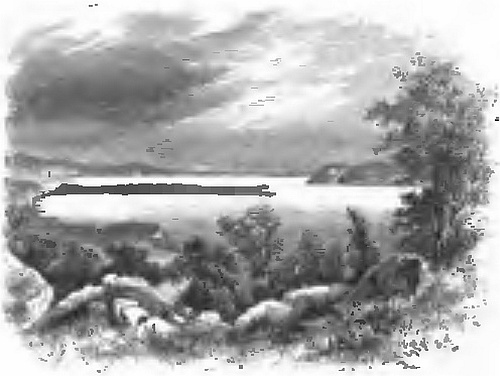
After we had lost sight of Cuba I could scarcely help expecting to see some rakish-looking craft hearing down on us, and I must own that it was with inward satisfaction that I remembered the fact that the black schooner and most of the scoundrels on board her were blown up, and unable any more to trouble voyagers over the deep sea. Poor Peter was continually on the look-out for an enemy, and if he saw a sail in the horizon he would come up to me and ask if we hadn’t better get ready to fight, lest it should be “another on them cut-throat gentlemen a-coming to look for us.”
Notwithstanding all the lad’s prognostications of evil, we reached, without any misadventure, the Crescent City, as New Orleans is not inappropriately called, on account of the shape it presents, built along the curving shore of the river. I hastened at once on landing, followed by Peter and Ready, to the office of the merchant on whom I had letters of credit, fortunately forwarded originally in duplicate by post, and having obtained a supply of cash, and such necessaries as I required, I was in a few hours on my way up the Mississippi, earnestly hoping that on this voyage I should escape being snagged, and not be blown up, as Aunt Becky had predicted would be my fate.
I have not been complimentary to New Orleans, but I must say that it is a very grand city. It is divided into two parts by Canal Street—the Old and the New—the Old, built by original French and Spanish founders, contains narrow and dirty streets and the worst class of the population, while in the New are numerous fine buildings, broad streets, and wealthy and respectable inhabitants. It is not nearly so unhealthy as is supposed when once a person is acclimatised,—but to be sure a good many die in the process. And so I make my bow to New Orlieens, as the natives call it. Although I had not many fears on the subject, I was glad to get away without being recognised, nor did anyone on board the steamer take especial notice of me, that I could discover. It was curious to go paddling on day after day, and night after night, and still to find oneself floating on the same broad stream, sometimes with rich level land on either side, and at others with light bluffs, or towns, or villages; also to pass the mouths of large rivers, and to be told that one was navigable eight hundred or a thousand miles up, and that five or six tributaries, each also navigable for six hundred miles or so, while others fell into it. Truly the eastern, southern, and northern parts of North America present a wonderful river system, suited for internal navigation.
We had a curious collection of passengers on board—five hundred at least in the main cabin—some of them, I judged by their physiognomies, not the most respectable portion of the human race. A party of them got round me, and in the most insinuating manner invited me to join them in a friendly game of cards, or dice, or dominoes, indeed they were not particular, anything that would enable me to pass the time agreeably. In spite of all their arguments I persevered in declining their polite invitations, and at length, in reply to no very polite remarks on my manners and appearance, and a strong expression of doubt as to whether I had anything to lose—
“You’ve hit it, gentlemen,” I remarked, quietly looking up at them. “It’s dull work to skin a flint, and I did not wish to give you the trouble.”
“You did well to keep clear of those fellows,” observed a gentleman to me shortly afterwards. “If they could catch you on a dark night near the side of the vessel, they wouldn’t scruple to rob you and heave you overboard.”
In many places the banks of the Mississippi exhibit high bluffs of an earthy nature, sometimes broken into the most fantastic forms, representing castles, towers, church steeples, and ruins of every description.
On the morning of the sixth day we were off the mouth of the Ohio, which river can be ascended for nine hundred miles to Pittsburg, and it must be remembered that I had already come upwards of a thousand miles from New Orleans. The next day, after paddling against stream two hundred miles farther, I landed at St. Louis, in the State of Missouri. It is a handsome city, built on ground sloping up from the Mississippi, about twenty miles distant from the mouths of the two mighty streams of the Missouri and Illinois, while the Mississippi itself has there already pursued a course of nearly seventeen hundred miles. It is a very busy place, and vessels of every description crowd its quays. Proceeding up the Ohio, I landed at Louisville, the chief town in Kentucky. Everyone has heard what Kentucky riflemen can do with their weapons. Understanding that a match was going forward outside the town I went to see it. To my disappointment it was over, but I saw two men shooting away as fast as they could load, at two cocks in a sort of enclosure, with an open space towards us, through which they kept constantly coming into view. Nearly a dozen shots had been tired, and the birds ran about as lively as at first. “Well, sir, I think with uncle’s old fowling-piece I could knock over them barn-doors a precious sight faster than that,” observed Peter, eyeing the marksmen with a glance of contempt.
“Now I guess, stranger, if you was to look closer you wouldn’t be quite so ready to boast of what you could do,” observed a stout, good-natured looking man near us. “Understand, just what you say you could do, they don’t want to do. Their business is to knock the feathers out of them birds’ tails, and do them no mortal injury. There’s a chalked line on their tails, inside of which a shot mustn’t go, or the man who fires it loses the match. Each man, too, has his bird and it requires a sharp eye to know which is which.”
Such I found to be the case. One man had shot all but one short feather away, and he was afraid of killing his bird; the other had shot all but two very long thin ones away, and his bullets constantly flew between them.
The next day we stopped at Cincinnati, a very handsome, civilised-looking city, and one of the most important west of the Alleganies. Here we embarked on board a much smaller steamer than any which had before carried us, though we had still four hundred miles farther to go up the stream to Pittsburg, from whence it was my intention to proceed to Toronto, and so find my way into the Hudson’s Bay Territory, in the best way I could. The boat drew very little water, for we had rapids and shallows to pass over; not so little, however, as a builder on board boasted was the case with one he had constructed—“Six inches, sir! why you know well enough, I guess, that if you was to attempt to send a craft drawing six inches of water up some of our streams, she’d be grounding every day in the week, and ten times in the day,” I heard him exclaim, in a tone of contempt, to a fellow-passenger. “Talk of inches, sir—what do you say to one I built, sir—why, she’d go along right slick across the prairie, provided the dew was thick enough on the grass in the morning. Why, sir, nothing could stop that craft if she could but get a taste of water.” Whether or not his assertion was believed I do not know, but as he was a big strapping fellow, and carried a formidable-looking bowie-knife in his waistcoat pocket, with which he used to pick his teeth and carve his meat, or indeed, what was not so pleasant, any dish intended for the public before him, nobody chose to call his assertion in question.
The country in which I was now about to seek for adventures, is a region which must before long become of importance on account of the great highway between the Atlantic and Pacific Oceans passing over it. Through that region indeed will be found the true and only practicable North-west passage, but it will be across the rolling prairie instead of the rolling ocean, and over rocky mountains instead of mountainous billows. The land I speak of is Central British America, also known as “Rupert’s Land,” “the North West Territory,” and the “Hudson’s Bay Company’s Territory.”
The earlier French settlers in Canada believed, and not without reason, that the high road to China would be found along the course of the mighty river on the banks of which they had located themselves. Their idea was ridiculed, and the name of La Chine was given to a village to the west of Montreal by those who believed that the explorers would never get farther in that direction, little supposing that ere long a rich province, full of wealthy cities, would have its eastern limits beyond the point in question; while only of late years the truth has dawned on a few far-sighted individuals that in that direction will be found the shortest and safest high road not only to China, but to provinces fast rising into importance, to British Columbia and Vancouver’s Island, to the wide-spreading shores of the Pacific, and to the numberless islands which stud its bosom; that it will afford a western outlet to the commercial enterprise of the British North American Confederation, which will raise it to a position of great wealth and power.
Let me try and map-down this great country. Following up the course of the St. Lawrence across Lake Ontario, and passing over a broad isthmus, where a deep canal is to be formed, we reach lake Huron. Still going west some two thousand miles distant from the month of the St. Lawrence, we arrive at the Saulte St. Marie, where the waters of the great Lake Superior fall into that of Huron. Here is a free port, and a free settlement has been formed; but we have yet Lake Superior to cross, when we shall reach Fort William, in Thunder Bay, where the most western British American settlement has lately been established. From Thunder Bay, a spot of great picturesque beauty, a good map will show us a succession of lakes, joined by rivers, and known as Dog Lake, Lac des Milles Lacs, Rainy Lake, and Lake of the Woods, the chain, extending till the extensive Lake Winnipeg is reached, having again numberless other lakes and rivers farther west. A journey of about eighty miles beyond the extreme west of the lovely Lake of the Woods carries us to a settlement of British people; not of people who have cast off their allegiance to the British crown, but true subjects, who desire to live under British laws and institutions, and to enjoy all the privileges which Britons justly value as their birthright; yet it is not too much to say that no community of the British race is more completely debarred from the advantages possessed by Englishmen at large than are the inhabitants of the settlement in question.
A glance at our map will show us a river rising in the State of Minnesota, and running nearly due north, entering the British territory at the forty-ninth parallel of latitude, and finally falling into Lake Winnipeg. This is the Red River, and the British settlements on its banks are known as the Selkirk, or Red River settlements. Here are located about six thousand white inhabitants. The spiritual wants of the people have not been neglected, and a bishop, called the Bishop of Rupert’s Land, and about eight Protestant clergymen are placed there, besides a Roman Catholic bishop and several priests. The productions of the district are valuable and numerous, and the climate, though cold enough in winter to ensure a supply of snow, and very warm in summer, is healthy in the extreme, and admirably adapted to British constitutions. The Red River is navigable from the States to the settlements, and again thence to Lake Winnipeg, from which there is a ramification of water communication by lakes and rivers, navigable for steamers for many hundred miles.
The Hudson’s Bay Company have a strongly-fortified post at the junction of the Assiniboine and Red Rivers, called Fort Garry, which serves as the citadel or capital of the settlements, for town or village there is not. The general aspect of the country here is that of a rich level prairie, with the river cutting its way tortuously through it towards Lake Winnipeg, forming steep or cliff-like banks. Belts of trees, however, are to be seen near the river, and woods scattered about, and to the east ranges of hills, while along the sides of both rivers are homesteads, substantial farm-houses, mills, stores, churches, parsonages, and school buildings. These settlements are about four hundred miles west of Thunder Bay, in Lake Superior, and the country for this distance must be the first opened up, and about three hundred miles of it is by far the most difficult part of the undertaking; yet the engineering difficulties for forming such a road as is required are trifling compared to those which have been overcome in numerous works in Canada.
It is a country peculiarly of lakes, and rivers, and forests, the timber being very fine. The timber, by means of the lakes and rivers, can be carried to the settlements, while it is most valuable for the formation of the roads, dams, canals, and villages about to be constructed. I am speaking of the first three hundred miles of road to be formed, whether that road is by lake, river, canal, or on the firm earth. The great object is to get a way opened up with the greatest expedition and at the least expense. Now let us turn our eyes west of the settlements, and we shall see a belt of fertile land, in some places one hundred, in others fifty miles wide, extending for eight hundred miles, to the very base of the Rocky Mountains. This magnificent belt of land has already been traversed from one end to the other by exploring expeditions, and emigrant parties with carts, dragged by oxen travelling at the rate of twenty miles a day. It is intersected by many rivers. The carts were unladen, formed into rafts, and towed across; the cattle swam or waded. The once declared impassable Rocky Mountains were passed with perfect ease, in several places, and British Columbia entered.
To understand clearly the nature of the country, let us suppose ourselves standing on the banks of the Red River, looking west. In front we have the fertile belt stretching out before, us, consisting chiefly of rich level prairie land, ascending gradually towards the Rocky Mountains. Rivers and streams run directly across it at intervals, invariably lined with trees, and here and there are forests of considerable extent, though generally trees are found in small clumps or copses, covering a few acres, having escaped the ravages of the fires which destroyed the primeval forests.
On the left, running from west to east, there is the Assiniboine River, connected by the Calling River with the south branch of the Saskatchewan. On the right, extending in a north-easterly direction, is a range of wood-covered mountains known as the Riding, Duck, and Porcupine Mountains, and on the other side of these are three large lakes, the Winnipeg, Manitobah, and Winnepegosis. Into the northern end of the first falls the important river Saskatchewan, navigable by steamers for two or more hundred miles, and, with certain breaks, up to the very; foot of the Rocky Mountains. The Saskatchewan gives its name to the greater portion of the fertile territory, which is known as the valley of the Saskatchewan. This wonderful chain of rivers and lakes abounds in a great variety of excellent fish, on which once numerous tribes of natives entirely subsisted—so that they thus afford a never-failing supply of food, abundant irrigation, and extensive water inter-communication.
Compared with the latitude of the British North American Provinces, the climate may be supposed to be severe, but it should be understood that as the west is approached the climate improves, and the fact is that near the Rocky Mountains, farther north, and at a far greater elevation, the climate is not more severe than at the Red River. Thus there is uniformity of temperature and natural productions throughout the territory. The cold is great, but not greater than in Lower Canada, and sometimes the winters are so mild that, as Mr Ross, an old settler, states, he has known ploughs at work at Christmas. When spring begins, the heat becomes considerable; thus all the productions of the earth ripen with wonderful rapidity, and from sowing to harvest time is often but three months.
Professor Hind, of the University of Toronto, stated some years ago that the valley of the Saskatchewan, or rather the basin of Lake Winnipeg, contains an area available for cultivation of eighty thousand square miles—a territory very nearly as large as England—and that it is capable of supporting an agricultural population exceeding fifteen millions of souls. “The outlying patches of fertile land lying within the limits of the great plains, together with the deep, narrow valleys of the rivers which run through those arid regions (that is, to the south of the fertile belt), the east flanks of the Rocky Mountains, and the low lands in the region of the great lakes, might support another ten millions, so that the present available area of arable soil—the greater portion of which is susceptible of being at once turned up by the plough—would sustain an agricultural population equal to that of Prussia.” Indeed, vast as is Canada, the professor’s calculations show an excess of land fitted for the permanent abode of man, in favour of the basin of Lake Winnipeg over Prussia, before its recent accessions of territory, of five million five hundred thousand acres. If the whole quantity of land fit for cultivation in Canada were occupied, it would sustain a population of eighteen millions, while in the same proportion the territory under discussion would sustain nineteen millions of people. Including the Red-men, who slaughter the buffaloes which roam over its rich pastures for the sake of their skins alone, it scarcely now supports twenty thousand souls.
As to the natural productions of this region, it may briefly be stated to contain abundance of wood, stone, and clay for building; lignite in many districts, and coal in others; iron of excellent quality, in the neighbourhood of coal; salt, which has long been in use, the springs being easy of access; and grasses, which afford rich fodder in abundance throughout the winter season to large numbers of horses, and to many cattle. “Within the limits of the fertile belt vast herds of buffalo come in winter to feed and fatten on the rich natural grasses, which the early frosts in autumn convert into nutritious hay.” To sum up the capabilities of the territory: It is an admirable grazing country, and cattle and horses can remain out all the winter. Sheep thrive and multiply. Pigs, where there are oak woods, if turned out, require no looking after.
It must be understood that agricultural operations have for many years been carried on at the Red River, and round the mission-stations and trading-posts, and that the statements made are the results of actual experience. Wheat is the staple produce. The ordinary yield is thirty bushels to the acre, and oftentimes forty bushels. It is cut three months from the date of sowing. Indian corn is very fine, and never fails on dry lands. Root crops, especially potatoes, turnips, and beet, yield abundantly, and attain large dimensions. The potato disease is unknown. Garden vegetables grow luxuriantly, and equal those of Canada. Barley and oats, when cultivated with care, yield as abundantly as wheat. Of hay from the natural grasses an abundance can be made. Tobacco is successfully cultivated. Hops, in great luxuriance, grow wild. Ale is brewed with them at Red River. Hemp and flax have also been successfully cultivated. A variety of fruits grow wild, such as strawberries, raspberries, currants, and gooseberries; so does rice. Melons grown in the open air are very fine, and sugar, as in Canada, is abundantly obtained from the maple-tree.
Again, considering the abundant supply of fish, and the various sorts of game, large and small, from the buffalo and deer to the hare and rabbit, it will be understood how amply the territory is provided by nature for the support of a large population.
Of the Indians, there are scarcely forty thousand in the fertile belt and wood and lake regions together, who chiefly subsist on buffalo flesh and fish, and live in skin or birch-bark tents. The Prairie Indians have large numbers of hones, while only some tribes of the Wood Indians possess those animals. Some few have been converted to Christianity, but the larger proportion retain all their heathen customs, though generally they do not show any hostility to the whites. The Sioux Indians, however, across the boundary line, from the treatment they have received from the people of the United States, are determined enemies of the white men and half-breeds.
But how, it may be asked, can this vast territory be peopled? By a simple and easily carried out system. The object, in the first place, is to establish a direct communication across it. A railroad is out of the question for many years to come, and even a regular macadamised road can scarcely be expected for some time, but we may well be content if we can obtain a road over which a wheeled vehicle may travel some forty miles in the day, and horsemen at still greater speed. In the first instance, there must be settlements, and it is proposed to establish them at about twenty-five miles apart, in a direct line from Lake Superior to the Rocky Mountains. Grants of land with freedom from taxation, and the certainty of obtaining ample employment, will quickly attract settlers. In the first place, in each settlement a wheelwright and cart-builder, a blacksmith, two or more carpenters, a painter and glazier, a baker, a butcher, an innkeeper, and other artisans obviously required on a great highway, would find employment. Several farmers and agricultural labourers, and a market-gardener, would be wanted to supply food. Stable-keepers, and grooms, and postilions may be named, and all these would, of course, attract storekeepers, tailors, and shoemakers. A police force, with small bodies of military pensioners, and perhaps a few troops, might be stationed at intervals in the settlements along the line. To these communities, with the aid of some navvies, might be confided the duty of improving the road at first roughly marked out. Bridges might be required over small streams, and ferries would certainly be required over broad ones, and here boat-builders and ferrymen would be called for.
It will thus be seen in what way the settlements can first be formed; but before they are placed along the whole line, the more difficult part of the country between Lake Superior and the Lake of the Woods must be pierced through. Trees have to be cut down, rough places smoothed, and bridges erected; and where the line is by water, dams have to be constructed, landing-places formed, and steamers launched. Scarcely one summer, however, would be required for the work; and it must be remembered that the route in question has been traversed for years back, and that, although heavy luggage cannot at present be carried that way, passengers and light goods may be transported by canoes through the lakes and rivers which have been described. The first settlement has already been formed by the colonial government at Fort William, on Thunder Bay. About forty miles to the west is the boundary line between the British North American Confederation, which is destined ere long to include the whole of British North America, and the Hudson’s Bay Company’s territory.
Chapter Fourteen.
From Toronto to the Pacific—Jack Trevor, an old Chum, for Fellow-traveller—From Collingwood by Steamer—Birch-bark Canoes—Lake Superior and Thunder Bay—Fort William to Lake Winnipeg—The Kaministiquia—Swiftfoot, our Indian Guide, and Half-caste Crew—A Portage—Our Camp and Progress—Missionaries and Settlers—Fort Garry and Selkirk Settlements.
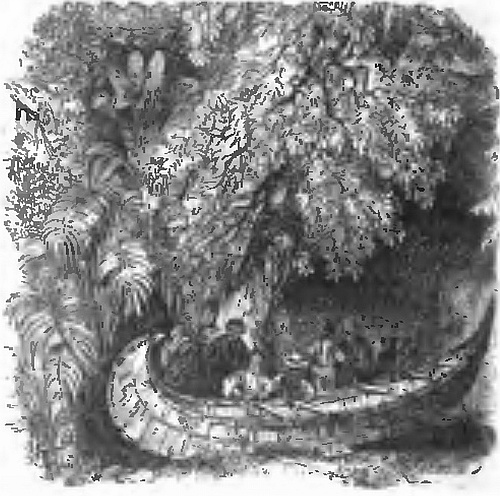
There is nothing that I need relate excepting that after my arrival at Toronto I immediately set to work in right earnest about preparations for a journey of fifteen hundred miles or so across the continent to the Pacific. I had become intensely British during my stay in the States, and resolved that my journey should he, if possible, entirely through British territory, and remote as possible from the United States boundary. Some of my friends advised me to go by railway to La Cross, and from thence up the upper waters of the Mississippi to St. Paul, in Minnesota, then, by a stage to Georgetown, on the Red River, down which stream I could proceed by a steamer to the Selkirk Settlement, in the centre of which Fort Garry is situated, at the point where the Assiniboine and Red River meet.
When travelling I seldom fail to find a companion, and my disposition being somewhat of a malleable nature, I generally manage so to work his and mine together that we are able to rub on socially till called upon to separate. In the present instance I was more fortunate than usual, for, while I was in the midst of my preparations, who should turn up one day—or rather roll into the office of my cousin, John Brown—but my old school-fellow, and strong-fisted, stout-hearted friend, Jack Trevor, brother of Lieutenant Trevor of the Spitfire! He was a capital shot, could handle oar and scull right well, throw a fly skilfully, run like a deer, walk thirty miles on a stretch without fatigue, and woe betide the man who felt the strength of his arm! I told Jack what I was about to undertake.
“Just suit me,” he exclaimed. “I was wondering what I should do. I’ve a year or so to spare, some cash to throw away, am in good training, and should amazingly like to have a scamper after buffalo.”
The ice of winter having sufficiently disappeared from the upper lakes to render navigation possible we started by the northern railway, passing Lake Simcoe to Collingwood, on the shores of the Georgian Bay, and then embarked on board a steamer named after the same heroic admiral. Paddling away north, we were soon out of sight of the generally low shore, and then the wind began to blow and the waves to roll furiously, making the big vessel tumble about in a most uncomfortable manner, till I thought it more than possible that she would go down then and there to the bottom of the lake. Peter looked at me reproachfully, remarking—
“I thought when we got into this country we were to have no more tossing about on the salt ocean?”
“Nor have we. This is but a pool, Peter; the water is fresh, and the land is on every side of us, only we don’t see it,” I answered, but I doubt if he was satisfied.
We managed, however, to tumble on till we got under the lee of a wooded island, where we remained as quietly as in a mill-pond till the next morning, when we continued our voyage between the Manitoulin islands and the north shore of Lake Huron till we came to the Bruce mines.
Along this north shore a road has been surveyed and settlements laid out. Proceeding up the St. Mary River, we reached the villages of that name—one on the British, the other on the States’ side. Between the two Lake Superior sends its waters in a fierce rapid into the river on their course to the ocean. We avoided them by stealing through a canal on the American side. On our way we took on board two birch-bark canoes which my indefatigable cousin, John Brown, had caused to be provided, as, also, a supply of gum to stick over the seams, wattap, which is the root of the tamarack, used to sew the pieces of birch-bark together, cod-lines, and other indispensables for canoe navigation. Here, also, an Indian guide and a crew joined us—dark-skinned individuals descended from French Canadians and Indians, a class which is employed by the Hudson’s Bay Company—in their canoes. I will describe them as we go on. We purposed picking up, afterwards, a few Indians to increase our strength.
Away we steamed along the northern shore of Lake Superior, occasionally sighting some lofty bluff, said to contain a vast supply of iron, copper, and other mineral wealth, till we neared the fine headland of Thunder Cape and found ourselves amid the magnificent scenery of Thunder Bay. Here the steamer anchored; and we, launching our canoes, went on shore at Fort William, an important port standing at the mouth of the river Kaministiquia. We found that surveyors had already laid out a settlement on the banks of this stream, which is navigable for large vessels for a good many miles from its mouth.
While preparing for our long inland voyage of something not much under five hundred miles to the Red River, we were entertained by the surveyor, who showed us the plans proposed for opening up the country for general traffic. Trevor had become very eager on the subject, and declared that he should be ready to devote his life to the undertaking. We therefore agreed to follow the same route. Sending our canoes with the voyageurs up the Kaministiquia River, we were to proceed north along the shore of Thunder Bay till we reached a harbour abreast of Dog Lake, where we were to land and push our way for twenty-eight miles across the country, along the line where a good road was soon to be formed to Dog Lake. Here we were to embark in our canoes, as we should have a clear navigation of thirty-five miles across the lake and up Dog River till it became shoal; then, landing, we were to ascend to the height of land forming the boundary between Canada and the North West Territory, and make a portage of five miles to the Savanna River. A portage is literally a carrying. The canoes and cargo are carried on men’s shoulders over the land, either to avoid a rapid, or from one lake or stream to another; thus, these intervening spaces of land come to be called also portages. After launching our canoes in the Savanna River we were to obtain a free navigation of sixty-five miles, the Lake des Mille Lacs, and the river Seine to the Little Falls. We were, from this place, to be prepared for numerous portages, amounting altogether to seven miles, and fifty-nine and a half of navigation. After the last of these portages we were to get a run of two hundred and eight miles down the river Seine into Rainy Lake, and from thence into the Lake of the Woods, which we were to cross at its western extremity either to a small lake known as Lac Flat, ninety-one and a half miles across an easy country to Fort Garry, or to descend the Winnipeg River into Lake Winnipeg, and along its northern shore to the mouth of the Red River.
We decided on the latter route for ourselves, as we wished for our canoes to navigate the lakes and rivers to the westward, and, not being expected, we should have had no horses sent over by the Selkirk people to meet us. It must be remembered that the Selkirk settlement and the Red River settlement are different names for the same district, and that Fort Garry is in the midst of it. Trevor, who had an especial taste for engineering projects, was delighted with the account, and made out that by means of good steamers, short railroads, or even roads for coaches, and tramways over which loaded boats could be drawn, the distance between Fort William and Fort Garry might be accomplished in six days.
“You see,” he observed, “the greater portion of the distance would be performed by steamers; though, on the sixty miles of broken navigation on the river Seine, large boats to be dragged up inclined planes and along tramways over the portages would be more suitable. Then the Red River people would make the short road necessary between this place and Lac Plat, and supply the conveyances, greatly to their profit. Why, the whole route, if people had energy, might be open by next summer, and as we all know that the distance between the Red River and the top of the Rocky Mountains offers no impediments, if the inhabitants of British Columbia would open up a communication on this side, we should, in a year or two, be sending our letters across the continent from the Atlantic to the Pacific in a couple of weeks or so; and fellows like you or me, Harry, would be able to accomplish it by railway, steam-boat, and on horseback, in about the same time.”
Having sent the canoes on two days before, we supplied ourselves with packs, blankets, and provisions for a couple of days, and engaged an Indian guide, and landing at the mouth of Current River, on the northern shore of Thunder Bay, we worked our way along the line of the proposed road to Dog Lake. We just saved our daylight to the shore of the lake, where we prepared to camp. Our guide first cut off a quantity of the young shoots of the spruce-fir, which he strewed on a dry spot to form our beds, while, at his suggestion, we collected a large supply of dry wood for a fire. Our kettle for tea was soon boiling, and by the aid of our frying-pan, the most useful of all cooking utensils, the dried provisions we had brought with us were converted into a savoury stew, seasoned with garlic, salt, and pepper, and thoroughly enjoyed by us. Trevor pronounced it jolly fun, and declared that he should never grow tired of living as we then were doing. Never go across wild countries without a portable frying-pan, you can boil water in it, cool, boil, stew, fry, and even bake, without any other appliance than a frying-pan and a little fire and water. Our Indian guide, whose name was Swiftfoot, was so pleased with the way we treated him that he begged he might accompany us, and as he bore a good character for honesty and good temper and for being an expert and daring hunter and canoe paddler, we accepted his services. As he understood English fairly, and had already been a considerable distance up the Saskatchewan, we considered him a valuable acquisition to our party.
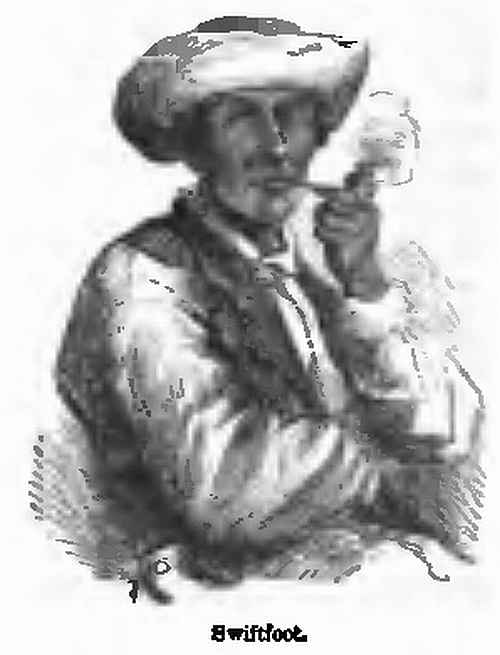
The next morning the canoes appeared. Having camped at no great distance from where we were, and having taken a hurried breakfast, we embarked.
“Take care,” cried Swiftfoot, as we stepped on board; and not without reason, for though accustomed to University eight-oars, we as nearly as possible pitched head foremost out on the other side of our frail barks, to the great risk of capsizing them and spoiling our goods.
Trevor and Swiftfoot went in one canoe, I with Peter and Ready in the other; and the crews, with stores and provisions, were evenly divided between us. Away we paddled across the lake, our Indians striking up a song of the character of “Row, brothers! row!” but not so melodious. All day we paddled, and camped at night. When we came to a portage we jumped out. Two men carried each canoe; the rest loaded themselves with her cargo and bore it on their shoulders half a mile, or perhaps two or three, or more, till smooth water was again reached.
On those occasions we sighed for tramways over which we could run swiftly with cargo and canoes. Every portage has its name, and so, indeed, has every point, stream, and isle, for ages the fur traders’ canoes have been traversing this country, and to these people every mile is known. We indulged in small tents for sleeping; but our beds were the hard rocks sprinkled with spruce-fir-tops and covered with rugs.
I have not described our canoes. They were formed of the bark of the white birch-tree, peeled off in large sheets and bent over a slender frame of cedar ribs confined by gunwales, which are kept apart by slender bars of the same wood. A thread called called wattap, made out of the flexible roots of the young larch-tree, is used to sew the sheets of bark together and to secure them to the gunwales, which have thus the appearance of an Indian basket. The joinings are made water-tight by a coating of tamarack gum put on hot, or by the pitch of the yellow pine. The seats are suspended from the gunwales so as not to press against the sides. The stem and stern are alike, the sheets of bark being cut into a graceful curve, and are frequently ornamented with beads or coloured moose hair. Ours carried six men each, and our baggage and provisions, and were so light that a couple of men lifted them out of the water and ran along with them over the roughest ground with the greatest ease. They are urged on by light paddles with broad blades, and are steered by another of the same shape. For several days we paddled on—making no great speed, however, for across lakes in calm weather we seldom did more than four miles an hour—when Trevor used to sing out, “Oh, for an eight-oar; oh, for an eight-oar! how we would make her spin along.” However, I persuaded him that we were better as we were—because, in case of being snagged, not having a boat-builder at hand, we should have been puzzled to repair her.
For several days we paddled on without meeting with any actual adventure, although objects of interest were not wanting during every hour of the day. We passed through the Lake of the Thousand Lakes and camped on its shores before beginning our descent of the river Seine. The night passed calmly. I awoke early: the stars were slightly paling, a cold yellow light had begun to show itself in the east, on the lake rested a screen of dense fog, through which a host of Indians bent on our destruction might have been approaching without my being able to discover them; landward was a forest equally impenetrable. Walking a step or two from the camp I heard a sudden rush. I started, and cocked my smooth-bore, but nothing appeared, and I guessed that it was a fox, minx, or marten, prowling close by, attracted by the remains of last night’s supper. From the expiring camp-fires a thin volume of smoke rose up above the trees and then spread lakewards, to join the damp misty veil which hid the quiet waters from view. Round the fires were the silent forms of the Indians lying motionless on their backs, wrapped in their blankets, like shrouded corpses stretched at full length. Two or three were under the canoes, and Swiftfoot had taken post in front of Trevor’s tent. As dawn advanced an Indian awoke, uncovered his face, and sitting upon his haunches, looked round from beneath the folds of his blanket, which he had drawn over his head. After a few minutes a low “waugh” from his throat made some of the others unroll themselves and begin blowing at the fire and adding fresh fuel. A few minutes were spent by the French voyageurs in prayer, and then the rest of the party being roused, the tents were struck, and our early meal, consisting of fried dampers and fish, biscuits, with hot coffee and tea, sweetened, but without milk, enjoyed. The canoes were then launched.
“No frying-pans, hatchets, or other valuables left behind?” sang out Trevor, who acted as commander-in-chief.
Each man examined the property committed to his charge, and all being found right, we paddled down the stream as usual.
Here let me advise those engaged in similar expeditions to be careful about such trifles, for a party may be brought to a standstill, and lives endangered, by the loss of articles which may appear, at the moment, of little value.
Now and then we came to rapids which it was deemed tolerably safe to shoot. We had performed this feat twice when we came to another. We had got through the greater part when, as we were dashing on amid the foam, the stern swiftly turning round, we grazed a rock.
“A narrow shave!” I exclaimed, thinking we were safe, but Peter’s cry of—
“Oh, sir! oh, sir! the water is a running in, and we shall all be drowned!”
“Stick your thumb into it,” cried Trevor, from the other canoe, which was just ahead, and had escaped all danger. This the lad did literally, but the water spouted up all round his arm.
“Never mind,” exclaimed “Longshot,” the chief of my canoe, “we shall go on till the next portage.”
But the water kept rising and rising till we had three inches of it inside the canoe. This was more than I bargained for, and as the cargo would be injured even if we did not sink, I insisted on landing. The chief trouble was unlading the canoe; for a piece of bark sewed on with wattap, and covered over with gum melted with a burning stick, soon repaired the damage.
Thus we made good three hundred and eighty-one miles, counting the sinuosities of the course, and found ourselves encamped on the north-west corner of the beautiful Lake of the Woods. I say beautiful, for no part of North America presents more lovely and picturesque lake scenery—here bare precipitous rocks, there abrupt timbered hills of every form, and gentle wooded slopes and open grassy areas, while islands of every variety of form and size dot the blue expanse.
There was the usual fog resting on the surface of the lake as I turned out in the morning before the rest of the party, whom I was about to rouse up, when my ear caught the sound of paddles approaching the camp. That they were Indians there could be no doubt, and I thought that they were probably on a journey and would pass by without observing us. Swiftfoot had not given the Wood Indians of this district the best of characters, yet, as they had always shown a friendly disposition towards the English, we heard, we had no cause to apprehend danger from them. Still, I knew that it was necessary when travelling in those regions to be on our guard, and I therefore stood still, expecting to hear the sound of the paddles gradually decrease as they passed by. Suddenly, however, a light puff of wind lifted the veil of mist, and exposed to view nearly a dozen large canoes filled with painted and feather-bedecked Indians, evidently a war-party, and coming directly for our camp.
“Indians! Quick, to your feet!” I shouted out, having no fancy to be murdered through too much ceremony, or by putting over-confidence in a band of savages.
In an instant Trevor stood with his revolver in one hand and his fowling-piece in the other, ready to do battle. Peter, with his fists doubled, and the rest with their different weapons prepared for use, while Ready showed his teeth and barked furiously to make amends for his previous carelessness.
On seeing our preparations a young chief stood up in the bow of the leading canoe, and waving his hand, stated that he was coming on a peaceable errand.
“My father, the chief, will be here anon—he sent me on to announce his coming.”
Finding that resistance would be almost hopeless if they meant evil, putting the best face we could on matters, we begged the young chief to land and sit down and smoke the calumet of peace, or, as Trevor expressed it, “take his pipe and make himself at home.” He was a talkative youngster, and seemed very proud of having killed two or three men in a war expedition against the Sioux, from which he had just returned, exhibiting to our unpleased eyes the fresh scalps he had taken. We found that he had brought them all down at long shots. Indeed, Red-men, notwithstanding all that has been said in their praise by novel writers, have a very unheroic notion of fighting. Trevor called it an “unsportsmanlike way of bagging their game.”
Our blood-thirsty young acquaintance smoked several pipes, drank a quart of tea, and talked of affairs in general, but left us as much in the dark as ever as to the reason of his coming, though he informed us that our fire had been seen in the evening; but that, unwilling to disturb us, he had postponed his visit till daylight. His followers had, meantime, landed and squatted round us in the most amicable manner—my dog Ready being the only one of the party who exhibited any hostile feeling, and he was in no way satisfied with the appearance of the ill-looking war-begrimed strangers. Our principal annoyance arose from being unable to proceed, which we could not venture to do till the appearance of the chief. At length his fleet of nearly twenty canoes hove in sight, and he soon landed, and with all the pomp and dignity he could assume, demanded the reason of our passing through his country. We replied, through Swiftfoot, that we were on a journey of pleasure, desiring to pass on to the big sea in the far-west, to hunt the buffalo, and shoot a grizzly if we could; in fact, to inspect the country and kill time.
After listening attentively, he gave a significant “ugh!” observing that we might or might not be speaking the truth, but that certainly we were more likely to meet pain than pleasure, that too many buffalo were hunted already, but that was no business of his, and that as to grizzlies, he knew nothing of them in his part of the country, nor of a big lake in the far-west, and that we could kill time far better at home; but there was one thing he did know, that the white people had deceived the Red-men so often, and had occupied their lands, so that with his will no one should pass through his country, which lay between the Lake of the Woods and the Red River. We took a few minutes to deliberate what to say, and then instructed Swiftfoot to inform the chief that he was a very wise man, but that he was labouring under one slight error, the fact being that the whole country belonged to the Queen of England, that he and his people were her subjects, and that so were we; that she desired all her subjects to be friendly to each other; that she was very angry with those who were not, and made presents to those who were; that we should set a good example by not passing through the country he claimed, though we were afraid she might be very much vexed at hearing of his want of courtesy, still to show him of our friendly disposition we proposed presenting him with some tobacco, hatchets, and blankets, although we had not come provided with presents. He looked completely taken aback on hearing this, and ended by sending two of his young men as guides down the Winnipeg River, the course we had intended to pursue.
We visited an island in the lake, a large portion of which was cultivated, and produced Indian corn, potatoes, squashes, and pumpkins; pigeons and a variety of birds flew over our heads, and fish swarmed in the lakes and streams we passed through. We stopped on our way at two or three Hudson’s Bay Company’s trading-posts. They are generally situated on commanding positions, surrounded by stockades which would serve to keep out a predatory party of Indians. We also visited a missionary station, that of Islington, established by an English lady, Mrs Sandon, of Bath. The missionary, Mr Macdonald, has long laboured among the Red-men, instructing them in the truths of the Gospel, teaching them agriculture, and educating their children in his schools with more success generally than the adults.
It took us nearly three weeks to voyage from Fort William to the mouth of the Red River, which we reached by a traverse across Lake Winnipeg. We ascended that river to a settlement of Christian Indians, presided over by an English clergyman, where we left our canoes and boatmen till we should again require them, and proceeded up, on horseback, to the main settlements, some rapids impeding this part of the navigation of the Red River.
In contrast to the wild scenery through which we had so long been travelling, the Selkirk settlements presented an aspect of civilisation and advancement which we had not expected. There were good roads, houses, churches, schools, mills, stores, large farms and small farms, and a cathedral and nunnery belonging to the Roman Catholics. There is no town in the settlement, but there is a large, tolerably strong fort, that of Fort Garry, on the point of land where the Assiniboine River falls into the Red River, and for twenty miles or so, on the banks of the two streams, the buildings I have described have been raised in groups or knots, forming separate hamlets, with, in most instances, a church and school-house for each. I might give a long and interesting account of the settlement, but such is not my aim. I will merely remark that the farms were well-stocked, and showed a variety and an abundance of produce; that horses and cattle lived out and grew fat on the native grasses throughout the winter, that so too did pigs in the woods on acorns and roots; and that all the inhabitants required to become wealthy and prosperous, was a regular market for their produce.
Chapter Fifteen.
We get up a Buffalo Hunt—We engage Stalker and Garoupe, two Half-caste Hunters—Pemmican—The Hunt—I get Floored by a huge Bison, but am carried to Camp in his Skin—Hostile Sioux, and a Brush with them—We cross the Assiniboine—La Prairie Portage.
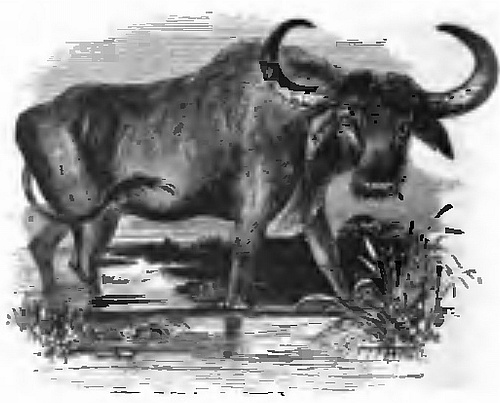
Trevor and I now formed our first hunting expedition. Buffalo, or rather bison-hunting, had long been our day-dream, and had formed the chief subject of our conversation as we paddled along in our canoes, or when seated round our camp-fires at night, so now we determined to make a beginning. We engaged a couple of half-breeds as guides and hunters, one was of English, the other of French parentage. One was called John Stalker, the other Pierre Garoupe. They were both bold, active fellows, and each amusingly tenacious of the honour of the country from which his father came. There was no want of good horses in the settlement, courageous, hardy animals, trained to hunt the buffalo, and taught to stand still should their rider be thrown, or any accident happen to him. The carts of the country are built entirely of wood, without a nail, and consequently float across rivers, and if broken, are easily repaired. We bought four of these carts to carry our tent, provisions, ammunition, and clothing. A large body of half-breed hunters, with their wives and children, had gone on before, towards the south-west, where the buffalo were said to have appeared in great numbers, on their way to the northward, and we hoped, by pushing on, to overtake the band in time to see some of the sport.
John Stalker gave us much information about these hunting expeditions. Great regularity is observed. Each man has his own cart or carts and horses. The band is divided into companies, with a chief to each, and constables, and a leader over the whole, whose word is supreme both in camp and on the hunting field. We found ourselves in a new kind of scenery. Here, and there were separate woods, but our course chiefly lay over the open prairie, a boundless expanse of waving grass. The greatest risk in dry weather in such a country is from fire; should it once become ignited no human power can arrest its progress, and Heaven have mercy on the hapless hunter whom it overtakes. The fleetest steed will scarcely escape if flying before it. We found from the fresh tracks that we were near the hunters, and at length we came upon them encamped, the women making pemmican, and the men cleaning their arms, or doing nothing. Pemmican is the staple food of all the hunters and travellers throughout the country. In the Cree tongue Pemmi means meat, and Kon fat. The flesh of the buffalo is cut up in strips and hung on poles to dry. Then it is pounded between two stones till the fibres separate. About fifty pounds of this meat are put into a bag of buffalo skin with forty pounds of hot melted fat, thoroughly mixed with it. A nicer sort contains berries and sugar, and is highly prized. It keeps for years, subject to wet, cold, or damp. One pound is considered equal to three of ordinary meat.
Having introduced ourselves to the leader of the party, and invited him to come and sup with us, we encamped in a position he assigned to us, and made preparations for the next day’s hunt. By early dawn, Trevor and I, followed by Peter, were in the saddle—the latter from his childhood had been accustomed to horses, and was now perfectly at home on horseback. I spoke of the Crees. They inhabit the country to the south and east of Lake Winnipeg, and the half-breeds are chiefly related to them on the mothers’ side.
It was a fine sight to see the band of hunters marshalled in order, advance towards the spot where the buffaloes, as the bisons are here called, were said to be feeding. I could not help thinking, as I watched them, what splendid light cavalry they would make, for the defence of the country against their encroaching neighbours, or mounted police, or irregular cavalry for any purpose. Trevor, too, was much struck with the scene. “We try to civilise the Red-men,” he remarked; “very good, and I don’t see any impossibility; but I do see the bungling manner in which we set about it. We try to make men who have been all their lives on horseback, or, with rifle in hand, have hunted buffaloes, deer, or grizzlies, or been accustomed to the trapping of small game, sit quietly down as farmers, gardeners, or carpenters, and attend school and church, Sundays and week days, without any approach to amusement, or what is still more absurd, without finding them any market for the produce of their industry when they are industrious. Teach them Christianity, and civilise them by all means, but introduce canoe races, horse races, foot races, shooting matches, foot-ball, cricket, all sorts of games,—anything, in fact, suitable to their bodily and mental powers, and open up the country; send people to buy their produce, and employ them as postillions, mail carriers, ostlers, cattle drovers, ferrymen; and at the same time keep them as much as possible separate from white men, under good guidance and instruction, and I have some hope that they will not decrease in numbers, and that they will become civilised in reality as well as nominally.”
Trevor had got thus far when the advanced guard made a signal for silence to be kept. We each of us stood up in our stirrups, and looking out ahead caught sight of numberless dark objects covering the prairie, far as the eye could reach, from north to south.
The wind blew from them, so that we might hope to get near without being perceived. The hunters now examined their saddle-girths, loaded their guns, and looked to their primings or percussion caps, and filled their mouths with bullets that they might drop them into their guns, without wadding, while at full gallop. The elder we heard cautioning the less experienced, and with good reason, not to shoot each other—a contingency I thought very likely to occur. Cautiously at first we approached the herd, clutching our weapons and bending forward eagerly, ready to dash on at a moment’s notice. Before us was a very large herd of buffaloes. On we went still unperceived—even the sagacious horses seemed to tread cautiously. At length some of the nearest animals lifted up their shaggy bearded heads. Our leader gave the signal—we were discovered. No further need now for silence. Our steeds sprang forward—off we dashed, and, scampering along at full speed, were soon in the midst of the more tardy-moving animals, each hunter firing right and left into the animal nearest him on either hand. It was like a naval engagement in days of yore, when a British fleet got among the enemy. In this instance, each hunter was widely separated from his companions, and only now and then the unfortunate chase turned to show fight. Even that was hopeless, for the well-trained horse, wheeling or leaping aside, knew as well as his rider how to avoid the charge of the furious buffalo, which was certain in the course of a few seconds to be brought low.
As each hunter killed an animal he dropped some article of his property to denote his prey, a handkerchief, tobacco box, knife, steel, and then galloped on, slaughtering right and left. I had told Peter to keep near me, lest any accident should happen to the lad; but carried away by the excitement of the chase, he separated from me, and Trevor very quickly disappeared. I was in high glee, for I had rolled over two buffaloes in succession. On I galloped, and brought down a third. I fired at a fourth, a huge bull, but though I hit him he did not fall, and before I could check the speed of my horse to load, the animal put his foot in a badger’s hole, and down he came, throwing me over his head. As I was on my way to the ground it seemed I looked up and beheld the huge buffalo, with his hairy head bent down, dashing towards me. I had no power of defending myself. I saw his red, fiery eyes close to me, felt his hot breath on my cheek, and gave myself up for lost. I remembered nothing more but a most horrible sensation of suffocation. I had remained some time in that condition, when I heard voices near me, and recognised Peter’s tones. “Yes, yes, that is my dear master,” he exclaimed. “Yes, Master Stalker, and he be coming to life again, I do believe. Hurra! hurra!”
On this I felt myself lifted up and carried to a little distance, when I was again put down. In a few minutes I was placed in a litter formed, I afterwards found, of the skin of the very buffalo which had so nearly finished me.
The shots I had put into him, though not instantaneously fatal, had produced his death at the moment he was about to gore me, and his huge body had fallen over, completely above me. Poor Peter, when the hunt was over, and the hunters were returning to camp, had searched about for me in every direction, till he was in perfect despair. At length a buffalo I had killed was discovered, and my course tracked till I was found under the body of my fourth victim. The lad had killed a buffalo, and Trevor boasted of knocking over six, so that he was well content with this result of his first hunt in British North America.
A considerable number of animals had been killed, and now the carts came up to carry off the flesh to be converted forthwith into pemmican, in the manner already described. There was a terrible waste of food even in this instance.
I was for several days unable to mount my horse, but had recovered completely by the time the pemmican was prepared and the camp broken up. It had been arranged that we were to begin the homeward march the next day, when the scouts, always kept actively employed on such occasions, brought in word that they had discovered the trail of a band of Sioux, their hereditary foes, and had followed it up till they found them encamped not more than a day’s journey from where we were—in American territory. A council of war was held immediately. It was agreed by the hunters that if they did not attack the Sioux, the Sioux would follow and attack them and take them unawares.
Trevor and I at once came to the opinion that it was our duty to be non-combatants; and, indeed, we counselled our friends to retreat without attacking the Sioux, and to trust to their own vigilance not to be taken by surprise. This advice was very unpalatable to the tastes of the hunters, and was totally disregarded. As far as the principles of the half-breeds are concerned we found them very little in advance of the Indians, though they pique themselves, as a mark of their civilisation, on not taking scalps. Trevor even offered to visit the camp of the Sioux, and to try and negotiate terms of peace. To this proposal, however, they would not a moment listen, declaring that he would lose his life in the attempt. The council broke up, and a war-party having been arranged, forthwith set out. They advanced with caution, with scouts thrown out to examine any ground which could possibly afford a spot for an ambush.
We rode on with them for some distance, and in vain again urged them to abandon so utterly profitless an expedition—certain as it was also, even should they be victorious in the present instance, to make their enemies retaliate on some future occasion. I believe that the women of the party regarded us with a considerable amount of contempt when we returned to the camp in consequence of our interference. Peter, however, explained to the fair dames that although we refused to attack men who had never injured us, we would fight for them like heroes if they were attacked. This assurance seemed to restore us to their good opinion. Two days passed, and the war-party returned, looking haggard and travel-stained. They boasted of having killed sixteen of the enemy, but as they had certainly lost five of their own men and had no trophies to show, we questioned this statement. There were also, we pointed out to them, as the result of their exploit, three widows in the camp and a dozen fatherless children whom they were bound to support.
We immediately began our return homewards. The camp remained quiet all night, but the next morning several horses were missing, and two scouts, at no great distance, were found killed and scalped. The following day a Cree hunter lost his life, but our friends showed no inclination to turn back on the enemy. They were, I found, so completely down-hearted at the loss they had sustained in consequence of their own folly, that they exhibited none of that courage and daring which they undoubtedly possess. Still I am convinced that, well led, they are men capable of performing the most daring exploits. As we did not wish to return to Fort Garry, while they kept to the right, we crossed the Assiniboine River and went on to La Prairie Portage, a settlement of Christian Indians, presided over by Archdeacon Cochrane, who has devoted the whole of his life to the service of these children of the wilderness. The settlement appeared in a flourishing condition. There are two churches, a number of neat cottages, and many well-cultivated and well-stocked farms.
Chapter Sixteen.
Animals of the Wilderness—The Sioux again—An Encampment of Cree Indians—Buffalo Pounds—To the Red River.
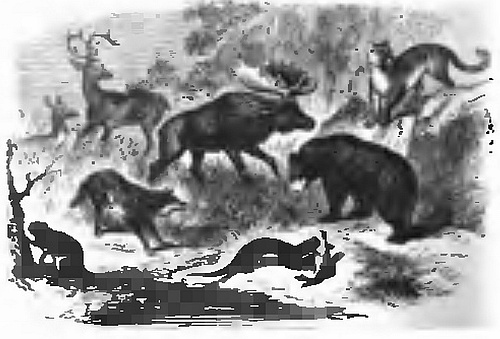
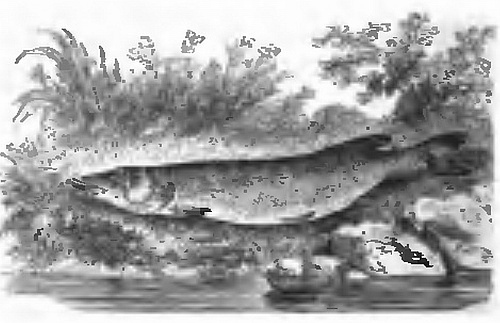
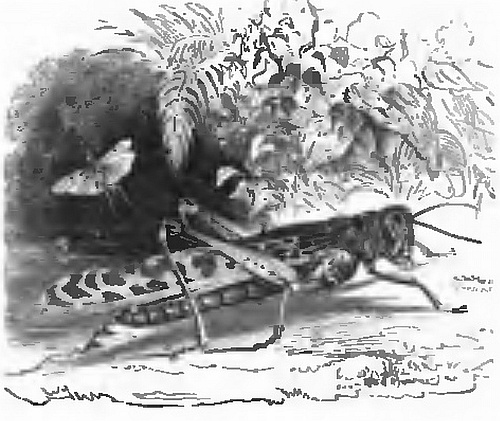
We remained here a couple of days to rest our cattle and put our carts in order, and then pushed on by the back trail due west across the prairie towards Fort Ellis. We encountered wonderfully few difficulties in our progress, though we met with not a few adventures. Everywhere rabbits were plentiful, as were all sorts of wild fowl, so that we fared sumptuously. We noticed hamming birds and locusts or grasshoppers, as they are here called, innumerable. Vast flights passed over our heads, appearing like silvery clouds in the sky. So voracious are they that they destroyed every article of clothing left on the grass. Saddles, girths, leather bags, and clothes were devoured without distinction. Ten minutes sufficed them, as some of our men found to their cost, to destroy several garments which had been carelessly left on the ground. Looking upwards at the sun as near as the light would permit, we saw the sky continually changing colour, according to the numbers in the passing clouds of insects. Opposite the sun the prevailing hue was a silver white, continually flashing. The hum produced by so many millions of wings is indescribable, sounding something like a singing in our ears. These locusts are, as may be supposed, the great enemies to the farmers of these regions—their greatest, even before early and late frosts. Fortunately they do not come every year. We fell in with a few black bears and wolves, and with red deer and elks, buffaloes, and other wild animals, so that we had plenty of fresh meat for the table, besides wild fowl and fish, amongst which is a delicious variety of pike, named by the original French Canadians, from the peculiar formation of its mouth and head, Masque-alonge, Long-face. Beavers have become almost extinct, and so have panthers; but in our fishing expeditions we found that otters were still plentiful. Our plan of encamping was somewhat different from that we adopted when voyaging in canoes. At night, our fires being lit, we assembled round them, to cook our provisions, and to escape the breeze-fly and mosquitoes and other insects which the smoke keeps away. Sending out scouts to ascertain that no Redskins were in the neighbourhood, who would steal our animals if they could, we turned them loose, knowing that they would not stray far. One night, however, one of our scouts reported that he had seen something approach the brow of the hill about two hundred yards off, and that after gazing at the encampment it had disappeared; but whether it was a two-legged or four-legged creature he could not say.
The next night, as I was going my rounds, I distinctly heard a horse neigh. This, when I reported it, with the occurrence of the previous night, made our guides sure that we were watched by Sioux, and that they would attempt to steal our horses. Our camp-fires were therefore put out, the carts placed close together, the animals brought in and tethered, and a watch set. The general opinion was, however, that no attack would be made till near dawn. Still, it would be unwise to trust to that. The horses, after a time, became restless. Ready also showed, by his low growls, that he fancied enemies were in the neighbourhood. Our half-breeds, accordingly, crawling through the grass, arranged themselves in a half-circle about seventy yards from the carts, each with his gun loaded with buck-shot. The night was dark, and not a word was spoken above a whisper. Towards morning a scout came in to report that he had heard a person or animal crossing the river—that it came near him and then passed on near the camp. On this he judged it time to follow—that it had come within thirty yards of the tents, when Ready had growled, and that then turning off it had recrossed the river. On hearing this, we became still more anxious than ever, expecting every moment an attack. When morning dawned we discovered that we had been completely surrounded by Indians; who, however, perceiving that we were on the alert and that the horses were tethered, abandoned the attempt to steal them.
This circumstance taught us the necessity for constant caution, at the same time it showed us that the Redskins could not be very desperate or blood-thirsty characters, or they would have attacked us in a far bolder manner. Some days after this our leading scout galloped in, announcing that he had come upon a large encampment of Crees near which we must pass. We closed up immediately and stood to our arms, not knowing whether the strangers would prove to be friends or foes. In the meantime we sent Stalker forward as an ambassador to announce our arrival, and to express a wish on our part to have an interview with their chief. Our envoy had not been long absent when a band of sixty Cree horsemen appeared in sight, galloping rapidly towards us—wild-looking fellows, many of them naked with the exception of the cloth and belts, and armed with bows and spears, while a few with more garments had firearms. They were headed by a gaily-dressed youth, with a spangled coat, and feathers in his hair, who announced himself as the son of the chief, and stated that he was sent forward to conduct us to their camp.
We accordingly begged him and his followers to dismount, and made them welcome with the never-failing calumet. He informed us that his tribe was engaged in buffalo hunting or rather trapping, and that they were about to construct a new pound, having filled the present one with buffalo, but had been compelled to abandon it on account of the stench which arose from the putrefying bodies; and he expressed a wish that we would watch them filling the new pound. After the young chief, whose name sounded and might I believe have been literally rendered Fistycuff, had sat smoking an hour he proposed setting out for the camp. We accordingly ordered an advance, and rode on talking pleasantly without the slightest fear of treachery. As we neared the Cree camp we saw the women employed in moving their goods, being assisted in this operation by large numbers of dogs, each dog having two poles harnessed to him, on which a load of meat, pemmican, or camp furniture was laid.
Having pitched our camp and enjoyed another official smoke, young Fistycuff invited us to see the old buffalo pound, in which during the past week they had been entrapping buffalo. We accepted the offer, and with as much dignity as if he was about to show us some delightful pleasure-grounds, he led us to a little valley, through a lane of branches of trees which are called “dead men,” to the gate or trap of the pound. The branches are called “dead,” or “silent men” rather, from the office they perform of keeping the buffalo in a straight line as they are driven towards the pound. A most horrible and disgusting sight broke upon us as we ascended the hill overlooking the pound. Within a circular fence of a hundred and twenty feet in diameter, constructed of the trunks of trees laced together with withies, and braced by outside supports, lay, tossed in every conceivable position, upwards of two hundred dead buffaloes. From old bulls to calves, animals of every description were huddled together in all the forced attitudes of a violent death. Some lay on their backs with their eyes starting from their heads, and their tongues thrust out through clotted gore. Others were impaled on the horns of the old and strong bulls, others again which had been tossed were lying with broken backs, two and three deep. The young chief and his people looked upon the dreadful and sickening scene with evident delight, and described how such and such a bull or cow had exhibited feats of wonderful strength in the death-struggle.
The flesh of many of the cows had been taken off, and was drying in the sun on stages near the tents to make pemmican. The odour was almost overpowering, and millions of large blue flesh-flies were humming and buzzing over the putrefying bodies.
After we had refreshed ourselves—as Fistycuff expressed a hope that we had done—with this spectacle, he begged that we would ride on to the new pound. It was formed in the same way. From it two lines of trees were placed, extending to a distance of four miles into the prairie, each tree being about fifty feet from the others, forming a road about two miles wide, all the mouths gradually narrowing towards the pound. Men had concealed themselves behind the trees, and the hunters having succeeded in driving a herd into the road, they rose and shook their robes on any attempt being made to break away from it. Now on came the herd rushing forward at headlong speed. Now an Indian would dart out from behind a tree and shake his robe as an animal showed an inclination to break out of the line, and as quietly again retreat. At the entrance of the pound there was a strong trunk of a tree about a foot from the ground, and on the inner side an excavation sufficiently deep to prevent the buffalo from leaping back when once in the pound. The buffaloes closed in one on the other, the space they occupied narrowing till they became one dense mass, and then, ignorant of the trap prepared for them, they leaped madly over the horizontal trunk. As soon as they had taken the fatal spring, they began to gallop round and round the ring fence, looking for a chance of escape; but with the utmost silence, the men, women, and children who stood close together surrounding the fence, held out their robes before every orifice until the whole herd was brought in. They then climbed to the top of the fence, and joined by the hunters who had closely followed the helpless buffalo, darted their spears or shot with bows or firearms at the bewildered animals, now frantic with rage and terror on finding themselves unable to escape from the narrow limits of the pound.
A great number had thus been driven in and killed, and we were about retiring from the horrid spectacle, at the risk of bringing on ourselves the contempt of our hosts, when one wary old bull espying a narrow crevice which had not been closed by the robes of those on the outside, made a furious dash and broke through the fence. In spite of the frantic efforts of the Indians to close it up again, the half-maddened survivors followed their leader, and before their impetuous career could be stopped they were galloping helter-skelter among the sand hills, with the exception of a dozen or so which were shot down by arrows or bullets as they passed along in their furious course.
In consequence of the wholesale and wanton destruction of the buffalo, an example of which we witnessed, they have greatly diminished. We were not surprised afterwards to hear the old chief say, that he remembered the time when his people were as numerous as the buffalo now are, and the buffalo were as thick as the trees of the forest. We spent two very interesting days with him, and then turned our horses’ heads towards the Red River, that we might prepare for a canoe voyage on the lakes and up the Saskatchewan, which we had resolved to make.
Chapter Seventeen.
High state of Cultivation of Settlements—Rupert’s Land—The Rapids—Lake Winnipeg—Our Bivouac—Peter nearly “drowned and dead”—How we caught Fish—The Swampies, and their mode of Fishing—An Ojibway Missionary Station—The Salt Springs—Pas Mission—Fort à la Carne.
As our object was to see as much as possible of Central British America, we sent John stalker with two of our carts laden with stores and provisions, on to Fort à la Carne, situated near the junction of the two branches of the Saskatchewan River, there to await our arrival, while we travelled back to Red River, there to embark in our canoes, and to voyage in them through Lake Winnipeg and up the North Saskatchewan. Travelling as we did with an abundance of food, and without any fear of knocking up our animals, we made rapid journeys, and were soon again at Red River. I will not stop to describe the really comfortable dwellings, the wheat-producing farms, the herds of fat cattle, and the droves of pigs we met as we approached the settlement. Neither Trevor nor I had any idea that a spot existed, so remote from the Atlantic on one side, and the Pacific on the other, containing a community possessed of so many sources of wealth. All the farmers we spoke to explained to us that they only wanted one thing, and that was a market, or in other words, settlers who would come and buy their produce.
“But if settlers come they will produce food for themselves,” remarked Trevor.
“So a few of them will,” answered the farmer. “But there will also come butchers, and bakers, and carpenters, and masons, and magistrates, and policemen, and soldiers, and numbers of other people who will produce nothing, and they will gladly buy what we have to sell. Just open up the country, sir. Make it easy for people to reach us from Canada; establish settlements from this to the westward to British Columbia, and not only we, but all who come here will be, ere long, on the fair way to wealth and prosperity.”
“Yes, sir, sure of it, certain of it,” cried Trevor. “It must become known before long, and appreciated. At least I should say so, if we were not so terribly slow to move in England. The next generation will accomplish the work if not this, that’s one comfort.”
“Small comfort to us, sir, in the meantime,” answered the farmer. “We shall be stagnating, growing old and rusty; or may be the Yankees will be beforehand and open up communication between the Atlantic and Pacific, while folks in England are only talking about it.”
“I’ll write a book as soon as I get home, and tell them all about it,” cried Trevor. “I’ll make your case known—the case of the country I should say, I’ll tell old and young—the boys of England if the men won’t listen—so that the boys may take it up when they grow older and able to act.”
The farmer shook his head, and thought that Jack was slightly cracked when he talked thus. For my own part I believe that the people of England will, before long, be made to understand the importance of the subject, though it may be said that neither Jack nor I writing about it for the rising generation will do much good, and therefore I will drop the subject and go ahead with our adventures.
We found Swiftfoot, with the rest of our men, eager to be off, and the two canoes in perfect order. I think that I mentioned that the Red River runs for two or three hundred miles, or more, from the United States territory, through Rupert’s Land, into Lake Winnipeg. For the whole of this distance it is navigable, with the exception of a portion near the mouth, where some fierce rapids exist, over which even canoes cannot pass. We consequently had to embark below these rapids. We slept for the last time in a house for many a day at the Indian settlement, and shoving off from the shore, soon passed through one of the reedy bank mouths of the Red River, into the open lake. The wind was contrary, but as there was not much of it, we paddled boldly on through the lake. It was curious to feel ourselves traversing what looked like an arm of the sea, in fabrics of a nature so frail as was that of our birch-bark canoes. What mere specks we must have appeared on the wide waters. The shore was clothed chiefly with aspens, birch and willow, and here and there bare limestone rocks appeared, the scenery having altogether a very wild and uncultivated look. There are many islands. On one of them we landed to rest and dine, intending to paddle on afterwards till it was time to camp for the night. While some of us were lighting fires, and making other preparations for a meal, Swiftfoot and three other men went out to fish, and soon returned with sufficient sturgeon, shad and bass, to feast the whole party.
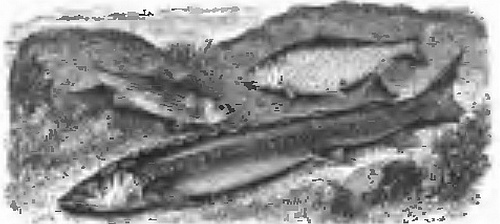
Whether at home amidst all the comforts of civilisation, or out in the uncultivated wilds still almost untrodden by man, a good dinner is a pleasant and soothing thing, and little do I envy that person whose heart is dead to gratitude to the great Giver for the gift. Here in the wilderness, His oxen covering a thousand hills, and delicious fowl and fish daily furnishing our meal, we never separated from table without sending up thanks to Him in simple words.
Refreshed in mind and body, away we went at a great rate before the breeze, with our square sail of cotton set. The Indians make their sails of the same material that they do their canoes, of birch-bark. It will not stand a heavy gale, neither will their canoes, so they always keep in harbour, or rather hauled up high and dry on such occasions. Lake Winnipeg is like a wasp’s body, very narrow in one port and broad at the ends. It runs north-west and south-east, and is about two hundred and eighty miles long, and fifty-seven broad, at its widest part. Our course was along the centre of the widest part of the southern end. With a bright moon, not to lose the favourable breeze, we ran on all night, eager to reach the mouth of the Saskatchewan, which it is possible to do from Red River in three days, and which will be done regularly when steamers are placed on the lake. What very unromantic and common-place ideas—steamers and Red Indians, and the far-west and cornfields!—the truth is, that romance is disappearing before the march of civilisation; however, no fear but that we should meet with adventures before long. After passing the narrow part of the lake we were paddling on towards evening in the hopes of gaining an island, where it was proposed that we should camp. The sky had been clear but clouds began to appear in the north-east, increasing quickly in numbers till they covered the sky, and a heavy swell rolled in towards us, such as would not be thought much of by those on board the Great Eastern, but which to us, embarked in frail bark canoes, was somewhat formidable; and then foaming waves arose and tossed us about till we expected every moment that the canoes would be upset. We paddled on with all our might against the fast rising gale to reach the shelter of the island, which we saw in the far distance.
The matter was growing serious, for every instant the waves were increasing in height. It seemed scarcely possible that our light canoes could float much longer. The force of the water alone was sufficient to crumple them up. Peter looked very pale, but said nothing, and baled away perseveringly, while our voyageurs paddled bravely on, facing the danger like men. Now we rose on the top of a huge sea foaming and bubbling and curling round us, and then down we sank again in the hollow, and it appeared that the next sea which we saw rolling on fierce and angry must overwhelm us, and so it would had we stayed where we were, but our buoyant canoes rose up the watery hill, and there we were on the top ready to plunge down on the other side. It was an anxious time. An accident to one canoe would have proved the destruction of both, for unless we had deserted our companions, in attempting to save them both would probably have perished. Our only chance would have been to throw all the lading out of the canoes and to cling on to them till we might be washed on shore. All we could feel was that, by dint of great exertions, we were making progress towards the island. We encouraged each other also by guessing how many yards we had made during each ten minutes. More than once I thought that we should go down, and at length a sea higher than its predecessors came rolling on, and I heard Trevor’s voice cry out that the canoe was filling and that they were sinking, urging us to paddle on and not to attempt to save them. I looked round—they had disappeared—my heart sank—we were leading, we could not have turned back without certain destruction—our only chance was to keep working away head to wind. I knew that, yet I longed to make an attempt to rescue my friend and his companions. I dared not look back. I thought that I should see them struggling in the waves, and yet not be able to stretch out a hand to help them. Presently I heard a voice. It was Jack’s—in cheery tones singing out—
“All right, Jolly; we’ve got rid of our ballast and will soon be up with you.”
I was thankful, indeed, to hear him, and little heeded the loss of the lading of which he spoke; though, as it consisted chiefly of our provisions, it was a serious matter. I did look round for an instant, and then he was paddling on as if nothing had been the matter. Still, we had a long way to go and darkness was coming on. My motto has always been “persevere—never give in while life remains.” So we paddled on. I had begun to fear, however, that we should never reach the island, when, on our port bow, as a sailor would say, appeared some low shrubs growing out of, not the water, but a sandbank which the dancing waves had before prevented us seeing. Had we gone on a few minutes longer and been driven on it to windward, though we might, for the moment, have escaped with our lives, our canoes must have been dashed in pieces and all our store and provisions destroyed and lost. I pointed it out to Trevor just in time; and now allowing our canoes to drop astern a little we found ourselves in comparatively smooth water, under the lee of the bank. Rather than risk proceeding further, especially as the channel between the bank and the island was rougher than any part, we agreed to land.
In a strong boat this is an easy matter, but a stone or a branch may drive a hole in an instant through a thin birch canoe. As soon, therefore, as we neared the shore we jumped out and lifted our canoes on to firm ground. I will not call it dry, for the spray completely covered it. Still we had reason to be thankful that we had escaped the great danger to which we had been exposed. We had very little light left us, but we picked out the highest and driest spot among the bushes we could find, though neither very high nor very dry, and there we managed to camp. We had no hopes of keeping our tent standing, and, indeed, before we could light a fire it was necessary to construct a screen to protect it from the wind. This we did with some sticks and birch-bark and shrubs washed on shore, and under it we all crouched down to try and dry our wet garments—when we had, after no little trouble, lighted our fire. The only wood we could get to burn was found under bushes and other sheltered places. Our crews were greatly fatigued with their exertions, and wrapping themselves up in their buffalo robes, they were soon asleep, as was Peter. Trevor and I also being very tired were preparing to follow their example—indeed, in spite of the storm, we could scarcely keep awake. We made up our fire as well as we could, hoping that it would continue burning till somebody awoke to replenish it. We persuaded ourselves that it was useless to keep watch, as no hostile Indians could approach us; nor could any wild beasts; our canoes were secured, and the fire was so placed that it could not injure us.
“Good night, old fellow,” said Trevor, drowsily. “Wake me when the storm is over, for we shall not be able to move till then.”
“Of course,” said I. “But if you wake first rouse me up.”
“Oh, yes. I say, Har—that’s it—just what—”
Trevor’s attempt to speak more failed him—or, at all events, I did not hear him, and we were both asleep. In my sleep, however, I heard the storm raging and the water dashing against the sandbank. Suddenly I was conscious that I was lifted from the ground—there was a hissing noise, and I felt very cold. I sprang to my feet, shouting out to the rest of the party, who were soon spluttering and jumping and crying out, not knowing what had happened or was going to happen. I very quickly guessed; a wave had broken over the bank, and as yet we could not discover who or what it had carried off, as it had completely extinguished the fire. I shouted out, demanding if all hands were there. Trevor, Swiftfoot, Pierre Garoupe, and the other voyageurs answered; but Peter made no reply. Again I shouted—no one answered. We felt for the spot where he had lain, but he was not there.
“Poor fellow, he must be lost!” I exclaimed.
Just then I heard a cry, and Ready, who had disappeared, gave a bark. Guided by the sound, I stumbled on to the spot, and there, caught in a bush and half in the water, I found a human being whom I recognised as Peter, from his exclamation—
“Oh, sir, we shall all be drowned and dead!”
With considerable exertion I managed to drag him up to the top of the bank again; and it was some time before he recovered. Some of the party ran to the canoes—they were safe as yet—but the storm was raging more furiously than ever, and should another wave wash over our bank they might be carried bodily away, when, unless seen by passing Indians, we should be left to starve.
To light another fire was impossible, as by this time all the wood around was thoroughly saturated. So there we sat or stood the livelong night, holding on to bushes or to paddles or other pieces of wood stuck in the ground to enable us to resist any other wave which should be driven over the bank. I have passed several disagreeable nights in my life, but that was one of the most disagreeable. All I can say is that it might have been worse. I would rather have been there than racked with pain on a bed of sickness—or on an iceberg—or in an open boat in the South Pacific, parched with thirst—or in a dungeon, or in many other disagreeable places. So we sat quiet, and tried to amuse ourselves by talking. Wet damps the pipes, I have observed, of the most determined songster or whistler; so that although two or three of us began a tune, it speedily stopped.
The storm raged as furiously as ever, the waves coming one after the other rolling up the bank; and, as we watched them, it appeared as if each successive one must advance beyond its predecessors and sweep us away. Poor Peter, after his former experience, was very much alarmed.
“Here it comes again, sir; here it comes. ’Twill be all over with us!” he cried out, as a huge roller capped with foam, looking vastly higher than it really was, came onwards towards the bank. It struck the solid ground, which it palpably shook. Then on it came, curling over, up, up, up. The water reached us; we sprang to our feet, holding each other’s hands and bending forward to resist its power united to the fury of the wind. It scarcely, however, reached to our ankles. While some of the mass rushed over the bank, the greater part flowed back, to be again hurled forward yet with diminished strength against the opposing barrier.
The dawn will come in spite of the darkness of the longest night; and as this was a short one, we were agreeably surprised to find it breaking, though, in the uncertain light, the waters looked more foaming and agitated than they appeared to be when the day was more advanced.
Gradually, too, the wind fell, the rollers ceased to strike the bank with their former fury, and though after a storm on the ocean days pass before it becomes calm, scarcely had the wind dropped than the surface of the lake became proportionately smooth. The sun came out, and its powerful rays dried our clothes and sticks sufficient to boil our kettle. After a hearty breakfast, we repaired our canoes with fresh gum, and continued our voyage.
As Trevor had been compelled to throw overboard so much of our provisions, we were anxious to secure some more to prevent the necessity of sending back to Red River. Swiftfoot told us of a river near at hand where large quantities of fine fish can always be caught—the Jack-fish River. Towards it we steered, and, after proceeding up a little way, came upon a weir, or “basket,” as it is called, erected across it by the Indians. It was much broken; but a number of Turkey buzzards hovered around, ready to pounce on any fish which might get into it. Our Indians immediately set to work to repair it. Indians, like other savages, are very industrious when hungry, and idle in the extreme when their appetites are satisfied. Our fellows were, fortunately for us, hungry, and so they worked with a will. The weir consisted of a fence of poles stretching completely across the river and doping in the direction of the current, so that the water could pass freely through. On one side there was an opening in this palisade, near the bank, about a yard in width, leading into a rectangular box with a grated bottom sloping upwards, through which the water flowed with perfect ease. The fish in the day-time see the weir, and either swim back or jump over it; but at night, hoping to avoid it, they dart through the opening, not observing the impediment beyond. Swimming on, they at length find themselves high and dry on the upper part of the grated trap or pound. The fisherman sits by the side of it with a wooden mallet in his hand, with which he knocks the larger fish on the head as they appear, and then pitches them out on the bank to be in readiness for his squaw, who appears in the morning to clean and cut them up.