The Pursuit—The Fight and Victory—We dispose of our Prisoners—The Black Dwarf—The City of Themistocles—We part Company—I go with Peter and Ready aboard the wondrous Highflier. (continued 2)
Reading edition
We now rode back to join our friends, anxious to hear an account of their adventures. The field was strewed on every side with dead bodies of Indians. We had killed nearly thirty, while two of our own men had fallen and four had been wounded. On reaching the hill we were warmly greeted by our friends, whose haggard looks told the sufferings they had endured, even before they had time to describe them. They had, it appeared, day after day, perseveringly pursued the enemy, whose traces they were on, but with whom they could not manage to come up. At length they got within four or five miles of them, and began to entertain hopes of surprising their camp. Preparations were made, and they were actually advancing to the attack when the scouts brought in word that the Indians had disappeared. They were now well into the Indian territory, and it was necessary to advance with the greatest caution. They were in the neighbourhood of the hill where we found them, when the scouts brought word that, at a short distance off, there was a large camp of Indians containing a number of warriors, quite capable of overwhelming them. It might have been wiser to retreat, but instead of doing that they at once rode up to the top of the hill, and began throwing up fortifications from such materials as were at hand. While some were thus employed, others remained in the plain to cut forage for their horses. They themselves had but food sufficient, on reduced rations, for a week or ten days. Their scouts meantime were watching the camp of the enemy, in case any opportunity might occur for rescuing the prisoners. They soon ascertained that their hopes on this score were vain, for preparations were seen to be making for the usual mode by which the Indians torture and then execute their prisoners. Two unfortunate men were thus destroyed the next day, and on the following two more were killed. It was proposed by some of the more daring of the party to attack the camp at this period, and I think that the attempt might have been successful, but the counsels of the timid prevailed. The consequence was that two of their scouts were caught and scalped, and they found themselves closely beset by the enemy. In this condition they had remained day after day, surrounded by such overwhelming numbers that they had no hopes of cutting their way out. The forage collected for the horses was soon consumed, and, one after the other, most of the animals died. They soon, too, had to kill more for the sake of supplying themselves with food. They had now no means of escaping, and they had made up their minds to fight to the last, and to sell their lives dearly unless relieved. Several of their number had fallen, but fewer than might have been expected.
Attacked day and night, their provisions entirely expended, with the exception of a little putrid horse-flesh, our friends were on the point of rushing out against the enemy to perish in the fight, when we were seen charging down on the enemy. Never did succour more opportunely reach a hard-pressed garrison. What was next to be done was now the question. A number of the Indian horses were still scampering about, and fortunately the greater portion were captured. We were thus able to mount all the heavier men of the party, while the stronger horses were made to carry two men each. As the day was drawing to a close before all our arrangements were made, we resolved to camp on the hill, where we could defend ourselves, rather than risk a march at night, when we might be attacked to disadvantage. Having lighted our fires, attended to our wounded, cooked our provisions, and made ourselves as comfortable as circumstances would allow, we sent our scouts as usual to give notice of the approach of an enemy. Though the Indians had been signally defeated, they still mustered we knew in the neighbourhood in numbers so overwhelming, that we could scarcely expect they would not make another attack on us. I felt the responsibilities of my office, and could not rest, in spite of the fatigue I had gone through, more than a few minutes at a time. I rose several times during the night, and, accompanied by Ready, climbed to the top of a rock on the brow of a hill, whence I could look out on the wide extent of open country, which, with the exception of small spaces covered by woods, stretched around. Not a sound, however, was to be heard: there was not a sign, that I could discover, of a foe near us. I regretted that our expedition had not proved more successful. We had relieved our friends and gained a victory, but another important object was not attained. We had not recovered any prisoners, and the poor young girl, in whose fate I had become interested, was still a captive in the hands of the savages. Again I awoke and went to the rock. A few streaks of light were appearing in the east, and grey dawn was stealing over the landscape.
It was time to arouse the camp, and to commence our journey, unless our scouts brought in such information as might lead us to hope that we might recover any survivors among the prisoners, either by force or negotiation. I was about to utter the usual shout to awaken the sleepers, when my eye was attracted by an object moving in the distance over the plain. What it was I could not tell, till it resolved itself into a horseman galloping at full speed towards us. Presently, as the light increased, I observed some other objects still further off, moving at like speed, and which I took to be other horsemen, very probably pursuing the first. The first was seeking us—of that there could be little doubt. Not a moment was to be lost; I shouted loudly to my companions, ordering them to mount their steeds, and follow me. Peter had run for my horse, which was picketed near. I dashed down the hill; about a dozen men followed me closely. I galloped on. The long locks of the seeming horseman, streaming in the wind, told me that a woman was approaching, while almost close behind her came eight or ten savages with their lances in rest, intent on her destruction. This made me the more eager to place myself between the lady and her pursuers. My men came on in good order, while others were hastening down the hill to their support. The stranger was fair and young. We opened our ranks to let her pass, pointing to our friends behind, and then spurred on against the Indians. Seeing that their prey had escaped them, they turned and galloped off. We sent some shots after them, and two fell dead from their saddles. The rest we pursued for some distance; but, unwilling to tire our horses, and aware of the danger of getting far from our main body, we allowed them to escape, and returned towards the hill. We found a group at the foot of it. They were surrounding the fugitive, who was no other than the young girl of whom we were in search. She had fainted when she found herself in safety among her friends. After a little time, however, she recovered, and was able to give an account of the fate of her companions. Every one of them had been tortured and murdered. She had stolen out of the tent of the chiefs in which she had been confined, and, mounting the fleetest mustang of his stud, had made her escape.
There was now no reason for our remaining in the neighbourhood. We reached the settlement without any further adventure, when I had the satisfaction of restoring the young girl to her friends, and receiving their thanks.
Chapter Nine.
I determine to return to New Orleans—A drunken Captain—Sam Snag, the Mulatto Mate—A Hurricane and Wreck—A Night of Horrors.
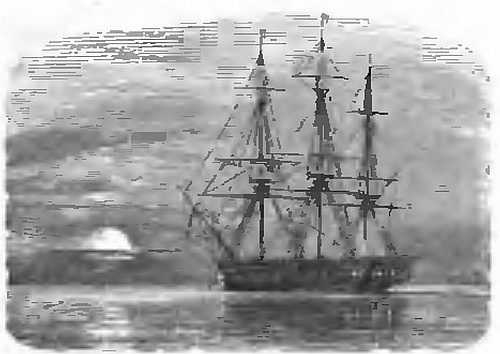
I had seen enough of life in the outskirts of Texas to satisfy me for the present, and as I had gone there, not from choice, but because it was the country I could most easily reach when it was necessary to run away from New Orleans, I felt that I could beat a retreat without loss of self-respect. Therefore, accompanied by Peter and Ready, I returned by the way I had come, without any adventure worthy of note, to Galveston.
I found a vessel, the Weathercock, Captain Parsons, sailing immediately for New Orleans, and, in an unfortunate moment, as it proved, took my passage in her. I supposed that after the lapse of so many months I should no longer be recognised in New Orleans, and having purposed to push up the Mississippi to its sources, I did not like to be baulked, and so determined to chance it. Ready was evidently pleased at finding himself again on salt water, but poor Peter was very uncomfortable.
“I hope we shan’t fall in with them black fellows as cut all our throats afore,” he remarked, as he gazed on the fast-receding land. “I do wish, sir, you’d tramp it back overland to Old England.”
Peter’s knowledge of geography was very limited, and I thought it scarcely worth while to explain to him that he proposed an impossibility.
“It would be a long tramp, even if there were a bridge; but as there is no bridge just now, nor likely to be for some time, we must e’en go back as we came,” said I. “But as we’ve a good many more places to see first, I cannot promise you a sight of the white cliffs of Old England for some long time to come, Peter. However, if you are afraid to go on, I will either find you employment in America, or put you on board the first homeward-bound ship we fall in with.”
Peter looked up at me with a half-reproachful glance as he answered—
“No, no, sir. You wouldn’t wish me to go and take service with any strangers in these foreign parts; and in the old country there’s no home for me now—all those who made it home are gone. No, no, sir, you’d not wish me to leave you.”
“Certainly not, my lad; but I thought that you might be afraid of going on,” I remarked.
“Afraid when I am with you, sir!” he exclaimed, in a tone which showed how much his feelings were hurt at the supposition. “No, no, sir; I’ll stick by you through thick and thin, now and ever, till you turn me away.”
I was sure that Peter felt what he said, and setting as I do a high value on a faithful friend, however humble he may be, I assured him that he need be under no apprehension that I should part with him without his consent.
This tranquillised him, and he seemed at once to become reconciled to his life on the heaving wave.
I soon discovered that the Weathercock was far from deserving the character which her agents gave her of a fine clipper sea-boat, and that Captain Parsons was a different sort of person to what he had been described. He was not drunk when he came on board, but he very soon got so; and if he turned out sober in the morning, he took care very quickly to reduce himself to a condition of utter indifference to all sublunary affairs. As may be supposed, therefore, he did not make a very direct course for his destination.
While the weather remained fine, this did not so much signify, as a day or two more at sea was of little consequence to me, and I knew that we could not well miss the yellow water at the mouth of the Mississippi; but should it come on to blow—no impossible contingency—we should, I saw, be placed in a very unpleasant predicament. Still there was no help for it; the skipper would not have put back had I asked him, but very likely, in a drunken fit, might have blown my brains out, or pitched Peter overboard.
The mate was likely to prove a more formidable opponent. He was a huge Mulatto, with a villainous expression of countenance. From my first stepping on board, he seemed to have taken a dislike to me. It might have been because he saw that I was a man not likely to stand nonsense. He dared not show it to me, however; but whenever he had an opportunity, I saw that he gave Peter a cuff and Ready a kick, which, as may be supposed, secured the latter as an enemy, though poor Peter was too kind-hearted to indulge in ill-feeling towards any human being. Sam Snag, the fellow was called, and he tyrannised over the crew, who dared not disobey his least command, and even the captain held him in awe, and disliked him; but they were necessary to each other. Sam Snag, though a good seaman, knew nothing of navigation, and therefore could not get the command of a vessel, and so he had to ship as mate, and preferred serving with a man like Parsons, whom he could govern, rather than with one who would govern him.
Why the mate had allowed the captain to get as drunk as he was puzzled me. I could not help suspecting that he had some sinister object in view.
Three days had passed since we left Galveston, and the only notable fact with regard to our navigation was, that, though we had lost sight of the land, we had made very little progress. There lay the vessel on the glassy shining sea, her sails flapping idly, but with now and then loud reports, against the masts. The captain was perfectly contented, and rather amiably-disposed towards me; for, as he sat in his little hot, stifling cabin—the atmosphere of which could not have been much under a hundred degrees—he sent his boy to ask me to come and liquor with him, and began to be very abusive when I declined the honour.
“That sneaking, white-haired, milksop of a Britisher—what business has he to refuse my civilities, I should like to know? It’s his natural pride, I guess, but I’ll pull it down a peg or two before I’ve done with him, I guess,” I heard him muttering as I sat reading on deck near the skylight under the shade of the mainsail.
He continued to drink and growl on, and as he got more and more drunk, he confused me with Snag, and abused both of us. From the language he occasionally used, and one or two expressions he let fall, I suspected that the unhappy man had fallen from a higher position in society to that which he now occupied. Now he quoted a line of Latin or Greek, and now he spoke in some Oriental language, Hindostanee or Arabic, I fancied, and swore in it fiercely, and then gave way to fits of idiotic laughter. Yes, I was certain that man had ranked as a gentleman, and now in appearance and manners he was the veriest brute under the sun.
“That’s what drink has done for him,” I said to myself: “or crime, and then drink to drown conscience; or probably drink produced the crime, and then, instead of repentance, came the more drink, that he might try and forget the crime. I am not in a pleasant position with the companionship of a set of ruffians. However, I have been in many a scrape before, and have got out of them. I hope that I may get out of this as well as I have done out of others.”
As the day grew on, however, I became more anxious. The heat increased until it became almost unnatural and utterly insupportable, and the sky assumed a lurid, brazen hue, which struck me as indicative of an approaching hurricane, or a gale of some sort. I observed the seamen casting anxious glances every now and then at the horizon, but no move was made among them to do anything; the mate was below asleep, and the master was too drunk by this time to know whether the sky was copper-colour, black, or blue, or to care what might become of the ship and all on board.
At last, having thought over all the descriptions I had read of hurricanes, I myself began to grow uneasy, and resolved to summon the mate, though I knew that I ran the risk of a quarrel in consequence. I put my head down the companion-hatch, and called out his name two or three times. The stifling air which came up from below made me unwilling to descend. The mate did not reply. He must be sleeping very soundly, I thought, or else he does not choose to answer. Peter, finding he did not appear, without my leave sprang down below, saying, as he did so, “I’ll rouse him up a bit, sir.”
“I say, mate—Mister Snag—wake up, will you? Wake up, Mister Snag,” I heard him sing out.
There was no reply for a minute, and then came a cry of pain and terror, and poor Peter reappeared faster than he had gone down, with an expression of alarm on his countenance, followed by the mate, who had a thick colt in his hand, with which he was accustomed to belabour any of the crew who offended him.
“For what you make all dat row?” he exclaimed fiercely, turning to me with a threatening gesture.
“To wake you up, and remind you of your duty,” I answered, in as calm a tone as I could command. “Look out there; what do you say to that sky?”
The mate gave a hurried glance round the horizon. He did not answer me, but he shouted—
“Aloft, all of ye! Furl the topsails. Let fly topgallants sheets. Here, you—Britisher, go to the helm, and do as I bid you. You, white boy, stand by those ropes.”
There was no time for further orders. The men flew aloft. They knew what ought to be done; but before they could do it the hurricane burst us. With desperate energy they attempted to gather in the furiously flapping canvas. As Snag directed I turned round the spokes of the wheel, and as the ship’s head was providentially pointing in the direction towards which the hurricane blew, away she flew before it, like a bird just escaping from the nets of the fowler. Had this not been the case, she would probably have instantly been thrown on her beam-ends. I had to exert all my strength to turn the wheel. I kept my eye on Snag, for not a word could I hear, as he rushed from rope to rope, hauling away with Peter on some, and letting go others.
The sails flapped and struggled with claps like thunder, as the blast caught them, till the vexed canvas tore itself out of the bolt-ropes. The masts bent and trembled, the yards strained and cracked. I looked up for a moment; I knew that the poor fellows aloft were in instant peril of their lives. They clung desperately to the yielding yards—clung for their lives—for the rent sails lashed furiously round them, and they scarcely dared to loose their hold for an instant to move in towards the masts. Most of them had lost their hats or caps, their hair was streaming out, their eyeballs starting from their heads.
A wild shriek reached my ears, even through the terrific din of the tempest. I caught a glimpse of the outer man on the fore-topsail-yard as the leech of the sail, torn to ribbons, coiled itself like some huge serpent round him, and tore him from his hold. In vain he tried to regain his hold, in vain to extricate himself—no human power could avail him. Helplessly he stretched out his arms; the fierce wind unloosened the coil of canvas, and, though grasping at a rope which eluded his hand, he was flung into the seething waters through which the brig was rushing onwards. For one instant I caught a sight of his countenance, as, still desperately struggling for life, he dropped astern, while the vessel flew by him. The mate saw what had happened, but took not the slightest notice. I thought Peter would have jumped overboard in his eagerness to try and save the man. He threw a rope, but it was utterly useless. Even had the poor wretch caught it, it would have been torn out of his hands. When Peter was certain that the man was hopelessly lost, I saw him wring his hands in sorrow, and he was evidently giving utterance to his feelings in words, though what he said of course I could not hear.
Even the gale did not bring the wretched master to his senses, but I fancied that I could hear him singing, or rather howling away in his drunken madness, keeping up a wild concert with the creaking of the bulkheads, the rattling of the blocks, the whistling of the wind through the rigging, and the loud roar of the rising seas, as they dashed against the sides of the vessel. The mate, to do him justice, was the only man of the whole crew who remained calm and collected. How he might have behaved aloft I do not know; still I think he would have been the same. He soon saw that it was impossible for the men to furl the canvas—or, rather, that there was no canvas left for them to furl. He made a signal to them to come down off the yards. It was not given too soon. Some obeyed, and slid down on deck, but before the last two on the main topsail-yard were off it, the main-top mast, which had already been bending ready to crack, gave way and went over the side, carrying the rigging, and the yard, and the two men on it, overboard. They were not shaken off, but still they clung with all the energy of despair to the spar. It was but for a moment. There were several loud cracks, some ropes gave way, the bolts which secured the shrouds to the side were drawn, and the whole mass of rigging, parting from the side, floated astern. In vain the men shrieked for help; in vain they held out their hands to us imploringly; no help could be given them, their fate might presently be ours.
The next minute the fore-topmasts went over the side, and the fore-yard came down with a crash on deck, carrying away the bulwarks, and crushing a man who had just descended from aloft, and thought he was in safety. There he lay writhing under it, and unable to extricate himself. I would have hurried to his assistance, but I dared not leave the helm, and Snag and the other men were so engaged in clearing the rest of the wreck, that they could make no attempt to lift up the yard so as to release him. It was dreadful to watch the poor fellow, as, with the movement of the ship, the heavy yard rolled on his broken limbs, inflicting the most excruciating torture. He shrieked out in his agony, entreating his companions either to release him or to put an end to his sufferings with a crowbar—so Peter told me, for his voice was borne far away from me on the wings of the hurricane. Peter, as soon as he saw what had occurred, in spite of the gestures of the mate ordering him to remain where he was, hurried forward. Still his whole strength could not, of course, move the spar; but getting hold of a handspike, he was able to prevent it from rolling over the man as often as before. Every moment the sea was rising, and as the vessel pitched more and more, the difficulty of keeping the yard off the man became greater.
At last the wreck, by means of axes and knives was cleared, and the mate had no longer on excuse for neglecting the seaman who lay under the yard. With careless indifference he directed the other men how to lift the spar so as to drag out the sufferer.
“He’s of no further use,” he exclaimed (so Peter told me) when he saw the injury the man had received. “May as well heave him overboard at once. We can’t mend broken legs here.”
“Oh, no; no, don’t now!” shrieked the poor wretch, who was probably not aware of the extent to which he was hurt. “I shall soon be well. I’ll work; I’ll work. Oh spare me!—spare! I am not fit to die! I’ll get well and work. Will nobody save me? I can’t die; I mustn’t die!”
“That’s what many more say, but it’s of no use,” growled out the mate.
Peter told me that on hearing this he could not help saying:
“Well, if you throw that poor fellow overboard while he’s got life in him, you may as well throw me and my master; for as sure as ever we get into port, we’ll go and tell the magistrate of you.”
The mate, with a look of surprise, gave a scornful laugh, but allowed Peter to draw the wounded man on one side, while he and the crew secured the spar, and passed life-lines forward where the bulwarks had been carried away.
I witnessed all that was taking place from my post aft, and as the mate saw that I could steer the vessel properly, he did not think fit to relieve me. I shouted to him over and over again to send a hand to the helm, but he either did not, or would not, hear me. As to where I was steering I had little conception. All I knew was that I was keeping the ship’s head away from the wind, for I had not thought of looking at the compass at first, and a block had fallen from aloft and broken in the binnacle.
The mate, I knew, was as ignorant as I was, and should the master not recover his senses, I suspected that we should have some difficulty in finding our way to New Orleans. There was a vast deal still to be done in getting the ship as much to rights as circumstances would allow, and, to do the mate justice, he worked himself, and made all under him work also.
On the ship flew under the bare stumps of the masts—they, I expected, would go next, as there were no shrouds to support them. The tortured, foaming waters rose higher and higher as the hurricane increased in strength and had longer time to affect them; and the higher the seas rose, the more the ship laboured, and the more difficult it was to steer, till my arms ached with the exertion, and I felt that if not relieved I must leave my post.
I shouted—I beckoned—to Snag, but though I was certain he saw me, he took no notice of my signs. At last Peter found his way to me, not without difficulty, and I sent him forward to summon one of the crew. The mate guessed his errand, and received him with a kick, and an order to tell me to remain where I was and make myself useful. Life is sweet, and we cling to it as long as we can; or otherwise, under the belief that the ship was hurrying to destruction, I should have thrown myself on deck, and let her broach to, which would probably at once have brought about the catastrophe. I was directing Peter to go back and help the poor wounded man, to drag him aft, if possible, and to get him down below, when there was a cry from forward. A huge sea came rolling up alongside, and (whether or not from my bad steering, I do not know) it broke on board, and, sweeping across the fore part of the deck, carried in its grasp all it reached. Two of the crew could be seen for an instant battling with the foaming seas, as if there was a possibility of their regaining the ship.
When once more the deck was free of water, the poor wounded man had disappeared. “He was surely taken in mercy, for his sufferings would otherwise have been fearful,” I said to myself. I was now glad to get Peter’s assistance, which he willingly gave; while honest Ready lay at my feet, looking up every now and then into my face, and saying in his own peculiar language, “Master, I wish that I could help you; but I couldn’t, I know—not if I was to try ever so much.” But Ready could be of use, even on board ship. Another huge sea came up, and this time, striking the quarters, it deluged the whole after-part of the vessel. I clung to the wheel, but Peter, less prepared, lost his hold of the wheel, and was carried away. Ready, instantly comprehending his danger, dashed after him, and seizing on the leg of his trousers as he lay thrown on his back, with the certainty of either being washed overboard or drowned in the lee-scuppers, dragged him up out of the water, and held him tight, till at length the mate, if not for my sake, for that of the ship, came aft to the wheel, and I was able to go to the rescue of my faithful follower.
Snag, though unconcerned for the loss of our companions, could not conceal from himself the danger we were in, and the probability that before long their fate would overtake him. He was as fierce and sulky-looking as before; but he said nothing, and I made no mark calculated to provoke his anger. The crew had done all that was possible for the safety of the ship, and the remnant now gathered under the after-bulwarks, awaiting what was next to happen.
The hatches had been put on, or they might possibly have gone below and turned into their berths—there to await their fate, as I have known seamen do. Night was coming on; but even that could scarcely add to the horrors of our position, except that perhaps darkness might render steering more difficult. As the mate stood alone at the helm in the gloom of evening, his hair, which was long, streaming in the wind, his neck bare, his dark countenance expressive of fierce and bad passions, his tall figure, the upper part of which was scarcely hid by the shirt—the only garment he wore besides his loose trousers—I thought that I had never seen a more perfect impersonification of some evil spirit. I scarcely, even now, like to recall the horrors of that night: the last sight on which my eyes rested was that demon-looking man steering the shattered vessel—amid the howling of the winds, the roaring of the seas—as it appeared, to inevitable destruction. Peter, Ready, and I crouched together under the bulwarks, holding on by lines secured to ring-bolts in the deck, and drenched by the seas which were constantly breaking over us. The darkness increased till it was impossible to see across the deck; nor could I even distinguish those nearest to me. The roaring waters continued sounding in my ears: frequently I felt myself under them as they broke over the ship; again I felt as if I could not possibly hold on longer, but with desperation I clutched the rope as the seas washed by, and had to be thankful that I had for the moment escaped the death which threatened me. Peter’s shout, close to my ear, of “All right, sir,” assured me that he and Ready had also escaped; for both were hanging on to the same rope, the latter holding it by his teeth with might and main, evidently as sensible as we were of the perilous position in which we were placed.
Hour after hour passed by, and no change occurred in the dreary monotony of that night of horror. I think that I must have dropped asleep for an instant, strange as that may seem; for a feeling of indifference as to what might happen had stolen over me, and unconsciousness of the present, when I was startled by the cry of “She’s sprung a leak!—she’s sinking! We are lost—we are lost!”
The voice of the mate was heard, even above the hurricane. “Lost! Who says we’re lost?” he shouted. “We shall not be lost if you’ll work like men. All hands to the pumps!”
The dismasted vessel flew on as rapidly as before through the foaming, tossing seas. The crew laboured at the pumps, the mate swearing furiously at them, when, as at times, they stopped to rest. Then again they pumped away till one of them cried out, in a tone of obstinate despair:
“The leak is gaining on us; we can pump no more.” Again the mate swore, and threatened them with death if they did not persist.
Suddenly, while the mate and the crew together were shouting and swearing at each other, there came a fearful crash; the ship trembled in every timber; another and another crash followed; the roaring sea washed over the vessel; now she lifted, and then down she came with yet more fearful force than before, and every plank and timber seemed rent asunder.
Chapter Ten.
I cling to a part of the Wreck, and am tossed in the Sea—Peter and Ready are also saved—I improvise a Raft, and get Peter and Ready aboard—We reach an uninhabited Island—Sam Snag and another also reach land—Friends or Foes?—Water! Water!—We land a Cask and find it Claret—Ready discovers a Spring—The Mate wants Meat, and means to eat us.
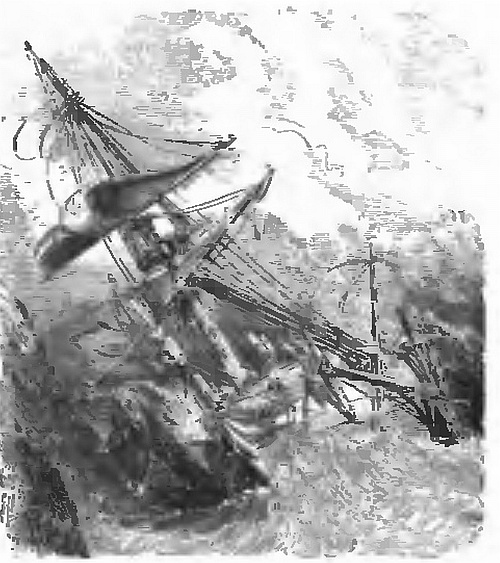
My impulse—and I followed it—was to cling fast to the ring-bolt to which I was holding on when the ship struck. I heard a few piercing shrieks, some faint cries followed, and then all was silent. I felt that the vessel was breaking up, and plank after plank was torn away, till I judged that but a small portion of the wreck remained for me to hold to. I urged poor Peter to hold on tight to the last, and scarcely had I uttered the words than the remainder of the vessel was rent asunder, and I found myself floating alone on the plank through which the ring-bolt was run. I shouted to Peter—there was no answer; I called Ready, but, for the first time since his puppyhood, he did not reply. I felt very forlorn as I was tossed up and down in the darkness amid that raging sea, with a sensation of down-heartedness which I had never before experienced. The planks forming the part of the deck to which I clung seemed to hold well together, so that I was under no expectation of immediate destruction, and that fact gave me time to think more of the loss of my two faithful companions.
I was convinced that daylight must soon come, and I hoped then to be able to ascertain how near to land I was. I supposed that the vessel had struck on a coral reef, and that it formed a barrier or outside reef to some island, or islet, such as is common in those seas. I was confirmed in this belief from finding the sea so much calmer than it had been, judging by the comparatively easy movements of my raft. I wished and wished for day, and though the wishing did not bring it, it came at last—a grey, cold dawn at first; but as the sun rose, the wind fell, the black vapours cleared away, the blue sky appeared, and now—the raft floating so calmly that I was able to stand up on it—I saw, rising at no great distance above, a yellow sandy beach, a grove of cocoa-nut palms, bananas, and other trees of the tropics. On the opposite side, a line of breakers, showing the position of the reef, outside which the sea still tossed and tumbled from the effects of the hurricane. Portions of the wreck, too, were floating about in the smooth water, and as I looked I saw that something was moving on one of them. I waved and shouted to draw attention to myself. A figure rose up and waved in return, and a faint bark reached my ear. Even at that distance my faithful Ready recognised me. I was indeed thankful that Peter and he had been thus far saved, though, as we were still some distance from the shore, we might both be starved before we could reach it. I could have swam to it with perfect ease, but I knew too much of the black fins of those seas to risk myself in the water, especially as I suspected that the monsters must have had their thirst for blood freshened by the meal they must have had off some of my late shipmates.
I longed to be able to communicate with poor Peter, but it seemed impossible that I could reach him. As the sun rose the hurricane completely ceased, and the water inside the reef became so perfectly smooth, that I could not only stand upright but could walk about. As I was doing so I saw, not far off, a boat’s oar, and a little beyond it what I took to be a mast, with other spars, and a sail and cordage hanging to it. I was contemplating swimming towards the oar, at all events, when, as I was about to plunge in, the fin of a shark slowly gliding by, warned me of my danger. I looked at the oar with a longing eye, and tried if I could by running on the piece of wreck urge it forward. While thus employed without any effect, I felt the breeze, which had completely fallen, fan my cheek, and as it increased I saw that my body was acting as a sail, and the raft was approaching the oar, though very slowly. At length I was able to seize it, and giving it a flourish above my head in my satisfaction, I began to paddle towards the broken mast with the spars and sail.
As the breeze increased, my fear was that I should be driven past it on one side, and I had to paddle with all my might to steer for it. I shouted with satisfaction when I got up to it, and had hauled it upon the raft. By forcing out a bull’s-eye in the deck I found a stop for the mast, and by carrying shrouds to the ring-bolts and to the splintered ends of the planks, I was able to secure it. I next hoisted my sail, and, infinitely to my satisfaction, found that I could direct my course for the part of the wreck to which Peter and Ready were clinging. They saw me coming. Peter waved his hands, and shouted and cried, and Ready jumped and barked, and nearly tumbled overboard in his agitation. I saw a shark waiting to catch him had he done so, and I entreated Peter to hold him down in case of an accident. They both, as I got up, sprang on to my raft at the same moment. Peter could scarcely speak to express his joy at my preservation, and Ready tried to lick me all over to show his love, though he could scarcely have understood how great was the danger we had run. The breeze which had carried me thus far, began to fail, and I feared that, after all, we should be unable to reach the shore.
We were very hungry, and as we had nothing to eat or drink, we were anxious to reach land as soon as possible. Peter suggested that we should make another paddle with one of the smaller spars I had picked up. To show that it was possible to do so he forced out some nails from the planks, and breaking off a piece of board, secured it to the spar. By this means we were able to paddle much faster than before, and, after considerable exertion, we reached the sandy beach with hearts thankful for our preservation.
To show his satisfaction, Ready scampered about on the sands, and then coming to lick my hands, lay down at my feet, with his tongue out, panting for water. My heart misgave me when I saw this. Had there been water his instinct would have conducted him to it, I fancied. I was already suffering severely from thirst, and so, I saw, was Peter, but he made no complaints. The cocoa-nuts, many of which strewed the ground, were yet too small to contain any milk, and we broke one after the other without finding one with any milk, although we allayed our thirst by chewing a little of the scarcely-formed fruit. A little refreshed, we set off in search of the much-desired water, but we had not gone many yards before the conviction forced itself on me that there was none to be procured.
Except the narrow belt of palm which I had at first seen, not another green thing was to be seen on the islet, the whole surface being little more than sand and coral rock.
As we stood outside the belt observing the inhospitable aspect of the country, I saw two objects moving along the beach in the distance. They were men, and there could be no doubt that they were part of the crew of the unfortunate Weathercock. I was thankful that some of the poor fellows had escaped, and we at once hurried on toward them. We had gone some distance when Peter slackened his speed, and even Ready hung back.
“What is the matter?” I asked of the former.
“Don’t you see that it’s that ill-doing mate fellow?” he answered. “No good’ll come if he’s to be with us.”
“Possibly the peril he has escaped may have improved his character,” I remarked, as I advanced towards the individual named, for I saw that he was no other than Sam Snag, and that the man with him was one of the most ill-favoured of the crew—a fellow with a stolid, hang-dog, evil countenance, who looked capable of committing any atrocity without the slightest compunction. Still, repulsive as were the two men, they were fellow-creatures, and I instinctively held out my hand to congratulate them on escaping from the terrific dangers we had gone through, when so many of our companions had perished.
Without either of them appearing to observe the motion they scowled fiercely at me, Snag greeting me with the remark, “Oh, so you’ve turned up, have you?”
“Yes, our lives have been spared as yet,” I answered quietly, determined not to give any cause of offence. “But, friends, we are suffering greatly from want of water. Can you tell us if any is to be found on the island?”
“Friends! eh—well, that’s as the case may be,” growled Snag. “As to the water, there may or there may not be some; but as there isn’t enough for all, it will be for those who have it and can keep it.”
The two ruffians held pieces of a spar in their hands, and assumed so menacing an attitude that I felt that it would be hopeless to obtain the water they had found by force, and equally hopeless to obtain it by persuasion.
“Very well, Mr Snag, what is your own you have a right to keep,” I replied calmly. “But I thought that a common danger escaped, would have made us friends, and I certainly should not have treated you as you seem disposed to treat me.” Saying this I turned aside towards the belt of palm trees. I was very glad that he had no firearms in his hand, for from the look he gave me, I felt very sure that he would have shot me at that moment, and would then probably have made Peter work for him as a slave, or have killed him also. I heard the ruffians giving way to shouts of hoarse laughter as I and Peter and Ready retired.
Such were the men who were to be my fellow islanders (I will not call them associates or companions), till we could make our escape from the islet. Their presence would greatly increase my difficulties. It would have been bad enough had I and Peter and Ready been alone. All we could do was to keep away from them, and to try and find something with which to quench our thirst.
After hunting about we found some young cocoa-nuts, blown down by the hurricane. The softest part of these afforded us sufficient moisture somewhat to allay our burning thirst. Ready shared with us, and without this would I think have gone mad. We then felt very hungry, and hoping to find some shell-fish on the rocks we returned to the beach. We were not disappointed, and were soon able to collect as many as we could require. While thus engaged I saw an object floating some way off in the lagoon. I pointed it out to Peter. He thought with me that it looked like a cask. We were seized with the hope that it might be filled with water, and therefore resolved forthwith to put off on our raft to try and obtain it. We had some difficulty in launching the raft, but at length getting it afloat we paddled out into the lagoon. I cannot describe the eagerness we felt as we neared what we hoped would prove a treasure incomparable. Only those who have been suffering from thirst as we then were, or in an open boat in the tropics, or when traversing the sandy deserts, can fully comprehend our sensations. We reached the cask. As I was paddling Peter ran to the fore part of the raft and seized it.
“It’s heavy, sir, it’s heavy,” he shouted. “I hope it’s water by the weight.”
Putting down my paddle I eagerly ran to help him. It was indeed heavy, but we at length got it safe up on the raft. Though the cask had the appearance of a water-cask, I dared not broach it till we could get it back to the shore, as while engaged in doing it we might have drifted away from the land. Parched as were our mouths and throats, we refrained, therefore, till we reached the beach. We had then to find a piece of wood to serve as a hammer, with which I knocked a nail out of our raft, and having sharpened the point, with this instrument managed to make a hole in the cask. It was frill of liquid, but not the pure fluid we wished for—it was wine. I cannot describe my disappointment. For an instant I refrained even from tasting it, till Peter observed—
“Well, sir, sure wine ain’t so bad a thing after all, is it?”
My month in a moment was at the hole. Instead of the strong wine I expected, it was claret. I quickly quenched my thirst, and bid Peter do the same. Though we valued it far less than water I hoped that after all it might serve to prolong existence if used with moderation, and keep us in health even better than water.
Our next thought was to conceal it from the other men, for of course should they find it, they would take care that we should not benefit by it. I was very anxious, however, about Ready—for though claret might keep us alive it would certainly not suit his taste.
We were not long in digging a hole in the sand and rolling our cask into it, and we then set to work to collect shell-fish to satisfy our hunger. Fortunately I had in my pocket a small article which I would advise every one travelling as I was to carry—a burning-glass—and with it we easily lighted a fire, so that we had not to eat our shell-fish raw. While we were employed as I have described, Ready disappeared. He had been absent for some time, and I began to fear that he had fallen into the power of Snag and the other man, who I felt sure would kill him if they could catch him. We were too hungry to wait, so we sat down to our mollusc meal.
While engaged in picking a shell-fish out of the ashes I felt Ready’s nose poked under my arm. “You want to share our meal, and you shall, old fellow,” I said, putting a full juicy mollusc into his mouth, which was, I felt, cool and moist, so that I had no doubt he had discovered some water, and taken care to avoid the villains who would not let us enjoy it. I suspected that they were either searching for food, or had fallen asleep, and that he had sagaciously taken the opportunity of approaching the spring. Supposing the latter idea to be correct, I allowed Peter to set off with Ready to try and find it, while I kept up the fire, which when they awoke was likely to attract the two men towards me and thus draw them away from the spring. Ready at once understood our wishes, and as soon as Peter got up he ran on before him as if to show the way.
I had on a Panama straw hat, which having been secured by a lanyard had been preserved. From its thick texture, it held water completely, and so I gave it to Peter to bring it back with as much as it could hold. I told him to cry out lustily should he be attacked that I might go to his assistance. I followed him a short distance till I could survey the greater part of the island through the grove of trees, but I could see nothing of the two men. Having made up the fire I took my post behind a tree, that I might watch for the two men. As the rock which formed the island was very unequal, Peter and Ready were soon lost to sight. I waited anxiously for their return. However, as the men did not appear, I hoped that they might, as we had supposed, be fast asleep in some cave, or under the shade of some rock, and that they would not interfere with us for the present. From the spot where I stood I could command a wide extent of the ocean’s surface, and I eagerly scanned it in the possibility that a sail might appear in the horizon, when I intended, should she approach the island, to signalise her, and endeavour to escape from it.
My mind was greatly relieved when Ready appeared with that jaunty, active air which a dog assumes when he is well satisfied, and he was followed closely by Peter carrying my hat brimful of water. In an instant I had my head into it almost, and had drunk up a large portion before I asked any questions. Peter had found a stream of pure water bubbling up from a deft in a rock, not thirty yards from the sea, into which it ran in a clear rivulet, in sufficient quantity to fill any number of ship’s casks. The landing on the beach, as far as I could judge from the lad’s description, was very good. As he had also observed the staves and hoops of some casks lying about, I had no doubt that it was a spot frequented by vessels in those seas to obtain a supply of water, when kept out by baffling winds. Had it not therefore been for the presence of the mulatto mate and his associate, we should have had no great cause for anxiety, as we might hope in a short time to be rescued by some vessel visiting the spot. I must confess, however, that I dreaded what might occur before we could get away. A savage villain is the most difficult being in creation to deal with. A lion or a tiger may be seen approaching, and be destroyed, so may a bear, or even a mad dog, a snake may be avoided; but however strongly we may suspect that a fellow man is plotting against our life, we may not defend ourselves until some overt act is committed, or take his life, unless we would have the guilt of homicide or murder on our heads, till he attempts openly to take ours.
Such was the position in which I felt that I was placed with regard to Snag and his companion. All we could do was to be on our guard, for I felt sure that if they fancied it was to their interest to kill us they would do so without the slightest scruple. We had, however, an advantage over them in having Ready on our side, as we might sleep securely, depending on his awakening us on the approach of danger. Then again I felt certain they would try to kill him first if they wished to destroy us.
We had discovered some cocoa-nut shells, the produce of the last year, and though the fruit was dried up they were split in a way which enabled them to hold water. These we filled with the remainder of the contents of my hat, which afforded us a sufficient supply for some hours. We spent the remainder of the day in erecting a hut in which we could shelter ourselves during the night. We passed it, contrary to my expectations, undisturbed. The next day we several times saw our shipmates on the shore, but they did not come near us, and as before, Peter, accompanied by Ready, accomplished the journey to the spring without being seen by them. He told me that he was sure that from the marks he had before observed on the sand not being increased, that they had not been to the spring since his last visit. This, coupled with their quietness, made me suspect that they also had got hold of a cask of wine, and that as long as that lasted we might hope to escape any annoyance from them.
Several days thus passed, and each day I was more confirmed in my suspicious. At length, one day after we had seen them in the morning on the beach, Peter proposed that he should try and discover what they were about.
“I can creep, creep along, Master Skipwith, for all the world like a snail; do, Mr Skipwith, do let me go.”
With my permission he stole off, and Ready seemed to understand that this time he was not wanted. The sun had nearly reached the horizon, so the men would probably have taken up their quarters for the night. As before, I sat down in a sheltered spot, where, should the men by chance be wandering about, they would not be likely to discover me. I waited for some time till I calculated that Peter ought to have returned. Then the stars came out in the dark sky, bright and clear like drops of liquid fire, but still my young follower did not make his appearance. However, Ready remained perfectly quiet, and I was sure that had he fancied anything was wrong he would have shown signs of uneasiness. At length, despairing of seeing Peter, though I hoped he might have gone round some other way, I returned to our hut. It was empty, and I began seriously to fear that the lad had fallen into the wretches’ hands, and I regretted having let him make the expedition.
I knew so little of the island that I could not venture to go in search of him, and all I could do, therefore, was to sit down and await his coming. I had fallen into an uneasy slumber when I was awoke by the sound of a voice in my ear, which I recognised as that of Peter.
“Oh sir, isn’t it just lucky I went, or we’d all have been murdered and eaten by this time to-morrow evening,” he said, still trembling with fear. “I heard them from beginning to end, but I’d like to make a long story short. They said one to the other as how they’d had no food, and that starve they wouldn’t, and that they’d have the dog to eat, and after him they’d have one of us; that would have been me, but that wouldn’t have so much mattered, may be, but they said they’d kill you too—indeed they did—and eat you too—yes—eat you! Oh, I felt my hair stand on end when I heard it, and was near crying out, but I didn’t, and waiting till they were talking again to each other loudly, I crept away as I came.”
I should have been inclined to doubt the truth of Peter’s tale, but it was so circumstantial that I was compelled to believe that his fancy had not deceived him. I cross-questioned him, and found that he had heard the voices of the two men, and had crawled on hands and feet towards them, when he discovered them seated in a cave, which it was evident they had made their present abode. Unfortunately he had not heard them speak of the hour they proposed to attack us. We were thus compelled to be constantly on the watch, and to be prepared for a struggle at any moment. I can answer for it from experience that it is excessively trying to the nerves to be sitting all night long in the dark, with the expectation of being attacked by a couple of villains with heavy clubs who intend to knock out one’s brains. I fully believed that Ready would prove faithful and watchful, but considering that my life and that of Peter were at stake, I could not bring myself to trust altogether to his sagacity. Sleep, of course, I could not, at least so I thought. The hours passed slowly by, the soft sighing of the wind in the trees over head, mingled with the low murmur of the ocean as it beat on the rocks, sounded in my ears, and then there came strange noises, and shrieks, and cries, and unearthly voices in the far distance, away out over the sea, and in spite of all my anxiety and intention of keeping awake till daylight, I was fast asleep. I must have slept soundly, and during more hours than I had supposed it wanted to daylight, when I was effectually aroused by a sharp bark from Ready, and a loud cry from Peter, and starting up I seized my staff and stood ready for action.
Chapter Eleven.
A Skrimmage for Life—A Truce—A Sail, a Sail appears—Marcus to the Rescue—The Pirate takes us off—Sam Snag’s fearful End.
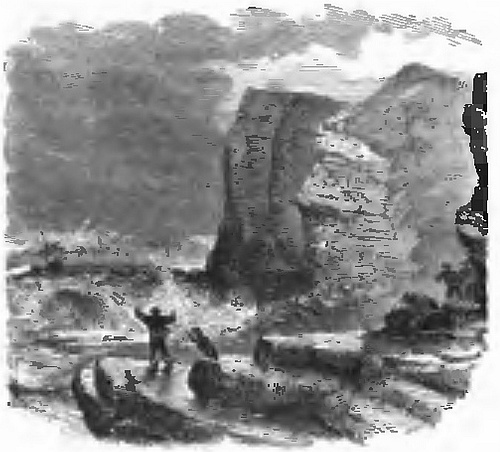
The grey dawn had just broken. It was the hour when even vigilant watchers are apt to doze, and deepen to sleep most soundly. I sprang out of our hut, in front of which I found Peter with his staff lifted ready to guard his head, at which the mulatto mate, Sam Snag, who had at that moment come up, was aiming a fierce blow, while his companion, who was a little behind, had also his stick uplifted, prepared to follow up the blow, or to inflict another on the dog, or on me. It was very evident that they had expected to find us both asleep, and to have murdered us without difficulty. So suddenly, indeed, did I appear, that I was able to turn aside the blow Snag was aiming at the lad, and to give him in return so severe a one on the right arm, that he dropped his stick; and this left me at liberty to defend myself against the other ruffian, who might have given me a great deal of trouble had not Ready, watching the moment that he was about to strike, seized him by the leg, which he tore away at with a fury which enabled me to gain an easy victory. Peter, also, while Snag, unwisely despising his young antagonist, stopped to pick up his stick, dealt him so heavy a blow on his head, that he sent him rolling over, and before he could recover himself I gave him another blow, which very nearly finished him. I had, however, to turn my attention to his companion, who, in spite of Ready’s jaws, was about to hit me, and while I warded off the blow Snag picked himself up and retreated, calling upon the other to follow his example. This he could not have done had not Ready at that moment opened his mouth to get a better grip, I fancy, when he sprang away with an agility I had not expected.
Had we followed them they would have had the advantage, for there were plenty of heavy pieces of coral about with which they could have settled Ready. Then, too, they were better prepared, for having only Peter to back me, who, though he had plenty of pluck, was but a boy in strength, I thought it prudent not to push matters to extremities. There we stood, the only four human beings on that desolate island, ready to take each others’ lives, and I may say, literally, that our opponents were thirsting for our blood. After all, we were only doing, on a small scale, what nations are often doing on a large one. Perhaps we had more to fight about, namely, our opponents wanted to eat us, and we did not wish to be eaten. I moralised much in this strain as I waited to see what Snag and his companion would next do. They probably were considering how they could execute their purpose with least risk to themselves. Their eyes glared fiercely as they looked at us. They were evidently very hungry. I determined to try what pacific measures would effect. I shouted to them, and told them that we had found an abundance of shell-fish on our side of the island, and that we would not molest them if they wished to collect it. I told them, also, that they might take some fire from ours. The mate looked at me for some minutes without speaking, as if he did not exactly comprehend what I was saying.
“There isn’t much to thank you for that,” he at length answered. “However, if you don’t wish to do us harm we’ll let you alone, and so that’s settled.”
The reply was ungracious, but I only said, “Very well, it is so understood between us.”
I did not, however, intend to trust the villains, for I was sure that, should they discover that we had the wine, they would make an attempt to possess themselves of it, and might, besides, very likely attack us again.
The excitement of the fight had not taken away our appetites, and so Peter and I set to work to collect shell-fish till the sun was high enough to allow of the use of the burning-glass. The two men, seeing how we were employed, followed our example; but even then, the way I saw them talking together and glancing towards us when they thought that they were not observed, convinced me that they would set upon us should they find a favourable opportunity. I had told Peter to keep near me, but he did not hear me, for, looking up, I saw that he had gone in the direction of the men, who at that moment were springing towards him with their clubs uplifted. I shouted out to him to avoid the danger, and just then, as I glanced seaward, my eyes fell on a vessel standing in under full sail towards the watering-place. I pointed her out to the men, and their attention being thus distracted, the lad escaped and got behind me, while they set off towards the watering-place, to be the first, I concluded, to welcome the strangers, and tell their own tale.
This mattered very little to me. If the strangers were honest, I felt sure that I could make my story good, and if not, I could scarcely be worse off than at present, and might, at all events, get rid of my unpleasant neighbours, waiting patiently till Peter and I could make our escape. Therefore, with some degree of tranquillity, I watched from a rock what was taking place. The schooner stood on like a vessel well accustomed to the place, and when close in brought up and furled all sails. Her crew were of a motley description; and as they approached in their boats, I was convinced of what I had before suspected—that the schooner was the very piratical vessel which had captured the Shaddock, and on board which I had found Marcus, the black. Though I could have wished him now, for his own sake, to have been in better company, I was anxious to ascertain if he was still with the pirates, as in that case I had no fear as to our safety. Peter also understood the state of the case.
“Yes, there he is; that’s him standing up in the first boat,” cried the lad. “He seems in an awful rage, though. If I thought he was a-threatening of me, I’d like to run away and hide myself.”
Sure enough, there was Marcus; but what could have excited his anger? I soon learned, for, looking higher up the rock, I saw the huge mulatto mate, Sam Snag, and his companion, on their knees with uplifted hands, in the most abject state of terror, imploring mercy, while Marcus, as the boat approached, stood ready with a pistol in his hand to shoot, it appeared, one or the other of them.
As the boat’s keel grated on the sand, he sprang on shore, gnashing his teeth like a wild beast, and I thought would have shot Snag dead at that moment, but seeing that he was really totally unarmed, he contented himself with hitting him in the face, and then kicking him over.
“Wretched slave-driver—overseer of your fellow-men—have I found you once again?” he exclaimed, literally foaming at the mouth, and striking him each time that he spoke. “Death is too good for a wretch like you. No fear, I’ll not kill you,” and seizing, as he spoke, the huge powerful man by the hair, he dragged him along over the sand. I never saw a man so completely prostrated by abject fear as was this would-be murderer and bully, Snag. Meantime some of the pirates had espied Peter and me, and with no very friendly gestures, thinking that we were of Silas Snag’s gang, were hurrying towards us. I thought it was now time to claim the protection of Marcus. The moment he heard my voice his whole manner changed. He almost took me in his arms in the excess of his affectionate feelings, as he inquired by what wonderful circumstance I had come there. I told him of the shipwreck and the cause of it.
“Ah, and that villain unhung was at the bottom of the mischief! However, we shall settle accounts ere long. I would have killed him to-day but that death would be too happy a fate for a wretch like him.”
I entreated Marcus not to stain his hands with the blood of the man, though I acknowledged that I had little reason for wishing to save him from punishment, as he had just before attempted to take my life and that of my companion.
“Well, I will promise to let him live on as long as he can on this islet,” said Marcus, casting a glance of hatred and contempt at the mulatto mate, who stood literally trembling before him. “He knows that it’s out of the track of most vessels, and that only those who are engaged as we are come off here occasionally for water, when they cannot venture elsewhere, so that his chance of escape is very small. If he wishes to prolong his life he must kill his companion, or his companion will kill him. Such things have been done on this island before now, and that is one of the reasons why it is so generally avoided.”
To this mode of treating Snag I had no objection to make. I could scarcely propose that he should be taken away in the pirate vessel, and he certainly had brought his fate upon himself. I was glad to get away from him and from a spot of such ill-repute; at the same time I doubted whether I should not be leaping out of the frying-pan into the fire. How might I be treated should the pirate be captured by a man-of-war, either English or American, and I be found on board? I could not say that I did not know her character before I went on board, and it was a question whether the plea would hold good that I did so in preference to remaining on a desert island. Still I saw that I had no choice. If I remained with Snag and did not kill him, he would if he had the opportunity kill me, and Peter and Ready into the bargain; whereas if I embarked I might very possibly get safe on shore, and if we were captured I felt very sure that Marcus would give evidence in my favour, and I hoped that the other pirates would do so likewise.
I told Marcus, therefore, that I accepted his offer, hinting, however, at the predicament in which I should be placed should the schooner be captured.
“She will never be captured,” he answered fiercely. “Sooner than that I would blow up the vessel, and all on board.”
A pleasant prospect for me, I thought to myself; however, as I said, I had no choice. Accordingly, I and Peter and Ready embarked with Marcus in the first boat returning with water to the schooner. The crew received us without any questions, and we were soon discussing in the cabin such a meal as we had not eaten for many a day. I said nothing about the wine we had left on shore, as I thought that it would do the pirates no good, and might do harm. Great despatch was made in getting water aboard, and in a short time all that was required was obtained. Marcus did not return to the shore, but I heard him giving directions to the officer of one of the boats which went back for water. Meantime I was watching what was taking place on the beach. Snag, who had concealed himself from Marcus, now made his appearance, and was evidently exerting his powers of persuasion on the crew of the remaining boat, probably forgetting that though his words could not reach the schooner his gestures could be seen from her. Judging from his and his companion’s manner, he appeared to have been successful; some flasks were produced from the boat, and they and the crew were seen to sit down, and to smoke and drink in a friendly manner.
The officer sent by Marcus, and several of his men, went heavily armed. On their reaching the beach the crew of the other boat were ordered into her, and then seizing the white man they carried him into their boat. Snag rushed after him but was driven back by the officer, who held a pistol towards his head as he approached the boat. In vain he pleaded with the very men with whom he had so lately been on friendly terms. The horror of his position burst upon him. He was to be left on the desert islet to die alone, without even the companionship of his former shipmate and associate in crime. In vain he pleaded. The pirates laughed at his terror and rage. He stamped—he gnashed with his teeth—he shook his clenched fist. He was unarmed and helpless. The boats pushed off and were already some distance from the beach. He waved and shouted to them. For a minute he stood irresolute, apparently hoping that those he had seemed to gain over would take him on board. Again he waved; some signal was made from the boat. He plunged headlong into the sea, and swam towards her. Still she pulled slowly towards the schooner, though, it seemed, he thought that he could overtake her. Too late he discovered that a barbarous trick had been played him, worthy of the wretches who were guilty of it. He might still have returned to the shore, but just then a dark fin, which had been hovering about the schooner, was seen to dash off in the direction of the boats. An instant after the mulatto mate threw up his arms—a fearful shriek was heard, and he disappeared beneath the water, an ensanguined circle on the surface marking the spot where he had gone down. Directly after the boats were hoisted in, the breeze sprang up, and the schooner made sail to the northward.
“Now, my friend, at which port do you wish to be landed?” asked Marcus.
“I was bound to New Orleans, and still wish to return there,” I answered.
“It is not the place I would counsel you to go to,” he observed. “Some of the people there have long memories, and they would treat you with Lynch law, and a scant allowance of that, if they caught you.”
I told him that I was aware that there was some danger, but that I had resolved to push north up the Mississippi; besides which, as I had letters of credit on a mercantile house at New Orleans, I must go there for the sake of replenishing my purse and wardrobe. He replied that he must consult with the captain about it, as he had strong doubts as to the policy of the proceeding. Some hours afterwards Marcus told me that it was impossible to land me at New Orleans, but that they would put me on shore at Havanna, from whence I could easily get across to that city if I still desired to go.
“But can you venture into the Havanna? will not your schooner run a great risk of being recognised?” I asked.
“Oh no, our papers are all correct. We have powerful friends there who would get us out of trouble, if we got into it, and we depend much on our boldness to escape suspicions,” he answered. “You shall see. With regard to you we shall only have the truth to tell. We found you cast away on an island, took you off, and wish to land you. We must depend on your discretion for the rest. For anything you know to the contrary, as far as you have seen, this vessel is perfectly honest. You understand me.”
Chapter Twelve.
The Pirate and the Man-of-war—The Chase—A Calm—Fatal Security—The Pirate blown up—We are captured—In Lieutenant Trevor of the Spitfire I find a dear old Friend, and a way of serving Marcus, who regains his liberty—We arrive at Havannah.
Poor Peter was very unhappy when he found that we were to go to an island, instead of to the mainland.
“Oh dear, oh dear, or, when shall we ever go to a country where we can get along on our feet away from the sight of this ugly sea?” he exclaimed, wringing his hands, and well-nigh blabbering outright.
My chief anxiety was to get away from the schooner as soon as possible, as I feared that the pirates might be tempted to attack some other vessel, and that Peter and I might be brought in as participators in the crime. I had no doubt that our innocence would ultimately be triumphantly established, but that might be only after we had been hung, in which there would not be much satisfaction to ourselves.
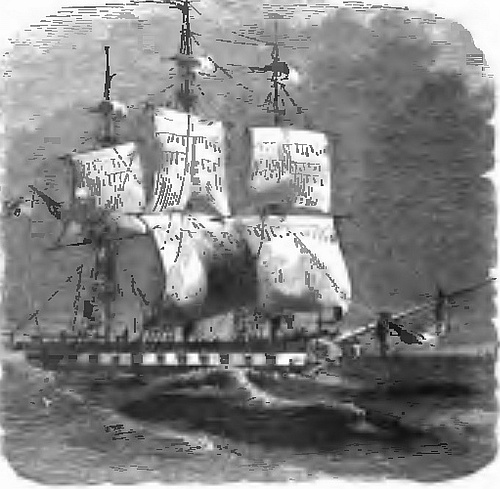
A very unattractive recollection of the picture of a row of pirates hanging in chains on the banks of the Thames, which I had seen in my boyhood, would intrude itself on my memory, as I walked the deck in solitude, thinking it wise to speak as little as possible to any one, when the look-out man from aloft hailed to say that a sail was in sight to windward. To my concern, I found that the schooner’s course was altered to meet her. We stood on, nearing her fast, when an officer who had gone aloft hailed that she was a large vessel with a wide spread of very white canvas. On this there was a consultation, glasses were directed towards the stranger, the schooner’s head once more put before the wind, while all sail that could be packed on her was set, and away we went, with the stranger, which was pronounced to be either a British or American man-of-war, in full chase after us.
I must own that I felt very uncomfortable. My worst fears were about to be realised. This termination to my career was one I had not anticipated when I left home. Kind aunt Becky! how horrified she would be to hear that her favourite nephew had been hung as a pirate by mistake. It would be enough to break the good old creature’s heart. From what I had seen and heard of the miscreants with whom I was at present associated, I felt that they would be a good riddance if captured and hung, with the exception of Marcus, who was, I was sure, fitted for a far different life to that into which circumstances had plunged him. I watched the countenances of the pirates to judge what they thought of the prospect of their escape. They had been so accustomed, it seemed, however, to consider their craft the fastest in those seas that they had no fears about the matter, but laughed and joked as if there was not an enemy who could sink their craft with a broadside close at their heels. The schooner sailed well, but so did the man of war, and as it appeared in the course of time, even better. As her courses rose gradually out of the water, the pirates became less and less loquacious, and finally many of them began to make very long faces. The officers held earnest consultations, they looked anxiously round at the sky, they carefully examined the compass, and then trimmed and re-trimmed the sails. Still the big ship was gaining on us. At length there appeared to be little doubt that we should be overtaken if the wind held as it then was. Marcus was as cool and undaunted as ever, indeed from the unconcerned manner in which he paced the deck, it was difficult to believe that he apprehended the slightest danger. I asked him at last what he thought of the state of things.
“That we shall be taken, and if taken, unless we can effect our escape, or die beforehand, we shall be hung,” he answered calmly. “I had heard that a very fast English man-of-war was expected out here expressly to look after us. That must be her.”
I did not like to ask more, still I had a strong wish to entreat him not to blow up the vessel, as he had threatened to do, should her capture be inevitable. He seemed to divine my thoughts.
“You know what I would do if we are hard pressed rather than be taken and hung,” he said to me. “Should the vessel in chase of us prove to be an American, my fate is sealed if we are taken. Still, I will do nothing to destroy your life if I can help it; but for my companions I cannot be answerable.”
“Should she be American my chance of escape will, I suspect, too, be very small, especially if I am accused of having assisted at your escape,” said I. “However, we will hope for the best.”
I must confess, that though I endeavoured to appear calm and unconcerned, I began to feel most uncomfortable as the stranger drew nearer and nearer, and wished more than once that I had remained on the desert island, even with Snag as a companion. Still, a stern chase is a long chase.
The day was drawing to a close, and, should the night prove dark, we might have a chance of escaping. As the sun sunk towards the horizon the wind fell, and by night there was a perfect calm. The stranger, supposed to be a frigate, lay about eight or nine miles off, also, when last seen, perfectly becalmed. Our escape depended on our getting the breeze first. If the frigate got the wind before us, our capture was inevitable. The pirates, I observed, as sailors often do when expecting to be shipwrecked, went below and put on two suits of their best clothes, and stowed away round their waists and in their pockets as much money as they could carry. I have known instances of men being drowned who might, had they not have been thus overloaded, have been able to swim on shore. Had it not been for this circumstance I should not have supposed that the men had any great apprehension of being captured. Among the officers, however, there were earnest consultations, and it was even suggested by some that they should take to the boats and desert the vessel; but this proposal was overruled by the majority. The opinion seemed to be that the calm would last for some time, and that, as we were as likely as the frigate to get the breeze first, we had a good chance of escaping. Most of the crew, indeed, were so satisfied with the state of affairs, that they turned into their berths and went to sleep, the usual watch only being left on deck.
Though Marcus had provided a berth for me, it was so hot below that I preferred remaining on deck with Peter and Ready by my side, under a boat’s sail, between two guns. After walking the deck till I was weary, admiring the bright constellations overhead, the calm, star-lit ocean, and enjoying the air so cool and refreshing after the heat of the day, I lay down, and was soon fast asleep, as was Peter too, and as Ready appeared to be, but the faithful fellow always slept with one eye open. I had slept for some time, when I heard him give a low warning bark close to my ear. I jumped up and looked about me, though still only half awake. A thick mist so closely surrounded the vessel that I could not see beyond the heel of the bowsprit, and could only just distinguish the calm silvery water alongside, though, at the same time, overhead I could still make out a few stars shining down out of the heavens on this ill-disposed world. Once more Ready gave a low bark, and stretched his neck out through a port over the water, but the watch took no notice. They were either asleep or drowsy and stupid. I felt sure from Ready’s behaviour that something was approaching. I listened very attentively. The sound of a boat’s keel gliding through the water and that of muffled oars pulled rapidly reached my ears. It was not for me to warn the pirates of the approach of danger, nor did I wish Ready to warn them, so I patted him on the head and put my hand on his mouth, to show him that I had understood his previous bark, and that I wished him to be quiet.
Meantime I was considering how I should act if the approaching boats, for there were several I was sure, proved to be, as I suspected they were, belonging to the man-of-war. I was not kept long in suspense. On a sudden, the watch on deck, at length hearing the sound of the boats, shouted out, “Keep off! keep off! or we’ll fire.” The pirates below jumped out of their berths, but before they could get their heads above the coamings several boats dashed alongside. Dark forms were seen climbing over the bulwarks, and a loud voice shouted out, “Yield, whoever you are, to her Britannic Majesty’s frigate, Spitfire.”
Before the words were well out of the mouth of the officer who uttered them, the pirates had rushed to their guns or seized their arms, and, instead of yielding, were desperately attempting to defend themselves and their vessel, the character of which it was very clear the assailants knew before they made the attack. On every side, instead of the silence which had before reigned, pistols were flashing, cutlasses were clashing, men were shouting and cursing, and thrusting boarding-pikes at each other, and big guns and muskets were going off as in the confusion they could be loaded. Though constitutionally fearless, I had no fancy to have my travels stopped by a stray bullet, or by a slash from a cutlass, so when the English seamen climbed up out of one of the boats, calling to Peter and Ready, who followed me, I tumbled into her, when without more ado we stowed ourselves away under the thwarts, where bullets were not likely to reach us.
So completely had the Spitfire’s crew taken the pirates by surprise that they gained an easy victory. Some were driven overboard, others below, and many more were cut down even before I had made my escape out of the schooner. I saw Marcus defending himself bravely, and would gladly have gone to his assistance had I had the power. I had not long taken up my quarters in the boat, when I heard a loud shout of, “Back! back! all of you.” And men came leaping into the boat—combatants of both sides—tumbling over and almost suffocating me; and there was a loud roar, then a bright glare, and shrieks and groans, and fearful cries, and the boat rocked to and fro, and, I thought, was sinking. Human beings, and burning fragments of wood, and rope, and canvas rained thickly down over us; and when I managed to scramble up and look around me the schooner was not to be seen, and the British crew were throwing the burning wood and the mangled bodies of the dead pirates overboard, and securing the living ones.
“Light a lantern,” I heard an officer sing out. “We shall better see what we are about.”
Peter and I were very soon afterwards seized on, when Ready set up a true English bark of indignation, and had I not calmed him would have bitten right and left at our captors, and probably have been knocked on the head and thrown overboard for his pains.
“Halloo, who have we here?” exclaimed the officer, holding the lantern to my face. “A renegade Englishman, a perfect villain by his countenance.”
“Thank you for the compliment, though concealed under a somewhat dubious turn of expression,” I answered ironically. “I am an Englishman, but one who had no wish to be on board the vessel out of which I have just escaped. I will explain matters when we get on board the frigate.”
“Very likely, my fine fellow,” observed the officer, an old salt who had seen much service, and had been disappointed in not obtaining his promotion. “And who are you, friend?” he asked next, coming to Peter.
“A true Englishman, like my master; and, sir, I’d just advise you to be treating Mister Skipwith here civilly, for he’s an Englishman, and a gentleman born and bred into the bargain,” he answered; boldly adding, “And I’ll tell you what, sir,—he’s not the man to tell a lie to you, nor to any man.”
Peter’s remarks had considerable effect on the officer, who immediately addressed me in a more civil tone, and desired the men to let me come aft and sit in the stern sheets, where I should be more comfortable. As I was about to move I heard a groan, and just then the light of the lantern fell on the countenance of poor Marcus, who lay near me badly wounded. I entreated that I might be allowed to attend to him, explaining that by his means my life, and that of my attendant, had been preserved. The officer, who was naturally humane, not only permitted this but gave every assistance in his power.
The other boats had been rowing about picking up the survivors of the pirates, and looking for some of the English seamen who were missing. I was glad to hear that the greater number of the latter had escaped in time to the boats, a small warning explosion having taken place before the magazine itself blew up. The order was now given to return to the frigate, the commanding officer’s boat leading the way. As he passed the boat in which I was, he asked the old officer in ours how many prisoners he had got. The reply was “Six; but one of them says he is a gentleman, and the other is his servant, captured by the pirates, and that their lives have been saved by a black man whom we have also on board.”
“A likely story indeed,” observed the officer in command of the expedition. “However, look to them, Mr Mudge, and ‘treat them as men should men, and not as Rome treats Britain.’”
“That’s my old friend, Dick Trevor, to the life,” I exclaimed. “I am right, am I not?”
“Yes,” he said.
“I thought I must be!” said I. “Oh! Dick, Dick! Is that the way you would treat your friends when you find them out all desolate and alone on the wide ocean?”
“Who can that be?” I heard him exclaim. “‘Speak, I charge thee, speak!’”
“Still stage-struck as of yore,” I answered. “Is my voice so strangely changed then?”
“Yes! it must be Harry Skipwith, turned up out here in the Gulf of Mexico,” he exclaimed. “Come on board my boat, Harry, and tell me all about it as we pull back to our ocean-home on the briny wave. That’s not the right quotation, but never mind.”
The next instant I was shaking hands with my old school-fellow, the eccentric but gallant second lieutenant of H.M.S. Spitfire. I need hardly say that I was most hospitably and kindly received on board the frigate, which was going to put into the Havanna to gain further evidence for the conviction of the pirates; and, what was of no little importance to me, the captain offered to endorse any bill I might wish to draw at that city for the replenishment of my wardrobe.
I enjoyed the luxury of a wash and shave in Trevor’s cabin, and a clean shirt, which I had not obtained on board the pirate, and more than all, the pleasant conversation of men of my own rank and education, of which I had been deprived for many a long day. I got the surgeon of the ship to look to Marcus, who rapidly recovered from his wounds, and when I told the captain his history, he declared that it would be a shame to let him be hung as a pirate, which it was plain that he was not of his own free will.
“You must arrange some plan to allow him to escape, only take care that he does not join any fresh band of pirates.”
I thanked the captain for his kind feeling towards my brave preserver, and promised that he should not be found on board another pirate vessel.
A week after the scenes I have described we entered the picturesque harbour of Havanna. While the frigate remained there I lived on board her, because I had many friends who pressed me to do so, and because the sleeping accommodations in the hotels in that capital of Cuba are far from satisfactory. At length the time arrived for the frigate to proceed to Jamaica, where the pirates were to be tried. I was thankful to find that all the evidence procured against them related to a period anterior to the time that Marcus had joined them, when I could prove that I had met him in the character of a slave in the United States. I bade farewell to Trevor and my other friends, and took up my quarters at one of the hotels. Though the best in the place it was far from comfortable; for though the provisions and public rooms were tolerable, the bed-rooms were much the contrary. In mine there were five beds; one occupied by a man who walked in his sleep, and who if he had not committed a murder, by his gestures looked as if he would. In another, the sleeper snored like a rhinoceros; and in the third lay an Irishman, who would talk, awake or asleep, generally to me and at the rest of the party. Nothing could make him keep silent; a boot-jack flung at his head had no effect; he seemed to know what was coming and bobbed under the bed-clothes. The fourth was occupied by a Portuguese dying of consumption, far away from his kindred and friends. Nothing could be done for him.
I have but a word or two to say of Havanna as a city. The streets are numerous, but narrow and dirty; there is a tolerably large palace for the governor, a good opera-house for the people on the evenings of most days in the week, and a very ugly big cathedral for the Sunday mornings, and a paseo, or public drive, for the afternoons. On this paseo are seen various antique vehicles, called volantes, each carrying two or three dames in full dress. A volante is built like a cabriolet on two wheels, with very long shafts, the points resting in a sort of saddle on a horse’s back,—which horse is ridden by a huge negro in vast leather leg coverings reaching, as he sits, almost up to his ears, and no feet to them, though with silver spurs, white breeches, a gold-laced red jacket, and a broad-brimmed straw hat. Everybody knows that cigars are manufactured in Havanna, that the slave trade is winked at, if not encouraged, by the authorities, who find it not altogether unprofitable to their own pockets, and that piracy, for the same reason, is not held in absolute disrepute by the same respectable gentlemen.
I had gone down to see the last of the frigate as she sailed out of the harbour, when, as I was about to return hotel-wards, I saw a black head rise slowly out of the fore-peak of a Spanish brig lying near, and soon the whole figure of Marcus appeared in view. He saw me, and as the vessels in that harbour are moored stem on to the quays, side by side, he came along over the bowsprit and swung himself down close to me. He congratulated himself on being once more at liberty, though he thought it best not to tell me how he had obtained his freedom. I told him that I was very glad to see him at liberty, and offered to supply him with funds, slender as mine were, to enable him to undertake some honest calling. He replied that he had ample means for his support, a thick roll of gold round his waist, besides a purse full of coin. “Indeed,” he added, “I hope that I shall not offend you, sir, when I tell you that I purposed offering you money, to enable you to proceed on your travels till you could reach some place where you may replenish your purse.” I thanked Marcus for his generous offer, but I felt doubly obliged to my friend the captain, who had enabled me to supply myself with funds, lest I should have been tempted to accept it; for I could not help reflecting how that money must have been obtained.