George Manville Fenn (continued 8)
Reading edition
“I must do it,” thought the boy, and his mind was made up. The open country must be reached, and he prepared for action by taking his revolver out of the holster and holding it ready for a shot; then gathering up his reins and pointing his pony’s head for the very centre of the line which hemmed him in, he went off at a canter straight for the open, picking out one man as his guide.
The result was exactly what he expected, for as he increased his pace the Indians to his right and left came galloping, evidently meaning to reach him just as he gained their line.
Chris urged his pony on at full gallop, and there was a race, the enemy sweeping over the short level grass, concentrating themselves as it were upon their quarry, and beginning to yell and shout as they tore along. But Chris’s movement was only a feint, and the next minute he had wheeled round, changing his direction to one parallel with the edge of the cliff, tearing along so that two out of three of the Indians dashed past him, while as he neared the other, who was right in his way, he raised his revolver, waited till he was as close as he was likely to get, and then at intervals fired three shots, the little bullets whizzing through the clear morning air, and the last, to the boy’s surprise and delight, finding its billet with a faint ping.
He had only expected to startle and perhaps make his enemy turn tail, but to his utter astonishment the last man’s pony stopped short, sending the rider over its head, and Chris tore on, with the intention of passing through the line.
It was a furious race now, for at intervals quite a dozen of the enemy were trailing along now to cut him off, and victory was bound to be to the most swift. But the enemy were clever enough not to trust to the result of this race, for several hundreds of yards out another line of horsemen was tearing over the plain, whirling their bows and spears over their heads and using them mercilessly upon the flanks of their steeds.
It was a good race, during which Chris’s mustang proved its speed, going over the grass ventre à terre, as the French call it, and, to his delight, the boy was able to pass round the farthest horseman, who strove vainly to head him, as he made now for the open plain.
The effort was vain, for the second line was closing-in at full gallop, and seeing the hopelessness of repeating his first feint, Chris now urged his pony on again parallel with the edge of the cliff, with some idea of riding round the end of the great depression so as to get to the far side, and then, trusting to the speed of his brave little mount, escaping there.
But it was of no use. At first he began to feel hopeful, for he was going fast and getting well on towards the head of the valley, which after a gallop he finally reached. The open country beyond was before him, he was bending down again to reach forward and pat the pony’s neck, shouting cheering words to it the while, when he suddenly became aware of the fact that right in front, and coming from quite a different direction, there was another party of the enemy, which no sooner caught sight of the chase than they increased their pace, spreading out into a line the while.
Chris began to draw rein, slowly checking his pony’s gallop to a canter, and then easing it down to a walk, for he had been gradually edged more and more towards the rim of the great depression, till there was not more than a hundred yards between him and the precipitous descent, which presented an effectual barrier to all escape there.
“They’re too much for me,” panted the boy breathlessly, and quite innocent of this naïve way of expressing himself, for it never occurred to him how pitifully small his chances of escape had been in pitting himself, a mere lad, against nearly a hundred of the active warriors of the plain.
“But I’m not done yet,” he muttered, as he pressed his pony’s sides and cantered on towards where in one spot the smooth level gave place to a rugged patch where the ground was broken up and strewed with stones right to the edge of the precipice for about a hundred yards, before it became smooth and level again.
As near as he could guess he was leaving behind the spot where the Indians had been first seen; but that was only a passing thought. He was, as he had said, not done yet, and in those stones he saw shelter for himself and his mount while he made a stand for a time in the hope that aid of some kind might come, or some turn of the tide occur in his favour.
Full of this idea, he cantered on, and reached the rugged patch of broken ground, his sinking spirits rising as he drew near and found that it would give more shelter than he had hoped for, since no horseman could charge through it; in fact, as he reached the spot he was obliged to let the pony pick its way in and out among pieces of rock eight or ten feet high which looked as if they had been turned up, while among them there were shallow, shady rifts, and in one case quite a gash going deeply down and cutting right through the edge of the depression, being evidently the work of water that at some period or other in the world’s history had run over the edge of the precipice in a cascade.
But Chris was in no humour then for calculating the causes of this appearance, this roughening of the level plain. He did wonder that he had not noticed it from below, but there was no occasion for wonder, since the stones stood too far back from the edge to be visible to people four or five hundred feet below. He only saw in the chaotic patch a place of sanctuary, and rode right in, to draw rein with his back to one of the largest blocks of stone, while others were between him and the advancing enemy.
It was the merest chance, but a long search could not have discovered a better spot for the boy’s temporary protection, and calling up the little knowledge he had picked up of the Indians’ nature and habits, he set his teeth as he let the rein fall upon his mount’s neck, passed the sling of his rifle over his head, and drew round and opened his cartridge-pouch.
“Stand still, old chap,” he said, and for the moment he thought of dismounting, resting the barrel of his piece across the saddle, and firing from there; but the thought came that at any moment he might have to seize the opportunity to gallop off, while the minute expended in changing his position and mounting might make all the difference between escape and capture.
So he sat fast and waited, watching the approach of the Indians, who did not ride in at once, but treated him, after their experience of seeing one of their companions go down, as a dangerous enemy, one to be taken unawares, or after being rendered helpless, while for his part Chris sat firm as a rock, feeling fear, of course, but strung up by the sensation of being suddenly called upon to fight for his life.
But he felt that it would not be long before the enemy took action, while there were moments when his heart seemed to sink with the heaviness of despair, as he fully realised how little he could do against so many.
He was not kept waiting long after the Indians had closed up, for they stopped about a hundred yards away and then started off as if about to turn their horses in an elliptical course, starting off and riding round, each man as he passed the lad at a distance of some fifty yards uttering a piercing war-whoop, with the evident intention of alarming their victim, who however sat waiting patiently and apparently not alarmed in the least.
These shouts were given as the whole body passed round and within range, and lasted till every man had shouted his defiant cry, while the lad sat fast holding his fire. But at the second career something else was evidently on the way, and if possible Chris set his teeth harder, for as one man went by at a canter he leaned over towards his left, raised the bow he held quickly with an arrow fitted on the string, and loosed it with a twang!
It was aimed pretty straight, and loosed off just as the man was clearing one of the blocks of stone, against whose side the arrow glanced and then whizzed by Chris’s head and flew over the edge of the precipice, to disappear in the depths below.
Chris drew a deep sigh and raised his rifle, for it seemed to him that it was nearing the time when he must use it.
For the Indians were riding on in the ellipse, and another man fitted an arrow to his bowstring, and as he rode by loosed it off.
A far better shot. There was no striking against rock for it to glance off, for the next moment it struck with a heavy thud in the pommel of Chris’s saddle, and quivered there till the lad snapped it off.
A loud yell rose from the cantering Indians as they saw the success of the shot, and as one of the next rode by he sent his arrow whizzing by the boy’s head, making him start nervously and raise his rifle to his shoulder; but nearly a minute elapsed before he fired and lowered his piece to thrust in a fresh cartridge, sitting half-hidden by the smoke, which screened him from his enemies at the same time that it hindered him from seeing the effect of his shot.
As the smoke rose it was only to show the party cantering by at an easy pace and looking as if they were engaged in some trial of skill, and in spite of the peril in which he was placed Chris’s thoughts played a strange prank, suggesting to him the old fable of the boys and the frogs.
“What is sport to you is death to us!” he muttered bitterly, and aiming more carefully now, well in advance of one of the Indians, he drew trigger and wrenched himself on one side to avoid the smoke and watch the effect.
The act worked in a two-edged way, for another arrow darted by him with a buzz like that of an angry hornet, at the same time that a yell arose, for he saw the man at whom he had fired trying to scramble up from the earth and falling again, while his horse after throwing its rider had reared up, to stand pawing the air frantically for some moments, before coming down on all fours, and then tearing off at full gallop as hard as it could set hoof to ground.
There was a furious yell of rage at this, and a feeling of satisfaction thrilled through the boy’s frame as his busy fingers opened and closed the breech of his rifle. But the triumph was only short-lived.
Whizz—thud, another arrow was loosed off from the string, striking the pony low-down in the chest. The poor animal uttered a groan that was almost human in its tones, as it plunged and wrenched itself round, to stand biting at the place where the arrow stuck out, snapping it in two, and nearly unseating its rider, as well as robbing him of the power to fire again, for his side was now towards the foe. Worse still, the pony’s change of front presented the whole flank to the enemy, who responded with a yell of triumph by sending in a couple more arrows, both of which hit.
In an instant the poor brute was erect upon its hind-legs, overbalancing itself and falling backward, Chris saving himself by throwing himself sidewise, while as he scrambled up, holding on tightly to his rifle, he turned to fire, fully expecting that the Indians would dash in; but the muzzle of the presented rifle was too formidable for them—they knew its power, and they kept on cantering along, yelling with delight.
Meanwhile the pony was kicking wildly and tearing at the turf as it lay upon its side.
Chris did not attempt to fire, but obeyed the impulse of trying to get his mount to rise again, with the full intent of flinging himself upon its back and galloping in desperation through the enemy.
Two arrows whizzed by him, for his motion, consequent upon the pony’s struggles and his efforts to avoid the poor brute’s hoofs, was so rapid that he formed a bad butt for a galloping horseman, and so escaped for the moment.
“Up—up, old chap!” he shouted, as he caught hold of the rein, and in obedience to the familiar voice the brave little beast made a desperate effort, and gained its feet, uttering an almost human shriek. Then with a bound it threw up its head, nearly snatching the rein from its master’s hand, plunging and kicking wildly.
“Keep still—wo-ho!—quiet!” cried Chris; but in vain, and doubtless fortunately for himself, for he was dragged here and there by the frantic steed, quite ignorant of the direction the pony’s struggles led him, but always just out of the course of arrow after arrow, some of which flew wide, while others nearly grazed him, but not one hit.
The thought that dominated all others now in Chris’s mind was that he must let go. He had nearly been down twice; then he had stumbled over one of the stones which lay thickly here and there; the pony’s hoof grazed his side as, mad with rage and pain, it tore away from him, giving a sudden snatch in its effort to get free from the rein Chris had twisted round his hand.
For the moment the boy felt that his shoulder was dislocated; then he knew that he had lost his foothold and was being dragged over the ground; and the very next moment, as a terrific yell smote his ears, it seemed to be cut off short and to sound distant, for he was falling through the air, to strike somewhere heavily, roll over and feel that he was gliding down amidst stones and loosened earth. Then he was checked again, hanging as it were for a moment before commencing another slide shorter than the last, for he was brought up with a sharp shock against a stone, to which he clung, just as he heard a dull crash somewhere beneath him, and the sound of hoofs tearing at stones, which kept on clattering down in an avalanche, to keep up a loud, heavy, rattling noise, but all far below.
In spite of the horrible excitement and confusion, Chris’s brain was clear enough. His left arm felt useless, and his shoulder throbbed, but he was quite conscious that his head was not injured, and perfectly well aware that he had stuck to the rein till the unfortunate pony had dragged him to the edge of the precipice at the head of the valley, and then, mad with pain, gone over, to be lying somewhere below.
But not dead yet, for every now and then the sound of the poor beast’s hoofs came up, striking at loose stones and sending more and more clattering down into the valley.
And then for a few moments the boy turned sick, and loosing his hold of his gun, which lay half under him, he clung with all his might to the stone which had checked his further downward progress; for the new thought which had attacked him was that if he did not hold fast he would fall—fall—down the dizzy height into the black darkness of the end.
As he lay there clinging with all his might he was conscious of a wild gabble of voices in an unknown tongue, somewhere above him, and then as if out of a mist a stone fell, struck that to which he clung, and glanced off, to be heard no more. But another small stone came rattling down, in company with some earth, and opening his eyes he found himself staring upward at the edge of the cliff and the narrow, earthy and stony cleft down which he had fallen, recognising it even then as the probable bed of the torrent, that had at some time or other flowed over the riven cliff to plunge into the depths below.
The loud talking right above cleared away the last of the giddy feeling of faintness, but only for him to be face to face with a fresh horror, for all at once another arrow whizzed by, but yards away, and looking up he could see the head of an Indian whose eyes glistened in the sunshine as he peered down as if to look for the effect of the arrow he had dispatched.
Then another head appeared, and the talking increased. Men were shouting, and apparently the shouts were orders, and more heads appeared. Stones and earth crumbled down too, and another arrow whizzed by and struck somewhere near; but it did not seem to come straight down, while another sent directly after evidently came from away to his right.
“They can’t reach over far enough to get a good aim at me,” thought Chris then, with a strange sense of resignation to the inevitable making him feel calm and patient in his utter helplessness. He could hear the pony strike out again and the stones the poor beast dislodged go clattering down, and then there was a peculiar rushing sound, and small broken pieces and earth began to fall near him, making him strain his eyes once more to see whence they came.
He knew the next moment, for a shout reached his ears, coming from above, and the legs of an Indian passed into sight, then the whole of his body, as more stones crumbled down, and as the boy watched he made out plainly enough that one of his enemies had lowered himself down, crept sidewise, and had just reached a ledge far above him and a little on one side, where he was busy settling himself in a sitting position before drawing his bow from his back and proceeding to fit an arrow to the string.
The look of triumph in the man’s painted face was clear enough in the bright morning air. His teeth glistened as he smiled, and Chris clung still not daring to move, but ready to smile as the thought occurred even then, Why shouldn’t I let go and fall, so as to disappoint this malicious savage of his attempt to slay?
But it was all like a terrible waking dream to Chris, who lay there conscious of the fact that several of the man’s comrades were peering over the edge of the cliff watching his efforts and now waiting to see the successful shot.
It seemed a long time after the nock of the arrow was fitted to the sinew string before, setting his feet against a stone and his back firmly against the perpendicular at the back of the shelf he had gained, the Indian fixed his eyes on his victim and deliberately drew the arrow to the head.
But the effort made in a very critical position caused one foot to slip a little, and slackening the string, the savage shifted his foot, and as soon as he had satisfied himself that he was not likely to slip and plunge headlong down into the valley, he drew the arrow to the head again.
But once more, as with starting eyes Chris watched for the loosing of the shaft, there was a check in the proceedings. For, after lying quite still for some minutes, the pony uttered a loud neigh and began to kick and paw at the stones amongst which he lay, sending a fresh avalanche down into the valley.
The Indian started like a wild beast at the sound, and his sharp eyes were turned to gaze downward as he reached out a little. But apparently satisfied that the sound was not the prelude to an attack, he once more settled himself down and—quickly now, in response to a shout from the Indians above him—drew his arrow to the head.
Chris tried to close his eyes, but his nerves and muscles were rigid as the bow twanged, and he noted that the arrow passed like a flash, high up above his head, as he saw the savage spring up standing on the ledge, clap his hand to his breast, and curving himself backward as his knees bent, fall outward and come down to strike the side of the cliff a couple of dozen yards away, level with the stone to which his intended victim clung. Then he bounded off to descend swiftly, drawing himself up like a ball, and pass out of sight, but only to fall with a sickening crash not far from where a little puff of smoke had darted out in the bottom of the valley, to be followed by a sharp crack which echoed from the cliffs and re-echoed twice, to mingle with a chorus of yells from the edge where a score of Indians stood peering over to try and see where their companion had struck.
Chapter Forty Two.
How to Turn Round.
There was another puff of smoke, and another, followed by their cracks and echoes; a few moments’ pause, and two more, with the result that every Indian on the ledge disappeared, two of them falling prone, to lie motionless, the others to hurry to where their companions held the reins that had been passed to them.
Chris saw nothing of this, but at every report coming from down in the depression his heart leaped, knowing as he did that the sharp cracks were the reports of rifles, and that these could only be fired by his friends.
From clinging there half stunned and perfectly inert, he felt a thrill of energy begin to move within him—a thrill which became a spasm as all at once he saw something moving that looked like an animal crawling over the edge of the cliff about fifty feet diagonally away from where he lay.
As the object passed from behind some intervening trees he could see plainly enough that it was an Indian grasping a bow, and the top of his quiver could be seen above his shoulder.
Chris was alert now, and grasped the fact that this was another of the enemy making his way down to a big patch of pensile growth which would afford him cover, from whence he could direct his arrows either at his watcher or at those who had fired upward from the valley.
“Could I?” he asked himself, with the desire for life once more throbbing strongly in his veins.
He began to prove his position. He had lain clinging with all his might to that stone ever since he had fallen, in the full belief that if he slackened his hold he would glide off into the depths and fall to the bottom; but as in his calmer frame of mind he began to test this, he found that loosening his desperate grasp made no difference, that where he lay was fairly level, and that he was safe enough so long as he could retain his nerve.
His left arm ached violently, but there was nothing the matter with his right, and to his great satisfaction his rifle was beside him, with pouch, pistol, and hunting-knife.
He began to examine his rifle-lock, and found all was right there, and that by moving a little he could place the stone between himself and his enemy so that he would not only have a breastwork over which to fire, but a protection to turn aside arrows sent for his destruction.
He turned cautiously aside, for he felt that cunning eyes might be watching him; but in spite of the caution he could not evade the quick glance of the watching enemy.
Chris grasped the fact, and quick as thought, as his rifle now rested upon the top of the stone, brought the sight to bear upon the Indian.
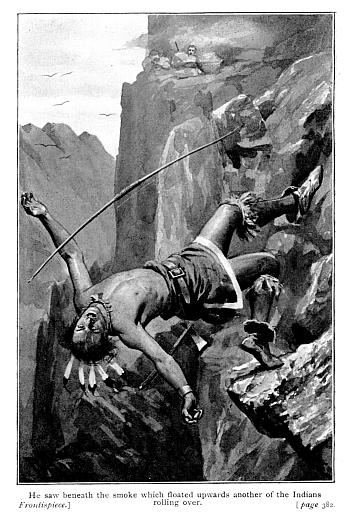
It was to save his life, he knew, for his enemy was as quick in his movements as he, with the result that a well-aimed arrow flashed across the intervening distance like a ray of light, which was quenched in the puff of white smoke which darted from the boy’s rifle. Then simultaneously with the report there was a sharp click, and the tough reed-like piece of wood glanced away, diverted from the object at which it was aimed, while as Chris peered with starting eyes over the top of the stone which had saved him from a grievous wound, if not from death, he saw beneath the smoke which floated upwards another of the Indians rolling over three or four times before descending into the depths below with ever-gathering speed.
There was another chorus of yells from overhead, and though he could not see them, Chris felt assured that the enemy were raging about the top of the cliff, seeking to send arrows at him; and he had additional proof of this being a fact, for crack!—crack!—crack!—crack! four reports came from below, with what effect he could not tell, but it seemed certain that his friends had fired at the enemy, whose yelling ceased, a strange and terrible silence succeeding the cries.
Chris re-loaded his empty barrel and looked sharply in several directions, mostly in that from which danger had shown itself, and with the full intention of firing at the first enemy who tried to reach the spot which commanded his resting-place. But the silence continued, and there was no sign of a renewed attack.
Then all at once there was a fresh beating of the pony’s hoofs from below, where everything was hidden. This was followed by a sharp scrambling sound, and again by a tremendous rush as of earth and stones sliding down for awhile before reaching the bottom with a crash.
“My poor nag!” groaned Chris, and in imagination he saw the crushed and bleeding body of the sturdy little steed lying motionless amidst the heap of stones.
The fancy was so horribly vivid that he shivered as if from a cold wind passing over him, while all the time he was bathed with perspiration.
The old dread of slipping from the narrow ledge upon which he lay came back, and with a terrible feeling of despair he waited for the moment when he would again be falling swiftly through the air to share the fate of his mount.
He had just reached this point when, sounding rather faint and distant but perfectly clear, he heard a familiar voice calling him by name.
But in his state of painful agitation he could make no reply, only lie motionless and ready to ask himself whether he had not conjured up the call himself.
But it was no fancy! It was his father’s voice, sounding as if sent forth with a great effort between hands held on either side of the speaker’s lips.
“Chris! Chris!” And perfectly clearly now a repetition of the words in a husky whisper from somewhere close at hand.
The Indians were above him, he knew, and it was like telling them exactly where he lay; but the boy felt that at all risks he must reply, and bending over a little so as to direct his voice downwards, he shouted—
“Ahoy! Here!”
Ahoy! Here!
The softly-whispered echo of the cry, not from close at hand, but from the face of the cliff far away.
But there was another and more ominous sound, or rather burst of sounds, at this, for a chorus of savage yells arose from the top of the cliff above him, and he knew that the Indians must have exposed themselves once more, for a couple of shots rang out from far below, raising strange echoes from the end of the valley, and once more there was the terrible silence in which Chris crouched hopelessly, for more than ever now he felt the crux in which he was placed—to attempt to move was to fall or expose himself to the arrows waiting for him on the top of the cliff.
The next minute the black cloud of hopelessness seemed to be cut by the voice which came up out of the depths—the voice that told him his friends were watching and waiting—as he felt must be the case—to fire at the first Indian who showed himself above the top of the cliff.
“Chris!” So low and distant, but so clear. “Chris!”
“Ahoy! Coo-ee!” shouted the boy downward, and from between his hands.
This time there was no answering yell, and Chris listened to the words that came up, sending a thrill of joy through him, but at the same time a strange tremor of fear.
“Can you hear?” came now.
“Yes.”
“Then—listen,” came with very slow emphasis. “You—must—creep—gully—lower—self—down.”
Chris was silent as he sat staring down as it seemed into nothing but the clear air, for the stone to which he had clung projected from the cliff-face, just as the parts above him overhung as if about to fall.
“Hear?” came from below.
The single word was so sharp and imperative that the boy replied at once, shouting the one word, “Can’t!” And then, as if ashamed of himself for so shrinking a reply, he alluded to one only of the dangers which hemmed him in by crying out, “Indians!”
Chris’s heart leaped again, and hope grew brighter, for he more fully grasped his situation from the next words that came, though he had pretty well understood it before.
“Dare—not—show.”
But the words had hardly been uttered before Chris felt that he knew more than his friends, for his strained and wandering eyes, which shrank from gazing down into the awful depths below, suddenly became aware of a slight movement amongst the pensile growth between the summit and the spot from which the Indians had shot at him.
He was in doubt for a few moments, and he held his breath as he cautiously brought his rifle to bear upon the hanging bush. But it did not stir, and it seemed evident that he had only imagined the danger.
He had held his breath painfully while he watched, and now, feeling that he was wrong, and must say something to those below, he breathed again freely and was about to speak when his heart seemed to stand still again, for one swinging bough was slightly agitated and pressed aside, showing the glistening, copper-hued skin of an Indian’s shoulder, with the strap of a quiver-sling plainly in view.
The man was evidently crawling like a short thick serpent to reach a spot from which he could shoot; but it was not to be, for covering the Indian’s side the boy waited a full minute to see if a better opportunity presented itself; and it came, for after lying perfectly still for awhile the man raised himself a little as if to clear something in his way, and then gave a spasmodic jerk, rolled over sidewise, and came gliding out from beneath the hanging growth, to fall like those who had gone before.
“How horrible!” thought Chris with a shudder, as he re-charged the barrel he had just fired. Then bitterly, “More horrible for poor father if it had been Chris Lee.”
The excitement of this fresh attempt to reach him roused him to try whether he could not obey the order that had been shouted from below, while the needed spur was now applied in the shape of the one word which rose up, perfectly clear—
“Try!”
The boy’s answer took the form of obedience.
Glancing upward to see that he was quite hidden, and again at the ledge from which the arrows had come, Chris passed his rifle-sling over his head and one shoulder, got the piece well over his back, and flattening himself down upon his chest, edged himself along to get his head a little beyond the stone of shelter so that he could look down, when he turned icy with the shiver that ran up his spine. For he was gazing down a perpendicular portion of the cliff-face to a patch of bushes fully two hundred feet below.
“Oh, it’s impossible!” he cried; but as he uttered the words once more the command came up—
“Try!”
“Ah, he doesn’t know,” groaned the boy despairingly, as he shrank shivering back to his old position, to lie still for a minute, feeling the palms of his hands grow wet. But the sound of that word try seemed to be echoing on his ear, and thrusting himself more away from the edge of the shelf over which he had peered, he wrenched his head round to see whether there was any possible ledge or slope on the other side of the stone where he had looked before and had seen as it were that it projected right out.
Once more his heart seemed to leap, for as he looked after backing a little more, he could see that his feet rested on a ledge formed by one band of the shale projecting about a foot beyond that above, while two yards or so beyond this ledge was broken sharply away.
What was beyond he could not see, but the ledge was certainly safer than the spot he occupied, there being room for him to lie down, and, better still, he could see that he would be better screened from any attack made from the ledge or the clump of bushes, the stone and an angle of the cliff being between the ledge and the dangerous foes.
It was a case of its being only the first step that costs. Chris had begun to try, and forcing himself backward along the ledge inch by inch, he soon had the satisfaction of feeling that he was more hidden from the danger of being shot at than he expected, while the cliff-wall at whose foot he lay completely screened him from above.
There was a hopefulness about this, a feeling of being rewarded for his effort to try, which nerved the boy to continue, in spite of the difficulties attending his backward progress and the way in which his rifle caught against the wall, and his having to stop again and again to readjust the holster of his revolver, which kept on slipping round.
“This going backward is horrible,” he said to himself at last, as he paused rather out of breath to look anxiously about him, but felt in better heart upon again seeing how thoroughly he was screened from the Indians. The danger was not there, and he had nothing to mind on one side where the rock-wall went right up, probably to the tableland above, which, for aught he knew to the contrary, might come right to the edge of the mass of earth and stone. That which he had to fear was the horrible vacancy on his left, over which, had he cared to, he could have stretched out his hand; but though more than once tempted to do so, he shrank from it with a shudder.
“But I must do something,” he thought. “I can’t go on backwards like this.”
He waited a little while to let his breath come and go more easily, and while he lay there resting upon his chest he thought. He reasoned with himself in a kind of argument and appeal to his common-sense.
“This natural shelf,” he said, “is about a foot wide, and if it were only just above the ground I should feel not the slightest nervousness, but be ready to stand up and run along it, instead of creeping back like a worm. Suppose it does go down hundreds of feet, what then? There is just as much room, and it only wants pluck. If I couldn’t run along it I might walk steadily. I will.”
But he did not begin. The horror of that great unknown depth was too hard to master; but he raised himself slowly on all fours to see if he could not turn himself round so as to crawl the rest of the way head first instead of feet.
It seemed very simple, but at the first trial his rifle caught tightly, and he was attacked by a sensation as of something thrusting at him hard, so that he closed his eyes and remained for some seconds with his head projecting over the edge of the shelf before he shuffled himself back into his former position, and then lay panting till the breathlessness that had attacked him passed away, leaving a sensation of anger against himself for his want of firmness.
“Oh, it’s cowardly,” he muttered fiercely. “I can’t go on backwards, and I must and will do it. But how?”
He thought more calmly at last, and it seemed plain enough. All he had to do, it seemed, was to take fast hold of some projection in the rock, so as to steady himself, and then—
No, that wouldn’t do.
“I see,” he panted the next minute. “Turn over on my back. But is there room?”
This required a good deal of anxious thought, for failure meant plunging down at once into the depths below.
“There must be room enough,” he panted, “if I keep on edging myself close to this great wall of rock.”
He hesitated no longer, but setting his teeth hard and moving by inches, and battling with the hindrances offered by the weapons he carried, he wrenched himself round till he lay flat upon his back, gazing upward calmly enough in spite of one terrible half-minute he had passed, when it seemed to him that his rifle was acting as a lever to thrust him right off.
“But that was only fancy,” he said to himself now the danger was past, “and all I have got to do is to take hold tightly of the rock with my right-hand and of some block or projection in this wall with my left, let my legs glide over the edge, and sit up. It only means my legs swinging over the gulf. Then I can get on to my hands and knees and go forward easily enough, while my rifle won’t be in the way.
“Only means my legs swinging over the gulf,” said Chris again, this time aloud, in a peevish, low voice. “Only! Oh, I can’t do it,” he groaned, and then breathlessly and without giving himself an opportunity to shrink, he said aloud, “I will.”
The next minute he had begun making the effort—seizing the edge of the rock and reaching up overhead to feel about till his fingers sank into a crevice, and then, panting heavily, he made one brave effort, holding on tightly and letting his legs glide over, while he stiffly raised himself up, moving as it were upon a pivot, that pivot being the base of his spine.
“There,” he cried triumphantly, as the result of his effort was that he was sitting upright on the ledge with his feet in the air, but not swinging, for he pressed his heels hard against the rock beneath him, as he glanced sidewise to think of how he was to make his next movement.
“Chris! Ahoy! Chris!” came faintly from below, and at the same moment there was a sharp crack, and the ledge upon which he was sitting gave way, dropping down with its burden, many feet on either side of him parting clean from the wall of rock, just as if it had been riven off by some mighty wedge.
Chapter Forty Three.
A Welcome Word.
Chris’s lips parted for a cry to escape, but his teeth remained fast set, and there was not a sound for the moment. He was conscious of dropping rapidly down without the slightest change in his position, and then there was a dull heavy shock, when the apparently solid piece of ledge, after being exposed to the atmosphere for ages, crumbled into dust and went on downward with a curious whispering rush along a steep slope instead of over a perpendicular wall. Choking with the dust which arose, rolled over and over and half blinded, Chris was stunned by the confusion of the rush, for how long he could not tell, and then there was a sudden stoppage, and he lay half buried in the débris of the little earthen avalanche.
For a few moments the lad was too much stunned to attempt to move, and lay motionless, trying to pierce the thick dust which closed him in. Then the horror and dread of his position came upon him with terrible force, and he began to struggle violently, increasing the dust, but getting first one arm and then the other free. Then matters grew more easy; he dragged himself sidewise, and shovelfuls of the débris dropped from his hips, while he could feel that his legs were looser. Then another desperate struggle, and he was on the outside of the sloping heap, but only to set the surface in motion again and roll and glide down and down and over and over once more, till he was brought up short in the narrowest part of a wedge-shaped mountain cleft, to begin struggling again, trampling as if rapidly ascending stairs, to avoid being buried by the gliding rubbish still in motion and filling up the bottom of the rift.
The dust was still forming a cloud, but it was floating away, leaving the bare sides of the cleft clear enough for him to see far above him where the ledge ran horizontally along the side of the huge wall; and the change in colour showed him where what seemed to be quite a small portion had dropped away.
Chris’s next effort was to feel himself over and move his limbs, which felt sore, and ached; but he soon found that he was not hurt, and began to try and realise his position.
As far as he could make out he was in a rift of the valley; walls almost completely shut him in on three sides and nearly so on the fourth, but here there was light—bright light—coming through a lightning-shaped, enormous crack which zigzagged downward from a great height, and whose depth below he could not trace.
The position would have been enough to confuse a man at any time, but now after the fall it was tenfold more puzzling than it would have been to one trying to ascend the rock-face. But Chris soon came to the determination that the open valley must be out beyond the zigzag rift, and shaking himself clear of the rubbish which adhered to his garments, he felt that his weapons were all right, and then began to make his way over the fallen stones and earth to the great crack.
“I must be a long way down the cliff,” thought the lad; “but it’s wonderful that I’m not hurt—more,” he added after a pause, for a feeling of stiffness and pain began to trouble him.
With the pain the remembrance of the Indians began to come back from where it had been driven, and instinctively drawing round his rifle, he looked upward; but the edge of the cliff was not visible from where he stood, and there was no fierce-looking warrior upon any ledge drawing his bow to send an arrow whizzing through the air. But all the same Chris instinctively hastened his steps over the yielding débris, seeing as he did that once inside the zigzag rift he would be sheltered from any such danger as that.
The next minute he had left the heaped-up earth and shale, to begin climbing over blocks of hard stone which filled up the bottom of the rift, finding the way difficult, even painful, with the light a very short distance in front, but with jagged masses hanging threateningly overhead and looking as if a touch would bring them thundering down.
It was only fancy though, for they would be immovable until the water that the boy now heard trickling softly amongst the stones far beneath his feet had gone on doing its insidious mining perhaps for ages, for the zigzag rift was composed of massive stone.
“Oh, if I could only get some of that water!” thought Chris, as he now heard the soft musical trickle which roused within him a parching feeling of thirst.
But it was far out of reach save to some burrowing animal which might have felt no compunction about making its way down through the crevices of the fallen blocks over which Chris continued to stumble, till all at once he dragged himself through a narrow opening between the two sides of the rift, to find that he could look diagonally across the valley at the openings and terraces far away, but evidently those which would be the unexplored portions of the rock city, opposite the places they had examined.
“Hurrah!” he cried, as the light seemed to flash into his spirit and give him strength, for a shot rang out from somewhere to his right. He knew it must come from there, for the echo came from beyond the opening on his left.
Then there was another, and another, to awaken the echoes, followed by silence, during which he waited for a fresh signal.
It came at last, but very faint and distant, and though he shouted several times over, there was no reply.
“It’s of no use to wait,” muttered Chris; “they can’t hear, and if they did they couldn’t help me. I must help myself.”
Feeling this strongly he climbed a little farther, to find that he was at the edge of the zigzag rift, which, as far as he could make out, clove the face of the cliff from a great height up to far below him; and to damp his spirits the fact was clearly before him that he could go no farther outward, for there was no fancy here—he was at the edge of a genuine precipice, and if there was any escape it must be by descending.
He stepped back a little way and reached where the stones were piled-up roughly, partially filling up the rift, and by using care he was able to descend from block to block, with the water keeping up its musical tinkle far below.
“Why, it must be making its way out into the valley,” he thought, “and if I can follow it I may be able to get out where it falls.
“But we saw no falls,” he said, after a few minutes’ thought; “but then we never came quite to this end of the place, and only saw it from a distance. Let’s see; water keeps going down and down, and if I can keep on close by it it’s sure to lead one right into the valley, which looked as if it was completely closed at the upper end.
“So it is,” Chris added, with a pitiful little laugh, “The Indians couldn’t get down—those who were shot did. And so did I; but only after two awful tumbles. Why, it must be a wonder that I am alive. But it killed my poor nag.”
Chris did not talk to himself, but his brain was very active, and he wondered a good deal why it was, as he kept on threading his way over and under stones, with the water acting as guide—why it was that he heard no more calls.
“It must be,” he thought, “that they are quite behind me, while I’m making my way across the end of the valley, so that I shall come out somewhere near the opposite side—if I ever do get out, for the place gets narrower and darker the farther I go.”
Chris had good cause to complain, for from climbing over blocks of stone he had to begin creeping under and between pieces so closely set that there were times when he was ready to give up in despair, and at last the end of his journey seemed to have arrived. For he was brought up short at the mouth of a cavern-like place where the sound of trickling water grew louder and was accompanied by a peculiar whispering echo sounding horribly strange and mysterious, coming as it did out of black darkness.
It took a strong effort to enter the place, but the lad had grown desperate. He was conscious that whatever difficulty there was to encounter he must face it, so bending down and feeling his way by the rough rocky wall, he stepped on very slowly and cautiously, for the flooring of the cavern-like place was of loose stones, beneath which he could hear the water running faster as if nearing its exit, and he knew that if he could not find the opening where the spring ran into the valley, he could come back, for the hidden stream would still be his guide.
He had just comforted himself with this thought—a most welcome one where all was black—when it seemed to him that there was a dull suggestion of light not far ahead, and he took a few more cautious steps with his hands telling him startling news, for he found that the roof was rapidly getting lower, and a few yards farther he had to stoop.
But it was lighter, and hence it was that a little farther on he did not hesitate to crawl, while before he had progressed many feet farther he had to drag himself over the rough stones, which vibrated now from the water flowing about their bases, and then as he dragged himself out into the full light of day it was into the rocky channel of a stream where the water, that must at some time have rushed out as a heavy fall, smoothing the stones on either side, was now invisible, descending as it did for about fifty feet into the valley amongst the rocks, and plunging, mole-like, deep down beneath the surface, as if shunning the light of day.
“Hah!” sighed the lad, as he stood upright and breathed deeply of the soft pure air, for his difficulties seemed to be at an end, nothing remaining for him to do but lower himself down amongst the rocks from the rough ledge upon which he was perched, when his heart leaped at the sound of a familiar voice hailing him with a cheery “Ahoy!”
Chapter Forty Four.
Open-Air Surgery.
“Griggs!” shouted Chris excitedly.
“Why, there you are! The doctor’s gone the other way to see if he could find a gully by which he could climb up to try and find you. I came this way. Same purpose, and I’ve got all the luck. Take care! Mind! These stones are slippery.”
“Yes, I’ll mind,” said Chris, as he descended the rocks backwards. “This is nothing; but hadn’t you better run and tell father you’ve found me?”
“Nay! I’m not going to brag. I didn’t find you; you seem to have found me. Then you haven’t broken your neck?”
“No.”
“How many legs are snapped?”
“None,” said Chris, who threatened to break one directly, so reckless was his progress.
“Arms, then?”
“I’m all right, I tell you, only a bit knocked about; but where’s Ned?”
“Along with his father on the upper terrace, giving the Indians a bit of a shot now and then to keep them from coming up after the mules.”
“But can they do it alone?”
“Oh yes; the brutes are sad cowards and don’t like powder and shot at all.”
“There!” cried Chris, leaping to earth and coming close to the American. “Now then, I want to join father.”
“That’s soon done,” said Griggs; “but keep an eye up towards the top yonder, and ’ware arrows.”
“Yes, I know,” said Chris excitedly.
“Of course you do; but they’ll be pretty shy of showing themselves now, after our bit of shooting.”
“Walk quicker,” said Chris. “But tell me, how did the enemy attack you?”
“That’s what we want you to tell us, lad. When they began we were afraid they had got you. How did it all happen?”
Chris explained in a few words, and then began questioning, to learn how those he had left behind were nearly taken by surprise, but their preparations proved too perfect and a few shots had driven the Indians back.
“Spoiled our night’s rest, though,” said Griggs dryly, “for there was no sleep for fear of the redskins stealing by us in the dark and driving off the cattle.”
“Ah,” said Chris, with a sigh. “My poor mustang!”
“Poor brute, yes,” said Griggs. “It was a thousand pities. I liked that pony. He made me jealous of you.”
“Don’t talk about him,” said Chris quickly. “I tried so hard to save him.”
“You did, my lad; you did.”
“How do you know?” said Chris, staring.
“How do I know? Why, didn’t I tell you the redskins spoiled our night’s rest?”
“Yes.”
“Well, that means we were all wide awake at daybreak.”
“Then you saw all?” cried Chris.
“Why, certainly. Ned had the glass and was telescoping in all directions up and down the valley, looking out for squalls, when he suddenly made us all jump nearly out of our skins for joy by shouting out, ‘There’s Chris!’”
“And then you saw all that happened?”
“To be sure we did,” said Griggs; “everything, and precious unpleasant some of it was. It brought us into action pretty soon though, making us hurry up towards the head of the valley here on the chance of getting a good shot or two in amongst our savage friends.”
Chris turned round and looked the American full in the face, but without speaking.
“Well, what’s the matter, lad? Smudgy with gunpowder? Oh, I’ve had no time to wash this morning.”
“Griggs,” cried Chris excitedly, “who was it fired that shot?”
“Which one, my lad? We sent a good many flying.”
“You know what I mean.”
“Yes, who was firing. Your father, of course.”
“You’re prevaricating, Griggs,” cried Chris huskily. “Tell me at once who fired that shot?”
“Which one? We tumbled two or three, or more, of the enemy down. So did you. I heard your rifle crack, and saw them come off the cliff.”
“No nonsense, Griggs; you know what I mean. I say, who fired that shot?”
“And I say which one? There were so many.”
“The one that saved my life.”
“Oh, I see,” cried the American; “that one. Well, I think it was either me or the doctor, but we were in such a state of excitement that it’s doubtful.”
“There, I was sure of it from the first,” cried Chris, holding out his hand; “it was you, Griggs.”
“I don’t say it was, and I don’t say it wasn’t, my lad,” said the American, turning away carelessly as if not seeing the extended hand; “but look here, it was bad enough for you, that set-to with the redskins; but it was all excitement and action; you had no time to think. It was a hundred times worse for us down below here.”
“Indeed?” said Chris half mockingly.
“Yes, indeed. I tell you, my lad, I never passed such a bad half-hour before in my life. We could see every movement, except when you galloped out of sight. It all stood out like a picture against the clear morning sky, while there we were nearly all the time, afraid to shoot because we were more likely to hit you than the enemy. My word, I felt bad enough, but it was just horrible for the doctor.”
“Poor father!” said Chris.
“You may well say that, my lad. P’r’aps you don’t know it, but he thinks a deal of you, my lad.”
“Why, of course,” cried Chris.
“Very foolish of him, I suppose, but then he don’t know you so well as I do. He’s prejudiced, you see.”
“I suppose so,” said Chris.
“My word, he did take on when he saw the mustang come over the cliff and drag you after it!”
“Don’t talk about it,” cried Chris with a shudder.
“Why not? I think it was very fine now. We were a bit worried at first, and the doctor couldn’t shoot at all for some time; but as soon as we heard you begin to pop and the redskins came down, we nearly went mad with joy. I saw, though he didn’t say much out loud, but I just caught sight of his lips moving now and then; and the way he shot afterwards—I don’t believe he made a miss. I say, the redskins were soon tired of showing their faces over the edge of the cliff. But, my word, Chris, lad, you had a narrow escape!”
“Several,” said Chris, smiling.
“Ah! Yes! You ought to have been killed with the arrows.”
“Ought I?”
“Yes, that you ought. Those fellows shoot very straight, and send those thin splints of wood with tremendous force.”
“They do,” sighed Chris. “My poor mustang!”
“Ah! Poor plucky little thing; he nearly killed you too.”
“In his agony, poor creature. He was shot savagely.”
“Ah! Yes. Seems rather hard on him—a horse to be shot by means of a horse.”
“I don’t understand you,” said Chris, staring.
“No? Don’t you know what some of their bows are?”
“Oh, you mean the strings. Made out of twisted gut, perhaps.”
“That’s quite right, my lad, but not what I meant. I meant the bows themselves.”
“Some very tough wood, I suppose, like the yew with which the English used to make bows.”
“Nay. Lots of them are made of horses’ or buffaloes’ ribs. They’re handy and short and tough. You know with what a whing they can send an arrow.”
“I didn’t know that,” said Chris thoughtfully.
“Didn’t you, now?” said Griggs mockingly. “I shouldn’t wonder if there are two or three more things that you haven’t found out yet. But, as I was saying, you ought to have been a dead one over that job, squire. The redskins meant you; but they got the worst of it. I say, though, I could teach you a-many things.”
“Well, you have taught me many things in shooting and fishing and hunting.”
“Well, yes, a few,” said the American coolly; “but they’re just about nothing to what you could teach me.”
“I?” cried Chris, staring at him in wonder. “Why, what could I teach you that you don’t know?”
“How to tumble over a cliff like that without doing yourself any worse damage than making a few scratches, tearing your jacket, and getting yourself full of dust.”
They had been tramping together across the head of the valley as they talked about their experiences, with Chris keeping a keen lookout ahead for the first glimpse of his father, and giving an occasional look up towards the edge of the cliff, which he noted was wonderfully broken up into hollows and prominences, rifts and gorges that had been invisible from a distance, and all overhung by a level band of apparently impassable rock. But during the last few minutes of their chat they had been so deeply interested that neither had glanced upward to their right, and the first warning they had of danger was given in a quick sharp shout in the doctor’s familiar voice.
“Ah, look out!” he cried, and followed up his words by firing; but before the bullet left his rifle Chris heard a loud whirring and saw his companion start violently before stooping down a few yards away to pick a little arrow from where it had stuck in the ground.
“That’s not bad shooting,” said Griggs coolly. “Hit him, doctor?”
“Yes,” said the latter, hurrying up to catch Chris’s hand.
“My boy! my boy!” he cried in a choking voice which prevented him from saying more.
But he seemed to give himself a wrench directly after, to speak out plainly and with decision.
“You must keep a sharper lookout, Griggs,” he cried. “You forget that we are within range of their arrows.”
“I shall remember in future, doctor,” said the American dryly.
“Did that arrow touch you?” said the doctor anxiously.
“Went right through the leg of my boot, sir,” said Griggs coolly.
“But it did not graze you? Why, man, you’re bleeding fast!”
“Oh, it’s nothing, sir,” said the man.
“How do you know?” cried the doctor. “Here, let’s get behind that stone. They can’t touch us there.”
Griggs walked firmly enough half the distance to the shelter sought for, but he limped the rest of the way, and was ready enough to sit down behind the rock and let the doctor go on one knee to carefully draw up the bloodstained bottom of the man’s trousers just above where it was thrust into the high boot.
“Hah!” sighed the doctor. “Only a clean little cut in the flesh. I’ll put a stitch or two in it. Why, it’s as clean as if done with a knife.”
The doctor had laid his rifle ready to hand, and was busy at once opening a pocket-book containing the necessaries he required; but first of all he pulled round the bottle slung over his shoulder and carefully washed the diagonal cut.
“You don’t think there’s poison in it, do you, doctor?” said the American, with a look of amusement.
“Any form of dirt is poison to a wound,” said the doctor, drying the place; and then, after deftly drawing the edges of the wound together, cutting some strips of plaister with the bright scissors ready, and applying them to keep all protected from the air.
“Hurt much?” he said, as he worked away, Chris watching the while as if taking a lesson.
“Well, yes, I won’t say it don’t, doctor; but not worse than I feel somewhere else. I say, though, hadn’t we better make haste back to the fort?”
“Yes; you feel faint, don’t you?”
“Horribly,” said Griggs, giving Chris a comical look.
“Let’s go, then. Put your foot as lightly as you can to the ground, and lean on me. We must get out of bowshot as quickly as we can.”
“Tchah! Only my nonsense, doctor,” said Griggs cheerily. “My faintness is the same as squire’s here. We want our breakfast horribly.”
“Oh,” cried the doctor, smiling. “I was afraid it was from your wound. I don’t wonder that you are faint, Chris. But one moment, boy, do you think the Indians can lower themselves down over the edge of the cliff?”
“No, father; not unless they are ready to drop as I did.”
“How far?”
“Can’t tell,” said Chris, with an involuntary shudder. “It was rather horrible, and I wonder I wasn’t killed.”
“And I wonder too,” said the doctor solemnly. “I don’t think that they will dare to descend in the daytime, for they will be afraid that we are waiting to fire at all who show; so come on. Are you sure you can walk, Griggs?”
“Walk, sir? I should like to run.”
“But your leg must smart.”
“Hardly smarts, sir; it’s just as if somebody was playing at sewing it up with a red-hot skewer. Nice bold refreshing sort of pain.—Tchah! That’s all right.”
“But where are the mules and ponies, father?” said Chris, as they hurried now in the direction of the terraced cliff on their right.
“Hobbled, and grazing at the foot of our cliff under shelter of a couple of rifles.”
“But there are more Indians at the mouth of the gulch?”
“I don’t know,” said the doctor. “They had a fire burning there last night.”
“Yes,” said Chris dryly, “I know;” but he did not then attempt to explain how he knew.
“They haven’t shown since they felt the effect of our bullets, but they’re as cunning as they are treacherous, and one never knows what they may be about.”
Some quarter of an hour later the adventurers were all in shelter, one of the cells of the lower range having been turned into a temporary mess-room, while the next showed signs of cooking in the shape of a curling little column of smoke; there was water in buckets outside on the terrace, where, behind a kind of breastwork hastily piled-up, watch was being kept; and well in sight there were the animals of the little train, grazing contentedly enough well within range of the watchers’ rifles.
Chris felt like a hero after the warmth of his welcome was beginning to cool down. He had eaten almost ravenously, and assuaged the great thirst from which he had suffered. But now the great desire from which he suffered was want of sleep, for he was utterly weary and so stiff that he could hardly refrain from uttering a groan.
All the same he had been obliged to relate his adventures once more—such of them as had not been seen from the valley. But at last he was lying down in the cool shade in one of the cells and dropping off, but only to be aroused by the coming in of Ned, who was eager to hear more.
“You are a lucky one, Chris,” he said, in an ill-used tone.
“What!” cried the boy angrily; but the next moment the remark presented such a ludicrous side that he began to laugh, and then, possibly from exhaustion and the result of the exciting passages he had gone through, his mirth grew at once almost hysterical, so that he could not check himself.
“Why, what’s the matter?” cried Ned wonderingly. “Have I said anything comic?”
“Horribly,” panted Chris; “but I do wish you’d go, and let me sleep.”
“I will soon,” said Ned; “but I don’t see what there is to laugh at, unless you feel jolly triumphant at getting all the best of the expedition to yourself.”
“I do,” said Chris. “It was lovely being shot at with arrows and tumbling down those precipices, better than any dream I ever had.”
The boy’s face looked mirthful, and Ned did not notice the bitterly sarcastic ring there was in his comrade’s words, as he said in an envious tone—
“Well, it’s all very fine, but I shall tell father that it isn’t fair for you to be made the favourite, and I don’t think you’ve behaved well.”
“Don’t you?” said Chris, sobering down. “I’m very sorry; but I’ve done the best I could.”
“Perhaps so, but I don’t think that if I had lost my pony I could have lain there and grinned as you’ve done. Poor brute! I almost believe I would rather have died myself.”
Chris was perfectly sobered now, and as Ned walked away he lay there in the cool shadow with a peculiar look in his weary eyes, while, far from desiring sleep, he could only lie hot-headed and in feverish pain, thinking of the gallant way in which the pony had galloped to save his life.
It was long before he slept, and when he did it was to go through most of the events of the past night and morning again in feverish dreams. But at last he slept too heavily for dreams. Nature required rest, and the boy lay breathing in the cool mountain air and sleeping as if he meant to crowd the rest of two nights into one.
Chapter Forty Five.
A Welcome Stronger.
“Chris!”
“Don’t!”
“Chris!” in a louder tone.
“Get out!” very irritably, and the speaker turned sharply over with his face to the stones and his back to the bright sunshine that came through the old window-opening.
“Are you going to sleep here for ever?”
A grunt, accompanied by the kicking out of one leg, which would have taken effect if Ned had not hopped over it.
“I say, are you going to sleep for a week?”
“No! And I’m not asleep now,” said Chris, with his eyelids squeezed very close together; “but I tell you what, if you don’t be off and leave me alone I’ll get up and punch your stupid old head.”
“You daren’t.—I should like to see you!”
“You soon will, and so I tell you. Be off, or I’ll empty the wash-hand jug over you.”
“Ha, ha, ha!” laughed Ned. “Where is it?”
“Oh, bother! Be off!”
“Shan’t! Do you know it’s to-morrow morning?”
“No, I don’t, Paddy Bull. How can it be to-morrow when it’s to-day?”
There was a grunt very much like a snore.
“Well, of all the old dormice!” muttered Ned. “Chris, you must get up.”
“Shan’t!”
“But you’ve been asleep twenty-four hours.”
“Look here, stupid,” grumbled Chris, without stirring, “if you want to tell a big fib you should always make it as big as you can, or else people won’t believe you. Say twenty-four days.”
“Why, you unbelieving old humbug! It’s the truth. You ate till I was ashamed of you, and then you lay down to sleep about this time yesterday, and here you are now as sleepy as ever. If you don’t get up I’ll go and tell the doctor you must be ill.”
Chris started up into a sitting posture and uttered a cry.
“Oh! I say!—Ugh! I am stiff. I can’t hardly move.—What’s the matter with me?”
“Slept till you’ve turned stiff as a log,” cried Ned. “Twenty-four hours right off.”
“I say, that isn’t true, is it?”
“Why, of course it is. Don’t you remember lying down?”
“Of course I do. But what time is it?”
“Oh, I don’t know about the time, but it’s getting on for mid-day.”
“Ned! I say, why didn’t you wake me up before?”
“To be kicked at and threatened and called names?”
“Oh dear, how stiff I am! But really, Ned—no gammon—have I slept like that?”
“Of course you have. Don’t you remember?”
“Yes, I think so. Yes, of course. But what about the Indians?”
“Oh, they’re hanging about. Some are at the mouth of the gulch, and some are on the cliffs at the top of the valley, but they don’t come near.”
“Haven’t got the horses and mules, have they?”
“No. We’ve kept too sharp a lookout for them.”
“Oh!” cried Chris wildly, and his face contracted with pain.
“Well, I suppose it hurts,” said Ned, with a trace of sympathy in his voice, “but I wouldn’t holloa like that. Get up and move about, the stiffness will soon go off.”
“I wasn’t shouting because of my hurts,” said Chris bitterly. “I was thinking of my poor mustang.”
“Yes,” said Ned, after a pause; “that was a horribly bad job; but I’ve been thinking about it all, old chap, and I’ve settled what we’ll do. I’m going to play fair—same as you would if it had been my nag. We’ll share one between us. I’ll have him one day, and you shall have him the next.”
“That wouldn’t be fair,” said Chris, who was rubbing himself and kneading his joints where they ached.
“Yes, it would. You wait and hear. Then we’ll have that mule that we took to fetch the water—old Brown Ginger. He’s a regular brick, and likes us. Don’t kick so much as the others—and take it in turns to ride him. What do you say now?”
“Well—yes! I like that idea; but you wouldn’t care for that.”
“Look here, you’re growing a sore-boned, old disagreeable. Say I’m a selfish beast at once.”
“Shan’t!”
“Then it’s all right,” cried Ned.
“It’s very good of you, old fellow.”
“Bah! Rubbish! Stuff! I say, are you so very sore?”
“I can’t hardly move some ways.”
“Like me to give you a rub?”
“Oh no,” said Chris, increasing the friction he was applying across the small of his back. “I shall be better soon. Only it’s just as if I’d been hammered all over. But how queer that I should sleep like that!”
“Not a bit of it. The doctor said it was all right and it would do you good.”
“Where is he?” cried Chris.
“Along with Wilton, watching the Indians down at the gulch. Father’s up yonder along with old Griggs, keeping an eye on the top of the cliff, and shooting the birds that rise out of the hollows and rifts there. They come down our part to get at the water.”
“Then you’ve been all alone?”
“Yes, playing pony and mule-herd. Nobody at home but me in this big three-storey house.”
“But what about breakfast?” said Chris anxiously.
“Over hours and hours ago. Hungry?”
“I think so: I feel very hungry.”
“That’s a good sign,” cried Ned, grinning. “Now I’ll confess. That’s why I roused you up. There’s coffee hot, and damper, and a split-up and frizzled bird. I don’t know what it is. Sort of vulture crow, perhaps.”
“What! A carrion bird?” cried Chris. “Disgusting! They’re not good to eat.”
“Oh, these are—delicious. I ate half of one this morning. Perhaps they’re not carrion birds, though.”
“It’s all your gammon,” cried Chris. “Who shot them?”
“Old Griggs, when they came after the water.”
“That proves it. Old Griggs knows what’s good to eat well enough.—Hah, that’s better. I’m not quite so stiff now. But is there plenty of water?”
“Lots. Why?”
“I want to have a wash.”
“Bucket and pan waiting for your lordship in the bathroom. There, go and have it; and look sharp. You’ll find me in the kitchen. We’re using that till the workmen have been to put the breakfast-room in a state of repair.”
“You seem pretty lively this morning,” said Chris, rather sourly, for he was in a good deal of pain.
“Of course I am. We’re enjoying ourselves so.”
“You did nothing but grumble yesterday, and said I was having all the fun.”
“Ah, but I didn’t know how sore you were going to be then,” cried Ned merrily. “There, look sharp. Breakfast’s waiting.—I say.”
“What?”
“I wouldn’t stop to shave this morning as it’s so late.”
Chris passed his hand over his chin.
“I expect it wants a scrape,” he said, “to take all the dust off.”
A few minutes later, feeling much refreshed, Chris was feasting away at a most enjoyable breakfast, the lads chatting away merrily the while.
“I say,” said Ned, “this wouldn’t be a bad place if it wasn’t for the Indians. Quite a palace when it’s put in repair. Land one’s own; the soil beautifully rich. I believe anything would grow here. I vote we settle down.”
“And what about the gold?”
“Ah, the gold! I’m beginning to think with my father that we shall never find the old temple, and that if we did we should be none the better for it. I don’t think we want all that gold.”
“Grapes sour?” said Chris dryly.
“N–no,” replied Ned. “But there, what’s the good of talking? We’ve come to find the gold, and we shall go on till we feel it’s no good. I like what we’re doing, though. We must stop here, of course, till the Indians are tired and have gone. I wish they would go.”
“Yes, it makes it so horrible.”
“Ah! Doesn’t it? I don’t mind shooting something that we want to eat. But firing at them—Ugh!”
“Yes, it is horrid,” said Chris; “but they’re hardly men. Savage wretches! They seem to love killing.”
“Have some more vulture,” said Ned quietly. “There’s all that piece of breast yet.”
“Vulture!” said Chris, laughing.
“Well, didn’t it taste bitter?”
“Yes, a little. It’s one of those prairie hen things, of course.”
“No, it was a fine fat cock.”
“Well, they call them prairie hens. It was, as you say, delicious.”
“Well, finish it.”
Chris shook his head, rose stiffly, and helped his companion to clear away.
“Now then,” he said, “I’m not much disposed to walk to-day. It’s just as if I’d strained one of the muscles or something up in my hip. I should like to go and sit out on the terrace. Haven’t got the glass, have you?”
“Yes, it’s there, in the lookout. You can’t do better than take my place. There’s a rifle too, and cartridges, in case the Indians show, and the stones are built-up with loop-holes so that you’ll be safe from arrows if the brutes do come crawling up and chasing the scouting-party.”
“What are you going to do?”
“Help you do nothing,” said Ned, laughing.
He led the way, and Chris limped after him, to find one part of the terrace turned into a rough observatory with a stone seat, and the binocular and rifle lying ready as Ned had said.
“I can’t see anything of our people, nor yet of the Indians,” said Chris, after a good look round in different directions.
“Oh, no; they keep well hidden.”
“No fear of their hiding in any of those cells or on the terraces across the valley, is there?”
“I dunno; they might,” replied Ned; “but they couldn’t send an arrow in here from that distance.”
“But we could send bullets. That side’s within range,” said Chris thoughtfully.
“Oh yes, and it wouldn’t be lucky for one of the scalpers to show himself, I can tell him; but I say, look at the animals. I went down to them this morning, and their coats are getting smooth already. The coarse rich grass here suits them splendidly. If we stop here long they’ll be growing fat.”
Chris turned the glass upon the little drove of mules, which were grazing contentedly enough, and then changed his position to look at the ponies, which were keeping themselves aloof from their distant relatives, and cropping away with the thick grass right up to their knees.
“One—two—three—four—five—six,” said Chris, by habit, counting the mustangs slowly.
“Hallo!” cried Ned. “Hurt one of your eyes?”
“Yes. It was when I came down with that ledge; I got both eyes full of dust and grit. Why?”
“Because you must be squinting,” said Ned.
“Is this another joke?” said Chris, with the glass to his eyes.
“It’s no joke,” replied Ned, “not to be able to count properly. Try again.”
“One—two—three—four—five—six,” said Chris, counting slowly.
“Nonsense! Only five. One of your eyes don’t go at all, seemingly.”
“I can see them distinctly through the glass,” cried Chris, with a touch of irritability in his tones.—“Why, Ned!”
“What’s the matter?”
“There are six.”
“Stuff!”
“There are, I tell you. Why, hurrah! hurrah! hurrah! My pony’s there.”
“What! You mean his ghost.”
“Ghosts can’t eat grass,” shouted Chris wildly.
“Why not? Horses’ ghosts would when they couldn’t get corn.”
“It is! It is!” cried Chris, with a sound like a sob in his throat, and certainly there were tears in his eyes as he handed the glass to his comrade. “Look! Look for yourself; it’s my dear old mustang. Ah! there! he’s walking lame. And I thought he was dead—I thought he was dead!”
“It is, old chap,” cried Ned, after a hurried glance. “He must have got here somehow and joined his mates in the night. I never noticed it, and no one else did, of course.”
“Oh, Ned, this is good luck!”
“Good? It’s glorious! Luck squared or cubed, or somethinged, up to the tenth power. Here, let’s go down and see. Can you walk?”
“Walk?” cried Chris excitedly. “I feel as if I could run!”
“Get your rifle then; we mustn’t stir without our popguns now. Why, I say, I never thought your mount was pure bred. His great-grandfather must have been a wildcat, a big one of the nine-lives breed, or he never could have come over that cliff, as you say, and lived. Perhaps it is his ghost, after all.”
“Come on, and don’t talk,” cried Chris, who had buckled on his belt and slung his rifle.
“It’s enough to make any one talk,” cried Ned. “But, I say, you said that the Indians shot at him till he was as full of arrows as a pincushion is full of pins.”
“I didn’t. I said he was wounded two or three times.”
“All the same. He must be a wonderful beast. Just wait till I’ve had a look at him, and then I tell you what we’ll do. We’ll change.”
“Will we?” cried Chris, through his set teeth. “Poor old fellow, I wouldn’t part with him for the world. Hff!”
“What’s the matter?”
“Oh, nothing much. I’m only stiff and bruised all over. Come on.”
Chris limped a great deal, and suffered plenty of pain, but he got down the slope bravely, managing to step from stone to stone until the way down to the water was passed and the two lads were hurrying across the verdant portion of the valley towards where the animals were browsing and grazing.
The mules just turned their heads to look at them in a surly, uncompromising fashion, and went on feeding again, but as soon as they were passed and the lads approached the ponies, Chris raised his voice, uttering a kind of bird-call, when the effect upon the little herd was immediate: all turned their heads, and Chris’s mount uttered a shrill whinnying sound, before advancing to meet him, going, however, very stiffly on three legs, and as they approached looking as if it had suffered badly enough for anything that claimed to be alive.
“My word, he has had it warmly,” cried Ned. “Poor old chap, he’s been in the wars, and no mistake!”
The animal limped badly, and so did Chris, as they came within touch, when the pony thrust forward its muzzle in response to its master’s extended hand, and then dropped its head and looked dejected in the extreme, but blinked and whinnied again as it felt itself caressed.
“My old beauty! My brave old chap!” cried Chris huskily. “Oh, look here, Ned! A broken arrow sticking in him still.”
“Why, there’s another on this side,” cried Ned, “and a cut or a scratch—no, it’s too bad for a scratch—there in his flank.”
“He’s cut here too, in the forehead. Oh, Ned, however did he manage to struggle back?”
“Oh, never mind about that. Let’s have the heads of these arrows out first thing.”
“Yes; they must be ready to fester in the wounds. No, we mustn’t do it; they want cutting out with a proper knife. Look here, Ned; jump on your pony and go and find father. He’d like to dress the wounds himself.”
“No need,” said Ned sharply, as a distant whistle rang out; “here they come.”
The whistle was answered, and a few minutes later the doctor and Wilton came into sight, saw the lads, and joined them.
“What’s the matter?” cried the doctor hurriedly. “Another pony hurt?—What!—Impossible!—Oh, the poor beast! The brave fellow! I can hardly believe it. Here, let’s lead him gently across, and I’ll see what I can do. Has he just crawled back?”
“No, father; he must have come in the night,” cried Chris. “We only just found that he was here.”
“We didn’t look at them before we went off this morning,” said Wilton.
“No, and I remember I reproached myself once for not doing so. But there, we’re giving all our sympathy to the pony. How are you, Chris, my boy?”
“All right now, father,” was the reply. “Seeing this poor fellow has made me forget my bruises.”
“But you are the better for your long sleep?”
“Yes, father; only a bit ashamed.”
“Never mind that.—Tut, tut, tut!” continued the doctor. “Lame in the off fore-foot. Some horrible wrench; cut in the flank. Why, he has three arrows in him,” continued the doctor, as he examined the poor beast while it limped along patiently by their side.
“But he’ll get better, father?” cried Chris excitedly.
“I hope so, my boy; but I am not a veterinary surgeon. Depend upon it, though, that I shall do my best.”
The pony followed them like a dog, holding out its muzzle to Chris from time to time, and uttering as soon as he was caressed a piteous sigh. But he did not wince till they were close up to the slope, where the doctor asked for bucket, water, and sponge, and began his attentions, with Chris’s help, to the suffering, badly-injured beast.
Chapter Forty Six.
A Patient Patient.
“I wonder you are both alive,” said the doctor gravely, as he began to make a careful examination of the mustang. “The height of those cliffs is far greater than I expected.”
Chris’s eyes danced with glee, for he was beginning more and more to forget his injuries in his delight at recovering his pony.
“But we only fell a bit at a time, father,” he said merrily.
“I suppose not,” said the doctor dryly. “But now, can you help me a little, or are you too full of aches and pains?”
“You mean with the pony, father? Oh yes, I’m going to help. He’ll be so much quieter if I stand with him.”
“That’s what I thought, for I don’t want to have to throw the poor beast; he must be sore enough as it is. Stand forward, and be on your guard.”
“Yes,” said Chris quietly, “but I never thought of it before: his saddle and bridle are both gone.”
“I wonder, his skin hasn’t gone too,” said Wilton. “But you had better get a good strong bridle on him again, doctor.”
“We’ll see. He’ll soon show whether he will bear what I do, or show fight. Be on your guard, Chris, for bites and kicks.”
“He won’t bite or kick me, father,” cried the boy resentfully.
“Not now, my boy, but I’m thinking about when I’m taking out those arrows. I must cut.—Let’s see.”
The doctor patted the poor animal on the neck, talking to him caressingly, and then passed his hand along slowly till his fingers pressed the spot where about an inch of one of the broken arrows stood out of the shoulder.
At the first touch the pony winced, giving a sharp twitch, making the skin crinkle up together; and he raised one hoof and stamped it impatiently, but he showed no disposition to bite.
“I believe he’ll stand it,” said the doctor, examining the wound. “It’s beginning to fester already, and I dare say the cutting will give as much relief as pain.”
“It’s risky to chance it, doctor,” said Wilton.
“No, I think not,” was the reply. “I don’t give animals the credit for much sense, but the poor beast knows us, and he may have enough to be aware that we are trying to do him good.”
As the doctor spoke he opened his leather case of instruments, and took out a curved, hook-like knife and a pair of strong forceps.
“Water and sponge all ready? That’s right. Now then, we shall soon know. Stand in front of his head, Chris.”
Then as soon as the boy was where he was directed to stand, stroking the poor beast’s nose, the doctor took hold of the broken shaft with the forceps, made sure of the position of the flattened arrowhead, and then passing the curved knife down by its side, made one firm cut through the skin and muscle, and the next moment the withdrawn arrow was thrown on the stones at their feet.
“Brave boy!” said the doctor loudly. “Why, he hardly winced. Now for the sponge and water. That’s right,” and he bathed and pressed the bleeding wound thoroughly. “There,” he said; “I believe the poor brute really does understand. Let that bleed a little; it will help it to heal better. Now for the next.”
This was a very different injury, for plainly enough to be seen just beneath the skin there lay fully six inches of a broken arrow.
The doctor passed his hand over this, and the pony shivered a little; but it was only a very superficial flinch, and the doctor changed his knife for another lying in the leather case.
“Poor old fellow,” he said. “I believe I could do anything to him. He must understand.”
The two boys watched everything intently, and noted that the operator pinched up the skin and arrow together; then starting from the orifice where the missile had entered he drew the keen point along the shaft till it grated on the barbed head, dividing the skin cleanly the whole length of the arrow, which required no forceps to remove it, for it dropped down of its own weight.
“Why, Chris,” cried the doctor, “you couldn’t have borne this so patiently.—Now, hold up the bucket, Ned. That’s the way. I dare say the sponging feels comforting and takes off the itching.”
“But ought it to bleed, father?” asked Chris.
“No, no. The injury is only to the skin. There’s very little harm done.”
The third wound was far worse, and to get out the arrowhead the doctor had to cut deeply, with the result that the equine patient stamped angrily and whinnied and shook his head. But he stood firm, making no attempt to kick or bite, and as soon as the wound was being bathed, stood blinking and evidently enjoying having its muzzle smoothed.
Then came the long cut or tear on the poor brute’s flank, an injury so tender that he winced and shivered at the slightest touch. But there was no cutting here, nothing but bathing and cleansing the place thoroughly, before the skin was drawn together by means of pins passed through the edges and waxed silk wound round and round from head to point of the little pins. The skin of the other injuries was closed in the same way, and then the doctor made a fresh examination of the poor animal’s sprain.
“I can do nothing here,” he said. “Nature will put that right. There, Chris, lead him back to the others, and let him graze and forget his troubles if he can.”
No leading was required, the pony following his master like a dog back to the pasture, where he began grazing for a few moments, before turning up his head to whinny loudly, and then lie down in the thick grass, stretching out legs and head, extended upon the flank.
“Why, Chris,” cried Ned, “he’s fainting!”
“Or something worse,” cried Chris anxiously, as he sank stiffly upon his knees behind the mustang’s head and laid his hand upon the neck.
“No, he’s all right,” cried Ned eagerly, for the pony on feeling the touch of his master’s hand and hearing his voice, raised his muzzle, looked at him, and let it sink down again.
“Poor old fellow,” said Chris softly, and he stayed there kneeling and talking quietly to the injured animal, till a shout from the terrace recalled them back.
Chris gave the soft neck another pat or two, and limped off with his companion.
“I do hope he’s not going to die, Ned,” he said, and he looked back when they had passed the mules, to have the satisfaction of seeing the pony make an effort to rise, without avail, but on the second trial he stood up with his legs far apart, gave himself a shake, and then lowered his head to begin biting feebly at the grass.
“Think he’ll get over it, father?” said Chris, as he reached their stronghold.
“Oh yes. The injuries are not deep; but I’m rather afraid of that strain. He may go lame; but we shall see. I called you because I want you to keep out of the sun. Lie down in the shade and rest.”
“I don’t feel anything much the matter now, father.”
“Perhaps not, my boy,” said the doctor quietly, “but I want you to be better still to-morrow, not worse.”
Chris, though he did not feel much the matter, to quote his own words, was fully conscious of being a good deal shaken, and when he lay down upon the rough bed of sage-brush covered with a blanket, the attitude was very pleasant to his aching limbs, and he soon began to feel that it was very restful to lie there watching the sides of the valley and making believe to keep a lookout for Indians.
The evening closed in, however, without any sign of the enemy, and soon after the lad had to listen to the congratulations of Bourne and Griggs, who brought in a pleasant addition to the stores in the shape of the grouse-like birds which came down from the tableland in coveys to get at the water which had been Chris’s guide to the bottom of the valley.
“A fine bit of luck that, squire,” said Griggs, “getting the mustang back. I was surprised.”
“Have you been to see him?” asked Chris anxiously.
“Oh yes; I went as soon as I heard.”
“What do you think of him?”
“Regular cripple,” said Griggs, in his uncompromising way.
“But you think he’ll get better?”
“Well, I hope so, but horses are ticklish things, and you never know what comes of a sprain or strain. I hope he’ll come round, but I have my doubts about his being quite sound again.”
As soon as it was dark the ponies and mules were quietly driven higher up the valley, so as to try and guard against any attempt to carry them off in the night. Then watch was set, and before those not on duty sought their resting-places a little debate was held as to the next steps to be taken. But not much was said. Reference was however made to Chris’s mount and the possibility of his being fit to ride again at the end of a few days.
“But, you see, everything depends on the Indians,” said the doctor. “We can’t leave here to have them hanging on our heels, ready to catch us at a disadvantage. I almost wish they’d attack us to-morrow or next day, to get severely punished and so discouraged that they’d be off and leave us alone.”
“Don’t you think they’d come back to revenge themselves?” said Chris. “They must feel very spiteful even now, father.”
“Yes, but an Indian is very fond of his life, my boy, and only likes to attack when he feels pretty sure of securing plunder. Now he is not likely to get much here, for any attempt made upon our cattle is bound to result in failure.”
“But suppose they attacked in the night?” said Chris.
“I don’t think these people would do that, my boy. They are horse Indians—Apaches, I fancy, and they like to fight as mounted men, so that they can dash in or gallop away. But come, you’ve talked too much already. Lie down and go to sleep. We’re pretty safe here in our stronghold; water is plentiful; and it seems as if we have only to go and lie up near that spring to get as many birds as we want. Now then, sleep. I want rest badly, for I’ve had a long day and quite as much anxiety as is good for any one man.”
Chris thought the same as he lay there, rather sleepless now, after so long an indulgence; and he thought a good deal too as he gazed up through the window-opening at the great stars, a little feverish and worried about his part in the adventures.