George Manville Fenn (continued 10)
Reading edition
“Fire? Never had time, sir. But there, I managed to shut up, I hope, so that the brutes couldn’t follow me, and then I hurried on to join you. Tut, tut, what a cracker that is! I didn’t hurry a bit. It was a regular crawl to the gully. Think me long?”
“Horribly,” cried Chris.
“No wonder, my lad. It was a horrible crawl, for I was regularly done. I felt what the Amurricans call real bad. But now tell me, did the whole band come by here?”
“As far as we can tell,” replied the doctor.
“That’s right. I never had time to look back, but it seemed to me as if the whole Indian nation was after my scalp on horseback. They didn’t get it, did they, Chris?”
“Get it? No, of course not.”
“I’m glad of that; but it felt precious cold two or three times. But now tell me—you’ve begun shooting—are the enemy coming on?”
“I believe we have only been attacked by a couple of stragglers—two who passed through the narrow gap here last.”
“And you’ve filled the gap well up?”
“Oh yes. No horse could get by here.”
“That’s right! Then the big lot haven’t found out yet that they’re trapped?”
“Certainly not,” said the doctor.
“Then there’s going to be a big fight when they do find it out,” said Griggs quietly. “I don’t want them to come yet till my hand grows a bit steady, for, kill and slay or no, we’ve got to bring down all we can.”
“I suppose so,” said the doctor gravely. “It’s their lives or ours.”
“Yes. They’ll be real mad; and we’ve got to give them a lesson—one that will make them shy of trying bows and arrows against rifles.—Yes, getting all right again now,” continued the speaker, in answer to eager inquiries from the other side of the gap.
“That’s right,” said Bourne. “Lee.”
“Yes?”
“What do you think of making for the ponies and mules now, before the Indians find that they’re trapped?”
“May I tell him, sir?” said Griggs sharply.
“Yes, say what you think,” cried the doctor.
“Look here, Mr Bourne,” said Griggs quickly; “the doctor thinks the same as I do—that it would be mad, giving ourselves up to be massacred. We’ve got to hold this barricade for our lives, and shoot down every man who tries to climb it. There must be no misses this time. Do you hear, boys? You’re fighting for your fathers’ lives as well as your own. It’s no time to be sorry for the poor Indians now. Shoot your best, and leave them to be sorry for themselves.—By the way, Chris, my lad, can you give me a drink out of your water-bottle? I’m pretty well dried-up. I had to fling mine away so as to run lighter, and it was getting so close that I was very nearly sending my rifle and cartridges off as well. But I managed to bring them home.—Hah!” he continued, after a long draught from the bottle Chris handed to him. “What fine stuff water is. I think we’ve found out that, Squire Bourne, even if we haven’t found the gold.”
“Hush! Listen!” cried the doctor, and he held up his hand.
For there was a peculiar reverberation from the rocks farther on towards the rock city—a sound that thrilled the listeners through and through.
“Yes, that’s them coming, sir,” said Griggs coolly. “They’re only riding gently, though, and it doesn’t seem as if they know what’s happened to them yet. We shall see them along that curve soon. Now, doctor, will you give your orders about how we are to shoot?”
“Slowly and steadily,” replied the doctor, “and always at the leading men. Listen, Wilton; we three will fire one by one while you all hold your hands to be ready to keep on while we reload, so that they will not be able to advance without seeing their men constantly falling. There must be no excitement, always a careful, steady aim.”
“When shall we begin?” asked Wilton.
“As soon as the first man rides out into the open yonder.”
“Then it’s time to begin at once, sir,” said Wilton sharply, “for here they come.”
“Yes,” said the doctor firmly. “Keep well in cover, every one. Wait till I give the word. I want the leaders to see that the way is barred against their retreat.”
“They’re beginning to see it already,” said Griggs, as about twenty of the Indians rode round the curve into sight, and their quick eyes grasped the fact at once that something had happened at the gap since they passed by.
“Look out! ’Ware arrows,” said Griggs, in a low, deep growl. “Tell ’em, doctor, that they needn’t mind those plaything toys so long as they keep well under cover.”
“We can hear what you say,” said Bourne, and an anxious half-minute passed, before there was a sudden yell, sounding wild and harsh, to echo and re-echo from the mighty walls on either side, while as it went reverberating on from side to side, to die away in the distance, there was another shout, and close upon it the whizz of a flight of arrows, and then a tinkling, splintering sound as they struck against the stones, to snap or glance off, the air just about the barrier seeming for a moment full of the glistening barbed wands.
“Fire!” said the doctor loudly, and crack—crack—crack with measured slowness the rifles of all three rang out, to raise a fresh set of echoes, and as these were still repeating themselves another and a fiercer yell rang out, for three of the mounted men had gone down and their horses had dashed forward, charging right at the barrier, snorting and tossing their manes, but only to turn back, startled by the heap of rocks piled-up before them, and returned at a fierce gallop, to confuse the crowd they had left, when the rifles from the other side flashed out fire and white puffs of smoke, and three more of the enemy went down, to free their startled and plunging ponies from their riders’ reins.
A yell more fierce than ever arose from the little crowd of Indians, whose mounts began to partake of the excitement imparted by the ponies that had begun to tear to and fro in the narrow gulch, while after discharging another innocuous flight of arrows against the barrier of stones, about a dozen of the savages came on, yelling and belabouring their mounts, driving them nearly frantic as they urged them forward.
The riders were evidently imbued with a mad belief that their half-wild steeds would surmount the barrier by leaps and climbing, as after a short wild career they were forced right at the rugged mass of stones. Fully half breasted it, some to fall, others to wrench themselves round, while others again flung their riders, to gallop back snorting with excitement, as they returned to dash into the halting mob they had left and add fresh confusion there.
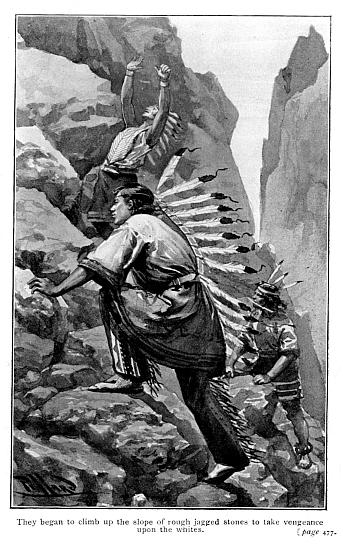
They were exciting moments at the barrier. One Indian pitched upon his head to lie senseless, but three more regained their feet, tore their knives from their belts, and placing them between their teeth to leave their hands free, began to climb up the slope of rough jagged stones to take vengeance upon the whites who had dared to oppose their attack. But not one of them reached the top of the hurled-down masses of rock, which were, after all, not half-way up to where the little party crouched, patient, cool, and watchful, as they obeyed their leader’s orders not to waste a shot.
The result of the desperate attack was that one man stopped short, tottered, and fell back, to roll over to the bottom and then begin to crawl slowly back, leaving his comrades motionless where they had fallen.
There was a few moments’ pause as the one man crept painfully back, and then about a dozen of the Indians dismounted and joined in driving the frantic ponies that were galloping about through an opening made for them by the waiting band.
This done the party remounted, and set up another furious yell to frighten the defenders from their posts.
Needless to say, this was as vain as the next and larger flight of arrows, which splintered amongst the stones or glanced off to fly far overhead.
There was no firing now by the defenders, for the need was not urgent. “Let them exhaust themselves,” cried the doctor, “and find out that their efforts are vain.”
Still there was no lack of bravery amongst the savages, who, some twenty strong, being as many as could act in the narrow gully, charged home again, directly after sending in their arrows, and accompanying the beating of their ponies’ hoofs with yell after yell.
This time there was no waiting on the part of the defenders, who began firing as soon as the advance commenced, with the result that several Indians dropped, to encumber the way and unsettle the serried band of plunging steeds, while the rest, on breasting the rocks, recoiled, and in a state of panic turned, regardless of yells and blows, to gallop back after the fashion of their kind, crowding together till they reached their fellows once again, to stand shivering, snorting, and stamping, but leaving two struggling in the bottom of the gulch in company with six of their riders, wounded or dead.
“That ought to settle them,” said Wilton, who knelt carefully wiping his rifle.
“I hope so,” said Bourne. “I’m tired of this murderous work.”
“’Tis bad, sir,” said Griggs, from the other side; “but it rests with the redskins.”
“Do you think they will give up now, Griggs?” said the doctor.
“No, sir; I don’t,” was the reply.
“Oh, Griggs, you’re making the worst of it,” cried Chris.
“No, my lad, I’m not. It’s of no use for me to talk nonsense. I know too much of Indian nature. All they’re thinking of now is how to get at us, and have revenge for what we have done.”
“Then you think they will attack again?”
“Sure to, sir,” replied Griggs; “but perhaps not with a rush. If they don’t, they’ll wait till it’s dark, and then leave their horses behind and come on with their knives.”
“Ugh!” ejaculated Chris. “That will be bad for us.”
“Horrid,” said Griggs coolly. “It seems—Hallo! They’re coming on again. Give ’em a volley, sir, this time.”
“Yes,” cried the doctor eagerly, as he saw at a glance that the Indians were gathering for another rush. “Hold your fire,” he cried loudly, “till they are three parts of the way here, and then all together. I’ll give the word.”
“But suppose they come on, dismount, and attack afterwards,” said Chris.
“You have the second barrels,” said the doctor. “Be ready. Here they come.”
For once more the savages were putting their regular tactics to the test, coming on yelling and waving their weapons, using them to frighten their foes as much as to madden their ponies into a furious gallop, and this right in the rear of another flight of arrows, half of which came from the Indians who remained behind for want of room.
To the boys this was the most exciting charge of all, for during the others they had something to do or see, as the firing was kept up almost from the first. Here they had to wait—only for moments, it is true, but moments which seemed like minutes, and during which they had no gathering smoke to hide the gleaming teeth, flashing eyes, and savage hate depicted in the red and painted faces coming swiftly on.
“Fire!” shouted the doctor, his voice sounding sharp and clear above the rattle, of hoofs, the yells of the savages, and the reverberations from the rocky sides of the gulch.
Every finger pressed the trigger at the same moment; there was a flash, six jets of grey smoke driven full in the faces of the on-coming ponies, and then one great crack, followed by a deafening roar, which combination checked the ponies as if by magic, making them rear up, dismounting several of their riders. Then they all tore back, leaving eight or nine Indians scrambling to their feet, to run after their steeds, others lying struggling among the stones, and, plain to see, two more tottering upon their ponies’ backs, one falling forward to cling to his mount’s neck, another to sink backward and drop off, and another to wrench himself round and shake his bow at the occupants of the barrier in impotent fury, before throwing up his hands and lying back clinging to his seat till his pony had plunged into the little crowd waiting their return.
“The most effective action yet,” said the doctor hoarsely, as the reloading ended.
“Yes, sir, I think that’s best,” responded Griggs.
“But such a sickening slaughter of the poor ignorant wretches,” cried Bourne bitterly.
“That’s what I used to think when I was first up in the Rockies, sir,” said Griggs coolly, “till I had been about a bit, and seen where the redskins up there had been amongst the settlers’ ranches. Pleasant homes burned down, and men, women, and children lying where they had been murdered and cut about—people who had been living hopeful lives, hard workers whose only crime against the Indians was trying to get a living out of a few acres instead of by hunting and war. I used to feel just as you do, Mr Bourne; but I don’t now.”
“I know, I know,” cried Ned’s father passionately; “but they are so ignorant of our power.”
“Yes, sir, but we’re not of theirs,” replied Griggs. “Now, doctor, they’re drawing off. Had enough of it for one day, and it’s time to be stirring.”
“What, retreat?”
“Not yet, sir. Here’s my idea. They’ll wait till it’s dark, attack us then with knives and tomahawks, coming on silently, leaving their horses behind, and we shan’t have a chance.”
“Then what do you propose?” said the doctor.
“Just this, sir, if you can’t see a better way. We three stop here, ready to have a shot at any Indian who shows himself, while Mr Bourne, young squire, and Chris go off to the mules and horses.”
“No,” cried Chris; “I’m not going to leave my father.”
“Wait, my boy,” said the doctor sternly.
“But, father—”
“Silence, sir!”
“Hadn’t done speaking, my lad,” said Griggs, looking at the boy with a smile. “Here’s the rest of it. Mr Bourne and Squire Ned get old Skeeter to the front; and set off at once as fast as the mules will go, which only means a walk.”
“But where—where?” cried Bourne excitedly.
“Anywhere, sir, except into the soda-plains. The thing you’ve got to do is to put as many miles between you and here as you can manage in the next twenty-four hours.”
“What, and desert you?” cried Bourne. “How are you going to manage to find us?”
“Oh, I’ll find you by your trail when the time comes, sir,” said Griggs, laughing. “Don’t you be afraid of that. Don’t even think about it, only of getting right away.”
“I see,” said the doctor, and he frowned down Chris, who was about to speak. “Now go on.”
“There’s not much more to say, sir. We shall stay here till dusk, giving the redskins a reminder now and then that we’re on the alert; and at last, when we feel that they’re coming on for the attack, into the saddles we jump, and steal off till we’re out of hearing, and then crawl till we make sure of the trail of the mules, and then gallop.”
“But the ponies will have gone with the mules,” cried Chris excitedly.
“You’d better not let them,” said Griggs, with a grim smile at the boy. “You’ve got to see the train started well on its way from the bottom of the gully, and then bring the horses here—all six, mind.”
“Yes, I see,” said Chris, brightening up, the sun seeming to come out on his gloomy, powder-smirched face. “But what about Ned’s and Mr Bourne’s ponies?”
“They’ll have to be contented with mules. They’ve only got to walk, and there are several now with half loads. We shall want their ponies for spare mounts, so as to give the others a rest now and then, for when we leave here we shall have to make the best of our way.”
“Oh!” cried Chris joyously. “I wish I were as clever as you are, Griggs.”
“It’s all right, my lad,” said the American grimly; “don’t be in a hurry. I’ve learned a bit about the Indians, and you’ve got that to begin with; by the time you get as old as I am you’ll have picked up a deal more than I know, and you will not think much of me then. Now, doctor, what’s your idea?”
“Yours, Griggs,” cried the gentleman addressed. “It cannot be bettered. You hear, Bourne?”
“Yes, I hear,” was the reply; “but about the Indians. You will not escape them; they’ll follow your trail.”
“A bit,” said Griggs, “while they’re hot and wild after finding out that we’ve tricked them and gone; but I seem to think that they won’t tramp far and leave their mustangs shut up in the valley. They’ll come back to get them out, and that will take them days, even if they do it then; while if they can catch us after giving us about a week’s law, I shall feel disposed to forgive them.”
“We need not discuss the matter further, eh, Wilton?” said the doctor, turning to the young man, who had crouched close by, watching the spot where the Indians had disappeared.
“No. It’s all cut and dried,” said the young man quietly. “Be off, Bourne; you’re going to have the best of it.”
“That father isn’t,” said Ned sharply. “I don’t think it’s fair. Let Chris go. I want to stop and fight.”
“Nay, nay, nay,” said Griggs, smiling; “don’t be greedy, lad. You’ve killed quite as many redskins to-day as is good for you. Be satisfied. I dare say we can contrive a bit more fighting for you by and by.”
“He may have all my share,” said Chris, screwing up his face. “I hate it. It’s horrible.”
“Obey orders,” said the doctor, smiling. “Bourne, will you get off at once?”
“Yes,” was the reply.
“And you, boys. I don’t think any eyes can reach us, for we get no more arrows now; but all the same, I would not show. Crawl down to the bottom; you will be safe from all observation there, and you can rise and walk as soon as you are past the first curve. Till we meet again.”
“Till we meet again,” said Bourne and Ned in a breath, and they began to crawl down the far side of the gulch from where they had made their defence.
“As for you, my boy,” continued the doctor, “you will bring the ponies down, following the mules, and coming to a halt at that spring by the big needle-like stone. There’s some browsing for them there.”
“Am I to stay with them, father?” said Chris.
“Of course, my boy, to be ready for starting at a moment’s notice.”
“But if you have to fight again?”
“We three will do our best.”
“But only three, father?”
“Only three, but three men fighting with a knowledge that if things go against them they have ponies waiting for them, ready for a retreat. Now, my boy. Duty. Be off. And mind, you’ll take no notice of a few shots.”
Chris made no reply. His rifle was already slung, and after one glance up the gulch towards the valley, without seeing a sign of the enemy, he began to back down the slope, creeping and crawling till it was safe to rise, and then hurrying after Bourne and Ned, overtaking them long before they could reach the entrance to the steep slope of the gully.
Chapter Fifty Three.
A Bit of Blue Sky.
The task of getting the mules together was simple enough, the irritable beasts making their usual objections, but following their old leader Skeeter quietly enough in spite of the bell not being in use; and in a short time they were trudging along with their loads down the steep slope till the gulch was reached, and Chris came after them with the ponies, to bring his charge to a halt.
“Like to change places, Ned?” he said archly.
“No; I’m going to do my part without that.”
“Good-bye, Chris, my lad,” said Bourne sadly. “I don’t like going off and leaving you.”
“And I don’t like you to go, Mr Bourne,” said Chris, holding out his hand, which was warmly grasped. “Take care of yourself, Ned.”
“Yes; and you,” said the boy sadly.
The next minute Chris was standing by his mustang’s head, watching the mules file away.
“Look at that,” said Chris, as he noted that his charge displayed no desire to follow the mules. “Why, if that old Skeeter isn’t actually sneering at my ponies! He deserves to be kicked for his conceit.”
Ned turned to wave his hand just before a bend in the gulch hid the mule-train from sight, and then Chris mounted and rode towards the pointed rock close to which the spring gurgled out of the rock. Here he took the precaution of drinking deeply himself before letting the ponies have their fill of the refreshing water, after which they began grazing in their quiet, inoffensive way, leaving their guardian to his thoughts, which were many and troubled.
In the full expectation of hearing shots, Chris spent plenty of time in listening; but no reports reached his ears, and he began thinking of the change from the wild excitement and risk of his position by the barrier a short time before, to the silence and grandeur of the deeply-cut rift in which he now stood. For gloomy and forbidding as the place looked by night, even awful in its black solemnity, it was striking enough now in its effects of brilliant sunshine and shade to make the boy think it was one of the most beautiful places he had ever seen in his life.
“What a pity!” he muttered, as he listened to the crop, crop of the ponies.
He did not say what was a pity, for the sharp crack of a rifle brought him out of his musings to gaze sharply in the direction of the barrier, far away from where he was waiting, and wondering now whether there was any more fighting on the way.
Another sharp crack, and Chris’s excitement increased, as he first looked anxiously at his charges to see if they were startled by the firing.
But the ponies did not even lift their heads, but went on browsing upon the green shoots near the spring, while the boy involuntarily dragged his rifle round, ready to throw the sling over his head if the need sprang up for its use.
But there was evidently no immediate danger, for quite an hour passed before there was another shot fired to raise the echoes, and this proved to be single.
A longer period elapsed before anything more occurred, and twice as long a time passed before there was another.
“It’s just as they said,” thought Chris—“a shot or two, just to show the redskins that we’re on the alert.”
It was about this time that Chris fancied that the faintness from which he suffered was due to the want of food, and opening his wallet he took out a piece of damper, to find that it ate very sweet with nothing but a few handfuls of water to wash it down.
By the time this was finished the sun had sunk far below the rocks on his left, and the dreamy, restful state into which the boy had been falling passed away. For the thoughts that came fast now were beginning to grow troublous. It would not be long before it was night, and with the darkness an exciting time would arrive. Chris thought that the Indians would not wait long before they attacked, and a great anxiety now oppressed him. Would his father think of this and be prepared, or would he wait too long, and then—
It was too horrible to think of. Chris all through that afternoon had been suffering from the effect of his exertions, and had sunk into a restful state a long way on to the border which divides wakefulness from sleep; but with the coming of darkness his brain had become active to a painful degree, and but for the stringent orders he had received to be prepared and wait with the ponies, he would have gone forward, sought his father, and told him of his fears.
“He’s sure to know better than I do,” cried the boy at last, to comfort himself, but with very poor effect, as he kept his watch till the darkness had seemed to settle down like a flood in the gulch, the ponies had become invisible, and the sky had turned to a dark purple with a few stars dotting it here and there.
Half-an-hour now passed, and then the boy’s agonised tension was broken by three shots ringing out almost together.
“A volley!” he said aloud, and the words had hardly passed his lips before there was a repetition of the reports.
“The other three barrels!” he cried excitedly, and then, speaking as if those of whom he thought were close at hand, “Load, load, load!” he panted. “Oh, quick, quick! They’re coming on!”
He waited again, but there was not a sound, and half-an-hour seemed to have passed, during which his busy brain invented a host of horrors, chief among which was that in which he pictured to himself the Indians stealing up to the defenders of the barrier, knife in hand, to spring upon them and massacre all before they could fire another shot in their defence.
So horrible became the silence at last that Chris felt that if it lasted much longer he must mount his mustang and ride forward to learn the worst.
“Even if they kill me,” he muttered, and he mentally saw himself falling beneath the enemy’s blows.
But in response to a desperate effort to recall his duty those thoughts grew dull and distant, and straining his eyes to gaze into the darkness he obeyed a sudden impulse to slip the ponies’ bridles into their mouths, fasten a strap or two, and then tighten the saddle-girths, the animals submitting patiently enough, and allowing themselves to be placed in readiness for a start.
“I can’t do anything more,” he said to himself. “Oh, how terribly dark!”
Pst! from close at hand, so close to him that the boy started as if he had been stung.
“Father!” he whispered.
“Good lad. Not a word. Are the ponies saddled and bridled?”
“Yes, father.”
“Right. Now, Griggs—Wilton; take two each, and lead on. Walk with them for the present, and as quietly as you can go. We’ll follow close behind.”
No further words were spoken, but there was the sound of hoofs passing over the stony bottom of the gulch, and the next minute Chris and his father, each leading his pony, were walking together side by side, the animals stepping instinctively in the footprints of those in front, and, saving for the faint sound of tramping, the silence seemed to the boy perfectly awful.
At last Chris could keep back a question no longer.
“The firing, father—I heard two volleys. Were the savages coming on?”
“No, but we treated them as if they were, just to show them that we were waiting for an attack, and then came on to join you at once. Now, no more talking; I want to listen till they announce that they are there.”
“Will they?” whispered Chris.
“They’ll either attack with one of their savage yells, or else give one in their rage when they find that we are gone. That will be the signal for us to mount and ride for our lives. Indians are swift of foot, boy.”
It seemed an hour, during which every ear was on the strain, but probably it was not a fourth of that time, before the fierce yell of the savages was heard; but it only reached the fugitives as a faint whisper, followed by another.
Fortunately the retiring party had reached where the gulch had opened out, and quite a broad band of brilliant stars was spread overhead from rock-wall to rock-wall, giving sufficient light for the ponies to follow one another in Indian file at a good round trot, which was kept up hour after hour, with intervals of walking and the indulgence now in a little conversation regarding the distance ahead of the mule-train or the possibility of its being missed.
But Griggs was positive.
“No,” he said, “we can’t have over-run them.”
“But have they turned off somewhere? I don’t remember any side valley, but we may have passed one.”
“No, we mayn’t, sir,” said Griggs coolly. “We don’t know it—at least, I don’t suppose you did, for I fancy I do—but if the mules had turned off anywhere our clever mustangs would have done the same. They’ve been following the mules’ trail ever since we started.”
“What! Impossible in this darkness.”
“Think so, sir? Well, suppose you wait and see.”
There was silence for awhile, before the doctor rode to the front again to where Chris was now beside Griggs.
“We have heard nothing of the enemy,” he said.
“No, sir. I’ve listened till it has given me a feeling like toothache.”
“Do you think they are on our trail?”
“Ah, there I can’t say anything, sir, only that they may be. But if they are, they’re coming on at a regular crawl; I am sure of that.”
“How can you be sure?” said the doctor wonderingly.
“Because they’ll be, as Indians mostly are when they can’t see their quarry, horribly suspicious of being led into an ambush.”
“They did not seem so when they followed you.”
“No; they could see me, and they forgot to be in doubt in the heat of the pursuit. But on a night like this, and after the way in which we have shot them down, they are bound to feel their way step by step if they follow at all. Most likely they’ll wait till morning, when they’ll pick up our trail.”
“And then?”
“Come on as fast as they can run, sir. They won’t ride.”
Griggs finished off with a loud chuckle. “Say, Chris,” he added, “won’t they be mad at not being able to get out their ponies!”
“I suppose so,” said Chris.
“But there’s a good side to everything. It’ll be grand for the poor beasts. They’re ridden nearly to death; now they’ll have a good rest with plenty of fine pasture.”
“But about to-morrow, Griggs?” said Chris.
“What about to-morrow?”
“The Indians may follow us and overtake us on foot.”
“Well, if they do, they do, my lad, and at the very worst they may capture some of our stores. But perhaps not. I don’t like being a brute to a dumb beast, but if I’m driven to it I may have to be a bit hard to some of those mules. They can go so fast that no Indian can catch them—if they like.”
“Yes?”
“Well, as a rule they don’t like.”
“That’s the worst of it,” said Chris.
“Yes, but this time they’ve got to like; and I know how to make them.”
Daybreak at last, and with that dawn all doubts about the mule-convoy were at an end, for the first streaks of dawn showed them about a mile ahead, trudging steadily along, while no broadening of the day, not even the rising of the sun, revealed that for which a most anxious lookout was kept, namely, so many dark dots to indicate that the Indians were on their trail.
“I say they won’t come now,” said Griggs decisively. “We’ll halt, sir, at the first water, and have a good rest and feed.”
“Will it be safe?” said the doctor.
“We must chance that, sir, for the sake of making horse, mule, man and boy fit for what more he has to do.”
“Well, perhaps so.”
“It won’t be losing time, and the mules and horses have done a good spell of work.”
Chapter Fifty Four.
Onward.
Whether the Indians followed up their trail the peril finders never knew, for they saw no more of that tribe, and wandered on for days in safety, passing into a new tract of country which Griggs hailed with delight.
“It’s not goldy land,” he said, pointing, “but a place where we can do a deal of hunting and lay up stores—dried meat for stock—before we enter the mountains yonder.”
“Why do you say that?” asked Ned. “Because of those old bleached bones?”
“Yes: buffalo. That means going on for months. Once we hit upon the tail-end of a drove we can hang on to them as long as we like, and head them in towards the mountains and forest-land yonder. There’s a peak there that looks very like the one we want to find.”
But the weeks went on, during which the bison-drove was found, and supplied the party with all the meat they needed, and sport besides, at the long gaunt wolves always on the lookout for the weakly calves. There was sport too with the bears, and a narrow escape for the doctor from a grizzly which overtook and clawed him from his pony’s back, the end seeming very near. But Chris Lee’s rifle-bullet was quicker than the huge bear, whose skin when sun-dried, became the doctor’s bed by night when it was hot, his cover when it was cold.
Then the great peak, reached at last, gave the adventurers a wondrous view all round, but not of the golden city, which always seemed to be farther off, while none of the peaks they found accorded with the old prospector’s map.
But as the time glided on adventures were always at hand. Another strange rock city was discovered, evidently inhabited at a later date, for here the old dwellers’ domestic implements were plentiful in the cell-like homes cut in the terraces of cliff or cañon. Great earthen handmade pots that had evidently held some kind of grain, flint-heads for arrows, and those of larger size which might have been used for spears.
And so the journeying went on, with times when Indians surprised the party and were driven off, while others again that were found by a rushing river proved friendly and willing to show the strange white people how it was possible to get mule-loads of a kind of salmon in a day from the rushing waters for present eating, and for splitting open and drying in the sun.
Then bison again—another salmon-river—a narrow escape from a horrible death by thirst once more—encounters with rattlesnakes—the discovery in a great open plain of the cause of a distant roaring sound like water, just at a time when it was once more wanted most. And there it was where they could look down, Tantalus-like, from the brink of a vast crack in the level plain and see a vast river foaming along half-a-mile below them, never to be reached.
And then a year had passed, and the second began, as full of adventure and excitement as ever. But by this time, while still pursuing the phantom gold, they had learned by experience the value of keeping near salmon-river and verdant rolling plain where bison were still plentiful, and the adventurers’ larder was always well supplied.
They led the life of the Indians of the plain, save that the finding of the golden city and temple was always kept in mind.
Twice over Griggs declared that though they had not found it they had discovered the high-road which led directly there. It was a watery way between perpendicular cliffs, and the place had been hailed for its promise of salmon, which they shot and speared as they glided in shoals over the yellow sands.
It was after scooping a wounded fish from the swift waters that Chris afterwards took the tin hanging from his belt and stood knee-deep to fill the vessel with the clear cold water fresh from the mountains.
“Hand me a tinful,” cried Ned, who stood aloof so as not to wet his buffalo-skin boots.
It was boy-like. Chris filled the tin, and giving Griggs a merry look, scooped it half full of sand as well.
“I say, it feels precious heavy,” cried Ned, as he raised it to his lips. “Yah!” he shouted, and he was about to toss the contents back over the giver, but Griggs caught him by the arm.
“I’ll drink that,” he said; “I’m not afraid of a little sand.”
He drank till the sand touched his lips, and then held it in the sunshine, looking into the tin, stooped and refilled it, and rinsed it round, to pour away a mixture of sand and water, refilled again, and repeated and repeated till nearly all the sand had gone; and then he held out the cup in triumph, for the others to see a few glistening pieces of yellow metal about as big as small, smooth, flattened shot.
“Gold!” he cried. “Now then, all we have to do is to follow up this river into the mountains. The golden city is there.”
And they followed that river for weeks, living upon the salmon, and washing for gold from time to time, and rarely without finding a few tiny nuggets, while the river grew more narrow, more rugged, more difficult of access, and drove them at last into cutting off curves and windings in the vast plain through which it flowed.
But the golden city was not there, nor anywhere else in their wanderings, which at last from sheer necessity in the way of supplies drew near an end.
But the journey was not yet over, for, to the surprise of all, they dropped one day upon a large settlement, with stores and all the necessaries required by civilised man.
Here they rested and recouped for a month, exciting no surprise, for prospectors were common objects there. Neither did their departure, after they had purchased all they needed, excite remark, for men came from the mountains to buy powder and blankets, and wandered off again in parties, generally with mules to bear their loads.
It was like getting out of prison to be far away in the wilds again, the boys said; and then the search went on week after week, month after month, always in vain; but despair and disappointment never cast a shadow over their little camp, for it was a delightful, healthy, exciting life, with every day bringing something new, and the golden city appearing generally in the distance after their most tiring days, when they had eaten, drunk of the crystal waters, and rolled themselves in their blankets to sleep.
It was then that the golden city came, bright and tempting, the visions of their dreams always luring them on when they rose refreshed by their rest in the clear air of the mountain or the plain.
“Oh, we’re going to do it yet,” Griggs would say merrily; and then they tramped to rest their ponies, and galloped when there was game afoot, and the time went on—and on—and on.
Chapter Fifty Five.
The Old House at Home.
The little mule-train, very lightly laden, and with harness, pack-saddles, and loads looking ragged, patched, sun-bleached, and repaired in every conceivable way, moved slowly along through the rich greenery, led and followed by its sun-tanned escort, three before and three behind. The ponies looked in admirable condition save that a change of diet seemed necessary to do away with a swollen-out aspect due to constant feeding upon green-stuff instead of corn. But the saddles and bridles were as bad as those of the mules, though every bit and buckle glistened in the sunshine through constant rubbing with sand. The less said about the patched garments of the escort the better.
But there were no rags. Patches of divers materials, principally furry skins, were plentiful, and the moccasins which had taken the place of boots were either Indian and very neat, or home-made and quite the reverse.
But here too there was something worthy of remark—each man’s weapons were admirably cared for and ready for instant use, while the occupants of the saddles, though horribly dilapidated in the way of clothes, were also in that grand state of vigorous health which also made them appear ready for immediate use in any way, from hunting or shooting to obtain the day’s provision, to fighting for dear life against the enemies of the white men who roamed the plains.
Not that these six wanderers could fairly be called white, for the sun had burned them to a dull brick-red; but the term men is advisedly used, for though when the party last passed that way, going in the opposite direction, they were made up of four hale vigorous men and two boys, the latter had been left in the desert lands through which they had been wandering for two years—left, that is to say, by degrees, every bit that had been boyish having physically died out, for its place to be taken by something more manly, till on this particular day they rode back with their feet much nearer the ground and their sturdy mustangs appearing stunted, though quite well able to carry a far heavier load than had been in the habit of climbing into the saddles when they started from the plantations at the above-named distance of time.
It was only about a couple of hours before, when the party left the shelter of a patch of great spruce-firs where they had camped for the night, that the doctor had made a remark to Bourne, and then both had stared hard at Chris and Ned, a proceeding which brought the blood into the young men’s faces and made Chris ask what they are to laugh at.
“You,” said the doctor. “Why, when we rode away on our search you looked a mere boy; you are coming back to the old home both of you men grown, if you weren’t so lathy and thin.”
“Nobody will know them, eh, Wilton?”
“That’s for certain. They will grin at you.”
“I wouldn’t advise them to,” said Griggs slowly. “Chris has grown very hot and peppery, and Ned here has done so much fighting that he always seems to be, as the Irish say, spoiling for another go in. So they’d better not laugh, for we want to settle down again as friends.”
They had been journeying on since then, getting nearer and nearer to the old settlement; but the change seemed wonderful, and they talked it over.
“Why,” said the doctor, “it isn’t only the boys that have grown, but everything here.”
“Yes, wonderfully,” said Bourne; “overgrown, one ought to say.”
“They don’t seem to have used the tracks much,” put in Griggs. “It’s hard work to make sure whether we’re going right.”
“Oh, we’re going right enough,” said Chris. “I remember every hill and dale. Look yonder; that’s where the plantations are. But how they have altered!”
“Yes,” said the doctor, “the place does seem changed; but from the state of the tracks I’m afraid that very little has been done in the way of developing the fruit trade. Hullo! Why are you turning off here, boys?”
“Because it was just under those big fir-trees, father, that we took and buried that poor old prospector. Ned and I want to see the board we cut and nailed on the biggest trunk.”
“To be sure, yes,” said Bourne; “let’s go and see.”
The mules were halted, and began to graze, while the party rode through the lush saplings and bushes that had sprung up so that it was hard work to get through, till they passed under the spreading branches of the trees, where the undergrowth became thin and sparse.
“There’s the old board,” cried Chris suddenly, and the party drew rein at last by the side of the heaped-up pile of stones with which they had marked the wanderer’s grave.
No one spoke for a few minutes, but they sat there thinking deeply of the old man’s coming, his death, and his legacy to the doctor, who broke the silence at length with a bitter sigh.
“Poor old dreamer!” he said sadly. “You bequeathed us your imagination, and sent us off on our quest for the phantom gold.”
“Yes,” said Bourne; “we’d better have left him his legacy and gone on home to the old-country.”
“Oh, I don’t know,” said Wilton. “We’ve had a grand time of travel and adventure, eh, boys?”
“Splendid!” came in a breath. “I’m only sorry that we’ve come back.”
“Yes,” added Chris. “You’ll think that over, father, about rigging up another expedition and making a fresh trial?”
“We shall see,” said the doctor thoughtfully; “we shall see. What do you say, Griggs, about another search for the golden city?”
“Well, I dunno,” said Griggs slowly. “Maybe I’ll wait a year before I decide one way or the other.”
“Griggs!” cried the two lads together.
“Oh, you needn’t shout,” said the American. “I’ve been thinking over it a deal, more’n you have, p’r’aps, and it seems to me that even if we had found the old place marked down on that old Rip Van Winkle map we should have had a deal of trouble to carry back enough gold to have made the journey worth while.”
“Ha, ha, ha!” laughed the two young men uproariously. “There’s an old fox. He has just found out that the grapes are sour.”
“Well, so they have been, boys,” cried the American. “But talk about grapes, it’s just five years since I planted some fine young vines in my patch and against the shanty. I wonder whether the blights have let them grow. My word, I should like a few bunches now!”
“I’m afraid they’ll be as sour as the gold, Griggs,” said the doctor. “There, let’s ride on and leave the poor old fellow to sleep in peace. He took his secret with him, for his map was too vague for us to find his city of golden dreams. We have spent two years over the search, but we have travelled well over an unknown land and come back, I hope, wiser and more ready to do battle with the world.”
“Oh, we shall try again, father,” cried Chris, “and get real gold yet, not phantom gold, as you call it. Nil desperandum, you know. Never say die.”
“Try again!” cried Ned.
“Hope springs eternal in the human breast,” said Bourne gravely.
“Better luck next time,” cried Wilton.
“Say, gentlemen,” said Griggs dryly, “it don’t seem to me a suitable time for you to be firing off your copy-book maxims all over the place when it’s getting on for dinner-hour. I want to progress and ride on to the old plantations to see which of our old friends is going to win in the fight to have us for guests and give us a good sitting-down square meal.”
“There’s wisdom,” cried Chris merrily. “Griggs is always right. Forward!”
He led the way from beneath the spreading boughs of the great spruce, out from the solemn gloom where the old prospector lay and into the glorious sunshine of the luxuriant, verdant country, which seemed a very Eden after the parching sandy alkali deserts and the rocky tracts. The mules and ponies kept on snatching at a mouthful here and a mouthful there, as if it were too rich and tempting to be passed; but in spite of the loveliness of all around, the adventurers became more and more impressed by a something desolate about the attractive district over which they passed. The hills and dales were glorious, but somehow they came upon no signs of cultivation, nor yet of settlements, till at last, with a feeling of sinking that was not all due to hunger, they rode right into the very centre of the cluster of plantations they had left two years before on their search for the golden city, to find on their return wherever they went traces of a fire here, completely over-run with greenery, there the remains of a shed or shanty with trees and vines dislodging the props and boards; and though they hailed and whistled it was only to scare birds or squirrels, and to awake no answering call.
They rode a little here and a little there, the ponies pushing their way through the tremendous growth; but it was all the same. Shanty after shanty was in ruins where it could be traced, but desertion everywhere.
But during the search, moved by a strange feeling of opposition, the friends shrank from approaching the dense grove which hid the home they had left. They all shared the feeling that it would be too painful to look upon the traces of the fire that without doubt had levelled with the soil the house they had toiled over, and it was not until Griggs spoke that something like a spell which had hung over them was driven away.
“Seems to me,” he said, “that when the fellows burned or carried off all their stuff they made a pretty clean sweep. I’m just going across now to have a look at my old spot; but I don’t suppose there’ll be any dinner waiting there. Won’t you have a look at your old roost first?”
“Yes,” said the doctor, making an effort. “I couldn’t go in yonder before. Chris, boy, there’s no one to blame but ourselves; we deserted the old place; but it seemed to be hard to bear. Let’s look at the ruins, if there are any left.”
They forced their way through a dense grove of fruit-trees and wild growth which towered above the plantings of the past, the ponies breaking down the lush vines and succulent canes, till they were brought up suddenly by something solid which was overgrown by a vine.
“What!” cried the doctor.
“Ahoy! Griggy!” roared Chris through his hands. “Ahoy! Hooray! Here’s one of our vines loaded and breaking down with grapes.”
The next minute the American and his companions had forced their way up to the front of the big shanty and its shed—the barracks, as they had termed it—to find that their fellow-settlers had respected the nailed-up doors and shutters, leaving at their exodus the unlucky district just as it had been at the peril finders’ departure; but Nature had been hard at work for her part, toiling as she toils in a rich country to destroy man’s work and restore all to its pristine state.
But though vines had draped, and shoots had dislodged shingles, the stoutly-nailed walls stood firm. No firebrand had been set to the sawn-up wood, and after some work with an axe to wrench away the boards that had been nailed over window-shutter and door, there was the old place fairly intact, with the utensils just as they had been left.
The consequence was that the wanderers, after seeing to their weary beasts and leaving them grazing in the midst of abundance, made their own dinner seated at the rough table, drinking the water from the swift river hard by, and finding, half smothered by the competing growth, abundance of peaches and Bartlett-pears to supplement the grapes ripening on the roof of the old home.
“I say, Chris,” said Ned, with his mouth full, or nearly so, of juicy pear, “is this all a dream?”
“My peach tastes just like a real one,” was the reply. “But I say, father, the fruit never used to grow like this.”
“No, my boy,” said the doctor; “I feel half stunned in my surprise. A complete change seems to have come over everything. The weeds and wild things have run rampant, but the fruit-trees, such as I can see, all look clean and free from blight.”
“Say, neighbour,” cried Griggs, “I’m going over to my place now, if some one else will help at the clearance. These grapes, you know.”
“They’re splendid,” said the doctor. “What about them?”
“Why, this,” said Griggs; “I planted lots, and they’d never grow any more than my oranges would.”
“Oranges!” cried Chris. “Here, father, we haven’t looked at our grove.”
“Come on with me, then,” said Griggs, “and we’ll take it on the way. I want to see mine too. As to the grapes, if yours’ll grow like this so ought mine; and if they have—But wait a bit.”
All mounted again, to make their mustangs breast their way in the direction of the dried-up peach and orange-grove which they had toiled over in despair, and at the first glance a shout of delight arose.
“Why, father,” cried Chris, “what was the good of going there through thirst and starvation to find phantom gold when it is glowing and growing, and breaking down the branches here?”
For it was a golden sight indeed for weary, longing and disappointed eyes.
Progress was difficult after they had literally gloated over the beauty and promise of the orange-grove, for the tracks were wonderfully grown over, everything showing that the settlement must have been forsaken almost directly after the departure of the adventurers. Then Griggs’ plantation was reached and found to be as full of promise as that which they had so lately quitted; and this proved to be the case wherever they rode, for the change everywhere was complete, the crops, as far as the encroaching wildings would allow, being abundant, but not a hand left to gather, those whom the party had known having forsaken the place to a man.
The rest of the day was devoted to cleaning and making the old home suitable for temporary if not for permanent habitation. Creeper and vine had to be cut back, so as to admit light and clear the choked-up chimney, while with the growth endless intruders, insect, reptile, and bird, were banished. The remaining stores, now very low, were brought in, and what all declared to be a very jovial supper prepared and most thoroughly enjoyed.
“One never knows what a day will bring forth,” cried Bourne, smiling upon his listeners. “Here we were this morning weary and despondent, looking forward to someone taking us in to-night by way of charity, while now we find that we have fallen on our feet, and are quite at home in the midst of abundance.”
“Yes,” said Wilton; “I’ve seen enough to prove that Nature has retaken possession here, and that an hour with a gun will give us all we want to-morrow in the way of game.”
“Yes,” cried Chris; “and look there, Ned—fish.”
“What about them?”
“The river’s full, and I saw plenty leaping, waiting for rod and line or net.”
“That’s good,” cried Ned.
“Oh yes; we shan’t starve,” said Griggs. “But let’s see, how far used we to be from the other settlement?”
“Forty miles,” replied the doctor.
“But suppose that is deserted, the same as this?”
“Then we shall be quite a hundred from the next.”
“A hundred,” said Griggs dryly. “Well, that seems horribly close and crowding one up like after living as we’ve been lately. It seems to me that if we liked to stop here now we might have the pick of the whole place, and as many patches as we like to take up.”
“What about the old owners?” said Bourne.
“They’ve thrown up the game and gone—back to England, perhaps. I don’t believe any one is ever likely to put in claims, but we could soon get that settled by the State law. I’ve nearly made up my mind to start afresh, doctor. You see, everything is going to be quite different; but there’s one thing I can’t understand. Climates don’t change all at once, but here’s this place boiling over, as one might say, with plenty now, while a few years ago we were only able to grow enough to feed the insects and blight. How do you account for that?”
“I can only give you what I surmise to be the case,” replied the doctor. “We were tempted here by seeing how beautiful and fruitful everything was.”
“Yes; everything but what we planted, and that tried to die out of the way as fast as it could. Well, sir, how was that?”
“Simply because the things we planted were strange to the land. All they wanted was time—years in which to root down to the best soil. If we had waited longer they would have appeared as good as they are now.”
“That sounds well, sir,” said Griggs, “and I should like to hear a little more about it, but I think we’ve got as much to think about as we can bear to-night. What say you?”
“That I shall be thankful for a good night’s rest,” was the reply, and soon after all was silent within the lonely ranch, both the lads lying listening to the varied sounds without, for to one of them it seemed as if all the wild creatures of the forest were holding a meeting to inquire into the fresh invasion of a tract of land out of which they had been driven years before, but to which they had returned upon its being deserted, while now the question was in respect of a new invasion, and whether those who had taken possession intended to stay.
Chapter Fifty Six.
Like to Go Again?
Chris Lee had the impression next morning that he had lain for hours listening to the strange cries of wild creatures which had once more made the plantations their home, and he smiled at the idea that had come to him respecting a meeting, when he rose from the blanket and saddle bed, upon which he had slept better than he remembered ever to have done in his life.
His first look was at the place Ned had occupied; but he was already gone, and upon hurrying out he came upon him just visible as he forced his way through the tall growth with an orange in each hand and half-a-dozen tucked into his breast.
“Morning,” he shouted. “I’ve been down to the river. It seems full of fish.”
“That’s good news,” cried Chris. “Isn’t it? But look here, there’ll be a long talk over breakfast this morning about—Seen Griggs?”
“No. But why will they talk about him over breakfast?”
“Stuff! I didn’t mean that. He came to the river with me, and he’s gone now to light a fire and boil the kettle. He wants to talk to you as he did to me.”
“What about?”
“What about? Why, about this place. He’s red-hot over it, and says it would be madness to go away now and give up real gold for what may after all be nothing better than a dream. What do you think?”
“I?” said Chris, laughing. “That I’ve had enough fighting and tramping to last me for many years to come.”
“Then if I say I’ll stay, will you?”
“I don’t know yet,” said Chris.
“What! Why, you’re never going to run back?”
“I’m not going to run back, nor run forward,” replied Chris. “I’m going to do just what my father does, and in spite of your talk I believe you’ll stand by Mr Bourne.”
“Of course,” cried Ned; “but he’s sure to say he’ll stay. There’s only your father and Wilton on the other side, so we shall be four to two if you’ll stand by me. Now what do you say?”
“Nothing at present; let’s wait.”
Ned pressed for a definite promise, but Chris remained firm and went to help Griggs in his preparation of the first breakfast that had been eaten upon the old hearth for two years.
It was rough; but appetite would have made up for that, only it seemed wanting, and the steaming coffee and tough damper bread remained almost untasted for a time, every one being thoughtful and silent.
At last the doctor spoke.
“Look here,” he said, “I’ve got something upon my mind, and judging from your looks it seems to me that every one is not only troubled in the same way, but eager to get that something off. Am I right in coming to the conclusion that you are all thinking of the same thing?”
“I guess I am,” said Griggs.
“I’m sure I am,” said Bourne.
“I’m thinking that the sooner we get to work the better,” said Wilton.
“That’s soon settled, then,” said the doctor, “for there is no occasion to ask the boys—it’s written plainly in both their faces. We all think that it would be madness to talk of leaving such a home as we can make of this.”
“All!” came in chorus, and then the appetite for breakfast, while they worked afterwards as they had never worked before to master and drive back the encroaching forest; fetch stores with their mule-train from the distant port; rebuild and restore; and in due time plant, gather, and farm, to provide the necessaries of life, till Golden Hollow, as it was renamed, became a veritable Eden—a home which, attracted others, till as time went on the peril finders’ struggle to grasp at the phantom gold seemed to grow more and more like some exciting dream.
“Ever think of the shooting now, boys?” said Griggs one day, as he stood by the side of the great green basket of fruit he had gathered and just set down, to turn over some half-a-dozen that were beginning to glow like gold.
“Not often,” said Ned, “but it will come at times.”
“Do you?” said Griggs, turning to Chris, who looked thoughtful.
“Yes: I did only yesterday,” was the reply. “I was at the bottom of the big peach-orchard, when I regularly jumped, for there was a sharp whizz close to my ear, and I began to think of the Indians hiding behind every bush.”
“But it couldn’t have been an arrow,” cried Griggs.
“No; only a hawk making a dash at one of those blue-breasted birds; but it set me thinking of arrows flying, and using one’s rifle too.”
“Ah, rough times those,” said Griggs, picking up two oranges, and then a third, to keep them, juggler fashion, following one another through the air. “Like to go again?”
“No!” shouted Chris and Ned together, in a way which disconcerted the juggler so that the oranges all came down, to be picked up quickly, as the American said sharply—
“Same here. Once was enough.”
The End.
| Chapter 1 | | Chapter 2 | | Chapter 3 | | Chapter 4 | | Chapter 5 | | Chapter 6 | | Chapter 7 | | Chapter 8 | | Chapter 9 | | Chapter 10 | | Chapter 11 | | Chapter 12 | | Chapter 13 | | Chapter 14 | | Chapter 15 | | Chapter 16 | | Chapter 17 | | Chapter 18 | | Chapter 19 | | Chapter 20 | | Chapter 21 | | Chapter 22 | | Chapter 23 | | Chapter 24 | | Chapter 25 | | Chapter 26 | | Chapter 27 | | Chapter 28 | | Chapter 29 | | Chapter 30 | | Chapter 31 | | Chapter 32 | | Chapter 33 | | Chapter 34 | | Chapter 35 | | Chapter 36 | | Chapter 37 | | Chapter 38 | | Chapter 39 | | Chapter 40 | | Chapter 41 | | Chapter 42 | | Chapter 43 | | Chapter 44 | | Chapter 45 | | Chapter 46 | | Chapter 47 | | Chapter 48 | | Chapter 49 | | Chapter 50 | | Chapter 51 | | Chapter 52 | | Chapter 53 | | Chapter 54 | | Chapter 55 | | Chapter 56 |