George Manville Fenn (continued 6)
Reading edition
At last.
Ned did not know what that meant. He did not hear any words spoken nor how it was. It was his coming back into a state of consciousness, and all he felt was that it somehow was at last. Time had nothing to do with it, and the first consistent thought was that it rained hard; the next that something was stinging his nostrils as if hundreds of tiny points were being inserted into the soft, delicate skin.
Soon after he seemed to be listening to people talking a long way off. They were making remarks about some one else, but he had no idea what, till it was as if something cracked in each ear and he started with his eyes wide open, to see that the sky above was all of a deep red glow, and on looking round him there were faces and mules, and packs lying just as if they had been taken off the mules’ backs.
“He’s coming round now,” said a familiar voice, and then he started again, to find that everything was clear, and that he was looking in the doctor’s face.
“Is he?” said Ned sharply, in a voice that he did not know for his own. “Has he been very bad?”
“Worse than any of us, Ned, my boy,” said another familiar voice.
“Is that you, father?” cried Ned.
“What’s left of me, my boy. I began to think we should never shake hands again. You two fellows saved our lives.”
Ned was silent, and lay with his hand pressed to his forehead, waiting till he could quite grasp that which seemed to be dancing strangely in his brain.
“No, father,” he said at length; “I recollect now. We did try, but we couldn’t. We broke down.”
“Yes,” said the doctor; “but just where we could find you when we were struggling on and nearly at the last gasp.”
“I don’t understand you, Mr Lee.—Who’s that—Griggs?”
“Yes, it’s me,” said the American, “but I’m feeling pretty thin, my lad, I can tell you. May I shake hands?”
“Why, of course!” cried Ned.
“Come away from him now,” said the doctor in a whisper. “I’m rather troubled about his head.”
“Oh, it don’t ache now,” said Ned sharply, “and things are not going round now. But you said Chris was better?”
“Yes. He’s sleeping under the tent. I kept you here because there is more air.”
“Where are we?” asked Ned anxiously.
“Just in the same spot as when we found you, with the mule broken-down under the heavy load of water.”
“Of course. I remember it all now,” cried Ned excitedly. “I broke down first, and after I got better it was poor old Chris. But he’s all right now?”
“He will be soon,” said the doctor.
“Can you tell us how far it is to the water, Ned?” said Wilton, making himself heard for the first time.
“No,” said Ned thoughtfully, “but I’m afraid it’s a long way. Why?”
“Because we’ve finished one of the barrels and half of the other, my boy,” said Bourne. “We must be getting on again, then, doctor?”
“Yes; as soon as they can sit their horses.”
“Can’t be very far, sir,” said Griggs, “because of the time they were away. Say, Ned, my lad, can you tell us when you started back with the water?”
“Yes,” said the boy; “directly after sunrise.”
“And when did the mule cave in?”
“I don’t quite know, because my head felt so thick; but it was when the sun was hottest. I think I could show you the way, though.”
“Oh, we can find the way, squire; you have written that down clearly enough in the sand. Tell us one thing more, though,” said Griggs. “What did you find—a rock spring or a pool?”
“A great lake that stretched out as far as we could see.”
There was a faint cheer at this, and the boy smiled.
“But there are big ’gators in it.”
“I don’t care if there are crocodiles in it half-a-mile long,” cried Griggs. “We’re going to have our share. Then it’s beyond the salt desert?”
“Oh yes. Beautiful green country, with mountains and trees.”
“Within half-a-day’s journey,” said the doctor. “Then I think we may give the poor beasts what water there is left.”
“Yes, sir,” said Griggs. “I’ll give ’em my share; but I never grudged parting with it so much before in my life. Shall I begin?”
“Yes, poor things; but they will not have much apiece even now.”
Griggs laughed.
“No, sir,” he said. “Skeeter would get outside the whole half-barrel if you gave him a chance, and then roll round the whites of his eyes and ask for more.”
By the time the water had been given to the beasts, all but a small portion reserved for the two boys, it was dark, with the stars just dimly-seen through the haze. All was ready, and the mules and horses stepped out briskly, the last drink having worked wonders; but probably the wonderful instinct of the mules taught them that they were nearing the end of their horribly toilsome journey. Perhaps it is not too much to say that by some subtle power of communication they had learned the fact from those which had made the journey before. Certainly our dumb friends do communicate good and bad information to one another.
Neither Chris nor Ned seemed much the worse since they had had a light meal, but sat their ponies well enough once more, while there was no need for their guidance, for the mule which had borne the water-barrels, unladen now, having been placed with the bell-bearer in front, started off freely enough, and needed no guidance to keep it to the track.
Naturally enough the two boys rode that night knee to knee with the doctor and Bourne, each giving and receiving a faithful account of their proceedings, and the lads too learning exactly what had taken place on the awakening at the camp, when, utterly worn out and suffering, not one of the four felt in a fit condition to stir, Griggs, naturally the strongest of the party and best able to cope with the arduous work, being by far the worst.
But he was the first to recover upon the discovery being made that the boys were gone. In fact, he took note of everything during the first few minutes, and was able to point out that they had taken with them a mule bearing the two water-barrels, and also found and pointed out the trail the two ponies and the mule had made in the parching sand.
No one felt fit to stir, and the beasts of burden seemed to be in worse plight than their masters.
But the doctor insisted upon a start being made at once, following upon the trail, and all expected to come before long upon the pair lying dead from thirst and exhaustion at the end of the track.
“We never expected to see you alive again, Chris,” said the doctor; “and when we came upon you at last, just as we all felt that we could go no farther, we stopped short, no one daring to approach, for we found you lying just as we had pictured you.
“The expedition was to all of us quite at an end, and we approached you at last to lie down by your sides and die, when Griggs saw something that neither I nor Ned’s father had noted.”
“What was that, father?” asked Chris.
“That the mule’s head was pointing in our direction, and that the trail on ahead was blurred, showing that you had been somewhere and were on the way back. The next minute he was shouting frantically for us to come on, and we did, having literally crawled up, to find you both alive and the two casks full of that which saved our lives.”
That night camp was made in the midst of plenty, and the sun rose in the morning over the thick desert-heated air to shine upon the dazzling waters of the lake and the rich forest-land spreading upward towards a range of mountains of a vivid blue.
It seemed to be the land of plenty that they had reached, where abundance of game awaited the rifle, fish in shoals were in the lake, and, most attractive of all, away on the horizon, amidst the range of mountains running to right and left, were peaks among any of which the golden city of which they were in search might be waiting to be compared with the unfortunate old prospector’s map.
Chapter Thirty One.
Off Again.
A short halt of a day or two only was made by the lake at first, and then an excursion which had been made successfully in search of game having resulted in the discovery of a more suitable spot higher up towards the mountains, a week was spent there in a beautiful little valley, where an abundant stream of crystal purity emptied itself into the wide-spreading lake. Pasturage was there for the horses and mules, and almost without effort food was to be had at the expense of a few cartridges, while very little skill was needed for Griggs and the boys to draw salmon-like and trout-like fish to the banks.
In a day or two the perils and sufferings of the journey across the salt plains were forgotten, and careful searching for signs of Indians having proved that they were the sole occupants of the district, the whole party gave themselves up to the pleasures of the peaceful life they were enjoying. But not for long.
Griggs had entered into the spirit of the chase, the fishing and the search for vegetable food. He was as eager too when the doctor led excursions into gully and up hill-sides of a part of the world that seemed to the adventurers as if it had never before been trodden by the foot of man, and ready to point out fresh flowers, or indications of metal or other minerals where the cliff was bared or splintered by some fall from above. But over the camp-fire at night, in some rocky nook, or beneath the spreading boughs of a gigantic spruce-fir, a hint or a word or two brought him back to the prime motive of their journey.
“I’m ready when you are, gentlemen,” he cried. “I don’t say this isn’t grand, and that we oughtn’t to be as happy as the day is long in a place like this, but we didn’t come out here only to enjoy a hunting-party. There’s that map, you know.”
“Yes,” said the doctor gravely, “there’s the map. But you don’t think this is a likely part of the country?”
“Not down here, sir; but from where we stood to-day after stalking those birds, I could see the mountains opening out in gulch and rift and hollow, beyond which there was peak and point and pass that looked as much like the sort of country as could be.”
“I noted the grand scenery too,” said the doctor.
“And I,” added Wilton. “It’s made me long to begin exploring again, for there was no sign of desert that I could see.”
“It’s a grand country,” said Bourne, “and the wonder to me is that it has not been settled. Why do you laugh, boy?”
“Oh, it was only at something I thought, sir,” said Chris.
“What was it?”
“That the salt plains were enough to keep anybody from coming as far as this.”
“That’s it, my lad,” said Griggs. “Men may have come prospecting in this direction for gold, but I shouldn’t be a bit surprised to find that this is only a patch of good land round and about these mountains, and that if we went far enough in any direction we should come to the salt plains again, shutting it in and keeping people back.”
“It is possible,” said the doctor.
“It’s more than likely, sir. If it were not so, wouldn’t people have settled here?”
“It is very far from civilisation, Griggs,” said Bourne.
“Most new places are far from civilisation, sir,” cried Griggs. “But look all round here, sir; if a good strong party of men came here with their wives and children they’d make their own civilisation, for it seems to me that we can find here already pretty well everything a man could want. See what it would be after a few years of farm-stock rearing and gardening.”
“Then why not stop and settle here?” said the doctor, smiling.
“Because we’ve got gold on the brain, sir,” replied Griggs grimly. “We set ourselves to see if that poor old fellow’s story was a fact, and having started, I say let’s carry out our work. If we don’t find out that his map told the truth, I’m ready to come and open out this bit of country, if you like, for it’s ten times the place that we came from. Even now if you say we’ll go no further, I’ll set to work with you; but because it’s so beautiful ought we to forget how we’re cutting ourselves off from the rest of the world?”
“No,” said the doctor emphatically. “I propose we make a fresh start to-morrow farther up into the mountains, and see what there is yonder.”
There was a murmur of agreement at this, in which the boys joined.
“Yes,” said Chris, as he sauntered away soon after with his eyes roaming in every direction in search of danger or something new. “Griggs is right. It’s as fine as fine here, and I don’t like leaving the fishing; but I am beginning to want a change, aren’t you?”
“No going down-hill again to be roasted and choked with thirst.”
“Of course not,” said Chris; “we’ve had enough of that. I want to do some of that shooting Griggs was talking about last night.”
“What, the goats up in the mountains?”
“Yes, and those big horned sheep; but I feel sure he was laughing at us about their jumping about the precipices, and running along ledges full gallop when they’re only a few inches wide.”
“Oh, I don’t know; he hadn’t got that queer cock of the eye that he has when he’s spinning a yarn.”
“Well, no; but it was a good deal like throwing the hatchet. Didn’t you see how serious your father looked?”
“Yes, but not so serious as your father did when Griggs declared that he’d seen flocks of those sheep running away from people stalking them till they got to the edges of the precipices where they could go no farther; and then jump down head first so as to come on the great thick twisted horns which cover their foreheads, and bounce up again, and go on running along a lower part.”
“Yes, I saw. Why, a big, heavy sheep if he came down like that would break his horns.”
“Break his horns!” cried Ned. “He’d break his neck.”
“I should like to shoot one of those fellows,” said Chris.
“Or be below when one of them jumped, came down on his head, and broke his neck,” said Ned. “I say, mutton—neck of mutton—leg of mutton! Wouldn’t a good roast joint be a treat?”
“Oh, what a fellow you are for thinking about eating!” cried Chris impatiently.
“And so are you for drinking,” replied Ned. “You’re always on the lookout for water.”
“Well, we must drink a great deal in such a thirsty land.”
“Yes, and we must eat a deal to keep up one’s strength,” said Ned. “I can’t help getting hungry when we’re walking about so much. I suppose it’s because I’m growing fast.”
“Yea, that’s it,” said Chris, smiling. “I get very hungry too. It’s all right; I won’t laugh at you any more. I say, what lots of those little gophers there are here. Look there; why, there must be about a hundred up on that patch of sandy ground. Watching us to see if we’re coming, and ready to pop into their holes.”
“I see them. There’s one of those little round tots of owls sitting there too just outside the burrow. It’s quite comic to see the gophers living so sociably with the little owls.”
Chris gave a shout just then, and the colony of little burrowing animals resembling the marmots of the Alps disappeared into their holes with an accompaniment of angry warning whistles, just as a huge eagle came sailing along overhead, swooping so near that a good marksman could easily have brought it down.
“Seems a pity to go away from a place where there’s so much to see,” said Chris, after a time. “And what for? To find gold. Well, it’s only yellow metal. We might stay here and find some.”
“Or silver,” said Ned.
“Yes, or lead, or antimony.”
“Or coal,” cried Ned.
“Ah, that would be useful for making our cooking fire,” said Chris. “But there’s plenty of wood everywhere, and I won’t complain. I want to go on and see more. Every place we come to seems more wonderful than the last, and there’s no knowing what we may find next.”
“We shall see,” said Ned, yawning, for the darkness was sweeping up the sides of the hills, leaving the hollows black, and they had had a long and tiring day. “I suppose we shall start, then, to-morrow.”
“For a certainty. I wonder what our next camping-place may be like.”
“That ruined city described by the old prospector, perhaps,” said Ned, laughing. “But what are we going to do then—load the mules with gold, and go back again?”
“I hope not,” cried Chris. “I don’t want to go back. Why, we haven’t shot a buffalo yet.”
“So much the better for the buffalo,” said Ned, yawning again.
“I say, don’t do that,” cried Chris querulously.
“I wasn’t doing anything.”
“Yes, you were; opening your mouth as wide as you could, just like old Skeeter when he’s getting ready to bray.”
“Whinny,” said Ned correctively. “He isn’t a donkey.”
“I know that. He can’t bray. He whinnies and squeals; but he tries to bray, and opens his mouth just like you do.”
“Perhaps so,” said Ned, changing the conversation at once. “I say, doesn’t that peak look beautiful? It’s just as if it is red-hot.”
“You’d find it pretty cold if you were up there,” said Chris, giving up making rude allusions to his companion’s yawning.
“Yes; that always seems to me so strange,” said Ned.
“What does?”
“That the nearer you get up to the sun the colder it is. It ought to be hotter.”
“Don’t find fault with nature,” said Chris dogmatically. “I wasn’t finding fault. I only say it seems queer. I want to thoroughly understand why it is.”
“Ask your father, he knows.”
“I did,” said Ned, “and he said it was because the atmosphere was thinner, the higher you get.”
“Then the lower you get I suppose the thicker it is,” said Chris thoughtfully, “and that’s why it’s so thick and hot down there on the salt desert. Oh, my word, how it used to scorch! It was just as if the haze was one great burning-glass.”
“Oh, I say,” cried Ned dolefully, “I wish you wouldn’t.”
“Wouldn’t what?”
“Talk about the heat on the salt plains. We’re going to start off afresh to-morrow morning, and I shall begin dreaming about what we went through over yonder.”
“Poor old chap!”
“Ah, you may laugh, but it’ll all come back like a nightmare, with the burning thirst and giddiness, and the black spots before one’s eyes.”
“That’s biliousness,” said Chris, speaking authoritatively, like a doctor’s son.
“I don’t care what it is. It’s very horrible,” said Ned, “and if I thought we were going through a time like that again I should want to stop at home.”
“Where’s that?” said Chris dryly.
“Ah, to be sure,” said Ned, with a sigh. “I forgot where we were. I suppose there’ll be no home again till we’ve found the gold.”
“And that won’t be to-night,” said Chris, as a shrill whistle rang out through the clear evening air. “There’s old Griggs calling us just as if we were dogs. I’ve a good mind not to hear.”
But Chris answered the whistle all the same, and the boys were soon after joined by the American, who had come to meet them, and his first words were—
“Now, boys, bed and a good long sleep. We’re off again at daybreak.”
Chapter Thirty Two.
Petra the Second.
Daybreak came all too soon for Chris, who sprang up rubbing his eyes and yawning, in response to a summons from Griggs, who stood over the boy like a black figure cut out of cardboard showing against a ruddy glow.
“Why—oh bother! It can’t be time,” cried the boy.
“Yes, it is, and we’re late.”
“So we are. You said daylight, and the sun’s rising.”
“Is it?” said Griggs. “Then it’s before its time. There, unbutton your eyelids and look again. The sun doesn’t crackle and spit when it gets over the world’s edge.”
“Humph!” grunted Chris, as he realised the truth that a roaring fire of pinewood was burning in a sheltered spot. “Have you woke Ned?”
“Yes, and he’s growling for his breakfast. Going to have a sluice first? You’ll just have time.”
Griggs went back to see after the breakfast, and Chris turned to where Ned had lain down on a fragrant pine-bough couch.
“Here, look sharp,” he said. “I suppose we must have a dose of cold water.”
Ned grunted and seemed as ill-humoured as his companion at being awakened from sleep, and the pair hurried through the gloom to the side of the gully, where there was a soft, splashing roar caused by water falling like so much foam from a ledge about a hundred feet above their heads into a rock-pool at their feet.
The boys’ preparations did not take long, neither did the application of their bath. Chris stepped into the rock-pool, took a couple of paces, and stood right in the middle of the descending broken water, uttered a gasp or two, stepped out, and began to apply a rough home-made towel with tremendous energy.
“Is it cold?” said Ned, with a preliminary shiver.
“Ugh! Horrid!” was the smothered reply.
The words seemed to check Ned, but the shock had to be suffered, and he too stepped into the natural shower-bath, and sprang out again, to follow his companion’s example.
“Feel sleepy now?” cried Chris, with a laugh, and in quite a different tone of voice.
“Sleepy? Who could?” was the reply, punctuated with gasps. “My! Isn’t it icy this morning!”
“Yes. Washed all the snarl out of you, old chap,” cried Chris merrily. “I say, you did sound disagreeable.”
“Oh, I like that!” said Ned. “Why, a bear with a sore head was nothing to you.”
“Humph!” grunted Chris, feeling too guilty to defend himself. “I say, feel cold now?”
“No; burning hot,” was the reply. “I say, what a pity there are not falls like this all over the salt desert.”
“There’d be no salt desert if there were,” said Chris, who was now dressing rapidly in the increasing light. “They’d soon wash all the salt away. Look sharp: old Griggs will be shouting directly.”
The word “Breakfast!” came almost as he spoke, and as the boys hurried towards the fire, fully alert now and ready for anything, they saw that the mules were all laden but the one which carried the kitchen, as they called it, and this beast was feasting in company with the ponies.
“Oh, I say, father, it isn’t fair,” cried Chris, in response to the morning greeting. “You know I like to help load.”
“Yes, my boy, but we woke earlier than usual, and I wanted you two to have a good rest, for we shall have a long day.”
Ned was making a similar protest to his father, who responded by telling him that he would be tired enough before night.
The words proved to be quite true, for they had a long, long journey through rugged valley, up steep mountain side, down precipitous gulch, and across many a roaring torrent, one of which necessitated the use of knotted-together ropes to ensure that the mules with their loads were not swept away.
For in spite of the descents they were gradually ascending into a higher mountainous region which grew more and more grand, while, notwithstanding the fierce heat of the sun, fatigue seemed non-existent, as the party drank in the strong, invigorating air.
The ideas that had been suggested about this part of the country being island-like, rising out of a vast sea of salt desert, were proved to be correct, for during quite a fortnight’s journeyings here and there they obtained glimpses in the far distance of the glistening plains over which hung the cloud-like haze of heat.
But whenever after scaling some height their approach towards the boundaries of the island was revealed, the doctor called a halt, and after a discussion with Griggs they struck off in a fresh direction through what proved to be a perfect wonderland of mountain gorge and forest, the home of wild animals and birds, every valley and plain furnishing supplies, while the want of water was never once felt.
“Why, we must have pretty well explored this part of the country,” said Wilton, one evening, as they sat resting and watching the sun-glow dying out amongst the peaks.
“A little bit of it, sir,” said Griggs dryly; “just to show us how we might spend a year or two.”
“What!” cried Wilton with a mocking laugh. “If we started west to-morrow in a couple of good marches we should be right out on the salt plains again.”
“Perhaps so; but this Amurrica’s a bigger place than you think for, sir. We’re going south-west to-morrow, aren’t we, doctor, so as to get a lookout from that double-topped mountain where the tongue of desert came right in?”
“Yes; that is what I proposed,” said the doctor. “He is quite right, Wilton. We have seen only a little of one of the grandest parts of the country I have been in.”
“Like some of the Rockies, sir,” cried Griggs enthusiastically. “I guess that Mr Wilton will alter his opinion as we go on.”
“Perhaps,” said Wilton good-humouredly. “I don’t mind. It is, as you folks say, very grand.”
“Grander than you think, sir,” said Griggs. “I went higher than the doctor yesterday, and I think we’re going to have a surprise to-morrow.”
The surprise did not come that next day as Griggs had prophesied, but two days later, when after an arduous struggle through a wild ravine, with the perpendicular cliffs rising to such a height on either side that the bottom was in twilight at mid-day, they took advantage of a fall of water to halt and refresh their ponies and mules, letting them drink their fill and then begin cropping the rich grass growing near, while wallets were opened and the tired party lay about partaking with excellent appetite of the provisions they had brought with them.
“This is about the wildest place we’ve been in yet, father,” said Chris, as he looked up at the mighty cliffs by which they were enclosed.
The doctor nodded, but Wilton, who heard the remark, made reply.
“Yes,” he said; “I shouldn’t care about being here in a storm. I should expect to have the rocks loosened by every peal of thunder, and come tumbling down upon our heads.”
“A frightful gorge,” said Bourne; “but we seem to have come to the end. It closes in yonder. A regular blind lead.”
“Just the sort of place where we ought to search for minerals,” said the doctor.
“Why don’t you come and lie down for a rest, Griggs?” cried Ned, for the American, after hurrying through his lunch, had gone forward a hundred yards or so to begin climbing up from ledge to ledge, pausing to look round from time to time.
He heard Ned’s question, which came to his ears like a strange whisper, and then again louder as if it was reflected from the rock-face on his left; but he only waved his hand by way of reply and went on climbing higher.
“If he were not as active as a goat,” said the doctor, “I should feel nervous and expect to see him fall.”
“Yes, it is very risky,” said Bourne thoughtfully, “and, though we have you with us, a broken limb would not add to the comfort of our journey.”
“Oh, Griggs won’t fall,” said Chris decisively. “He’s going up there to see where the spring comes from.”
“No,” said the doctor. “He is climbing up beside the fall because the water has worn the gully into rough steps and formed a staircase by which we might get out of this gorge and perhaps find ourselves in another perhaps wilder valley. What’s he doing now?”
“Chipping at the stones by the water-side to see if there’s any gold,” said Ned, who was watching their companion attentively. “But he hasn’t found any, for he’s going on.”
This was the case, and at last they saw him come to a stand as if unwilling, or unable, to go any farther.
“Quite a blind lead there,” said the doctor.
“You wouldn’t attempt to take the mules up there, would you,” said Wilton, “even if he said it was passable?”
“No, it would be folly; too much risk. We’ll go back soon, and try some other way.”
“Here he comes back,” said Chris, as he saw the American turn and begin to descend by another way, leaving the rushing torrent above him and following the sharp descent into the bottom of the gorge, along which he made his way till he was level with and joined them.
“Find the door locked?” said Wilton, laughing.
“No,” was the reply, as the American stretched himself on the grass.
“No? You couldn’t have got along that way any further, could you?” said the doctor.
“Oh yes; the place seems to come to a blank end from here, but from up yonder you can see that it doubles back round a sharp corner to the left.”
“But the mules couldn’t get by?”
“Oh yes; it looks narrow, but not so strait as that. We can ride along.”
“Indeed?” cried Bourne, while the boys listened eagerly.
“I half thought we should have to go back, but it’s all right. This place only zigzags a bit, and we can get through into the next valley when the beasts have had their feed. It’s much better to go forward than journey back.”
“Did you find anything when you were chipping up there?” said Ned.
“Yes,” replied the American coolly; “there’s gold in the rock up yonder by the water, and I found this in one little hole.”
He took a scrap of yellow metal from his pocket, and held it out to the doctor.
“A nugget of gold,” said that gentleman, “very much worn by the water.”
“And the stones,” said Griggs sharply; “and no wonder, for it was being swept round and round. One minute I could see it, the next it was gone; but it was washed right into my hand at last. I dare say we might wash a good deal here.”
“But you do not propose to stop?”
“No, sir; I’ve an idea that this is the most likely part we’ve come to yet. Let’s get on. We could come back then if we found nothing better.”
Griggs’ remarks roused the interest of all present, and at the end of half-an-hour, spent by the boys in washing the sand in a pool lower down, where they found a few scales of the rich metal, the journey was continued, Griggs leading, to where all further progress seemed impossible, for they were compelled to halt by the apparent closing-in of the gorge, which presented, in fact, an unclimbable precipice. A few steps farther there was a narrow rift extending from their feet to the top of the cliff a couple of thousand feet above their heads, and literally doubling back into this, they threaded their way along a passage not twenty feet in width, which zigzagged here and there for about a quarter of a mile deeper and deeper into the mountains, growing more and more gloomy, and then all at once displaying the bright glow of sunshine right in front, as if it came round an elbow of the way. A few minutes later Griggs led the party into a vast amphitheatre walled in by towering walls that were on the whole perpendicular, but seamed with rifts running up to natural terraces or breaks in the strata of which the vast walls were composed.
The change from the gloom of the zigzag ravine along which they had made their way, to the sunlit amphitheatre, was almost painful, and the party stood in a group shading their eyes, gazing about in silence, till Chris suddenly snatched off his hat, waved it in the air, and with a shout startled the mules into the beginning of a stampede.
But this was nipped in the bud, and as soon as the animals were calmed down, the boy cried excitedly—
“I didn’t mean to do that. But, I say, we’ve found the old city at last.”
“Nay,” cried Griggs, shaking his head. “This don’t go on all fours with our map.”
“But it’s a city,” cried Ned eagerly. “It’s precious old; but look all along there, and up yonder, and down that bit—everywhere, there are houses with doorways and windows. Why, there’s quite one side of a street along at the back of that shelf.”
“Yes, boys; it’s a city, sure enough,” said the doctor almost as excitedly as the lads. “Why, Griggs, this must be one of the old pueblas that the Spaniards talked about.”
“Yes, sir, that’s it, sure enough; a city cut out of the rock-faces of this great shut-in place. Why, it must have been a regular stronghold where thousands of people lived, and we’ve hit upon the way in. I shouldn’t wonder if there’s no way out.”
“Oh, there may be at the end yonder. How far is it to where that great rock-wall closes in?”
“Mile and a quarter, I should say,” replied the American.
“Then at the widest part yonder it must be nearly half-a-mile across,” cried Bourne.
“Hardly, sir; say quarter, and here and there not half that.”
“But the cliffs seem about the same height,” cried Chris, “just as if they had been cut level.”
“Nature cut them then,” cried Griggs, laughing. “Seems to me that it’s just one great fault in a bit of tableland.”
“But how could it come so regular?” said Wilton thoughtfully.
“Who knows, sir? Earthquake perhaps, or shrinking. Anyhow, here it is, regular rock city such as we’ve read about; and the old folks made it by cutting away. Chopped it out of the stone and by filling up and securing the openings.”
“But look at the terraces one above the other. They must have built those.”
“Nay, squire; those regular lines are just how the rocks form in ledges and cracks. I s’pose, doctor, we shan’t go any further to-day?”
Chapter Thirty Three.
The Water Search.
“Certainly not,” cried the doctor. “We must explore this place. But it looks so fresh that most likely we shall find a tribe of Indians living here still.”
“Nay,” said Griggs, shaking his head as his keen eyes wandered from place to place along the vast opening. “Indians who lived here must have had horses for going about, and there isn’t a sign of one anywhere. Besides, if there had been any Indians we should have had some of them showing. The fighting men might be away, but there’d be their wives and papooses skulking here and there.”
“Yes; a city of the dead,” said the doctor, sweeping the sides of the amphitheatre with his glass. “Not a sign of life but some marmot-like animals yonder. And, as far as I know, there are no Indians who build or carve out such houses as these living now, except the puebla Indians. Well, this is a discovery indeed. We are bound to find some interesting relics here if other travellers have not been beforehand with us.”
“Then we shall camp here for a day or two, father?” cried Chris eagerly. “Let’s ride on to the end, and see if there’s a way out yonder.”
“Yes, it will be as well,” said the doctor, “and at the same time we can select our camp. But the first thing is to find water.”
“If there is none we must go back to that torrent where the gold was found.”
“And make some excursions here,” said Wilton.
“Must be water somewhere here, sir,” said Griggs uneasily. “There must have been a strong tribe living here at some time—hundreds of ’em, perhaps—and they couldn’t live without drinking.”
There was a desolate look about the newly-discovered city, but the bottom between the vast walls was every here and there verdant with grass and shrub, while the walls themselves were dotted with the growth of ages. Bushes were everywhere, while in every crack and cleft, trees had taken root, some being of a pendent growth spreading graceful boughs which waved in the soft wind that from time to time swept through the great depression.
“Let’s leave the mules to browse here,” said the doctor; “there’s enough of this short bush to keep them together while we ride on and explore, for I think we may make sure that we have the place to ourselves.”
“I won’t say yes to that yet, sir,” said Griggs dryly; “not till we’ve had a good look round. And first thing I’ve got to say is, ’Ware snakes.”
“What!” cried the boys, in a breath.
“’Ware snakes, as aforesaid, neighbours,” repeated the American. “You may depend upon it some of those gentlemen came creeping or tumbling down from the flats above, found the premises convenient, and are living with large families up in some of these houses.”
These words had a strange effect upon the listeners. It was as if all the interest in the place had been crashed out; all desire to explore the wonders of this old city of the past had died away on the instant. As for the boys, their adventures in the desert came back, and clearly standing out were the creeping and writhing poisonous reptiles whose stroke meant a horrible death, lurking ready for them wherever they turned: and a shudder ran through them as if they had just been swept by some icy wind.
Then the doctor spoke.
“That’s a horrible notion of yours, Griggs,” he said; “but, after all, it is only a guess: there may not be a reptile here.”
“So much the better for us, sir,” cried the American cheerily; “but all the same I say it once more—’Ware snakes.”
“Yes: you all have a shot-cartridge ready?” said the doctor.
“Yes,” came back—one word, and everybody unslung his double piece.
“The mules,” said the doctor then—“we must not have them bitten.”
“They’ll be pretty safe where they are grazing,” said Griggs coolly. “Rattlesnakes don’t care for places like that. It’s in the stony sandy bits where they can get the full heat of the sun that there is most risk.”
“Yes,” said the doctor thoughtfully; “perhaps we might leave them as they are.”
“And pick our way slowly and carefully, doctor. Shall I go first?”
“I don’t like setting you always where there is most danger,” replied the doctor.
“None for me here,” replied Griggs. “It’s my poor mustang who has to run the risk; but I’ll try and save him all I can.”
“How?”
“Well, I’ve a sort of idea that I can manage it this way,” replied the American, re-slinging his rifle and taking out his strong keen-edged hunting-knife, after dismounting and throwing his rein upon the ground over his pony’s head. The sturdy little creature stood gazing at it, as if full of the belief that the rein held it fast to a peg driven firmly into the ground, and never attempting to move, while its master stepped to a clump of young fir-trees, selecting a sapling about a dozen feet high and cutting it off close to the ground.
This done, he proceeded quickly to lop off all the horizontal branches close to the stem, clearing them quickly away all but the thick top, where he left a tuft, and on finishing, had provided himself with a rough lance whose green brush-like top furnished him with the weapon of offence and defence with which he intended to protect his pony.
“What are you going to do?” asked Chris, who had been watching him intently.
“You come next, and see,” was the reply. “Now, gentlemen, I’ll lead; please follow in single file.”
Griggs sent his pony forward at a walk towards the far end of the amphitheatre, holding the fir-pole well-balanced and low-down in front, while, rising in his stirrups, he bent forward, lancer-like, keeping his eyes fixed upon the ground before him, over which he guided his mount. In this way he advanced, still keeping at a walk, avoiding every dangerous-looking spot, keeping to the open, and wherever there was the possibility of a lurking enemy being at hand the tuft at the point of the pole was lowered to the ground and used as a beater to drive out any reptile that might be there.
At the commencement the mustang seemed disposed to start and shy, but a few soothing words calmed it, and as if divining the object in view, it stepped out finally, only uttering a snort or two when the green head of the spear was rustled about, the snorts sounding as if given to help scare any danger away.
“Don’t seem to be any, Griggs,” said Chris.
“Not yet, my lad,” was the reply. “You see, I’m picking out the least likely bits; but one never knows.”
“There goes one,” shouted Chris the next moment, and he raised his piece to his shoulder.
“Don’t fire; he’s got well into cover,” cried Griggs. “It was a snake, but I don’t think it was a rattler, for he didn’t talk with his tail.”
“No; I didn’t hear him rattle. Why did you tell me not to fire?”
“Because you wouldn’t have hit the brute, only wasted a cartridge.”
There had been no check, and they rode slowly on and on till the end of the depression had been reached, Griggs’s plan resulting in starting off altogether five dangerous-looking serpents from the spots where they lay ready to scuttle in amongst the growth at the first movement of the extemporised weapon—the last of the fleeing reptiles proving its dangerous nature as it hurried away by giving off a harsh, dull, rattling sound with its quivering tail.
A careful examination was made to the left without effect, and another to the right, but everywhere they were faced by the precipitous wall of cliff, carved-out and terraced, and here and there offering facilities for climbing up more or less high, the stones from above having fallen from the weakening and decay of time till a glacis-like slope had been formed; but after the reptiles that had been started in the less likely places, there was no present temptation for ascending the stony slopes, bathed in the hot sunshine and looking thoroughly suited for the home of the dangerous creatures.
This exploration of the lower part of the amphitheatre, ravine, or depression tempted farther search, the party riding on, and after examining cautiously the sides, visiting the upper portion near the zigzag gorge by which they had entered; but only to find that there was no other means of access to the city unless by a descent from the tableland in which the place seemed to be formed.
“And snakes seem to be the only inhabitants,” said Chris to his companion. “Why, Griggs, we can’t stop here.”
“Not unless we can find water,” said the American.
“And not even then,” replied the boy, “with the risk of getting bitten.”
“If there are no more than we started we’re not going to give up for that,” said Griggs coolly. “Why, they’re quite scarce.”
“But we haven’t been upward on those terraces. They may be swarming there,” cried Chris.
“Yes, and there may be none. We don’t want to go up there to-day. What we want is water. Now, where is it?”
“Nowhere, seemingly.”
“Oh, that notion won’t do,” said the American. “Here, it is plain enough that once upon a time this was a big place with no end of people living in it.”
“Yes; so my father thought.”
“Very well, then; I dare say it was just such a dry, hot place as it is now, and they must have had water close at hand, or they wouldn’t have settled here.”
“They got it out of the gully through which we came.”
“No, that won’t do,” cried Griggs. “This was the old people’s stronghold, where they could be safe and set all their enemies at defiance. Everything points to that. Don’t it?”
“I think so,” said Chris grudgingly.
“Well, then, it isn’t likely that they would depend on a fall of water from which the first enemies who attacked them could cut them off and leave them to die of thirst.”
“I never thought of that,” said Chris, as, separated now from the rest, they allowed their ponies to pace slowly on, nibbling off such juicy shoots as came in their way.
“It isn’t likely,” said Griggs. “There must be water somewhere—a fine fall that comes down from the plain up above, or they wouldn’t have chosen this spot.”
“Perhaps there used to be one, and it has dried-up.”
“Nay; the place is too green. Water must come on the high ground somewhere and find its way into this great hollow. Anyhow, it’s out of sight, so it’s underneath somewhere.”
“Then we shan’t find it.”
“I don’t know about that, my lad,” replied the American, with a little laugh. “There’s other senses besides seeing.”
“Yes, smelling,” said Chris, with a smile; “but we can’t find it that way.”
“Don’t you be in too great a hurry, my lad. We’re going to have another good hunt round at the bottom of these great cliffs, and if that comes to nothing we might try smelling.”
“Ah! Nothing but a dog would be any use there.”
“In a hurry again, boy. I’d back something else to find water before a dog.”
“A fish on dry land?”
“Tchah! No. What was it found the lake for us the other day?”
“The mule,” cried Chris.
“Got it again,” said Griggs, laughing. “I don’t say he would, but I shouldn’t at all wonder, if we brought old Skeeter round, as like as not he’d smell out the place.”
“Buried under some of these great stone slides that have come down?”
“To be sure, my lad. Now, that’s a likely place.”
Griggs pointed to a huge gap in the cliff away to their right where the carved-out openings running along behind a rough terrace a hundred feet up the vast wall suddenly ceased as if broken off, and commenced again at about the same height on the other side of the gap.
“Let’s go and look, then,” said Chris; “but it doesn’t seem very likely, for it’s all one bank of piled-up stones.”
“That have run down from up yonder like those avalanches we read about. Mind how you come, for it’s a snaky-looking bit. Go on, old chap; I’ll sweep the way for you with my fir-pole.”
Chris felt a creepy sensation at the allusion to snakes, and his eyes looked very wide open as he followed close behind his companion, whose pony picked its steps with the greatest caution, the way growing more and more encumbered with stones as they neared the slope which filled up the gap.
“It looks as if there had been an earthquake. What a roar there must have been when these stones came tumbling down!”
“More likely that water had been coming down in a regular stream for hundreds and hundreds of years till all the earth and small stones had been washed away and made a great hollow underneath which held up the cliff as long as it could, and then gave way all at once.”
“You’re talking as if a torrent ran down from the top of the cliff yonder.”
“Jusso,” said Griggs.
“Then where did it go to?” said Chris.
“That’s what we’ve got to find out. Got a hole of its own underground, perhaps, and dives down, to come up again miles away, perhaps, and—Water it is!”
“Where?” cried Chris excitedly, and he threw up his head, his nostrils expanded, and he sniffed loudly.
Griggs threw up his head too, but he did not open his nostrils and sniff loudly. He only laughed.
“More ways of killing a cat than hanging it,” he cried merrily. “Other ways besides seeing and smelling. Hark!”
They had pushed their way in among the outer blocks that had bounded farthest, and their ponies had halted at the bottom of the slope because they could go no farther without attempting to climb.
“Hark? What to—what at? I can’t hear anything. Yes, I can,” cried the boy excitedly. “It’s a singing, gurgling noise. Why, Griggs, you’re right. There’s water running down below here.”
“Well done, hearing!” cried Griggs. “I’ll be bound to say there’s a big natural tunnel down below here. One minute. Let’s try a bit more to the right.”
They dismounted, and Griggs led the way, brushing the rocks about with his pole as he climbed up and up, listening the while, for about sixty or seventy yards, and then he stopped short, picked up a stone about as big as his head, and pitched it away forward.
There was silence for a few moments, and then, just as Chris climbed up alongside and found himself on the edge of a deep chasm going down into gloom, he heard a hollow, echoing splash.
“Sounds like water,” said Griggs coolly, “and plenty of it.”
“Yes,” cried Chris, as he listened. “Why, I heard that dull, rumbling sound before,” he continued, as he bent over, “but it seemed to come from high up in the cliffs, and I thought it was the wind.”
“So did I,” said Griggs. “I suppose the sound comes up and strikes against the rock-face, to be reflected off to where we could hear it down below.”
“Would it be?”
“To be sure, my lad. Sound’s just like light in that. It strikes against anything and goes off, they say, at the same angle, and then perhaps it’s only in one position that you can see it. Same here: there’s one part down below where we can catch this rumbling, hissing echo.”
“But you don’t call that finding water? What a horrible place! How are we to get at it?”
“Oh, easily enough,” said Griggs coolly. “You’ll have to go down with all the bottles and fill them.”
“What! Down there?”
“Yes. Shouldn’t you like the job?”
“Of course not.”
“Well, then, I must,” said Griggs, laughing.
“No, that wouldn’t be fair.”
“Never mind; we’ll argue that out afterwards,” said Griggs merrily. “Anyhow, we’ve found what we wanted.”
Clapping his hands to the sides of his mouth, he shouted “Water!” and the rest of the party began to move towards them, delighted with the news.
“Any snakes about?” cried the doctor, as they reached the foot of the slope.
“Haven’t seen any up here,” was the reply; and the party climbed up to stand at the edge of the great pit-like place, gazing down and listening to the hollow, echoing roar of what was evidently a large body of water.
“Well done!” cried the doctor. “Why, there must be quite a tunnel below here.”
“I think not, sir; it’s only a narrow path in the side of the place, partly filled up with the big stones fallen from above; but there’s evidently a great well-like place going right down ever so deep to flow underground.”
“But how are we to get at the water now we have found it?” said Wilton. “I for one am not going down there.”
“It ought to be some one light and active, not a big, strong man,” said Griggs dryly. “P’r’aps Mr Ned here wouldn’t mind.”
Ned’s face underwent such a change, becoming contracted in so absurd a manner, that Chris burst into a roar of laughter and began to stamp about.
“Oh yes, it’s very funny,” cried Ned, in an ill-used tone. “Perhaps Chris would like the job.”
“Not I,” cried the boy. “Nobody could go down there.”
“I’m afraid not,” said the doctor, peering down and listening to the deep, hollow roar. “Then we’ve had all our trouble for nothing.”
“Oh no, sir,” said Griggs; “the hole doesn’t go straight down. We’re all thirsty, and it would be a long job to go all the way back to that fall. We’d better give the animals what we have in the tubs, and I’ll go down with one and fill it again.”
“No, no; we must go back.”
“Before we’ve explored this place, sir? Why, as likely as not we shall find it is another gold city when we come to search. I’ll go down.”
“It is too risky, man. Suppose you slipped?”
“Ah, that would be awkward; and you’d have to go miles away to look for the hole where I came out,” said Griggs, laughing; “but I’m not going to run any risks of that sort. I’ve too much liking for old Griggs, as young Chris here calls me. Oh, it’s easy enough, sir. I’ll take down one of the barrels with some of the lariats knotted together and one end made fast round my chest. Then if I slip you can haul me up.”
“I hardly like letting you go,” said the doctor, speaking dubiously.
“It’ll be easy enough,” said the American coolly. “I’ll do it.”
They went back to where the mules were grazing, distributed the contents of one barrel amongst them, and then brought the empty vessel up to the edge of the gap, where Griggs set busily to work knotting the hide-ropes they had with them tightly together, after which a bundle of dry pine-boughs was lit, after being bound together with a bit of chain attached to the end of the lariats.
The wood was soon blazing brightly, and it was then lowered down, to keep on touching at the side of what proved to be a sharp slope, but only to be shaken clear again and go on lighting up the sloping, cave-like place, till as the watchers peered down they suddenly caught sight of the reflection of the ruddy, smoky light, and upon the blazing faggot descending another few feet after lodging once more, they could see the rushing water tearing along, to pass right beneath where the observers stood.
By this time the faggot was burning rapidly away, and fiery brands began to drop, to fall with a hiss into the underground torrent, some to become extinct on the moment, while others glided out of sight on the surface, giving a good idea of the extent of the place.
“There,” said Griggs coolly, “it’s all right, you see, sir. We’ll have two ropes, one for the barrels and one for a life-line. I shall take one of the lanthorns down with me. Say, young Chris, I hope we shan’t have made the water taste of burnt wood and turpentine.”
“There’s no fear of that,” said the doctor; “all that water will be far away before you reach the surface. Are you making those knots sure?”
“You may trust me, sir,” said Griggs, coolly enough. “Why, what a fuss we’re making about going twenty feet down at the end of a rope. I believe I could creep down those stones easy enough without. May as well have a line round me, though, I suppose.”
“You’ll not go down without,” said the doctor decisively.
The preparations did not take long, “only long enough to make us more thirsty,” Griggs said; and then of the two lines made ready, one was attached to the barrel carefully and well, the other made fast about the American’s chest.
“I don’t like for him to go down,” said Chris, aside, to his companion.
“I don’t either,” replied Ned.
“It seems so unfair when I’m so much lighter,” continued Chris excitedly, “and as if I ought to go.” Then on the impulse of the moment, “Here, father, I’ll go down instead.”
“Shame!” cried Griggs merrily. “Do you want to rob a poor fellow of having the first drink? No, thank you; this is my job, and I won’t give it up to any one. Now then, we’re all ready, I think.”
“What about the lanthorn?” cried Bourne.
“I won’t have it, thank you, sir,” said Griggs. “It’ll only be in the way, and I shan’t want it. Looks dark down there, but it’ll be light enough when I get below for all that I’ve got to do.”
“But it looks horribly dark,” whispered Chris, who stood close to Griggs.
“Yes, from here, because you are looking into a dark hole. When I am down there I shall be able to look up here at the sunshine.”
“Light the lanthorn, boys, and tie it to the end of a couple of the ropes. We have plenty, have we not?”
“Oh yes, plenty,” said Wilton, and in a very short time the light was ready in case of an emergency.
“Now then,” said Griggs; “I dare say I shall be able to climb up again after I have done, but if I can’t I suppose two will be strong enough to haul me up.”
“We can have three if necessary,” said Bourne excitedly, for he looked the most nervous of any one present.
“Lower down the barrel, then, my lads. You can do that,” said Griggs. “Just let it touch the water. You’ll know when it does, for there will be a tug to sweep it away; but don’t let it go. Haul it up a few feet then, and be ready to lower it again when I shout.”
“Yes,” was the reply, in a husky whisper, and directly after the barrel was following the course previously taken by the burning faggot, but without catching, its shape allowing it to pass down the steep slope, till the expected jerk was given as it kissed the water, when it was snatched back out of the current’s reach.
“That’s all right, then,” said Griggs cheerily. “Now, look here, I shall want you to lower it again so that I can press the bung-hole under water. Most likely I shall have to do this with my foot, because my hands will be wanted for holding on. You understand?”
“Oh yes, we see,” cried Chris.
“Then down I go,” said Griggs.
“Stop!” cried the doctor, and his companions drew a deep breath which sounded as if they were greatly relieved.
“What’s the matter? Knots loose?”
“No, but I don’t see that it is necessary for you to go down. We’ll let the barrel go into the water, and it will fill itself.”
“Not it,” said Griggs. “It will only be battered to pieces against the rocks there.”
“I don’t know,” said the doctor. “We’ll try. I don’t think we ought to let you go down save as a last resource.”
“Very well, then,” cried Griggs. “Suppose you try.”
The doctor had already joined the boys at the rope and helped to lower the barrel down to the surface once again, to be, as it were, literally seized by the current; and as those above held on there was a strange, hollow, echoing noise as it was banged from side to side for a minute or two, before Griggs cried—
“That’ll do. If there’s much more of that all the hoops will be torn off. Haul up a bit. You see I must go, sir.”
The barrel was raised a little once more, and as soon as this was done Griggs turned to Wilton and Bourne, who held the rope fastened about his breast.
“Ready?” he said.
“Yes,” was the reply.
“Keep it just tight enough to feel me, but not enough to hinder me as I get down from stone to stone. I don’t mean to if I can help it, but be prepared for a slip.”
The next minute they could see their companion descending from block to block, his form growing fainter each few seconds, during which he made no strain upon the rope, which was steadily drawn through the holders’ hands, the doctor having stepped behind the others to form a third, while Chris and Ned lay down upon their chests so as to watch the brave fellow’s descent.
“All easy going,” said Griggs, his voice coming up out of the gloom, and sounding hollow and strange.
The rope glided down, and a strange, harsh, rasping sound was made as the adventurer lowered himself from stone to stone till he must have been half-way down, when all at once there was a violent tug at the rope, a crash as of something giving way, and directly after a deep, echoing roar as of a heavy body plunging into deep water far below.
Chapter Thirty Four.
The Olden Folk.
“Pull, pull, pull!” cried Chris wildly.
“No, no!” came from below. “I’m all right. Only a big stone I loosened. Wait a moment, and then let me go on.”
Chris uttered a hoarse gasp, and turned faint, while Ned felt the hide-rope attached to the barrel turn wet and slippery in his hands.
“Go on! Gently!” cried Griggs, and the rope was once more allowed to glide steadily down; the rasping of boots on the blocks of stone below continued, and at the end of another minute ceased as Griggs shouted up—
“There, I’m all right—standing on a big block with the water rushing along about a foot below me. Keep tight hold now. You, boys, ease down the barrel till I shout. Don’t let it go when the water grabs it. Lower away. Right! I have it; now ease a little more and a little more. Now keep tight; I’m going to force it under water.”
It seemed to Chris that he could see everything quite plainly as their hands which held the hide-ropes were drawn lower and lower.
“That’s right,” came up in Griggs’ hoarse, echoing voice, which sounded as if he were panting from the way in which he was exerting himself; and then with the barrel rope jerking violently, the boys felt a peculiar thrill and a sensation as if the weight was increasing for what seemed, though only a few minutes, a terribly long time.
“All right!” at last. “She’s full. Now, then, haul up. I’m safe here, on good standing-ground. Two hold my rope. Up with the barrel.”
Those at the surface needed no second order, but began to haul away, Chris’s hands now growing wet as a horrible thought made him more nervous; and that thought was, What would be the consequence if the rope broke or the barrel slipped from its fastenings?
He shuddered again and again at the idea, as with Bourne now helping, the barrel was drawn higher and higher, and then all at once was checked by catching against some projection.
“Lower it a little,” whispered Chris huskily, and the weight was allowed to descend a few inches, being in the gloom as it went down.
“Up now,” cried Chris again, and the next moments were exciting in the extreme, as he anticipated another check when the projection was reached. But Chris’s gasp turned into a faint hurrah as the barrel hoops scraped over the projection, and it came up now hand over hand till it reached the surface and was drawn right away to stand amongst the loose stones.
“Got it?” came from below.
“Yes,” cried the doctor. “All right. Can you climb up?”
There was no answer for some seconds, and then the American said, in a peculiarly husky voice—
“Coming up. Haul steady.”
Three pairs of hands were at the rope now, and their owners exchanged glances as they kept up a steady strain, feeling that Griggs was trying to climb, but jerking the line again and again as if his efforts resulted in a series of slips. After the last the adventurer’s efforts seemed to be so feeble that the haulers kept on steadily gathering in the rope hand over hand, till Griggs’ hands came within reach, when Chris and Ned each seized one to give the final tug which drew him over the edge of the hole and right away to a level spot, where he sank down, apparently quite exhausted, and with a peculiarly strained look about his eyes.
“Feel overdone?” said the doctor.
“A little, sir,” was the faint reply. “Can you give me a drop of the water?”
This was quickly obtained, and the poor fellow swallowed it with difficulty, and then seemed to revive a little, while the doctor, who looked anxious, held one of his hands.
“Better now,” panted Griggs. “That’s beautiful water, cold and sweet; but I should have to be very bad before I dared go down to get any more. I didn’t know I was such a cur.”
“I felt that it was too much for a man to do, Griggs,” said the doctor quietly.
“So did I, sir,” was the feeble reply; “but it had to be done, and I thought I could make a better finish out of the job. I say, nice example to set you two lads. It has made me feel as weak as a rat. Ugh! It was very horrid when that stone gave way. I thought I was gone.”
“It was horrible!” said the doctor. “There, you succeeded; now don’t think any more about it.”
“Can’t help it, sir. I feel as if I must. I say, I hope that the people who lived here didn’t all disappear down that hole and never come up again.”
“It has quite unnerved you, Griggs,” said the doctor kindly.
“I don’t know about that, sir, but it has made me feel that I daren’t go down that place again, even if it was to save my life. There, I’m sorry I made such an exhibition of myself. I did try to be plucky; but that place below there, with the water trying to sweep you off into the black darkness and the end, was too much for me. I believe I nearly lost my senses once. Well,” he cried, half-fiercely, after a short pause, during which he looked keenly at first one and then the other of the boys, “you’ve both got the laugh of me this time. Did you ever see such a coward before?”
“Come along down below there, and see about a fire and a meal,” said the doctor quietly. “Let it go now, Griggs. You didn’t feel more nervous than I did. I was worse, I believe, for I felt guilty as well for letting you go down. There, I don’t think we shall want to get our water from that place again.”
“Why not?” said Ned suddenly. “We could get some up with a bucket if there was a heavy stone in the bottom. It would only mean half-a-bucketful at a time, but there’s no reason why we couldn’t do that.”
Every one glared at the speaker as if wroth with him for proposing so simple and self-evident a means of getting at the water at a time when they had only succeeded at the risk of losing a valuable life.
But no one spoke, all preparing to descend the slope, at the bottom of which the barrel was slung and carried between Wilton and Bourne to the spot chosen for their camp. Here a good fire was soon made, dead wood being plentiful, and over the evening meal, hastily prepared, the incident of the afternoon was gravely discussed, Griggs joining in calmly enough now, for he seemed to have quite recovered his nerve.
“You’ll have a good examination made of this place in the morning, sir?” he said.
“I was thinking of moving off,” said the doctor quietly, “and getting to somewhere better suited for a temporary camp.”
“You couldn’t get a better place than this, doctor,” said Griggs quietly. “I’ve been thinking over what young Ned here said about dipping out water, and he’s quite right. Don’t think of going until the place has been thoroughly searched. I’m quite right now.”
“Very well,” said the doctor; “we’ll have another day, at all events; but I do not anticipate making much of a find here.”
“I don’t know, sir,” said Griggs gravely. “We’re getting into the gold country now, and such a place as this wouldn’t have been made for nothing, nor be the living camp of a few poor wandering Indians. I shouldn’t be a bit surprised to find traces of mining with furnaces and crucibles for melting the gold somewhere through these openings. They were evidently a big race of people who lived up here.”
“We shall find that out to-morrow,” said the doctor. “But what about keeping watch? Do you think there is any danger of Indians tracing us here?”
“Not a bit, sir,” replied the American. “They don’t care much for these rocky parts; they like the plains, where their horses feel at home.”
“But there must have been a big tribe here.”
“No, sir; not of Indians such as rove the plains. These must have been a different kind of people—miners and builders. Your regular Red Indian thinks of nothing but his horse, his hunting, and a fight with his enemies so as to get plunder. The people who mined for gold were a different kind of folk altogether.”
“Well, we shall see to-morrow,” said the doctor; “there are sure to be some traces of them in their old homes.”
“I don’t care what they were or what they did,” said Chris that night, as they laid down to sleep in the dark bottom of the depression, gazing up at the great lustrous stars; “but I don’t want any more water got like that. Ugh! It almost had a nasty taste when it was made into tea. Didn’t you notice it?” he said, after a pause; but there was no reply. “I say, didn’t you notice that the water seemed to taste nasty?” said Chris, a little louder; but still there was no reply.
“Oh, what a fellow you are!” cried the boy impatiently. “Such a one as you are for eating and noticing everything, I should have thought you’d have had something to say about it. Asleep again! Why, I couldn’t sleep after what we’ve gone through to-day, even if I tried.”
That was Chris’s opinion, but he evidently could sleep without trying, for the next minute he was breathing heavily, and without a single troublous dream born of the perils of the day.
Chapter Thirty Five.
In the Stone Age.
The experiment was tried next day. A bucket, loaded with stones heavy enough to sink it, was lowered down the black-looking pit, and was drawn up again nearly full of water. This was given to the nearest grazing animals, and the bucket sent down again, to catch against some projecting block and tilt out the ballast, after which it refused to sink, but made a jerk or two to escape, and then had to be drawn out.
Fresh stones were put in the bottom, and again were tilted out, but the result of another trial from a little different spot resulted in the vessel’s coming up full.
More trying resulted in the adventurers finding that they could depend upon obtaining about five bucketfuls out of a dozen trials, and with this they were content.
An attempt to reach the first terrace was now made, and this did not prove to be so difficult as it appeared from below, Chris finding a spot where the rock-face was a good deal broken away and proposing to try and climb it.
The doctor hesitated.
“What about the snakes?” he said.
Chris started, looked up, and then looked down, to see that Ned’s eyes were fixed upon him, and he turned red.
“A snake couldn’t climb up there!” he said sharply.
“No,” said his father, “I should doubt whether one could; but there is every probability that one or many might have come down from above.”
“Bother!” exclaimed the boy, and he hesitated for a few moments before saying, “If one did fall, or come creeping down one of those great cracks, perhaps, it wouldn’t stop there. Snakes want something to eat, and there doesn’t seem to be anything to live on up there. Wouldn’t it come down lower, after all?”
“Possibly,” said the doctor, laughing. “You want to venture?”
“Yes, father.”
“Very well, go. But take a good stick with you—say such a piece of sapling as Griggs carried, only much shorter, and use it well as you go.”
Chris nodded, and without asking the American, hurried off to cut such a piece as he required, ending by trimming it well and leaving quite a small bush-like tuft of green at the end.
“You mean to go, then?” said Ned quietly.
“Yes. Will you come with me?”
“No,” said Ned, wincing. “I hate snakes.”
“Not half so much as I do.”
“Yes, I will. I’ll come too.”
“Like to go first?” asked Chris mischievously.
“N–yes, give me the stick. I can climb up there as easily as you can. Well, why don’t you give me the stick?”
“’Cause I want it myself, lad. No, thank you; I’m going to have the honour of sweeping down all the rattlers as I go up. You’d better stand back out of the way, in case I should send a big one down. You can shoot it then.”
“Some one else will have to do that,” said Ned, in an off-hand way, to hide his nervousness. “I shall be close behind you.”
“Then you mean to come?”
“Of course.”
“That’s right, old chap. I say, Ned, I don’t believe there’ll be any, after all.”
“Think not?”
Chris nodded. Then laughingly—
“We’ve got to chance it all the same. Come on.”
Chris led the way, with his piece slung, revolver and knife in belt, and the pine staff in his hand, when Griggs took a step forward, with his eyes twinkling.
“I say,” he cried, “it’s hardly fair for us if you get chivvying those rattlers and sending them flying over the edge and down here.”
“Oh, you must take your chance about that,” said Chris merrily.
“Be careful, my boy,” said the doctor.
“What, about the rattlers, father?”
“Of course; but I meant where you place your feet. Many of the stones are rotten and loose.”
“We’ll mind,” said Chris, and he began to climb, raising himself a step or two, and then striking sharply in amongst some growing plants, before thrusting his staff up in front of him and drawing himself up again.
This he kept on repeating, and without much difficulty climbed some thirty feet, before an awkward place came like a check, caused by a big stone having fallen, leaving a good-sized cavity.
“Look out now, Ned,” he said softly. “Here’s a hole that may hold one.”
“All right,” was the reply, and as Chris planted his feet firmly, one in a hole and the other on a projecting stone, Wilton uttered a warning word or two, which the boys were too busy to heed.
“It’s a bigger place than I thought,” said Chris, taking fast hold of a stone with his left hand and advancing his tufted staff with his right, as he stood well upright, bringing his head above the edge of the hole. “It was built-up once, for the stones were square, and it goes in quite deep. Now, then, look out for a big one.”
He leaned a little on one side, thrust in the stick, and gave it a sharp rattle round in different directions, when to his horror there was a rush which nearly made him loosen his hold before he realised what had happened. But fortunately he held on, and in an instant the alarm and danger had passed away. For the occupants he had disturbed proved to be some half-dozen huge bats, which fluttered out, squealing, and made for the opposite side of the depression.
“Phew! How they smell! Cockroachy,” cried Chris. “I say, father, there are not likely to be snakes here now.”
“No,” said the doctor. “If there were I should not think that you would have found the bats. But be careful.”
Chris said nothing, but climbed right into the hole.
“Here, come on, Ned,” he cried; “this isn’t a hole made by some stone falling over; it’s quite a little chamber, with—What’s that?” he added—“A chimney?”
A minute’s investigation proved that it was no chimney that had taken his attention, but a sloping shaft with plenty of room for a man to pass upward, and the way made easy by projecting stones.
“You are not going in there?” said Ned anxiously, as he stood close behind.
“But I am. Come and look. You can see daylight. Why, Ned, it’s the way up to the first terrace. Come on.”
Chris stepped in, and with his curiosity aroused, Ned followed, just as Bourne’s voice came from below, with the question—
“What are you boys doing? Mind how you climb above that hole. You had better get a little to the right.”
“No, we hadn’t,” said Chris, who was half up the shaft. “Don’t speak yet, Ned. Come on; it’s quite easy.”
Ned followed, and came in for plenty of dry dust and chips as Chris climbed on, to find himself directly after in a cell-like chamber, evidently cut out of the solid rock.
“Ahoy! Where are you, boys?” cried the doctor, in an anxious tone of voice.
“You look out of the window-opening,” said Chris; “I’m going to look down out of this,” and passing as he spoke through a low opening, he stood in the middle of another cell-like place.
They were saluted with a shout.
“No snakes, then?” said Griggs.
“I don’t think so. None here,” cried Chris. “Are you all coming up?”
There was no need to answer, for Griggs was already leading the way, and as soon as they were all up an investigation of the place began, during which it was found that they had evidently hit upon one of the openings, or probably enough the principal one into the rock city, where upon the level where they stood some dozens of roughly carved-out, cell-like habitations communicated one with another.
There was a great deal of dust and other accumulation, for in damp spots where there was a chance for plants to exist they seemed to have grown, died, and turned to earth. Here and there, too, as the party made their way from cell to cell there were proofs that various animals had taken possession of the rough shelters and brought the prey they had captured, stores of well-gnawed bones lying scattered about; but saving the traces left of construction, cutting out of the rock and building in, they found nothing to show what kind of people they were who had lived there, nothing to prove how far back it was in the world’s history that the rock city had been occupied by a teeming population.
“How long is it since people lived here, father?” was asked by Chris, after they had been wandering about from cell to cell but not finding any way of getting higher without a dangerous climb from the terrace outward.
“Ah, you are asking what has been puzzling me,” replied the doctor, “and I seem to be faced by a blank wall built-up between now and the past. If we could find anything in the shape of weapons or household implements, one might make a guess; but every trace we have found is of the last inhabitants.”
“Well, that ought to do,” said Chris.
“But I mean the pumas or jaguars that seem to have here and there turned the cells into caves, and left their gnawed bones about. They may have lived here fifty years ago, a hundred years, or five. But there is one thing evident, and it is this—that the people who lived here chose the place as being one that they could make into a stronghold, one which they could fortify so as to defend themselves from their enemies.”
“What enemies, sir?” asked Ned sharply.
“Ah, that I can’t tell you. The people here must have been to a great extent civilised, or they would not have been builders; and most likely their enemies were wild Indian-like tribes who roamed the plains, as they do to this day. I want to find something left by these builders, and then perhaps we might learn something.”
They had now come to the last of the long range of cells that they had been making their way through, and further progress was checked by solid rock which had evidently been neither chipped away nor added to.
They cautiously stepped through the front opening, to stand upon the rough, crumbled-away terrace, from which they could look down into the great depression where the ponies and mules were contentedly grazing, and for about the tenth time looked upward for some means of reaching the terrace above, one which appeared more time-worn and dangerous than that upon which they stood; but without ladders it would have been risking life to make any attempt to reach it.
“Strikes me, sir,” said Griggs, “that we’ve left the way up far behind.”
“Why?” said Wilton sharply.
“Because we’ve seen no way here, and we found one there.”
“But I could see nothing likely to lead higher,” said Chris.
“We didn’t look about much,” cried Ned. “We were eager to come along here.”
“Yes, I suppose that was so,” said Chris thoughtfully. “Well, there’s the row of cells above us, and there must be a way.”
“Unless it has been swept off by some landslip,” suggested Bourne.
“Well, we’ll turn back now,” said the doctor, “for even if we had a shovel I don’t think we should find anything that would help us.”
They went back from cell to cell, and twice over found the terrace outside sufficiently level and secure to allow of their passing along it, but they soon had to take to the interior again with its low doorway-like connections.
At last they all stood together at the top of the roughly-stepped sloping shaft by which they had ascended, to find that the roof here was entirely broken away by the falling of a portion of the cliff; but they found also what they sought, for there, about a score of feet above their heads, was the evident continuation of the shaft-like hole by which they had come up.
“Look,” cried Griggs triumphantly; “no wonder we could not find it.”
“But how are we to use it?” said Bourne.
“Oh, we can manage that, sir; eh, boys?”
“You might,” said the doctor, gazing up, “but I’m sure I couldn’t.”
“Oh yes, you could, sir, when one of us has been up and driven a peg here and a peg there into some of those cracks. The stones are quite in layers; and after that we’ll drive a very strong one in, and tie a lariat to it to hang down like a balustrade to steady whoever goes up.”
“But where are the pegs?”
“Down below, sir, growing in amongst those trees. I vote we go down, have some dinner, and come up again after I have chopped as many pegs as I think we shall want. I should bring the axe up here too, so as to drive them in. Why, Chris, lad, we could make a regular ladder up there.”
Griggs’ proposal was adopted, and that same afternoon found them in the same place, with the American ready for action, and the boys carrying rope and pegs.
And now what had seemed difficult before had grown easy, the American, who had cut plenty of tough short pieces of pine and formed them chisel-ended, driving one in between the natural faults in the stone with the head of the axe, and then climbing upon it to drive in another, which formed a standing-place in turn, the slope upward of the cliff making the task easy—so easy, in fact, that less than half-an-hour sufficed to bring him to the spot where the shaft was in fair preservation, with its projecting pieces of stone left by the original carvers of the way.
Here the American fixed the strong peg pitched up to him by Chris, who had followed him up step by step, and after tying to it one end of the lariat thrown up by Ned, the two workers made their way up to the intact shaft, and reached the first cell of the next row, some fifty feet above the other, gaining at the same time a better view of the terrace in front, and seeing that it was comparatively very little broken-down, merely worn by the weather.
“Here, let’s go on a little way,” cried Chris eagerly.
“No,” replied Griggs; “fair play’s a jewel. Let’s go back; your father will like to be one of the first to begin exploring.”
“So he will; but look, here they come.”
For Ned was close up, being the next to test the stability of the new ladder, and was closely followed by the doctor and their other friends.
“Capital!” cried the doctor. “A much finer view from up here. Why, with such a stronghold and no better way for the enemy to approach, the old people ought to have been able to set all the tribes of the plain at defiance.”
“Perhaps they did, sir,” said Griggs; “but it seems to me that they must have had a regular channel of water coming down from above there to supply all these rooms, or cells, as you call them.”
“Most likely,” said the doctor.
“How would it be then if the enemy managed to break down the channel from somewhere up yonder where we found the hole under the fallen stones? Could the people who attacked them have done that?”
“Why, Griggs, you are making history. That was the old people’s aqueduct, and it is quite possible that when they were besieged the enemy caused the destruction over which we climbed.”
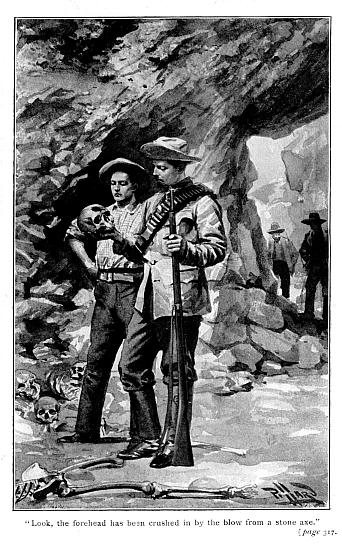
“Yes,” said Griggs thoughtfully; “that would ruin the folk. No doubt some of these places were used as stores, and those might last for years; but if their supply of water were cut off there wouldn’t be much chance for them then.”
“Well, let’s see farther,” said the doctor. “I can’t help thinking that they must have been a strong and fairly civilised race.”
Chris led the way in, to find the cell he entered cut out and built-up just the same as those which they had seen; but the floor was encumbered deeply with the dust of ages, and on stirring some of it with his foot the boy drew back hurriedly and looked strangely at his father.
“What have you found?” said the doctor.
“The jaguars must have killed a man here, father,” replied the boy, who looked on in disgust as his father stepped in and picked up a skull which might have lain there, sheltered by the roofing of stone, for ages. It looked brown and as if very little pressure would suffice to crumble it up into dust; but the teeth left in the upper jaw were perfect and fairly white.
“Ah!” said the doctor thoughtfully. “Here’s a bit of genuine history at last.”
“Killed by a jaguar, father?” cried Chris excitedly.
“No, my boy,” was the reply; “this is not the marking of a jaguar’s teeth, but the cause of death, plainly enough.”
“What, that hole?” cried Chris excitedly.
“Yes. Look, the forehead has been crushed in by the blow from a stone axe, or possibly by a stone hurled from above.”
“Perhaps only held in the hand, sir,” said Griggs thoughtfully.
“Why, that’s a heap of old bones,” cried Ned, with a look of horror; “the dust’s full of them.”
“Yes,” said the doctor, moving the relics carefully with the butt of his rifle for fragments that were fully defined as to shape to fall together as mere dust and hide portions below. “There’s another skull,” continued the examiner, “crushed in more than the first. A finely-preserved specimen, for, in spite of that hole, it shows the shape of the relic—a low forehead, retreating very rapidly, the brows very bony and heavy, and the cheek-bones widely prominent.”
“That’s not the same shaped skull as the first,” said Bourne quickly.
“Certainly not,” replied the doctor. “I should say it belonged to a fiercer, more savage race of man, who might have been an ancestor of the present Indians of the plains.”
“Then that was one of the enemy, father,” said Chris decidedly, “and he got it in the attack.”
“Possibly,” said the doctor, looking strangely at his son. “He seems to have got it, Chris, but that doesn’t sound to me a very scientific way of describing the antique remains.”
Chris turned very red, and pressed some of the dust aside with his foot, laying bare the side of another of the ghastly relics.
“And that’s like the first,” cried the doctor, bending forward to pick it up, a skull looking whiter than either of the others. “Certainly this is of a different race, Bourne, and the owner died in the same way, the brow crushed.—Look at that.”
The rest were already looking, and saw what caused the doctor’s abrupt exclamation, for as he took up the skull the back portion fell away and the front dropped apart into so much crumbling dust.
“We’re looking down at the remains of a desperate fight, sir, I should say,” said Griggs thoughtfully. “It’s just as if there had been a stand made here.”
“Come on into the next place,” said the doctor eagerly; “but keep close to the wall, following my steps. Ah! it’s impossible to avoid crushing the remains,” he continued, as he sidled along, leaving his footprints in the soft dust which lay thick.
“I say, Chris, isn’t this very horrid?” whispered Ned, as the boys followed last towards the low doorway opposite to that by which they had entered.
“Yes, I suppose so,” said Chris thoughtfully; “but it makes one think of ever so far back when all this dust must have been alive—all fierce men, fighting, some to kill, others to save their lives. I don’t know; it doesn’t seem so very horrid, though I don’t like treading on all their dust—and—and—”
“Bones,” suggested Ned.
“No; because they’re not bones now, only the shape of bones. See how that all crumbled-away when my father picked it up. Dust and ashes, we ought to call it. Do you want to go back?”
“N–no, I think not. I say, what a fight it must have been!”
“Yes,” said Chris, with a deep breath that sounded like a sigh. “One seems to fancy one can see the men who had the white skulls being driven back from this cell into that one, and I shouldn’t wonder if we find that—”
“Yes,” came the doctor’s voice from the next place, “it’s wonderfully interesting. The civilised men must have been making a desperate stand here, and I fully expect that we shall find that they were driven back from cell to cell. Yes,” he said, with his voice growing fainter. “What do you say, Griggs?”
“It’s worse in here, sir, and—yes, worse still in the next place.”
“Driven back from cell to cell,” cried the doctor, “and it’s my impression that we shall find the remains of women and children in the farthest one. We shall hit upon the scene of a terrible massacre—the destruction of the race who built-up this place.”
The boys had joined the speakers now, just in time to hear Wilton speak—
“But I say, Lee, aren’t you letting your imagination carry you a little too far?”
“I think not,” replied the doctor quietly. “Look here; you cannot call this imagination. Small as the space is in these rock chambers, there are the remains of scores of men who fought desperately for their lives. To me it seems like a vivid reproduction of the past.”
“How far back?” said Bourne.
“Ah, that is beyond me. How long would it take these bones to decay to this extent as they lay here just as their owners fell? It is a question that no man can answer—one dependent upon the action of the air in a climate like this, with the remains sheltered from sun and rain, to gradually pass away into dust. You can see plainly enough that these are not the remains found in some burial place, added to year after year, age after age. This slaughter must have been the work of only a few hours, and the people lie piled-up as they fell. Let’s go on.”
Cell after cell was entered, with the remains lying thick as the warriors had fallen, the searchers continuing the examination to the very end, and then gladly stepping out on to the terrace, to stand there in the broad daylight, the air seeming to feel fresh and clear after what they had gone through.
“A strange bit of history,” said the doctor thoughtfully. “We know now and think how this bit of civilisation came to an end; but we have discovered no weapons of war to help us to give a date to the siege.”
“But we haven’t half done our search yet, sir,” said Griggs. “There’s another terrace above this, you see,” and he pointed up to where there had been another row of the cells formed in the rock-face, these latter standing back a little and evidently being the last, for above them the cliff projected like a gigantic cave, as far as they could see, from end to end.
“Who votes that we give up now and leave the examination till another day?” said Bourne, who had seemed more and more enthusiastic as the search went on.
There was no reply.
“Who votes that we try and get up to the next stage?”
Hands went up, and Ned shouted eagerly—
“Everybody.”
“Let’s get back, then,” said the doctor; “but we’ll keep out here on the terrace as far as we can. It is gruesome work trampling amongst the ashes of the fallen, interesting as it all is.”
“I suppose we shall find another of those chimney-like flights of steps,” said Wilton; “but I was too much taken up with what we were doing to notice.”
“I hope so,” replied the doctor, “but I saw nothing. I fancy, though, that this was the only way up into the town or city, and, judging by the appearance of the next terrace, it will be the last.”
“Then we shall be able to get on to the top of the cliffs this way, sir,” said Griggs.