Part 4 — SCROFULA.
Reading edition
It is estimated that about one fifth of the human family are afflicted with scrofula. A disease so prevalent and so destructive to life, should enlist universal attention and the best efforts of medical men in devising the most successful treatment for its cure. It varies in the intensity of its manifestation, from the slightest eruption upon the skin (scrofulous eczema), to that most fatal of maladies, pulmonary consumption.
The Scrofulous Diathesis. The existence of a certain disposition or habit of body designated as the scrofulous or strumous diathesis, is generally recognized by medical practitioners and writers as a constitutional condition predisposing many children to the development of this disease. Enlargement of the head and abdomen, fair, soft and transparent or dark, sallow, greasy or wax-looking skin, and precocious intellect are supposed to indicate this diathesis.
The characteristic feature of this disease, in all the multifarious forms that it assumes, is the formation of tubercle, which, when the malady is fully developed, is an ever-present and distinguishing element.
Tuberculous is therefore almost synonymous with scrofulous, and to facilitate an acquaintance with a large list of very prevalent maladies, we may generalize, and classify them all under this generic term. As tubercle is frequently spoken of in works treating on medicine and surgery, playing, as it does, a conspicuous part in an important list of diseases, the reader may very naturally be led to inquire:
What is Tubercle? As employed in pathology, the term is usually applied to a species of degeneration, or morbid development of a pale yellow color, having, in its crude condition, a consistence analogous to that of pretty firm cheese. The physical properties of tubercle are not uniform, however. They vary with age and other circumstances. Some are hard and calcareous, while others are soft and pus-like. The color varies from a light yellow, or almost white, to a dark gray.
It is almost wholly composed of albumen united with a small amount of earthy salts, as phosphate and carbonate of lime, with a trace of the soluble salts of soda.
The existence of tubercular deposits in the tissues of the body, which characterizes scrofula, when fully developed, must not, however, be regarded as the primary affection. Its formation is the result of disordered nutrition. The products of digestion are not fully elaborated, and pass into the blood imperfected, in which condition they are unable to fulfill their normal destiny—the repair of the bodily tissues. Imperfectly formed albuminous matter oozes out from the blood, and infiltrates the tissues, but it has little tendency to take on cell-forms or undergo the vital transformation essential to becoming a part of the tissues. Instead of nutritive energy, which by assimilation produces perfect bodily textures, this function, in the scrofulous diathesis, is deranged by debility, and there is left in the tissues an imperfectly organized particle, incapable of undergoing a complete vital change, around which cluster other particles of tubercular matter, forming little grains, like millet seed, or growing, by new accretions of like particles, to masses of more extensive size. As tubercle is but a semi-organized substance, of deficient vitality, it is very prone to disintegration and suppuration. Being foreign to the tissues in which it is embedded, like a thorn in the flesh, it excites a passive form of inflammation, and from lack of inherent vital energy it is apt to decompose and cause the formation of pus. Hence, infiltration of the muscles, glands, or other soft parts with tuberculous matter, when inflammation is aroused by its presence, and by an exciting cause, give rise to abscesses, as in lumbar or psoas abscesses. When occurring in the joints, tubercles may give rise to chronic suppurative inflammation, as in white swellings and hip-joint disease. Various skin diseases are regarded as local expressions of, or as being materially modified by, the scrofulous diathesis, as eczema, impetigo, and lupus. The disease popularly known as "fever-sore" is another form of scrofulous manifestation, affecting the shafts of the bones, and causing disorganization and decay of their structure. Discharges from the ear, bronchitis, chronic inflammation of the intestinal mucous membrane, and chronic diarrhea are frequently due to scrofula, while pulmonary consumption is unanimously regarded as a purely scrofulous affectation. Scrofula shows a strong disposition to manifest itself in the lymphatic glands, particularly in the superficial ones of the neck. The most distinguishing feature of this form of the disease is the appearance of little kernels or tumors about the neck. These often remain about the same size, neither increasing nor diminishing, until finally, without having caused much inconvenience, they disappear. After a time these glands may again enlarge, with more or less pain accompanying the process. As the disease progresses, the pain increases, and the parts become hot and swollen. At length the "matter" which has been forming beneath, finds its way to the surface and is discharged in the form of thin pus, frequently containing little particles or flakes of tubercular matter. During the inflammatory process there may be more or less febrile movement, paleness of the surface, languor, impaired appetite, night sweats, and general feebleness of the system. The resulting open ulcers show little disposition to heal.
Symptoms. There is a train of symptoms characteristic of all scrofulous disease. The appetite may be altogether lost or feeble, or in extreme cases, voracious. In some instances there is an unusual disposition to eat fatty substances. The general derangement of the alimentary functions is indicated by a red, glazed or furrowed appearance of the tongue, flatulent condition of the stomach, and bloated state of the bowels, followed by diarrhea or manifesting obstinate constipation. Thirst and frequent acid eructations accompany the imperfect digestion. The foul breath, early decay of the teeth, the slimy, glairy stools, having the appearance of the white of eggs, and an intolerable fetor, all are indicative of the scrofulous tendencies of the system.
Causes. Scrofula may be attributed to various causes. Observation has shown that ill-assorted marriages are a prolific source of scrofula. Both parents may be not only healthy and free from hereditary taints, but robust, well-formed physically, perfectly developed, and yet not one of their children be free from this dire disease. It may present itself in the form of hip disease, white swelling, "fever-sore" suppurating glands, curvature of the spine, rickets, ulcers, pulmonary consumption, or some skin disease, in every case showing the original perversion of the constitution and functions. Scrofula is hereditary when the disease, or the diathesis which predisposes to its development, is transmitted from one or both parents who are affected by it, or who are deficient in constitutional energy, showing feeble nutrition, lack of circulatory force, and a diminished vitality. All these conditions indicate that a few exposures and severe colds are often sufficient to produce a train of symptoms, which terminate in pulmonary or other strumous affections. Whatever deranges the function of nutrition is favorable to the development of scrofula, therefore, irregularities and various excesses tend to inaugurate it. Depletion of the blood by drastic and poisonous medicines, such as antimony and mercurials, hemorrhages and blood-letting, syphilis, excessive mental or physical labor, as well as a too early use and abuse of the sexual organs, all tend to waste the blood, reduce the tone of the system, and develop scrofula.
Fig. 1. A Scrofulous Tumor
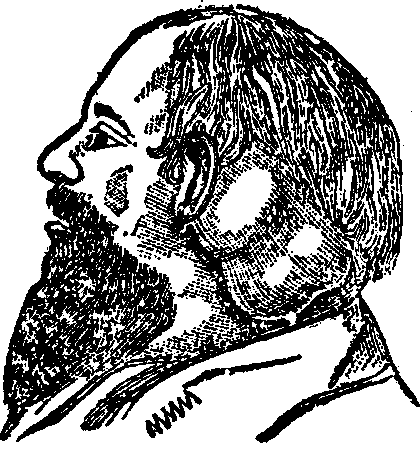
Scrofula may be the consequence of insufficient nourishment, resulting from subsisting upon poor food, or a too exclusively vegetable diet, with little or no animal food.
Want of exercise and uncleanliness contribute to its production. It is much more prevalent in temperate latitudes, where the climate is variable, than in tropical or frigid regions. The season of the year also greatly influences this disease, for it frequently commences in the winter and spring, and disappears again in the summer and autumn months.
Treatment. The skin should be kept clean by means of frequent baths. These assist the functional changes which must take place on the surface of the body, permit the stimulating influence of the light and air and facilitate the aeration of the blood, as well as the transpiration of fluids through the innumerable pores of the skin. All exposure to a low temperature, especially in damp weather, and the wearing of an insufficient amount of clothing should be avoided. Then the food should be generous and of the most nourishing character. Steady habits and regular hours for eating and sleep must be observed, if we would restore tone and regularity to the functions of nutrition. Moderate exercise in the open air is essential, in order that the blood may become well oxygenated, that the vital changes may take place. It is no doubt true that the occasion of the prevalence of scrofula among the lower classes may be ascribed to frequent and severe climatic exposures, irregular and poor diet, or want of due cleanliness. Every well-regulated family can avoid such causes and live with a due regard to the conditions of health. The proper treatment of scrofula is important, because we meet with its symptoms on every side, showing its slow actions upon different parts of the body and its influence upon all the organs. After this disease has been existing for an indefinite length of time, certain glands enlarge, slowly inflame, finally suppurate, and are very difficult to heal. These sores are very liable to degenerate into ulcers. All of these symptoms point to a peculiar taste of the blood, which continually feeds and strengthens this morbid outbreak. All authors agree that the blood is not rich in fibrinous elements, but tends to feebleness and slow inflammation, which ends in maturation. Thus we may trace back this low and morbid condition of the blood to debility of the nutritive organs, defective digestion, which may be induced by irregular habits, a lack of nourishing food, or by the acquirement of some venereal taint.
The matter that is discharged from these glands is not healthy, but is thin, serous, and acrid; a whey-like fluid containing little fragments of tuberculous matter, which resembles curd. The affected glands ulcerate, look blue and indolent, and manifest no disposition to heal. We have thus traced this disorder back to weak, perverted and faulty nutrition, to disordered and vitiated blood, the products of which slowly inflame the glands, which strain out unhealthy, irritating, poisonous matter. The medicines to remedy this perverted condition of the blood and fluids must be alteratives which will act upon the digestive organs and tone the nutritive functions, thus enriching and purifying the blood. As this affection is frequently a complication in chronic diseases, it is eminently proper for us to refer to a few considerations involved in its general treatment.
An alterative medicine belongs to a class which is considered capable of producing a salutary change in a disease without exciting any sensible evacuation. In scrofula, remedies should be employed which will improve digestion and also prevent certain morbid operations in the blood.
It is well known to medical men that nearly all medicines belonging to the class of alteratives, are capable of solution in the gastric and intestinal secretions, and pass without material change, by the process of absorption, through the coats of the stomach and intestines, as do all liquids, and so gain an entrance into the general circulation; that these same alteratives act locally to tone and strengthen the mucous surfaces, and thus promote and rectify the process of digestion before being absorbed; that alterative medicines, when in the blood, must permeate the mass of the circulation, and thus reach the remote parts of the body and influence every function; that these medicines, while in the blood, may combine with it, reconstruct it, and arrest its morbid tendencies to decomposition.
We should use those alteratives which give tone to the digestive and nutritive functions, in order to curtail the constant propagation of scrofula in the system; which alter and purify the blood through the natural functions, thus reconstructing it; and which check the septic, disorganizing changes which are evinced by the irritating and poisonous matter discharged from the ulcers.
These are the three ways in which medicines operate upon the nutritive functions and the blood.
Thus alteratives may be specifics, in so far as they are particularly useful in certain disorders, and the combination which has been made in Dr. Pierce's Golden Medical Discovery, excels all others with which we are acquainted, for scrofulous diseases, particularly in fulfilling the foregoing indications. It works out peculiar processes in the blood, not like food, by supplying merely a natural want, but by strengthening the nutritive functions and counteracting morbid action, after which operations it passes out of the system by excretion.
From what has been said upon the importance of blood medicines and their modes of action, the reader must not infer that we account for all diseases by some fault of the humors of the body, for we do not. But that scrofula, in its varied forms, results from imperfect nutrition and disorders of the blood, is now universally conceded. It is for this reason that neither time nor pains have been spared in perfecting an alterative, tonic, nutritive, restorative, and antiseptic compound, to which Dr. Pierce has given the name of "Golden Medical Discovery." Not only is it an alterative and a nutritive restorative, acting upon the secretions, but it opposes putrefaction and degenerative decay of the fluids and solids. Hence its universal indication in all scrofulous diseases. It will intercept those thin, watery discharges which are the result of weakness, degeneration, and putrescent decay of the blood, perpetuated by a low grade of scrofulous inflammation. By an adult it can be taken in doses of from one to two teaspoonfuls three or four times per day.
The bowels should be properly regulated. When constipation exists one or two of Dr. Pierce's Pleasant Pellets taken daily, will fulfill the indication. The patient ought not to neglect to carry out all the hygienic recommendations heretofore given. The treatment of running sores is very simple. Cleanse them every day with Castile-soap and water, being careful not to rub or touch the surface of the sores. Use a clean sponge or a piece of clean muslin and saturating it with the warm water, hold it a few inches above the affected part, and squeeze out the fluid, allowing the cleansing stream to fall gently upon the open sore. After thoroughly cleansing the sore, apply to it Dr. Pierce's All-Healing Salve. 25 cents in postage stamps sent to us will secure a box by return post if your druggist does not have it in stock.
HIP-JOINT DISEASE.
(COXALGIA.)
Hip-joint disease, also known as Coxalgia, is frequently a scrofulous affection of the hip-joint. It usually attacks children, but may occur at any period of life. The causes of this affection are imperfectly understood, yet all the indications point to a scrofulous state of the system. Dampness, cold, improper diet, severe injuries from blows or falls are all numbered among the exciting causes which are conducive to the establishment of this disease.
The Symptoms are usually developed gradually; at first there is severe pain in the knee, but finally it is located in the hip-joint. Occasionally it is noticed in the hip and knee at the same time. As the disease progresses, the general health becomes impaired, there is wasting of the muscles, wakefulness, disturbed sleep, high fever, profuse and offensive perspiration, the hair falls out, and there is an inability to move the limb without producing excruciating pain. Frequently pus will be formed and discharged at different points, and the limb will become greatly emaciated. Since pain in the knee-joint may mislead as to the location of the disease, to determine the seat of the affection, place the patient in a chair and percuss the knee lightly, by giving it a slight blow with the knuckle; if the hip be affected, the pain will be readily felt in that joint; if it be simply neuralgia of the knee-joint, it will excite no pain whatever. If the disease be allowed to progress and dislocation of the joint takes place, the affected limb becomes shortened.
Treatment. The treatment of this disease should consist in rest for the hip-joint, cleanliness of the person and plenty of fresh air and light, a nutritious diet and the use of tonics and sustaining alterative, or blood-cleansing medicines. Dr. Pierce's Golden Medical Discovery has, unaided by other medicines, cured many cases of this disease. This class of medicines should be persistently employed, in order to obtain their full effects. It is a disease which progresses slowly and which is not easily turned from its course, and its fatality should warn the afflicted to employ the best treatment.
Many poor, unfortunate victims know too well, from sad experience, that the course of treatment frequently recommended and employed by physicians and surgeons is ineffectual, and cruel; they deplete the system, apply locally liniments, lotions, iodine, and hot applications; confine the patient in bed and strap his hips down immovably, thus preventing all exercise; then they attach that cruel instrument of torture, the weight and pulley, to the diseased limb.
After many years of practical experience in the treatment of hundreds of cases, we have developed a system of treatment for this terrible malady which is based upon common sense. Instead of depleting, we, by proper constitutional treatment, strengthen and fortify the system. We do not confine the patient in bed, but permit him to go around and take all necessary exercise. We adjust an ingeniously devised and perfectly fitting appliance or apparatus, by which a gentle extension of the limb is maintained, thereby relieving the tension of the muscles, and preventing the friction and wearing of the inflamed surfaces of the joint, which, without the use of our new and improved appliance, are a source of constant irritation. The appliances required in the successful treatment of this disease are numerous and varied in their construction, and require skill and experience on the part of the surgical mechanic as well as on the part of the surgeon, to take accurate and proper measurements of the diseased limb, and to construct the appliances so that they will be adapted to the various requirements of different cases. There are no definite rules for taking these measurements, and only a thorough examination of the case can indicate to the eye of the experienced surgeon what measurements are required, and what kind of an appliance is suitable for each individual case. At the Invalids' Hotel and Surgical Institute these measurements are all taken by the surgeon in person, and each appliance is constructed under his immediate supervision. It is utterly impossible for physicians who have but a limited experience in the treatment of such cases to take correct measurements and send off for an apparatus which fulfills the requirements of the case.
In the light of our vast experience at the Invalids' Hotel and Surgical Institute, we feel that we cannot too strongly urge the employment of a suitable apparatus for supporting the hip-joint, giving it perfect rest, and enabling the patient to exercise and get the outdoor air. As much of the pain in this disease is due to the pressure of the head of the femur, or thigh-bone, in the acetabulum, or socket, steadily-applied mechanical extension, to relieve the inflamed and sensitive joint of the pressure, is of the greatest importance. By such application the patient is enabled to move about without pain, while the joint is kept perfectly at rest—a condition favorable to the reduction of inflammation within it. The surgeon specialist of the Invalids' Hotel and Surgical Institute is frequently sent for to visit cases of this disease hundreds of miles away and by the employment of suitable apparatus he has been enabled, in scores of cases, to relieve the suffering at once. In cases in which the head of the thigh bone, or the bony socket of the joint has become so diseased as to cause it to ulcerate and break down, all portions of diseased bone should be thoroughly removed by a surgical operation. If this be neglected or delayed, a fatal termination of the disease may be expected. Parents should not put off the employment of a competent specialist in this terrible, distressing, and fatal disease. As treated by general practitioners, it very often proves fatal; or, after causing intense suffering for a series of years, if the active condition of the disease subsides, the patient is left with a ruined and broken constitution, a result which more prompt and earlier relief would have prevented.
The records of practice at the Invalids' Hotel and Surgical Institute abound in reports of cases, demonstrating the fact, that by careful and judicious management, hip-joint disease in its earlier stages, may be promptly arrested, and that cures may be effected even when the bony structure of the joint is seriously diseased.
WHITE SWELLING
White Swelling, otherwise known as Hydrarthrus, or Synovitis, more frequently affects the knee-joint than any other part. The joints of the elbow, wrist, ankle, or toes, may, however, be affected with this disease, but we shall speak of it in this connection as affecting only the knee-joint. Synovitis may be acute or chronic. The latter form is sometimes induced by blows, sprains, falls, etc., or from exposure to cold; more frequently it is the result of rheumatism or scrofula.
The Symptoms of this affection are generally slow in their appearance, being sometimes months in manifesting themselves. The joint at first presents only a slight degree of swelling, which gradually increases. Pain is soon felt, mild at first, but augmenting until it becomes severe. The skin has a smooth, glistening appearance, and there is an increased amount of heat in the parts. The affected limb becomes wasted, and is sometimes permanently flexed. There is more or less fever about the body, impairment of the digestive organs, and sleeplessness. The pulse is low but quick, and night-sweats and diarrhea often appear. Under this irritation, the patient is liable to waste away and finally die.
A post-mortem examination reveals the effects of the disease upon the parts attacked. The cartilages of the joint are soft, the synovial membrane is thickened, the ligaments are inflamed and often destroyed, the synovial fluid is increased in amount, sometimes normal in appearance, at others thick and viscous. If the bones be diseased, their articular extremities may be distended and fatty matter deposited in them. The conditions depend upon the form, severity, and duration of the disease.
Synovitis may be considered under three heads; Rheumatic, Scrofulous, and Syphilitic.
Rheumatic Synovitis may arise from exposure to cold, from some injury, or from intemperance in eating. The beginning of the disease may be distinctly marked, or it may come on so gradually that the time of its commencement cannot be noted. The pain is of a dull, steady character, and less severe in the night. This form of the disease sometimes terminates favorably, but in scrofulous systems it is liable to end in the destruction of the joint. It is more common in early life, rarely occurring after the thirtieth year.
Scrofulous Synovitis, or Tuberculosis of the Knee-joint, when of a chronic character, shows a wasting of the limb, and the swelling is of a pulpy consistence. This form of the disease is more liable to occur in children, though occasionally it is met with in adults. But little pain accompanies this form, although the limb is liable to become permanently affected. In its earlier stages this disease may be checked.
Syphilitic Synovitis is the result of syphilis. The pain is more severe during the night. It, however, generally terminates unfavorably, especially in scrofulous constitutions.
The Treatment of white swelling should be both constitutional and local. Alterative medicines are indicated to purify the blood. Doctor Pierce's Golden Medical Discovery is unequaled for this purpose.
As local treatment, in the active stage of the disease, the knee-joint should be steamed, and hot fomentations applied. This should be followed by applications over the joint of solid extract of stramonium or belladonna, mixed with glycerine. The joint should be wrapped in cotton or wool to keep it uniformly warm. If there are openings about the joint, discharging pus, syringe them out once a day with Castile soap-suds, which may be improved by adding a little bicarbonate of potash (common saleratus). See that the bowels are kept regular, and that the diet is nourishing.
Cases of this disease which have been treated at the Invalids' Hotel and Surgical Institute with uniform success might be cited to the extent of filling a very large number of pages like these. When treated by a skilled specialist, this otherwise formidable and dangerous disease is readily amenable to treatment, and good and serviceable limbs can be promised, even in the extreme cases in which amputation is usually advised by general practitioners and surgeons, who desire the glory that they imagine they will receive by performing a capital operation.
RICKETS. (RACHITIS.)
Rickets is a scrofulous disease, in which there is derangement of the entire system, and it finally manifests itself in disease of the bones. It is characterized by a softening of the bony tissue, due to a deficiency of earthy or calcareous matter in their composition. It appears to be a disease incident to cold, damp places, ill-lighted and imperfectly ventilated rooms, and it especially attacks those who are uncleanly in their habits.
The Symptoms of rickets are severe pains in the bones, especially during the night, febrile excitement and profuse perspiration, paleness of the face, a sallow and wrinkled appearance of the skin, and derangement of the digestive organs. After a time the body becomes emaciated, the face pale, and the head unusually large. The bones become soft and unable to support the body; various distortions appear; the extremities of the long bones are enlarged, while the limbs between the joints are very slender. Rickets is a disease peculiar to childhood, though it may not be developed until a more advanced period of life. It rarely proves fatal, unless the lungs, heart, or other vital organs, become involved. In some instances the softening and other symptoms continue to increase until every function is affected, and death ensues.
Post-mortem examinations of those who have died of rickets have disclosed morbid changes in the brain, liver, and lymphatic glands. The lungs are often compressed or displaced, and the muscles of the body become pale and wasted. Sometimes the bones are so soft, on account of the deficiency of the calcareous deposit, that they can be easily cut with a knife.
Treatment. The use of Dr. Pierce's Golden Medical Discovery is indicated in this affection. It is a disease usually developed during childhood, in consequence of insufficient exercise, deprivation of the sunlight, low, innutritious diet, and lack of cleanliness. Therefore, it is essential to obviate all known causes, and, at the same time supply the patient with food rich in those elements which the system seems to demand. Under any plan of treatment the general directions given for the hygienic management of scrofula should be followed. We might cite many cases that have entirely recovered from this disease, under our advice and the use of "Golden Medical Discovery." We shall merely say, for the encouragement of the afflicted, that this form of scrofula yields readily to this medicine.
OLD SORES. (CHRONIC ULCERS.)
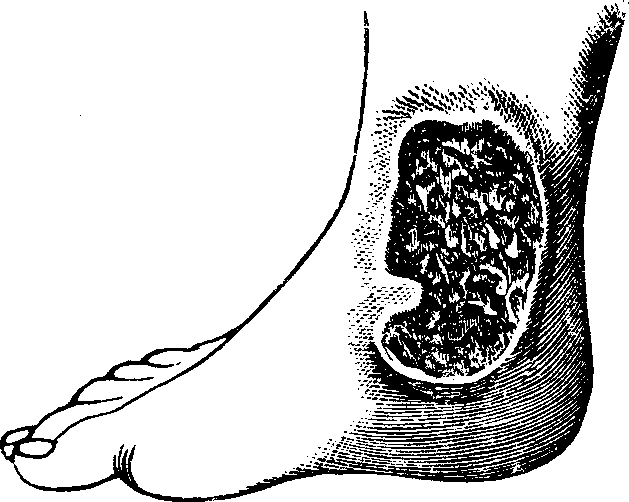
Under this head we may properly consider that class of affections known as Fever-sores, Running-sores, Ulcers, etc. These sores have common characteristics, yet each possesses certain peculiarities, which have led to their division into irritable, indolent, and varicose. These peculiarities are not constant, one form of ulcer often changing into another. One feature common to all, however, is their slowness in healing, which has sometimes led to the belief that they are incurable. Another popular notion is that their cure is detrimental to the health of the patient. With equal propriety we might say that it is dangerous to cure diarrhea, dysentery, consumption, or cancer. As a result of these erroneous impressions, many people suffer from chronic ulcers for years, and even for a life-time, without attempting to obtain relief. Chronic ulcers usually appear upon the lower extremities. The depth and appearance of the ulcer depend upon its character and the thickness of the tissues where it is situated. Fig. 2 shows a chronic ulcer, or fever-sore, as it appears upon the ankle.
Fig. 2. A Chronic Ulcer.
The Irritable Ulcer is painful and tender, the slightest injury causing it to bleed. It is of a dark purplish hue, and filled with spongy, sensitive granulations. It discharges a thin, bloody matter which is sometimes very fetid and acrid, and excoriates the tissues if it comes in contact with them. The edges of this species of ulcer are shelf-like and ragged, and turn inward. The adjacent structures are red and swollen. Very often they are attended by severe constitutional disturbances, such as chills, fever, and great nervous prostration and irritability.
In the Indolent Ulcer the edges are not undermined, but turned outward, and are rounded, thick, glossy, and regular. The granulations are broad, flat, pale, insensible, and covered with a grayish, tenacious matter. The surrounding parts are not very sensitive, but the limb on which it is located is apt to be swollen. This is the commonest form of ulcer, and often remains for years.
Varicose Ulcer. This species of ulcer occasions a swollen or enlarged condition of the neighboring veins, which are very much enfeebled. It almost invariably appears below the knee, and may be either indolent or irritable. It is generally sensitive to the touch, and sometimes excessively painful. Knots of superficial veins may often be seen beneath the skin.
As we have before remarked, these various species of ulcers are merely modifications of one form of chronic sore. The patient may assert that he enjoys excellent health, but if we question him closely, we find that the sore irritates him, and that there is sufficient constitutional disturbance to prevent the healing powers of nature from effecting a cure.
Treatment. The cure of these sores is necessarily slow, and who ever expects to obtain immediate relief will be disappointed.
Constitutional treatment is of the utmost importance, and should, therefore, be thoroughly and persistently applied. The nutritive system, especially the absorbents, should be kept active, as these are the channels by which the broken-down tissue surrounding the sore is replaced by that of a higher grade of vitality. For this purpose, the best alteratives or blood cleansing remedies are required. If secretion and excretion are not normally performed, the blood becomes poisoned by the absorption of unhealthy "matter" from the sore, and various constitutional disturbances occur. If, at any time during treatment, constitutional disturbances are manifested by fullness or disagreeable sensations in the head, nausea, pain, cough, chills, or fever, a thorough cathartic should be given. If the patient be robust, a repetition of the same once a week will be very beneficial. Dr. Pierce's Golden Medical Discovery, and "Pellets" will be productive of the best results.
The local treatment should depend upon the character of the ulcer. If the sore be irritable or painful, soothing applications, such as warm poultices or steaming in a vapor of bitter herbs, as hops, boneset or smart-weed or water pepper, will be found highly beneficial. A poultice of powdered slippery elm is also very soothing, and hence well adapted to this purpose. If the ulcer be indolent, a stimulating application is necessary. The hardened, callous state of the edges should be removed by alkaline applications. A strong solution of saleratus, or even a caustic, prepared by boiling the lye from hard-wood ashes to the consistence of syrup, will prove of great utility. One or two applications of the latter are generally sufficient.
The foregoing course of treatment is intended to put the open sore or ulcer in what is known to surgeons as a healthy condition—a condition most favorable for the healing process.
But the open surface of the sore needs something more. It needs the cleansing or antiseptic and soothing influence of such a dressing as is found in Dr. Pierce's All-Healing Salve. If your dealer in medicines does not have this Salve in stock, 25 cents in stamps sent to World's Dispensary Medical Association, Buffalo, N.Y., will secure a box of this unequaled dressing. It will be sent to your address by return post. Therefore, do not allow the dealer to put you off with some inferior preparation. If he has not the All-Healing Salve in stock you can easily obtain it by sending to us as above directed.
No matter how good the local dressing applied to the open sore, or ulcer, do not discontinue the internal use of the "Golden Medical Discovery" until the affected parts are completely healed.
FEVER-SORE. (NECROSIS.)
By the term necrosis we mean mortification, or the state of a bone when it is deprived of life. Dunglison says: "This condition is to the bone what gangrene is to the soft parts." It is popularly known as fever-sore, there being no distinction made between this species of sore and those ulcers which affect only the soft tissues of the body. When any part of a bone becomes necrosed, it is treated as a foreign body. Nature makes an effort for its removal, and at the same time attempts to replace it with new and healthy materials. In consequence of this process, the dead portion is often inclosed in a case of new, sound bone, termed the involucrum; when this is the case the dead portion is termed the sequestrum. If, however, it be superficial, and separate from the parts beneath, it is called an exfoliation. This healing process, by which the involucrum is formed, cannot be completed while the dead portion remains. Hence, numerous openings are made through the involucrum, to permit the escape of the sequestrum. When a surgical operation is performed for the removal of the necrosed bone it is called sequestrotomy. The instruments which our specialists usually employ for this practice are represented in Figs. 3, 4, and 5.
Fig. 3. Hand drill for boring bone.

Fig. 4. The osteotrite, for enlarging openings and cutting carious bone.

Fig. 5. Gouge forceps for excavating bone.
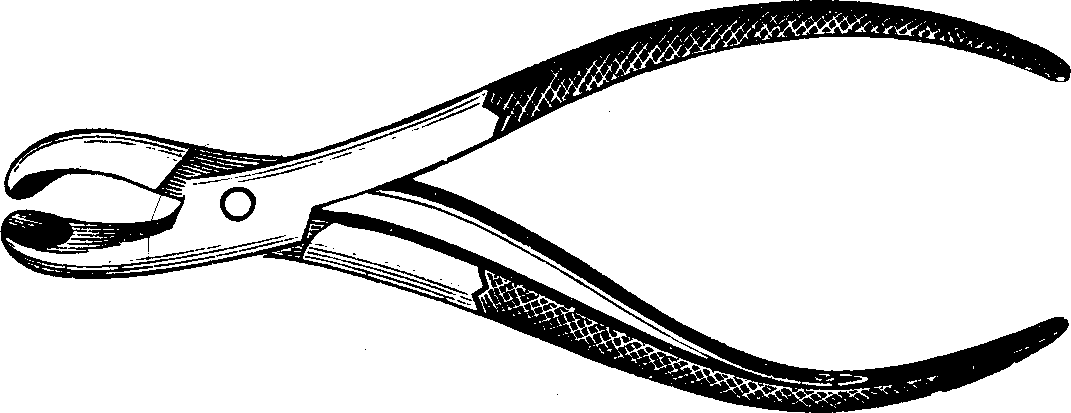
Causes. Fever-sore may be due to inflammation, injuries, working in phosphorus, or from the inordinate and protracted use of mercury.
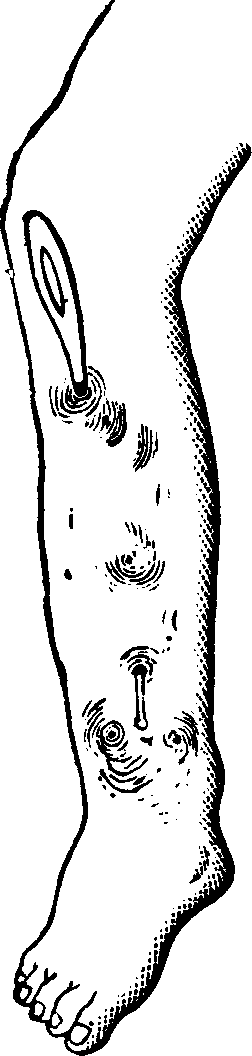
Symptoms. The pain frequently commences in the night, and all the different stages succeed, until, finally, the result is frequently mortification or death. The entire bone, or only a part of it, may be affected; the parts become swollen, "matter" forms, and unless it be artificially evacuated, it will in time work its way out through a fistulous opening. As the disease progresses, the adjacent tissues become thickened and numerous openings are formed, which communicate with the bone, and often with each other, so that a probe may be passed from one to another, as represented in Fig. 6, copied from a drawing by Dr. Howe. The discharge from fever-sores varies in character, and usually has a fetid odor. The surgeon can readily distinguish between healthy and unhealthy bone by the use of a probe. The pus discharged in necrosis contains minute particles of bone, which may be felt by rubbing it between the fingers. Sometimes large pieces present themselves at the openings. The general health is seriously impaired, and the patient becomes debilitated, anæmic, and hectic.
Fig. 6. Necrosis of the tibia. A common probe is passed through the sinuses, or openings.
Treatment. The process of repair is necessarily tedious, and nature should be assisted to remove the old bone and promote the formation of the new. An alterative course of treatment is indicated and must be persistently followed. Give Dr. Pierce's Golden Medical Discovery and Pleasant Pellets in sufficient doses to keep the bowels regular. However, all efforts to heal the sores, as long as dead bone remains, will prove fruitless. The sores should he throughly cleansed with injections of an alkaline solution, after which bandages, moistened with glycerine, may be applied. If they emit a fetid odor, add a few drops of carbolic acid to the glycerine. The dead bone can be but slowly removed by suppuration, therefore time, and, indeed, sometimes life itself, may be saved by removing it with surgical instruments. In the operation of sequestrotomy, the surgeon must exercise great judgment. Carelessness may prolong the disease and subsequently necessitate another operation, or, perhaps, an amputation.
Usually the dead bone is easily removed by the skilled specialist surgeon, and, when thoroughly taken out, the parts readily heal and the patient rapidly recovers. The removal, therefore, of the dead bone which is a constant source of irritation, and the cause of protracted suffering, should not be delayed, for very rarely indeed can it be removed at all without the assistance of the surgeon. Besides, delay often results in the loss of the limb, and not unfrequently occasions the death of the patient. Under the influence of a reliable local anæsthetic, carefully applied, the operation of removing the decayed and offensive bone is speedily and painlessly performed, the use of chloroform or ether not generally being required.