Part 4 — ERYTHEMATOUS AFFECTIONS.
Reading edition
The prominent features, eruption, and itching of eczematous affections are purely local. Erythematous affections are, however, remarkable for their symptoms of constitutional disorder. Each of these affections is preceded by intense febrile excitement and nervous debility. In brief, the local manifestations are simply signs of general internal disorders; hence, the treatment should be directed to the restoration of the system. This group includes erythema, erysipelas, and urticaria.
Erythema. A vivid and partial flushing of the face is produced by a superficial inflammation of the skin, termed erythema. There are many stages of this disease, from the instantaneous transient flush caused by emotional excitement, to the protracted inflammation and swelling of erythema nodosum.
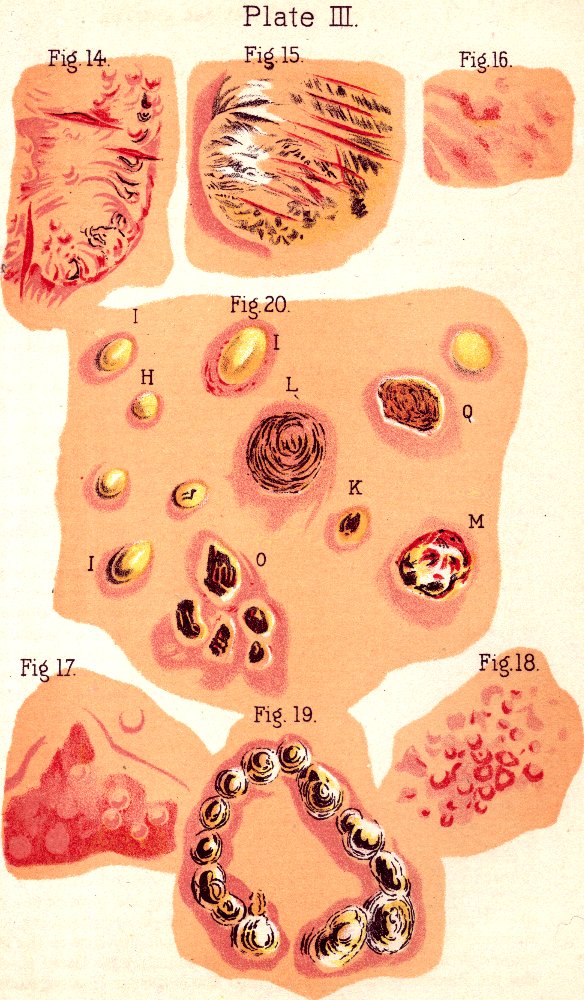
The affection is characterized by a flush which is at first a bright vivid scarlet, but which changes to a deep purplish tint. There is a slight elevation of the skin, sometimes accompanied by itching. In the second stage of development, the flush subsides, the skin has a yellowish or bruised appearance, and a few minute scales are formed. In erythema papulosum, a fine representation of which is given in Colored Plate III, Fig. 18, there is an eruption of red pimples or pustules. The prominent feature of erythema nodosum, a variety of erythema which affects those portions of the skin exposed to the sun, is the appearance of a large swelling, usually lasting four or five days and attended by constitutional symptoms, such as nausea, fever, languor, and despondency. The disease is associated with the symptoms incident to a disordered nervous system and sometimes results fatally, in other cases, it terminates in melancholy and mania.
Causes. The predisposing causes of erythema are constitutional debility, changes of climate and temperature, and irritating food or medicines. Locally, it may be produced by friction and the heat of the sun.
Plate III. Fig. 14. Fig. 15. Fig. 16. Fig. 20. Fig. 17. Fig. 19. Fig. 18.
Erysipelas. There are few adult persons in this country who have not, by observation or experience, become somewhat familiar with this disease. Its manifestations are both constitutional and local, and their intensity varies exceedingly in different cases. The constitutional symptoms are usually the first to appear, and are of a febrile character. A distinct chill, attended by nausea and general derangement of the stomach is experienced, followed by febrile symptoms more or less severe. There are wandering pains in the body and sometimes a passive delirium exists. Simultaneously with these symptoms the local manifestations of the disease appear. A red spot develops on the face the ear, or other part of the person. Its boundary is clearly marked and the affected portion slightly raised above the surrounding surface. It is characterized by a burning pain and is very sensitive to the touch. It is not necessary for the information of the general reader that we should draw a distinction between the different varieties of this malady. The distinctions made are founded chiefly upon the depth to which the morbid condition extends, and not on any difference in the nature of the affection.
Suppuration of the tissues involved is common in the severer forms. Should the tongue become dark and diarrhea set in, attended with great prostration, the case is very serious, and energetic means should be employed to save life. A retrocession of the inflammation from the surface to a vital organ is an extremely dangerous symptom.
The disease is not regarded as contagious, but has been known to become epidemic.
Urticaria. (Hives, or Nettle-Rash.) This word is derived from urtica, signifying a nettle; it is a transient affection of the skin, indicated by a fierce, burning, itching sensation and a development of pustules, or white blotches of various forms. A representation of this eruption is given in Colored Plate III, Fig. 17. It is appropriately named nettle-rash, from its resemblance to the irritation caused by the sting of a nettle. There is the same sharp, tingling sensation and a similar white wheal or blotch, caused by the muscular spasm of the corium, a layer of the skin.
Urticaria may be either acute or chronic. Acute urticaria is always preceded by febrile symptoms and the attack is indicated by a sudden congestion of the skin, followed by a slight swelling or elevation of the affected part. When the congestion subsides, the skin has a bruised appearance. In chronic urticaria, the febrile symptoms are absent.
Causes. The exciting causes of urticaria are gastric disorder, irritation of the mucous membrane, or a sudden nervous shock. The predisposing causes are conceded to be assimilative and nervous debility. Hence, it frequently accompanies purpura or land scurvy and rheumatism. The skin in some persons is so susceptible to irritation that urticaria can be kindled at any moment by excitement, as an animated conversation, or by the simple pressure of the hand.
Treatment. The proper treatment for simple erythema consists in applying to the affected parts a little lime-water, or sweet-oil, or glycerine, with the use of warm baths and mild cathartics. This is generally sufficient to effect a cure, if followed up with the persistent use of Dr. Pierce's Golden Medical Discovery taken three times a day.
In erysipelas a hot bath, with warm, sweating teas, or, better still. Dr. Pierce's Compound Extract of Smart-weed may be given to favor sweating. The whole person should be frequently bathed with warm water rendered alkaline by the addition of saleratus or soda. The whole should be moved by a full dose of the "Pleasant Pellets." Fluid extract of veratrum viride, in doses of a drop or two every hour will best control the fever. The specific treatment, that which antidotes the poison in the blood, consists in administering fifteen-drop doses of the tincture of the muriate of iron in one teaspoonful of the "Golden Medical Discovery," every three hours. As a local application, the inflamed surface may be covered with cloths wet in the mucilage of slippery elm. A preparation of equal parts of sweet oil and spirits of turpentine, mixed and painted over the surface, is an application of great efficacy.
For urticaria, the "Pleasant Pellets" should be administered in sufficient doses to move the bowels, the skin bathed with warm water rendered alkaline by the addition of common baking soda or saleratus, and, if there be any febrile symptoms, a little tincture of aconite or veratrum may be administered in one drop doses once each hour. In the chronic form of the disease, the diet should be light, unstimulating, and easily digested, the skin kept clean by frequent bathing, and fresh air and outdoor exercises freely taken. The somewhat protracted use of Dr. Pierce's Golden Medical Discovery will result in the greatest benefit in this form of disease.
BULLOUS AFFECTIONS.
The distinguishing feature of this group of cutaneous affections is the formation of bullæ, or blebs, which are defined as "eminences of the cuticle, containing a fluid."
Herpes is an inflammation of the skin in which the eruption appears in patches of a circular form. On the second day, minute, transparent vesicles appear and gradually develop, becoming opalescent. On the succeeding days, they shrink and produce reddish brown scabs, which soon become hard and fall off, leaving deep, purplish pits. In adults, these vesicles sometimes terminate in painful ulcers, caused by an irritation of the eruption. By some practitioners, herpes is regarded as a purely nervous disorder, from the fact that it is frequently accompanied by severe neuralgic pains. These pains are not constant, but occasional, and do not appear at any definite stage of the disease. Sometimes they precede and accompany the eruption. Other instances are recorded in which they remained many years after the disease had disappeared. The local and constant pain of herpes is a severe burning, prickling, itching sensation, which remains after the scabs fall.
The three general forms of this disease are herpes zoster, phlyctoenodes and circinatus.
In herpes zoster, or shingles, the clusters of vesicles encircle one-half of the body, frequently at the waist; hence, it has received the name of zona or girdle. The vesicles often develop into bullæ, and sometimes ulcerate. In herpes phlyctoenodes, the vesicles are small, round, and irregularly distributed over the face, neck, arms, and breast. This form is accompanied by febrile symptoms and offensive excretions.
In herpes circinatus, or ringworm, the vesicles appear in circular patches, or rings. This is the mildest form of herpes, and is not attended by symptoms of constitutional disorder. The various forms of herpes are represented in Colored Plate I, Fig. 3.
Causes. Herpes is not contagious. It is caused by vicissitudes of heat and cold, violent emotions, excessive exertion, irritation of the skin, and a general atony of the system.
Miliaria is the name given to an eruption of vesicles which are larger than those of eczema, but smaller than the bullæ of herpes. At first, the serum contained in the vesicles is perfectly transparent, and reflects the red tint of the underlying skin, hence the name miliaria rubra. But gradually it becomes milky and opalescent, hence, the term miliaria alba. The vesicles of miliaria are generally solitary, and appear on those portions of the body most liable to become heated and to perspire. The eruption is preceded by chills, languor, slight fever, intense thirst, a sharp prickling sensation of the skin, and profuse perspiration. The vesicles soon desiccate and are replaced by a new crop.
Causes. Miliaria is almost universally an accompaniment of febrile disease, and all disorders in which there occurs a profuse perspiration. The causes to which it may be traced in each instance are improper diet, impure air, burdensome clothing, or strong emotions.
Pemphigus is a peculiar eruption which appears upon the limbs and abdomen. The affected part is of a bright red color, and, in a few hours, small vesicles appear containing a transparent fluid. The vesicles soon develop into bullæ, entirely covering the inflamed portion. The fluid becomes opaque and in a few hours escapes. The patch is then covered with a yellow scab. Pemphigus may be either acute or chronic. The acute form is subdivided according to the degree of inflammation, as pemphigus pompholyx in which it is severe, and pemphigus benignus, when it is mild. The bullæ of pemphigus are illustrated in Colored Plate III, Fig. 19.
Cause. Pemphigus is always caused by a vitiated state of the system.
Rupia is indicated by an eruption as large as a chestnut containing a watery fluid, which desiccates into a yellowish-brown crust. A fine representation of rupia vesicles in both stages of development, is given in Colored Plate II, Fig. 13.
Treatment. In all forms of herpes, the administration of a small dose of Dr. Pierce's Pleasant Pellets, with the use of his "Golden Medical Discovery" in one to two teaspoonful doses three times a day, will be followed by the happiest results. The skin should be kept clean by the use of the sponge-bath, rendered alkaline by the addition of common baking soda or saleratus. The portion of the body covered by the eruption, should be bathed with a solution of sulphate of zinc, one ounce to a pint of water.
Miliaria is generally associated with certain febrile diseases, and its proper treatment consists in overcoming the febrile and other constitutional symptoms which accompany the disease. A hot foot-bath and small doses of tincture of aconite, say one drop in water each hour, will suffice to remove the fever. If the stomach and bowels are in a vitiated condition, as they are apt to be, a mild cathartic dose of "Pellets" should be given.
The treatment of pemphigus should consist in frequent alkaline sponge-baths, and in covering the affected parts with poultices of slippery elm, which should be kept moist with vinegar, The constitutional treatment should embrace the persistent use of the "Golden Medical Discovery." When the disease occurs in children, it is most generally dependent upon deficient nutrition, and special attention should be given to the diet of the patient, which should be nutritious. Fresh air and outdoor exercise ought not to be neglected.
The proper treatment of rupia does not differ from that suggested for pemphigus.
NERVOUS AFFECTIONS OF THE SKIN.
In nervous affections of the skin, the natural sensibility may be increased, diminished, or perverted. These morbid impressions arise from the nervous system. Although there are several varieties of these affections, yet, being of minor importance, we shall omit their consideration and only speak of one of them in this work.
Prurigo affects the entire surface of the body and imparts to the skin a parched, yellowish appearance. It is characterized by pimples, and an intense burning, itching sensation. Rubbing and scratching only irritate the skin, which becomes covered with thin black scabs. A good representation of prurigo may be seen in Colored Plate II, Fig. 6. The itching sensations are sometimes caused by chilling the body, by violent exercise, and heat; allowing the mind to dwell upon the affection aggravates it. Prurigo is recognized under two forms; vulgaris, which is a mild form, and senilis, which chiefly occurs in old age, and is more severe. The external genital parts of females are frequently affected with this disease, and it is aggravated by menstruation and uncleanliness.
This affection may be due to a vitiated condition of the blood, and is common among those who are greatly debilitated. It is frequently occasioned by uncleanliness, intemperance, the use of unwholesome food, or by an impure atmosphere.
Treatment. To allay the itching, take glycerine, one ounce, add to it one drachm of sulphite of soda, and one ounce of rose-water, and apply this to the affected parts. A solution made with borax, two drachms, and morphine, fire grains, dissolved in six ounces of rose-water, makes an excellent lotion to allay the itching. If the disease be severe, it will be necessary to correct the vitiated condition of the blood by a protracted use of Dr. Pierce's Golden Medical Discovery, and to aid its effects, give one "Pleasant Pellet" every day, not to operate as a cathartic, but only to exert an alterative influence.
ALPHOUS AFFECTIONS.
(SCALY SKIN DISEASES.)
Differences of opinion exist with regard to the proper classification of these affections. We shall briefly consider alphos, which is sometimes confounded with lepra.
Alphos, which from its Greek derivation signifies white, is characterized by circular, slightly raised white spots. These eruptions vary in size from one line to two inches in diameter, and may be scattered over the entire surface of the body, although they most frequently appear upon the elbows and knees. Alphos may consist of a single tubercle, or of large clusters constituting patches. The scales vary in color and thickness. In Colored Plate III, Figs. 14 and 15, are fine illustrations of alphos. When a person begins to recover from this affection, the scales fall off, leaving a smooth red surface, which gradually returns to its natural color.
This disease is more liable to occur in winter than in summer, although in some cases the reverse holds true. It may disappear for a time, only to return again with renewed vigor. It is not regarded as contagious.
Treatment. Thorough and protracted constitutional treatment is required to overcome this disease. Dr. Pierce's Golden Medical Discovery should be taken internally and also applied locally to the affected parts. To every other bottle of the "Discovery" which is taken, one-half ounce of the iodide of potash may be added. One or two of the "Pellets" taken daily will prove a useful adjunct to the "Discovery."
Locally, we have sometimes applied a lotion made of oxide of zinc, one-half drachm; benzoic acid, two drachms; morphine, five grains; glycerine, two ounces. Tincture of the chloride of iron, one drachm in one ounce of glycerine, makes an excellent local application. Whatever the local treatment may be, however, we chiefly rely upon the persistent use of the best alteratives, or blood-cleansing medicines.
AFFECTIONS OF THE HAIR-FOLLICLES.
Favus (Scald Head) is a disease peculiar to the hair-follicles, and is indicated by the formation of small yellow crusts, having the form of an inverted cup. The eruption has a very offensive odor. When it appears in isolated cups, it is termed favus dispersus, but it often occurs in large clusters, as represented in Colored Plate II, Fig. 12. and is then termed favus confertus. It generally affects the scalp, but sometimes extends to the face and neck.
Cause. Favus is caused by nutritive debility, which results in a perverted cell-growth.
Sycosis (Barber's Itch) is an inflammatory affection of the hair follicles of the face. The prominent features of the disease are redness and the formation of scales. It is peculiar to males. It has received various names, according to its predominating characteristics, such as sycosis papulosa, tuberculosa, and fungulosa. Colored Plate II, Fig. 10, is a line illustration of sycosis as it appears on the cheek.
Causes. Various causes induce the appearance of sycosis. The general causes are nutritive debility, vicissitudes of heat and cold, and an exhausted state of the nervous system. It may also result from various chronic diseases, such as syphilis and dyspepsia.
Comedones, or grubs, are due to a retention of the sebaceous matter in the follicles. The sebaceous substance undergoes a change, becoming granular and somewhat hardened. It gradually extends to the mouth of the follicle, where it comes in contact with the atmosphere, and assumes a dark color, as represented in Plate II, Fig. 8. This fact, together with its peculiar form when squeezed out of the skin, has caused it to be termed grub. They often appear in great numbers on the face of persons whose circulation is not active, or those who are of a particularly nervous temperament. Stimulating baths and friction will prove very efficacious in removing these cylinders of sebaceous matter. If they are allowed to remain, they will produce an irritation of the skin causing an inflammatory disease known as acne, or stone-pock.
Acne or Stone-pock. In the earliest stage of congestion, acne is characterized by minute hardened elevations of the skin, as shown in Plate II, Fig. 9, and is termed acne punctata. As the affection progresses, a bright red pimple, Plate II, Fig. 11, appears, having a conical form, hence the name acne coniformis. The pimple develops into a pustule containing yellow "matter," and is then known as acne pustulosa. This is followed by a thickening of the tissues, termed acne tuberculata. When the thicker skin is removed, it leaves a deep scar, hence the term acne indurata.
Causes. The remote cause of acne is nutritive debility. The immediate causes are rapid growth, anæmia, improper food, errors of hygiene, mental exhaustion, and various chronic diseases.
Treatment. The treatment of favus or scald-head should be commenced by shaving the hair off close to the scalp and washing the head thoroughly with soap and water. In some severe cases, it may be necessary to soften the incrustations with poultices, following these with a free use of soap and water. Having thus exposed the scalp and thoroughly divested it of incrustations, apply to it the ointment of iodide of sulphur, which may be procured at any good drug store. It should be gently rubbed over the parts night and morning. The scalp ought to be kept perfectly clean throughout the treatment. Instead of the foregoing, the following may be applied: Take oxalic acid, ten grains; creosote, twenty drops; water, two ounces; mix. Half an hour after using this lotion, anoint the head freely with butter or lard; it will add greatly to the efficacy of the treatment. But while local applications will relieve many skin diseases and mitigate suffering, we cannot too strongly impress upon the minds of our readers the importance, in this as in all other chronic diseases of the skin, of perseverance in the use of the best alteratives. In this class of agents Dr. Pierce's Golden Medical Discovery stands pre-eminent. Its efficacy may be increased in this disease by adding to each bottle one ounce of the acetate of potash, and, when thus modified, it may be administered in the same manner as if no addition had been made to it.
The Treatment of Sycosis should be essentially the same as that suggested for favus, and it will result in prompt relief and a permanent cure.
Treatment of Acne. In the treatment of this, as in that of other diseases, we should seek to ascertain the cause, and, when possible, remove it. Outdoor exercise, a spare, unstimulating diet, and perfect cleanliness are of the first importance. The affected parts should be bathed with warm water and Castile, or, what is better, carbolic soap. Washing the face in cold water generally aggravates the disease. As a local application to the pustules, we have used with good results the following lotion: Oxide of zinc, twenty grains; morphine, five grains; glycerine, two ounces: mix. First having washed the affected parts thoroughly, apply this compound. Our chief reliance, however, as in the preceding diseases, should be upon the persistent use of alteratives and mild cathartics or laxatives.
FURUNCULAR AFFECTIONS.
(BOIL-LIKE AFFECTIONS.)
Under this head properly belong boils, carbuncles, and styes.
Boils. These annoying affections are hard, prominent, circumscribed, inflamed, suppurating tumors, having their seat in the cellular tissue beneath the skin. They vary in size from a pea to a hen's egg, and may occur on any part of the body. The color of a boil varies from deep red to mahogany. It is painful, tender, advances rapidly to maturity, becomes conical, and finally bursts and discharges bloody "matter." Through the opening, and filling the cavity, may be seen a piece of sloughing cellular tissue which is called the core. In from four to fifteen days, it is all expelled and the sore rapidly heals. The causes are an impure condition of the blood, which generally arises from imperfect action of the liver or kidneys.
Treatment. Spirits of turpentine applied to a boll in its earliest stage will almost always cause it to disappear; but when suppuration has commenced it should be favored by the application of poultices. Next purify the blood to prevent subsequent returns to other parts of the body. For this purpose take Dr. Pierce's Golden Medical Discovery. One or two "Pleasant Pellets" each day will aid in the cure.
CARBUNCLE. (ANTHRAX.)
These are more violent, larger, and more painful than boils, which they resemble. They may spring from several small pimples which extend deep into the tissues, and on the surface frequently several small vesicles appear and break. They may discharge, through one or several openings, a thin acrid, bloody, or dark-colored fluid. They most frequently appear upon the back of the neck, back, back part of the limbs, and under the arms. Their presence is evidence of a depressed condition of vitality. These tumors vary in size from one-half an inch to six inches in diameter, and rapidly proceed to a gangrenous condition, a grayish slough being detached from the healthy tissue.
Treatment. Invigorate the system by every possible means. The bitter tonics, such as Golden Seal, Gentian, or Willow, together with quinine and iron should be used. Nutritious diet, pure air, etc., are necessary. Purify the blood to remove the causes of the disease. For this purpose, give the "Golden Medical Discovery" in as large doses as can be borne without acting too freely on the bowels. Anodynes may be necessary to overcome the pain. Poultices are useful to encourage the separation of the dead from the living tissues. Antiseptic dressings are beneficial, of which carbolic acid is to be preferred; yeast, however, may be employed.
Sometimes powerful caustics or free incisions are productive of gratifying results, if followed by appropriate dressings, but these extreme measures should only be resorted to by the direction of a physician.
For a considerable time after the urgent symptoms have subsided, the "Golden Medical Discovery" should be used, to purify and enrich the blood, and the bitter tonics and iron may be alternated with it, or be used conjointly to good advantage.