Part 4 — ECZEMATOUS AFFECTIONS.
Reading edition
Eczematous affections constitute a very important class of skin diseases, the prominent characteristics of which are eruption and itching. They are progressive in character, passing through all the successive stages of development, from mere redness of the skin to desquamation, or thickening of the cuticle. The affections belonging to this group are eczema, psoriasis, pityriasis, lichen, impetigo, gutta rosacea, and scabies, or itch. A careful examination of each of these diseases shows it to be a modified form of eczema, and, therefore, they demand similar treatment.
Eczema. (Humid Tetter, Salt-rheum, Running Scall, or Heat Eruption.) The term eczema is used to designate the commonest kind of skin diseases.
In this disease, the minute blood-vessels are congested causing the skin to be more vascular and redder than in its natural state. There is an itching or smarting in the affected parts. The skin is raised in the form of little pimples or vesicles, and a watery lymph exudes. Sometimes the skin becomes detached and is replaced by a crust of hardened lymph, or it may be partially reproduced, forming squamæ, or scales. There are three stages of this disease; the inflammatory, accompanied by swelling, and the formation of pimples or vesicles; that of exudation, which is succeeded by incrustation; and that of desquamation, in which the skin separates in little scales and sometimes becomes thickened. Rarely, if ever, does the disease pass through these successive stages, but it is modified by its location and the temperament of the patient.
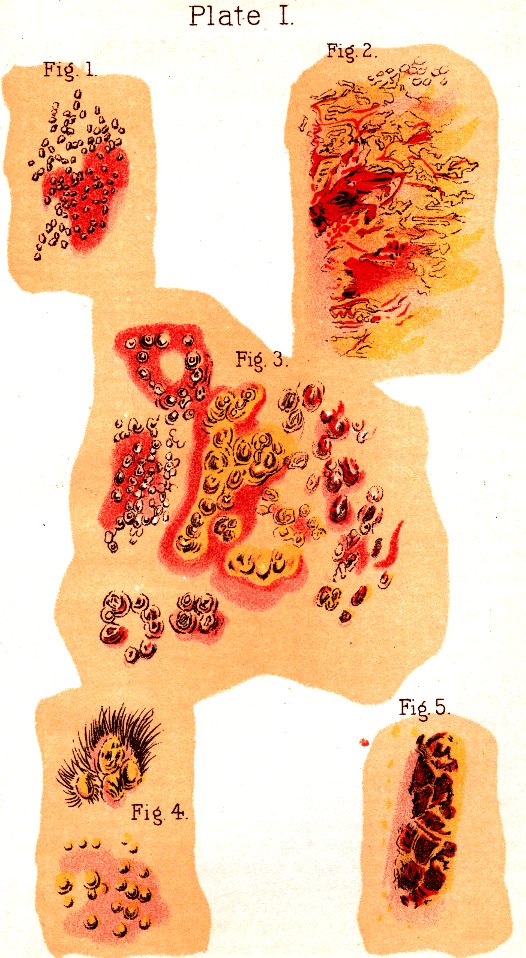
The many varieties of eczema are designated according to their predominating characteristics. Thus, when pimples or vesicles are abundant, it is termed, respectively, eczema papulosum and eczema vesiculosum, a fine illustration of which may be seen in Colored Plate I, Fig. 1. Again, when characterized by the eruption of pustules, it is termed eczema pustulosum, a representation of which may be seen in Plate I, Fig. 2; and, when the prominent feature is the formation of scales, it is termed eczema squamosum.
Eczema may be general or partial; in other words, the eruption may appear in patches or be distributed over the entire surface of the body. The latter form often appears in infants, but rarely occurs in adults. Two or more varieties of the eruption may be associated, or one form may gradually develop into another.
Plate I. Fig. 1. Fig. 2. Fig. 3. Fig. 4. Fig. 5.
Infants and young children are peculiarly subject to this disorder, and, if the disease be not promptly arrested, it will assume the severest form and eventually become chronic. The muscles are soft, the eyes are dull and expressionless, and the little sufferer experiences the most excruciating torments. Frequently the whole body is covered with patches of eczema, the secretions are arrested, and, where the scales fall off, the skin is left dry and feverish.
Eczema has no symptoms proper, since the morbid feelings are due to constitutional debility, of which eczema is the result. The signs of eczema are redness, heat, an itching or smarting sensation, the formation of pimples or vesicles, exudation, incrustation, the separation of the cuticle into scales and a gradual thickening of the skin.
Causes. Three forms of constitutional derangement predispose the system to eczema; nutritive, assimilative, and nervous debility. In the former, there is a diminution of nutritive power, so that the patient becomes weak and emaciated. Assimilative debility is indicated by an impaired digestion and a consequent suppression, or an abnormal state of the secretions. Eczema occasioned by nervous debility, is accompanied by all the morbid conditions incident to irritation and exhaustion of the nervous system. Eczema may be excited by a violation of the rules of hygiene, as undue exposure, or sudden transition from heat to cold, deficient or excessive exercise, impure air, or improper clothing.
Psoriasis. Psoriasis may be defined as a chronic form of eczema. The transition of the last stage of eczema into psoriasis is indicated by a tendency of the inflamed, thickened, scaly skin to become moist when rubbed. It usually appears in patches on various portions of the body. The skin is parched and highly discolored. The hairs are harsh and scanty. The patient is constantly tormented by an unbearable itching sensation and, if the skin is rubbed, it exudes a viscous or sticky fluid. These are the characteristic signs of psoriasis. It generally appears on the flexures, folds and crooks of the joints, the backs and palms of the hands, the arms, and the lower portions of the legs.
Pityriasis. (Branny Tetter, or Dandruff.) This affection is a mild form of psoriasis, from which it may be distinguished by a more superficial congestion or inflammation of the affected parts, the absence of swelling, and the formation of smaller scales, having the form and appearance of fine bran. It generally appears on the scalp, sometimes extends over the face, and, in rare instances, affects the entire surface of the body. The signs peculiar to this disease are slight inflammation, itching, and the formation of minute scales.
Causes. Pityriasis is caused by nutritive debility, and is often associated with erysipelas, rheumatism, and bronchitis.
Lichen. (Papular Rash.) Lichen is a term used to designate an eruption of minute conical pimples, which are more or less transparent, red, and occasion great annoyance. The eruption is attended with a severe, hot, prickling sensation, as if the flesh were punctured with hot needles. The pimples contain no pus, but if opened, they exude a small quantity of blood and serum. This disease more frequently occurs between the ages of twelve and fifty, but occasionally appears during dentition, when it is called "tooth rash." The lichen pimples are sometimes dispersed singly over the skin and gradually subside, forming a minute scale, corresponding in position with the summit of the pimple. When the pimples appear in clusters, there is a diffused redness in the affected part, and, if they are irritated, minute scabs will be formed. Lichen generally appears on the upper portion of the body, as on the face, arms, hands, back, and chest.
The various forms of lichen are designated according to their causes, signs, location, manner of distribution, and the form of the pimples.
Lichen Simplex is the simplest form of this disorder, and is indicated by the appearance of minute pimples, which, when the distribution is general, are arranged like the blotches of measles. Sometimes the eruption is local and bounded by the limits of an article of clothing, as at the waist. In eight or ten days, the cuticle separates into minute scales, which are detached and thrown off; but a new crop of pimples soon appears and runs the same course, only to be succeeded by another, and thus the affection continues for months and even years.
Lichen circumscriptus is an aggravated form of lichen simplex, and is characterized by a circular arrangement of the pimples. The circumference which marks the limit of the patch is sharply defined. This form of lichen usually appears on the chest, hips, or limbs, and is not unfrequently mistaken for ringworm.
Lichen strophulosus is a variety peculiar to infants. Dermatologists recognize several subdivisions of this species, but the general characteristics are the same in all. The pimples are much larger than in the other forms of lichen, of a vivid red color and the duration of the eruption is limited to two or three weeks.
Lichen urticatus is also an infantile affection and begins with inflammation, which is soon succeeded by the eruption. In a few days the pimples shrink, the redness disappears, and the skin has a peculiar bleached appearance. The eruption is attended by an intense itching sensation and, if the skin is ruptured, a small quantity of blood is discharged and a black scab formed. This variety of lichen is very obstinate and of long duration.
Lichen tropicus, popularly known as prickly heat, is an affection which attacks Europeans in hot climates. It is characterized by the appearance of numerous red pimples of an irregular form, distributed over those portions of the body usually covered by the clothing. It is attended with a fierce, burning, itching sensation, which is aggravated by warm drinks, friction of the clothing, and the heat of the bed. The eruption indicates a healthy condition of the system; its suppression or retrocession is an unfavorable symptom, denoting some internal affection such as deranged nutrition.
Plate II. Fig. 6. Fig. 7. Fig. 8. Fig. 9. Fig. 10. Fig. 11. Fig. 12. Fig. 13.
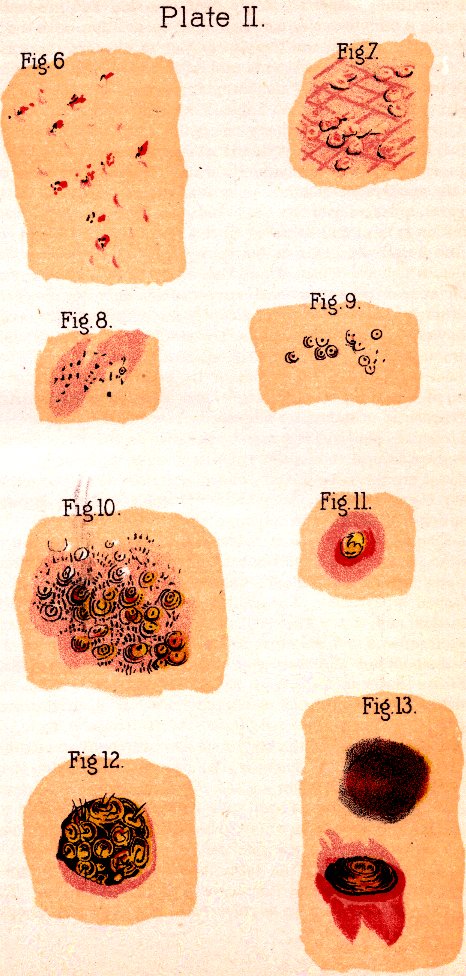
In lichen planus, as the term indicates, the pimples are flattened. There is no sensation of itching or formation of scabs. The pimples are solitary and have an angular base, and the fresh pimples formed appear on the spaces between the former eruptions. This affection usually attacks some particular region, such as the abdomen, hips, or chest. Instances are recorded in which it has appeared on the tongue and the lining membrane of the mouth. Sometimes it appears in patches, but even then, the margin of each pimple can be discerned.
Lichen pilaris and lividus are modifications of lichen simplex, the former being so named to describe the location of the pimples, i.e., surrounding the minute hairs which cover the body, especially the lower limbs. The term lichen lividus indicates the dark purplish hue caused by a torpid circulation and the consequent change of arterial into venous blood before leaving the pimples. Lichen circinatus is a modified form of lichen circumspectus. The pimples in the center of the circular patch subside and a ring is formed which gradually increases in size. When the rings become broken or extend in regular forms, the affection is termed lichen gyratus.
Causes. Constitutional debility predisposes the system to this eruption. The exciting causes are irritation of the skin, strumous diathesis, dentition, and any violation of hygienic rules. Although lichen is not a fatal disease, yet it tends to reduce the vitality of the system.
Impetigo. (Crusted Tetter or Scall.) Impetigo is a term applied to an inflammation of the skin, more severe and energetic in its character than the preceding affection. We have found the predominating characteristics of eczema and lichen to be the presence of exudation in the former, and the absence of it in the latter.
Impetigo is marked by the formation of yellow pus, which raises the cuticle into pustules. There is a slight swelling, redness, and the pus gradually dries up, forming an amber-colored crust, a representation of which is given in Colored Plate I, Fig. 5. It soon falls, leaving the skin slightly inflammed, but with no scar. The pustules are sometimes surrounded by a cluster of smaller ones.
The varieties of impetigo are designated according to the distribution of the pustules. Impetigo figurata, is characterized by the appearance of large clusters upon an inflamed and swollen surface, generally upon the face, but sometimes upon the scalp. This form is represented in Colored Plate I, Fig. 4. In impetigo sparsa the pustules are scattered over the whole body.
Causes. The predisposing cause of impetigo is nutritive debility, and the exciting causes are irritation, impure air, and errors of diet.
Gutta Rosacea is a progressive disease, and its successive stages of development mark the several varieties, such as gutta rosacea, erythematosa, papulosa, tuberculosa, pustulosa, according as they are characterized by redness, pimples, tubercles, or pustules. This affection is attended with heat, itching, and throbbing. The pustules contain serous lymph, which exudes if the cuticle be broken, and forms a crust at the summit of the pustule.
This eruption often appears on the face of persons addicted to intemperate habits, and has thus received the name of "rum blossom."
Cause. It is essentially a chronic affection, and depends upon constitutional causes.
Scabies. (Itch.) This disease is characterized by a profuse scaliness of the skin, by an eruption of pimples, vesicles, and, in rare instances, of pustules. Its prominent feature is an intense itching, so aggravating that, in many instances, the skin is torn by the nails. Unlike other diseases of the skin, it is not due to inflammation, but is caused by animalculæ, or little parasites, termed by naturalists the acarus scabiei. This minute animal burrows in the skin, irritating it, and thus producing the scaliness and itching. The vesicles are comparatively few in number, and contain a transparent fluid. The pustules are only present in the severest forms or when the skin is very thin and tender. It is then termed pustular itch.
The parts usually affected are the hands, flexures of the joints, and the genital organs. Cases are recorded, in which scabies appeared upon the face and head, but they are of rare occurrence. The activity of the animalculæ, is modified by the vitality of the victim. In persons of a vigorous constitution, they will rapidly multiply, and, in a few days after their first appearance, will be found in almost every part of the body.
Scabies is not confined to any age or sex, but chiefly affects persons of filthy habits. This disease can only be communicated by contact, or by articles of clothing worn by an infected person. There are certain indications which predispose the system to infection, such as robust health, a hot climate, and uncleanliness.
Treatment. In all the varieties of eczematous affections, except scabies, the treatment of which will hereafter be separately considered, remedies employed with a view to the removal of the constitutional fault are of the greatest importance. The eruption upon the skin is but a local manifestation of a functional fault, which must be overcome by alterative remedies. All the excretory organs should be kept active. To open the bowels, administer a full cathartic dose of Dr. Pierce's Pleasant Pellets. Afterwards they should be used in broken doses of one or two daily, in order to obtain their peculiar alterative effects. The use of Dr. Pierce's Golden Medical Discovery is also necessary to secure its constitutional remedial benefits. As a local corrective to relieve the itching and disagreeable dryness of the skin, add half an ounce of blood-root to half a pint of vinegar, steep moderately for two hours, strain and paint the affected parts once or twice daily with the liquid. Every night before retiring, apply glycerine freely to all the affected parts, or dissolve one drachm of oxalic acid in four ounces of glycerine and anoint the skin freely. The white precipitate ointment, obtainable at any drug store, is an excellent application is most forms of eczema. A tea, or infusion, of black walnut leaves, applied as a lotion to the affected parts, has also proved beneficial. The surface of the body should be kept clean by frequent bathing, and thus stimulating its capillary vessels to healthy activity. The eczematous surfaces should not be bathed frequently, and never with harsh or irritating soaps. All varieties of eczematous affections, except scabies, are only temporarily relieved by external applications, while the radical cure depends upon a protracted use of alterative, or blood-cleansing medicines. Therefore, we would again remind the reader of the necessity of keeping the bowels regular, and removing all morbid taints of the blood and faults of the secretory organs by the persistent use of Dr. Pierce's Golden Medical Discovery. The successful treatment of scabies, or common itch, generally requires only local applications, for the object to be obtained is simply the destruction of the little insects which cause the eruption. Happily, we possess an unfailing specific for this purpose. Numerous agents have been employed with success, but Sulphur enjoys the greatest reputation for efficacy, and, since it is perfectly harmless, we advise it for this class of disease. Take a quantity of pulverized sulphur and mix with sufficient vaseline or lard to form an ointment. Having first divested the body of clothing, anoint it all over freely, and rub the ointment thoroughly into the pores of the skin while standing before a hot fire. The application should be made at night before retiring, and the patient should wear woolen night-clothes or lie between woolen blankets. In the morning after the application, the patient should take a warm bath, washing the skin thoroughly and using plenty of soap. This treatment should be repeated two or three times to be certain of a perfect eradication of the disease. After this course of treatment, the wearing apparel as well as the bed-clothes should be thoroughly cleansed, as a precaution against a return of the disease.