THE WEEK.
Reading edition
May 27.—The anniversary of the birth at Florence, in the year 1265, of Dante Alighieri, the great father of Italian, and, it may almost be said, of modern European poetry. Dante, whose family was of noble descent, was carefully educated in all the learning of his age, and began to compose Latin poetry in his boyhood. Fortunately he relinquished the use of that language when he grew older, and applied himself to composition in his native Tuscan tongue—a circumstance not more fortunate for his own fame than for the literature of his country and the world. His life, passed among the political agitations of the time, was a busy, turbulent, and, upon the whole, unhappy one; the party in the state to which he attached himself having been defeated by their opponents, and he himself sentenced to be burnt alive—a fate from which he only preserved himself by remaining in banishment, and flying from one place of refuge to another. It was while he was thus a proscribed exile and wanderer that he is supposed to have written his famous ‘Commedia Divina, or Vision of Hell, Purgatory, and Paradise,’ a poem which has ranked him with the greatest masters of his art. He finally settled at Ravenna, and died there on the 14th of September, 1321, after a short illness, in the extremity of which he composed his own epitaph, in six rhyming Latin hexameters, which were engraved upon his tomb. Byron, in the fourth canto of ‘Childe Harold’s Pilgrimage,’ alludes to the foreign death and sepulchre of the great poet in the following lines:—
“Ungrateful Florence! Dante sleeps afar,
Like Scipio, buried by the upbraiding shore;
Thy factions, in their worse than civil war,
Proscribed the bard whose name for evermore
Their children’s children would in vain adore
With the remorse of ages.”
An old author mentions an anecdote of Dante, which forcibly illustrates the studious ardour of his mind. Having gone one day to the house of a bookseller, from one of whose windows he was to be a spectator of a public show exhibited in the square below, he by chance took up a book, in which he soon got so absorbed that on returning home, after the spectacle was over, he solemnly declared he had neither seen nor heard anything whatever of all that had taken place before his eyes.
May 28.—The birth-day of the late Right Honourable William Pitt, second son of the great Earl of Chatham, who was born in 1759. He was the favourite of his father, who even in his childhood, it is said, used to place him before him on a table, and encourage him to harangue with oratorical form and solemnity. He afterwards used to attend the debates in the House of Commons, where it was his practice, in listening to all the more distinguished speakers, to consider how every successive argument they used might be answered. He was educated for the bar, and went the western circuit once or twice; but being introduced into Parliament almost as soon as he was of age, he forthwith abandoned everything else for politics. On the dissolution of the Rockingham administration, in 1782, Mr. Pitt became Chancellor of the Exchequer, while yet little more than twenty-two years of age; and before the close of the following year he was prime-minister. From this period his life belongs to the history of his country, whose affairs he continued to direct, with the exception of the three years, from 1801 to 1804, till his death, in the forty-seventh year of his age, on the 23d of January, 1806. No man ever gave himself up more entirely to his high office than Mr. Pitt did. To his public duties he sacrificed alike his health and his fortune; and, owing to entire inattention to his private affairs, died not only poor, but encumbered with heavy debts, which Parliament voted a grant of money to pay.
May 29.—The Restoration of King Charles II.—By an act of parliament made in the twelfth year of the reign of Charles II. (the year of his restoration), the church still celebrates the return to the throne of this monarch.
May 31.—Ascension Day. Holy Thursday.—On this day the church celebrates the ascension of Our Saviour. It is usual for the bounds of parishes to be perambulated on this festival.
June 1.—The birth-day of the celebrated French painter, Nicolas Poussin, who was born at Andelys, in Normandy, in 1594. Poussin, whose family was poor, though ancient and respectable, endured many privations and hardships while studying his art, and, before his merits had become known, was frequently reduced to such straits as to be obliged to sell his pictures for little more than what the colours had cost him. But, even after he attained celebrity, Poussin made but little money, and lived in great simplicity. It is he of whom it is told, that having one evening received a visit from a certain bishop, he was lighting him down stairs himself, when the bishop said, “I much pity you, Poussin, that you have not one servant.”—“And I you, my Lord,” replied the painter, “that you have so 76many.” Poussin died at Rome, in 1665, at the age of seventy-one.
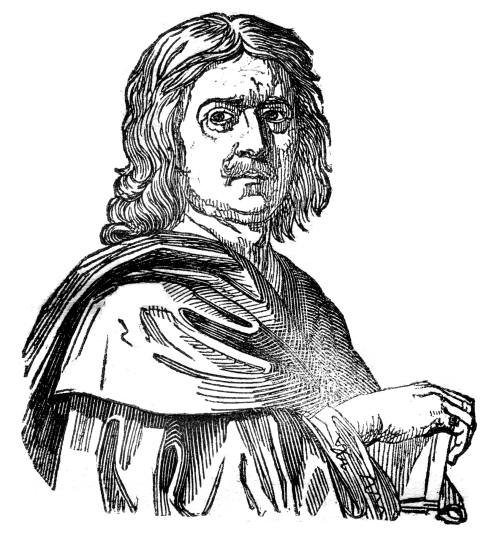
[Nicolas Poussin.]