THE BRITISH MUSEUM.—No. 2.
Reading edition
THE MEMNON.
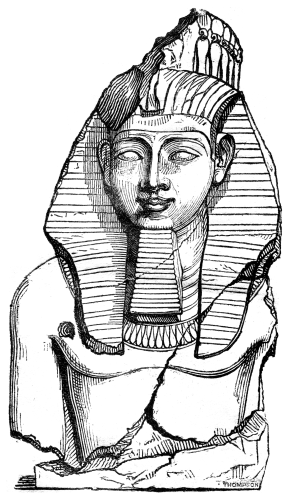
Those who visit the British Museum cannot fail to have observed in the room of Egyptian antiquities, a colossal statue of which only the head and breast remain. It is numbered 66 in the catalogue and on the stone.
Though this statue is commonly called the “younger Memnon,” a name to which for convenience we shall adhere, there is no reason in the world for calling it so, but a mistake of Norden, a Danish traveller who visited Egypt in 1737. He then saw this statue in its entire state, seated on a chair, in precisely the same attitude as the black breccia figure, No. 38, but lying with its face on the ground; to which accident indeed the preservation of the features is no doubt mainly due. Several ancient writers, and among them the Greek Geographer Strabo, speak of a large temple at Thebes on the west side of the Nile, to which they gave the name of the Memnonium, or Memnon’s temple. Norden fancied that the building, amidst whose ruins he saw this statue, was the ancient Memnonium; though he supposed, that another statue of much larger dimensions than this in the Museum, and now lying in numerous fragments in the same place, was the great Memnon statue, of which some ancient writers relate the following fact—that at sun-rise when the rays first struck the statue, it sent forth a sound something like that of the snapping of the string of a lute.
It is now generally admitted that the real statue of Memnon is neither the large one still lying at Thebes in fragments, nor this statue in the Museum, which came out of the same temple—but another statue still seated in its original position on the plain of Thebes, and showing by numerous Greek and Latin inscriptions on the legs, that it was the statue of which Strabo, Pausanias, and other ancient writers speak. The entire black statue, No. 38, is also a Memnon statue, for it resembles in all respects the great colossus with the inscriptions on its legs, and it has also the name of Memnon written on it and enclosed in an oblong ring, on each side of the front part of the seat, and also on the back.
If this colossus in the Museum (No. 66) was entire in 1737, it may be asked how came it to be broken? We cannot say further than the following statement:—
Belzoni, whose name must be fresh in the recollection of most people, went to Egypt in 1815, intending to propose to the Pasha some improved mechanical contrivances for raising water from the river in order to irrigate the fields. Owing to various obstacles this scheme did not succeed, and Belzoni determined to pay a visit to Upper Egypt to see the wonderful remains of its temples. Mr. Salt, then British Consul in Egypt, and Lewis Burckhardt, commissioned Belzoni to bring this colossal head from Thebes. Belzoni went up the river, and landing at Thebes found the statue exactly in the place where the Consul’s instructions described it to be[2]. It was lying “near the remains of its body and chair, with its face upwards, and apparently smiling on me at the thought of being taken to England. I must say that my expectations were exceeded by its beauty, but not by its size. I observed that it must have been absolutely the same statue as is mentioned by Norden, lying in his time with the face downwards, which must have been the cause of its preservation. I will not venture to assert who separated the bust from the rest of the body, by an explosion, or by whom the bust has been turned face upwards.”
It will be observed that the left shoulder of this figure is shattered, and that there is a large hole drilled in the right shoulder. We believe both are the work of the French who visited Thebes during the occupation of Egypt by the French army in 1800; and there is no doubt that Belzoni in the above extract means to attribute to them the separation of the head and shoulders from the rest of the body. In the magnificent work on Egyptian Antiquities, which has been published at Paris, there is a drawing of this head, which is pretty correct, except that the hole and the whole right shoulder are wanting. It seems that they drew the colossal bust in that form which it would have assumed, had they blown 77off the right shoulder. From what cause it happened we do not know, but they left the colossus behind them; and Belzoni, alone and unaided, accomplished what the French had unsuccessfully attempted.
All the implements that Belzoni had for removing this colossus were fourteen poles, eight of which were employed in making a car for the colossus, four ropes of palm-leaves, four rollers, and no tackle of any description. With these sorry implements and such wretched workmen as the place could produce, he contrived to move the colossus from the ruins where it lay to the banks of the Nile, a distance considerably more than a mile. But it was a no less difficult task to place the colossus on board a boat, the bank of the river being “more than fifteen feet above the level of the water, which had retired at least a hundred feet from it.” This, however, was effected by making a sloping causeway, along which the heavy mass descended slowly till it came to the lower part, where, by means of four poles, a kind of bridge was made, having one end resting on the centre parts of the boat and the other on the inclined plane. Thus the colossus was moved into the boat without any danger of tilting it over by pressing too much on one side.
From Thebes it was carried down the river to Rosetta and thence to Alexandria, a distance of more than 400 miles: from the latter place it was embarked for England.
The material of this colossus is a fine-grained granite, which is found in the quarries near the southern boundary of Egypt, from which masses of enormous size may be procured free from any split or fracture. These quarries supplied the Egyptians with the principal materials for their colossal statues and obelisks, some of which in an unfinished form may still be seen in the granite quarries of Assouan. There is considerable variety in the qualities of this granite, as we may see from the specimens in the Museum, some of which consist of much larger component parts than others, and in different proportions; yet all of them admit a fine polish. The colossal head, No. 8, opposite to the Memnon, and No. 2, commonly called an altar, will serve to explain our meaning.
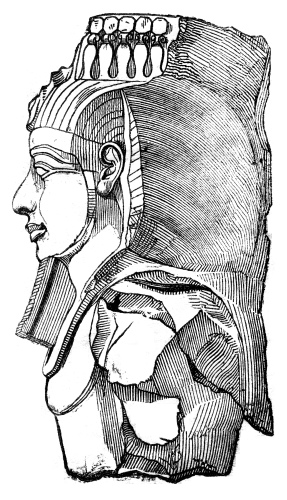
This Memnon’s bust consists of one piece of stone, of two different colours, of which the sculptor has judiciously applied the red part to form the face. Though there is a style of sculpture which we may properly call Egyptian as distinguished from and inferior to the Greek, and though this statue clearly belongs to this Egyptian style, it surpasses as a work of art most other statues from that country by a peculiar sweetness of expression and a finer outline of face. Though the eyebrows are hardly prominent enough for our taste, the nose somewhat too rounded, and the lips rather thick, it is impossible to deny that there is great beauty stamped on the countenance. Its profile, when viewed from various points, will probably show some new beauties to those only accustomed to look at it in front.
The position of the ear in all Egyptian statues that we have had an opportunity of observing is very peculiar, being always too high; and the ear itself is rather large. We might almost infer that there was some national peculiarity in this member from seeing it so invariably placed in the same singular position. The appendage to the chin is common in Egyptian colossal statues, and is undoubtedly intended to mark the beard, the symbol of manhood: and it may be observed not only on numerous statues, but also on painted reliefs, where we frequently see it projecting from the end of the chin and not attached to the breast, but slightly curved upwards. Osiris, one of the great objects of Egyptian adoration, is often thus represented; but the beard is generally only attached to the clothed figure, being, for the most part, but not always, omitted on naked ones. The colossal figures, No. 8 and 38, have both lost their beards. There is a colossal head in the Museum, No. 57, that is peculiar in having the upper margin of the beard represented by incisions on the chin after the fashion of Greek bearded statues. It is the only instance we have seen, either in reality or in any drawing, of a colossus with a genuine beard.
There is more variety in the head-dresses of colossal statues than in their beards. No. 8, opposite the Memnon, has the high cap which occurs very often on Egyptian standing colossi which are placed with their backs to pilasters. No. 38 has the flat cap fitting close to the head and descending behind, very much like the pigtails once in fashion. The Memnon head-dress differs from both of these, and has given rise to discussions, called learned, into which we cannot enter here.
On the forehead of this colossus may be seen the remains of the erect serpent, the emblem of royalty, which always indicates a deity or a royal personage. This erect serpent may be traced on various monuments of the Museum, and perhaps occurs more frequently than any single sculptured object.
Our limits prevent us from going into other details, but we have perhaps said enough to induce some of our readers to look more carefully at this curious specimen of Egyptian art; and to examine the rest of the ornamental parts. The following are some of the principal dimensions:—
ft. in.
The whole height of the bust from the top of the head-dress to the lowest part of the fragment, measured behind 8 9
Round the shoulders and breast, above 15 3
Height of the head from the upper part of the head-dress to the end of the beard 6 0½
From the forehead to the chin 3 3½
Judging from these dimensions, the figure in its entire state would be about 24 feet high as seated on its chair; which is about half the height of the real Memnon, who still sits majestic on his ancient throne, and throws his long shadow at sun-rise over the plain of Thebes.
78