BUTTER.
Reading edition
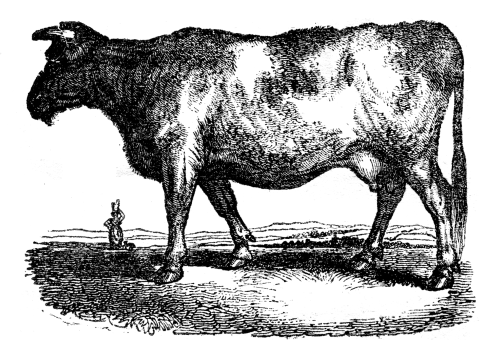
[Yorkshire Cow.]
The various circumstances attending the introduction and use of butter in antiquity, have been investigated by Beckmann with great learning and industry. The conclusion at which he arrives is, “that butter was not used either by the Greeks or Romans in cooking, as is everywhere customary at present. We never find it mentioned by Galen or any other ancient medical writer, as food, though they have spoken of it as applicable to other purposes. No notice is taken of it by the Roman epicure, Apicius, who wrote on cookery; nor is there anything said of it in that respect by the authors who treat of agriculture, though they have given us very particular information with respect to milk, cheese, and oil.
“This, as has been remarked by others, may be easily accounted for, by the ancients having accustomed themselves to the use of good oil; and in like manner butter is very little employed at present in Italy, Spain, Portugal, and the southern parts of France.”—Butter is very extensively used in this and most other northern countries; that of England and Holland is reckoned the best.
The production and consumption of butter in Great Britain is very great.—The consumption in the metropolis may, it is believed, be averaged at about one half pound per week for each individual, being at the rate of 26 lbs. a year; and supposing the population to amount to 1,450,000, the total annual consumption would (on this hypothesis) be 37,700,000 lbs. or 16,830 tons: but to this may be added 4,000 tons for the butter required for the victualling of ships and other purposes, making the total consumption in round numbers 21,000 tons, or 47,040,000 lbs., which, at 10d. per pound, would be worth 1,960,000l.
The average produce per cow of the butter dairies is estimated by Mr. Marshall at 168 lbs. a year; so that, supposing we are nearly right in the above estimate, about 280,000 cows will be required to produce an adequate supply of butter for the London market.
Butter made in hot countries is generally liquid. In India it is called ghee, and is mostly prepared from the milk of buffaloes[1]: it is usually conveyed in duppers or bottles made of hide, each of which contains from ten to forty gallons. Ghee is an article of considerable commercial importance in many parts of India.
The Arabs are the greatest consumers of butter in the world. Burckhardt tells us, that it is a common practice among all classes to drink, every morning, a cupful of melted butter or ghee; and they use it in an infinite variety of other ways. The taste for it is universal, and even the poorest individuals will spend half their daily income that they may have butter for dinner, and butter in the morning. Large quantities are annually shipped from Cosseir, Sonakin, and Massona, on the west coast of the Red Sea, for Djidda and other Arabian ports.
We shall notice in our Supplementary number for this month the very valuable publication, M’Culloch’s Dictionary of Commerce, from which the above account is extracted.
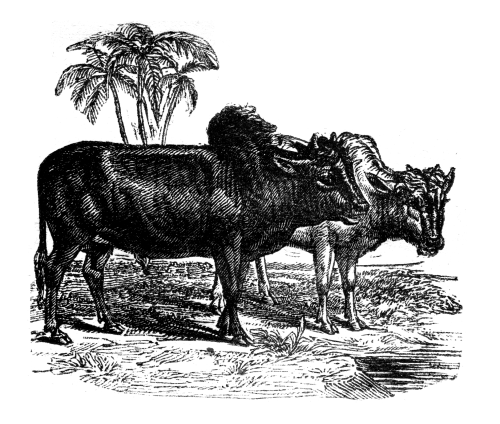
[Zebus: from Specimens in the Zoological Gardens.]