WESTMINSTER BRIDGE.
Reading edition
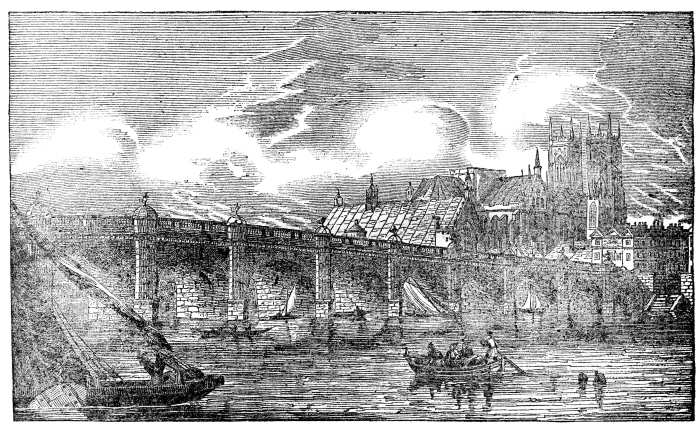
[View of Westminster Bridge.]
A century ago not one of the several bridges existed that now span the Thames at London. There was then, in fact, no bridge over the river at all, with the exception of that which stood where the present London bridge is now erected. It was not until the year 1735, that parliament, on the petition of the inhabitants of Westminster, passed an act for the building of a second bridge. Even then this improvement was not secured without great difficulty; a strenuous opposition being made to it by the Company of Watermen, the society called the West-Country Bargemen, the Borough of Southwark, and the City of London, all of which parties conceived themselves interested in forcing everybody who wanted to cross from one side of the water to the other, either to go round by London bridge, or to make the passage in a boat. Fortunately, however, it was determined that the convenience of the whole population should not be sacrificed, nor their personal safety placed in jeopardy, on this monstrous demand of a few individuals.
On the 13th of September, 1738, the preparations for the building of the bridge were begun, by the driving of the first pile for its foundation, in the presence of a vast multitude of spectators. The piers were built in cofferdams; of which contrivance we have already given a description in our notice of London bridge in the Supplement for April. On the 29th of January following, the first stone of one of the two central piers, that next the west side, was laid by the Earl of Pembroke. The whole structure is built of stone, and principally of Portland block stones, of which few are less than a ton in weight, while many are two or three, and some even four or five tons. There are fourteen piers in all, besides the two abutments, and consequently fifteen arches. They are semicircular in form, and the span of that in the middle is seventy-six feet; the others gradually decrease in width; the sixth from the centre on each side being only fifty-two feet, and the two next the abutments only twenty-five each. The whole length of the bridge is 1223 feet; and the clear water-way under the arches is 870 feet. The road over it is 44 feet in breadth, the foot-paths on each side included. In the beginning of 1747, when it was nearly completed, one of the piers sank so much as to determine the commissioners to have it pulled down and rebuilt; and this was the only circumstance by which the work was materially retarded. It was at last brought to a conclusion, on the 10th of November that year; when the new bridge was formally opened by a procession passing over it. The work cost in all 389,500l., which was granted for the purpose in successive years by parliament. Maitland states that the value of 40,000l. is computed to be always under water in stone and other materials; and according to other authorities the whole quantity of stone used in this bridge is asserted to have been nearly double that employed in St. Paul’s Cathedral[1].