THE WEEK.
Reading edition
September 7.—The birth-day of Dr. Samuel Johnson. He was born in 1709, in the city of Litchfield, where his father was a bookseller. Having received the elements of a classical education principally at the grammar school of his native place, he was sent at the age of nineteen to Pembroke College, Oxford, by a gentleman who engaged to maintain him there as a companion to his son. After some time, however, this person withdrew his aid; and Johnson, having made an ineffectual attempt to subsist on his own resources, found himself obliged to discontinue his residence before obtaining a degree. He had already, however, during the period he spent at the university, obtained a high reputation for scholarship and abilities. For many succeeding years the life of this distinguished luminary of English literature was one of those hard struggles with poverty which learning and genius have so often been called on to sustain. About the time that he left college, namely, in 1731, his father died, leaving scarcely twenty pounds behind him. Thus situated, Johnson was constrained to accept the office of usher at the grammar-school of Market Bosworth. But the treatment to which he was subjected soon forced him to give up this appointment. He now attempted in succession various projects of a literary nature, in order to escape from the extremest indigence. In 1735 he married a Mrs. Porter, the widow of a mercer, who brought him a fortune of about 800l.; and with this money he opened a boarding-school at Edial. But the scheme met with no success. He then determined to set out for London; and here accordingly he arrived in March, 1737, accompanied by a young friend, who had been one of his pupils, David Garrick, who afterwards became the greatest actor that the modern world had seen. The first employment which he obtained was from the proprietors of the Gentleman’s Magazine. But the emoluments he derived from this source were very insufficient to afford him a respectable subsistence; and he was often without a shilling to procure him bread during the day, or a lodging wherein to lay his head at night. These difficulties clung to him for a long while, but they did not prevent him from gradually working his way to literary distinction. His reports of parliamentary debates, inserted in the Gentleman’s Magazine, which were often almost entirely original compositions of his own, attracted a great deal of notice; but it was not till long afterwards that their authorship was generally known. The year after his arrival in the metropolis, he published his poem, entitled ‘London’, in imitation of the third Satire of Juvenal. This production had the honour of being commended in very warm terms by Pope. In 1744 appeared his eloquent and striking life of his friend Savage. Three years after he was engaged by an association of booksellers to prepare a new Dictionary of the English Language. This celebrated work occupied the greater part of his time for seven years, and at last appeared in 1755, after the money, 1500 guineas, which it had been agreed he should receive for his labour, was all spent. It brought him, however, a large share of public applause, and at once placed his name among the first of the living cultivators of English literature. Meanwhile, even before the appearance of his Dictionary, he had by various occasional productions been steadily advancing himself in reputation, although not in wealth. In 1749 he gave to the world his imitation of Juvenal’s tenth Satire, under the title of ‘The Vanity of Human Wishes.’ The same year his tragedy of Irene, which he had brought with him when he first came to town, was produced at Drury Lane by his friend Garrick. In March, 1750, he commenced the publication of ‘The Rambler,’ which he continued for two years at the rate of two papers every week, the whole, with the exception of only five numbers, being the production of his own pen. These, and other works, however, failed in relieving him from the pressure of great pecuniary difficulties, as is proved by the fact, that in 1756 he was arrested for a debt of about five pounds, and only obtained his liberty by borrowing the money from a friend. In 1758 he began a new periodical publication, to which he gave the name of ‘The Idler,’ and which, like the ‘Rambler,’ he carried on for about two years. In 1759 his mother, to whom he was tenderly attached, died at an advanced age; and having gone down to Litchfield to superintend her funeral, he there wrote his beautiful romance of Rasselas in a single week, while his parent lay unburied, in order to obtain the means of defraying the expenses of her interment. This may well be characterised as the finest anecdote that is to be told of Dr. Johnson; for the whole range of biography scarcely records anything more noble or affecting. At last, in 1762, the Crown was advised to bestow upon him a pension of 300l. per annum; an act of bounty which placed him for the rest of his life in ease and affluence. After this he distinguished himself as much by the brilliancy and power of his conversation in the literary circles and general society which he frequented, as by his labours with his pen; but still he was far from relinquishing authorship. In 1765 appeared a new edition of Shakspeare, in the superintendence of which he had been long engaged, and the splendid preface to which is one of the most celebrated of his productions. In 1773 he published the well-known account of his ‘Journey to the Western Isles of Scotland,’ which he had just accomplished in company with his friend Boswell. In 1775 he received the degree of LL.D. from the University of Oxford; and in 1781 he brought to a close the last, and perhaps, upon the whole, the greatest of his works, his ‘Lives of the Poets,’ in four volumes octavo. He survived this publication only a few years, and having died on the 13th of December, 1784, in the seventy-sixth year of his age, he was interred with great solemnity in Westminster Abbey, in a grave near to that of his friend Garrick. Notwithstanding considerable heat of temper and arrogance of manner, as well as some weak prejudices and singularities by which he was marked, it is impossible to deny that the moral character of Dr. Johnson abounded in noble points, or to regard it upon the whole with other feelings than those of admiration and reverence. A scrupulous respect for virtue, evinced both by the language and scope of all his writings and by the unvarying tenor of his conduct, a lofty scorn of injustice and baseness, a spirit of independence and self-reliance which no trials and sufferings could tame down either to despair or servility, a warm sympathy with human sorrow wheresoever found or howsoever caused, the intrepidity to do a good action in the face even of the world’s laugh, and 224charity in relieving the unfortunate to the utmost verge of his means, and even to his own painful inconvenience,—all these dispositions, based on religious principle, and adorned and crowded by the most fervid piety, are sufficient to cast into the shade far deeper traits of frailty than any with which his nature can fairly be said to have been marked. The question of the intellectual rank properly belonging to Dr. Johnson has given rise to more difference of opinion. He was certainly neither a very original nor a very subtle thinker; and his eminence, indeed, will probably be maintained even by his warmest admirers on the ground rather of his powers of expression than of thought. His poetry rarely ascends beyond the height of rhetoric in rhyme; and his metaphysical and philosophical speculations are throughout extremely common-place and unrefined. But in what may be called the art of criticism, the detection of conventional beauties and defects, and the delineation of the merely literary character of a writer’s productions, he is a great master. His style is undoubtedly a bad one in the main; for, to say nothing of its being more Latin than English, and so studiously regulated on the principle of mere sonorousness that it almost entirely wants picturesqueness and the other higher qualities which contribute to effective expression, it is suited at the best to only one kind of writing, the grave didactic. Still, with all its faults, even this style has great qualities. Its dignity is often very imposing, and its inventor is certainly entitled to the praise of having set the example of a grammatical accuracy and general finish of composition not to be found in the works of our best authors before his time, but which have since been copied by all.
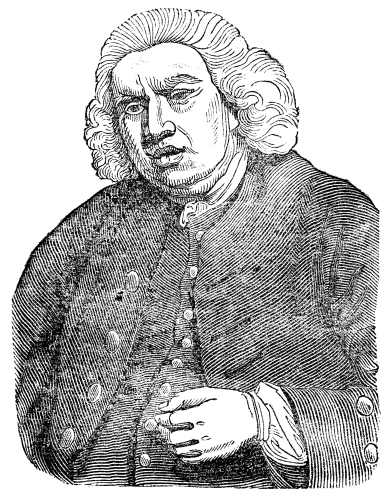
[Johnson.]
The Firemen’s Dog.—A gentleman connected with one of the principal London fire-insurance offices has sent us the following account of the dog whose singular propensities we described in Number 23. Our correspondent has been induced to make particular inquiries in consequence of our notice:—“His home, if it can be called so, is in one of the recesses of Blackfriars Bridge; and it is supposed he has acquired his taste for blazes in consequence of being noticed by the firemen who so frequently pass over that bridge. It has been remarked that he invariably follows close upon the heels of every fireman he sees until driven away. This induces me to believe that it is for the men and not for the fires that he entertains so strong a regard. On one occasion he followed the engines to a fire at Greenwich, and remained there until the last of the engines had packed up its apparatus to depart. On another occasion (the fire at Mr. Tyler’s premises, in Warwick Lane) he remained with the men sixteen days, during which they were employed in rescuing property from the smouldering ruins. He is perfectly well known to every fireman in London. He is called ‘Tyke,’ and is exceedingly ugly in his appearance, being one of the worst formed specimens of the turnspit breed.”
Division of Time used by the Inhabitants of the Feroe Islands.—They have one method of dividing time peculiar to themselves: they reckon the day and night by eight ökter of three hours each; the ökters again are reduced into halves, and they are named according to the point of the compass where the sun is at the time: for example, East-North-East is half past four in the morning; East is six; East-South-East, half past seven.—Landt’s Description.