STRATFORD-ON-AVON.
Reading edition
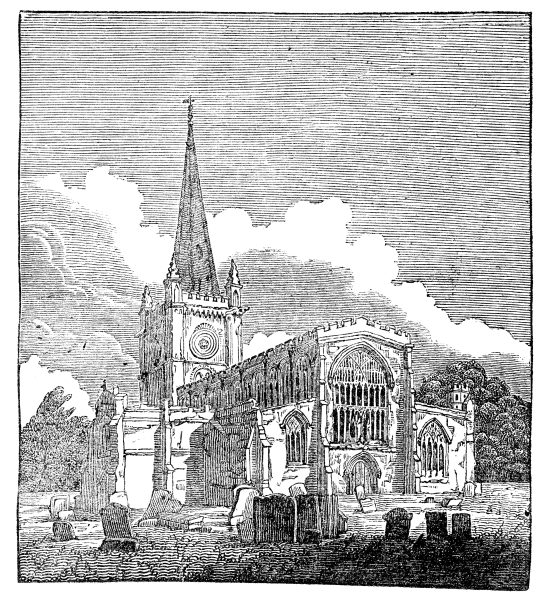
[Parish Church of Stratford-on-Avon.]
Within the walls of the fine old Church of Stratford-on-Avon, represented in the above wood-cut, lie the ashes of Shakspeare. In a small house still standing in the same town, was the great poet born. We may best convey to our readers some impression of the interest which we have felt in visiting this spot, by reprinting some passages from ‘The Sketch Book’ of Washington Irving, one of the most pleasing and accomplished writers that the United States has produced.
“I had come to Stratford on a poetical pilgrimage. My first visit was to the house where Shakspeare was born, and where, according to tradition, he was brought up to his father’s craft of wool-combing. It is a small mean-looking edifice of wood and plaster, a true nestling-place of genius, which seems to delight in hatching its offspring in bye-corners. The walls of its squalid chambers are covered with names and inscriptions, in every language, by pilgrims of all nations, ranks, and conditions, from the prince to the peasant; and present a simple, but striking instance of the spontaneous and universal homage of mankind to the great poet of nature.
“The house is shown by a garrulous old lady in a frosty red face, lighted up by a cold blue anxious eye, and garnished with artificial locks of flaxen hair, curling from under an exceedingly dirty cap. She was peculiarly assiduous in exhibiting the relics with which this, like all other celebrated shrines, abounds. There was the shattered stock of the very matchlock with which Shakspeare shot the deer, on his poaching exploit. There, too, was his tobacco-box; which proves that he was a rival smoker of Sir Walter Raleigh; the sword also with which he played Hamlet: and the identical lanthorn with which Friar Laurence discovered Romeo and Juliet at the tomb! There was an ample supply also of Shakspeare’s mulberry tree, which seems to have as extraordinary powers of self-multiplication as the wood of the true cross; of which there is enough extant to build a ship of the line.”
Since the visit of Mr. Irving to Stratford, the inscriptions on the walls of Shakspeare’s house have been obliterated. We can no longer hunt out the hand-writing of Garrick or Byron amidst the crowd of Smiths and Whites whom curiosity had brought hither. The ancient tenant of the house, the keeper of the Shaksperian relics described above, being ejected from the premises which she had so long occupied with profit, in a fit of wrath had the sacred walls smeared over with whitewash the night before she quitted them. The old lady had moved with her heap of relics to a house on the opposite side of the way when we visited Stratford about seven years ago. But the knowledge of her malicious outrage prevented us looking upon her trumpery with any patience. We had ceased to have any faith in these matters. We refused to sit in her Shakspeare’s chair, affirming, to her great mortification, that the real chair had been sold to the Empress of Russia; and, worst of all, we refused to purchase her own play of the Battle of Waterloo. Poor woman! she claimed to be a lineal descendant from the poet, and to prove her claim to the inheritance of his genius, wrote the most execrable verses that folly ever produced. We could have forgiven her bad verses, had some of Shakspeare’s good humour and kindness of heart descended to her. But she whitewashed out all the names, noble and ignoble, of the sacred chamber to spite her successor! Her play and her plaster doubly destroyed all belief in her pedigree! We should add, that the exterior of Shakspeare’s house has been much altered within the last forty years. The following cut exhibits it as it appeared in 1788.
221
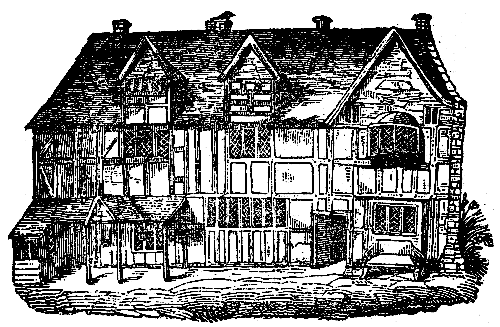
[Shakspeare’s House as it appeared in 1788.]
We proceed with Mr. Irving’s agreeable narrative:—
“From the birth-place of Shakspeare a few paces brought me to his grave. He lies buried in the chancel of the parish church, a large and venerable pile, mouldering with age, but richly ornamented. It stands on the banks of the Avon, on an embowered point, and separated by adjoining gardens from the suburbs of the town. Its situation is quiet and retired: the river runs murmuring at the foot of the church-yard, and the elms which grow upon its banks droop their branches into its clear bosom. An avenue of limes, the boughs of which are curiously interlaced, so as to form in summer an arched way of foliage, leads up from the gate of the yard to the church-porch. The graves are overgrown with grass; the grey tomb-stones, some of them nearly sunk into the earth, are half covered with moss, which has likewise tinted the reverend old building. Small birds have built their nests among the cornices and fissures of the walls, and keep up a continual flutter and chirping; and rooks are sailing and cawing about its lofty grey spire.
“We approached the church through the avenue of limes, and entered by a gothic porch, highly ornamented, with carved doors of massive oak. The interior is spacious, and the architecture and embellishments superior to those of most country churches. There are several ancient monuments of nobility and gentry, over some of which hang funeral escutcheons, and banners dropping piecemeal from the walls. The tomb of Shakspeare is in the chancel. The place is solemn and sepulchral. Tall elms wave before the pointed windows, and the Avon, which runs at a short distance from the walls, keeps up a low perpetual murmur. A flat stone marks the spot where the bard is buried. There are four lines inscribed on it, said to have been written by himself, and which have in them something extremely awful. If they are indeed his own, they show that solicitude about the quiet of the grave, which seems natural to fine sensibilities and thoughtful minds:—
‘Good friend, for Jesus’ sake, forbeare
To dig the dust enclosed here.
Blessed be he that spares these stones,
And curst be he that moves my bones.’
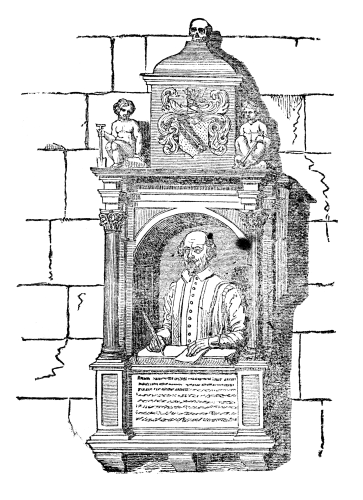
“Just over the grave, in a niche of the wall, is a bust of Shakspeare, put up shortly after his death, and considered as a resemblance. The aspect is pleasant and serene, with a finely arched forehead; and I thought I could read in it clear indications of that cheerful, social disposition, by which he was as much characterized among his contemporaries as by the vastness of his genius. The inscription mentions his age at the time of his decease—fifty-three years; an untimely death for the world: for what fruit might not have been expected from the golden autumn of such a mind, sheltered as it was from the stormy vicissitudes of life, and flourishing in the sunshine of popular and royal favour.
“The inscription on the tomb-stone has not been without its effect. It has prevented the removal of his remains from the bosom of his native place to Westminster Abbey, which was at one time contemplated. A few years since also, as some labourers were digging to make an adjoining vault, the earth caved in, so as to leave a vacant space almost like an arch, through which one might have reached into his grave. No one, however, presumed to meddle with his remains, so awfully guarded by a malediction; and lest any of the idle or the curious, or any collector of relics, should be tempted to commit depredations, the old sexton kept watch over the place for two days, until the vault was finished and the aperture closed again. He told me that he had made bold to look in at the hole, but could see neither coffin nor bones; nothing but dust. It was something, I thought, to have seen the dust of Shakspeare.
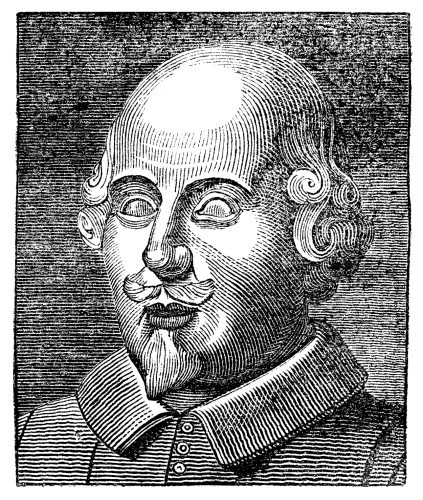
[Shakspeare.]
“Next to his grave are those of his wife, his favourite daughter Mrs. Hall, and others of his family. On a tomb close by, also, is a full-length effigy of his old 222friend John Combe, of usurious memory; on whom he is said to have written a ludicrous epitaph. There are other monuments around, but the mind refuses to dwell on anything that is not connected with Shakspeare. His idea pervades the place: the whole pile seems but as his mausoleum. The feelings, no longer checked and thwarted by doubt, here indulge in perfect confidence; other traces of him may be false or dubious, but here is palpable evidence and absolute certainty. As I trod the sounding pavement, there was something intense and thrilling in the idea, that, in very truth, the remains of Shakspeare were mouldering beneath my feet. It was a long time before I could prevail upon myself to leave the place; and as I passed through the church-yard I plucked a branch from one of the yew-trees, the only relic that I have brought from Stratford.”
Mr. Irving’s paper continues in a very pretty description of his visit to the old family seat of the Lucys at Charlecot, whose park was the scene of the hair-brained exploits of which Shakspeare’s boyhood has been accused. Our limits will not allow us to dwell longer on this subject, except to give the concluding paragraph of Mr. Irving’s reflections on Stratford-on-Avon:—
“He who has sought renown about the world, and has reaped a full harvest of worldly favour, will find, after all, that there is no love, no admiration, no applause, so sweet to the soul as that which springs up in his native place. It is there that he seeks to be gathered in peace and honour among his kindred and his early friends. And when the weary heart and failing head begin to warn him that the evening of life is drawing on, he turns as fondly as does the infant to the mother’s arms, to sink to sleep in the bosom of the scene of his childhood. How would it have cheered the spirit of the youthful bard, when, wandering forth in disgrace upon a doubtful world, he cast back a heavy look upon his paternal home; could he have foreseen that, before many years, he should return to it covered with renown; that his name should become the boast and glory of his native place; that his ashes should be religiously guarded as its most precious treasure; and that its lessening spire, on which his eyes were fixed in tearful contemplation, should one day become the beacon, towering amidst the gentle landscape, to guide the literary pilgrim of every nation to his tomb!”