THE LABOURERS OF EUROPE.—No. 2.
Reading edition
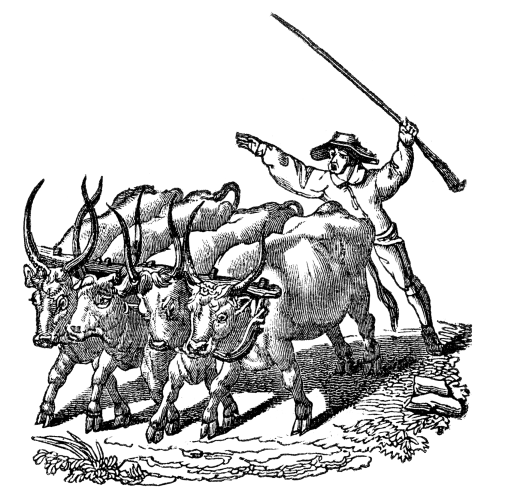
[Driving Wild Cattle in the Maremma.]
That part of Italy which borders the Mediterranean, from the mountains of Genoa to the extremity of Calabria, a length of about seven hundred miles, consists, except in a few places, such as Naples, where hills intervene, of a broad stripe of flat country extending from the sea-shore to the lower ridges of the Apennine mountains. This region is called the Maremma. It is particularly unhealthy during the summer months, from June to October, when all the inhabitants who are able remove to the hills, and the few who are obliged to remain are exposed to the malaria fever, an intermittent ague, which emaciates the body, exhausts the vital strength, and, if not checked in time, proves fatal to the patient. The farms in the greater part of this immense tract, and more particularly in the Roman and Tuscan divisions of it, are very large, often extending to several thousand acres. They are held by wealthy tenants, who live in the towns and keep agents and domestics who reside on the spot, at least till harvest time. By far the greater part of the land, although arable, is left for pasture, about one-fourth or one-sixth being brought into cultivation by annual rotation. No villages or cottages are to be seen; but here and there, at long intervals, a dingy, dismal looking casale or farm-house, a speck in the midst of the desert. As there is no fixed population in these plains, labourers are engaged from the interior, and chiefly from the highlands of the Apennines, where a scanty soil, though under a healthy climate, does not furnish sufficient occupation for the native peasantry. They generally come down from the mountains in October, in bands of about one hundred each, under the guidance of a leader, a sort of jobber, who stipulates for their services and pay with the agent of the farm. It is calculated that about twenty thousand come down in this manner every year in the Campagna or plains of Rome alone. Many of them remain till May, employed in the different works of the farm. They are engaged mostly by the season, and receive at the rate of from ten to fifteen pence a day. Their chief nourishment consists of polenta, or Indian corn flour, boiled, with water and salt, into a sort of pudding, with the occasional addition of skimmed milk or grated cheese. They sleep on the bare ground, either in the casale, or under shelter of temporary huts made with canes (arundo tenax), which grow luxuriantly in these regions.
At harvest time, about the latter end of June, a new reinforcement of labourers from the mountains is required. This is the most critical period in the year for those poor men who come by thousands from the pure and wholesome atmosphere of their native districts to inhale the pestilential air of the lowlands, working by day under a burning sun, and sleeping at night in the open air, exposed to the heavy dews and to the bite of gnats and other insects. The harvest men are engaged for eleven or twelve days, sometimes a fortnight, and they are paid at the rate of about two francs, or 1s. 10d. a day. They are also better fed at this time, and have a plentiful allowance of wine and water. The corn must be cut, threshed, winnowed, and carried into the granary by the middle of July, after which no one dares to remain in the fields. Mr. Chateauvieux, who visited one of these immense farms during the harvest season, gives the following description of the scene:—
“The fattore or steward ordered horses for us to visit the farm, and while they were getting ready I examined the casale, or farm-house, a noble but gloomy structure. It consisted of a spacious kitchen and two large apartments adjoining, at the end of which were three other rooms of similar dimensions; all totally destitute of furniture, not even having windows. These formed the ground floor of the centre building. Above them were six other rooms of the same size used as granaries, one only being furnished for the use of the superintendants. The wings were formed by capacious arched stables, at once airy and cool; and above them were lofts for hay. This part of the establishment is almost superfluous, being merely used to put up the cattle employed in the work of the farm during the resting time in the middle of the day; at all others they are turned out to graze in the open air. There was not the least appearance of care or neatness about the whole farm. Neither trees, gardens, nor vegetables were to be seen. To my observations about this negligence the people replied that the cattle would trample down and destroy whatever might be planted or sown, and that it was therefore more convenient to purchase their vegetables in the neighbouring towns, which are surrounded with vineyards, orchards, and gardens. The expense of carriage is nothing on these large grazing farms, where there are always cattle in abundance. They put a loaf and a bundle of hay into the cart, and thus equipped will perform a journey of sixty miles without any expense. This abundance of animals constitutes the only luxury of these farms. Neither steward, superintendants, nor even the herdsmen, ever think of going on foot. They are always on horseback, galloping at full speed over the plains, with a gun or a pungolo or spear in their hands, and horses are always kept ready saddled in the stables, each person employed on the farm having two assigned for 197his use. As soon as we were mounted, the steward conducted us to the part of the farm where the harvest had commenced. Broad stripes, of a golden yellow, extended at a distance over the undulated surface of the soil towards the sea; and we at length came in sight of a sort of army in battle array, with the commanders on horseback having lances in their hands, fixed to their stations. We passed several carts drawn by oxen, which were loaded with bread intended for the consumption of the men. We beheld before us a long line of a thousand reapers round a vast tract of corn which was silently falling under their sickles, while twelve superintendants on horseback surveyed and animated them from behind. They raised a loud shout at our approach, which resounded through the solitude, and was intended as a salute to the master of the farm. Soon after, the carts which we had passed drew up under the shade of some oaks, which were providentially still remaining in the middle of the plain. At a signal given, the reapers quitted their work, and the whole troop defiled before us. There were about as many men as women, all natives of the Abruzzi. The former were good figures, but the women were frightful. They were bathed in sweat, for the heat was terrible. Though it was only a few days since they left the mountains, the malaria was beginning to affect them. Two only had as yet been attacked by the fever, but I was told that the number would increase daily, and that by the end of the harvest, scarce half the troop would be left. ‘What becomes of these poor wretches?’ inquired I. ‘We give them a piece of bread, and send them away.’ ‘But where do they go?’ ‘They return towards the mountains: some of them die on the road, and the others reach home exhausted with illness and fatigue to recommence the same attempt next year.’ The repast of this day was a festival; for the master, in order to make his visit the more welcome, had purchased at Genzano two cart-loads of water-melons, which were distributed to the reapers with the bread, which in general forms their only food. The eyes of the poor people were eagerly fixed on these fine fruits, and I cannot describe the joy which appeared in their countenances when the large knives displayed the red pulp and refreshing juice of the melons, and spread around a delicious perfume. They make three meals a day, which divides their labours into two periods, and they are allowed two hours sleep in the middle of the day. Their slumbers at that time are unattended with danger; but the earth still serves as their bed after the cold dews of the evening haze descended upon it, and they pass the night on the moist turf in the midst of sulphureous exhalations. Their employers say that they would lose too much time were they to return every evening to sleep at the casale, which in these extensive farms is often at a great distance.”
Thus for about one pound sterling, to which the wages of a reaper during the harvest fortnight amount, thousands of these poor men walk fifty or sixty miles and back again, to work in the pestilential flats of the Maremma, with the prospect of catching the fever, and either dying away from home, or returning sickly and debilitated for the rest of the year. Such is, and has been for ages past, the condition of labourers in some of the most celebrated regions of Italy. In the time of the ancient Romans the country was cultivated chiefly by slaves, who were considered no better than cattle, and over whose persons the owners had unlimited power, beating them, mutilating them, or putting them to death at their will. Christianity effected a great change: the slaves became, first of all, serfs attached to the soil, and bound to perform a certain measure of work for their masters, but their persons were placed under the protection of the laws. By degrees the serfs became emancipated over the greatest part of Europe, and although most of them continued poor, they were enabled to dispose of their own labour and carry it to the best market. This is as much as human justice and benevolence have been able to effect as yet for the labourers of Europe in the course of eighteen centuries. Any further improvement in their condition must be the result of a slow progress in the general condition of society, to be accelerated by the diffusion of sound knowledge.
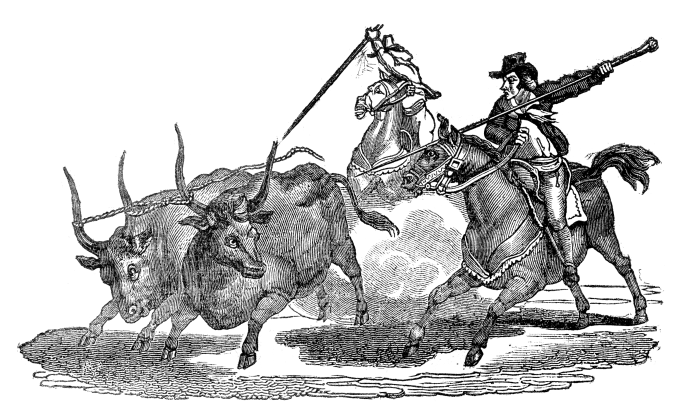
The only stationary population in the Maremma consists of the cow and buffalo keepers, and forest rangers. The former are always mounted and armed with a lance, with which they keep in respect the wild cows and fierce bulls, which are let to roam about these solitudes. These keepers lead a life of freedom and independence, like that of the Arabs in the desert; they are paid by yearly wages, besides which they generally rear up cattle of their own, which are allowed to feed with the rest. They retire in the summer months to the shady forests which line the sea-shore, and where the air is not so unwholesome as in the open plains. There, also, criminals escaped from the pursuits of justice take shelter, and are sometimes employed as wood rangers or buffalo drivers by the people of the neighbouring farms. The following cut, as well as that at the head of this article, represents the mode of driving cattle to the towns.