ANCIENT PAINTINGS.
Reading edition
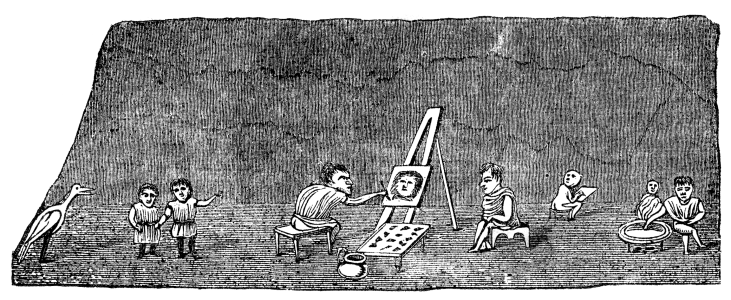
[Grotesque representation of a Portrait Painter’s Studio.]
During the progress of the excavations at Pompeii, a painting was found in the Casa Carolina, which scarcely held together to be copied, and fell in pieces upon the first rain. It is of grotesque character, and represents a pigmy painter whose only covering is a tunic. He is at work upon the portrait of another pigmy, clothed in a manner to indicate a person of distinction. The artist is seated opposite to his sitter, at an awful distance from the picture, which is placed upon an easel, similar in construction to ours. By the side of the artist stands his palette, which is a little table with four feet, and by it is a pot to wash his pencils in. He therefore was working with gum, or some sort of water-colours: but he did not confine himself to this branch of the art, for to the right we see his colour-grinder, who prepares in a vessel placed on some hot coals, colours mixed with wax and oil. Two amateurs enter the studio, and appear to be conversing with respect to the picture. On the noise occasioned by their entrance, a scholar seated in the distance turns round to look at them. It is difficult to explain the presence of the bird in the painting-room. The picture is not complete: a second bird, and on the opposite side a child playing with a dog, had perished before Mazois (an artist who has preserved some of the most valuable remains at Pompeii) copied it. This picture is very curious, as it shows how few things, in the mechanical practice of painting, have been changed during 2000 years.
There is another picture preserved at Pompeii, representing a female employed in making a copy of the bearded Bacchus. She is dressed in a light green tunic, without sleeves, over which she wears a dark red mantle. Beside her is a small box, such as we are told by Varro painters used, divided into compartments, into which she dips her brush. She mixes her tints on the palette, which she holds in her left hand.
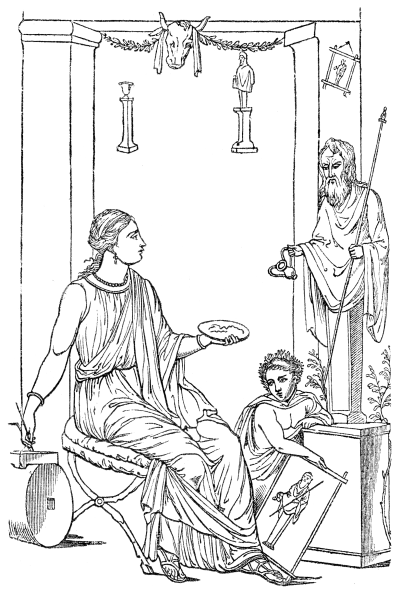
[Painting of a Female Artist.]
Union for Ill.—When the Prince of Conde and Cardinal de Retz, two leaders of opposite factions in France, were viewing the curious garden of a hermit who was famous as a florist, they amused themselves by keeping him attentive to their discourse while they trod to pieces his best flowers on each side of the path. He soon discovered their plan, and, shaking his grey locks, “Alas!” said he, “how much were it to be wished that you could agree in plans to relieve your distressed country with the same readiness which you show in joining to persecute a helpless solitary.”
Command of Temper.—Lopez d’Acunha, a gallant Spaniard, who lived in 1578, recorded in the Apophthegms of Juan Ruffo, seems to have had the affections of his mind under rare command. He was called out from his tent by a sudden alarm. His servants armed him in great haste, and although he told them that his helmet pained him exceedingly, they insisted that it could not be fitted better. The brave Lopez had not leisure to contest the point: he rushed to the combat, fought with success, and at his return, unlacing his casque, and throwing it down on the ground together with his bloody ear, “There,” said he mildly to his awkward valets, “was I not right when I told you how much you hurt me in putting on my helmet?”
⁂ The Office of the Society for the Diffusion of Useful Knowledge is at 59, Lincoln’s Inn Fields.
LONDON:—CHARLES KNIGHT, PALL-MALL EAST.
Shopkeepers and Hawkers may be supplied Wholesale by the following Booksellers:—
London, Groombridge, Panyer Alley, Paternoster Row.
Bath, Simms.
Birmingham, Drake.
Bristol, Westley and Co.
Carlisle, Thurnam; and Scott.
Derby, Wilkins and Son.
Doncaster, Brooke and Co.
Falmouth, Philip.
Hull, Stephenson.
Leeds, Baines and Newsome.
Lincoln, Brooke and Sons.
Liverpool, Willmer and Smith.
Manchester, Robinson; and Webb and Simms.
Newcastle-upon-Tyne, Charnley.
Norwich, Jarrold and Son.
Nottingham, Wright.
Sheffield, Ridge.
Worcester, Deighton.
Dublin, Wakeman.
Edinburgh, Oliver and Boyd.
Glasgow, Atkinson and Co.
Printed by William Clowes, Stamford-Street.
Transcriber’s Notes
New original cover art included with this eBook is granted to the public domain. Illustrations have been moved in some cases to natural breaks in the text. Itemized changes from the original text:
p. 197: Changed “providentally” to “providentially” in phrase “He then desired him to write ‘Tarky,’ the chief of the garrison.”
p. 198: Added closing single quotation mark after “Tarky” in phrase “providentially” in phrase “which were providentially still remaining in the middle of the plain.”
p. 200: Added closing bracket to caption of illustration “Grotesque representation of a Portrait Painter’s Studio.”