THE WEEK.
Reading edition
August 15.—The birthday of Admiral Blake, one of the noblest of England’s heroes and patriots. Robert Blake was born in 1599, at Bridgewater, in Somersetshire, where his father, who had been a Spanish merchant, was settled. After he had spent some years at Wadham College, Oxford, his father died; and he, being the eldest son, returned to Bridgewater, and lived in a retired manner on the estate which he had inherited. Although known for his attachment to puritan principles, he took no part in public affairs till 1640, when he was returned for Bridgewater to the parliament which met for a few weeks in the early part of that year. But he failed in being re-elected for the one by which it was followed—the celebrated Long Parliament, which was destined to act so memorable a part. He was employed, however, in the war between the King and the nation, which soon after broke out, and distinguished himself by his military talent on various occasions. But it was on another element that his fame was to be chiefly gathered. It was in 1649, when he was fifty years of age, that he was first invested with a command at sea. The expedition on which he was sent was directed against Prince Rupert, whom he pursued from Kinsale, in Ireland, to the Tagus, and thence to Malaga, on the southern coast of Spain, where he scattered or destroyed nearly the whole of his fleet. On his return to England, after this victory, which he had achieved in despite of the opposition of both Spain and Portugal, he was appointed to the honourable office of Warden of the Cinque Ports. In the beginning of the year 1652, when the nation was preparing for war with Holland, Blake was the man who was chosen to be invested with the chief command of the fleet. Hostilities soon commenced, and Blake found himself opposed by the most celebrated admiral of the age, Van Tromp, at the head of one of the finest equipments that had ever been sent out by the first naval power in the world. In the beginning of May Van Tromp appeared in the Channel with forty fine men-of-war; and, by way of defiance, took up his station in Dover Roads. The fleet under Blake’s command consisted only of twenty-six sail; but on the 9th he nevertheless boldly advanced against the enemy, who weighed anchor at his approach, and in reply to three successive guns, which he fired without ball, as a signal for them to strike their flag, ranged themselves in order of battle. A desperate fight ensued, which lasted from four in the afternoon till night, and the result of which was that the Dutch, after losing two of their ships, thought proper to retreat. The next great affair with the enemy, in which Blake was engaged, took place on the 29th of November. On that day he was again met in the Channel by Van Tromp, now at the head of a fleet of seventy men-of-war, and six fire-ships. Blake’s force scarcely exceeded half that of his opponent—but scorning to run away, he determined to try once more what the gallantry of English sailors could do under the conduct of a captain who had before led them on to victory through so unequal a strife. And perhaps his courage might have been again crowned with success; but besides being obliged to contend throughout the engagement with an adverse wind, he himself unfortunately received a wound which partially disabled him, and threw a part of his forces into disorder. The consequence was, that after a conflict which lasted from eight in the morning till night, the English found themselves obliged to retreat, and to take refuge partly in the Downs and partly in the Thames. Although the circumstances were such as to remove from it all disgrace, Blake probably felt this defeat severely, especially as it was followed by the most arrogant and insulting conduct on the part of the Dutch admiral, who immediately made his way through the Channel, bearing the ensign of a broom fastened to 192his main-topmast, as if to signify that he had swept those seas of British ships. But in the February following, the English hero, having employed the interval with admirable diligence in repairing his ships, again put to sea with a fleet of sixty sail, and soon after encountered his old adversary at the head of seventy men-of-war, and having three hundred merchantmen under convoy. The battle this time was far more obstinate than any that had yet been fought between them: for three days the two armaments, running up the Channel together, scarcely intermitted their furious fire; when at last, on the fourth morning, the Dutch, having lost eleven of their ships of war and thirty merchantmen, while only one of the English vessels was destroyed, took flight for the coast of Holland. Several other engagements took place between the two admirals in the course of the same year; and the result, upon the whole, was decidedly in favour of the English. Having thus asserted the dominion of his countrymen over their surrounding seas, Blake returned to England, and was received both by the Protector and the people with all respect and honour. Some time before this Cromwell had dismissed the Long Parliament, and openly assumed arbitrary power; but Blake being at sea when this change took place, grieved and indignant as his noble spirit must have felt, restrained himself from giving expression to his sentiments; and calling his officers together, merely remarked to them, that, with the enemy yet unsubdued, they had clearly in the mean time only one duty to perform: “It is not for us,” said he, “to mind state affairs, but to keep the foreigners from fooling us.” In the parliament which assembled in September, 1654, Blake was returned for Bridgewater; and he sat in the House till 1656, when he was despatched with a fleet to the Mediterranean, to chastise Spain for certain insults which that power had offered to the English flag. He acquitted himself in this expedition with his usual ability; but after having done great injury to the marine of the enemy, and taken many rich prizes, he was attacked by an illness which rapidly enfeebled him, and from which indeed he soon felt that he could not recover. He exerted himself, however, as long as his strength would allow, and even engaged in a new enterprise against Santa Cruz, in Teneriffe, which was attended with splendid success, after it had become evident that this would be his last service of gallantry to his country. He then set sail for England; and as life was fast ebbing, the only and constant wish he expressed was that he might but once more rest his eyes, for however short a space, on the coast of his native land before closing them for ever. His wish, and no more, was granted. He expired as the fleet was entering Plymouth Sound, on the 27th of August, 1657. A true model in all things of a British sailor, Blake had been during his life as prodigal of his money among his comrades as of his personal exertions in the service of his country; and notwithstanding the ample opportunities he had had of enriching himself, it was found that he had not increased his paternal fortune by so much as 500l. A magnificent public funeral, and the interment of his body in Henry VII.’s Chapel, in Westminster Abbey, testified the grief of England for the loss of her greatest defender; but among the mean outrages which disgraced the triumph of the Restoration, it was one of the very meanest that Blake’s mouldering remains were removed from the honourable resting-place thus assigned to them, and deposited in the neighbouring church-yard of St. Margaret. They could not, however, remove his glory from the page of the national history, nor bury among common and forgotten things the name and actions of one who, as having first taught our seamen that daring and contempt of danger for which they have ever since been famous, deserves to be regarded as, more than any other, the founder of the naval greatness of England.
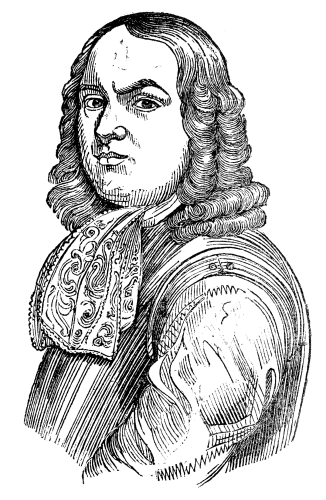
[Admiral Blake.]
General Education.—A strange idea is entertained by many that education unfits persons for labour, and renders them dissatisfied with their condition in life. But what would be said were any of the powers of the body to be in a certain case disused? Suppose a man were to place a bandage over his right eye—to tie up one of his hands—or to attach a ponderous weight to his legs—and, when asked the cause were, to reply, that the glance of that eye might make him covetous—that his hand might pick his neighbour’s pocket—or that his feet might carry him into evil company,—might it not be fairly replied, that his members were given to use and not to abuse, that their abuse is no argument against their use, and that this suspension of their action was just as contrary to the wise and benevolent purpose of their Creator as their wrong and guilty application? And does this reasoning fail when applied to the mind? Is not the unemployed mental faculty as opposed to the advantage of the individual as the unused physical power? Can the difference between mind and matter overturn the ordinary principles of reasoning and of morals? Besides, how is man to be prepared for the duties he has to discharge?—By mere attention to his body? Impossible. The mind must be enlightened and disciplined; and if this be neglected, the man rises but little in character above the beasts that perish, and is wholly unprepared for that state to which he ought to have aspired.—Wilderspin’s Early Discipline.
Trade in Bristles.—In 1828, 1,748,921 lbs. of bristles were imported into England from Russia and Prussia, each of which cannot have weighed less than two grains. From this we may fairly conjecture that 13,431,713,280 bristles were imported in that year. As these are only taken from the top of the hog’s back, each hog cannot be supposed to have supplied more than 7680 bristles, which, reckoning each bristle to weigh two grains, will be one pound. Thus in Russia and Prussia, in 1828, 1,748,921 hogs and boars were killed, to furnish the supply of England with bristles.
⁂ The Office of the Society for the Diffusion of Useful Knowledge is at 59, Lincoln’s Inn Fields.
LONDON:—CHARLES KNIGHT, PALL-MALL EAST.
Shopkeepers and Hawkers may be supplied Wholesale by the following Booksellers, of whom, also, any of the previous Numbers may be had:—
London, Groombridge, Panyer Alley, Paternoster Row.
Bath, Simms.
Birmingham, Drake.
Bristol, Westley and Co.
Carlisle, Thurnam; and Scott.
Derby, Wilkins and Son.
Doncaster, Brooke and Co.
Falmouth, Philip.
Hull, Stephenson.
Leeds, Baines and Newsome.
Lincoln, Brooke and Sons.
Liverpool, Willmer and Smith.
Manchester, Robinson; and Webb and Simms.
Newcastle-upon-Tyne, Charnley.
Norwich, Jarrold and Son.
Nottingham, Wright.
Sheffield, Ridge.
Worcester, Deighton.
Dublin, Wakeman.
Edinburgh, Oliver and Boyd.
Glasgow, Atkinson and Co.
Printed by William Clowes, Stamford-Street.
Transcriber’s Notes
New original cover art included with this eBook is granted to the public domain. Itemized changes from the original text:
p. 186: Added period after “wor,ship.” to match other entries in table.
p. 190: Replaced period with comma after phrase “some hints in the Metamorphoses of Ovid.”