THE OLIVE.
Reading edition
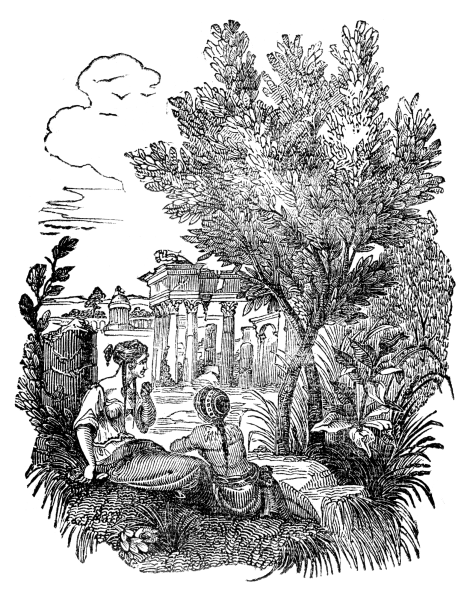
[The Olive Tree.]
There is something peculiarly mild and graceful in the appearance of the olive-tree, even apart from its associations. The leaves bear some resemblance to those of the willow, only they are more soft and delicate. The flowers are as delicate as the leaves; they come in little spikes from buds between the leaf-stalks and the spikes. At first they are of a pale yellow; but when they expand their four petals, the insides of them are white, and only the centre of the flower yellow.
The wild olive is found indigenous in Syria, Greece, and Africa, on the lower slopes of the Atlas. The cultivated one grows spontaneously in many parts of Syria; and is easily reared in all parts of the shores of the Levant that are not apt to be visited by frosty winds. Where olives abound they give much beauty to the landscape. The beautiful plain of Athens, as seen toward the north-west from Mount Hymettus, appears entirely covered with olive-trees. Tuscany, the south of France, and the plains of Spain, are the places of Europe in which the olive was first cultivated. The Tuscans were the first who exported olive-oil largely, and thus it has obtained the name of Florence-oil; but the purest is said to be obtained from about Aix, in France.
The proper time for gathering olives for the press is the eve of maturity. If delayed too long, the next crop is prevented, and the tree is productive only in the alternate years. At Aix, where the olive harvest takes place early in November, it is annual: in Languedoc, Spain, and Italy, where it is delayed till December or January, it is in alternate years. The quality of the oil, also, depends upon the gathering of the fruit in the first stage of its maturity. It should be carefully plucked by the hand; and the whole harvest completed, if possible, in a day. The oil-mill is simple. The fruit is reduced to a pulp, put into sacks of coarse linen, or feather-grass, and subjected to pressure. The growth of olives and the manufacture of the oil afford a considerable employment to many of the inhabitants of France and Italy. The importation of olive-oil into Great Britain amounted, in 1827, to about four thousand five hundred tons, paying a duty of eight guineas per tun.
In ancient times, especially, the olive was a tree held in the greatest veneration; for then the oil was employed in pouring out libations to the gods, while the branches formed the wreaths of the victors at the Olympic Games. The Greeks had a pretty and instructive fable in their mythology, on the origin of the olive. They said that Neptune having a dispute with Minerva, as to the name of the city of Athens, it was decided by the gods that the deity who gave the best present to mankind should have the privilege in dispute. Neptune struck the shore, out of which sprung a horse: but Minerva produced an olive-tree. The goddess had the triumph; for it was adjudged that Peace, of which the olive is the symbol, was infinitely better than War, to which the horse was considered as belonging, and typifying. Even in the sacred history, the olive is invested with more honour than any other tree. The patriarch Noah had sent out a dove from the ark, but she returned without any token of hope. Then “He stayed yet other seven days; and again he sent forth the dove out of the ark; and the dove came to him in the evening; and, lo, in her mouth was an olive-branch plucked off: so Noah knew that the waters were abated from the earth.”
The veneration for the olive, and also the great duration of the tree, appears from the history of one in the Acropolis at Athens. Dr. Clarke has this passage in his Travels, in speaking of the temple of Pandrosus—“Within this building, so late as the second century, was preserved the olive-tree mentioned by Apollodorus, which was said to be as old as the foundation of the citadel. Stuart supposed it to have stood in the portico of the temple of Pandrosus (called by him the Pandroseum) from the circumstance of the air necessary for its support, which could here be admitted between the caryatides; but instances of trees, that have been preserved to a very great age, within the interior of an edifice inclosed by walls, may be adduced.”
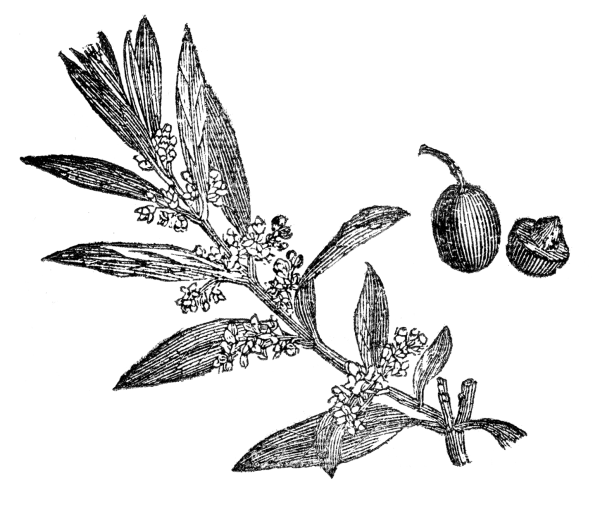
[The Olive.]