HOLYROOD HOUSE, EDINBURGH.
Reading edition
The west part of Edinburgh is built along the ridge of a somewhat steep hill, stretching for about a mile from east to west. At the western extremity of the street, which, under various names, extends in a continuous line along this summit, stands the castle, crowning a lofty and precipitous rock; at its opposite end, which lies low, is the palace of Holyrood House, there commonly designated the Abbey. Holyrood House, in fact, was a religious establishment long before it became a royal residence. It was one of the numerous monasteries founded by the Scottish King David I., a monarch who was made a saint for his pious profusion. The name of Holyrood was derived from a celebrated silver rood (or cross) said to have been actually put into the hands of the founder by an angel, as he was hunting one day on the spot where the abbey was afterwards erected. This cross was accordingly regarded with great veneration and pride by the Scots for more than two centuries; but David II. having thought proper to carry it along with him, in 1347, in his foolish invasion of England, it fell a prey to the victors at the disastrous battle of Neville’s Cross, in which the King himself was severely wounded and taken prisoner, and, according to some accounts, twenty thousand of his troops left dead on the field. The Holy Rood was long after this preserved with great care in the cathedral of Durham, and continued to be the object of nearly as reverential a regard among its new as it had been among its original possessors. Holyrood House was most liberally endowed with lands and privileges both by its founder and by several of his successors; so that it eventually became the richest ecclesiastical establishment in Scotland. This abbey was repeatedly both plundered and burned in the course of the wars with the English. In 1544, especially, when Leith and Edinburgh were taken and sacked by the Earl of Hertford (afterwards the Protector Somerset) the whole of the church was burned to the ground, with the exception of the nave, which was subsequently used as a chapel.
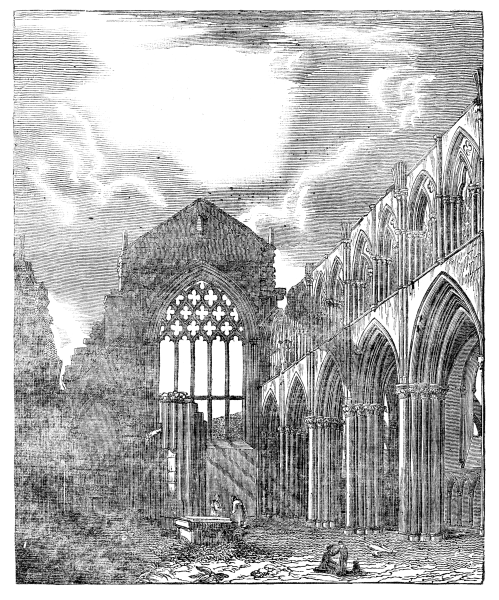
[Interior of Holyrood Chapel.]
The earliest notice we have of the existence of a palace at Holyrood is no older than the beginning of the sixteenth century. The more ancient palaces of the Scottish kings were all to the north of the Forth, the country to the south of that river not having properly formed part of their dominions till a comparatively recent era. It is probable, however, that they may have had a residence at Holyrood before the year 1503, when we first find the palace expressly mentioned. After this, in 1528, James V. made great additions to the buildings already existing, or rather indeed rebuilt the whole from the foundation. A great part of this erection was burnt by the English in 1544; but the devastation committed on this occasion was soon after repaired; and a new 189palace built on a much more extensive scale than before. It was probably, indeed, a considerably larger building than the present, inasmuch as it is stated to have consisted of five courts, or quadrangles. Here the unfortunate Mary had her principal residence during the time she enjoyed her regal dignity; and here also her son James VI. held his court, till his accession to the crown of England. A considerable part of this building was afterwards burned down by Cromwell’s soldiers, and it lay in ruins till about the year 1670, when, by direction of Charles II. the present structure was commenced after a design of Sir William Bruce.
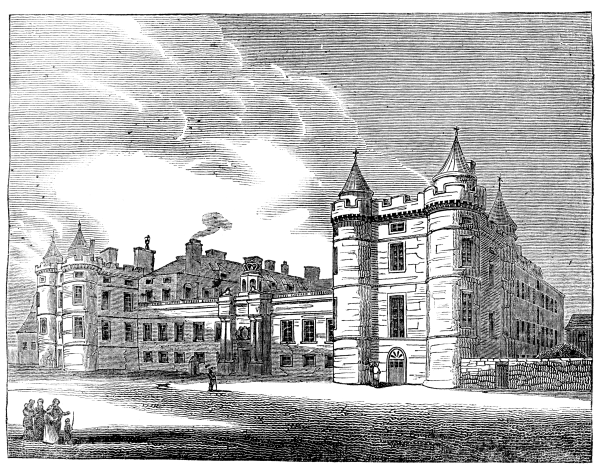
[Western Front of Holyrood Palace.]
The present palace of Holyrood House is a handsome stone edifice, surrounding a court which is nearly square, each side measuring about 230 feet in length. The four different ranges of buildings are flanked by towers at each extremity—and an arcade, supported by pillars, goes round the whole of the interior. The north-west portion of the building is all that remains of the palace erected by James V.; but the apartments which it contains are very interesting. Here are both the state-room and the bed-chamber which were used by Queen Mary, with the old furniture remaining, much of the needlework of which is said to have been done by her own hands. It was in this bed-room that she was sitting at supper, with her half-sister, the Countess of Argyle, when Darnley and his fellow-conspirators rushed in, and dragging forth her minion, Rizzio, slew him at the door of the apartment. The unhappy man received about fifty-five wounds. The trap-door, or opening in the floor of the adjoining passage, by which they ascended from the apartment below, is still shown, as well as certain dark stains on the floor, stated to be the marks made by Rizzio’s blood. The Pretender, Charles Edward, took possession of these apartments when he established himself for a short time in Edinburgh, in 1745, and slept, it is said, in what had been Queen Mary’s bed. The same bed, which still occupies its ancient place, received, a few months afterwards, the victorious Duke of Cumberland, when the slaughter of Culloden had for ever decided the question between the houses of Stuart and Hanover. In later times it has twice served as an asylum to the exiled princes of another house. Charles X. of France, when Count d’Artois, resided here from 1795 till 1799, with his two sons, the Dukes d’Angouleme and de Berri; and the same royal personage, a second time driven from his country, has now a second time found refuge, with his family, within the same walls. A new ‘Fall of Princes,’ such as old Lydgate translated from a French version of Boccaccio’s Latin, or a continuation of the ‘Mirror for Magistrates,’ might be compiled from the history of the successive tenants of Holyrood House since it was first erected by James V.
When his late Majesty visited Scotland in 1822, the state apartments in Holyrood House were fitted up with great magnificence, and their gilded and mirrored walls again reflected the splendour of levees and drawing-rooms. Considerable sums also have since been expended from the crown revenues in restoring the palace; and in consequence many important repairs and alterations have been effected. The largest of the apartments which it contains is a gallery on the north side, 145 feet in length by 25 in breadth, and 18½ in height. This gallery is adorned with 111 imaginary portraits of Scottish kings, all painted by a Flemish artist named De Witt, who was brought over by James VII. to execute the work. They are not worth much more as specimens of art than as illustrations of history. The Duke of Cumberland’s troops, when here in 1746, by way perhaps of evincing their superior connoisseurship, thought proper to stab and slash many of these canvass monarchs with their swords and bayonets; but they have since been repaired, and are now inserted into the panels of the wainscot. It is in this gallery that the elections of the representative peers of Scotland take place.
190Next to Queen Mary’s apartments, however, the old chapel is the most interesting part of Holyrood House. It consists, as we have already intimated, only of the nave of the original abbey-church. This ruin (for it is now nothing more) has received in the course of the recent restorations such repairs as will at least arrest for some time the farther progress of decay.
Holyrood House, as being a royal palace, is still a sanctuary for insolvent debtors; and they enjoy the protection, which extends to their effects as well as to their persons, not only within the immediate precincts of the palace, but over the whole of the adjoining royal park. This park is about three miles in circumference, and comprehends within its bounds the hill called Arthur’s Seat, one of the most striking objects of natural scenery to be found in the neighbourhood of any city.