WARWICK CASTLE.
Reading edition
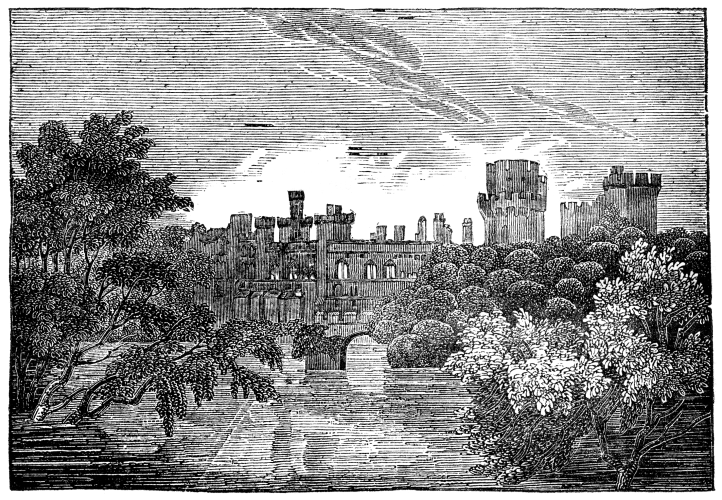
[Warwick Castle, from the Avon.]
Warwick Castle is one of the most interesting monuments of feudal grandeur in the kingdom. The view which we have given above is from the River Avon, from whose banks the principal part of the edifice abruptly rises, being built upon the solid rock of freestone which bounds the river. Viewed by itself, this portion of the building is not the most picturesque. But taken in connection with the ancient towers of the castle, with the ecclesiastical edifices of Warwick Town in the back-ground, and with the Avon and its beautiful bridge in front, it would be difficult to find a scene more imposing,—certainly impossible to find one so rich in historical associations, which should be also so uninjured by time.
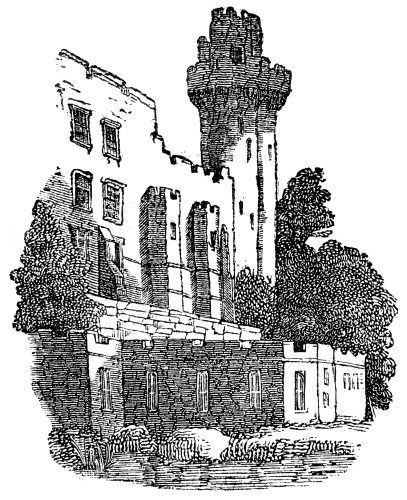
[Cæsar’s Tower, and part of Warwick Castle, from the Island.]
Passing through a road cut through the solid rock, which now presents a plantation of shrubs judiciously arranged so as to shut out the view of the castle till it is suddenly presented to the eye, the visitor finds himself in a spacious area where he is at once surrounded by ancient fortifications, and Gothic buildings of a later date, now devoted to the peaceful occupation of the descendants of the old chieftains who here once held a stern and bloody sway over their trembling dependants. The keep, erected, it is said, in the days of our Anglo-Saxon ancestors, is now only a picturesque ruin. But two towers of high antiquity are still entire; and these are associated with the days of baronial splendour, when many a proud man, the lord of such a castle as this, 178held the lives and fortunes of trembling vassals in dependence upon his uncontrolled will. Miserable was the condition both of “the oppressor and the oppressed” in those evil times. One of these towers is called Cæsar’s—a common appellation of some commanding part of the fortress in many castles of remote antiquity.
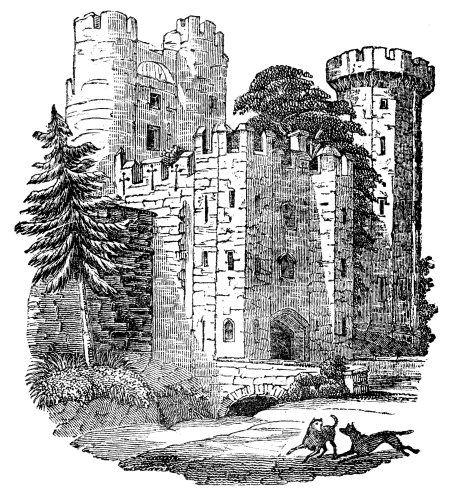
[Guy’s Tower with the entrance to Warwick Castle from the Lower Court.]
Another, and the more important of these towers, is called Guy’s. This building is perhaps the most commanding feature of Warwick Castle. It is a hundred and forty-eight feet in height. From whatever point it is viewed its proportions are truly majestic. Its real grandeur is neither advanced nor impaired by the traditions with which it is connected. Sir Guy of Warwick is one of the heroes of the wild romances of the days of chivalry. He is said, as is said of most of these worthies, to have killed a giant and a dragon; but his chief exploit is thus recorded in an old ballad:—
“On Dunmore heath I also slew
A monstrous wild and cruel beast,
Called the Dun-cow of Dunmore heath,
Which many people had opprest.”
In these days no great importance will be attached to this passage in the good knight’s prowess; and in truth many of the bragging feats of those days, when people rode about on great horses, clad in coats of mail, were not a whit more valuable to mankind, or evinced more real courage, than this vaunted destruction of the “Dun-cow.”
The state-rooms, which are exhibited at Warwick Castle, contain many objects deserving attention. Some of the pictures are of the first order of excellence, particularly several portraits by Vandyke. In a greenhouse, delightfully situated in the grounds surrounding the castle, is one of the finest and most perfect remains of antiquity, a Grecian vase of white marble, dug up from the ruins of the Emperor Adrian’s palace at Tivoli, and conveyed to England by the late Sir William Hamilton. Of this celebrated piece of sculpture, now called “the Warwick Vase,” we shall give a representation in a future number.
On the edge of the road that leads from Warwick to Coventry is a knoll, now almost covered with trees, which was the scene of one of the most remarkable events in our history, which forcibly illustrates the difference between the Warwick Castle of five centuries ago, and the Warwick Castle of the present day. It was on this mount that Piers Gaveston, the favourite of a weak monarch (Edward II.), was beheaded. The original name of this place was Blacklow-hill. It is now called either by that name, or by that of Gaveston-hill. Piers Gaveston, the clever but unprincipled favourite of the King, was the object of especial enmity to the great barons who were in opposition to the crown. After various conflicts with the monarch, they succeeded in banishing the favourite from the kingdom: but he having impudently returned in 1312, the Earl of Warwick forcibly seized upon his person, in defiance of an express convention, and bore him in triumph to Warwick Castle, where the Earls of Lancaster, Hereford, and Arundel, repaired to hold a consultation about their prisoner. His fate was speedily decided. He was dragged to Blacklow-hill, about two miles from Warwick Castle, where he was beheaded amidst the scorn and reproach of his implacable and perfidious enemies. On the top of Blacklow-hill there is a rude stone, on which the name of Gaveston, and the date of his execution, are cut in ancient characters. As we now look upon the beautiful prospect which this summit presents, it is satisfactory to contrast the peacefulness and the fertility that are spread around, with the wild appearance that the same spot must have exhibited at the period of lawless violence which we have described; and to reflect that such a tragedy can never again occur, as long as all men are under the equal justice of the laws.