THE GREAT SKELETON OF THE MEGATHERIUM.
Reading edition
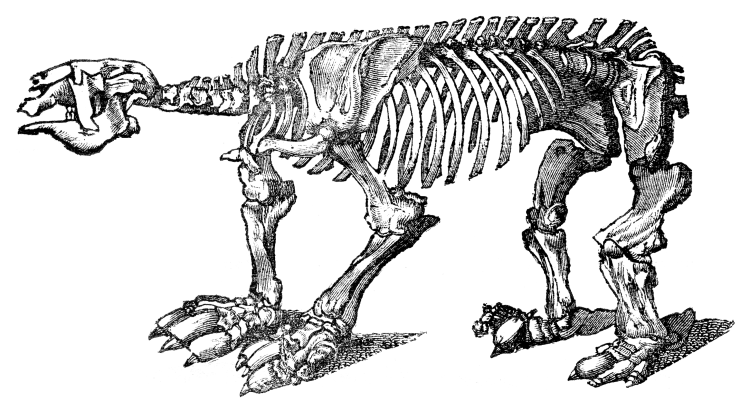
Our conceptions of the plan of Nature must, to say the least, be ever imperfect: perhaps we do not err in supposing that it is the design of Providence to fill all space with life and enjoyment. We may look in two directions at her works; by the assistance of the microscope we find everywhere minute vegetable and animal productions:—rising from the contemplation of these, we turn to that luxuriant vegetation, and to those huge animals which, according to the economy and fabric of the animal body, exhibit the largest possible dimensions. Of these it would appear that many have yielded their abode to man, and are now extinct.
In the great plains of South America, and more especially behind Buenos Ayres, in that flat country which is washed by the Parana and its tributaries, there are found the remains of enormous animals. Their bones lie sunk in the mud, or alluvial soil; and sometimes, during a very dry season, when the waters are low, they appear standing up above the surface like trunks of trees, or snags as they are called in America. Such are the bones lately brought to London by the very meritorious exertions of Mr. Parish.
The inhabitants of a remote district saw the pelvis of the animal which we are going to describe, appearing above the water, and throwing a lasso, or cord, over it, they drew it ashore. The pelvis is the circle of bones which extends from haunch to haunch; and we may form some conception of its size, both from the manner in which it was found, and from the lively remark of Professor Buckland, on seeing this portion of the skeleton—that two of the largest members of the Geological Society might pass through its circle. When we put our hands upon our haunches, we rest them upon the wings of the pelvis: now if we extend our arms to the utmost, we have an exact measure of the breadth of the bones of which we are speaking, for it measures across from five to six feet.
This part of the skeleton was brought to the authorities at Buenos Ayres; from whom Mr. Parish had interest to obtain it: after which, he sent some hundred miles into the country; had the bottom of the river sounded and dragged for the remainder of the bones; and, finally, had that part of the water dammed off, so as to obtain the skull, the vertebræ of the spine and of the tail, the bones of the hinder extremity, and the shoulder bone. This skeleton, imperfect as it is, proves to be, not the mastodon, or fossil animal of the Ohio, but the great fossil animal of Paraguay, the last discovered of the extinct species, and called megatherium by Cuvier, from two Greek words which signify the great monster.
An imperfect skeleton of this animal is in the Royal Cabinet of Natural History at Madrid; and it is singular enough that what is wanting in those bones is supplied in the present. Some doubts were entertained, for example, whether the pelvis made a complete circle, for this part, in the Madrid skeleton, was broken off in front; the sagacious Cuvier presumed that it did; and our specimen proves it.
Examining these bones, putting them together, and comparing them with the drawings of Joseph Garrega, Madrid, 1796, and of Dr. Pander and Dr. D’Alton, of Bonn, 1821, we may venture upon some speculations concerning them. The hinder parts of this animal must have been of great magnitude and strength compared with the anterior part. Anatomists know, from the inspection of the bones, what was the condition of the muscles; for the processes by which they are acted upon are ever strong and projecting, when the muscles are powerful. The processes of the pelvis show what large and strong muscles must have operated upon the thigh bone; and the thigh bone itself is an extraordinary object. It is two feet five inches in length; is three feet four inches round its thickest, and two feet two inches round its smallest, part; it is thus twice or three times the thickness of the thigh bone of the elephant. It is of very great solidity, and the ridges or processes which stand out from it, imply that the muscles were of extraordinary power. The bones of the leg, the tibia and fibula, which are separate in other animals, are here short, thick, and united into one compact bone. The calcaneum, or heel bone, projects far, being more than a foot in length, and thus it gives a powerful lever to the muscles that are attached to it. And the bones of the toes are, indeed, very curious; exhibiting to the comparative anatomist that structure which is adapted for the attachment of long and clumsy claws—but neither like the split hoof of the ruminating animals, nor the retractile claws of the feline, or cat tribe, and resembling more the tardigrade class, or sloths. Some have estimated the foot to be upwards of four feet in length, and to be a foot in breadth.
A most ingenious member of the Geological Society, in his observations upon this subject, conceived that this great strength was given to the hinder extremities of the animal, that it might the better stand upon three feet, and scratch with the fore foot that was free. We should have the more willingly assented to this idea had the hind foot been obviously calculated for standing upon; but the processes of the bones, and the formation of the toes, seem to indicate that this limb was to be more actively employed. Why not suppose that it dug like such animals as we see employed in digging?—they work with their fore feet, and, after a certain 181accumulation, make more desperate exertions with their hind feet, to clear away the encumbrance. On the whole, the extremities of this animal must have been short compared with his length, and the breadth of his haunches; for his height is not estimated at more than seven feet. As we have said, the processes of the bones imply great muscular strength, and, probably, activity,—such activity as we see in the motions of the armadillo.
Nothing is more surprising than the smallness of the head in this animal: indeed we could not have believed that the head belonged to these enormous bones, had not Mr. Cliff put the vertebræ together, and did we not see that those of the neck corresponded with each other; and that the anterior vertebra of all, the atlas, fitted exactly into the articulating processes of the skull. This part is imperfect, but happily the teeth and a portion of the jaw are here. The teeth are most singular in their structure. There are no incisors or front teeth. Probably the animal had a projecting snout, like the tapir in the Zoological Gardens. It certainly had not a trunk like the elephant; because the length of the neck, as shown by the vertebræ, enabled it to reach the ground with the mouth: and neither the form of the bones of the face, nor the holes through which the nerves pass, indicate the attachment of such an organ as the trunk. The teeth are seated in the back part of the jaw; their ground surfaces enter into one another with extraordinary exactness; and the enamel is so placed that they are worn in a manner quite peculiar. They are unlike the teeth of the lion or of the tiger; they obviously suffered great attrition: and are provided against a rapid wasting by the mode of their growth, which resembles that of the front teeth of animals which gnaw—the rodentia. The projecting incisor teeth of the beaver, for example, cut like an adze, but they necessarily suffer from the attrition; to provide against which they grow at their roots, and advance forwards in proportion as they waste on their exposed surfaces. These teeth of the megatherium, although in the usual place of grinders, have the provision for growing at the fangs, whilst they waste on their crowns; which implies that they were used in cutting vegetables, and, probably, the roots dug out of the earth. From the processes of the scapula, or shoulder-blade, we see that this animal had a clavicle, or collar-bone, and that the radius and ulna had free rotatory motion: the marks upon the humerus, too, show that the muscles which roll the wrist-joint were powerful: now these, with the adaptation in the form of the toes for long and strong claws, lead us to believe that the animal turned out the earth like the mole, and was in structure something between the sloth and the ant-eater. Altogether, it would appear that he dug and searched for roots, and lived on vegetables.
There is another fact important to our speculations on the habits of this animal; there has been brought home from the same districts, and found along with bones similar to these, though remotely placed from the present specimen, a cover like the shell of the armadillo, but of a size like a great brewer’s boiler, and studded with tubercles, like the nails upon a prison-door. If this shell covered the animal, for what purpose of defence could it be? An ingenious geologist conceived that the animal had the power of flinging up the soil in such masses, that, in descending, it required a protection to its back. This conjecture will hardly be satisfactory; and yet to suppose that such a creature, possessed of such dimensions, could have a formidable enemy, and that it required the protection of a defensive armour, like the armadillo, is perhaps equally extravagant.
According to the methods of the naturalists, from the circumstance of this animal wanting the front teeth, we should class it with the Edentés of Cuvier, and, following that author, place it along with the megalonyx (having large claws). This latter animal, also extinct, President Jefferson described as a great lion, higher in limbs than our largest ox, and the enemy of the grand mastodon, thereby presenting a terrific idea of the ancient world. But Cuvier, by his knowledge of anatomy, proved it to have been a vegetable feeder, and to be properly classed with the tardigrade animals, a harmless race.
This specimen of the megatherium, in its magnificent ruins, must give activity to the fancy. It is said that there is nothing interesting in antiquarian research, but as it is associated with man,—with human action or suffering. But here are remains which carry the mind back to the most remote times; not into the contemplation of the ages of mankind, but to the earlier condition of the globe, when it was undergoing a succession of changes, which were, at length, to suit it for the abode of the human race.
The condition of a part of these bones may convey an idea of the plains where they are found. Some of them are nearly consumed by fire; the natives using them for setting their kettles on when cooking. To understand how they should be applied for such uses, we must recollect that there is no stone to resist the fire; and that there is nothing but mud and vegetable productions for many hundred miles around where these bones were discovered.
The wood-cut of the megatherium at the head of this notice is copied from a plate in the great work of Cuvier on Fossil Bones, which representation is from the specimen in Madrid.