THE WEEK.
Reading edition
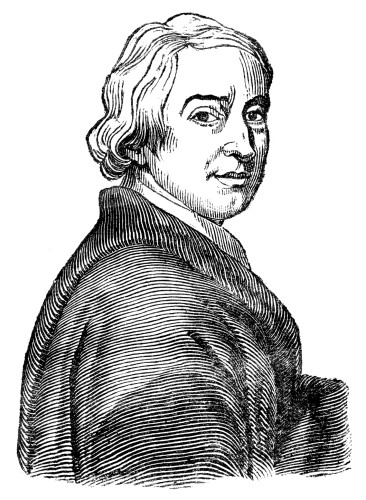
[Dryden]
August 9th.—The anniversary of the birth of John Dryden. This great poet was born in 1631, in the parish of Aldwinkle-All-Saints, Northamptonshire, where his father, the third son of Sir Erasmus Dryden, Bart., had a small estate. The poet’s third son, Erasmus Henry, eventually succeeded to this baronetcy. All Dryden’s near connexions appear to have attached themselves in the civil wars to the party of the Parliament; and the poet himself, afterwards so celebrated for his royalist strains, began also by exercising his talents on that side of the question. The first verses by which he made himself much known, were his ‘Heroic Stanzas on the Death of Oliver Cromwell,’ in which he celebrated the memory of the Protector and his actions with no cold or sparing panegyric. When the Restoration, however, a few months after, brought other principles or 182professions into fashion, Dryden, with many more, made no scruple to adopt the new creed. His Elegy on Cromwell was followed by his ‘Astræa Redux,’ an effusion of thanksgiving ‘on the happy Restoration and Return of his sacred Majesty Charles II.;’ and that by a shorter piece on the coronation of the same monarch. As the poet, however, was yet only in his twenty-ninth year, perhaps it may be thought that he had not passed the age for the only change of political opinion which is usually looked upon with indulgence—the first, namely, which a man makes, or that in which he relinquishes the creed of education and custom, for that of reason and experience. And it is at least to be said for Dryden, that after this he distinguished himself by no second apostacy, but, right or wrong, adhered steadily during the remainder of his days to the colours under which he now took his place, although he lived to see the time when it would certainly have been for his worldly interest to have again changed sides, and when he would also have had many and high examples to countenance him in so doing. It was in the year after the publication of his ‘Astræa Redux’ that he first appeared in the character of a dramatist, which he afterwards sustained by so long a series of productions. His commencing effort in this line was his play entitled ‘The Duke of Guise,’ It was in the ‘Annus Mirabilis,’ however, which appeared in 1667, that his genius first broke forth with any promise of that full effulgence at which it eventually arrived. It is with the publication of this poem too that he may be properly said to have entered upon authorship as a profession; and from that event till the close of the century, his life may be described as having been but one long literary labour, scarcely ever relieved by any considerable interval of repose. We cannot here go over in detail the names and dates of his manifold productions; but we may merely observe that no fewer than twenty-eight dramas, and eight original poems of considerable length, besides many minor effusions, and several volumes of poetical translation from Chaucer, Boccaccio, Ovid, Theocritus, Lucretius, Horace, Juvenal, Persius, and Virgil, together with no small number of treatises in prose, in the shape of dedications, prefaces, and other more elaborate disquisitions, attest the unwearied industry, as well as the singular fertility of his mind. Such incessant exertions were so far from exhausting his genius, that his powers continued not only to do their work with unimpaired elasticity, but even apparently to gather new vigour and dexterity to the last. His celebrated ‘Alexander’s Feast,’ and his admirable Fables, (the latter, translations indeed, in so far as the incidents are concerned, from Boccaccio and Chaucer, but made by Dryden entirely his own by the embellishment and the filling up,) were written when the illustrious author was on the verge of his seventieth year, and suffering under poverty and accumulated afflictions, from which he was relieved by death a few months afterwards. He died on the 1st of May, 1700, and was buried in Westminster Abbey, in a grave next to that of Chaucer. Among our English poets Dryden stands at the head of the school to which he belongs, which, however, is not that of the highly imaginative, but rather that of the intense, energetic, and pointed, in feeling and expression. Pope, who is to be classed as, in many respects, his pupil, has excelled him in precision, regularity, and neatness of diction, and his wit, also, if not more brilliant, is certainly more refined and unmixed; but he has not approached Dryden either in the rich and varied music of his verse, or in the cordiality of his indignant declamation, or in the exquisitely free and easy flow of his merely discursive passages. There is nothing, indeed, more perfect in the language than Dryden’s reasoning in rhyme. Here, and in every thing else, his extraordinary command of expression is one of the chief sources of his strength. Dryden’s vocabulary, without comprehending the whole extent of the English tongue, is yet complete for the demands of his particular range of composition. Certainly few writers have wielded language with a more perfect mastery of the weapon. And it is this which not only gives much of its power to his poetry, but has also imparted to his prose style a charm that has been rarely equalled. It deserves, however, to be remarked, that to his affluence of words are probably to be in part ascribed some of his defects as well as many of his excellences. As a dramatist he has almost completely failed, and perhaps to a greater degree than he otherwise would have done, simply because he was so consummate a rhetorician. In his plays, as in all his other productions, he has given us sonorous verse and splendid declamation in abundance, but little true passion—many feats of art, but few touches of nature—much, in short, to fill the ear, but almost nothing to move the heart. But on another account also, indeed, Dryden was altogether unfitted to excel as a dramatic writer. He wanted the power of forgetting and abstracting himself from his merely personal feelings. But nearly every thing that Dryden has written most forcibly—every thing he has done in which there is really any passion, derives the chief portion of its animation from its being the mere utterance of his own rage, or scorn, or exultation, or other pervading sentiment at the moment. There is none of that passing out of himself into another being, the capacity of which is the soul of dramatic genius, and by the exertion of which a great dramatist seems not to speak through his characters, but only, as it were, to listen to what they say, and faithfully to write it down.