TOBACCO
Reading edition
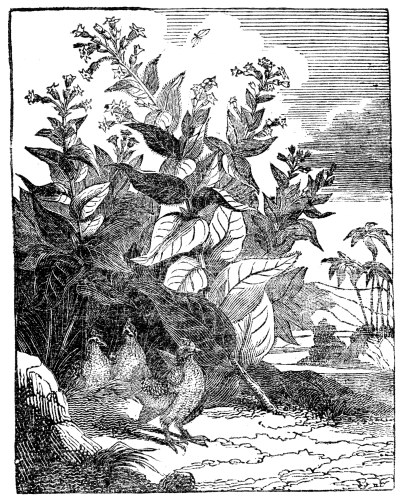
Tobacco was introduced into Europe from the province of Tabaca in St. Domingo in 1559, by a Spanish gentleman, named Hernandez de Toledo, who brought a small quantity into Spain and Portugal. From thence, by the means of the French ambassador at Lisbon, Jean Nicot from whom it derived its name of Nicotia, it found its way to Paris, where it was used in the form of a powder by Catherine de Medici. Tobacco then came under the patronage of the Cardinal Santa Croce, the pope’s nuncio, who, returning from his embassy at the Spanish and Portuguese courts, carried the plant to his own country, and thus acquired a fame little inferior to that which, at another period, he had won by piously bringing a portion of the real cross from the Holy Land. Both in France and in the Papal States it was at once received with general enthusiasm, in the shape of snuff; but it was some time after the use of tobacco as snuff that the practice of smoking it commenced. This practice is generally supposed to have been introduced into England by Sir Walter Raleigh; but Camden says, in his ‘Elizabeth,’ that Sir Francis Drake and his companions, on their return from Virginia in 1585, were “the first, as far as he knew, who introduced the Indian plant, called Tabacca or Nicotia, into England, having been taught by the Indians to use it as a remedy against indigestion. And from the time of their return,” says he, “it immediately began to grow into very general use, and to bear a high price; a great many persons, some from luxury, and others for their health, being wont to draw in the strong-smelling smoke with insatiable greediness through an earthenware tube, and then to puff it forth again through their nostrils: so that tabacca-taverns (tabernæ tabaccanæ) are now as generally kept in all our towns, as wine-houses or beerhouses.” No doubt the tobacco-taverns of Queen Elizabeth’s times were not unworthy predecessors of the splendid cygar divans of the present day. It appears from a note in the ‘Criminal Trials,’ vol i. p. 361, that in 1600 the French ambassador, in his despatches, represented the Peers, on the trial of the Earls of Essex and Southampton, as smoking tobacco copiously while they deliberated on their verdict. Sir Walter Raleigh, too, was accused of having sat with his pipe at the window of the armoury, while he looked in at the execution of Essex in the Tower. Both these stories are probably untrue, but the mere relation of them by contemporaneous writers shows that they were not then monstrously incredible, and they therefore prove the generality of the practice of smoking at that time amongst the higher class of society. After a time, however, the practice of smoking tobacco appears to have met with strenuous opposition in high places, both in this country and other parts of Europe. Its principal opponents were the priests, the physicians, and the sovereign princes; by the former its use was declared sinful; and, in 1684, Pope Urban VIII. published a bull, excommunicating all persons found guilty of taking snuff when in church. This bull was renewed in 1690, by Pope Innocent; and, about twenty-nine years afterwards, the Sultan Amurath IV made smoking a capital offence. For a long time smoking was forbidden in Russia, under pain of having the nose cut off; and in some parts of Switzerland, it was likewise made a subject of public prosecution—the police regulations of the canton of Berne, in 1661, placing the prohibition of smoking in the list of the Ten Commandments, immediately under that against adultery. Nay, that British Solomon, James I., did not think it beneath the royal dignity to take up his pen upon the subject. He accordingly, in 1603, published his famous ‘Counterblaste to Tobacco,’ in which the following remarkable passage occurs:—“It is a custom loathesome to the eye, hatefull to the nose, harmfull to the braine, dangerous to the lungs, and in the black stinking fume thereof nearest resembling the horrible Stygian smoke of the pit that is bottomless.” But notwithstanding this regal and priestly wrath, the use of the plant extended itself far and wide; and tobacco is, at this moment, perhaps the most general luxury in existence. The allusion to the practice in the following lines, taken from the ‘Marrow 149of Compliment,’ written in 1651, seems to show the prevalence of smoking at that period:—
“Much meat doth Gluttony procure
To feed men fat as swine;
But he’s a frugal man indeed,
That on a leaf can dine!
He needs no napkin for his hands,
His fingers’ ends to wipe,
That hath his kitchen in a box,
His roast meat in a Pipe!”