LYCIDAS.
Reading edition
One of the most beautiful minor poems of Milton, though slightly obscure in some passages from the use of antiquated phrases, and in one instance strongly imbued with the author’s political feelings, is his Monody of Lycidas. This was written in Milton’s 29th year, on the occasion of the untimely death of his friend, Mr. John King, who was drowned in the passage from England to Ireland. The character of the poem is pastoral, it being assumed that the author and his lamented friend were brother shepherds:—
“For we were nurst upon the self-same hill;
Fed the same flock by fountain, shade, and rill.
Together both, ere the high lawns appear’d
Under the opening eye-lids of the morn,
We drove a-field, and both together heard
What time the gray-fly winds her sultry horn,
Batt’ning our flocks with the fresh dews of night
Oft till the star that rose, at evening, bright,
Toward Heav’ns descent had slop’d his west’ring wheel.”
The complaint of the poet on the shortness of life, and the glowing reply of Phœbus to his lamentation, is one of the finest passages in the whole compass of English verse:—
“Fame is the spur that the clear spirit doth raise
(That last infirmity of noble mind)
To scorn delights, and live laborious days;
But the fair guerdon when we hope to find,
And think to burst out into sudden blaze,
Comes the blind Fury with th’ abhorred shears,
And slits the thin spun life. But not the praise,
Phœbus reply’d, and touch’d my trembling ears;
Fame is no plant that grows on mortal soil,
Nor in the glist’ring foil
Set off to th’ world, nor in broad rumor lies,
But lives and spreads aloft by those pure eyes,
And perfect witness of all-judging Jove;
As he pronounces lastly on each deed,
Of so much fame in heav’n expect thy meed.”
But Milton’s soul was nourished with the hopes of the Christian, as well as excited with the ambition of the poet;—and thus the monody finely concludes with an eloquent expression of the only real consolation under every such calamity:—
“Weep no more, woful shepherds, weep no more,
For Lycidas your sorrow is not dead.
Sunk though he be beneath the wat’ry floor;
So sinks the day-star in the ocean bed;
And yet anon repairs his drooping head,
And tricks his beams, and with new-spangled ore
Flames in the forehead of the morning sky:
So Lycidas sunk low, but mounted high,
Through the dear might of him that walk’d the waves,
Where other groves and other streams along,
With nectar pure his oozy locks he laves,
And hears the unexpressive nuptial song,
In the blest kingdoms meek of joy and love.
There entertain him all the saints above,
In solemn troops and sweet societies,
That sing, and singing in their glory move,
And wipe the tears for ever from his eyes.”
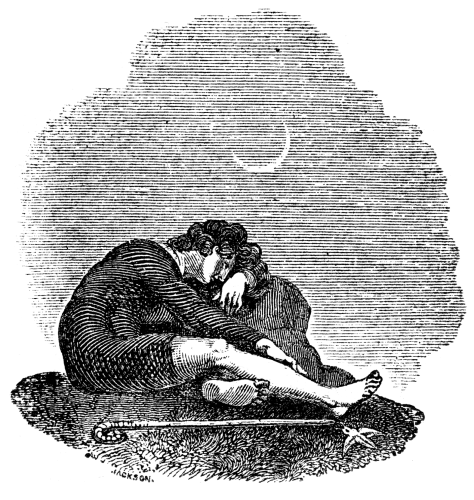
[Lycidas. From a design by Fuseli.]
That sanctity which settles on the memory of a great man, ought, upon a double motive, to be vigilantly sustained by his countrymen; first, out of gratitude to him, as one column of the national grandeur; secondly, with a practical purpose of transmitting, unimpaired, to posterity the benefit of ennobling models. High standards of excellence are among the happiest distinctions by which the modern ages of the world have an advantage over earlier, and we are all interested by duty as well as policy in preserving them inviolate.—From a Memoir of Milton in ‘The Gallery of Portraits.’
This liberty in conversation (fiction and exaggeration) defeats its own end. Much of the pleasure and all the benefit of conversation depends upon our opinion of the speaker’s veracity.—Paley’s Moral Philosophy.
⁂ The Office of the Society for the Diffusion of Useful Knowledge is at 59, Lincoln’s Inn Fields.
LONDON:—CHARLES KNIGHT, PALL-MALL EAST.
Shopkeepers and Hawkers may be supplied Wholesale by the following Booksellers, of whom, also, any of the previous Numbers may be had.
London, Groombridge, Panyer Alley, Paternoster Row.
Bath, Simms.
Birmingham, Drake.
Bristol, Westley and Co.
Carlisle, Thurnam; and Scott.
Derby, Wilkins and Son.
Doncaster, Brooke and Co.
Falmouth, Philip.
Hull, Stephenson.
Leeds, Baines and Newsome.
Lincoln, Brooke and Sons.
Liverpool, Willmer and Smith.
Manchester, Robinson; and Webb and Simms.
Newcastle-upon-Tyne, Charnley.
Norwich, Jarrold and Son.
Nottingham, Wright.
Sheffield, Ridge.
Dublin, Wakeman.
Edinburgh, Oliver and Boyd.
Glasgow, Atkinson and Co.
Printed by William Clowes, Stamford Street.
Transcriber’s Notes
New original cover art included with this eBook is granted to the public domain. Illustrations have been moved in some cases to natural breaks in the text. Itemized changes from the original text:
p. 148: Added missing or misprinted “t” in “advantageously” in phrase “may be advantageously consulted.”
p. 148: Added missing or misprinted closing single quote after “trials” in phrase “It appears from a note in the ‘Criminal Trials,’ vol i. p. 361.”
p. 150: Capitalized “Capitol” in phrase “the title and prerogatives of poet-laureat are revived in the Capitol” to match other references.
p. 150: Added semicolon after phrase “uncorrupted by avarice, sensuality, or ambition.”
p. 150: Added missing period after phrase “or become wantonly instrumental in producing them.”