THE COLOSSEUM.
Reading edition
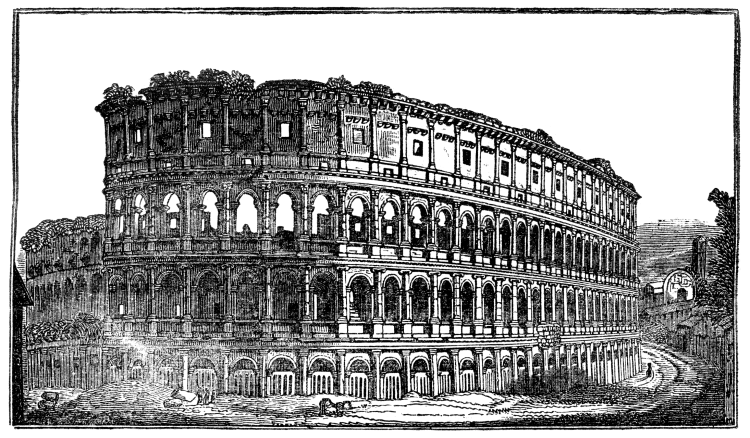
[Colosseum or Coliseum of Rome.]
When the imperial power was firmly established at Rome, the sports of the amphitheatre were conducted upon a scale to which the Consuls of the republic had scarcely dared to aspire. Caligula, on his birth-day, gave four hundred bears, and as many other wild beasts to be slain; and on the birth-day of Drusilla, he exhibited these brutal spectacles, continued to the succeeding day on a similar scale[1]. Claudius instituted combats between Thessalian horsemen and wild bulls; and he also caused camels to fight for the first time with horses. Invention was racked to devise new combinations of cruelty. Many of the emperors abandoned themselves to these sports with as passionate an ardour as the uncultivated multitude. Sensuality debases as much as ignorance, because it is ignorance under another name. Claudius rose at daylight to repair to the Circus, and frequently remained, that he might not lose a single pang of the victims, while the people went to their afternoon meal. Sometimes, during the reigns of Claudius and Nero, an elephant was opposed to a single fencer; and the spectators were delighted by the display of individual skill. Sometimes, hundreds and even thousands of the more ferocious beasts were slaughtered by guards on horseback; and the pleasure of the multitude was in proportion to the lavishness with which the blood of man and beast was made to flow. The passion for these sports required a more convenient theatre for its gratification than the old Circus. The Colosseum was commenced by Vespasian, and completed by Titus (A. D. 79). This enormous building occupied only three years in its erection. Cassiodorus affirms that this magnificent monument of folly cost as much as would have been required for the building of a capital city. We have the means of distinctly ascertaining its dimensions and its accommodations from the great mass of wall that still remains entire; and although the very clamps of iron and brass that held together the ponderous stones of that wonderful edifice were removed by Gothic plunderers; and succeeding generations have resorted to it as to a quarry for their temples and their palaces; yet the “enormous skeleton” still stands, to show what prodigious works may be raised by the skill and perseverance of man, and how vain are the mightiest displays of his power when compared with those intellectual efforts which have extended the empire of virtue and of science.
The Colosseum, which is of an oval form, occupies the space of nearly six acres. “It may justly be said to have been the most imposing building, from its apparent magnitude, in the world; the pyramids of Egypt can only be compared with it in the extent of their plan, as they cover nearly the same surface[2].” The greatest length, or major axis, is 620 feet; the greatest breadth, or minor axis, 513 feet. The outer wall is 157 feet high in its whole extent. The exterior wall is divided into four stories, each ornamented with one of the orders of architecture. The cornice of the upper story is perforated for the purpose of inserting wooden masts, which passed also through the architrave and frieze, and descended to a row of corbels immediately above the upper range of windows, on which are holes to receive the masts. These masts were for the purpose of attaching cords to, for sustaining the awning which defended the spectators from the sun or rain. Two corridors ran all round the building, leading to staircases which ascended to the several stories; and the seats which descended towards the arena, supported throughout upon eighty arches, occupied so much of the space that the clear opening of the present inner wall next the arena is only 287 feet by 180 feet. Immediately above and around the arena was the podium, elevated about twelve or fifteen feet, on which were seated the emperor, senators, ambassadors of foreign nations, and other distinguished personages in that city of distinctions. From the podium to the top of the second story were seats of marble for the equestrian order; above the second story the seats appear to have been constructed of wood. In these various seats eighty thousand spectators might be arranged according to their respective ranks; and indeed it appears from inscriptions, as well as from expressions in Roman writers, that many of the places in this immense theatre were assigned to particular 146individuals, and that each might find his seat without confusion. The ground was excavated over the surface of the arena in 1813; a great number of substructions were then discovered, which by some antiquaries are considered to be of modern date, and by others to have formed dens for the various beasts that were exhibited. The descriptions which have been left by historians and other writers of the variety and extent of the shows, would indicate that a vast space and ample conveniences were required beneath the stage, to accomplish the wonders which were, doubtless, there realized in the presence of assembled Rome. We subjoin, from Messrs. Cresy and Taylor’s work, an interior view looking west, taken at the time when the arena was so excavated. It has since been filled up. The external view of this remarkable building is given as it existed in the time of Piranesi, in the last century.
Gibbon, the historian, has given a splendid description, in his twelfth book, of the exhibitions of the Colosseum; but he acknowledges his obligation to Montaigne, who, says the historian, “gives a very just and lively view of Roman magnificence in these spectacles.” Our readers will, we doubt not, be gratified by the quaint but most appropriate sketch of the old philosopher of France:—
“It was doubtless a fine thing to bring and plant within the theatre a great number of vast trees, with all their branches in their full verdure, representing a great shady forest, disposed in excellent order, and the first day to throw into it a thousand ostriches, a thousand stags, a thousand boars, and a thousand fallow deer, to be killed and disposed of by the people: the next day to cause an hundred great lions, an hundred leopards and three hundred bears to be killed in his presence: and for the third day, to make three hundred pair of fencers to fight it out to the last,—as the Emperor Probus did. It was also very fine to see those vast amphitheatres, all faced with marble without, curiously wrought with figures and statues, and the inside sparkling with rare decorations and enrichments; all the sides of this vast space filled and environed from the bottom to the top, with three or four score ranks of seats, all of marble also, and covered with cushions, where an hundred thousand men might sit placed at their ease; and the place below, where the plays were played, to make it by art first open and cleft into chinks, representing caves that vomited out the beasts designed for the spectacle; and then, secondly, to be overflowed with a profound sea, full of sea-monsters, and loaded with ships of war, to represent a naval battle: and thirdly, to make it dry and even again for the combats of the gladiators; and for the fourth scene, to have it strewed with vermilion and storax, instead of sand, there to make a solemn feast for all that infinite number of people—the last act of one only day.
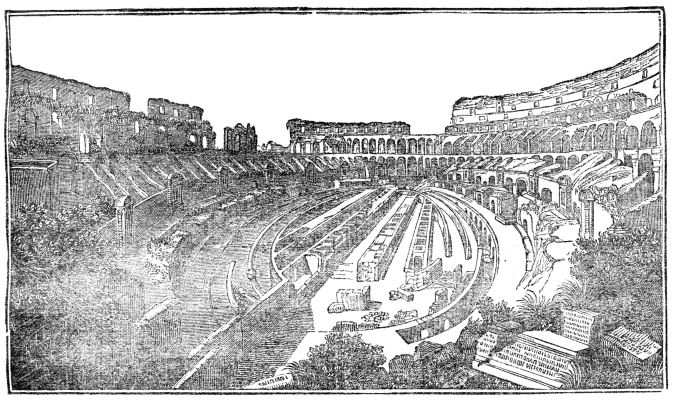
[Interior View of the Colosseum.]
“Sometimes they have made a high mountain advance itself, full of fruit-trees and other flourishing sorts of woods, sending down rivulets of water from the top, as from the mouth of a fountain: other whiles, a great ship was seen to come rolling in, which opened and divided of itself; and after having disgorged from the hold four or five hundred beasts for fight, closed again, and vanished without help. At other times, from the floor of this place, they made spouts of perfumed waters dart their streams upward, and so high as to besprinkle all that infinite multitude. To defend themselves from the injuries of the weather, they had that vast place one while covered over with purple curtains of needle-work, and by and by with silk of another colour, which they could draw off or on in a moment, as they had a mind. The net-work also that was set before the people to defend them from the violence of these turned-out beasts, was also woven of gold.”
“If there be anything excusable in such excesses as these,” continues Montaigne, “it is where the novelty and invention create more wonder than expense.” Fortunately for the real enjoyments of mankind, even under the sway of a Roman despot, “the novelty and invention” had very narrow limits when applied to matters so utterly unworthy and unintellectual as the cruel sports of the amphitheatre. Probus, indeed, transplanted trees to the arena, so that it had the appearance of a verdant grove; and Severus introduced four hundred ferocious animals in one ship sailing in the little lake which the arena formed. But on ordinary occasions, profusion,—tasteless, haughty, and uninventive profusion,—the gorgeousness of brute power, the pomp of satiated luxury—these constituted the only claim to the popular admiration. If Titus exhibited five thousand wild beasts at the dedication of the amphitheatre, Trajan bestowed ten thousand on the people at the conclusion of the Dacian war. If the younger Gordian collected together bears, elks, zebras, ostriches, boars, and wild horses, he was an imitator only of the spectacles of Carinus, in which the rarity of the animals was as much considered as their fierceness. Gibbon has well remarked, “While the populace gazed with stupid wonder on the splendid show, the naturalist might indeed observe the figure and properties of so many different species, transported from every part of the ancient world into the amphitheatre of Rome. But this accidental benefit, which science might derive from folly, 147is surely insufficient to justify such a wanton abuse of the public riches.” The prodigal waste of the public riches, however, was not the weightiest evil of the sports of the Circus. The public morality was sacrificed upon the same shrine as its wealth. The destruction of beasts became a fit preparation for the destruction of men. A small number of those unhappy persons who engaged in fight with the wild animals of the arena, were trained to these dangerous exercises, as are the matadors of Spain at the present day. These men were accustomed to exhaust the courage of the beast by false attacks; to spring on a sudden past him, striking him behind before he could recover his guard; to cast a cloak over his eyes, and then despatch or bind him at this critical moment of his terror; or to throw a cup full of some chemical preparation into his gaping mouth, so as to produce the stupefaction of intense agony. But the greater part of the human beings who were exposed to these combats, perilous even to the most skilful, were disobedient slaves and convicted malefactors. The Christians, during their persecutions, constituted a very large number of the latter class. The Roman power was necessarily intolerant; the assemblies of the new religion became objects of dislike and suspicion; the patience and constancy of the victims increased the fury of their oppressors; and even such a man as the younger Pliny held that their obstinacy alone was deserving of punishment. Thus, then, the imperial edicts against the early Christians furnished more stimulating exhibitions to the popular appetite for blood, than the combat of lion with lion, or gladiator with gladiator. The people were taught to believe that they were assisting at a solemn act of justice; and they came therefore to behold the tiger and the leopard tear the quivering limb of the aged and the young, of the strong and the feeble, without a desire to rescue the helpless, or to succour the brave.
⁂ Abridged from Menageries, vol. ii.