THE WEEK.
Reading edition
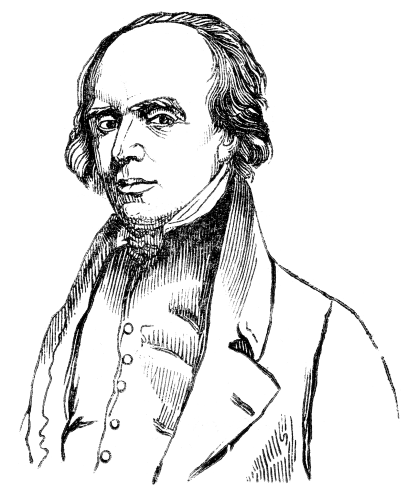
[Flaxman.]
July 4.—On this day, in the year 1715, was born at Haynichen, near Freyberg, in Saxony, the German poet, Christian Furchtegott Gellert. Gellert was not a man of the highest genius; but appearing at a favourable time, being animated by the finest spirit of benevolence and virtuous ambition, and possessing just the talents and character of mind suited to the task which he undertook, that of awakening the general body of his countrymen to a taste for literature, he produced as great and as gratifying an effect by his works as, perhaps, any writer that ever lived. His father was a clergyman, and he was originally intended for the same profession; but his first attempt in the pulpit convinced him that his constitutional timidity would probably prevent him from ever becoming an effective public speaker. He then resolved to devote himself to the instruction of his countrymen through the press. At this time Germany was almost destitute of a national literature. The country had given birth to many great scholars; and both classical learning and the abstruse philosophy of the middle ages were cultivated with zeal and success in its colleges. But scarcely any one had yet arisen to write for the people. This Gellert and a few of his friends resolved to do. Discarding all the repulsive technicalities of the schools, they proceeded to expound and illustrate the great principles of morality, metaphysics, and criticism, 126for the use of society at large, in a natural and popular style, such as was fitted to be intelligible and interesting to all. In this patriotic enterprise Gellert may be said to have spent his life. Every successive work which he produced was received with delight by Germany; but his celebrated ‘Fables’ were read with rapture by all classes of the population. One day a peasant appeared at Gellert’s door in Leipsic, with a waggon loaded with fire-wood. “Is it not here,” asked the man, “that Mr. Gellert lives?” On being told that it was, he desired to see the master of the house; and having been brought to him, “Are not you, sir,” he said, “the author of the ‘Fables?’” “I am,” replied Gellert. “Well then,” said the other, “here is a load of wood, which I have brought you, to thank you for the pleasure which your book has given to myself, my wife, and my children.” By such a heart as Gellert’s this was probably felt to be a more touching tribute to his powers than the plaudits of crowded theatres would have been. Another time he was standing in the workshop of a bookbinder, when a villager came in with a book in his hand. “Here,” said he, “I want this book strongly bound.” “Where did you pick up this book?” asked the binder. “I bought it in our town,” replied the delighted possessor of the treasure; “it has made the steward of the manor and the schoolmaster laugh till they have almost split their sides: I have a little boy, who is now a tolerably good reader; he shall read from this book to me in the evening, while I smoke my pipe, and I will go no more to the ale-house.” Even the war (commonly called the seven years’ war) which ravaged a great part of Germany from 1756 to 1763, did not extinguish the popular enthusiasm for the writings of Gellert. When Leipsic was taken by the Prussians in 1758, a lieutenant of hussars found out the peaceable poet in his house, and not contented with thanking him warmly for the delightful books to which, he said, he owed so many pleasant hours, insisted, by way of more substantially testifying his gratitude, upon making him a present of a pair of pistols, which he had taken from a Cossack. Nay, the common soldiers themselves used to come, almost in regiments, to hear a course of lectures on moral philosophy, which he read in public about this time; and it is related that one man, having obtained leave of absence, turned a considerable way out of his road, on his journey homewards, in order to see, as he expressed it, that honest fellow, Mr. Gellert, whose books had saved him from becoming a profligate. The works of Gellert have been frequently printed in a collected form, and amount, in the fullest edition, to ten volumes duodecimo. He had been afflicted during the greater part of his life by bad health; and died on the night of the 13th of December, 1769, in the fifty-fifth year of his age. Having lingered long in considerable pain, he remarked to the physician, a short time before his death, that he had not believed it would have been so difficult to die, and asked when the termination of his sufferings might be expected. When he was informed that another hour would probably release him, “God be praised,” he said; “still another hour!” and then lay in silent resignation, till the expected deliverance came. Germany lamented, with all the tokens of national grief, the loss of her amiable instructor; and medals and public monuments testified the admiration and gratitude of all ranks of his countrymen.
July 6.—The birth-day of John Flaxman, the late eminent sculptor, whose works have done so much to form the English school of design. Flaxman was born in 1755, in York, from whence he was removed in his infancy to London, where his father, who was a moulder of figures, subsequently kept a shop in the Strand for the sale of plaster casts. The father’s occupation, no doubt, contributed to call forth the genius of the son; but the boy very early began to give evidence of fondness for those arts to which his future life was devoted, and of singular taste and skill in the efforts of his uninstructed pencil. Like many more of the most distinguished cultivators of literature and art, he was prevented by the weakness and delicate health of his early years from mixing in the ruder sports of boys of his own age; and this, of course, gave him more time for solitary study. His father was not able to afford him the advantages of a regular education; but he rapidly acquired a great deal of knowledge by his own unaided efforts. When he was fifteen he was admitted a student in the Royal Academy. Here he was successful in a competition for the inferior honour of the silver medal; but on the contest for the gold one, Sir Joshua Reynolds, the President, awarded the prize to another. This was, perhaps, upon the whole, not an unfortunate incident for Flaxman, though he severely felt what he thought an injustice. His rival, notwithstanding his good fortune on this occasion, never rose to any distinction; but Flaxman, with the heroism of true genius, resolved to obliterate this defeat of his youth by future triumphs, of the glory of which no such decision should be able to rob him. And this resolution he nobly fulfilled. His first employment was given him by the Messrs. Wedgewood, the productions of whose porcelain potteries he embellished with designs that gave at once a new character to this branch of British manufactures. In 1782 he married; and five years afterwards proceeded to visit Italy, where he remained till 1794, studying the celebrated monuments of the fine arts with which that country abounds, and at the same time exerting his own pencil in the production of works which soon spread his fame over Europe. Having then returned to England, he was in 1797 elected an Associate, and in 1800 a Member, of the Royal Academy. After this he executed many great works in marble; and, as a lecturer, afforded some valuable contributions to the literature of his profession. For many years before his death his name ranked with the highest of the living artists of England. But we must refer the reader for an account of his performances to Mr. Allan Cunningham’s interesting life of him, lately published, or to the abstract of that memoir in the second number of the Gallery of Portraits. He died at his house in Buckingham-street, on the 7th of December, 1826, in the seventy-second year of his age.