THE BRITISH MUSEUM.—No. 4.
Reading edition
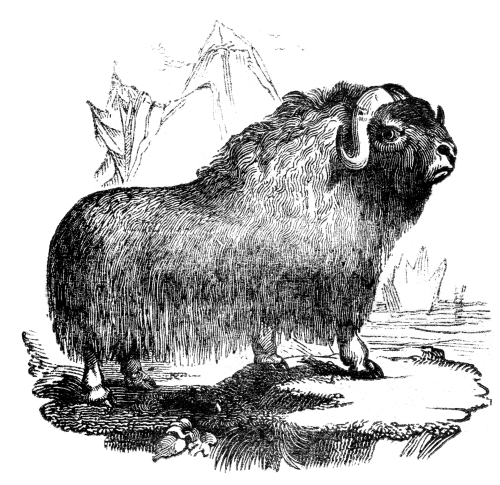
[The Musk-Ox.]
We shall occasionally turn aside from the monuments of Art in the British Museum to notice some of the specimens in the collection of Natural History. Stuffed skins and skeletons are, of course, much less interesting, both to the scientific student of zoology and to the ordinary observer, than the living animal, retaining his natural habits, as far as they can be preserved, in a menagerie. But, at the same time, a stuffed skin affords a much better notion of the animated creature than the best drawing; and, in some cases, the living specimen cannot be procured, or kept alive, in this country. In such cases we are compelled to resort to such preserved specimens as that of the musk-ox, on the great staircase of the Museum.
This specimen is very faithfully represented in the above wood-cut. The animal, of which this skin was once a part, was shot by some of the persons accompanying Captain Parry, in one of his expeditions to the Polar Seas; and was presented to the Museum by the Lords of the Admiralty. The appearance of the musk-ox, as the visitor will observe, is strikingly different from that of the common black cattle of Great Britain. Its limbs are singularly short,—its crooked horns are broad and flattened,—long thick hair covers the whole of its trunk, hanging down nearly to the ground,—and its short tail, bending inwards, is entirely hidden by the long hair of the rump and hind quarters. It will be noticed that the hair is particularly thick under the throat, looking something like a horse’s mane inverted. The adaptation of the structure of this animal to the frozen regions which he inhabits, offers one of the most striking illustrations of design which the natural world exhibits. The shortness of the creature’s limbs prevents that exposure of the trunk to the snow-storms and the cold, which would result from a greater elevation; whilst he is more effectually protected from the severity of the seasons by the dense mass of hair with which his whole body is covered, and which, in winter, becomes a thick woolly coat, beneath the long straight hair which forms his outer garment. The Author of the Appendix to Parry’s Second Voyage, in noticing the remarkable projection of the orbits of the eyes in this species, considers that their formation is necessary to carry the eye of the animal clear beyond the large quantity of hair required to preserve the warmth of the head.
Thus protected from the inclemency of winter cold, the musk-ox remains the contented and happy inhabitant of the most barren and desolate parts of the earth. Within the Arctic Circle, in those almost inaccessible regions which lie nearest the North Pole, large herds of these quadrupeds are found, appearing to derive as much enjoyment from existence as the cattle who graze on the most luxuriant pastures, beneath a genial sky. They are not often found at a great distance from woods; but when they feed upon open grounds they prefer the most precipitous situations, climbing amidst rocks with all the agility and precision of the mountain-goat or the chamois. Grass, when they can get it, moss, twigs of willow, and pine shoots, constitute their food. The parts of the polar regions inhabited by the musk-ox are thus described in the Appendix to Parry’s Second Voyage:—
“This species of ox inhabits the North Georgian Islands in the summer months. They arrived in Melville Island in the middle of May, crossing the ice from the southward, and quitted it on their return towards the end of September. The musk-ox may be further stated, on Esquimaux information, to inhabit the country on the west of Davis’ Strait, and on the north of Baffin’s Bay; as a head and horns and a drawing of a bull being shown to the Esquimaux of the west coast of Davis’ Strait who were communicated with on the 7th of September, were immediately recognized, and the animal called by the name of Umingmack. This is evidently the same with the Umimak of the Esquimaux of Wolstenholme Sound, who were visited by the former expedition, and of which nothing more could be learnt at the time from their description than that it was a large horned animal inhabiting the land, and certainly not a rein-deer. It is probable that the individuals which extend their summer migration to the north-east of Baffin’s Bay, retire during the winter to the continent of America, or to its neighbourhood, as the species is unknown in South Greenland.”
Captain Franklin, in his Journey to the Polar Sea, has given the following account of the habits of this species:—
“The musk-oxen, like the buffalo, herd together in bands, and generally frequent barren grounds during the summer months, keeping near the rivers, but retire to the woods in winter. They seem to be less watchful than most other wild animals, and when grazing are not difficult to approach, provided the hunters go against the wind. When two or three men get so near a herd as to fire at them from different points, these animals, instead of separating or running away, huddle closer together, and several are generally killed; but if the wound is not mortal they become enraged, and dart in the most furious manner at the hunters, who must be very dexterous to evade them. They can defend themselves by their powerful horns against wolves and bears, which, as the Indians say, they not unfrequently kill. The musk-oxen feed on the same substances with the rein-deer, and the prints of the feet of these two animals are so much alike, that it requires the eye of an experienced hunter to distinguish them. The largest killed by us did not exceed in weight three hundred pounds. The flesh has a musky disagreeable flavour, particularly when the animal is lean, which unfortunately for us was the case with all that we now killed,”
The bulls of this species killed during Parry’s second voyage weighed, upon an average, about 700 lbs., yielding about 400 lbs. of meat; and they stood about 10½ hands high at the withers.
On the staircase of the Museum are also stuffed specimens of a male and female Giraffe, or Camelopard, which were presented to the Museum by Mr. Burchell, the traveller in Africa. The living giraffe which was presented to George IV. in 1827, by the Pacha of Egypt, died in 1829. The other giraffe sent to the 125government of France, in 1827, is still living in the Jardin des Plantes, at Paris. It is impossible from a studied specimen to form an adequate idea of the grace and beauty of this remarkable animal; nor of the impression produced upon the senses by a creature of such enormous height lifting up its head to gather the tender leaves from branches three times as high as a tall man. Till the living giraffes were brought to England and France there was a general belief that the descriptions of this animal were partly fabulous. It is now established that the account which was given of this animal by Le Vaillant, one of the most amusing of travellers, who saw the animal in its native woods, is perfectly accurate. We copy the following description from his Second Voyage, as translated in ‘The Menageries,’ Vol. I.:—
“The giraffe ruminates, as every animal does that possesses, at the same time, horns and cloven feet. It grazes also in the same way; but not often, because the country which it inhabits has little pasturage. Its ordinary food is the leaf of a sort of mimosa, called by the natives kanaap, and by the colonists, kameeldoorn. This tree being only found in the country of the Namaquas, may probably afford a reason why the giraffe is there fixed, and why he is not seen in those regions of Southern Africa where the tree does not grow.
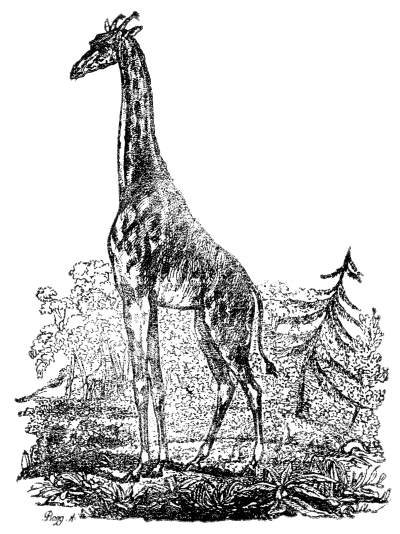
[The Giraffe.]
“Doubtless the most beautiful part of his body is the head. The mouth is small; the eyes are brilliant and full. Between the eyes, and above the nose is a swelling, very prominent and well defined. This prominence is not a fleshy excrescence, but an enlargement of the bony substance; and it seems to be similar to the two little lumps, or protuberances, with which the top of his head is armed, and which, being about the size of a hen’s egg, spring, on each side, at the commencement of the mane. His tongue is rough, and terminates in a point. The two jaws have, on each side, six molar teeth; but the lower jaw has, beyond these, eight incisive teeth, while the upper jaw has none.
“The hoofs, which are cleft, and have no nails, resemble those of the ox. We may remark, at first sight, that those of the fore feet are larger than those of the hind. The leg is very slender, but the knees have a prominence, because the animal kneels when he lies down.
“If I had not myself killed the giraffe, I should have believed, as have many naturalists, that the fore legs are much longer than the hind. This is an error; for the legs have, in general, the proportion of those of other quadrupeds. I say in general, because in this genus there are varieties, as there are in animals of the same species.… His defence, as that of the horse and other hoofed animals, consists in kicks; and his hinder limbs are so light, and his blows so rapid, that the eye cannot follow them. They are sufficient for his defence against the lion. He never employs his horns in resisting any attack.… The giraffes, male and female, resemble each other in their exterior, in their youth. Their obtuse horns are then terminated by a knot of long hair: the female preserves this peculiarity some time, but the male loses it at the age of three years. The hide, which is at first of a light red, becomes of a deeper colour as the animal advances in age, and is at length of a yellow brown in the female, and of a brown approaching to black in the male. By this difference of colour the male may be distinguished from the female at a distance. The skin varies in both sexes, as to the distribution and form of the spots. The female is not so high as the male, and the prominence of the front is not so marked. She has four teats. According to the account of the natives, she goes with young about twelve months, and has one at a birth.”