THE CAVE OF ELEPHANTA.
Reading edition
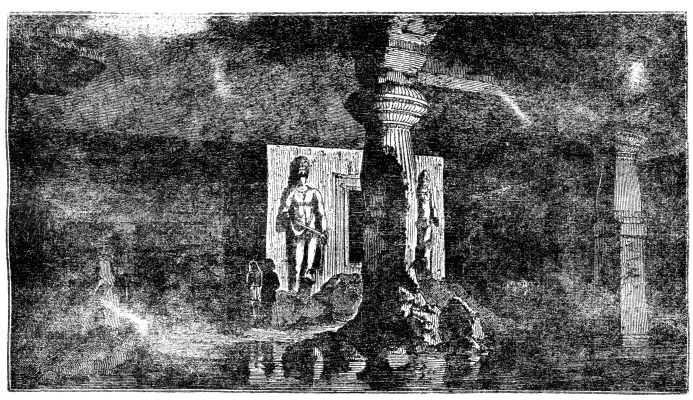
One of the earliest monuments of India that attracted the notice of Europeans was the excavation of Elephanta, situated in a beautiful island of the same name, called by the natives Goripura, or Mountain City. This island is in the bay of Bombay, seven miles from Bombay castle; it is about six miles in circumference, and composed of two long hills with a narrow valley between them.
The island has taken its familiar name from a colossal statue of an elephant, cut out of a detached mass of blackish rock unconnected with any stratum below. This figure has had another on its back, which the old travellers call a young elephant, but which, as far as we can judge from the drawing of what remains of it, has much more probably been a tiger. The head and neck of this elephant dropped off about 1814, owing to a large fissure that ran up through its back. The length of this colossal figure, from the forehead to the root of the tail, was 13 feet 2 inches; and the height at the head 7 feet 4 inches. The remains of this colossus stand about 250 yards to the right of the usual landing-place, which is towards the southern part of the island.
After proceeding up the valley till the two mountains unite, we come to a narrow path, after ascending which there is a beautiful prospect of the northern part of the island, and the opposite shores of Salsette. “Advancing forward and keeping to the left along the bend of the hill, we gradually mount to an open space, and come suddenly on the grand entrance of a magnificent temple, whose huge massy columns seem to give support to the whole mountain which rises above it.
“The entrance into this temple, which is entirely hewn out of a stone resembling porphyry, is by a spacious front supported by two massy pillars and two pilasters forming three openings, under a thick and steep rock overhung by brushwood and wild shrubs. The long ranges of columns that appear closing in perspective on every side; the flat roof of solid rock that seems to be prevented from falling only by the massy pillars, whose capitals are pressed down and flattened as if by the superincumbent weight; the darkness that obscures the interior of the temple, which is dimly lighted only by the entrances; and the gloomy appearance of the gigantic stone figures ranged along the wall, and hewn, like the whole temple, out of the living rock,—joined to the strange uncertainty that hangs over the history of this place,—carry the mind back to distant periods, and impress it with that kind of uncertain and religious awe with which the grander works of ages of darkness are generally contemplated.
“The whole excavation consists of three principal parts: the great temple itself, which is in the centre, and two smaller chapels, one on each side of the great temple. These two chapels do not come forward into a straight line with the front of the chief temple, are not perceived on approaching the temple, and are considerably in recess, being approached by two narrow passes in the hill, one on each side of the grand entrance, but at some distance from it. After advancing to some distance up these confined passes, we find each of them conduct to another front of the grand excavation, exactly like the principal front which is first seen; all the three fronts being hollowed out of the solid rock, and each consisting of two huge pillars with two pilasters. The two side fronts are precisely opposite to each other on the east and west, the grand entrance facing the north. The two wings of the temple are at the upper end of these passages, and are close by the grand excavation, but have no covered passage to connect them with it.[1]”
From the northern entrance to the extremity of this cave is about 130½ feet, and from the eastern to the western side 133. Twenty-six pillars, of which eight are broken, and sixteen pilasters, support the roof. Neither the floor nor the roof is in the same plane, and consequently the height varies, being in some parts 17½, in others 15 feet. Two rows of pillars run parallel to one another from the northern entrance and at right angles to it, to the extremity of the cave; and the pilasters, one of which stands on each side of the two front pillars, are followed by other pilasters and pillars also, forming on each side of the two rows already described, another row, running parallel to them up to the southern extremity of the cave. The pillars on the eastern and western front, which are like those on the northern side, are also 122continued across the temple from east to west. Thus the ranges of pillars form a number of parallel lines intersecting one another at right angles—the pillars of the central parts being considered as common to the two sets of intersecting lines. The pillars vary both in their size and decorations, though the difference is not sufficient to strike the eye at first.
All the walls are covered with reliefs (which are yet very little known for want of complete drawings), but are described as being in good proportion and producing rather a pleasing effect than the contrary. All the sculptures refer to the Indian mythology, and the temple seems to have been the special property of the god Siva, since he appears very frequently with his usual attributes. In one place we see him as half man and half woman, with one breast and four hands, in one of which he holds the snake.
In Mr. Daniell’s Views in India (vol. v. pl. 7) we have a beautiful drawing of the northern front of the Elephanta cave, with its overhanging trees and shrubs. His eighth plate is that which we have above given. “The view is taken near the centre of the temple looking westward. The space between four of the pillars is formed into a small temple, sacred to Mahadiva (Siva), and has an entrance on each side, guarded by colossal figures.” “On the walls are several groups of figures in basso-relievo, evidently relating to the Hindoo mythology; many of them are of colossal dimensions and well executed. To the east and west are small apartments, decorated also in the same manner. This excavation is considerably elevated above the sea; the floor, nevertheless, is generally covered with water during the monsoon season; the rain being then driven in by the wind; a circumstance to which possibly its present state of decay is chiefly owing.”
Larger excavations of this kind are found in the neighbouring island of Salsette. But these are far surpassed by the temples of Ellora, which are in the province of Hyderabad, about twenty miles north-west from Aurungabad, the capital, and 239 east of Bombay. It may be considered as near the centre of India. Here we have a granite mountain, which is of an amphitheatre form, completely chiselled out from top to bottom, and filled with innumerable temples; the god Siva alone having, it is said, about twenty appropriated to himself. To describe the numerous galleries and rows of pillars which support various chambers lying one above another, the steps, porticos, and bridges of rock over canals, also hewn out of the solid rock, would be impossible; and we recommend those who have the opportunity to look at Daniell’s designs, which will serve to give some idea of this wonderful place.
The rock-cut temples of India are generally supposed to be of higher antiquity than pagodas[2] or temples, built on the surface of the earth.
⁂ Abridged from ‘British Museum—Egyptian Antiquities.’