THE NATURAL BRIDGE OF VIRGINIA.
Reading edition
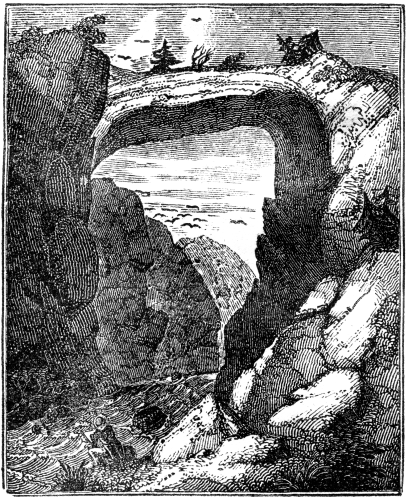
Virginia, the largest state in the American Union, is intersected by a chain of mountains called the Blue Ridge, which, running in their general direction parallel to the Atlantic coast, divide the state into two parts not differing very considerably in extent. The portion immediately to the west of the Blue Ridge is an extensive and fertile valley of limestone formation. It is principally watered by one stream, the Shenandoah, which unites with another, the Potomac, at a place called Harper’s Ferry. At their point of junction, on the west side of the Blue Ridge, the spectator, as he takes his stand on the high ground above the small town of Harper’s Ferry, sees before him a wide opening in the mountain chain through which the united current finds its way. On each side the mountains rise in some parts very abruptly, and their rugged faces and the shattered appearance of the whole of this magnificent natural canal show evident traces of a violent disruption.
This passage at Harper’s Ferry has been often described by different travellers, but never, as far as we have seen, in a way calculated to give an accurate conception of what it really is. Nor do we intend to attempt this description, but only to notice briefly another natural phenomenon of the Valley of Shenandoah, which, though less talked of and visited than Harper’s Ferry, is for beauty and grandeur perhaps unrivalled. We allude to the Natural Bridge, or Rock-Bridge, as it is familiarly called by the people who live near it, which is situated a few miles on the west side of the Blue Ridge, on a small stream in the upper part of the great valley, and in the county of Rock-Bridge.
From a small and uncomfortable tavern in the neighbourhood, kept by a Mr. Galbraith, (we wish this could meet his eye and make him mend his fare,) we pass for about two miles over uneven ground, and after ascending a small hill, we find a piece of rough stony road with a few stunted firs and scrub oaks on the right hand and on the left. A traveller might proceed without making any other observation, as the common road runs right over the bridge, and it is said that some people have actually passed over without being aware of it. But though this is certainly a possible occurrence if a person should be in a closed carriage, it can hardly have happened to a man on foot or on horseback, who is accustomed to keep his eyes open when he is travelling. On the right and left he will perceive that the slope of the hill is interrupted by a deep and sudden descent; and on going nearer to the right side of the road, he finds himself on the edge of a tremendous precipice. At the bottom a small stream is seen making its way amidst broken rocks. Going to the opposite side of the road and looking down there, he will observe the little river continuing its course in a deep channel down a narrow valley. The traveller is now on the Natural Bridge; he is standing on a stupendous natural arch of limestone; and though he may form some conjecture of his situation by looking down from the edge of the precipice, he can have no adequate conception without viewing it from below. The arch is best seen from the bed of the rivulet, and from a point just under it. On looking up you behold a noble arch of one solid mass of stone hanging over your head, somewhat curved in its highest part, and almost like the work of man. The same native rock forms, on each side, the supports of this enormous arch, which is said to be about 80 feet wide near the top; at the level of the water the width is only about forty. The whole height from the outer top of the arch to the water is about 210 feet, as ascertained by measurement with a string and a stone at the end. This is greater than the height of the London monument. The vertical thickness of the arch is probably about 30 feet. Like many other great works both of nature and art it is not the first sight that produces the deepest impression. On a second visit we found that we had learned to form more accurate conceptions of this wonderful bridge, beneath which a man might sit and gaze for hours with still increasing astonishment at the majestic arch which nature constructed before man began his work, and which seems likely to outlive the most durable of his monuments. Whatever may have been the origin of this bridge, it seems pretty certain, from an inspection of it, that it has not been produced by any sudden and violent cause.
The stream that runs beneath, called Cedar Creek, though inconsiderable, adds to the general effect. When we visited the place, drops of water, filtered through the limestone, were falling in quick succession from the arch, and by the time occupied in their descent, their increasing velocity, and their full bright appearance, served to give a measure of the height from which they fell, and to increase the beauty of the scene. There is another natural bridge in Virginia, in Scot county, which is said to be above 340 feet high, but is inferior to that of Cedar Creek in form and completeness.
The Prebischthor, in the Saxon Switzerland, has sometimes been compared with this Virginia Bridge, but it is a very different kind of thing.
The accompanying view, taken from the N.W. side, at the level of the water, has hardly any pretensions beyond showing the general shape of the arch and the view through it, which is very confined and altogether devoid of interest.
106The chain[1] of the Andes in South America presents most striking natural phenomena in the immense clefts, or crevasses as they are sometimes called, which separate two contiguous masses of mountain, and in some instances are near 5000 feet deep. If Mount Vesuvius were plunged into one of these frightful abysses, its summit would not reach to the peaks of the highest rocks on each side; while the bottom of the cleft would be only one-fourth less elevated above the level of the sea than the passes of St. Gothard and Mont Cenis in the Alps.
The valley of Icononzo is less remarkable for its dimensions than for the extraordinary form of its rocks, which seem as if they had been cut by the hand of man. Their naked and arid summits form a most picturesque contrast with the tufts of trees and herbaceous plants which cover the borders of the crevasse. A little torrent has made itself a way through the valley, and lies sunk in a channel, which is so difficult of approach, that the river would hardly be passable if nature herself had not formed two bridges of rock, which are justly regarded as the greatest curiosity in that country. Humboldt and Bonpland crossed these natural bridges in 1801, on their route from Santa Fé de Bogota to Popayan and Quito.
In the valley of Icononzo the grès or sandstone is composed of two distinct kinds of rock—one very compact and quartzose without any marks of fissure or stratification—the other a fine-grained sandstone, formed of an infinite number of thin and almost horizontal layers. We may imagine that the compact material resisted the force which rent the mountains asunder, and that it is the unbroken mass of this rock which forms the bridge by which the traveller now crosses from one side of the valley to the other. This natural arch is about 47½ feet long, 41½ wide, and about 8 feet thick at the centre. By very careful experiments made on falling bodies, with the assistance of a good chronometer, combined with the measurement obtained by a plummet, it appears that the height of the upper of the two natural bridges, above the level of the torrent, is about 313 feet.
Sixty feet below the first natural bridge there is another formed by three enormous masses of rock, which have fallen in such a way as to support one another. The centre rock forms the key of the arch.