THE MAHOGANY TABLE.
Reading edition
Milton, who was at once the most sublime and the most practical of writers, has said,
⸻ “To know
That which before us lies in daily life,
Is the prime wisdom.”
The poet more especially had in view that knowledge to which all other knowledge is secondary—we mean the knowledge of ourselves. But we may not improperly adopt his forcible expressions as a motto to a series of articles which we shall occasionally publish, which will have for their object to collect some of the most striking facts belonging to the commonest things by which we are surrounded in our every-day life, particularly those comforts and conveniences which the humblest man possesses in a state of advanced civilization. The history of a knife, or a button, or a coat, or a watch, or an earthen pan, or a candle, or a lump of coal, or a mahogany table, or a Penny Magazine, suggests to our minds more precise and satisfactory notions of the progress of society, and therefore of the real history of the people of these kingdoms, than all the details of wars and treaties and state intrigues, of which history is in general made up. In the execution of such a purpose it is not important to pursue any systematic plan. The most material consideration will be to select those things of ordinary use which are so common, that it would be difficult to find a single reader who is not more or less indebted to them for some of his enjoyments.
We will begin with a Mahogany Table. If we had been speaking about a mahogany table, or any other article of mahogany, thirty or forty years ago, we should have expected only to have interested the rich in the description of this important material of English furniture. Now, what tradesman, or mechanic, or even cottager, does not possess some article of mahogany—if it be only a tea-caddy? The universal employment of mahogany for articles of furniture, whose price does not operate as a prohibition against their use in general society, has been produced by the large application of capital to the commercial speculation of bringing mahogany logs to this country from the West Indies,—and, further, by the invention of machinery for cutting those logs into thin layers, called veneers, by which operation the finest wood is brought within a reasonable cost. Now observe what commercial enterprise and mechanical ingenuity will accomplish in a comparatively small period. Some piece of mahogany furniture is now, probably, found in every house in England;—a hundred and eight years ago the wood was unknown here. A physician of the name of Gibbons, who resided in London, received in 1724 a present of some mahogany planks from his brother, a West-India captain. Dr. Gibbons was then building a house in King-street, Covent-garden, and he desired his carpenter to work up the wood. The carpenter had no tool hard enough to touch it; so the planks were laid aside. The doctor’s wife, after the house was finished, wanted a candle-box, and the mahogany was again thought of. A cabinet-maker of the name of Wollaston was applied to; and he also complained that his tools were too soft. But he persevered, and the candle-box was at length completed—after a rude fashion no doubt. The candle-box was so much admired, that the physician resolved to have a mahogany bureau; and when the bureau was finished, all the people of fashion came to see it. The cabinet-maker procured more planks, and made a fortune by the numerous customers he obtained. From that time the use of mahogany furniture went forward amongst the luxurious;—and the drawers and bureaus of walnut-tree and pear-tree were gradually superseded in the houses of the rich. To show the present extensive use of mahogany in this country it 108may be sufficient to mention that in 1829 the importation of this wood amounted to 19,335 tons.
The common mahogany (called by botanists Swietenia mahagoni) is one of the most majestic trees of the whole world. There are trees of greater height than the mahogany;—but in Cuba and Honduras this tree, during a growth of two centuries, expands to such a gigantic trunk, throws out such massive arms, and spreads the shade of its shining green leaves over such a vast surface, that even the proudest oaks of our forests appear insignificant in comparison with it. A single log, such as is brought to this country from Honduras, not unfrequently weighs six or seven tons.
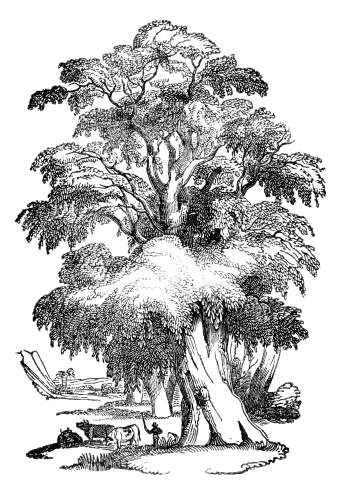
[Mahogany Tree.]
When we consider the enormous size of a trunk of mahogany, and further learn that the most valuable timber grows in the most inaccessible situations, it must be evident that a great portion of the price of this timber must be made up of the cost of the labour required for transporting it from its native forests to the place of its embarkation for England. The mode in which this difficult work is accomplished is highly interesting; and we have, fortunately, the means of giving an account of the process (which, we believe, has never before been described in any English publication,) from some statements printed in a Honduras Almanac, which has been kindly put into our hands for this purpose.
The season for cutting the mahogany usually commences about the month of August. The gangs of labourers employed in this work consist of from twenty to fifty each, but few exceed the latter number. They are composed of slaves and free persons, without any comparative distinction of rank, and it very frequently occurs that the conductor of such work, here styled the Captain, is a slave. Each gang has also one person belonging to it termed the Huntsman. He is generally selected from the most intelligent of his fellows, and his chief occupation is to search the woods, or, as it is called, the bush, to find labour for the whole. Accordingly, about the beginning of August, the huntsman is despatched on his important mission. He cuts his way through the thickest of the woods to some elevated situation, and climbs the tallest tree he finds, from which he minutely surveys the surrounding country. At this season the leaves of the mahogany tree are invariably of a yellow reddish hue, and an eye accustomed to this kind of exercise, can, at a great distance, discern the places where the wood is most abundant. He now descends, and to such places his steps are directed; and, without compass, or other guide than what observation has imprinted on his recollection, he never fails to reach the exact point at which he aims. On some occasions no ordinary stratagem is necessary to be resorted to, by the huntsman, to prevent others from availing themselves of the advantage of his discoveries; for, if his steps be traced by those who may be engaged in the same pursuit, which is a very common thing, all his ingenuity must be exerted to beguile them from the true scent. In this, however, he is not always successful, being followed by those who are entirely aware of all the arts he may use, and whose eyes are so quick that the lightest turn of a leaf, or the faintest impression of the foot, is unerringly perceived. The treasure being, however, reached by one party or another, the next operation is the felling of a sufficient number of trees to employ the gang during the season. The mahogany tree is commonly cut about ten or twelve feet from the ground, a stage being erected for the axe-man employed in levelling it. The trunk of the tree, from the dimensions of the wood it furnishes, is deemed the most valuable; but, for ornamental purposes, the limbs, or branches, are generally preferred.
A sufficient number of trees being felled to occupy the gang during the season, they commence cutting the roads upon which they are to be transported. This may fairly be estimated at two-thirds of the labour and expense of mahogany cutting. Each mahogany work forms in itself a small village on the bank of a river,—the choice of situation being always regulated by the proximity of such river to the mahogany intended as the object of future operations.
After completing the establishment of a sufficient number of huts for the accommodation of the workmen, a main road is opened from the settlement, in a direction as near as possible to the centre of the body of trees so felled, into which branch-roads are afterwards introduced, the ground through which the roads are to run being yet a mass of dense forest, both of high trees and underwood. The labourers commence by clearing away the underwood with cutlasses. This labour is usually performed by task-work, of one hundred yards, each man, per day. The underwood being removed, the larger trees are then cut down by the axe, as even with the ground as possible, the task being also at this work one hundred yards per day to each labourer. The hard woods growing here, on failure of the axe, are removed by the application of fire. The trunks of these trees, although many of them are valuable, such as bullet-tree, ironwood, redwood, and sapodilla, are thrown away as useless, unless they happen to be adjacent to some creek or small river, which may intersect the road. In that case they are applied to the construction of bridges, which are frequently of considerable size, and require great labour to make them of sufficient strength to bear such immense loads as are brought over them.
If the mahogany trees are much dispersed or scattered, the labour and extent of road-cutting is, of course, greatly increased. It not unfrequently occurs that miles of road and many bridges are made to a single tree, that may ultimately yield but one log. When roads are cleared of brush-wood, they still require the labour of hoes, pick-axes, and sledge hammers to level down the hillocks, to break the rocks, and to cut such of the remaining stumps as might impede the wheels that are hereafter to pass over them.
109The roads being now in a state of readiness, which may generally be effected by the month of December, the cross cutting, as it is technically called, commences. This is merely dividing crosswise, by means of saws, each mahogany tree into logs, according to their length; and it often occurs, that while some are but long enough for one log, others, on the contrary, will admit of four or five being cut from the same trunk or stem. The chief guide for dividing the trees into logs is the necessity for equalizing the loads the cattle have to draw. Consequently, as the tree increases in thickness, the logs are reduced in length. This, however, does not altogether obviate the irregularity of the loads, and a supply of oxen are constantly kept in readiness to add to the usual number, according to the weight of the log. This becomes unavoidable, from the very great difference of size of the mahogany trees, the logs taken from one tree being about 300 cubic feet, while those from the next may be as many thousand. The largest log ever cut in Honduras was of the following dimensions:—Length, 17 feet; breadth, 57 inches; depth, 64 inches; measuring 5,168 superficial feet, or 15 tons weight.
The sawing being now completed, the logs are reduced, by means of the axe, from the round or natural form, into the square. The month of March is now reached, when all the preparation before described is, or ought to be, completed; when the dry season, or time of drawing down the logs from the place of their growth, commences. This process can only be carried on in the months of April and May; the ground, during all the rest of the year, being too soft to admit of a heavily laden truck to pass over it without sinking. It is now necessary that not a moment should be lost in drawing out the wood to the river.
A gang of forty men is generally capable of working six trucks. Each truck requires seven pair of oxen and two drivers; sixteen to cut food for the cattle, and twelve to load or put the logs on the carriages. From the intense heat of the sun, the cattle, especially, would be unable to work during its influence; and, consequently, the loading and carriage of the timber is performed in the night. The logs are placed upon the trucks by means of a temporary platform laid from the edge of the truck to a sufficient distance upon the ground, so as to make an inclined plane, upon which the log is gradually pushed up by bodily labour, without any further mechanical aid.
The operations of loading and carrying are thus principally performed during the hours of darkness. The torches employed are pieces of wood split from the trunk of the pitch-pine. The river-side is generally reached by the wearied drivers and cattle before the sun is at its highest power; and the logs, marked with the owner’s initials, are thrown into the river.
About the end of May the periodical rains again commence; the torrents of water discharged from the clouds are so great as to render the roads impassable in the course of a few hours, when all trucking ceases. About the middle of June the rivers are swollen to an immense height. The logs then float down a distance of two hundred miles, being followed by the gang in pitpans (a kind of flat-bottomed canoe), to disengage them from the branches of the overhanging trees, until they are stopped by a boom placed in some situation convenient to the mouth of the river. Each gang then separates its own cutting, by the marks on the ends of the logs, and forms them into large rafts; in which state they are brought down to the wharves of the proprietors, where they are taken out of the water, and undergo a second process of the axe, to make the surface smooth. The ends, which frequently get split and rent by being dashed against rocks in the river by the force of the current, are also sawed off. They are now ready for shipping.
The ships clearing out from Belize, the principal port of Honduras, with their valuable freight of mahogany, either come direct to England, or take their cargo to some free warehousing port of the British possessions in the West Indies or America.
We must describe the beautiful process of cutting mahogany logs into veneers, before we have reached the point when the skill of the cabinet-maker is employed to produce a mahogany table. This shall be done in an early number.
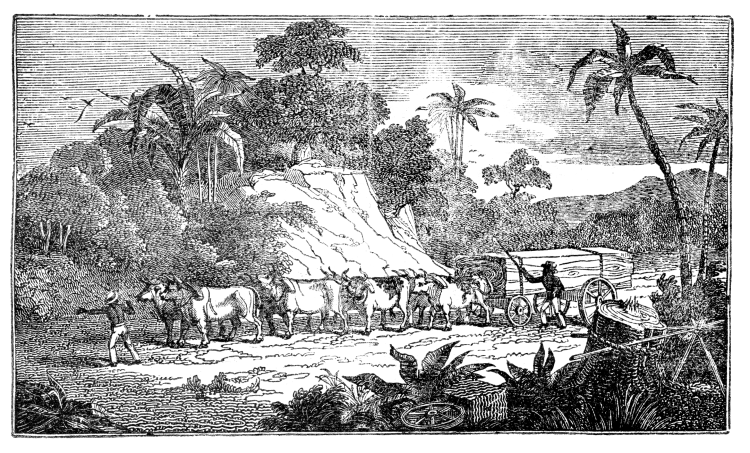
[Trucking Mahogany.]