Front matter
Reading edition
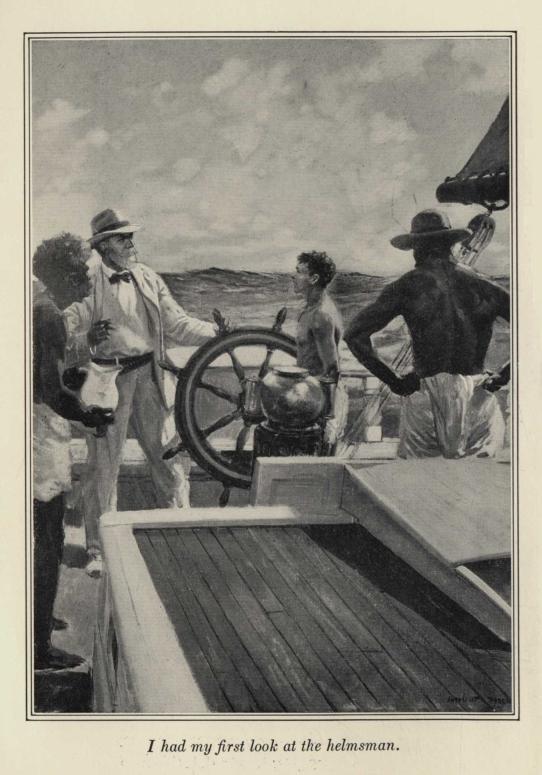
I had my first look at the helmsman.
THE PEARL LAGOON
By
CHARLES NORDHOFF
ILLUSTRATED BY ANTON OTTO FISCHER
BOSTON LITTLE, BROWN AND COMPANY
COPYRIGHT 1924 BY THE ATLANTIC MONTHLY PRESS
THE ATLANTIC MONTHLY PRESS PUBLICATIONS ARE PUBLISHED BY LITTLE, BROWN, AND COMPANY IN ASSOCIATION WITH THE ATLANTIC MONTHLY COMPANY
PRINTED IN THE UNITED STATES OF AMERICA
To
WALTER AND SARAH C. W. NORDHOFF
DEAR PARENTS AND UNDERSTANDING FRIENDS WHOSE GRANDCHILDREN, I HOPE, WILL ONE DAY READ THIS BOOK
PREFACE
For some months past, my daily stint at the typewriter has been cheered by an ambitious hope: that this story might prove entertaining to the young—the finest of all audiences. They are too wise even to glance at so dull a thing as a preface, but to you older people, who are responsible for what the young ones read, I have a word to say.
I make no claim, in the pages which follow, to have done more than muster the familiar marionettes and put them through their paces before your eyes. In one respect, nevertheless, I venture to commit myself. I know the islands fairly well—white man and native; skipper, trader, and pearl-diver; the sea, the lagoons, the small and lonely bits of land; and I can vouch for the genuineness of the story's atmosphere.
As for the story, there is nothing in it which has not happened, or might not happen to-day—for Romance, like the sea itself, is ever old and ever new.
C. N. TAHITI, 1924
CONTENTS
I. The Coming of the Schooner II. The Pearls of Iriatai III. Aboard the Tara IV. At Faatemu V. Iriatai VI. The End of the Shark—the Beginning of the Diving VII. South Sea Fishermen VIII. I Turn Pearl-Diver IX. The Cave of the Shark-God X. The Cholita Comes to Iriatai XI. Piracy XII. Boarders! XIII. Tahiti
ILLUSTRATIONS
I had my first look at the helmsman . . . . . . Frontispiece
"You're Charlie, eh?" he said, when he had looked me up and down with a smile that took me back to the evenings by our fireside, ten years before
The shark reared almost vertically beneath the swimmer and, opened his great jaws
Next moment the wave burst over the gunwale, and we were struggling in the sea
THE PEARL LAGOON
O Kahiki, land of the far-reaching ocean, Land where Olopana dwelt! Within is the land, outside is the sun! Indistinct are the sun and the land when approaching. Perhaps you have seen it? I have seen it. I have surely seen Kahiki.
I THE COMING OF THE SCHOONER
We lived on the coast of California, on the Spanish grant my grandfather had purchased from the mission which still stands, deserted and crumbling, in the Santa Brigida Valley. Our house, built long before the Civil War, overlooked the lower end of the valley, from a knoll above the salt marshes at the river-mouth. The house was built in the form of a hollow square, surrounding a paved court. The walls were of adobe,—sun-dried bricks of clay, mixed with a little straw,—four feet thick, and pierced by small grated windows, designed for loopholes more than for the admittance of light and air. The beams and rafters were of roughhewn pine, carried down from the mountains by the Santa Brigida Indians, a tribe long since extinct, and the same patient workers had moulded and baked the old red tiles of the roof.
My father and my uncle Harry Selden had been brought up to the half-Spanish life of old California. For ten miles along the coast and six miles inland the land was theirs, and in those days three thousand head of cattle, bearing my grandfather's brand, grazed on the mesas and filed down in long lines to drink. When the brothers were young, the grizzly still lingered in the hills, the tracks of deer and mountain lion were everywhere, the quail trotted in thousands along the river-bottom, and in the winter months the plains along the seacoast were clamorous with flocks of wild geese, feeding on the rich grass. But times were changing, and little by little, civilization was creeping in. A church and a schoolhouse were built in the township north of us; taxes were raised; and finally a party of surveyors appeared, running a line for the new railway. My grandfather abhorred the idea of a railway passing through his land; he made a bitter fight and would not give in till his own lawyer showed him that if he refused to accept what was offered for the right of way, the law would force him to do so for the public good. He died a short time after the trains began to run.
The brothers were young men at that time, and as their mother had been dead for many years, their friends supposed that they would carry on the ranch in a sort of family partnership. But Uncle Harry, in his love of a wild and independent life, was my grandfather over again. He announced that he had had enough of civilization, persuaded my father to buy out his share of the Santa Brigida, and bade his brother and his friends good-bye. I remember, when I was very small, how eagerly we looked forward to the letters my father used to read aloud to us: accounts of African gold-mining; of wanderings in Central America and Mexico; of great cattle-ranches—estancias, Uncle Harry called them—in the Argentine; of voyages along the barren Chilean coast: of storms and shipwrecks among distant archipelagoes. In the end he settled as a trader, a buyer of copra and pearl-shell, in the South Seas.
As for my father, he was content to marry and to stay at home, but he clung to his cattle stubbornly, refusing to farm or to sell an acre of his land and growing poorer with each year that passed. He often said that we would never starve and that our land was constantly increasing in value, but at such times my mother used to rise from her chair with a sigh and walk out alone among her roses in the court. She was a patient woman and she loved my father dearly, but I knew that the sale of only a few acres among all our thousands would have provided her with many things she craved. What with dry years and low prices, our taxes ate up nearly all the profits from the cattle. We could never afford a motor-car or the occasional trips to San Francisco of which our neighbors' children gave me glowing accounts, yet outside of such luxuries, I must own that we had little need of ready money. Our own fat steers provided us and our men with beef; my mother was superintendent of a garden which furnished more vegetables than we could eat; and in the fall and winter game was still plentiful enough to be a real resource.
Our circumstances had made me a rather serious boy, fond of solitude and given to endless day-dreams—dreams of returning from vague gold-mines or speculations in land with a fortune, to be invested in the ranch and to provide my mother with travel, and rest, and pretty clothes. On my rides to school along a five-mile stretch of coast, where the pearly fog billowed about the hills and the Pacific broke lazily beyond the dunes, I lived in a world of pure fancy, from which the sight of San Isidro, with its single dusty street, its stores, and hideous frame schoolhouse, recalled me daily with an unpleasant start. All through the week I lived only for the coming Saturday, when I would be free to shoot, or fish in the surf, or ride out with our men to track down some band of half-wild steers, hidden in the thick oak scrub of the foothills.
It was on a Saturday that my uncle came. I was fifteen that winter, and ten years had gone by since he had visited us last, but I had not forgotten his lean powerful figure, or the black eyes lighting up a face tanned to an unfading brown, or the stories he had told a wondering youngster of five, sitting on his knee by the fireplace.
The month was February, as I remember it, for the wild mustard was tall and green on the hills and scattered cock-quail were perched on the fence-posts, filling the air with the long sweet whistle of their mating-time. We were early risers, all of us, and at dawn, as I was eating the breakfast my mother had prepared, she asked me if I would take my gun and try for some wild duck on the marshes. There would be guests from San Isidro to-morrow, and a few brace of duck would be a treat for people from the town. I assented joyfully, for such a request meant that ammunition would be furnished from my father's store, and I loved nothing more than the long lazy hours in a blind, where one could watch the strings of wild fowl trailing across the sky.
I had good sport that morning, hidden close to a shallow pool behind the dunes. As I waded across the marsh, carrying my gun and half-a-dozen wooden decoys, a cloud of teal rose quacking from the grass and headed seaward on beating wings. The redhead were beginning to fly northward from their wintering grounds on the lonely Mexican lagoons; small flocks of them, led by drakes with heads glinting like burnished copper in the sunlight, rose from the creeks ahead of me and sped away, low over the sand hills. At the place that I had chosen for my shooting, I unwound the anchor-lines of the decoys, tossed them far out into the pool, and built myself a rough shelter of pickle-weed, strung on stakes pounded into the mud. I found an old piece of board for a seat, loaded my gun, laid out a box of cartridges within easy reach, and settled myself luxuriously to wait.
Next moment I glanced upward and crouched down lower than before, cocking my old-fashioned hammer-gun. High in the air above the marsh, a flock of sprig was descending in great spiral curves, the wind humming musically through the rigid flight-feathers of their wings. Lower and lower they swung, while my pulse raced as I peeped over the edge of the blind. I could see the snowy breasts of the drakes, the feathers of their long forked tails, and their heads turning this way and that as they scanned the marsh warily for signs of danger. They had seen the decoys, and as they swept past me, still out of range, I called to them, imitating the feeble quack of the hen bird. Then, while I held my breath, they turned again, low over the pool, and came sailing straight at me—necks up and feet dropping to settle among the decoys. My hands were trembling a little, but I took careful aim at the old white-breasted leader, pulled the trigger, and saw him crumple and strike the water with a mighty splash. Wild with alarm, another drake came towering above my head, and leaning backward till I nearly fell off my seat, I let drive with the left barrel and watched him fold his wings and come down plunging to the grass.
I can recall that warm winter morning as if it were yesterday: the steady thunder of the breakers, the perfume of the salt marsh, the wisps of cloud drifting across a soft blue sky. Flock after flock of wild fowl came speeding in from the sea, circled the marsh, set their wings to alight, bounded upward, scattering, at the reports of my gun, and headed back for the ocean—fast-vanishing dots above the dunes. Once a wedge of geese passed at a great height overhead, flying northward with slow steady wing-beats, thrilling me with the hoarse music of their voices. My life seemed cramped and narrow as I gazed at these free rovers of the sky, travelers beyond the far rim of the horizon north and south.
The warm sun and the drowsy chirping and buzzing of insects in the grass brought on a nap that caught me unaware. It must have been mid-day when I awoke with a little start, to sit up and rub my eyes, wondering for an instant where I was. Unloading my gun, I waded out after the decoys and strung my dead birds on a thong of leather. Then, yielding to a habit of those days, I climbed to the top of a sand hill, for a look at the beach. Next moment I nearly shouted aloud in the excitement of what I saw.
Close inshore, not far beyond the outer line of breaking seas, a two-masted schooner was rounding into the wind. She was painted white and her sails shivered crisply in the light air. One needed small knowledge of ships to appreciate the beauty of the little vessel: the high sharp bows, the graceful sweep of sheer, the slender masts, the taut lines of shroud and stay. The sight of a ship was rare along our stretch of coast. At long intervals we saw a trail of smoke far out to sea,—the steamer trading between San Francisco and the west coast of Mexico,—but this was the first time within my memory that a vessel of any kind had passed so close to shore. And she was not merely passing, for I saw now that her crew was sliding a long double-ended boat over the rail. Three men sprang into the whaleboat: a pair of oarsmen who seated themselves and began to pull toward shore, and a man in blue, who stood in the stern, holding a steering-sweep with one hand and waving good-bye to a gigantic figure at the schooner's wheel. The giant raised his hand in an answering wave; the schooner bore off, her sails filled, and she headed out to sea, heeling gracefully to the breeze.
There had been a storm in the north and the swell was high that day. Even from my perch on the dune, the approaching boat was invisible each time it swung down into the trough. It was just beyond the breakers now, and as it rose on the crest of a wave I saw that the oarsmen had ceased to pull and that the man with the steering-sweep had turned his head and was watching the rearing seas astern. The ground swell, as I have said, was very high, rolling shoreward a good ten feet from trough to ridge, and I began to wonder how these three men would win the beach through the turmoil of white water ahead of them. Rearing and tossing as the water shoaled, three or four great waves passed under the boat and crashed forward, racing toward the beach in walls of foam. Then, clear above the thunder of the surf, I heard a vibrant shout—a command in some strange foreign tongue. The men on the seats tugged with a sudden desperate effort at their oars; the man astern, with a single heave of his sweep, turned the boat straight in toward where I lay. He was smoking a cigar, and I felt a thrill of admiration at the easy, careless way he stood at his post. A tremendous comber, with patches of foam beginning to appear along its crest, lifted the boat high in air and swept it forward tilting on the brink of a foaming wall. The wave tumbled and crashed and came rushing far up the beach.
The boat grounded with a gentle shock and the two oarsmen leaped overboard to hold her against the strong backwash. They were brown men, I saw: great brawny fellows more than six feet tall, with handsome, good-natured faces and teeth that flashed when they smiled. The steersman sprang out on the damp sand and gave an order, at which his men dropped a pair of light rollers on the beach and began to drag the boat up beyond highwater mark. Then he came strolling toward the sand hill where I lay hidden in the grass.
He was dressed in blue serge—a double-breasted coat with brass buttons—and a blue yachting-cap with a white crown. His age must have been forty or forty-five, but he was straight as an Indian and carried himself like a boy. His face, of a humorous and rather reckless cast, was tanned almost to the shade of the brown sailors toiling with the boat, and his black eyes were the most brilliant I have ever seen.
His eyes betrayed him. He tossed away the burned-down cigar, folded his arms, and came walking slowly toward my hiding-place, gazing about him with a half-smile on his lips, as if this lonely beach recalled a train of pleasant memories. I was peering down over a clump of rank salt grass when he glanced up and looked directly into my eyes.
"Uncle Harry!" I shouted as I came sliding and tumbling down the steep face of the dune. His strong hands seized me and lifted me to my feet.
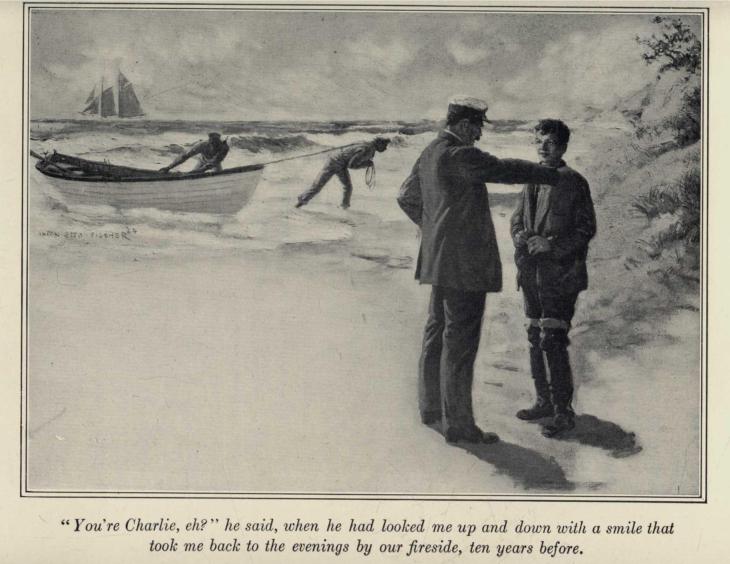
"You're Charlie, eh?" he said, when he had looked me up and down with a smile that took me back to evenings by our fireside, ten years before. "You've done well to remember me all this time! By Jove! I'd never have known you in the world! Here, let's have another look. A chip of the old block, I reckon—you're going to have your grandfather's mouth. Well, I never liked a soft man. How are you all? Did you sight me from the house? Been shooting, eh—let's see your birds."
"You're Charlie, eh?" he said, when he had looked me up and down with a smile that took me back to the evenings by our fireside, ten years before.
I led him across the dunes to where I had left my gun and string of duck. At his request I undid the thong about their necks and laid them out on the sand, while he took them up one by one, spreading a wing to admire the changing colors of the speculum, or smoothing the feathers of a glossy head. At last he sighed, as he cut the end of a fresh cigar and looked up at me.
"Ah, Charlie, it takes me back," he remarked. "Many and many a time I've shot over this pond! I had an old muzzle-loader, twice the weight of that gun of yours. On a Friday night your grandfather used to say: 'Which one of you is going down to the marsh to-morrow to get me a mess of duck?' and I always landed the job. Your daddy liked to work with the cattle; he reckoned shooting was a chore, like splitting kindling, or driving the milk-cows in from pasture. But it's time for kaikai, and I'm keen to see Ben and Mary after all these years. And Marion—she'll be seventeen now, eh? I'll bring my boys up to the house for a bite; the swell was too high to drop anchor, so I told the mate to stand off and on till I came out."
He turned toward the beach and called the sailors in his strong vibrant voice: "E Ivi! E Ofai e!" A moment later I saw the two brown men trotting across the dunes. Their feet were bare and they wore sailor jackets and trousers of dungaree. Their round caps bore the schooner's name, Tara, woven in silver thread upon the bands.
"Good lads," remarked my uncle, as they drew near. "Paumotu boys from Rangiroa—they've been with me since the Tara was built. Shake hands with them before we start." He spoke to the sailors in their own tongue, telling them that I was his brother's son, and they smiled as they gazed at me with the frank curiosity of savages. At a word from Uncle Harry, one of them picked up my gun and birds, and I led the way around the marsh to the Santa Brigida road.
We had not walked more than half a mile when we met my father, who had sighted the schooner and was now riding down to the beach.
"Harry!" he exclaimed, his bearded face transformed by an expression I had never seen; and in an instant he was off his horse and wringing my uncle's hand. "It's like you to drop in this way, without an hour's warning, but your welcome will be all the warmer for that! It's good to see you, old fellow! You're looking well—your cannibal islands must agree with you. What do you think of this uncle of yours, eh, Charlie? He wouldn't for the world drop me a wire a day or two ahead, or arrive by train or motor-car, like a civilized man. Nothing will do but to come in a schooner and land like a pirate on the beach! But come along to the house and bring your men; I can't offer them missionary, if that's their usual diet, but we killed a steer yesterday, and there's plenty of fresh beef."
"Well, Ben," said Uncle Harry, still clasping my father's hand, "ten years haven't changed you, after all! I can't tell you how good it is to be back on the Santa Brigida again! Your boy says that Mary and Marion are well—come, I want to see them; let's be getting along. I'll bring my sailors, if I may. No need to ask how you are—rugged as an old grizzly, eh?"
At sight of Uncle Harry my mother forgot her cares, and only the joy of preparing dinner for him persuaded my sister Marion to leave his side. We dined at midday in the old-fashioned manner, and that afternoon we lingered long at table, until a whispering buzz of talk from the courtyard told us that the news had spread—that my grandfather's old retainers were assembling to greet the boy they had known so many years before. Motioning us to keep our places, Uncle Harry rose from his chair with a smile and walked out through the door to the sunny court beyond.
I heard a chorus of exclamations in Spanish: "Don Enrique! Patroncito! Ay, Dios Mio!" and the voice of old Juana, the white-haired woman who had nursed him as a child, sobbing aloud as she murmured over and over: "My child, my child—you have not forgotten old Juana, no?" He had an almost uncanny faculty for winning people's love.
We sat late that evening about the fire of oak logs in the living-room. Even to-day the scent of wood smoke brings back the picture of that long, dim-lit room, with its ceiling, so lofty that parts of it were lost in shadow, crossed by great roughhewn beams, blackened by half a century of smoke. The heads of antelope and deer and bighorn looked down from the walls, and close to the chimney my grandfather's silver-mounted spurs and old Sharp's rifle hung from a peg. The floor was covered with the skins of animals that he had shot: wildcat and mountain lion; grizzlies from San Gorgonio and Temescal; a moth-eaten buffalo-robe from the days when he had crossed the plains.
At last we rose to bid my mother and Marion good-night. Eager to hear what my uncle would have to say, I seated myself inconspicuously in a high-backed chair, and at that moment my father turned and noticed me. "Bedtime, Charlie," he said in his firm, kindly way. But Uncle Harry was of a different mind.
"Let him sit up for once," he put in, with a twinkle in his dark eyes; "I want to have a yarn with you, and I want Charlie to hear what I have to say. Don't complain if I keep you up the best part of the night, for this is my only chance. I am going to tell you a story, which will explain why I must leave to-morrow, and why I ask you to let Charlie go with me when I sail."
"Sailing to-morrow!" exclaimed my father, sitting up suddenly in his chair; "and you want to take Charlie away! That's a deuce of a thing to tell me the first time I've seen you for ten years! Why in the world must you rush away so fast?"
My uncle smiled a wry smile.
"It's hard to leave so soon," he said. "I wish I could spend a month or two with you, wandering over the old place and having a bit of sport. But I'm short of time. I've been in San Francisco, having a motor installed in the Tara, and the people at the shipyard were slow. I would have communicated with you, but I didn't want to make any rash promises, and it began to look as if I wouldn't have time to put in here at all. I'll be up next year for a real visit—on my word; but to-morrow I must sail; I'm going to take Charlie with me if I have to sit up all night persuading you."
Uncle Harry gave me one of his brilliant glances, tempered with a wink, and I felt my heart beat with excitement at the prospect opening suddenly before me. He rose to his feet, took a pair of long thin cigars from his case, offered one to my father, and sank back into his chair, cocking his heels high against the rough stone of the fireplace.
"Now," he went on, blowing a cloud of smoke toward the ceiling, "if you're not too sleepy, I'm going to tell you how I came to hear of the pearls in Iriatai Lagoon."
II THE PEARLS OF IRIATAI
"Iriatai," my uncle began, "is an atoll in the Paumotus—a narrow ring of land nowhere more than a few yards high, surrounding a lagoon ten or twelve miles across. The island has a curious history, for its people were the last to remain savages among all the eighty islands of the group. It is a lonely place, far out to the eastward where trading-schooners seldom pass, and long after the missionaries had civilized the other atolls, Iriatai remained unknown—no white man had landed on its beaches, or laid eyes on the wild people whose village was screened by the dense bush along the shore.
"In those days there was a famous Catholic school on Mangareva in the Gambier group, and one year, at Christmas time, a brig set sail from Tahiti for the South, with a cargo of trade, and half a dozen children of wealthy half-caste families, sent to be educated by the Church. A week after the brig's departure, a gale came roaring down out of the northwest—a storm so fierce and long-continued that old men speak of it to this day. On Tahiti there was great anxiety for the vessel's safety, and no one was surprised when many months later a schooner came north from Mangareva, with word that the brig had never arrived. It was an old story,—another ship lost somewhere in the lonely spaces of the South Pacific,—but there was one woman on Tahiti who refused to believe that the vessel was lost. She was a rich widow whose only child, a flaxen-haired girl of eight, was missing with the others, and she offered great rewards to anyone who could bring her news of the ship.
"One day a trading skipper came to her with a clew. On his last trip through the Paumotus he had been blown far out of his course, and while hove-to in a heavy sea, he had raised an island only vaguely marked on the charts. He ran in to take shelter in the lee, and as they stood off and on, close to the leeward reef, the lookout had reported people ashore. Taking up his glass, the captain made out a crowd of savages standing on the beach. They brandished spears and were dressed in girdles of pandanus leaf, but two or three of them wore about their shoulders pieces of cloth which the skipper took to be of European make. He was an old-timer in the islands, and he was certain that no trader had ever visited the place.
"The widow lost no time in fitting up an expedition at her own expense. The skipper who had seen the savages on Iriatai was given command; the old man is living in Papeete to-day—I had the yarn from him. He picked up half a dozen Rangiroa boys and armed them with rifles in case of trouble, though they were instructed not to shoot unless attacked.
"After a fortnight of beating about, they raised the palms of Iriatai, sailed in through the pass, dropped anchor a stone's throw off the village, and went ashore. There were canoes hauled up on the beach, fishing tackle lay about as it had been dropped in haste, and the thatched huts seemed to have been inhabited within an hour past, but saving a dog or two and a few half-wild pigs, no living creature was in sight. The captain heard a shout from one of his men who was exploring the far end of the village, and the others hastened to the place where the Christian boy was pointing with horror to the ground. There, close to the temple of the islanders,—a long platform of rude coral blocks,—was the umu tagata: the oven in which human bodies were roasted whole. The bones of men, clean-picked by the cannibals of Iriatai, were scattered on all sides, and hundreds of Chilian silver dollars—current throughout the Pacific in those days—were arranged in neat patterns about the cooking-place. A few yards off, mounted on sharpened stakes along the coral wall, a row of heads was drying in the sun, and one of them—a small head from which hung wisps of long flaxen hair—made the whole story clear. The widow's daughter had been found.
"The skipper was sickened—if he had caught the people then, he told me, he would have slaughtered them like sheep. Calling to his men, he set off recklessly through the bush, resolved to shoot down the savages at sight. Hour after hour the searchers struggled through the dense green bush, scratched by thorns, streaming with perspiration, stumbling over the sharp coral underfoot. It was a hot still day, and the jungle was lifeless and strangely quiet. No leaf stirred, no bird sang, and the drooping fronds of palms hung motionless overhead. Nothing moved anywhere saving the small white sea-birds which circled eerily, high above the tree-tops. The oppression of the bush cooled the skipper's anger and lowered the spirits of the searching-party; no word had been spoken for half an hour when they sat down in silence to rest, close to a pile of jagged coral blocks. Leaning against a tree-trunk, with his rifle between his knees, the captain was in the act of filling a pipe when one of the men touched his arm, signing him to make no sound. To one side of them, in the bleached mass of coral, there was a faint scratching noise, and presently, as they watched, a brown hand and arm appeared for an instant in a crevice of the rocks.
"'That is their hiding-place,' the native breathed into the skipper's ear; 'I have heard my own people speak of such caverns, where they took refuge in the old wars.'
"The captain thought for a moment before he spoke. 'Go alone to the mouth of the cave,' he whispered to the boy beside him; 'our rifles will protect you. See if you can talk to the savages. and if they understand you, try to persuade one or two of the men to come out.'
"The native rose and stole away, and soon they heard his voice calling softly in the Paumotan tongue. He seemed to be in conversation with the people underground. When he returned there was an odd smile on his lips. 'It is strange,' he said, 'those people speak a tongue such as our old men use. They are like beasts or cruel children, killing because they know no better, or are afraid. I do not believe that they are evil men. There is no entrance to the cave—only a little hole in the rock, through which a man may thrust his hand and arm. The place is sacred in these people's eyes and on the ground close to the hole there is an offering of food. They feared it might betray their hiding-place; the man we saw was trying to reach it from within. There is another way out, they said, knowing that I could never find the place. To reach it, they swim beneath the water of the lagoon. We cannot get in from above; all our strength would not suffice to move the rocks. They are afraid to come out, but perhaps I might persuade them if I could show gifts such as they have never seen.'
"The captain collected a few bright trifles among his men: a mirror or two, a gaudy bandanna handkerchief, a clasp knife with a glittering blade. The native returned to parley with the savages, and while he was gone the skipper gave instructions to his men—they were to scatter a little and lie hidden; if the wild people found courage to leave their cave, and they were not too many, they were to be seized and bound at once.
"An hour passed. Then, without the warning crackle of a twig, two savages stepped from the bush and came toward the native who awaited them, holding out gifts and speaking encouragingly. They were naked save for light girdles of grass, and their shocks of hair were tied in high knots upon their heads. The captain whistled, and a moment later the two men of Iriatai lay triced and helpless on the ground.
"The schooner sailed for Tahiti the same night, carrying the prisoners, whose evidence—the story, freely told, of how the wrecked brig had been plundered before she broke up, and how every soul aboard had been massacred—was placed before the French authorities. A few months later a man-of-war was sent to Iriatai, with one of the prisoners as interpreter, and the people of the island were carried off to Tahiti to be civilized. In the end, the chief was executed in reprisal for the island's crime, and his people were taken away to distant atolls of the group.
"Only one of them, so far as I know, ever returned to Iriatai—Turia, the chief's daughter, a girl of eleven or twelve when she was carried off aboard the man-of-war. Her beauty and intelligence attracted the notice of a half-caste Tahitian, who adopted her and gave her an education at the Sisters' School. At seventeen she married the Baron von Tesmar—an Austrian nobleman, a man of wealth and taste, brought up among the capitals of the Old World. He was well known in all the outlandish ports of the Pacific; for reasons of his own, of which he never spoke, he had chosen to shut the door on the past. He traveled on his own yacht with a Kanaka crew, and during a visit to Tahiti he ran across Turia, the girl from Iriatai. A month later she sailed away with him, with a marriage certificate, all legal and shipshape, stowed away in her camphorwood box. I suppose she must have been the Baroness von Tesmar—By Jove, a funny world!
"The natives have a quality I like: each one of them loves his own island in a way that we can scarcely understand. Turia was no exception, but unlike the rest of her people, she ended her days on Iriatai. A short time after he married her the Baron became interested in pearl-culture and—at her suggestion, no doubt—they settled on the island where her savage forefathers had lived and died.
"To give you an understanding of the story from now on, I must tell you one or two things about pearl-shell, which furnishes the mother-of-pearl used all over the world for buttons and ornaments and the handles of knives. In the Paumotus where I trade, the pearl-oysters are of a kind called 'black-lipped,' valuable as mother-of-pearl but rather barren so far as real pearls are concerned. Out to the west, about Celebes and in the Sulu Sea, there is another variety, richer in pearls and far more valuable as shell, called 'gold-lipped,' because the edges of the shell are golden-tinted. Von Tesmar was a man of some scientific attainments, and he suspected, far ahead of his time, that the growth of a pearl in the oyster was caused by a parasite, which it might be possible to transmit by artificial means. In order to carry out his experiments, he had his schooner fitted with a kind of well, through which the sea water was allowed to circulate, and brought shipments of live oysters from distant parts, to be transplanted in Iriatai Lagoon. He may have had an idea that the gold-lipped oysters, in this new environment, would prove more susceptible to infection—to the little-known parasite believed to cause the pearl.
"The Baron's career, his studies of the pearl, and his new settlement on Iriatai were all ended by the hurricane of 1881. The island had been one of the finest of the Paumotus, with dense groves of coconuts and a deep soil on the higher spots, but when I first landed there, in ninety-six, it was a waste of sand and tumbled coral-blocks, clean-swept from end to end by breaching seas. On an islet, far down the lagoon, a small clump of palms remained—the only living things, save Turia and her child, to survive the fury of the sea.
"The settlement was at the weather end, and when the seas began to breach across into the lagoon, von Tesmar's schooner was anchored fifty yards offshore. Both cables snapped and she disappeared in an instant among the driving clouds downwind. She must have piled up at the leeward end, or perhaps she was carried clean over into the open sea beyond. At any rate, no man of her crew was ever seen again. The people of the settlement—a dozen natives with their wives, brought by von Tesmar to labor in the oyster-beds—had no time to chop off the tops of the palms in which they took refuge. A pair of old palms, eighty feet high, flexible and tough as whalebone, stood close beside the house. High up on the bole of one, the Baron tied himself, and Turia swarmed up the other, her three-year-old boy lashed to her back.
"It is useless to try to describe a South Sea hurricane. One after another, the houses were carried away. Each frothing comber seemed to rush over the land more fiercely than the last; the wind came in gusts that bent the palms like reeds. With a sound audible above the uproar of the hurricane, a palm-bole snapped, and its top, with two human beings clinging among the fronds, sped off to vanish in the wrack. Turia's was the last to withstand the wind; she watched the others go,—men, women, and babies at their mothers' breasts,—and finally a faint, splitting report close by told her that von Tesmar's palm had given way. Next moment her own refuge went, and still clinging to the upper bole, she was sailing above the torn white surface of the lagoon. How she survived the impact, disentangled herself from the wreckage, and lived through miles of angry water is a thing that I have never understood. When she struggled ashore on the islet which was the only land above the sea, her child was still alive. No one but a Paumotan could have done it, and no woman of any other race could have lived and supported her child—as Turia did for many weeks—on coconuts and the fish she was able to catch with her bare hands. In the end, the lookout of a passing schooner saw her signal-smoke."
My uncle's cigar had gone out and he rose for a moment to scratch a match against the fireplace. The lamp was turned low; the glowing logs on the andirons sent waves of light flickering among the shadows of the room. My father stood up to stretch his legs. Standing with hands clasped behind his back, he gazed quizzically at his brother, seated in the deep old leather chair.
"That's a good story of yours, as far as it goes," he observed; "but what has all this to do with you, or with the fact that you can spend only one day with us?"
"No wonder you're growing impatient," said Uncle Harry, with a smile; "it must seem an interminable yarn, but it's all linked together, as you will see. I came into it about ten years ago, when I took a lease on Iriatai. It was just after my last visit here. A friend suggested that I have a look at the island with a view to planting coconuts—they thrive wonderfully in the coral of the atolls. I had heard half-legendary accounts of von Tesmar and his pearls, but such experiments are not taken seriously in the islands, where so many cranks have tried this scheme or that, and failed. The lagoon had never been a place for shell.
"I met Turia when I landed there. Von Tesmar had left her a little money in the Papeete bank, and after a year of civilization, she had been overpowered by the homing instinct of her race. Her husband had relatives in German Samoa—the directors of a great Apia trading-house—and she took her child to them before she set out to end her days on Iriatai. Then she chartered a small schooner and sailed away with a couple of poor native families and a stock of provisions and seed-coconuts. I found her happy in a lonely sort of life, settled in a one-room cottage, surrounded by groves of fine twelve-year-old palms. The place was furnished with a bed, an accordion, and a chest of camphorwood; a portrait of von Tesmar, in the uniform of an officer of dragoons, hung on the wall. There must have been a human side of this man's character, for his widow remembered him with a devotion hard to match.
"She was the only claimant to rights in the island, and I had no difficulty in gaining her consent. Within a year I obtained from the French Government a long lease on Iriatai and now there are sixty thousand young palms on the island, some of them already beginning to bear. Another hurricane? We can't afford to think of that—they strike an island not more than once in every hundred years. During the visits when I carried labor and supplies to Iriatai, Turia used to spin me yarns about the hurricane. She was an interesting woman, as those of the pure old blood are apt to be. When I knew her she was straight and handsome still—no darker than a woman of southern Spain. Sometimes she showed me letters from her boy, growing up in far-off Samoa with his relatives. I did not meet him till after she was dead.
"I needed a rest last year, and as I didn't have time for a run up to see you all, I decided to take a vacation among the islands—a short cruise through the Tongan and Samoan groups. One night in Apia, the German port, I had been dining at the consulate, and as I walked along the moonlit beach to where my boat's crew awaited me, I was stopped by a young half-caste, dressed in soiled white duck. He spoke English, and he looked so miserable, so poor and ill that it needed a thicker skin than mine to pass him without a word. His body was no more than skin and bones, and when he turned in the moonlight, I saw the wreck of what had been a handsome face, ravaged by quick tropical tuberculosis. He spoke in abrupt sentences, gasping for breath and stopping at intervals to cough.
"'You English?' he asked. 'No? American, eh? I speak German, French—not much English. That Tara your schooner? They tell me you go Tahiti to-morrow. Give me passage, eh? I cook—wash dishes—cabin boy—anything! I want go Tahiti too much!'
"He turned away from me and leaned over with a hand to his chest, coughing frightfully; when the paroxysm had passed he stood gasping and unable to speak. It was impossible not to be sorry for the poor devil.
"'I'll let you know to-morrow,' I told him. 'I'm sailing at sundown. Come to the beach at four or five o'clock.'
"Next morning, strolling with the American consul, I pointed out the half-caste, asleep in the shade of a beached canoe. 'Oh, that fellow,' said the consul; 'Yes, I know him; von Tesmar's his name. Doesn't look much like a nobleman, does he? As a matter of fact, he's a baron of the Austrian Empire—when he's drunk enough he'll show you the papers to prove it! Odd story. His father married a Paumotu woman years ago and was lost in a hurricane, back in the eighties. The mother brought her child out here—old Madame Lichtenstein, of the Hamburg Concession, was the youngster's aunt. The old lady was good to him, sent him to the Protestant school and finally shipped him off to Europe with plenty of money to spend. But the cold winters were too much for his native blood, I guess; t.b. got him after the second year, and as happens so often in the islands, consumption led to drink. Then one day he turned up here, a yellow skeleton with a craving for alcohol. The Germans took pity on him and pensioned him off for a time, but he was sinking rather low, and finally they cut off the money and ceased to recognize him at all. One can't really blame them much!'
"I didn't say anything, but I was interested, I'll admit. So this was Turia's son—the child of the hurricane on Iriatai! He had traveled a long road since those days; but I suspected that the end was near. Why should he want to go to the eastern islands? The old instinct of his mother's blood, perhaps, calling the wanderer home at last to die.
"I gave him a passage, at any rate. He was willing enough, but it was absurd to talk of working his way—when we'd been out three days I knew that his eyes would never see another landfall. I put him in a berth in the spare stateroom. He'd picked up his English on the beach, but in French you'd have been surprised to hear the fellow talk. With the interest one cannot help feeling in a dying man, I spent a good deal of time yarning with him, and finally told him that I had heard something of his story and had known Turia on Iriatai. He was in a steady low fever by this time, and our talks seemed to excite him; he asked endless questions about his mother and her life—the island—the lagoon.
"One night, when I was at the wheel, the cabin boy came on deck, rubbing the sleep from his eyes, to say that von Tesmar wanted to see me at once. There was something of great importance to tell me, it seemed. We were in the middle of the wide, lonely reach of sea that stretches from Rose Island to the Leeward group. The moon had risen about eleven o'clock; there was not a cloud in the sky, and a steady breeze blew warm and fair from the northwest. I had taken the wheel at moonrise and I hated to go below, but the half-caste's message seemed so urgent that I called the man on watch to take my place.
"I found von Tesmar gasping in his berth. He had gotten up to undo a bundle he carried with him, wrapped in a piece of native cloth, and when I pulled the curtain aside, he held out to me a tattered sheet of cheap ruled notepaper.
"'For you,' he whispered breathlessly, in the French he had picked up during an edifying year in Paris. 'Ah, mon ami, this is the end—now I must die, and a glass of your excellent rum would help me to die gracefully. Merci bien—you are kindness personified! I wonder why: there is so little, in your eyes, that I can do. Yes, this is the end. I cannot complain—I have had my fun and paid for some of it, at least. Never again shall I watch the faces passing my table on the boulevard, nor sit with the brown people in a bush-clearing far from the church, while the drums throb and the sleek young girls twist and flutter their hands in the torchlight. No doubt you are thinking that I am a drôle de type, and so I am, by training and by birth—half savage, half boulevardier. But the time is short and I weary you with idle reflections; allons, to business! You can read the native Tahitian, eh? It is difficult for one who knows only the Samoan dialect. I had hoped to keep that paper to myself; the doctors say that men with my malady are always optimists. But you have treated me as one white man treats another—keep it, read it, and do as you please. Perhaps it is worth another glass of rum, n'est-ce pas? Another rum for Monsieur le Baron! They called me that in Paris, at the Grand Hotel—Ha, ha! Noble on both sides, bon Dieu!—my mother a cannibal Princess—Monsieur le Baron von Tesmar, Prince of Iriatai! How's that for a title, hein?'
"At five o'clock, when the moonlight paled before the first flush of dawn, he turned his face away from me and died. I blew out the light and went on deck to give orders for his burial. Then, when I had my coffee, I lay down in my berth and unfolded the paper he had given me. It proved a quaint document—a letter in the native language from Turia to her son, written a few days before her death. Here it is—it is worth translating for your benefit:—
This from your dear mother, who loves you and prays that God's blessing may bring you prosperity and health. Amen. I am ill, and though the woman who tends me has made medicine, I think that I shall soon die. Do not weep for me—I shall be happy to be again with your father, whom I have always loved. Now pay attention, for there is a thing that I must tell you. Your father was a wise man, and his work was to bring pearl oysters from foreign seas to this lagoon. After the hurricane, when I swam so far with you clinging to my back, I believed for many years that the oysters must all be dead, but that was not true. In the far end of the lagoon, where no one goes to-day, I have found where the strange shells with edges like gold lie on the coral in thousands, not more than fifteen fathoms deep. Many times I have gone alone in my canoe to dive for them, and I have found fine pearls, great and small. These are true words. The white man called Seroni, who brings people to plant coconuts on Iriatai, is a good man and my friend, but I have said nothing of the pearls to him. They were your father's work, and you will want them, since you live in the white man's land. The oysters are on coral bottom, midway between the islet and the reef. Beware of a great brown shark when you come here to dive; he comes sometimes to that end of the lagoon, and twice he has nearly had me when I was intent upon my work. I think he is the old god of my people, worshiped when I was a child. Farewell, my dear son—I shall not see you again.
On Iriatai, from Turia, to her son, Arno von Tesmar
"Somehow, as I read this letter, I was convinced that what the woman said was true. There are nearly a hundred square miles in Iriatai Lagoon, and though my men did a good deal of fishing, a shell-patch of the largest size might have escaped their notice for years. No one in the Eastern Pacific had ever succeeded in acclimatizing the gold-lipped shell, but that did not prove that it could not be done. If Turia's words were true, von Tesmar's eagerness to reach the group was justified. It might prove a rare chance, and I resolved to investigate at once.
"Fatu, my big mate, is a man that I can always trust. He is a first-class diver, and when the Tara was anchored at Iriatai, I told him the story and explained that he must hold his tongue. We took a big canoe and made camp on the islet at the far end of the lagoon. Even with Turia's directions, it took us four days to find the shell, but when Fatu began to bring up the gold-lipped oysters in both hands, I saw that the dead half-caste had paid his passage a thousandfold.
"My man reported the bottom covered with shell for acres on either side—a little fortune in mother-of-pearl alone. And pearls—By Jove, I could scarcely drag Fatu away!
"I didn't dare to linger—there was danger of causing talk. It would need a dozen or fifteen divers to work the patch properly; the news would travel like a whirlwind, and I hadn't the shadow of a claim on the shell. The open lagoons—I must explain—with passes through which a vessel can enter from the sea are Government property, and during the legal season any native may dive and keep what he obtains. Unless I did some careful planning, half the schooners in the South Pacific would soon be anchored at Iriatai. Well, I headed for Tahiti and did my thinking on the way. The Governor of French Oceania is a friend of mine. When we reached Papeete my plans were made and I put the matter up to his common-sense: By pure chance, in one of the atolls under his administration I had discovered a brand-new patch of shell. (I said nothing, of course, about von Tesmar, or the fact that the shell was golden-lipped.) If properly preserved and worked, this patch might in the future prove a valuable asset to the Government. As things were, I could not legally profit by my discovery—any Kanaka diver had as much right as I to exploit the new lagoon. If I held my tongue, a hundred years might pass before another man stumbled on the place. In view of all this, therefore, wouldn't it be fair to give me one season's exclusive rights, in return for adding a new pearl-lagoon to the five or six already under French control?
"It struck me as a fair thing to ask, and I had little difficulty with the Governor. Within a month the papers were delivered to me all signed and sealed: a year's rights to the shell and pearls of Iriatai. I had always wanted an engine for the Tara and now I felt that I could afford one. In the Paumotus, with reefs and five-knot currents and frequent calms, a motor is better than a dozen insurance policies. Now the engine's installed and I am heading back without a day to waste. It will take time to find the men, to build canoes, and get the diving under way."
As he finished his story, my uncle rose and began to pace back and forth before the fireplace. My father lay in his chair, smoking and making no comment; I fancy that the glimpse of an adventurous life on the other side of the world had set his thoughts to wandering. Though it was long past midnight, I was wide awake.
All at once my uncle stopped beside his brother's chair and stood looking down at him, with a half-apologetic smile.
"See here, Ben," he said, "I want you to let Charlie come along. A few months out of school will do no harm and I'll give you my word to have him back in the fall. I've come to the age when a man feels the need of youngsters, and yours are all I have. There'll be plenty of work—I need someone I can really trust. He'll have his share in what we get, of course, and he'll earn it—I'll see to that. Be a good fellow, and let him come!"
My father looked up and sighed before he spoke. "Ah, Harry," he remarked, "you're a lucky man! All your life you've been a rainbow-chaser and now you seem to have caught up with one at last. It's hard not to envy you when I hear a story like the one you've told! I didn't realize what a dull old stay-at-home I had become. As for the boy, I'm tempted to let him go; but you're asking a good deal! You live in a rough part of the world, if the stories one hears are true. There must be men down there who would make it hot for you if the news of your pearl-lagoon leaked out. Even in California we used to hear of the exploits of Bully Hayes."
My uncle smiled and shook his head.
"Those days are past," he said. "Pease and Hayes are dead, and they've left no successors in the Eastern Pacific. So far as I know, there's only one scoundrel of that type left in Polynesia and he operates far out to the west: 'Thursday Island Schmidt'—ever hear of him? I don't know him myself, and I'm not hankering to make his acquaintance until this job is done. But he's never been east of Samoa, and even old Thursday Island would hesitate to tackle a barefaced hold-up nowadays. Warships and the wireless have ended all that. Let the boy come—I'd be the last man to drag him into any scrapes."
"He can go, then," said my father, rising from his chair. "I only wish I'd had such a chance when I was a youngster. But you'll have to talk his mother around—I wash my hands of that! We'll leave that for tomorrow, eh? Come, you must be tired; we'd better turn in, all three of us."
And so the matter was left, while I wandered in a daze to my room and lay down to spend a night made sleepless by mingled anxiety and happiness.
III ABOARD THE TARA
It must have taken a deal of talking to win my mother's consent, but Uncle Harry proved equal to the task. When we had breakfasted he sat with her for an hour in the courtyard, and afterward, when I saw her alone, she kissed me and told me that I was to go.
We had guests that day—old friends who had known my uncle when he was a boy. I sat at dinner with the others, but all I can remember of the meal is that Uncle Harry praised my ducks. I was still dazed at my good fortune: my dreams of adventure and of distant wanderings were to come true at last! A cruise on the Tara in the South Seas—a quest for pearls in a tropical lagoon—a part in the sequel of my uncle's tale—indeed, the prospect was enough to intoxicate any boy of fifteen. Iriatai! There was magic in the word alone, and I repeated it under my breath while the older people about me spoke of commonplace things.
The sun was low over the Pacific when we said good-bye. The others accompanied us to the beach: my father and mother, Marion, and our guests; and in a little group of people from the Santa Brigida I saw old Juana sobbing, with a shawl pulled over her head. The two sailors rolled the whaleboat into the wash of the sea; after the final handclasps, Uncle Harry and I took our places in the stern. The ocean was calmer than on the day before. Ivi and Ofai watched their time, ran the boat out in a lull, leaped in to seize their oars, and pulled seaward through the gentle surf. The mate of the Tara had seen us with his glasses and the schooner was headed toward the land. Presently we came alongside, scrambled over the rail, and helped the sailors haul the boat on deck. My uncle shouted a command; the sheets were slacked away, and the Tara bore off to the southwest.
I turned for a last look at the watchers on the beach, already so far distant that they were no more than a patch of color against the dunes. There was a lump in my throat—it was the first time that I had been away from home.
"I hate to leave," remarked Uncle Harry, who was standing at my side, "but we're off now; in the morning we'll be out of sight of land. Come below and have a look at your quarters. I think you'll like the Tara; she's my only child!"
The Tara, as I have said, was schooner-rigged—a vessel of a hundred tons, fast, comfortable, and designed to ride out any sea. A glance convinced me of her owner's love. The sides were snowy with fresh paint; the decks of white pine were holystoned till they gleamed spotless against their seams of pitch; the masts and spars were newly varnished, and no spot of mildew stained the sails. On the after deck a shallow cockpit contained the wheel and binnacle. Forward of the cockpit, the companionway led down to the saloon, where a pair of curtained doors gave on staterooms to starboard and to port. The woodwork was of bright mahogany. On either side of the saloon there was a leather-upholstered lounge, and half a dozen chairs were screwed fast to the floor about a handsome dining-table. Forward of the saloon was the engine-room, shut off by a bulkhead from the main hold where burlapped bales and packing-cases were piled high between decks. The galley was on deck, and the forecastle was placed far up in the bows, furnished with a deal-table and berths made of piping on which lengths of heavy canvas had been stretched.
My uncle's was the larger of the two staterooms. It was fitted with a washstand and a single berth; a few framed photographs hung on the walls, a large porthole gave a view of the sea outside, and a steel safe was built into one corner of the room. The cabin opposite was assigned to me—it was here that the half-caste son of von Tesmar had breathed his last.
"You're not afraid of ghosts, eh?" my uncle asked me with a smile. "The poor devil died in that very bunk, but he's never troubled us since, and if he did appear, he'd be harmless enough. Come—I want you to know my boys; excepting the cook I shipped in 'Frisco, I've known them all for years."
They were Kanakas—brown Polynesians of the islands, akin to the Hawaiian people and to the Maoris of far-away New Zealand. Ivi and Ofai I already knew. Fatu, the mate, was a huge silent fellow with a smile in his quick dark eyes—a nobly proportioned giant. The engineer, Pahuri, was an elderly Rarotongan with a passion for fishing: a small man, gray, wrinkled, and talkative. He had followed the sea since boyhood and had visited many parts of the world on whaling vessels and on merchant ships. His heart was kind, but he possessed a biting tongue and his travels had made him cynical. Then came Rairi, the half-caste cook my uncle had found stranded in San Francisco after a voyage before the mast. He was a shade lighter than the others, with a handsome, sullen face: a tall man and powerfully built, though dwarfed in the presence of the mate. Rairi spoke a little English, picked up along the waterfront, and had a pleasant manner when he wished to make himself agreeable, but at other times his features were of a forbidding cast. He cooked, and cooked well, in his box of a galley, set on the forward deck above the hold. Outside of his duties he had little to do with the men, as if his strain of white blood caused him to hold aloof. Last of all came Marama the cabin boy, who served our meals, polished brasses, and made himself useful whenever there was an odd job on hand. He was a brown lad of my own age, though larger and much stronger than I, and I liked him from the moment we met. He was a cheerful worker, his black eyes were bright with humor and intelligence, and he never lost his temper when a lurch of the deck threw a potful of hot coffee over his feet. His father, Uncle Harry told me, was a chief on Raiatea.
"We're heading straight for Raiatea," said my uncle as we sat at dinner that night. "I want you to stop there while I run across to unload my cargo at Tahiti. It's a fine island and the chief of Faatemu is a great friend of mine. You can put up at his house; I'll leave young Marama to keep you company. He knows a bit of English—that will help you at first. By the way, you'll need to pick up the native as fast as you can; the man who can't speak with them is handicapped. It's easy to learn; why not work at it during our passage South? I'll help you and so will any of the men; it always pleases them to find one of us interested in their language. Try memorizing a few words a day at the start, then the simple phrases will come to you, and before you know it, you'll be yarning with the crew.
"The quieter we keep this business the less trouble we'll have, and for that reason I'm going to pick up my men on Raiatea. There's a Paumotan colony on the island—we'll have no trouble in getting all the divers we need. They work two in a canoe, and we'll want fifteen canoes to be on the safe side. They'll have to be built specially; I want you to stay in Faatemu to see that they are ready when I return. It's a great place for fishing and pig-hunting—you'll have a lot of fun!"
When dinner was over we sat on deck for a time, while my uncle smoked one of his slender black cigars. The sails were furled, for the wind had died away an hour after sunset. An oily swell was running from the west and the pulsing of the Tara's engine drove us steadily away from land. By the dim light of the binnacle I could see that Ofai, at the wheel, was shivering. Finally he called to Ivi, and the other came aft with a thick woollen jacket on his arm. Uncle Harry tossed the stump of his cigar overboard; I heard it hiss for an instant as it struck the sea.
"Come," he said; "let's turn in before we're both frozen. My blood's too thin for these chilly winters of yours!"
Next day we left the zone of coastwise calms and ran into the northeast trade. The engine was stopped and the Tara headed southward with all sails set, running almost free. It is a brave wind, the trade, and it blew strong and fair, making the whitecaps dance on the dark blue swells, and driving us southward day after day till we were within a few degrees of the Line. Each day, at noon, my uncle fetched his sextant on deck to observe the sun, and I watched him afterward, bending over the chart in his stateroom, marking off our position with dividers and scale. Finally, with a very sharp pencil, he made a tiny cross, and I knew that this mark on the great blank spaces of the mid-Pacific was where the schooner had been at twelve o'clock.
Sometimes the wind fell away at sunset and the engine chugged steadily throughout the night; once, when the trade blew day and night without abating, the Tara reeled off two hundred knots from noon to noon.
The weather grew warmer day by day. Shoes, stockings, and warm clothing were stowed away, and the men went about their work in waistcloths, with brown chests bare. One morning Uncle Harry called me into the trade-room at the after end of the hold, and handed me half a dozen pareus—strips of cotton print, dyed in barbaric patterns of scarlet and white, a yard wide and two yards long.
"If I were you," he said, "I'd put away my trousers from now on—shirts too, if you're not afraid of the sun. My friends call me a savage, but aboard my own schooner I dress as I please. The natives invented the pareu, and it's the most sensible dress for this part of the world. It's cooler than pyjamas at night, and in the morning you have merely to hitch a fresh one around your waist and you're dressed for the day. Let me show you the trick of putting it on." He wrapped the cloth about my waist, tucked in the ends and made a tight roll at the top. "There," he remarked with a smile, "that's quick dressing, eh?"
From that day we went barefoot and bare-chested as the sailors did, and I was soon burned to a uniform deep ruddy brown, only a shade paler than the native crew.
We were in the tropics now. The ocean was of a vivid blue that I had never seen. Shoals of flying fish rose before the Tara's cutwater to skim off above the waves, and sometimes the water about us was alive with the predatory fish which rove the open sea. One afternoon Marama showed me how to catch my first albicore in native fashion.
We were standing by the rail, on the after deck. Suddenly, close to the schooner's side, a dozen great steel-blue fish flashed into the air, leaping like porpoises. "Albicore!" exclaimed my companion, as he darted away toward the forecastle. A moment later he was back, brandishing a twelve-foot pole of heavy bamboo. To the small end of it he made fast a length of strong cotton line, terminating in a lure of mother-of-pearl tinted in iridescent shades of yellow and green and fitted with a barbless hook of brass. The shell was cut and polished to resemble a six-inch flying-fish, with a tuft of white horsehair projecting on either side to represent the wings.
The albicore were still leaping and flashing alongside, now darting ahead, now circling to follow in our wake. Marama tossed his lure overboard and allowed it to skitter on the waves, holding the butt of the rod strongly with both hands. There was a flash of blue in the sea; the lure disappeared; the line snapped taut; the bamboo bent with the struggles of a powerful fish. A yell burst from my companion's lips. He braced himself to heave with all his strength, and a thirty-pound albicore, vibrant and flashing in the sunlight, broke from the water, sailed over the rail, and thudded to the deck.
"Quick!" shouted Marama. "You try! I kill this one—take him forward—Seroni no like blood on deck."
My own blood was up and the hint was enough. In an instant the lure was overboard and I was doing my best with unskilled hands to make it skitter as the native boy had done. The fish had circled and were following astern; I could see the spray of their leaping in the schooner's wake. Then, as I gazed into the clear water, I saw a single monstrous albicore rushing at my hook. His jaws gaped wide—there was a mighty wrench; I found myself doubled over the rail, clinging to the rod with all my strength and shouting for help. Marama had turned to come aft and his quick eye took in the situation at a glance. He bounded to the forecastle and came running along the deck, holding aloft a long, four-pointed spear. "Tapea maitai!" he shouted—"Don't let go!" At that moment, Seroni himself—for that was my uncle's native name—appeared on deck. He seized the spear from Marama's hand and sprang to the rail. I was beginning to learn that Uncle Harry prided himself on excelling the natives in their own pursuits. His arm shot out in a swift dexterous thrust which transfixed the wallowing fish, so heavy that we could not lift it till a noose had been thrown over its tail.
That night, for the first time in my life, I tasted the characteristic dish of Polynesia: raw fillets of fish, soaked in vinegar and served as an appetizer.
The trade wind held for sixteen days, and when it died away at last we were only four hundred miles north of the Line. Then the Tara's sails were furled and for three days and three nights the engine drove us southward over a sea ruffled by light airs from the west. I shall never forget those equatorial nights, when all the others, saving the steersman and myself, were asleep on deck—the steady pulsing of the Tara's motor; the calm sea, heaving gently as a sleeper's breast; the Southern Cross, low down among the blazing constellations. Each day at dawn the air cooled and freshened; presently the sky to the east began to pale, the little clouds on the horizon grew luminous with rosy light, and the sun appeared above the rim of the sea, a disk of dazzling brightness, glaring like burnished brass. The sunsets, on evenings when masses of cloud were piled along the western sky, were still more beautiful. Long after the sun had sunk beyond the slope of the world the clouds were tinted with opal and rose, and pierced by lofty shafts of golden light.
We crossed the Line and met the southeast trade, blowing from the far-off Chilean coast. Then the sheets were close-hauled and the Tara began to beat southward, pitching and bucking into the head sea. Marama brought racks to hold the dishes on our table; we moved about the deck in short runs, grasping at the rail or a convenient stay; and for the first time I felt a landsman's seasick qualms. The constant tossing made all hands irritable, and brought on the trouble between Pahuri and the cook.
I heard from Marama how the affair began. Fatu and the engineer ate their meals forward with the men, old friends and natives like themselves, with whom there was no occasion to enforce strict discipline. Pahuri, the little Rarotongan engineer, was the oldest man and the recognized story-teller of the crew. He had seen many strange parts of the world, and no doubt, like other story-tellers I have known, he was quite ready to describe other places he had never seen. No matter how often the story had been told, nor how obviously embellished by a resourceful imagination, the men always listened eagerly when Pahuri began his tale. Rairi, the half-caste cook, was the only skeptic of the lot, and his comment on the engineer's accounts of Sydney and Wellington and Singapore, coupled with his own white blood and pretense of superiority, caused daily friction between the two. There was soup on the day of the trouble, scalding-hot soup, carried to the forecastle by Rairi's own hands, and a plate of it, poured down the engineer's neck when the Tara gave a sudden violent lurch, brought Pahuri raging to his feet. Rairi was Paumotan on the native side; to a man of his kind no epithet could have been more offensive than the engineer's angry: "Uri Paumotu!—Paumotan dog!" But the mate's presence tied his hands and he retired sullenly to the galley, trembling with rage. The sequel came late that night.
Pahuri had been working on his engine and he came on deck, a little after midnight, for a breath of air. He was leaning on the rail by the shrouds when strong hands seized his throat and he heard a fierce whisper in his ear:—
"Ah!—Pig of a Rarotongan!"
Pahuri was a wiry little man and he struggled frantically in the other's grasp, for he realized at once that the cook intended to strangle him into silence and heave him overboard. He twisted his body about, gripped the shrouds like a monkey, doubled up his knees and drove both heels into Rairi's stomach. The cook relaxed his hands for a moment with a grunt of pain, and Pahuri managed to give a stifled shout. But the half-caste's fingers tightened once more, and the engineer felt his senses leaving him. His hands fell from the shrouds to which he had clung, his body was lifted to the height of the rail, and he thought numbly that the end was near. Then, suddenly as he had been seized, he was dropped to the deck, where he lay gasping for a time before he realized what had occurred.
The giant mate was standing over him, gazing down with an expression of concern. There was a waning moon, and by its light Pahuri saw that Fatu held the cook with one huge outstretched hand, the thumb and fingers sunk in the half-caste's corded neck. He held him easily as one lifts a puppy by the scruff.
"What is this?" the mate asked mildly, in his soft deep voice. "Has this man tried to do you harm?"
The man at the wheel had given the alarm, and my uncle came on deck a moment later, dressed only in a pareu, his chest and powerful shoulders bare. I had been sleeping, but the noises of the scuffle awakened me, and I followed close behind. Pahuri was able to speak when we arrived and he told a story that left out no detail of the affair. For a moment, no one thought of the half-caste, struggling weakly in Fatu's mighty grip. Even in the moonlight, I could see that his face was blackening—I pointed and touched my uncle's arm.
"Let him go, Fatu!" he ordered sharply. "You'll kill the man!"
The mate had been listening intently to Pahuri's tale, and at Uncle Harry's words he dropped Rairi with an air of surprise, as if he had forgotten him. The cook had fainted; we could not revive him until a bucket of sea water had been dashed over his face. At that he sat up feebly, groaning as his hands went up to feel his neck. My uncle glanced down, his dark eyes burning with a glitter that made Rairi turn away his face.
"Feel better now?" asked my uncle in a hard vibrant voice. "I'm glad of that, for I've something to say to you. You understand English, eh? You needn't do any talking—I know all about this affair. You tried to kill Pahuri—an old man half your size and your superior on board. These boys would like to heave you into the sea; I fancy they're right, it would be a riddance of damned poor trash. The only difficulty is that I need a cook. We're going to Raiatea first, and if you value your skin, you'll stick close aboard. Then I'm going to Tahiti and I'll drop you there. If you behave yourself from now on, I'll say nothing to the authorities; but if you try any more tricks, if any member of the crew goes overboard accidentally at night, or if anyone so much as falls ill before we reach Tahiti, I'll feel it my duty to turn you over to the French, who know me well. They guillotine their murderers down there—it's not a pleasant way to die! Think it over. You can go forward now."
Rairi struggled to his feet and tottered forward with a hand on the rail. At that moment, moved by a boy's emotion, I felt almost sorry for him, but as he passed me I caught a glimpse of his face in the moonlight—dark handsome features distorted by passion. I drew back as if he had raised his hand to strike me, but the others had not seen what I had seen, and I stifled the cry of warning which rose to my lips.
There was no more trouble with Rairi while he remained aboard the Tara; he went about his duties in silence, ignored by the sailors and sitting alone in his galley during the slack hours of the day. But I know now that it would have been better for us, and better for him, perhaps, in the long run, if my uncle had given his men their way—had let them throw the revengeful half-caste to the sharks.
On the morning after the trouble we raised our first land—the western islands of the Marquesas. At sunset we had seen flocks of birds flying steadily southeast, and my uncle told me that if we followed them they would lead us to the land. At dawn, when I came on deck, I heard the ringing shout of landfall from aloft, and gazing eastward, I made out the high silhouette of Hatutu, a faint outline against the flushing sky. An hour later we drew abreast of Eiao, a saw-toothed ridge, falling away gently at either end; and toward midday we raised the rock of Motu Iti, and the long highlands of Nukuhiva, veiled in masses of black thundercloud. At nightfall, in the darkling east, the pinnacled skyline of Uapou faded and disappeared.
"A beautiful group," remarked my uncle, standing by the rail. "When I was trading there I knew every bay from Hanavave to Tai-O-Hae. The larger islands have a fascination—a gloomy beauty that gets into one's blood. The people, though they were cannibals, were a fine savage race, who had developed, during the course of centuries in their isolated group, an interesting culture of their own. But their blood was too wild to stand contact with our civilization, and when the white man came they died off, as the Indian and the buffalo disappeared from our American plains. Now the valleys where people once dwelt in thousands are silent and deserted, the lonely burial-places of a vanished race. I suppose I'm a heathen, but I can see the savage's point of view—he asked no more than to be left in peace, a favor we white men have never been willing to grant...."
Two days afterward I had my first glimpse of the coral islands. The moon was bright that evening as we passed through the twelve-mile channel separating the atolls of Rangiroa and Tikehau. I climbed to a perch in the shrouds and lingered there as we coasted the western end of Rangiroa; the night-breeze blowing off the land brought to my nostrils a faint sweet perfume, the odor of pandanus blossoms. The line of palms, growing on the low ring of land, stood out sharply in the moonlight, and at times, when we passed a region of sparser vegetation, I had glimpses of the great lagoon beyond, silvered by the moon and stretching away to the horizon without land in sight.
It was close to midnight when the atoll dropped away astern and I climbed down to the deck, stiff from my long vigil aloft. I found Uncle Harry busy over some papers at the little desk in his stateroom. He swung about in his chair and lit a cigar as I sat down on the berth.
"Been having a look at Rangiroa, eh," he remarked. "There's a kind of beauty about the atolls, especially on a moonlight night. Iriatai is the same sort of place, though on a much smaller scale. There's no other group in the world like the Paumotus: eighty lagoon islands, some of them of immense size, strung out northwest and south-east in a cluster a thousand miles long. Darwin believed that they were the peaks of a submerged mountain-range, on which the coral polyps have built, as the mountains sank little by little beneath the sea. The lagoons are accounted for on the ground that the polyps tend to die in calm water, and thrive best in the froth and spray of breaking seas. As time went on, you see, the ones on the outside would build higher and higher, while the ones inside would die. Then, as the island continued gradually to sink, with the live polyps all working in the wash of the sea along the outer run, a deepening lagoon would form inside—and there you have your atoll. The passes are believed to be caused by fresh water, the heavy rainfall of these latitudes, finding an outlet to the sea. Running out at low tide over the lowest portion of the reef, it kills the coral-builders and causes the slow formation of a pass, often deep enough to allow large vessels to enter the lagoon.
"There was a day, perhaps, two thousand years ago, when the Paumotus lay lonely and uninhabited, spread out like a vast net, a thousand miles long and four hundred miles across, to catch the canoes of wanderers who had missed the higher and richer islands to the west. The Polynesians were daring seamen, but their methods of navigation were of the most primitive sort—by the stars, the clouds, the trade wind, and the flight of birds. Hundreds of their great double canoes with clumsy sails of matting must have left Samoa for the eastern groups, and some of them, missing the Cook Islands or Tahiti, of which they had only half-legendary accounts, fetched up along this chain of atolls. The Paumotan people of to-day are their descendants. The names of the islands still show the wonder of those ancient wanderers at the strange sea in which they found themselves, and the joy and relief the landfalls brought—'The Spread-out Heavens'; 'The Place of Rejoicing'; 'The Windward Rainbow'; 'The Land of Great Beacon-Fires.' But perhaps this doesn't interest you very much—I have a way of preaching when I start on the subject of the islands!" My uncle tilted his chair and smiled at me through a cloud of smoke.
"The wind is shifting toward the north," he went on, "and with a little luck we'll sight Raiatea before dark to-morrow night. As I said, I'll leave young Marama with you; you're getting on well with the language, but you'll need an interpreter for the present. I'll be gone a month, at least, and when I return I'd like to be able to start at once for Iriatai. You'll stop with Marama's father, the chief of Faatemu Bay. I'll be careful to explain what I want to the old man, but remember that a native hasn't the least notion of the passage of time. I'm leaving this to you—if you don't keep after old Taura every day, the canoes may not be finished for months. I want fifteen strongly made canoes of hibiscus wood, about twenty feet long, and complete with outriggers, cinnet for lashings, and a pair of paddles with each. Then we'll need twenty-five or thirty pairs of diving-goggles, with the glass set in wood or horn. Some of the men will have their own, but they're always losing them, and once his goggles are lost, a diver is no more use. I'll leave you the glass and the diamond to cut it with; Marama will find you men who understand this work. I have a store at Faatemu; you can take the keys and advance a certain amount of goods to the canoe-builders, but don't let them get too far ahead of you! Old Taura, the chief, is as good a native as I know, and he'll see that you enjoy your stay on the island. You'll be swimming, and spearing fish, and hunting wild pig in the mountains—I only wish that I were stopping over, myself!"
The north wind blew all night with sudden fierce gusts and squalls of rain. The day broke wild and gray, but toward noon the sun shone out, and presently the clouds were left behind, sinking along the horizon to the north. At four bells land was in sight—the peaks of Huahine, bearing a little west of south, minute irregularities on the line where sea met sky. It was an afternoon such as one sees rarely in the tropics: a cloudless horizon and an atmosphere clear as the air above our deserts at home. An hour before sundown the Leeward Islands were all in view, strung out in the shape of a great half-moon on the sea ahead of us. The tall mountain rising abruptly in the north was Bora Bora; Tahaa and Raiatea, sheltered within the same circling barrier-reef, lay straight before the Tara's bows; and Huahine made the southern horn—beautiful as some land remembered from a dream.
At midnight we saw the torches of fishermen on the Raiatea reef, and dawn found us off Faatemu Bay. The sails were furled, Pahuri started the engine, and we glided in through the Nao Nao passage, past the green islet of Haaio, past Tuuroto Point, and into the deep inlet where the thatched roofs of the village clustered beneath the palms.
IV AT FAATEMU
I wish that I had space to tell more of the month I spent at Faatemu—the story of all that happened in those days would fill a thicker volume than this one. I was young, keenly alive, and set down among strange and kindly people in a brand-new world. When the Tara set sail at nightfall I felt a little lonely and forlorn, but before another day had passed I was beginning to enjoy one of the happiest periods of my life. No matter how far I wander, or how remote those dreamy island days, I shall never forget the kindness of my friends, the brown Faatemu villagers.
We had been sighted offshore and canoes were thick about the Tara when her anchor dropped. Taura was the first man aboard—a stately, gray-haired native, of a type not common nowadays. He was barefoot, but his suit of drill was spotless and he wore a beautifully plaited hat. His fat old wife Hina came behind him, her kindly face working and her eyes full of tears; and Tetua, Marama's little sister, stood shyly at her mother's side. Hina made straight for her son and clung to him for a time, sobbing gently; Tetua kissed her brother bashfully; and finally the chief, after he had shaken hands with the rest of us, sat down beside Marama for the silent greeting of their race.
"Come ashore with me," called my uncle, as the ship's boat went over the side; "there's some copra here and I still have room for a bit of deck cargo. We must hurry if I'm going to get away to-night!"
The boat plied back and forth all morning, laden with bags of copra, while Uncle Harry unlocked his store, showed me how to keep account of the goods, and explained to Taura that I was to stop over and that the canoe-building must be hurried as much as possible. The chief promised to have the canoes ready in a month's time. As for divers, he believed we could pick up all we needed on Raiatea—Paumotu men who had settled in the Leeward group. My bag and light blanket were brought ashore and installed in Taura's house, and toward evening my uncle bade us good-bye and was pulled out to the schooner. It was dusk when she stole out through the pass, before the gentle night-breeze which comes down from the hills.
I lay awake long that night, in my bed in a corner of Taura's great single room. The others had spread a mat on the floor and set a turned-down lamp near by. Father, mother, and sister lay in a circle about Marama while he recounted, in a low voice and with many gestures, the story of his adventures in the north. I lay staring up at the rafters under the lofty thatch, thinking of all that had happened since Uncle Harry had steered his boat in through the California surf; of the von Tesmars, father and son; of Iriatai, and what the future held in store. The lamp flickered when the land breeze found its way through the thin bamboo walls, causing the shadows above me to deepen and retreat; Marama's rapid flow of words droned on monotonously; and at last sleep closed my eyes.
Early next day, when Taura came to demand half a dozen axes for his men, I did my first bit of trading. Then I closed the store, and Marama and I went with the canoe-builders to select their trees in the valley far up among the mountains. We followed the river up from the bay toward Faaroa, the great central valley of the island. A dim path, along which we walked in single file, led through the jungle, winding about the trunks of fallen trees, across the rushing, waist-deep stream, high along the mountain-side, at a place where the valley became a gorge. I saw thickets of fei, the wild plantain, bearing great bunches of its reddish fruit; jungle cock crowed shrilly among the hills; and once a troop of wild pig, led by a gray old boar, crashed off, grunting, through the undergrowth. It was strange to think that only three generations had passed since Marama's ancestors, fierce brown warriors armed with rude ironwood clubs and spears, had stolen along this same path on forays against neighboring clans.
The wild hibiscus seldom grows large enough to furnish a log for a twenty-foot canoe, and it took us the best part of the day to choose our trees. All were close enough to be dragged to the river and floated down to Faatemu, and while the work was going on Marama and I went out every day with the men. First of all, the tree was felled and the branches chopped off smoothly, flush with the trunk. Then a twenty-foot length was measured along the straightest part of the tree and the ends cut off, before the log was rolled and dragged to the riverside. Finally, when our fifteen logs were ready, it took a strenuous day's work, pushing over shallow reaches and swimming through deep pools, to float them to the beach.
Once our logs were at Faatemu, Taura was for giving a feast and resting for a day or two. But I urged haste, recalling my uncle's words to the chief. Then the logs were laid out in the shade, close to the village, and one man set to work on each, fashioning a canoe with axe and adze. Day after day the builder chopped, while the chips flew and the form of the canoe emerged—the curve of sheer, the rounded bilge, the sharp lines of bow and stern. Sometimes a man stood off, squinting at his handiwork with one eye closed—judging the symmetry of the slender hull. When the outside was roughly chopped to shape, the log was turned over and the builder began to hollow out the inside with his adze. At last, when the walls of wood were of the required thickness, the process of finishing began: a slow and laborious rubbing with hard bits of coral, and a final smoothing with the rough skin of a stingray's tail, tacked to a wooden block. Then a pair of narrow planks of hibiscus were sawn out to make the raised gunwales, six inches high and of the same thickness as the sides of the canoe. After long scraping and repeated trials, these gunwales were made to fit so perfectly that no crack of light appeared when they were set in place. At intervals of about a foot, holes were drilled in the gunwales and corresponding holes in the dugout-sides beneath. The planks were joined at stem and stern and lashed to the canoe with cinnet—strong cording made of the braided fibre of the coconut. Now, save for its outrigger, the canoe was finished.