Front matter (continued 3)
Reading edition
Frightened and ill at ease, I let go the line and saw the weight ascending through the deep bluish purple of the sea above me, which seemed, like the earth's atmosphere, to extend upward into infinity. There was no sign of the surface—nothing to catch the eye in the break between sea and air. For a moment I was in a panic; it seemed to me that I should never reach the air again, never feel the friendly warmth of the sun nor see the bright sun-lit world above. Then I saw the bottom of the canoe, close over my head. Fifteen or twenty seconds had passed, and though far from feeling at home, I had gained enough assurance to gaze with interest at the strange new world in which I found myself.
Though not so dark as the greater depths I visited later on, there was far less light than I had supposed. The floor of the lagoon, here at seven fathoms, was bathed in a sort of purplish twilight which enabled me to see as clearly, I should say, as on an average moonlight night ashore. But instead of being silvery, like moonlight, the light was purple, and tinged with changing shades of green and blue. The bottom was of dense reef-coral, which dies when sheltered from the breaking sea, but a hundred fantastic varieties of still-water coral grew on the dead madrepore, as vegetation grows on the inanimate earth, and its forms were those of vegetation. Close beneath me I saw little coral plants, fragile as violets or anemones; on a level with my head were leafless shrubs, marvelously colored and perfect in trunk and limb and twig; yonder a giant mushroom, ten feet across and growing on a tall thick stalk, towered above the undergrowth. Shoals of small fish, gay as the bird life of the tropics, drifted through the coral foliage or darted into the shelter of the mushrooms when larger fish passed overhead.
The floor of the lagoon was irregular, seamed by gullies and rising in rough hillocks here and there, and my weighted basket lay at the edge of one of these ravines. By swimming slowly in a horizontal position I could move from place to place without great effort, and hoping to find at least one oyster before I was forced to rise for air, I swam along the brink, scanning the coral sharply for the pearl oysters I knew to be plentiful at this place. A great silver cavally, four feet long and with goggle-eyes as large as dollars, darted out of a gloomy cleft, halted to gaze at me for an instant, passed within a foot of my face, and disappeared in the shadows. The fish gave me a start; in the flurry I let go a good half of my breath, which rose in a string of bubbles toward the air. My lungs were cramped. I had reached the limit of endurance.
I made for the line, seized it with both hands, heaved strongly and felt myself bounding upward like a cork. When my head broke water and I raised the goggles from my eyes, I saw that the native boy was bending over me with an air of concern.
"Another moment," he said, "and I would have gone down after you. You were long on the bottom—I feared that you had been seized with cramps."
"It is strange down there," I answered, a little apologetically, "the pressure—the dim light—I was so interested that I nearly forgot to look for shell and when I did look there was none to be seen."
"It was the same with me at first," declared Marama, smiling, "but if you look closely in the rough places, on piles of coral and along the edges of the gullies, you will see the oysters there by hundreds. It is easy to mistake them for lumps of rock—coral and barnacles grow on them as on the rock itself. They lie open like the pahua (the tridacna clam), but that helps you little, for their fringes are not blue and yellow like the clam's tongue."
I did not waste my strength by climbing into the canoe, but lay in the water resting as I had seen the natives do. When five minutes had passed I put down my glasses and went to the bottom again, and this time I saw two pearl-oysters. I found them at the edge of the gulley, when I was on the point of giving up in despair of seeing the elusive things. They looked for all the world like irregular lumps of coral, projecting like hundreds of other lumps from the rocky wall, and I would have passed without a second glance if one of them had not moved. Though they have no eyes, in our sense of the word, all bivalves which do not habitually lie buried in sand or mud seem to possess a subtle sense of light. As my body passed over the oyster, shutting off the light, the creature was thus mysteriously warned, and instantly its shells closed with a smooth swiftness. Looking more closely, I recognized the outlines of the margaritifera, the pearl oyster, beneath a protective growth of parasites, and grasping it with my gloved hand, I endeavored to wrench it from its fibrous moorings. As I struggled to free it from the coral, the water must have been agitated, for another rough lump closed with the same smooth swift movement, revealing a second great oyster. By this time I had been under nearly a minute, and though I tugged with all my might I was unable to wrench the shell free before I rose.
"I have seen the oysters," I told Marama, as I lay resting in the sunlight, "but try as I would, I could not tear one loose!"
He picked up an opened shell from the bottom of the canoe.
"Take hold thus," he instructed me, "and turn the oyster with a sudden wrench. It is useless to pull. Ah—your left hand is bleeding—take care to use the gloved hand only, for the coral cuts like a knife, and oftentimes the wounds are poisoned."
By the third time down I had gained confidence and was beginning to feel at home on the bottom. Now I remembered the trick of which the Paumotan diver had told me, and when I had been half a minute under water I began to let the air out of my lungs. The native had spoken truly; each little string of bubbles brought its moment of relief and enabled me to go about my work more calmly.
I was beginning to see the oysters now: my eyes were growing accustomed to the dim light. This time I managed to tear off a couple of oysters and put them in the basket before I rose for air. Three dives filled the basket, and when Marama pulled it from the water with its coral-encrusted load, I gave an imitation of the exultant native shout—a cry which brought a grin to my companion's face.
"We are learning," he said mockingly, "but it will be time to shout when we can fill the basket at one dive!"
That afternoon, when we joined the little fleet of canoes to paddle home, Maruia stood up, craning her neck for a look at our catch. "You have done well," she remarked, a smile wrinkling her brown face, "not badly for the first day's diving! I have seen grown men do worse. No pearls? Never mind—you will find them surely. Beginners always have the luck!"
From that day onward the fishing occupied less than a third of our time, and the balance was put in on the lagoon. We learned fast, as boys do, and gradually worked our way into deeper water till we were diving with the rest. Within a few weeks we were bringing in as much shell as the Paumotans, and my uncle was enthusiastic over our success! He could dive with any native, and once or twice, when he had leisure, he sent Marama out alone to fish and accompanied me to the diving-grounds. On those days my uncle's share of the shell went to the native boy's account—growing into a round little sum.
As for me, the diving fascinated me more each day: the beauty and strangeness of the underwater world; the spice of danger—small, but a reality, nevertheless; the thought of the money I was earning; the daily, even hourly, hope of finding a rich pearl, perhaps worth a small fortune. From time to time we found a few small pearls, but when at last good fortune came to us, it came hand in hand with tragedy.
As the nearer shell-patches became worked out, the canoes moved gradually northward, taking the cream of the shell without diving enough to exhaust the beds at any one place. One morning, in the latter part of July, Marama and I anchored close beside Maruia's canoe, on new and very promising grounds. It was my turn to open shell. The Paumotan woman, not ten yards away from me, was loafing that day—letting her nephew dive, for once. Teura was a boy of twenty or twenty-one, a favorite among the natives because of his skill as a musician and his jokes. I had grown fond of him since we had been thrown with the divers, and often went ashore in the evening to chat with old Maruia and listen to her nephew's songs, accompanied by wild native airs on his accordion.
I remember that morning as if it were yesterday. The bottom was at about eleven fathoms, rougher than any part of the lagoon that we had seen. Here and there pinnacles of coral rose to within a few yards of the surface; in the shadowy depths below, the bottom was seamed with crannies and pitted with the mouths of caves. The look of the place, in fact, was by no means reassuring, but the men sent out to survey the bottom reported that the lagoon there was fairly paved with shell.
It had become my habit to take a water glass in the canoe, for by now I was expert at opening the shell, and I found it interesting, in leisure moments, to watch my companion at his work. The depth was too great to see clearly, but I watched Marama plunge feet-first into the shadows, and a moment later, a second string of bubbles told me that Maruia's nephew had followed him down. Vaguely in the depths I could see Marama moving about, a dim moving shadow when his body passed above a patch of sand. Then, before half a minute had passed, the canoe lurched suddenly and sharply—the native boy was pulling himself up the line in desperate haste.
His head broke water. With a heave and a spring that nearly capsized us, he threw himself into the canoe.
"Ah, the great tonu—he nearly had me!" he panted, trembling with excitement. "Aué! Teura! Where is he?"
I snatched up the water glass, and side by side, with our heads close together, we gazed down into the blue water. Hearing the boy's words, Maruia had seized her own glass. Next moment a sudden sharp wail came from her lips. Then I saw the figure of her nephew, mounting his line with great heaves of both hands—and rising deliberately beneath him a monster hideous as a nightmare memory. It was a huge fish, eight or nine feet long and of enormous bulk. Its great spiny head, four feet across and set with a pair of eyes like saucers, terminated in jaws larger than a shark's; its rough body was spotted and brindled in a way that rendered it almost invisible against the coral; its pectoral fins, frilled and spiny as the fins of a sculpin, spread out like wings on either side. It had the look of an incredibly old and gigantic rock-cod—to which family, indeed, I have been told that the tonu belongs.
We watched in terrible suspense, all three of us, Teura was nearing the surface; in another moment he would be safe. The tonu seemed undecided, as if it were following the man out of curiosity rather than pursuing him. I began to breathe more freely. Then when the diver was within twenty feet of us. the fish reared itself suddenly and came rushing up, huge jaws agape.
In a twinkling it was beneath us, so close that the water beneath the canoes swirled with its passage. The next instant the monster flashed downward and the man was gone.
The tonu halted, four or five fathoms down, and lay with gently moving fins. It was then I saw, to my unutterable horror, that Teura's feet and the calves of his legs hung from the creature's twitching jaws.
Another spectator was close at hand. "Aué!" cried old Maruia bitterly, in a choking voice. "Teura is gone! But I shall kill that devil as he has killed my boy!"
She had been baptized—she was a churchgoer and a keeper of the Sabbath day; but now I heard her half chanting a strange invocation, in loud and solemn tones. "She prays to the heathen gods," muttered Marama in an awed whisper, "to Taiao, and to Ruahatu, the old shark-god of her people!"
I glanced up. The woman was standing in the stern of her canoe. She wore her usual diving-dress, a loose gown of cotton over a pareu worn as the men wore theirs. The goggles were on her eyes and she had taken up a heavy fish-spear from its place on the outrigger-poles of the canoe. It was a formidable weapon, a haft of tough black wood tipped with a yard of steel: a tapering lance sharpened to a needle-point. I turned my head to look into the water glass. The great fish lay beneath us, a monstrous vision in the blue twilight below; but now the man's legs had disappeared.
Maruia's canoe came alongside. I heard the outrigger knock softly against our own. Then both canoes rocked violently, and we started at the sound of a heavy plunging splash.
Without a word to us or an instant's hesitation, Maruia had leaped overboard. One hand held a leaden diving-weight and the other gripped the spear, point downward. The fish scarcely moved at the turmoil in the water; the hideous lord of the lagoon was making his meal. Our hearts beat fast as we watched what followed, gazing through our little pane of glass. Swift and straight, the woman went down head-first till she was within two yards of the tonu's back. She let go the weight, which plunged down out of sight among the shadows; she drew herself together and struck—struck squarely where the head joined the misshapen body, a foot behind the monstrous goggle eyes. I saw the steel strike deep—saw Maruia raise herself upright in the water to drive the spear home with both hands on the shaft. The fish started; its jaws gaped wide—the sprawled and mangled body of Teura eddied down toward the coral forty feet below. The wounded monster turned on his side, the shaft of the spear protruding from his spiny back, and swam feebly and aimlessly to the surface, where the divers, now gathering from all sides, put a quick end to his struggles.
Then I heard the eerie diver's whistle close beside our canoe and the voice of Maruia calling to us. "I am going home," she said. "Lend me a hand to put Teura in the canoe." She had been nearly four minutes under water and had brought up with her the body of her boy.
The natives did no more diving that day. Anchors came up, gear was stowed away, and one after another the canoes fell in behind old Maruia, while the wailing of the tangi, the native mourning for the dead, floated across the lagoon. I reached for our own anchor-line, but Marama stopped me with a gesture.
"Wait," he said seriously, "we will go back soon, but first there is something I must tell you."
"Let us go to the Tara," I answered, "and tell Seroni what has happened. This place makes me shudder. I have no more heart for diving to-day."
The native boy looked at me solemnly.
"Like you, I am afraid," he confessed, "but I have seen what moves me more strongly than fear. And I know that our fears are baseless, for my grandfather, who was the most skilled fisherman of Raiatea, has told me many times that where one tonu lives, another is never to be found close by.
"Watch well," he went on, "and move the basket if there is danger, for I am going down once more. In the cave where I first saw the tonu, are two parau tahito—the old oysters of which the divers speak. They are covered with barnacles, very old and huge, and perhaps they hold pearls—great pearls that will make rich men of you and me. But that cave is an evil place! Teura went down with his back to me, and I saw him reach the bottom close to the entrance of the cavern, which he did not see. Then I looked in, and my heart beat fast as I saw that pair of old oysters, just inside. I looked more closely, and there in the shadows were the eyes of the tonu watching me, and his great jaws opening as he made ready to rush out. For a moment my limbs were paralyzed! The rest you saw."
I was becoming infected with my companion's excitement. Ever since we had begun to dive I had heard stories of famous pearls, taken throughout the group in years gone by, and the pearls which fetched the greatest sums and made immortal the names of their finders had always come from these huge, old, and sickly-looking oysters, growing apart from the rest.
Marama had picked up his goggles and was making ready to go over the side, when a saying of my uncle's flashed across my mind. "Never let one of your men do a job you're afraid to do yourself!" Then all at once I knew that I should have no peace unless I acted quickly.
"Stop," I said—a little shakily, at the prospect of the task before me. "You have been down once. Now it is my turn!"
All my life I have found that the more one fears a thing, the quicker it should be done. Without heeding Marama's protests, I snapped on my glasses, tucked up my waistcloth, and went overboard. Next moment I seized the lead-line and signaled Marama to let go.
Never, before or since, have I been more afraid than on that day, as the weight took me plunging down into a bluish gloom. The bottom, as I have said, was at about eleven fathoms,—close to seventy feet,—and since the coral was of the dark-purple kind, the light was very dim. When my weight struck the coral my heart was beating so that I nearly choked; I lost my bearings and wasted half a minute before I found the entrance of the tonu's cave. Suddenly, five yards ahead of me, I perceived the dark mouth of the cavern, like a low wide doorway, fringed with pink coral and gently waving weeds. As I stared into the darkness which seemed to fill a vast chamber, I felt a prickling at the roots of my hair—what if the tonu had a mate.
Then, dimly in the gloom, I made out the forms of the two great oysters, their barnacled and crusted shells agape. I moved forward to wrench them from the rock. With one in each hand I swam toward the basket, glancing back fearfully as went. There was no shout of triumph when I reached the surface—I flung myself into the canoe and lay there while Marama pulled up the basket.
"You got them?" he inquired eagerly, without turning his head in my direction.
"They are In the basket," I said, "but if I had not found them, I would not have gone down again!"
"My stomach was cold at the thought of it. Come—let us open the shell and leave this evil place. I can scarce wait to see what is inside!"
"You take one," I suggested, "and I will open the other."
"Yes!" he answered, with a boy's eagerness to prolong the moment of suspense, "I will open mine first, and when we have seen what it contains, you can look into the other one."
He inserted his knife close to the hinge, severed the muscle connecting the shells, and laid the great oyster open on the bottom of the canoe. His fingers, skilled with long practice, went under the fringing mantle where nearly all pearls are found, searching rapidly and in vain. He felt more carefully—uttered an exclamation of disgust.
"There is nothing," he said mournfully, "not so much as a blister pearl!"
I took my knife and opened the oyster he had handed me. It was very old and diseased; the shells seemed half rotten, pierced with the holes of borers, and the flesh of the creature inside had a sickly, greenish look. My forefinger went under the mantle—felt something hard and smooth, which moved loosely at the touch. Next moment I laid in Marama's hand a magnificent pearl, the size of a marble, round, flawless, and glimmering with the sheen of perfect orient.
We gazed at it, awed by our good fortune. A man might spend years among the atolls without laying eyes on a pearl one half so beautiful! My fingers had gone back to the oyster to complete the habitual inspection when Marama found his voice.
"With such a pearl," he said softly, "a man could buy a schooner like the Tara, or an entire island for himself! Not one of the divers has ever seen its match, nor—"
I interrupted him with a frenzied shout, as I laid in the palm of his hand, beside the first pearl, a second one—its twin in size, in color, in lustre, and perfection of form.
"Marama," I said when we had grown a little calmer, "we must say nothing of this to anyone except Seroni. I know little of pearls, but the value of this matched pair is too great to be made known. The sight of them would tempt a man to things he might regret."
Our mood of exultation was quenched by the wailing of mourners as we passed the islet, and the sight of my uncle's sober face when he met us at the Tara's rail. "I'm glad you came in," he said. "This has been a bad day and I'm feeling anxious and depressed. Teura—poor devil; he was one of the best of the lot; I've known him since he was a lad at school. This business won't stop the diving, of course,—it's all part of the day's work to them,—but it's a pity that such a tragedy has come to spoil our season at Iriatai. I've been jumpy as an old woman since the canoes came in—a silly idea that you might have gone on diving and that there might have been another of those damned tonus about!"
"We want to have a talk with you, Uncle Harry," I said. "Can we go down to your stateroom—all three of us?"
I followed my uncle and Marama into the stateroom and closed the door behind me. Then I unrolled the tuck of my pareu, opened a knotted handkerchief and laid on the table the twin pearls of the tonu's cave. My uncle's dark brilliant eyes opened wide, his eyebrows went up, and he whistled a soft and long-drawn note. Without a word he took up first one pearl and then the other, turning them in his fingers and letting the light play over their gleaming and flawless surfaces.
"By Jove!" he exclaimed at last, "you take my breath away! I reckon this is the most beautiful matched pair that ever came out of the Paumotus—by long, long odds! In Paris, on the Rue de la Paix, the jewelers would fight one another for a chance to bid on them! You can't set a price on a pair of pearls like these. One of them by itself would make you independent in a small way; the fact that they're matched probably doubles the value of each." He turned to the native boy. "Eh Marama," he said to him, in his own tongue; "you are a lucky boy! This morning's work will make you the richest man of Raiatea, with a fine house, a cutter, and plantations enough to keep all your relatives in plenty. But say nothing of this, for not all men are good at heart."
"Of course they are yours," he went on in English, "to do with as you wish; but I advise you two to let me handle this matter for you. They must be sold as a pair, and I know a Jew on Tahiti who will give us the top of the market. He is buyer for one of the largest firms in Paris, and in a case like this, something more than money is involved. These pearls will make history, you will see; I haven't a doubt they'll end among the jewels of some European court. Sikorsky knows me and knows that I know the game; it will be a matter of naming our own price, within reason, for the acquisition of such a pair of pearls would be a tremendous feather in his cap. Come, we must christen them, for pearls of real importance are always named. What do you say to calling them the Marama Twins? Marama means the moon, and their orient has the pure, pale glimmer of moonlight. What beautiful things! If I were a rich man I'd take them off your hands myself!
"See—we'll put them in cotton-wool in this tobacco-tin, and stow it away in the safe. The less said the better, I fancy, even among ourselves. Such a temptation might prove too much for almost any man! But tell me about Teura—his aunt was too much cut up to talk."
Marama left us to go on deck while I told my uncle the story of the morning's happenings. He shook his head when I told of how the canoes had gone home, and of our resolution to go down after the two old oysters Marama had seen. Then I spoke of my feeling that I must be the one to dive, and how I had gone down to bring up the oysters from the tonu's cave.
"I know what you mean," he remarked, as I concluded, "and you did the right thing; but don't take such chances very often! You'll have to keep on diving for a few days, if only for the sake of public morale, but I wish you'd slack off gradually and give it up altogether in a week or two."
IX THE CAVE OF THE SHARK GOD
I went on deck that night and lay alone in the warm darkness, building castles in Spain. Every lad has dreamed of all that he would do for his parents when he had gone out into the world and made his fortune, and now my dreams seemed to have come true at last. I thought of my mother, and the things I might do to brighten the dullness of her life; of Marion, and how my good fortune would send her to the Eastern school she longed for; of my father, who had dreamed for years of improving and restocking the ranch. The old Santa Brigida where I had been born and where I hoped to end my days—a sudden understanding came to me, a rush of gratitude for my father's determined clinging to our land. I realized as never before how I loved the valley, the brown hills, the lonely stretch of coast. A home to go back to—that was the best thing in life!
Teura was to be buried in the morning, and no man on the islet slept that night. After the native fashion the divers were assembled at Maruia's house, and all night long their wild and melancholy songs floated out across the water. The hymns of the islanders have a power to stir one strangely: the voices of the women wailing in a minor key, the deep, chanting refrain of the men—gradually, under the influence of their music, my thoughts wandered, and I fell asleep.
The natives observe Sunday with a strictness unknown among more civilized Christian races. Saving a few unavoidable tasks like cooking, no work of any kind is done on that day, and the man bold enough to break the rule would make an outcast of himself. If he went fishing, they believe that his fishing would be accursed; if by any chance he caught a fish, its flesh would be poisonous; and in all probability a shark would be sent to overturn his canoe and make an end of the impious Sabbath-breaker. White men are a law unto themselves, of course, but my uncle had warned me long since that it would be a mistake to urge Marama to break the rules of his religion. Our Sundays, therefore, were what Sundays should be—days of rest and change from the occupations of the week.
Marama and I often persuaded the cook to put up a cold lunch for us, and set out in our canoe to explore the distant portions of the lagoon. To amuse ourselves, and for easier traveling on these occasions, we had rigged a sail—a bamboo mast, a big leg-of-mutton sail of unbleached cotton, and a spar of tough light wood. We selected from the Tara's stock of lumber a long two-inch plank, and when we set out for a day's sailing this plank was lashed to the canoe—one end to the outrigger, the middle to the gunwales, and the other projecting up and out, six feet on the starboard beam. We carried a tremendous spread of sail for so small a craft, and the long narrow canoe, with a fresh breeze astern or on the beam, skimmed the lagoon at a speed that delighted our hearts. One of us managed the sheet and steered with an oar from the whaleboat; the other took his place on the plank, changing sides when we tacked, and crawling out on the weather beam when the wind freshened and the canoe lay over—bounding forward to rush through the water with a tearing sound.
On the Sunday after Teura's burial, we took our lunch and set out for an all-day sail, and toward the middle of the afternoon the trade wind fell away and died. We were on the west side of the lagoon, a mile or two north of the village of the copra-makers, built on the site of the ancient Paumotan settlement. It was the first time that we had passed close to the place where the shark had met his death, and as we paddled slowly along the coral cliffs rising almost to the surface, we watched for the opening of the cave.
Finally, through the calm blue water, not more than ten or twelve feet down, we saw the mouth of the cavern where the monster had taken refuge. The palms alongshore almost overhung the lagoon at this place. The fringing reef which fell away in a line of submarine cliffs was only a few yards wide, and beyond it lay the highest land on Iriatai, the path of an ancient hurricane where the breaching seas of centuries ago had piled great blocks and masses of coral to a height of eight or ten yards above the sea. Marama dropped his paddle and took up a pair of water goggles.
"Hold the canoe here a moment," he said; "I am going overboard for a look. There was only one shark and I do not believe that a tonu would live so close to the surface."
Next moment he was over the side and swimming down toward the cave-mouth, into which I saw his body disappear. Presently, with leisurely strokes, he swam into sunlit water and rose to take breath, with a hand on the gunwale of the canoe. "Have patience a little longer," he said with a smile, as he pulled down his goggles for the second time. "I am going down once more."
Again he disappeared, and again I waited idly for his reappearance. A minute passed; a minute and a half; two minutes. I began to be alarmed. Three minutes were gone. I knew that never before had my friend stayed down so long. Four minutes—I hauled up the canoe in the shallows, snapped on my glasses and plunged down to the entrance of the cavern. As I peered in anxiously, I saw that there was a strange glimmer of light where only darkness should have been. Suddenly the light was blotted out, and Marama emerged from the tunnel and rose with me to the surface of the lagoon. When we had taken breath, his hand went up to interrupt my hasty demand for an explanation.
"Aué!" he exclaimed in an excited voice, "but that is a strange place! The hole in the coral rises as it runs inward, and seeing light ahead I thought that I would swim in a little way. The light grew stronger; all at once my head was out of water and I was breathing air. When I pushed up my glasses to look about me, I found that I was swimming in the midst of a great pool, arched over with a low ceiling of rock. At the farther end a single ray of sunlight shines through a crack between two wedged-in boulders, and beneath the light I saw a broad ledge, sandy and high above the water. On that ledge, where a hundred might stand together, are things of the old times: a heathen god, spears, stone axes, the whitened heads of men. I am afraid, but I will go back if you desire to see."
A sudden memory flashed into my mind—the scent of wood-smoke; the long, shadowy living room at home; my uncle lying in a rawhide chair with his feet against the stones of the fireplace; the missing brig; the savages of Iriatai; the story of the searching-party—beyond doubt we had stumbled on the cave where the cannibals took refuge on that day so long ago!
"There is nothing to fear in old bones," I said. "Lead the way, if you are not weary, and I will follow close behind."
Marama ducked under like a rolling porpoise, to swim down the face of the cliff with long easy strokes, and I swam after him down the cliff and into the faintly luminous gloom. The light grew stronger as we advanced; twenty yards from the entrance my head came out of water and I breathed the welcome air again. We were swimming in a black pool which half filled a long shadowy cavern, illuminated by a beam of sunlight filtering in through a cranny in the rocks. Stalactites of fantastic shape hung from the low roof, and I saw the broad ledge of which the native boy had spoken. We were in the hidden refuge of the savages, the lurking-place of the terrible carcharodon, the shark which had come so near to making an end of my uncle during our early days on Iriatai!
It was an eerie place. We swam to the far end, and my heart was beating faster than usual when my feet touched bottom and we walked out, side by side, upon the ledge. A glance showed me that the place had been a heathen temple of some sort. Under the hole which admitted light stood a small platform of roughhewn coral blocks, a kind of marae, like others to be found throughout the Polynesian islands. On the platform, with his misshapen back to the ray of afternoon sunlight, squatted a hideous little god of stone, leering and monstrous, with hands folded on his belly and with a grinning mouth. A semicircle of crumbling skulls lay about the idol, and leaning against the rocky wall I saw carved war-clubs, beautifully fashioned spears, and axes of polished stone. Marama touched my arm.
"Let us go," he whispered. "This is an ill place, indeed! I have heard the old men's tales of the days when there were still wild people in the Paumotus; without doubt that tiki is Ruahatu, to whom you heard old Maruia pray. These heads are the heads of men slain here in sacrifice—their bodies were offered to Atua Mao, the shark god. Let us go!"
That night, when I was telling my uncle of the cavern, Maruia came aboard to show him a pearl that she had found. Her eyes gleamed as he translated to her the story of our adventure, and she nodded her head violently in confirmation of each fresh detail.
"Aye," she remarked at the end; "It was thus in the old days among the Paumotan people. On my island, Matahiva, we had such a place; my father has told me how in his childhood the women took refuge there when the warriors went out to meet the men of Rangiroa, raiding in their great canoes. And that stone god was Ruahatu, the Lord of Sharks. For know that the shark you killed was not a shark, nor would you have killed him had you not been a white man! You smile—but I am speaking true words. For a hundred years, two hundred, since time beyond reckoning, perhaps, he has lived in that cave and fattened on the bodies of men, cast to him by the priests. Yet his own people might swim about him fearlessly, for he knew them, and they were of his clan. One of my own ancestors, after his death, took on the semblance of a shark!"
"You'll have an interesting yarn to tell at home," said my uncle, when the woman was gone. "I've heard of these Paumotan refuge-caves, but I never knew a man who had laid eyes on one. Some Sunday we'll run down for a look. I'd like to get those weapons for my collection in Tahiti."
X THE CHOLITA COMES TO IRIATAI
In those days Marama and I were accounted among the skilled fishermen of the island, and a few weeks after we explored the shark's cave, we decided to make an expedition after a fish seldom captured in the South Seas—the dolphin, or dorado, which the natives called mahimahi. He is a noble fish, swift, predatory, and difficult of approach, a rover of the open sea, where his pursuit requires no small degree of hardihood and skill. And the dolphin's flesh is delicate above all other fish—a feast for island kings before the white man came. Pahuri, the Tara's wrinkled engineer, gave us the idea of dolphin-fishing: we were listening to his yarns one night when he chanced to speak of the mahimahi.
"Aye," he said, as he twisted a bit of tobacco in a pandanus-leaf, "there is one fish that you have never caught! How many men on this island have tasted of the dolphin? Not you—nor you?" We shook our heads.
"When I was a boy in the Cook Islands," he went on reminiscently, "that fish was often in the oven at my father's house. In those days the men had not grown lazy and timid, clinging to the land. For it needs a man to bring the dolphin home: he is not to be found in a few fathoms of water close to shore! The mahimahi is the swiftest of all fish and the most beautiful, with his colors of blue and green, changing like flame. He ranges far out to sea in little bands—three or four males and as many females together. You will know them apart easily, for the male will often weigh a hundred pounds, while his mate is never more than half his size. How can you find the dolphin? Listen and I will tell you—I have forgotten more of fishing-lore than these others will know in all their lives!
"Paddle offshore a mile, two miles, three miles, and wait in the early morning calm, when the birds fly out to feed. When you see the itatae, the small, pure white tern, watch carefully! Remember that the brown noddy-tern, which follows the bonito, never circles above the mahimahi. But if you see four or five white birds circling low and fast above the waves, hasten to that place and make ready for the dolphin-fishing. As for bait, flying-fish is good, but I will tell you a secret. Above all other food, the mahimahi loves the lobster! Take with you the white meat from the tails of the lobsters, and when your canoe is close to the birds throw this bait into the water directly under them. Then watch closely and you will see the dolphin dart up from the depths like a living flame! Let your baited hook sink slowly and presently a fish will seize it, but you must handle him gently, for he is very swift and strong. If one is taken, the others will stay about the canoe, and you will catch them all. You are going to try? I would go with you if I had time—it is work from daybreak to darkness!"
That night we made torches of dried coconut-leaves, bound in long bundles, and paddled out to the reef separating the two islands north of camp. There was a new moon, by good luck—the best time of the month for lobsters and other dwellers on the barrier. We wore rope-soled shoes to protect our feet from the sharp spines of sea urchins, and when we had anchored the canoe in shallow water we walked abreast along the outer edge of the reef, brightly illuminated by our torches. When a comber toppled and crashed, sending a foaming rush of water across the coral, we halted and waited till the water cleared in the interval before the next breaker came rolling in. Then we walked slowly, bending to scan each weedy crevice and hole. Sometimes a lobster darted like a flash from his refuge and was gone; sometimes the torchlight reflected from a pair of stalk-eyes betrayed our quarry in time for us to press a foot down on the lobster's back, seize him warily from behind, and toss him into the gaping sack. In an hour we had more than we could use.
The stars were shining and there was only the faintest glimmer of dawn, when we dragged our canoe over the reef and shot out seaward through the breakers. Gradually, as we left Iriatai behind us, the eastern sky paled, grew luminous, flushed a rosy pink. The sea changed from black to gray, and from gray to blue—a new day had begun. Around the vast circle of the horizon, saving in the west, where masses of dark cloud towered to a great height, light scattered trade-wind clouds hung above the line where sea met sky.
"I do not like the look of the weather," remarked Marama, glancing westward; "there is wind in those clouds, and if they draw nearer we must return in haste. But the sea is calm, so let us go about our fishing for an hour or two."
We were perhaps four miles offshore. The palms of Iriatai lay like a low smudge along the horizon to the south of us. Singly and in twos and threes, the birds had left their roosting-places ashore and were flying this way and that over the sea, on the lookout for schools of fish. There were boobies and noddy terns in plenty, and a few of the small snow-white terns on which we kept a special watch. Suddenly, a quarter of a mile from us, a pair of noddies began to circle and dive; other birds came flapping hastily from all directions, and soon hundreds of them were wheeling and plunging through the air.
"Bonito," said my companion, heading the canoe toward the school. "Let us make sure of not returning empty-handed!"
It was an old game to me, but one of which I never wearied. We bent our backs and dug our paddles into the sea. The light canoe flew over the swells at a pace that left a wake of foam. I heard Marama drop his paddle; knew that he had turned to face the stern and taken the long bamboo pole from its place on the outrigger-supports. "Hoe! Hoe!" he cried. "Paddle your hardest—the school is turning, and in a moment we shall be among them!"
Now the birds were all about us, and the sea was alive with the small fish on which birds and bonito feed, leaping and flashing by thousands in a frenzy of fear. A bonito leaped with a heavy plunge, close to the canoe—another—another; next moment an acre of sea was churned into foam as they fell upon their prey like wolves. I was in the bow place, and now my efforts were redoubled, for everything depended on keeping the canoe in rapid motion. Marama was seated on the stern thwart, facing the rear. In his right hand he held the butt of the rod, braced against the thwart. As the sun was bright, he had selected a dark lure,—a piece of greenish-black mother-of-pearl, fashioned in the shape of a four-inch minnow,—and it skittered along behind us in an extraordinary lifelike way. Cupping his left hand, Marama leaned over the side and began to throw water over the lure, five yards astern—a custom believed to attract the fish. I heard a shout—a fat bonito came tumbling through the air and thumped into the bottom of the canoe. Next instant the hook was free and over the side again, and the native boy was calling: "Paddle! Paddle! You are letting them draw away from us!" For a quarter of an hour, with aching muscles and a dry throat, I held the canoe on the outskirts of the school. At last the pace became too much for me, and I dropped my paddle as the rearmost birds left us in their wake.
We sank into the bottom of the canoe and lay there panting. Marama was worn out, for bonito-fishing is a strenuous sport. In fifteen minutes, after paddling five hundred yards at racing speed, he had hooked and swung into our canoe nearly a score of fish, averaging seven or eight pounds each! It was still calm, and the dugout rose and fell gently on the swell as we lay there resting. The bank of black clouds was moving imperceptibly toward us, blotting out the horizon with an ominous violet gloom. It was time that we went home and I was about to speak when I saw Marama was pointing eastward.
"The dolphin!" he exclaimed, as my eye caught the glint of half a dozen small white birds circling rapidly above the sea. "Shall we paddle out yonder for a try, or shall we leave the mahimahi for another day?"
"Let us chance it," I suggested. "Pahuri knows, and from what he said there must be dolphin yonder. It may be a long time before we see the white birds circle again!"
We were young and far from prudent. In spite of the approaching squall, we headed the canoe away from land and strained at our paddles anew. When first sighted, the birds were not more than half a mile distant, but they were moving slowly away from us, and twice, before we caught up, the fish must have sounded, for the terns ceased their feeding and flew about uncertainly till they fell to circling again. At last the birds were diving fearlessly about the canoe—beautiful little creatures, smaller than a pigeon, with pointed wings and dark, incurious eyes. Remembering Pahuri's advice, I baited my hook and stood up in the bow to throw out morsels of lobster. Then I swung the line around my head and cast far out in front of the canoe.
"Te mahimahi!" cried Marama excitedly; and I saw a great fish, gleaming with the colors of a fire opal, dart up from the depths, seize a morsel of bait, and disappear. At that instant the line tautened with a jerk that cut the skin of my hand: I was fast to my first dolphin.
He seemed strong as a wild horse. Fathom after fathom of line hissed over the gunwale and into the sea, at a speed that brought a shout to Marama's lips. Then the fish turned and shot up to the surface, rushing this way and that—a streaking flame of azure in the sea. As the line shortened, Marama leaned over the side, long-handled gaff in hand. The dolphin was growing weary; still fighting, but at a slowing pace, he passed close to the side of the canoe—and the native boy's arm shot out. The dugout lurched and nearly capsized as he brought the fish alongside, the gaff deep-buried in the gleaming back. A stroke of the club, a dying quiver, and we seized gills and tail to drag the fish aboard, exclaiming in excited admiration at the play of gorgeous color on his sides.
I had forgotten the impending squall, and now, as I glanced back toward Iriatai, I saw that there was no land in sight. Sea and sky were merged in a thick gloom; the air stirred uneasily; the black clouds were almost overhead. Marama was cutting short lengths of fishline to make fast the loose articles in the canoe; the fish-blub, the baler, the gaff. He passed me a bit of line. "Tie one end to the thwart and the other to your paddle," he said, "and remember that if we swamp there will be no cause for fear—there is small chance that the sharks will find us. Three times have I been swamped at sea, and each time we lay in the water till the waves had calmed, and reached the land without mishap. Look well to the outrigger-lashings forward there—a turn of line might make them more secure."
I doubt if any other type of craft as small and light would have weathered what our canoe went through in the half hour that followed. Long before the wind reached us we could hear the moaning sound of it and see an unbroken line of white advancing across the face of the sea. Then, after a sharp preliminary gust, the squall was on us, shrieking and raving out of the west.
A spume of torn salt water, white and stinging like sleet, drove from crest to crest of the seas, mingling with horizontal sheets of rain which blinded us as we fought desperately to hold the plunging canoe bow-on. It was then that I began to realize the wonderful seaworthiness of the Polynesian canoe—light, sharp, and high-sided, balanced by its outrigger of hibiscus wood, buoyant as cork. In riding such a sea there were sudden fierce strains on outrigger and outrigger-poles—strains which would have snapped the tough wood in an instant, save for its strong and flexible cinnet-lashings. Each time a sea came rearing high above us the bow tossed up to meet the slope of broken water—rose up and up, surmounted the wave, and plunged into the seething trough beyond.
"Bale!" Marama was shouting in a voice that came to me faintly above the screaming of the wind. "Bale, or we shall be swamped!"
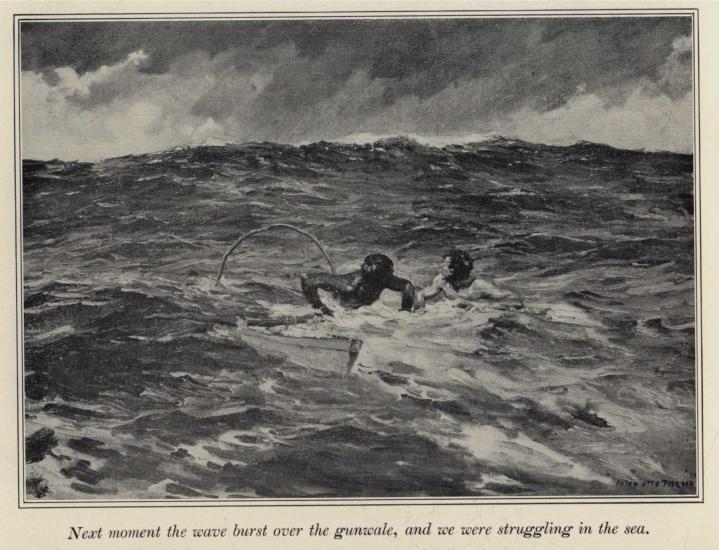
As I leaned back to take up the baler I saw that the canoe was a third full of water—mingled sea water and rain. I set to work in a panic, while Marama fought to hold us head-on to the seas, with clenched teeth and a steady eye ahead. Working at top speed to throw the water out, I perceived with a sinking heart that the task was beyond his strength; we had done our best, but in another moment the canoe would fill and swamp. Three times, with a sweep of the paddle that knotted his muscles as though cast in bronze, Marama saved us by a miracle. A white-crested roller seized us with a fierce caprice, spinning the canoe about. Marama's paddle dug deep to swing our bows to meet the oncoming sea and then, with a crackling sound audible above the wind, the haft of hard black wood snapped clean in two.
Next moment the wave burst over the gunwale, and we were struggling in the sea.
Next moment the wave burst over the gunwale, and we were struggling in the sea.
For a time I felt that the end was near. The water was warm and I was clinging to the outrigger-pole, but it seemed impossible to breathe. I think I should have suffocated, without my long experience of diving at Iriatai. My eyes were filled with water, and each time I strove to get a breath, the sea broke over me to fill my nose and mouth. Little by little I learned to watch my chance, to fill my lungs hastily at moments when I could get a gulp of air.
Marama worked his way along the gunwale of the swamped canoe and took hold beside me, on the forward outrigger pole. The buoyant wood supported our bodies in the water, and our weight at the forward end held the long hull bow-on. The clouds were breaking to the west; the squall was passing suddenly as it had come. The ocean was calming rapidly, steep breaking seas giving place to a long swell, though for the time being there could be no thought of baling the canoe. Before long we were able to speak of our predicament, and I remember that neither of us mentioned sharks, the subject uppermost in both our minds. It is curious that the white man, like his savage cousins, brown or black, is still the prey of an ancient instinct of the race: Never speak of the evil thing you dread!
If the sharks had found us that day, our end would have been a sudden and a ghastly one.
Toward noon the sun shone out through the last of the storm clouds and the sea had gone down so much that Marama made ready for an attempt to get the water out of our canoe. "You have seen it done at Faatemu," he said; "I will watch the waves carefully till our chance comes—and then you must do your best!"
We swam aft and took our places on either side of the stern, holding the canoe head-on while two or three long swells rolled by. Then, at the beginning of a lull, the native boy gave the signal, and we put all our weight on the stern, sinking it deep. "Now!" cried Marama, and we dove down, pushing it still deeper and thrusting forward as our hands let go their hold. The canoe shot into the air, leaping forward as the light wood bounded to the surface; the hull smacked down on the sea, and a rush of water tumbled forward and poured in a cascade over the bows. Piloted by Marama's skilled hands, she took the next swell without shipping a cupful, her gunwale four or five inches clear of the sea.
"Hold on with one hand and bale with the other," ordered my companion, "and I will swim forward to keep her head-on till she is dry."
There were still a good fifty gallons of water and my task was a weary one, but at last she floated high and one after the other we clambered in gingerly over the stern. Without a word Marama stood up, balancing himself with one bare foot on either gunwale as he gazed out intently to the west.
"There is no land in sight," he said.
I felt no great concern at his words, for I believed the squall could not have carried us many miles offshore and though we had only one paddle between us, a few hours would bring us within sight of the palms of Iriatai. I learned afterward that we were in the clutch of one of the uncharted currents of the Paumotus—a current which swept around the north end of Iriatai and was carrying us farther and farther into the vast stretch of ocean between the coral islands and the South American coast.
Toward three o'clock, while I paddled and Marama scanned the empty line of the horizon from his perch in the bows, he gave a sudden shout. "E pahi!—a ship!" he cried, and presently I made her out, a two-masted schooner, hull down in the north. Could it be the Tara, come out in search of us? But no—this was not the first time we had spent a day away from camp; by evening my uncle would begin to feel anxiety, but for the present he would think we had been caught in the squall and forced to land—a stove-in canoe, perhaps, and a weary journey on foot through thorny bush and over sharp and broken rocks.
A light steady breeze ruffled the sea that afternoon, and anxious minutes passed before we made certain that the schooner was heading south. When she was still miles away I saw that she was not the Tara. She carried a pair of lofty topsails, a rare sight in these seas; and unlike the schooners in the island trade, the stranger's mainsail sported a gaff, cocked at a jaunty yachting angle. As she came closer, her towering canvas drawing every ounce of power from the air, she made a picture to delight more critical eyes than mine. The Tara had a sturdy beauty of her own, but she was a "bald-headed" schooner, without topmasts, and she would have had the look of a barge beside the tall, graceful vessel approaching us, skimming the sea like a cup-defender under her press of sail.
Presently she was within hailing-distance and we saw her native crew along the rail. The brown men began to shout questions at us, after the fashion of their race: Who were we—whence did we come—where were we going? Then I heard a command, in a roaring voice that made the sailors spring to their posts. The schooner shot into the wind with a crisp shiver of canvas, bobbing and ducking into the head sea as she moved forward and lost way close alongside. Lines were passed down, strong hands came out to help us; the next moment our canoe lay on deck and we were standing beside it, surrounded by good-natured islanders who were chattering, gesticulating, grinning with flashes of their white teeth.
Again the roaring voice boomed out from astern: "Back the fore-staysail! Eh, Tua! Send the Kanaka forward and bring the white boy aft to me!"
Tua, the mate, a tall native with a handsome determined face, touched my arm. Walking aft while the schooner filled away again, I had my first look at the helmsman, a white man of herculean build. He wore a suit of drill, freshly starched and ironed, snowy yachting-shoes, and a Panama of the finest weave. The lower part of his face was concealed by heavy moustaches and a thick blond beard, but the skin above his cheek-bones was smooth as a woman's. His eyes were of a blue I have never seen before nor since: dark and sparkling when his humor was good—in anger, glittering with the cold glare of ice. In some subtle way the eyes reflected the man's whole personality, at once virile, magnetic, daring, unscrupulous, and cruel. But I was young and his cordial manner disarmed me; for the time, my eyes were not open to the evil in our rescuer. He smiled and stretched out a hand to me—an enormous hand with fingers like so many bananas.
"Well, young man," he said, his deep voice and the order of his words carrying a foreign hint, "from where are you come? In that direction, South America is the nearest land!"
I had asked for water as I stepped aboard, and now a black man with a great shock of hair came aft to hand me a pitcher and a glass. The captain watched me, smiling behind his beard as I drank the water to the last drop. Finally I set down the glass.
"Excuse me, sir," I said, "I was very thirsty! It was lucky for us that you happened to pick us up. We went fishing this morning and our canoe was swamped in a squall. Afterward, when the clouds passed, the land was out of sight, and we've been paddling ever since." He glanced down at a chart unrolled before him on the cockpit floor.
"From Iriatai you are come, then," he remarked. "That is strange, for the island is marked as uninhabited. Well, it is not far out of my course—I am bound for Mangareva to load shell."
His courteous manner and lack of curiosity made me feel that it would be boorish to be reticent. I had no suspicion that he was feeling me out for information. And my uncle had nothing to conceal.
"My name is Selden," I told him, "and I have been on the island several mouths. My uncle, Henry Selden, has leased Iriatai from the Government and planted coconuts. Last year he discovered a patch of shell in the lagoon, and the French have granted him a season's diving-rights."
I was going to say more, but a sudden sound interrupted my words. The ship's bell rang out two sharp and measured beats, paused, and sounded twice again. It was six o'clock. The watch was changing, and at a word from the captain the tall mate came aft to take the wheel.
"Keep a man aloft," the skipper said. "It grows dark, but within half an hour you will raise the land." He turned to me. "Come below," he suggested, "you will be hungry after your day at sea. When we have dined, I shall be interested to hear more of your island."
He followed me down to the saloon, where the table was set with shining glass and porcelain. A young woman rose as we appeared, a slender, graceful girl, with sullen eyes and a great bruise disfiguring one pale brown cheek. She wore a loose gown of scarlet silk; crescents of gold were in her ears; and her dark hair, dressed in a single braid thick as a man's arm, hung to her knees. I learned afterward that she was a half-caste from the Carolines. The captain spoke to her and glanced at me.
"Madame Schmidt," he said in introduction; and as I took her hand, I realized suddenly how I must have appeared. It was months since scissors had touched my hair, which stood on my head like a Fijian's, tangled and bleached by the sun. My skin was tanned to a sort of saddle-color, and I was naked save for the torn and faded pareu about my waist. The captain seemed to divine my thought.
"Eh, Raita!" he ordered, "get out for our guest some clean clothes. He will feel more at ease."
I slipped into a stateroom to put on the garments the woman laid out for me: an enormous pair of trousers I rolled up at the bottom, and a coat in which Marama and I could have buttoned ourselves with room to spare. The meal was served by the captain's body servant, the black, shock-headed savage I had seen on deck. He was an evil-looking creature, like some fierce ape masquerading in a sailor's clothes. Several times during the meal Schmidt gave him orders in an outlandish jargon I had never heard, and once, when the captain told him to fetch wine, he asked his master a question in a shrill chatter, grimacing with his eyebrows like a monkey. The woman ate sullenly, without once raising her eyes; when she had finished, she rose and left us without a word.
It was still daylight outside, but the swinging lamp above the table was lit, and under its light I had an opportunity to study the features of my host. I began to change my first opinion of him, for the scrutiny was not reassuring: the more I looked, the more he puzzled me and the less I trusted him. When the black man set cups of coffee before us Schmidt began to question me. How long had we been on Iriatai? How many divers were at work? Was there plenty of shell? Was its quality good? Had we been lucky with pearls? But by now I was on my guard, and returned evasive answers, feigning the stupidity of weariness—a deception which did not require much acting on my part. A long-drawn shout from above brought us suddenly to our feet.
"Land ho!"
When I came on deck the western sky was glowing with a fiery sunset, and under the crimson clouds I could make out the long dark line of Iriatai. Puzzled and vaguely uneasy in my mind, I was leaning on the rail when my eye fell on a handsome dinghey, slung on davits close to where I stood. Her stern was toward me, and there, neatly lettered on the bright varnished wood, I saw the word, "Cholita." So Schmidt's vessel was called Cholita—a pretty name for a pretty schooner—and then I remembered with a sudden start. My thoughts flashed back to the morning when I had paddled out to breakfast with my uncle in Faatemu Bay—to his account of Thursday Island Schmidt. My uncle's words came back to me: "His schooner's as pretty as her reputation is black, and the way he handled her was a treat to watch."
So this was the Cholita, and I was the guest of the famous Thursday Island Schmidt!
I felt a touch on my shoulder, Marama was beside me, a serious expression on his face. "Listen!" he said in a hurried whisper; "I must go forward before the captain returns. If we approach the land to-night, let us slip overboard and swim ashore. Seroni must be warned, for I think that there is evil afoot. Do you remember Rairi, the Tara's cook who tried to kill old Pahuri that night on our passage south? He is aboard—I have seen him, though his face was turned away from me. He has been ordered to keep out of your sight. This schooner was bound for Iriatai before she picked us up. The mate, who is a good man and beginning to fear for himself, has told me as much."
The captain was approaching with a noiseless step; when I glanced up he was not four yards off. He halted and looked at Marama in angry astonishment. "Get forward," he bellowed, in a voice that made the sailors turn their heads, "verdammt Kanaka cheek!" He turned to me, the former suavity gone from his manner. "And you," he ordered—"go below!"
I obeyed him, choking with anger and a sense of impotence. The half-caste girl was sitting on the lounge, she had been sewing, but now her hands were clenched and her work lay where it had dropped to the floor. There was a look of apprehension in her eyes. When she saw that I was alone she beckoned me with a swift gesture.
"Come here, boy—me want talk with you," she whispered in quaint broken English. "Me hear Schmidt say 'Go below'—he too much bad man! Guk! Me hate him!—Suppose we go near land tonight, me jump overboard, swim ashore. You come too—we go hide in bush."
Her fierce eyes blazed as she pointed to the bruise on her cheek.
"Schmidt do that yesterday," she went on. "Me like kill him, but too much 'fraid! Before, me think him good man. My father white man—same you. Me, my mother, live Ponape, Caroline Island. One day Cholita come—everybody think Schmidt good man—spend plenty money—have good time. Every day he come my house. By and by he say: 'To-morrow I go 'way; you my friend—give me orange, pig, drinking-coconut. To-night you bring old woman aboard—we have big kaikai.' My mother think he good man—we go. Schmidt bring us aboard schooner—we eat, play accordion, have good time. Pretty soon hear noise on deck. My mother stand up. 'What that?' she say. Then Kwala hold old woman—Schmidt throw me in stateroom—lock door. Outside reef he throw my mother in canoe—tell her go ashore. Porthole open—me hear old woman crying—Guk! Schmidt never let me go ashore. In Tahiti—Noumea—me 'fraid—he say suppose me swim ashore, send police fetch."
Her quick ear caught the sound of a footstep on deck and she signaled me hurriedly to move away. Next moment Schmidt came down the companionway, glancing at the woman sharply. Without a word he motioned me into the stateroom, slammed the door behind me, and turned the key.
I heard Raita's voice raised in protest, and the captain's gruff reply. Then the companionway creaked under his weight as he went on deck again.
Until now I had viewed the Cholita and her master in an adventurous light; but as I lay there in the dark behind a locked door I began to feel anxious and a little afraid. Little by little, as realization grows at such a time, I put together the scattered recollections in my mind: what my uncle had said of Schmidt; the half-caste girl's story; the presence aboard the Cholita of Rairi, our former cook; the old letter, telling of the gold-lipped shell in Iriatai lagoon; Rairi's stealthy visit to the Tara after his discharge; Schmidt's treatment of me; Marama's words, and the brutal stopping of our conversation. There was small room for doubt—each detail fitted perfectly into the story taking form in my mind.
While the schooner lay alongside the Papeete wharf (I thought), discharging the load of shell of which my uncle had spoken, Rairi must have made the acquaintance of Schmidt. Our one-time cook had looked through the papers snatched up in hope of doing my uncle an injury, and had come upon Turia's letter, written to her son. It was a chance in a thousand, but how was Rairi to make use of it? Then, meeting Schmidt and knowing something of his character from gossip along the waterfront, the vengeful Paumotan must have seen his opportunity. A few cautious questions to feel out his man, increasing confidence, the final disclosure of Turia's old letter—and the compact made. It would be a daring bit of robbery in these modern days; I wondered how Schmidt could hope to keep out of trouble in the long run. He might scuttle the Tara, of course, and leave us marooned on Iriatai, but our whereabouts was known to many people, and before many months had passed someone was bound to set out with a schooner to see what had become of us. But he was a resourceful scoundrel, from all I had heard; he must have weighed his chances before embarking on such a piece of barefaced piracy. And robbery was the Cholita's errand. I knew it now as surely as if Schmidt had disclosed his plans to me.
As I lay there in the berth, tired and frightened, I began to blame myself for not having played a more cunning game. Now that my chance had gone, I saw that I might have played the part of a talkative and unsuspecting lad, answered Schmidt's questions freely, and perhaps have kept my liberty until we drew near the land. Then I might have gone overboard in the darkness, made my way to my uncle and given him warning of the Cholita's approach. Now it was too late. They would take the Tara by surprise. There might be bloodshed. A terrible thought flashed into my mind—Uncle Harry stretched out on his schooner's deck—
I sat up in the berth, clenching my hands. I had no dearer friend in the world. But at last excitement and weariness overcame my anxious thoughts, and I fell into a dreamless sleep.
When I awoke the morning sun was shining through my porthole, and looking out, I saw that we lay close to the beach, just inside the pass of Iriatai. A noise of thumping and scrubbing overhead told me that the decks were being washed down. We were at anchor, I knew, for the schooner lay motionless, though the current at this place was strong. An hour passed and as I craned my neck out the port I saw the Cholita's dinghey approaching us from the north. The handsome little boat drew near and I saw Rairi in the stern, a Winchester across his knees and a bandolier of cartridges over one shoulder. Schmidt's shock-headed black was at the oars and at his feet a man lay in the bottom of the dinghey—an elderly native, bound hand and foot, his gray head matted with blood and unsheltered from the sun. It was Pahuri—I knew with a sudden breathlessness that they had taken the Tara and that Rairi was enjoying a savage's revenge.
The dinghey passed out of my sight around the schooner's stern. I heard the thump of a body flung down roughly on the after deck, Rairi's voice raised in a sharp command, and the creak of the davit-blocks as the boat was hoisted to the rail. Then, for a long time, all was quiet. Rairi had gone below for a rest and a nap, leaving the black on guard, for most of the crew were new men whom neither Rairi nor Schmidt would trust too far. Finally the silence was broken by a weak voice—old Pahuri begging monotonously for water. Heavy steps came aft over my head and I heard the mate order the black man to give water to his prisoner. But the savage chattered a refusal in his own uncouth tongue; he had a rifle and he was under orders from Rairi, so Tua strode forward angrily, muttering to himself. Then suddenly I heard a rapid whispering at the keyhole of my door. It was Raita.
"Eh, boy!" she said, "listen—you asleep?"
"No," I whispered back.
"Last night," she went on, "Schmidt take your schooner—Rairi bring back old man he no like. I sorry that man—head hurt—too much blood. Rairi leave him in sun—no give water. Schmidt stop aboard your schooner—suppose wind come up, Cholita go there. Native boy, your friend, swim ashore last night. Me think go too, then think no—me stop aboard, maybe help you. Ah—me hear Rairi—me go!"
I heard her move away, quickly and softly, from the door. Her words added little to my anxiety, for Pahuri's presence told me that Schmidt had captured the Tara, but the thought of my uncle tortured me: Where was he—captured, wounded, perhaps dead? I glanced out the porthole. The palms were swaying to the first of the trade wind, heralded by long blue streaks outside the pass. Presently there were sounds of activity on deck; shouting and creaking of blocks as they hoisted the foresail, the deep-voiced chant of the sailors at the windlass. Then, heeling a little to the freshening breeze, the Cholita filled away on the port tack, turned to leeward as she gathered way, and slacked off for the long run across the lagoon.
When we drew near the islet, toward midday, I saw that the Tara's anchorage had been changed: she was lying fully a quarter of a mile off shore. Eight bells struck as we rounded into the wind beside her; I heard the anchor plunge overboard and the prolonged rattle of the chain. Then the bellowing voice of Schmidt hailed us, shouting orders and instructions. A moment later the key turned in the lock of my door and Rairi entered to grasp me by the arm.
"Come," he said roughly, "Schmidt want you aboard Tara!"
He half dragged me up the companionway and across the deck, where I had a glimpse of our engineer lying bound in the sun, his gray hair clotted with blood. Rairi motioned me into the dinghey alongside, sprang in after me and signed to the oarsman to pull us across to the Tara. Schmidt was standing by the rail.
"Where's the Kanaka boy?" he asked.
"Swim ashore last night; maybe shark take him—no matter."
"Let him go—no harm can he do us. Wait for me."
I clambered over the rail in obedience to Schmidt's gesture, and he followed me below. My uncle's stateroom was open and in great disorder. We halted opposite the door of my own cabin. The German drew from his belt a heavy Colt's revolver, cocked it, unlocked the door quickly, and pushed me inside. As I stood there, dazzled by the bright light of the porthole, I heard the key turn behind me, and then my uncle's quizzical voice.
"Well, old fellow," he remarked, "it's good to see you safe and sound. We seem a bit down on our luck, eh?"
He was lying in my berth, quietly puffing one of his long, thin cigars.
XI PIRACY
For a moment I was overcome by astonishment and relief; my mouth half opened and tears came into my eyes. My uncle stretched out his hand.
"Cheer up!" he said, smiling at my long face. "We're not beaten yet! Before I tell you my side of the yarn, let's hear how our friend Thursday Island happened to pick you up."
Speaking in a low voice, I told him of our fishing, of the squall, how the canoe was swamped, how we had baled her, and how Schmidt had picked us up. His only comment was a soft whistle when I spoke of how I had nearly drowned before the sea went down. Then I told him of the Cholita: her captain, the half-caste girl, Rairi, and the story I had pieced together. As I finished, Uncle Harry nodded his head.
"That's it," he remarked—"not a doubt! That scoundrel Rairi—I wish I'd handed him over to the authorities as I was tempted to do! I wish also that I hadn't built my stateroom doors so well; they're solid oak, an inch and a half thick, with hinges and locks to match! And Schmidt took care to clear away everything movable: even the water-bottle's gone! But I must tell you about last night.
"You know the family next door to Maruia's house—their baby died yesterday, and when dinner was over I gave the men permission to go ashore for the singing. It was careless, of course, but we've never stood an anchor watch since we've been here. Pahuri stopped aboard—he was asleep up forward—and I was in a pareu, working on my ledger. I keep the books in the safe, you know, and the door of the safe, like the stateroom door, was open. At about eleven o'clock I heard a boat bump softly against the Tara's side, but Fatu was due to bring the men aboard and I paid no attention to the sound. I glanced up from my work a moment later, and there was Mr. Thursday Island Schmidt in the doorway, with a big revolver cocked and aimed at my chest. He requested me, very politely, to hold up my hands and keep them there, and as my own gun was in a drawer behind me, I could see no way of refusing him!
"The only men with Schmidt, I believe, were Rairi and some sort of outlandish nigger. All I saw of the black man was a glimpse of his fuzzy head outside the door, but Schmidt still keeping me covered, ordered Rairi in to go through the contents of the safe. He wanted to get me out of the way, but he saw that the safe was open and he was too wise to turn his back on his partner, even for a moment. He's a cheeky devil, Rairi: he gave me a sour grin that must have done him good. First he pulled out the little drawer where I keep my loose money for emergencies—about a thousand dollars in gold. He laid it on the table, and as Schmidt glanced down I was tempted to have a go at him. But I knew his reputation, and I knew that Rairi was aching for a chance at me. At that moment, when I was half decided to try to knock Schmidt out, I was distracted by a glimpse of something that escaped him altogether. Out of the corner of my eye I saw Rairi's hand shoot out suddenly behind his back and come up to his waist, where he seemed to fumble for an instant with the tuck of his pareu. I looked more closely—one of the small round tobacco-tins was missing from the row on the shelf! Rairi stooped down as though he had just perceived them, gathered the little boxes in a double handful, and stepped across the room to lay them on the table beside the drawer of gold. 'Pearls, perhaps,' he said.
"Schmidt showed signs of interest at that. He ordered Rairi to open them, and gave each lot a glance, one after the other, but he never relaxed his watch on me. Thursday Island is not a man to trifle with—he's proved that over and over again! 'A nice lot of pearls, Mr. Selden,' he observed, grinning behind his beard; 'there will be a sensation on Tahiti when they learn that the gold-lipped shell has been acclimatized. The Government will owe you a debt for the discovery.'
"I'd been keeping an eye on the pearls and when the last tin was opened I saw that the Twins were missing: by the purest chance, Rairi's thieving hand had landed on their box. I was on the point of telling Schmidt that the pearls he had seen were not bad, but that the finest of the lot were in the tuck of his partner's waistband. I don't know why I didn't speak,—they might have had a row which would have given me my chance—but for some reason I kept my mouth shut. When Rairi had made a bundle of my papers and made sure that there was nothing else of value in the safe, Schmidt told him to clear all the loose stuff out of the stateroom across the way. Then he invited me to make myself at home here until his business was done. He spent some time in assuring himself that the door and lock were strong. 'It may ease your mind,' he said, polite as a dancing-master, 'to know that your nephew is safe; I picked him up yesterday at sea; he'll join you presently.'
"They must have overlooked Pahuri when they first came aboard. As the German left my door I heard a racket up forward: that half-caste, mauling the old man in a way that made me see red. I was fool enough to try to break down the door until Schmidt bellowed out something that stopped the noise."
My uncle held up his hands to show me the knuckles, bruised and clotted with blood.
"The noise must have given the alarm to Fatu," he went on, "for a few minutes afterward he put off with Ivi and Ofai in the boat. The current had swung the Tara around so that I could see what followed out of the porthole. Schmidt heard them launching the boat and called his men. He had a powerful electric torch and when he flashed it toward the land I saw my boys taking their places at the oars, Fatu in the stern, and ten or a dozen divers on the beach. Schmidt growled out an order to his partner and I heard Rairi's voice raised to warn the boat away. But our men paid no attention; the light showed them making for the Tara at top speed.
"'Let them have it, then!' bawled Thursday Island. I heard two rifles crack, the snap and click of the levers, and two more quick shots. Ivi dropped his oar and sank down on the grating with a hand to his shoulder. Fatu sprang to his feet, snatched up the oar, and took the wounded man's place, to pull straight for the schooner. Rairi and the nigger would have slaughtered them like sheep, but they held their fire when I shouted through the porthole, telling my men to go back; that a strange schooner was in the lagoon, that her skipper had made me prisoner, and that they had best leave the affair in my hands. There isn't a gun of any sort ashore and I don't want to be rescued at the cost of half a dozen lives! Well, they obeyed me and went ashore. The sound of the shooting roused the whole camp—things have been humming ever since. Perhaps Fatu has some scheme for setting me free; Schmidt seems to think so at any rate, for he and his men went to work on the windlass, got the anchor off the bottom, and allowed the Tara to drift offshore with the current before they anchored her again. As for the fix we're in, the worst that can happen is that we'll lose our pearls. I doubt if even Schmidt has the audacity to load a hundred tons of shell under the noses of the men ashore—I wonder if he would dare? What sort of crew has he—many men he can trust for this sort of villainy?"
I said that I believed most of Schmidt's men were newly shipped, that aside from Rairi and the black they seemed an average lot of natives, not particularly bad. From Marama's words and what I had seen of the man himself, I judged that Tua, the mate, was a first-class fellow, beginning to feel qualms about the company in which he found himself.
"Tua," remarked Uncle Harry, musingly, "Tua—that's not a common name! Did he ship in Papeete? He isn't by any chance a youngish chap, rather light brown and more than six feet tall? That's the man? By Jove! I'd like fifteen minutes alone with him—he's Maruia's foster son!"
A sound of voices put an end to our talk. Schmidt and the black man had come across in the dinghey and were making her fast alongside. Raita was with them, for I heard the captain order her roughly to climb aboard. There was a step on the deck overhead; a sound made me look up and I saw that a basket of food had been lowered to our porthole. Schmidt hailed us.
"I am sorry, Mr. Selden," he said, "that your lunch comes late. For me, these are busy days!" He spoke with a kind of cool politeness he had not troubled to affect toward me. I never heard any man speak rudely to my uncle; even now, while he lay helpless to resent an injury, Schmidt chose to address him courteously. Water was to be had at the tap, and we ate with good appetites while Schmidt conversed with my uncle through the stateroom door. He had come below for a yarn, he said, and he seemed in a communicative mood.
"My friend Rairi," he began abruptly, "does not love that old man of yours. Last night, when he tied his hands, he hurt him more than I thought necessary—I believed that he was taking him back to the schooner that he might bind up his wounds. To-day I found that old man delirious in the sun, and I was forced to speak plainly. Ach! A savage—I have had more than enough of the native—It would be good if business did not deprive me of your company."
"See here, Schmidt," remarked my uncle good-naturedly, "do you realize that this business of yours is apt to deprive you of all company except your own, for a good many years to come? You have brains, man—use them! So far, you've played your cards well: we'll grant that you are able to get away from Iriatai with the pearls. You know pearls. I'll be frank: they're worth forty or fifty thousand at least. But think of the future—you can't do this sort of thing nowadays. Matters were different twenty years ago. Sooner or later this affair will be the talk of the Pacific. Think of the wireless, man—they'll be looking for you in every port in the world! Don't mistake me,—I'm not telling you this for your own good,—but the lawyers have a very unkind name for what you are doing. Think it over, Schmidt. If you're wise, you'll return what you've taken and clear out of Iriatai. As a matter of fact I rather admire your nerve. If you'll turn over Rairi to me, I'll let the matter drop at that."
The answer to my uncle's words was a rumbling chuckle; I could fancy the ironical glint in the German's cold blue eyes. "A handsome offer," he said mockingly. "You are more than kind! Since you are good enough to be frank, I will be frank as well. As for thinking, mine was done long ago. I do not fear all the warships and all the wireless in the world! There can be no harm in telling you, for that matter; in estimating my chances of escape, you can amuse yourself for the next day or two.
"This morning I took my glasses and had a look ashore. A nice stack of shell you have made ready for me, under the shed! That I must have. If there is trouble in loading it and any of your men are hurt, they will have themselves to blame. Bloodshed I do not like: it is always foolishness! Without an axe you will not break out of your stateroom. Matches I have left you and you could set fire to the schooner, but that would be for you unpleasant and would only save me trouble in the end. If you should succeed in breaking out, always there will be one of my men to deal with. Kwala, the black, is a Malaita boy—not a man to trifle with. And Rairi I do not trust overmuch myself; he is a primitive, and he bears you an old grudge. I was nervous last night when he brought me in through the pass; did you know that long ago he lived on this island? Yes—his mother was one of the savage women deported by the French. So you see, I put you out of my mind."
"Well," said my uncle in an amused voice, "suppose you do load the shell and get away from Iriatai. Can't you see that your troubles would only be beginning then?"
"Ach, Mr. Selden," said Schmidt with reproachful irony, "you do me injustice! Remember, please, I am a man of resource. There can be no harm in it: I shall open my heart to you and tell the truth—what my vulgar Australian friends used to call, in their picturesque way, the 'straight griffin,' or the 'dinkum oil.' First of all, much though I regret, I must scuttle your pretty Tara. When I am ready to leave and the holes are bored, the key will be given you through the porthole in time, that you may swim to land before the schooner goes down. Your boats I shall tow to sea with me. I hope you are not foolhardy enough to venture to sea in the native canoe. Many months will pass before information can be laid against me. One chance I take—that a schooner might put in here soon after I leave; but that chance is small. Like your schooner, the Cholita is of French registry now; on paper, my mate, Tua, is her captain; I am cleared for the Paumotus, to pick up copra and shell. What shall I do? The simple thing, which all my life I have found the wisest: go straight to Tahiti, sell my cargo to the highest bidder, and clear once more for the Paumotus within a week. As for the gold-lipped shell, there will be a hint of a discovery in a remote lagoon; I can see now the wise ones among the traders hastening to a place five hundred miles from Iriatai! My men may talk, but two things will close their mouths, I think—love of money and fear of me. Clear of Tahiti, my beard and my schooner's topmasts will come off; she will have a new name and a new set of papers. At filling them out, I am clever—you would be surprised! Then, one fine day, long before they have come to look for you on Iriatai, a strange schooner will put into a far-away port, South America, perhaps, or among the Dutch East Indies—Ach—who knows? There is a Chinaman in Gillolo who would gladly take the schooner off my hands. It is a sad thing to grow old, my friend; I am tired of the Pacific and of this wandering life. Much is forgotten in twenty years; it is my dream to settle quietly in the German village where I was born—But you must excuse me—I hear my good Rairi calling!"
I heard Rairi's voice and the sound of Schmidt's footsteps as he climbed on deck. Then all was silent for an hour or more, while my uncle and I spoke in low tones of our predicament. Suddenly there was a whispering at our door—the voice of Raita. the half-caste girl.
"Eh, boy," she said rapidly, "you hear me? No talk loud—Kwala, that black man, on deck! Schmidt, Rairi, they go aboard Cholita. You got kaikai—got water? Good—me 'fraid you hungry. Listen: Raita tell you what they do. Schmidt go Cholita tell that mate, Tua, go ashore. Tua tell people on island stop in bush to-morrow; suppose they come on beach, they get shot! When Tua come back, Schmidt, Rairi come aboard this schooner sleep. Keep pearls here. When dark, maybe me swim ashore hide in bush."
"Raita," I called softly, as a sudden idea came to me, "wait by the door for a minute. I want to speak to you when I've talked with my uncle."
I climbed into the upper berth and squeezed my head and shoulders through the porthole. It was as I thought; no man could have passed through such a narrow aperture, but the feat was possible for a slender boy. "Listen, Uncle Harry," I whispered as I climbed down to his side, "you heard what that woman said; now see what you think of the plan I have in mind. Schmidt has sent Tua ashore to warn the people to keep away from the beach while he loads our shell. Tua, you say, is Maruia's foster son, and I feel sure that he and most of the crew are uneasy in their minds. This is my plan: we can see the shore from our porthole, and if, by the time it is dark, Tua has not returned to the Cholita, I will wriggle through the port and swim ashore. It will be easy, I think, to explain the situation to Tua and to our divers. Tua can go off to the Cholita and tell his crew what kind of venture they are engaged in. Once they understand, I'm sure there won't be a hand raised to help Schmidt to-night. Then, in the darkness after the moon has set, I'll swim off quietly with Fatu, Ofai, and a few of the divers, climb aboard and take the Tara by surprise. Once we have Schmidt and his two followers, there'll be no trouble with the others, I think. We must decide quickly—let me try!"