Front matter (continued 2)
Reading edition
Round-bottomed and very narrow for their length, the native canoes would capsize at once were it not for their outriggers—light slender logs which float in the water alongside at a distance of four or five feet, attached to the hull by a pair of transverse poles. When Captain Cook first sailed among the islands, the natives marveled at the great canoe which remained upright without an outrigger—more wonderful by far, in their eyes, than the white man's cannon, or muskets, or axes of steel. "Aué!" they exclaimed, in astonishment. "E vaa ama oré!"—a canoe without an outrigger!
We made our outriggers of light purau wood, twenty feet long, five or six inches thick, and pointed at the forward end. The attaching poles were of iron wood—casuarina is the name of the beautiful, pale-foliaged tree—lashed across the gunwales fore and aft, the bow pole rigid, the rear one curved and flexible. At Taura's suggestion, I gave orders that all the outriggers and their fittings be assembled, and the canoes tested in the water before they were taken apart to be loaded aboard the Tara. Thanks to the chief, they were ready some days before the schooner came in sight, and our diving-goggles, made in the evenings by the old men of the village, were finished and waiting at the store.
To the native fisherman, these goggles are nearly as important as his spear. They are not unlike the goggles used by motorists at home: a pair of glasses, set in wooden rims which fit tightly about one's eyes, and held in place by an elastic around the head. With such glasses, well fitted and water-tight, one can see nearly as well in the clear sea-water as in the air above.
I kept two pairs for Marama and myself, and we went out often, on afternoons of leisure, to spear fish inside the reef. Paddling to a place where the water was from five to ten feet deep, we moored our canoe to a coral mushroom and set out, swimming for long distances or wading as the water shoaled. Little by little I learned one of the most difficult of native arts: to swim gently with my face under water, holding the spear between my toes. I learned to distinguish the good fish from the bad, the wholesome from the poisonous; to recognize the holes where the fat black maito hide; to see the octopus dart into his cranny; to transfix my quarry with a well-aimed thrust. Sometimes we were in the water for three hours at a stretch, but I never wearied of admiring the strange beauty of this underwater world. The sunlight, filtering through the clear lagoon and reflected from the bottom in delicate tints of blue and green, revealed shoals of fish, colored like jewels and of fantastic shapes, gliding among the branches of the coral forest. In deeper water a gleam of vivid blue showed where the tridacna—the giant clam—lay in his hole with jaws agape, and I learned to swim down with a bar of steel and pry him from the rock.
Sometimes, on moonless nights, we took torches and went out spearing on the reef. The Raiatea barrier-reef, about a mile offshore, is no more than a low dyke of coral, half awash and breaking the landward run of the swell. By night, when the torches flicker and flare, and mighty combers, bursting on the outer edge, come foaming waist-deep across the jagged rock, the reef is an eerie place, not without dangers of its own. Under cover of darkness, strange monsters have been known to crawl up from the depths on the seaward side—the huge decapods on which the sperm whale feeds, and nameless creatures of which the natives speak with whispered dread. There were tales of fishermen who had paddled out at nightfall, never to return.... Nothing would have tempted me to fish on the reef alone at night, though when several of us went out together, armed with machetes and heavy spears, there was a wild charm about the sport.
We walked abreast in a line that reached from lagoon to sea, each man bearing in his left hand a torch of dry bamboo. At times, a cry from the seaward man caused us to brace ourselves for the big sea he had seen rearing in the torchlight. Then with a roar and a crash the wave would break, sending a wall of white water across the barrier. Sometimes a shark came thrashing across with the wave, to be speared before he could reach the deep water of the lagoon. Sometimes a series of shouts went up as a great silver cavally swept by us so fast that man after man missed his thrust. When the wave receded there were spiny crayfish to be caught in the pools, and enormous pink-spotted crabs to be held down with a spear-shaft till one could take a safe grip, out of reach of the menacing claws.
One day, when the sun was bright and the current in the pass was slack, Marama showed me a pleasanter and lazier kind of fishing. He had caught a great quantity of hermit crabs the night before, and at daybreak I found him on the beach, picking up the pebbles used for sinkers and tossing them into the bottom of the canoe. He had brought a line fitted with strong hooks on wire leaders, and his water glass—a small wooden box, open at the top and with a bottom made of a pane of clear glass. We paddled to the passage and anchored the canoe on one side, where she could swing out over the wall of coral, shelving almost vertically into deep blue water. Then Marama began to crack the shells of his crabs, smash the claws and bodies between two stones, and toss this ground bait over the side of the canoe. I took the glass and watched the fragments of crab-meat eddying down beside the seamed and crannied wall. The water was so clear that every detail of the scene was visible: the strange fish drifting along the face of the cliff; the mouths of the caverns from which larger fish looked out; the sandy bottom beneath us, scoured clean by the current of the pass. At first, only a shoal of small fry gathered to gobble up the bait, but suddenly they scattered in terror as a pair of parrot fish, bright blue and a yard long, with horny beaks instead of mouths, moved leisurely from their hiding-place. There was so little wind that my companion had seen them without his glass. He baited his hook with the soft body of a hermit crab, tied a pebble to his line with the curious hitch that allows the sinker to be released by a jerk, and dropped hook and stone over the side. I watched the pebble rush down toward the bottom; saw it halt below the drifting bait; saw the line jerk and the sinker drop off and disappear; watched the baited hook rise slowly to the level of the parrot fish, that were beginning to feed in their deliberate way.
Now Marama's bait was eddying among the other morsels of crab, and I almost shouted as I saw it disappear in the beak of the larger of the big blue fish. The native boy struck sharply and began to haul in his line, cutting the water in crisp zigzags this way and that. A final heave brought the twenty-pound fish tumbling into the canoe, a blow of a short club ended its struggles, and I examined it at leisure while Marama baited his hook once more. It was the first that I had seen—a strange and beautiful creature, covered with scales larger than a fifty-cent piece, scales of a vivid iridescent blue with a green spot at the base of each. A nip of its horny beak would have severed a man's finger clean. Later that day when I ate my share of it, steaming-hot from the oven, I understood why the parrot fish was prized so highly.
When Taura's family assembled for a meal, all of their cooked food came from the native oven, under the shed behind the house. Their method of cooking seemed to me—and still seems, when I think of those dinners at Faatemu—the finest in the world, preserving as it does all the juices and flavor of fish or fowl or meat. The native cook's equipment consists of a heap of waterworn pebbles, picked up along the beach, a pile of large green leaves, and a supply of firewood. Fish and chicken and pork are cut into pieces of convenient size and made into little leaf-wrapped packages. Yams, sweet potatoes, plantains, and bananas are selected for cooking and laid out beside the packages of meat. Then a shallow hole is scraped out in the earth—perhaps a foot deep, and two feet across—and a hot fire is built inside. When the fire is blazing well, the pebbles are heaped on the wood and left till they are heated almost to a glow. At this stage the hole is raked out clean, the food put in and covered with hot pebbles, and the whole overlaid with a thick layer of leaves and earth. An hour later the oven may be opened, the baked vegetables peeled, and the packages of fish and meat removed from their clean leafy wrappings.
As time went on, it seemed to me that my friend Marama possessed more useful accomplishments than any lad of his age at home. The fishing excursions in which I was always eager to join were in reality his work, for we supplied more than half of the household's food. My friend could read and write, but otherwise he had no education in our sense of the word. He knew nothing of history, algebra, or geometry, but his mind was a storehouse of complex fishing-lore, picked up unconsciously since babyhood and enabling him to provide himself and his family with food. And when you come to think of it, that is one of the purposes of all education.
The habits of the fish in the South Pacific are regulated by the moon, and Marama knew what kinds were to be found on any night of the native lunar month. On nights of bright moonlight we cast a white fly for the small rockfish which frequent patches of live coral; on dark nights we gathered the mollusks abounding in the lagoon. During the week of the new moon's first appearance, we went out at dawn to fish for tunny in the pass. Sometimes Tetua, the twelve-year-old sister of Marama, took me with her to spear prawns in the Faatemu River. Carrying torches and armed with small barbless spears, we slipped and clambered over the wet rocks, scanning the pools for the little fresh-water lobsters which soon filled our pail. Sometimes I took a paddle in one of the long narrow bonito-canoes and went with the men on trips that took us far offshore, following the birds above the leaping schools. I grew hard and browned by the sun, and the native language came to me surprisingly.
Once on a Saturday, when my uncle's work was done, Taura took us to the mountains to hunt for pig. The chief's two lean dogs ranged ahead, and far up in the Faaroa Valley they started a bristling gray boar, fierce, old, and fleet of foot. He led us a long chase over the rough stream-bed and through dense thickets of tree-fern and hibiscus. In the end we heard a fierce uproar of snarls and yelps and grunting, and knew that he had turned at bay. Taura was too old to run as we did, and by this time the chief was a good half-mile behind. We had no weapons, and when I saw the angry brute, foam dripping from his jaws as he faced the dogs with his back to a great tree-trunk, I wondered what we were to do, now that we had come up with him. But Marama did not share my hesitation.
"Take care!" he warned me—unnecessarily, I thought. "He is a bad pig! If he runs at you, jump into a tree!"
He took a clasp knife from the tuck of his pareu, cut a limb of hibiscus, and peeled off a length of the tough bark—the strongest of natural cord. Then he shouted encouragingly to the dogs, and while their attack diverted the boar's attention, he stole quickly around the sheltering tree-trunk. I saw his brown hands shoot out to seize the boar's hind legs, and the next moment—grunting and struggling ferociously—the old brute was thrown heavily upon his back. I rushed to lend a hand and our combined strength was enough to hold him while we tied his legs with strips of bark. Taura found us lying exhausted beside our captive, while the dogs lay in the cool stream, with heaving flanks and tongues lolling in the water.
That evening, when Marama had recounted the details of our hunt, his mother told us one of her tales of heathen days—the story of how the first pigs were given by the ancient gods to mankind. Many of her words I understood; at times her son whispered a translation in rapid broken English. We were lying on a wide mat, spread under the palms close to the beach. A new moon was setting behind the point and the evening was so calm that only the faintest of murmurs came from the reef.
There was a time—so the story ran—many years ago, when there were no pigs on any of these islands. In those days men ate only fish, and sometimes, in seasons of famine, the flesh of rats. The clans of the different valleys were constantly at war, for there was no one government over the island—no family of Raiatean chiefs. Men lost heart for the planting when villages were destroyed and crops burned on every hand, and many of the people left their lands to live in hidden caves among the hills.
In this bay of Faatemu lived a feeble old man, blind with age and weeping, for his wife and all but one of his children had been slaughtered in the wars. He was called Vatea, and the name of his young son, who cared for him, was Tamatoa. They lived in a rude thatch-shelter the boy had built. It was a time of famine; a war-party from Tahaa had burned the village, and there were no plantations of yams or sweet potatoes. The men of Tahaa, as was their custom, had chopped down all the coconut palms, and Tamatoa feared to go after plantains. By day the father and son kept to their hidden shelter, and each night the boy came cautiously to the seaside, to catch what fish he could. Since he dared not use a torch, that was not much; on many occasions his patience was rewarded by no more than one small fish. Then he would make for himself a poor dish of scraped banana-stalks, not fit to keep the life in a man, and after preparing his single fish, he would carry the food to where blind old Vatea awaited him. "I have caught only two small fish," he told the old man at these times; "one for you, and one for me. Now let us eat!" And while the hungry father devoured his fish, the son would make a great noise of smacking his own lips over the wretched scrapings of banana stalk.
Each day the fish were smaller and more difficult to catch, and finally the old man was starving, though Tamatoa gave him all the real food that he could find. As happens at such times, Vatea grew suspicious of his son, thinking that the boy was taking advantage of his blindness to save the best morsels for himself. One day, when the son brought a small raw fish and his own dish of grated banana-stalk, the old man spoke. 'Fetch me a calabash of cool water from the stream,' he said; and when the boy was gone, he felt his way across to where his son's food lay in a wooden bowl. Then his tears fell, and his heart was heavy with remorse.
That night, as they lay side by side on their mats, old Vatea spoke to his son. "Listen carefully to my words," he said, "and forget nothing that I say. To-morrow I shall die; when I am dead, bury me by the great rosewood tree yonder in the valley. Then, every morning, you shall go to my grave at the hour when the sun first strikes the ground. Watch closely; take what you find and use it wisely—it will make you a powerful man."
Next morning old Vatea died, and his son, who was a dutiful lad, did as the father had instructed. For two days, when the first rays of sunlight touched his father's grave he was watching by the rosewood tree, and on the third morning his eyes saw a strange thing. The earth cracked and heaved, and he heard a new sound, the sound of grunting, as a pair of pigs came up out of the dust—the first pigs that any man had seen. Marveling greatly, Tamatoa took them home and cared for them, and only a day or two later, peace was made among the clans, and a bountiful run of fish entered the lagoon.
Litters of young pigs were born as time went on, and the fame of Tamatoa went abroad among the islands—to Huahine, to Bora Bora, and even to distant Maupiti. Then the high priest of Oro, at the Opoa temple, was seized with a frenzy, and through his lips the chiefs learned that Tamatoa, the favored of the gods, was to be made ruler of the island. Thus Tamatoa became king, and the race of swine was given to furnish food for men.
As she finished the story, Marama's mother heaved herself to her feet and led the way to Taura's steep-roofed house. The moon had set, and as I followed through the warm darkness, I thought drowsily of my uncle and wondered when the Tara would return. I might have slept less soundly if I had known that she was then within twenty miles, and that in the morning she would anchor in Faatemu Bay.
V IRIATAI
I was awakened at daybreak by a noise of shoutings and running out of the house, my eyes still heavy with sleep, I saw the Tara standing in through the Nao Nao Pass. I called to Marama. We launched our canoe and paddled out as the schooner rounded to and dropped anchor with a prolonged rattle of chain. My uncle was standing at the wheel—a tall bronzed figure in a scarlet waist-cloth; he called out a jovial greeting as we paddled alongside. Ivi and Ofai were busy with the whaleboat; Fatu waved an enormous hand at us; I saw Pahuri standing by the rail, smiling his cynical and wrinkled smile.
"Come aboard, boys," my uncle shouted. "Eh, Charlie, the islands agree with you, I see! You're brown as a native and an inch broader than when I saw you last! Hello, Marama! Mai ai oe? How's the work coming on? All the canoes ready?"
It seemed like returning home, to breakfast once more in the Tara's saloon. Uncle Harry was in high spirits at the prospect of an early start. Everything had been arranged in Tahiti; the Tara's cargo had been unloaded, and a fresh cargo—all our supplies for the diving-season on Iriatai—taken aboard.
"An odd thing happened," remarked my uncle as we sat down. "I lost a lot of papers from my desk. Remember the letter I translated to you at home—the one about Iriatai, from the old native woman to her son? Well, that was among them; it's of no use to anyone, of course, now that we have the lagoon tied up. A piece of spite-work, I think. Rairi, that precious cook of ours, boarded the schooner one day while I was ashore—said he'd forgotten a bundle of his things.
"I wish you'd been with me," he went on, "you'd have had a look at a famous schooner and the most picturesque scoundrel in the South Seas. Ever hear of Thursday Island Schmidt? Oh yes, I remember—I mentioned him that night at the ranch. Well, this was my first glimpse of him, and I'll own that I was interested. A week ago he brought his little schooner into Papeete with a load of shell from the Gambier Islands. She's as pretty as her reputation is black, and the way he handled her was a treat to watch. She's flying the tricolor now; he transferred her to French registry in Noumea, last year. They know less than the British about her past! She's dodged Russian gunboats when Schmidt was seal-poaching in the foggy North Pacific; she's kidnapped wild bush-niggers, out in the Solomons and New Hebrides; she's posed as an Australian revenue-boat to hold up the Malay pearlers in Torres Straits, where her skipper got his name. I saw Schmidt in the club that afternoon—he's a big German, with a full beard and a pair of cold blue eyes. They say he's a cashiered naval officer—a great talker at any rate, and speaks English like a professor.
"Papeete's a gossipy place! After Schmidt had left the club, I heard some queer yarns. There's a rumor that he has a prisoner aboard the Cholita—someone who's never allowed ashore and whom visitors are never allowed to see! The traders have nothing to think about but the price of copra, and other men's affairs!
"One night on the water-front I saw Schmidt walking with a man I thought was Rairi, but the native turned away before I was close enough to make sure, and old Thursday Island gave me a long stare as I passed under a street lamp. By Jove! It set me to thinking, you know! Suppose Rairi has the letter—he may be cooking up some deviltry with the master of the Cholita! I'll be nervous as an old woman till I get that shell safely stowed away! But that's nonsense—we're living in the twentieth century, and even if Rairi knows more than is good for him, Thursday Island wouldn't dare try any of his old tricks nowadays.
"Come," concluded Uncle Harry, who had been talking as I breakfasted, "we must be getting ashore. Fatu can bring the canoes out and stow them away while we have a yarn with the chief. I hope he has found me some divers."
Taura had sent word to the small Paumotan settlements scattered around the island, and for a week past the divers had been drifting in to Faatemu, traveling by cutter or sailing-canoe with their women, their children, and their household goods. My uncle went to their camp to select his men, and soon the bay was a lively place, echoing with laughter and shouts as the laden canoes plied between the schooner and the beach. The Tara, once smart as a yacht, took on the aspect of a floating menagerie: pigs grunted disconsolately on deck; dogs barked; hens clucked; roosters crowed. A swarm of Paumotans lay about, smoking, chattering in high-pitched voices, playing accordions. The decks were littered with their mats and bedding, on which small brown babies lay asleep, unconscious of the uproar of departure.
Late in the afternoon Marama and I made our parting gifts to his family and paddled out to where the Tara lay, her engine going and her anchor up. We clambered over the rail; old Taura stood in the canoe, waving his hat while the schooner got under way and glided out toward the pass. Months were to pass before we saw the gray-haired chief again.
My uncle laid his course due east, to pass between the great atoll of Fakarava and Faaite, the smaller island to the south. The fair weather held while the Tara threaded her way through the strange Sea of Atolls—the dangerous archipelago, dreaded by mariners since the Pacific was first explored. We passed the southern end of Fakarava, a lagoon like an inland sea, surrounded by a narrow ring of palms, passed Katiu and Tuanake, turned south to skirt the treacherous reefs of Makenio, were swept eastward by the current racing between Nihiru and Marutea, and breathed freely once more as we turned north, past Reka Reka, the Island of Good Hope. Sometimes a low smudge of palms lay along the horizon; sometimes, with no land in sight, the Tara battled with the fierce uncharted currents of this maze of reefs; and there were days when a green glimmer in the sky told of the presence of some huge lagoon, hidden from our eyes by the curving slope of the world. In the open sea to the east of Reka Reka, the bad weather began.
The wind veered to the northwest—the storm wind the natives call the toerau. Black clouds closed above the Tara like a canopy; for two days and two nights she made heavy weather through squalls of wind and rain. My uncle spent much of his time at the rail, binoculars raised to scan the empty horizon east of us.
"We must be close to Iriatai," he said to me on the morning of the last day, "but in these shifting currents, and without a chance for a shot at the sun, it's hard to say just where we are! Risky business, this knocking about at night—if we don't raise the land to-day, I'm going to heave to."
I had been gazing idly at the clouds drifting overhead, and had noticed several flocks of sea birds, passing high above us, all heading southward. As my uncle spoke, another flock appeared in the north. He saw them, too, and shouted a command to alter the schooner's course.
"That's the third lot of birds I've seen this morning," he remarked; "there's a chance that they are coming from Iriatai. We'll beat up to the north a bit, and have a look."
An hour later I heard a long-drawn cry from the crosstrees, and soon from the deck I made out the familiar atoll-landfall—a level dark line of palm-tops, low on the northern horizon. It was Iriatai.
The island differs from most of the atolls in that the pass is on the weather side. The lagoon is nearly circular, ten miles long and about eight across, and the surrounding land is composed of three long curving islands, separated by short stretches of reef over which the sea washes no more than knee-deep on a calm day. A dense growth of young palms—planted by my uncle—covered the islands, and just inside the pass, where von Tesmar's settlement had stood before the hurricane, I saw the loftier tops of the trees planted by Turia, the dead Paumotan woman. From a perch high up in the shrouds, gazing with the glasses toward the far end of the lagoon, I could make out the tall old palms of the islet where the woman and her child had fetched up in that long-ago storm. We were at the end of our voyage: somewhere between the islet and the reef lay the patch of gold-lipped shell planted by the strange Austrian wanderer!
That night we anchored the Tara off the village of my uncle's laborers, natives established on the island to plant and to make copra as the trees began to bear. Next morning, with a dozen fresh helpers gossiping on deck and a man at the masthead to give us warning of shoals, the Tara sailed the length of the lagoon and found a berth close to the high islet at the farther end. Our divers made their camp on that ten-acre dot of land, shaded by old palms which had survived the hurricane.
While the divers floated their canoes ashore and set to work to lash on the outriggers, the other men launched the boats to transfer the schooner's cargo to the beach. The women and children went ashore at once, stacked their belongings in individual heaps, and busied themselves with plaiting the palm-fronds with which their houses would be thatched.
The younger women and some of the boys swarmed up the trees like monkeys, machete in hand, and soon the green fronds were crashing to the ground on every side. Their older companions chopped off the heavy butts and split each rib down the middle, making a pair of tough strips of fibrous wood, fringed along one side with the narrow leaves of the coconut. Squatting on their heels, while their fingers worked with marvelous rapidity and skill, the women braided these leaves together to form strips of coarse green matting, a foot wide and eight feet long. As each piece was finished it was stacked on the growing family pile. By nightfall the last of the canoes was assembled and they were hauled up in a line on the beach. The men were now ready for their task of housebuilding. In two days our village on the islet was complete.
They began by clearing the chosen site, a couple of acres in extent. There was a dense growth of wild hibiscus under the coconut palms, and as they chopped this away with axe and bush-knife, they took care to save the long straight poles which would be of use. Then each man selected the place for his house and set to work by himself. With the help of his wife and children he dug four holes and set the corner-posts, forked at the top to receive the long poles corresponding to plates. Midway between the corner-posts at each end of the house, a much taller post was set, to support the ridgepole. Then plates and ridgepole were laid on their forked supports and lashed in place with strips of tough hibiscus-bark. Next, the rafters were made fast at a steep pitch, laid at intervals of about a foot, and a similar light framework was lashed to the gable ends. At this stage the house was ready to be thatched.
Now the entire family went to the far end of the islet to cut armfuls of bark for tying on their thatch, and when a supply of this natural cord was on hand, they set up light temporary scaffoldings of poles and took their places,—the woman outside, the man inside the roof,—to lay the thatch of plaited fronds. Working from the eaves toward the ridgepole, the strips were laid on like shingles, each one overlapping by four or five inches the one beneath, with the split midrib tied firmly to each rafter that it crossed. After the roof, the gable ends were thatched; a doorway was framed on the leeward side, and a rustic siding of hibiscus wands, placed vertically as close together as they would go, was set up from ground to plates. Then the family gathered the snowy coral gravel on the beach and spread it several inches deep to make a floor. The house was finished—cool, airy, and weatherproof, beautifully adapted to an environment where lumber and corrugated iron were out of place.
But lumber and iron were necessary for our water supply, and while the natives were busy with their housebuilding, we set to work to build a long low shed, with a gutter along the lower edge of the roof, from which tin piping would conduct the rain water to a series of large connected tanks. The drinking-nuts would never suffice for such a gathering, and fresh water was the one important thing the islet lacked. We relied on the rains to furnish our supply, and the shed was to serve as a store, and as a warehouse for our shells when that had been cleaned and sacked.
The building was finished on a Saturday, and that night the men went out in their canoes to fish. They were all Christians and they kept the Sabbath more religiously than most of us at home. The missionaries who had converted them were of the strict old Calvinist school, which taught that it was sinful to fish, or plant, or to do any kind of work on the day of rest. My uncle respected the divers' beliefs, but he had communicated his own restless energy to the members of the Tara's crew, and on that Sunday, while the Paumotans dozed in the shade of their new houses, we took the whaleboat on an excursion to explore the diving-grounds. When we returned at sunset the others shook their heads—in their eyes we had reaped the reward of sacrilege, for our boating-party had come near to ending tragically.
The lagoon was calm that morning, calm as an inland lake, its surface ruffled at intervals by faint catspaws from the north. Looking back toward the pass, there was no land in sight—the blue water met the sky in an unbroken line. Ahead of us, at the northern end of the atoll, the seabeach was little more than a mile away, and the thunder of the breakers was borne to our ears, now loud, now soft, on flaws of air. My uncle stood in the stern and I sat beside him; Fatu was in the bow, Ivi and Ofai at the oars. Once or twice Fatu motioned my uncle to change his course, to avoid the coral mushrooms rising to within a few inches of the surface, but in general the depth of the lagoon varied from six to twenty fathoms. Gazing down through the blue translucent water, I could see the strange forms of growing coral far beneath us; and sometimes, as the bottom turned sandy and the water shoaled, the lagoon shaded to purest emerald green. Clad only in a scarlet pareu, with his bronzed back and shoulders bare, Uncle Harry was leaning over the side, gazing intently at the bottom through a water glass. He had given the word to go slowly, and the men were resting on their oars.
"This is the place," he said; "we'll anchor here and let Ofai go down for a look."
While Fatu was paying out the anchor line, I took the glass and leaned over to see what I could make out. The water was about twelve fathoms deep, and far down beneath the whaleboat's keel I could distinguish the purple coral on the floor of the lagoon. Ofai, the Rangiroa boy, was preparing himself to dive. He coiled a long cotton line in the bottom of the boat, and made fast to one end of it a thirty-pound bulb of lead, like an enormous sinker. Then he adjusted his goggles and went over the side. While he lay in the water, drawing a series of deep breaths, Fatu passed him the weight. He allowed it to sink a yard beneath him, seized the rope between the toes of one foot, and took a grip, high up on the line, with his left hand.
"A haere!" ordered Fatu—"Go ahead!"
The diver filled his lungs with air, grinned at us like some goggle-eyed creature of the sea, and let go the gunwale. Coil after coil of line flew over the side, and a train of bubbles rose to the surface, hissing faintly. When the line ceased to run out, Fatu pulled in the slack till it stood taut from the bottom, and made it fast to a cleat. Gazing downward through the water glass, I found that I could see Ofai dimly, in the twilight of the depths. He was swimming close to the bottom, with strange slow motions of his arms and legs; at times he stopped as if examining something, and finally—after what seemed a longer time than any man could hold his breath—I saw him approach the rope, pull himself upright, and heave strongly with one hand. He seemed to shoot upward faster than he had gone down; an instant later his head broke water and he was expelling his breath with the eerie whistling sound I was to know so well. Then he shouted—the long-drawn yodeling cry which announces a lucky dive.
"Never have I seen shell of such a size!" he exclaimed, as he handed up a great coral-encrusted oyster and came clambering over the side. "It grows everywhere—the bottom was covered as far as my eyes could see!"
My uncle was opening the oyster with the blade of his clasp knife. It was a rough, roundish thing, uncouth to the eye, and a full eight inches across. He cut the muscle, felt skillfully but vainly for pearls under the fringe, tossed the soft body overboard, and handed the shells—still attached at the hinge—to me. Craning their necks to see, the natives exclaimed with wonder. When closed, the oyster might have been mistaken for an ugly lump of coral, picked up at random on the floor of the lagoon; when open, it displayed the changing opalescent shades of mother-of-pearl, fringed with a band of gold.
"Get up the anchor," ordered Uncle Harry; "we'll try again, a hundred yards farther on."
"There would be a sensation on Tahiti," he went on, turning to me, "if you showed the traders that shell! It's worth twenty dollars a ton more than the black-lipped variety, and the books say that it produces a great many more pearls. We'll do a bit of prospecting to-day, mark the best places, and let the men begin diving in the morning."
We wandered on for several hours, examining the bottom at each halt and marking the more likely spots with a small buoy, moored to the coral with a few fathoms of line. By mid-afternoon, our work seemed finished—we had found more shell than our men could bring up in all the months ahead of us. Our final halt was close to the reef, and there, in about ten fathoms of water, Ofai went overboard for the last time that day.
The coral was light-colored at this place and I could see every motion of the diver beneath us. Suddenly, when he had been about a minute under water, I saw him crouch and disappear in a crevice of the rock, and an instant later a long moving shadow passed beneath the boat.
"E mao!" exclaimed Fatu. "A shark!" My uncle sprang to the side.
I leaned over with the rest, watching with acute suspense to see if the shark would move away. No—he had seen Ofai and was turning back toward the deep crevice in which the diver had taken refuge. Then the shark rose toward us and we saw him clearly—longer than our boat, livid-brown and hideous. An exclamation of horror went up from the men. There seemed nothing we could do. Thirty seconds passed; Ofai had been under water a minute and a half. My uncle had reached the limit of his endurance. He spoke to Fatu sharply: "Your goggles! That knife! The other weight!"
The shark had approached the surface again, and as he turned to go down, before any of us could utter a cry of protest Uncle Harry went over the side, plunging downward with all the impetus of the heavy leaden bulb. It was an act of the most reckless courage; for in spite of the stories one reads, men do not attack the great sharks of the South Pacific in their own element.
Half sickened with suspense, I watched what followed: a drama played out in the limpid water beneath our boat. Grasping in his right hand a keen broad-bladed knife, my uncle shot down so fast that half-way to the bottom he overtook his monstrous antagonist. The shark was still intent upon Ofai; I saw him start and turn with a sweep of his tail as the man's body struck him and the thrust of a powerful arm sent the knife deep into his side. A pink cloud of blood gushed from the wound, and at that moment I saw Ofai emerge from his hiding-place, seize the rope, and bound toward the surface of the lagoon. The diver's lungs must have been nearly bursting, and he mounted the rope with desperate speed. Now he was close to my uncle. The shark had circled, turning on his side with a livid gleam of his under parts, and was coming straight at the native. The monster reared—again I saw Uncle Harry raise his arm, saw the long knife sink home and the water reddened by a cloud of blood. The respite had been enough for Ofai; his head broke water with a gasp, and before a hand could be raised to help him he had seized the gunwale and was over the side of the boat.
My uncle was in desperate straits. He had been under water nearly a minute and was still eighteen or twenty feet beneath the surface. Fatu and Ivi were brave men and devoted to him, but it would have been insanity to think of going to his rescue now. I heard Fatu's voice, unreal and far-off, shouting to the men to move to the other side of the boat; I felt the boat list, and saw, out of the corner of my eye, the gigantic figure of the mate standing on the seat beside me, bent almost double as he watched the scene below.
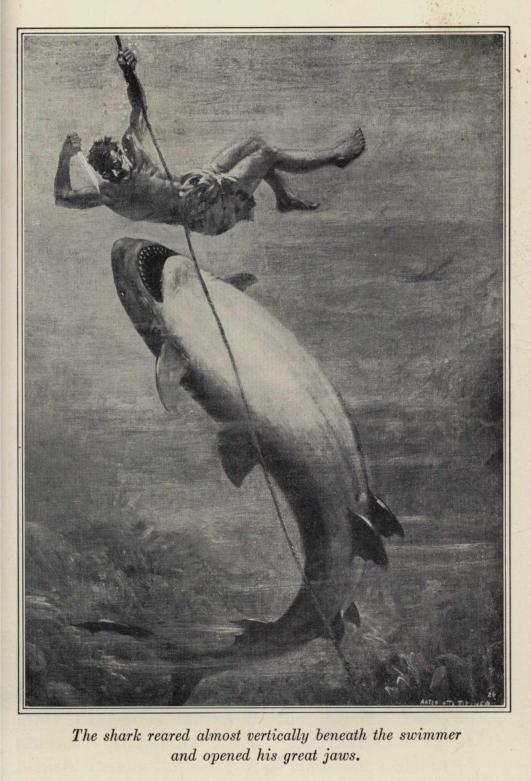
Uncle Harry had dropped the weight at the first attack, and now, still grasping his knife, he made for the rope and seized it with his left hand. The shark had darted away as he felt the steel for the second time, but now he was returning straight for the antagonist he seemed to recognize at last. Moving with horrid deliberation, he reared almost vertically beneath the swimmer, and opened his great jaws. My uncle stopped himself with his left hand on the rope, gathered his body together, and drove the knife into the broad rounded snout beneath him—the shark's most vulnerable point. For a moment the monster lay stunned and motionless, and in that moment Uncle Harry nearly reached the surface of the lagoon. Fatu was bent double, his hands already in the water. Then the shark seemed to regain his senses and came rushing upward grimly. I saw the muscles of the mate's arms standing out as though cast in bronze, I saw the swimmer's goggled face within a yard of the surface, and the great fish charging with open jaws, fearfully close behind. Then the whaleboat lurched as Fatu plunged his arms deep into the water, seized my uncle and swung him up and inboard with a single mighty heave.
The shark reared almost vertically beneath the swimmer and opened his great jaws.
The shark came crashing against the side of the boat—a blow that nearly stove in the planking and started a dozen seams.
A minute passed before my uncle sat up and lifted the goggles from his eyes. "Get the oars out," he gasped, "and pull for the shallow water yonder. Bale, you two, and look lively—that fellow means mischief!"
The shark was at the surface now, swimming in swift zigzags like a hound at fault. While Ofai and I baled and the others began to row, I glanced over my shoulder and saw the tall dorsal fin heading straight for us, so swiftly that the water rippled away on either side.
"Pull hard—he's after us!" shouted my uncle, standing in the stern with a twelve foot oar in his hand.
We were making for the shallows over a large coral mushroom, a hundred yards away, and the men were rowing at top speed, for they realized that our light cranky boat gave little protection against such an enemy. The shark drew rapidly abreast of us and as his head ranged alongside Uncle Harry raised the oar and thrust down with all his strength. The blow was a glancing one, and before he recovered his weapon the three-inch shaft of tough wood was between a pair of formidable jaws. My uncle's eyebrows went up as he raised what was left of the oar, sheared off as a child bites through a stick of candy. Next moment Ivi cried out, as the monster seized his sweep and wrenched it from his hands. I saw it float to the surface with a splintered blade—felt our boat shaken violently as the shark took the keel in his teeth. Then the bow grated on coral, and we leaped out in the shallows to pull the boat into the safety of a foot of water.
After a time the ominous fin tacked away toward the reef and disappeared. We were not anxious for another encounter and allowed our enemy plenty of time to go. The men were talking excitedly in high-pitched voices, when my uncle lit one of his long cigars and turned to me.
"What a brute!" he remarked. "I thought he had me that last time! By Jove! When Fatu took hold of me I could fairly feel those teeth sinking into my legs! Well, our work is cut out for us—there'll be no diving till that fellow is dead. The men are saying that in all probability there are no other dangerous sharks in the lagoon. Do you remember the letter I read you that evening at home? This is the same shark, without a doubt,—he may have been here for a hundred years. He's of a rare kind, by good luck; so rare that I know only his Latin name: Carcharodon. They are relics of prehistoric times and seem to be nearly extinct to-day, though a few of them still linger in the warm waters close to the Line. Remember the big fossil teeth, from Florida, on the mantel at the ranch? They came from one of this fellow's ancestors who grew to be ninety feet long and swarmed in the Tertiary seas."
"But won't he die?" I asked. "I saw you stab him three times."
My uncle laughed. "No more than you will," he replied. "A shark of that size takes a lot of killing. But he's going to die to-morrow, if we have to sit up all night hammering out a lance and a harpoon. Our fish-spears would only tickle his ribs. Come, he seems to have given us up—let's be getting back to the Tara."
VI THE END OF THE SHARK AND THE BEGINNING OF THE DIVING
That Sunday night, while the crew of the Tara told to their friends the story of Ofai's rescue, my uncle and I labored with forge and anvil and grindstone under the shed of corrugated iron. From the schooner's trade-room we took a couple of the whale-spades used throughout the islands as agricultural tools, and removed the wooden hafts from their sockets. While I pumped the bellows, Uncle Harry heated one of these in the forge and hammered it into the shape of a harpoon, welding on a piece of steel to make the socket into which the hinged barb would fit. Then, gripping a morsel of steel in the tongs, he forged out the barb, punched a hole through it, and riveted it in place, so that it folded into its socket when the harpoon was thrown and opened to prevent the iron's withdrawal from the wound. When the harpoon was finished to his satisfaction, I turned the grindstone while he ground it to a razor-edge. After that he heated the other spade and forged out a lance for killing: a slender, double-edged blade, two inches wide and eighteen long—a murderous weapon in skilled hands. We fixed the lance on a twelve-foot pole of hibiscus, and whittled out a short stout shaft for the harpoon, tapered to fit loosely in the socket. Then my uncle fetched from the storeroom a coil of heavy cotton line. Passing one end of it through a screw eye halfway up the shaft of the harpoon he lashed it firmly to the small of the iron. It was long past midnight.
"We won't get much sleep," he remarked, as we paddled out to the schooner in a canoe. "We must kill that shark to-morrow—to-day, rather—without fail! The natives are superstitious as children; they used to worship sharks, you know, before the missionaries came, and if any ghost-talk starts, we may have to go back for another lot of men. I'll wake you at five o'clock."
I dreamed strange dreams that night, for my mind was feverish with the excitement of the day. I was diving, and like Ofai, I had taken refuge in the coral while a great shark nosed at me from above. But the crevice was too narrow for his head, and I crouched there with bursting lungs, praying that the monster would leave me to reach the air before I drowned. At last I could stand it no longer; I sprang out from my retreat—past the shark gazing at me with fierce green eyes, upward toward the surface, so far off that I gave myself up for lost. The water weighed on me like lead; I seemed to sink instead of rising; I saw the monster approaching, grimly and deliberately. Then he seized my shoulder in his jaws. I felt the sharp teeth tear the flesh and crunch the bone—and I awoke with a strangled shout.
The stateroom was lit by the first gray light of dawn, and my uncle's hand was on my shoulder as he shook me awake.
"Time for coffee," he said, smiling at my bewildered face. "The men have killed a pig for bait, and they're getting the surfboat ready. We'll be off in half an hour."
We left before sunrise, in the broad heavy boat used for landing cargo from the schooner. I sat aft with Fatu, who held the steering-sweep; Ivi and Ofai pulled, and my uncle stood forward in the bows. The morning was calm, and as we reached the line of buoys we kept a close lookout for the shark, but no fin cut the water and no long shadow passed beneath the boat. Finally, at the place where we had sighted our enemy the day before, we cut open the carcass of the pig, tied it to a buoy, and pulled off a little way to watch.
An hour passed; the sun rose, and the lagoon began to shimmer in the heat. I heard the booming of the breakers where the ring of land was broken north of us and saw the smoke rising vertically from the ovens at our island camp. The natives were half dozing, but my uncle had not relaxed his watch.
"There he is!" he exclaimed suddenly. "Quick—pull over there—don't make a noise with your oars!"
I glanced up as he spoke and saw the dead pig rise and disappear in a circle of ripples. Then the head and forelegs came to the surface again—the carcass of our pig had been bitten in two.
"Row faster," my uncle whispered in the native tongue. "Make haste, or he will eat the pig and go."
Our boat glided toward the feeding monster. Without turning his head, Uncle Harry motioned to the men to cease their rowing, and it was then I caught sight of the huge brownish body of the shark, rising to finish what was left. My uncle brandished the harpoon above his head—hurled it with all the strength of his arm. The water swirled and coil after coil of line flew out through the chock. We were fast.
As he felt the iron, the shark turned with a mighty sweep of his tail and rushed off swiftly to the south. Fatu swung the boat around to follow, and before half the line had streaked overboard we were gathering way. Then my uncle got his hands on the line, paying it out more gradually until our full weight was on the fish; the oars came in and we foamed along at a faster gait, perhaps, than the clumsy surfboat had ever known. The shark seemed tireless—we passed the islet, where the people stood on the beach, waving in answer to our shouts, and sped on toward the southern end of the lagoon. We were following a deep channel in the coral, which turned westward halfway to the pass and approached the long island that formed the atoll's western side. At the end of an hour I could see the village of the copra-makers and the distant pass, a gap in the low ring of wooded land. The channel had brought us close to the inner beach and our pace was slowing appreciably. My uncle was beginning to haul up, when all at once the fish turned at right angles toward the submarine cliff of coral, close at hand. The line went slack; the boat drifted quietly for a few yards, and came to a halt. My uncle turned his head.
"Look," he said, "he's gone into that hole yonder! See the mouth of it a couple of fathoms down? This must be his den."
Holding the line with one hand, he took up the lance and ordered the rowers to back water—to keep a steady galling strain on the fish. "The iron is tickling him," he remarked when five minutes had passed. "I can feel him twitch. Look lively now! He'll be out in a moment—Ah! Here he comes!"
Far in beneath the coral the cave must have broadened, for the shark had turned to face the entrance of his lair. He came out with a rush, maddened by the pain of his wound, open-mouthed and at bay. Before Ofai could pull in his oar the monster had wrenched it from his hands and turned to sink his teeth in the cutwater of the boat. But my uncle was ready with the lance. Again and again his arm rose and thrust downward, and at each stroke the keen blade bit deep. The water reddened; the jaws relaxed their hold; the tail ceased its lashing and lay quiet. The huge carcass turned belly-upward and sank in the clear blue channel beneath us.
Uncle Harry laid down the lance and came aft to light a cigar. "That's a good day's work," he said. "No diving with that fellow about! He's sinking now; we'll have the boys cut the line and make the end fast to the coral. To-morrow he'll float high—I'll send a couple of men to cut out the jaws. They'll make you a fine souvenir of Iriatai."
There was rejoicing when we arrived at camp, for the native regards a large shark with a peculiar, superstitious dread. There had been much talk among the divers since the night before, but now their fears were at an end and they busied themselves with preparations for the ensuing day.
That night, when dinner was over and we sat talking on the Tara's deck, my uncle explained to me the terms of the agreement under which his divers worked. "Ordinarily," he said, "when the Government opens the lagoons the men are free to keep everything they bring up: the shell and the pearls are theirs to do with as they please. The traders keep track of all the better men and do their best to get them as deeply as possible in debt before the season begins. You can imagine what happens when credit is offered to simple fellows like these Paumotans: they run up bills for all sorts of useless trash—guitars; silk dresses and high-heeled shoes for their women; cheap perfume at five or six dollars a bottle; every kind of fancy white-man's food in tins. They load up with this sort of stuff till they are over their heads in debt. By the time he begins to dive, each native is safe in the clutches of some trading-house—Chinese, more often than not—and every pearl and every pound of shell must be sold to the creditor at the creditor's price.
"It is different here on Iriatai, for the men know that I have a year's monopoly of the lagoon. But there is more shell, and it lies in shallower water than in the lagoons which have been worked for a generation, so the divers are glad to accept my terms. Ever since I came to the islands I have tried to deal honestly with the people, for I have a theory that the savage appreciates a square deal as well as a civilized man. It has paid me, too. As you know, I am furnishing the canoes and advancing a reasonable amount of food and goods. The men have agreed, on their side, to work every day the weather permits and to let me make the first offer on their catch. Half of the shell goes to me; all of the pearls and the other half of the shell will be theirs. At the end of the season I'll make each man an offer on his shell—cleaned, sacked, and loaded aboard the Tara. As for the pearls, they will be brought out every night and offered for sale to me. Those I do not care to buy, or for which the owners think they can get a higher price in Tahiti, will be sold in the open market when we go North. But I'll get all the really fine ones—I can pay good prices and still double my money in every case!"
In the morning I had my first sight of pearl-diving as it is practised among the atolls of the Paumotus.
The men we had brought with us from Raiatea, reënforced by a few volunteers from the copra-makers of Iriatai, made up fifteen crews of two men each. I say men, but one of the best of the lot was an elderly brown woman, and there was not a man who could dive deeper than old Maruia, or bring up more shell in a day.
Each canoe was equipped with its paddles, an anchor at the end of thirty fathoms of line, a five-gallon kerosene-tin, a stout knife, and two coils of light rope—one attached to the diving-weight, the other to a large openwork basket of bamboo. The two members of the crew shared equally in the catch, though almost without exception one man did all the diving while his partner remained at the surface, raising and lowering the basket, cleaning the shell roughly, opening the oysters and inspecting them for pearls.
As they worked no more than five hours a day, we did not leave camp till the sun was well up, illuminating the bottom of the lagoon. I went out with a pair of middle-aged Paumotans whose acquaintance I had made during the passage from Raiatea. It was about half a mile from the islet to the patch of shell on which work was to begin. Uncle Harry had gone out ahead of us in the whaleboat and as the little fleet of canoes drew near, he pointed out to the paddlers the two acres of lagoon in which they were to work. The bow-man in our canoe dropped anchor in about seventy feet of water, and began to prepare himself to dive.
First of all, he stripped off the cotton shirt he had been wearing and hitched the pareu tight about his waist. Then he polished his water goggles, adjusted them carefully over his eyes, and thrust his right hand into a heavy working-glove. A pile of coral lumps, picked up on the beach the night before, lay in the bottom of the canoe; the stern-man placed a couple of these in the basket and lowered it into the lagoon till it came to rest on the bottom. Then the diver went over the side and lay in the water with a hand on the gunwale of the canoe, while his partner coiled the diving-line and lowered the leaden weight till it hung a few feet beneath the surface. The man in the water gripped the line with his left hand and the toes of his left foot; he took two or three long breaths before he jerked his head upward in a sudden gesture that meant: "Let go!" Coil after coil of line went leaping overboard, as the diver sank like a stone, leaving a trail of bubbles in his wake. When the lead touched bottom the stern-man hauled it up at once, coiling the line in readiness for the next dive.
A minute passed—a minute and a quarter—a minute and a half. The canoe lurched to a sudden strain on the taut basket-line. I looked over the side. Far down in the green water I could see the shadowy figure of the diver, mounting the rope with leisurely movements of his arms. He came to the surface, exhaling the breath from his lungs with the strange shrill whistle I had heard before. Then, raising the goggles from his eyes, he gave the exultant whoop of the diver who has brought up a rich haul—a cry that was beginning to ring out on all sides, where the canoes lay at anchor. He lay resting alongside while his companion pulled up the basket, loaded with six or seven great gold-lipped oysters; and craned his neck to watch as the other opened the shells with a twist of his knife at the hinge, felt for pearls under the soft mantle, and tossed the body of each mollusk into the open kerosene-tin. My companions seemed excited.
"Aué!" exclaimed the diver. "There is no other island like this! It is as Seroni told us—the bottom is covered with shell, and the water is not overdeep: twelve fathoms, by the knots on my line. Last year, at Hikueru, I worked at twenty till my head ached all through the night. And this shell—the size, the weight, the color of the lip—think of what it must be worth a ton! No man in all these islands has ever seen its like! I would still dive if there were fifty sharks instead of the one Seroni killed yesterday. But watch carefully, and if a shark comes, move the basket up and down a little so that I may be warned. Now pass me the weight, for I am ready to go down again."
At the end of three hours the diver clambered stiffly into the canoe; even in this water, only a few degrees below the temperature of one's blood, a man grows chilled and must come out to rest and warm himself in the sun. He had averaged a minute and a half to two minutes under water, and five minutes' rest at the surface between dives, and I noticed that he sent up five or six oysters each time he went down. We had brought along a bottle of water and a package of cold food done up in leaves. When lunch was over and the diver lay basking in the sun, I asked him how he could stay under water so long, and how a man could stand the pressure of the depths. At home in California I had excelled my friends by bringing up sand from the bottom at thirty feet, and my ears had ached for an hour afterward. These natives thought nothing of working at seventy feet, and from what they said, I knew that one hundred and twenty feet was not considered an extraordinary depth.
"It is not difficult," the diver remarked, smiling at my efforts to question him in his own tongue. "If he would take the trouble, the white man could learn as well as we. But one must know how. You say that at six fathoms your head ached and your lungs were bursting. That was because you tired yourself by swimming down instead of letting a weight pull you to the bottom. And perhaps you held all of your breath until you rose—that is wrong. First of all, you must learn never to tire yourself beneath the water, and not to fill your lungs too full before you start. When your time is half up, you must begin to let the air out of your lungs, little by little,—a few bubbles now and then,—so that, as you reach the top, there will be scarcely any air left in you. If your ears ache, swallow; or hold your nose and blow—this will clear the little passages between your nose and ears, and stop the pain. That is all, except that in deep water you must never look up, nor bend your body backward. As for the sharks, there is little danger—not one in a hundred will do you harm. When that one comes, you will know him by the way he swims, and if there is sand or mud on the bottom, you can escape by throwing it up to cloud the water while you pull yourself quickly up the basket-rope. Otherwise you can only take refuge in a crevice of the coral, hoping that the shark will leave you before your lungs go flat. Conger eels are more to be feared; you must watch sharply as you pass the holes where they lie hidden. The big eel's jaws are like the jaws of a dog! If a conger seizes wrist or ankle, it is useless to struggle—ten strong men could not drag one from his hole. Three times, when I was young and careless, I have felt the teeth of the eel; see—my ankles bear the scars to this day. But I remembered what the old men had told me and lay quietly without struggling, till the conger relaxed his jaws to dart forward for a better hold. Each time I tore my ankle free and reached the surface with only the loss of a little blood. But we must get to work—the others are beginning to dive."
The canoes returned to camp in mid-afternoon. The women were waiting to begin their task of cleaning shell, and there were exclamations of wonder as the day's catch was brought ashore. While the men went off to rest, their wives and daughters sat gossiping in little groups, hammering, chipping, and washing the mother-of-pearl. Half of the catch of each canoe had been set aside as my uncle's share, and some of his own people—Ivi, Ofai, and a few men and women from the settlement on Iriatai—set to work to clean it in a space reserved for them. I saw a number of women along the beach, filling the tins from the canoes with sea water, mashing the soft meat between their fingers, and pouring off the mess little by little, as they searched for any pearls that might have been overlooked. My uncle was delighted with the first day's work.
"It is going better than I had hoped," he said, as we sat in his stateroom that evening. "They brought in about two tons of shell to-day, and the quality is superb—nothing like it has ever been seen in this part of the Pacific. Your canoe had no luck, but the others netted four handsome pearls and a number of small ones for the day. That alone proves that there must be something in von Tesmar's theory. I've seen thousands of black-lipped oysters opened without a pearl. Old Maruia found a beauty to-day, with her usual luck. I gave her a thousand dollars for it, and any jeweler in Paris would jump at a chance to offer twice as much. You are smiling, eh, to think of that funny old woman having a thousand dollars, all at once? Why, in the eyes of her people Maruia is a millionaire! Twenty years of diving have made her the owner of a fine plantation, and one of the prettiest villas on Tahiti. Ah—I almost forgot to show you our first pearls."
He leaned over to twirl the knob of the safe, swung open the door, and took from the shelf a small tobacco-tin, which he opened and handed to me. It was lined with cotton and there, lying side by side like tiny eggs in a nest, were four pearls, pale, lustrous, and without a flaw. Three of them were like peas in size and the other was larger than the three together,—I had never seen a pearl of such size and beauty,—shimmering with a soft opalescence in its bed. My uncle took it in his hand, turning it to admire the perfection of its shape.
"You won't see a pearl like this five times in a season," he remarked. "There are many larger ones of greater value, but there is nearly always something wrong with them—a flattened spot, a flaw on the surface, a dullness in orient. Though not of great size, this is a really perfect pearl. If I had a mate for it I could ask my own price for the pair!
"I wish now that I had brought a few more men," he went on, "but I think we can make out by shutting down the copra-making and putting everyone at work. I am going to put Fatu and Ofai to diving, with a couple of stern-men from the village; they say we can find trees to build two or three more canoes. The others will have to work at cleaning shell, and from now on I'm counting on you and Marama to feed us. Tins are all right in an emergency, but it would be absurd to make ourselves ill on canned stuff in a place swarming with excellent fish. There are eight of us on board, counting the new cook, and I want you to supply us with fish. You can begin to-morrow—I'll give you the small canoe and whatever gear you need."
VII SOUTH SEA FISHERMEN
I have always loved fishing since I was old enough to hold a rod and cast out into the surf at home, and now, as I look back on the months spent with my uncle in the South Seas, I know that my happiest memories of Iriatai are of the long hours in a canoe with Marama in the lagoon or on the open sea beyond the reef. It was fishing in unspoiled waters—fishing to dream about in after years. Our primitive tackle, much of which was fashioned by our own hands, did not detract from the charm of the sport, and the background—the land, the sea, the sky—was hauntingly and strangely beautiful.
Some of those nights were unforgettable—calm nights when we lay off the reef from sunset till dawn began to brighten in the east. In all that solitude our lantern was the only light, the only sign of man. Iriatai lay like a shadow on the sea, stretching off vaguely to the south, and the heavens above us were powdered with stars of a brilliance I had never known before. The native boy was a better astronomer than I; he had names for many of the constellations, and strange old stories to tell of them. Castor and Pollux, the Twins, sinking on the horizon to the west, he called Pipiri-Ma—a boy and a girl, he told me, who had lived in very ancient times and who, because of their unkind parents, had fled away to the skies. The Southern Cross was Tatauro; the Scorpion was a great fishhook, flung into the sky after a god had used it to pull up the islands of the Paumotus; the Pleiades, visible in the east an hour before the dawn, he called Matarii—the Little Eyes, and told me a pretty story of their origin.
Much of our fishing was done at night, when we fished offshore for the great bottom-feeders of the South Pacific: the deep-water albicore, the castor-oil fish, and the manga—a long black creature shaped like an enormous pickerel, with goggle-eyes and rows of formidable teeth.
Our custom was to start an hour before sunset and paddle north to a break between the two long islands, where we dragged our canoe through the ankle-deep wash of the barrier, waited our moment, and slipped out through the surf. The outer face of the reef shelved off steeply, and our line, which reached the bottom at two hundred fathoms, would have reached the reef as well. Marama usually took the stern, paddling gently, while I did the fishing forward. Our bait was fish, saved from the previous day's catch and salted. I chose a morsel large as a man's fist and tied it with strong thread to the point of one of the great wooden hooks used in this deep-sea fishing: a fork of ironwood, six inches from tip to tip, and barbed with a cod-hook lashed on to point down and inward. It was useless, I learned, to fish with an ordinary hook for these dwellers on the bottom. Their habit of swimming down vertically, to seize the bait from above, made necessary the use of our barbaric implement. When my hook was baited, I fastened a large pebble to the line, with a special hitch that Marama had taught me. Coil after coil ran out as the pebble sank, until at last I felt the slackening which told me that it had touched bottom. Hauling up a yard or two, I gave the jerk which freed my coral sinker, and settled myself to wait. Sometimes an hour passed without a strike, and then, when I was least prepared for it, some monster of a hundred pounds seized my hook with a rush that carried my arm elbow-deep into the black water alongside. Hand over hand I brought him slowly to the surface till he lay wallowing beside the canoe, eyes bulging with the release from the pressure of his deep-sea haunts. A blow with the blunt side of our whale-spade ended his struggles, and taking hold by the gills, we tilted the canoe and slid the quivering body inboard.
Sometimes, as my fish neared the surface, I felt a sudden slackening of the line—one of the small sharks that prowled along the reef at night had helped himself, leaving only a bodiless and gaping head upon the hook. Once or twice, when the marauder rose close to our canoe, Marama sprang to his feet in a rage—keen-bladed spade in hand—and ended the shark's life with a cutting blow forward of the eyes. At those times we seized our paddles and made off swiftly for new fishing-grounds; for the scene of the ensuing feast was no place for our light canoe.
Fishing by night meant sleeping through the warm hours of the day. Sometimes, when we wearied of this, the order was reversed and we went out at daybreak to pursue the schools of bonito far offshore. The lures for bonito are made of mother-of-pearl, and the fisherman must carry six or seven different shades to suit the varying conditions of sea and sky. Marama selected half a dozen large pearl-shells, shading from light to dark, and marked with a pencil on the thickest part of each the outline of a small fish. When this was done we took our shell to the shop my uncle had set up ashore, and set to work with vise and hacksaw to cut out the lures. Then came the grinding and polishing, and finally a barbless hook of brass was attached to each, the line made fast to the forward end, and a tuft of coconut fibre bound on across the rear. We tied the lines to a stiff pole of bamboo, ten or twelve feet long and equipped with a ring at the butt end, in which to hook the lures when not in use.
Bonito-fishing was hard work and not unspiced with danger,—the risk of being swamped or blown offshore in a squall,—but it had a fascination of its own. We used to paddle half a mile out to sea and wait in the morning calm, on the lookout for birds. At sunrise the boobies and noddy terns left their roosting-places by hundreds and cruised about over the sea, singly or in little bands, in search of breakfast. We watched them flying this way and that until at last, perhaps a mile away, a dozen noddies began to circle and dive. Then it was time to seize our paddles and strain our backs to make for the birds at top speed. Keener eyes than ours had been on the watch, and before a minute had passed hungry sea-birds were flapping from all directions toward the school of fish. The small fish, pursued by both bonito and birds, were far from remaining stationary; sometimes they sounded and disappeared altogether; sometimes, when our backs were aching with an hour's chase, they swept off to windward at a pace that made us lay down our paddles in despair. There were days when we went home worn out and empty-handed, but there were other days when luck was with us and we drove the canoe into the midst of ravenous schools. Then, while the man forward paddled with all his might, the stern-man faced about, long rod in hand and lure skittering over the waves behind us. A hasty trial proved which shade of mother-of-pearl was most attractive, and next moment fish after fish came tumbling aboard—fat, steel-blue, and vibrant. There were days when we hooked and landed thirty fish in half as many minutes, before we sank down exhausted to rest, leaving the birds to circle off above the foaming sea.
Sometimes, when we could get bait, we enjoyed a sport even more thrilling than bonito-fishing—trolling along the reef at daybreak for tunny, barracuda, and the giant cavally of the Pacific. A silvery species of mullet proved the best lure for the fish that lay in wait in the caverns along the outer edge of the reef, and many of our afternoons were spent in mullet-catching. First of all we prepared a mass of paste, made of flour or arrowroot, and with this for bait, we paddled to a place in the lagoon where the water shoaled to three or four feet over a coral bottom. Our tackle was a stick of light wood eighteen inches long, attached by a trace to twenty feet of line, and fitted with a small hook on a leader at either end. One of us baited the hooks with bits of paste and stood ready to cast the stick, while the other threw pieces of our dough ahead of the motionless canoe. Presently the water would dimple and swirl with rising mullet—it was time to cast. The float lay quietly for a moment—bobbed—jerked disappeared under water, with a pair of fat mullet, as often as not, fast on the hooks. We kept them alive in an openwork basket floating alongside, and towed our catch back to the Tara, in readiness for the morning's fishing.
An hour before sunrise we dragged our canoe over the reef, shot out through the breakers, and paddled to our favorite trolling-grounds—a shoal which ran out a quarter of a mile to sea. Our hook for this kind of fishing was equipped with a leader of piano-wire, which was passed lengthwise through the body of a mullet and pulled through the mouth until the shank of the hook was out of sight. Then the lips were lashed to the wire with a bit of thread and the leader made fast to the end of a hundred yards of heavy line. Arranged in this way and towed at a good pace behind the canoe, the mullet flashed and zigzagged through the water in imitation of a living fish—an imitation so perfect that many a wary old dweller on the reef was deceived and came rushing upward to his death.
The handling of these powerful fish required all our skill, and Marama, being more experienced than I, usually took the stern on trolling-expeditions. Making the line fast to the outrigger-pole which crossed the canoe behind his seat, he gave the word, and we began to paddle our hardest, following the edge of the shoal. As the sun rose, one could look down and see the changing colors of the coral—every fold and crevice clearly visible ten fathoms beneath us. There were certain crannies and caverns where we knew the big fish lay, and as we passed above them we increased our efforts to make speed. In this kind of sport there was no holding the line to feel for a bite; we were never in doubt when a monster tunny or barracuda struck. The canoe quivered with the shock. Sometimes we fought for half an hour while the hooked fish towed us in rushes, this way and that. One old barracuda, I remember,—seven feet long and with the jaws of a shark,—pulled us more than a mile before he lay exhausted at the surface.
We seldom returned from trolling till the trade wind came up at eight or nine o'clock, for a good catch, sufficient for two or three days, meant rest and time for other amusements. The weather was hot of course, and we had no ice, but the native method of cooking—baking over and over again, which improves the flavor with each succeeding day—permitted fish to be kept for as long as a week. On days of leisure we rested, overhauled our tackle, or went in search of the shellfish which abounded at Iriatai.
There were lobsters, crabs, and sea snails on the reef, clams and mussels in the lagoon, and best of all,—to be found on patches of shallow sandy bottom,—there were varos, creatures whose repulsive English name is "sea centipede." They look like the tail of a lobster, with rows of legs along the sides and a small head, armed with a pair of wicked nippers, said to inflict a poisoned wound. The varo is no beauty, but if it is broiled over a charcoal fire and eaten hot with melted butter, I agreed with my uncle that the sea produced nothing half so good.
One calm morning, when there was a plentiful supply of fish aboard, Marama suggested that we try our luck at varo-fishing and showed me the tackle he had made the afternoon before. It consisted of half a dozen slender sticks of wood to which rows of small fishhooks were lashed, points out. Each stick was provided with a few feet of line and a light float, made fast to the upper end. While I was examining these curious snares, my uncle passed along the deck and stopped at sight of us.
"Going after varos, eh?" he remarked. "The men used to say there were plenty of them here. Good luck to you—we'll have a feast here tonight if you can get some!"
The native boy threw his snares and a few pieces of smelly fish into our canoe and we paddled to the western shore of the lagoon, where a bottom of mud and sand ran out from shore. He allowed the canoe to drift over the shoal while he scanned the bottom through the calm water, clear as glass. Here and there I saw that the sand was pitted with holes, the burrows of various marine creatures; and presently Marama pointed down to one, smaller than the rest and surrounded by a little mound of sand. "That is the dwelling of the varo," he said, "I can tell by its freshness and the smallness of the opening that he is at home."
I held the canoe in place while he took up one of the snares, tied a bit of fish to the upper end, and unwound the short line attached to the float. Then he tucked up his pareu and went overboard. Taking a long breath and working with head and shoulders submerged, he enlarged the mouth of the burrow until its full size was exposed and inserted the baited stick—gently, so as not to alarm the creature inside. Varos were plentiful at this place; we set all our snares within a radius of fifty yards and sat at leisure in the canoe, watching the floats for the first signs of life. We had not long to wait; Marama pointed to one of the floats which was beginning to bob and twitch; a few strokes of the paddle brought us alongside and he went overboard again.
The fishhooks on the snares were lashed on in tiers of three, pointing out and up. The bait was tied to the upper half of the stick, so that in order to get at it, the varo was obliged to pass the uppermost tier of hooks. As it tore the fish with its nippers and crammed the pieces into its mouth, its hard back was against the wall of the burrow and its more vulnerable under-parts in range of the barbs. Marama put his head under water again, seized the end of the stick and held the varo against the side of its hole; then, with a quick pull, he sank his hooks into the creature's under joints and held up the snare with a triumphant shout, the captive struggling and waving its claws. "Take care you are not hurt," he told me as he broke off the nippers. "They cut like scissors and they are poisoned—the wounds will fester and swell for weeks!"
At ten o'clock, when the breeze came up, we paddled back to the schooner with a score of varos in the bottom of our canoe, a feast for all hands.
As we crossed the lagoon Marama spoke to me suddenly at the end of a long silence. "Listen, Tehare," he said,—"Tehare" was as near as he could come to pronouncing my name,—"let us speak together, for there is a plan in my mind. I dare not ask Seroni myself. Fishing is the work he gave me, but he is your father's brother and if you desire to do the thing that I propose, perhaps you will speak to him. You have learned much about our fishing and you see how easy it is to provide for the Tara's needs: two or three nights each week give us more fish than we can use. It is in my mind that on days when there is fish in plenty we might take this canoe and go out with the others to dive. I can dive deeper than one need go in this lagoon, and you can pull up the basket and open shell, since men are not accustomed to diving in your land. We shall get much shell, and perhaps a great pearl like the one Maruia found. What say you—will you ask Seroni?"
VIII I TURN PEARL-DIVER
My chance came the same afternoon, as we were finishing lunch. At last Uncle Harry lit a cigar and called for coffee. "By Jove!" he remarked as he blew out a cloud of fragrant smoke, "those varos were wonderfully good. I reckon the best restaurant in San Francisco couldn't produce a finer dish!" The moment seemed opportune.
"We can always get plenty when the weather is calm," I said, "in fact it only takes a third of our time to catch more fish than the Tara can use. We were speaking of this to-day and wondering if you wouldn't let us go out with the divers in our spare time; Marama says he has often been down to twelve fathoms, and offers to do the diving if I will open shell. I wish you could let us go—it would be fun and somehow I feel sure that we'd be lucky. Of course, if you'd let me, I'd like to try a little diving myself." My uncle looked at me with a twinkle in his dark eyes.
"I knew you'd ask me that sooner or later," he said. "As a matter of fact I ought not to let you do it—I'm responsible to your father, after all, and old Taura's a good friend of mine. Diving is always a dangerous business, though I don't believe there are any more bad sharks in the lagoon. Still, the other men do it every day, and you two are old enough to take the same risks. If I had youngsters of my own, they'd have to take their chances with the rest—otherwise they'd miss their share of good times and hard knocks, and become the helpless sort of men and women who are no use in the world. Yes, you may go, and dive too, if you wish. But, for my sake, keep your eyes open and be as careful as you can!"
That evening, when the day's work was over and the people lay on mats before their houses, smoking and gossiping in the brief twilight, we went ashore. My uncle led the way to where old Maruia lived with one of her nephews: Teura, a pleasant and amusing boy, who paddled her canoe to the diving-grounds and opened the shell that she brought up. Her house was surrounded by a fence of stakes, inside which a pair of pigs wandered, rooting up the earth. As we opened the gate, I heard her voice give the hospitable shout of "Haere mai!—Come in!"
"I have come to talk with you about Tehare, my nephew," said Uncle Harry, when a mat had been spread and we had taken our places on it, native-fashion. "He and Marama have become so clever at the sea fishing that we are glutted with fish and time hangs heavy on their hands. To-day they have asked me if they might go out and dive for shell with you others; they are strong boys and well grown—it is in my mind to let them go. What think you of the plan? Is Iriatai a lagoon overdangerous for boys?"
The old woman shook her head as she replied.
"There is little danger here," she said. "Ten fathoms would not hurt a child, and the great shark you killed was the only evil shark in the lagoon. And he was not a shark, as I and all the others know! For the rest, we have seen neither tonu nor conger eel in all the days we have been diving, though it is well to watch closely, for a tonu is an ill thing to meet! But let them go—they will come to no harm; perhaps they will find a pearl like mine, and in any case the white boy will have strange tales to tell when he returns to his own land. I myself will show them where there is shell in seven fathoms of water—not so much as where we dive, but a good place to begin. Let them beware of the clefts and crevices where an eel might lurk, and avoid the dark caverns in the coral, for it is in such places that the tonu lies in wait. There seems little to fear in Iriatai, but one is never sure. As for pearls, watch always for the great lone oysters crusted with coral and misshapen with old age—parau tahito, we call them, and every diver knows that they contain the finest pearls."
When the divers went out next morning Marama and I went with them, our canoe equipped like the others with basket and weight and line. Maruia, smoking a cigarette in the bow of her canoe while Teura paddled, showed us the way to a patch of shell she had found in shallow water, a quarter of a mile east of where the others were diving. "Drop your anchor here," she said, bending over the gunwale to examine the bottom. "The depth is seven fathoms and there is enough shell to keep you busy, though not so much nor of such great size as in the deeper water where we work. Now I must leave—stay here, you two!"
I weighted the basket with a heavy stone and lowered it till it rested on the bottom, while Marama tucked up his pareu, adjusted his goggles, and fastened the glove on his right hand. Then he went overboard, a grin on his brown good-natured face. I passed him the weight; at the signal, I let go the line and watched him shoot down into the blue and green of the depths. After all, seven fathoms were more than forty feet. I pulled up the lead, coiled the line for the next dive, and waited, watching the figure of my companion, seen dimly in the twilight beneath the canoe, as he moved along the bottom with deliberate motions of the arms and legs. Once I thought I saw him place something in the basket, and finally, when more than two minutes had elapsed, he seized the upright line and pulled himself to the surface. But he gave no shout of exultation as he raised the goggles from his eyes.
"Aué!" he exclaimed, shaking his head, "it is more difficult than I had thought! The oysters are there, but I have not the eyes to see them, nor the art to twist them off the rocks. There is no need to pull up the basket; I got only two oysters, though in all my life I have never stayed longer beneath the water. But I shall learn!"
All through that morning Marama dove with increasing success. It was well for me that he did not send up as much shell as the older divers, for I was clumsy at opening it and so afraid of missing a pearl that I wasted a great deal of time in useless fumbling under the fringes of the oysters. At mid-day I had found no pearls, but the shell Marama had brought up was opened and neatly stacked amidships, and the soft bodies of the oysters were thrown into our kerosene-tin for inspection in the evening.
"I am going to dive this afternoon," I announced to Marama, as we lay resting after lunch.
"That is well," he answered. "I am not accustomed to being so long in the water—my bones are chilled! I will open the shell and you can try your hand as I have done. It is strange down there, and very beautiful, with the coral colored like flowers and the great fish passing close at hand. At first I was a little afraid. Do not let yourself grow discouraged; the shell is hard to see and harder still to wrench off until you learn the trick. Remember that the old divers never look upward—to gaze into the blue water overhead gives one a horror of the depth!"
At last, with a beating heart, I made ready for my first dive. I loved the sun, which had burned my back and shoulders to the color of mahogany, and I wore nothing but a pareu. This savage garment I hitched about my waist as I had seen the others do, before I polished my glasses and fastened the glove tightly on my wrist. Once in the water, I held the lead-line with my left hand and the toes of my left foot, adjusted the goggles to my eyes and gave the signal to let go. I saw Marama's answering grin—felt the water close over my head. Then, gripping the line tightly, I plunged down into a strange purple twilight.
An instant later there was a gentle shock and the line slackened in my hand. I had reached the bottom. My ears ached and the pressure on my chest and stomach made my body feel as if it were being squeezed flat. I could understand now the curiously deliberate movements of the divers, for my limbs seemed weighted with lead—the same feeling I have had in dreams, when to my horror I have found myself unable to avoid the attack of some nightmare monster. I swallowed as I had been instructed, then held my nose and blew. The pains in my head ceased at once.