William Le Queux (continued 5)
Reading edition
The girl hesitated.
“She certainly spoke to me,” she admitted at last. “I was her most intimate friend, and it was only natural perhaps that she told me what was most uppermost in her mind.”
“And what was that?”
“I regret,” she replied, “that I cannot repeat it; Mr Statham.”
“What! You refuse to say anything?”
“Under compulsion—yes,” was her firm answer. “I did not know,” she added, “that you had invited me here to ply me with questions in this manner.”
“Or you would not have come, eh?” he laughed. “Well, my dear young lady, you apparently don’t quite realise how very important it is to me to discover Doctor Petrovitch. I have asked you here in order to beg a favour of you. I may be rough and matter-of-fact, but I trust you will pardon my apparent rudeness.”
“There is nothing to forgive, Mr Statham,” was her quiet, dignified response. “My reply, quite brief and at the same time unalterable, is that I have nothing to say.”
“You mean you refuse to tell me?”
She nodded.
He thrust his hands deep into the pockets of his old grey trousers, and stared down at the carpet. Marion Rolfe was more difficult to question than he had anticipated. She possessed the same firm, resolute nature of her father and her brother. That Maud Petrovitch had made a statement to her which possessed a most important bearing upon the serious interests involved, he was absolutely certain. Ever since the day following the strange disappearance, certain secret agents of his had been at work, but they had discovered next to nothing. Marion Rolfe alone was in possession of the actual facts. He knew that full well, and was therefore determined that she should be compelled to speak and explain.
“I wish, Miss Rolfe, that I could impress upon you the extreme importance of this matter to myself personally,” he said, assuming an air quite conciliatory in the hope that he might induce her to reveal the truth. “I have begged of you to assist me in a very difficult task—one which, if I fail in accomplishing, will mean an enormous financial revenue. Your brother is in my service, while you yourself are also indirectly in my service,” he added; “and if, as result of your information, I am able to discover the Doctor, I need not tell you that I shall mark your services in an appreciable manner.”
“You have already been very generous to us both, Mr Statham, but I think you cannot know much of me if you believe that for sake of reward I will betray the Doctor,” was her dignified answer.
“It is not a question of betrayal,” he hastened to reassure her. “It is to his own interest as well as to mine that we should meet. If we do not, it will mean ruin to him.”
“And if he is dead?” suggested Marion.
“My own belief is that he is not dead,” was the millionaire’s reply. “I know more of him and of his past than you imagine. There is every reason why he should live.”
“And Maud—what of her?”
He shrugged his shoulders, and replied:
“As regards her—you know best. She told you the truth.”
“Yes—and which I will not repeat.”
“Oh! but, my dear young lady, you must! Why waste time like this? Every day, nay every hour, causes the affair to assume increased gravity. I would have gone to the police long ago, only such a course would have brought the Doctor into a criminal dock. I have his interests, as well as my own at heart.”
“I have given my promise of secrecy, Mr Statham, and I will not betray it,” she repeated, again rising from her chair, anxious to leave the house.
“You still refuse!” he cried starting to his feet also, and standing before her. “You still refuse—even to save yourself!”
“To save myself!” she exclaimed. “I do not follow you, Mr Statham.”
A sinister grin spread over his grey face.
“You are perfectly free to leave this place, Miss Rolfe,” he said in a hard, meaning voice, “but first reflect what they will say at Cunnington’s regarding your visit here to-night!”
“You—you will tell them!” she gasped, drawing back from him, pale as death as she realised, for the first time, how she had imperilled her good name, and how completely she was in his power. “I—I believed, Mr Statham, that you were an honourable man!”
“Where a man’s life is concerned it is not a question of honour,” was his reply. “You refuse to assist me—and I refuse to assist you. That is all!”
Chapter Thirty One.
“His Name!”
“Not a question of honour, Mr Statham!” she cried. “Is it not a question of my own honour!” and she stood before him, erect and defiant.
“My dear young lady,” he laughed, “pray calm yourself. Let us discuss the matter quietly.”
“There is nothing to discuss,” she exclaimed resentfully, looking straight into the old man’s grey face. “You have threatened to divulge the secret of my visit to you to-night if—if I refuse to betray my friend! Is such an action honourable? Does such a threat against a defenceless woman do you credit?” she asked.
“You misunderstand me,” he hastened to assure her, realising the mistake he had made.
“I understand that you ask me a question,” she said. “You wish me to repeat what was told to me in confidence—the secret imparted to me by the girl who was my beat friend!”
“Yes; I wish to know what Maud Petrovitch told you,” he answered, standing with his thin hands behind his back.
“Then I regret that I am unable to satisfy your curiosity,” was her firm response. “I now realise your motive in inviting me here at this hour to see you in secret. You meant me to compromise myself—to remain away from Cunnington’s and be punished for my absence—the punishment of dismissal,” she went on, her fine eyes flashing in anger at his dastardly tactics. “You know quite well, Mr Statham, that the world is only too ready to think ill of a woman! You anticipate that I will betray my friend, in order to save myself from calumny and dismissal from the service of the firm. But in that you are mistaken. No word shall pass my lips, and I wish you good-night,” she added with serve hauteur, moving towards the door.
“No, Miss Rolfe!” he cried, quickly intercepting her. “Surely it is unnecessary to create this scene. I hate scenes. Life is really not worth them. You have denounced what you are pleased to call my ungentlemanly tactics. Well, I can only say in my defence that Samuel Statham, although he is not all that he might be, has never acted the blackguard towards a woman, and more especially, towards the daughter of his dear friend.”
“You have told me that you will refuse to assist me further!” she said. “In other words, you decline to preserve the secret of my visit here, although you made a promise that my absence to-night from Cunnington’s should not be noted!”
“I have given you a promise, Miss Rolfe, and I shall keep it,” was his quiet and serious response.
She looked at him with distrust.
“You have asked me a question, Mr Statham—one to which I am not permitted to reply,” she said.
“Why not?”
“Because—well, because I have made a vow to regard what was told me as strictly in confidence.”
Sam Statham pursed his lips. Few were the secrets he could not learn when he set his mind upon learning them. In every capital in Europe he had his agents, who, at orders from him, set about to discover what he wished to know, whether it be a carefully-guarded diplomatic secret, or whether it concerned the love affair of some royal prince to whom he was making a loan. He knew as much of the internal affairs of various countries as their finance ministers did themselves, and with the private affairs of some of his clients he was as well acquainted as were their own valets.
To the possession of sound but secret information much of the old man’s success was due. The mysterious men and women who so often came and went to that house all poured into his ear facts they had gathered—facts which he afterwards duly noted in the locked green-covered book which he kept in the security of his safe.
Surely the contents of that book would, if published, have created a huge sensation; for there were noted there many ugly incidents in the lives of the men who were most prominent in Europe, together, be it said, with facts concerning them that were highly creditable, and sometimes counterbalanced the black pages in their history.
And this man of many secrets stood there thwarted by a mere chit of a girl!
He regarded her coldly with expressionless eyes. His gaze caused her to shudder. She withdrew from him with instinctive dislike. About this man of millions, whose touch turned everything to gold, there seemed to her something superhuman, something indescribably fearsome. His very gaze seemed to fascinate her, and yet at the same time she regarded him with distrust and horror. She was a fool, she told herself, ever to have listened to his appeal. She ought to have had sense enough to know that by bringing her there at that hour he had some sinister motive.
His motive was to wring from her the words of Maud Petrovitch.
Suddenly he altered his tactics, and, drawing her chair forward again, said:
“Let us sit down and talk of something else. You look pale. May I offer you something?”
“No, thank you,” she replied. It was true that his threatening words a few moments ago had upset her, therefore she was glad to be seated again. He evidently did not intend that she should leave yet.
Having re-seated himself near his writing-table, he said: “As I explained, I want you, if you will, to go on a journey for me. The car is awaiting you round in Deanery Street.”
“A journey? Is it far?”
“That all depends—if you are prepared to render me this service,” he replied.
“I am prepared to render you any service, Mr Statham, that is within my power, and my conscience permits me,” she said in a firm voice.
“Ah, now, that’s better. We’re beginning to be friends. When you know me, you will not accuse me of ungentlemanly conduct—especially towards a woman. But,” he added with a laugh, “I’m a woman hater. I daresay you’ve heard that about me—eh?”
She smiled also.
“Well—yes. I’ve heard that you are not exactly a ladies’ man. But surely you are not alone in the world in that!”
“If all men were like me, Miss Rolfe,” he said, “there wouldn’t be much work for the parsons in the matter of marrying.”
“You’ve been unfortunate, perhaps, in your female acquaintances,” she ventured to suggest. His manner towards her had altered, therefore she was again perfectly at her ease.
“Yes,” he sighed. “You have guessed correctly—unfortunate.”
And then a dead silence fell, and Marion, watching his face, saw that he was reflecting deeply.
Of a sudden, he looked straight into her face again, and said:
“You have a lover, Miss Rolfe—and you are happy. Is not that so?”
The girl blushed deeply at this unexpected statement. How could the old man possibly know, unless some of the people at Cunnington’s had carried tales to him. Perhaps Mr Warner had told Mr Cunnington, and he had spoken to the millionaire!
“I see,” he laughed, “that I’ve spoken the truth. Max Barclay loves you, doesn’t he? He’s a friend of your brother’s. I know him, and allow me to congratulate you. He’s a thoroughly good fellow, and would be better if he’d keep off hazardous speculation.”
She did not reply. The old man’s final sentence impressed her. Max’s speculations were hazardous. This was news to her.
“You don’t deny that you love young Barclay, do you?” the old man demanded.
She hesitated, her cheeks crimsoning.
“Well, why should I?” she asked. “He is very good to me—very good, indeed.”
“That’s right,” he said approvingly. “If I did not think him an honest, upright fellow I should warn you against him. Girls in your dependent position, you know, are too frequently victims of men whom the world call gentlemen. You know that, don’t you?”
“Yes,” she answered in a low voice. She was impressed by his solicitude on her behalf. In his eyes was a kindly glance, and she began to declare within herself that she had misjudged him.
“Well,” he went on, “when it came to my knowledge that Max Barclay was paying court to you, and that you were seen together of an evening and on Sundays, it gave me great satisfaction. I owe a debt of gratitude to your poor father, Miss Rolfe, and I am endeavouring to repay it to his children. Therefore I admit to you now that more than once I wondered what kind of lover would be yours. I anticipated annoyance, but, on the contrary, I have only the most complete satisfaction.”
“I am sure, Mr Statham, it is very kind of you to say this. And surely it is very generous of you to take in interest in Charlie and myself.”
“It is not a matter of kindness, but a matter of duty,” he said. “We were talking of Barclay. How did you meet him?”
“Charlie introduced him to me one Sunday afternoon in the Park.”
“And he has promised you marriage? Tell me frankly.” She nodded, again blushing deeply.
“Then you have my very heartiest wishes for your future happiness,” he declared with a pleasant smile. “Mind I am told the date, so that I can send you the usual teapot!”
Whereat they both laughed in chorus. The old man could be charming when he wished.
“Oh! we shan’t be married for a long time yet, I suppose!” Marion exclaimed. “Max talks of going with a shooting party up the Zambesi next spring. They’ll be away a full year, I expect.”
“And you’ll be left all alone?” he said in a tone of surprise. “No, I don’t think he’ll do that. He ought not to leave you alone at Cunnington’s.”
“Oh, but he’s going out to Turkey now—in a few days I think. He has some financial business out there. Something which will bring him in a very big sum of money.”
“Oh, what’s its nature?” asked the old financier, instantly pricking up his ears.
“I believe it’s a concession from the Sultan for the construction of a railway from some place on the Servian frontier, across Northern Albania, down to San Giovanni di Medua—if I pronounce the name aright—on the Adriatic.”
“What!” cried Statham, starting up. “Are you quite certain of this?”
“Yes; why?” she asked, surprised at the sudden effect her words had produced upon him.
“Well—well, because this is a surprise to me, Miss Rolfe,” he said. “Tell me the details, as far as you know them. Has he spoken to you about it?”
“Yes. He is hesitating to go, not wishing to leave me.”
“Of course. Did I not tell you so a moment ago?” he remarked with a smile. “But are you aware that this concession, if the Sultan really gives it, is of the greatest importance to the commercial development of the Near East? There are big interests involved, and correspondingly big profits. Curious that I have not heard anything of the scheme lately! It’s a dream that every Balkan statesman has had for the past fifteen years—the creating of an outlet for trade to the Adriatic; but the Sultan could never be induced to allow the line to run through his dominion. He is not too friendly with either Bulgaria or Servia. I thought I was being kept well informed of all the openings in Constantinople where British capital can be employed. Yet I haven’t heard anything of this long discussed scheme for quite a year.”
“Your informants believe, perhaps, that it would not interest you?”
“Interest me!” he echoed. “Why, they could not successfully carry it through in London without my aid—or, at least, without my consent. Whoever is getting the concession—if it is being obtained at all, which I very much doubt—knows full well that in the long run he must come to Sam Statham. Do you happen to know who, besides Barclay, is interested in the scheme?”
“There is a French gentleman—a friend of Max’s—who wants him to go to Constantinople with him.”
“What is his name? I may probably know him?”
“Adam—Jean Adam.”
“Jean Adam!” gasped the old man. “Jean Adam—a friend of Max Barclay?”
“Yes,” she answered, staring at him. “Why?”
“Why, girl!” he cried roughly. “Don’t ask me why? But tell me all about it—tell me at once!”
Chapter Thirty Two.
Man’s Broken Promises.
“I know very little of the details,” replied the girl. “Max could, of course, tell you everything. He introduced me one night to Mr Adam, who seemed a very polite man.”
“All bows and smiles, like the average Frenchman—eh? Oh, yes. I happen to know him. Well?”
“He seems a most intimate friend of Max’s.”
“Is he really?” remarked the millionaire. “Then Max doesn’t know as much about him as I do.”
“What?” asked Marion in quick alarm. “Isn’t he all that he pretends to be?”
“No, he isn’t. I must see Barclay to-morrow—the first thing to-morrow. I wonder if he’s put any money into the venture?”
“Of that I don’t know. He only told me that it would mean a big fortune.”
“So it would—if it were genuine.”
“Then isn’t it genuine?” she asked anxiously.
“Genuine! Why, of course not! Nothing that Jean Adam has anything to do with, my dear young lady, is ever genuine. Depend upon it that his Majesty the Sultan will never grant any such concession. He fears Bulgaria far too much. If it could have been had, I may tell you at once I should already have had it. There is, as you say, a big thing to be made out of it—a very big thing. But while the Sultan lives the line will never be constructed. Pachitch, the Prime Minister of Servia, told me so the last time I was in Belgrade, and I’m entirely of his opinion.”
“But what you tell me regarding Mr Adam surprises me.”
“Ah! you are still young, Miss Rolfe! You have many surprises yet in store for you,” he replied with a light laugh. “Do you know Adam personally?”
“Yes.”
“Then beware of him, my girl—beware of him!” he snapped, his grey face darkening in remembrance of certain ugly facts, and in recollection of the sinister face of the shabby lounger against the park railings.
“Is he such a bad man, then?”
Sam Statham pressed his thin lips together.
“He is one of those men without conscience, and without compunction; a man whose plausible tongue would deceive even Satan himself.”
“Then he has deceived Max—I mean Mr Barclay,” she exclaimed, quickly correcting her slip of the tongue, her cheeks slightly crimsoning at the same time.
“Without doubt,” was the millionaire’s reply. “I must see Barclay to-morrow, and ascertain what are Adam’s plans.”
“He is persuading Mr Barclay to go to Constantinople. I know that because he asked me to use my influence upon him in that direction.”
“Oh, so he has approached you, also, has he? Then there is some strong motive for this journey, without a doubt! Barclay will be ill-advised if he accepts the invitation. The bait held out is a very tempting one; but when I’ve seen your gentleman friend he will not be so credulous.”
“I’m very surprised at what you told me. I thought Mr Adam quite a nice person—for a foreigner.”
“No doubt he was nice to you, for he wished to enlist your services to induce your lover to go out to Turkey. For what reason?”
“How can I tell?” asked the girl. “Mr Barclay mentioned that the railway concession would mean the commercial development of the Balkan States, and that it would be one of the most paying enterprises in Europe.”
“That is admitted on all hands. But as the concession is not granted, and never will be granted, I cannot see what object Adam has in inducing your friend to visit Constantinople. Was he asked to put money into the scheme, do you know?”
“Mr Adam did not wish him to put up any money until he had thoroughly satisfied himself regarding the truth of his statements.”
Statham was silent.
“That’s distinctly curious,” he remarked at last, apparently much puzzled by her statement. “Underlying it all is some sinister motive, depend upon it.”
“You alarm me, Mr Statham,” the girl said, apprehensive of some unexpected evil befalling the man she loved.
“It is as well to be forearmed in dealing with Jean Adam,” was the old man’s response. “More than one good man owes the ruin of his life’s happiness, nay his death, to the craft and cunning of that man, who, under a dozen different aliases, is known in a dozen different capitals of the world.”
“Then he’s an adventurer?”
“Most certainly. Tell Barclay to come and see me. Or better, I will write to him myself. It is well that you’ve told me this, otherwise—” and he broke off short, without concluding his sentence.
The pretty clock chimed the half-hour musically, reminding Marion of the unusual hour, and she stirred as if anxious to leave. Her handkerchief dropped upon the floor. The old man noticed it, but did not direct her attention to it.
“Then if you wish it, Mr Statham, I will say nothing to Mr Barclay,” she remarked.
“No. You need say nothing. I will send him a message in the morning. But,” he added, looking straight into the girl’s beautiful face, “will you not reconsider your decision, Miss Rolfe?”
“My decision! Of what?” she asked.
“Regarding the statement made to you by Maud Petrovitch. She told you something. What was it? Come, tell me. Some very great financial interests are involved in the ex-Minister’s disappearance. Your information may save me from very heavy losses. Will you not assist me?”
“I regret that it is impossible.”
“Have I not even to-night been your friend?” he pointed out. “Have I not warned you against the man who is Max Barclay’s secret enemy—and yours—the man Jean Adam?”
“I am very grateful indeed to you,” she answered; “and if it were in my power, I would tell you what she told me.”
“In your power!” he laughed. “Why, of course, it is in your power to speak, if you wish?”
“Maud made a confession to me,” she declared, “and I hold it sacred.”
“A confession!” he exclaimed, regarding her in surprise. “Regarding her father, I suppose?”
“No; regarding herself.”
“Ah! A confession of a woman’s weakness—eh?”
“Its nature is immaterial,” she responded in a firm tone. “I was her most intimate friend, and she confided in me.”
“And because it concerns her personally, you refuse to divulge it?”
“I am a woman, Mr Statham, and I will not betray anything that reflects upon another woman’s honour.”
“Women are not usually so loyal to each other!” he remarked, not without a touch of sarcasm. “You appear to be unlike all the others I have known.”
“I am no better than anybody else, I suppose,” she replied. “Every woman must surely possess a sense of what is right and just.”
“Very few of them do,” the old man snarled, for woman was a subject upon which he always became bitterly sarcastic. In his younger days he had been essentially a ladies’ man, but the closed page in his history had surely been sufficient to sour him against the other sex.
The world, had it but known the truth, would not have pondered at Sam Statham’s hatred of society, and more especially the feminine element of it. But, like many another man, he was misjudged because he was compelled to conceal the truth, and was condemned unjustly because it was not permitted to him to make self-defence.
How many men—and women, too—live their lives in social ostracism, and perhaps disgrace, because for family or other reasons they are unable to exhibit to the world the truth. Many a man, and many a woman, who read these lines, are as grossly misjudged by their fellows as was Samuel Statham, the millionaire who was a pauper, the man who lived that sad and lonely life in his Park Lane mansion, daily gathering gold until he became crushed beneath the weight of its awful responsibility, his sole aim and relaxation being the mixing with the submerged workers of the city, and relieving them by secret philanthropy.
The sinner assumes the cloak of piety, while too often the denounced and maligned suffer in silence. It was so in Samuel Statham’s case; it is so in more than one case which has come under my own personal observation during the inquiries I made before writing this present narrative of east and west.
The old millionaire was surprised at the girl’s admission that what the Doctor’s daughter had told her was a confession. He realised how, in face of the fact that her brother loved Maud Petrovitch, it was not likely that she would betray her. Still, his curiosity was excited. The girl before him knew the truth of the ex-Minister’s strange disappearance—knew, most probably, his whereabouts.
“Was the confession made to you by the Doctor’s daughter of such a private nature that you really cannot divulge it to me?” he asked her, appealingly. “Remember, I am not seeking to probe the secrets of a young girl’s life, Miss Rolfe. On the contrary, I am anxious—most anxious—to clear up what is at present a most mysterious and unaccountable occurrence. Doctor Petrovitch disappeared from London just at a moment when his presence here was, in his own interests, as well as in mine, most required. I need not go into the details,” he went on, fixing her with his sunken eyes. “It is sufficient to explain to you that he and I had certain secret negotiations. He came here on many occasions, always in secret—at about this hour. He preferred to visit me in that manner, because of the spies who always haunted him and who reported all his doings to Belgrade.”
“I was not aware that you were on friendly terms,” Marion remarked. “Maud never told me that her father visited you.”
“Because she was in ignorance,” Statham replied. “The Doctor was a diplomatist, remember, and could keep a secret, even from his own daughter. From what I’ve told you, you can surely gather how extremely anxious I am to know the truth.”
Marion was silent. She realised to the full that financial interests of the millionaire were at stake—that her statement might save huge losses if she betrayed Maud, and told this man the truth. He was her friend and benefactor. To him both she and Charlie owed everything. Without him they would be compelled to face the world, she friendless and practically penniless. The penalty of her silence he had already indicated. By refraining from assisting her, he could to-morrow cast her out of her employment, discredited and disgraced!
What would Max think? What would he believe?
If she remained silent she would preserve Maud’s honour and Charlie’s peace of mind. He was devoted to the sweet-faced, half-foreign girl with the stray little wisp of hair across her brow. Yet if he knew what she had told him he would hate her—he must hate her. Ah! the mere thought of it drove her to a frenzy of despair.
She set her teeth, and, with her face pale as death, she rose slowly to go. Her brows were knit, her countenance determined.
Come what might, she would be loyal to her friend. Charlie should never know the truth. Rather than that she would sacrifice herself—sacrifice her love for Max Barclay, which was to her the sweetest and most treasured sentiment in all the world.
“I have asked you to assist me, Miss Rolfe,” the old man said, in a low, impressive voice, leaning his arm upon the edge of his writing-table and bending towards her. “Surely when you know all that it means to me, you will not refuse?”
“I refuse to betray my friend,” was her firm response, her face white to the lips. “You may act as you think proper, Mr Statham. You may allow my friends to think ill of me; you may stand aside and see me cast to-morrow at a moment’s notice out of Cunnington’s employ because of my absence to-night, but my lips are closed regarding the confession made to me in confidence. In anything else I am ready to serve you. You have asked me to go upon a journey in your interests—in a motor car that is awaiting me. This I am willing and anxious to do. You are my benefactor, and it is my duty to do what you wish.”
“It is your duty, Miss Rolfe, to tell me what I desire to know.”
“No!” she cried, facing him boldly, her bright eyes flashing defiantly upon him. “It is not my duty to betray my friend—even to you!”
“Very well,” he answered, with a smile upon his thin lips. “It is getting late. They may be wondering at Cunnington’s. I will see you to the door.”
And the expression upon his face showed her, alas! too plainly that for her there was no future.
The present was already dead, the future—?
Chapter Thirty Three.
Against the Rules.
“Miss Rolfe, Mr Cunnington wants you in the counting-house,” exclaimed a youth approaching Marion just after ten o’clock the following morning. She had been in the department early, and was busy re-arranging an autumn costume upon a stand, with a ticket bearing the words, “Paris model, 49 shillings, 11 pence.”
The dread words that broke upon her ear caused her young heart to sink within her. As she feared, she was “carpeted.”
To be absent at night without leave was the “sack” at a moment’s notice to any of Cunnington’s girls. There was no leniency in that respect as in certain other large stores in London which I could name, where the girls are so very badly paid that it is a scandal and disgrace to the smug, church-going shareholders who grow fat upon their dividends. But who among those who bold shares in the big drapery concerns of London, or who among the millions of customers on the look-out for bargains at sales, care a jot for the poor girl-assistant, the drudgery she has to undergo, or the evils she suffers by the iniquitous system of “living-in?”
It is a dull, drab life indeed, the life of the London shop, with its fortnight’s holiday each year and its constant strain of the telling of untruths in order to sell goods. But the supply of shop labour is always greater than the demand. Girls and youths are always coming up from the country in constant streams, “cribbing,” as it is called—or on the lookout for a berth—and as soon as a girl loses her freshness, or a man’s hair begins to show silver threads, he is thrown out in favour of a youth—from Scotland or Wales by preference.
London, alas! little dreams of the callous heartlessness of employers in the drapery trade.
Marion knew this. Since she had been at Cunnington’s her eyes had been opened to the scant consideration she need expect. Girls who had worked in her department had been discharged merely because, suffering from a cold or from the stress of overwork, they had been absent a couple of days. And all the information vouchsafed them was that the firm could not afford to support invalids. Once, indeed, she had sat beside a dying girl in the Brompton Hospital—a girl to whom the close, vitiated atmosphere of the shop had brought consumption, and she had been sent forth, at a moment’s notice, homeless, and to die.
And so, when the youth made the announcement, she knit her brows, brushed the hair from her brow, placed down the pincushion in her hand, and followed him through the several shops into another building where Mr Cunnington’s private room was situated.
In the outer office of the counting-house several persons, buyers, callers, and others, were waiting audience with the chief.
One girl, a saucy, dark-haired assistant in the ribbons, exclaimed:
“Hullo, Rolfe! What are you up for?”
Marion flushed slightly, and answered:
“I—I hardly know.”
“Well, I’m going in for a rise, and if the guv’nor don’t give it to me I’m going to Westoby’s to-morrow. I’ve got a good crib there. My young man is shop-walker, so I’ll get on like a house on fire.”
“Westoby’s is a lot better than here,” remarked a pale-faced male assistant. “I was there for a sale once. I only wish they’d have kept me.”
“I’ve heard that the food is wretched,” remarked Marion, for the sake of something to say.
“It isn’t good,” declared the young man, “but the girls get lots more freedom. They do as they like almost. Old Westoby don’t care, as long as the business pays. It’s a public company, like this, but they do a bit lower-class trade, which means more ‘spiffs.’”
“I haven’t made a quid this last three months out of ‘spiffs’,” declared the ribbon-girl. “That’s why I want a rise.”
Marion smiled within herself, for beyond the glass partition were quite a dozen girls, all of them young, several quite good-looking, waiting to see if any berths were vacant, and ready that very hour to take the ribbon-girl’s place—and hers.
Every girl who came up to London went first to Cunnington’s, for the assistants there were declared to be of better class than those of the other drapery houses that jostle each other on the north side of Oxford Street.
Marion waited, full of deep anxiety. Every detail of that midnight interview with the man who held controlling interest in the huge concern came back to her—his clever attempt to ingratiate himself with her in order to learn Maud’s secret, and her curt dismissal when she had met his request with point-blank refusal.
One by one the applicants for a hearing were received by Mr Cunnington, again emerging from his room, some dark and angry, and others smiling and happy. At last her turn came, and she walked into the small office with the severe-looking writing-table and the dark blue carpet.
The dark-bearded man, by whose enterprise that big business had been built up, turned in his chair and faced her.
“Miss Rolfe!” he exclaimed. “Ah! yes,” and he referred to a memorandum upon his desk. “You were absent without leave last night, the housekeeper reports. You are aware of rule seventy-three—eh?”
“Most certainly, sir,” was the trembling girl’s reply, for this meant to her all her future, and more. It meant Max’s love. “But I think I ought to explain that—”
“I have no time, miss, for explanations. You know the rule. When you were engaged here you signed it, and therefore I suppose you’ve read it. It states as follows: ‘Any assistant absent after eleven o’clock without previously obtaining signed leave from Mr Hemmingway or myself will be discharged on the following day.’ The firm have, therefore, dispensed with your services. As regards character, Miss Rolfe, please understand that the firm is silent.”
“But, Mr Cunnington,” cried the girl, “I was absent at the express request of Mr Statham. He wished to see me.” The head of the firm frowned slightly, answering:
“I have no desire to enter into the reasons of your absence. You could easily have asked for leave. If Mr Statham had wished to see you, he would have sent me a note, no doubt. It was at his request I engaged you, I recollect. Therefore, I think that the least said regarding last night the better.”
“But Mr Statham promised me he would send you a message this morning,” the girl declared in her distress.
“Parker, has Mr Statham been on the ’phone this morning?” asked Mr Cunnington of the young man seated near him.
“No, sir,” was the prompt reply.
“But will you not ask him?” cried the girl. “He promised me he would communicate with you.”
Mr Cunnington hesitated for a moment. He reflected that the girl was a protégée of the millionaire. Therefore he gave Parker orders to ring up the man whose millions controlled the concern.
Marion waited in breathless anxiousness. The secretary asked for Mr Statham, and spoke to him, inquiring if he knew anything of Miss Rolfe’s absence from the firm’s dormitory on the previous night. “Mr Statham says, sir,” said Parker at last, “that he is too busy to be troubled with the affaire of any of Cunnington’s shop-assistants.”
The reply filled Mr Cunnington with suspicion. It showed him plainly that Statham had at least no further interest in the girl, and that her discharge would be gratifying.
“You hear the reply,” he said to her. “That is enough.” And he scribbled something upon a piece of paper. “Take it to the cashier, and he will pay your wages up to date.”
“Then I am discharged!” asked the girl, crimsoning—“sent out from your establishment without a character?”
“By reason of your own action,” was the rough reply. “You know the rules. Please leave. I am far too busy to argue.”
“But Mr Statham wrote asking me to call and see him. I have his letter here.”
“I have no desire or inclination to enter into Mr Statham’s affairs,” Cunnington replied. “You are discharged for being absent at night without leave. Will you go, Miss Rolfe?” he asked angrily.
“Mr Cunnington,” she said, quite quietly, “you misjudge me entirely. Mr Statham asked me to call upon him in secret, because he desired me to give him some private information. He promised at the same time to send you word, so that my absence should not be mentioned. You are a man of honour, with daughters of your own,” she went on appealingly. “Because I refused to betray a friend of mine, a woman, he has refused to stretch forth a hand to save me from the disgrace of this discharge,” and tears welled in her fine eyes as she spoke.
“It is a matter that does not concern me in the least, Miss Rolfe, Mr Statham put you here, and if he wishes for your discharge I have nothing to say in the matter. Good morning.”
And he turned from her and busied himself with the heap of papers on his desk.
She did not move. She stood as one turned to stone. Therefore he touched the electric button beneath the arm of his chair, and a clerk appeared.
“Send in Mortimer,” he said coldly, disregarding the girl’s presence. Then Marion, seeing that all appeal was in vain, turned upon her heel and went out—broken and bitter—a changed woman.
Mr Cunnington turned and watched her disappearing. Suddenly, as though half uncertain whether his action might not be criticised by Statham, he exclaimed:
“Call that young lady back!”
Marion returned, her face full of anger and dignity.
“Do I really understand you that Mr Statham invited you to his house?” he asked her. “I mean that you received letters from him?”
“Yes.”
The dark-bearded man, alert and businesslike, eyed her critically, and asked:
“You have those letters, I presume.”
“Certainly. I have them here,” was her reply, as she fumbled in the pocket of her black skirt. “I refused to call upon him, but he pressed me so much that I felt it imperative. He has been so very good to me that I feared to displease him.”
And she placed several letters upon Mr Cunnington’s desk.
“I see they are marked ‘private,’” he said, with a good deal of curiosity. “Have I your permission to glance at them?”
“Certainly,” was the cool reply. “You refuse to hear me, therefore I am compelled to give you proof.”
The man opened them one after the other, scanned them, and placed them aside. Statham’s refusal to answer the query upon the telephone was for him all-sufficient.
“You had better leave these letters with me, Miss Rolfe,” he said decisively, for he saw that at all hazards he must obtain that correspondence and hand it back to the writer.
“But—”
“There are no buts,” he exclaimed, quickly interrupting her. “Had Mr Statham desired you to remain in our service he would have replied to that effect. Come, you are wasting my time. Good morning.”
And a moment later, almost before she was aware of it, Marion found herself outside the room, with the door closed behind her.
She was no longer in the service of Cunnington’s. She had been discharged in disgrace.
What would Charlie say? What explanation could she offer to Max?
Chapter Thirty Four.
The Mysterious Mademoiselle.
The future, nay, the very life, of Samuel Statham depended, according to his own admission to his secretary, upon the honour of Maud Petrovitch.
The position was, to say the least, strangely incongruous. Here was a man whose power and wealth were world-famous, a man whom kings and princes sought to conciliate and load with honours, which he steadfastly refused to accept, dependent for his life upon a woman, little more than a child.
Charlie Rolfe had thought over his master’s strange, enigmatical words many times. Maud—his Maud whom he loved so dearly, and who had so suddenly and mysteriously gone out of his life—was to be sacrificed. Why? What did old Sam mean when he uttered those words, each of which had burnt indelibly into his soul.
“You have promised to save me; you have sworn to assist me, and the sacrifice is imperative?” Statham had said. “It is her honour—or my death!”
Each time he entered the grim portals of the silent house in Park Lane those fateful words recurred to him. The house of mystery seemed dark and chilly, even on those sunny days of early September, and old Levi seemed more sphinx-like and solemn. A dozen times had he been on the point of referring again to the matter, but each time he had refrained, for the millionaire’s manner had now changed. He was less anxious, and far more bright and hopeful. The discovery of Duncan Macgregor seemed to have wrought a great change in him, for the old Scot frequently spent the evening there, being telegraphed for from Glasgow, ostensibly to discuss business matters.
On the day following Marion’s visit to Park Lane Charlie was in Paris, having been sent there overnight upon a pressing message to the branch house in the Avenue de l’Opéra, for Statham Brothers were as well-known for their stability in France as in England.
Just before twelve o’clock, as he was issuing from the fine offices of the firm into the street, he stumbled against a rather short but well-dressed girl of about twenty-four. He raised his hat, and in English asked her pardon, whereupon, with a light laugh, she replied in the same tongue.
“Oh, really no apology is needed, Mr Rolfe.”
He glanced at her inquiringly.
“I—I really haven’t the pleasure of your name,” he said, still upon the doorstep of the office. At all events, she was rather good-looking and well-bred, even if her stature was a trifle diminutive. Her gown was in excellent taste, too.
“My name really doesn’t matter,” she laughed. “I know you quite well. You are Mr Charles Rolfe, old Mr Statham’s secretary.”
Then, in an instant, the troth flashed across his mind. This girl must be one of old Sam’s friends—one of his secret agents controlled and paid from the office in Old Broad Street.
“You wish to speak to me—eh?” he asked, in a quick, businesslike way.
“Yes; I do. Let us stroll somewhere where we can talk.” Then after a moment’s reflection she added: “The Tuileries Gardens would be a good place. We might avoid eavesdroppers there.”
“Certainly,” he said, and, rather interested in the adventure, he strolled along at her side. She put up her pale blue sunshade, for it was a hot day, and at that hour the Avenue was deserted, for the work-girls were not yet out from the numerous ateliers in the neighbourhood, and half Paris was away at the spas or at the sea.
Rolfe knew many of old Sam’s spies, but had never seen this English girl before. That she was a lady seemed evident by her manner and speech, and that she had something of importance to tell him was plain. She had, no doubt, learned of his flying visit to Paris—for he meant to leave for London at four o’clock—and had come to the office in order that he could not escape her.
As he walked beside her, a well-set-up figure in dark grey flannel, he cast a furtive glance at the pretty, dark-complexioned face beneath the turquoise sunshade. She looked younger than she was, for her skirts only reached to her ankles, displaying a neat brown shoe tied with large bows. Across her brow was just a tiny wisp of stray hair, reminding him forcibly of the sweet countenance of his lost love. He recollected how he used to tease her about that unruly little lock, and how often he used to tenderly brush it back from her eyes.
“You live in Paris?” he asked as they walked together.
“Sometimes,” was her rather vague reply. “I’m always fond of it, for it is so bright and pleasant after—” and she was on the point of giving him a clue to her place of abode, but stopped her words in time.
“After what?” he asked.
“After other places,” she answered evasively.
He glanced at her again, wondering whom she might be. A girl of her age could scarcely act as secret agent in financial matters. Her white gown perhaps gave her a more girlish appearance than she otherwise possessed, but there could be no two opinions that she was really good-looking.
She had approached him with timidity and modesty, yet in those few minutes of their acquaintance she had already become quite friendly, and they were already laughing together as they crossed the Rue de Rivoli.
“I knew you were in Paris, and came here specially to meet you, Mr Rolfe,” she said at last. “I’m afraid you must think me very dreadful to purposely compel you to apologise and speak to me.”
“Not at all. Only—well, I think you know you have a rather unfair advantage of me. You ought to give me your name,” he urged.
“I have my own reasons for not doing so,” she laughed. “It is sufficient for you to know that I am your friend.”
“And a very charming little friend, too,” he laughed. “I only wish all my friends were so dainty as yourself.”
“Ah! so you are a flatterer—eh?” she said, reproving him with a smile.
“Not flattery—but the truth,” he declared, filled with curiosity as to whom she might be. Why, he wondered, had she sought him? Perhaps if he described her at the office they had just left, she might be known there.
Though out of the season, there was still life and movement in the Rue de Rivoli, as there always is between the Magasins du Louvre and the Rue Castiglione. The tweeds and blouses of the Cook’s tourists were in evidence as usual, and the little midinette tripped gaily through the throng.
At last they entered the gate of the public gardens, which in the afternoons are given over to nurses in white caps and children with air-balls, and, walking some distance, still chatting, presently found a seat in full view of the Quai with its traffic and the sluggish Seine beyond.
Then as he seated himself beside her she, with her sunshade held behind her head, threw herself back slightly and laughed saucily in his face, displaying her red lips and even, pearly teeth.
“Isn’t this a rather amusing meeting?” she asked, with tantalising air. “I know you are dying to know who I am. Just think. Have you never seen me before?”
Charlie was puzzled—sorely puzzled. He tried to think, but to his knowledge he had never previously set eyes upon the dark-haired little witch before in all his life.
“I—well I really don’t recollect. You’ve asked me a riddle, and I’ve given it up.”
“But think. Have you never seen me before?”
“In London?”
“No; somewhere else—a long way from here.”
He shook his head. She was a complete enigma this girl not yet out of her teens.
“I must apologise to you, but I do not recollect,” he said. “If you refuse to tell me who you are, you can surely give me your Christian name.”
“Why?”
“Well, because—”
“Because of your natural curiosity!” she declared. “Men are always curious. They always want to get at hard facts. Half the romance of life is taken away by their desire to go straight to the truth of things. Women are fond of a little imagination.”
Was she merely carrying on a mild flirtation with him because of a sheer love of romance? He had heard of girls of her age, overfed upon romantic novels and filled with daydreams, starting out upon adventures similarly perilous. He looked into her eyes, and saw that they danced with tantalising merriment. She was making fun of him!
“My curiosity is certainly natural,” he said, a little severely, piqued by her superiority. “You have told me that you wish to speak with me in confidence. How can I repose equal confidence in you if you refuse me your name?”
“I do not ask you to repose confidence in me, Mr Rolfe,” was her quick response, opening her eyes widely. “I have brought you here to tell you something—something which I know will greatly interest you, more so, indeed, than the question of whom and what I am.”
“Then tell me your Christian name, so that I may address you by that.”
For a moment she did not reply. Her gaze was fixed straight before her. The wind stirred the dusty leaves above them, causing them to sigh slightly, while before them along the Quai a big cream-coloured automobile sped swiftly, trumpeting loudly.
At last she turned to him, and with a smile upon her fresh dimpled cheeks, she said:
“My name is a rather unusual one—Lorena.”
“Lorena!” he echoed. “What a very pretty name! Almost as charming as its owner!”
She moved with a gesture of mock impatience, declaring: “You are really too bad, Mr Rolfe! Why do you say these things?”
“I only speak the truth. I feel flattered that you should deign to take notice of such an unimportant person as myself.”
“Unimportant!” she cried, again opening her eyes and making a quick gesture which showed foreign residence. “Is Mr Statham’s secretary an unimportant man?”
“Certainly.”
“But he is of importance to one person at least.”
“To whom?”
For a moment she did not answer. Then, she turned her dark eyes full upon his, and replied:
“To the woman who loves him!”
Charlie started perceptibly. What could the girl mean? Did she mean that she herself entertained affection for him, or was she merely hinting at what she believed might possibly be the case—that he was beloved.
He was more than ever dumbfounded by her attitude. There was something very mysterious about her—a mystery increased by her own sweet, piquante and unconventional manner. In his whole career he had never met with a similar adventure. At one moment he doubted her genuineness, but at the next he reflected how, at the first moment of their meeting, she had been extremely anxious to speak with him alone. Her attitude was of one who had some confidential information to impart—something no doubt in the interests of the world-renowned firm of Statham Brothers.
Other secret agents of Sam Statham whom he had seen on their visits to Park Lane had been mostly men and women advanced in age, for the most part wearing an outward aspect of severe respectability. Some were, however, the reverse. One was a well-known dancer at the music-halls of Paris and Vienna, whose pretty face looked out from postcards in almost every shop on the Continent.
But the question was, who could be this dainty girl who called herself Lorena?
“What do you mean by the woman who loves me?” he asked her presently, after a pause. “I don’t quite follow you. Who does me the great honour of entertaining any affection for me?”
“Who? Can you really ask that?” she said. “Ask yourself?”
“I have asked myself,” he laughed, rather uneasily, meeting her glance and wavering beneath it.
“Ah! you will not admit the truth, I see,” she remarked, raising her finger in shy reproof.
“Of what?”
“That you are beloved—that you are the lover of Maud Petrovitch!”
“Maud Petrovitch!” he gasped. “You know her? Tell me,” he cried quickly.
“I have told you,” she answered. “I have stirred your memory of a fact which you have apparently forgotten, Mr Rolfe.”
“Forgotten—forgotten Maud!” he exclaimed. “I have never for a moment forgotten her. She is lost to me—and you know it. Tell me the truth. Where is she? Where can I see her?”
But the girl only shook her head slowly in sadness. Over her bright, merry face had fallen a sudden gloom, a look of deep regret and dark despair.
“Where is she?” he demanded, springing up from the seat and facing his companion.
But she made no response. She only stared blankly before her at the dark sluggish waters of the Seine.
Chapter Thirty Five.
In which there is another Mystery.
The girl puzzled him.
Her attitude was as though she delighted in tantalising him, as if she held knowledge superior to his own. And so she did. She was evidently aware of the whereabouts of Maud—his own lost love.
He repeated his question, his eyes fixed upon her pale, serious countenance. But she made no response.
“Why have you brought me here, Miss Lorena?” he asked. “You told me you had something to tell me.”
“So I have,” she answered, looking up at him again. “I don’t know, Mr Rolfe, what opinion you must have of me, but I hope you will consider my self-introduction permissible under the circumstances.”
“Why, of course,” he declared, for truth to tell he was much interested in her. She seemed so charmingly unconventional, not much more than a schoolgirl, and yet with all the delightful sweetness of budding womanhood. “But you have mentioned the name of a woman—a woman who is lost to me.”
“Ah! Maud Petrovitch,” she sighed. “Yes. I know. I know all the tragic story.”
“The tragic story?” he echoed, staring at her. “What do you mean?”
“I mean the tragic story of your love,” was her slow, distinct reply. “Pray forgive me, Mr Rolfe, for mentioning a subject which must be most painful, but I have only done so to show you that I am aware of the secret of your affection.”
“Then you are a friend of Maud?”
She nodded, without uttering a word.
“Where is she? I must see her,” he said quickly, with a fierce, anxious look upon his countenance. “This suspense is killing me.”
She was silent. Slowly she turned her fine eyes upon his, looking straight into his face.
“You ought surely to know,” she said, unflinchingly.
“I—I know! Why? Why do you say that?”
“Because you know the truth—you know why they so suddenly disappeared.”
“I know the truth!” he repeated. “Indeed I do not. You are speaking in enigmas, just as you yourself are an enigma, Miss Lorena.”
Her lips relaxed into a smile of incredulity.
“Why, Mr Rolfe, do you make a pretence of ignorance, when you are fully aware of the whole of the combination of circumstances which led Doctor Petrovitch and his daughter to escape from London?”
“But, my dear girl!” he cried; “you entirely misjudge me. I am in complete ignorance.”
“And yet you were present at Cromwell Road on the night in question!” she said slowly, fixing her eyes calmly upon him.
“Who are you, Miss Lorena, that you should make these direct allegations against me?” he cried, staring at her.
“I am your friend, Mr Rolfe, if you will allow me to act as such.”
“My friend!” he cried. “But you are alleging that I have secret knowledge of the Doctor’s disappearance—that I make a pretence of ignorance. If I were in possession of the facts, is it feasible that I should be so anxious of the welfare of Maud?”
“No anxiety is necessary.”
“Then she is alive?”
“I believe so.”
“And well?”
“Yes, she is quite well. But—”
“But what?” he demanded. “Speak, Lorena. Speak, I beg of you.”
She had hesitated, and he saw by her contracted brow that anxiety had arisen within her mind.
“Well—she is safe, I believe, up to the present. Yet if what I fear be true, she is daily nay, hourly, in peril—in deadliest peril.”
“Peril!” he gasped. “Of what?”
“Of her life. You know that the political organisations of the East are fraught with murder plots. Dr Petrovitch has opponents—fierce, dastardly opponents, who would hesitate at nothing to encompass his end. They have intrigued to induce the King to place him in disgrace, but at Belgrade the Petrovitch party are still predominant. It is only in the country—at Nisch and Pirot—where the Opposition is really strong.”
“You seem to know Servia and the complication of Servian politics, mademoiselle?” he remarked.
“Yes, I happen to know something of them. I have made them a study, and I assure you it would be very fascinating if there were not quite so many imprisonments in the awful fortress of Belgrade, and secret assassination. But Servia is a young country,” the girl added, with a philosophic air, “and all young countries must go through the same periods of unrest and internal trouble. At any rate, all parties in Servia acknowledge that King Peter is a constitutional monarch, and is doing his utmost for the benefit of his people.”
“You are a partisan of the Karageorgevitch?”
“I am. I make no secret of it. Alexander and Draga were mere puppets in the hands of Servia’s enemies. Under King Peter the country is once more prosperous, and, after all, political life there is no more fraught with danger than it is in go-ahead Bulgaria. Did they not kill poor Petkoff the other day in the Boris Garden in Sofia? That was a more cruel and dastardly murder than any in Servia, for Petkoff had only one arm, and was unable to defend himself. The other was shot away at the Shipka where he fought for his country against the Turk.”
“How is it you know so much of Servia?” Charlie inquired, for he found himself listening to the girl’s sound arguments with much interest. Her views upon the complicated situation in the Near East were almost identical with his. “Did you ever see Petkoff, for instance?”
“I knew him well. Twice I’ve dined at his house is Sofia. Strangely enough, he was with his bosom friend Stambuloff when the latter was assassinated, and for years was a marked man. As Prince Ferdinand’s Prime Minister, which he was at the time he was shot, he introduced many reforms into Bulgaria, and was a patriot to the core.”
He was surprised. Who could this girl be who dined with Prime Ministers, and who was, apparently, behind the scenes of Balkan politics?
“And you fear lest the same fate should befall Maud. Why?” he asked.
“Because the Opposition has a motive—a strong motive.”
“For the secret assassination of the daughter of the man who has made Servia what she is!” he exclaimed.
“Yes. Maud is in peril.”
“And for that reason, I suppose, is living incognito?”
“Possibly,” she answered, not without hesitation. “There is, I believe, a second reason.”
“What is that?”
“I scarcely like to tell you, Mr Rolfe. We are strangers, you and I.”
“But do tell me. I am very anxious to know. If she is your friend, she has, no doubt, told you of our love.”
“Well, she wishes to avoid you.”
“Avoid me—why?”
“Because acquaintance with you increases her peril.”
“How absurd!” he cried. “How can her love for me affect her father’s political opponents in Servia?”
“I am ignorant of the reasons. I only know the broad facts.”
“But the Doctor had retired from active political life long ago! He told me one day how tired he was of the eternal bickerings of the Skuptchina.”
“Of course he had ostensibly retired, but he secretly directed the policy of the present Government. In all serious matters King Peter still consults him.”
“And that is why you have brought me into the privacy of these gardens, Miss Lorena—to tell me this!” he laughed, bending to her and drawing a semi-circle in the gravel with the point of his stick.
“No,” she replied sharply, with just a little frown of displeasure. “You do not understand me, Mr Rolfe. Have I not said, a few moments ago, that I wanted to be your friend?”
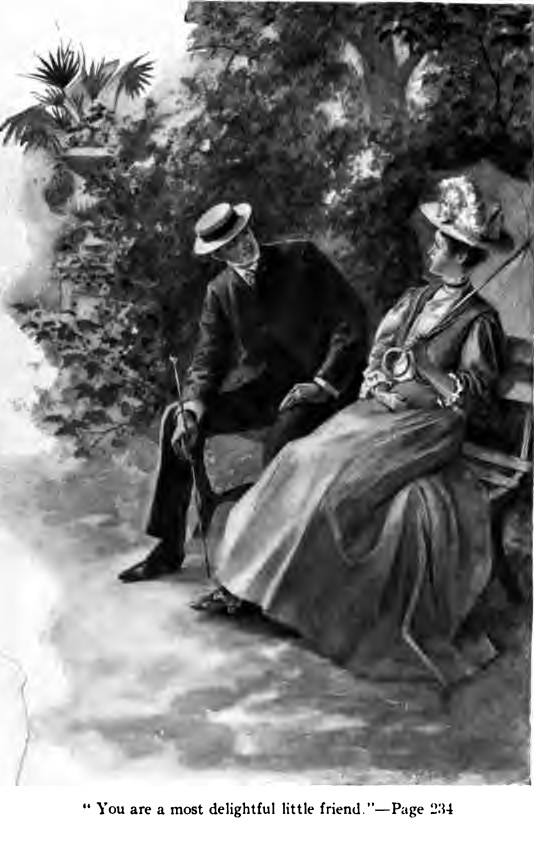
“You are a most delightful little friend,” was his courteous reply.
“Ah! I see. You treat me as a child,” was her rather impatient reply. “You are not serious.”
“I am most serious,” he declared, with a solemn face. “Indeed, I was never more serious in my life than I am at this moment.”
She burst out laughing—a peal of light, merry, irresponsible, girlish laughter.
“And before I met you,” she said, “I thought you a most terribly austere person.”
“So I am—at times. I have to be, Miss Lorena. I’m secretary to a very serious old gentleman, remember.”
“Yes. And that was the very reason why I threw the convenances to the winds—if there are any in the Anglo-French circle in Paris—and spoke to you—a perfect stranger.”
“You spoke because I was Mr Statham’s secretary?” he asked, somewhat puzzled.
“Yes. I wanted to speak to you privately.”
“Well, nobody can overhear us here,” he said glancing around, and noticing only a fat bonne wheeling a puny child in a gaudily-trapped perambulator.
“I wanted to speak to you regarding Mr Statham,” she said, after a long pause. “I ascertained you were coming to Paris, and waited in order to see you.”
“Why?” he asked, much surprised. The refusal of her name, her determination to conceal her identity, her friendship for Maud, and her intimate acquaintance with thing Servian, all combined to puzzle him to the verge of distraction. Who was she? What was she?
The mystery of the Doctor and his daughter was an increasing one. His pretended ignorance of certain facts had been unmasked by her in a manner which showed that she was aware of the actual truth. Was she really a secret messenger from the girl he loved so devotedly—the girl with whom he had last walked and talked with in the quietness of the London sundown in Nevern Square?
He glanced again at her pretty but mysterious face. She was a lady—refined, well-educated, with tiny white hands and well-shod feet. There was nothing of the artificial chic of the Parisienne about her, but a quiet dignity which seemed almost incongruous in one so young. Indeed, he wondered that she was allowed about in the streets of Paris alone, without a chaperone.
Her piquante manner, and her utter disregard of all conventionality, amused him. True, she was older than Maud but most possibly her bosom friend. If so, Maud was probably in hiding in Paris, and this pretty girl had been sent to him as Cupid’s messenger.
“I wanted to see you on a matter which closely concerns Mr Statham.”
“Anything that concerns Mr Statham concerns myself, Miss Lorena,” he said. “I am his confidential secretary.”
“I have ascertained that, otherwise I would not have dared to speak to you. I want to warn you.”
“Of what?”
“Of a deeply-laid conspiracy to wreck Mr Statham’s life,” she said. “There have arisen recently two men who are now determined to lay bare the secret of the millionaire’s past, in revenge for some old grievance, real or fancied.”
“For the purposes of blackmail—eh?” he asked. “Every rich man is constantly being subjected to attempted blackmail in some form or other.”
“No. They have no desire to obtain money. Their sole intention is to expose Mr Statham.”
“Most men who are unsuccessful are eager to denounce the methods of their more fortunate friends,” he said, smiling. “Mr Statham has no fear of exposure, I assure you.” The girl looked him straight in the face with a long, steady gaze.
“Ah! I see?” she exclaimed, after a pause. “You treat me as an enemy, Mr Rolfe; not as a friend.”
Chapter Thirty Six.
The Locked Door in Park Lane.
“Excuse me, Miss Lorena, I do not,” he declared quickly. “Only we have heard so many threats of exposure that to cease to regard them seriously. Mr Statham’s high reputation is sufficient guarantee to the public.”
“I quite admit that,” answered the girl. “It is not the present that is in question, but the past.”
“In these days of hustle, a man’s past matters but little. It is what he is, not what he was, which the public recognise.”
“Personally,” she said, “I hold Mr Statham in highest esteem. I have never met him, it’s true, but I have knowledge of certain kind and generous actions on his part, actions which have brought happiness and prosperity to those who have fallen upon misfortune. For that reason I resolved to speak to you and warn you of the plot in progress. Do you happen to know a certain Mr John Adams?”
Rolfe started, and stared at her. What could she know of the Damoclean sword suspended over the house of Statham?
“Well,” he answered guardedly, “I once met a man of that name, I think.”
“Recently?”
“About a month ago.”
“You knew nothing of him prior to that?”
Rolfe hesitated. “Well, no,” he replied.
“He made pretence of being friendly with you.”
“Yes. But to tell you the truth I was somewhat suspicions of him. What do you know of him? Tell me.”
“I happen to be well acquainted with him,” the girl responded. “It is he who has arisen like one from the grave, and intends to avenge the wrong which he declares that Mr Statham had done him.”
“Recently?”
“No, years ago, when they were abroad together—and Mr Statham was still a poor man.”
Charlie Rolfe was silent. He knew Adams; he knew, too, that evil was intended. He had warned old Sam Statham, but the latter had not heeded. Adams had had the audacity to approach him in confidence, believing that he might be bought over. When he had discovered that the millionaire’s secretary was incorruptible, he openly declared his sinister intentions.
“I had no idea you were acquainted with Adams,” he said, still puzzled to know who she was, and what was her motive.
“I happen to know certain details of the plot,” she answered.
“And you will reveal them to me?” he asked in quick anxiety.
“Upon certain conditions.”
“And what are they? I am all attention.”
“The first is that you will not seek to learn the identity of the person who is associated with Mr Adams in the forthcoming exposure; and the second is that you say nothing to Mr Statham regarding our secret meeting.”
“Why?” he asked, not quite understanding the reason of her last stipulation. “I thought you wished to warn Mr Statham?”
“No. I warn you. You can take measures of precaution, on Mr Statham’s behalf without making explanation.”
“Mr Statham has already seen John Adams and recognised him. He is already forewarned.”
“And he has not taken any steps in self-defence?” she cried quickly.
“Why need he trouble?”
“Why, because that man Adams has sworn to hound him to self-destruction.”
Rolfe shrugged his shoulders, and replied:
“Mr Statham has really no apprehension of any unpleasantness, Miss Lorena. It is true that in the old days the two men were friends, and, apparently, they quarrelled. Adams was lost for years to all who knew him, and now suddenly reappears to find his old acquaintance wealthy beyond the dreams of avarice, and seeks, as many more before him have done, to profit by his former friendship.”
“Or enmity,” added the girl, lowering her sunshade a little until for a moment it hid her features. “I do not think you realise the dastardly cunning of the plot in progress. It has not only as its object the ruin of the credit of the house of Statham Brothers, but the creation of a scandal which Mr Samuel Statham will not dare to face. He must either fly the country, or commit suicide.”
“Well?”
“The latter is expected by the two men who have combined and are now perfecting their ingenious conspiracy. It is believed by them that he will take his own life.”
Charlie Rolfe reflected for a moment. He recollected old Sam’s terrible agitation on the day when he recognised John Adams leaning against the railings of the Park. Of late, the great financier had betrayed signs of unusual nervousness, and had complained several times of insomnia. To his secretary knowledge he had spent two nights that very week in walking the streets of London from midnight until dawn, ostensibly to do charitable actions to the homeless, but in reality because his mind was becoming unbalanced by the constant strain of not knowing from one moment to another when Adams would deal his staggering blow.
Had there been any question of blackmail, the aid of solicitors and of Scotland Yard could have been invoked. But there had been no threat beyond the statement made openly to Rolfe by the man who intended to encompass the ruin of the eccentric millionaire and philanthropist.
“I think, Miss Lorena, that we need have no fear of Mr Statham doing anything rash,” he said. “But why is it hoped that he will prefer to take his life rather than face any exposure?”
“Because they will profit by his death—profit to an enormous degree.”
“But how can Adams profit? He has had no dealings with Mr Statham of late.”
“Not Adams, but his friend. The latter will become wealthy.”
“And may I not know his name?”
“No. That is the stipulation which I make. For the present it is sufficient that you should be made aware of the broad lines of the plot, and that its main object is the death of Samuel Statham.”
“And you wish me to tell him all this?”
“Certainly, only without explaining that I was your informant.”
“Why do you wish to conceal the fact, Miss Lorena?” he asked. “Surely he would be only too delighted to be able to thank you for your warning?”
She shook her head, saying:
“If it were known that I had exposed their plans it would place me in peril. They are determined and relentless men, who would willingly sacrifice a woman in order to gain their ends, which in this case is a large fortune.”
“And you will not tell me the name of Adams’s associate in the matter?”
“No. I—I cannot do that. Please do not ask me,” she answered hurriedly.
Rolfe was again silent for a few moments. At last he asked:
“Cannot you tell me something of the past relations between Adams and Statham? You seem to know all the details of the strange affair.”
“Adams makes certain serious allegations which he can substantiate. There is a certain witness whom Mr Statham believes to be dead, but who is still alive, and is now in England.”
“A witness—of what?” asked Rolfe quickly.
“Of the crime which Adams alleges.”
“Crime—what crime?” ejaculated the young man in surprise, staring at his pretty companion.
“Some serious offence, but of what nature I am not permitted to explain to you.”
“Why not, Miss Lorena? You must! Remember that Mr Statham is in ignorance of this—I mean that Adams intends to charge him with a crime. Surely the position is most serious! I imagined that Adams’s charges were criticism of Mr Statham’s methods of finance.”
“Finance does not enter into it at all,” said the girl. “The delegation is a secret crime by which the millionaire laid the foundation of his fortune; a crime committed abroad, and of which there are two witnesses still living, men who were, until a few weeks ago, believed to be dead.
“But you tell me that Adams’s associate will, if Mr Statham commits suicide, profit to an enormous amount. Will you not explain? If this is so, why have they not attempted to levy blackmail? If the charge has foundation—which I do not for one moment believe—then surely Mr Statham would be prepared to make payment and hush up the affair? He would not be human if he refused.”
“The pair are fully alive to the danger of any attempt to procure money by promise of secrecy,” she replied. “They have already fully considered the matter, and arrived at the conclusion that to compel Mr Statham to take his own life is the wiser and easier course.”
“You seem to be in their confidence, Miss Lorena?” he said, gazing at the pretty girl at his side.
“Yes, I am. That is why I am unable to reveal to you the name of Adams’s companion,” she replied. “All I can tell you is that the intention is to make against him a terrible charge of which they possess evidence which is, apparently, overwhelming.”
“Then you know the charge it is intended to bring against him—eh?”
“Yes,” was her prompt answer. “To me it seems outrageous, incomprehensible—and yet—”
“Well?”
“And yet, if it is really true, it would account to a very great degree for Mr Statham’s eccentricity of which I’ve so often read in the papers. No one enters his house in Park Lane. Is not that so?”
“He is shy, and does not care for strangers,” was Rolfe’s response.
“But it said in the paper only a week ago that nobody has ever been upstairs in that house except himself. There is a door on the stairs, they say, which is always kept locked and bolted.”
“And if that is so?”
“Well—have you ever been upstairs, Mr Rolfe. Tell me; I’m very anxious to know.”
“I make no secret of it,” was his reply, smiling the while. “I have never been upstairs. Entrance there is forbidden.”
“Even to you—his confidential secretary?”
“Yes, even to me.”
“And yet there are signs of the upstairs’ rooms being occupied,” she remarked. “I have seen lights there myself, as I’ve passed the house. I was along Park Lane late one evening last week.”
“So you have been recently in London?”
“London is my home. I am only here on a visit,” was her reply. “And ascertaining you were coming here, I resolved to see you.”
“And has this serious allegation which Adams intends to bring any connection with the mystery concerning the mansion?”
“Yes. It has.”
“In what way?”
She paused, as though uncertain whether or not to tell the truth.
“Because,” she said at last, “because I firmly believe, from facts known to me, that confirmation of the truth of Adams’s charge will be discovered beyond that locked door!”
Chapter Thirty Seven.
Max Barclay is Inquisitive.
“Miss Rolfe has left the firm’s employ, sir.”
“Left—left Cunnington’s?” gasped Max Barclay, staring open-mouthed at Mr Warner, the buyer.
“Yes, sir. She left suddenly yesterday morning,” repeated the dapper little man with the pen behind his ear.
“But this is most extraordinary—to leave at a moment’s notice! I thought she was so very comfortable here. She always spoke so kindly of you, and for the consideration with which you always treated her.”
“It was very kind of her, I’m sure,” replied the buyer; “but it is the rule here—a moment’s notice on either side.”
“But why? Why has she left?”
Warner hesitated. He, of course, knew the truth, but he was not anxious to speak it.
“Some little misunderstanding, I think.”
“With you?”
“Oh, dear no. She was called down to the counting-house yesterday morning, and she did not return.”
“Then she’s been discharged—eh?” asked Max in a hard voice.
“I believe so, sir. At least, it would appear so.”
“And are they in the habit of discharging assistants in this manner—throwing them out of a home and out of employment at a moment’s notice? Is Mr Cunnington himself aware of it?”
“It would be Mr Cunnington himself who discharged her,” was the buyer’s answer. “No other person has authority either to engage or discharge.”
“But there must be a reason for her dismissal!” exclaimed Max.
“Certainly. But only Mr Cunnington knows that.”
“Can I see him?”
“Well, at this hour he’s generally very busy indeed; but if you go down to the counting-house in the next building, and ask for him, he may give you a moment.”
“Thank you, Mr Warner,” Barclay said, a little abruptly, and, turning on his heel, left the department.
“She hasn’t told him evidently,” remarked one girl-assistant to the other. “I’m sorry Rolfie’s gone. She wasn’t half a bad sort. She was old Warner’s favourite, too, or her young gentleman would never have been allowed to talk to her in the shop. If you or I had had a young man to come and see us as she had, we’d have been fired out long ago.”
“I wonder who her young man really is,” remarked the second girl, watching him as he strode out, a lithe figure in a well-cut suit of grey tweeds.
“Well, he’s a thorough gentleman, just like her brother,” remarked her companion. “I saw him in his motor-boat up at Hampton the Sunday before last. He’s completely gone on her. I wonder what’ll happen now. I don’t think much of the new girl; do you? Does her hair awfully badly.” Unconscious of the criticism he had evoked, Max Barclay descended the stairs, passed through the long shops—crowded as they always were in the afternoon—into the adjoining building, and sought audience of the titular head of the great firm.
After waiting for some time in an outer office he was shown in. The moment he asked his question Mr Cunnington grasped the situation.
“I very much regret, sir, that it is not my habit to give information to a second party concerning the dismissal of any of my assistants. If the young lady applies for her character, she is perfectly entitled to have it.”
“But I apply for her character,” said Max promptly.
“You are not an employer, sir. She has not applied to you for a situation.”
“No; but I may surely know the reason she has left your service?” Max pointed out. “Her brother, who is abroad just now, is my most intimate friend.”
Mr Cunnington stroked his dark beard thoughtfully, but shook his head, saying:
“I much regret, Mr Barclay, that I am unable to give you the information you seek. Would it not be better to ask the young lady herself?”
“But she has left, and I have no idea of her address!” exclaimed Barclay. “Can you furnish me with it?”
The head of Cunnington’s, Limited, took up the telephone receiver and asked for a certain Mr Hughes, of whom he made inquiry if Miss Rolfe had left her address.
There was a wait of a few moments, then Mr Cunnington turned and said:
“The young lady left no address. She was asked, but refused to give one.”
Max’s heart sank within him. She had been dismissed at an instant’s notice, and was lost to him. He turned upon Mr Cunnington in quick anger and said:
“So I am to understand that you refuse me all information concerning her?”
“I merely adhere to my rule, sir. Any dismissal of my assistants is a matter between myself and the person dismissed. I am not called upon to give details or reasons to outsiders. I regret that I am very busy, and must wish you good afternoon.”
Max Barclay bit his lip. He did not like the brisk, business-ike air of the man.
“I shall call upon Mr Statham, whom I happen to know,” he said. “And I shall invoke his aid.”
“You are perfectly at liberty to do just as you like, my dear sir. Even Mr Statham exercises no authority over the assistants in this establishment. It is my own department and I brook no interference.”
Max did not reply, but left the office and strode out into Oxford Street, pushing past the crowd of women around the huge shop-windows admiring the feminine finery there displayed so temptingly.
Marion—his Marion—had disappeared. She had been dismissed—in disgrace evidently; probably for some petty fault or for breaking one of the hundred rules by which every assistant was bound. He had always heard Mr Cunnington spoken of as a most lenient, and even generous, employer, yet his treatment of Marion had been anything but just or humane.
When he thought of it his blood boiled. Charlie was away, he knew. He had telephoned to his rooms that very morning, but his man had replied that his master had left hurriedly for the Continent—for Paris, he thought.
At the corner of Bond Street he halted, and glanced at his watch. Should he try and find Charlie by telegraph or should he take the bull by the horns and go and see old Sam Statham. His well-beloved had disappeared. Would the old financier assist him to discover the truth?
He was well aware that for a comparative stranger to be deceived in that big house in Park Lane was exceptional. Old Levi had his orders, and few among the many callers ever placed their foot over the carefully-guarded threshold. Still, he resolved to make the attempt, and, with that object, jumped into a taxi-cab which happened at the moment to be passing.
Alighting at the house, he presented his card to old Levi, who opened the door, and asked the favour of a few moments’ conversation with Mr Statham? The old servant scrutinised the card closely, and took stock of the visitor, who, noticing his hesitation, added: “Mr Statham will remember me, I believe.”
Levi asked him into the hall, with a dissatisfied grunt, and disappeared, to return a few moments later, and usher the visitor into the presence of the millionaire.
Old Samuel, who had been dozing over a newspaper in the his easy-chair near the fireplace, rose, and, through his spectacles, regarded his visitor with some suspicion. The blinds were drawn, shading the room from the afternoon sun, therefore Max found the place was in comparative darkness after the glare outside.
In a few moments, however, when his eyes grew accustomed to the semi-darkness, he saw the old fellow wave his hand in the direction of a chair, saying:
“I’m very glad you called, Mr Barclay—very glad. Indeed, curiously enough, I intended to write to you only yesterday upon a business matter, but I was too busy.”
Barclay seated himself, full of surprise that the great financier should wish to consult him upon any business matter.
“Well, Mr Statham,” he said, “I may as well tell you at once that I am here to seek your kind assistance and help in a purely personal matter—a matter which closely concerns my own happiness.”
Statham pricked up his ears. He knew what was coming. Marion Rolfe had told him of her visit there.
“Well?” he asked coldly, in a changed manner.
“You possibly are unaware that I am engaged to be married to Marion Rolfe, the sister of your secretary, a young lady in whom you were kind enough to take an interest am obtain for her a situation at Cunnington’s.”
The old man nodded, his countenance sphinx-like.
“The lady in question has been dismissed by Mr Cunnington at a moment’s notice, and he refuses to tell me the reason of his very remarkable action. I want you to be good enough to obtain a response for me.”
“And where is the young lady?” asked the wary Statham.
“Nobody knows. She would leave no address.”
“Then you are unaware of her whereabouts?”
“She has disappeared.”
“Extraordinary!” the old fellow remarked, reflecting deeply for a moment.
“Yes. I cannot imagine why, in the circumstances, she has not written to me,” Max declared, the expression upon his face betraying his deep distress.
“It is certainly somewhat strange,” the old man agreed. “Girls at Cunnington’s are not often discharged in that manner. Cunnington himself is always most lenient. Have you seen him?”
“Yes; and he absolutely refuses any information.”
“In that case, Mr Barclay, I don’t see very well how I can assist you. The management and organisation of the concern are left to him, as managing director. I really cannot interfere.”
“But was it not through you that Marion, without previous experience or apprenticeship, was engaged there?”
“Yes; I have some recollection of sending a line of recommendation to Cunnington,” was the millionaire’s response. “But, of course, my interest ended there. My secretary asked me to write the note, and I did so.”
“Then you really cannot obtain for me the information I desire?”
“But why are you so inquisitive—eh?” snapped the old man. “Surely the lady will tell you the reason of her dismissal!”
“I don’t know where she is.”
“A fact which is—well—rather curious—shall we designate it?” the old man remarked meaningly.
“You mean to imply that her instant dismissal has cast a slur upon her character, and that she fears to meet me lest she be compelled to tell me the truth?” he said slowly as the suggestion dawned upon him. “Ah! I see. You refuse to help me, Mr Statham, because—because I love her.”
And his face became pale, hard-set, and determined.
Chapter Thirty Eight.
Friend or Foe?
The two men were silent for some moments. Statham was watching his visitor’s face. To him it was, at least, satisfactory to know that Marion had disappeared, fearing to let her lover know the reason of her sudden dismissal lest he should misjudge her.
Truth to tell, he had anticipated that she would have gone straight to Barclay and told him the truth. Within himself he acknowledged that he had played the poor girl a scoundrelly trick, but consoled himself with the thought that when a man’s life was at stake, as his was, any mode of escape became justifiable.
At last the old man stirred in his chair, and, turning to Max, said:
“Please understand plainly it is not because I refuse to help you, but because it is not within my province to dictate to Cunnington replies regarding his assistants.”
“But you hold a controlling interest in the firm,” declared the other.
“That may be so, but I have nothing to do with the details of organisation,” he replied. “No, Mr Barclay, let us end this matter with an expression of my regret at being unable to assist you. Perhaps, however, I may be able to do so in another direction.”
“In another direction!” he echoed. “How?”
“In a small matter of business.”
Max Barclay was both surprised and interested. He knew quite well that Statham could if he wished, give him previous knowledge that would enable him to make a considerable coup. Ignorance of Marion’s visit to the old man or the cause of her dismissal allowed him to regard the millionaire with feelings of friendliness, and to reflect that, after all, he had no power to dictate to Cunnington.
“You know, Mr Barclay,” he said, “I frequently obtain confidential knowledge of what is transpiring in the world of finance. The other day it came to my ears, through a source it is unnecessary to mention, that the Adriatic railway concession has been placed before you.”
Max opened his eyes. He believed that not a soul except the man who had joined him in partnership was aware of this. The information must have come from Constantinople, he thought.
“That is true,” he admitted.
“A big thing!” remarked the old man in his croaking voice. “A very big thing indeed—means prosperity to the Balkan countries. But pardon me if I ask one or two questions. Do not think I have any intention of going behind your back, or attempting to upset your plans. I merely ask for information, because, as perhaps you know, there is but one man in London who could float such a thing, and it is myself.”
“I know, Mr Statham, that we shall be compelled to come to you when we have the concession all in order.”
“You will,” he said with a smile. “But can you, without injury to yourself, tell me who is your associate in this business?”
“A Frenchman—Mr Jean Adam, of Constantinople.” Statham’s face never moved a muscle. Of this he was already quite well aware.
“An old friend of yours, I suppose?”
“Not—not exactly an old friend. I met him for the first time about a month or so ago,” responded Max.
“And what do you know of him?”
“Nothing much except that I believe him to be a man of the highest integrity and the possessor of many friends interested in high finance.”
“Oh! and what causes you to believe that?”
“Well, we first met in Paris, where, having mooted the idea of a partnership, he introduced me to several well-known people, among them Baron Tellier, who arranged the match monopoly of Turkey, and Herr Hengelmann, of Frankfort, whom, no doubt, you know as the concessionaire of the German railway from the Bosphorus to Bagdad.”
The old man gave vent to a dissatisfied grant.
“Both men stand very high in the financial world, do they not?” Max asked.
“Well—they did,” replied old Sam, smiling.
“Did? What, have they gone under?”
“No. Only Hengelmann has been in his coffin fully two years, and the Baron died at Nice last winter.”
“What?” cried Max, starting forward.
“I repeat what I say, Mr Barclay. Your friend Adam has been indulging in a pretty fiction.”
“Are you sure? Are you quite sure they are dead?”
“Most certainly. I was staying in the same hotel at Nice when the Baron died, and I followed him to the grave. He was a great friend of mine.”
Max Barclay sat stunned. Until that moment he had believed in Jean Adam and his plausible tales, but he now saw how very cleverly he had been deceived and imposed upon.
“You’re surprised,” he laughed. “But you must remember that you can get a decent suit of gentlemanly clothes for five pounds, and visiting-cards are only two shillings a hundred. People so often overlook those two important facts in life. Thousands of men can put off their identity with their clothes.”
“But Adam—do you happen to know him?” Max asked. “If you do, it will surely be a very friendly act to tell me the truth.”
“Well,” replied the elder man with some hesitancy, “I may as well tell you at once that the Sultan has never given any concession for the railway from Nisch to San Giovanni di Medua to cross Turkish territory—and will never give it. He fears Bulgaria and Servia too much, for he never knows what Power may be behind them. And, after all, who can blame him? Why should he open his gates to an enemy? Albania is always in unrest, for in the north the Christians predominate, and there is bound to be trouble ere long.”
“Then you believe that the whole thing is a fiction?”
“Most certainly it is. If there was any idea of the Sultan giving an iradé, I should most certainly know of it. I have good agents in Constantinople. No. Take it from me that the concession will never be given. It is not to Turkey’s interest to allow the development of Servia and Bulgaria, therefore your friend’s pretty tale is all a fairy story.”
“Then why is he pressing me to go out to Constantinople?” Max asked.
Statham shrugged his shoulders, indicative of ignorance.
“Perhaps he thinks you will plank down money?” he suggested.
“He wants nothing until I myself am satisfied with the bonâ fides of the business.”
“Stuff on his part, most likely. He’s a past-master of the art.”
“How well do you know him?”
“Sufficiently well to have nothing to do with him.”
“Then that accounts for his refusal to allow me to confide in you,” said Barclay. “I see the reason now.”
“Of course, act just as you think fit. Only recollect that what I’ve told you is bed-rock fact. The man who calls himself Adam is a person to be avoided.”
“Have you had dealings with him?”
“Just once—and they had a very unpleasant result.”
He reflected upon certain remarks and criticisms which the Frenchman had uttered concerning Statham and his normal methods. In the light of what he now knew, he saw that the two men were enemies. It seemed as though one man wished to tell him something, and yet was hesitant.
“Have you put any money into the scheme?” the millionaire asked.
“Not yet.”
“Then don’t. Tell him to take it somewhere else. Better still, tell him to bring it to me. You need not, however, say that it is I who warned you. Leave him in the dark in that direction. He’s a clever fellow—extraordinarily clever. Who is with him now?”
“Well, he has a friend named Lyle—a mining engineer.”
“Leonard Lyle—a hunchback?” asked Statham quickly.
The millionaire’s countenance went a trifle paler, and about the corners of his thin lips was a hard expression. To him, the seriousness of the conspiracy was only too apparent.
Those two men intended that he should be driven to take his own life—to die an ignominious death.
“You’ve spoken to this man Lyle?” he asked in as steady a voice as he could.
“Once or twice. He seems to possess a very intimate knowledge of Servia, Bulgaria, and European Turkey. Is he an adventurer like Adam?”
“Not exactly,” was the rather ambiguous reply. “But his association with Adam shows plainly that fraud is intended.”
“But why does he want me to go post-haste out to Turkey?” queried Max, who had risen from his chair in the excitement of this sudden revelation which caused his brilliant scheme to vanish into thin air.
“To induce confidence, I expect he would have introduced you to some men wearing fezzes, and declared them to be Pashas high in favour at the Yildiz Kiosk. Then before you left Constantinople he would have held you to your bargain to put money into the thing. Oh! never fear, you would have fallen a victim in one way or another. So it’s best that you should know the character of the two men with whom you are dealing. Take my advice; treat them with caution, but refuse to stir from London. They will, no doubt, use every persuasion to induce you to go, but your best course is to hear all their arguments, watch the gradual development of their scheme, and inform me of it. Will you do it?”
“Will my information assist you in any way, Mr Statham?”
“Yes, it will—very materially,” the old man answered.