William Le Queux (continued 2)
Reading edition
The pair glared at each other for one single second. Then Sam Statham, recognising in the other’s crafty eyes a look of cruel, relentless revenge, started back into the room, breathless and deathly pale. He staggered to his chair, supporting himself by clutching at its back.
“Then they did not lie!” he gasped aloud. “He—he’s alive—therefore so it’s all over! I—I saw his intentions plainly written in his face. I’ve played the game and lost! He has returned, therefore I must face the inevitable. Yes,” he added, with that same bitter laugh, only this time it was the hoarse, discordant laugh of a man who found himself cornered, without any possible means of escape. “Yes—this is the end—I must die!—to-day!” And he whispered, glancing round the room as though in terror of his own voice, “Yes—before the sun sets.”
Chapter Nine.
In which Levi Gives Advice.
For fully five minutes Samuel Statham stood steadying himself by the back of his chair. His face was white and rigid, his jaw set, his breathing quick and excited, his hands trembling, his face full of a sudden horror.
He had entirely changed. The sight of that shabby stranger had filled him with fear.
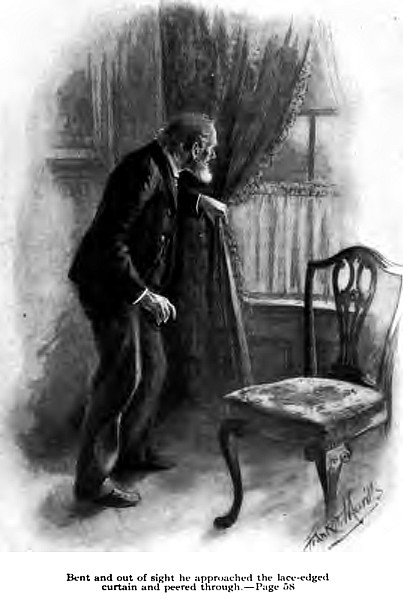
Once or twice he glanced furtively at the window. Then, straightening himself in a vain endeavour to remain calm, he bent and crept back to the window in order to ascertain whether the man still remained. Bent and out of sight he approached the lace-edged curtain and peered through unseen.
Yes; the fellow was still there. He had lit his pipe with calm unconcern, and was leaning back against the railings in full view of the house. The man’s attitude was that of complete triumph. Ah! what a fool he had been to have shown himself so openly as he had done! To think that this man of all men was still alive!
He crept back again, trembling. His face was haggard and bloodless, the countenance of a man whose future was but a blank—the dismal blank of the grave.
His whole body trembled as he sank into his writing-chair, and, leaning his elbows upon the desk, he buried his face in his hands and sobbed. Yes; he, the hard-headed financier, whose influence was felt in every corner of the world, the man who controlled millions and who loaned great sums to certain of the rulers of Europe, sobbed aloud.
“Ah!” he cried to himself, “I was a fool when I disbelieved them. I thought that blackmail was their object in telling me the story of how that man was alive and had been seen. Therefore I only laughed at them and took no precaution. Ah! I was a fool, and my foolishness must end fatally. There is no way out of it for me—only death. I’ve been a fool—a confounded fool. I ought to have made certain; I ought not to have taken any risk. I’m wiser now than I was then. Age has brought me wisdom as well as destroying my belief in the honesty of men and the loyalty of friends”; and as he sighed heavily, his brow still bent upon his hand, he touched the bell, and old Levi appeared.
“Levi,” he said, in a low unusual voice, “go quietly to that window and, without attracting attention, look outside at a man opposite.”
The faithful old servant, somewhat surprised at these rather unusual instructions, walked stealthily to the window and peered through the lace insertion of the brisé-brisé.
Scarcely had he done so than, with a cry, he withdrew, and facing his master, stood staring at him.
“Did you see anyone, Levi?” asked his master, raising his head suddenly.
“Yes,” was the hoarse whisper of the man who stood there, white-faced in fear. “It’s him! I—I thought you said he was dead.”
“No; he isn’t! He’s there in the flesh.”
“And what are we to do?”
“What can we do? He recognised me a moment ago, and he’s watching the house.”
“Which means that you had better leave England for a considerable time.”
“What!” cried Statham, in quick reproof. “What—run away? Never!”
“But—well, in the circumstances, don’t you scent danger—a very grave danger?” asked the old servant whose devotion to his master had always been so marked.
“When I am threatened I always face my accuser. I shall do so now,” was the great man’s calm reply, even though it were in absolute contradiction to his attitude only a few moments before. Perhaps it was that he did not wish old Levi to know his fear.
“But—but that can only result in disaster,” remarked the old servant, who never addressed his master as “sir”—the pair were on too intimate terms for that. “If I might presume to advise, I think—”
“No, Levi,” snapped the other; “you haven’t any right to give advice in this affair. I know my own business best, surely?”
“And that man knows as much as you do—and more.”
“They told me he was alive, and I—fool that I was—disbelieved them!” the old millionaire cried. “And there he is now, watching outside like a terrier outside a rat-hole. And I’m the rat, Levi—caught in my own trap!”
“Is there no way out of this?” asked the other. “Surely you can escape if you so desire—get away to America, or to the Continent.”
“And what’s the use. He’d follow. And even if he didn’t, think of what he can tell if he goes to the police.”
“Yes; he could tell sufficient to cause Statham Brothers to close their doors—eh?” remarked the old servant very seriously.
“That’s just it. I’ve been a confounded idiot. Rolfe warned me only the other day that the fellow was in London, but I said I wouldn’t believe him until I saw the man with my own eyes. To-day I have actually seen him, and there can be no mistake. He’s the man that—that I—”
His sentence remained unfinished, for he sank into his chair and groaned, covered his face again with his hands in an attitude of deep remorse, while Levi stood by watching in silence.
“Rolfe could help you in this matter,” the man exclaimed at last. “Where is he?”
“I don’t know. I sent him yesterday to Belgrade, but last night he telephoned that he had lost the train.”
“Then he may have left at nine o’clock this morning?”
“Most probably.”
“Then you must recall him by wire.”
“No telegram can reach him till he gets to Servia, for I don’t know whether he’s gone from Ostend or Paris.”
“They’d know in the City. Why not ask them?”
“No; they wouldn’t know.”
“Why?”
“Because Rolfe had with him a big sum in German notes and a quantity of securities belonging to the National Bank of Servia. In that case he would not let anyone know his route, for fear of thieves. It is one of my strictest orders to him. Why he lost the train last night I can’t tell.”
“Well, it’s a thousand pities we can’t get at him, for he’s the only man to help you out—of this difficulty.”
“Yes; I quite agree. That shabby, down-at-heel man waiting outside is my master, Levi—the master of Statham Ltd. My future is in his hands!”
He had raised his head, and sat staring at the beautiful picture upon the wall before him, the picture with its wonderful tints which had been copied in a hundred different places.
His countenance was haggard and drawn, and in his eyes was a look of unspeakable terror, as though he were looking into his own grave, as indeed at that moment he was.
The sombre melancholy-looking Levi stood watching for a moment, and then, creeping to the window, looked out into the sunshine of Park Lane.
The ragged tramp was still there, idling against the railings, and smoking a short, dirty pipe quite unconcernedly. He was watching for the re-appearance of that white, startled face at the window—the face of the great Samuel Statham. “He’s still outside, I suppose?” queried the man at the other end of the room.
Levi replied in the affirmative, whereat old Samuel clenched his teeth and muttered something which sounded like an oration. He was condemning himself for his disbelief in his secretary’s warnings.
“Had I listened to him I could easily have saved myself—I could have prevented him from coming here,” he said in a meaning voice.
“Yes; it would not have been difficult to have prevented this. After what has occurred that blackguard has no right to live.”
“Aha! then you believe me, Levi?” cried the wretched man. “You do not blame me?” he asked, anxiously.
“He was to blame—not you.”
“Then I was right in acting as I did, you think—right to protect my interests.”
“You were right in your self-defence,” the man answered, somewhat grey, sphinx-like, for Levi was a man whose thoughts one could never read from his thin, grey, expressionless face. “But you were injudicious when you disregarded Rolfe’s warning.”
“I thought he had his own interests to serve,” was Statham’s reply.
“Frankly, you believed it to be an attempt at blackmail. I quite follow you. But do you think Rolfe would be guilty of such a thing?”
“My dear Levi, when a poor man is in love, as Rolfe is, it is a sore temptation to obtain by any means, fair or foul, sufficient to marry and support a wife. You and I were both young once—eh? And we thought that our love would last always. Where is yours to-day, and”—he sighed—“where is mine?”
“You are right,” replied the old servant slowly, with a slight sigh. “You refer to little Marie. Ah! I can see her now, as plainly as she was then, forty years ago. How beautiful she was, how dainty, how perfect, and—ah!—how well you loved her. And what a tragedy—the tragedy of your life—the tragedy that has ever been hidden from the world—the—”
“No! Enough, Levi!” cried his master hoarsely, staring straight before him. “Do not recall that to me, especially at this moment. It was the great tragedy of my life, until—until this present one which—which threatens to end it.”
“But you are going to face the music. You have said!”
“I may—and I may not.”
Levi was silent again. Only the low ticking of the dock broke the quiet, and was followed by the rumble of a motor-’bus and the consequent tremor in the room.
“At any rate, Samuel Statham will never act the coward,” the millionaire remarked at last, in a soft but distinct voice.
“Rolfe can help you. Where is he—away just at the moment that he’s wanted,” Levi said.
“My fault! My fault, Levi!” his master declared. “I disbelieved him, and sent him out to Servia to show him that I did not credit what he told me.”
“You were a fool!” said Levi, bluntly. He never minced words when his master spoke confidentially.
“I know I was. I have already admitted it,” exclaimed the financier. “But what puzzles me is that that man outside is really alive and in the flesh. I never dreamed that he would return to face me. He was dead—I could have sworn it.”
“So you saw him dead—eh?”
Old Statham drew a quick breath, and his face went ashen, for he saw how he had betrayed himself. Next instant he had recovered from his embarrassment and, bracing himself with an effort, said:
“No—no, of course not. I—I only know what—well, what I’ve been told. I was misled wilfully by my enemies.”
Levi looked straight into his face with a queer expression of disbelief. Statham noticed it, and it unnerved him.
He had inadvertently made confession, and Levi did not credit his denial.
The peril of the situation was complete!
Chapter Ten.
Shows a Woman’s Peril.
Several hours had gone by, hours which Samuel Statham spent, seated in a deep easy-chair near the empty fire grate, reviewing his long and eventful life.
With his head buried in his hands, he reflected upon all the past—its tragedy and its prosperity. True, he had grown rich, wealthier than he had ever dreamed, but, ah! at what a cost! The world knew nothing. The world of finance, known in the City, looked upon him as a power to be reckoned with. By a stroke of that stubby, ink-stained pen which lay upon the writing-table he could influence the markets in Paris or Berlin. His aid and advice were sought by men who were foremost in the country’s commerce and politics, and he granted loans to princes and to kingdoms. And yet the tragedy of his own heart was a bitter one, and his secret one that none dreamed.
He, like many another world-famous man, had a skeleton in his cupboard. And that day it had seen the light, and the sight of it had caused him to begin the slow and painful process of putting his house in order, prior to quitting it for ever—prior to seeking death by his own hand.
For nearly an hour he had been huddled up in the big leather armchair almost immovable. He had scrawled two or three letters, and written the superscription upon their envelopes, and from his writing-table he had taken a bundle of letters tied with a faded blue ribbon. One by one he had read them through, and then, placing them in the grate, he had applied a match and burnt them all. Some other business documents followed, as well as an old parchment deed, which he first tried to tear, but at last burned until it was merely twisted tinder.
It was now afternoon, and the silence of that house of mystery, wherein no one save Charles Rolfe ever penetrated, was unbroken. Across the soft green carpet lay a bar of warm sunlight that seemed strangely out of place in that sombre apartment, with its despairing owner, while outside the shabby stranger was no longer to be seen.
He might be lurking in the vicinity, but Levi had an hour ago entered and informed his master that the patient vigil had been relaxed.
Old Sam had dismissed him with a grunt of dissatisfaction. Those last hours of his life he wished to spend alone.
He had been trying to see some way out of the cul-de-sac in which he found himself, but there was none. That shabby wayfarer—his worst enemy, had found him. Years ago he had sworn a terrible vengeance, but for secret reasons, known only to Statham himself, he had laughed his threats to scorn. Then came his death, and Statham was free, free to prosper, become rich and powerful, and use his great wealth for good or for evil as he felt so inclined.
He had, however, used it for good. His contributions to charities were many and handsome. Among other things, he had built and endowed a wing of the London Hospital, for which his Majesty signified his intention of conferring a baronetcy upon him. But that honour he declined. To his brother in the City he had said, “I don’t wish for any honour, and I’ll remain plain Sam to the end of my days.” There was a reason—a secret reason—why he was unable to receive the distinction. None knew it—none even dreamed.
The papers expressed wonder at the refusal, and people called him a fool. In Old Broad Street men were envious, and laughed in their sleeves. Yet if they had known the real reason they would surely have stood aghast.
One day, however, his private secretary, young Rolfe, had come to him with a strange and improbable tale. His enemy was alive and well, and was, moreover, actually in England! He questioned the young man, and found certain discrepancies in the statement. Therefore, shrewd and far-seeing, he refused to believe it, and suspected blackmail to be the ultimate intention. He did not, however, suspect Rolfe of any inclination that way. He was both faithful and devoted.
Five years before, Rolfe’s father, a man of considerable means who had been interested in his financial undertakings, burnt his fingers badly over a concession given by the Persian Government and became bankrupt. A year later he died, a ruined man, leaving a son Charles and a daughter Marion. The latter had been compelled, he understood, to earn her living in a London shop, and the former, who had only recently come down from Oxford, he had engaged as his confidential secretary.
He had indeed done this because he had felt that Charlie’s father had made the ruinous speculation upon his advice, and it therefore behoved him to do some little for the dead man’s children. Few men in the City of London in these modern days are possessors of consciences, and those who have are usually too busy with their own affairs to think of the children of ruined friends.
Old Sam Statham was a hard man, it must be admitted. He would drive a bargain to the last fraction of percentage, and in repayment of loans he was relentless sometimes. Yet the acts of private charity that he did were many, and he never sought to advertise them.
In Charles Rolfe he had not been disappointed. Never once had he disobeyed the orders he had given, and, what was more, never once had he sought to penetrate beyond the door at the head of the staircase which shut off the ground floor from the one above.
The first day that Rolfe came to attend to his correspondence he had told him that he must never ascend those stairs, and that if he did he would be discharged at a moment’s notice.
This prohibition struck the young man as curious and lent additional colour to the whispers of mystery concerning the fine fashionable house. A thousand weird suggestions arose within his mind of what was concealed upstairs, yet he was powerless to investigate, and, after a few weeks, grew to regard his master’s words as those of an eccentric man whose enormous wealth had rendered a trifle extraordinary at times.
Old Levi was janitor of that green baize door. Situated round the corner, no one standing in the hall could see it. Therefore its existence was unsuspected. But it was an iron door covered with green baize, and always kept locked. Levi kept the key, and to all Rolfe’s inquisitiveness he was dumb.
“The master allows nobody upstairs,” was always his reply. “I sleep downstairs because I am not permitted to ascend.”
What other servants might be there he knew not. Levi was the only other person he ever saw. The curtains at the upper windows always looked fresh and smart, and often as he went up Park Lane at night and glanced up at them, he saw lights in them, showing that they must be inhabited.
At first all this puzzled him sorely. He had told Marion about it, and also Maud Petrovitch, both girls being intensely interested in the mystery of the house and the character of the unseen occupants of its upper floors.
But as Charlie declared that old Statham was eccentric in everything, the mystery had gradually worn off and been forgotten.
The old man’s face had sadly changed since early morning. His countenance now was that of a man in sheer despair. He had looked up the Continental Bradshaw and had scrawled half a dozen telegrams, addressed to his secretary, now on his way to Servia, and these had been taken to the post-office by Levi.
But it was all in vain. The message to Belgrade could not possibly reach Rolfe for another three days, and then, alas! it would be too late.
Before then he would be finished with all earthly things, and the world would denounce him as a coward. Yet even that would be preferable to standing and hearing his enemy’s denunciation than facing exposure, ridicule, and ruin.
“Levi was right when he suggested flight,” he was murmuring to himself. “Yet where can I go? I’m too well-known. My portrait is constantly in the papers, and, save Greece, there is no country in which I could obtain sanctuary. Again, suppose I got safely to Greece, what about the firm’s credit? It would be gone. But if I die to-day, before this man returns, they cannot accuse the dead, and the firm, being in a sound financial position, cannot be attacked. No, only by my own death can I save the situation. I must sacrifice myself. There is no help for it! None! I must die!”
He gazed wildly around the big old-fashioned room as though his eyes were searching for some means of escape.
But there was none. His past had that day risen against him, and he was self-condemned.
His chin sank again upon his chest, and his deep-set eyes were fixed upon the soft, dark-green carpet. The marble clock chimed the hour of four, and recalled him to a sense of his surroundings.
He stretched himself, sighing deeply. He was wondering, when that shabby watcher, who held his life in his dirty talons, would return.
Thoughts of the past, tragic and bitter, arose within him, and a muttered imprecation escaped his thin, white lips. He was faced with a problem that even the expenditure of his millions could not solve. He could purchase anything on earth, but he could not buy a few more years of his own life.
He envied the man who was poor and struggling, the man with a cheerful wife and loving children, the man who worked and earned and had no far-reaching interests. The wage-earner was to him the ideal life of a man, for he obtained an income without the enormous responsibility consequent upon being a “principal.” His vast wealth was but a millstone about his neck.
That little leather book, with its brass lock, wherein was recorded his financial position in a nutshell, was lying upon the table. When he had consulted it he had been appalled. He was worth far more than he had ever imagined. And yet, by an irony of fate, the accumulation of that wealth was now to cost him his life!
The long bar of sunlight had been moving slowly across the carpet, all the afternoon. Old Sam Statham has risen and crossed again to his writing-table, searching among some papers in a drawer, and finding a silver cigarette case, much tarnished by long neglect. This he opened, and within was displayed one tiny object. It was not a cigarette, but a tiny glass tube with a glass stopper, containing a number of very small white pilules.
He was gazing thoughtfully upon these, without removing the tube from its hiding-place, when, of a sudden, the door opened, and Levi, his pale face flushed with excitement and half breathless, entered, exclaiming in a low whisper:
“Rolfe is here! Shall I show him in?”
“Rolfe!” gasped the millionaire in a voice of amazement. “Are you serious, Levi?”
“Serious? Of course. He has just called and asked if you can see him.”
“Show him in instantly,” was Statham’s answer, as hope became at that instant renewed. “We may find a way out of this difficulty yet—with his aid.”
“We may,” echoed Levi, closing the door for a moment behind him, so that the young man might not overhear his words. “We may; but recollect that he is a man in love.”
“Well?”
“And he loves that girl Maud Petrovitch. Don’t you understand—eh?” asked Levi, with an evil flash in his eyes.
“Ah! I see,” replied his master, biting his under lip. “I follow you, Levi. It is good that you warned me. Leave the girl to me. Show him in.”
“You know what I told you a few days ago—of his friendship with Petrovitch,” the old servant went on. “Recollect that what I said was the truth, and act upon the confidential information I gave you. In this matter you’ve a difficult task before you, but don’t be chicken-hearted and generous, as you are so very often. You’re in a tight corner, and you must get out of it somehow, by hook or by crook.”
“Trust me to look after myself,” responded the millionaire, with a sudden smile upon his pale, haggard face, for he saw that with his secretary in London he might after all escape, and he had already closed the tarnished cigarette case that contained those pilules by which he had been contemplating ending his stormy existence. “Tell him to come in.”
“But I beg of you to be firm. You’re not a fool,” urged Levi, bending earnestly towards him. “What is a woman’s honour as compared with your future? You must sacrifice her—or yourself. There are many women in the world, recollect—but there is only one Samuel Statham!”
Chapter Eleven.
Samuel Statham Makes Confession.
When Rolfe entered old Sam’s presence he saw that something was amiss.
Was it possible that his employer knew his secret—the secret of his visit to Cromwell Road on the previous night? Perhaps he did. The suggestion crossed his mind, and he stood breathless for a few seconds.
“I thought you had left for Servia, Rolfe,” exclaimed the old man in his thin, weak voice. He had seated himself at the writing-table prior to his secretary’s appearance, and had tried to assume a businesslike air. But his face was unusually drawn and haggard.
“I missed the train last night,” was the young man’s reply. “It is useless to leave till to-night, as I can then catch the Orient Express from Paris to-morrow morning. Therefore I thought I’d call to see if you have any further instructions.”
The old man grunted. His keen eyes were fixed upon the other’s face. The explanation was an unsatisfactory one.
Samuel Statham, as became a great financier, had a wonderful knack of knowing all that passed. He had his spies and secret agents in every capital, and was always well informed of every financial move in progress. To him, early information often meant profits of many thousands, and that information was indeed paid for generously.
In London, too, his spies were ever at work. Queer, mysterious persons of both sexes often called there in Park Lane, and were admitted to private audience of the king of the financial world. Rolfe knew them to be his secret agents, and, further, that his employer’s knowledge of his own movements was often wider than he had ever dreamed.
No man in the whole City of London was more shrewd or more cunning than old Sam Statham. It was to the interest of Statham Brothers to be so. Indeed, he had once remarked to his secretary that no secret, however carefully kept, was safe from his agents, and that he could discover without difficulty anything he wanted to know.
Had he discovered the truth regarding the strange disappearance of the Doctor and his daughter?
“Why did you lose the train last night, Rolfe?” asked the great financier. “You did not go to Charing Cross,” he added.
Rolfe held his breath again. Yes, as he had feared, his departure had been watched for.
“I—well, it was too late, and so I didn’t attempt to catch the train.”
“Why too late?” asked Statham, reprovingly. “In a matter of business—and especially of the magnitude of yours at this moment—one should never be behindhand. Your arrival in Belgrade twenty-four hours late may mean a loss of about twenty thousand to the firm.”
“I hope not, sir,” Rolfe exclaimed, quickly. “I trust that the business will go through all right. I—I did my best to catch the train!”
“Your best! Why, you had half a day in which to pack and get to Charing Cross!”
“I quite admit that, but I was prevented.”
“By what?” asked Statham, fixing his eyes upon the young man before him.
“By a matter of private business.”
“Yes—a woman! You may as well admit it, Rolfe, for I know all about it. You can’t deceive me, you know.”
The other’s face went ghastly white, much to Statham’s surprise. The latter saw that he had unconsciously touched a point which had filled his secretary with either shame or fear, and made a mental note of it.
“I don’t deny it, sir,” he faltered, much confused. He had no idea that his employer had any knowledge of Maud.
“Well—you’re an idiot,” he said, very plainly. “You’ll never get on in the world if you’re tied to a woman’s shoe strings, depend upon it. Girls are the ruin of young men like you. When a man is free, he’s his own master, but as soon as he becomes the slave of a pretty face then he’s a lost soul both to himself and to those who employ him. Take the advice of an old man, Rolfe,” he added, not unkindly. “Cast off the trammels, and be free to go hither and thither. When I was your age, I believed in what men call love. Bah! Live as long as I have, and watch human nature as I have watched it, and you’ll come to the same conclusion as I have arrived at.”
“And what is that?” asked Rolfe, for such conversation was altogether unusual.
“That woman is man’s ruin always—that the more beautiful the woman the more complete the ruin,” he answered, in the hard, unsympathetic way which he sometimes did when he wished to emphasise a point.
Charlie Rolfe was silent. He was familiar with old Sam’s eccentricities, one of which was that he must never be contradicted. His amazing prosperity had induced an overbearing egotism. It was better to make no reply.
At heart the old man was beside himself with delight that his secretary had not left London, but it was his policy never to betray pleasure at anything. He seldom bestowed a single word of praise upon anyone. He was silent when satisfied, and bitterly sarcastic when not pleased.
“I do not think, sir, that whatever you may have heard concerning the lady in question is to her detriment,” he could not refrain from remarking.
“All that I have heard is very favourable, I admit. Understand that I say nothing against the lady. What I object to is the principle of a young man being in love. Why court unhappiness? You’ll meet with sufficient of it in the world, I can assure you. Look at me! Should I be what I am if I had saddled myself with a woman and her worries of society, frocks, children, petty jealousies, flirtations, and the thousand and one cares and annoyances which make a man’s life a burden to him.
“No. Take my advice, and let those fools who run after trouble go their own way. Sentimentalists may write screeds and poets sonnets, but you’ll find, my boy, that the only true friend you’ll have in life is your own pocket.”
Charlie was not in the humour to be lectured, and more especially upon his passionate devotion to Maud. He was annoyed that Statham should have found it out, and yet, knowing the wide-reaching sources of information possessed by the old millionaire, it was scarcely to be wondered at.
“Of course,” he admitted, somewhat impatiently, “there is a good deal of truth in your argument, even though it be a rather blunt one. Yet are not some men happy with the love of a good wife?”
“A few—alas! a very few,” Statham replied. “Think of our greatest men. Nearly all of them have had skeletons in their cupboards because of their early infatuations. Of some, their domestic unhappiness is well-known. Others have, however, hidden it from the world, preferring to suffer than to humiliate themselves or admit their foolishness,” he said, with a calm cynicism. “To-day you think me heartless, without sentiment, because you are inexperienced. Twenty years hence recollect my words, and you will be fully in accord with me, and probably regret deeply not having followed my advice.”
With his thin hand he turned over some papers idly, and then, after a moment’s pause, his manner changed, and he said, with a good-humoured laugh:
“You won’t listen to me, I know, Rolfe. So what is the use of expounding my theory?”
“It is very valuable,” the young man declared, deferentially. “I know that you are antagonistic towards women. All London is aware of that.”
“And they think me eccentric—eh?” he laughed. “Well, I do not want them. Society I have no use for. It is all too shallow, too ephemeral, and too much make-believe. If I wished to go into Society to-morrow, it would welcome me. The door of every house in this neighbourhood would be opened to me. Why? Because my money is the key by which I can enter.
“The most exclusive set would be delighted to come here, eat my dinners, listen to my music, and borrow my money. But who among the whole of that narrow, fast-living little world would care to know me as a poor man? I have known what it is to be poor, Rolfe,” he went on; “poorer than yourself. The world knows nothing of my past—of the romance of my life. One day, when I am dead, it may perhaps know. But until then I preserve my secret.”
He was leaning back in his padded chair, staring straight before him, just as he had been an hour ago.
“Yes,” he continued; “I recollect one cold January night, when I passed along the pavement yonder,” and jerked his finger in the direction of the street. “I was penniless, hungry, and chilled to the bone. A man in evening-dress was coming from this very house, and I begged from him a few coppers, for I had tasted nothing that day, and further, my poor mother was dying at home—dying of starvation. The man refused, and cursed me for daring to beg charity. I turned upon him and cursed him in return; I vowed that if ever I had money I would one day live in his house. He jeered at me and called me a maniac.
“But, strangely enough, my words were prophetic. My fortune turned. I prospered. I am to-day living in the house of the man who cursed me, and that man himself is compelled to beg charity of me! Ah, yes!” he exclaimed suddenly, rising from his chair with a sigh. “The world little dreams of what my past has been. Only one man knows—the man whom you told me, Rolfe, a little time ago, is in England and alive.”
“What—the man Adams?” exclaimed Rolfe, in surprise.
“Yes,” replied his employer, in a hoarse, changed voice. “He knows everything.”
“Things that would be detrimental to you?” asked his private secretary slowly.
“He is unscrupulous, and would prove certain things that—well, I—I admit to you in strictest confidence, Rolfe, that it would be impossible for me to face.”
Charlie stared at him in utter amazement.
“Then you have satisfied yourself that what I told you is correct?”
“I disbelieved you when you told me. But I no longer doubt.”
“Why?”
“Because I have seen him to-day—seen him with my own eyes. He was standing outside, there against the railings, watching the house.”
“And did he see you?”
“He saw and recognised me.”
Charlie gave vent to a low whistle. He recognised the seriousness of the situation. As private secretary he was in old Statham’s confidence to a certain extent, but never before had he made such an admission of fear as that he had just done.
“Where is he now?”
“I don’t know. Gone to prepare his coup for my ruin, most probably,” was the old man’s response, in a strained unnatural voice. “But listen, Rolfe. I have told you to-day what I would tell no other man. In you I have reposed many confidences, because I know you well enough to be confident that you will never betray them.”
“You honour me, sir, by those words,” the young man said. “I endeavour to serve you faithfully as it is my duty. I am not forgetful of all that you have done for my sister and myself.”
“I know that you are grateful, Rolfe,” he said, placing his bony hand upon the young man’s shoulder. “Therefore I seek your aid in this very delicate affair. The man Adams has returned from the grave—how, I do not know. So utterly bewildering is it all that I was at first under the belief that my eyes were deceiving me—that some man had been made up to resemble him and to impose upon me. Yet there is no imposture. The man whom I know to be dead is here in London, and alive!”
“But did you actually see him dead?” asked Rolfe, innocently.
Old Statham started quickly at the question.
“Er—well—no. I mean, I didn’t exactly see him dead myself,” he faltered.
“Then how are you so very positive that he died?”
“Well, there was a funeral, a certificate, and insurance money was, I believe, paid.”
“That does not prove that he died,” remarked Rolfe. “I thought I understood you to say distinctly when we spoke of it the other day that you had actually stood beside the dead body of John Adams, and that you had satisfied yourself that life was extinct.”
“No! no!” cried the old man, uneasily, his face blanched. “If I led you to suppose that, I was wrong. I meant to imply that, from information furnished by others, I was under the belief that he had died.”
Charlie Rolfe was silent. Why had his employer altered his declaration so as to suit the exigencies of the moment?
He raised his eyes to old Sam’s countenance, and saw that it was the face of a man upon whom the shadow of a crime had fallen.
Chapter Twelve.
In which a Woman’s Honour is at Stake.
“John Adams has seen you!” exclaimed Rolfe, slowly. “Therefore the situation is, I understand, one of extreme peril. Is that so?”
“Exactly,” responded the millionaire, in a thin, weak voice. “But by your aid I may yet extricate myself.”
The younger man saw that the other was full of fear. Never had he seen his employer so nervous and utterly unstrung. The mystery of it all fascinated him. Statham had unwittingly acknowledged having been present at the presumed death of John Adams, and that in itself was a very suspicious circumstance.
“Whatever assistance I can give I am quite ready to render it,” he said, little dreaming what dire result would attend that offer.
“Ah, yes!” cried the old man, thankfully, grasping his secretary’s hand. “I knew you would not refuse, Rolfe. If you succeed I shall owe my life to you; you understand—my life!” And he looked straight into the young man’s face, adding, “And Samuel Statham never forgets to repay a service rendered.”
“I look for no repayment,” he said. “You have been so very good to my sister and myself that I owe you a deep debt of gratitude.”
“Ah! your sister. Where is she now?”
“At Cunnington’s, in Oxford Street.”
“Oh, yes! I forgot. I wrote to Cunnington myself regarding her, didn’t I? I hope she’s comfortable. If not, tell me. I’m the largest shareholder in that business.”
“You are very kind,” replied the young man. “But she always says she is most comfortable, and all the principals are very kind to her. Of course, it was hard for her at first when she commenced to earn her own living. The hours, the confinement, and the rigorous rules were irksome to a girl of her character, always been used as she had to freedom and a country life.”
“Yes,” replied the old man rather thoughtfully. “I suppose so. But if she’s getting on well, I am quite satisfied. Should she have any complaint to make, don’t fail to let me know.”
Rolfe thanked him. The old fellow, notwithstanding his eccentricities, was always a generous master.
There was a pause, during which the millionaire walked to the window, peered out to see if the shabby watcher had returned, and then came back again to his table.
“Rolfe,” he commenced, as he seated himself, with surprising calmness, “I have spoken more openly to you this afternoon than I have spoken to anyone for many years. First, you must remain in London. Just ring them up in the City, and tell them to send Sheldon here, and say that he must leave for Belgrade to-night. I will see him at seven o’clock.”
The secretary took up the transmitter of the private telephone line to the offices of Statham Brothers in Old Broad Street, and in a few moments was delivering the principal’s message to the manager.
“Sheldon will be here at seven for instructions,” he said, as he replaced the transmitter.
“Then sit down, Rolfe—and listen,” the old man commanded, indicating a chair at the side of the table.
The younger man obeyed, and the great financier commenced.
“You have promised your help, and also complete secrecy, have you not?”
“I shall say nothing,” answered the other, at the same time eager to hear some closed page in the old man’s history. “Rely upon my discretion.”
He was wondering whether the grey-faced old fellow was aware of the startling events of the previous evening in Cromwell Road. His spies had told him of Maud. They perhaps had discovered that amazing truth of what had occurred in that house, now deserted and empty.
Was it possible that old Statham, being in possession of his secret, did not now fear to repose confidence in him, for he knew that if he were betrayed he could on his part make an exposure that must prove both ruinous and fatal. The crafty old financier was not the person to place himself unreservedly in the hands of any man who could possibly turn his enemy. He had an ulterior motive, without a doubt. But what it was Charles Rolfe was unable to discover.
“The mouth of that man Adams must be closed,” said the old man, in a slow, deliberate voice, “and you alone are able to accomplish it. Do this for me, and I can afford to pay well,” and he regarded the young man with a meaning look.
Was it possible that he suggested foul play. Rolfe wondered. Was he suggesting that he should lurk in some dark corner and take the life of the shabby wayfarer, who had recently returned to England after a long absence?
“It is not a question of payment,” Rolfe replied. “It is whether any effort of mine can be successful.”
“Yes; I know. I admit, Rolfe, that I was a fool. I ought to have listened to you when you first told me of his re-appearance, and I ought to have approached him and purchased his silence. I thought myself shrewd, and my cautiousness has been my undoing.”
“From the little I know, I fear that the purchase of the fellow’s silence is now out of the question. A week ago it could have been effected, but now he has cast all thought of himself to the winds, and his only object is revenge.”
“Revenge upon myself,” sighed the old man, his face growing a trifle paler as he foresaw what a terrible vengeance was within the power of that shabby stranger. “Ah! I know. He will be relentless. He has every reason to be if what has been told him had been true. A man lied—the man who is dead. Therefore the truth—the truth that would save my honour and my life—can never be told,” he added, with a desperate look upon his countenance.
“Then you have been the victim of a liar?” Rolfe said. “Yes—of a man who, jealous of my prosperity, endeavoured to ruin me by making a false statement. But his reward came quickly. I retaliated with my financial strength, and in a year he was ruined. To recoup himself he committed forgery, was arrested, and six months later died in prison—but without confessing that what he had said concerning me was a foul invention. John Adams believed it—and because of that, among other things, is my bitterest enemy.”
“But is there no way of proving the truth?” asked Rolfe, surprised at this story.
“None. The fellow put forward in support of his story proofs which he had forged. Adams naturally believed they were genuine.”
“And where are those proofs now?”
“Probably in Adams’ possession. He has no doubt hoarded them for use at the moment of his triumph.”
Rolfe did not speak for several moments.
“A week ago those proofs might, I believe, have been purchased for a round sum.”
“Could they not be purchased now? From the man’s appearance he is penniless.”
“Not so poor as you think. If what I’ve heard is true, he is in possession of funds. His shabbiness is only assumed. Have you any knowledge of a certain man named Lyle—a short man slightly deformed.”
“Lyle!” gasped his employer. “Do you mean Leonard Lyle? What do you know of him?”
“I saw him in the company of Adams. It is he who supplies the latter with money.”
“Lyle!” cried Statham, his eyes glaring in amazement. “Lyle here—in London?”
“He was here a week ago. You know him?”
“Know him—yes!” answered the old millionaire, hoarsely. “Are you certain that he has become Adams’ friend?”
“I saw them together with my own eyes. They were sitting in the Café Royal, in Regent Street. Adams was in evening-dress, and wore an opera-hat. They’d been to the Empire together.”
“Why didn’t you tell me all this before?” asked Statham, in a tone of blank despair. “I—I see now all the difficulties that have arisen. The pair have united to wreak their vengeance upon me, and I am powerless and unprotected.”
“But who is this man Leonard Lyle?” inquired the secretary.
“A man without a conscience. He was a mining engineer, and is now, I suppose—a short, white-moustached man, with a slightly humped back and a squeaky voice.”
“The same.”
“Why didn’t you tell me this before? If Lyle knows Adams, the position is doubly dangerous,” he exclaimed, in abject dismay. “No,” he added, bitterly; “there can be no way out.”
“I said nothing because you had refused to believe.”
“You saw them together after you had told me of Adams’ return, or before?”
“After,” he replied. “Even though you refused to believe me, I continued to remain watchful in your interests and those of the firm. I spent several evenings in watching their movements.”
“Ah! you are loyal to me, I know, Rolfe. You shall not regret this. Hitherto I have not treated you well, but I will now try and atone for the manner in which I misjudged you. I ask your pardon.”
“For what?” inquired Rolfe, in surprise.
“For believing ill of you,” was all the old man vouchsafed.
“I tried to do my duty as your secretary,” was all he said.
“Your duty. You have done more. You have watched my enemies even though I sneered at your well-meant warning,” he said. “But if you have watched, you perhaps know where the pair are in hiding.”
“Lyle lives at the First Avenue Hotel, in Holborn. Adams lives in a small furnished flat in Addison Mansions, close to Addison Road railway station.”
“Lives there in preference to an hotel because he can go in and out shabby and down-at-heel without attracting comment—eh?”
“I suppose so. I had great difficulty in following him to his hiding-place without arousing his suspicions.”
“Does he really mean mischief?” asked the principal of Statham Brothers, bending slightly towards his secretary.
“Yes; undoubtedly he does. The pair are here with the intention of bringing ruin upon you and upon the house of Statham,” was Rolfe’s quiet reply.
“Then only you can save me, Rolfe,” cried the old man, starting up wildly.
“How? Tell me, and I am ready to act upon your instructions,” Rolfe said.
The millionaire placed his hand upon the young man’s shoulder and said:
“Repeat those words.”
Rolfe did so.
“And you will not seek to inquire the reason of a request I may make to you, even though it may sound an extraordinary and perhaps mysterious one?”
“I will act as you wish, without desiring to know your motives.”
The great financier stood looking straight into his secretary’s eyes. He was deeply in earnest, for his very life now depended upon the other’s assent. How could he put the proposal to the man before him?
“Then I take that as a promise, Rolfe,” he said at last. “You will not withdraw. You will swear to assist me at all hazards—to save me from these men.”
“I swear.”
“Good! Then to-day—nay, at this very hour—you must make what no doubt will be to you a great sacrifice.”
“What do you mean?” asked Rolfe, quickly.
“I mean,” the old man said, in a very slow distinct voice—“I mean that you must first sacrifice the honour of the woman you love—Maud Petrovitch.”
“Maud Petrovitch!” he gasped, utterly mystified.
“Yes,” he answered. “You have promised to save me—you have sworn to assist me, and the sacrifice is imperative! It is her honour—or my death!”
Chapter Thirteen.
Describes the Man from Nowhere.
Late that same night, in the small and rather well-furnished dining-room of a flat close to Addison Road station, the beetle-browed man known to some as John Adams and to others as Jean Adam was seated in a comfortable armchair smoking a cigarette.
He was no longer the shabby, half-famished looking stranger who had been watching outside Statham’s house in Park Lane, but rather dandified in his neat dinner jacket, glossy shirt-front, and black tie. Adventurer was written all over his face. He was a man whose whole life history had been a romance and who had knocked about in various odd and out-of-the-way corners of the world. A cosmopolitan to the backbone, he, like his friend Leonard Lyle, whom he was at that moment expecting, hated the trammels of civilised society, and their lives had mostly been spent in places where human life was cheap and where justice was unknown.
Alone in that small room where the dinner-cloth had been removed and a decanter and glasses had been placed by his one elderly serving-woman, who had now gone for the night, he was muttering to himself as he smoked—murmuring incoherent words that sounded much like threats.
It was difficult to recognise in this well-groomed, gentlemanly-looking man, with the diamond in his shirt-front and the sparkling ring upon his finger, the low-looking tramp whose eyes had encountered those of the man whose ruin he now sought to encompass.
In half a dozen capitals of the world he was known as Jean Adam, for he spoke French perfectly, and passed as a French subject, a native of Algiers; but in London, New York, and Montreal he was known as the wandering and adventurous Englishman John Adams.
Whether he was really English was doubtful. True, he spoke English without the slightest trace of accent, yet sometimes in his gesture, when unduly excited, there was unconsciously betrayed his foreign birth.
His French was as perfect as his English. He spoke with an accent of the South, and none ever dreamed that he could at the same time speak the pure, unadulterated Cockney slang.
He had just glanced at his watch, and knit his brows when the electric bell rang, and he rose to admit a short, triangular-faced, queer-looking little old man, whose back was bent and whose body seemed too large for his legs. He, too, was in evening-dress, and carried his overcoat across his arm.
“I began to fear, old chap, that you couldn’t come,” Adams exclaimed, as he hung his friend’s coat in the narrow hall. “You didn’t acknowledge my wire.”
“I couldn’t until too late. I was out,” the other explained, in a tone of apology. “Well,” he asked, with a sigh, as he stretched himself before he seated himself in the proffered chair, “what has happened?”
“A lot, my dear fellow. We shall come out on top yet.”
“Be more explicit. What do you mean?”
“What I say,” was Adams’ response. “I’ve seen old Statham to-day.”
“And he’s seen you—eh?”
“Of course he has. And he’s scared out of his senses—thinks he’s seen a ghost, most likely,” he laughed, in triumph. “But he’ll find I’m much more than a ghost before he’s much older, the canting old blackguard.”
Lyle thought for a second.
“The sight of you has forearmed him! It was rather injudicious just at this moment, wasn’t it?”
“Not at all. I meant to give him a surprise. If I’d have gone up to the house, rung the bell, and asked to see him, I should have been refused. He sees absolutely nobody, for there’s a mystery connected with the house. Nobody has ever been inside.”
“What!” exclaimed the old hunchbacked mining engineer. “That’s interesting! Tell me more about it. Is it like the haunted house in Berkeley Square about which people used to talk so much years ago?”
“I don’t think it’s ever been alleged to be haunted,” responded Adams. “Yet there are several weird and amazing stories told of it, and of the grim shadows which overhang it both night and day.”
“What stories have you heard?” asked his companion, taking a cigarette from the box, for he had suddenly become much interested.
“Well, it is said that the place is the most gorgeously furnished of any house in that select quarter, and that it is full of art treasures, old silver, miniatures, and antique furniture, for old Statham is a well-known collector and is known to have purchased many very fine specimens of antiques during the past few years. They say that, having furnished the place from kitchen to garret in the most costly manner possible, he sought out the old love of his earlier days—a woman who assisted him in the foundation of his fortune, and invited her to inspect the house. They went round it together, and after luncheon he proposed marriage to her. To his chagrin, she declined the honour of becoming the wife of a millionaire.”
“She was a bit of a fool, I should suppose,” remarked the hunchback.
“They were fond enough of each other. She was nearly twenty years his junior, and though they had been separated for a good many years, he was still devoted to her. When she refused to marry him, there was a scene. And at last she was compelled to admit the truth—she was the wife of another! A quarter of an hour later she left the house in tears, and from that moment the beautiful mansion, with the exception of two or three rooms, has been closed. He will allow nobody to pass upstairs, and the place remains the same as on that day when all his hopes of happiness were shattered.”
“But you said there were stories concerning the house,” Lyle remarked, between the whiffs of his cigarette.
“So there are. Both yesterday and to-day I’ve been making inquiries and been told many curious things. A statement, for instance, made to me is to the effect that one night about a month ago the chauffeur of the great Lancashire cotton-spinner living a few doors away was seated on the car at two o’clock in the morning, ready to take two of his master’s guests down to their home near Epsom, when he noticed Statham’s windows all brilliantly lit.
“From the drawing-room above came the sounds of waltz music—a piano excellently played. This struck the man as curious, well knowing the local belief that the upper portion of the house was kept rigorously closed. Yet, from all appearances, the old millionaire was that night entertaining guests, which was further proved when a quarter of an hour later the door opened and old Levi, the man-servant, came forth. As he did so, a four-wheeled cab, which had been waiting opposite, a little further up the road, drew across, and a few moments later both Levi and Statham appeared, struggling with a long, narrow black box, which, with the cabman’s aid, was put on top of the vehicle. The box much resembled a coffin, and seemed unusually heavy.
“So hurried and excited were the men that they took no notice of the motor car, and the cab next moment drove away, the man no doubt having previously received his orders. The music had ceased, and as soon as the cab had departed the lights in the windows were extinguished, and the weird home remained in darkness.”
“Very curious. Looks about as though there had been some foul play, doesn’t it?” Lyle suggested.
“That’s what the chauffeur suspects. I’ve spoken with him myself, and he tells me that the box was so like a coffin that the whole incident held him fascinated,” Adams said. “And, of course, this story getting about, has set other people on the watch. Indeed, only last night a very curious affair occurred. It was witnessed by a man who earns his living washing carriages in the mews close by, and who has for years taken an interest in the mysterious home of Samuel Statham.
“He had been washing carriages till very late, and at about half-past two in the morning was going up Park Lane towards Edgware Road, where he lives, when his attention was drawn to the fact that as he passed Statham’s house the front door was slightly ajar. Somebody was waiting there for the expected arrival of a stranger, and, hearing the carriage washer’s footstep, had opened the door in readiness. There was no light in the hall, and the man’s first suspicion was that of burglars about to leave the place.
“Next instant, however, the reputation for mystery which the place had earned, occurred to him, and he resolved to pass on and watch. This he did, retiring into a doorway a little farther down, and standing in the shadow unobserved he waited.
“Half an hour passed, but nothing unusual occurred, until just after the clock had struck three, a rather tall, thin man passed quietly along. He was in evening-dress, and wore pumps, for his tread was noiseless. The man describes him as an aristocratic-looking person, and evidently a foreigner. At Statham’s door he suddenly halted, looked up and down furtively to satisfy himself that he was not being watched, and then slipped inside.”
“And what then?” inquired Lyle, much interested.
“A very queer circumstance followed,” went on the cosmopolitan. “There was, an hour and a half later, an exact repetition of the scene witnessed by the chauffeur.”
“What! the black trunk?”
“Yes. A cab drove up near to the house, and, at signal from Levi, came up to the kerb. Then the long, heavy box was brought out by the servant and his master, heaved up on to the cab, which drove away in the direction of the Marble Arch.”
“Infernally suspicious,” remarked the hunchback, tossing his cigarette end into the grate. “Didn’t the washer take note of the number of the cab?”
“No. That’s the unfortunate part of it. Apparently he didn’t notice the crawling four-wheeler until he saw Levi come forth and give the signal.”
“And the aristocratic-looking foreigner? Could he recognise him again?”
“He says he could.”
“That was last night—eh?”
“Yes.”
“There may be some police inquiries regarding a missing foreigner,” remarked Lyle, thoughtfully. “If so, his information may be valuable. How did you obtain it?”
“From his own lips.”
“Then we had better wait, and watch to see if anybody is reported missing. Certainly that house is one of mystery.”
“Sam Statham is unscrupulous. I know him to my cost,” Adams remarked.
“And so do I,” Lyle declared. “If what I suspect is true, then we shall make an exposure that will startle and horrify the world.”
“You mean regarding the foreigner of last night?”
“Yes. I have a suspicion that I can establish the identity of the foreigner in question—a man who has to-day been missing?”
Chapter Fourteen.
Reveals a Clever Conspiracy.
“And who was he?” asked Adams, quickly.
“For the present that is my own affair,” the hunchback replied. “Suffice it for you to know that we hold Samuel Statham in the hollow of our hand.”
“I don’t know so much about that,” remarked Adams, dubiously. “I thought so until this morning.”
“And why, pray, has your opinion changed?”
“Because when he came a second time to the window and looked out at me, there was a glance of defiance in his eye that I scarcely lie. He’s wealthy and influential—we are not, remember.”
“Knowledge is power. We shall be the victors.”
“You are too sanguine, my dear fellow,” declared the other. “We are angling for big game, and to my idea the bait is not sufficiently attractive.”
“Statham is unscrupulous—so are we. We can prove our story—prove it up to the hilt. Dare he face us? That’s the question.”
“I think he dare,” Adams replied. “You don’t know him as well as I do. His whole future now depends upon his bluff, and he knows it. We can ruin both the house of Statham Brothers and its principal. In the circumstances, it is only natural that he should assume an air of defiance.”
“Which we must combat by firmness. We are associated in this affair, and my advice is not to show any sign of weakness.”
“Exactly. That’s the reason I asked you here to-night, Lyle—to discuss our next step.”
The hunchback was silent and thoughtful for a few moments. Then he said:
“There is but one mode of procedure now, and that is to go to him and tell him our intentions. He’ll be frightened, and the rest will be easy.”
“Sam Statham is not very easily frightened. You wouldn’t be, if you were worth a couple of million pounds.” Adams remarked, with a dubious shake of the head.
“I should be if upon me rested the burden of guilt.”
“Then your suggestion is that I should go and tell him openly my intentions?”
“Decidedly. The more open you are, the greater will be the old man’s terror, and the easier our ultimate task.”
“He’ll refuse to see me.”
“He goes down to the City sometimes. Better call there and present a false card. He won’t care to be faced in the vicinity of his managers and clerks. It will show him from the first that the great home of Statham is tottering.”
“And it shall fall!” declared Adams, with a triumphant chuckle. “We hold the trump cards, it is true. The only matter to be decided is how we shall play them.”
“They must be played very carefully, if we are to win.”
“Win?” echoed the other. “Why, man, we can’t possibly lose.”
“Suppose he died?”
“He won’t die, I’ll take care of that,” said Adams, with a fierce expression upon his somewhat evil countenance. “No; the old blackguard shall live, and his life shall be rendered a hell of terror and remorse. He made my life so bitter that a thousand times I’ve longed for death. He taunted me with my misfortunes, ruined me and laughed in my face, jeered at my unhappiness and flaunted his wealth before me when I was penniless. But through all these years I have kept silence, laughing within myself because of his ignorance that I alone held his secret, and that when I chose I could rise and crush him.
“He had no suspicion of my knowledge until one blazing day in a foreign city I betrayed myself. I was a fool, I know. But very soon afterwards I repaid the error by death. I died and was buried, so that he then believed himself safe, and has remained in self-satisfied security until this morning, when his gaze met mine through the window. I have risen from the dead,” he added, with a short, dry laugh; “risen to avenge myself by his ruin.”
“And his death,” added the hunchback.
“Don’t I tell you he shall not die?” cried Adams. “What satisfaction should I have were he to commit suicide? No; I mean to watch his agony, to terrify him and drive him to an existence constantly fearing exposure and arrest. He shall not enjoy a moment’s peace of mind, but shall be tortured by conscience and driven mad by terror. I will repay his evil actions towards me and mine a hundredfold.”
“How can you prevent him escaping you by suicide?”
“He’ll never do that, for he knows his suicide would mean the ruin of Statham Brothers, and perhaps the ruin of hundreds of families. The canting old hypocrite would rather do anything nowadays than ruin the poor investor.”
“Yet look at his operations in earlier days! Did he not lay the foundation of the house by the exercise of cunning and unscrupulous double-dealing? Was it not mainly by his influence that a great war was forced on, and did he not clear, it is declared, more than half a million by sacrificing the lives of thousands? And he actually has the audacity to dole out sums to charities, and contributions to hospitals and convalescent homes!”
“The world always looks at a man’s present, my dear old chap, never at his past,” responded the hunchback.
“Unfortunately that is so, otherwise the truth would be remembered and the name of Statham held up to scorn and universal disgust. Yet,” Adams went on, “I grant you that he is not much worse than others in the same category. The smug frock coat and light waistcoat of the successful City man so very often conceals a black and ungenerous heart.”
“But if you really make this exposure as you threaten, it will arouse the greatest sensation ever produced in England in modern years,” Lyle remarked, slowly lighting a fresh cigarette.
“I will make it—and more!” he declared, bringing his fist down heavily upon the table. “I have waited all these years for my revenge, and, depend upon it, it will be humiliating and complete.”
For a few moments neither man spoke. At last Lyle said: “I have more than once wondered whether you are not making a mistake in your association with that young man Barclay.”
“Max Barclay is a fool. He doesn’t dream the real game we are playing with him.”
“No. If he did, he wouldn’t have anything to do with us.”
“I suppose he wouldn’t. But the whole thing appears to him such a gilt-edged one that we’ve fascinated him—and he’ll be devilish useful to us in the near future.”
“You’ve inquired about that girl, I suppose?”
“Yes. She’s in a drapery shop—at Cunnington’s, in Oxford Street, and, funnily enough, is sister of old Sam’s secretary.”
“His sister! By Jove! we ought to know her—one of us. She might be able to find out something.”
“No: we must keep away from her at present,” Adams urged. Then, in a curious voice, he added: “We may find it necessary to become her enemy, you know. And if so, she ought not to be personally acquainted with either of us. Do you follow me?”
“You mean that we may find it necessary to secure Max Barclay’s aid at sacrifice of the girl—eh?”
His companion smiled meaningly.
“We must be careful how we use Barclay,” Lyle said. “The young man has his eyes open.”
“I know. I’m well aware of that,” Adams said, quickly. “He will be of the greatest assistance to us.”
“If he has no suspicions.”
“What suspicion can he have?” laughed the other. “All that we’ve told him he believes to be gospel truth. Only the night before last we dined together at Romano’s, and after an hour at the Empire he took me to his club to chat and smoke.”
“He, of course, believes the story of the railway concession to be genuine,” Lyle suggested. “Let me see, the concession is somewhere in the Balkans, isn’t it?”
“Yes; the railroad from Nisch, in Servia, across Northern Albania, to San Giovanni di Medua, on the Adriatic. A grand scheme that’s been talked of for years, and which the Sultan has always prevented by refusing to allow the line to pass through Turkish territory.
“Our story is,” added Adams, “that his Majesty has at last signed an iradé granting permission, and that within a month or so the whole concession will be given over to an English group of whom I am the representative. I saw that the scheme appealed to him from the very first. He recognised that there was money in it, for such a line would tap the whole trade of the Balkans, and by a junction near the Iron Gates of the Danube, take the trade of Roumania, Hungary, and South-Western Russia to the Adriatic instead of as at present into the Black Sea.
“For the past week I’ve met Barclay nearly every day. He suggested that, as the railway would be a matter of millions, he should approach old Sam Statham and ask him to lend us his support.”
“Does he know Statham?”
“Slightly. But I at once declined to allow him to speak about the scheme.”
“Why?”
“Because old Sam, with the aid of his spies and informants in diplomatic circles, could in three days satisfy himself whether our story was true or false. It would have given the whole story away at once. So I made an excuse for continued secrecy.”
“Quite right. We must not court failure by allowing any inquiry to be prematurely made,” said Lyle. “Make the project a secret one, and speak of it with bated breath. Hint at diplomatic difficulties between Turkey and England, if the truth were known.”
“That’s just what I have done, and he’s completely misled. I explained that Germany would try and bring pressure upon the Sultan to withdraw the iradé as soon as it were known that the railway had fallen into British hands. And he believed me implicitly!”
“He had no suspicion of whom you really are?”
“Certainly not. He believes that I’ve never met Statham but that I have the greatest admiration for his financial stability and his excellent personal qualities,” Adams replied: “He knows me as Jean Adam, of Paris, as they do here in these flats—a man who has extensive business relations in the Near East, and therefore well in with the pashas of the Sublime Porte and the officials of the Yildiz. I tell you, Lyle, the young fellow believes in me.”
“Because you’re such a confoundedly clever actor, Adams. You’d deceive the cutest business man in London, with your wonderful documents, your rosy prospectuses, and your tales of fortunes ready to be picked up if only a few thousands are invested. You’ve thoroughly fascinated young Max Barclay, who, believing that you’ve obtained a very valuable concession, is seized with a laudable desire to share the profits and to obtain a lucrative occupation as a director of the company in question.”
“Once he has fallen entirely in our power, the rest will be easy,” answered the adventurer. “I mean to have my revenge, and you receive thirty thousand as your share.”
“But what form is this revenge of yours to take?” the hunchback inquired. “You have never told me that.”
“It is my own affair,” answered Adams, leaning back against the mantelshelf.
“Well, I think between friends there should not be any distrust,” Lyle remarked. “You don’t think I’d give you away, do you? It’s to my interest to assist you and obtain the thirty thousand.”
“And you will, if you stick to me,” Adams answered.
“But I’d like to know your main object.”
“You know that already.”
“But only yesterday you told me that you don’t want a farthing of old Statham’s money.”
“Nor do I. His money has a curse upon it—the money filched from the pockets of widows and orphans, money that has been obtained by fraud and misrepresentation,” cried Adams. “To-day he is respected and lauded on account of his pious air and his philanthropy; yet yesterday he floated rotten concerns and coolly placed hundreds of thousands in his pocket by reason of the glowing promises that he never fulfilled. No!” cried the man, clenching his strong, hard fist; “I don’t want a single penny of his money. You, Lyle, may have what you want of it—thirty thousand to be the minimum.”
“You talk as though you contemplated handling his fortune,” the other remarked, in some surprise.
“When I reveal to him my intentions, his banking account will be at my disposal, depend upon it,” Adams said. “But I don’t want any of his bribes. I shall refuse them. I will have my revenge. It shall be an eye for an eye, and a tooth for a tooth. He showed me no mercy—and I will show him none—none. But it is Max Barclay who will assist me towards that end, and the girl at Cunnington’s, Marion Rolfe, who must be made the catspaw.”
Lyle remained thoughtful, his eyes upon the carpet.
“Yes,” he said, slowly, at last. “I quite follow you and divine your intentions. But, remember she’s a woman. Is it just—is it human?”
“Human!” echoed the cosmopolitan, removing his cigarette as he shrugged his shoulders with a nonchalant air. “To me it matters nothing, so long as I attain my object. Surely you are not chicken-hearted enough to be moved by a woman’s tears.”
“I don’t understand you,” his friend declared.
“No; I suppose you don’t,” he answered. “And, to be frank with you, Lyle, I don’t intend at this moment that you shall. My intention is my own affair. I merely foreshadow to you the importation into the affair of a woman who will, through no fault of her own, be compelled to suffer in order to allow me to achieve the object I have in view.”
The hunchback turned slightly towards the curtained window. He moved quickly in order to conceal an expression upon his face, which, had it been detected by his companion, the startling and amazing events recorded in the following chapters would surely never have occurred.
But John Adams, standing there in ignorance, was chuckling over the secret of the terrible triumph that was so very soon to be his—a triumph to be secured by the sacrifice of an honest woman!
Chapter Fifteen.
More about Marion.
The following Sunday afternoon was warm and bright, perfect for up-river excursions, and, as was their usual habit, Max and Marion were spending the day together.
Released from the eternal bustle of Oxford Street, the girl looked forward with eager anticipation to each Saturday afternoon and Sunday—the weekly period of rest and recreation. To the assistant in shops where the “living-in” system pertains, Sunday is the one bright interval in an otherwise dull, dreary, and monotonous life, the day when he or she gets away from the weariness of being businesslike, the smell of the “goods,” and the keen eye of the buyer or shop-walker, and when one is one’s own master for a few happy hours.
To those not apprenticed in their youth to shop-life who, being born in a higher status, have been compelled to enter business as a means of livelihood, the long hours are terribly irksome, especially in winter, when artificial light is used nearly the whole day. The work is soul-killing in its monotony and the pay very meagre, therefore customers need hardly be surprised when a tired assistant does not take the trouble to exert herself unduly to satisfy her requirements.
In summer, Marion loved the river. The air was fresh and healthful, after the vitiated atmosphere of the costume department at Cunnington’s. Usually Max brought his little motor-boat from Biffen’s, at Hammersmith Bridge, where he kept it, up to Kew, and there they would embark in the morning and run up to Hampton Court, Staines, or even Windsor, getting their luncheon or tea at one or other of the old riverside inns, and spending a lazy afternoon up some quiet, leafy backwater, where, though so near the metropolis, the king-fishers skimmed the surface of the stream and the water-lilies lay upon their broad, green leaves.
Those lazy hours spent together were always delightful, therefore, to the devoted pair, a wet Sunday was indeed a calamity. On the afternoon in question they had met at Kew Bridge at four o’clock, and as she sat upon the crimson cushions in the stern, they were ascending the broad Thames, the motor running as evenly as a clock, and leaving a small wash in their wake. Marion could not meet her lover before, because she had spent the morning with a poor girl who had been a fellow assistant at Cunnington’s, and was now in Guy’s Hospital. The girl was friendless and in a dangerous condition, therefore Marion had given up her morning and taken her some grapes.
There were not many people on the river, for pleasure-seekers usually prefer the reaches above Richmond. The craft they passed was mostly sailing boats, belonging to the club Chiswick, and the inevitable launch of the Thames Conservancy.
In a well-cut gown of plain white cotton, with lace and muslin at the throat, a straw hat of mushroom shape, with a band of pale blue velvet, and a white sunshade over her shoulder, she looked delightfully fresh and cool. He was in navy serge suit and a peaked cap, and in his mouth a pipe.
Seated sideways in the boat, with the throbbing motor at his feet, he thought he never had seen her looking so chic and indescribably charming. Those stiff black dresses, which custom forced her to wear in business, did not suit her soft beauty. But in her river dress she looked delightfully dainty, and he tried to conjure up a vision of what figure she would present in a well-cut evening gown. The latter, however, she did not possess. The shop-assistant has but little need of décolleté, and, indeed, its very possession arouses comment among the plainer, more prudish, and more elderly section of the girls in the “house.”
More than once Max had wanted to take her to the stalls of a theatre in an evening gown, but she had always declared that she preferred wearing a light blouse. As a man generally is, he was a blunderer, and she could not well explain how, by the purchase of evening clothes, she would at once debase herself in the eyes of her fellow-assistants. As was well-known, her salary at Cunnington’s certainly did not allow of such luxuries as theatre gowns, and from the very first she had always declined to accept Max’s well-meant presents.
The only present of his that she had kept was the pretty ring now upon her slim, white hand, a ring set with sapphires and diamonds and inscribed within “From Max to Marion,” with the date.
As she leaned back enjoying the fresh air, after the dust and stifling heat of London, she was relating how pleased the poor invalid had been at her visit, and he was listening to her description of her friend’s desperate condition. A difficult operation had turned out badly, and the surgeons held out very little hope. Not a soul had been to see the poor girl all the week, the nurse had said, for she had no relatives, and all her friends were in business and unable to get out, except on Sunday.
“I very much fear she won’t live to see next Sunday,” Marion was saying, with a sigh, a cloud passing over her bright face. “It is so very sad. She’s only twenty, and such a nice girl. Her father was a naval officer, but she was left penniless, and had to earn her own living.”
“Like you yourself, dearest,” he answered. “Ah! how I wish I could take you from that life of drudgery. I can’t bear to think of you being compelled to slave as you do, and to wait upon those crotchety old cats, as many of your customers are. It’s a shame that you should ever have gone into Cunnington’s.”
“Mr Statham, Charlie’s employer, holds the controlling interest in our business. It was through him that I got in there. Without his influence they would never have taken me, for I had no experience. As a matter of fact,” she added, “I’m considered very lucky in obtaining a situation at Cunnington’s, and Mr Warner, our buyer, is extremely kind to me.”
“I know all that; but it’s the long hours that most wear you out,” he said, “especially in this close, muggy weather.”
“Oh! I’m pretty strong,” she declared lightly, her beautiful eyes fixed upon him. “At first I used to feel terribly tired about tea-time, but nowadays I can stand it very much better.”
“But you really must leave the place,” Max declared. “Charlie should so arrange things that you could leave. His salary from old Statham is surely sufficient to enable him to do that!”
“Yes; but if he keeps me, how can he keep a wife as well?” asked Marion. “Dear old Charlie is awfully good to me. I never want for anything; but he’ll marry Maud before long, I expect, and then I shall—”
“Marry me, darling,” he exclaimed, concluding her sentence.
She blushed slightly and smiled.
“Ah!” she said, in mock reproof. “That may occur perhaps in the dim future. We’ll first see how Charlie’s marriage turns out—eh?”
“No, Marion,” he cried. “Come, that isn’t fair! You know how I love you—and you surely recollect your promise to me, don’t you?” he asked seriously.
“Of course I do,” she replied. “You dear old boy, you know I’m only joking.”
He seemed instantly relieved at her words, and steered across to the Middlesex banks as they approached Brentford Dock in order to get the full advantage of the rising tide.
“Has Charlie seen Maud of late?” he asked, a few moments later.
“I don’t know at all. I suppose he’s in the East. I haven’t seen him since he came to the shop to say good-bye to me.”
“I wonder if the Doctor and his daughter have returned to their own country?” he suggested.
“What! Have you heard nothing of them?”
“Nothing,” he replied. “I have endeavoured to discover where their furniture was taken, or where they themselves went, but all has been in vain. Both they and their belongings have entirely disappeared.”
The girl did not utter a word. She was leaning back, with her fine eyes fixed straight before her, reflecting deeply.
“It is all very extraordinary,” she remarked at last.
“Yes. I only wish, darling, you were at liberty to tell me the whole truth regarding Maud, and what she has told you,” he said, his gaze fixed upon her pale, beautiful face.
“I cannot do that, Max,” was her prompt answer, “so please do not ask me. I have already told you that in this matter my lips are sealed by a solemn promise—a promise which I cannot break.”
“I know! Yet I somehow cannot help thinking that you could reveal to me some fact which might expose the motive of this strange and unaccountable disappearance,” he said. “Do you know, I cannot get rid of the suspicion that the Doctor, and possibly Maud herself, have been victims of foul play. Remember that as a politician he had many enemies in his own country. A political career in the Balkans is not the peaceful profession it is here at St. Stephen’s. Take Bulgaria, for instance, and recall the political assassinations of Stambuloff, Petkoff, and a dozen others. The same in Servia and in Roumania. The whole of the Balkans is permeated by an air of political conspiracy, for there life is indeed cheap, more especially the life of the public man.”
“What! Then you really suspect that both Maud and her father have actually been the victims of some political plot?” she asked, regarding him with a strange expression.
“Well—how can I conjecture otherwise? The Doctor would never have left suddenly without sending word to me. Have you written to Charlie telling him of the sudden disappearance?”
“Yes. I wrote the same day that you told me, and addressed the letter to the Grand Hotel, at Belgrade.”
“Then he has it by now?”
“Certainly. I’m expecting a wire from him asking for further particulars. He should have got my letter the day before yesterday, but up to the present I’ve received no acknowledgment.”
Max did not tell her that her brother had not left London on the night when he was believed to have done so, and that it was more than probable he had never started from Charing Cross. He kept his own counsel, at the same time wondering what was the real reason why Marion so steadfastly refused to tell him the nature of Maud’s confession. That it had been of a startling nature she had already admitted, therefore he could only suppose that it had some direct connection with the astounding disappearance of both father and daughter.
On the other hand, however, he was suspicious of some ingenious plot, because he felt convinced that the Doctor would never have effaced himself without giving him confidential news of his whereabouts.
“Have you written to Maud?” he asked, after a fen; moments.
“No. I don’t know her address.”
“And you have not seen her?”
“No.”
“But you don’t seem in the least alarmed about her disappearance?”
“Why should I be? I rather expected it,” she answered; and it suddenly occurred to him whether, after all, she had been with Maud to the concert at Queen’s Hall on the night of the sudden removal.
A distinct suspicion seized him that she was concealing from him some fact which she feared to reveal—some fact that concerned herself more than Maud. He could see, in her refusal to satisfy him as to the girl’s confession, an attempt to mislead and mystify him, and he was just a trifle annoyed thereby. He liked open and honest dealing, and began to wonder whether this pretended promise of loyalty to her friend was not being put forward to hide some secret that was her own!
The two girls had, during the past few months, been inseparable. Had Maud really made a startling confession, or was the girl seated before him, with that strangely uneasy expression upon her beautiful countenance, endeavouring to deceive him?
He tried to put such thoughts behind him as unworthy of his devotion to her. But, alas! he could not.
Mystery was there—mystery that he was determined to elucidate.
Chapter Sixteen.
On Dangerous Ground.
In the glorious sundown glinting across the river, and rendering it a rippling flood of gold, Max and Marion were seated in the long upstairs room of that old-fashioned riparian inn, the “London Apprentice,” at Isleworth, taking their tea at the open window.
Before them was the green ait, with the broad, tree-fringed river beyond, a quiet, peaceful old-world scene that, amid the rapidly changing metropolitan suburbs, remains the same to-day as it has been for the past couple of centuries or so.
They always preferred that quiet, old-fashioned upstairs room—the club-room, it was called—of the “London Apprentice,” at Isleworth, to the lawns and string bands of Richmond, the tea-gardens of Kew, or the pleasures of Eel Pie Island.
That long, silent, old, panelled room with its big bow-window commanding a wide reach of the river towards St. Margaret’s was well suited to their idyllic love. They knew that there they would at least be alone, away from the Sunday crowd, and that after tea they could sit at the window and enjoy the calm sundown.
The riverside at Isleworth does not change. Even the electric trams have passed close by it on their way to Hampton Court from Hammersmith but they have not modernised it. The old square-towered church, the row of ancient balconied houses, covered with tea-roses and jasmine, and the ancient waterman’s hostelry, the “London Apprentice,” are just the same to-day as they have ever been in the memory of the oldest inhabitant; and the little square in the centre of the riverside village is as silent and untrodden as in the years when Charles II loved to go there on his barge and dine in that very room at the inn, and when, later, David Garrick and Pope sang its praises.
Max and his well-beloved had finished their tea, and, with her hat and gloves off, she was lying back in a lounge chair in the deep bay window, watching the steamer Queen Elizabeth, with its brass band and crowd of excursionists, slowly returning to London. Near her he was seated, lazily smoking a cigarette, his eyes upon her in admiration, but still wondering, as he always wondered.
The truth concerning Maud Petrovitch had not been told.
He was very fond of the Doctor. Quiet, well-educated, polished, and pleasant always, he was, though a foreigner, and a Servian to boot, the very essence of a gentleman. His dead wife had, no doubt, influenced him towards English ways and English thought, while Maud herself—the very replica of his lost wife, he always declared—now held her father beneath her influence as a bright and essentially English girl.
The disappearance of the pair was an enigma which, try how he would, he could not solve. His efforts to find Rolfe had been unavailing, and Marion herself had neither seen nor heard from him. At Charlie’s chambers his man remained in complete ignorance. His master had left for Servia—that was all.
Max had been trying in vain to lead the conversation again up to the matter over which his mind had become so much exercised; but, with her woman’s keen ingenuity, she each time combated his efforts, which, truth to tell, only served to increase his suspicion that her intention was to shield herself behind her friend.
Why this horrible misgiving had crept upon him he could not tell. He loved her with his whole heart and soul, and daily he deplored that, while he lived in bachelor luxury in artistic chambers, and with every whim satisfied, she was compelled to toil and drudge in a London drapery store. He wished with his whole heart that he could take her out of that soul-killing business life, with all its petty jealousies and its eternal make-believe towards customers, and put her in the companionship of some elderly gentlewoman in rural peace.
But he knew her too well. The mere offer she would regard as an insult. A hundred times she had told him that, being compelled to work for her living, she was proud of being able to do so.
Charlie, her brother, he could not understand. He had just made a remark to that effect, and she had asked—“Why? He’s awfully good to me, you know. Lots of times he sends me unexpectedly five-pound notes, and they come in very useful to a girl like me, you know. I dare say,” she laughed, “you spend as much in a single evening when you go out with friends to the theatre and supper at the Savoy as I earn in a month.”
“That’s just it,” he said. “I can’t understand why Charlie, in his position, secretary to one of the wealthiest men in England, allows you to slave away in a shop.”
“He does so because I refuse to leave,” was her prompt answer. “I don’t care to live on the charity of anybody while I have the capacity to work. My parents were both proud in this respect, and I take after them, I suppose.”
“That is all to your credit, dearest,” he said; “but I am looking forward to the future. I love you, as you well know, and I can’t bear to think that you are bound to serve at Cunnington’s from nine in the morning till seven at night—waiting on a set of old hags who try to choose dresses to make them appear young girls.”
She laughed, her beautiful face turned towards him. “Aren’t you rather hard on my sex, Max?” she asked. “We all of us try to present ourselves to advantage in order to attract and please.”
“All except yourself, darling,” he said courteously. “You look just as beautiful in your plain black business gown as you do now.”
“That’s really very sweet of you,” she said, smiling. Then a moment later a serious look overspread her countenance, and she added: “Why worry yourself over me, Max, dear. I am very happy. I have your love. What more can I want?”
“Ah! my darling!” he cried, rising and bending till his lips touched hers, “those words of yours fill me with contentment. You are happy because I love you! And I am happy because I have secured your affection! You can never know how deeply I love you—or how completely I am yours. My only thought is of you, my well-beloved; of your present life, and of your future. I have friends—men of the world, who spend their time at clubs, at sport, or at theatres—who scoff at love. I scoff with them sometimes, because there is but one love in all the world for me—yours!”
“Yes,” she said, slowly fixing her eyes upon his, and tenderly stroking his hair. “But sometimes—sometimes I am afraid, Max—I—”
“Afraid!” he echoed. “Afraid of what?”
“That you cannot trust me.”
He started. Was it not the unconscious truth that she spoke? He had been doubting her all that afternoon.
“Cannot trust you!” he cried. “What do you mean? How very foolish!”
But she shook her head, and a slight sigh escaped her. She seemed to possess some vague intuition that he did not entirely accept her statement regarding Maud. Yet was it, after all, very surprising, having in view the fact that she had admitted that Maud had made confession. It was the truth regarding that admission on the part of the Doctor’s daughter that he was hoping to elicit.
“Marion,” he said presently, in a low, intense voice, “Marion, I love you. If I did not trust you, do you think my affection would be so strong for you as it is?”
She paused for a moment before replying.
“That all depends,” she said. “You might suspect me of double-dealing, and yet love me at the same time.”
“But I do not doubt you, darling,” he assured her, at the same time placing his arm around her slim waist and kissing her upon the lips. “I love you; surely you believe that?”
“Yes, Max, I do,” she murmured. “I do—but I—”
“But what?” he asked, looking straight into her fine eyes and waiting for her to continue.
She averted his gaze, and slowly but firmly disengaged herself from his embrace, while he, on his part, wondered.
She was silent, her face pale, and in her eyes a look of sudden fear.
“Tell me, darling,” he whispered. “You have something to say to me—is not that so?”
He loved her, he told himself, as truly as any man had ever loved a woman. It was only that one little suspicion that had arisen—the suspicion that she had not been to Queen’s Hall with his friend’s daughter.
He took her hand lightly in his and raised it courteously to his lips, but she drew it away, crying, “No! No, Max! No.”
“No?” he gasped, staring at her. “What do you mean, Marion. Tell me what you mean.”
“I—I mean that—that though we may love each other, perfect trust does not exist between us.”
“As far as I’m concerned it does,” he declared, even though he knew that his words were not exactly the truth. “Why have you so suddenly changed towards me, Marion? You are my love. I care for no one save yourself. You surely know that—have I not told you so a hundred times? Do you still doubt me?”