William Le Queux (continued 4)
Reading edition
He saw that Macgregor had no great love for Rolfe, but put it down to the fact that his secretary, being practically in charge of the works, had become out of favour with the men over the question of labour. The Scot had said nothing derogatory regarding Charlie, but merely expressed surprise that he had not been accorded an interview at once. Then he had urged that he had something of importance and of interest to impart.
“Well, you see, Macgregor,” replied the millionaire, half apologetically; “the fact is I have to make it a rule to see nobody. Of course, to old friends, like yourself, I am always accessible, and delighted to have a chat, but if it were known that I received people, I should be besieged here all day long. I make it a rule not to allow anybody here in my house.”
“Why?” asked the Scot, quite unconscious of the gravity of his inquiry. He was in entire ignorance of the strange stories concerning the house wherein he was at that moment. The papers never mentioned them for fear of an action for libel. As far as he had seen there was nothing peculiar or extraordinary about the place. The hall and the library were very handsomely furnished, as befitted the home of one of England’s wealthiest men. The fact that Levi had been called into conference even was not remarkable, for the reason had already been explained to him briefly, in half-a-dozen words.
“But you have your ain circle of good friends here, I suppose?” suggested the Scot, as the great man had not replied to his question.
“No,” replied Statham. “Nobody comes here—nobody enters my door.”
“But why?”
Master and servant exchanged glances. It was a direct question to which it was impossible to give a truthful reply without the revelation of a secret.
And so Samuel Statham lied to his best, humble yet most devoted friend.
Chapter Twenty Three.
London Lovers.
Nearly three weeks had now passed since the extraordinary disappearance of Dr Petrovitch and his daughter from the house in Cromwell Road.
The cleverness with which the removal of their household goods had been effected, and the cunning and ingenuity displayed regarding them, showed Max Barclay plainly that the disappearance had been carefully planned, and that those assisting had been well paid for keeping their secret.
And yet, after all, it was quite possible that the men who had removed the furniture from the house were merely hired for the job, and had gone away thinking they had acted quite legitimately. Harmer’s Stores often engage extra hands, and what would have been easier than for the foreman to have paid them, and driven the van with the false name upon it to another part of London. That was, no doubt, what had really been done.
Max had devoted the greater part of his time to endeavouring to elucidate the mystery, but had failed ignominiously. The statement made by Marion concerning what seemed to be some confession of Maud’s greatly puzzled him. His well-beloved was loyal to her friend, and would not betray her. Times without number he had reverted to the question, but she always evaded his questions.
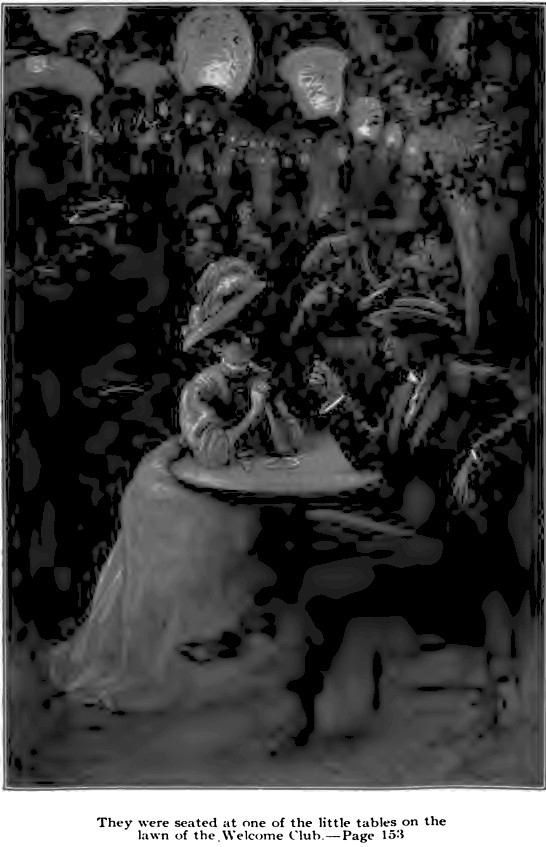
Only a few evenings before, while they were seated at one of the little tables on the lawn of the Welcome Club at the Earl’s Court Exhibition, of which he was a member, he had again referred to Maud, and asked her, in the interests of his inquiry, to give him some idea of what she had stated on that night when they last met.
“I really cannot tell you, Max,” was her reply, as she lifted her eyes to his in the dim light shed by the coloured lamps with which the place was illuminated. “Have I not already told you of the promise I gave her? You surely do not wish me to break it! Would it be fair, or just? I’m sure you, who are always loyal to a woman, would never wish me to mention what she told me.”
“Of course. If it is anything against her reputation—her honour—then it is certainly best left unsaid,” he replied quickly. “Only—well, I—I thought, perhaps, it might give us a clue to the motive of their unaccountable flight.”
“Perhaps it might,” she admitted; “and yet I cannot tell you.”
“Does Charlie know? Would he tell me, do you think?”
“I don’t think Charlie knows. At any rate, she would not tell him. If he does know, it must be through some other source.”
“And you anticipate that what Maud told you had some connection with their sudden disappearance?” he asked, looking steadfastly into the face of the woman he dearly loved.
“I’ve already told you so.”
“But when you parted from her that night, did you believe that you would not meet her again?”
She was silent, looking straight before her at the crowd of idlers circulating around the illuminated bandstand and enjoying the music and the cool air after the stifling London day.
At last she spoke, saying in a low, rather strained voice:
“I can hardly answer that question. Had I suspected anything unusual I think I should have mentioned my apprehension to you.”
“Yes, I feel sure you would have done, dearest,” he declared. “I quite see the difficulty of your present position. And you understand, I’m quite sure, how anxious I feel regarding the safety of the doctor, who was such a dear friend of mine.”
“But why are you so anxious, Max?” she asked.
“Because if—well, if there had not been foul play, I should have heard from the doctor before this!” he said seriously.
“Foul play?” she gasped, starting forward. “Do you suspect some—some tragedy, then?”
“Yes, Marion,” was his low, earnest reply. “I do.”
“But why?” she queried. “Remember that the doctor was a diplomat and statesman. In Servia politics are very complex, as they are, I’m told, in every young nation. Our own English history was a strange and exciting one when we were the present age of Servia. The people killed King Alexander, it is true; but did we not kill King Charles?”
“Then you think that some political undercurrent is responsible for this disappearance?” he suggested.
“That has more than once crossed my mind.”
“Yet would he not have sent word to me in secret?”
“No. He might fear spies. You yourself have told me how secret agents swarm in the Balkan countries, and that espionage is as bad there as in Russia.”
“But we are in London—not in Servia.”
“There are surely secret agents of the Servian Opposition party here in London!” she said. “You were telling me something about them once—some facts which the doctor had revealed to you.”
“Yes, I remember,” he remarked thoughtfully, feeling that in her argument there was much truth. “Yet I have a kind of intuition of the occurrence of some tragedy, Marion,” he added, recollecting how her brother had stolen in secret from that denuded house.
“Well, I think, dear, that your fears are quite groundless,” she declared. “I know how the affair is worrying you, and how much you respected the dear old doctor. But, if I were you, I would wait in patience. He will surely send you word some day from some remote corner of the earth. Suppose he had sailed for India, South America, or South Africa, for instance? There would have been no time for him to write to you from his hiding-place.”
“Then he is in hiding—eh?” asked Max, eager to seize on any word of, hers that might afford a clue to the strange statement of Maud.
“He may be.”
“Is that your opinion?”
“I suspect as much.”
“Then you do not believe there has been a tragedy?”
“I believe only in what I know,” replied the girl with wisdom.
“And you know there has not been a tragedy?”
“Ah! no. There you are quite mistaken. I have no knowledge whatsoever.”
“Only surmise?”
“Only surmise.”
“Based upon what Maud told you—eh?” he asked at last, bringing the conversation to the point.
“What Maud told me has nothing whatever to do with my surmise,” was her quick reply. “It is a surmise, pure and simple.”
“And you have no foundation of fact for it?”
“None, dear.”
Max was disappointed. He sat smoking, staring straight before him. At the tables around, beneath the trees, well-dressed people were chatting and laughing in the dim light, while the military band opposite played the newest waltz. But he heard it not. He was only thinking of how he could clear up the mystery of the strange disappearance of his dearest friend. He glanced at the soft face of the sweet girl at his side, that was so full of affection and yet so sphinx-like.
She would tell him nothing. Again and again she had refused to betray the confidence of her friend.
For the thousandth time he reflected upon that curious and startling incident which he had seen with his own eyes in Cromwell Road, and of the inexplicable discovery he had made. He had not met Rolfe. That he should keep away from him was, in itself, suspicious. Without a doubt he knew the truth.
Max wondered whether Charlie had told his sister anything—whether he had told her the truth, and the reason of her determination not to speak was not to incriminate him. He knew in what strong affection she held her brother—how she always tried to shield his faults and magnify his virtues. Yet was it not only what might be very naturally supposed that she would do? Charlie was always very good to her. To him, she owed practically everything.
And so he pondered, smoking in silence while the band played and the after-dinner idlers gossiped and flirted on that dimly-lit lawn. He pondered when later on he took her to Oxford Street by the “tube,” and saw her to the corner of the street in which Cunnington’s barracks were situated, and he pondered as he drove along Piccadilly to the Traveller’s to have a final drink before going home.
Next morning, about eleven, he was in his pleasant bachelor sitting-room in Dover Street going over some accounts from his factor up in Scotland, when the door opened and Charlie Rolfe entered, exclaiming in his usual hearty way:
“Hulloa, Max, old chap, how are you?”
Barclay looked up in utter surprise. The visit was entirely unexpected, and so intimate a friend was Rolfe that he always entered unannounced.
In a moment, however, he recovered himself.
“Why, Charlie,” he exclaimed, motioning him to a low easy-chair on the other side of the fireplace, “you’re quite a stranger. Where have you been all this long time?”
“Oh! I thought you knew through Marion. I’ve been up in Glasgow. Had a lot of worries at the works—labour trouble and all that sort of thing,” he replied. “Those Scotch workmen are utterly incorrigible, but I must say that it’s due to agitators from our side of the border.”
“Yes; I saw something in the papers the other day about an impending strike. Have a cigar?” and he pushed the box towards his friend.
“There would have been a strike if the old man hadn’t put his foot down. The men held a meeting and reconsidered their position. It’s well for them they did, otherwise I had orders to close down the whole works for six months—or for a year, if need be.”
“But you’d have lost very heavily, wouldn’t you?”
“Lost? I should rather think so. We should have had to pay damages for breach of contract with the Italian railways to the tune of a nice round sum. But what does it matter to the guv’nor. When he takes a stand against what he calls the tyranny of labour he doesn’t count the cost.”
“Well,” sighed Max, looking across at Marion’s brother, “it’s rather nice to be in such a position, and yet—”
“And yet it isn’t all honey to be in his shoes—eh? No, Max, it isn’t,” he said. “I know more about old Sam than most men, and I tell you I’d rather be as I am than stifled by wealth as he is. He’s a millionaire in gold, but a pauper in happiness.”
“I can’t help thinking that his unhappiness must, in a great measure, be due to himself,” Max remarked, wondering why Charlie had visited him after this length of time. “I think if I had his money I should try and get some little enjoyment out of it. Other wealthy men have yachts, or motor cars, or other hobbies. Why doesn’t he?”
“Because he doesn’t care for sport. He told me once that in his younger days abroad he was as keen a sportsman as anybody. But now-a-days he’s too old for it, and prefers his armchair.”
“And yet he isn’t a very old man, is he?”
“Sometimes wealth rejuvenates a man, but more often the worry of it ages him prematurely,” Rolfe remarked. “I only got back from Glasgow again last night, and I thought I’d look in and see you. Seen Marion lately?”
“I was with her at Earl’s Court last night. She’s all right.”
Then a silence fell between the pair. Rolfe lit the cigar he had been slowly twisting between his fingers. Max looked furtively into his friend’s face, trying to read what secret thought lay behind. Charlie, however, preserved his usual easy, nonchalant air as he leaned back in his chair, his weed between his teeth and his hands clasped behind his head.
“Look here, Charlie,” Max exclaimed at last, in a tone of confidence. “I want to ask you something.”
The other started visibly, and his cheeks went just a trifle paler.
“Well, go on, old chap.” He laughed uneasily. “What is it?” And then he held his breath.
“It’s about old Statham.”
“About old Statham!” the other echoed, breathing freely again.
“Yes. Do you know that there are going about London a lot of queer stories regarding that house of his in Park Lane—I mean a lot more stories.”
“More stories!” laughed the private secretary. “Well, what are people saying now?”
“Oh, all sorts of weird and ridiculous thing.”
“What is one of them? I’m interested, for they never tell me anything.”
“Because they know you to be connected with the place,” Max remarked. “Well, just now there are about a dozen different tales going the rounds, and all sorts of hints against the old man.”
“Set about by those with whom he has refused to associate—eh?”
“Probably concocted by spiteful gossips, I should think. Some of them bear upon the face of them their own refutation. For instance, I’ve heard that the reason lights are seen upstairs is because there’s a mysterious Mrs Statham and her family living there in secret. Nobody has seen them, and they never go out.”
“Oh! And what reason is given for that?”
“Because they say she’s a Turkish woman, and that he still keeps her secluded as she has been ever since a child. The story goes that she’s a very beautiful woman, daughter of one of the most powerful Pashas in Constantinople, who escaped from her mother’s harem and got away over the frontier into Bulgaria, where Statham joined her, and they were married in Paris.”
Rolfe laughed aloud. The idea of old Sam being an actor in such a love-romance was distinctly amusing.
“They call him Statham Pasha, I suppose! Well, really, it is the very latest, just as though there may not be lights upstairs when the old man goes to bed.”
“Of course,” said Max. “But the fact that the old man refuses to allow anybody in the house has given rise to all these stories. You really ought to tell him.”
“What shall I tell him? Is there any other gossip?”
“Yes,” replied Max, looking the secretary straight in the face in suspicion that he knew more about the mysteries of that house than he really did. “There’s another strange story, which I heard two or three days ago, to the effect that one night recently a person was seen to go there secretly, being admitted at once. Then, after the lapse of an hour or so, old Levi came forth, signalled to a four-wheeled cab which was apparently loitering about on the chance of a fare. Then from out of the house was carried a long, heavy box, which was placed on the cab and driven away to an unknown destination.”
“A box!” gasped Rolfe in surprise, bending quickly across to the speaker. “What do you mean—what do you suggest?”
“Well the natural suggestion is that the body of the midnight visitor was within that box?”
Charlie Rolfe did not reply. He sat staring open-mouthed, as though Max’s story had supplied the missing link in a chain of suspicions which had for a long time existed in his mind—as though he now knew the terrible and astounding truth.
Chapter Twenty Four.
Truth or Untruth.
The two men exchanged glances, each suspicious of the other.
Max tried to imagine the motive of his friend’s visit, while Rolfe, on his part, was undecided as to the extent of the other’s knowledge. To come there and boldly face Max had cost him a good many qualms. At one moment he felt certain that Max suspected, but at the next he laughed at his own fears, and declared himself to be a chicken-hearted fool. And so days had gone on until, unable to stand it further, he had at last resolved to call at Dover Street.
“You’re quite a stranger, Charlie,” Max remarked at last. “I haven’t seen you since the doctor disappeared so mysteriously.”
He watched Rolfe’s face as he spoke, yet save a very slight flush upon the cheeks he was in no way perturbed.
“Well, I’ve been away nearly the whole time,” was the other’s reply. “The whole affair is most curious.”
“And haven’t you seen Maud since?”
He hesitated slightly, and in that hesitation Max detected falsehood.
“No,” was his reply.
“What? And haven’t you endeavoured to find out her whereabouts?” cried Max, staring at him. “If Marion had disappeared, I think I should have left no stone unturned in order to discover the truth.”
“I have tried to solve the mystery, and failed,” was his rather lame response.
“But where are they—where can they be? It’s most extraordinary that the doctor should not send me word in confidence of their secret hiding-place. I was his most intimate friend.”
“Well,” he said. “The fact is that until this moment I believed you were well aware of their whereabouts, but could not, in face of your friendship, betray them.”
Max looked him straight in the face. Was he lying?
Such a statement was, indeed, ingenious, to say the least. Yet how, recollecting that he had left the empty house in secret, could he believe that Max knew the truth and was concealing it? Was it really possible that he was in ignorance? Barclay thought. Had he gone to Cromwell Road expecting to find the doctor at home, just as he had done? If he had, then why had he crept out of the place and made his escape so hurriedly?
Again, he recollected the result of the search in company with the man from Harmer’s, and the finding of the open safe. Somebody had been there after his visit; somebody who had robbed the safe! That person must have been aware of the departure of the doctor. Who was it if not the man seated there before him?
“Well, Rolfe,” Max remarked at last. “You’re quite mistaken. I haven’t the slightest notion of where they are. I’ve done my best to try and discover some clue to the direction of their flight, but all in vain. The more I have probed the affair, the more extraordinary and more mystifying has it become.”
“What have you discovered?” asked Charlie quickly.
“Several strange things. First, I have found that the furniture was removed in vans painted with the name of Harmer’s Stores, but they were not Harmer’s vans. The household goods were spirited away that night, nobody knows whither.”
“And with them the Doctor and Maud.”
“Exactly. But—well, tell me the truth, Charlie. Have you had no message of whatever sort from Maud?”
“None,” he replied, his face full of pale anxiety.
“But, my dear fellow she loved you, did she not? It was impossible for her to conceal it.”
“Yes, I know. That’s why I can’t make it out at all. I sometimes think that—”
“That what?”
“Well, that there’s been foul play, Max,” he said hoarsely. “You know what the people of those Balkan countries are—so many political conspirators in every walk of life. And the doctor was such a prominent politician in Servia.”
Was he telling an untruth? If so, he was a marvellous actor.
“Then you declare that you have received no word from either Maud or the Doctor.”
“I have heard nothing from them.”
“But, Charlie,” he said slowly, “has it not struck you that Marion knows something—that if she liked she could furnish us with a clue to the solution of the mysterious affair?”
“Yes,” he said, his face brightening at once. “How curious! That thought struck me also. She knows something, evidently, but refuses to say a word.”
“Because she is Maud’s most intimate friend.”
“Yet she ought, merely to set my mind at rest. She knows how fondly I love Maud.”
“What has she told you?”
“She’s merely urged me to be patient. That’s all very well, because I feel sure that if Maud were allowed to do so she would write to me.”
“Her father may prevent her. He does not write to me, remember,” said Max.
“I can’t understand Marion; she is so very mysterious over it all. Each time I’ve seen her I’ve tried to get the truth from her, but all in vain,” Rolfe declared. “My own idea is that on the night in question, when they went together to Queen’s Hall, Maud told Marion something—something that is a secret.”
Max pondered. His friend’s explanation tallied exactly with his own theories; but the point still remained whether or not there had been foul play.
“But why doesn’t the Doctor send me word of his own safety?” asked Barclay. “I was with him only a few hours before, smoking and chatting. He surely knew then of his impending flight. It had all been most ingeniously and cleverly arranged.”
“No doubt. When I knew of it I was absolutely staggered,” Rolfe said.
It was curious, thought his friend, that he did not admit visiting the house after the furniture had been removed.
“I thought you left at nine that night to go to Belgrade. Marion told me you had gone,” Max remarked.
“Yes. I had intended to go, but I unfortunately missed my train. The next day the old gentleman sent somebody else, as he wanted me at home to look after affairs up in Glasgow.”
“And how did you first know of Maud’s disappearance?” asked Max, thinking to upset his calm demeanour.
“I called at the house,” he replied, vouchsafing no further fact.
“And after that?” Max inquired, recollecting that tell-tale stain upon the woman’s bodice.
“I made inquiries in a number of likely quarters, without result.”
“And what’s your theory?” Max asked, looking him straight in the face, now undecided whether he was lying or not.
“Theory? Well, my dear fellow, I haven’t any. I’d like to hear yours. The doctor and his daughter have suddenly disappeared, as though the earth has swallowed them, and they’ve not left the least trace behind. What do you believe the real truth to be?”
“At present I’m unable to form any actual theory,” his friend replied. “There has either been foul play, or else they are in hiding because of some act of political vengeance which they fear. That not a word has come from either tends to support the theory of foul play. Yet if there has been a secret tragedy, why should the furniture have been made to disappear as well as themselves?” Then, after a pause, he fixed his eyes suspiciously upon Charlie, and added, “I wonder if the Doctor kept any valuables or securities that thieves might covet in his house?”
Rolfe shrugged his shoulders. Mention of that point in no way disturbed him.
“I have never heard Maud speak of her father having any valuable possessions there,” he said simply.
“But he may have done so, and a theft may have been committed!”
“Of course. But the whole affair from beginning to end is most puzzling. I wonder the papers didn’t get hold of it. They could have concocted lots of theories if it had become known.”
“And now, at this lapse of time, the Press could not mention it for fear of libel. They’ll think that the Doctor had done a moonlight flit, instead of paying his rent.”
“It certainly looks like that,” remarked Max with a laugh. “But I only wish we could induce Marion to tell us all she knows.”
Charlie sighed.
“Yes,” he said. “I only wish she would say something. But she refuses absolutely, and so we’re left entirely in the dark.”
“Well, all I can say is, that the Doctor would never wilfully leave me in ignorance of his whereabouts, especially at this moment. We have certain business matters together involving a probable gain of a good round sum. Therefore, it was surely to his interest to keep me in touch with him!” Max declared.
The man before him was silent.
Was it possible that he had misjudged him? Was he lying; or had he really gone to Cromwell Road in search of the Doctor and found the house untenanted and empty?
“It is a complete mystery,” was all that Rolfe could say.
“Do you know, Charlie, a curious thought struck me the other day, and I mention it to you in all confidence. It may be absurd—but—well, somehow I can’t get it out of my head.”
“And what is it?” asked his friend with an eagerness just a little unusual.
Max paused. Should he speak? Or should he preserve silence? The mystery now held him bewildered. What had become of the dear old Doctor and the pretty girl with the tiny wisp of hair straying across her white brow? Yes. He would speak the vague impression that had, of late, been uppermost in his mind.
“Well,” he said, “old Statham has financial interests in Servia, has he not?”
“Certainly. Quite a number. He floated their loan a few years ago.”
“And has it not struck you then that he and the Doctor might be acquainted?”
“They were strangers,” he exclaimed quickly, darting a strange look across at Barclay.
Max was somewhat surprised at the vehement and decisive nature of Charlie’s declaration.
“And Maud never met the old fellow?”
“Never—to my knowledge.”
“Statham has a number of friends and acquaintances whom you do not know. The Doctor may have been one of them.”
“Oh, Sam has very few secrets from me. I am his confidential secretary,” was the other’s rather cold response.
“I know—I know. But would it not be to Statham’s interest to be on friendly terms with such a powerful factor in the Servian political world as Dr Petrovitch?”
“Well, it might. But you know how independent he is. He never goes into society, and has no personal friends. He’s utterly alone in the world—the loneliest man in London.”
“Then let us go a trifle further,” said Max at last. “Answer me one question. Is it or is it not, a fact that you were at the house in Cromwell Road on the night of—of their disappearance?”
Rolfe’s countenance changed in an instant. His lips went white.
“Why?” he faltered—“what do you mean to imply?—why—?”
“Because, Rolfe,” the other said in a hard, determined voice, “because I saw you there—saw you with my own eyes!”
Chapter Twenty Five.
Two Men and a Woman.
The face of Charlie Rolfe went pale as death.
He was in doubt, and uncertain as to how much, or how little, was known by this man who loved his sister.
“I saw you there, Rolfe, with my own eyes,” repeated Max, looking straight into his face.
He tried to speak. What could he say? For an instant his tongue clave to the roof of his mouth.
“I—I don’t quite understand you,” he faltered. “What do you mean?”
“Simply that I saw you at the Doctor’s house on the night of their disappearance.”
“My dear fellow,” he laughed, in a moment, perfectly cool, “you must have been mistaken. You actually say you saw me?”
“Most certainly I did,” declared Max, his eyes still upon his friend.
“Then all I can say is that you saw somebody who resembled me. Tell me exactly what you did see.”
Max was for a moment silent. He never expected that Rolfe would flatly deny his presence there. This very fact had increased his suspicions a hundredfold.
“Well, the only person I saw, Charlie, was you yourself—leaving the house. That’s all.”
“Somebody who closely resembled me, I expect.”
“Then you deny having been at the house that evening?” asked Max in great surprise.
“Why, of course I do. You’re absolutely mistaken, old chap,” was Charlie’s response. “Of course, I can quite see how this must have puzzled you. But what now arises in my mind is whether someone has not endeavoured to personate me. It seems very much as though they have. You say that I left the house. When?”
“After the removal. You were in the empty house, which you left secretly.”
“And you were there also, then?” he asked.
“Of course. I called, ignorant that they had left.” Charlie Rolfe did not speak for several moments.
“Well,” he exclaimed at last, “it seems that somebody has been impersonating me. I certainly was not there.”
“Why should they impersonate you?”
“Who knows? Is there not mystery in the whole affair?”
“But if somebody went there dressed to resemble you, there must have been a motive in their visit,” Max said.
“Well, old fellow, as you know, I have kept away from the house of late—at Maud’s request. She feared that her father did not approve of my too frequent visits.”
“And so you met her at dusk in the quiet streets about Nevern Square and the adjacent thoroughfares?”
“Certainly. I told you so. I made no secret of it to you. Why should I?”
“Then why make a secret about your visit to the house on that particular evening?”
“I don’t make any secret of it,” he protested. “As I’ve already told you, I was not there.”
“But you didn’t leave Charing Cross, as you made people believe you had done. You didn’t even go to the station,” returned Max.
“Certainly I did not.”
“You had no intention, when you saw Marion at Cunnington’s, of leaving at all. Come, admit that.”
“You are quite right. I did not intend to leave London.”
“But Statham had given you orders to go.”
“I do not always obey his orders when it is to his own interest that I should disregard them,” he replied enigmatically.
“Then you had a reason for not going to Servia?”
“I had—a very strong one.”
“Connected with Maud Petrovitch?”
“In no way whatever. It was a purely personal motive.”
“And you thought fit to disregard Statham’s injunctions in order to attend to your own private business!”
“It was his business, as well as mine,” declared Charlie, who, after a pause, asked: “Now tell me, Max, why are you cross-examining me like a criminal lawyer? What do you suspect me of?”
“Well—shall I be frank?”
“Certainly. We are old enough friends for that.”
“Then I’m sorry to say, Charlie, that I suspect you of telling a lie.”
“Lies are permissible in certain cases—for instance, where a woman’s honour is at stake,” he replied, fixing his eyes steadily upon those of his friend.
“Then you admit that what you have just told me is not the truth?”
“I admit nothing. I only repeat that I was not in Cromwell Road on the evening in question.”
“But my eyes don’t deceive me, man! I saw your face, remember.”
“If it was actually my face, it was not in Cromwell Road. That’s quite certain?” laughed old Statham’s secretary. “But it was your face.”
“It was, I repeat, somebody who resembled me,” he declared. “But you haven’t told me what the person was doing in the empty house.”
“That’s just what I don’t know,” Barclay replied. “I only know this: When I entered that night I saw nothing of a safe let into the wall. But on going there the next day the safe stood revealed, the door was open, and it was empty.”
“And so you charge me with being a thief!” cried Rolfe, his cheek flushing.
“Not at all. You asked me for the truth, and I’ve told you.”
“Well, it’s evident that you suspect me of sneaking into the house, breaking open the Doctor’s safe, and taking the contents,” he said plainly, annoyed.
“The Doctor may have returned himself in secret,” Max replied. “But such could hardly be the case, for the door had been blown open by explosives.”
“That would have created a noise,” Charlie remarked quickly. “Shows that whoever did it was a blunderer.”
“Exactly. That’s just my opinion. What I want to establish is the motive for the secret visit, and who made it.”
“Well, I can assure you that I’m in entire ignorance of the existence of any safe in the Doctor’s house.”
“And so was I. It was concealed by the furniture until my second visit, on the following morning.”
“Curious,” Rolfe said. “Very curious indeed. The whole thing is most remarkable—especially how both father and daughter got away without leaving the least trace of their flight.”
“Then you don’t anticipate foul play?” Max asked quickly.
“Why should one?”
“The Doctor had a good many political enemies.”
“We all have enemies. Who has not? But they don’t come and murder one and take away one’s household goods.”
“Then I am to take it that it was not you I saw at Cromwell Road, Charlie?” asked his friend in deep earnestness, at the same time filled with suspicion. He felt that his eyes could not deceive him.
“In all seriousness,” was the other’s reply. “I was not there. This personation of myself shows that there was some very clever and deeply-laid scheme.”
“But you’ve just declared that a falsehood was permissible where a woman’s honour was concerned?”
“Well, and will not every man with a sense of honour towards a woman hold the same opinion? You yourself, Max, for instance, are not the man to give a woman away?”
“I know! I know—only—”
“Only what? Surely you do not disagree with me!”
“In a sense I don’t, but I’m anxious to clear up this matter as far as you yourself are concerned.”
Rolfe saw that he had shaken his friend’s fixed belief that he had seen him in Cromwell Road. Max was now debating in his mind whether he had not suspected Charlie unjustly. It is so easy to suspect, and so difficult to satisfy one’s self of the actual truth. The mind is, alas! too apt to receive ill-formed impressions contrary to fact.
“It is already cleared up,” Rolfe answered without hesitation. “I was not there. You were entirely mistaken. Besides, my dear chap, why should I go there when I had been particularly asked by Maud not to visit the house?”
“When did she ask you?”
“Only the night before. That very fact is, in itself, curious. She urged me that whatever might occur, I was not to go to the house.”
“Then she anticipated something—eh?”
“It seems as though she did.”
“And she told Marion something on the night when she and her father disappeared.”
“I know.”
“You know what she told her?”
“No. Marion refuses to tell me, I wish I could induce her to speak. Marion knows the truth—that’s my firm belief.”
“And mine also.”
“The two girls have some secret in common,” Rolfe said. “Can’t you get Marion to tell you?”
“She refuses. I’ve asked her half a dozen times already.”
“I wonder why! There must be some reason.”
“Of course there is. She is loyal to her friend. But tell me honestly, Charlie. Do you know the Doctor’s whereabouts?”
“I tell you honestly that I haven’t the slightest idea. The affair is just as great a mystery to me as to you.”
“But why have you kept away from me till to-day?” Barclay asked. “It isn’t like you.”
“Well,” answered Rolfe, with a slight hesitation, “to tell you the truth, because I thought your manner had rather changed towards me of late.”
“Why, my dear fellow, I’m sure it never has.”
“But you suspected me of being in that house on the night of the disappearance!”
“Of course, because I saw you.”
“Because you thought you saw me,” Charlie said, correcting him. “You surely would not misjudge me for that.”
“No. But your theory regarding falsehoods has, I must admit, caused some suspicion in my mind.”
“Of what?”
“Well, of prevaricating in order to shield a woman—Maud it may be.”
“I am not shielding her!” he declared. “There is nothing to shield. I love her very dearly indeed, and she loves me devotedly in return. Cannot you imagine, Max, my perturbed state of mind now that she has disappeared without a word?”
“Has she sent you no secret message of her safety?” Max asked, seriously.
“Not a word.”
“And you do not know, then, if she has not met with foul play?”
“I don’t. That’s just it! Sometimes—” And he rose from his chair and paced the room in agony of mind. “Sometimes—I—I feel as if I shall go mad. I love her—just as you love Marion! Sometimes I feel assured of her safety—that she and her father have been compelled to disappear for political or other reasons—and then at others a horrible idea haunts me that my love may be dead—the victim of some vile, treacherous plot to take from me all that has made my life worth living!”
“Stop!” cried Max, starting to his feet and facing him. “You love her—eh?”
“Better—ah! better than my own life!” he cried in deep earnestness, his troubled face being an index of his mind.
“Then—then upon her honour—the honour of the woman you love—swear to me that you have spoken the truth!”
He looked into his friend’s eyes for a moment. Then he answered:
“I swear, Max! I swear by my love for Maud that I have spoken the truth!”
And Barclay stood silent—so puzzled as to be unable to utter a word.
Chapter Twenty Six.
Which Puts a Serious Question.
At last Max spoke, slowly and with great deliberation.
“And you declare yourself as ignorant as I am myself of their whereabouts?”
“I do,” was Rolfe’s response. Then after a second’s hesitation he added in a changed voice: “I really think, Max, that you are scarcely treating me fairly in this matter. Sorely it is in my interests to discover the whereabouts of Maud! I have done my best.”
“Well?”
“And I’ve failed to discover any clue whatever—except one—that—”
And he broke off, without finishing his sentence.
“What have you discovered? Tell me. Be frank with me.”
“I’ve not yet established whether it is a real clue, or whether a mere false surmise. When I have, I will tell you.”
“But cannot we join forces in endeavouring to solve the problem?” Max suggested, his suspicion of his friend now removed.
“That is exactly what I would wish. But how shall we begin? Where shall we commence?” asked Rolfe.
“The truth that it was not you whom I saw leaving the house in Cromwell Road adds fresh mystery to the already astounding circumstance,” Max declared. “The man who so closely resembled you was purposely made up to be mistaken for you. There was some strong motive for this. What do you suggest it could be?”
“To implicate me! But in what?”
The thought of that blood-stained bodice ever haunted Max. It was on the tip of his tongue to reveal his discovery to his friend, yet on second thoughts he resolved to at present retain his secret. He had withheld it from the police, therefore he was perfectly justified in withholding it from Charlie.
The flat denial of the latter regarding his visit to Cromwell Road caused him deep reflection. He watched his friend’s attitude, and was compelled to admit within himself that now, at any rate, he was speaking the truth.
“The only reason for the visit of the man whom I must have mistaken for yourself, Charlie,” he said, “must have been to open that safe.”
“Probably so.”
Then Max explained, in detail, the position of the safe, and how he had discovered it being open, and its contents abstracted.
“On your first visit, then, the safe was hidden?”
“Yes. But when I went in the morning it stood revealed, the door blown open by some explosive.”
“By an enemy of the Doctor’s,” remarked Charlie.
Max did not reply. The Doctor’s words regarding his friend on the last occasion they had sat together recurred to him at that moment with a queer significance. The Doctor certainly did not like Rolfe. For what reason? he wondered. Why had he taken such a sudden dislike to him?
Hitherto, they had been quite friendly, ever since the well-remembered meeting at the Villa des Fleurs, in Aix-les-Bains, and the Doctor had never, to his knowledge, objected to Maud’s association with the smart young fellow whose keen business instincts had commended him to such a man as old Sam Statham. The Doctor held no doubt, either secret knowledge of something detrimental to Rolfe, or else entertained one of those sudden and unaccountable prejudices which some men form, and which they are unable to put behind them.
“The one main point we have first to decide, Charlie,” he said at last, standing at the window and gazing thoughtfully down into the narrow London street, “is whether or not then has been foul play.”
Rolfe made no reply, a circumstance which caused him to turn and look straight into his friend’s face. He saw a change there.
His countenance was blanched; but whether by fear of the loss of the woman he loved, or by a guilty knowledge, Max knew not.
“Marion can tell us,” he answered at last. “But she refuses.”
“You, her brother, can surely obtain the truth from her?”
“Not when you, her lover, fail,” Charlie responded, his brows knit deeply.
“But a moment ago you said you had a clue?”
“I think I have one. It is only a surmise.”
“And in what direction does it trend?”
“Towards foul play,” he said hoarsely.
“Political?”
“It may be.”
“And were both victims of the plot?”
“I cannot tell. At present I’m making all the secret inquiries possible—far afield in a Continental city. It takes time, care, and patience. As soon as I obtain anything tangible, I will tell you. But first of all, Max,” he added, “I wish to have your assurance that you no longer suspect me. I am not your enemy—why should you be mine?”
“I am not, my dear fellow,” declared Barclay. “How can I be the enemy of Marion’s brother? I was only suspicious. You would have been the same in similar circumstances, I’m sure.”
“Probably,” laughed Charlie. “Yet what you’ve told me about the endeavour to implicate myself in the affair is certainly extraordinary. I don’t see any motive.”
“Except that you were known by the conspirators, whoever they are, to be Maud’s lover.”
“If so, then they intend, most probably, to bring some false charge against me. And—and—”
“And what?” asked Max in some surprise.
“Why, don’t you see?” he said hoarsely, staring straight into his friend’s face with a horrified expression as a terrible truth arose within him. “Don’t you see that you yourself, Max, would become the principal witness against me!”
Max stood wondering at the other’s sudden anticipation of disaster. What could he dread if this denial of his was the actual truth?
Again he grew suspicious.
“How can I be witness against you if you are innocent of any connection with the affair?” he queried.
“Because the Doctor’s enemies have done this, in order to shield themselves.”
“But if the Doctor is really still alive, what have you to fear?”
“Is he alive? That is the point.”
“Marion gives me to understand that both he and Maud are safe,” Max responded quickly.
The other shook his head dubiously, saying: “If she has told you that, then it is exactly contrary to what she has given me to understand.”
“What? She has expressed a suspicion of foul play?”
“Yes—more than a suspicion.”
“Well—this is certainly strange,” Max declared. “Marion has all along been trying to allay my fears.”
“Because she feared to upset you, perhaps. With me it is different. She does not mind my feelings.”
“I’m sure she does, Charlie. She’s devoted to you. And she ought to be. Few brothers would do what you have done.”
“That’s quite outside the question,” he said, quickly pacing anxiously up and down the room. “She told me distinctly the other day that her fears were of the worst.”
“Ah! if you could only induce her to tell us what Maud confessed to her. It was a confession—a serious and tragic one, I believe.”
“Yes. It was, no doubt; and if she would only speak we could, I believe, quickly get at the truth,” Rolfe said. “To me it seems incredible that the Doctor, your most intimate friend, should not have found some secret manner by which to communicate with you, and assure you of his safety.”
There was a pause. Suddenly Max turned to the speaker and exclaimed—
“Tell me, Charlie. Be perfectly frank with me. Have you, do you think, at any time recently given some cause for offence to the Doctor?”
“Why do you ask that?” inquired the other in quick surprise.
“I have reasons for asking. I’ll tell you after you’ve answered my question.”
“I don’t know,” he laughed uneasily. “Some men, and especially foreigners, are very easily offended.”
“But have you offended the Doctor?”
“Perhaps. A man never knows when he gives unintentional offence.”
“Are you aware of having done anything to offend him?”
“No, except that Maud asked me not to visit there so often, as her father did not approve of it.”
“Did she ever tell you that the Doctor had suddenly entertained a dislike of you?”
“Certainly not. I always believed that he was very friendly disposed towards me. But—well—why do you ask all this?”
“I merely ask for information.”
“Of course, but you promised to tell me the reason.”
“Well, the fact is this. On the afternoon prior to their disappearance, the Doctor expressed feelings towards you that were not exactly friendly. It seemed to me that he had formed some extraordinary prejudice. Fathers do this often towards the men who love their daughters, you know. They are sometimes apt to be over-cautious, with the result that the girl loses a very good chance of marriage,” he added. “I’ve known several similar cases.”
“Well,” said Charlie thoughtfully, “that’s quite new to me. I had flattered myself that the Doctor was very well disposed towards me. This is quite a revelation?”
“Didn’t Maud ever tell you?”
“Not a word.”
“She feared, of course, to hurt your feelings. It was quite natural. She loves you.”
“If what we fear be true, you should put your words into the past tense, Max,” was his reply in a hard voice. Barclay knew that his friend loved the sweet-faced girl with the stray, unruly wisp of hair which fell always across her white brow and gave her such a piquante appearance. And if he loved her so well, was it possible that he could have been author of, or implicated, in a foul and secret crime?
Recollection of that dress-bodice with the ugly stain still wet upon it flashed upon him. Was it not in itself circumstantial evidence that some terrible crime had been committed?
The man before him denied all knowledge of the disappearance of his well-beloved, and yet Max, with his own eyes, had seen him slinking from the house!
Had he spoken the truth, or was he an ingenious liar?
Such was the problem which Max Barclay put to himself—a question which was the whole crux of the extraordinary situation. If what Rolfe had declared was the truth, then the mystery became an enigma beyond solution.
But if, on the other hand, he was now endeavouring to shield himself from the shadow of guilt upon him, then at least one fact was rendered more hideous than the rest.
The question was one—and only one.
Had this man, brother of his own dear Marion, sworn falsely upon what he had held to be most sacred—his love for Maud?
What was the real and actual truth?
Chapter Twenty Seven.
In the Web.
It was four o’clock on the following afternoon, dark and threatening outside, precursory of a thunderstorm.
In that chair in Max’s room, where Charlie Rolfe had sat on the previous morning, was the polished cosmopolitan, Jean Adam, lazily lolling back, smoking a cigarette.
Max had lunched over at White’s, and just come in to find Adam awaiting him. The Frenchman had risen and greeted him merrily, took the proffered Russian cigarette, and they; had settled themselves to chat.
“I’ve been expecting every day to hear from you,” Adam exclaimed at last. “When do you propose starting for Constantinople?”
“Well, I’ve been thinking over the matter, and I’ve come to the conclusion that just at present it is impossible for me to leave London. I have other interests here.”
Adam stirred uneasily in his chair. This reply filled him with chagrin, yet so clever was he, and such a perfect type of ingenious adventurer, that he never showed the least trace of surprise.
“Really,” he laughed, “that’s very unfortunate—for you!”
“Why, for me?”
“Well, the missing of such a chance would be unfortunate, even to a Rothschild,” he said. “There’s hundreds of thousands in the deal, if you’ll only go out with me. You’re not a man of straw. You can afford to risk a thousand or two, just as well as I can—even better.”
“I would willingly go if it were not for the fact that I find I must remain in London.”
Adam laughed, with just a touch of sarcasm.
“Ah! the lady! I quite understand, my dear fellow. The charming young lady whom I met with you the other night does not wish you to leave her side—eh? We have all of us been through that stage of amorous ecstasy. I have myself, I know that; and if I may tell you with the frankness of a friend, I’ve regretted it,” he added, holding up his white palms.
“All men do not regret I hope to be the exception,” remarked Max Barclay, pensively watching the smoke from his lips rise to the ceiling.
“Of course. But is it wise to turn one’s back upon Fortune in this way?” asked Adam, in that insidious manner by which he had entrapped many a man. “Review the position calmly. Here is a project which, by good luck, has fallen into my hands. I want somebody to go shares with me in it. You are my friend, I like you. I know you are an upright man, and I ask you to become my partner in the venture. Yet you refuse to do so because—well, merely because a woman’s pretty face has attracted you, and you think that you please her by remaining here in London!
“Is it not rather foolish in your own interests? Constantinople is not the Pole. A fortnight will suffice for you to get there and back and clinch the bargain. Muhil is awaiting us. I had a wire only yesterday. Do reconsider the whole question—there’s a good fellow.”
Max had said nothing about the meeting with Marion. Therefore he believed that she had not told her lover. Adam was reflecting whether she might not, after all, be a woman to be trusted. This refusal of Max’s to go out to Turkey interfered seriously with the plans he had formed. Yet what those plans actually were he had not even told the hunchback. He was a man who took counsel of nobody. His ingenious schemes he evolved in his own brain, and carried them into effect by his own unaided efforts.
The past history of Jean Adam, alias John Adams, had been one of amazing ups-and-downs and clever chicanery. He knew that Samuel Statham held him in awe, and was now playing upon his fears, and gloating over the success which must inevitably be his whenever he thought fit to deal the blow. It would be irresistible and crushing. He held the millionaire in his power. But before he moved forward to strike, he intended that Max should be induced to go abroad. And if he went—well, when he thought of his victim’s departure his small, near-set eyes gleamed, and about the corners of his mouth there played an expression of evil.
“My decision does not require any reconsideration,” said the young fellow, after a pause. “I shall remain in London.”
“And lose the chance of a lifetime—eh?” exclaimed Adam, as though perfectly unconcerned.
“I have some very important private matters to attend to.”
“I, too, used to have when I was your age.”
“They do not concern the lady,” Max said quickly. “It is purely a personal matter.”
“Of business? Why, you’d make as much in an hour over this Railway business as you’d make in twenty years here in London,” Adam declared. “Besides, you want a change. Come out to the Bosphorus. It’s charming beside the Sweet Waters.”
“All sounds very delightful; but even though I may let the chance of a fortune slip through my fingers, I cannot leave London at present.”
“But why?”
“A purely private matter,” was his reply, for he did not wish to tell this man anything concerning the strange disappearance of the Doctor and his grave suspicions of Charlie Rolfe. “I can tell you nothing more than that.”
“Well, I’m sure the lady, if she knew that it was in your interests to go to Turkey, would urge you to go,” declared Adam. “She would never keep you here if she knew that you could pull off such a deal as I have put before you.”
“She does know.”
“Oh! And what does she say?”
“She suggested that I should go with you.”
“Then why not come?”
“Because, as I’ve already told you, it is impossible. I am kept in London by something which concerns the welfare of a very dear friend,” Max answered. “You must put it before somebody else. I suppose the affair cannot wait?”
“I don’t want to put it before anybody else. If we do business, I want you and I to share the profits.”
“Very good of you, I’m sure; but at present I am quite unable to leave London.”
Max was wondering for the first time why this man was so pressing. If the thing was a really good one—as it undoubtedly was, according to the friend he had consulted in the City—then there could not be any lack of persons ready to go into the venture. Was it sheer luck that had led this man Adam to offer to take him into it, or had the man some ulterior motive? Max Barclay was no fool. He had sown his wild oats in London, and knew the ways of men. He had met many a city shark, and had been the poorer in pocket through the meeting. But about this man Adam was something which had always fascinated him. The pair had been drawn together by some indescribable but mutual attraction, and the concession by the Sultan which must result in great profits was now within his reach. Nevertheless, he felt that in the present circumstances it was impossible to leave London. Before doing so he was desirous of solving the problem of the disappearance of Doctor Petrovitch, and clearing up the question of whether or not there had been foul play.
Rolfe’s denial of the previous day had complicated matters even further. He was convinced, now that he had reflected calmly, that his friend was concealing something from him—some fact which had an important bearing upon the astounding affair.
Was Charlie playing a straight game? After long consideration he had come again to the conclusion that he was not!
In his ear was the voice of the tempter Jean Adam. Fortune awaited him in that sunlit city of white domes and minarets beside the Bosphorus—the city of veiled women and of mystery he had always hoped to visit. Would he not spare fourteen days, travel there, and obtain it?
It was a great temptation. The concession for that railway would indeed have been a temptation to any man. Did not the late Baron Hirsch lay the foundation of his huge fortune by a similar iradé of his Majesty the Sultan?
The man seated in the deep armchair with the cigarette between his lips looked at his victim through his half-closed eyes, as a snake watches the bird he fascinates.
Jean Adam was an excellent judge of human nature. He had placed there a bait which could not fail to attract, if not to-day, then to-morrow—or the next day. He had gauged Max Barclay with a precision only given to those who live upon their wits.
To every rule there are, of course, exceptions. Every man who lives upon his wits is not altogether bad. Curious though it may be, there are many adventurers to be met with in every capital in Europe, who, though utterly unscrupulous, have in their nature one point of the most scrupulous honour—one point which redeems them from being classed as utter blackguards.
Many a man, who will stick at nothing where money can be made, is loyal, honest, and upright towards a woman; while another will with one hand swindle the wealthy, and with the other give charity to the poor. Few men, indeed, are altogether bad. Yet when they are, they are, alas! outsiders indeed.
Adam was a man who had no compunction where men were concerned, and very little when a woman stood in his way. His own adventures would have made one of the most interesting volumes ever written. Full of ingenuity and tact, fearless when it came to facing exposure, and light-hearted whenever the world smiled upon him, he was a marvellous admixture of good fellow and scoundrel.
He knew that his clever story had fascinated the man before him, and that it was only a question of time before he would fall into the net so cleverly spread.
“When do you anticipate you could go East—that is, providing I can get the matter postponed?” asked Adam at last, as he placed his cigarette end in the ash-tray.
“I can’t give you a date,” replied Max. “It is quite uncertain. Why not go to somebody else?”
“I tell you I have no desire to do so, my dear friend,” was the Frenchman’s reply. “I like you. That is why I placed the business before you. I know, of course, there are a thousand men in the City who would only jump at this chance of such a big thing.”
“Then why not go to them?” repeated Max, a little surprised and yet a little flattered.
“As I have told you, I would rather take you into partnership. We have already decided to do the thing on a sound business basis. Indeed, I went to my lawyers only yesterday and gave orders for the agreement to be drawn up between us. You’ll receive it to-night or to-morrow.”
“Well,” replied Max with some hesitation, “if it is to be done, it must be done later. At present I cannot get away. My place is in London.”
“Beside the lady to whom you are so devoted, eh?” the Frenchman laughed.
Max was irritated by the man’s veiled sarcasm.
“No. Because I have a duty to perform towards a friend, and even the temptation of a fortune shall not cause me to neglect it.”
“A friend. Whom?”
“The matter is my own affair. It has nothing to do with our business,” was Max’s rather sharp response.
“Very well,” said the other, quite unruffled. “I can only regret. I will wire to-night to Muhil Pasha, and endeavour to obtain a postponement of the agreement.”
“As you wish,” Max said, still angered at this importation of the woman he loved into the discussion. “I may as well say that it is quite immaterial.”
“To you it may be so. But I am not rich like yourself,” the other said. “I have to obtain my income where I can by honest means, and this is a chance which I do not intend to lose. I look to you—I hold you to your promise, Barclay—to assist me.”
“I do not intend to break my promise. I merely say that I cannot go out to Turkey at once.”
“But you will come—you will promise that in a few days—in a week—or when you have finished this mysterious duty to your friend, that you will come with me?” he urged. “Come, give me your hand. I don’t want to approach anybody else.”
“Well, if you really wish it,” Max replied, and he gave the tempter his hand in pledge.
When, a few seconds later, Jean Adam turned to light a fresh cigarette there was upon his thin lips a smile—a sinister smile of triumph.
Max Barclay had played dice with the Devil, and lost. He had, in his ignorance of the net spread about him, in that moment pledged his own honour.
Chapter Twenty Eight.
Old Sam has a Visitor.
It was past midnight.
At eleven o’clock old Sam Statham had descended from the mysterious upper regions, emerged from the green baize door upon the stairs, which concealed another white-enamelled door—a door of iron, and, passing down to the study, had switched on the electric light, thrown himself wearily into an armchair, and lit a cigar.
Upon his grey, drawn countenance was a serious apprehensive look, as of a man who anticipated serious trouble, and who was trying in vain to brave himself up to face it. For nearly half an hour he had smoked on alone, now and then muttering to himself, his bony fingers clenched as though anticipating revenge. The big room was so silent at that hour that a pin if dropped might have been heard. Only the clock ticked on solemnly, and striking the half-hour upon its silvery bell.
The old millionaire who, on passing through that baize-covered door, had locked the inner door so carefully after him, seemed strangely agitated. So apprehensive was he that Levi, entering some time afterwards, said in his sharp, brusque manner:
“I thought you had retired long ago. What’s the matter?”
“I have an appointment,” snapped his master; “an important one.”
“Rather late, isn’t it?” suggested the old servant. “Remember that there are spies about. That little affair the other night aroused some curiosity—I’m certain of it.”
“Among a few common passers-by. Bah! my dear Levi, they don’t know anything.”
“But they may talk! This house has already got a bad name, you know.”
“Well, that’s surely not my fault,” cried the old man with a fiery flash in his eyes. “It’s more your fault for acting so infernally suspiciously and mysteriously. I know quite well what people say of me.”
“A good deal that’s true,” declared old Levi in open defiance of the man in whose service he had been so long.
Sam Statham grinned. It was a subject which he did not wish to discuss.
“You can go to bed, Levi. I’ll open the door,” he said to the man who was his janitor.
“Who’s coming?” inquired Levi abruptly.
“A friend. I want to talk to him seriously and alone.”
“What’s his name?”
“Don’t be so infernally inquisitive, Levi. Go to bed, I tell you,” he croaked with a commanding wave of the hand.
The servant never thwarted his master’s wishes. He knew Sam Statham too well. A strange smile played about the corners of his mouth, and he looked around to see that the whisky, syphons and glasses were on the side table. Then with a rather ill-grace said:
“Very well—good-night,” and, bowing, he retired.
When the door had closed the old millionaire ground his teeth, muttering:
“You must always poke your infernal long nose into my affairs. But this matter I’ll keep to myself just for once. I’m tired of your constant interference and advice. Ah!” he sighed. “How strange life is! Samuel Statham, millionaire, they call me. I saw it in the Pall Mall to-night. Rather Sam Statham, pauper—the Pauper of Park Lane! Ah! If the public only knew! If they only knew!” he gasped, halting suddenly and staring wildly about him. “What would be my future—what will it be when my enemies, like a pack of wolves, fall upon me and tear me limb from limb? Yes, yes, they’ll do that if I am unable to save myself.
“But why need I anticipate failure? What does the sacrifice of one woman matter when it will mean the assurance of my future—my salvation from ruin?” he went on, speaking to himself in a low, hoarse voice. “It’s a thing I cannot tell Levi. He must find it out. He will—one day—when the police inquiries give him the clue,” and he snapped his own white fingers nervously and glanced at the clock in apprehension.
He threw down his cigar, for it had gone out a long time ago. Sam Statham’s life had been made up of many crises, and one of these he was passing through on that hot, breathless night after the motor-’buses had ceased their roar in Park Lane and tinkling cab-bells were few and far between.
One o’clock, the sound of the gong arousing him. He switched off the light, and, walking to the window, raised one of the slats of the Venetian blinds and peered out upon the pavement where so recently he had first recognised that man from the grave—the man Jean Adam.
He stood behind the blue brocade curtains, watching eagerly. The passers-by were few—very few. Lower-class London was mostly at Margate and Ramsgate, while “the West-End” was totally absent, in Scotland or at the sea.
He was wondering if Levi had really gone to bed. Or was he lurking there to ascertain who might be the visitor expected? Old Sam crept noiselessly to the door, and, opening it, peered out. The wide hall was now in darkness. Levi had, apparently, obeyed his orders and gone below to bed. And yet, so faithful was he to his trust that nobody could ever enter that house without him being aware of the identity of the visitor.
Sometimes old Sam would regret the brusque manner in which he treated the man who was so entirely devoted to him and who shared so many of his secrets.
But the secret of that night he did not intend Levi to share. It was his—and should be his alone. And for that person he was waiting to himself open the door to his midnight caller.
He was about to close the study door again when he fancied he heard a slight movement in the darkness of the hall. “Levi!” he exclaimed angrily. “What are you doing here when I ordered you to retire?”
“I’m doing my duty,” responded the old servant, advancing out of the shadow. “I do not wish you to go to the door alone, and at night. You do not take sufficient care of your personal safety.”
“Rubbish! I have no fear,” he answered as both stood there in the darkness.
“Yes, but, you are injudicious,” declared the old servant. “If not, you would have heeded young Rolfe’s warning, and your present dangerous position might have been avoided. Adams means mischief. You surely can’t close your eyes to that!”
“I know he does,” answered the millionaire in a voice that seemed harsh and hollow. “I know I was a fool.”
“You took a false step, and can’t retrace it. If you had consulted me I would have given you my views upon the situation.”
“Yes, Levi. You’re far too fond of expounding your view on subjects of which you have no knowledge. Your incessant chatter often annoys me,” was his master’s response. “If I have committed an error, it is my affair—not yours. So go to bed, and leave me alone.”
“I shall not,” was Levi’s open reply.
“I’m master here. I order you to go!” cried Sam Statham in an angry, commanding tone.
“And I refuse. I will not allow you to run any further risk.”
“What do you anticipate?” his master asked with sarcasm. “Are you expecting that my enemies intend to kill me in secret. If so, I can quickly disabuse your mind. It would not be to their interests if I were dead, for they could not then bleed me, as is, no doubt, their intention. I know Adams and his friends.”
“So do I,” declared Levi. “Whatever plot they have formed against you is no doubt clever and ingenious. They are not men to act until every preparation is complete.”
“Then why fear for my personal safety?” asked the millionaire. “I always have this—and I can use it,” and he drew from his pocket something which glistened in the darkness—a neat plated revolver.
“I fear, because of late you’ve acted so injudiciously.”
“Through ignorance. I believed myself to be more shrewd than I really am. You see I admit my failing to you, Levi. But only to you—to nobody else. The City believes Sam Statham to possess the keenest mind and sharpest wits of any man between Temple Bar and Aldgate. Strange, isn’t it, that each one of us earns a reputation for something in which really does not excel?”
“You excel in disbelieving everybody,” remarked Levi outspokenly. “If you believed that there was some little honesty in human nature you might have been spared the present danger.”
“You mean I’m too suspicious—eh? My experience of life has made me so,” he growled. “Of the thousand employees I possess, is there a man among them honest? And as for my friends, is there one I can trust—except Ben and yourself, of course?”
“What about Rolfe?”
Sam Statham hesitated. It was a question put too abruptly—a question not easily decided on the spur of the moment. Of course, ever since his failure to go to Belgrade, he had entertained some misgivings regarding his secretary. There was more than one point of fact which did not coincide with Rolfe’s statements. The old man was quickly suspicious, and when he scented mystery, it was always a long time before his doubts were allayed. Like every man of great wealth, he had been surrounded by sycophants, who had endeavoured to get rich at his expense. The very men he had helped to fortune had turned round afterwards and abused and libelled him. It was that which had long ago soured him against his fellow men, and aroused in his heart a disbelief in all protestation of honesty and uprightness.
Levi recognised his master’s lack of confidence in Rolfe, and it caused him to wonder. Hitherto he had been full of praise of the clever and energetic young secretary by whose smart business methods several great concerns in which he had controlling interest had been put into a flourishing condition. But now, quite of a sudden, there was a hesitancy which told too plainly of lack of confidence. Was the star of Rolfe’s prosperity on the wane?
If so, Levi felt sorry, for he was attached to the young man, whom he felt confident had the interests of his master thoroughly at heart. Old Levi was a queer fish. He had seldom taken to anybody as he had done to Mr Rolfe, who happily cracked a joke with him and asked after his rheumatics.
“Levi,” exclaimed Statham after a few moments of silence, “is it not absurd for us to chatter here, in the darkness? It’s past one. I wish you to go downstairs and leave me alone.”
“Why?” demanded the old retainer.
“Because I have a strong reason for opening the door myself. I—well I promised that my visitor should be seen by no one except myself. Now, do you understand?”
Levi did not answer for a few moments.
“Then in that case,” he said with reluctance, “I suppose I must do as you wish, only I’m very much against you opening the door yourself. You know that!”
And grunting, his dark figure moved along the hall, and he disappeared down the stairs, wishing his master “good-night.”
Statham, having listened to his retreating footsteps, re-entered the library, which was still unlit, and, going again to the window, peered forth into Park Lane.
Rain was falling, and the street-lamps cast long lines of light upon the shining pavements. In the faint ray of light that fell across the room from without he bent and looked at his watch. It was half-past one—the hour of the appointment.
The old fellow raised both hands to his head and smoothed back his grey hair. Then he drew a long sigh, and waited in patience, peering forth in eager expectancy.
For another ten minutes he remained almost motionless until at last his ear caught the sound of a footstep coming from the direction of Oxford Street, and a dark figure, passing the window, stopped beneath the porch.
Next second he flew along the hall to the door, opening it noiselessly to admit a woman in a black tailor-made gown and motor-cap, her features but half concealed by a thin veil of grey gauze.
She crossed the threshold without speaking, for he raised his finger as though to command her silence. Then, when he had closed the door behind her and slipped the bolt into its socket, he conducted her along to the dark study, without uttering a word.
Her attitude and gait was that of fear and hesitancy; as though she already regretted having come there, and would fain make her escape—if escape were possible.
Chapter Twenty Nine.
In which Marion is Indiscreet.
On entering, old Statham switched on the electric light quietly, the soft glow revealing the pale countenance of his guest.
The blanched face, with its apprehensive, half-frightened expression, was that of Marion Rolfe.
“Well,” he said in his thin, rather squeaky voice, after he had closed the door behind her and drawn forward a chair, “you have at last summoned courage to come—eh?” He smiled at her triumphantly. “Why have you refused my invitation so many times? My house, I know, bears a reputation for mystery, but I am no ogre, I assure you, Miss Rolfe.”
“Whispers have come back to me that I am believed by some to be a modern Blue Beard, or by others a kind of seducer; but I trust you will disbelieve the wild rumours put out by my enemies, and regard me as your friend.”
She had sunk into the soft depths of the green silk upholstered chair, and, with her motor-veil thrown back, was gazing at the old man, half in fear, half in wonder. To his words she made no response.
“I hope the car I sent came for you as arranged?” he said, at once changing the subject.
“Yes. The man arrived punctually,” she answered at last. “But—”
“But what?”
“I ought never to have come here,” she declared uneasily. “I will have to go before Mr Cunnington to-morrow for being absent all night, and shall certainly be discharged. He will never hear excuse in any case. Instant dismissal is the hard and fast rule.”
“Not in your case, Miss Rolfe,” replied the old millionaire. “Remember that it is not Mr Cunnington who controls Cunnington’s, Limited. I have asked you here in order to speak to you in strictest confidence. Indeed, I want to take you into my confidence, if you’ll allow me. Perhaps you will be absent from Oxford Street a week—perhaps a month. But when you return you will not find the vacancy filled.” His cold eyes were fixed upon hers. She found a strange fascination in the old man’s glance, for he seemed to fix her and hold her immovable. Now, for the first time she experienced what Charlie had so often told her, namely, that Samuel Statham could, when he so desired, exercise an extraordinary power over his fellow men.
“Absent a month?” she echoed, staring at him. “What do you mean?”
“What I say. The car is awaiting you at the Marble Arch, isn’t it?”
“I suppose so. The chauffeur put me down there—at your orders, I believe.”
“I told you to put on a thick coat and motor-veil. I see you have done as I wished. I want you to go on a long journey.” She looked at the grey, immovable face before her in sheer astonishment. To this man both her brother Charlie and she herself owed their present happiness. And yet he was a man of millions and of mystery. Charlie had always been reticent regarding the strange tales concerning the house in which she now found herself, a visitor there under compulsion. Max, on the other hand, had often expressed wonder whether or not there was really any substratum of truth.
As she sat there she recollected how, only a fortnight before, Max had told her the latest queer story regarding the mysterious mansion and its eccentric owner. What would he say if he knew that she had dared to go alone there—that she was seated in the old man’s private room?
Dared! If the truth were told, Sam Statham had written to her fully half-a-dozen times, asking her to call upon him in secret in the evening when her brother would have left, as he wished to speak with her. Each time she had replied making excuses, for within herself she could not imagine upon what business he wished to see her. She had only met him once, on the day her brother took her to the City and asked his master to secure her a berth at Cunnington’s. The interview only lasted five minutes, and the impression he left upon her was that of a peevish, snappy old man who held all women in abhorrence.
“Very well, very well, Rolfe,” he had replied impatiently, “I’ll write to Cunnington’s about your sister. Remind me to-morrow.” Then, turning to her, he had wished her a hasty good-bye, and resumed his writing. He had hardly taken the trouble to look at her.
Now, for the first time, he was gazing straight into her face, and she thought she detected in his eyes an expression of sadness, combined with kindliness. An expert in the reading of character, however, would have noticed beneath that assumed kindliness was an expression of triumph. He had brought her there against her will. She was there at his bidding, merely because she dare not offend the man to whom both Charlie and herself owed their daily bread.
For a long time she had held out against all his strongly-expressed desires to see her. His letters had been placed in her hand by a special messenger, and Mr Warner, “the buyer,” had on two occasions witnessed their delivery, and wondered who might be his assistant’s correspondent. He never dreamed that it was Samuel Statham, the man who held the controlling interest in the huge concern.
The writer of those letters particularly requested her not to mention the matter to her brother, therefore she more than once thought of consulting Max. But Statham’s instructions was that she should regard the matter as confidential so she had refrained, and at the same time had met all his invitations with steady excuses.
At last on the previous day came a tersely worded note, which made it plain that the millionaire would brook no refusal. She was to purchase a motor-cap and veil, and, wearing them, was, at an hour he appointed, to meet a dark red motor car that would be awaiting her at Addison Road station. In it she was to drive back to the Marble Arch, where he was to alight and walk along Park Lane direct to the house, where he himself would admit her in secret. The writer added that she was to ask no questions, and that no reply was needed. He would be expecting her.
And so she had come there in utter ignorance of his motive for inviting her, and as she sat before him she became filled with apprehension. Hers was, she knew, an adventure of which neither Charlie nor Max would approve.
The clever old man read the girl’s mind like an open book, and at once sought to allay her misgivings.
“I see,” he said, smiling, “that you are not altogether at your ease. You’re afraid of what people might say—eh? Your fellow-assistants wouldn’t approve of you coming to see me at this hour, I suppose. Yes,” he laughed. “What is considered discreditable among the middle classes is deemed quite admissible in society. But who need know unless you yourself tell them?”
“It will be known to-morrow morning that I was absent,” she said.
“Leave that to me. Only one person will know—Cunnington himself. So make your mind quite easy upon that point, my dear young lady. I can quite understand your hesitation in coming here. It is, of course, only natural. But you must remember in what high esteem I held your father, and how for the sake of his memory I have taken your brother into my service.”
“Before we go further, Mr Statham,” exclaimed the girl, “I would like to take this opportunity of thanking you for all you’ve done for both of us. Had it not been for your generosity I’m sure Charlie would never have been in such a position.”
“Ah! you’re very fond of your brother, eh?” he asked in his quick, brusque way, leaning back in his armchair and placing his hands together.
“Yes. He is so very good to me.”
“And you probably know something of his affairs?”
“Very little. He doesn’t tell me much.”
“He talks of me sometimes, I suppose?” remarked the old man with a good-humoured smile.
“With the greatest admiration always, Mr Statham. He is devoted to you,” she declared.
The old man moved uneasily, and gave a sniff of suspicion combined with a low grunt of satisfaction.
“He’s engaged to some foreign woman, I hear,” he said. “You know her, of course.”
“You mean Maud Petrovitch. Yes, she is my friend.”
“Petrovitch—Petrovitch,” he repeated, as though in ignorance of the fact. “I’ve heard that name before. Sounds like a Russian name.”
“Servian. She is the daughter of Doctor Petrovitch, the well-known Servian statesman.”
“Of course. I recollect now. He’s been in the Ministry once or twice. I recollect having some dealings with him over the Servian Loan. He was Finance Minister then. And so he is in love with her!” he said, reflectively. “If I remember aright, she’s the only daughter. His Excellency invited me to dine at his house in Belgrade one night a few years ago, and I saw her—a very pretty, dark-haired girl; she looked more French than Servian.”
“Her mother was English.”
“Ah!”
And a dead silence fell, broken only by the low tinkle of a cab-bell outside.
“So your brother is in love with the pretty daughter of the ex-Minister! What a happy circumstance is youth!” sighed the old man. “And you yourself?” he went on, staring straight at her. “You have a lover also! How can I ask? Of course, a beautiful girl like you must have a lover.”
Marion blushed deeply—dropping her eyes from his. She was annoyed that he should make such an outspoken comment, and yet she forgave him, knowing full well what an eccentric person he was.
The truth was that the old man now, for the first time, realised how extremely good-looking was the sister of his secretary. He had been told so by Mr Cunnington on one occasion, but he had heard without paying attention. Yet as he now sat with his gaze fastened upon her he saw how uneasy she was, and how anxious to escape from his presence.
This rather piqued him. He had a suspicion that her brother might have said something to prejudice him in her estimation; therefore he exerted all his efforts to place her at her ease—efforts which, alas! had but little avail. The silence of that sombre but gorgeous room, the weird mystery of the house itself, and the thin-faced man of millions himself all combined to fill her with some instinctive dread. Alone there at that hour, she felt herself completely in that man’s power.
Only three days before she had read a paragraph in “M.A.P.” regarding his enormous wealth and his far-reaching power and influence. The writer said that Samuel Statham was a man who seldom smiled, and whose own secretary scarcely knew him, so aloof did he hold himself from the world. And it was added that he, possessor of millions, preferred hot baked potatoes on a winter’s night to the finest dishes which a French chef could contrive.
He was a man of simplest tastes, yet strangely erratic in his movements; a man whose foresight in business matters was little short of miraculous, and whose very touch seemed to turn dross to gold. He had declined half-a-dozen invitations to meet royalty at royalty’s express wish, and when offered a peerage by the Prime Minister before the late Government went out of office he had respectfully declined the preferred honour. Sam Statham sneered at society, and turned a cold shoulder to it—a fact which caused society to be all the more eager to know him.
Marion recollected every word of this as she sat in wonder at the actual motive of her visit. Her eyes wandered around the fine room with its beautiful pictures, its priceless pieces of statuary, and its great Chinese vases that were loot from the Summer Palace at Pekin. The air of wealth and luxury impressed her, while even the arrangement of the electric lights, placed out of sight behind the book-cases and reflected into the centre of the apartment, was so cunningly devised that the illumination was bright without being glaring.
“And so you have a lover in secret—eh?” he laughed, leaning back and regarding her with half-closed eyes. “Like every other girl, you dream of marriage and happiness—a shadowy dream, I can assure you. Happiness is as tangible as the moonbeams, and love as fleeting as the sunset. But you are young, and will disbelieve me. I don’t ask you to heed me, indeed, for I am old and world-weary and soured of life. I only urge upon you to pause, and think deeply, very deeply and earnestly, before you plight your troth to any man. Most men are unworthy, and all men are liars.”
Had he brought her there at that unusual hour to deliver a discourse upon the perils of affection?
She sat listening to him without uttering a word. But she thought of Max—her Max, who loved her so dearly and so well—and she laughed within herself at the old man’s well-meant warnings.
His words were those of a man whose happiness had been wrecked by some woman, vain and worthless.
Why had he insisted that she should visit him in secret? To her, his motive was a complete enigma, rendered the more complicated by his vigorous denunciation of affection, and all that appertained to it.
Chapter Thirty.
The Spider’s Parlour.
“What you have told me, Miss Rolfe, concerning your brother’s engagement, interests me greatly,” the old fellow said at last. “He is entirely in my confidence, and a most valuable assistant, therefore I, naturally, am very anxious that he should not make an unhappy marriage.”
“I—I hope that you will not say that I have told you,” exclaimed the girl quickly. “I know I ought not to—”
“Whatever is said between us in this room, Miss Rolfe, is said in strictest confidence,” the millionaire declared. “I have a good many secrets in my keeping, you know. Therefore rest assured that whatever you tell me goes no further.”
“You are against his marriage,” she suggested, looking him boldly in the face.
“I have not said so. I am only seeking information abort the lady—Maud Petrovitch, I think you said was her name?”
“Whatever I can tell you is only in her favour. She was a dear—a very dear friend of mine.”
“Ah! then you have quarrelled—eh?” he said, looking at her sharply.
“You said she was your friend—you used the past tense.”
“I know.”
“Why?”
“Because,”—and she grew confused—“well, because something has happened.”
“To interrupt pure friendship?”
She did not reply. He had craftily led up the conversation to Maud, and was, as he had openly told her, seeking information. He watched the flush upon her cheeks, and the nervous manner in which she picked at her skirt.
“And yet, though you are friends no longer, you are in favour of your brother’s marriage with the lady? That appears strange. I suppose he loves her. Every man loves at his age, and lives to regret it at forty,” he added with that touch of biting sarcasm that was never absolutely absent from his remarks.
“Yes; Charlie does love her. I’m convinced of that. And her devotion to him has always been very marked, from the first time they were introduced at Aix-les-Bains. She has told me how deep is her affection for him.”
“At Aix-les-Bains,” Statham exclaimed in surprise: “I thought Doctor Petrovitch lived in London?”
“And so he did—until recently.”
“Where is he now? I would much like to meet him again.”
“I do not know. He left London suddenly with his daughter.”
“Your brother would know, of course.”
“No. He also is unaware of their present whereabouts,” she answered quickly, adding: “Recollect your promise not to mention the matter to him.”
“When I make a promise, Miss Rolfe, I keep it,” was his grave response. “Only forgive me for saying so, but you appear to be a little evasive regarding the Doctor’s daughter.”
“Evasive?” she echoed. “I don’t understand you, Mr Statham.”
“Well, you are trying to mislead me,” he answered, knitting his brows and looking her straight in the face. “And let me say that when you try to mislead Sam Statham you have a difficult task.”
She started at his sudden change of manner, and again became confused.
“Now,” he said, bending forward to her from his chair, “let us understand each other at the outset. You were the most intimate friend of this girl Maud who, with her father, suddenly disappeared from London. The facts of their disappearance are already known to me, I may as well tell you that much. They vanished, and took their household goods with them. Perhaps they were afraid of anarchists or political enemies, or perhaps the Doctor is wanted by the police. Who knows? It was a mystery, and as such remains, is not that so?”
She nodded. This knowledge of his astounded her. She had believed that the disappearance was only known to the two or three persons who had been the Petrovitchs’ personal friends. She little dreamed of the many spies in the pay of the great financier, men and women who reported to him any political move at home or abroad which might influence the markets. The world had often believed that Sam Statham was omnipresent. They knew nothing of his agents, or of their secret visits.
“Now, Miss Rolfe, let us advance one step further,” the old man said, still keeping his keen gaze upon hers. “If you will kindly carry your mind back to the day of their disappearance, you will remember that you accompanied the Doctor’s daughter to a concert at Queen’s Hall.”
“How do you know that?” she cried, starting up from her chair.
“How I know it is immaterial,” he said firmly. “Kindly re-seat yourself.”
“I will not,” she declared boldly. “You are cross-examining me as though I were a criminal. This is outrageous!”
“I politely request you to sit down, Miss Rolfe,” he said, never moving a muscle.
Her beautiful face was flushed with resentment and anger, as, standing erect before him, she faced him in open defiance.
“I see no further point in this interview,” was her cool reply. “I will go.”
“I think it would be wiser for you to remain,” he responded in a low, determined voice; “wiser for you to answer my questions.”
“I have already answered them.”
“I wish to know something further,” he said, stirring again in his chair, and waving his hand with a repeated request that she would be re-seated.
“I have nothing to conceal,” was her reply, attempting to smile. “Why should I?”
“Why, indeed,” he said, “I may as well tell you that I have reasons—very strong business reasons—for elucidating this mystery concerning Doctor Petrovitch. To me it involves a question of many thousands of pounds. I have considerable interests out in Servia, as your brother may have explained to you. I must find the Doctor, and the reason I have asked you here to-night is to invoke your aid in assisting me to do so. Can I be more explicit?”
He looked in her face, but a shrewd observer would have known by the wavering smile at the corners of his mouth that he was not speaking the exact truth. There was some trick or motive underlying it all.
Though she did not detect this, she was still undecided. Anger was aroused within her by his commanding manner. His attitude had changed so suddenly that she had been taken thoroughly aback.
“I am afraid, Mr Statham, that I cannot render you any assistance in discovering the whereabouts of the Petrovitchs.”
“But, my dear young lady!” he cried. “They had servants. Surely there is one who could give us some very valuable information.”
“Perhaps so, if he or she could be found,” she remarked. “They, no doubt, took every precaution against being followed. As a matter of fact, so great a care has the Doctor taken that his most intimate friend in London is in ignorance.”
“And who is he, pray?” asked the millionaire quickly.
“A gentleman named Barclay—Mr Max Barclay.”
“Max Barclay! I’ve heard of him. A friend of your brother’s, eh? And so he was the Doctor’s friend?”
“They were inseparable, but the Doctor left without a word of farewell.”
“And also the daughter—except to you, Miss Rolfe,” he said, looking at her meaningly.
“To me?”
“Yes,” he went on, his keen gaze again upon her. “It is useless to assume ignorance. You know quite well that the doctor’s daughter, on the night of their disappearance, made a statement to you—an important statement.”
“My brother told you that!” she cried. “He has told you everything!”
“He has told me nothing,” replied the old man coldly. “I only ask whether you deny that she made a statement.”