DAVIES GILBERT, (continued 3)
Reading edition
This brought a letter from Cromwell, declaring that the horrible savour of his sins, his crimes, and his iniquities had ascended before the Lord; and that, unless he immediately relinquished an office which he had most grossly abused, an ecclesiastical commission would proceed to inquire into his misdeeds, and to punish him accordingly. This latter is understood to have produced either an immediate surrender of the priory, or Collyns’s resignation preparatory to it. He was elected in 1506, and died in 1539, as appears from his tombstone in the chancel.
107 The site of this priory was granted in 1542 to Edward Seymour, then Earl of Hertford, afterwards Duke of Somerset, and Protector. It subsequently became the joint property of the St. Aubyns and the Pendarveses of Roscrow. The late Lord Dunstanville inherited the latter portion, and acquired the former by purchase.
It seems that a manor of Tywardreth, which in early times must have been paramount over the others, passed from Ricardus Dapifer to the Cardinhams. Mr. Lysons says it was sold towards the latter part of the 13th century, by Isolda de Cardinham to the Champernownes, for a hundred pounds. From this family it passed to the Herles and Bonvilles, and fell to the Crown on the attainder of the Duke of Suffolk in 1554. It belonged to the family of Rashleigh, in the early part of the subsequent century; with whom it still remains, including the entire impropriation of the great and small tithes.
Menabilly has been the seat of that distinguished family for a period of at least two hundred years. At the last visitation of the Heralds in 1620, Jonathan Rashleigh of Fowey, who married Alice, daughter of —— Bonithan of Kertleowe, is said to be alive, having two sons. The eldest John Rashleigh, aged 34, and Jonathan Rashleigh the second. John Rashleigh, ancestor of these two brothers, in the fifth degree, is stated to have been of Barnstaple.
Individuals of this family have represented Fowey during the reign of Queen Elizabeth, Charles the First, Charles the Second, and King William; and since the accession of King George the Second, up to very recent times, scarcely a Parliament has been assembled that could not count a Rashleigh among its members.
Mr. Jonathan Rashleigh was elected Member for Fowey in 1728, and continued to represent that town in eight successive Parliaments, and in the last with his eldest son.
This gentleman married Mary, daughter of Sir William Clayton of Surrey, and died in 1764, leaving a very numerous family, all of whom have been distinguished as persons 108 of ability, of integrity, and of honour, followers of the best advice said ever to have been given by a parent.
Αιεν αριστευειν, και ὑπειροχον εμμεναι αλλων, Μηδε γενος πατερων αισχυνεμεν.
Mr. Philip Rashleigh, the eldest brother, represented Fowey during a length of time almost equal to that of his father. He greatly improved the family seat, but especially distinguished Menabilly by placing there the most extensive and magnificent collection of Cornish minerals, enriched by others from every part of the known world, that could any where be seen. And Mr. Rashleigh has given to the public, in two thin quarto volumes, fifty-three coloured plates, with descriptions of the most choice or rare specimens. The work is entitled, “Specimens of British Minerals, selected from the Cabinet of Philip Rashleigh, with general descriptions of each article,” printed by Bulmer and Co. the first volume in 1797, and the second in 1802. At the end of the second volume is added a Geological Plate, being a section of the stream work at Porth in the parish of St. Blazey, about a quarter of a mile from high water-mark, containing the position and measurement of ten distinctly marked deposits, with subdivisions, accompanied by descriptions of each; the whole extending to a depth of 44 feet: and what adds to the value of this section, the stream work was destroyed by a very high tide about the period when the volume was published.
In addition to this scientific collection, Mr. Rashleigh constructed a grotto at some distance from the house, encrusted on the inside by some common but splendid minerals, exhibiting also the position of lodes, their heaves, their slides, &c. and this was liberally thrown open to all persons applying for admission.
Mr. Rashleigh married very late in life, and dying without children, left his ample estate to William, the eldest son of his next brother, the Reverend Jonathan Rashleigh, Rector of Silverton in Devonshire.
109 Mr. William Rashleigh succeeded his uncle in the representation of Fowey, but voluntarily retired from public life to enjoy domestic happiness, with the esteem and regard of every one who has good fortune to be numbered among his acquaintances.
Polkerris, a small harbour near Menabilly, as indeed is indicated by the first syllable of the name, has been improved, perhaps as a matter of fancy, by the Rashleigh family. Mr. Jonathan Rashleigh built a pier capable of giving shelter to coasting vessels and boats; and his son the late Mr. Philip Rashleigh continued a sean fishery for the benefit of the neighbourhood.
Kilmarth, which formerly belonged to a family called Baker, is also the property of Mr. Rashleigh; the house is placed on a very elevated piece of ground near the road leading from St. Austell to Fowey.
Treveryan once belonged to a branch of the Courtenays: it passed by a purchase to John Thomas, esq. by whom the house was built. Mr. Thomas devised it to the Reverend John Thomas Thomson, who died at Penzance in 1811; and the estate now belongs to his son Henry Thomson, esq. resident at Lostwithiel, a magistrate, and late a captain in the Cornwall militia.
Tywardreth measures 2967 statute acres.
£. s. d.
Annual value of the Real Property as returned to Parliament in 1815 4539 0 0
Poor Rate in 1831 735 15 0
Population,—
in 1801, 727 in 1811, 741 in 1821, 1238 in 1831, 2288
giving an increase of nearly 215 per cent. in 30 years.
This great increase in the number of inhabitants is occasioned by that parish and the neighbourhood becoming a mining district.
Present Vicar, the Rev. Thomas Pearce, presented by W. Rashleigh, esq. in 1820. The net value of the living, as returned in 1831, was 135l.
110 GEOLOGY, BY DR. BOASE.
The extreme northern part of this parish, in an angular form, extends upon the granite, surrounded on all sides by the granite of Lanlivery. The remaining parts of the parish are composed of schistose rocks, which next the granite are of the porphyritic series, but become of a doubtful nature in the southern extremity; these latter belong perhaps to the calcareous series, as do also some of the rocks in the adjoining parish of Fowey. The felspathic rocks next the granite, like those of St. Austell, are metalliferous, as is proved by the important mines of Lanescot and Fowey Consols.
ST. VEEP.
HALS.
St. Veep is situate in the hundred of West, and hath upon the north St. Wenow, east Lanreth, south Lanteglos, west Fowey river or haven. It was the church of the Abbat or Prior of St. Carock’s monastery in this parish, for whom William Earl of Morton built and first endowed it.
In the Domesday Book 1087, this district was taxed under the jurisdiction of Lanreth. In the inquisition of the Bishops of Lincoln and Winchester 1294, Ecclesia de Wepe or Weep, in decanatu de West, was rated cs. In Wolsey’s Inquisition 1521, £5. 0s. 6d. by the name of St. Wepe. The patronage formerly in the prior of St. Carock, now in Wrey; the incumbent —— Tyncomb; the rectory in possession of —— Wrey; and the parish rated 111 to the four shillings per pound Land Tax 1696, for one year, £229.
In this parish is the priory called Carock St. Pill, in which place William Earl of Morton and Cornwall founded and endowed an house of Cluniac monks, and dedicated the same to St. Sergius.
In this cell of St. Syriac lived that celebrated author Walter de Exeter, a Benedictine Monk 1292, as Isaack in his Memorials of Exeter calls him, with greater probability than that he was a Dominican friar, as Bale saith, or a Franciscan friar as Mr. Carew tells us (Survey of Cornwall, page 59); who, at the request of Baldwin of Exeter, writ the life of Guy Earl of Warwick, who was the son of Syward Baron of Wallingford, and married Felicia, daughter and heir of Rohand Earl of Warwick; which Guy, at the request of King Athelstan, fought a combat with Colbrand the Danish giant, and slew him, since which time his valour and conduct hath been very famous.
And Walter of Exeter for this book, and his skill in other histories, hath by Bale given him this character:—“In historiarum cognitione non fuit ultimus,” that he was none of the meanest historians of his time; though Mr. Carew saith he only deformed the history of Guy of Warwick.
The house and chapel aforesaid, except the windows, is now quite dilapidated, the burying place made a garden, and a new dwelling house erected near it with the stones thereof on its barton lands, now pertaining to the heirs of Carter and Sillye. The fee-farm rent of £5 per annum is paid to the king or prince, and is exempted from payment of tithes.
In this parish at Botowne, i. e. cow town, is the dwelling of —— Hawke, gentleman.
TONKIN.
St. Veep, in the hundred of West, is bounded to the west by the river Fowey, to the north by St. Winnow, to the east by Lanreath, to the south by Lanteglos.
112 This is a vicarage, valued in the King’s Book, £5; the patronage in Sir Bourchier Wrey, Bart.
In anno 1201, 20 Edw. I. the rectory of this church was valued (Tax. Ben.) at cs. being appropriated to the Priory of Montacute in Somerset; but “vicar ejusdem taxatur nihil propter paupertatem.”
The chief, or at least one of the most noted estates in this parish, is
THE MANOR OF MANELY OR MENELY.
This, in the extent of Cornish acres, 12 Edw. I. is valued in twelve. (Carew, fol. 49.) In 3 Henry IV. Matilda de Hewish held half of a small fee of Mort. [Morton honour] in Manely. (Ibid. fol. 42.)
THE EDITOR.
The church of this parish is situated on an elevated ridge of land, and is therefore conspicuous to a considerable distance. It contains several monuments, and in the churchyard is a memorial of Nicholas Courtenay, one of the family to whom lands in this parish, parcel of Montacute priory, were granted by King Henry the Eighth.
There are two places in St. Veep especially deserving of attention. One the site of an ancient monastery constituted on the smallest scale.
Tanner has given a list of the various names by which this little priory appears to have been called in early times. St. Syriac, St. Ciriac, St. Carricius, St. Kerrocus, St. Cyret, and St. Julette. It was a small cell of two monks only, dependent on Montacute; and being mentioned by Gervase of Canterbury, it is known to have existed at the least so early as the time of King Richard the First.
The church of St. Currie, or Karentocus, was given to the monks of Montacute by their founder.
113 This cell occurs but once in Pope Nicholas’s Taxation.
Prior de Sancto Karabo (or by a various reading Sto. Karoko) habet de redditu in decanatu de Westweleschire, et Major Tregeschire, £2.
In the valuation returned to King Henry the Eighth, and preserved in the Augmentation Office, this small establishment is said to possess a revenue of £11. 1s.
It appears to have been valued as a separate house from the parent establishment, although the return states, Cella Sancti Kaboci in comitatu prædicto, dicto Prioratui de Monte Acuto appertinens, unde Laurencius Castelton est Prior, est dative et removabile dicti Prioris de Monte Acuto.
The site was granted in the 37th of Henry VIII. as parcel of the possessions of Montacute, to Laurence Courtenay.
St. Cyric’s Creek, by which this house stood, is said to have derived its name from a saint so called, who was buried there, perhaps in the very place where the small monastery stood. The place has long since acquired the appellation of St. Cadix; it belongs to the coheiresses of the family of Wymond.
It is certainly a curious circumstance, that a work which engaged the attention and even the admiration of England for a long period of years, should have emanated in any way from a remote cell, consisting of two monks. Mr. Carew assigns 1292 for the date of this work; but Mr. Warton says, in his History of English Poetry, that a life of Guy Earl of Warwick was written by Giraldus Cambrensis, who died about the year 1220; but the history of our renowned champion has been composed in Norman French, and in old English, both in prose and in verse; moreover, the first part of the romance describing the adventures of a preux chevalier combating à la outrance to recommend himself to the favour of his lady love, is clearly by a different hand, and even of another age from the second part, which represents him deserting the idol of 114 his affection; journeying to Palastine; and on his arrival back to England, instead of repairing to Warwick Castle, the abode and rich inheritance of his wife the Lady Felicia, retiring to a cell, and taking alms at the castle gate, on the supposition that a powerful and malignant demon, the creation of perverted imagination in those times of ignorance, and blasphemously named after the Divinity, might be propitiated by such disgusting observances, and by human misery. The monk of St. Cyric may therefore have blended, enlarged, abridged, versified, or rendered into prose the achievements of Sir Guy, and his performance may have been peculiarly suited to the taste of his age.
The second place to be noticed is Trevelyan, the original seat of the very ancient and respected family that has resided for the last three hundred years at Nettlecombe in Somersetshire, which they acquired by a marriage with the heiress of Whalesborowe. The names of Whalesborough and of Trevelyan occur among the Sheriffs of Cornwall in the time of the Plantagenets, and also together as representatives of the county; and the name of Trevelyan may be found in the same lists for the county of Somerset. It is extraordinary that of this ancient seat one half only belongs to the family. It would almost suggest the suspicion of the other part being lost from want of attention, when the intercourse between distant places was interrupted by difficulties unknown to modern travellers. Few traces remain of the ancient mansion.
Mr. Lysons notices several manors in this parish, with their descents or sales, but without any thing that can make them interesting, except perhaps the notice that a manor called Manely Coleshill formed a part of the ample estate possessed by Lord Chief Justice Trevilyan.
Mr. Howell and Mr. Rashleigh are proprietors. The advowson of the vicarage is divided, and in private patronage.
The Rev. Nicholas Every the present incumbent.
It is said that the cavalry commanded by King Charles 115 the First was stationed at St. Veep when the infantry of the opposite army capitulated at Fowey. This station was probably selected for the purpose of preventing a retreat to Plymouth; which however the cavalry effected by passing the river some miles higher up, but not without much blame attaching to many officers on the royalist side, and especially to General Goring.
St. Veep measures 2394 statute acres.
£. s. d.
Annual value of the Real Property as returned to Parliament in 1815 4087 0 0
Poor Rate in 1831 477 17 0
Population,—
in 1801, 506 in 1811, 511 in 1821, 585 in 1831, 697
giving an increase of 38 per cent. in 30 years.
Net Value of the benefice in 1831, £215.
Since the above was written, Mr. Every, Vicar of this parish, and a magistrate in the prime of life, is no more.—1836.
THE GEOLOGY, BY DOCTOR BOASE.
The rocks of this parish belong to the calcareous series, and are similar to those of Lanreath and Lanteglos.
VERYAN.
HALS.
Veryan is situate in the hundred of Powder, and hath upon the north Tregony and Ruan Lanyhorne, east Caryhayes, west Philley, south the British Channel.
Sure I am that in the Domesday Book 1087, this church 116 or district was taxed under the name and jurisdiction of Elerchy, situate upon the lands of the Bishop of Bodman, now the Bishop of Exeter’s manor of Elerchy; and by the same name it was taxed in the inquisition of the Bishops of Lincoln and Winchester 1294, where we read Ecclesia de Elerky in decanatu de Powdre £10. vicar’ ejusdem 40s.; and in Wolsey’s Inquisition 1521, alias St. Verian as aforesaid, £19; the patronage in the Bishop of Exeter; the incumbent ——; the rectory in possession of ——; and the parish rated to the four shillings per pound Land Tax 1696, for one year, £216. 9s. by the name of Verian.
Note further, that Cæsar in his Commentaries mentions several places in Gallia, called Elerci and Aulerci, from whence this word came into Britain. Those were of four sorts, viz. Aulerci Eburorices, now Eureæ in Normandy, Aulerci Diablentres, Aulerci Cenomanni, now Mans, and Elerci Branovices.
In this parish is the dwelling by lease of Richard Trevanion, gent. captain of a foot company in the militia, that married —— Maunder, his father ——, his grandfather Arundell, originally descended from the Trevanions of Tregarthin and Caryhayes, and giveth the same arms with them. His son Richard, that married —— Verman, was bred up in the school of Mars, under King William III. in his wars, wherein he accompanied him as captain of a foot company in all his Irish and Flanders war; and lastly, was posted to the command of Pendenis Castle in Cornwall, where he died. His son Nicholas was also bred up in the marine regiments of King William III. and afterwards had the command of the ——, a third-rate man-of-war, and demeaned himself so well therein, in point of valour and conduct, that after King William’s death, he was knighted by Queen Anne, and is now one of the commissioners at the dock of Plymouth for the Admiralty.
In this parish also at ——, by lease, is the dwelling of John Robins, esq. some time Commissioner for 117 the Peace and Taxes, that married —— Thomas, his father —— Lawry, his grandfather ——, and giveth for his arms, of a supposed allusion to his name, Argent, a fess nebulé, between three Robin Red-breasts Proper; whereas, robin in Cornish is Robert in English, and roobron is red-breast.
In the Domesday Book are taxed also the vokelands of two other manors, which I take it are now dismembered and situate in this parish, viz. Treviles, or Trefilies, and Govile.
TONKIN AND WHITAKER.
Veryan is in the hundred of Powder, and is bounded to the west by St. Just, [by Gerrans,] by Philleigh, by Ruan Lanyhorne, and by St. Cuby, [by Ruan Lanyhorne and the Fal,] to the east by St. Ewe and St. Michael Carhays, to the south by Gerrans and the sea [rather by the sea only, Gerrans being only west and south-west].
The name of this parish is a corruption, or rather abbreviation of St. Symphorian, of which name there are two; one, saith Mr. Willis (Not. Parl. vol.II. page 119), “born (as the Legenda Aurea tells us) in Augustinum, the head city of Burgundy, where he suffered martyrdom on the 22d of August, about the year 270.” The other [Mr. Willis’s own words are these, “though besides this person, I find mention made of another St. Simphorian, in Leland’s Collectanea, vol. I. a martyr, buried with St. Wolfran a Bishop at Grantham, to whose memory that church is dedicated. This St. Wulfran’s festival [was] celebrated the 15th of October.” (Note, that in many fines, records, &c. this parish is called Sancta Symphrogia, or Simphrosia, who was wife to Getulius, a rich citizen of Rome, and suffered martyrdom with him and seven of her sons at Rome, A. D. 136, under Adrian. See Le Seur, Hist. de l’Eglise et l’Empire, vol. I. page 516).
This church is a vicarage, valued in the King’s Book, 118 £19; the patronage in the Dean and Chapter of Exeter; the incumbent Mr. Fincher; the sheaf in Mr. Richard Kempe of Tregony, by lease [from Mr. Weston, who had a lease transmitted, I believe, from his father, Bishop Weston]; who resigning in 1734, was succeeded by Mr. Question.
But the antient name of this parish was Elerky, and so it is still called in the King’s Book, as it is too in Taxatio Benefic. 20 Edw. I. “Ecclesia de Elerky 10 lib. vicar’ ejusdem, xl. solid.” from the great
MANOR OF ELERKY.
In Domesday Book it is called Elerchi, which signifies the swan’s house or swannery; for Elerk in Cornish is a swan, and there are the remains of a large pool under the house, which seems to have been designed to that end.
It is in the said book inserted among the manors given by William the Conqueror, to his half-brother Robert Earl of Morton and Cornwall.
Francis Tregian, esq. among the rest of his estates, forfeited his half of this manor.
WHITAKER.
The original name of this parish was the same with the name of the manor Elerchi, or Elerky; that the appellation of the manor in Domesday Book, this in the present time, and both derived from the manerial house. This house stood upon a rising ground, nearly opposite to the church, and on the west of it, which is now covered with several houses of a mean condition, and yet marked as something considerable to the eye, by a grove of tall trees upon it. The great house, which the ancestors of these trees shaded, has been long down, I suppose; and the mean houses on the ground have been constructed of the poorest remains of it. It was bounded on the south by the lane leading down 119 to its own mills, still called Elerky Mills, and distinctively noted as higher and lower; and on the east and north by its lively brook, without a name, that divides the glebe from the manor, then environs the house, and finally runs to the two mills below. The manor is accordingly noticed so late as the 5th of Charles the First, to have two mills within it. These mills even now proclaim their original relation to each other, by the restrictions which the higher is under to the lower, in not being able to keep up the water from the other, beyond a certain space of time. And the house thus environed by the brook could not have been very small, as it was the mansion of a district, which in the 12th of Edward the First was reckoned at forty-two acres, when so many are valued in much less, and when so few are valued in more; but whence is the original name of this house derived? Mr. Tonkin derives it from Elerk (C.) a swan, and makes Elerky to signify the swannery, adding, that “there are the remains of a large pool under the house, which seems to have been designed to that end.” In all that part of antiquarian researches where the eye is to be assisted by the imagination, and the past to be collected from the broken appearances of the present; every active and lively mind is apt to cry out against the creative fancies of the antiquarian poet, and to exclaim in the language of Shakspeare,
—— As imagination bodies forth The form of things unseen, the Poet’s pen Turns them to shapes, and gives to airy nothing A local habitation and a name.
But this spirit of exclamation should be checked. What depends in any degree upon imagination, may by minds without imagination be easily turned into ridicule. What is only to be inferred by slow and painful collation of circumstances, will be ridiculed at once by those who are too brisk to be slow, and too lively to take pains. And the very ingeniousness of antiquaries themselves, will at times 120 be a snare to them also, by inducing them to cut short the labour of investigation, to ridicule the dull laboriousness of conjecturing industry, and to leap over the difficulty which it will not take the trouble to remove. On the whole, therefore, I think Mr. Tonkin’s etymology of Elerky to be the only one which is easy and natural, and his reference to “remains of a large pool under the house,” to be sufficiently grounded. There has evidently been something of the kind there. A little dam below would easily make one now. The remains were probably more in Mr. Tonkin’s time than they now are. And these corroborating, and corroborated by the positive import of Eala, (I.) Alarch (W.) and Elerk, Elerchy (C.) a swan, and the undoubted signification of the latter when thus combined Elerch Chy (C.) for a swan’s house, compel us to adopt the etymon.
But this name has been entirely superseded in popular use by the name of the saint. So much was the spiritual patron of a church considered and talked of, that his name was used to the total neglect of the other. But who was the saint of this church? Symphorian, says Mr. Tonkin; and Mr. Tonkin is right. It seems odd indeed to suppose such a corruption of a name as this; Symphorian changed into Veryan. But we see in Leland, (Itin. ii, 112), that the parish of Trevenny at Tintagel in this county, “is of S. Symphorian, ther caullid Simiferian.” This is exactly in point. Symphorian was called in this parish, as well as in Trevenny, Simiforian or Simiferian, in order to accommodate it more to our liquified pronunciation. It would then be sure to be abridged soon, for the more rapid pronunciation of it, by leaving out the first half of the name, and taking only the last, just as Elizabeth is popularly abbreviated into Bet. The name would thus be Phorian, Ferian, Voryan, or Verian; as we have an estate in the parish before, denominated Tre-Veryan, and as the ordinary appellation of the parish is St. Veryan in a record above, and in common conversation Veryan. And the time of observing the parish feast coincides with all, and 121 confirms it; Symphorian, of Autun in Burgundy, having suffered martyrdom the 22d of August; and the feast in honour of his martyrdom being observed accordingly. Eight years ago the feast was agreed, for the sake of the harvest, to be postponed one month; as, upon the same principle, the memory of the parishioners says, it had been previously postponed one fortnight. It is now kept on the first Sunday in October, was previously kept on the first in September, and originally on the third Sunday in August.
Nor can the name of St. Symphrogia, or Simprosia, which is said to occur as the title of the parish “in many fines, records, &c.” be any thing else than a corruption of St. Symphorian. And as a full evidence, I find the picture of St. Veryan and his wife were within memory to be seen in the eastern window of the church.
The square tower of Veryan church appears from its position on the side of the church, and at the south-western end of the chancel, to have been an addition to the church. After the lord had deserted Elerkey for Ruan, the lord’s chapel was lengthened out into a belfry, with a tower over it. The architecture of this tower seems to a passing eye different from that of the church itself. And within, I doubt not, evident traces will appear on examination, of the posteriority of the tower to the church.
THE EDITOR.
There is very little to add respecting Veryan. Mr. Lysons states that the manor of Elerkey, which gave its secular name to the parish, now lost in that of the patron saint, belonged with Ruan Lanihorne to the family of Archdeknes, from them it passed to the Lucys and Vaux, &c. and that it was finally purchased by the late Mr. Francis Gregor in 1790.
The Dean and Chapter of Exeter have the great tithes, and they are patrons of the vicarage; and, what is perhaps without example in reference to so fluctuating a body, three 122 successive vicars have stood in near relationship to each other. The Reverend Mr. Mills was succeeded by his son-in-law the Rev. Jeremiah Trist, and Mr. Trist by his son, the Rev. S. P. J. Trist, who was instituted in 1829. The net income of the benefice in 1831 was £339.
In the charter of William Earl of Morton, founding his priory of Montacute, among the endowments is the following: “Et in Cornubia Ecclesiam de Lerky,” which cannot be any other than Veryan, by its original name.
The late Mr. Trist built a very excellent house on his own land adjoining to the glebe.
Veryan measures 4864 statute acres.
£. s. d.
Annual value of the Real Property as returned to Parliament in 1815 6625 0 0
Poor Rate in 1831 1255 12 0
Population,—
in 1801, 1007 in 1811, 1082 in 1821, 1421 in 1831, 1525
giving an increase of 51½ per cent. in 30 years.
THE GEOLOGY, BY DOCTOR BOASE.
This extensive and interesting parish is entirely situated within the boundaries of the calcareous series. The prevailing rock is a blue argillaceous slate, the surface of which, when perfect, is either glossy and irridescent, or finely striated: it alternates with several kinds of massive or coarsely lamellar rocks, into which it gradually passes. These rocks present the following varieties: a fine grained rock abounding in scales of mica; a variety of greenstone or cornean quartz rocks; and dark-coloured limestone.
This suite of rocks offers many objects worthy of a minute inquiry, far beyond the limits of these short notices.
123 THE EDITOR.
A very excellent account is given of the Veryan limestone by S. J. Trist, esq. in the first volume of the Transactions of the Geological Society of Cornwall.
Mr. Trist says,
The limestone occurs on the coast at Pendower Beach, and may thence be traced for a mile and a half inland.
It comes to the surface, in three different places, nearly equidistant from each other, but at different elevations, the most inland being probably a hundred and twenty, or thirty feet above the level of the sea. In each instance it creeps out at the brow of a hill, and no where appears in the vale below, where it would seem originally to have stretched across the valleys, but to have been subsequently carried away, together with the accompanying matter, by diluvian action.
In breadth it extends over a superficies of 350 yards, but alternates with an argillaceous schist, the lime itself never exceeding three feet in thickness, and that only in the upper beds of the strata. The lime scarcely amounts altogether to one eighth of the whole mass.
According to an analysis made by the Rev. William Gregor, a good specimen of this stone consists of about nine parts in ten of carbonate of lime.
Mr. Trist then gives a comparative statement of the results from calcining this limestone, and the well-known limestone of Plymouth, that 200 Winchester bushels of lime from the kiln, provincially called shells or foreright lime, are produced from 11 tons of the Veryan limestone, by the consumption of 46 Winchester bushels of culm, more universally known as Welsh stone coal; but that 14½ tons are required of the Plymouth limestone to give the same quantity of lime from the kiln, with the consumption of 56 bushels of culm, which would make the Plymouth limestone inferior to that of Veryan, in about 32 per cent. 124 as to quality, and about 22 per cent. more in regard to fuel. As a cement, its quality is remarkably good. Small spherical masses of oxide of iron occur in great abundance; they are, in the opinion of Mr. Gregor, pyrites in a state of decomposition, the sulphur having escaped.
The colour of the rock is blue, and it is frequently traversed by veins of calcareous spar.
In the schist which immediately reposes on the limestone, mica appears in considerable abundance, and the whole is strongly impregnated with lime. It is of a soft crumbling nature, decomposing on exposure to the atmosphere, and in that state it is much esteemed as a manure.
The floor on which the lime rests (probably the whole alternating formation) is an argillaceous schist, with veins of manganese, which have been partially wrought.
Mr. Greenough has laid down on his map a broad line extending about E. N. E. from Gerrans and Veryan, crossing St. Blasey Bay and ending near Looe, with the inscription, “calcareous matter along this line”.
WARBSTOW.
HALS.
Warbstow vicarage is in the hundred of Lesnewith, and hath upon the north Jacobstow, east Tremayne, south Trenegles, west Davidstow.
In the Domesday Book this district was taxed under the name and jurisdiction of Treveliad, now Trevelian.
This church was not endowed at the time of the first inquisition of the Bishops of Lincoln and Winchester, 125 1294, and therefore not named therein. It now goes in consolidation and presentation with Trenegles, and is also taxed together with it. The patronage in the Duke of Cornwall; the incumbent Wood; the rectory in possession of ——.
TONKIN AND WHITAKER.
Warbstow, in the hundred of Lesnewith, hath to the west Otterham, to the north Jacobstow, to the east part of Devonshire and Tremain, to the south Davidstow and Trenegles.
The true name of this parish is St. Warbury-stow, St. Warbury’s Place, from St. Warbury alias Warburg. She was the daughter of Wolpher King of Mercia, son to the famous Penda. The church celebrates her memory the 21st of June, a holy virgin, to whom Leofrick dedicated a church in Chester, which Hugh Lupus, the first earl of Chester of the Norman blood, repaired and granted to the monks, and it is now the cathedral there. [N. B. a Saxon Saint in Cornwall, introduced by the Saxons on their early settlement on this eastern and detached part of Cornwall.] This [church] is now attached to Treneglos, and passes in the same presentation; the present incumbent being Mr. Charles Porter.
In this parish is a noble fortification, which perhaps might give occasion of dedicating it to such a Saint as carried it with it such a warlike sound [or, as the fact assuredly is, the fortification was called Warborough, and the parish from it, Warborough-stow or Warbstow. W.] I measured, and took a more particular view of it than I had formerly done, this present year 1731.
THE EDITOR.
This part of Cornwall abounds in military antiquities, but it has been far less carefully examined than other districts 126 of the county; judging from the present aspect of the country, one is induced to wonder that camps or fortresses should ever have been established there, or that stationary armies could by possibility have received support.
The Editor recollects having seen the entrenchment many years ago; that it struck him as much resembling the Roman works in Dorsetshire; and as being of dimensions far more extensive than those of the usual earthworks in Cornwall.
St. Walburge, the patroness of this parish, was the daughter of St. Richard, a King of the West Saxons, who is said to have died at Lucca in the year 722, on his way as a pilgrim to Rome.
His daughter having become a nun in the monastery at Wimbourn Minster, was permitted by the Abbess Testa to depart with several other females who had taken the vows, for the purpose of assisting her relation St. Boniface in his conversion of the Germans, and in establishing the angelic life among the women of this country.
Crediton in Devonshire had the honor of St. Boniface’s birth about the year 680, and Exeter has to boast of his education under the pious Abbat Wolphard. At about twenty-six years of age he undertook the conversion of Germany, but was driven back by the war of Charles Martel. He was, soon after his return, elected Abbat of Nutcell, a place subsequently destroyed by the Danes, and never restored; he left this high situation, however, and, fortified by the Pope’s blessing and encouragement, he went a second time into Germany, where he succeeded to so great a degree as to found the Archbishopric of Mentz; to receive a plenitude of power with the gift of a pall from Rome, so as to establish Bishoprics at his discretion; and with an alteration of his name, which from an unfortunate association in the English language, seems to us very contrary to what was intended. The original name of the primate, the apostle of Germany, was Winfrid, but that 127 sounding neither sufficiently soft nor harmonious in Teutonic ears, Boniface was substituted in its place.
The saint is distinguished by an invention perfectly singular within the period of authentic history; he enriched the alphabet with an additional letter, the (w) double u.
Having ascended to the pinnacle of terrestrial glory, he at last obtained the crown of martyrdom through the medium of an ignorant mob excited by the priests, whose craft he had destroyed.
Little is recorded of St. Walburga except the general piety of her life and the miracles performed by various minute subdivisions of her relics, which sufficiently attested her beatitude. There is a church dedicated to St. Walburga at Bristol.
The great tithes of this parish are in the Eliot family. The vicarage is in the gift of the Crown, being annexed to Treneglos.
Mr. Lysons says, that the chief manor in this parish, called Fentrigan or Ventrigan, belonged to the Priory of Tywardreth, and that it was one of those given to the Duchy of Cornwall in exchange for the honour of Wallingford. Another manor called Donneny or Downniney belonged to Oto Colyn, who died possessed of it in 1466, and has since passed through the families of Champernownes and Arscotts to that of Molesworth.
Warbstow measures 3557 statute acres.
£. s. d.
Annual value of the Real Property as returned to Parliament in 1815 1727 0 0
Poor Rate in 1831 241 16 0
Population,—
in 1801, 330 in 1811, 323 in 1821, 439 in 1831, 481
giving an increase of 45½ per cent in 30 years.
GEOLOGY, BY DR. BOASE.
The rocks of this parish are similar to those of the adjacent parishes of Otterham and Tremaine.
128
WARLEGGON.
HALS.
Warleggan or Warleggon rectory is situate in the hundred of West, and hath upon the north Temple, east St. Neot, south St. Pineck, west Cardinham.
In the Domesday Book 1087, this place was distinguished and taxed by the name of Cabell-an, id est, the chapel, (ab-Capella-an, Cornish Latin) or Neot’s-ton, and at-Cabillian, now Cabilla, i. e. the chapel in this parish tempore Henry III. and Edward I. Petrus filius Ogeri tenet quadraginta acras terræ per serjantiam in Cabillian, in com. Cornub. per unam capam de gresenge, in adventum dicti Regis in Cornubiam, i. e. a grey cape coat with a cape or capouch.
At the time of the Inquisition of the Bishops of Lincoln and Winchester into the value of Cornish Benefices 1294, Ecclesia de Warliggan was rated xxs. In Wolsey’s Inquisition 1521, Warliggan was valued 5l. 17s. 6d. The patronage is in Gregor, in right of his manor of Warliggon; the incumbent Trigg; and the parish is rated to the 4s. per pound Land Tax of one year, by the name of War-liggan, 55l. 4s.
Tren-Gove, alias Tren-Goffe, in this parish, synonymous words signifying a stout, strong, robust, or courageous smith, so called for that some such mechanic person heretofore lived in this place, or was lord thereof, gave name and original to an old family of gentlemen, from thence surnamed de Trengoffe, according to Verstegan’s rhyme, by me set down under Angove in Illogan parish:
“From whence came Smith, let him be Lord or ’Squire, But from the smith that forgeth in the fire?”
129 One of whose posterity sold those lands to Tubb, in whose issue it remained for several descents; till by them sold to Parker, whose son or grandson sold the same to John Trengoff, alias Nance, Esq. now in possession thereof, some time Commissioner for the Peace and Taxes; a younger branch of those Trengoves or Trengoffs that sold this barton to Tubb aforesaid, and were so transnominated from living at Nance in Illogan, whereof they had a lease. This gentleman married Chester, his father Heale; and giveth for his arms, Argent, a cross hammed (i. e. couped) Sable.
TONKIN AND WHITAKER.
Worleggon, in the hundred of West, hath to the west Cardenham, to the north Temple, to the east St. Neot’s, to the south Bradock.
As for the name, I take it to be an abbreviation of Warth-la-gan, the higher place on the downs, or the higher downy place, which will agree very well with the situation of this church and parish, which lies high, and mostly coarse ground, though some of it be now much improved. [War Le Gan, upon the down, forms a nearer etymon. W.]
This is a rectory, valued in the King’s Book £5. 18s. 6d. the patronage in Francis Gregor, Esq.; the incumbent Mr. Daniel Bandry; [who was succeeded by Mr. Samuel Gurney, of Tregoney. W.]
In an. 1291, 20 Edw. I. this church was valued (Tax. Benef.) at xxs. having never been appropriated.
THE MANOR OF WARLEGGON,
[Which gave name to the parish, and took it from its own house, being built upon a down. W.]
130 THE EDITOR.
Mr. Lysons states, that the manor of Warleggon, carrying with it the advowson of the rectory, has been long in the Gregor family. Another manor of the same name, belonging to the Corytons, was purchased by John Trengove, otherwise —— Nance, Esq. in the year 1680, from whom it has descended to James Wyard Gooch, Esq. of Orford in Suffolk.
The manor of Carborro or Carburrow has been for a considerable time in the family of Arscott Bickford, Esq. of Deansland in Devonshire.
The church and tower of this parish suffered most severely from lightning so recently as in the year 1818, when on Saturday the 14th of March, according to the accounts then published, the tower was almost shivered to pieces, and a part falling on the church, nearly destroyed the whole interior, as well as the roof.
The improvidence and carelessness of mankind, in respect to contingent dangers, more especially when they are unconnected with individual interest, is not in any instance more manifestly displayed than in what regards precautions against the tremendous effects of lightning. Tower after tower has been struck in the county of Cornwall, and scarcely one is provided with a simple metallic rod, which would obviate all danger; and, more astonishingly still, vessels of war, with hundreds of persons on board, and merchant vessels, laden with the richest cargoes, are allowed to proceed on voyages, exposed to the danger of utter destruction from this cause, on account of a reluctance to incur an expense almost imperceptible in the general outfit, if no value were placed on human life. On this subject the reader may be desired to consult the writings of William Snow Harris, Esq. F.R.S. of Plymouth, one among the distinguished natural philosophers of modern times.
131 Warleggon measures 1807 statute acres.
£. s. d.
Annual value of the Real Property as returned to Parliament in 1815 1,127 0 0
Poor Rate in 1831 175 16 0
Population,—
in 1801, 166 in 1811, 228 in 1821, 296 in 1831, 274
giving an increase of 60 per cent. in 30 years.
Present Rector, the Rev. D. Clements, instituted 1833; the net income of the living in 1831 was £125.
THE GEOLOGY, BY DR. BOASE.
This parish, like the adjoining and parallel parish of Cardinham, commences in the northern part on granite, and in proceeding southward gradually passes from rocks of the porphyritic series into those of the calcareous series.
WEEK ST. MARY.
HALS.
Week St. Mary is situate in the hundred of Stratton, and hath upon the north Marhamchurch, west Jacobstowe, south North Pendyrwyn, east Tamerton.
In the Inquisition of the Bishops of Lincoln and Winchester 1292, Ecclesia de Wi-Wyke, in decanatu de Trigmajorshire, was valued cvis. viiid.
In Wolsey’s Inquisition 1521, by the name of Wike St. Mary, £17. The patronage was formerly in —— that endowed it, now alternately in Rashleigh and ——; the incumbent ——; and the parish rated to the 4s. per pound Land Tax, 1696, for one year, by the name of Wike St. Mary, £170. 11s. 6d. It is called Wike St. Mary (to distinguish it from St. Mary 132 Magdalen’s church at Lanceston), this being dedicated to the Blessed Virgin Mary, as its tutelar guardian.
This Wike St. Mary was the birth-place of that famous minion of fortune and example of charitable benevolence Thomasine Bonaventure. Whether so called from her success in worldly affairs, or from her ancestors, is altogether unknown to me; most certain it is she was born of poor parents about the year 1450, tempore Henry VI. but not so poor but that her father had a small flock of sheep that depastured on the wastrell of Wike St. Mary downs or moor, whereof she was the shepherdess, (see Carew, p. 282, Lord Dunstanville’s edition,) who on a certain day in that place doing this office, it happened that there passed by a London mercer or draper that traded in this country, who was going to visit his customers in those parts, and gather up such monies as there were due from them to him for such wares as he sold. This gentleman, at first sight, observing the beauty of Thomasine, desired to talk with her, and, after some discourse, found her discreet answers suitable to the beauty of her face, much beyond her rank and degree. Then inquiring into her circumstances, as to her riches, and understanding that she was poor, and she likewise inquiring into his wealth, and where he lived, which was as aforesaid; whereupon he told her, if she would go to London and reside with him as a servant, he doubted not but it would be very conducive to her wealth and preferment.
Thomasine replied, that she was under the guardianship of her father and mother, and that she could not accept his proposal without their consent; but if they were made acquainted therewith, and approved thereof, and he appeared to them to be such a person as he pretended, she knew nothing to the contrary but that she might embrace his offer.
Whereupon this Londoner forthwith applied himself to her parents, and gave verbal assurances, that if they would permit their daughter Thomasine to go to London, 133 and become a servant to him, she should not only have good wages and be well used, but in case he happened to die while she was with him, he would so effectually provide for her that she should not have occasion to try the friendship of any other person afterwards; and to strengthen those his proposals, he produced some of his acquaintance and debtors in those parts, who satisfied her parents as to his reputation and integrity for performance of what he promised.
Upon which report Thomasine’s parents consented to his request, so that soon after she was conveyed or carried up to London, and entered as a servant in this gentleman’s house, when she demeaned herself very well, to the good liking of himself and family; when it so happened that in a few years after, this tradesman’s wife sickened of a mortal distemper and died, and some time after Thomasine and her master were solemnly married together as husband and wife, who then, according to his promise, endowed her with a considerable jointure in case of her survivorship; and about two years after, having no issue, he died; and by his last will and testament further made her his sole executrix, leaving her a rich widow whom he took a poor servant.
This dower, together with her youth and beauty, procured her to the cognizance of divers well deserving men, who thereupon made addresses of marriage to her, but none of them obtained her affection but only Henry Gall, an eminent and wealthy Citizen of London, to whom, after he had made another augmentation of jointure in case of her survivorship, she was accordingly married, and lived in great amity and reputation with him as a wife for some years, till in fine this Mr. Gall sickened of a mortal distemper whereof he died, and left Thomasine a richer widow than he found her, aged about thirty years.
After which the fame, virtue, wealth, and beauty of the said Thomasine spread itself over the City of London, so that persons of the greatest magnitude for wealth and dignity there courted her; and amongst the rest it was the 134 fortune of John Percivall, Esq. to prevail with her to become his wife; after which it happened that he was chosen Carver at the table of the feast of Sir John Collet, Knt. Lord Mayor of London, the 2d of Henry VII. anno Dom. 1487, at which time, according to the custom of that City, Sir John drank to him in a silver cup of wine, in order to make him Sheriff thereof for the year ensuing (in conjunction with Hugh Clopton, Esq.); whereupon he covered his head, and sat down at the table with the Lord Mayor of London, and was accordingly one of the Sheriffs thereof. Afterwards, in 14 Hen. VII. 1499, the said John Percivall, was elected Lord Mayor of London, and knighted by that King, at which time Thomas Bradberry and Stephen Jenings were Sheriffs thereof.
By this gentleman our Thomasine had a third augmentation of jointure and wealth, together with the title of Dame or Lady, which she lived many years to enjoy after the death of Sir John Percivall, Knight. After which, Dame Thomasine, having no child by either of her three husbands, spent the remainder of her days, till about the year 1530, when she died, in works of piety and charity; as repairing highways, building bridges, endowing or providing funds for poor maids, relieving prisoners, feeding and apparelling poor people, with her treasure and riches; and especially in this parish of Wike St. Mary, where she was born, she founded a chantry and free school to pray for her soul, the souls of her father and mother, her husbands and relatives. To this chantry and school she added a small library, with a fair house for lodgings for the schoolmaster, and chanters or singing men, and others, parts of which are yet extant; and endowed the same with £20 lands for ever. In which place, during the latter part of the reign of Henry VIII. many gentlemen’s sons, both in Cornwall and Devon, had their education in the liberal arts and sciences, under one Cholwell, a good linguist, as Mr. Carew saith.
But, alas! afterwards, in the Parliament of the fourth of 135 November, first of King Edward VI. 1550, all colleges, free chapels, chantries, fraternities, and guilds, throughout this kingdom, being dissolved and given to that King, this chantry and free school underwent with others the common downfall, and its revenues vested in the Crown, from whence it passed to ——, now in possession thereof.
There are two fairs kept yearly in this parish on the 8th of September and the 10th of December.
THE EDITOR.
The church is situated on an eminence, and is therefore conspicuous at a considerable distance in all directions; it is large, and built in the usual manner of western churches with three aisles of equal height; but the tower is so lofty as to exceed in height (according to report) any other in the county, even those at Probus and St. Mabyn.
The church town is large; and the inhabitants preserve a shadow of former traditionary importance by electing an annual mayor, who used at least to receive some voluntary obediences from his townspeople in the settling of small differences between them.
The etymology of the prefix Week seems to be less obscure than most other additions to proper names. Week is in Cornish literally, sweet, an epithet frequently applied to female Saints.
An alms, Sir Priset! the drooping pilgrim cries, For sweet St. Mary and your Order’s sake. To St. Agnes. Then cast, sweet Saint! a circle round, And bless from fools this holy ground.
These lines are from modern compositions, but made in imitation of others much older.
136 St. Mary Week is, therefore, sweet or beloved St. Mary; indeed Treweek is known to mean sweet, beloved town or village. The Saxon wick is never, I believe, lengthened into week.
Mr. Lysons says,
The church town is in all ancient records called the borough of Week St. Mary, and the occupiers of certain fields are still called burgageholders.
The ancient manor of Week St. Mary appears to have been merged in that of Swannacot, which belonged to the late Lord Dunstanville by inheritance from his great grandmother, heiress of the Heles.
The manor of East Orchard Mauvais was purchased from Mr. Dennis Rolle by the late Sir John Call.
There is a place near the church town called Castle Hill, believed to be the site of an ancient fortress.
The advowson of the rectory belongs to Sidney-Sussex College in Cambridge, having been given to that Society in exchange for another immediately connected with his residence by Lord Carteret, who inherited the disposal of this preferment from the family of Grenville.
Week St. Mary measures 5,167 statute acres.
£. s. d.
Annual value of the Real Property as returned to Parliament in 1815 3,012 0 0
Poor Rate in 1831 367 11 0
Population,—
in 1801, 566 in 1811, 612 in 1821, 782 in 1831, 769
giving an increase of 36 per cent. in 30 years.
Present Rector, the Rev. Walter Gee, presented by Sidney-Sussex college in 1821; net value of the living in 1831, £388.
GEOLOGY, BY DOCTOR BOASE.
The rocks of this parish are of the same nature as those of Poundstock and Jacobstow.
WENDRON.137
This parish has been already described under the name of Gwendron, in the second volume.
ST. WENN.
HALS.
St. Wenn is situate in the hundred of Pider, and hath upon the north St. Breock, east Withiell, south Roach, west St. Colomb Major; but whether named from its tutelar guardian and patron, Sanctus Wina, or Wena, the Bishop of Winchester, anno Dom. 660, translated to London anno Dom. 666, who died 670; or from Anwena or Unwena, Bishop of Dorchester, anno Dom. 786, I know not.
This place is that San Vene, or Wena, taxed in the Domesday Book, and the only church or district in all that book in Cornwall to which was added the pronoun Saint, of which I have spoken elsewhere. In the Inquisition of the Bishops of Lincoln and Winchester into the value of Cornish Benefices, Ecclesia de Sanct. Wenne in decanatu de Pidre 1294, was rated at vil. xiiis. iiiid. Vicar’ ejusdem xiiis. iiiid. In Wolsey’s Inquisition, 1521, £16. 6s. 8d. The patronage was formerly in the Prior of Bodman, who endowed it; afterwards, when that Priory was dissolved, in the Crown; from whence it passed to Prideaux of Netherton, by him sold to Rashleigh, now in possession thereof. The incumbent Bedford; the rectory in Rashleigh; and the parish rated to the 4s. per pound Land Tax, 1696, for one year, £126. 4s.
138 About the year 1663, the tower and bells of this parish church were struck down with thunder and lightning, and broken to pieces in a stormy night, and a great part of the roof of the church broken in.
(Here is another deficiency in the manuscript.)
And in particular those lands to the Lord Botreaux, by whose heir it passed in marriage to Hungerford, from Hungerford to Hastings, from Hastings to Edgecomb, from Edgcomb to Parkinge, from Parkinge to Vivian of Truan, from Vivian to Hals (the writer hereof), now in possession thereof.
Of this family was Michael de Tregury, a man of great learning, made first governor or professor of the University founded at Caen in Normandy by King Henry V. He was afterwards by him made Archbishop of Dublin, where, after twenty-two years’ residence, he died, 1471, and lies buried in St. Patrick’s Church there, with this bold epitaph:
Præsul Metropolis Michael hic Dublinensis
Marmore tumbatus, pro me Christum flagitetis.
i. e. Michael, the Metropolitan Bishop of Dublin, lyes under this marble tomb, for whome Christ shall earnestly intreate or desire.[15]
Lan-cor-la, in this parish, was formerly parcel of the manor of Ryalton, the Prior of Bodman’s lands, who endowed this church upon part of the said manor’s lands, with a considerable glebe, at least eighty statute acres of ground.
This little barton of Lancorla was anciently the voke lands of a considerable manor, now all dismembered, held, 139 by the Records of the Exchequer and Carew’s Survey of Cornwall, page 46, by the tenure of knight’s service.
It is now by lease in the possession and dwelling of the writer hereof, from Sir Jonathan Trelawny, Bart. Sir John Seyntaubyn, Bart. and Sir George Cary, of Clovelly, knight, as heirs to Jenkin of Trekeninge, to whom it came by purchase from Botreauxes and Parkinge’s heirs and assigns.
This manor of old contained fifteen Cornish acres of land, before dismembered tempore Edward I. that is to say, 638 statute acres, and was privileged with the jurisdiction of a Court Baron or Leet, and had a steward or bailiff pertaining thereto as dependant on Ryalton aforesaid.
Checkenock, now Killignock (S. T.) in this parish, was another district taxed in the Domesday Book 1087, from whence was denominated an old family of gentlemen surnamed de Killignock, where they flourished in good fame for many generations, till the time of Henry VIII. when the only daughter and heir of Thomas Killignock was married to Richard Nanskevall, alias Typpet, of St. Colomb, which marriage brought these lands into his possession, where for three or four descents his posterity flourished in genteel degree, till the latter end of the reign of King Charles II. when Matthew Typpet, Gent. that married Ringwood, of Braddock, having encumbered his estate with much debts, sold this place and the manor of Borlace Varth to Mr. Joseph Hawkey, his attorney-at-law, to pay costs in defence of actions brought against him by his creditors; and his other lands to Bligh, Vivian, and Hals, the writer of these lines, and left his son and heir a beggar. The arms of Typpet, —— three tippets, as I remember.
Tre-with-an, in this parish, i. e. the Tree Town, or Town of Trees, tempore Henry IV. was the land of Stephen de Trewithan, who held in this place and elsewhere, by the tenure of knight service, 25 Edward III. £20 per annum in lands of Barkley’s manor of Tremore (Survey of Cornwall, p. 52), from whose posterity, tempore Queen 140 Mary, it passed by sale to Renphry, whose son sold it, tempore James I. to Parkings, whose great-grandson Francis Parkings is now in possession thereof. The arms of Parkings are, in a field —— three pigeons ——.
In this parish stands Damelsa Castle, a treble entrenchment of earth on a high mounted bank or hill, on the south side of, and contiguous with, Damelsa House and lands. Probably it was erected before the Norman Conquest, to resist the incursions of the Danes, since those three rampiers consist of rude stones and earth after the British manner, as a hedge, not a wall. (See Castle an Dinas, in St. Colomb). For after the Conquest aforesaid, castles in England were generally built of lime and stones after the manner of the French. Probably it was demolished tempore King Stephen or King Henry II. when, many hundreds of those castles by their decree were pulled down in this island, as our chronologers all tell us.
In this parish, at Treganatha, i. e. the Spinster’s Town or dwelling, is held annually a fair or mart on St. Mark’s day, April 25, and another on August 1.
TONKIN.
St. Wenn is in the hundred of Pider, and hath to the west St. Colomb Major and St. Ennodor, to the north St. Breock, to the east Withiell, to the south St. Roche. This parish takes its name from St. Wenna, its female patroness.
This is a vicarage, valued in the King’s Book £16. 6s. 8d. The patronage in Philip Rashleigh, Esq. the incumbent Mr. John Bedford.
In an. 1291, 20 Edward I. the rectory here was valued (Tax. Ben.) at vil. xiiis. iiijd. being appropriated to the Abbey of Tewkesbury in Gloucestershire; and the vicarage at xiiis. iiijd.
The manor of Borlase, id est, the green summit or rising [as Bar Glas or Las (C.)] This lordship was given by King William II. surnamed Rufus, to —— Lord of the 141 Castle of Palfer in Normandy, ever since which his posterity have flourished here and at Treluddero, &c. in great esteem, by the name of Borlace (V. Upton de re militari). [N. B. This is a singular, perhaps a single, instance of a Norman or Saxon family assuming a Cornish name. Indeed I suspect it not to be true; and what is more certain, that species of apples which in Cornwall we call a Borlase, and more commonly a Treluddera, pippin, appears plainly to have taken its name from this family and that place, and serves as a good opening for explaining all those other names of apples which are merely Cornish in themselves like this. Whitaker.]
THE EDITOR.
It seems that Great Skewish, in this parish, belonged to a family of that name, one of whom was an author at a period so early as the reign of Henry the Sixth, when he compiled an abridgment of the Chronicles and the Wars of Troy; but in all probability the work has never been printed, since it is not noticed by Warton; nor is the author’s name to be found in the catalogues of our public libraries.
But the glory of this parish is Michael Tregury, Archbishop of Dublin.
Six or seven years ago, my attention having been drawn to this individual, who may justly be considered an honour to Cornwall, I applied to the Very Reverend J. R. Dawson, Dean of St. Patrick’s, through his brother the Right Honourable George Robert Dawson, when the Dean most kindly and liberally supplied me with a drawing of Archbishop Tregury’s tomb, as it is restored by the celebrated Doctor Swift, and furnished me with all the particulars known of my distinguished countryman.
I procured a wood engraving to be made of the drawing, and sent it, with whatever I could collect of Tregury, to the Gentleman’s Magazine, a reprint of which will here be inserted:
142
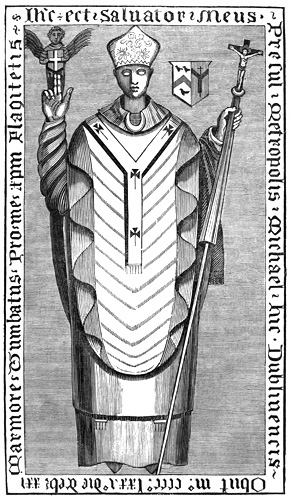
SEPULCHRAL EFFIGY OF ARCHBISHOP TREGURY, IN THE CATHEDRAL OF DUBLIN.
143 Mr. Urban, Tredrea, Cornwall, March 2, 1831.
You will much gratify me, and, I may venture to add, many other correspondents, by inserting in your most excellent repository, which has now survived one century with a spirit and vigour that give promise for its continuing through another, some particulars of an individual sprung from this county, who must have been a man of talent and of learning sufficient for adding lustre to any origin; but who is now almost entirely forgotten, his family having long since become extinct, and the records of the University, of the Church, of the Diocese, and of the Province over which he presided, having in great measure perished in the devastations of the civil war, and especially of those aggravated by religious dissensions.
Mr. Lysons, in his History of Cornwall, states, that in the parish of St. Wenn is situated Tregury, Tregurra, or Tregurtha, the seat of a family so called, of whom was Michael de Tregury, Archbishop of Dublin, who died in 1471. The last heir male of the elder branch of this family died in the reign of Henry the Fifth, leaving three daughters coheirs, who sold this barton to the family of Botreaux, from whom it passed successively, by inheritance or sale, through the families of Hungerford, Hastings, Edgcumbe, Parkins, and Vivian, to Mr. William Hals, who wrote the Parochial History of Cornwall, and resided here in the latter part of his life. The estate, now called Tregotha, is the property of Thomas Rawlings, Esq.
This brief notice of the Archbishop scarcely made any impression on my mind beyond a mere recollection of the circumstance, when a Cornish gentleman informed me that he had observed a monument to this Prelate in the Cathedral at Dublin. I then took the liberty of applying, through Mr. Dawson, Member for the County of Londonderry, to his brother the Dean of St. Patrick’s, who not only gave me every information and reference that is known to exist, but also a drawing of the monument, of which I have sent a wood engraving.—Since this was engraved, I 144 have seen a tracing from an old drawing in the possession of Sir William Betham, Ulster King at Arms, which shows that the sides of the original altar-tomb were adorned with trefoil-headed arches rising from short pillars.
It appears that few records are extant of the Prelates and Dignitaries of Dublin prior to the Reformation, in places where they might most reasonably have been expected to be found; and the monument itself would have perished but for the care and attention of the celebrated Doctor Jonathan Swift, who, with the Chapter, exactly a hundred years ago, rescued it from a dilapidated chapel, and carried the monument to its present situation in the Cathedral.
Michael Tregury attained his reputation for learning at the University of Oxford. He was Junior Proctor in the year 1434, under which Anthony Wood gives the following notice of him in his “Fasti.” He “was now Fellow of Exeter College, and about these times Principal of several Halls successively that stood near to the said College. But the King, having a special respect for him (being now accounted the utmost ornament of the University), made him Prefect or Governor of [the College at] Caen in Normandy, lately erected by King Henry the Fifth of England; which office he performing with singular applause, became at length, through divers preferments (of which the Deanery of St. Michael of Pencryche[16] was one) Archbishop of Dublin in Ireland.”
The foundation of the College or University of Caen, is again mentioned by Wood in his Annals, under 1417. In consequence, he says, of discontents regarding preferment and tithes, “the corruptness of provisions, and especially the wars between England and France, many dispersed themselves to other places. And because Normandy, Angiers, Poyctou, 145 Aquitaine, Bretagne, Gascoigne, and other places that were subject to the Crown of England, could not for that reason exercise their Scholastical Arts at Paris publicly and without murmurings, they receded to Caen in Normandy,[17] and studied there, which place Henry the Fifth, of England, made an University, causing one Michael Tregorie, an Oxford Doctor, sometime Fellow of Exeter College, to be governor and reader there, to the end that the doctrine of the University of Oxford might dilate itself and take root in those parts.”
The following memoir is extracted from Ware’s History of Ireland, vol. I. p. 359:
“Before the close of the same year (1449), Michael Tregury, a native of Cornwall, and Doctor of Divinity of the University of Oxford, was consecrated Archbishop of this See. He was a man of such great eminence for learning and wisdom, that in the year 1418, King Henry the Fifth invited him over to Caen in Normandy, to take upon him the government of a College, which that Monarch had then founded in the said city; to whom he joined, out of the Mendicant Friars, learned professors in all sciences.[18] There he is said to have discharged the trust committed to him with great applause, both by his public prelections and writings. A catalogue of his works may be seen in Bale and Pits. At last, upon the death of Talbot in 1449, he was promoted to this See by a papal provision, and was the same year, on the 10th of February (English style), restored to the temporalities by King Henry the Sixth, whose Chaplain he was: [But was obliged to submit himself to the King’s favour, and renounce every clause in his Bull prejudicial to the Crown.[19]] He was called into the Privy Council immediately, and had twenty pounds per annum[20] 146 granted him by the King, pro sano consilio, for giving good counsel, as his predecessors, Archbishops of Dublin, who were of the Council, had; and in 1453 King Henry the Sixth, for securing an arrear of two years and a half, and the growing salary, granted him a custodium on the manor of Tassagard, and the town of Ballachise, parcel thereof, to continue during the time he should be Archbishop of Dublin.[21]
“In certain Annals ascribed to Dudley Firbisse, there is a mention made under the year 1453, that an Archbishop of Dublin was taken prisoner at sea. I must leave the passage to the credit of the Annalist, not having met any hint of it elsewhere. There is extant in the Black Book of the Archbishop of Dublin (p. 82), a copy of a Bull of Pope Pius the Second, dated the 23d of November 1462, and directed to the Bishop and Archdeaconry of Ossory, commanding them to pronounce excommunicated, Geofrey Harold, Thomas and Edmund his sons, Patrick Birne, Thady Sheriff, Thomas Becagh, Robert Burnell, and other laymen of the city and diocese of Dublin, for laying violent hands on this Prelate, and committing him to prison; and that they should keep them under excommunication until they went to Rome for absolution, with the testimonials of the Bishop and Archdeacon. The reason of this insult is no where mentioned, that I can find. He repaired the manor house of Tawlaght, and died there in a very advanced age, on the 21st of December 1471; having governed this See about twenty-two years. His remains were conveyed to Dublin, attended by the clergy and citizens, and buried in St. Patrick’s Church, near St. Stephen’s altar [as he had directed by his will], where heretofore might have been seen a specious monument, adorned 147 with his statue, of elegant workmanship, on which are inscribed the following verses, penned without the aid of the Muses:
‘Præsul Metropolis Michael hic Dubliniensis Marmore tumbatus, pro me Christum flagitetis.’
And at the head of the statue,
‘Jesus est Salvator meus.’
“This monument was found under the rubbish in St Stephen’s Chapel; the cover of it was preserved by the care of the Rev. Dr. Jonathan Swift, Dean of St. Patrick’s, and the Chapter, who in the year 1730 fixed it up in the wall, on the left hand, as you enter the west gate, between the said gate and the place where heretofore the Consistory Court was held; and they have placed this inscription over it: ‘Vetus hoc Monumentum, è ruderibus Capellæ Divi Stephani nuper instauratæ erutum, Decanus et Capitulum hùc transferri curaverunt, A.D. 1730.’
“The will of this Prelate, dated the 10th of December 1471, is extant among the manuscripts in the Library of Trinity College, Dublin (B. 52), whereby he deviseth his two silver gilded saltsellers (salsaria) with their covers, to make cups for St. Patrick’s, to serve in divine offices. He also bequeathed his pair of organs to the said Church, to be used at the celebration of divine service in St. Mary’s Chapel. ‘I devise also (says he) that William Wyse, whose industry for this purpose I choose, shall in my stead visit with a decent oblation St. Michael’s Mount in Cornwall, which by vow I am bound to perform either by myself or proxy;’ and also orders him to give some largesses towards building the neighbouring churches near where his friends dwell.
“The registry[22] of the Dominican Abbey in Dublin gives an account, that above fifty persons went out of the 148 Diocese to Rome in 1451, to celebrate the jubilee then held under Pope Nicholas the fifth, and that this prelate gave them recommendatory certificates to the Pope; that seven of the number were pressed to death in the crowd, besides what died in their return. This squares with the relation given by Mathias Palmerius, in his additions to the Chronicle of Eusebius, ‘That there was so great a concourse of people from all parts of the Christian world at this jubilee, that at Hadrian’s Mole almost two hundred perished in the press, besides many who were drowned in the Tiber.’ They who returned sate in 1453, brought the melancholy news, that Constantinople was taken by the Turks, and the Emperor Constantine Palæologus slain. Our Archbishop was so afflicted at the account, that he ordered a fast to be kept strictly throughout his diocese for three days together, and granted indulgences of an hundred years to the observers of it; and he himself went before the clergy in procession to Christ Church cloathed in sackcloth and ashes.”
The works of Tregury are thus noticed by Pits, in his volume “De illustribus Angliæ Scriptoribus:”
“Multa scripsisse perhibetur, quæ Gallis inter quos vixit vel Hibernis apud quos obiit, magis quàm Anglis e quibus natus est, nota esse poterunt. Hos tamen paucos titulos sequentes invenio:
Super Magistro Sententiarum lib. iv.
De Origine illius Studii lib. i.
Quæstiones Ordinarias lib. i.
Contra Henricum Albrincensem lib. i.
Yours, &c. —— Davies Gilbert.
De Restitutione Temporalium Archiepiscopatus Dublinensis.
[Rymeri Fœdera, tom. xi. p. 260.]
Rex Cancellario nostro, vel ejus deputato, seu Custodi Magni Sigilli nostri in terrâ nostrâ Hiberniæ, qui nunc est vel qui pro tempore fuerit, salutem. Cum dominus Summus 149 Pontifex, nuper vacante ecclesiâ metropolitanâ Dublinensi, per mortem bonæ memoriæ Richardi ultimi Archiepiscopi ejusdem loci, dilectum Capellanum nostrum Magistrum Michaelem Tregorre, sacræ theologiæ professorem, in Archiepiscopum illius loci præfecerit et pastorem, sicut per literas bullatas ipsius domini Summi Pontificis nobis inde directis nobis constat, Nos, pro eo quòd idem Archiepiscopus omnibus et singulis verbis in dictis literis bullatis contentis nobis et Coronæ nostræ prejudicialibus coram nobis renunciavit, et gratiæ nostræ humiliter se submisit, volentes cum eo agere gratiòse, cepimus fidelitatem ipsius Archiepiscopi, et temporalia archiepiscopatûs illius, prout moris est, restituimus eidem; et ideo vobis mandamus quòd eidem Archiepiscopo, seu ejus in hac parte attornatis, deputatis, seu procuratoribus, temporalia prædicta infra terram prædictam, cum pertinentiis, per brevia nostra inde in cancellariâ nostrâ terræ nostræ prædictæ, tot et talia quot et qualia sibi in hac parte necessaria fuerint, seu quomodolibet opportuna, sub magno sigillo nostro ejusdem terræ debitè conficienda deliberari demandetis, habenda in formâ prædictâ, cum suis juribus et pertinentiis universis. Teste Rege apud Westmonasterium, decimo die Februarii.
Et mandatum est militibus, liberis hominibus, et omnibus aliis tenentibus de Archiepiscopatu prædicto infra terram nostram prædictam, quod eidem Michaeli tanquam Archiepiscopo et domino suo in omnibus quæ ad Archiepiscopatum prædictum pertinent, intendentes sint et respondentes, sicut prædictum est. In cujus, &c. Teste, ut supra.
Pro Archiepiscopo Dubliniæ.
[Rymeri Fœdera, vol. xi. p. 325.]
Rex omnibus ad quos, &c. salutem.
Sciatis quòd, cùm venerabilis in Christo pater Michael Dublinensis Archiepiscopus habere et percipere debeat viginti libras per annum, de nobis pro suo sano consilio utilitatem et politicum regimen terræ nostræ Hiberniæ concernente, 150 nobis impenso et impendendo tempore quo Archiepiscopus ibidem extiterit, prout ejus prædecessores, Archiepiscopi loci prædicti, ac de consilio nostro et progenitorum nostrorum Regum Angliæ existentes, habere solebant de nobis et progenitoribus nostris prædictis pro hujusmodi consilio suo,—dictoque nunc Archiepiscopo summa quinquaginta librarum, de dictis viginti libris annuis (videlicet, a quarto die Novembris, in anno regni nostri vicesimi-noni usque quartum diem Februarii in anno regni nostri tricesimi-primi, scilicet per duos annos integros et unum dimidium annum, per quod tempus ipse venerabilis pater Archiepiscopus Dublinensis extitit, et sanum suum consilium ad utilitatem terræ nostræ prædictæ impendit,) per nos debita jam existat,—volentes eundem Archiepiscopum tam de dictâ summâ quinquaginta librarum contentari, quàm de viginti libris annuis hujusmodi, pro tempore quo ipsum Archiepiscopum ibidem fore contigerit percipiendis et habendis, ipsum Archiepiscopum securiorem fieri et reddi, de gratiâ nostrâ speciali ac de mero motu et certâ scientiâ nostris, commissimus eidem nunc Archiepiscopo custodium manerii sive dominii de Tassagard cum pertinentiis, necnon villæ de Ballachize, parcellæ manerii prædicti, cum pertinentiis, in manu nostrâ certis de causis existentium, habendum et tenendum eidem Archiepiscopo, unà cum proficiis, commoditatibus, curiis, juribus, emolumentis, et pertinentiis suis quibuscunque, per totum tempus quo ipsum Archiepiscopum Dublinensem fore contigerit, reddendo inde nobis per annum, pro custodiâ prædictâ, durante tempore illo, ad Scaccarium nostrum in Hiberniâ, tales et tantas denariorum summas, de qualibus et quantis nobis pro custodiâ manerii et villæ prædictorum cum pertinentiis modo responsum existet; et ulteriùs volumus et præfato Archiepiscopo concedimus quòd ipse centum solidos annuatim de denariorum summis, quæ per ipsum Archiepiscopum de custodiâ prædictâ deberi contigerint, in manibus suis propriis habeat et retineat, quòdque ipse dictam summam quinquaginta librarum inde sic levaverit, perciperit, et in manibus suis retinuerit.
151 Et insuper quòd ipse Archiepiscopus annuatim, durante toto termino prædicto, quo ipse Archiepiscopus ibidem et de consilio nostro fuerit, de hujusmodi denariis, de custodiâ prædictâ nobis per ipsum Archiepiscopum debendis et extunc proveniendis, in manibus suis propriis habeat et retineat viginti libras per annum, habendas, percipiendas, et retinendas in satisfactionem dictarum viginti librarum per annum, quas ipse Archiepiscopus pro consilio suo prædicto de nobis per tempus prædictum percipere debet, quamdiù ipse Archiepiscopus Dublinensis extiterit, pro sano suo consilio nobis impendendo; et ulteriùs concedimus præfato Archiepiscopo quòd ipse, in solutione dictarum denariorum summarum et custodiæ prædictæ, ad Scaccarium prædictum de omnibus hujusmodi summis, quas ipse Archiepiscopus, prætextâ harum literarum nostrarum patentium, habuerit, perciperit, aut retinuerit, de tempore in tempus, debitam habeat deductionem et allocationem; aliquo statuto, actu, ordinatione, sive restrictione in contrarium factis, editis, seu provisis, sive aliquâ aliâ re, materiâ, vel causâ non obstantibus. In cujus, &c. Teste Rege apud Westmonasterium, nono die Maii [1453].
Per Breve de Privato Sigillo.
St. Wenn measures 3,858 statute acres.
£. s. d.
Annual value of the Real Property as returned to Parliament in 1815 2963 0 0
Poor Rate in 1831 228 5 0
Population,—
in 1801, 358 in 1811, 452 in 1821, 589 in 1831, 649
giving an increase of 81 per cent. in 30 years.
Present Incumbent, the Rev. R. P. Gilbert, instituted in 1810.
GEOLOGY, BY DOCTOR BOASE.
The rocks of this parish resemble those of the northern half of St. Columb Major.
152
WHITSTONE.
HALS.
Whitstone is situate in the hundred of Stratton, and hath upon the north part of Bridgerule and Marhamchurch, west Wike St. Mary and Tamerton, south Werrington and St. Stephen’s.
In the Inquisition of the Bishops of Lincoln and Winchester 1294, Ecclesia de Witeston, in decanatu de Trigmajorshire, was valued at £4. 6s. 8d. In Wolsey’s Inquisition 1521, £14. 11s. 0½d. The patronage in the Bishop of Exeter, who endowed it; the incumbent Tregena or Hosken; and the parish rated to the four shillings per pound Land Tax, 1696, for one year £124. 12s. 6d. tempore William III.
The barton of Benett, in this parish, was formerly the seat of George Heale, esq. Sheriff of Cornwall, 4 and 5 of Charles I. that married ——; as also of Edmund Hele, esq. his son, Sheriff of Cornwall, 22 Charles I. whose son dying without issue, those lands and much other descended to his daughter Lucy, the wife of John Basset, of Tehidy, esq. now in possession thereof. The name Hele, Heale, is Saxon English, and signifies the same as hell in British, viz. a hall, either of a dwelling house or refectory, or a place of judicature or prætorium, a tabernacle or a tent.
The arms of Heale are Gules, a bend lozengy Ermine.
TONKIN.
Whitston is in the hundred of Stratton, and hath to the west St. Mary Week, to the north Marhamchurch and Bridgerule, to the east the river Tamar, between it and Devon, to the south Tamerton.
The name of the parish is derived from a white rock, on which part of the church is founded. It is a large white 153 stone in the south side of the church; the part which appears is of an oval form. This account I had from Mr. Nicholas Hoskins, jun. and vicar of Boyton, son to the rector of this.
In anno 1291, 20 Edw. I. this church was valued (Tax. Benef.) at £4. 6s. 8d. having never been appropriated.
This church is a rectory, valued in the King’s Book, £14. 11s. ob.; the patronage in the heirs of Sir John Arundell; the incumbent Mr. Nicholas Hoskins.
THE MANOR OF WHITESTONE.
This, in Domesday Book, is called Witestan, being one of the manors given by William the Conqueror to Robert Earl of Morton, when he created Earl of Cornwall the said Robert.
In the extent of Cornish acres, 12 Edw. I. (Car. f. 48), this, by the name of Wilston and St. Petnell (St. Petronel, I suppose), is valued in two.
The 3 Henry IV. (Idem, f. 40 b.) John de Cobbeham held one fee in Wiston and Serpeknol, which I take to be the same with the former, only wrong spelt.
[The name of the parish is not derived, I apprehend, from any white stone on which the church is founded. From the very description here given of it, it could never have given name to the church itself. Only “part of the church is founded” on it. Nor is this part “founded” on it. There is only “a large white stone in the south side of the church;” and this is plainly built up in the side, as it is said to be “of an oval form.” The reference of the name to this stone, therefore, has been merely the idle play of intellect, in those who in antiquarian matters did not know how to exert their understandimg seriously. The real name of the church is “St. Petnell, St. Petronel, I suppose.” The church then could not give name to the parish. And the parish actually received its name from the manor, as the manor received it from its manerial 154 house, this being built upon a white rock, that very rock assuredly from which the white stone in the wall of the church had been brought. W.]
THE EDITOR.
The church and tower of this parish, like several others in the north-eastern part of Cornwall, are fine objects in themselves, and are placed on commanding situations.
There are several monuments to former residents and proprietors in the parish. Among these is one to the memory of George Hele, of Bennetts, esq. who died in 1652, and of his son Warwick Hele, who died in 1650. The family of Hele had resided for many generations at Bennetts, which came into the Basset family in the latter part of that century, by the marriage of John Basset, esq. of Tehidy, with Lucy Hele. Their great-grandson, the late Lord Dunstanville, was in the habit of visiting Bennetts for several weeks at a time. This place had been leased for lives to a respectable family of the name of Webbe, probably soon after it came to Mr. John Basset.
The advowson of the living belonged to the Arundells of Lanherne and Wardour, who sold it about fifty years ago; and, after passing through various hands, it came to the Rev. John Kingdon, who is also the incumbent, instituted in 1793. The net value of the living in 1831 was £231.
Whitstone measures 3429 statute acres.
£. s. d.
Annual value of the Real Property as returned to Parliament in 1815 1832 0 0
Poor Rate in 1831 205 13 0
Population,—
in 1801, 345 in 1811, 397 in 1821, 466 in 1831, 481
giving an increase of 40 per cent. in 30 years.
THE GEOLOGY, BY DR. BOASE.
Whitstone, like all the other parishes in this division of Cornwall, is situated on the calcareous series, more particularly on the compact schistose varieties of dunstone.
155
ST. WINNOW.
HALS.
St. Wennoe is situate in the hundred of West, and hath upon the north Braddock and Cardenham, west the Foye river or sea, south St. Veepe, east Lanreth.
In the glass windows of this church, the Patron Saint is called after the Latin St. (Sanctus) Winotus, but further knowledge of him I have not.
In the Domesday Book 1087, this district was taxed by the name of Tre-vocar-Winoe. In the Inquisition of the Bishops of Lincoln and Winchester, 1294, Ecclesia de Sancto Winotho was valued lxs. In Wolsey’s Inquisition 1521, it was rated 5l. The Patronage in ——; the incumbent Laurence; the rectory in possession of ——; and the parish rated at 4s. per pound Land Tax, 1696, for one year, £210. 8s. 8d.
In this parish is a chapel of ease dedicated to St. Nectan, vulgo vocat. St. Knighton, or Nighton, whose revenues in the Inquisition of the Bishops of Lincoln and Winchester 1294, were thus rated, Capella de Nectan, in decanatu de West, vs. This Nectan was born in Devon about the year 940, a man of singular piety and holiness, as most of those days afforded, who lived a monkish or eremitical life, at Hartland, in Devon, where he died about the year 1010. After his death his relics (see Rawlegh’s Relicta Nomen viri) were enshrined and set up in the same little chapel where he served God there; in which place Githa, wife of Godwin Earl of Kent (or rather Goditha his daughter, afterwards married to Edward the Confessor), as Malmesbury informs us, 1030, built and endowed a monastery of secular priests, which might marry wives; valued at the suppression, 26 Hen. VIII. at £350 per annum; and the reason of this her pious foundation is said to be, for that 156 she was fully persuaded that her husband, Earl Godwin, escaped the danger of a shipwreck in a raging tempest at sea by his merits and intercessions.
Galfrid de Dynham, Lord of Hartland, was a great benefactor to this monastery, and changed the Secular Priests into Black Canons Augustine, who were prohibited marriage by their rule. See the Monasticon Anglicanum, tome II. p. 285, concerning Nectan and Hartland.
This barton and manor of St. Winow gave name and original to an old family of gentlemen, from thence surnamed de St. Winow, of which family was that Philip de St. Winow, who had £20 lands and upwards in this place, held by the tenure of knight service, 25 Edward III. 1352 (Survey of Cornwall, p. 52,) from whose heirs it passed by descent or purchase about Henry VIth’s time to —— Upton, which Upton was originally descended either from the Uptons of Upton and Colombton, or Lupton, in Brixham parish, in Devon, whose elder brother’s estate passed by his daughter and heir in marriage to the Wingfields; as also the estate of this Upton of St. Winow did by marriage with his daughter and heir to William Lower, esq. of Trelaske, in Lawanack, Sheriff of Cornwall 16 Henry VIII. 1525. William Lower, esq. his son, or grandson, was Sheriff of Cornwall 20th of Elizabeth; he married one of Reskimer’s heirs, and had issue Nicholas Lower, esq. afterwards knighted, Sheriff of Cornwall 8 Charles I. Sir Nicholas married ——, and had issue one only daughter, that became his heir, and was married to Sir William Drummond, knight, who had issue by her two daughters that became his heirs; the one married to Charles Trevanion, of Caryhayes, esq. and to —— Roper, esq. now Lord of this place in fee. The possession by lease in Stephen Robins, esq. Sheriff of Cornwall about the year 1700, who married —— Robins, his father William of Probus, and giveth for his arms the same as Robins of Verian.
157 Tethe, in this parish, alias Eade or Ethy, was the seat of some of the Courtneys of Boconnock, from whose heirs it passed by purchase, as I am informed, to John Trevill, esq. Sheriff of Cornwall 18 Charles II. whose three daughters and heirs carried those lands, together with themselves, in marriage, to Burthog, Savery, and Arscott; but Arscott’s lady dying under age, he purchased this barton and manor of Tethe, or Ethy, from Burthog and Savery, whose younger son Denis Arscott, esq. Sheriff of Cornwall 4th King George, was then in possession thereof.
Tre-vego, alias Tre-vega, in this parish, that is to say, the town upon the top of a stiff hill or precipice, according to the natural circumstances of the place, is the dwelling of Warwick Hankey, esq. barrister-at-law, that married Jane, daughter of Giles Risdon, of Babeleigh, esq.
In this parish stands Lar-an Bridge, i. e. the Floor Bridge.
TONKIN.
The tutelar saint of this parish is St. Winnocus (Moreri’s Dictionary, vol. I. voce Bergh St. Vinoc), who was born in Armorica, or Little Britain, and having associated himself about the year 680 with St. Bertin, Abbat of Sithien, established a monastery at a place in Flanders, and died there the 6th of November 717, which place has been once called from him Bergh St. Winnox, a town being built there and surrounded with walls in 950; since that it has been regularly fortified, belongs to the French, and is about four miles from Dunkirk.
This is a vicarage, valued in the King’s Book at £5.; the patronage in the Dean and Chapter of Exeter; the incumbent Mr. Thomas Laurenc.
In 1291, 20 Edward I. this church was valued (Tax. Benef.) at cxs. being appropriated to the Chapter of Exeter; and the chapel of St. Nectan at vs.
158 THE EDITOR.
The Church of St. Winnow is beautifully situated on the eastern bank of the river, at its most beautiful part, between Lestwithiel and Fowey. The church, with its tower, are fine objects as seen from the river, which does not yield in this spot to the Dart itself. The Church contains several monuments.
The vicarage house and glebe partake of the splendour of the scenery; and during the life of their late proprietor, the Reverend Robert Walker, were among the most attractive spots in Cornwall. Mr. Walker, possessed of strong abilities, had an ardent desire to discharge all the duties attached to him as a clergyman and as a country gentleman, in a manner the most beneficial to all with whom he had any concern; in the relations of private life he was equally estimable; and as a most decisive proof of his real merits and high deserts, it may be truly said, that, although he was induced on principle to take a strong part in politics, he had not a single personal enemy.
The chapel, dedicated to the Recluse of Hertland, has still divine service occasionally performed in it, although it does not form any practical division of the parish.
The history of Ethy has been brought down to the period immediately preceding its possession by the Edgecumbe family; the house has been occupied of late years by several gentlemen, and especially by one who has done honour to the nation by his naval and military services, and to Cornwall as a private man. Admiral Sir Charles Vinicombe Penrose distinguished himself on so many occasions, that to enumerate them all would be to write a life. Two, which do not relate immediately to the more obvious features of the military profession, may, however, be selected.
In the year 1797, when the navy of England underwent the greatest disgrace it has ever experienced, by the prevalence of a mutiny which threatened our safety as a country, 159 this excellent officer preserved his ship in due subordination.
In the year 1814, when the Duke of Wellington invaded France from the Pyrenees, and his passage was disputed across the Adour, Admiral Penrose, uniting to scientific acquirements the skill and the bravery of an English seaman, constructed a bridge of boats where it was thought impossible to place them, and thus greatly contributed to the success of this important part of the combined attack.
In the Parliamentary Edition of the Taxatio Ecclesiastica of Pope Nicholas IV. p. 145, the entries respecting St. Winnowe are as follow:
£. s. d.
Eccl’ia de S’c’o Winnico 2 10 0
Vicar’ ejusdem 1 0 0
This parish measures 5,501 statute acres.
£. s. d.
Annual value of the Real Property as returned to Parliament in 1815 4304 0 0
Poor Rate in 1831 603 14 0
Population,—
in 1801, 671 in 1811, 782 in 1821, 906 in 1831, 1048
giving an increase of 56 per cent. in 30 years.
Present Vicar, the Rev. Percival Frye, who succeeded the Rev. W. Molesworth in 1834, on the presentation of the Dean and Chapter of Exeter. Mr. Molesworth had been instituted in 1816. The clear value of the benefice in 1831 was £197.
GEOLOGY, BY DOCTOR BOASE.
The rocks of this parish are similar to those of the adjoining parishes, Broadoak, Boconnoc, and St. Veep.
160
WITHIEL.
HALS.
Withiel is situate in the hundred of Pider, and hath upon the north St. Breock, east Lannyvet, south Roach, west St. Wenn. As for those names, they are synonymous in Cornish, and signify in that phrase, a place of trees, which heretofore it was; and is so called, for that this church is situate upon the manor of Withell Goose, i. e. Tree Wood, or a place heretofore consisting in its voke lands of a wood of trees (neither is it altogether destitute of wood and trees to this day, though within the memory of man, much of them have been cut down for buildings and charcoal there, and all the parish over).
At the time of the Norman Conquest, this district was rated in the Domesday Book by the name of Ber-neves (still the voke lands of a manor in this parish, of which, see more under), as also Trenant or Trenance. In the inquisition of the Bishops of Lincoln and Winchester into the value of Cornish Benefices, Ecclesia de Withell, in decanatu de Pider, was rated at £4. In Wolsey’s Inquisition, 1621, £10. The patronage was formerly in the Prior of Bodman, who endowed it out of his manor of Withell Goos aforesaid; which lands and patronage, when that Priory was dissolved, fell to the Crown, from whence it passed to Glanvill of Killivor; from Glanvill to Vivian of Truan; from Vivian of Truan, by marriage of his daughter, to Vivian of Trelowarren, now in possession thereof; the incumbent —— Wood; and the parish rated to the four shillings per pound Land Tax 1696, for one year, tempore William III. £18. 4s. 2d.
Thomas Vivian, Prior of St. Pedyr at Bodmyn, Bishop 161 of Megara, a city of Achaia in Greece, on the borders of Attica, built the rectory house in this place, as appears from his paternal coat armour, and that of the arms of Megara bishoprick, lately extant in the glass windows thereof, tempore Henry VII. and VIII.
Bor, Ber, or Bur-nevas or Nefas, is still the voke lands of an ancient dismembered manor, taxed as aforesaid, otherwise Buro-neves.
Tre-nance in this parish, i. e. the valley town, or town in the valley, was also rated in the Domesday Book 1087, as then the voke lands of a manor, which place gave name and original to an old family of gentlemen surnamed de Trenance, one of which family married Littleton’s heir, and afterwards removed to Lanhydrock, whereof they were lords, tempore James I. when Littleton Trenance, esq. sold that barton to the Lord Robartes, as a younger branch of this family, living at Black Haye in this parish, sold Trenance to Mapowder; and Mapowder sold it to Bone; Bone gave it to Harris of St. Stephen’s; and Harris sold it to Hawkins, now in possession of part thereof. The other moiety of this little barton of Trenance, is in possession of the Arundells of Lanherne.