Volume 7 — CHAPTER IX.
Reading edition
The year 1840 finds Mr. Lincoln entering his thirty-second year and still unmarried. "I have come to the conclusion," he suggests in a facetious letter, two years before, "never again to think of marrying." But meanwhile he had seen more of the world. The State Capital had been removed to Springfield, and he soon observed the power and influence one can exert with high family and social surroundings to draw upon. The sober truth is that Lincoln was inordinately ambitious. He had already succeeded in obtaining no inconsiderable political recognition, and numbered among his party friends men of wealth and reputation; but he himself was poor, besides lacking the graces and ease of bearing obtained through mingling in polite society—in fact, to use the expressive language of Mary Owens, he was "deficient in those little links which make up the chain of woman's happiness." Conscious, therefore, of his humble rank in the social scale, how natural that he should seek by marriage in an influential family to establish strong connections and at the same time foster his political fortunes! This may seem an audacious thing to insinuate, but on no other basis can we reconcile the strange course of his courtship and the tempestuous chapters in his married life. It is a curious history, and the facts, long chained down, are gradually coming to the surface. When all is at last known, the world I believe will divide its censure between Lincoln and his wife.
Mary Todd, who afterwards became the wife of Mr. Lincoln, was born in Lexington, Kentucky, December 13, 1818. "My mother," related Mrs. Lincoln to me in 1865, "died when I was still young. I was educated by Madame Mantelli, a lady who lived opposite Mr. Clay's, and who was an accomplished French scholar. Our conversation at school was carried on entirely in French—in fact we were allowed to speak nothing else. I finished my education at Mrs. Ward's Academy, an institution to which many people from the North sent their daughters. In 1837 I visited Springfield, Illinois, remaining three months. I returned to Kentucky, remaining till 1839, when I again set out for Illinois, which State finally became my home."
The paternal grandfather of Mary Todd, General Levi Todd, was born in 1756, was educated in Virginia, and studied law in the office of General Lewis of that State. He emigrated to Kentucky, was a lieutenant in the campaigns conducted by General George Rogers Clark against the Indians, and commanded a battalion in the battle of Blue Licks, August 18, 1782, where his brother, John Todd, was killed. He succeeded Daniel Boone in command of the militia, ranking as major-general, and was one of the first settlers in Lexington, Ky. February 25, 1779, he married Miss Jane Briggs. The seventh child of this union, born February 25, 1791, was Robert S. Todd, the father of Mrs. Lincoln. On her maternal side Mrs. Lincoln was highly connected. Her great-grandfather, General Andrew Porter, was in the war of the Revolution. He succeeded Peter Muhlenberg as major-general of the Pennsylvania militia. Her great uncles, George B. Porter, who was governor of Michigan, James Madison Porter, secretary of the navy under President Tyler, and David R. Porter, governor of Pennsylvania, were men of ability and distinction. Her mother, Anne Eliza Parker, was a cousin of her father, Robert S. Todd. The latter had served in both houses of the Kentucky Legislature, and for over twenty years was president of the Bank of Kentucky at Lexington. He died July 16, 1849.
To a young lady in whose veins coursed the blood that had come down from this long and distinguished ancestral line, who could even go back in the genealogical chart to the sixth century, Lincoln, the child of Nancy Hanks, whose descent was dimmed by the shadow of tradition, was finally united in marriage.
When Mary Todd came to her sister's house in Springfield in 1839, she was in her twenty-first year. She was a young woman of strong, passionate nature and quick temper, and had "left her home in Kentucky to avoid living under the same roof with a stepmother."* She came to live with her oldest sister, Elizabeth, who was the wife of Lincoln's colleague in the Legislature, Ninian W. Edwards. She had two other sisters, Frances, married to Dr. William Wallace, and Anne, who afterwards became the wife of C. M. Smith, a prominent and wealthy merchant. They all resided in Springfield. She was of the average height, weighing when I first saw her about a hundred and thirty pounds. She was rather compactly built, had a well rounded face, rich dark-brown hair, and bluish-gray eyes. In her bearing she was proud, but handsome and vivacious. Her education had been in no wise defective; she was a good conversationalist, using with equal fluency the French and English languages. When she used a pen, its point was sure to be sharp, and she wrote with wit and ability. She not only had a quick intellect but an intuitive judgment of men and their motives. Ordinarily she was affable and even charming in her manners; but when offended or antagonized, her agreeable qualities instantly disappeared beneath a wave of stinging satire or sarcastic bitterness, and her entire better nature was submerged. In her figure and physical proportions, in education, bearing, temperament, history—in everything she was the exact reverse of Lincoln.
* Mrs. Edwards, statement, Aug. 3, 1887.
On her return to Springfield she immediately entered society, and soon became one of the belles, leading the young men of the town a merry dance. She was a very shrewd observer, and discreetly and without apparent effort kept back all the unattractive elements in her unfortunate organization. Her trenchant wit, affability, and candor pleased the young men not less than her culture and varied accomplishments impressed the older ones with whom she came in contact. The first time I met her was at a dance at the residence of Col. Robert Allen, a gentleman mentioned in the preceding chapter. I engaged her for a waltz, and as we glided through it I fancied I never before had danced with a young lady who moved with such grace and ease. A few moments later, as we were promenading through the hall, I thought to compliment her graceful dancing by telling her that while I was conscious of my own awkward movements, she seemed to glide through the waltz with the ease of a serpent. The strange comparison was as unfortunate as it was hideous. I saw it in an instant, but too late to recall it. She halted for a moment, drew back, and her eyes flashed as she retorted: "Mr. Herndon, comparison to a serpent is rather severe irony, especially to a newcomer."
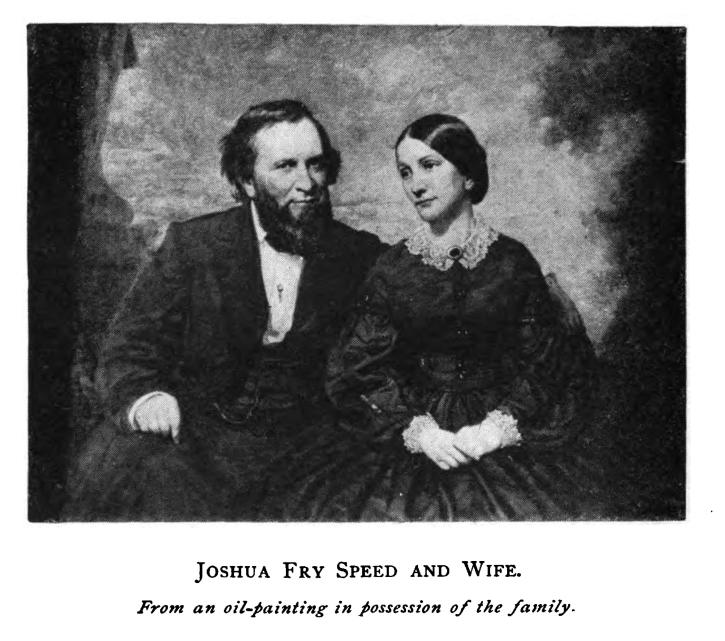
Through the influence of Joshua F. Speed, who was a warm friend of the Edwardses, Lincoln was led to call on Miss Todd. He was charmed with her wit and beauty, no less than by her excellent social qualities and profound knowledge of the strong and weak points in individual character. One visit succeeded another. It was the old story. Lincoln had again fallen in love. "I have often happened in the room where they were sitting," relates Mrs. Edwards, describing this courtship, "and Mary invariably led the conversation. Mr. Lincoln would sit at her side and listen. He scarcely said a word, but gazed on her as if irresistibly drawn towards her by some superior and unseen power. He could not maintain himself in a continued conversation with a lady reared as Mary was. He was not educated and equipped mentally to make himself either interesting or attractive to the ladies. He was a good, honest, and sincere young man whose rugged, manly qualities I admired; but to me he somehow seemed ill-constituted by nature and education to please such a woman as my sister. Mary was quick, gay, and in the social world somewhat brilliant. She loved show and power, and was the most ambitious woman I ever knew. She used to contend when a girl, to her friends in Kentucky, that she was destined to marry a President. I have heard her say that myself, and after mingling in society in Springfield she repeated the seemingly absurd and idle boast. Although Mr. Lincoln seemed to be attached to Mary, and fascinated by her wit and sagacity, yet I soon began to doubt whether they could always be so congenial. In a short time I told Mary my impression that they were not suited, or, as some persons who believe matches are made in heaven would say, not intended for each other." But Mrs. Edwards' advice was seed, sown on rocky soil. The courtship ran on smoothly to the point of engagement, when a new and disturbing element loomed up ahead in their paths. It was no less than the dashing and handsome Stephen A. Douglas, who now appeared on the scene in the guise of a rival. As a society man Douglas was infinitely more accomplished, more attractive and influential than Lincoln, and that he should supplant the latter in the affections of the proud and aristocratic Miss Todd is not to be marveled at. He was unremitting in his attentions to the lady, promenaded the streets arm-in-arm with her—frequently passing Lincoln—and in every way made plain his intention to become the latter's rival. There are those who believe this warm reciprocation of young Douglas' affection was a mere flirtation on Mary Todd's part, intended to spur Lincoln up, to make him more demonstrative, and manifest his love more positively and with greater fervor. But a lady relative who lived with Lincoln and his wife for two years after their marriage is authority for the statement coming from Mrs. Lincoln herself that "she loved Douglas, and but for her promise to marry Lincoln would have accepted him." The unfortunate attitude she felt bound to maintain between these two young men ended in a spell of sickness. Douglas, still hopeful, was warm in the race, but the lady's physician,—her brother-in-law,—Dr. William Wallace, to whom she confided the real cause of her illness, saw Douglas and induced him to end his pursuit,* which he did with great reluctance.
* Mrs. Harriett Chapman, statement, Nov. 8, 1887.
If Miss Todd intended by her flirtation with Douglas to test Lincoln's devotion, she committed a grievous error. If she believed, because he was ordinarily so undemonstrative, that he was without will-power and incapable of being aroused, she certainly did not comprehend the man. Lincoln began now to feel the sting. Miss Todd's spur had certainly operated and with awakening effect. One evening Lincoln came into our store and called for his warm friend Speed. Together they walked back to the fireplace, where Lincoln, drawing from his pocket a letter, asked Speed to read it. "The letter," relates Speed, "was addressed to Mary Todd, and in it he made a plain statement of his feelings, telling her that he had thought the matter over calmly and with great deliberation, and now felt that he did not love her sufficiently to warrant her in marrying him. This letter he desired me to deliver. Upon my declining to do so he threatened to intrust it to some other person's hand. I reminded him that the moment he placed the letter in Miss Todd's hand, she would have the advantage over him. 'Words are forgotten,' I said, 'misunderstood, unnoticed in a private conversation, but once put your words in writing and they stand a living and eternal monument against you.' Thereupon I threw the unfortunate letter in the fire. 'Now,' I continued, 'if you have the courage of manhood, go see Mary yourself; tell her, if you do not love her, the facts, and that you will not marry her. Be careful not to say too much, and then leave at your earliest opportunity.' Thus admonished, he buttoned his coat, and with a rather determined look started out to perform the serious duty for which I had just given him explicit directions."
That night Speed did not go upstairs to bed with us, but under pretense of wanting to read, remained in the store below. He was waiting for Lincoln's return. Ten o'clock passed, and still the interview with Miss Todd had not ended. At length, shortly after eleven, he came stalking in. Speed was satisfied, from the length of Lincoln's stay, that his directions had not been followed.
"Well, old fellow, did you do as I told you and as you promised?" were Speed's first words.
"Yes, I did," responded Lincoln, thoughtfully, "and when I told Mary I did not love her, she burst into tears and almost springing from her chair and wringing her hands as if in agony, said something about the deceiver being himself deceived." Then he stopped.
"What else did you say?" inquired Speed, drawing the facts from him.
"To tell you the truth, Speed, it was too much for me. I found the tears trickling down my own cheeks. I caught her in my arms and kissed her," "And that's how you broke the engagement," sneered Speed. "You not only acted the fool, but your conduct was tantamount to a renewal of the engagement, and in decency you cannot back down now."
* Statement, Joshua F. Speed, Sep. 17, 1866, MS.
"Well," drawled Lincoln, "if I am in again, so be it. It's done, and I shall abide by it." Convinced now that Miss Todd regarded the engagement ratified,—instead of broken, as her tall suitor had at first intended,—Lincoln continued his visits, and things moved on smoothly as before. Douglas had dropped out of the race, and everything pointed to an early marriage. It was probably at this time that Mr. and Mrs. Edwards began to doubt the wisdom of the marriage, and now and then to intimate the same to the lady; but they went no farther in their opposition and placed no obstacle in their paths.
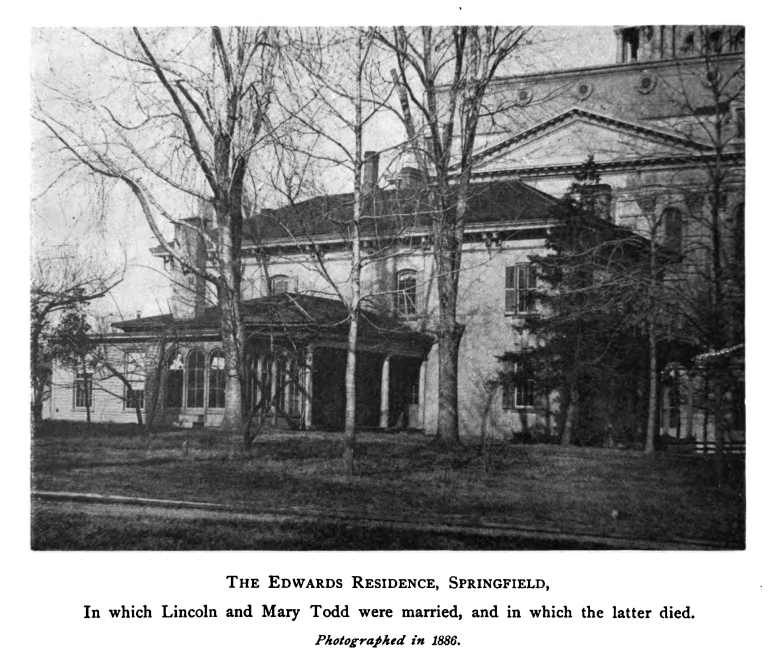
The time fixed for the marriage was the first day in January, 1841. Careful preparations for the happy occasion were made at the Edwards mansion. The house underwent the customary renovation; the furniture was properly arranged, the rooms neatly decorated, the supper prepared, and the guests invited. The latter assembled on the evening in question, and awaited in expectant pleasure the interesting ceremony of marriage. The bride, bedecked in veil and silken gown, and nervously toying with the flowers in her hair, sat in the adjoin-ing room. Nothing was lacking but the groom. For some strange reason he had been delayed. An hour passed, and the guests as well as the bride were becoming restless. But they were all doomed to disappointment. Another hour passed; messengers were sent out over town, and each returning with the same report, it became apparent that Lincoln, the principal in this little drama, had purposely failed to appear! The bride, in grief, disappeared to her room; the wedding supper was left untouched; the guests quietly and wonderingly withdrew; the lights in the Edwards mansion were blown out, and darkness settled over all for the night. What the feelings of a lady as sensitive, passionate, and proud as Miss Todd were we can only imagine—no one can ever describe them. By daybreak, after persistent search, Lincoln's friends found him. Restless, gloomy, miserable, desperate, he seemed an object of pity. His friends, Speed among the number, fearing a tragic termination, watched him closely in their rooms day and night. "Knives and razors, and every instrument that could be used for self-destruction were removed from his reach."* Mrs. Edwards did not hesitate to regard him as insane, and of course her sister Mary shared in that view. But the case was hardly so desperate. His condition began to improve after a few weeks, and a letter written to his partner Stuart, on the 23d of January; 1841, three weeks after the scene at Edwards' house, reveals more perfectly how he felt. He says: "I am now the most miserable man living. If what I feel were equally distributed to the whole human family, there would not be one cheerful face on earth. Whether I shall ever be better, I cannot tell; I awfully forebode I shall not. To remain as I am is impossible. I must die or be better, as it appears to me... I fear I shall be unable to attend to any business here, and a change of scene might help me. If I could be myself I would rather remain at home with Judge Logan. I can write no more."
* J. F. Speed, MS. letter, January 6, 1866,
During all this time the Legislature to which Lincoln belonged was in special session, but for a time he was unable to attend.* Towards the close of the session, however, he resumed his seat. He took little if any part in the proceedings, made no speeches, and contented himself with answers to the monotonous roll-call, and votes on a few of the principal measures. After the adjournment of the Legislature, his warm friend Speed, who had disposed of his interests in Springfield, induced Lincoln to accompany him to Kentucky. Speed's parents lived in a magnificent place a few miles from Louisville. Their farm was well stocked, and they, in the current phrase, "lived well." Thither he was taken, and there amid the quiet surroundings he found the "change of scene" which he told Stuart might help him. He was living under the cloud of melancholia, and sent to the Sangamon Journal a few lines under the gloomy title of "Suicide." They were published in the paper, and a few years since I hunted over the files, and coming across the number containing them, was astonished to find that some one had cut them out. I have always supposed it was done by Lincoln or by some one at his instigation.
* His illness and consequent incapacity for duty in the Legislature, continued for almost three weeks. On the 19th of January, 1841, John J. Hardin announced his illness in the House. Four days afterward he wrote the letter to Stuart from which I have quoted a few lines.
Speed's mother was much impressed with the tall and swarthy stranger her son had brought with him. She was a God-fearing mother, and besides aiding to lighten his spirits, gave him a Bible, advising him to read it and by adopting its precepts obtain a release from his troubles which no other agency, in her judgment, could bring him. "He was much depressed. At first he almost contemplated suicide. In the deepest of his depression he said one day he had done nothing to make any human being remember that he had lived; and that to connect his name with the events transpiring in his day and generation, and so impress himself upon them as to link his name with something that would redound to the interest of his fellow-men, was what he desired to live for."* The congenial associations at the Speed farm,** the freedom from unpleasant reminders, the company of his staunch friend, and above all the motherly care and delicate attentions of Mrs. Speed exerted a marked influence over Lincoln.
* Letter, J. F. Speed, February 9, 1866, MS. ** At the time of Lincoln's visit at the Speed mansion, James Speed, a brother of Joshua, and afterward Attorney- General in Lincoln's Cabinet, was practicing law in Louisville. Lincoln came into his office daily. "He read my books," related Mr. Speed in after years; "talked with me about his life, his reading, his studies, his aspirations." Mr. Speed discredits the thought that Lincoln was insane at the time, although he understood he was saddened and melancholy over an unfortunate love affair.
He improved gradually, day by day gaining strength and confidence in himself, until at last the great cloud lifted and passed away. In the fall he and Speed returned to Springfield. At this point, as affording us the most reliable account of Mr. Lincoln's condition and views, it is proper to insert a portion of his correspondence with Mr. Speed. For some time Mr. Speed was reluctant to give these letters to the world. After some argument, however, he at last shared my view that they were properly a matter of history, and sent them to me, accompanied by a letter, in which he says:
"I enclose you copies of all the letters of any interest from Mr. Lincoln to me. Some explanation may be needed that you may rightly understand their import. In the winter of 1840 and 1841, he was unhappy about his engagement to his wife—not being entirely satisfied that his heart was going with his hand. How much he suffered then on that account none knew so well as myself; he disclosed his whole heart to me.*
* Lincoln wrote a letter—a long one which he read to me—to Dr. Drake of Cincinnati, descriptive of his case. Its date would be in December, 1840, or early in January, 1841. I think that he must have informed Dr. Drake of his early love for Miss Rutledge, as there was a part of the letter which he would not read... I remember Dr. Drake's reply, which was, that he would not undertake to prescribe for him without a personal interview."—Joshua F. Speed, MS. letter, November 30, 1866.
"In the summer of 1841 I became engaged to my wife. He was here on a visit when I courted her; and, strange to say, something of the same feeling which I regarded as so foolish in him took possession of me and kept me very unhappy from the time of my engagement until I was married. This will explain the deep interest he manifested in his letters on my account.
"One thing is plainly discernible; if I had not been married and happy—far more happy than I ever expected to be—he would not have married."
The first of these letters is one which he gave Speed when the latter started on his journey from Illinois to Kentucky. It bears no date, but was handed him January 1, 1842, as Speed has testified, in another letter to me, that he left Springfield on that day. It is full of consolation and advice how best to conduct himself when the periods of gloom which he feels sure will follow come upon his friend. "I know," he says, "what the painful point with you is at all times when you are unhappy; it is an apprehension that you do not love her as you should. What nonsense! How came you to court her?... Did you court her for her wealth? Why, you say she had none. But you say you reasoned yourself into it. What do you mean by that? Was it not that you found yourself unable to reason yourself out of it? Did you not think, and partly form the purpose, of courting her the first time you ever saw her or heard of her? What had reason to do with it at that early stage? There was nothing at that time for reason to work upon. Whether she was moral, amiable, sensible, or even of good character, you did not nor could then know, except perhaps you might infer the last from the company you found her in.... Say candidly, were not those heavenly black eyes the whole basis of all your reasoning on the subject? After you and I had once been at the residence, did you not go and take me all the way to Lexington and back for no other purpose but to get to see her again on our return on that evening to take a trip for that express object?"
The next paragraph is significant as affording us an idea of how the writer perhaps viewed Miss Todd's flirtation with Douglas: "What earthly consideration," he asks, "would you take to find her scouting and despising you and giving herself up to another? But of this you need have no apprehension, and therefore you cannot bring it home to your feelings."
February 3, he writes again, acknowledging receipt of a letter dated January 25. The object of Speed's affection had been ill, and her condition had greatly intensified his gloomy spirits. Lincoln proffers his sympathy. "I hope and believe," he continues, "that your present anxiety about her health and her life must and will forever banish those horrid doubts which I know you sometimes felt as to the truth of your affection for her. If they can once and forever be removed (and I almost feel a presentiment that the Almighty has sent your present affliction expressly for that object), surely nothing can come in their stead to fill their immeasurable measure of misery... It really appears to me that you yourself ought to rejoice and not sorrow at this indubitable evidence of your undying affection for her. Why, Speed, if you did not love her, although you might not wish her death, you would most certainly be resigned to it. Perhaps this point is no longer a question with you, and my pertinacious dwelling upon it is a rude intrusion upon your feelings. If so you must pardon me. You know the hell I have suffered on that point, and how tender I am upon it. You know I do not mean wrong. I have been quite clear of hypo since you left, even better than I was along in the fall."
The next letter, February 13, was written on the eve of Speed's marriage. After assurances of his desire to befriend him in everything, he suggests: "But you will always hereafter be on ground that I have never occupied, and consequently, if advice were needed, I might advise wrong. I do fondly hope, however, that you will never again need any comfort from abroad... I incline to think it probable that your nerves will occasionally fail you for awhile; but once you get them firmly graded now, that trouble is over forever. If you went through the ceremony calmly or even with sufficient composure not to excite alarm in any present, you are safe beyond question, and in two or three months, to say the most, will be the happiest of men."
Meanwhile Lincoln had been duly informed of Speed's marriage, and on the 25th he responds:
"Yours of the 16th, announcing that Miss Fanny and you are 'no more twain, but one flesh,' reached me this morning. I have no way of telling how much happiness I wish you both, though I believe you both can conceive it. I feel somewhat jealous of both of you now. You will be so exclusively concerned for one another that I shall be forgotten entirely... I shall be very lonesome without you. How miserably things seem to be arranged in this world! If we have no friends we have no pleasure; and if we have them we are sure to lose them, and be doubly pained by the loss."
In another letter, written the same day, he says, "I have no doubt it is the peculiar misfortune of both you and me to dream dreams of Elysium far exceeding all that anything earthly can realize. Far short of your dreams as you may be, no woman could do more to realize them than that same blackeyed Fanny. If you could but contemplate her through my imagination, it would appear ridiculous to you that any one should for a moment think of being unhappy with her. My old father used to have a saying, that, 'If you make a bad bargain hug it all the tighter,' and it occurs to me that if the bargain just closed can possibly be called a bad one it is certainly the most pleasant one for applying that maxim to which my fancy can by any effort picture."
Speed having now safely married, Lincoln's mind began to turn on things nearer home. His relations with Mary Todd were still strained, but reminders of his period of gloom the year before began now to bring her again into view. In a letter to Speed, March 27, he says:
"It cannot be told how it thrills me with joy to hear you say you are 'far happier than you ever expected to be.' That much, I know, is enough. I know you too well to suppose your expectations were not at least sometimes extravagant, and if the reality exceeds them all, I say, 'Enough, dear Lord.' I am not going beyond the truth when I tell you that the short space it took me to read your last letter gave me more pleasure than the total sum of all I have enjoyed since that fatal first of January, 1841. Since then it seems to me I should have been entirely happy but for the never-absent idea that there is one still unhappy whom I have contributed to make so. That kills my soul. I cannot but reproach myself for even wishing to be happy while she is otherwise. She accompanied a large party on the railroad cars to Jacksonville last Monday, and on her return spoke, so that I heard of it, of having enjoyed the trip exceedingly. God be praised for that!"
The last paragraph of this letter contains a bit of sentiment by Lincoln in acknowledgment of a violet. In the margin of the letter which he gave me, Speed made this note in pencil: "The violet was sent by my wife, who dropped it in the letter as I was in the act of sealing it. How beautiful the acknowledgment!" This is the paragraph: "The sweet violet you enclosed came safely to hand, but it was so dry, and mashed so flat, that it crumbled to dust at the first attempt to handle it. The juice that mashed out of it stained a place in the letter, which I mean to preserve and cherish for the sake of her who procured it to be sent. My renewed good wishes to her."
Meanwhile the coldness that existed between Lincoln and his "Mary" was gradually passing away, and with it went all of Lincoln's resolution never to renew the engagement. In a letter, July 4, he says: "I must gain confidence in my own ability to keep my resolves when they are made. In that ability I once prided myself as the only chief gem of my character; that gem I lost, how and where you know too well. I have not regained it; and until I do I cannot trust myself in any matter of much importance. I believe now that had you understood my case at the time as well as I understood yours afterwards, by the aid you would have given me I should have sailed through clear; but that does not now afford me sufficient confidence to begin that or the like of that again.... I always was superstitious; I believe God made me one of the instruments of bringing Fanny and you together, which union I have no doubt he had foreordained. Whatever he designs he will do for me yet. 'Stand still and see the salvation of the Lord,' is my text just now. If, as you say, you have told Fanny all, I should have no objection to her seeing this letter, but for its reference to our friend here; let her seeing it depend upon whether she has ever known anything of my affairs; and if she has not, do not let her. I do not think I can come to Kentucky this season. I am so poor and make so little headway in the world that I drop back in a month of idleness as much as I gain in a year's sowing."
The last letter, and the one which closes this series, was written October 5, 1842. In it he simply announces his "duel with Shields," and then goes on to "narrate the particulars of the duelling business, which still rages in this city." This referred to a challenge from the belligerent Shields to William Butler, and another from General Whitesides to Dr. Merryman. In the latter, Lincoln acted as the "friend of Merryman," but in neither çase was there any encounter, and both ended in smoke. The concluding paragraph of this letter is the most singular in the entire correspondence. I give it entire without further comment:
"But I began this letter not for what I have been writing, but to say something on that subject which you know to be of such infinite solicitude to me. The immense sufferings you endured from the first days of September till the middle of February you never tried to conceal from me, and I well understood. You have now been the husband of a lovely woman nearly eight months. That you are happier now than the day you married her, I well know, for without, you could not be living. But I have your word for it, too, and the returning elasticity of spirits which is manifested in your letters. But I want to ask a close question: 'Are you in feeling as well as judgment glad you are married as you are?' From anybody but me this would be an impudent question, not to be tolerated, but I know you will pardon it in me. Please answer it quickly, as I am impatient to know." Lincoln again applied himself to the law. He re-entered the practice, after the long hiatus of rest, with renewed vigor. He permitted the memory of his engagement with Mary Todd to trouble him no longer. Their paths had diverged, the pain of the separation was over, and the whole thing was a history of the past. And so it might ever have remained but for the intervention of a very shrewd and sagacious lady—one who was capable of achieving success anywhere in the ranks of diplomacy. This lady was the wife of Simeon Francis, the editor of the Sangamon Journal. She was a warm friend of Mary Todd and a leader in society. Her husband was warmly attached to Lincoln. He ran the Whig organ, and entertained great admiration for Lincoln's brains and noble qualities. The esteem was mutual, and it is no stretch of the truth to say that for years Lincoln exercised undisputed control of the columns of the Journal himself. Whatever he wrote or had written, went into the editorial page without question. Mrs. Francis, sharing her husband's views of Lincoln's glorious possibilities, and desiring to do Mary Todd a kindly act, determined to bring about a reconciliation. She knew that Miss Todd had by letter a few days after "that fatal first of January, 1841," as Lincoln styled it, released him from the engagement, and that since then their relations had been strained, if not entirely broken off. As she viewed it, a marriage between a man as promising in the political world as Lincoln, and a woman as accomplished and brilliant in society as Mary Todd, would certainly add to the attractions of Springfield and reflect great credit on those who brought the union about. She was a great social entertainer, and one day arranged a gathering at her house for the express purpose of bringing these two people together. Both were invited and both attended; but neither suspected the other's presence. Having arranged things so ingeniously and with so much discretion, it was no difficult task for the hostess to bring the couple together by a warm introduction and the encouraging admonition, "Be friends again." Much to the surprise of both they found the web woven around them. They entered into the spirit of the reconciliation, and found Mrs. Francis' roof an inviting place for many succeeding meetings. A wall reared itself between them and the past, and they started again under the auspicious omens of another engagement. The tact of a woman and the diplomacy of society had accomplished what love had long since despaired of ever doing or seeing done.
The meetings in the parlor of Mrs. Francis' house were conducted with no little privacy. At first even Mrs. Edwards knew nothing of it, but presently it came to her ears. "I asked Mary," said this lady, "why she was so secretive about it. She said evasively that after all that had occurred, it was best to keep the courtship from all eyes and ears. Men and women and the whole world were uncertain and slippery, and if misfortune befell the engagement all knowledge of it would be hidden from the world." *
* Statement, January 10, 1866, MS.
It is unnecessary to prolong the account of this strange and checkered courtship. The intervention of the affair with Shields, which will be detailed in a subsequent chapter, in no way impeded, if it did not hasten the marriage. One morning in November, Lincoln, hastening to the room of his friend James H. Matheney before the latter had arisen from bed, informed him that he was to be married that night, and requested him to attend as best man.* That same morning Miss Todd called on her friend Julia M. Jayne, who afterward married Lyman Trumbull, and made a similar request. The Edwardses were notified, and made such meager preparations as were possible on so short notice. License was obtained during the day, the minister, Charles N. Dresser,** was sent for, and in the evening of November 4, 1842, "as pale and trembling as if being driven to slaughter," Abraham Lincoln was at last married to Mary Todd.*
* "Marriages in Springfield up to that time had been rather commonplace affairs. Lincoln's was perhaps the first one ever performed with all the requirements of the Episcopal ceremony. A goodly number of friends had gathered, and while witnessing the ceremony one of the most amusing incidents imaginable occurred. No description on paper can do it justice. Among those present was Thomas C. Brown, one of the judges of the Supreme Court. He was in truth an "old-timer," and had the virtue of saying just what he thought, without regard to place or surroundings. He had been on the bench for many years and was not less rough than quaint and curious. There was, of course, a perfect hush in the room as the ceremony progressed. Brown was standing just behind Lincoln. Old Parson Dresser, in canonical robes, with much and impressive solemnity recited the Episcopal service. He handed Lincoln the ring, who, placing it on the bride's finger, repeated the Church formula, 'With this ring I thee endow with all my goods and chattels, lands and tenements.' Brown, who had never witnessed such a proceeding, was struck with its utter absurdity. 'God Almighty! Lincoln,' he ejaculated, loud enough to be heard by all, 'the statute fixes all that!' This unlooked-for interruption almost upset the old parson; he had a keen sense of the ridiculous, and for the moment it seemed as if he would break down; but presently recovering his gravity, he hastily pronounced them husband and wife."—Letter, James H. Matheney, MS., Aug. 21,1888. ** "My father, Rev. Charles Dresser, was a graduate of Brown University, Providence, R. I., of the class of 1823."— Thomas W. Dresser, MS. letter, Sept. 17, 1888.
One great trial of his life was now over, and another still greater one was yet to come. To me it has always seemed plain that Mr. Lincoln married Mary Todd to save his honor, and in doing that he sacrificed his domestic peace. He had searched himself subjectively, introspectively, thoroughly: he knew he did not love her, but he had promised to marry her! The hideous thought came up like a nightmare. As the "fatal first of January, 1841," neared, the clouds around him blackened the heavens and his life almost went out with the storm. But soon the skies cleared. Friends interposed their aid to avert a calamity, and at last he stood face to face with the great conflict between honor and domestic peace. He chose the former, and with it years of self-torture, sacrificial pangs, and the loss forever of a happy home.*
* While dressing for the wedding in his room at Butler's house, the latter's little boy, Speed, seeing Lincoln so handsomely attired, in boyish innocence asked him where he was going? "To hell, I suppose," was Lincoln's reply.
With Miss Todd a different motive, but one equally as unfortunate, prompted her adherence to the union. To marry Lincoln meant not a life of luxury and ease, for Lincoln was not a man to accumulate wealth; but in him she saw position in society, prominence in the world, and the grandest social distinction. By that means her ambition would be satisfied. Until that fatal New Year's day in 1841 she may have loved him, but his action on that occasion forfeited her affection. He had crushed her proud, womanly spirit. She felt degraded in the eyes of the world. Love fled at the approach of revenge. Some writer—it is Junius, I believe—has said that, "Injuries may be forgiven and forgotten, but insults admit of no compensation: they degrade the mind in its own self-esteem and force it to recover its level by revenge." Whether Mrs. Lincoln really was moved by the spirit of revenge or not she acted along the lines of human conduct. She led her husband a wild and merry dance. If, in time, she became soured at the world it was not without provocation, and if in later years she unchained the bitterness of a disappointed and outraged nature, it followed as logically as an effect does the cause.
I have told this sad story as I know and have learned it. In rehearsing the varied scenes of the drama,* I have unearthed a few facts that seem half-buried, perhaps, but they were not destined to lay buried deep or long. The world will have the truth as long as the name of Lincoln is remembered by mankind.
* For many years I had reason to believe that Sarah Rickard, who was a sister of Mrs. William Butler, had been the recipient of some attentions at the hand of Mr. Lincoln. The lady, long since married, is now living in a Western State. I applied to her for information recently, and after some entreaty received this answer in her own handwriting: "As an old friend I will answer the question propounded to me, though I can scarcely see what good it can do history. Mr. Lincoln did make a proposal of marriage to me in the summer, or perhaps later, in the year of 1840. He brought to my attention the accounts in the Bible of the patriarch Abraham's marriage to Sarah, and used that historical union as an argument in his own behalf. My reason for declining his proposal was the wide difference in our ages. I was then only sixteen, and had given the subject of matrimony but very little, if any, thought. I entertained the highest regard for Mr. Lincoln. He seemed almost like an older brother, being, as it were, one of my sister's family."
There were two things Mr. Lincoln always seemed willing to forget. One was his unparliamentary escape with Joseph Gillespie from the Legislature by jumping through the church window, in 1839, and the other was the difficulty with James Shields, or, as he expressed it in a letter to Speed, the "duel with Shields." Other incidents in his career he frequently called up in conversation with friends, but in after years he seldom if ever referred to the affair with Shields. People in Illinois did gradually forget or, at least, cease mention of it, but in more remote quarters where Mr. Lincoln was less extensively known, the thing, much to his regret, kept rising to the surface. During a visit which I made to the Eastern States in 1858, I was often asked for an account of the so-called duel; so often, in fact, that on my return home I told Mr. Lincoln of it. "If all the good things I have ever done," he said regretfully, "are remembered as long and well as my scrape with Shields, it is plain I shall not soon be forgotten."
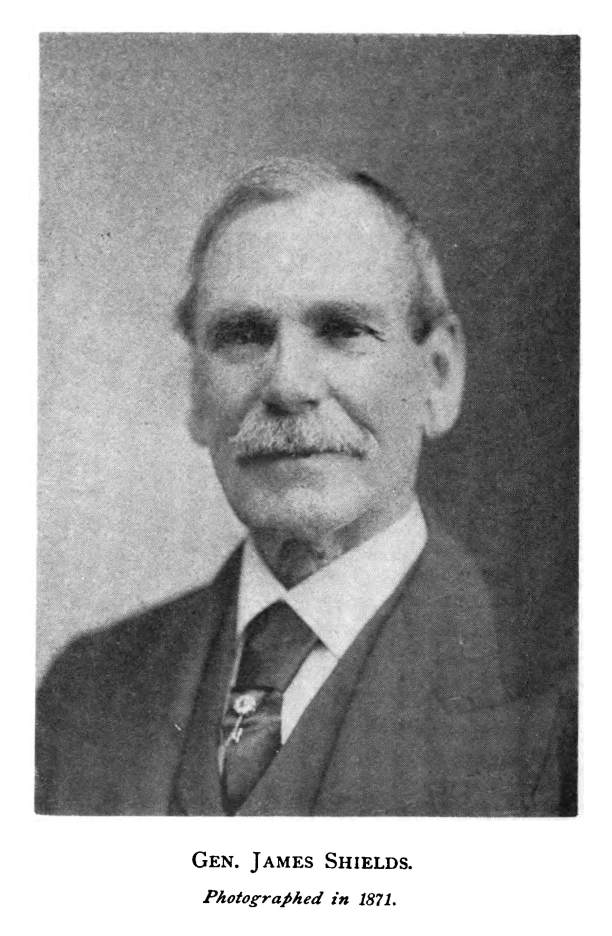
James Shields, a "gallant, hot-headed bachelor from Tyrone county, Ireland," and a man of inordinate vanity, had been elected Auditor of State. Encouraged somewhat by the prominence the office gave him, he at once assumed a conspicuous position in the society of Springfield. He was extremely sensitive by nature, but exposed himself to merciless ridicule by attempting to establish his supremacy as a beau among the ladies. Blind to his own defects, and very pronounced in support of every act of the Democratic party, he made himself the target for all the bitterness and ridicule of the day. It happened that the financial resources of the State, owing to the collapse of the great internal improvement system, were exceedingly limited, and people were growing restless under what they deemed excessive taxation. The State officers were all Democrats, and during the summer they issued an order declining to receive any more State Banknotes or bills in payment of taxes. This made the tax-payer's burdens greater than ever, as much of this paper remained outstanding in the hands of the people. The order met with opposition from every quarter—the Whigs of course losing no opportunity to make it as odious as possible. It was perfectly natural, therefore, that such an ardent Whig as Lincoln should join in the popular denunciation. Through the columns of the Springfield Journal, of which he had the undisputed use, he determined to encourage the opposition by the use of his pen. No object seemed to merit more ridicule and caricature than the conspicuous figure of the Auditor of State. At this time Lincoln was enjoying stolen conferences under the hospitable roof of Mrs. Francis with Mary Todd and her friend Julia M. Jayne. These two young ladies, to whom he confided his purpose, encouraged it and offered to lend their aid. Here he caught the idea of puncturing
Shields. The thing took shape in an article published in that Journal, purporting to have come from a poor widow, who with her pockets full of State Bank paper was still unable to obtain the coveted receipt for her taxes. It was written by Lincoln and was headed:
A Letter from the Lost Townships.
Lost Townships, August 27,1842.
Dear Mr. Printer,
I see you printed that long letter I sent you a spell ago. I'm quite encouraged by it, and can't keep from writing again. I think the printing of my letters will be a good thing all round—it will give me the benefit of being known by the world, and give the world the advantage of knowing what's going on in the Lost Townships, and give your paper respectability besides. So here comes another. Yesterday afternoon I hurried through cleaning up the dinner dishes and stepped over to neighbor S——— to see if his wife Peggy was as well as mout be expected, and hear what they called the baby. Well, when I got there and just turned round the corner of his log cabin, there he was, setting on the doorstep reading a newspaper. "How are you, Jeff?" says I. He sorter started when he heard me, for he hadn't seen me before. "Why," says he, "I'm mad as the devil, Aunt 'Becca!" "What about?" says I; "ain't its hair the right color? None of that nonsense, Jeff; there ain't an honester women in the Lost Townships than"—"Than who?" says he; "what the mischief are you about?" I began to see I was running the wrong trail, and so says I, "Oh! nothing: I guess I was mistaken a little, that's all. But what is it you're mad about?"
"Why," says he, "I've been tugging ever since harvest, getting out wheat and hauling it to the river to raise State Bank paper enough to pay my tax this year and a little school debt I owe; and now, just as I've got it, here I open this infernal Extra Register, expecting to find it full of 'Glorious Democratic Victories' and 'High Comb'd Cocks,' when, lo and behold! I find a set of fellows, calling themselves officers of the State, have forbidden the tax collectors and school commissioners to receive State paper at all; and so here it is dead on my hands. I don't now believe all the plunder I've got will fetch ready cash enough to pay my taxes and that school debt."
I was a good deal thunderstruck myself; for that was the first I had heard of the proclamation, and my old man was pretty much in the same fix with Jeff. We both stood a moment staring at one another without knowing what to say. At last says I, "Mr. S———, let me look at that paper." He handed it to me, when I read the proclamation over.
"There now," says he, "did you ever see such a piece of impudence and imposition as that?" I saw Jeff was in a good tune for saying some ill-natured things, and so I tho't I would just argue a little on the contrary side, and make him rant a spell if I could. "Why," says I, looking as dignified and thoughtful as I could, "it seems pretty tough, to be sure, to have to raise silver where there's none to be raised; but then, you see, 'there will be danger of loss' if it ain't done."
"Loss! damnation!" says he. "I defy Daniel Webster, I defy King Solomon, I defy the world—I defy—I defy—yes, I defy even you, Aunt 'Becca, to show how the people can lose anything by paying their taxes in State paper."
"Well," says I, "you see what the officers of State say about it, and they are a desarnin' set of men. But," says I, "I guess you're mistaken about what the proclamation says. It don't say the people will lose anything by the paper money being taken for taxes. It only says 'there will be danger of loss'; and though it is tolerable plain that the people can't lose by paying their taxes in something they can get easier than silver, instead of having to pay silver; and though it's just as plain that the State can't lose by taking State Bank paper, however low it may be, while she owes the bank more than the whole revenue, and can pay that paper over on her debt, dollar for dollar;—still there is danger of loss to the 'officers of State'; and you know, Jeff, we can't get along without officers of State."
"Damn officers of State!" says he; "that's what Whigs are always hurrahing for."
"Now, don't swear so, Jeff," says I; "you know I belong to the meetin', and swearin' hurts my feelings."
"Beg pardon, Aunt 'Becca," says he; "but I do say it's enough to make Dr. Goddard swear, to have tax to pay in silver, for nothing only that Ford may get his two thousand a year, and Shields his twenty-four hundred a year, and Carpenter his sixteen hundred a year, and all without 'danger of loss' by taking it in State paper. Yes, yes: it's plain enough now what these officers of State mean by 'danger of loss.' Wash, I s'pose, actually lost fifteen hundred dollars out of the three thousand that two of these 'officers of State' let him steal from the treasury, by being compelled to take it in State paper. Wonder if we don't have a proclamation before long, commanding us to make up this loss to Wash in silver."
And so he went on till his breath run out, and he had to stop. I couldn't think of anything to say just then, and so I begun to look over the paper again. "Ay! here's another proclamation, or something like it."
"Another?" says Jeff; "and whose egg is it, pray?"
I looked to the bottom of it, and read aloud, "Your obedient servant, James Shields, Auditor." "Aha!" says Jeff, "one of them same three fellows again. Well, read it, and let's hear what of it."
I read on till I came to where it says, "The object of this measure is to suspend the collection of the revenue for the current year."
"Now stop, now stop!" says he; "that's a lie a'ready, and I don't want to hear of it."
"Oh! may be not," says I.
"I say it—is—a—lie. Suspend the collection, indeed! Will the collectors, that have taken their oaths to make the collection, dare to suspend it? Is there anything in law requiring them to perjure themselves at the bidding of James Shields?
"Will the greedy gullet of the penitentiary be satisfied with swallowing him instead of all of them, if they should venture to obey him? And would he not discover some 'danger of loss,' and be off about the time it came to taking their places?
"And suppose the people attempt to suspend, by refusing to pay; what then? The collectors would just jerk up their horses and cows, and the like, and sell them to the highest bidder for silver in hand, without valuation or redemption. Why, Shields didn't believe that story himself: it was never meant for the truth. If it was true, why was it not writ till five days after the proclamation? Why didn't Carlin and Carpenter sign it as well as Shields? Answer me that, Aunt 'Becca. I say it's a lie, and not a well told one at that. It grins out like a copper dollar. Shields is a fool as well as a liar. With him truth is out of the question; and as for getting a good, bright, passable lie out of him, you might as well try to strike fire from a cake of tallow. I stick to it, it's all an infernal Whig lie!"
"A Whig lie! Highty tighty!"
"Yes, a Whig lie; and it's just like everything the cursed British Whigs do. First they'll do some divilment, and then they'll tell a lie to hide it. And they don't care how plain a lie it is: they think they can cram any sort of a one down the throats of the ignorant Locofocos, as they call the Democrats."
"Why, Jeff, you're crazy: you don't mean to say Shields is a Whig!"
"Yes, I do."
"Why, look here! the proclamation is in your own Democratic paper, as you call it."
"I know it; and what of that? They only printed it to let us Democrats see the deviltry the Whigs are at."
"Well, but Shields is the auditor of this Loco—I mean this Democratic State."
"So he is, and Tyler appointed him to office."
"Tyler appointed him?"
"Yes (if you must chaw it over), Tyler appointed him; or, if it wasn't him, it was old Granny Harrison, and that's all one. I tell you, Aunt 'Becca, there's no mistake about his being a Whig. Why, his very looks shows it; everything about him shows it: if I was deaf and blind, I could tell him by the smell. I seed him when I was down in Springfield last winter. They had a sort of a gatherin' there one night among the grandees, they called a fair. All the gals about town was there, and all the handsome widows and married women, finickin' about trying to look like gals, tied as tight in the middle, and puffed out at both ends, like bundles of fodder that hadn't been stacked yet, but wanted stackin' pretty bad. And then they had tables all around the house kivered over with [ ] caps and pincushions and ten thousand such little knic-knacks, tryin' to sell'em to the fellows that were bowin' and scrapin' and kungeerin' about'em. They wouldn't let no Democrats in, for fear they'd disgust the ladies, or scare the little gals, or dirty the floor. I looked in at the window, and there was this same fellow Shields floatin' about on the air, without heft or earthly substances, just like a lock of cat fur where cats had been fighting.
"He was paying his money to this one, and that one, and t'other one, and sufferin' great loss because it wasn't silver instead of State paper; and the sweet distress he seemed to be in,—his very features, in the ecstatic agony of his soul, spoke audibly and distinctly, 'Dear girls, it is distressing, but I cannot marry you all. Too well I know how much you suffer; but do, do remember, it is not my fault that I am so handsome and so interesting.'
"As this last was expressed by a most exquisite contortion of his face, he seized hold of one of their hands, and squeezed, and held on to it about a quarter of an hour. 'Oh, my good fellow!' says I to myself, 'if that was one of our Democratic gals in the Lost Townships, the way you'd get a brass pin let into you would be about up to the head.' He a Democrat! Fiddlesticks! I tell you, Aunt 'Becca, he's a Whig, and no mistake: nobody but a Whig could make such a conceity dunce of himself."
"Well," says I, "maybe he is; but, if he is, I'm mistaken the worst sort. Maybe so, maybe so; but, if I am, I'll suffer by it; I'll be a Democrat if it turns out that Shields is a Whig, considerin' you shall be a Whig if he turns out a Democrat."
"A bargain, by jingoes!" says he; "but how will we find out?"
"'Why," says I, "we'll just write and ax the printer."
"Agreed again!" says he; "and by thunder! if it does turn out that Shields is a Democrat, I never will"—
"Jefferson! Jefferson!"
"What do you want, Peggy?"
"Do get through your everlasting clatter some time, and bring me a gourd of water; the child's been crying for a drink this livelong hour."
"Let it die, then; it may as well die for water as to be taxed to death to fatten officers of State."
Jeff run off to get the water, though, just like he hadn't been saying anything spiteful for he's a raal good-hearted fellow, after all, once you get at the foundation of him.
I walked into the house, and, "Why, Peggy," says I, "I declare we like to forgot you altogether." "Oh, yes," says she, "when a body can't help themselves, everybody soon forgets'em; but, thank God! by day after to-morrow I shall be well enough to milk the cows, and pen the calves, and wring the contrary ones' tails for'em, and no thanks to nobody."
"Good evening, Peggy," says I, and so I sloped, for I seed she was mad at me for making Jeff neglect her so long.
And now, Mr. Printer, will you be sure to let us know in your next paper whether this Shields is a Whig or a Democrat? I don't care about it for my self, for I know well enough how it is already; but I want to convince Jeff. It may do some good to let him, and others like him, know who and what these officers of State are. It may help to send the present hypocritical set to where they belong, and to fill the places they now disgrace, with men who will do more work for less pay, and take a fewer airs while they are doing it. It ain't sensible to think that the same men who get us into trouble will change their course; and yet it's pretty plain if some change for the better is not made, it's not long that either Peggy or I or any of us will have a cow left to milk, or a calf's tail to wring.
Yours truly,
Rebecca ———.
Within a week another epistle from Aunt Rebecca appeared, in which, among other things, she offered the gallant Shields her hand. This one was written by Miss Todd and Miss Jayne. I insert it without further comment:
Lost Townships, September 8, 1842. Dear Mr. Printer:
I was a-standin' at the spring yesterday a-wash-in' out butter when I seed Jim Snooks a-ridin' up towards the house for very life, when, jist as I was a-wonderin' what on airth was the matter with him, he stops suddenly, and ses he, "Aunt 'Becca, here's somethin' for you and with that he hands out your letter. Well, you see, I steps out towards him, not thinkin' that I had both hands full of butter; and seein' I couldn't take the letter, you know, without greasin' it, I ses, "Jim, jist you open it, and read it for me." Well, Jim opens it and reads it; and would you believe it, Mr. Editor, I was so completely dumfounded and turned into stone that there I stood in the sun a-workin' the butter, and it a-running on the ground, while he read the letter, that I never thunk what I was about till the hull on't run melted on the ground and was lost. Now, sir, it's not for the butter, nor the price of the butter, but, the Lord have massy on us, I wouldn't have sich another fright for a whole firkin of it. Why, when I found out that it was the man what Jeff seed down to the fair that had demanded the author of my letters, threatnin' to take personal satisfaction of the writer, I was so skart that I tho't I should quill-wheel right where I was.
You say that Mr. S——— is offended at being compared to cats' fur, and is as mad as a March hare (that ain't fur), because I told about the squeezin'.
Now I want you to tell Mr. S——— that, rather than fight, I'll make any apology; and, if he wants personal satisfaction, let him only come here, and he may squeeze my hand as hard as I squeezed the butter, and, if that ain't personal satisfaction, I can only say that he is the fust man that was not satisfied with squeezin' my hand. If this should not answer, there is one thing more that I would rather do than get a lickin'. I have long expected to die a widow; but, as Mr. S——— is rather goodlooking than otherwise, I must say I don't care if we compromise the matter by—really, Mr. Printer, I can't help blushin'—but I—it must come out—I—but widowed modesty—well, if I must, I must—wouldn't he—may be sorter let the old grudge drap if I was to consent to be—be—h-i-s w-i-f-e? I know he's a fightin' man, and would rather fight than eat; but isn't marryin' better than fightin', though it does sometimes run in to it? And I don't think, upon the whole, that I'd be sich a bad match neither: I'm not over sixty, and am jist four feet three in my bare feet, and not much more around the girth; and for color, I wouldn't turn my back to nary a gal in the Lost Townships. But, after all, maybe I'm countin' my chickins before they are hatched, and dreamin' of matrimonial bliss when the only alternative reserved for me may be a lickin'. Jeff tells me the way these fire-eaters do is to give the challenged party choice of weapons, etc., which bein' the case, I'll tell you in confidence that I never fights with anything but broomsticks or hot water or a shovelful of coals or' some such thing; the former of which, being somewhat like a shillalah, may not be very objectional to him. I will give him choice, however, in one thing, and that is, whether, when we fight, I shall wear breeches or he petticoats, for, I presume that change is sufficient to place us on an equality.
Yours, etc.,
Rebecca ———.
P. S.—Jist say to your friend, if he concludes to marry rather than fight, I shall only inforce one condition, that is, if he should ever happen to gallant any young gals home of nights from our house, he must not squeeze their hands.
Not content with their epistolary efforts, the ladies invoked the muse. "Rebecca" deftly transformed herself into "Cathleen," and in jingling rhyme sang the praises of Shields, and congratulated him over the prospect of an early marriage to the widow. Following are the verses, rhyme, metre, and all:
Ye Jew's-harps awake! The Auditor's won. Rebecca the widow has gained Erin's son; The pride of the north from Emerald Isle Has been wooed and won by a woman's smile. The combat's relinquished, old loves all forgot: To the widow he's bound. Oh, bright be his lot! In the smiles of the conquest so lately achieved. Joyful be his bride, "widowed modesty" relieved, The footsteps of time tread lightly on flowers, May the cares of this world ne'er darken his hours! But the pleasures of life are fickle and coy As the smiles of a maiden sent off to destroy. Happy groom! in sadness far distant from thee The fair girls dream only of past times of glee Enjoyed in thy presence; whilst the soft blarnied stone Will be fondly remembered as relics of yore, And hands that in rapture you oft would have pressed, In prayer will be clasped that your lot may be blest. Cathleen.
The satire running through these various compositions, and the publicity their appearance in the Journal gave them, had a most wonderful effect on the vain and irascible Auditor of State. He could no longer endure the merriment and ridicule that met him from every side. A man of cooler head might have managed it differently, but in the case of a high-tempered man like Shields he felt that his integrity had been assailed and that nothing but an "affair of honor" would satisfy him. Through General John D. Whiteside he demanded of editor Francis the name of the author. The latter hunted up Lincoln, who directed him to give his name and say nothing about the ladies. The further proceedings in this grotesque drama were so graphically detailed by the friends of both parties in the columns of the Journal at that time, that I copy their letters as a better and more faithful narrative than can be obtained from any other source. The letter of Shields' second, General Whiteside, appearing first in the Journal, finds the same place in this chapter:
"To the Editor of the Sangamon Journal: Springfield, Oct. 3, 1842.
"SIR: To prevent misrepresentation of the recent affair between Messrs. Shields and Lincoln, I think it proper to give a brief narrative of the facts of the case, as they came within my knowledge; for the truth of which I hold myself responsible, and request you to give the same publication. An offensive article in relation to Mr. Shields appeared in the Sangamon Journal of the 2d of September last; and, on demanding the author, Mr. Lincoln was given up by the editor. Mr. Shields, previous to this demand, made arrangements to go to Quincy on public business; and before his return Mr. Lincoln had left for Tremont to attend the court, with the intention, as we learned, of remaining on the circuit several weeks. Mr. Shields, on his return, requested me to accompany him to Tremont; and, on arriving there, we found that Dr. Merryman and Mr. Butler had passed us in the night, and got there before us. We arrived in Tremont on the 17th ult., and Mr. Shields addressed a note to Mr. Lincoln immediately, informing him that he was given up as the author of some articles that appeared in the Sangamon Journal (one more over the signature having made its appearance at this time), and requesting him to retract the offensive allusions contained in said articles in relation to his private character. Mr. Shields handed this note to me to deliver to Mr. Lincoln, and directed me, at the same time, not to enter into any verbal communication, or be the bearer of any verbal explanation, as such were always liable to misapprehension. This note was delivered by me to Mr. Lincoln, stating, at the same time, that I would call at his convenience for an answer. Mr. Lincoln, in the evening of the same day, handed me a letter addressed to Mr. Shields. In this he gave or offered no explanation, but stated therein that he could not submit to answer further, on the ground that Mr. Shields's note contained an assumption of facts and also a menace. Mr. Shields then addressed him another note, in which he disavowed all intention to menace, and requested to know whether he (Mr. Lincoln) was the author of either of the articles which appeared in the Journal, headed 'Lost Townships,' and signed 'Rebecca'; and, if so, he repeated his request of a retraction of the offensive matter in relation to his private character; if not, his denial would be held sufficient. This letter was returned to Mr. Shields unanswered, with a verbal statement 'that there could be no further negotiation between them until the first note was withdrawn.' Mr. Shields thereupon sent a note designating me as a friend, to which Mr. Lincoln replied by designating Dr. Merryman. These three last notes passed on Monday morning, the 19th. Dr. Merryman handed me Mr. Lincoln's last note when by ourselves. I remarked to Dr. Merryman that the matter was now submitted to us, and that I would propose that he and myself should pledge our words of honor to each other to try to agree upon terms of amicable arrangement, and compel our principals to accept of them. To this he readily assented, and we shook hands upon the pledge. It was then mutually agreed that we should adjourn to Springfield, and there procrastinate the matter, for the purpose of effecting the secret arrangement between him and myself. All this I kept concealed from Mr. Shields. Our horse had got a little lame in going to Tremont, and Dr. Merryman invited me to take a seat in his buggy. I accepted the invitation the more readily, as I thought that leaving Mr. Shields in Tremont until his horse would be in better condition to travel would facilitate the private agreement between Dr. Merryman and myself. I travelled to Springfield part of the way with him, and part with Mr. Lincoln; but nothing passed between us on the journey in relation to the matter in hand. We arrived in Springfield on Monday night. About noon on Tuesday, to my astonishment, a proposition was made to meet in Missouri, within three miles of Alton, on the next Thursday! The weapons, cavalry broadswords of the largest size; the parties to stand on each side of a barrier, and to be confined to a limited space. As I had not been consulted at all on the subject, and considering the private understanding between Dr. Merryman and myself, and it being known that Mr. Shields was left at Tremont, such a proposition took me by surprise. However, being determined not to violate the laws of the State, I declined agreeing upon the terms until we should meet in Missouri. Immediately after, I called upon Dr. Merryman and withdrew the pledge of honor between him and myself in relation to a secret arrangement. I started after this to meet Mr. Shields, and met him about twenty miles from Springfield. It was late on Tuesday night when we both reached the city and learned that Dr. Merryman had left for Missouri, Mr. Lincoln having left before the proposition was made, as Dr. Merryman had himself informed me. The time and place made it necessary to start at once. We left Springfield at eleven o'clock on Tuesday night, travelled all night, and arrived in Hillsborough on Wednesday morning, where we took in General Ewing. From there we went to Alton, where we arrived on Thursday; and, as the proposition required three friends on each side, I was joined by General Ewing and Dr. Hope, as the friends of Mr. Shields. We then crossed to Missouri, where a proposition was made by General Hardin and Dr. English (who had arrived there in the mean time as mutual friends) to refer the matter to, I think, four friends for a settlement. This I believed Mr. Shields would refuse, and declined seeing him; but Dr. Hope, who conferred with him upon the subject, returned and stated that Mr. Shields declined settling the matter through any other than the friends he had selected to stand by him on that occasion. The friends of both the parties finally agreed to withdraw the papers (temporarily) to give the friends of Mr. Lincoln an opportunity to explain. Whereupon the friends of Mr. Lincoln, to wit, Messrs. Merryman, Bledsoe, and Butler, made a full and satisfactory explanation in relation to the article which appeared in the Sangamon Journal of the 2d, the only one written by him. This was all done without the knowledge or consent of Mr. Shields, and he refused to accede to it, until Dr. Hope, General Ewing, and myself declared the apology sufficient, and that we could not sustain him in going further. I think it necessary to state further, that no explanation or apology had been previously offered on the part of Mr. Lincoln to Mr. Shields, and that none was ever communicated by me to him, nor was any even offered to me, unless a paper read to me by Dr. Merryman after he had handed me the broadsword proposition on Tuesday. I heard so little of the reading of the paper, that I do not know fully what it purported to be; and I was the less inclined to inquire, as Mr. Lincoln was then gone to Missouri, and Mr. Shields not yet arrived from Tremont. In fact, I could not entertain any offer of the kind, unless upon my own responsibility; and that I was not disposed to do after what had already transpired.
"I make this statement, as I am about to be absent for some time, and I think it due to all concerned to give a true version of the matter before I leave.
"Your obedient servant,
"John D. Whiteside."
Springfield, October 8, 1842.
Editors of the Journal:
Gents:—By your paper of Friday, I discover that General Whiteside has published his version of the late affair between Messrs. Shields and Lincoln, I now bespeak a hearing of my version of the same affair, which shall be true and full as to all material facts.
On Friday evening, the 16th of September, I learned that Mr. Shields and General Whiteside had started in pursuit of Mr. Lincoln, who was at Tremont, attending court. I knew that Mr. Lincoln was wholly unpractised both as to the diplomacy and weapons commonly employed in similar affairs; and I felt it my duty, as a friend, to be with him, and, so far as in my power, to prevent any advantage being taken of him as to either his honor or his life. Accordingly, Mr. Butler and myself started, passed Shields and Whiteside in the night, and arrived at Tremont ahead of them on Saturday morning. I told Mr. Lincoln what was brewing, and asked him what course he proposed to himself. He stated that he was wholly opposed to duelling, and would do anything to avoid it that might not degrade him in the estimation of himself and friends; but, if such degradation or a fight were the only alternatives, he would fight.
In the afternoon Shields and Whiteside arrived, and very soon the former sent to Mr. Lincoln, by the latter, the following note or letter:—
Tremont, September 17, 1842.
A. Lincoln, Esq.:—
I regret that my absence on public business compelled me to postpone a matter of private consideration a little longer than I could have desired. It will only be necessary, however, to account for it by informing you that I have been to Quincy on business that would not admit of delay. I will now state briefly the reasons of my troubling you with this communication, the disagreeable nature of which I regret, as I had hoped to avoid any difficulty with any one in Springfield while residing there, by endeavoring to conduct myself in such a way amongst both my political friends and opponents, as to escape the necessity of any. Whilst thus abstaining from giving provocation, I have become the object of slander, vituperation, and personal abuse which, were I capable of submitting to, I would prove myself worthy of the whole of it.
In two or three of the last numbers of the Sangamon Journal, articles of the most personal nature, and calculated to degrade me, have made their appearance. On inquiring, I was informed by the editor of that paper, through the medium of my friend, General Whiteside, that you are the author of those articles. This information satisfies me that I have become, by some means or other, the object of secret hostility. I will not take the trouble of inquiring into the reason of all this, but I will take the liberty of requiring a full, positive, and absolute retraction of all offensive allusions used by you in these communications, in relation to my private character and standing as a man, as an apology for the insults conveyed in them.
This may prevent consequences which no one will regret more than myself.
Your ob't serv't,
Jas. Shields.
About sunset, General Whiteside called again, and secured from Mr. Lincoln the following answer to Mr. Shields's note:—
Tremont, September 17, 1842.
Jas. Shields, Esq.:—
Your note of to-day was handed me by General Whiteside. In that note you say you have been informed, through the medium of the editor of the Journal, that I am the author of certain articles in that paper which you deem personally abusive of you; and, without stopping to inquire whether I really am the author, or to point out what is offensive in them, you demand an unqualified retraction of all that is offensive, and then proceed to hint at consequences.
Now, sir, there is in this so much assumption of facts, and so much of menace as to consequences, that I cannot submit to answer that note any further than I have, and to add, that the consequences to which I suppose you allude would be matter of as great regret to me as it possibly could to you.
Respectfully,
A. Lincoln.
In about an hour, General Whiteside called again with another note from Mr. Shields; but after conferring with Mr. Butler for a long time, say two or three hours, returned without presenting the note to Mr. Lincoln. This was in consequence of an assurance from Mr. Butler that Mr. Lincoln could not receive any communication from Mr. Shields, unless it were a withdrawal of his first note, or a challenge. Mr. Butler further stated to General Whiteside, that, on the withdrawal of the first note, and a proper and gentlemanly request for an explanation, he had no doubt one would be given. General Whiteside admitted that that was the course Mr. Shields ought to pursue, but deplored that his furious and intractable temper prevented his having any influence with him to that end. General Whiteside then requested us to wait with him until Monday morning, that he might endeavor to bring Mr. Shields to reason.
On Monday morning he called and presented Mr. Lincoln the same note as Mr. Butler says he had brought on Saturday evening. It was as follows:—
Tremont, September 17, 1842.
A. Lincoln, Esq.:—
In your reply to my note of this date, you intimate that I assume facts and menace consequences, and that you cannot submit to answer it further. As now, sir, you desire it, I will be a little more particular. The editor of the Sangamon Journal gave me to understand that you are the author of an article which appeared, I think, in that paper of the 2d September inst., headed "The Lost Townships" and signed Rebecca or 'Becca. I would therefore take the liberty of asking whether you are the author of said article, or any other of the same signature which has appeared in any of the late numbers of that paper. If so, I repeat my request of an absolute retraction of all offensive allusions contained therein in relation to my private character and standing.
If you are not the author of any of the articles, your denial will be sufficient. I will say further, it is not my intention to menace, but to do myself justice.
Your ob't serv't,
Jas. Shields.
This Mr. Lincoln perused, and returned to General Whiteside, telling him verbally, that he did not think it consistent with his honor to negotiate for peace with Mr. Shields, unless Mr. Shields would withdraw his former offensive letter.
In a very short time General Whiteside called with a note from Mr. Shields, designating General Whiteside as his friend, to which Mr. Lincoln instantly replied designating me as his. On meeting General Whiteside, he proposed that we should pledge our honor to each other that we would endeavor to settle the matter amicably; to which I agreed, and stated to him the only conditions on which it could be settled; viz., the withdrawal of Mr. Shields's first note, which he appeared to think reasonable, and regretted that the note had been written, saying however, that he had endeavored to prevail on Mr. Shields to write a milder one, but had not succeeded. He added, too, that I must promise not to mention it, as he would not dare to let Mr. Shields know that he was negotiating peace; for, said he, "He would challenge me next, and as soon cut my throat as not." Not willing that he should suppose my principal less dangerous than his own, I promised not to mention our pacific intentions to Mr. Lincoln or any other person; and we started for Springfield forthwith.
We all, except Mr. Shields, arrived in Springfield late at night on Monday. We discovered that the affair had, somehow, got great publicity in Springfield, and that an arrest was probable. To prevent this, it was agreed by Mr. Lincoln and myself that he should leave early on Tuesday morning. Accordingly, he prepared the following instructions for my guide, on a suggestion from Mr. Butler that he had reason to believe that an attempt would be made by the opposite party to have the matter accommodated:
In case Whiteside shall signify a wish to adjust this affair without further difficulty, let him know that, if the present papers be withdrawn, and a note from Mr. Shields asking to know if I am the author of the articles of which he complains, and asking that I shall make him gentlemanly satisfaction if I am the author, and this without menace or dictation as to what that satisfaction shall be, a pledge is made that the following answer shall be given:
"I did write the 'Lost Township' letter which appeared in the Journal of the 2d inst., but had no participation in any form in any other article alluding to you. I wrote that wholly for political effect. I had no intention of injuring your personal or private character, or standing as a man or a gentleman; and I did not then think, and do not now think, that that article could produce, or has produced, that effect against you; and had I anticipated such an effect, I would have forborne to write it. And I will add, that your conduct towards me, so far as I knew, had always been gentlemanly, and that I had no personal pique against you, and no cause for any."
If this should be done, I leave it with you to manage what shall and what shall not be published.
If nothing like this is done, the preliminaries of the fight are to be:
1st. Weapons:—Cavalry broadswords of the largest size, precisely equal in all respects, and such as now used by the cavalry company at Jacksonville.
2d. Position:—A plank ten feet long, and from nine to twelve inches broad, to be firmly fixed on edge on the ground as the lines between us, which neither is to pass his foot over upon forfeit of his life. Next, a line drawn on the ground on either side of said plank and parallel with it, each at the distance of the whole length of the sword and three feet additional from the plank; and the passing of his own such line by either party during the fight shall be deemed a surrender of the contest.
3d. Time:—On Thursday evening at five o'clock, if you can get it so; but in no case to be at a greater distance of time than Friday evening at 5 o'clock.
4th. Place:—Within three miles of Alton, on the opposite side of the river, the particular spot to be agreed on by you.
Any preliminary details coming within the above rules, you are at liberty to make at your discretion; but you are in no case to swerve from these rules, or to pass beyond their limits.
In the course of the forenoon I met General Whiteside, and he again intimated a wish to adjust the matter amicably. I then read to him Mr. Lincoln's instructions to an adjustment, and the terms of the hostile meeting, if there must be one, both at the same time.
He replied that it was useless to talk of an adjustment, if it could only be effected by the withdrawal of Mr. Shields's paper, for such withdrawal Mr. Shields would never consent to; adding, that he would as soon think of asking Mr. Shields to "butt his brains out against a brick wall as to withdraw that paper." He proceeded: "I see but one course—that is a desperate remedy: 'tis to tell them, if they will not make the matter up, they must fight us." I replied, that, if he chose to fight Mr. Shields to compel him to do right, he might do so; but as for Mr. Lincoln, he was on the defensive, and, I believe, in the right, and I should do nothing to compel him to do wrong. Such withdrawal having been made indispensable by Mr. Lincoln, I cut the matter short as to an adjustment, and I proposed to General Whiteside to accept the terms of the fight, which he refused to do until Mr. Shields' arrival in town, but agreed, verbally, that Mr. Lincoln's friends should procure the broadswords, and take them to the ground. In the afternoon he came to me, saying that some persons were swearing out affidavits to have us arrested, and that he intended to meet Mr. Shields immediately, and proceed to the place designated, lamenting, however, that I would not delay the time, that he might procure the interference of Governor Ford and General Ewing to mollify Mr. Shields. I told him that an accommodation, except upon the terms I mentioned, was out of question; that to delay the meeting was to facilitate our arrest; and, as I was determined not to be arrested, I should leave the town in fifteen minutes. I then pressed his acceptance of the preliminaries, which he disclaimed upon the ground that it would interfere with his oath of office as Fund Commissioner. I then, with two other friends, went to Jacksonville, where we joined Mr. Lincoln about 11 o'clock on Tuesday night. Wednesday morning we procured the broadswords, and proceeded to Alton, where we arrived about 11 o'clock A. M., on Thursday. The other party were in town before us. We crossed the river, and they soon followed. Shortly after, General Hardin and Dr. English presented to General Whiteside and myself the following note:
Alton, September 22, 1842.
Messrs. Whiteside and Merryman: As the mutual personal friends of Messrs. Shields and Lincoln, but without authority from either, we earnestly desire to see a reconciliation of the misunderstanding which exists between them. Such difficulties should always be arranged amicably, if it is possible to do so with honor to both parties.
Believing, ourselves, that such an arrangement can possibly be effected, we respectfully but earnestly submit the following proposition for your consideration:
Let the whole difficulty be submitted to four or more gentlemen, to be selected by ourselves, who shall consider the affair, and report thereupon for your consideration. John J. Hardin,
R. W. English.
To this proposition General Whiteside agreed: I declined doing so without consulting Mr. Lincoln. Mr. Lincoln remarked that, as they had accepted the proposition, he would do so, but directed that his friends should make no terms except those first proposed. Whether the adjustment was finally made upon these very terms and no other, let the following documents attest:
Missouri, September 22, 1842.
Gentlemen:—All papers in relation to the matter in controversy between Mr. Shields and Mr. Lincoln having been withdrawn by the friends of the parties concerned, the friends of Mr. Shields ask the friends of Mr. Lincoln to explain all offensive matter in the articles which appeared in the Sangamon Journal of the 2d, 9 th, and 16th of September, under the signature of "Rebecca," and headed "Lost Townships."
It is due General Hardin and Mr. English to state that their interference was of the most courteous and gentlemanly character.
John D. Whiteside.
Wm. Lee D. Ewing.
T. M. Hope.
Missouri, September 22, 1842.
Gentlemen:—All papers in relation to the matter in controversy between Mr. Lincoln and Mr. Shields having been withdrawn by the friends of the parties concerned, we, the undersigned, friends of Mr. Lincoln, in accordance with your request that explanation of Mr. Lincoln's publication in relation to Mr. Shields in the Sangamon Journal of the 2d, 9th, and 16th of September be made, take pleasure in saying, that, although Mr. Lincoln was the writer of the article signed "Rebecca" in the Journal of the 2d, and that only, yet he had no intention of injuring the personal or private character or standing of Mr. Shields as a gentleman or a man, and that Mr. Lincoln did not think, nor does he now think, that said article could produce such an effect; and, had Mr. Lincoln anticipated such an effect, he would have forborne to write it. We will state further, that said article was written solely for political effect, and not to gratify any personal pique against Mr. Shields, for he had none and knew of no cause for any. It is due to General Hardin and Mr. English to say that their interference was of the most courteous and gentlemanly character.
E. H. Merryman.
A. T. Bledsoe.
Wm. Butler.
Let it be observed now, that Mr. Shields's friends, after agreeing to the arbitrament of four disinterested gentlemen, declined the contract, saying that Mr. Shields wished his own friends to act for him. They then proposed that we should explain without any withdrawal of papers. This was promptly and firmly refused, and General Whiteside himself pronounced the papers withdrawn. They then produced a note requesting us to "disavow" all offensive intentions in the publications, etc., etc. This we declined answering, and only responded to the above request for an explanation.
These are the material facts in relation to the matter, and I think present the case in a very different light from the garbled and curtailed statement of General Whiteside. Why he made that statement I know not, unless he wished to detract from the honor of Mr. Lincoln. This was ungenerous, more particularly as he on the ground requested us not to make in our explanation any quotations from the "Rebecca papers;" also, not to make public the terms of reconciliation, and to unite with them in defending the honorable character of the adjustment.
General Whiteside, in his publication, says: "The friends of both parties agreed to withdraw the papers (temporarily) to give the friends of Mr. Lincoln an opportunity to explain." This I deny. I say the papers were withdrawn to enable Mr. Shields's friends to ask an explanation; and I appeal to the documents for proof of my position.
By looking over these documents, it will be seen that Mr. Shields had not before asked for an explanation, but had all the time been dictatorially insisting on a retraction.
General Whiteside, in his communication, brings to light much of Mr. Shields's manifestations of bravery behind the scenes. I can do nothing of the kind for Mr. Lincoln. He took his stand when I first met him at Tremont, and maintained it calmly to the last, without difficulty or difference between himself and his friends.
I cannot close this article, lengthy as it is, without testifying to the honorable and gentlemanly conduct of General Ewing and Dr. Hope, nor indeed can I say that I saw anything objectionable in the course of General Whiteside up to the time of his communication. This is so replete with prevarication and misrepresentation, that I cannot accord to the General that candor which I once supposed him to possess. He complains that I did not procrastinate time according to agreement. He forgets that by his own act he cut me off from that chance in inducing me, by promise, not to communicate our secret contract to Mr. Lincoln. Moreover, I could see no consistency in wishing for an extension of time at that stage of the affair, when in the outset they were in so precipitate a hurry that they could not wait three days for Mr. Lincoln to return from Tremont, but must hasten there, apparently with the intention of bringing the matter to a speedy issue. He complains, too, that, after inviting him to take a seat in the buggy I never broached the subject to him on our route here. But was I, the defendant in the case, with a challenge hanging over me, to make advances, and beg a reconciliation?
Absurd! Moreover, the valorous General forgets that he beguiled the tedium of the journey by recounting to me his exploits in many a well-fought battle,—dangers by "flood and field," in which I don't believe he ever participated,—doubtless with a view to produce a salutary effect on my nerves, and impress me with a proper notion of his fire-eat-ing propensities..
One more main point of his argument and I have done. The General seems to be troubled with a convenient shortness of memory on some occasions. He does not remember that any explanations were offered at any time, unless it were a paper read when the "broadsword proposition" was tendered, when his mind was so confused by the anticipated clatter of broadswords, or something else, that he did "not know fully what it purported to be." The truth is, that, by unwisely refraining from mentioning it to his principal, he placed himself in a dilemma which he is now endeavoring to shuffle out of. By his inefficiency and want of knowledge of those laws which govern gentlemen in matters of this kind, he has done great injustice to his principal, a gentleman who, I believe, is ready at all times to vindicate his honor manfully, but who has been unfortunate in the selection of his friends, and this fault he is now trying to wipe out by doing an act of still greater injustice to Mr. Lincoln.
E. H. Merryman.
* The following letter from Lincoln to his friend Speed furnishes the final outcome of the "duelling business." "Springfield, October 5, 1842. "Dear Speed:- "You have heard of my duel with Shields, and I have now to inform you that the duelling business still rages in this city. Day before yesterday Shields challenged Butler, who accepted, proposed fighting next morning at sunrising in Bob Allen's meadow, one hundred yards distance, with rifles. To this Whiteside, Shields's second, said 'no' because of the law. Thus ended duel No. 2. Yesterday Whiteside chose to consider himself insulted by Dr. Merryman, so sent him a kind of quasi-challenge inviting him to meet him at the Planter's House in St. Louis, on the next Friday, to settle their difficulty. Merryman made me his friend, and sent Whiteside a note, inquiring to know if he meant his note as a challenge, and if so, that he would, according to the law in such case made and provided, prescribe the terms of the meeting. Whiteside returned for answer that if Merryman would meet him at the Planter's House as desired, he would challenge him. Merryman replied in a note, that he denied Whiteside's right to dictate time and place, but that he (Merryman) would waive the question of time, and meet him at Louisiana, Mo. Upon my presenting this note to Whiteside, and stating verbally its contents, he declined receiving it, saying he had business in St. Louis, and it was as near as Louisiana. Merryman then directed me to notify Whiteside that he should publish the correspondence between them, with such comments as he saw fit. This I did. Thus it stood at bed-time last night. This morning Whiteside, by his friend Shields, is praying for a new trial, on the ground that he was mistaken in Merryman's proposition to meet him at Louisiana, Mo., thinking it was the State of Louisiana. This Merryman hoots at, and is preparing his publication; while the town is in a ferment, and a street-fight somewhat anticipated. "Yours forever, "Lincoln."