Volume 7 — CHAPTER XI (continued 2)
Reading edition
Springfield, Oct. 3, 1842. To the Editor op "The Sangamon Journal."
Sir,—To prevent misrepresentation of the recent affair between Messrs. Shields and Lincoln, I think it proper to give a brief narrative of the facts of the case, as they came within my knowledge; for the truth of which I hold myself responsible, and request you to give the same publication. An offensive article in relation to Mr. Shields appeared in "The Sangamon Journal" of the 2d September last; and, on demanding the author, Mr. Lincoln was given up by the editor. Mr. Shields, previous to this demand, made arrangements to go to Quincy on public business; and before his return Mr. Lincoln had left for Tremont, to attend the court, with the intention, as we learned, of remaining on the circuit several weeks. Mr. Shields, on his return, requested me to accompany him to Tremont; and, on arriving there, we found that Dr. Merryman and Mr. Butler had passed us in the night, and got there before us. We arrived in Tremont on the 17th ult.; and Mr. Shields addressed a note to Mr. Lincoln immediately, informing him that he was given up as the author of some articles that appeared in "The Sangamon Journal" (one more over the signature having made its appearance at this time), and requesting him to retract the offensive allusions contained in said articles in relation to his private character. Mr. Shields handed this note to me to deliver to Mr. Lincoln, and directed me, at the same time, not to enter into any verbal communication, or be the bearer of any verbal explanation, as such were always liable to misapprehension. This note was delivered by me to Mr. Lincoln, stating, at the same time, that I would call at his convenience for an answer. Mr. Lincoln, in the evening of the same day, handed me a letter addressed to Mr. Shields. In this he gave or offered no explanation, but stated therein that he could not submit to answer further, on the ground that Shields's note contained an assumption of facts and also a menace. Mr. Shields then addressed him another note, in which he disavowed all intention to menace, and requested to know whether he (Mr. Lincoln) was the author of either of the articles which appeared in "The Journal," headed "Lost Townships," and signed "Rebecca;" and, if so, he repeated his request of a retraction of the offensive matter in relation to his private character; if not, his denial would be held sufficient. This letter was returned to Mr. Shields unanswered, with a verbal statement "that there could be no further negotiation between them until the first note was withdrawn." Mr. Shields thereupon sent a note designating me as his friend, to which Mr. Lincoln replied by designating Dr. Merryman. These three last notes passed on Monday morning, the 19th. Dr. Merryman handed me Mr. Lincoln's last note when by ourselves. I remarked to Dr. Merryman that the matter was now submitted to us, and that I would propose that he and myself should pledge our words of honor to each other to try to agree upon terms of amicable arrangement, and compel our principals to accept of them. To this he readily assented, and we shook hands upon the pledge. It was then mutually agreed that we should adjourn to Springfield, and there procrastinate the matter, for the purpose of effecting the secret arrangement between him and myself. All this I kept concealed from Mr. Shields. Our horse had got a little lame in going to Tremont, and Dr. Merryman invited me to take a seat in his buggy. I accepted the invitation the more readily, as I thought, that leaving Mr. Shields in Tremont until his horse would be in better condition to travel would facilitate the private agreement between Dr. Merryman and myself. I travelled to Springfield part of the way with him, and part with Mr. Lincoln; but nothing passed between us on the journey in relation to the matter in hand. We arrived in Springfield on Monday night. About noon on Tuesday, to my astonishment, a proposition was made to meet in Missouri, within three miles of Alton, on the next Thursday! The weapons, cavalry broadswords of the largest size; the parties to stand on each side of a barrier, and to be confined to a limited space. As I had not been consulted at all on the subject, and considering the private understanding between Dr. Merryman and myself, and it being known that Mr. Shields was left at Tremont, such a proposition took me by surprise. However, being determined not to violate the laws of the State, I declined agreeing upon the terms until we should meet in Missouri. Immediately after, I called upon Dr. Merryman, and withdrew the pledge of honor between him and myself in relation to a secret arrangement. I started after this to meet Mr. Shields, and met him about twenty miles from Springfield. It was late on Tuesday night when we both reached the city, and learned that Dr. Merryman had left for Missouri, Mr. Lincoln having left before the proposition was made, as Dr. Merryman had himself informed me. The time and place made it necessary to start at once. We left Springfield at eleven o'clock on Tuesday night, travelled all night, and arrived in Hillsborough on Wednesday morning, where we took in Gen. Ewing. From there we went to Alton, where we arrived on Thursday; and, as the proposition required three friends on each side, I was joined by Gen. Ewing and Dr. Hope, as the friends of Mr. Shields.
We then crossed to Missouri, where a proposition was made by Gen. Hardin and Dr. English (who had arrived there in the mean time as mutual friends) to refer the matter to, I think, four friends for a settlement. This I believed Mr. Shields would refuse, and declined seeing him; but Dr. Hope, who conferred with him upon the subject, returned, and stated that Mr. Shields declined settling the matter through any other than the friends he had selected to stand by him on that occasion. The friends of both the parties finally agreed to withdraw the papers (temporarily) to give the friends of Mr. Lincoln an opportunity to explain. Whereupon the friends of Mr. Lincoln, to wit, Messrs. Merryman, Bledsoe, and Butler, made a full and satisfactory explanation in relation to the article which appeared in "The Sangamon Journal" of the 2d, the only one written by him. This was all done without the knowledge or consent of Mr. Shields; and he refused to accede to it until Dr. Hope, Gen. Ewing, and myself declared the apology sufficient, and that we could not sustain him in going further. I think it necessary to state further, that no explanation or apology had been previously offered on the part of Mr. Lincoln to Mr. Shields, and that none was ever communicated by me to him, nor was any ever offered to me, unless a paper read to me by Dr. Merryman after he had handed me the broadsword proposition on Tuesday. I heard so little of the reading of the paper, that I do not know fully what it purported to be; and I was the less inclined to inquire, as Mr. Lincoln was then gone to Missouri, and Mr. Shields not yet arrived from Tremont. In fact, I could not entertain any offer of the kind, unless upon my own responsibility; and that I was not disposed to do after what had already transpired.
I make this statement, as I am about to be absent for some time, and I think it due to all concerned to give a true version of the matter before I leave.
Your obedient servant,
John D. Whiteside.
To which Mr. Merryman replied:—
Springfield, Oct. 8, 1842.
Editors of "The Journal."
Gents,—By your paper of Friday, I discover that Gen. Whiteside has published his version of the late affair between Messrs. Shields and Lincoln. I now bespeak a hearing of my version of the same affair, which shall be true and full as to all material facts.
On Friday evening, the 16th of September, I learned that Mr. Shields and Gen. Whiteside had started in pursuit of Mr. Lincoln, who was at Tremont, attending court. I knew that Mr. Lincoln was wholly unpractised both as to the diplomacy and weapons commonly employed in similar affairs; and I felt it my duty, as a friend, to be with him, and, so far as in my power, to prevent any advantage being taken of him as to either his honor or his life. Accordingly, Mr. Butler and myself started, passed Shields and Whiteside in the night, and arrived at Tremont ahead of them on Saturday morning. I told Mr. Lincoln what was brewing, and asked him what course he proposed to himself. He stated that he was wholly opposed to duelling, and would do any thing to avoid it that might not degrade him in the estimation of himself and friends; but, if such degradation or a fight were the only alternative, he would fight.
In the afternoon Shields and Whiteside arrived, and very soon the former sent to Mr. Lincoln by the latter the following note or letter:—
Tremont, Sept. 17,1842.
A. Lincoln, Esq.—I regret that my absence on public business compelled me to postpone a matter of private consideration a little longer than I could have desired. It will only be necessary, however, to account for it by informing you that I have been to Quincy on business that would not admit of delay. I will now state briefly the reasons of my troubling you with this communication, the disagreeable nature of which I regret, as I had hoped to avoid any difficulty with any one in Springfield while residing there, by endeavoring to conduct myself in such a way amongst both my political friends and opponents, as to escape the necessity of any. Whilst thus abstaining from giving provocation, I have become the object of slander, vituperation, and personal abuse, which, were I capable of submitting to, I would prove myself worthy of the whole of it.
In two or three of the last number's of "The Sangamon Journal," articles of the most personal nature, and calculated to degrade me, have made their appearance. On inquiring, I was informed by the editor of that paper, through the medium of my friend, Gen. Whiteside, that you are the author of those articles. This information satisfies me that I have become, by some means or other, the object of your secret hostility. I will not take the trouble of inquiring into the reason of all this; but I will take the liberty of requiring a full, positive, and absolute retraction of all offensive allusions used by you in these communications, in relation to my private character and standing as a man, as an apology for the insults conveyed in them.
This may prevent consequences which no one will regret more than myself.
Your ob't serv't,
[Copy.] Jas. Shields.
About sunset Gen. Whiteside called again, and received from Mr. Lincoln the following answer to Mr. Shields's note:—
Tremont, Sept. 17, 1812
Jas. Shields, Esq.—Your note of to-day was handed me by Gen. Whiteside. In that note, you say you have been informed, through the medium of the editor of "The Journal," that I am the author of certain articles in that paper which you deem personally abusive of you; and, without stopping to inquire whether I really am the author, or to point out what is offensive in them, you demand an unqualified retraction of all that is offensive, and then proceed to hint at consequences.
Now, sir, there is in this so much assumption of facts, and so much of menace as to consequences, that I cannot submit to answer that note any further than I have, and to add, that the consequence to which I suppose you allude would be matter of as great regret to me as it possibly could to you. Respectfully,
A. Lincoln.
In about an hour Gen. Whiteside called again with another note from Mr. Shields; but after conferring with Mr. Butler for a long time, say two or three hours, returned without presenting the note to Mr. Lincoln. This was in consequence of an assurance from Mr. Butler that Mr. Lincoln could not receive any communication from Mr. Shields, unless it were a withdrawal of his first note, or a challenge. Mr. Butler further stated to Gen. Whiteside, that, on the withdrawal of the first note, and a proper and gentlemanly request for an explanation, he had no doubt one would be given. Gen. Whiteside admitted that that was the course Mr. Shields ought to pursue, but deplored that his furious and intractable temper prevented his having any influence with him to that end. Gen. W. then requested us to wait with him until Monday morning, that he might endeavor to bring Mr. Shields to reason.
On Monday morning he called and presented Mr. Lincoln the same note as, Mr. Butler says, he had brought on Saturday evening. It was as follows:—
Tremont, Sept. 17, 1842.
A. Lincoln, Esq.—In your reply to my note of this date, you intimate that I assume facts and menace consequences, and that you cannot submit to answer it further. As now, sir, you desire it, I will be a little more particular. The editor of "The Sangamon Journal" gave me to understand that you are the author of an article which appeared, I think, in that paper of the 2d September inst., headed "The Lost Townships," and signed Rebecca or 'Becca. I would therefore take the liberty of asking whether you are the author of said article, or any other over the same signature which has appeared in any of the late numbers of that paper. If so, I repeat my request of an absolute retraction of all offensive allusion contained therein in relation to my private character and standing. If you are not the author of any of the articles, your denial will be sufficient. I will say further, it is not my intention to menace, but to do myself justice.
Your ob't serv't,
[Copy.] Jas. Shields.
This Mr. Lincoln perused, and returned to Gen. Whiteside, telling him verbally, that he did not think it consistent with his honor to negotiate for peace with Mr. Shields, unless Mr. Shields would withdraw his former offensive letter.
In a very short time Gen. Whiteside called with a note from Mr. Shields, designating Gen. Whiteside as his friend, to which Mr. Lincoln instantly replied, designating me as his. On meeting Gen. Whiteside, he proposed that we should pledge our honor to each other that we would endeavor to settle the matter amicably; to which I agreed, and stated to him the only conditions on which it could be so settled; viz., the withdrawal of Mr. Shields's first note; which he appeared to think reasonable, and regretted that the note had been written,—saying, however, that he had endeavored to prevail on Mr. Shields to write a milder one, but had not succeeded. He added, too, that I must promise not to mention it, as he would not dare to let Mr. Shields know that he was negotiating peace; for, said he, "He would challenge me next, and as soon cut my throat as not." Not willing that he should suppose my principal less dangerous than his own, I promised not to mention our pacific intentions to Mr. Lincoln or any other person; and we started for Springfield forthwith.
We all, except Mr. Shields, arrived in Springfield late at night on Monday. We discovered that the affair had, somehow, got great publicity in Springfield, and that an arrest was probable. To prevent this, it was agreed by Mr. Lincoln and myself that he should leave early on Tuesday morning. Accordingly, he prepared the following instructions for my guide, on a suggestion from Mr. Butler that he had reason to believe that an attempt would be made by the opposite party to have the matter accommodated:—
In case Whiteside shall signify a wish to adjust this affair without further difficulty, let him know, that, if the present papers be withdrawn, and a note from Mr. Shields asking to know if I am the author of the articles of which he complains, and asking that I shall make him gentlemanly satisfaction if I am the author, and this without menace or dictation as to what that satisfaction shall be, a pledge is made that the following answer shall be given:—
"I did write the 'Lost Township' letter which appeared in the 'Journal' of the 2d inst., but had no participation in any form in any other article alluding to you. I wrote that wholly for political effect. I had no intention of injuring your personal or private character, or standing as a man or a gentleman; and I did not then think, and do not now think, that that article could produce, or has produced, that effect against you; and, had I anticipated such an effect, would have forborne to write it. And I will add, that your conduct towards me, so far as I knew, had always been gentlemanly, and that I had no personal pique against you, and no cause for any."
If this should be done, I leave it with you to manage what shall and what shall not be published.
If nothing like this is done, the preliminaries of the fight are to be:—
1st, Weapons.—Cavalry broadswords of the largest size, precisely equal in all respects, and such as now used by the cavalry company at Jacksonville.
2d, Position.—A plank ten feet long, and from nine to twelve inches broad, to be firmly fixed on edge on the ground as the line between us, which neither is to pass his foot over upon forfeit of his life. Next, a line drawn on the ground on either side of said plank and parallel with it, each at the distance of the whole length of the sword and three feet additional from the plank; and the passing of his own such line by either party during the fight shall be deemed a surrender of the contest.
3d, Time.—On Thursday evening at 5 o'clock, if you can get it so; but in no case to be at a greater distance of time than Friday evening at 5 o'clock.
4th, Place.—Within three miles of Alton, on the opposite side of the river, the particular spot to be agreed on by you.
Any preliminary details coming within the above rules, you are at liberty to make at your discretion; but you are in no case to swerve from these rules, or to pass beyond their limits.
In the course of the forenoon I met Gen. Whiteside, and he again intimated a wish to adjust the matter amicably. I then read to him Mr. Lincoln's instructions to an adjustment, and the terms of the hostile meeting, if there must be one, both at the same time.
He replied that it was useless to talk of an adjustment, if it could only be effected by the withdrawal of Mr. Shields's paper, for such withdrawal Mr. Shields would never consent to; adding, that he would as soon think of asking Mr. Shields to "butt his brains out against a brick wall as to withdraw that paper." He proceeded: "I see but one course,—that is a desperate remedy:'tis to tell them, if they will not make the matter up, they must fight us." I replied, that, if he chose to fight Mr. Shields to compel him to do right, he might do so; but as for Mr. Lincoln, he was on the defensive, and, I believed, in the right, and I should do nothing to compel him to do wrong. Such withdrawal having been made indispensable by Mr. Lincoln, I cut this matter short as to an adjustment, an I proposed to Gan. Whiteside to accept the terms of the fight, which he refused to do until Mr. Shields's arrival in town, but agreed, verbally, that Mr. Lincoln's friends should procure the broadswords, and take them to the ground. In the afternoon he came to me, saying that some persons were swearing out affidavits to have us arrested, and that he intended to meet Mr. Shields immediately, and proceed to the place designated; lamenting, however, that I would not delay the time, that he might procure the interference of Gov. Ford and Gen. Ewing to mollify Mr. Shields. I told him that an accommodation, except upon the terms I mentioned, was out of the question; that to delay the meeting was to facilitate our arrest; and, as I was determined not to be arrested, I should leave town in fifteen minutes. I then pressed his acceptance of the preliminaries, which he disclaimed upon the ground that it would interfere with his oath of office as Fund Commissioner. I then, with two other friends, went to Jacksonville, where we joined Mr. Lincoln about 11 o'clock on Tuesday night. Wednesday morning we procured the broadswords, and proceeded to Alton, where we arrived about 11, A.M., on Thursday. The other party were in town before us. We crossed the river, and they soon followed. Shortly after, Gen. Hardin and Dr. English presented to Gen. Whiteside and myself the following note:—
Alton, Sept. 22, 1842.
Messrs. Whiteside and Merryman.—As the mutual personal friends of Messrs. Shields and Lincoln, but without authority from either, we earnestly desire to see a reconciliation of the misunderstanding which exists between them. Such difficulties should always be arranged amicably, if it is possible to do so with honor to both parties.
Believing ourselves, that such an arrangement can possibly be effected, we respectfully, but earnestly, submit the following proposition for your consideration:—
Let the whole difficulty be submitted to four or more gentlemen, to be selected by yourselves, who shall consider the affair, and report thereupon for your consideration.
John J. Hardin.
E. W. English.
To this proposition Gen. Whiteside agreed: I declined doing so without consulting Mr. Lincoln. Mr. Lincoln remarked, that, as they had accepted the proposition, he would do so, but directed that his friends should make no terms except those first proposed. Whether the adjustment was finally made upon these very terms, and no other, let the following documents attest:—
Missouri, Sept. 22, 1842.
Gentlemen,—All papers in relation to the matter in controversy between Mr. Shields and Mr. Lincoln having been withdrawn by the friends of the parties concerned, the friends of Mr. Shields ask the friends of Mr. Lincoln to explain all offensive matter in the articles which appeared in "The Sangamon Journal" of the 2d, 9th, and 16th of September, under the signature of "Rebecca," and headed "Lost Townships."
It is due to Gen. Hardin and Mr. English to state that their interference was of the most courteous and gentlemanly character.
John D. Whiteside.
Wm. Lee D. Ewino.
T. M. Hope.
Missouri, Sept. 22, 1842.
Gentlemen,—All papers in relation to the matter in controversy between Mr. Lincoln and Mr. Shields having been withdrawn by the friends of the parties concerned, we, the undersigned, friends of Mr. Lincoln, in accordance with your request that explanation of Mr. Lincoln's publication in relation to Mr. Shields in "The Sangamon Journal" of the 2d, 9th, and 16th of September be made, take pleasure in saying, that, although Mr. Lincoln was the writer of the article signed "Rebecca" in the "Journal" of the 2d, and that only, yet he had no intention of injuring the personal or private character or standing of Mr. Shields as a gentleman or a man, and that Mr. Lincoln did not think, nor does he now think, that said article could produce such an effect; and, had Mr. Lincoln anticipated such an effect, he would have forborne to write it. We will further state, that said article was written solely for political effect, and not to gratify any personal pique against Mr. Shields, for he had none, and knew of no cause for any It is due to Gen. Hanlin and Mr. English to say that their interference was of the most courteous and gentlemanly character.
E. H. Merryman.
A. T. Bledsoe.
Wm. Butler.
Let it be observed now, that Mr. Shields's friends, after agreeing to the arbitrament of four disinterested gentlemen, declined the contract, saying that Mr. Shields wished his own friends to act for him. They then proposed that we should explain without any withdrawal of papers. This was promptly and firmly refused, and Gen. Whiteside himself pronounced the papers withdrawn. They then produced a note requesting us to "disavow" all offensive intentions in the publications, &c., &c. This we declined answering, and only responded to the above request for an explanation.
These are the material facts in relation to the matter, and I think present the case in a very different light from the garbled and curtailed statement of Gen. Whiteside. Why he made that statement I know not, unless he wished to detract from the honor of Mr. Lincoln. This was ungenerous, more particularly as he on the ground requested us not to make in our explanation any quotations from the "Rebecca papers;" also not to make public the terms of reconciliation, and to unite with them in defending the honorable character of the adjustment.
Gen. W., in his publication, says, "The friends of both parties agreed to withdraw the papers (temporarily) to give the friends of Mr. Lincoln an opportunity to explain." This I deny. I say the papers were withdrawn to enable Mr. Shields's friends to ask an explanation; and I appeal to the documents for proof of my position.
By looking over these documents, it will be seen that Mr. Shields had not before asked for an explanation, but had all the time been dictatorily insisting on a retraction.
Gen. Whiteside, in his communication, brings to light much of Mr. Shields's manifestations of bravery behind the scenes. I can do nothing of the kind for Mr. Lincoln. He took his stand when I first met him at Tremont, and maintained it calmly to the last, without difficulty or difference between himself and his friends.
I cannot close this article, lengthy as it is, without testifying to the honorable and gentlemanly conduct of Gen. Ewing and Dr. Hope, nor indeed can I say that I saw any thing objectionable in the course of Gen. Whiteside up to the time of his communication. This is so replete with prevarication and misrepresentation, that I cannot accord to the General that candor which I once supposed him to possess. He complains that I did not procrastinate time according to agreement. He forgets that by his own act he cut me off from that chance in inducing me, by promise, not to communicate our secret contract to Mr. Lincoln. Moreover, I could see no consistency in wishing for an extension of time at that stage of the affair, when in the outset they were in so precipitate a hurry, that they could not wait three days for Mr. Lincoln to return from Tremont, but must hasten there, apparently with the intention of bringing the matter to a speedy issue. He complains, too, that, after inviting him to take a seat in my buggy, I never broached the subject to him on our route here. But was I, the defendant in the case, with a challenge hanging over me, to make advances, and beg a reconciliation? Absurd! Moreover, the valorous general forgets that he beguiled the tedium of the journey by recounting to me his exploits in many a well-fought battle,—dangers by "flood and field" in which I don't believe he ever participated,—doubtless with a view to produce a salutary effect on my nerves, and impress me with a proper notion of his fire-eating propensities.
One more main point of his argument, and I have done. The General seems to be troubled with a convenient shortness of memory on some occasions. He does not remember that any explanations were offered at any time, unless it were a paper read when the "broadsword proposition" was tendered, when his mind was so confused by the anticipated clatter of broadswords, or something else, that he did "not know fully what it purported to be." The truth is, that by unwisely refraining from mentioning it to his principal, he placed himself in a dilemma which he is now endeavoring to shuffle out of. By his inefficiency, and want of knowledge of those laws which govern gentlemen in matters of this kind, he has done great injustice to his principal, a gentleman who I believe is ready at all times to vindicate his honor manfully, but who has been unfortunate in the selection of his friend; and this fault he is now trying to wipe out by doing an act of still greater injustice to Mr. Lincoln.
E. H. Merryman.
And so Mr. Lincoln acknowledged himself to have been the author of one of the "Lost Township Letters." Whether he was or not, was known only perhaps to Miss Todd and himself. At the time of their date, he was having secret meetings with her at Mr. Francis's house, and endeavoring to nerve himself to the duty of marrying her, with what success the letters to Speed are abundant evidence. It is probable that Mary composed them fresh from these stolen conferences; that some of Mr. Lincoln's original conceptions and peculiarities of style unwittingly crept into them, and that here and there he altered and amended the manuscript before it went to the printer. Such a connection with a lady's productions made it obligatory upon him to defend them. But why avow one, and disavow the rest? It is more than likely that he was determined to take just enough responsibility to fight upon, provided Shields should prove incorrigible, and not enough to prevent a peaceful issue, if the injured gentleman should be inclined to accept an apology.
After his marriage, Mr. Lincoln took up his residence at the "Globe Tavern," where he had a room and boarding for man and wife for the moderate sum of four dollars per week. But, notwithstanding cheap living, he was still as poor as ever, and gave "poverty" as one of his reasons for not paying a friendly visit which seemed to be expected of him.
At the bar and in political affairs he continued to work with as much energy as before, although his political prospects seem just now to have suffered an unexpected eclipse. In 1843, Lincoln, Hardin, and Baker were candidates for the Whig congressional nomination; but between Hardin and Baker there was "bitter hostility," and between Baker and Lincoln "suspicion and dislike." The contest was long and fierce; but, before it was over, Lincoln reluctantly withdrew in favor of Baker. He had had a hard time of it, and had been compelled to meet accusations of a very strange character. Among other things, he was charged with being an aristocrat; with having deserted his old friends, the people, by marrying a proud woman on account of her blood and family. This hurt him keenly, and he took great pains to disprove it; but this was not all. He was called an infidel by some, a Presbyterian here, an Episcopalian there; so that by turns he incurred the hostility of all the most powerful religious societies in the district.
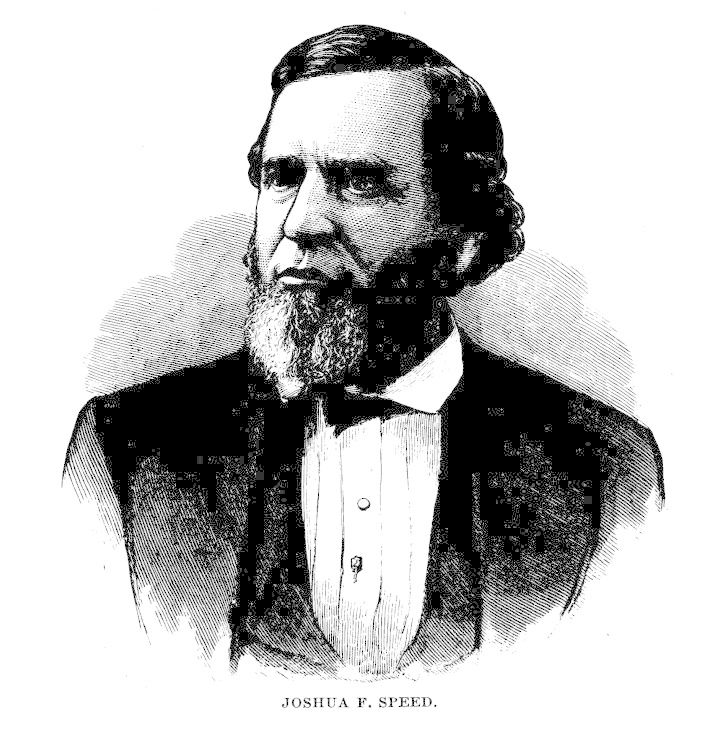
On the 24th of March, he wrote to Mr. Speed as follows:—
Springfield, March 24, 1843.
Dear Speed,—... We had a meeting of the Whigs of the county here on last Monday to appoint delegates to a district convention; and Baker beat me, and got the delegation instructed to go for him. The meeting, in spite of my attempt to decline it, appointed me one of the delegates; so that, in getting Baker the nomination, I shall be fixed a good deal like a fellow who is made a groomsman to a man that has cut him out, and is marrying his own dear "gal." About the prospects of your having a namesake at our town, can't say exactly yet.
A. Lincoln.
He was now a Baker delegate, pledged to get him the nomination if he could; and yet he was far from giving up the contest in his own behalf. Only two days after the letter to Speed, he wrote to Mr. Morris:—
Springfield, Ill., March 26, 1843.
Friend Morris,—Your letter of the 23d was received on yesterday morning, and for which (instead of an excuse, which you thought proper to ask) I tender you my sincere thanks. It is truly gratifying to me to learn, that, while the people of Sangamon have cast me off, my old friends of Menard, who have known me longest and best, stick to me. It would astonish, if not amuse, the older citizens (a stranger, friendless, uneducated, penniless boy, working on a flat-boat at ten dollars per month) to learn that I have been put down here as the candidate of pride, wealth, and aristocratic family distinction. Yet so, chiefly, it was. There was, too, the strangest combination of church-influence against me. Baker is a Campbellite; and therefore, as I suppose, with few exceptions, got all that church.
My wife has some relations in the Presbyterian churches, and some with the Episcopal churches; and therefore, wherever it would tell, I was set down as either the one or the other, while it was everywhere contended that no Christian ought to go for me, because I belonged to no church, was suspected of being a deist, and had talked about fighting a duel. With all these things, Baker, of course, had nothing to do. Nor do I complain of them. As to his own church going for him, I think that was right enough: and as to the influences I have spoken of in the other, though they were very strong, it would be grossly untrue and unjust to charge that they acted upon them in a body, or were very near so. I only mean that those influences levied a tax of a considerable per cent upon my strength throughout the religious controversy. But enough of this.
You say, that, in choosing a candidate for Congress, you have an equal right with Sangamon; and in this you are undoubtedly earnest. In agreeing to withdraw if the Whigs of Sangamon should go against me, I did not mean that they alone were worth consulting, but that if she, with her heavy delegation, should be against me, it would be impossible for me to succeed; and therefore I had as well decline. And in relation to Menard having rights, permit me fully to recognize them, and to express the opinion, that, if she and Mason act circumspectly, they will in the convention be able so far to enforce their rights as to decide absolutely which one of the candidates shall be successful. Let me show the reason of this. Hardin, or some other Morgan candidate, will get Putnam, Marshall, Woodford, Tazewell, and Logan,—make sixteen. Then you and Mason, having three, can give the victory to either side.
You say you shall instruct your delegates for me, unless I object. I certainly shall not object. That would be too pleasant a compliment for me to tread in the dust. And besides, if any thing should happen (which, however, is not probable) by which Baker should be thrown out of the fight, I would be at liberty to accept the nomination if I could get it. I do, however, feel myself bound not to hinder him in any way from getting the nomination. I should despise myself were I to attempt it. I think, then, it would be proper for your meeting to appoint three delegates, and to instruct them to go for some one as a first choice, some one else as a second, and perhaps some one as a third; and, if in those instructions I were named as the first choice, it would gratify me very much.
If you wish to hold the balance of power, it is important for you to attend to and secure the vote of Mason also. You should be sure to have men appointed delegates that you know you can safely confide in. If yourself and James Short were appointed for your county, all would be safe; but whether Jim's woman affair a year ago might not be in the way of his appointment is a question. I don't know whether you know it, but I know him to be as honorable a man as there is in the world. You have my permission, and even request, to show this letter to Short; but to no one else, unless it be a very particular friend, who you know will not speak of it.
Yours as ever,
A. Lincoln.
P. S.—Will you write me again?
To Martin M. Morris, Petersburg, 111.
And finally to Speed on the same subject:—
Springfield, May 18, 1843.
Dear Speed,—Yours of the 9th inst. is duly received, which I do not meet as a "bore," but as a most welcome visitor. I will answer the business part of it first.
In relation to our Congress matter here, you were right in supposing I would support the nominee. Neither Baker nor I, however, is the man, but Hardin, so far as I can judge from present appearances. We shall have no split or trouble about the matter,—all will be harmony. In relation to the "coming events" about which Butler wrote you, I had not heard one word before I got your letter; but I have so much confidence in the judgment of a Butler on such a subject, that I incline to think there may be some reality in it. What day does Butler appoint? By the way, how do "events" of the same sort come on in your family? Are you possessing houses and lands, and oxen and asses, and men-servants and maid-servants, and begetting sons and daughters? We are not keeping house, but boarding at the Globe Tavern, which is very well kept now by a widow lady of the name of Beck. Our room (the same Dr. Wallace occupied there) and boarding only costs us four dollars a week. Ann Todd was married something more than a year since to a fellow by the name of Campbell, and who, Mary says, is pretty much of a "dunce," though he has a little money and property. They live in Boonville, Mo., and have not been heard from lately enough for me to say any thing about her health. I reckon it will scarcely be in our power to visit Kentucky this year. Besides poverty and the necessity of attending to business, those "coming events," I suspect, would be somewhat in the way. I most heartily wish you and your Fanny would not fail to come. Just let us know the time, and we will have a room provided for you at our house, and all be merry together for a while. Be sure to give my respects to your mother and family: assure her, that, if I ever come near her, I will not fail to call and see her. Mary joins in sending love to your Fanny and you.
Yours as ever,
A. Lincoln.
After the "race," still smarting from the mortification of defeat, and the disappointment of a cherished hope, he took his old friend Jim Matheny away off to a solitary place in the woods, "and then and there," "with great emphasis," protested that he had not grown proud, and was not an aristocrat. "Jim," said he, in conclusion, "I am now, and always shall be, the same Abe Lincoln that I always was."