Volume 7 — CHAPTER XI
Reading edition
UNDER the Act of Assembly, due in great part to Mr. Lincoln's exertions, the removal of the archives and other public property of the State from Vandalia to Springfield began on the fourth day of July, 1839, and was speedily completed. At the time of the passage of the Act, in the winter of 1836-7, Mr. Lincoln determined to follow the capital, and establish his own residence at Springfield. The resolution was natural and necessary; for he had been studying law in all his intervals of leisure, and wanted a wider field than the justice's court at New Salem to begin the practice. Henceforth Mr. Lincoln might serve in the Legislature, attend to his private business, and live snugly at home. In addition to the State courts, the Circuit and District Courts of the United States sat here. The eminent John McLean of Ohio was the justice of the Supreme Court who sat in this circuit, with Judge Pope of the District Court, from 1839 to 1849, and after that with Judge Drummond. The first terms of these courts, and the first session of the Legislature at Springfield, were held in December, 1839. The Senate sat in one church, and the House in another.
Mr. Lincoln got his license as an attorney early in 1837, "and commenced practice regularly as a lawyer in the town of Springfield in March" of that year. His first case was that of Hawthorne vs. Wooldridge, dismissed at the cost of the plaintiff, for whom Mr. Lincoln's name was entered. There were then on the list of attorneys at the Springfield bar many names of subsequent renown. Judge Stephen T. Logan was on the bench of the Circuit Court under the Act of 1835. Stephen A. Douglas had made his appearance as the public prosecutor at the March term of 1836; and at the same term E. D. Baker had been admitted to practice. Among the rest were John T. Stuart, Cyrus Walker, S. H. Treat, Jesse B. Thomas, George Forquer, Dan Stone, Ninian W. Edwards, John J. Hardin, Schuyler Strong, A. T. Bledsoe, and Josiah Lamborn.
By this time Mr. Lincoln enjoyed considerable local fame as a politician, but none, of course, as a lawyer. He therefore needed a partner, and got one in the person of John T. Stuart, an able and distinguished Whig, who had relieved his poverty years before by the timely loan of books with which to study law, and who had from the first promoted his political fortunes with zeal as disinterested as it was effective. The connection promised well for Mr. Lincoln, and no doubt did well during the short period of its existence. The courtroom was in Hoffman's Row; and the office of Stuart & Lincoln was in the second story above the court-room. It was a "little room," and generally a "dirty one." It contained "a small dirty bed,"—on which Lincoln lounged and slept,—a buffalo-robe, a chair, and a bench. Here the junior partner, when disengaged from the cares of politics and the Legislature, was to be found pretty much all the time, "reading, abstracted and gloomy." Springfield was a small village, containing between one and two thousand inhabitants. There were no pavements: the street-crossings were made of "chunks," stones, and sticks. Lincoln boarded with Hon. William Butler, a gentleman who possessed in an eminent degree that mysterious power which guides the deliberations of party conventions and legislative bodies to a foregone conclusion. Lincoln was very poor, worth nothing, and in debt,—circumstances which are not often alleged in behalf of the modern legislator; but "Bill Butler" was his friend, and took him in with little reference to board-bills and the settlement of accounts. According to Dr. Jayne, he "fed and clothed him for years;" and this signal service, rendered at a very critical time, Mr. Lincoln forgot wholly when he was in Congress, and Butler wanted to be Register of the Land Office, as well as when he was President of the United States, and opportunities of repayment were multitudinous. It is doubtless all true; but the inference of personal ingratitude on the part of Mr. Lincoln will not bear examination. It will be shown at another place that Mr. Lincoln regarded all public offices within his gift as a sacred trust, to be administered solely for the people, and as in no sense a fund upon which he could draw for the payment of private accounts. He never preferred his friends to his enemies, but rather the reverse, as if fearful that he might by bare possibility be influenced by some unworthy motive. He was singularly cautious to avoid the imputation of fidelity to his friends at the expense of his opponents.
In Coke's and Blackstone's time the law was supposed to be "a jealous mistress;" but in Lincoln's time, and at Springfield, she was any thing but exacting. Politicians courted her only to make her favor the stepping-stone to success in other employments. Various members of that bar have left great reputations to posterity, but none of them were earned solely by the legitimate practice of the law. Douglas is remembered as a statesman, Baker as a political orator, Hardin as a soldier, and some now living, like Logan and Stuart, although eminent in the law, will be no less known to the history of the times as politicians than as lawyers. Among those who went to the law for a living, and to the people for fame and power, was Mr. Lincoln. He was still a member of the Legislature when he settled at Springfield, and would probably have continued to run for a seat in that body as often as his time expired, but for the unfortunate results of the "internal-improvement system," the hopeless condition of the State finances, and a certain gloominess of mind, which arose from private misfortunes that befell him about the time of his retirement. We do not say positively that these were the reasons why Mr. Lincoln made no effort to be re-elected to the Legislature of 1840; but a careful study of all the circumstances will lead any reasonable man to believe that they were. He was intensely ambitious, longed ardently for place and distinction, and never gave up a prospect which seemed to him good when he was in a condition to pursue it with honor to himself and fairness to others. Moreover State politics were then rapidly ceasing to be the high-road to fame and fortune. Although the State of Illinois was insolvent, unable to pay the interest on her public debt, and many were talking about repudiating the principal, the great campaign of 1840 went off upon national issues, and little or nothing was said about questions of State policy. Mr. Lincoln felt and obeyed this tendency of the public mind, and from 1837 onward his speeches—those that were printed and those that were not—were devoted chiefly, if not exclusively, to Federal affairs.
In January, 1837, he delivered a lecture before the Springfield Lyceum on the subject of the "Perpetuation of our Free Institutions." As a mere declamation, it is unsurpassed in the annals of the West. Although delivered in mid-winter, it is instinct with the peculiar eloquence of the most fervid Fourth of July.
"In the great journal of things," began the orator, "happening under the sun, we, the American People, find our account running under date of the nineteenth century of the Christian era. We find ourselves in the peaceful possession of the fairest portion of the earth, as regards extent of territory, fertility of soil, and salubrity of climate. We find ourselves under the government of a system of political institutions conducing more essentially to the ends of civil and religious liberty than any of which the history of former times tells us. We, when mounting the stage of existence, found ourselves the legal inheritors of these fundamental blessings. We toiled not in the acquisition or establishment of them: they are a legacy bequeathed us by a once hardy, brave, and patriotic, but now lamented and departed race of ancestors. Theirs was the task (and nobly they performed it) to possess themselves, and, through themselves, us, of this goodly land, and to uprear upon its hills and valleys a political edifice of liberty and equal rights: 'tis ours only to transmit these—the former unprofaned by the foot of an invader, the latter undecayed by the lapse of time and untorn by usurpation—to the latest generation that fate shall permit the world to know. This task, gratitude to our fathers, justice to ourselves, duty to posterity,—all imperatively require us faithfully to perform.
"How, then, shall we perform it? At what point shall we expect the approach of danger? Shall we expect some transatlantic military giant to step the ocean and crush us at a blow? Never! All the armies of Europe, Asia, and Africa combined, with all the treasure of the earth (our own excepted) in their military chest, with a Bonaparte for a commander, could not, by force, take a drink from the Ohio, or make a track on the Blue Ridge, in a trial of a thousand years!
"At what point, then, is the approach of danger to be expected? I answer, if it ever reach us, it must spring up amongst us. It cannot come from abroad. If destruction be our lot, we must ourselves be its author and finisher. As a nation of freemen, we must live through all time, or die by suicide.
"I hope I am not over-wary; but, if I am not, there is even now something of ill-omen amongst us. I mean the increasing disregard for law which pervades the country, the growing disposition to substitute the wild and furious passions in lieu of the sober judgment of courts, and the worse than savage mobs for the executive ministers of justice. This disposition is awfully fearful in any community, and that it now exists in ours, though grating to our feelings to admit it, it would be a violation of truth and an insult to our intelligence to deny. Accounts of outrages committed by mobs form the every-day news of the times. They have pervaded the country from New England to Louisiana; they are neither peculiar to the eternal snows of the former, nor the burning sun of the latter. They are not the creature of climate; neither are they confined to the slaveholding or non-slaveholding States. Alike they spring up among the pleasure-hunting masters of Southern slaves and the order-loving citizens of the land of steady habits. Whatever, then, their cause may be, it is common to the whole country."
The orator then adverts to the doings of recent mobs in various parts of the country, and insists, that, if the spirit that produced them continues to increase, the laws and the government itself must fall before it: bad citizens will be encouraged, and good ones, having no protection against the lawless, will be glad to receive an individual master who will be able to give them the peace and order they desire. That will be the time when the usurper will put down his heel on the neck of the people, and batter down the "fair fabric" of free institutions. "Many great and good men," he says, "sufficiently qualified for any task they should undertake, may ever be found, whose ambition would aspire to nothing beyond a seat in Congress, a gubernatorial or a presidential chair; but such belong not to the family of the lion or the tribe of the eagle.1 What! Think you these places would satisfy an Alexander, a Cæsar, or a Napoleon? Never! Towering genius disdains a beaten path. It seeks regions hitherto unexplored. It sees no distinction in adding story to story upon the monuments of fame erected to the memory of others. It denies that it is glory enough to serve under any chief. It scorns to tread in the footsteps of any predecessor, however illustrious. It thirsts and burns for distinction; and, if possible, it will have it, whether at the expense of emancipating slaves or enslaving freemen.... Another reason which once was, but which, to the same extent, is now no more, has done much in maintaining our institutions thus far. I mean the powerful influence which the interesting scenes of the Revolution had upon the passions of the people as distinguished from their judgment." This influence, the lecturer maintains, was kept alive by the presence of the surviving soldiers of the Revolution, who were in some sort "living histories," and concludes with this striking peroration:—
"But those histories are gone. They can be read no more forever. They were a fortress of strength; but what invading foeman could never do, the silent artillery of time has done,—the levelling of its walls. They are gone. They were a forest of giant oaks; but the all-resistless hurricane has swept over them, and left only here and there a lonely trunk, despoiled of its verdure, shorn of its foliage, unshading and unshaded, to murmur in a few more gentle breezes, and to combat with its mutilated limbs a few more rude storms, then to sink and be no more. They were the pillars of the temple of liberty; and now that they have crumbled away, that temple must fall, unless we, the descendants, supply their places with other pillars hewn from the same solid quarry of sober reason. Passion has helped us, but can do so no more. It will in future be our enemy. Reason—cold, calculating, unimpassioned reason—must furnish all the materials for our future support and defence. Let those materials be moulded into general intelligence, sound morality, and, in particular, a reverence for the Constitution and the laws; and that we improved to the last, that we revered his name to the last, that during his long sleep we permitted no hostile foot to pass or desecrate his resting-place, shall be that which to learn the last trump shall awaken our Washington. Upon these let the proud fabric of freedom rest as the rock of its basis, and as truly as has been said of the only greater institution, 'The gates of hell shall not prevail against it."'
1 The italics are the orator's.
These extracts from a lecture carefully composed by Mr. Lincoln at the mature age of twenty-eight, and after considerable experience in the public service, are worthy of attentive perusal. To those familiar with his sober and pure style at a later age, these sophomoric passages will seem incredible. But they were thought "able and eloquent" by the "Young Men's Lyceum" of Springfield: he was "solicited to furnish a copy for publication," and they were duly printed in "The Sangamon Journal." In the mere matter of rhetoric, they compare favorably with some of his other productions of nearly the same date. This was what he would have called his "growing time;" and it is intensely interesting to witness the processes of such mental growth as his. In time, gradually, but still rapidly, his style changes completely: the constrained and unnatural attempts at striking and lofty metaphor disappear, and the qualities which produced the Gettysburg address—that model of unadorned eloquence—begin to be felt. He finds the people understand him better when he comes down from his stilts, and talks to them from their own level.
Political discussions at Springfield were apt to run into heated and sometimes unseemly personal controversies. When Douglas and Stuart were candidates for Congress in 1838, they fought like tigers in Herndon's grocery, over a floor that was drenched with slops, and gave up the struggle only when both were exhausted. Then, as a further entertainment to the populace, Mr. Stuart ordered out a "barrel of whiskey and wine."
On the election-day in 1840, it was reported to Mr. Lincoln that one Radford, a contractor on the railroad, had brought up his men, and taken full possession of one of the polling-places. Lincoln started off to the precinct on a slow trot. Radford knew him well, and a little stern advice reversed proceedings without any fighting. Among other remarks, Lincoln said, "Radford, you'll spoil and blow if you live much longer." He wanted to hit Radford, but could get no chance to do so, and contented himself with confiding his intentions to Speed. "I intended just to knock him down, and leave him kicking."
The same year, Col. Baker was making a speech to a promiscuous audience in the court-room,—"a rented room in Hoffman's Row." It will be remembered that Lincoln's office was just above, and he was listening to Baker through a large hole or trap-door in the ceiling. Baker warmed with his theme, and, growing violent and personally offensive, declared at length, "that wherever there was a land-office, there was a Democratic newspaper to defend its corruptions." "This," says John B. Webber, "was a personal attack on my brother, George Webber. I was in the Court House, and in my anger cried, 'Pull him down!'" A scene of great confusion ensued, threatening to end in a general riot, in which Baker was likely to suffer. But just at the critical moment Lincoln's legs were seen coming through the hole; and directly his tall figure was standing between Baker and the audience, gesticulating for silence. "Gentlemen," said he, "let us not disgrace the age and country in which we live. This is a land where freedom of speech is guaranteed. Mr Baker has a right to speak, and ought to be permitted to do so. I am here to protect him, and no man shall take him from this stand if I can prevent it." Webber only recollects that "some one made some soothing, kind remarks," and that he was properly "held until the excitement ceased," and the affair "soon ended in quiet and peace."
In 1838, or 1840, Jesse B. Thomas made an intemperate attack upon the "Long Nine," and especially upon Mr. Lincoln, as the longest and worst of them. Lincoln was not present at the meeting; but being sent for, and informed of what had passed, he ascended the platform, and made a reply which nobody seems to remember, but which everybody describes as a "terrible skinning" of his victim. Ellis says, that, at the close of a furious personal denunciation, he wound up by "mimicking" Thomas, until Thomas actually cried with vexation and anger. Edwards, Speed, Ellis, Davis, and many others, refer to this scene, and, being asked whether Mr. Lincoln could not be vindictive upon occasion, generally respond, "Remember the Thomas skinning."
The most intimate friend Mr. Lincoln ever had, at this or any other time, was probably Joshua F. Speed. In 1836 he settled himself in Springfield, and did a thriving business as a merchant. Ellis was one of his clerks, and so also was William H. Herndon, Mr. Lincoln's future partner. This store was for years Lincoln's familiar haunt. There he came to while away the tedious evenings with Speed and the congenial company that naturally assembled around these choice spirits. He even slept in the store room as often as he slept at home, and here made to Speed the most confidential communications he ever made to mortal man. If he had on earth "a bosom crony," it was Speed, and that deep and abiding attachment subsisted unimpaired to the day of Mr. Lincoln's death. In truth, there were good reasons why he should think of Speed with affection and gratitude, for through life no man rendered him more important services.
One night in December, 1839, Lincoln, Douglas, Baker, and some other gentlemen of note, were seated at Speed's hospitable fire in the store. They got to talking politics, got warm, hot, angry. Douglas sprang up and said, "Gentlemen, this is no place to talk politics: we will discuss the questions publicly with you," and much more in a high tone of banter and defiance. A few days afterwards the Whigs had a meeting, at which Mr. Lincoln reported a resolution challenging the Democrats to a joint debate. The challenge was accepted; and Douglas, Calhoun, Lamborn, and Jesse B. Thomas were deputed by the Democrats to meet Logan, Baker, Browning, and Lincoln on the part of the Whigs. The intellectual encounter between these noted champions is still described by those who witnessed it as "the great debate." It took place in the Second Presbyterian Church, in the hearing of as many people as could get into the building, and was adjourned from night to night. When Mr. Lincoln's turn came, the audience was very thin; but, for all that, his speech was by many persons considered the best one of the series. To this day, there are some who believe he had assistance in the preparation of it. Even Mr. Herndon accused Speed of having "had a hand in it," and got a flat denial for his answer. At all events, the speech was a popular success, and was written out, and published in "The Sangamon Journal," of March 6, 1840. The exordium was a sort of complaint that must have had a very depressing effect upon both the speaker and his hearers:—
"Fellow-Citizens,—It is peculiarly embarrassing to me to attempt a continuance of the discussion, on this evening, which has been conducted in this hall on several preceding ones. It is so, because on each of these evenings there was a much fuller attendance than now, without any reason for its being so, except the greater interest the community feel in the speakers who addressed them then, than they do in him who is to do so now. I am, indeed, apprehensive that the few who have attended have done so more to spare me of mortification, than in the hope of being interested in any thing I may be able to say. This circumstance casts a damp upon my spirits which I am sure I shall be unable to overcome during the evening.
"The subject heretofore and now to be discussed is the Sub-Treasury scheme of the present administration, as a means of collecting, safe-keeping, transferring, and disbursing the revenues of the nation, as contrasted with a National Bank for the same purposes. Mr. Douglas has said that we (the Whigs) have not dared to meet them (the Locos) in argument on this question. I protest against this assertion. I say we have again and again, during this discussion, urged facts and arguments against the Sub-Treasury which they have neither dared to deny nor attempted to answer. But lest some may be led to believe that we really wish to avoid the question, I now propose, in my humble way, to urge these arguments again; at the same time begging the audience to mark well the positions I shall take, and the proofs I shall offer to sustain them, and that they will not again allow Mr. Douglas or his friends to escape the force of them by a round and groundless assertion that we dare not meet them in argument.
"Of the Sub-Treasury, then, as contrasted with a National Bank, for the before-enumerated purposes, I lay down the following propositions, to wit:—
"1st. It will injuriously affect the community by its operation on the circulating medium.
"2d. It will be a more expensive fiscal agent.
"3d. It will be a less secure depository for the public money."
Mr. Lincoln's objections to the Sub-Treasury were those commonly urged by its enemies, and have been somewhat conclusively refuted by the operation of that admirable institution from the hour of its adoption to the present. "The extravagant expenditures" of Mr. Van Buren's administration, however, was a standard topic of the Whigs in those days, and, sliding gracefully off from the Sub-Treasury, Mr. Lincoln dilated extensively upon this more attractive subject. This part of his speech was entirely in reply to Mr. Douglas. But, when he came to answer Mr. Lamborn's remarks, he "got in a hard hit" that must have brought down the house.
"Mr. Lamborn insists that the difference between the Van Buren party and the Whigs is, that, although the former sometimes err in practice, they are always correct in principle, whereas the latter are wrong in principle; and, the better to impress this proposition, he uses a figurative expression in these words: 'The Democrats are vulnerable in the heel, but they are sound in the heart and head.' The first branch of the figure,—that is, that the Democrats are vulnerable in the heel,—I admit is not merely figuratively but literally true. Who that looks but for a moment at their Swartwouts, their Prices, their Harringtons, and their hundreds of others, scampering away with the public money to Texas, to Europe, and to every spot of the earth where a villain may hope to find refuge from justice, can at all doubt that they are most distressingly affected in their heels with a species of 'running itch.' It seems that this malady of their heels operates on the sound-headed and honest-hearted creatures very much like the cork-leg in the comic song did on its owner, which, when he had once got started on it, the more he tried to stop it, the more it would run away. At the hazard of wearing this point threadbare, I will relate an anecdote which seems to be too strikingly in point to be omitted. A witty Irish soldier who was always boasting of his bravery when no danger was near, but who invariably retreated without orders at the first charge of the engagement, being asked by his captain why he did so, replied, 'Captain, I have as brave a heart as Julius Cæsar ever had, but somehow or other, whenever danger approaches, my cowardly legs will run away with it.' So with Mr. Lamborn's party. They take the public money into their hands for the most laudable purpose that wise heads and honest hearts can dictate; but, before they can possibly get it out again, their rascally vulnerable heels will run away with them."
But, as in the lecture before the Lyceum, Mr. Lincoln reserved his most impressive passage, his boldest imagery, and his most striking metaphor, for a grand and vehement peroration.
"Mr. Lamborn refers to the late elections in the States, and, from their results, confidently predicts every State in the Union will vote for Mr. Van Buren at the next presidential election. Address that argument to cowards and knaves: with the free and the brave it will affect nothing. It may be true: if it must, let it. Many free countries have lost their liberty, and ours may lose hers; but, if she shall, be it my proudest plume, not that I was the last to desert, but that I never deserted her. I know that the great volcano at Washington, aroused and directed by the evil spirit that reigns there, is belching forth the lava of political corruption in a current broad and deep, which is sweeping with frightful velocity over the whole length and breadth of the land, bidding fair to leave unscathed no green spot or living thing; while on its bosom are riding, like demons on the wave of hell, the imps of that evil spirit, and fiendishly taunting all those who dare to resist its destroying course with the hopelessness of their efforts; and, knowing this, I cannot deny that all may be swept away. Broken by it, I, too, may be; bow to it, I never will. The probability that we may fall in the struggle ought not to deter us from the support of a cause we believe to be just. It shall not deter me. If ever I feel the soul within me elevate and expand to those dimensions, not wholly unworthy of its almighty Architect, it is when I contemplate the cause of my country, deserted by all the world beside, and I standing up boldly, alone, hurling defiance at her victorious oppressors. Here, without contemplating consequences, before Heaven and in face of the world, I swear eternal fealty to the just cause, as I deem it, of the land of my life, my liberty, and my love. And who that thinks with me will not fearlessly adopt that oath that I take? Let none falter who thinks he is right, and we may succeed. But if, after all, we shall fail, be it so: we still shall have the proud consolation of saying to our consciences, and to the departed shade of our country's freedom, that the cause approved of our judgment and adored of our hearts, in disaster, in chains, in torture, in death, we never faltered in defending."
Considering that the times were extremely peaceful, and that the speaker saw no bloodshed except what flowed from the noses of belligerents in the groceries about Springfield, the speech seems to have been unnecessarily defiant.
In 1840 Mr. Lincoln was a candidate for presidential elector on the Harrison ticket, and stumped a large part of the State. He and Douglas followed Judge Treat's court all around the circuit, "and spoke in the afternoons." The Harrison club at Springfield became thoroughly familiar with his voice. But these one-sided affairs were not altogether suited to his temper: through his life he preferred a joint discussion, and the abler the man pitted against him, the better he liked it. He knew he shone in retort, and sought every opportunity to practise it. From 1838 to 1858, he seems to have followed up Douglas as a regular business during times of great political excitement, and only on one or two occasions did he find the "Little Giant" averse to a conflict. Here, in 1840, they came in collision, as they did in 1839, and as they continued to do through twenty or more years, until Lincoln became President of the United States, and Douglas's disappointments were buried with his body. Once during this Harrison campaign they had a fierce discussion before a meeting assembled in the market-house. In the course of his speech, Lincoln imputed to Van Buren the great sin of having voted in the New York State Convention for negro suffrage with a property qualification. Douglas denied the fact; and Lincoln attempted to prove his statement by reading a certain passage from Holland's "Life of Van Buren," containing a letter from Van Buren to one Mr. Fithian. Whereupon "Douglas got mad," snatched up the book, and, tossing it into the crowd, remarked sententiously, although not conclusively, "Damn such a book!"
"He was very sensitive," says Mr. Gillespie, "where he thought he had failed to come up to the expectations of his friends. I remember a case. He was pitted by the Whigs, in 1840, to debate with Mr. Douglas, the Democratic champion. Lincoln did not come up to the requirements of the occasion. He was conscious of his failure; and I never saw any man so much distressed. He begged to be permitted to try it again, and was reluctantly indulged; and in the next effort he transcended our highest expectations. I never heard, and never expect to hear, such a triumphant vindication as he then gave of Whig measures or policy. He never after, to my knowledge, fell below himself."
It must by this time be clear to the reader that Mr. Lincoln was never agitated by any passion more intense than his wonderful thirst for distinction. There is good evidence that it furnished the feverish dreams of his boyhood; and no man that knew him well can doubt that it governed all his conduct, from the hour when he astonished himself by his oratorical success against Posey and Ewing, in the back settlements of Macon County, to the day when the assassin marked him as the first hero of the restored Union, re-elected to his great office, surrounded by every circumstance that could minister to his pride, or exalt his sensibilities,—a ruler whose power was only less wide than his renown. He never rested in the race he had determined to run; he was ever ready to be honored; he struggled incessantly for place. There is no instance where an important office seemed to be within his reach, and he did not try to get it. Whatsoever he did in politics, at the bar, in private life, had more or less reference to this great object of his life. It is not meant to be said that he was capable of any shameful act, any personal dishonor, any surrender or concealment of political convictions. In these respects, he was far better than most men. It was not in his nature to run away from the fight, or to desert to the enemy; but he was quite willing to accept his full share of the fruits of victory.
Born in the humblest circumstances, uneducated, poor, acquainted with flatboats and groceries, but a stranger to the drawing-room, it was natural that he should seek in a matrimonial alliance those social advantages which he felt were necessary to his political advancement. This was, in fact, his own view of the matter; but it was strengthened and enforced by the counsels of those whom he regarded as friends.
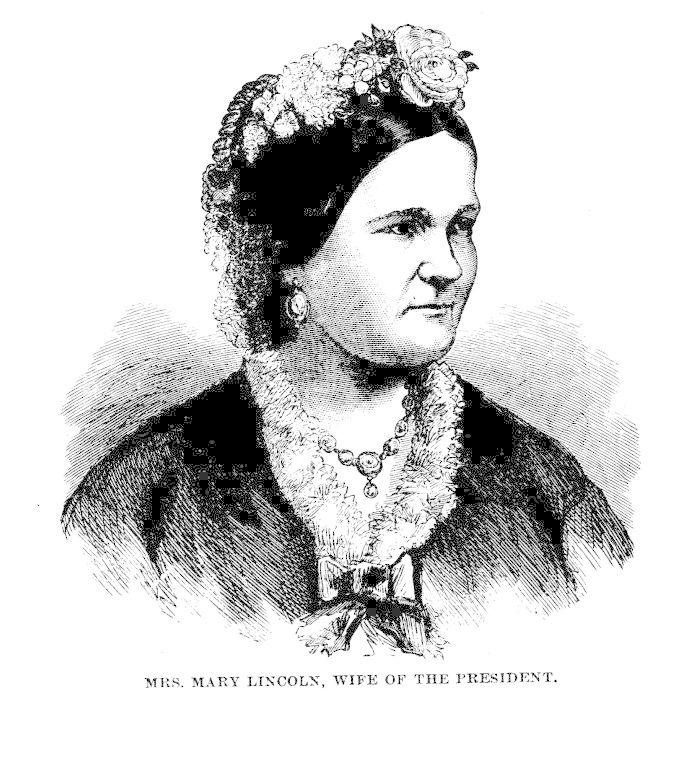
In 1839 Miss Mary, daughter of Hon. Robert S. Todd of Lexington, Ky., came to live with her sister, Mrs. Ninian W. Edwards, at Springfield. Like Miss Owens, Miss Todd had a stepmother, with whom she failed to "agree," and for that reason the Edwardses offered her a home with them. She was young,—just twenty-one,—her family was of the best, and her connections in Illinois among the most refined and distinguished people. Her mother having died when she was a little girl, she had been educated under the care of a French lady, "opposite Mr. Clay's." She was gifted with rare talents, had a keen sense of the ridiculous, a ready insight into the weaknesses of individual character, and a most fiery and ungovernable temper. Her tongue and her pen were equally sharp. High-bred, proud, brilliant, witty, and with a will that bent every one else to her purpose, she took Mr. Lincoln captive the very moment she considered it expedient to do so.
Mr. Lincoln was a rising politician, fresh from the people, and possessed of great power among them: Miss Todd was of aristocratic and distinguished family, able to lead through the awful portals of "good society" whomsoever they chose to countenance. It was thought that a union between them could not fail of numerous benefits to both parties. Mr. Edwards thought so; Mrs. Edwards thought so; and it was not long before Mary Todd herself thought so. She was very ambitious, and even before she left Kentucky announced her belief that she was "destined to be the wife of some future President." For a little while she was courted by Douglas as well as by Lincoln; but she is said to have refused the "Little Giant," "on account of his bad morals." Being asked which of them she intended to have, she answered, "The one that has the best chance of being President." She decided in favor of Lincoln, and, in the opinion of some of her husband's friends, aided to no small extent in the fulfilment of the prophecy which the bestowal of her hand implied. A friend of Miss Todd was the wife of an elderly but wealthy gentleman; and being asked by one of the Edwards coterie why she had married "such an old, dried-up husband, such a withered-up old buck," she answered that "He had lots of horses and gold." But Mary Todd spoke up in great surprise, and said, "Is that true? I would rather marry a good man, a man of mind, with hope and bright prospects ahead for position, fame, and power, than to marry all the horses, gold, and bones in the world."
Mrs. Edwards, Miss Todd's sister, tells us that Mr. Lincoln "was charmed with Mary's wit and fascinated with her quick sagacity, her will, her nature and culture." "I have happened in the room," she says, "where they were sitting often and often, and Mary led the conversation. Lincoln would listen, and gaze on her as if drawn by some superior power,—irresistibly so: he listened, but never scarcely said a word.... Lincoln could not hold a lengthy conversation with a lady,—was not sufficiently educated and intelligent in the female line to do so."
Mr. Lincoln and Mary were engaged, and their marriage was only a question of time. But Mr. Lincoln's love-affairs were destined never to run smoothly, and now one Miss Matilda Edwards made her "sweet appearance," and brought havoc in her train. She was the sister of Ninian W. Edwards, and came to spend a year with her brother. She was very fair, and soon was the reigning belle. No sooner did Lincoln know her than he felt his heart change. The other affair, according to the Edwardses, according to Stuart, according to Herndon, according to Lincoln and everybody else, was a "policy match;" but this was love. For a while he evidently tried hard to go on as before, but his feelings were too strong to be concealed. Mr. Edwards endeavored to reconcile matters by getting his sister to marry Speed; but the rebellious beauty refused Speed incontinently (as she did Douglas too), and married Mr. Schuyler Strong. Poor Lincoln never whispered a word of his passion to her: his high sense of honor prevented that, and perhaps she would not have listened to him if it had been otherwise.
At length, after long reflection, in great agony of spirit, Mr. Lincoln concluded that duty required him to make a candid statement of his feelings to the lady who was entitled to his hand. He wrote her a letter, and told her gently but plainly that he did not love her. He asked Speed to deliver it; but Speed advised him to burn it. "Speed," said Mr. Lincoln, "I always knew you were an obstinate man. If you won't deliver it, I'll get some one else to do it." But Speed now had the letter in his hand; and, emboldened by the warm friendship that existed between them, replied, "I shall not deliver it, nor give it to you to be delivered. Words are forgotten, misunderstood, passed by, not noticed in a private conversation; but once put your words in writing, and they stand as a living and eternal monument against you. If you think you have will and manhood enough to go and see her, and speak to her what you say in that letter, you may do that." Lincoln went to see her forthwith, and reported to Speed. He said, that, when he made his somewhat startling communication, she rose and said, "'The deceiver shall be deceived: woe is me!' alluding to a young man she had fooled." Mary told him she knew the reason of his change of heart, and released him from his engagement. Some parting endearments took place between them, and then, as the natural result of those endearments, a reconciliation.
We quote again from Mrs. Edwards:—
"Lincoln and Mary were engaged; every thing was ready and prepared for the marriage, even to the supper. Mr. Lincoln failed to meet his engagement. Cause, insanity!
"In his lunacy he declared he hated Mary and loved Miss Edwards. This is true, yet it was not his real feelings. A crazy man hates those he loves when at himself. Often, often, is this the case. The world had it that Mr. Lincoln backed out, and this placed Mary in a peculiar situation; and to set herself right, and free Mr. Lincoln's mind, she wrote a letter to Mr. Lincoln, stating that she would release him from his engagement.... The whole of the year was a crazy spell. Miss Edwards was at our house, say a year. I asked Miss Edwards if Mr. Lincoln ever mentioned the subject of his love to her. Miss Edwards said, 'On my word, he never mentioned such a subject to me: he never even stooped to pay me a compliment.'"
In the language of Mr. Edwards, "Lincoln went as crazy as a loon," and was taken to Kentucky by Speed, who kept him "until he recovered." He "did not attend the Legislature in 1841-2 for this reason."
Mr. Herndon devoutly believes that Mr. Lincoln's insanity grew out of a most extraordinary complication of feelings,—aversion to the marriage proposed, a counter-attachment to Miss Edwards, and a new access of unspeakable tenderness for the memory of Ann Rutledge,—the old love struggling with a new one, and each sending to his heart a sacrificial pang as he thought of his solemn engagement to marry a third person. In this opinion Mr. Speed appears to concur, as shown by his letter below. At all events, Mr. Lincoln's derangement was nearly, if not quite, complete. "We had to remove razors from his room," says Speed, "take away all knives, and other dangerous things. It was terrible." And now Speed determined to do for him what Bowlin Greene had done on a similar occasion at New Salem. Having sold out his store on the 1st of January, 1841, he took Mr. Lincoln with him to his home in Kentucky, and kept him there during most of the summer and fall, or until he seemed sufficiently restored to be given his liberty again at Springfield, when he was brought back to his old quarters. During this period, "he was at times very melancholy," and, by his own admission, "almost contemplated self-destruction." It was about this time that he wrote some gloomy lines under the head of "Suicide," which were published in "The Sangamon Journal." Mr. Herndon remembered something about them; but, when he went to look for them in the office-file of the "Journal," he found them neatly cut out,—"supposed to have been done," says he, "by Lincoln." Speed's mother was much pained by the "deep depression" of her guest, and gave him a Bible, advising him to read it, to adopt its precepts, and pray for its promises. He acknowledged this attempted service, after he became President, by sending her a photograph of himself, with this inscription: "To my very good friend, Mrs. Lucy G. Speed, from whose pious hands I received an Oxford Bible twenty years ago." But Mrs. Speed's medicine, the best ever offered for a mind diseased, was of no avail in this case. Among other things, he told Speed, referring probably to his inclination to commit suicide, "that he had done nothing to make any human being remember that he had lived, and that to connect his name with the events transpiring in his day and generation, and so impress himself upon them as to link his name with something that would redound to the interest of his fellow-man, was what he desired to live for." Of this conversation he pointedly reminded Speed at the time, or just before the time, he issued the Emancipation Proclamation.
What took place after his return to Springfield cannot be better told than in the words of the friends of both parties. "Mr. Edwards and myself," says Mrs. Edwards, "after the first crash of things, told Mary and Lincoln that they had better not ever marry; that their natures, minds, education, raising, &c., were so different, that they could not live happy as man and wife; had better never think of the subject again. All at once we heard that Mr. Lincoln and Mary had secret meetings at Mr. S. Francis's, editor of 'The Springfield Journal.' Mary said the reason this was so, the cause why it was, was that the world, woman and man, were uncertain and slippery, and that it was best to keep the secret courtship from all eyes and ears. Mrs. Lincoln told Mr. Lincoln, that, though she had released him in the letter spoken of, yet she would hold the question an open one,—that is, that she had not changed her mind, but felt as always.... The marriage of Mr. Lincoln and Mary was quick and sudden,—one or two hours' notice." How poor Mr. Lincoln felt about it, may be gathered from the reminiscences of his friend, J. H. Matheny, who says, "that Lincoln and himself, in 1842, were very friendly; that Lincoln came to him one evening and said, 'Jim, I shall have to marry that girl.'" He was married that evening, but Matheny says, "he looked as if he was going to the slaughter," and that Lincoln "had often told him, directly and individually, that he was driven into the marriage; that it was concocted and planned by the Edwards family; that Miss Todd—afterwards Mrs. Lincoln—was crazy for a week or so, not knowing what to do; and that he loved Miss Edwards, and went to see her, and not Mrs. Lincoln."
The license to marry was issued on the 4th of November, 1842, and on the same day the marriage was celebrated by Charles Dresser, "M.G." With this date carefully borne in mind, the following letters are of surpassing interest. They are relics, not only of a great man, but of a great agony.
The first is from Mr. Speed to Mr. Herndon, and explains the circumstances under which the correspondence took place. Although it is in part a repetition of what the reader already knows, it is of such peculiar value, that we give it in full:—
W. H. Herndon, Esq.
Dear Sir,—I enclose you copies of all the letters of any interest from Mr. Lincoln to me.
Some explanation may be needed, that you may rightly understand their import.
In the winter of 1840 and 1841 he was unhappy about his engagement to his wife,—not being entirely satisfied that his heart was going with his hand. How much he suffered then on that account, none know so well as myself: he disclosed his whole heart to me.
In the summer of 1841 I became engaged to my wife. He was here on a visit when I courted her; and, strange to say, something of the same feeling which I regarded as so foolish in him took possession of me, and kept me very unhappy from the time of my engagement until I was married.
This will explain the deep interest he manifested in his letters on my account.
Louisville, Nov. 30, 1866.
If you use the letters (and some of them are perfect gems) do it care fully, so as not to wound the feelings of Mrs. Lincoln.
One thing is plainly discernible: if I had not been married and happy,—far more happy than I ever expected to be,—he would not have married.
I have erased a name which I do not wish published. If I have failed to do it anywhere, strike it out when you come to it. That is the word———.
I thank you for your last lecture. It is all new to me, but so true to my appreciation of Lincoln's character, that, independent of my knowledge of you, I would almost swear to it.
Lincoln wrote a letter (a long one, which he read to me) to Dr. Drake, of Cincinnati, descriptive of his case. Its date would be in December, 1840, or early in January, 1841. I think that he must have informed Dr. D. of his early love for Miss Rutledge, as there was a part of the letter which he would not read.
It would be worth much to you, if you could procure the original.
Charles D. Drake, of St. Louis, may have his father's papers. The date which I give you will aid in the search.
I remember Dr. Drake's reply, which was, that he would not undertake to prescribe for him without a personal interview. I would advise you to make some effort to get the letter.
Your friend, &c.,
J. F. Speed.
The first of the papers from Mr. Lincoln's pen is a letter of advice and consolation to his friend, for whom he apprehends the terrible things through which, by the help of that friend, he has himself just passed.
My dear Speed,—Feeling, as you know I do, the deepest solicitude for the success of the enterprise you are engaged in, I adopt this as the last method I can invent to aid you, in case (which God forbid) you shall need any aid. I do not place what I am going to say on paper, because I can say it better in that way than I could by word of mouth; but, were I to say it orally before we part, most likely you would forget it at the very time when it might do you some good. As I think it reasonable that you will feel very badly sometime between this and the final consummation of your purpose, it is intended that you shall read this just at such a time. Why I say it is reasonable that you will feel very badly yet, is because of three special causes added to the general one which I shall mention.
The general cause is, that you are naturally of a nervous temperament, and this I say from what I have seen of you personally, and what you have told me concerning your mother at various times, and concerning your brother William at the time his wife died. The first special cause is your exposure to bad weather on your journey, which my experience clearly proves to be very severe on defective nerves. The second is the absence of all business and conversation of friends, which might divert your mind, give it occasional rest from the intensity of thought which will sometimes wear the sweetest idea threadbare, and turn it to the bitterness of death.
The third is the rapid and near approach of that crisis on which all your thoughts and feelings concentrate.
If from all these causes you shall escape, and go through triumphantly, without another "twinge of the soul," I shall be most happily but most egregiously deceived. If, on the contrary, you shall, as I expect you will at some time, be agonized and distressed, let me, who have some reason to speak with judgment on such a subject, beseech you to ascribe it to the causes I have mentioned, and not to some false and ruinous suggestion of the Devil.
"But," you will say, "do not your causes apply to every one engaged in a like undertaking?" By no means. The particular causes, to a greater or less extent, perhaps, do apply in all cases; but the general one,—nervous debility, which is the key and conductor of all the particular ones, and without which they would be utterly harmless, though it does pertain to you,—does not pertain to one in a thousand. It is out of this that the painful difference between you and the mass of the world springs.
I know what the painful point with you is at all times when you are unhappy: it is an apprehension that you do not love her as you should. What nonsense! How came you to court her? Was it because you thought she deserved it, and that you had given her reason to expect it? If it was for that, why did not the same reason make you court Ann Todd, and at least twenty others of whom you can think, and to whom it would apply with greater force than to her? Did you court her for her wealth? Why, you know she had none. But you say you reasoned yourself into it. What do you mean by that? Was it not that you found yourself unable to reason yourself out of it? Did you not think, and partly form the purpose, of courting her the first time you ever saw her or heard of her? What had reason to do with it at that early stage? There was nothing at that time for reason to work upon. Whether she was moral, amiable, sensible, or even of good character, you did not, nor could then know, except, perhaps, you might infer the last from the company you found her in.
All you then did or could know of her was her personal appearance and deportment; and these, if they impress at all, impress the heart, and not the head.
Say candidly, were not those heavenly black eyes the whole basis of all your early reasoning on the subject? After you and I had once been at the residence, did you not go and take me all the way to Lexington and back, for no other purpose but to get to see her again, on our return on that evening to take a trip for that express object?
What earthly consideration would you take to find her scouting and despising you, and giving herself up to another? But of this you have no apprehension; and therefore you cannot bring it home to your feelings.
I shall be so anxious about you, that I shall want you to write by every mail. Your friend,
Lincoln.
Springfield, Ill., Feb. 3, 1842.
Dear Speed,—Your letter of the 25th January came to hand to-day. You well know that I do not feel my own sorrows much more keenly than I do yours, when I know of them; and yet I assure you I was not much hurt by what you wrote me of your excessively bad feeling at the time you wrote. Not that I am less capable of sympathizing with you now than ever, not that I am less your friend than ever, but because I hope and believe that your present anxiety and distress about her health and her life must and will forever banish those horrid doubts which I know you sometimes felt as to the truth of your affection for her. If they can once and forever be removed (and I almost feel a presentiment that the Almighty has sent your present affliction expressly for that object), surely, nothing can come in their stead to fill their immeasurable measure of misery. The death-scenes of those we love are surely painful enough; but these we are prepared for and expect to see: they happen to all, and all know they must happen. Painful as they are, they are not an unlooked-for sorrow. Should she, as you fear, be destined to an early grave, it is indeed a great consolation to know that she is so well prepared to meet it.. Her religion, which you once disliked so much, I will venture you now prize most highly.
But I hope your melancholy bodings as to her early death are not well founded. I even hope that ere this reaches you, she will have returned with improved and still-improving health, and that you will have met her, and forgotten the sorrows of the past in the enjoyment of the present. I would say more if I could, but it seems that I have said enough. It really appears to me that you yourself ought to rejoice, and not sorrow, at this indubitable evidence of your undying affection for her.
Why, Speed, if you did not love her, although you might not wish her death, you would most certainly be resigned to it. Perhaps this point is no longer a question with you, and my pertinacious dwelling upon it is a rude intrusion upon your feelings. If so, you must pardon me. You know the hell I have suffered on that point, and how tender I am upon it. You know I do not mean wrong. I have been quite clear of hypo since you left, even better than I was along in the fall. I have seen———but once. She seemed very cheerful, and so I said nothing to her about what we spoke of.
Old Uncle Billy Herndon is dead, and it is said this evening that Uncle Ben Ferguson will not live. This, I believe, is all the news, and enough at that, unless it were better.
Write me immediately on the receipt of this.
Your friend as ever,
Lincoln.
Springfield, Ill., Feb. 13, 1842.
Dear Speed,—Yours of the 1st inst. came to hand three or four days ago. When this shall reach you, you will have been Fanny's husband several days. You know my desire to befriend you is everlasting; that I will never cease while I know how to do any thing.
But you will always hereafter be on ground that I have never occupied, and consequently, if advice were needed, I might advise wrong. I do fondly hope, however, that you will never again need any comfort from abroad. But, should I be mistaken in this, should excessive pleasure still be accompanied with a painful counterpart at times, still let me urge you, as I have ever done, to remember, in the depth and even agony of despondency, that very shortly you are to feel well again. I am now fully convinced that you love her as ardently as you are capable of loving. Your ever being happy in her presence, and your intense anxiety about her health, if there were nothing else, would place this beyond all dispute in my mind. I incline to think it probable that your nerves will fail you occasionally for a while; but once you get them firmly graded now, that trouble is over forever.
I think if I were you, in case my mind were not exactly right, I would avoid being idle. I would immediately engage in some business, or go to making preparations for it, which would be the same thing.
If you went through the ceremony calmly, or even with sufficient composure not to excite alarm in any present, you are safe beyond question, and in two or three months, to say the most, will be the happiest of men.
I would desire you to give my particular respects to Fanny; but perhaps you will not wish her to know you have received this, lest she should desire to see it. Make her write me an answer to my last letter to her; at any rate, 1 would set great value upon a note or letter from her.
Write me whenever you have leisure.
Yours forever,
A. Lincoln.
P. S.—I have been quite a man since you left.
Springfield, Feb. 25, 1842.
Dear Speed,—Yours of the 16th inst., announcing that Miss Fanny and you are "no more twain, but one flesh," reached me this morning. I have no way of telling how much happiness I wish you both, though I believe you both can conceive it. I feel somewhat jealous of both of you now: you will be so exclusively concerned for one another, that I shall be forgotten entirely. My acquaintance with Miss Fanny (I call her this, lest you should think I am speaking of your mother) was too short for me to reasonably hope to long be remembered by her; and still I am sure I shall not forget her soon. Try if you cannot remind her of that debt she owes me,—and be sure you do not interfere to prevent her paying it.
I regret to learn that you have resolved to not return to Illinois. I shall be very lonesome without you. How miserable things seem to be arranged in this world! If we have no friends, we have no pleasure; and, if we have them, we are sure to lose them, and be doubly pained by the loss. I did hope she and you would make your home here; but I own I have no right to insist. You owe obligations to her ten thousand times more sacred than you can owe to others, and in that light let them be respected and observed. It is natural that she should desire to remain with her relatives and friends. As to friends, however, she could not need them anywhere: she would have them in abundance here.
Give my kind remembrance to Mr. Williamson and his family, particularly Miss Elizabeth; also to your mother, brother, and sisters. Ask little Eliza Davis if she will ride to town with me if I come there again.
And, finally, give Fanny a double reciprocation of all the love she sent me. Write me often, and believe me
Yours forever,
Lincoln.
P. S.—Poor Easthouse is gone at last. He died a while before day this morning. They say he was very loath to die.
Springfield, Feb. 25, 1842.
Dear Speed,—I received yours of the 12th, written the day you went down to William's place, some days since, but delayed answering it till I should receive the promised one of the 16th, which came last night. I opened the letter with intense anxiety and trepidation; so much, that, although it turned out better than I expected, I have hardly yet, at the distance of ten hours, become calm.
I tell you, Speed, our forebodings (for which you and I are peculiar) are all the worst sort of nonsense. I fancied, from the time I received your letter of Saturday, that the one of Wednesday was never to come, and yet it did come, and, what is more, it is perfectly clear, both from its tone and handwriting, that you were much happier, or, if you think the term preferable, less miserable, when you wrote it, than when you wrote the last one before. You had so obviously improved at the very time I so much fancied you would have grown worse. You say that something indescribably horrible and alarming still haunts you. You will not say that three months from now, I will venture. When your nerves once get steady now, the whole trouble will be over forever. Nor should you become impatient at their being even very slow in becoming steady. Again you say, you much fear that that Elysium of which you have dreamed so much is never to be realized. Weil, if it shall not, I dare swear it will not be the fault of her who is now your wife. I now have no doubt, that it is the peculiar misfortune of both you and me to dream dreams of Elysium far exceeding all that any thing earthly can realize. Far short of your dreams as you may be, no woman could do more to realize them than that same black-eyed Fanny. If you could but contemplate her through my imagination, it would appear ridiculous to you that any one should for a moment think of being unhappy with her. My old father used to have a saying, that, "If you make a bad bargain, hug it all the tighter;" and it occurs to me, that, if the bargain you have just closed can possibly be called a bad one, it is certainly the most pleasant one for applying that maxim to which my fancy can by any effort picture.
I write another letter, enclosing this, which you can show her, if she desires it. I do this because she would think strangely, perhaps, should you tell her that you received no letters from me, or, telling her you do, refuse to let her see them. I close this, entertaining the confident hope that every successive letter I shall have from you (which I here pray may not be few, nor far between) may show you possessing a more steady hand and cheerful heart than the last preceding it.
As ever, your friend,
Lincoln.
Springfield, March 27, 1842.
Dear Speed,—Yours of the 10th inst. was received three or four days since. You know I am sincere when I tell you the pleasure its contents gave me was and is inexpressible. As to your farm matter, I have no sympathy with you. I have no farm, nor ever expect to have, and consequently have not studied the subject enough to be much interested with it. I can only say that I am glad you are satisfied and pleased with it.
But on that other subject, to me of the most intense interest whether in joy or sorrow, I never had the power to withhold my sympathy from you. It cannot be told how it now thrills me with joy to hear you say you are "far happier than you ever expected to be." That much I know is enough. I know you too well to suppose your expectations were not, at least, sometimes extravagant, and, if the reality exceeds them all, I say, Enough, dear Lord. I am not going beyond the truth when I tell you, that the short space it took me to read your last letter gave me more pleasure than the total sum of all I have enjoyed since that fatal 1st of January, 1841. Since then it seems to me I should have been entirely happy, but for the never-absent idea that there is one still unhappy whom I have contributed to make so. That still kills my soul. I cannot but reproach myself for even wishing to be happy while she is otherwise. She accompanied a large party on the railroad cars to Jacksonville last Monday, and on her return spoke, so that I heard of it, of having enjoyed the trip exceedingly. God be praised for that.
You know with what sleepless vigilance I have watched you ever since the commencement of your affair; and, although I am almost confident it is useless, I cannot forbear once more to say, that I think it is even yet possible for your spirits to flag down and leave you miserable. If they should, don't fail to remember that they cannot long remain so. One thing I can tell you which I know you will be glad to hear, and that is that I have seen———and scrutinized her feelings as well as I could, and am fully convinced she is far happier now than she has been for the last fifteen months past.
You will see by the last "Sangamon Journal" that I have made a temperance speech on the 22d of February, which I claim that Fanny and you shall read as an act of charity to me; for I cannot learn that anybody else has read it, or is likely to. Fortunately, it is not very long, and I shall deem it a sufficient compliance with my request if one of you listens while the other reads it.
As to your Lockridge matter, it is only necessary to say that there has been no court since you left, and that the next commences to-morrow morning, during which I suppose we cannot fail to get a judgment.
I wish you would learn of Everett what he would take, over and above a discharge, for all trouble we have been at, to take his business out of our hands and give it to somebody else. It is impossible to collect money on that or any other claim here now, and, although you know I am not a very petulant man, I declare I am almost out of patience with Mr. Everett's endless importunity. It seems like he not only writes all the letters he can himself, but gets everybody else in Louisville and vicinity to be constantly writing to us about his claim. I have always said that Mr. Everett is a very clever fellow, and I am very sorry he cannot be obliged; but it does seem to me he ought to know we are interested to collect his claim, and therefore would do it if we could.
I am neither joking nor in a pet when I say we would thank him to transfer his business to some other, without any compensation for what we have done, provided he will see the court cost paid, for which we are security.
The sweet violet you enclosed came safely to hand, but it was so dry, and mashed so flat, that it crumbled to dust at the first attempt to handle it. The juice that mashed out of it stained a place in the letter, which I mean to preserve and cherish for the sake of her who procured it to be sent. My renewed good wishes to her in particular, and generally to all such of your relations who know me.
As ever,
Lincoln.
Springfield, Ill., July 4, 1842.
Dear Speed,—Yours of the 16th June was received only a day or two since. It was not mailed at Louisville till the 25th. You speak of the great time that has elapsed since I wrote you. Let me explain that. Your letter reached here a day or two after I had started on the circuit. I was gone five or six weeks, so that I got the letters only a few weeks before Butler started to your country. I thought it scarcely worth while to write you the news which he could and would tell you more in detail. On his return, he told me you would write me soon, and so I waited for your letter. As to my having been displeased with your advice, surely you know better than that. I know you do, and therefore will not labor to convince you. True, that subject is painful to me; but it is not your silence, or the silence of all the world, that can make me forget it. I acknowledge the correctness of your advice too; but, before I resolve to do the one thing or the other, I must gain my confidence in my own ability to keep my resolves when they are made. In that ability you know I once prided myself, as the only or chief gem of my character: that gem I lost, how and where you know too well. I have not yet regained it; and, until I do, I cannot trust myself in any matter of much importance. I believe now, that, had you understood my case at the time as well as I understood yours afterwards, by the aid you would have given me I should have sailed through clear; but that does not now afford me sufficient confidence to begin that or the like of that again.
You make a kind acknowledgment of your obligations to me for your present happiness. I am much pleased with that acknowledgment. But a thousand times more am I pleased, to know that you enjoy a degree of happiness worthy of an acknowledgment. The truth is, I am not sure that there was any went with me in the part I took in your difficulty: I was drawn to it as by fate. If I would, I could not have done less than I did. I always was superstitious: I believe God made me one of the instruments of bringing your Fanny and you together, which union I have no doubt he had fore-ordained. Whatever he designs, he will do for me yet. "Stand still, and see the salvation of the Lord" is my text just now. If, as you say, you have told Fanny all, I should have no objection to her seeing this letter, but for its reference to our friend here: let her seeing it depend upon whether she has ever known any thing of my affairs; and, if she has not, do not let her.
I do not think I can come to Kentucky this season. I am so poor, and make so little headway in the world, that I drop back in a month of idleness as much as I gain in a year's sowing. I should like to visit you again. I should like to see that "sis" of yours that was absent when I was there, though I suppose she would run away again, if she were to hear I was coming.
My respects and esteem to all your friends there, and, by your permission, my love to your Fanny. Ever yours, Lincoln.
Springfield, Oct. 5, 1842.
Dear Speed,—You have heard of my duel with Shields, and I have now to inform you that the duelling business still rages in this city. Day before yesterday Shields challenged Butler, who accepted, and proposed fighting next morning at sunrising in Bob Allen's meadow, one hundred yards' distance, with rifles. To this Whitesides, Shields's second, said "no," because of the law. Thus ended duel No. 2. Yesterday Whiteside chose to consider himself insulted by Dr. Merryman, so sent him a kind of quasi-challenge, inviting him to meet him at the Planter's House in St. Louis, on the next Friday, to settle their difficulty. Merryman made me his friend, and sent W. a note, inquiring to know if he meant his note as a challenge, and, if so, that he would, according to the law in such case made and provided, prescribe the terms of the meeting. W. returned for answer, that, if M. would meet him at the Planter's House as desired, he would challenge him. M. replied in a note, that he denied W.'s right to dictate time and place, but that he (M.) would waive the question of time, and meet him at Louisiana, Mo. Upon my presenting this note to W., and stating verbally its contents, he declined receiving it, saying he had business in St. Louis, and it was as near as Louisiana. Merryman then directed me to notify Whiteside that he should publish the correspondence between them, with such comments as he thought fit. This I did. Thus it stood at bedtime last night. This morning Whiteside, by his friend Shields, is praying for a new trial, on the ground that he was mistaken in Merryman's proposition to meet him at Louisiana, Mo., thinking it was the State of Louisiana. This Merryman hoots at, and is preparing his publication; while the town is in a ferment, and a street-fight somewhat anticipated.
But I began this letter, not for what I have been writing, but to say something on that subject which you know to be of such infinite solicitude to me. The immense sufferings you endured from the first days of September till the middle of February you never tried to conceal from me, and I well understood. You have now been the husband of a lovely woman nearly eight months. That you are happier now than the day you married her, I well know; for without you could not be living. But I have your word for it, too, and the returning elasticity of spirits which is manifested in your letters. But I want to ask a close question, "Are you now in feeling, as well as judgment, glad you are married as you are?" From anybody but me this would be an impudent question, not to be tolerated; but I know you will pardon it in me. Please answer it quickly, as I am impatient to know.
I have sent my love to your Fanny so often, I fear she is getting tired of it. However, I venture to tender it again,
Yours forever,
Lincoln.
In the last of these letters, Mr. Lincoln refers to his "duel with Shields." That was another of the disagreeable consequences which flowed from his fatal entanglement with Mary. Not content with managing a timid, although half-frantic and refractory, lover, her restless spirit led her into new fields of adventure. Her pen was too keen to be idle in the political controversies of the time. As a satirical writer, she had no rival of either sex at Springfield, and few, we venture to say, anywhere else. But that is a dangerous talent: the temptations to use it unfairly are numerous and strong; it inflicts so much pain, and almost necessarily so much injustice, upon those against whom it is directed, that its possessor rarely, if ever, escapes from a controversy without suffering from the desperation it provokes. Mary Todd was not disposed to let her genius rust for want of use; and, finding no other victim handy, she turned her attention to James Shields, "Auditor." She had a friend, one Miss Jayne, afterwards Mrs. Trumbull, who helped to keep her literary secrets, and assisted as much as she could in worrying the choleric Irishman. Mr. Francis, the editor, knew very well that Shields was "a fighting-man;" but the "pieces" sent him by the wicked ladies were so uncommonly rich in point and humor, that he yielded to a natural inclination, and printed them, one and all. Below we give a few specimens:—
LETTER FROM THE LOST TOWNSHIPS.
Lost Townships, Aug. 27, 1842.
Dear Mr. Printer,—I see you printed that long letter I sent you a spell ago: I'm quite encouraged by it, and can't keep from writing again. I think the printing of my letters will be a good thing all round,—it will give me the benefit of being known by the world, and give the world the advantage of knowing what's going on in the Lost Townships, and give your paper respectability besides. So here comes another. Yesterday afternoon I hurried through cleaning up the dinner-dishes, and stepped over to Neighbor S——, to see if his wife Peggy was as well as mought be expected, and hear what they called the baby. Well, when I got there, and just turned round the corner of his log-cabin, there he was setting on the doorstep reading a newspaper.
"How are you, Jeff?" says I. He sorter started when he heard me, for he hadn't seen me before.
"Why," says he, "I'm mad as the devil, Aunt'Becca!"
"What about?" says I: "ain't its hair the right color? None of that nonsense, Jeff: there ain't an honester woman in the Lost Townships than"—
"Than who?" says he: "what the mischief are you about?"
I began to see I was running the wrong trail, and so says I, "Oh! nothing: I guess I was mistaken a little, that's all. But what is it you're mad about?" "Why," says he, "I've been tugging ever since harvest getting out wheat and hauling it to the river, to raise State-Bank paper enough to pay my tax this year, and a little school-debt I owe; and now, just as I've got it, here I open this infernal 'Extra Register,' expecting to find it full of 'Glorious Democratic Victories' and 'High-Comb'd Cocks,' when, lo and behold! I find a set of fellows calling themselves officers of State have forbidden the tax-collectors and school-commissioners to receive State paper at all; and so here it is, dead on my hands. I don't now believe all the plunder I've got will fetch ready cash enough to pay my taxes and that school-debt."
I was a good deal thunderstruck myself; for that was the first I had heard of the proclamation, and my old man was pretty much in the same fix with Jeff. We both stood a moment staring at one another, without knowing what to say. At last says I, "Mr. S———, let me look at that paper." He handed it to me, when I read the proclamation over.
"There, now," says he, "did you ever see such a piece of impudence and imposition as that?" I saw Jeff was in a good tune for saying some ill-natured things, and so I tho't I would just argue a little on the contrary side, and make him rant a spell if I could.
"Why," says I, looking as dignified and thoughtful as I could, "it seems pretty tough, to be sure, to have to raise silver where there's none to be raised; but then, you see, 'there will be danger of loss' if it ain't done."
"Loss, damnation 1" says he. "I defy Daniel Webster, I defy King Solomon, I defy the world,—I defy—I defy—yes, I defy even you, Aunt'Becca, to show how the people can lose any thing by paying their taxes in State paper."
"Well," says I, "you see what the officers of State say about it, and they are a desarnin' set of men. But," says I, "I guess you're mistaken about what the proclamation says. It don't say the people will lose any thing by the paper money being taken for taxes. It only says 'there will be danger of loss;' and though it is tolerable plain that the people can't lose by paying their taxes in something they can get easier than silver, instead of having to pay silver; and though it is just as plain that the State can't lose by taking State-Bank paper, however low it may be, while she owes the bank more than the whole revenue, and can pay that paper over on her debt, dollar for dollar,—still there is danger of loss to the 'officers of State;' and you know, Jeff, we can't get along without officers of State."
"Damn officers of State!" says he: "that's what you Whigs are always hurrahing for."
"Now, don't swear so, Jeff," says I: "you know I belong to the meetin', and swearin' hurts my feelins'."
"Beg pardon, Aunt'Becca," says he; "but I do say it's enough to make Dr. Goddard swear, to have tax to pay in silver, for nothing only that Ford may get his two thousand a year, and Shields his twenty-four hundred a year, and Carpenter his sixteen hundred a year, and all without 'danger of loss' by taking it in State paper. Yes, yes: it's plain enough now what these officers of State mean by 'danger of loss.' Wash, I s'pose, actually lost fifteen hundred dollars out of the three thousand that two of these 'officers of State' let him steal from the treasury, by being compelled to take it in State paper. Wonder if we don't have a proclamation before long commanding us to make up this loss to Wash in silver."
And so he went on till his breath run out, and he had to stop. I couldn't think of any thing to say just then; and so I begun to look over the paper again. "Ay! here's another proclamation, or something like it."
"Another!" says Jeff; "and whose egg is it, pray?"
I looked to the bottom of it, and read aloud, "Your obedient servant, Jas. Shields, Auditor."
"Aha!" says Jeff, "one of them same three fellows again. Well, read it, and let's hear what of it."
I read on till I came to where it says, "The object of this measure is to suspend the collection of the revenue for the current year."
"Now stop, now stop!" says he: "that's a lie a'ready, and I don't want to hear of it."
"Oh! maybe not," says I.
"I say it—is—a—lie. Suspend the collection, indeed! Will the collectors, that have taken their oaths to make the collection, dare to suspend it? Is there any thing in the law requiring them to perjure themselves at the bidding of James Shields? Will the greedy gullet of the penitentiary be satisfied with swallowing him instead of all them, if they should venture to obey him? And would he not discover some 'danger of loss,' and be off, about the time it came to taking their places?
"And suppose the people attempt to suspend, by refusing to pay, what then? The collectors would just jerk up their horses and cows, and the like, and sell them to the highest bidder for silver in hand, without valuation or redemption. Why, Shields didn't believe that story himself: it was never meant for the truth. If it was true, why was it not writ till five days after the proclamation? Why didn't Carlin and Carpenter sign it as well as Shields? Answer me that, Aunt'Becca. I say it's a lie, and not a well-told one at that. It grins out like a copper dollar. Shields is a fool as well as a liar. With him truth is out of the question; and, as for getting a good bright passable lie out of him, you might as well try to strike fire from a cake of tallow. I stick to it, it's all an infernal Whig lie!"
"A Whig lie! Highty tighty!"
"Yes, a Whig lie; and it's just like every thing the cursed British Whigs do. First they'll do some divilment, and then they'll tell a lie to hide it. And they don't care how plain a lie it is: they think they can cram any sort of a one down the throats of the ignorant Locofocos, as they call the Democrats."
"Why, Jeff, you're crazy: you don't mean to say Shields is a Whig!"
"Yes, I do."
"Why, look here! the proclamation is in your own Democratic paper, as you call it."
"I know it; and what of that? They only printed it to let us Democrats see the deviltry the Whigs are at."
"Well, but Shields is the auditor of this Loco—I mean this Democratic State."
"So he is, and Tyler appointed him to office."
"Tyler appointed him?"
"Yes (if you must chaw it over), Tyler appointed him; or, if it wasn't him, it was old Granny Harrison, and that's all one. I tell you, Aunt'Becca, there's no mistake about his being a Whig. Why, his very looks shows it,—every thing about him shows it: if I was deaf and blind, I could tell him by the smell. I seed him when I was down in Springfield last winter. They had a sort of a gatherin' there one night among the grandees, they called a fair. All the gals about town was there; and all the handsome widows and married women, finickin' about, trying to look like gals, tied as tight in the middle, and puffed out at both ends, like bundles of fodder that hadn't been stacked yet, but wanted stackin' pretty bad. And then they had tables all round the house kivered over with [ ] caps, and pincushions, and ten thousand such little knick-knacks, tryin' to sell'em to the fellows that were bowin' and scrapin' and kungeerin' about'em. They wouldn't let no Democrats in, for fear they'd disgust the ladies, or scare the little gals, or dirty the floor. I looked in at the window, and there was this same fellow Shields floatin' about on the air, without heft or earthly substance, just like a lock of cat-fur where cats had been fightin'.
"He was paying his money to this one, and that one, and t'other one, and sufferin' great loss because it wasn't silver instead of State paper; and the sweet distress he seemed to be in,—his very features, in the ecstatic agony of his soul, spoke audibly and distinctly, 'Dear girls, it is distressing, but I cannot marry you all. Too well I know how much you suffer; but do, do remember, it is not my fault that I am so handsome and so interesting.'
"As this last was expressed by a most exquisite contortion of his face, he seized hold of one of their hands, and squeezed, and held on to it about a quarter of an hour. 'O my good fellow!' says I to myself, 'if that was one of our Democratic gals in the Lost Townships, the way you'd get a brass pin let into you, would be about up to the head.' He a Democrat! Fiddlesticks! I tell you, Aunt'Becca, he's a Whig, and no mistake: nobody but a Whig could make such a conceity dunce of himself."
"Well," says I, "maybe he is; but, if he is, I'm mistaken the worst sort. Maybe so, maybe so; but, if I am, I'll suffer by it; I'll be a Democrat if it turns out that Shields is a Whig; considerin' you shall be a Whig if he turns out a Democrat."
"A bargain, by jingoes!" says he; "but how will we find out?"
"Why," says I, "we'll just write, and ax the printer."
"Agreed again!" says he; "and, by thunder! if it does turn out that Shields is a Democrat, I never will"—
"Jefferson,—Jefferson"—
"What do you want, Peggy?"
"Do get through your everlasting clatter sometime, and bring me a gourd of water: the child's been crying for a drink this live-long hour."
"Let it die, then: it may as well die for water as to be taxed to death to fatten officers of State."
Jeff run off to get the water, though, just like he hadn't been sayin' any thing spiteful; for he's a raal good-hearted fellow, after all, once you get at the foundation of him.
I walked into the house, and "Why, Peggy," says I, "I declare, we like to forgot you altogether."
"Oh, yes!" says she, "when a body can't help themselves, everybody soon forgets'em; but, thank God! by day after to-morrow I shall be well enough to milk the cows, and pen the calves, and wring the contrary ones' tails for'em, and no thanks to nobody."
"Good-evening, Peggy," says I; and so I sloped, for I seed she was mad at me for making Jeff neglect her so long.
And now, Mr. Printer, will you be sure to let us know in your next paper whether this Shields is a Whig or a Democrat? I don't care about it for myself, for I know well enough how it is already; but I want to convince Jeff. It may do some good to let him, and others like him, know who and what those officers of State are. It may help to send the present hypocritical set to where they belong, and to fill the places they now disgrace with men who will do more work for less pay, and take a fewer airs while they are doing it. It ain't sensible to think that the same men who get us into trouble will change their course; and yet it's pretty plain, if some change for the better is not made, it's not long that either Peggy or I, or any of us, will have a cow left to milk, or a calf's tail to wring.
Yours, truly,
Rebecca———.
Lost Townships, Sept. 8,1842. Dear Mr. Printer,—I was a-standin' at the spring yesterday a-washin' out butter, when I seed Jim Snooks a-ridin' up towards the house for very life like, when, jist as I was a wonderin' what on airth was the matter with him, he stops suddenly, and ses he, "Aunt'Becca, here's somethin' for you;" and with that he hands out your letter. Well, you see I steps out towards him, not thinkin' that I had both hands full of butter; and seein' I couldn't take the letter, you know, without greasin' it, I ses, "Jim, jist you open it, and read it for me." Well, Jim opens it, and reads it; and would you believe it, Mr. Editor? I was so completely dumfounded, and turned into stone, that there I stood in the sun, a-workin' the butter, and it a-runnin' on the ground, while he read the letter, that I never thunk what I was about till the hull on't run melted on the ground, and was lost. Now, sir, it's not for the butter, nor the price of the butter, but, the Lord have massy on us, I wouldn't have sich another fright for a whole firkin of it. Why, when I found out that it was the man what Jeff seed down to the fair that had demanded the author of my letters, threatnin' to take personal satisfaction of the writer, I was so skart that I tho't I should quill-wheel right where I was.
You say that Mr. S. is offended at being compared to cat's fur, and is as mad as a March hare (that ain't far), because I told about the squeezin'. Now, I want you to tell Mr. S, that, rather than fight, I'll make any apology; and, if he wants personal satisfaction, let him only come here, and he may squeeze my hand as hard as I squeeze the butter, and, if that ain't personal satisfaction, I can only say that he is the fust man that was not satisfied with squeezin' my hand. If this should not answer, there is one thing more that I would do rather than get a lickin'. I have all along expected to die a widow; but, as Mr. S. is rather good-looking than otherwise, I must say I don't care if we compromise the matter by—really, Mr. Printer, I can't help blushin'—but I—it must come out—I—but widowed modesty—well, if I must, I must—wouldn't he—maybe sorter, let the old grudge drap if I was to consent to be—be—h-i-s w-i-f-e? I know he's a fightin' man, and would rather fight than eat; but isn't marryin' better than fightin', though it does sometimes run into it? And I don't think, upon the whole, that I'd be sich a bad match neither: I'm not over sixty, and am just four feet three in my bare feet, and not much more round the girth; and for color, I wouldn't turn my back to nary gal in the Lost Townships. But, after all, maybe I'm countin' my chickins before they' re hatched, and dreamin' of matrimonial bliss when the only alternative reserved for me may be a lickin'. Jeff tells me the way these fire-eaters do is to give the challenged party choice of weapons, &c., which bein' the case, I'll tell you in confidence that I never fights with any thing but broomsticks, or hot water, or a shovelful of coals, or some such thing; the former of which being somewhat like a shillalah, may not be very objectionable to him. I will give him choice, however, in one thing, and that is, whether, when we fight, I shall wear breeches or he petticoats; for I presume that change is sufficient to place us on an equality.
Yours, &c.
Rebecca———.
P. S.—Jist say to your friend, if he concludes to marry rather than fight, I shall only inforce one condition: that is, if he should ever happen to gallant any young gals home of nights from our house, he must not squeeze their hands.
It is by no means a subject of wonder that these publications threw Mr. James Shields into a state of wrath. A thin-skinned, sensitive, high-minded, and high-tempered man, tender of his honor, and an Irishman besides, it would have been strange indeed, if he had not felt like snuffing blood. But his rage only afforded new delights to his tormentors; and when it reached its height, "Aunt'Becca" transformed herself to "Cathleen," and broke out in rhymes like the following, which Miss Jayne's brother "Bill" kindly consented to "drop" for the amiable ladies.
[For The Journal.] Ye Jew's-harps awake! The A———s won: Rebecca the widow has gained Erin's son; The pride of the North from Emerald Isle Has been wooed and won by a woman's smile. The combat's relinquished, old loves all forgot: To the widow he's bound. Oh, bright be his lot! In the smiles of the conquest so lately achieved, Joyful be his bride, "widowed modesty" relieved. The footsteps of time tread lightly on flowers, May the cares of this world ne'er darken his hours! But the pleasures of life are fickle and coy As the smiles of a maiden sent off to destroy. Happy groom! in sadness, far distant from thee, The Fair girls dream only of past times of glee Enjoyed in thy presence; whilst the soft blarnied store Will be fondly remembered as relics of yore, And hands that in rapture you oft would have prest In prayer will be clasped that your lot may be blest. Cathleen.
It was too bad. Mr. Shields could stand it no longer. He sent Gen. Whiteside to Mr. Francis, to demand the name of the person who wrote the letters from the "Lost Townships;" and Mr. Francis told him it was A. Lincoln. This information led to a challenge, a sudden scampering off of parties and friends to Missouri, a meeting, an explanation, and a peaceful return.
Abraham Lincoln in the field of honor, sword in hand, manoeuvred by a second learned in the duello, would be an attractive spectacle under any circumstances. But with a celebrated man for an antagonist, and a lady's humor the occasion, the scene is one of transcendent interest; and the documents which describe it are well entitled to a place in his history. The letter of Mr. Shields's second, being first in date, is first in order.