CHILD-NAMING RITUAL OF THE PUMA GENS (Wa-xthi´-zhi)
Reading edition
When a man of the Puma gens is prepared for the ceremonial naming of his newly born son he sends for the Sho´-ḳa (official messenger) of his gens. On the arrival of the Sho´-ḳa the father puts before him his customary fee of a blanket or blue cloth and a little pipe which he must carry as his official badge. The father of the child then orders the Sho´-ḳa to go and call the Noⁿ´-hoⁿ-zhiⁿ-ga of the Puma, the Ṭsi´-zhu Wa-shta-ge, and the Wa´-ṭse-ṭsi Wa-shta-ge gentes. The Ṭsi´-zhu Wa-shta-ge is the Peace gens of the Ṭsi´-zhu great tribal division, and the Wa´-ṭse-ṭsi Wa-shta-ge the Peace gens of the Hoⁿ´-ga great tribal division. Prominence was given, in this ceremony, to these two gentes because they are the favored people of the sun and the unclouded sky, the most sacred of the cosmic forces. Through these two favored gentes the blessings of peace and long life are invoked for the child to be named and formally given its place in the tribal unit.
The Noⁿ´-hoⁿ-zhiⁿ-ga of these three gentes assemble in the evening at the house of the father who, in a formal speech, makes known to them the purpose of the summons. Then the heads of the Ṭsi´-zhu Wa-shta-ge and the Wa´-ṭse-ṭsi Wa-shta-ge gentes direct the Sho´-ḳa to go and call the Noⁿ´-hoⁿ-zhiⁿ-ga of the following gentes to assemble at the house of the father on the next morning:
Hoⁿ´-ga A-hiu-ṭoⁿ, Wa-ça´-be-ṭoⁿ and the O´-poⁿ, of the Hoⁿ´-ga subdivision; Wa´-ṭse-ṭsi Wa-shta-ge, Ho´ I-ni-ḳa-shi-ga, Wa-zha´-zhe Çka and the Ṭa´ I-ni-ḳa-shi-ga of the Wa-zha´-zhe subdivision; Ṭsi´-zhu Wa-shta-ge, Ṭsi´-zhu Wa-noⁿ, Mi-k’iⁿ´ Wa-noⁿ and the Tho´-xe of the Ṭsi´-zhu great division.
The Sho´-ḳa, as he goes on this errand, does not neglect the little pipe, his official badge.
Ḳi´-noN—Ceremony of Decorating the Xo´-ḳa
Before sunrise of the following day the Noⁿ´-hoⁿ-zhiⁿ-ga of the Puma gens assemble at the house of the member who had been appointed by the father to act as Xo´-ḳa in the ceremony. When all the members had taken their places the A´-ḳi-hoⁿ Xo´-ḳa (master of ceremonies) recites the wi´-gi-e relating to the symbolic articles with which the Xo´-ḳa is to be decorated. The wi´-gi-e is accompanied by certain ceremonial acts performed by an assistant. The first section of the wi´-gi-e relates to the red dawn, the beginning of the life of day. The assistant, who has put red paint on the palms of his hands, spreads them out toward the dawn that is reddening the eastern sky. When the A´-ḳi-hoⁿ Xo´-ḳa reaches the fourth line the assistant paints red the face of the Xo´-ḳa. Then, as the A´-ḳi-hoⁿ Xo´-ḳa goes on to the second section the assistant takes up a white, downy feather (pl. 3, b), taken from the under covert of an eagle’s tail, and holds it poised over the Xo´-ḳa’s head. When the twelfth line of the wi´-gi-e is reached the assistant quickly fastens the feather to the scalplock of the Xo´-ḳa. This feather symbolizes one of the two white shafts of light that may be seen at either side of the sun as it rises through the fading color of the dawn. Each of these two shafts symbolizes a never-ending life. The one at the right belongs to the Hoⁿ´-ga great division and the one at the left to the Ṭsi´-zhu great division. At the beginning of the third section of the wi´-gi-e the assistant rubs in the palms of his hands a bit of buffalo fat, then holds his outspread hands poised over the Xo´-ḳa’s head. When the twentieth line is reached he anoints the Xo´-ḳa’s hair with the oil, an act by which is expressed the wish that the child whom the Xo´-ḳa represents shall always be abundantly supplied with food of all kinds.
At the fourth section of the wi´-gi-e the assistant takes up a necklace of beads, or a narrow woven band, to which is attached a shell gorget (pl. 3, a) and holds it in readiness. When the twenty-sixth line is reached he puts the necklace upon the neck of the Xo´-ḳa so that the gorget hangs upon his breast. This gorget typifies the Sun, whose life endures forever.
Ḳi´-noN Wi´-gi-e (FREE TRANSLATION)
1
1. Verily, at that time and place, it has been said, in this house, 2. The people spake to one another, saying: With what shall the little ones decorate their faces, as they travel the path of life? 3. With the symbol of the god who never fails to appear at the beginning of day, 4. The little ones shall decorate their faces, as they travel the path of life. 5. When they decorate their faces with this symbol, 6. They shall be difficult to overcome by death, as they travel the path of life, O, younger brothers.
2
7. Verily, at that time and place, it has been said, in this house, 8. They spake to one another, saying: What shall they use as a plume? 9. There is a god who never fails to appear at the beginning of day (the sun), 10. At whose right side 11. There stands a plume-like shaft, 12. Which the little ones shall use as a plume, 13. And they shall become difficult to overcome by death. 14. When the little ones use this plume, 15. They shall have a plume that will forever stand, as they travel the path of life.
3
16. Verily, at that time and place, it has been said, in this house, 17. They spake to one another, saying: With what shall the little ones anoint their hair? 18. The young male buffalo 19. Has fat adhering to the muscle on the right side of his spine. 20. The little ones shall use the oil of this fat to anoint their hair. 21. When they use this fat 22. They shall always live to see old age, as they travel the path of life, O, younger brothers.
4
23. Verily, at that time and place, it has been said, in this house, 24. They spake to one another, saying: What neck ornament shall they put upon him? (the Xo´-ḳa). 25. The mussel who sitteth upon the earth 26. They shall always put upon him, O, younger brothers. 27. The God of Day who sitteth in the heavens, 28. He shall bring to us, 29. They shall put upon him the sun as a neck ornament, O, younger brothers. 30. When they make of him (the sun) the means by which to reach old age, 31. They shall always live to see old age, as they travel the path of life.
Wa´-ṭse-ṭsi and the Ṭsi´-zhu Wa-shta-ge Gentes
As the ceremony of decorating the Xo´-ḳa goes on, the Noⁿ´-hoⁿ-zhiⁿ-ga members of the Wa´-ṭse-ṭsi Wa-shta-ge gens, followed, by those of the Ṭsi´-zhu Wa-shta-ge gens, go to the house of the father of the child to be named, and enter to take their places, those of the Wa´-ṭse-ṭsi at the east end on the south side and those of the Ṭsi´-zhu at the east end on the north side. (Fig. 1.) The house then becomes the home of these two gentes for the time being and for the purposes of the ceremony. The Wa´-ṭse-ṭsi is the Peace gens of the Hoⁿ´-ga great tribal division, its life symbol is the water portion of the earth. The hereditary chief of the Hoⁿ´-ga division was chosen from this gens. The Ṭsi´-zhu is the Peace gens of the Ṭsi´-zhu great division. Its life symbol is the clear blue sky. The hereditary chief of the Ṭsi´-zhu great division was chosen from this gens.
Ṭsi Ṭa´-p̣e (Approach to the House)
The purpose of the Ḳi´-noⁿ ceremony is to prepare the Xo´-ḳa who represents the child to be named to approach in the prescribed manner the house wherein sit the Noⁿ´-hoⁿ-zhiⁿ-ga of the Wa´-ṭse-ṭsi and the Ṭsi´-zhu gentes, the first representing the life-giving power of water and the latter the life-giving power of the sun whose abode is in the great blue sky. The Xo´-ḳa is to come to the sacred house as a suppliant for a full and complete life, uninterrupted by diseases or accidents, and for an endless line of descendants. The ceremonial approach of the Xo´-ḳa to the sacred house is called Ṭsi Ṭa´-p̣e (Ṭsi, house; Ṭa´-p̣e, approach), as to a place of refuge.
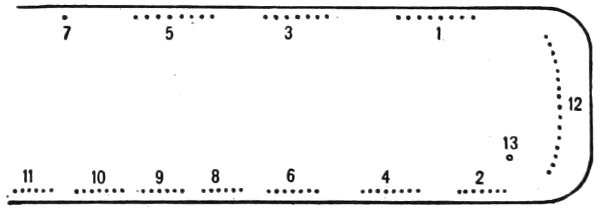
Fig. 1.—Diagram showing places of gentes in the lodge. 1. Ṭsi´-zhu Wa-shta-ge; 2. Wa-ṭse-tsi Wa-shta-ge; 3. Ṭsi´-zhu Wa-noⁿ; 4. Hoⁿ´-ga A-hiu-ṭoⁿ; 5. Mi-k’iⁿ´ Wa-noⁿ; 6. Wa-ça´-be; 7. Tho´-xe; 8. O´poⁿ; 9. Ho´ I-ni-ḳa-shi-ga; 10. Wa-zha´-zhe çka; 11. Ṭa´ I-ni-ḳa-shi-ga; 12. Iⁿ-gthoⁿ´-ga; 13. Sho´-ḳa
At the close of the Ḳi´-noⁿ ceremony the Xo´-ḳa wraps about his body a buffalo robe, hair outside, and thus clothed in his sacerdotal attire he goes out of his own house to make his processional approach to the sacred house, following his Sho´-ḳa who precedes him in the march. After the manner of all suppliants who approach Wa-ḳoⁿ´-da, the Xo´-ḳa carries with him a little pipe with which to make a smoke offering to that mysterious power that controls all life. The Xo´-ḳa and the Sho´-ḳa, on their solemn approach to the House of Mystery, keep a certain distance apart. When they have gone some 40 or 50 paces they make a pause and the Xo´-ḳa sings the following song, after which he recites the first section of the wi´-gi-e called Wa´-çi-thu-çe Wi´-gi-e (Footstep Wi´-gi-e). The song precedes each of the four sections of the wi´-gi-e:
Footstep Song and Wi´-gi-e
Wa-ṭse wiⁿ u-tha-ḳi-oⁿ stse, Wa-ṭse wiⁿ u-tha-ḳi-oⁿ stse he Wa-ṭse wiⁿ u-tha-ḳ-oⁿ stse, E the he wi-ṭa doⁿ u-tha-ḳi-oⁿ stse he, Wa-ṭse wiⁿ u-tha-ḳi-oⁿ stse.
WI´-GI-E
1
1. Toward what shall the little ones take their footsteps? they asked of one another. 2. It is the Male Star (the sun) who sitteth in the heavens, 3. Toward which the little ones shall take their footsteps 4. When the little ones take their footsteps toward the Male Star, 5. They shall always live to see old age, O, younger brothers, they said to one another.
2
6. Toward what shall the little ones take their footsteps? they asked of one another. 7. It is the Female Star (the moon) who sitteth in the heavens, 8. Toward which the little ones shall take their footsteps. 9. When the little ones take their footsteps toward the Female Star, 10. They shall always live to see old age, O, younger brothers, they said to one another.
3
11. Toward what shall the little ones take their footsteps? they asked of one another. 12. It is the Male Star (the sun) who sitteth in the heavens, 13. Toward which the little ones shall take their footsteps. 14. When the little ones take their footsteps toward the Male Star, 15. They shall always live to see old age, O, younger brothers, they said to one another.
4
16. Toward what shall the little ones take their footsteps? they said to one another. 17. It is the Female Star (the moon) who sitteth in the heavens, 18. Toward which the little ones shall take their footsteps. 19. When the little ones take their footsteps toward the Female Star, 20. They shall always live to see old age, O, younger brothers, they said to one another.
The words of the processional song:
Into a star you have cast yourself, Into my star you have cast yourself, etc.
are addressed to the child upon whom is to be conferred his personal, gentile name, and who is to be given his place in the Puma gens into which he was born. The star referred to in the song is the sun, the greatest life symbol of the Puma gens.
In the first section of the “Footstep Wi´-gi-e,” which the Xo´-ḳa recites as he makes his processional approach to the House of Mystery, the sun is referred to as the “Male Star.” The first line of the wi´-gi-e, “Toward what shall the little ones take their footsteps,” implies that much thought was given by the ancient Noⁿ´-hoⁿ-zhiⁿ-ga to the question as to the places where prayers for aid for the attainment of long life should be directed. The lines that follow imply that the Noⁿ´-hoⁿ-zhiⁿ-ga had finally arrived at the belief that if the “Little Ones” go with their prayers to the “Male Star,” the sun, they would find the way by which they could reach old age. The authors of these peculiar rites in speaking of long life did not only mean the attainment of old age by the child but they also meant the continuity of its life by procreation.
In the second section of the wi´-gi-e the moon is referred to as the “Female Star.” The same form that is used for the sun is also used for the moon. The pairing of these two great cosmic bodies in this wi´-gi-e suggests a procreative relationship between the two. The last two sections of the wi´-gi-e are repetitions of the first two. These repetitions are made in order to complete the mystic number four. The moon, referred to in the second section as the female star, is the life symbol of the Wa-ça´-be, or the Black Bear gens.
When the Xo´-ḳa have finished reciting the first section of the Footstep Wi´-gi-e, which speaks of the approach of the little ones to the sun, he and the Sho´-ḳa continue their march. Again they pause and the Xo´-ḳa recites the second section which tells of the approach of the little ones toward the moon seeking for long life. The fourth pause brings them to the door of the House of Mystery, which they enter, followed by the A´-ḳi-hoⁿ Xo´-ḳa and the Noⁿ´-hoⁿ-zhiⁿ-ga of the Puma gens who are to give their child a place in the visible universe. They take their place at the east end of the lodge where sit the father and mother with the child. The Noⁿ´-hoⁿ-zhiⁿ-ga who had been called to take part in the ceremony also enter and take their fixed places, those belonging to the Hoⁿ´-ga great division at the south side and those of the Ṭsi´-zhu great division at the north side of the lodge. (Fig. 1.)
The Wa-the´-the Ceremony
When all the Noⁿ´-hoⁿ-zhiⁿ-ga have become settled in their places, according to gentes, the A´-ḳi-hoⁿ Xo´-ḳa proceeds with the ceremonial acts called Wa-the´-the, which, translated literally, means, The Sending; that is, the sending of a fee of a blanket or other article of value to each, head of the gentes taking part in the child-naming ceremony. It is understood by these ceremonial acts that the members of the gens to whose head is sent a fee are requested to recite the wi´-gi-e relating to the Life Symbol of their gens. Each article is received from the hands of the A´-ḳi-hoⁿ Xo´-ḳa by the Sho´-ḳa who delivers it to the head of the gens for whom it is sent.
Wa-xthi´-zhi, who gives this child-naming ritual of his gens, the Puma, when acting as A´-ḳi-hoⁿ Xo´-ḳa, sends the fees in the following order:
Ṭsi´-zhu Wa-shta-ge: Fee, with a red downy eagle feather, symbolizing the sun. The members of the gens will recite their wi´-gi-e relating to the life-giving power of the sun. (See 36th Ann. Rept. Bur. Amer. Ethn., p. 124, lines 1 to 177.)
Wa-ça´-be: Fee; will recite the Zha´-zhe Ḳi-ṭoⁿ Wi´-gi-e, Name Wi´-gi-e of the gens. (See 36th Ann. Rept. Bur. Amer. Ethn., p. 228, lines 238 to 304.) The Wa-ça´-be and the Iⁿ-gthoⁿ´-ga gentes are closely related and one acts as Sho´-ḳa for the other in their ceremonies of initiation into the mysteries of the tribal rites.
Ṭsi´-zhu Wa-noⁿ: Fee; will recite their wi´-gi-e relating to the life-giving power of the sun, their life symbol. (See 36th Ann. Rept. Bur. Amer. Ethn., p. 118, lines 1 to 36.)
Hoⁿ´-ga A-hiu-ṭoⁿ: Fee; will recite wi´-gi-e relating to the mottled eagle, the “stainless” bird that led the people down from the sky to the earth. (See 36th Ann. Rept. Bur. Amer. Ethn., p. 162, lines 177 to 311.)
Mi-k’iⁿ´ Wa-noⁿ: Fee; the members of this gens will recite their wi´-gi-e relating to the moon and all the stars and to their power to aid the “little ones” to reach old age. (See 36th Ann. Rept. Bur. Amer. Ethn., p. 122, lines 1 to 44.)
O´-poⁿ: Fee; the members of the gens will recite the Wa-dsu-ṭa I-hi-thoⁿ-be Wi´-gi-e which tells of the various places of the earth where the little ones may find the animals on which to live. (See 36th Ann. Rept. Bur. Amer. Ethn., p. 112, lines 1 to 109.)
Tho´-xe: Fee; some grains of maize are also sent. The members of this gens will recite the wi´-gi-e relating to the bringing of the maize to the people by a buffalo bull, and to his offer to aid the little ones to reach old age. (See 36th Ann. Rept. Bur. Amer. Ethn., p. 280, lines 83 to 110; also p. 134, lines 1 to 162.)
Wa´-ṭse-ṭsi Wa-shta-ge: Fee, with cedar fronds. Members of this gens will recite their wi´-gi-e relating to the red cedar, an evergreen tree which has power to resist death, and to its offer to aid the little ones to reach old age. (See 36th Ann. Rept. Bur. Amer. Ethn., p. 95, lines 1 to 34.)
Ho´ I-ni-ḳa-shi-ga: Fee, with a kettle of water. The members of this gens will recite their wi´-gi-e relating to the everflowing water which, has power to help the little ones to reach old age. These are the Fish people. (See 36th Ann. Rept. Bur. Amer. Ethn., p. 98, lines 1 to 35.)
Wa-zha´-zhe çka: Fee, with a mussel shell. The mussel is the life symbol of this gens. The members of the gens will recite their wi´-gi-e relating to the power of the mussel to resist death, and to its consent to aid the little ones to reach old age. The Wa-zha´-zhe çka are a water people. (See 36th Ann. Rept. Bur. Amer. Ethn., p. 94, lines 1 to 29.)
Ṭa I-ni-ḳa-shi-ga, the Deer People: Only a fee is sent to them. The members will recite their Wa-dsu´-ṭa I-hi-thoⁿ-be Wi´-gi-e, which tells of the various places of the earth where the deer will reveal themselves to the little ones to give them help to reach old age. (See 36th Ann. Rept. Bur. Amer. Ethn., p. 97, lines 44 to 103.)
When the Sho´-ḳa had delivered the last fee every Noⁿ´-hoⁿ-zhiⁿ-ga who knows his wi´-gi-e begins to recite it in a loud voice. None of the wi´-gi-es are alike and none of the members of a gens recite in unison, consequently there would be a volume of sounds most bewildering to the uninitiated.
Zha´-zhe Ḳi-ṭoN Wi´-gi-e
The wi´-gi-e recited by the members of the Iⁿ-gthoⁿ´-ga gens at this time is called Zha´-zhe Ḳi-ṭoⁿ Wi´-gi-e, freely translated, the Name Wi´-gi-e. It is in three parts. The first, which includes sections 1 to 8, is called Zha´-zhe Ḳi-ṭoⁿ, the taking of names; the second, which includes sections 9 and 10, is called U´-noⁿ U-tha-ge, the telling of the means by which to reach old age; the third, which includes sections 11 and 12, is called U´-noⁿ-bthe U-gi-dse, the story of the search for the life-giving foods.
NAME-TAKING WI´-GI-E (FREE TRANSLATION) 1
1. Verily, at that time and place, it has been said, in this house, 2. The Hoⁿ´-ga, a people who possess seven fireplaces 3. Spake to one another, saying: O, younger brothers, 4. The little ones have become persons, 5. Should not the little ones go below to become a people? they said to one another. 6. Then, at that very time, 7. They said: There are four great gods 8. To whom we shall appeal for aid. 9. Verily at that time, 10. They spake to the god of day (the sun) saying: 11. O, my grandfather, 12. Our little ones have become persons, 13. Should they not go below (to the earth) to become a people? 14. At that very time 15. The god of day replied: You say the little ones should go below to become a people, 16. When the little ones go below to become a people, 17. They shall always live to see old age, as they travel the path of life.
2
18. Verily, at that time and place, it has been said, in this house, 19. They said: The little ones shall go below to become a people. 20. Then again they spake to the god of day, saying: The little ones have no names, O, grandfather. 21. The god of day replied: O, little ones, 22. You say your little ones have no names, 23. Your little ones shall be named after me, 24. Mi´-wa-ga-xe, Child-of-the-sun, 25. The little ones shall take, as they travel the path of life. 26. When they take this for a personal name, 27. They shall always live to see old age, as they travel the path of life.
3
28. What shall the little ones take for a personal name? it has been said, 29. Moⁿ-çi´-tse-xi, Sacred-arrowshaft, 30. The little ones shall take for a name, as they travel the path of life. 31. When they take this for a personal name, 32. They shall always live to see old age, as they travel the path of life.
4
33. What shall the little ones take for a personal name? 34. I´-e-çka-wa-the, Giver-of-clear-speech 35. The little ones shall take for a name, as they travel the path of life. 36. When they take this for a personal name, 37. They shall always live to see old age, as they travel the path of life.
5
38. What shall the little ones take for a personal name? 39. Moⁿ-zhoⁿ´-op-she-wiⁿ, Woman-who-travels-over-the-earth, 40. The little ones shall take for a name, as they travel the path of life. 41. When they take this for a personal name, 42. They shall always live to see old age, as they travel the path of life.
6
43. What shall they take for a personal name? 44. Moⁿ´-ga-xe, Arrow-maker, 45. The little ones shall take for a name, as they travel the path of life. 46. When they take this for a personal name, 47. They shall always live to see old age, as they travel the path of life.
7
48. What shall the little ones take for a personal name? 49. Noⁿ´-mi-tse-xi, Beloved-child-of-the-sun, 50. The little ones shall take for a name, as they travel the path of life. 51. When they take this for a personal name, 52. They shall always live to see old age, as they travel the path of life.
8
53. What shall the little ones take for a personal name? 54. Iⁿ-shta´-sha-be, Dark-eyes, 55. The little ones shall take for a name, as they travel the path of life. 56. When, they take this for a personal name, 57. They shall always live to see old age, as they travel the path of life.
9
58. Verily, at that time and place, it has been said, in this house, 59. They spake to one another, saying: O, younger brothers, 60. The little ones have nothing of which to make their bodies, 61. They went forth with hurrying footsteps, 62. To the soft stone that sitteth upon the earth. 63. Verily, at that time, 64. They spake to him, saying: O, my grandfather, 65. The little ones have nothing of which to make their bodies. 66. The soft stone replied: O, little ones, 67. You say your little ones have nothing of which to make their bodies. 68. The little ones shall make of me their bodies. 69. Verily, at that time and place, 70. He spake further, saying: When the little ones become ill and fretful, 71. They shall cling to me as one who can produce the heat by which they can be purified.
10
72. Verily, at that time and place, it has been said, in this house, 73. They spake to one another, saying: Give heed, my younger brothers, 74. You will go forth to make further search, 75. Then, even as these words were spoken, they hastened 76. To the friable stone, 77. And, standing close to him, 78. Spake, saying: O, grandfather, the little ones have nothing of which to make their bodies. 79. The friable stone replied: O, my little ones, 80. You say the little ones have nothing of which to make their bodies. 81. The little ones shall make of me their bodies. 82. When they make of me their bodies, 83. They shall cling to me as one who can produce the heat by which their bodies can be purified.
11
84. Verily, at that time and place, it has been said, in this house, 85. They spake to one another, saying: O, younger brothers, 86. The little ones have nothing which they can use for food at all times, 87. You will go and search for such food as they can use for all time. 88. A younger brother hastened 89. To the very center of a lake, 90. Where lay the root of the tse´-wa-the (Nelumbo lutea). 91. He hastened home with the root, 92. And spake, saying: O, elder brothers, how will this serve for food? 93. The elder brothers hastened to try the taste of the root, 94. Like milk the juice squirted in their mouths, 95. And they said to one another: O, younger brothers, 96. This will serve as food for the little ones. 97. When the little ones make use of this plant as food, 98. They shall always live to see old age, as they travel the path of life.
12
99. There lacks one more, O, younger brothers, they said to one another. 100. You will go forth and make further search. 101. Even as these words were spoken, 102. One hastened to the farther borders of the lake, 103. Where sat the do (Apios apios). 104. Close to it he stood, 105. Then he hastened home, carrying the plant with him. 106. Standing before his brothers, he spake, saying: O, elder brothers, 107. How will this serve for food? 108. They replied: O, younger brother, 109. That is the very object for which you have been searching. 110. The elder brothers hastened to try the taste of the root, 111. Like milk the juice squirted in their mouths. 112. Then they spake, saying: The little ones shall use this plant for food. 113. When the little ones use this plant for food, 114. They shall always live to see old age. 115. It shall make their limbs to stretch in growth, as they travel the path of life.
When Wa-xthi´-zhi made up his mind to give a description of the Child-naming Ritual of his own gens, the Puma, he did not hesitate to recite the wi´-gi-es and to tell of the ceremonial forms that accompany the entire ritual. But when asked to recite the wi´-gi-es of the 11 gentes who were summoned to take part in the ceremony of conferring a name upon a Puma child he declined to give them, although he knew all of them, for the reason that they were not his to give. He had not obtained from any of these gentes the right to transfer them to strangers or to members of other gentes.
It so happened that when Wa-xthi´-zhi was describing the Child-naming Ritual of his own gens, which he had a perfect right to do, Wa-sho´-she (pl. 4), a member of the Hoⁿ´-ga A-hiu-ṭoⁿ gens, was present. This man, when asked if he would be willing to give the U´-noⁿ Wi´-gi-e (Old-age Wi´-gi-e) of his gens for a fee, promptly replied that he would. He had obtained by purchase from his father the wi´-gi-e and so had acquired the right to transfer it to anybody, but the transfer must always be made for a fee. The fee was provided and Wa-sho´-she sat down and recorded the Old-age Wi´-gi-e of his own gens, the Hoⁿ´-ga A-hiu-ṭoⁿ. This name refers to the “Stainless Bird,” the mottled eagle, who conducted the Hoⁿ´-ga people to earth from mid-heaven. (See 36th Ann. Rept. Bur. Amer. Ethn., p. 162, lines 177 to 199.)
BUREAU OF AMERICAN ETHNOLOGY FORTY-THIRD ANNUAL REPORT PLATE 3
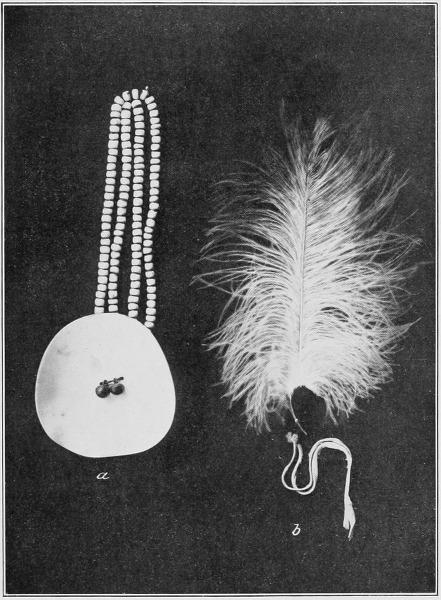
SHELL GORGET AND DOWNY PLUME (LIFE SYMBOLS)
BUREAU OF AMERICAN ETHNOLOGY FORTY-THIRD ANNUAL REPORT PLATE 4
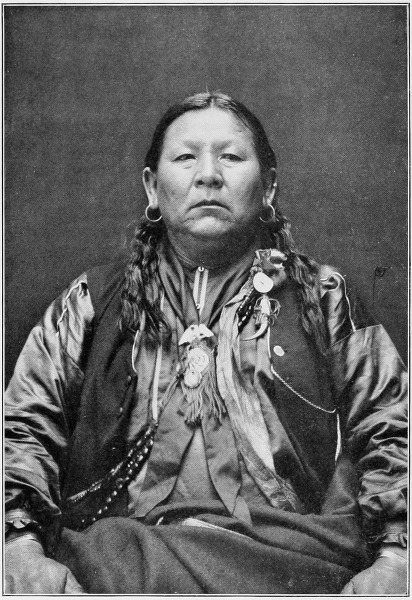
WA-SHO´-SHE (HON´-GA A-HIU-TON (EAGLE) GENS)
The first seven lines of the wi´-gi-e refer back to the time when “the Hoⁿ´-ga who possess seven fireplaces” chose for one of their life symbols the “Stainless Bird,” the mottled eagle. The people who are here spoken of as the Hoⁿ´-ga having seven fireplaces are those who compose the seven gentile groups that represent the land portion of the earth in the two great tribal divisions symbolizing the cosmos. These seven gentile groups (seven fireplaces) are, as given by Black-dog. (See 36th Ann. Rept. Bur. Amer. Ethn., pp. 52-53.)
1. Wa-ça´-be-ṭoⁿ, They-who-own-the-black-bear. 2. Iⁿ-gthoⁿ´-ga, Puma. 3. O-poⁿ, Elk. 4. Moⁿ-iⁿ-ḳa-ga-xe, Makers-of-the-earth. 5. Hoⁿ´-ga gthe-zhe, The-mottled-sacred-one. 6. Xu-tha´, Eagle (the adult golden eagle). 7. Hoⁿ´-ga zhiⁿ-ga, The-little-sacred-one.
When the “Hoⁿ´-ga, a people who possess seven fireplaces” went to the “Stainless Bird” and said to him (lines 5, 6, and 7): “The little ones have nothing of which to make their bodies,” meaning that they have no symbol for the long life which they crave, he replied in the words as given in the wi´-gi-e, from line 10 to the end:
Old-Age Wi´-gi-e FREE TRANSLATION
1. Verily, at that time and place, it has been said, in this house, 2. The Hoⁿ´-ga, a people who possess seven fireplaces, 3. Spake to one another, saying: Lo, we have nothing of which to make our bodies. 4. Then, at that very time, 5. They spake to the bird that has no stains (evil disposition), 6. Saying: O, grandfather, 7. The little ones have nothing of which to make their bodies. 8. Then, at that very time, 9. The bird that has no stains (evil disposition) 10. Spake, saying: When the little ones make of me their bodies, 11. They shall always live to see old age, as they travel the path of life. 12. Again the bird spake: 13. Behold my toes that are gathered together in folds, 14. Which I have made to be the sign of my old age. 15. When the little ones make of me the means of reaching old age, 16. They shall always live to see old age, as they travel the path of life. 17. Behold, also, the wrinkles upon my shins, 18. Which I have made to be the sign of my old age. 19. When the little ones make of me the means of reaching old age, 20. They shall always live to see old age, as they travel the path of life. 21. The bird that has no stain 22. Again spake, saying: Behold the wrinkles upon my knees, 23. Which I have made to be the sign of my old age. 24. When the little ones make of me the means of reaching old age, 25. They shall always live to see old age, as they travel the path of life. 26. Behold the flaccid muscles of my inner thigh, 27. Which I have made to be the sign of my old age. 28. When the little ones make of me the means of reaching old age, 29. They shall always live to see old age, as they travel the path of life. 30. Behold the muscles of my breast, gathered together as in a fold, 31. Which I have made to be the sign of my old age. 32. When the little ones make of me the means of reaching old age, 33. They shall always live to see old age, as they travel the path of life. 34. Behold the flaccid muscles of my arms, 35. Which I have made to be the sign of my old age. 36. When the little ones make of me the means of reaching old age, 37. They shall always live to see old age, as they travel the path of life. 38. Behold the bend of my shoulders, 39. Which I have made to be the sign of my old age. 40. When the little ones make of me the means of reaching old age, 41. They shall always live to see their shoulders bent with age, as they travel the path of life. 42. Behold the flaccid muscles of my throat, 43. Which I have made to be the sign of my old age. 44. When the little ones make of me the means of reaching old age, 45. They shall always live to see old age, as they travel the path of life. 46. Behold the folds in the corners of my eyelids, 47. Which I have made to be the signs of my old age. 48. When the little ones make of me the means of reaching old age, 49. They shall always live to see the corners of their eyelids folded with age, as they travel the path of life. 50. Behold my eyelids that are gathered into folds, 51. Which I have made to be the signs of my old age. 52. When the little ones make of me the means of reaching old age, 53. They shall always live to see their eyelids gathered into folds with age, as they travel the path of life. 54. Behold the hair on the crown of my head, now grown thin, 55. Which I have made to be the sign of my old age. 56. When the little ones make of me the means of reaching old age, 57. They shall always live to see the hair on the crown of their heads grown thin with age, as they travel the path of life.
Wi´-gi-e of the Wa´-ṭse-ṭsi Gens
At the close of the recital of the wi´-gi-es by all the Noⁿ´-hoⁿ-zhiⁿ-ga, the Sho´-ḳa places before the head of the Ṭsi´-zhu Wa-shta-ge gens a bowl of water into which had been put fronds of the red cedar. The red cedar and the water are the life symbols of the Wa´-ṭse-ṭsi, the people who came to earth from the stars. The following is an epitome of their wi´-gi-e:
I am a person who is fit for use as a symbol, Behold the female red cedar, Verily, I am a person who has made of that tree his body. When the little ones make of me their bodies, They shall always live to see old age. Behold the male red cedar, The little ones shall always use this tree as a symbol. When the little ones use it for a symbol, They shall always live to see old age. Behold these waters, That we shall make to be companions to the tree. When the little ones make use of these waters As the means of reaching old age, They shall always live to see old age.
—(See 36th Ann. Rept. Bur. Amer. Ethn., p. 95.)
Wi´-gi-e of the Bow People
The E-noⁿ´ Miⁿ-dse-ṭoⁿ, a people who belong to the same great tribal division as the Wa´-ṭse-ṭsi, use a similar wi´-gi-e, which is as follows:
I am a person who is fitted for use as a symbol. Verily, in the midst of the rushing waters Abides my being. Verily, I am a person who has made of the waters his body. Behold the right side of the river, Of which I have made the right side of my body. When the little ones make of me their bodies And use the right side of the river To make their bodies, The right side of their bodies shall be free from all causes of death. Behold the left side of the river, Of which I have made the left side of my body. When the little ones also make of it the left side of their bodies, The left side of their bodies shall always be free from all causes of death. Behold the channel of the river, Of which I have made the hollow of my body. When the little ones make of me their bodies, The hollow of their bodies shall always be free from all causes of death.
A bowl of shelled corn, the life symbol of the Tho´-xe gens, was also placed before the head of the Ṭsi´-zhu Wa-shta-ge gens. (For the Maize Wi´-gi-e of the Tho´-xe gens, see 36th Ann. Rept. Bur. Amer. Ethn., p. 135, lines 57 to 113; also p. 277, lines 83 to 110.)
When the bowls of water and cedar fronds and shelled corn are placed before the Ṭsi´-zhu Wa-shta-ge, the Sho´-ḳa puts in his arms the child to be blessed and named. The head of the Ṭsi´-zhu Wa-shta-ge gens then passes the tips of the fingers of his right hand over the bowl of water and cedar fronds, and the bowl of the life-giving corn, then touches with the tips of his fingers the lips, head, arms and body of the child. The two bowls and the child are then passed on to the head of the Wa´-ṭse-ṭsi Wa-shta-ge gens, who goes through the same motions with the child. The child and the two bowls are then passed on to the heads of each of the other gentes who make the same motions over the child as were made by the heads of the first two gentes.
These ceremonial acts performed by the heads of the gentes officiating, by which the child is brought into touch with the ever-flowing waters, the red cedar, an everlasting tree, and the life-giving corn, are supplicatory acts by which the aid of Wa-ḳoⁿ´-da is sought for the child who is to go forth to take part in the great life activities. Not only is the attainment of old age desired for the child but also the continuity of its life by a never-ending line of descendants.
At the close of these ceremonial acts a sacred gentile name is conferred upon the child without further ceremony. If, however, there are two or more names to choose from, as is the case in some of the gentes, the mother of the child has the privilege of making a choice from two or three names. This privilege is given by the Xo´-ḳa, who offers to the mother two small sticks prepared for this purpose, each of which represents a name mentioned in the origin ritual of the gens naming the child. The mother usually chooses the stick representing the name which to her has the greater religious significance and is the most euphonious.
Earth Names and Wi´-gi-es
It was stated (see p. 33) that earth names as well as sky names were used by both the Iⁿ-gthoⁿ´-ga and the Wa-ça´-be gentes as distinctive birth names for their children.
In the course of a conversation concerning the gentile names, classed as sky and earth names, Wa-xthi´-zhi, of the Puma gens, remarked that: When the Hoⁿ´-ga people were coming from the sky to the earth they chose two persons (gentes) to act as official messengers. One of these persons was called Hoⁿ´-ga Wa´-ṭse-gi-ṭsi, The-sacred-one-from-the-stars, and the other Hoⁿ´-ga Wa-ṭse-ga-wa, The-sacred-radiant-star. These messengers were expected to find some way of dispersing the waters that submerged the earth and of exposing the ground beneath so as to make it habitable for all living creatures.
Wa´-ṭse-gi-ṭsi and Wa´-ṭse-ga-wa, the two messengers, found on the still waters the water spider, the water beetle, the white leech, and the dark leech, of whom they asked for aid which they could not give, but promised to help the people to reach old age. (See 36th Ann. Rept. Bur. Amer. Ethn., p. 163, lines 200 to 273.) The two messengers went on and they met O´-poⁿ-ṭoⁿ-ga, the Great Elk, and appealed to him for aid. The Great Elk threw himself upon the waters four times and splashed about until the ground was exposed and ready to receive men and animals. He then called to the four corners of the earth for the life-giving winds to come. Next he threw himself upon the ground and rolled about; then, as he arose, the hairs of his body clung to the soil and became the grasses of the earth. (See 36th Ann. Rept. Bur. Amer. Ethn., pp. 165-167, lines 274 to 354.)
The two messengers then led the people over the dry land of the earth, when suddenly Hoⁿ´-ga Wa´-ṭse-gi-ṭsi, The-one-from-the-stars, came upon Iⁿ-gthoⁿ´-ga, the Puma. The messenger then changed his name from Wa´-ṭse-gi-ṭsi to Iⁿ-gthoⁿ´-ga. In like manner the Hoⁿ´-ga Wa´-ṭse-ga-wa, the Radiant Star, came upon Wa-ça´-be, the Black Bear. The Radiant Star then changed his name from Wa´-ṭse-ga-wa to Wa-ça´-be, the Black Bear.
These were the first earth names of the two related gentes, the Iⁿ-gthoⁿ´-ga and the Wa-ça´-be. Wa-xthi´-zhi mentioned several other personal earth names of these two gentes but he suggested that the parts of the rituals given by himself and Wa-ṭse´-moⁿ-iⁿ (pl. 5), in which are mentioned the earth names, be referred to as authoritative, and so the following paraphrases of those parts of the rituals are here given.
EARTH NAME WI´-GI-ES (Wa-xthi´-zhi)
The people spake to one another, saying: The little ones have nothing to use as a symbol of courage. Then, at that very time, The Hoⁿ´-ga Wa´-ṭse-ga-wa (Hoⁿ´-ga-radiant-star), Went forth with hurried footsteps To the Iⁿ-gthoⁿ´-ga do-ga, (male puma), With whom he stood face to face and spake, Saying: The little ones have nothing to use as a symbol of courage, O, grandfather. The Male puma replied: I am a person whom the little ones may use as a symbol of courage. The brothers spake in low tones, Saying: He is a puma, O, younger brothers, Let us take personal names from him; Iⁿ-gthoⁿ´-ga-ṭoⁿ´-ga, the Great-puma, Shall be our name, O, younger brothers; Iⁿ-gthoⁿ´-ga-zhiⁿ-ga, the Young-puma, Shall be our names, as we travel the path of life. The Hoⁿ´-ga Wa´-ṭse-ga-wa, Radiant-star, Went forth with hurried footsteps, To the Wa-ça´-be, the Black-bear that is without blemish, Who stood as in a flame of fire. The Radiant-star spake to him, saying: The little ones have nothing to use as a symbol of their courage. Wa-ça´-be replied: I am a person whom the little ones may use as a symbol of their courage. The brothers spake to one another, saying: He is a black bear! He is very dark in color! Let us take from him personal names. Sha´-be-ṭsi-gthe, the Dark-one, Shall be our name henceforth, as we travel the path of life. You have found the Dark-one, O, younger brothers, Sha´-be-i-the, Finder-of-the-dark-one, Shall be our name, henceforth, as we travel the path of life. Look you, O, younger brothers, they said to one another, The little ones have nothing to use as a symbol of courage. Then they went forth in a body to an open prairie, Where sat Mi´-xa-çka, the Great-white-swan. Face to face they stood with him and spake, Saying: The little ones have nothing to use as a symbol of courage, O, grandfather. The brothers spake in low tones, saying: O, younger brothers, We shall take from him personal names. How white he is! the younger ones exclaimed, He is a bird, A white swan. Mi´-xa-çka, the White-swan, Shall be our name, O, younger brothers. How white he is! they again exclaimed, Wa-zhiⁿ´-çka, the White-bird, shall also Be our name, O, younger brothers.
—(36th Ann. Rept. Bur. Amer. Ethn., pp. 194-195, lines 1063 to 1115.)
Earth names mentioned in the origin wi´-gi-e given, by Wa-ṭse´-moⁿ-iⁿ.
Wi´-gi-e of the Wa´ṭse-gi-ṭsi HE-WHO-CAME-FROM-THE-STARS
What said they? it has been said, in this house, The people spake, saying: O, younger brothers, We are a people who give no mercy to the foe. Then they spake to the one (gens) who had made of the Puma his body, Saying: O, younger brother. Hardly were these words spoken when the Puma hastened forth. After a time the people said: There are signs that our brother is returning. Then some of the brothers ran to meet him. To their inquiry the Puma replied: O, elder brothers, Yonder stands a man, Verily, a man whose appearance inspires fear, A man who is like us in form. The people spake, saying: O, younger brother, We are a people who show no mercy to the foe. Whoever this man may be, We shall send him to the abode of spirits, We shall make him to lie low. Then toward the man they hastened: They made one ceremonial pause. At the fourth pause, The Puma exclaimed: There he stands! It is well, the people replied, We shall send him to the abode of spirits. Then, at that very time, The stranger spake, saying: I am a sacred man, O, elder brothers. The Puma spake, saying: He speaks clearly our language! I am Hoⁿ´-ga Wa´-ṭse-gi-ṭsi, a sacred person come from the stars, the stranger continued. I am Zhiⁿ-ga´-ga-hi-ge,1 The-young-chief; I am Wa´-ṭse-ga-hi-ge, The-star-chief; I am Wa´-ṭse-ga-wa, The-star-radiant; I am Wa´-ṭse-moⁿ-iⁿ, The-traveling-star. That pleases us! the people exclaimed. Zhiⁿ-ga´-ga-hi-ge, The-young-chief, the stranger went on, Shall be your name, as you travel the path of life; Wa´-ṭse-ga-wa, The-star-radiant, Shall also be your name, as you travel the path of life. I have done much to make you contented and happy. We are pleased! the people exclaimed, We shall henceforth put away all anger and hatred, We shall accept the names thus offered us. Zhiⁿ-ga´-ga-hi-ge, The-young-chief, Shall be our name, Wa´-ṭse-ga-wa, The-star-radiant, Shall be our name. I´-e-çka-wa-the, He-speaks-clearly, We shall also take as a name in his honor, P̣a´-thiⁿ-hoⁿ-ga, The-sacred-stranger, We shall also take as a name in his honor.
Mi´-xa-çka, the white swan from whom personal names were taken, as mentioned in the following wi´-gi-e given by Wa-ṭse´-moⁿ-iⁿ, is a warrior symbol. The black color on its feet and on the tip of its nose typifies the fire that knows no mercy. The standards (crooks), which were carried by an Osage war party (pl. 6, a), typify the neck of the white swan.
MI´-XA-ÇKA, THE WHITE SWAN
The people spake to one another, saying: We have nothing of which to make a symbol (war standard). They spake to the Puma (gens), saying: Go thou and make search (for materials). Even as these words were spoken the Puma went forth to search. In time he hastened homeward, And, standing before the elder brothers, he spake, saying: O, elder brothers, what appears to be an animal, Is in yonder place. Make haste! the people said to one another, We shall send him to the abode of spirits. Verily, we are a people who give no mercy to the foe. They made one ceremonial pause, The fourth pause brought them close to the place. Then the Puma spake, saying: There he stands! O, elder brothers. An elder brother pointed with his index finger at the bird, And it fell to the ground in death, its feathers strewing the earth. They gathered around the fallen bird and stood. Then one spake, saying: It is a swan! O, elder brothers, A white swan! Even from its white plumage We shall take personal names, Mi´-xa-çka, White-swan, Wa-zhiⁿ´-ga-çka, White-bird, And Moⁿ´-shoⁿ-çka, White-feathers, The little ones shall be named, as they travel the path of life.
—(36th Ann. Rept. Bur. Amer. Ethn., pp. 228-231, lines 238 to 358.)
The earth names given by Wa-xthi´-zhi, of the Iⁿ-gthoⁿ´-ga (Puma) gens, in his wi´-gi-es are as follows:
1. Iⁿ-gthoⁿ´-ga-ṭoⁿ-ga, the Great-puma. 2. Inⁿ-gṭhoⁿ´-ga-zhiⁿ-ga, the Young-puma. 3. Sha´-be-ṭsi-gthe, the Dark-one. 4. Sha´-be-i-the, Finder-of-the-dark-one. 5. Mi´-xa-çka, the White-swan. 6. Wa-zhiⁿ´-çka, the White-bird.
The earth names given by Wa-ṭse´-moⁿ-iⁿ of the Wa-ça´-be (Black Bear) gens in his wi´-gi-es:
1. Wa´-ṭse-gi-ṭsi, He-who-came-from-the-stars. 2. Zhiⁿ-ga´-ga-hi-ge, Young-chief. 3. Wa´-ṭse-ga-hi-ge, Star-chief. 4. Wa-ṭse´-ga-wa, Star-radiant. 5. Wa-ṭse´-moⁿ-iⁿ, Traveling-star. 6. I´-e-çka-wa-the, He-speaks-clearly. 7. P̣a´-thiⁿ-hoⁿ-ga, The-sacred-stranger. 8. Mi´-xa-çka, White-swan. 9. Wa-zhiⁿ´-ga-çka, White-bird. 10. Moⁿ-shoⁿ-çka, White-feather.
The following earth names, not specifically mentioned by Wa-xthi´-zhi, also appear in the wi´-gi-es recorded by himself and by Wa-ṭse´-moⁿ-iⁿ. These names are also regarded as sacred and are ceremonially bestowed upon the children of the Puma and Black Bear gentes:
WA-XTHI´-ZHI
1. Moⁿ´-hiⁿ-çi-i-ba-btho-ga, Round-handled-knife. (36th Ann. Rept. Bur. Amer. Ethn., p. 206, line 1399.)
2. Monⁿ´-hiⁿ-hoⁿ-ga, Sacred-knife. (36th Ann. Rept. Bur. Amer. Ethn., p. 207, line 1424.)
3. Moⁿ-hiⁿ-zhu-dse, Red-knife. (36th Ann. Rept. Bur. Amer. Ethn., p. 208, line 1439.)
4. The fourth name given by Wa-xthi´-zhi (Noⁿ-be´-wa-koⁿ-da, Mysterious-hand) does not appear in any of the wi´-gi-es given either by himself or by Wa-ṭse´-moⁿ-iⁿ. However, the Mysterious-hand is spoken of by both of these men in their conversations concerning the rites, and is referred to in some of the wi´-gi-es. (See 36th Ann. Rept., p. 230, lines 323 to 340.) The story of the Mysterious-hand, as told colloquially, is that when the people came from the sky to the earth they had no weapons, but they killed animals by moistening the index finger of the right hand with saliva and pointing it at them. This name is also bestowed ceremonially.
WA-ṬSE´-MON-IN
1. Miⁿ´-ṭse-xi, Sacred-robe. (36th Ann. Rept. Bur. Amer. Ethn., p. 235, line 510.)
2. Noⁿ´-ḳa-dsi-wiⁿ, Spine-woman. (36th Ann. Rept. Bur. Amer. Ethn., p. 235, line 512.)
3. Ṭse´-p̣a´-ga-xe, Buffalo-head-maker. (36th Ann. Rept. Bur. Amer. Ethn., p. 235, line 518.)
4. Moⁿ´-hiⁿ-zhu-dse, Red-knife. (36th Ann. Rept. Bur. Amer. Ethn., p. 237, line 573.)
5. Moⁿ´-hiⁿ-hoⁿ-ga, Sacred-knife. (36th Ann. Rept. Bur. Amer. Ethn., p. 237, line 576.)
Special Instructions to the Mother
At the close of the ceremony of blessing the child by the various gentes officiating, the Sho´-ḳa conducts the mother to a seat prepared for her in front of the Xo´-ḳa, who gives her special instructions in the ceremonies to be observed by her to complete the child-naming rite. Between the two is spread a buffalo robe which had been decorated with certain symbolic designs. (Fig. 2.) This formal talk to the mother is called “Ḳi´-noⁿ U-tha-ge,” Telling of the Symbolic Painting. Extra fees are required for the special instruction, which, with the help of friends and relatives, the mother is enabled to pay.
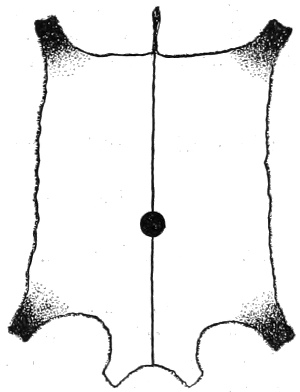
Fig. 2.—Symbolic robe prepared for children
If the mother is skilled with her awl and thread in ornamental work she would decorate with porcupine quills the symbolic robe to be used in this special ceremony; if not skilled, she would content herself with painting the symbolic designs on the robe.
When the robe has been spread before the Xo´-ḳa he begins to talk, as follows:
Wi-ṭsi-ni-e´, My daughter-in-law, I see you have brought with you a robe which you have dressed and decorated for the comfort of your little one. It is a sacred robe which should be put to use with proper ceremony. This ceremony you will observe for a period of four days, during which you will paint red the parting or your hair. It will be a sign that you appeal for a long and fruitful life for yourself and child, to the god of day whose path lies over the middle of the earth.
You have reddened the head and the forelegs of the robe. The head and forelegs of the robe typify that part of the earth whence rises the god of day to take his westward journey. Red is the color of the day when it is young, the time when you will rise and go forth to prepare food for the little one whose tender life is wholly dependent upon your efforts. A narrow line runs from the head of the robe along the middle of the back to the tail. This line typifies the path of the god of day who ever travels from east to west. Midway of the path is a round spot which represents the god of day when it has reached the middle of heaven. Here he marks the time when you will turn your thoughts from other things to the feeding of the little one so that the nourishing of its life may be continuous. The god of day continues his journey and in time reaches the edge of the earth, behind which he finally disappears. The hind legs and the tail of the robe are reddened to typify the glow that warns us of the ending of the day when your thoughts will again turn to the care of the little one. When you put these symbolic marks upon this sacred robe your thoughts reached out in appeal to Wa-ḳoⁿ´-da for yourself and child.
BUREAU OF AMERICAN ETHNOLOGY FORTY-THIRD ANNUAL REPORT PLATE 5
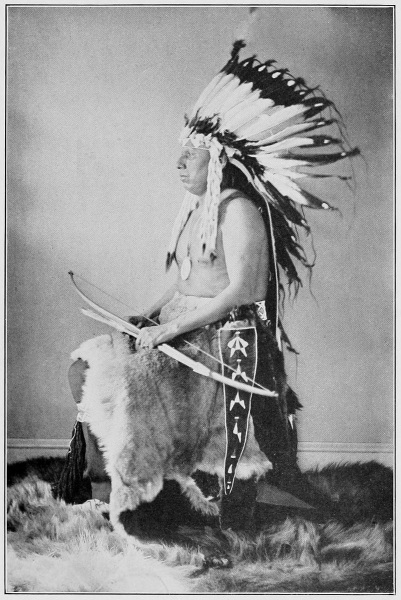
WA-ṬSE´-MON-IN (WA-ÇA´-BE (BLACK BEAR) GENS)
BUREAU OF AMERICAN ETHNOLOGY FORTY-THIRD ANNUAL REPORT PLATE 6
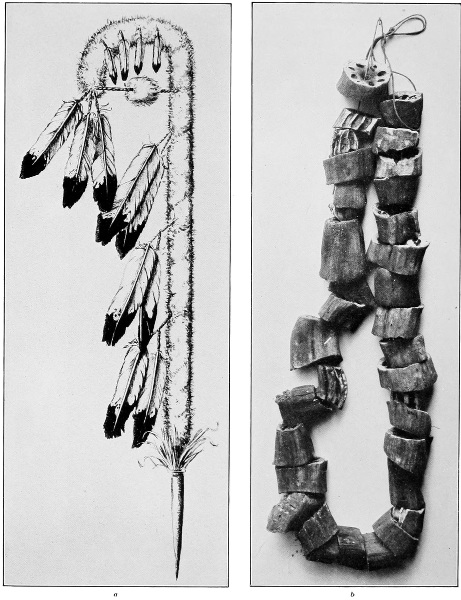
a, WAR STANDARD (SYMBOLIZES THE WHITE SWAN) b, ṬSE´-WA-THE ROOT (NELUMBO LUTEA), USED FOR FOOD
As the shadow of night spreads over the land you will take your little one in your arms, draw this robe over you, then rest in sleep. The robe which you draw over yourself and child typifies the heaven, whence comes all life, and the act is an appeal to heaven for protection.
The procuring of food for the little one should always be done with a feeling of gratitude toward the Mysterious Power that brings forth life in all forms. There is a plant which is dedicated to use as a sacred food in the bringing up of the little ones, known as ṭse´-wa-the (Nelumbo lutea) (pl. 6, b). (36th Ann. Rept. Bur. Amer. Ethn., p. 183, lines 910 to 923.) You will at times go to the lake to gather the roots of this plant for use in feeding your little one. When about to go to the lake you will paint red the parting of your hair, as a sign of your gratitude to the god of day who passes over your head and over the plant you go to seek, shedding his life-giving power upon you as he goes upon his journey.
When you come to the edge of the lake you will look about for a staff to support you as you work in the water. You will choose the willow for your staff, for it is a tree that clings persistently to life. By this act you will make an appeal to the great Life-giving Power for a long and fruitful life for yourself and the little one. With the willow staff in your hands you will step into the water and take up from the soft earth beneath a root of the sacred plant, the ṭse´-wa-the. You will find clinging to the root some of the soft earth from which the plant draws nourishment and strength. Take this bit of soil and touch your forehead and body with it, an act which will be as a sign that you appeal to the earth wherein there is Life-giving Power. When you have performed this act return the root to the earth beneath the water, with the wish that the plant shall forever be plentiful. Then gather enough of the roots to satisfy the little one and yourself.
The maize is another sacred life-giving plant. You raise this plant from year to year. When you prepare the ground for planting the seed you will take one grain and put it in a hill, you will press down upon it the soil with your foot, and say: “My father-in-law bade me do this, as an expression of my faith that the sky and the earth will yield to me not only one ear of maize but one animal as well, or even one herd of animals.” In the next hill you will put two grains, in the next three, the next four, the next five, the next six, and in the seventh seven, always repeating the words at each planting.
The ceremony closes with the end of the special instructions given to the mother of the child blessed and named, and as each member of the gentes who had taken part in the rite rises to go he makes some pleasant remarks to the father and the mother.
When the mother goes to her field to plant the seeds of the maize she remembers the instructions and follows them in every detail. As the maize matures and the ears are still green and tender the mother cuts the stalks from the hills she had ceremonially made, leaving the ears on the stalks. She ties the stalks in bundles, and, with the aid of friends, carries them home to her house. She then prepares a feast to which she invites the man who had acted as Xo´-ḳa at the ceremonial naming of her child. He in turn invites some of his friends who had acted as Xo´-ḳa in child-naming ceremonies to come and share in the feast prepared for him.
If among the invited guests there happens to be a member of the Tho´-xe gens, learned in the rituals, he is requested by the honored guest to recite the maize wi´-gi-e of his gens.
A paraphrase is here given of the wi´-gi-e which the Tho´-xe recite to give pleasure to the host and to the guests. The mythical story points to mid-heaven as the region of the conception of life forms, and as the starting point of the Osage people in their journey to earth, the region of actual birth into bodily existence.
Origin Wi´-gi-e of the Tho´-xe Gens
The people spake to one another, saying: Lo, the little ones are not a people, Let search be made by the younger brothers for a place where the little ones may become a people. Even as these words were being spoken, a younger brother Hastened to the first division of heaven, Close to which he came and paused, When, returning to the elder brothers, he spake, saying: Verily, nothing of importance has come to my notice. Make further search, O, younger brothers, the people said, The little ones are not a people. Then, a younger brother, Even as these words were being spoken, Hastened to the second division of heaven, where he paused, When, as the god of darkness cast a shadow upon the heavens, He returned to the eldest brothers and stood. They looked up and spake, saying: How has it fared with you? It was not your wont to suffer so, O, younger brother. He replied: I have been to the second division of heaven. It is not possible for the little ones to become a people there. O, Younger brother, We bid you make further search, the people said. Even as these words were being spoken, One hastened to the third division of heaven, He drew near and paused. The younger brother, As the god of darkness cast a shadow upon the heavens, Returned to the elder brothers and stood. The elder brothers spake: How has it fared with you? It was not your wont to suffer so. The younger brother replied: It is impossible! O, younger brother, the people said, We bid you make further search. Then a younger brother Hastened to the Fourth division of heaven. Close to it he came and paused. Then the Man of Mystery, the god of the clouds, Drew near and stood before him. The younger brother turned to the elder brothers and said: Here stands a man! A fear-inspiring man! His name, I verily believe, is Fear-inspiring. The people spake to him, saying: O, grandfather! The Man of Mystery replied: I am a person of whom your little ones may make their bodies. When they make of me their bodies, They shall cause themselves to be deathless. Little-hawk They shall take for their personal name, Then shall they always live to see old age. Hawk-maiden, also, Is a name that is mine. That name also Your little ones shall take to be their name, Then shall they always live to see old age. O, younger brother! the people said, And the younger brother went in haste To the Tho´-xe (the Buffalo-bull), Close to whom he stood and spake, saying: O, grandfather! Then to the elder brothers he said: Here stands a man! A fear-inspiring man! The Tho´-xe spake: I am a person of whom the little ones may make their bodies. Whereupon he threw himself to the ground, Then up sprang the blazing star, From the earth where it stood in all its beauty, pleasing to look upon. Tho´-xe spake, saying: Of this plant also the little ones may make their bodies. The people tasted the root of the plant, And exclaimed: It is bitter to the taste! Tho´-xe spake, saying: This plant shall be medicine to the little ones. When they use it as medicine, Their arms shall lengthen in growth, And they shall live to see old age. Again Tho´-xe threw himself upon the ground, And the poppy mallow Sprang from the earth and stood resplendent in its reddened blossoms. Of this plant also Tho´-xe said, The little ones shall make their bodies. When they use it as medicine, Their arms shall lengthen in growth. The root is astringent, And, referring thereto, your little ones shall take the name Astringent. When the little ones make of this plant their bodies, They shall always live to see old age. Tho´-xe (the Buffalo-bull), Threw himself to the ground, And a red ear of maize He tossed in the air, As he exclaimed: The little ones shall make of this their bodies! Then shall they always live to see old age. Again Tho´-xe threw himself to the ground, And a blue ear of maize, Together with a blue squash, He tossed in the air as he said, These plants, also, Shall be food for the little ones, Then shall they live to see old age. A third time he threw himself to the ground, And a white ear of maize, Together with a white squash he tossed in the air, As he exclaimed: These plants also shall be food for the little ones! Then shall they be difficult for death to overcome them, And they shall always live to see old age. A fourth time he threw himself to the ground, And a speckled ear of maize, Together with a speckled squash, He tossed in the air as he exclaimed: What creature is there that would be without a mate! And he wedded together the maize and the squash, Then exclaimed: These also shall be food for the little ones! And they shall be difficult for death to overcome them.
The feasting of the Noⁿ´-hoⁿ-zhiⁿ-ga upon the fruits of the seeds of the maize planted by the mother with religious care in the seven sacred hills completes the rite of the naming of her child, by which its right to a place in its gens is formally recognized; the child has a place, not only in its gens, but also in the sky and the earth which the two great tribal divisions, the Hoⁿ´-ga and the Ṭsi´-zhu, represent.