Front matter
Reading edition
THE
ORPHEUS C. KERR PAPERS.
NEW YORK: BLAKEMAN & MASON, 21 MURRAY STREET. 1862.
Entered, according to Act of Congress, in the year 1862, by BLAKEMAN & MASON, In the Clerk's Office of the District Court of the United States, for the Southern District of New York.
Electrotyped by Smith & McDougal, 82 & 84 Beekman Street.
Printed by C. S. Westcott & Co., 79 John Street.
CONTENTS.
PAGE
LETTER I.
SHOWING HOW OUR CORRESPONDENT CAME INTO THE WORLD: WITH SOME PARTICULARS CONCERNING HIS EARLY CHILDHOOD 9
LETTER II.
SHOWING HOW THE WRITER INCREASED IN YEARS AND INDISCRETION, AND HOW HE WAS SAVED FROM MATRIMONY BY THE LAMENTABLE EXAMPLE OF JED SMITH 14
LETTER III.
OUR CORRESPONDENT BECOMES LITERARY, AND FATHOMS CERTAIN MYSTERIES OF JOURNALISM. HE PRODUCES A DISTINCTIVE AMERICAN POEM, AND GAINS THE USUAL REWARD OF YOUTHFUL GENIUS 22
LETTER IV.
DESCRIBING THE SOUTH IN TWELVE LINES, DEFINING THE CITIZEN'S FIRST DUTY, AND RECITING A PARODY 31
LETTER V.
CONCERNING THE GREAT CROWD AT THE CAPITAL, OWING TO THE VAST INFLUX OF TROOPS, AND TOUCHING UPON FIRE-ZOUAVE PECULIARITIES AND OTHER MATTERS 37
LETTER VI.
INTRODUCING THE MACKEREL BRIGADE, DILATING ON HAVELOCKS AS FIRST MADE BY THE WOMEN OF AMERICA, ILLUSTRATING THE STRENGTH OF HABIT AND WEAKNESS OF "SHODDY," AND SHOWING HOW OUR CORRESPONDENT INDULGED IN A HUGE CANARD, AFTER THE MANNER OF AN ENLIGHTENED DAILY PRESS 42
LETTER VII.
RECORDING THE FIRST SANGUINARY EXPLOIT OF THE MACKEREL BRIGADE, AND ITS VICTORIOUS ISSUE 50
LETTER VIII.
THE REJECTED "NATIONAL HYMNS" 54
LETTER IX.
IN WHICH OUR CORRESPONDENT TEMPORARILY DIGRESSES FROM WAR MATTERS TO ROMANTIC LITERATURE, AND INTRODUCES A WOMAN'S NOVEL 68
LETTER X.
MAKING CONSERVATIVE MENTION OF THE BATTLE OF BULL RUN AND ITS EVENTS. THE FIRE-ZOUAVE'S VERSION OF THE AFFAIR, AND SO ON 74
LETTER XI.
GIVING AN EFFECT OF THE NEW BUGLE DRILL IN THE MACKEREL BRIGADE, AND MAKING SOME NOTE OF THE LATEST IMPROVEMENTS IN ARTILLERY, ETC. 82
LETTER XII.
GIVING AN ABSTRACT OF A GREAT ORATOR'S FLAGGING SPEECH, AND RECORDING A DEATHLESS EXPLOIT OF THE MACKEREL BRIGADE 88
LETTER XIII.
SUBMITTING VARIOUS RUMORS CONCERNING THE CONDITION OF THINGS AT THE SOUTH, WITH A SKETCH OF A LIGHT SKELETON REGIMENT AND A NOTE OF VILLIAM BROWN'S RECRUITING EXPLOIT 94
LETTER XIV.
SHOWING HOW OUR CORRESPONDENT MADE A SPEECH OF VAGUE CONTINUITY, AFTER THE MODEL OF THE LATEST APPROVED STUMP ORATORY 99
LETTER XV.
WHEREIN WILL BE FOUND THE PARTICULARS OF A VISIT TO A SUSPECTED NEWSPAPER OFFICE, AND SO ON 105
LETTER XVI.
INTRODUCING THE GOTHIC STEED, PEGASUS, AND THE REMARKABLE GERMAN CAVALRY FROM THE WEST 109
LETTER XVII.
NOTING A NEW VICTORY OF THE MACKEREL BRIGADE IN VIRGINIA, AND ILLUSTRATING THE PECULIAR THEOLOGY OF VILLIAM BROWN; WITH SOME MENTION OF THE SHARPSHOOTERS 114
LETTER XVIII.
DESCRIBING THE TERRIBLE DEATH AND MYSTERIOUS DISAPPEARANCE OF A CONFEDERATE PICKET, WITH A TRIBUTE TO HIS MEMORY 120
LETTER XIX.
NOTICING THE ARRIVAL OF A SOLID BOSTON MAN WITH AN UNPRECEDENTED LITERARY PRIZE, AND SHOWING HOW VILLIAM BROWN WAS TRIUMPHANTLY PROMOTED 124
LETTER XX.
CONCERNING A SIGNIFICANT BRITISH OUTRAGE, AND THE CAPTURE OF MASON AND SLIDELL 181
LETTER XXI.
DESCRIBING CAPTAIN VILLIAM BROWN'S GREAT EXPEDITION TO ACCOMAC, AND ITS MARVELLOUS SUCCESS 186
LETTER XXII.
TREATING OF VILLIAM'S OCCUPATION OF ACCOMAC, AND HIS WISE DECISION IN A CONTRABAND CASE 144
LETTER XXIII.
CONCERNING BRITISH NEUTRALITY AND ITS COSMOPOLITAN EFFECTS, WITH SOME ACCOUNT OF HOW CAPTAIN BOB SHORTY LOST HIS COMPANY 149
LETTER XXIV.
NARRATING THE MACKEREL BRIGADE'S MANNER OF CELEBRATING CHRISTMAS, AND NOTING A DEADLY AFFAIR OF HONOR BETWEEN TWO WELL-KNOWN OFFICERS 158
LETTER XXV.
PRESENTING THE CHAPLAIN'S NEW YEAR POEM, AND REPORTING THE SINGULAR CONDUCT OF THE GENERAL OF THE MACKEREL BRIGADE ON THE DAY HE CELEBRATED 164
LETTER XXVI.
GIVING THE PARTICULARS OF A FALSE ALARM, AND A BIOGRAPHICAL SKETCH OF THE OFFICER COMMANDING 173
LETTER XXVII.
TOUCHING INCIDENTALLY UPON THE CHARACTER OF ARMY FOOD, AND CELEBRATING THE GREAT DIPLOMATIC EXPLOIT OF CAPTAIN VILLIAM BROWN AT ACCOMAC 177
LETTER XXVIII.
CONCERNING THE CONTINUED INACTIVITY OF THE POTOMAC ARMY, AND SHOWING HOW IT WAS POETICALLY CONSTRUED BY A THOUGHTFUL RADICAL 184
LETTER XXIX.
INTRODUCING A VERITABLE "MUDSILL," ILLUSTRATING YANKEE BUSINESS TACT, NOTING THE DETENTION OF A NEWSPAPER CHARTOGRAPHIST, AND SO ON 190
LETTER XXX.
DESCRIPTION OF THE GORGEOUS FETE AT THE WHITE HOUSE, INCLUDING THE OBSERVATIONS OF CAPTAIN VILLIAM BROWN: WITH SOME NOTES OF THE TOILETTES, CONFECTIONS, AND PUNCH 196
LETTER XXXI.
TREATING OF THE GREAT MILITARY ANACONDA, AND THE MODERN XANTIPPE 203
LETTER XXXII.
COMMENCING WITH A BURST OF EXULTATION OVER NATIONAL VICTORIES, REFERRING TO A SENATORIAL MISTAKE, DEPICTING A WELL-KNOWN CHARACTER, AND REPORTING THE RECONNOISSANCE OF THE WESTERN CENTAURS 209
LETTER XXXIII.
EXEMPLIFYING THE TERRIBLE DOMESTIC EFFECTS OF MILITARY INACTIVITY ON THE POTOMAC, AND DESCRIBING THE METAPHYSICAL CAPTURE OF FORT MUGGINS 219
LETTER XXXIV.
BEGINNING WITH A LAMENTATION, BUT CHANGING MATERIALLY IN TONE AT THE DICTUM OF JED SMITH 228
LETTER XXXV.
GIVING PRACTICAL ILLUSTRATION OF MODERN PATRIOTISM, AND CELEBRATING THE ADVANCE OF THE MACKEREL BRIGADE TO MANASSAS, ETC. 239
LETTER XXXVI.
CONCERNING THE WEAKNESSES OF GREAT MEN, THE CURIOUS MISTAKE OF A FRATERNAL MACKEREL, AND THE REMARKABLE ALLITERATIVE PERFORMANCE OF CAPTAIN VILLIAM BROWN 248
LETTER XXXVII.
DESCRIBING THE REMARKABLE STRATEGICAL MOVEMENT OF THE CONIC SECTION, UNDER CAPTAIN BOB SHORTY 254
LETTER XXXVIII.
INTRODUCING THE VERITABLE "HYMN OF THE CONTRABANDS," WITH EMANCIPATION MUSIC, AND DESCRIBING THE TERRIFIC COMBAT A LA MAIN BETWEEN CAPTAIN VILLIAM BROWN, OF THE UNITED STATES OF AMERICA, AND CAPTAIN MUNCHAUSEN, OF THE SOUTHERN CONFEDERACY 260
LETTER XXXIX.
SHOWING HOW A REBEL WAS REDUCED, AND CONVERTED TO "RECONSTRUCTION," BY THE VALOROUS ORANGE COUNTY HOWITZERS 270
LETTER XL.
RENDERING TRIBUTE OF ADMIRATION TO THE WOMEN OF AMERICA, WITH A REMINISCENCE OF HOBBS & DOBBS, ETC. 276
LETTER XLI.
CITING A NOTABLE CASE OF VOLUNTEER SURGERY, AND GIVING AN OUTLINE SKETCH OF "COTTON SEMINARY" 288
LETTER XLII.
REVEALING A NEW BLOCKADING IDEA, INTRODUCING A GEOMETRICAL STEED, AND NARRATING THE WONDERFUL EXPLOITS OF THE MACKEREL SHARPSHOOTER AT YORKTOWN 289
LETTER XLIII.
CONCERNING MARTIAL LITERATURE; INTRODUCING A DIDACTIC POEM BY THE "ARKANSAW TRACT SOCIETY," AND A BIOGRAPHY OF GARIBALDI FOR THE SOLDIER 294
LETTER XLIV.
SHOWING HOW THE GREAT BATTLE OF PARIS WAS FOUGHT AND WON BY THE MACKEREL BRIGADE, AIDED AND ABETTED BY THE IRON-PLATED FLEET OF COMMODORE HEAD 306
LETTER XLV.
EXEMPLIFYING THE INCONSISTENCY OF THE CONSERVATIVE ELEMENT, AND SETTING FORTH THE MEASURES ADOPTED BY CAPTAIN VILLIAM BROWN IN HIS MILITARY GOVERNMENT OF PARIS 314
LETTER XLVI.
WHEREIN IS SHOWN HOW THE GENERAL OF THE MACKEREL BRIGADE FOLLOWED AN ILLUSTRIOUS EXAMPLE, AND VETOED A PROCLAMATION. ALSO RECORDING A MILITARY EXPERIMENT WITH RELIABLE CONTRABANDS 322
LETTER XLVII.
INTRODUCING A POEM BASED UPON AN IDEA THAT IS IN VIOLET—A POEM FOR WHICH ONE OF THE WOMEN OF AMERICA IS SOLELY RESPONSIBLE 329
LETTER XLVIII.
TREATING CHIEFLY OF A TERRIBLE PANIC WHICH BROKE OUT IN PARIS, BUT SUBSEQUENTLY PROVED TO BE ONLY A NATURAL EFFECT OF STRATEGY 333
LETTER XLIX.
NOTING THE ARCHITECTURAL EFFECTS OF THE GOTHIC STEED, PEGASUS, AND DESCRIBING THE MACKEREL BRIGADE'S SANGUINARY ENGAGEMENT WITH THE RICHMOND REBELS 340
LETTER L.
REMARKING UPON A PECULIARITY OF VIRGINIA, AND DESCRIBING COMMODORE HEAD'S GREAT NAVAL EXPLOIT ON DUCK LAKE, ETC. 351
LETTER LI.
GIVING DUE PROMINENCE ONCE MORE TO THE CONSERVATIVE ELEMENT, NOTING A CAT-AND-DOG AFFAIR, AND REPORTING CAPTAIN BOB SHORTY'S FORAGING EXPEDITION 361
LETTER LII.
DESCRIBING AMONG OTHER THINGS, A SPECIALITY OF CONGRESS, A VENERABLE POPULAR IDOL, AND THE DIFFICULTIES EXPERIENCED BY CAPTAIN SAMYULE SA-MITH IN DYING 374
LETTER I.
SHOWING HOW OUR CORRESPONDENT CAME INTO THE WORLD: WITH SOME PARTICULARS CONCERNING HIS EARLY CHILDHOOD.
Washington, D.C., March 20th, 1861.
Judge not by appearances, my boy; for appearances are very deceptive, as the old lady cholerically remarked when one, who was really a virgin on to forty, blushingly informed her that she was "just twenty-five this month."
Though you find me in Washington now, I was born of respectable parents, and gave every indication, in my satchel and apron days, of coming to something better than this,—much better, my boy.
Slightly northward of the Connecticut river, where a pleasant little conservative village mediates between two opposition hills, you may behold the landscape on which my infantile New England eyes first traced the courses of future railroads.
Near the centre of this village in the valley, my boy, and a little back from its principal road, stood the residence of my worthy sire—and a very pretty residence it was. From the frequent addition of a new upper-room here, a new dormer window there, and an innovating skylight elsewhere, the roof of the mansion had gradually assumed an Alpine variety of juts and peaks somewhat confusing to behold. Local tradition related that, on a certain showery occasion, a streak of lightning was seen to descend upon that roof, skip vaguely about from one peak to another, and finally slink ignominiously down the water-pipe, as though utterly disgusted with its own inability to determine, where there are so many, which peak it should particularly perforate.
Years afterwards, my boy, this strange tale was told me by a venerable chap of the village, and I might have believed it, had he not outraged the probability of the meteorological narrative with a sequel.
"And when that streak came down the pipe," says the aged chap, thoughtfully, "it struck a man who was leaning against the house, ran down to his feet, and went into the ground without hurting him a mite!"
With the natural ingenuousness of childhood I closed one eye, my boy, and says I:
"Do you mean to tell me, old man, that he was struck by lightning, and yet wasn't hurt?"
"Yes," says the venerable chap, abstractedly cutting a small log from the door-frame of the grocery store with his jack-knife; "the streak passed off from him, because he was a conductor."
"A conductor?" says I, picking up another stone to throw at the same dog.
"Yes," says the chap confidentially, "he was a conductor—on a railroad."
The human mind, my boy, when long affected by country air, tends naturally to the marvellous, and affiliates with the German in normal transcendentalism.
Such was the house in which I came to life a certain number of years ago, entering the world, like a human exclamation point, between two of the angriest sentences of a September storm, and adding materially to the uproar prevailing at the time.
Next to my parents, of whom I shall say little at present, the person I can best remember, as I look back, was our family physician. A very obese man was he, my boy, with certain sweet-oiliness of manner, and never out of patients. I think I can see him still, as he arose from his chair after a profound study of the case before him, and wrote a prescription so circumlocutory in its effect, that it sent a servant half a mile to his friend, the druggist, for articles she might have found in her own kitchen, aqua pumpaginis and sugar being the sole ingredients required.
The doctor had started business in our village as a veterinary surgeon, my boy; but, as the entire extent of his practice for six months in that line was a call to mend one of Colt's revolvers, he finally turned his attention to the ailings of his fellows, and wrought many cures with sugar and water Latinized.
At first, my father did not patronize the new doctor, having very little faith in the efficacy of sugar and water without the addition of a certain other composite often seen in bottles; but the doctor's neat speech at a Sunday school festival won his heart at last. The festival was held near a series of small waterfalls just out of the village, my boy, and the doctor, who was an invited guest, was called upon for a few appropriate remarks. In compliance with the demand he made a speech of some compass, ending with a peroration that is still quoted in my native place. He pointed impressively to the waterfalls, and says he:
"All the works of nature is somewhat beautiful, with a good moral. Even them cataracts," says he, sagely, "have a moral, and seem eternally whispering to the young, that 'Those what err falls'."
The effect of this happy illustration was very pleasing, my boy; especially with those who prefer morality to grammar; and after that, the physician had the run of all the pious families—our own included.
It was a handsome compliment this worthy man paid me when I was about six months old.
Having just received from my father the amount of his last bill, he was complacent to the last degree, and felt inclined to do the handsome thing. He patted my head as I sat upon my mother's lap, and says he:
"How beautiful is babes! So small, and yet so much like human beings, only not so large. This boy," says he, fatly, looking down at me, "will make a noise in the world yet. He has a long head, a very long head."
"Do you think so?" says my father.
"Indeed I do," says the doctor. "The little fellow," says he, in a sudden fit of abstraction, "has a long head, a very long head—and it's as thick as it is long."
There was some coolness between the doctor and my father after that, my boy: and, on the following Sunday, my mother refused to look at his wife's new bonnet in church.
I might cover many pages with further account of childhood's sunny hours; but enough has been given already to establish the respectability of my birth, despite my present location; and there I let the matter rest, my boy, for the time being.
Yours, retrospectively,
Orpheus C. Kerr.
LETTER II.
SHOWING HOW THE WRITER INCREASED IN YEARS AND INDISCRETION, AND HOW HE WAS SAVED FROM MATRIMONY BY THE LAMENTABLE EXAMPLE OF JED SMITH.
Washington, D.C., March 25th, 1861.
To continue from where I left off, my boy: between the interesting ages of ten and eighteen I went to school at the village academy, working through the English branches and the Accidence, with a lively sense of a preponderance of birch in the former, and occasional class-sickness in the latter.
Those were my happiest days, my boy; and as I look back to them now, for a moment all my flippancy leaves me, and I forget that I am an American and a politician. Those dear old days! those short, unreal days! Only long in being long past.
It was just after the eternal "Bonus—Bona—Bonum" of the master had ceased to ring in my ears, that I commenced to be a young man. I knew that I was becoming a young man, my boy; for it was then that I began to regard the unmarried women of America with sheepish bashfulness, and stumbled awkwardly as I entered my father's pew in church. Then it was that the sound of a young female giggle threw me into a cold perspiration, and a looking-glass deluded me into gesticulating in solitude before it, and extemporizing the speeches I was to make when called upon to justify the report of fame by admiring populaces.
Do you remember the asinine time in your own life, my boy,—do you remember it? I know that you do, my boy, for I can feel your blush on my own cheeks.
Of the few women of America who looked upon me with favor, there was one—Ellen—whom I really loved, I think; for of all the girls, the mention of her name, alone, gave me that peculiar feeling in which instinctive impulse blends undefinably and perpetually with a sense of reverent respect; or, rather, with a sense of some unworthiness of self. Ellen died before I had known her a year. I thought afterwards, like any other youngster, that I loved half-a-dozen different girls; but, even in maturer years, second love is a poor imitation. Say what you will about second love, my boy, in the breast of him truly a man, it is but an imperium in imperio—a flower on the grave of the first.
There was one young woman of America in our village, my boy, about whom the chaps teased me not a little; and I might, perhaps, have been teased into matrimony, like many another unfortunate, but for the example of a Salsbury chap I met one night in one of the village stores. He was a Yankee chap with much southwestern experience, my boy, and when he heard the lads teasing me about a woman, he hoisted his heels upon the counter, and says he:
"Anybody'd think that creation was born with a frock on, to hear the way you younkers talk woman. Darn the she-critters!" says he, shutting his jack-knife with a clash. "I'd rayther be as lonesome as a borryed pup, than see a piece of caliker as big as a pancake. What's wimmen but a tarnation bundle of gammon and petticoats. Powerful! Be you married folks, stranger?"
"Not yet," says I.
"Don't never be then," says he. "My name's Smith—one of the Smithses down to Salsbury, that's guaranteed to put away as much provender and carry as big a turkey as ever set on critters down in that deestrict. And whilst my name's Smith, there'll never be a younker to call me 'daddy,' ef a gal was to have Jerusalem tantrums after me. You'rn a stranger, and ain't married folks; but I don't mind tellin' ye about a golfired rumpus I got into down in Salsbury when I took to a gal that stuck out all around like a hay-stack, an' was a screamer at choir-meetin' and such like. Her name was Sal Green—one of the Greenses down in Pegtown—and the first time I took a notion to her was down to the old shingle meetin'-house, when Sam Spooner had a buryin'. When the parson gets out a hymn, she straightened up like a rooster at six o'clock of daybreak, and let out a string of screams that set all the babies to yelping as though big pins was goin' clean through their insides. Geewhillikins! how the critter did squawk and squeal, and turn up her eyes like a sick duck in a shower. I was jest fool enough to think it pooty; and when my old man says, says he, 'Jed, you're took all of a heap with that pooty creeter,' I felt as ef chills an' fever was givin' me partikiler agony. Says I, 'She's an armful fur the printze of Wales, and ef that Bob Tompkins don't stop makin' eyes at her over there, I'll give him sech a lacing that he won't comb his hair for six weeks.'
"The old man put a chaw into his meat-safe, and shut one eye; and, sez he: 'Jed, you're a fool ef you don't hook that gal's dress fur her before next harvestin'. She's a mighty scrumptious creetur, and just about ripe for the altar. Jest tell her there's more Smithses wanted an' she'll leave the Greenses 'thout a snicker.' I rayther liked the idee: but I told the old man that his punkin-pie was all squash; because it wouldn't do to let on too soon. When the folks was startin' from the church, I went up to Sal, and sez I, 'Miss, I s'pose you wouldn't mind lettin' me see you tu hum.' She blushed like a biled lobster, and sez she: 'I don't know your folks.' I felt sorter streaked; but I gev my collar a hitch, and sez I: 'I'm Mister Smith: one of the Smithses of this deestrict, an' always willin' for a female in distress.' Then she made a curtesy, an' was goin' to say somethin', when Bob Tompkins steps up, and sez he: 'There's a-goin' to be another buryin' in this settlement, ef some folks don't mind their own chores, an' quit foolin' with other folkses company!' This riled me rite up, and sez I: 'There's a feller in this deestrict that hain't had a spell of layin' on his back for some time: but he's in immediate danger of ketchin' the disease bad.' Bob took a squint at the width of my chist, and then he turned to Sal, who was shakin' like a cabbage leaf in a summer gale, and sez he: 'Sal, let's marvel out of bad company before it spiles our morials.' With that he crooked one of his smashin' machines, and Sal was jest hookin' on, when I put the weight of about one hundred pounds under his ear, an' sez I: 'Jest lay there, Bob Tompkins, until your parients comes out to look fur your body.' He went down as ef he'd been took with a suddint desire to examine the roots of the grass, and Sal screamed out that I'd murdered the rantankerous critter. Sez I: 'The tombstun that's fur his head ain't cut yet: but I calkilate it'll be took out of the quarry ef he comes smellin' around my heels ag'in.' Jest as I made this feelin' remark, the varmint began to scratch earth as ef he had a mind to see how it would feel to be on his pins ag'in, and I crooked my elbow to Sal and thought it was about time to marvel. She layed up to me like a pig to a rough post, and we peregrinated along for some distance until we were pretty nigh hum. I was askin' her ef it hurt her much when she sung, an' she was sayin' 'not partikeler,' when all of a suddint somethin' knocked Fourth-o'-July fireworks out of my eyes, and I went to grass with my heels up. It was Bob Tompkins, and sez he: 'Lay there, Mr. Smith, and let us here from you by the next mail.' For a minute, I thought I was bound for glory, but pooty soon I come to my oats, and then I rolled over and seen Bob a-squeezing Sal's hand. All right, my prooshian blue, thinks I, there'll be a 'pothecary's bill for some family in this here deestrict: but I won't say who's to pay it at present. I jest waited to see the feller try to put his nose into Sal's face, and then I stretched to my feet, and sez I: 'This here pasture wants a little mashin' down to make it fruitful, and it's my impreshun that I can do it.' Sal see that I was bound to make somebody smell agony, so she jist ripped away from Bob, and marveled for the house, screaming 'fire,' like a scrumptious fire-department. Bob looked after her for a minit, and then he turned to me, and sez he: 'I hope your folks have got some crape to hum; because there's goin' to be a job fur our wirtuous sexton.' I kinder smiled outer one eye, and sez I: 'When Sal and I is married, we'll drop a tear fur the early decease of an individual who never would hev been born if it hadn't been for your parients.' This riled Bob up awful, and he came right at me, like a mad bull at a red shawl. I felt somethin' drop on the bridge of my nose, and see a hull nest of sky rockets all at onct; but I only keeled for the shake of a tail, and then I piled in like a mad buffalo with the cholic. It was give and take for about five minutes; and, I tell you, Bob played away on my nose like a Trojan. The blood flu some, and I was sorry I hadn't said good-bye to the folks before I left them; but I gave Bob some happy evidences of youthful Christianity around his goggles, and pooty soon he looked as ef he'd been brought up to the charcoal business. We was makin' pooty good time round the lot, when, all of a suddint, Sal came running up with her father and mother; and, sez the old feller: 'Ef you two members of the church don't stop your religious exercises, there'll be some preachin' from the book of John.'
"With that, Bob took his paw out of my hair, and sez he: 'Smithses son hit me the first whack.' I jest promenaded up to the old man, and sez I: 'If you'll jest show me a good buryin'-place, I'll take pleasure in makin' a funeral for the Tompkinses.' The old man looked kinder queerious at Sally, and she commenced to snicker; and sez she: 'What are you two fellers rumpussin' about?' I looked lovin' at her, and sez I: 'It's to see who shall hev the pootiest gal of all the Greenses.' When I said this, the old man bust into a larf like a wild hyenner; and the old woman, she put her hands across her stummik and begin to larf like mad, and Sal she snickered right eout in my countenance, and sez she: 'Why, I'm engaged to Sam Slocum!'
"Strannger, there's no use of talkin'. My hair riz right up like a blackin'-brush, and Bob's eyes came out like peas out of a yaller pod. There was speechless silence for two minits, and then says Bob: 'There's a couple of golfired fools somewheres in this country, and it's a pity their dads ever seen their mothers.' I see he felt powerful mean, so I walked up to him, and sez I: 'Suppose we go and look for the New Jerusalem?' He jest hooked to my elbow, and without sayin' another word, we marveled for hum.
"Sence that, I hain't held no communion with petticoats, and ef I ever get married, you shall hev an invite to the funeral."
As I went home that night, my boy, after hearing the story of that rude, unlettered man, I made up my mind to have nothing more to do with the uncertain women of America, until my position should be such that they would not dare to "fool" me. The women of America, my boy, are equally apt at making a fool of a man in his own estimation, and a man of a fool in their own.
Yours, for celibacy,
Orpheus C. Kerr.
LETTER III.
OUR CORRESPONDENT BECOMES LITERARY, AND FATHOMS CERTAIN MYSTERIES OF JOURNALISM. HE PRODUCES A DISTINCTIVE AMERICAN POEM, AND GAINS THE USUAL REWARD OF YOUTHFUL GENIUS.
Washington, D.C., March 31st, 1861.
As far I can trace back, my boy, we never had a literary character in our family, save a venerable aunt of mine, on my mother's side, who commenced her writing career by refusing to contribute to the Sunday papers, and subsequently won much fame as the authoress of a set of copy-books. When this gifted relative found herself acquiring a reputation, she came in state to visit us, and so disgusted my very practical father by wearing slip-shod gaiters, inking her right hand thumb nail every morning, calling all things by European names, and insisting upon giving our oldest plough horse the romantic and literary title of "Lord Byron," that my exasperated parent incurred a most tremendous prejudice against authorship, my boy, and vowed, when she went away, that he never would invite her presence again.
I was only twenty years old at that time, and the novelty of my aunt's conduct had rather an infatuating effect upon me. With that perversity often observable in youngsters before they have seen much of the world, I became deeply interested in my literary relative as soon as my father commenced to speak contemptuously of her pursuits, and it took very little time to invest me with a longing and determination to be a writer.
Thenceforth I wore negligent linen; frequently rested my head upon the forefinger of my right hand, with a lofty and abstracted air; assumed an expression of settled and mysterious gloom when at church, and suffered my hair to grow long and uncombed.
Speaking of the masculine literary habit of wearing the hair in this way, my boy, I find myself impressed with a profound metaphysical idea. You have probably noticed that writers following this fashion will frequently scratch their heads when inspiration plays the laggard. It is also true that wearers of long and uncombed hair who are not writers, will scratch their heads in the same way, occasionally. The action being the same in both cases, can it be that physiological inspection would develope an affinity between the natural causes thereof?
I have often thought of this, my boy,—I've often thought of this.
My bearing during this period of infatuation could hardly fail to attract considerable attention in our village, and there were two opinions about me. One was that I had been jilted; the other, that I was about to become a vagabond and an actor. My father inclined to the former, and left me, as he thought, to get over my disappointment in the natural way.
My peripatetic spell had lasted about six weeks, my boy, when I formed the acquaintance of the editor of the Lily of the Valley, who permitted me to mope in his office now and then, and soothed my literary inflammation by permitting me to write "puffs" for the village milliner.
Oh! the fierce and tremendous ecstasy of that moment when I first saw my own words in print, with not more than six typographical errors in each line:—"Quebn Victoria, it is said, is comind to this coontry for the xpress purpose of obtoining one of these beautiful spring bunnets at Madame Smith's."
I noticed as I went home on the day of publication, that all whom I passed paused to look after me. I was already famous. The discovery, on reaching our house, that one of my temples was somewhat fingered with printers' ink, did not shake me in this belief, my boy; I was too far gone for that.
The editor of the Lily treated me considerately, and even asked me at times to accompany him to the place where he daily sipped inspiration, gaining thereby a fresh flow of ideas and the qualified immortality of certain additional chalk-marks on the back of a door. I refer to a spirituous establishment.
Finding that the editorial treasury did not redeem its verbal promissory notes, my boy, the proprietor of this establishment suddenly put forth a new sign, conspicuously reading:—
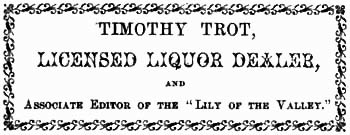
The editor went to him, and says he:
"What do you mean by this impertinence, Timothy?"
The liquor chap stuck his hands into his pockets, my boy, and says he:
"If I furnish inspiration for nothing, I may as well have some literary credit. The village swallows what you furnish," says the chap, reasoningly, "and you swallow what I furnish, and so I'm the head editor after all."
But he took down the sign, my boy, when the editor dissolved the partnership by paying his score.
What are called Spirited Editorials in the New York papers, my boy, very often involve two swallows as well as a spread-eagle.
While looking over some old magazines in the Lily office one day, I found in an ancient British periodical a raking article upon American literature, wherein the critic affirmed that all our writers were but weak imitators of English authors, and that such a thing even as a Distinctively American Poem sui generis, had not yet been produced.
This radical sneer at the United States of America fired my Yankee blood, my boy, and I vowed within myself to write a poem, not only distinctively American, but of such a character that only America could have produced it. In the solitude of my room, that night, I wooed the aboriginal muse, and two days thereafter the Lily of the Valley contained my distinctive American poem of
THE AMERICAN TRAVELER. To Lake Aghmoogenegamook, All in the State of Maine, A man from Wittequergaugaum came One evening in the rain. "I am a traveler," said he, "Just started on a tour, And go to Nomjamskillicook To-morrow morn at four." He took a tavern bed that night, And with the morrow's sun, By way of Sekledobskus went, With carpet-bag and gun. A week passed on; and next we find Our native tourist come To that sequestered village called Genasagarnagum. From thence he went to Absequoit, And there—quite tired of Maine— He sought the mountains of Vermont, Upon a railroad train. Dog Hollow, in the Green Mount State, Was his first stopping-place, And then Skunk's Misery displayed Its sweetness and its grace. By easy stages then he went To visit Devil's Den; And Scrabble Hollow, by the way, Did come within his ken. Then, via Nine Holes and Goose Green, He traveled through the State, And to Virginia, finally, Was guided by his fate. Within the Old Dominion's bounds, He wandered up and down, To-day, at Buzzard Roost ensconced, To-morrow, at Hell Town. At Pole Cat, too, he spent a week, Till friends from Bull Ring came, And made him spend a day with them In hunting forest game. Then, with his carpet-bag in hand, To Dog Town next he went; Though stopping at Free Negro Town, Where half a day he spent. From thence, into Negationburg His route of travel lay, Which having gained, he left the State And took a southward way. North Carolina's friendly soil He trod at fall of night, And, on a bed of softest down, He slept at Hell's Delight. Morn found him on the road again, To Lousy Level bound; At Bull's Tail, and Lick Lizzard, too, Good provender he found. The country all about Pinch Gut So beautiful did seem, That the beholder thought it like A picture in a dream. But the plantations near Burnt Coat Were even finer still, And made the wond'ring tourist feel A soft, delicious thrill. At Tear Shirt too, the scenery Most charming did appear, With Snatch It in the distance far, And Purgatory near. But spite of all these pleasant scenes, The tourist stoutly swore, That home is brightest, after all, And travel is a bore. So back he went to Maine, straightway, A little wife he took; And now is making nutmegs at Moosehicmagunticook.
In his note, introductory of this poem, my boy, the editor of the Lily affirmed (which is strictly true) that I had named none but veritable localities; and ventured the belief that the composition would remind his readers of Goldsmith. Upon which his scorpion contemporary in the next village observed, that there was rather more smith than gold about the poem. Genius, my boy, is never appreciated until its possessor is dead; and even the useless praise it then obtains is chiefly due to the pleasure that is experienced in burying the poor wretch.
Up to the time when this poem appeared in print, I had succeeded in concealing from my father the nature of my incidental occupation; but now he must know all.
He did know all, my boy; and the result was, that he gave me ten dollars, and sent me to New York to look out for myself.
"It's the only thing that will save him," says he to my mother, "and I must either send him off, or expect to see him sink by degrees to editorship, and commence to wear disgraceful clothes."
I went to New York; I became private secretary and speech-scribe to an unscrupulous and, therefore, rising politician; and now—I am in Washington.
Thus, my boy, have I answered your desire for an outline of my personal history; and henceforth let me devote my attention to other and more important inhabitants of our distracted country. I had a certain postmastership in my eye when I first came hither; but war's alarms indicate that I may do better as an amateur hero.
Yours inconoclastically,
Orpheus C. Kerr.
LETTER IV.
DESCRIBING THE SOUTH IN TWELVE LINES, DEFINING THE CITIZEN'S FIRST DUTY, AND RECITING A PARODY.
Washington, D.C., April —, 1861.
The chivalrous South, my boy, has taken Fort Sumter, and only wants to be "let alone." Some things of a Southern sort I like, my boy; Southdown mutton is fit for the gods, and Southside particular is liquid sunshine for the heart; but the whole country was growing tired of new South wails before this, and my present comprehensive estimate of all there is of Dixie may be summed up in twelve straight lines, under the general heading of
REPUDIATION. 'Neath a ragged palmetto a Southerner sat, A-twisting the band of his Panama hat, And trying to lighten his mind of a load By humming the words of the following ode: "Oh! for a nigger, and oh! for a whip; Oh! for a cocktail, and oh! for a nip; Oh! for a shot at old Greeley and Beecher; Oh! for a crack at a Yankee school-teacher; Oh! for a captain, and oh! for a ship; Oh! for a cargo of niggers each trip." And so he kept oh-ing for all he had not, Not contented with owing for all that he'd got.
In view of the impending conflict, it is the duty of every American citizen, who has nothing else to do, to take up his abode in the capital of this agonized Republic, and give the Cabinet the sanction of his presence. Some base child of treason may intimate that Washington is not quite large enough to hold every American citizen; but I'm satisfied that, if all the democrats could have one good washing, they would shrink so that you might put the whole blessed party into an ordinary custom house. Some of the republicans are pretty large chaps for their size, but Jeff Davis thinks they can be "taken in" easily enough; and I know that the new tariff will be enough to make them contract like sponges out of water. The city is full of Western chaps, at present, who look as if they had just walked out of a charity-hospital, and had not got beyond gruel diet yet. Every soul of them knew old Abe when he was a child, and one old boy can even remember going for a doctor when his mother was born. I met one of them the other day (he is after the Moosehicmagunticook post-office), and his anecdotes of the President's boyhood brought tears to my eyes, and several tumblers to my lips. He says, that when Abe was an infant of sixteen, he split so many rails that his whole county looked like a wholesale lumber-yard for a week; and that when he took to flat-boating, he was so tall and straight, that a fellow once took him for a smoke-stack on a steamboat, and didn't find out his mistake until he tried to kindle a fire under him. Once, while Abe was practising as a lawyer, he defended a man for stealing a horse, and was so eloquent in proving that his client was an honest victim of false suspicion, that the deeply-affected victim made him a present of the horse as soon as he was acquitted. I tell you what, my boy, if Abe pays a post-office for every story of his childhood that's told, the mail department of this glorious nation will be so large that a letter smaller than a two-story house would get lost in it.
Of all the vile and damning deeds that ever rendered a city eternally infamous, my boy—of all the infernal sins of dark-browed treachery that ever made open-faced treason seem holy, the crime of Baltimore is the blackest and worst. All that April day we were waiting with bated breath and beating hearts for the devoted men who had pledged their lives to their country at the first call of the President, and were known to be marching to the defence of the nation's capital. That night was one of terror: at any moment the hosts of the rebels might pour upon the city from the mountains of guilty Virginia, and grasp the very throat of the Republic. And with the first dim light of morning came the news that our soldiers had been basely beset in the streets of Baltimore, and ruthlessly shot down by a treacherous mob! Those whom they had trusted as brothers, my boy—whose country they were marching to defend with their lives—assassinating them in cold blood!
I was sitting in my room at Willard's, when a serious chap from New Haven, who had just paused long enough at the door to send a waiter for the same that he had yesterday, came rushing into the apartment with a long, fluttering paper in his hand.
"Listen to this," says he, in wild agitation, and read:
BALTIMORE. Midnight shadows, dark, appalling, round the Capitol were falling, And its dome and pillars glimmered spectral from Potomac's shore; All the great had gone to slumber, and of all the busy number That had moved the State by day within its walls, as erst before, None there were but dreamed of heroes thither sent ere day was o'er— Thither sent through Baltimore. But within a chamber solemn, barred aloft with many a column, And with windows tow'rd Mount Vernon, windows tow'rd Potomac's shore, Sat a figure, stern and awful; Chief, but not the Chieftain lawful Of the land whose grateful millions Washington's great name adore— Sat the form—a shade majestic of a Chieftain gone before, Thine to honor, Baltimore! There he sat in silence, gazing, by a single planet's blazing, At a map outspread before him wide upon the marble floor; And if 'twere for mortal proving that those reverend lips were moving, While the eyes were closely scanning one mapped city o'er and o'er— While he saw but one great city on that map upon the floor— They were whispering—"Baltimore." Thus he sat, nor word did utter, till there came a sudden flutter, And the sound of beating wings was heard upon the carvéd door. In a trice the bolts were broken; by those lips no word was spoken, As an Eagle, torn and bloody, dim of eye, and wounded sore, Fluttered down upon the map, and trailed a wing all wet with gore O'er the name of Baltimore! Then that noble form uprising, with a gesture of surprising, Bent with look of keenest sorrow tow'rd the bird that drooped before; "Emblem of my country!" said he, "are thy pinions stained already In a tide whose blending waters never ran so red before? Is it with the blood of kinsmen? Tell me quickly, I implore!" Croaked the eagle—"Baltimore!" "Eagle," said the Shade, advancing, "tell me by what dread mischancing Thou, the symbol of my people, bear'st thy plumes erect no more? Why dost thou desert mine army, sent against the foes that harm me, Through my country, with a Treason worlds to come shall e'er deplore?" And the Eagle on the map, with bleeding wing, as just before, Blurred the name of Baltimore! "Can it be?" the spectre muttered. "Can it be?" those pale lips uttered; "Is the blood Columbia treasures spilt upon its native shore? Is there in the land so cherished, land for whom the great have perished, Men to shed a brother's blood as tyrant's blood was shed before? Where are they who murder Peace before the breaking out of war?" Croaked the Eagle—"Baltimore." At the word, of sound so mournful, came a frown, half sad, half scornful, O'er the grand, majestic face where frown had never been before; And the hands to Heaven uplifted, with an awful pow'r seemed gifted To plant curses on a head, and hold them there forevermore— To rain curses on a land, and bid them grow forevermore— Woe art thou, O Baltimore! Then the sacred spirit, fading, left upon the floor a shading, As of one with arms uplifted, from a distance bending o'er; And the vail of night grew thicker, and the death-watch beat the quicker For a death within a death, and sadder than the death before! And a whispering of woe was heard upon Potomac's shore— Hear it not, O Baltimore! And the Eagle, never dying, still is trying, still is trying, With its wings upon the map to hide a city with its gore; But the name is there forever, and it shall be hidden never, While the awful brand of murder points the Avenger to its shore; While the blood of peaceful brothers God's dread vengeance doth implore, Thou art doomed, O Baltimore!
"There!" says the serious New Haven chap, as he finished reading, stirring something softly with a spoon, "what do you suppose Poe would think, if he were alive now and could read that?"
"I think," says I, striving to appear calm, "that he would be 'Raven' mad about it."
"Oh—ah—yes," says the serious chap, vaguely, "what will you take?"
Doubtless I shall become hardened to the horrors of war in time, my boy; but at present these things unhinge me.
Yours, unforgivingly,
Orpheus C. Kerr.
LETTER V.
CONCERNING THE GREAT CROWD AT THE CAPITAL, OWING TO THE VAST INFLUX OF TROOPS, AND TOUCHING UPON FIRE-ZOUAVE PECULIARITIES AND OTHER MATTERS.
Washington, D.C., May 24th, 1861.
I am living luxuriously, at present, on the top of a very respectable fence, and fare sumptuously on three granite biscuit a day, and a glass of water, weakened with brandy. A high private in the Twenty-second Regiment has promised to let me have one of his spare pocket-handkerchiefs for a sheet on the first rainy night, and I never go to bed on my comfortable window-brush without thinking how many poor creatures there are in this world who have to sleep on hair mattresses and feather-beds all their lives. Before the great rush of the Fire Zouaves and the rest of the menagerie commenced, I boarded exclusively on a front stoop on Pennsylvania Avenue, and used to slumber, regardless of expense, in a well-conducted ash-box; but the military monopolize all such accommodation now, and I give way for the sake of my country.
I tell you, my boy, we're having high old times here just now, and if they get any higher, I shan't be able to afford to stay. The city is in "danger" every other hour, and as a veteran in the Fire Zouaves remarked, there seems to be enough danger laying around loose on Arlington Heights to make a very good blood-and-thunder fiction in numerous pages. If the vigilant and well-educated sentinels happen to see an old nigger on the other side of the Potomac, they sing out, "Here they come!" and the whole blessed army is snapping caps in less than a minute. Then all the cheap reporters telegraph to their papers in New York and Philadelphia, that "Jeff. Davis is within two minutes' walk of the Capital, with a few millions of men," and all the free states send six more regiments a piece to crowd us a little more. I sha'n't stand much more crowding, for my fence is full now, and there were six applications yesterday to rent an improved knot-hole. My landlord says that, if more than three chaps set up housekeeping on one post, he'll be obliged to raise the rent.
Those Fire Zouaves are fellows of awful suction, I tell you. Just for greens, I asked one of them, yesterday, what he came here for? "Hah!" says he, shutting one eye, "we came here to strike for your altars and your fires—especially your fires." General Scott says that if he wanted to make these chaps break through the army of a foe, he'd have a fire-bell rung for some district on the other side of the rebels. He says that half a million of the traitors couldn't keep the Fire Zouaves out of that district five minutes. I believe him, my boy!
The weather here is highly favorable to the free development of perspiration and mint-juleps, and I have enjoyed the melancholy satisfaction of losing ten pounds of flesh in three days. One of the lieutenants of the Eighth has a gutter about half an inch deep worn down the bridge of his nose by the stream of perspiration since Wednesday; and a chap from Vermont melted so awfully the other day, that they had to put him in a refrigerator to keep enough of him to send home to his rich but pious family.
In fact, this weather makes the Northern boys fall away awfully; one of the Fire Zouaves fell away tremendously yesterday; he fell away from Washington to Annapolis, and then somebody had to put him in a guard-house to keep him from perspiring all the way back to New York. The chap that boards on the next front stoop to me now, was so fat when he came here that his captain refused to use him as a sentinel, because he could not see far enough over his stomach to detect any one approaching him. Well, my boy, that chap has fallen away to such an extent that it took me half an hour last night to find out what part of his uniform he lived in. He blew down three or four times while we were walking up Pennsylvania avenue; and while I was helping him up the last time, a passer-by asked me "What I would take for that ere flag-staff?"
By-the-by, you ought to have heard Honest Old Abe's speech, on Wednesday, when we raised the Star-spangled particular on the Post-office. Says he: "On this present occasion, I feel that it will not be out of place to make a few remarks which were not applicable at a former period. Yesterday, the flag hung on the staff throughout the Union, and in consequence of the scarcity of a breeze, there was not much wind blowing at the time. On the present happy occasion, however, the presence of numerous zephyrs causes the atmosphere to agitate for our glorious Union, and this flag, which now unfolds itself to the sight, is observed, upon closer inspection, to present a star-spangled appearance."
Mr. Seward's speech, which was also received with frantic enthusiasm, sounded equally well. He said: "I trust that this glorious spectacle will make a deep impression upon all present, notwithstanding the fact that I am still convinced that peace may yet put an end to this unhappy conflict by means of a convention of all the States on the Fourth of July, 2776, which I have always advocated. As the President has remarked, the breeze which has just arisen in the bay of Naples, causes the Star-Spangled Banner to arouse a far prouder feeling in every American breast, than if a vessel should come in with a palmetto flag at her peak, and upon being asked where it came from, should reply: 'Oh, from one of the petty republics of America.' I have nothing more to say."
I know this report is correct, for I copied both the speeches from a phonographic reporter's copy, and the phonographic reporter had only taken six glasses of old peach and honey before he went to work.
Yours, hastily,
Orpheus C. Kerr.
LETTER VI.
INTRODUCING THE MACKEREL BRIGADE, DILATING ON HAVELOCKS AS FIRST MADE BY THE WOMEN OF AMERICA, ILLUSTRATING THE STRENGTH OF HABIT AND WEAKNESS OF "SHODDY," AND SHOWING HOW OUR CORRESPONDENT INDULGED IN A HUGE CANARD, AFTER THE MANNER OF AN ENLIGHTENED DAILY PRESS.
Washington, D.C., June 15th, 1861.
The members of the Mackerel Brigade, now stationed on Arlington Heights to watch the movements of the Potomac, which is expected to rise shortly, desire me to thank the women of America for supplies of Havelocks and other delicacies of the season just received. The Havelocks, my boy, are rather roomy, and we took them for shirts at first; and the shirts are so narrow-minded, that we took them for Havelocks. If the women of America could manage to get a little less linen in the collars of the latter article, and a little more into the other departments of the graceful garment, there would be fewer colds in this division of the Grand Army.
The Havelocks, as I have said before, are roomy—very roomy, my boy. Villiam Brown, of Company 3, Regiment 5, put one on last night, when he went on sentry-duty, and looked like a broomstick in a pillow-case, for all the world. When the officer of the night came round and caught sight of Villiam in his Havelock, he was struck dumb with admiration for a moment. Then he ejaculated:
"What a splendid moonbeam!"
Villiam made a movement, and the sergeant came up.
"What's that white object?" says the officer to the sergeant.
"The young man which is Villiam Brown," says the sergeant.
"Thunder!" roars the officer, "tell him to go to his tent, and take off that night-gown!"
"You're mistaken," says the sergeant. "The sentry is Villiam Brown, in his Havelock, which was made by the wimmen of America."
The officer was so justly exasperated at his mistake, that he went immediately to his head-quarters, and took the Oath three times running, with a little sugar.
The Oath is very popular, my boy, and comes in bottles. I take it medicinally myself.
The shirts made by the women of America are noble articles, as far down as the collar; but would not do to use as an only garment. Captain Mortimer de Montague, one of the skirmish squad, put one on when he went to the President's Reception, and the collar stood up so high, that he couldn't put his cap on, while the other departments didn't quite reach to his waist. His appearance at the White House was picturesque and interesting, and as he entered the drawing-room, General Scott remarked, very feelingly:
"Ah! here comes one of our wounded heroes."
"He's not wounded, general," remarked an officer, standing by.
"Then, why is his head bandaged up so?" asked the venerable veteran.
"Oh!" says the officer, "that's only one of the shirts made by the patriotic wimmen of America."
In about five minutes after this conversation, I saw the venerable veteran, the wounded hero, and the officer taking the Oath together.
The Seventy-ninth, Highlanders, came to town early last week, and are the finest body of Scotchmen that were ever half kilt by uniform alone. My heart warmed to them when I first saw them; and, with arms outspread, I greeted the gallant fellow nearest to me. With a tear of gratified pride in his eye, he exclaimed:
"Auld lang syne and Scots who ha'e; but gang awa' wi' Heeland laddie thegither o' John Anderson my Jo; and, moreover, we'll tak' a right gude willie wacht for muckle twa and braw chiel."
I told him I thought so myself.
I'm sorry to say, my boy, that some members of this splendid regiment are badly off for trowsers, and shock my modesty tremendously. They probably forgot them in their hurry to get to the war, and the Union Pretence Committee ought to send them out an assortment of peg-tops at once. "Not that I hobject to the hinnocent hamusements of the Highlanders, but that decency and propriety must be preserved within the limits of the army"—as the British show-man observed.
I took a trip down to Alexandria the other night, to see how the Fire Zouaves were getting along, and came pretty near getting into trouble with one of Five's screamers. He was on guard; and when he challenged me, the pass-word slipped my memory.
"Drop that ere butt," says he, bringing his musket to a charge, "or I'll give yer a taste of the old masheen. Who—wha—what are yer coughin' at—sa-a-ay?"
I was frightened, my boy, and had just commenced the appropriate prayer of "Now I lay me down to sleep," when suddenly an idea struck me, and I acted on it immediately.
"Hello!" says I, "Johnny, didn't you hear the old Hall kettle strike for the Fourth District? Come along with me and help to get the old dog-cart on a jump, or Nine's roosters will get the rail-road track and have the old butt in Christie street before we can swing the old masheen over a pig's whisker."
"Bully for you!" says he, dropping his musket, all in a quiver, and commencing to roll up his pantaloons. "I've got a bet on that ere fire; and ef I don't take the starch out of that ere Nine's feller what wears good clothes and don't do nothing—you may just take my boots."
It was all the force of habit, you see; and if I hadn't stopped that Zouave, I really believe he'd have run clean into the bosom of all the first families, looking for the Fourth District and Nine's feller!
The Mackerel brigade have got their new uniforms, and they are not the martial garments it would do to get fat in. High private Samivel Green put his on, partially, yesterday; but, it's a positive fact, my boy, that by the time he got his coat buttoned, his pantaloons were all worn out. I managed to get on one of the uniforms myself, and the first time I went into the open air all the buttons blew off.
I've just returned from visiting the most mournful sight that ever made a man feel as though he'd been peeling onions all the week, and grating horse-radish on Sunday. It was the first dying scene of one of the "Pet Lammers," down at Alexandria, and, as one of Five's chaps remarks, it was enough to make the eye of a darning-needle weep, and bring tears to the cheek of the Greek slave. Jim was the only name of the sufferer, and if he ever had any other, it had slipped his memory, though his affectionate relatives sometimes called him "Shorty," by way of endearment. He was out on picket-guard the night before, when the Southern Confederacy attempted to pass him. He challenged the intruder, and called to his comrades for help; but, before the latter could arrive, the Southern Confederacy drew a masked battery from his pocket, and fired six heavy balls through the head of the unfortunate Zouave, nearly fracturing his skull, and breaking several panes of glass. The cowardly miscreant then fled to an adjacent fence, closely followed by Sherman's Artillery.
Upon discovering that he was wounded, Mr. Shorty examined the cap on his musket, and stood it carefully against a tree, buttoned his jacket to his neck, and asked a comrade for a chew of tobacco. Too full of emotion to speak, the comrade handed a gentlemanly plug to the dying man, who cut about half an ounce from it, placed it thoughtfully in his mouth, and then stuffed his handkerchief carefully in the hole in his forehead made by the balls.
"Is any of my brains hanging out?" he asked of another of his comrades.
"No, Shorty," answered the other, bursting into tears; "you never had any to hang out."
After this response, the dying man paused for a moment to spit in the eyes of a dog that was smelling around his heels, and then proceeded with his comrades in the direction of the hospital, or the house used for that purpose.
As they were passing the quarters of the officer with whom I was spending the night, the expiring Zouave stopped to twist the tail of an old darkey's cat, which made such a noise that the officer's attention was attracted, and he called the whole party into his room. I at once noticed that the top of Mr. Shorty's head was completely gone, and that one of his eyes was half-way down the back of his neck. Upon entering the room he took a pipe from the mantel and commenced to smoke it, giving us, at the same time, a history of Nine's Engine and the first "muss" he was ever engaged in. After finishing the pipe, and requesting me to wrap him up in the American flag, he spit on one of my boots, and then died. I append a short biographical sketch.
THE LATE PRIVATE SHORTY.
Mr. James Shorty, the gallant Zouave who was shot last night by the Southern Confederacy, was born some years ago in a place I am not aware of, and graduated with high honors in the New York Fire Department. He was universally beloved for his genial manner of taking the butt, and never hit a feller bigger than himself. In the year 1861, he entered the United States army as a private Zouave, and was in it when the fate of war deprived the country of his beloved presence. His remains will be taken to the first fire that occurs.
Poor Shorty! I knew him well, my boy, and shall never forget how ready he always was to take a cigar from
Yours, mournfully,
Orpheus C. Kerr.
P.S.—Since writing the above, I have heard that no such occurrence took place at Alexandria. The alarm was occasioned by the fall of a bag of hay in one of the officers' quarters, the noise being mistaken for the firing of a battery. Mr. Shorty, it seems, does not belong to the Zouaves, at all, and is still in New York.
O. C. K.
LETTER VII.
RECORDING THE FIRST SANGUINARY EXPLOIT OF THE MACKEREL BRIGADE, AND ITS VICTORIOUS ISSUE.
Washington, D.C., June 20th, 1861.
I have just returned, my boy, with my fellow-mercenaries and several mudsills from a carnival of gore. I am wounded—my sensibilities are wounded, and my irrepressibles reek with the blood of the slain. These hands, that once opened the oysters of peace and toyed with the bivalves of tranquillity, are now sanguinary with the red juice of battle (gushing idea!), and linger in horrid ecstacy about the gloomy neck of a bottle holding about a quart. Eagle of my country, proud bird of the menagerie! thou art avenged!
At a late hour last evening, the Brigadier-General of the Mackerel Brigade (formerly a practitioner in the Asylum for Idiots) received intelligence from a messenger that a strong force of chickens were intrenched near Fairfax Court-House under the command of a rabid secessionist named Binks. The brigade was at once ordered over the bridge at a double-quick, the general throwing a strong force of skirmishers into the Potomac, and waving his sword repeatedly to show that he was a stranger to fear. Shortly after touching Virginia soil, the orderly sergeant reported an engagement, on the left flank, between private Villiam Brown and the man that puts his hair in papers. A consultation of officers was immediately called, and the order "About face" was given. So excited was our general by the event, that when the order to march was given he forgot all about the "About face" business, and we didn't know that we were going the wrong way until we suddenly found ourselves at the bridge again. A consultation of officers was immediately called, and it was determined that, in consequence of the well-known revolution of the world on its axis, the part with the bridge on it had taken a turn while we were halting, and we were ordered to counterbalance the singular phenomena by marching the other way immediately. We had proceeded about one mile, when a scout reported that a shower was coming up. A consultation of officers was immediately called, and it was determined that a squad should search a neighboring farmhouse for an umbrella for the Brigadier-General. The umbrella being obtained without loss of life, we pushed on toward Fairfax, and soon found ourselves before the works of the enemy. A consultation of officers was immediately called, and it was decided that the Brigadier-General should climb a tree, in order to be able to direct the assault effectively, and prevent the appearance of a widow in his family at home. The first regiment, Watch Guards, were ordered to reconnoitre the works, and private Villiam Brown had almost succeeded in surrounding a very fat pullet, when Colonel Binks put his head out of the window of his fortress, and discharged a ten-inch boot-jack at our centre.
The Man that puts his hair in papers was wounded severely on one of his corns, and the Brigadier-General slid hastily down from the tree, and retired to the rear of an adjacent barn. A consultation of officers was immediately called, and it was determined to form our brigade into a square, and receive the charge of the enemy, who speedily appeared before the breastworks with a pair of tongs in his hands. Reaching forward with the horrid weapon, he pulled the nose of our returned Brigadier-General with it. A consultation of officers was immediately called, and it was determined that death was preferable to defeat. Accordingly, the brigade was ordered to advance cautiously upon the enemy, while the orderly sergeant was sent to harass his rear, and turn his flank, if possible. Our brigadier-general attempted to lead the charge, but made a mistake about the direction again, and had galloped half a mile toward where we came from before he could be convinced of his mistake. Seeing us descending upon him, at last, like an avalanche, the enemy deployed to the right, and poured in a volley of "cusses," throwing our right column into confusion, and wounding the delicacy of our chaplain. A consultation of officers was immediately called, and it was determined to make one more dash. We were formed into the shape of a bunch of radishes, the brigadier-general retired a distance of two miles to encourage us, and we poured down upon the foe with irresistible force. His ranks were broken by the impetuosity of our charge, and he scattered and fled in dismay.
The engagement then became general, and in a little while we were on our victorious way to Washington again, with 150 rebel prisoners. Our captives were chickens, in excellent condition for dressing, and their appearance so delighted our brigadier-general—whom we found sharpening his sword on the bottom of his boot, some miles away—that a consultation of officers was immediately called, and it was determined to cook and eat them immediately, lest the President should administer the oath of allegiance to them, and discharge them in the morning.
Yours, victoriously,
Orpheus C. Kerr.
LETTER VIII.
THE REJECTED "NATIONAL HYMNS."
Washington, D.C., June 30th, 1861.
Immediately after mailing my last to you, I secured a short furlough, and proceeded to New York, to examine into the affairs of that venerable Committee which had offered a prize of $500 for the best National Hymn.
Upon going into literary circles, my boy, no less than fifty acknowledged poets confidentially informed me, that the idea of bribing the muse to be solemnly patriotic was altogether too vulgar to be tolerated for a moment by writers of reputation; and a whole swarm of poets, never acknowledged by anybody, were human enough to say that $500 was not a small sum in these times; but they hadn't "come to that yet, you know."
One very poor Bohemian, my boy (whose scathing sarcasm at the expense of those degraded creatures who prefer wealth to intellect, has often delighted and improved the public mind), was so rash as to intimate that the importunities of his laundress might drive him to the desperate resource of competing for the prize; but he was quickly made to blush for the unworthy thought, by the undisguised contempt for his "dem'd lowness" displayed by a decayed young gentleman in a dirty collar and very new neck-tie, who lives in a two-pair back in Wooster street (fish balls and a roll twice a day), and writes graphic sketches of fashionable life for the wholesale market.
And yet, notwithstanding all this high-mindedness, my boy, there is an immense amount of some sort of genius insidiously pitted against the contemptible $500. Astounding and distracting to relate, the committee announces the reception of no less than eleven hundred and fifty "anthems"!
The magnitude of eleven hundred and fifty "anthems" is almost more than one human mind can grasp. Allowing that each "anthem" is a quarter of a yard long, we have a grand total of two hundred and eighty-seven and a half yards of "anthem"; allowing that each "anthem" weighs half a pound (intellectually and materially), I find a gross weight of five hundred and seventy-five pounds of "anthem"!
Let the reflective mind consider these figures for a moment, and it will be stricken with a sense of the singular resemblance between Genius and other marketable commodities. Eleven hundred and fifty anthems are enough to prove that Genius has its private mercenary weaknesses as well as Trade, my boy, and that brains can be bought by the yard as well as calico. Genius may carry with it a seeming contempt for the yellow dross of common humanity; but—it has to pay its occasional washerwoman.
And all these "anthems" are rejected by the venerable committee! But must they all, therefore, be lost to the world? I hope not, my boy,—I hope not. Having some acquaintance with the discriminating rag-merchant to whom they were turned over as rejected, I have procured some of the best, from which to quote for your special edification.
Imprimis, my boy, observe this
NATIONAL ANTHEM. BY H. W. L——, OF CAMBRIDGE. Back in the years when Phlagstaff, the Dane, was monarch Over the sea-ribbed land of the fleet-footed Norsemen, Once there went forth young Ursa to gaze at the heavens— Ursa, the noblest of all the Vikings and horsemen. Musing, he sat in his stirrups and viewed the horizon, Where the Aurora lapt stars in a North-polar manner, Wildly he started—for there in the heavens before him Fluttered and flew the original Star-Spangled Banner.
The committee have two objections to this: in the first place, it is not an "anthem" at all; secondly, it is a gross plagiarism from an old Scandinavian war-song of the primeval ages.
Next, I present a
NATIONAL ANTHEM. BY THE HON. EDWARD E——, OF BOSTON. Ponderous projectiles, hurled by heavy hands, Fell on our Liberty's poor infant head, Ere she a stadium had well advanced On the great path that to her greatness led; Her temple's propylon was shattered; Yet, thanks to saving Grace and Washington, Her incubus was from her bosom hurled; And, rising like a cloud-dispelling sun, She took the oil, with which her hair was curled, To grease the "Hub" round which revolves the world.
This fine production is rather heavy for an "anthem," and contains too much of Boston to be considered strictly national. To set such an "anthem" to music would require a Wagner; and even were it really accommodated to a tune, it could only be whistled by the populace.
We now come to a
NATIONAL ANTHEM. BY JOHN GREENLEAF W——. My native land, thy Puritanic stock Still finds its roots firm-bound in Plymouth Rock, And all thy sons unite in one grand wish— To keep the virtues of Preserv-éd Fish. Preserv-éd Fish, the Deacon stern and true, Told our New England what her sons should do, And should they swerve from loyalty and right, Then the whole land were lost indeed in night.
The sectional bias of this "anthem" renders it unsuitable for use in that small margin of the world situated outside of New England. Hence the above must be rejected.
Here we have a very curious
NATIONAL ANTHEM. BY DR. OLIVER WENDELL H——. A diagnosis of our hist'ry proves Our native land a land its native loves; Its birth a deed obstetric without peer, Its growth a source of wonder far and near. To love it more behold how foreign shores Sink into nothingness beside its stores; Hyde Park at best—though counted ultra-grand— The "Boston Common" of Victoria's land—
The committee must not be blamed for rejecting the above, after reading thus far; for such an "anthem" could only be sung by a college of surgeons or a Beacon-street tea-party.
Turn we now to a
NATIONAL ANTHEM. BY RALPH WALDO E——. Source immaterial of material naught, Focus of light infinitesimal, Sum of all things by sleepless Nature wrought, Of which abnormal man is decimal. Refract, in prism immortal, from thy stars To the stars blent incipient on our flag, The beam translucent, neutrifying death; And raise to immortality the rag.
This "anthem" was greatly praised by a celebrated German scholar; but the committee felt obliged to reject it on account of its too childish simplicity.
Here we have a
NATIONAL ANTHEM BY WILLIAM CULLEN B——. The sun sinks softly to his evening post, The sun swells grandly to his morning crown; Yet not a star our flag of Heav'n has lost, And not a sunset stripe with him goes down. So thrones may fall; and from the dust of those, New thrones may rise, to totter like the last; But still our country's nobler planet glows While the eternal stars of Heaven are fast.
Upon finding that this did not go well to the air of "Yankee Doodle," the committee felt justified in declining it; being furthermore prejudiced against it by a suspicion that the poet has crowded an advertisement of a paper which he edits into the first line.
Next we quote from a
NATIONAL ANTHEM BY GEN. GEORGE P. M——. In the days that tried our fathers Many years ago, Our fair land achieved her freedom, Blood-bought, you know. Shall we not defend her ever As we'd defend That fair maiden, kind and tender, Calling us friend? Yes! Let all the echoes answer, From hill and vale; Yes! Let other nations, hearing, Joy in the tale. Our Columbia is a lady, High-born and fair; We have sworn allegiance to her— Touch her who dare.
The tone of this "anthem" not being devotional enough to suit the committee, it should be printed on an edition of linen-cambric handkerchiefs, for ladies especially.
Observe this
NATIONAL ANTHEM BY N. P. W——. One hue of our flag is taken From the cheeks of my blushing Pet, And its stars beat time and sparkle Like the studs on her chemisette. Its blue is the ocean shadow That hides in her dreamy eyes, It conquers all men, like her, And still for a Union flies.
Several members of the committee being pious, it is not strange that this "anthem" has too much of the Anacreon spice to suit them.
We next peruse a
NATIONAL ANTHEM BY THOMAS BAILEY A——. The little brown squirrel hops in the corn, The cricket quaintly sings; The emerald pigeon nods his head, And the shad in the river springs, The dainty sunflower hangs its head On the shore of the summer sea; And better far that I were dead, If Maud did not love me. I love the squirrel that hops in the corn, And the cricket that quaintly sings; And the emerald pigeon that nods his head, And the shad that gayly springs. I love the dainty sunflower, too, And Maud with her snowy breast; I love them all;—but I love—I love— I love my country best.
This is certainly very beautiful, and sounds somewhat like Tennyson. Though it was rejected by the Committee, it can never lose its value as a piece of excellent reading for children. It is calculated to fill the youthful mind with patriotism and natural history, besides touching the youthful heart with an emotion palpitating for all.
Notice the following
NATIONAL ANTHEM BY R. H. STOD——. Behold the flag! Is it not a flag? Deny it, man, if you dare; And midway spread, 'twixt earth and sky, It hangs like a written prayer. Would impious hand of foe disturb. Its memories' holy spell, And blight it with a dew of blood? Ha, tr-r-aitor!! * * * It is well.
And this is the last of the rejected anthems I can quote from at present, my boy, though several hundred pounds yet remain untouched.
Yours, questioningly,
Orpheus C. Kerr.
LETTER IX.
IN WHICH OUR CORRESPONDENT TEMPORARILY DIGRESSES FROM WAR MATTERS TO ROMANTIC LITERATURE, AND INTRODUCES A WOMAN'S NOVEL.
Washington, D.C., July —, 1861.
While the Grand Army is making its preparations for an advance upon the Southern Confederacy, my boy, and the celebrated fowl of our distracted country is getting ready his spurs, let me distract your attention for a moment to the subject of harrowing Romance as inflicted by the intellectual women of America.
To soothe and instruct me in my leisure and more ebrious moments, one of the ink-comparable women of America has sent me her new novel to read; and before I allow you to enjoy its green leaves, my boy, you must permit me to make a few remarks concerning the generality of such works.
Long and patient study of womanly works teaches me that woman's genius, as displayed in gushing fiction, is a power of creating an unnatural and unmitigated ruffian for a hero, my boy, at whose shrine all created crinoline and immense delegations of inferior broadcloth are impelled to bow. Such a one was that old humbug, Rochester, the beloved of "Jane Eyre." The character has been done-over scores of times since poor Charlotte Bronté gave her famous novel to the world, and is still "much used in respectable families."
The great difficulty with the intellectual women of America is, that they will persist in attempting to delineate a phase of manly character which attracts them above all others, but which they do not comprehend. Woman entertains a natural fondness for that which she can not understand, and hence it is that we very seldom find her without a wildly-vague admiration of Emerson.
There is in this world, my boy, a noble type of manhood which unites dignified reserve with the most loyal integrity, relentless pride of manner with the kindest humility of heart, rigid indifference to the applause of the world with the finest regard for its honest respect, and carelessness of woman's mere frivolous liking with the most profound and chivalrous reverence for her virtues and her love.
This is the type which, without comprehending it, the intellectual women of America are continually striving to depict in their novels; and a pretty mess they make of it, my boy,—a pretty mess they make of it.
Their "Rochester" hero is harder to understand than Hamlet, when he falls into the hands of our school-girl authoresses. He looms rakishly upon us, my boy, a horridly misanthropic wretch, despising the world with all the dreadful malignity of chronic dyspepsia, and displaying a degree of moral biliousness truly horrifying to members of the church. His behavior to the poor little heroine is a perpetual outrage. Alternately he caresses and snubs her. He never fails to make her read to him when he traps her in the library; and when she says, "Good night" to him he is too deep in a "fit of gloomy abstraction" to answer her civilly. If he calls her a "little fool," her fondness for him becomes ecstatic: and at the first hint of his having murdered a noble brother and two beautiful sisters in early life, she is led to fear that her adoration of him will exceed the love she owes to her Maker!
This unprincipled ruffian may be separated from the virtuous little heroine for years, and be flirting consumedly with half a dozen crinolines when next she sees him; yet is he loved dearly by the virtuous little heroine all the time, and when last we hear of him, she is resting peacefully upon his vest-pattern.
What makes the inconsistency of the whole story still more apparent, is the intense and double-refined piety of the heroine, as contrasted with an utter stagnation of all morality in the breast of the ruffian. How the two can assimilate, I do not understand; and my misunderstanding is wofully augmented by the heroine's frequent expressions of churchliness, and the ruffian's equally frequent outbursts of waggish infidelity.
And now, my boy, let me transcribe for you the new novel, sent to me with such kind intent by one of the young and intellectual women of America. You will find much lusciousness of sentiment, my boy, in
HIGGINS.
AN AUTOBIOGRAPHY.
BY GUSHALINA CRUSHIT.
PREFACE.
In writing the ensuing pages, I have been guided by no motives other than those which lead the mind, in its leisure hours, to scatter the germs of the beautiful. It may be urged that the character of my hero is unnatural; but I am sure there are many of my sex who will discover in Mr. Higgins a counter-part of the ideal of days when life still knew the odors of its first spring, and the soul of man seemed to the eye of innocence an elysium of virtue into which no gangrene of mere worldliness intruded. I have done.
CHAPTER I.
It was on the eve of a day in the happy month of June, that my great grandfather's carriage, drawn by six hundred and twenty-two white horses, drew up under the tall palm trees before the gates of the venerable Higgins' Lodge, and I was lifted almost fainting from the wearied vehicle. As my grandfather supported my trembling steps into the spacious hall of the lodge, I noticed that another figure had been added to our party. It was that of a man six feet high, and broad in proportion, whose majestic and spacious brow betokened realms of elysian thought and excrescent ideality. His pallid tresses hung in curls down his back, and an American flag floated from his Herculean shoulders. Fixed by a fascination only to be realized by those who have felt so, I cast my piercing glance at him, and my inmost soul knew all his sublimity. It was as though an angel's wing had swept my temples, and left a glittering pinion there.
"Mr. Higgins," said my grandfather, "here is your ward, Galushianna."
For an instant silence prevailed.
Then Mr. Higgins said, in tones of exquisitely modulated thunder:
"What did you bring the d—d girl here for, you old cuss you?"
It was as when one sees a strain of music. I remembered the prayers of my dear departed mother when she sought to enlighten my speechless infancy with divine grace, and I felt that I loved this Higgins.
Such is life. We wander through the bowers of love without a thought of the morrow, while the dread vulture of predestination eats into our souls, and cries, wo! wo! Truly, earthly happiness is a mockery.
CHAPTER II.
Scarcely had I taken my seat in the library after my grandfather had left us, when Mr. Higgins ordered me to black his boots. This I proceeded to do with a haughty air, scarcely daring to hope, but wishing that he would conquer his freezing reserve, and speak to me again. For I was but a child, and my young heart yearned for sympathy.
Presently, Mr. Higgins turned his large gray eyes on me, and said:
"Ha!"
After this, he remained in a thoughtful reverie for two hours, and then turning to me, asked:
"Galushiana, what do you think of me?"
"I think," replied I, carefully putting the blacking-brush in its place, "that your nature is naturally a noble one, but has been warped and shadowed by a misconceived impression of the great arcana of the universe. You permit the genuflexions of human sin to bias your mind in its estimate of the true economy of creation; thus blighting, as it were, the fructifying evidences of your own abstract being—"
I blushed, and feared I had gone too far.
"Very true," responded Mr. Higgins, after a moment's pause; "Schiller says nearly the same thing. It was a sense of man's utter nothingness that led me to kill my grandmother, and poison the helpless offspring of my elder brother."
Here Mr. Higgins held down his head and quivered with emotions, as the ocean quakes under the shrieking howl of the blast.
I felt my whole being convulsed, and could not endure the spectacle. I stole softly to the door, and stammered through my tears, "Good-night, Mr. Higgins, I will pray for you."
He did not turn his noble head, but said, in firm tones: "Poor little beast, good night."
I went to my room, but could not sleep. Shortly after half-past two o'clock I crawled noiselessly down to the library-door and looked in. Mr. Higgins still sat before the fire in the same thoughtful position. "Poor little beast!" I heard him murmur softly to himself—"poor little beast!"
CHAPTER III.
Let the reader transport himself to a small stone cottage on the Hudson, and he will behold me as I was at the age of twenty-one. I had reached that acme of woman's career when common sense is to her as nothing, and the world with all its follies bursts upon her ravished ears with ten-fold succulence. My grandfather had been dead some fifty years, and I was even thinking of him, when the door opened, and Mr. Higgins entered. I felt my heart palpitate, and was about to quit the room, when he cast a searching glance at me, and said:
"Well, girl—are you as big a fool as ever?"
I hung my head, for the tell-tale blush would bloom.
"Come," said Mr. Higgins, "don't speak like a donkey. I'm no priestly confessor. Curse the priests! Curse the world! Curse everybody! Curse everything!" And he placed his feet upon the mantel-piece, and gazed meditatively into the fire.
I could hear the beatings of my own heart, and all the warmth of my nature went forth to meet this sublime embodiment of human majesty; yet I dared not speak.
After a short silence, Mr. Higgins took a chew of tobacco, and placing his hand on my shoulder, exclaimed:
"Why should I deceive you, girl? Last night I poisoned my only remaining sister because she would have wed a circus-keeper, and scarcely an hour ago I lost two millions at faro. Your priests would say this was wrong—hey?"
I stifled my sobs and said, as calmly as I could:
"Our Church looks at the motive, not the deed. If a high sense of honor compelled you to poison all your relatives and play faro, the sin was rather the effect of vice in others than in your own noble heart, and I doubt not you may be called innocent."
He glanced into the fire a few hours, and then said:
"Go, Galushianna!—I would be alone! Go, innocent young scorpion."
Oh, Higgins, Higgins, if I could have died for thee then, I don't know but I should have done it!
CHAPTER IV.
Seventy-five years have rolled by since last I met the reader, and I am still a thoughtless girl. But oh, how changed! The raven of despair has flapped his hideous brood over the halls of my ancestors, and taken from them all that once made them beautiful. When I look back I can see nothing before me, and when I look forward I can see nothing behind me. Thus it is with life. We fancy that each hour is a butterfly made to play with, and all is gall and bitterness.
I was chastened by misfortune, and occupied a secluded cavern in the city of New Orleans, when my faithful old nurse entered my dressing-room, and burst into a fit of hysterical laughter.
"Sassafrina!" I exclaimed, half angrily.
"Please don't be angry, miss," responded the tired old creature; "but I knew it would come all right at last. I told you Sir Claude Higgins hadn't married his youngest sister, but you wouldn't believe me. Now he's down stairs in the parlor waiting for you."
And the attached domestic fell dead at my feet.
After hastily putting on a pair of clean stockings and reading a chapter in my mother's family Bible, I left the room, murmuring to myself, "Be still, my throbbing heart, be still."
CHAPTER V.
When I entered the parlor, Mr. Higgins sat gazing into the fire in an attitude of deep reflection, and did not note my entrance until I had touched him. His dishevelled hair hung from his massive temples in majestic discomposure, and an extinguished torch lay smouldering at his glorious feet.
O my soul's idol! I can see thee now as I saw thee then, with the firelight glowing over thee, like a smile from the cerulean skies!
As I touched him, he awoke.
"Miserable girl!" he exclaimed, in those old familiar tones, drawing me towards him, while a delicious tremor shook my every nerve. "Wretched little serpent! And is it thus we meet? Poor idiot, you are but a woman, and I—alas! what am I? Two hours ago, I set fire to three churches, and crushed a sexton 'neath my iron heel. Do you not shrink? 'Tis well. Then hear me, viper, I lovest thee."
Was it the music of a higher sphere that I smelt, or was I still in this world of folly and sin? And were all my toils, my cares, my heart-breathings, my hope-sobbings, my soul-writhings to end thus gloriously at last in the adoration of a being on whom I lavished all the spirit's purest gloatings?
My bliss was more than I could endure. Tearing all the hair-pins from my hair and tying my pocket handkerchief about my heaving neck, I flung myself upon his steaming chest.
"My Higgins!"
"Your Higgins!!"
"OUR Higgins!!!"
The Blissful Finis.
The intellectual women of America draw it rather tempestuously when they try to reproduce gorgeous manhood; but they mean well, my boy,—they mean well.
Yours, in a brown study,
Orpheus C. Kerr.
LETTER X.
MAKING CONSERVATIVE MENTION OF THE BATTLE OF BULL RUN AND ITS EVENTS. THE FIRE-ZOUAVE'S VERSION OF THE AFFAIR, AND SO ON.
Washington, D.C., July 28th, 1861.
We have met the enemy at last, my boy; but I don't see that he's ours. We went after him with flying banners, and I noticed when we came back that they were flying still! Honor to the brave who fell on that bloody field! and may we kill enough secessionists to give each of them a monument of Southern skulls!
I was present at the great battle, my boy, and appointed myself a special guard of one of the baggage-wagons in the extreme rear. The driver saw me coming, and says he:
"You can't cut behind this here wehicle, my fine little boy."
I looked at him for a moment, after the manner of the late great actor, Mr. Kirby, and says I:
"Soldier, hast thou a wife?"
Says he:
"I reckon."
"And sixteen small children?"
Says he:
"There was only fifteen when last heard from."
"Soldier," says I, "were you to die before to-morrow, what would be your last request?"
Here I shed two tears.
"It would be," says he, "that some kind friend would take the job of walloping my offspring for a year on contract, and finding my beloved wife in subjects to jaw about."
"Soldier," says I, "I'm your friend and brother. Let me occupy a seat by your side."
And he didn't let me do it.
Just at this moment, something burst, and I found myself going up at the rate of two steeples and a shot-tower a second. I met a Fire Zouave on the way down, and says he:
"Towhead, if you see any of our boys up where you're goin' to, just tell them to hurry down; fur there's goin' to be a row, and Nine's fellers 'll take that ere four-gun hydrant from the seceshers in less time than you can reel two yards of hose."
As I was very tired I did not go all the way up; but turned back at the first cloud, and returned hastily to the scene of strife. I happened to light on a very fat secesher, who was doing a little running for exercise. Down he went, with me on top of him. He was dreadfully scared; but says he to me: "I've =seen you before, by the gods!" I winked at him, and commenced to sharpen my sword on a stone.
"Tell me," says he, "had you a female mother?"
"I had," says I.
"And a masculine father?"
"He wore breeches."
"Then you are my long lost grandfather!" says the secesher, endeavoring to embrace me.
"It won't do," says I; "I've been to the Bowery Theatre myself;" and with that I took off his neck-tie and wiped my nose with it. This action was so repugnant to the feelings of a Southern gentleman, that he immediately died on my hands; and there I left him.
It was my first personal victory in this unnatural war, my boy, and as I walked away I thought sadly of the domestic circle in the Southern Confederacy that might be waiting anxiously, tearfully, for the husband and father——him whom I had morally assassinated. And there he sprawled, denied even the simple privilege of extending a parting blessing to his children. Under ordinary circumstances, my boy, there's something deeply affecting in
THE DYING SOUTHERNER'S FAREWELL TO HIS SON. My boy, my lion-hearted boy, Your father's end draws near; Already is your loss begun, And, curse it, there's a tear. I've sought to bring you up, my son, A credit to the South, And all your poker games have been An honor to us both. Though scarcely sixteen years of age, Your bowie's tickled more Than many Southerners I know At fifty and three score. You've whipped your nigger handsomely, And chewed your plug a day; And when I hear you swear, my son, What pride my eyes betray! And now, that I must leave the world, My dying words attend; But first, a chew of niggerhead, And cut it near the end. To you the old plantation goes, With mortgage, tax, and all, Though compound interest on that first, Will make the profit small. The niggers to your mother go; And if she wants to sell, You might contrive to buy her out, Should all the crops grow well. I leave you all my debts, my son, To Yankees chiefly due; But—curse the black republicans! That needn't trouble you. A true-born Southern gentleman Disdains the vulgar thought Of paying, like a Yankee clerk, For what is sold and bought. Leave that to storekeepers and fools Who never banked a card; We pay our "debts of honor," boy, Though pressed however hard. Last summer at the North I bought, Some nigger hats and shoes, And gave my note for ninety days; Forget it if you choose. The Yankee mudsills would not have Such articles to sell, If Southern liberality Had fattened them less well. The Northern dun we hung last week Had twenty dollars clear, And that, my son, is all the cash I have to give you here. But that's enough to make a start, And, if you pick your boat, A Mississippi trip or two Will set you all afloat. You play a screaming hand, my son, And push an ugly cue; Oh! these are thoughts that make me feel As dying Christians do! Keep cool, my lion-hearted boy, Till second ace is played, And then call out for brandy sour As though your pile was made. The other chaps will think you've got The tiger by the tail; And when you see them looking glum, Just call for brandy pale! I never knew it fail to make Some green one go it blind; And when the first slip-up is made, It's all your own, you'll find. My breath comes hard—I'm euchred, boy— First Families must die; I leave you in your innocence, And here's a last good-bye.
Shortly after the event I have recorded, I was examining the back of a house near the battle-field, to see if it corresponded with the front, when another Fire Zouave came along, and says he:
"It's my opine that you're sticking rather too thick to the rear of that house to be much punkins in a muss. Why don't you go to the front like a man?"