Front matter (continued 4)
Reading edition
"'What's that ere concern of yourn, hoss?'
"Says I:
"'It's one of them doctor's flyers as I'd rather ride in it than in Queen Victory's bang-up, A, No. 1, stage-coach. It's a scrouger.'
"He kinder stuck a minute, and then says he:
"'What'll ye take for it, hoss?'
"I made out as though I didn't keer, and says I:
"'It was sent to me by a cousin up in York, and I don't keer to sell; but yer may take it for $250.'
"He turned green about the gills at that, and says he:
"'Say $100, and I'll take it with my eyes shut.'
"'It's yourn,' says I. 'Give us the rags.'
"He smelt a bug that time; but it was too late; so he forked out the rale stuff, and then went to look at the two-wheeler.
"'Thunder!' says he, blinkin' at the seat. 'I've seen that afore, or my name isn't what my father's wus!'
"'Better 'blieve it,' says I; 'that's your four-wheeler shaved down to the very latest York-fashion.'
"Then he did cuss; but twarn't no use. The trade was a trade, and all the boys larfed till their tongues hung out. I treated all round, and as I left 'em, says I:
"'Uncle Johnny, when ye want to trade agin, jist pick out a grindstun that isn't too hard for yer blade.'"
At the conclusion of this tale of real life I returned to the city, my boy; impressed with the conviction that the purpose of the sun's rising in the East is to give the New Englanders the first chance to monopolize the supply, should daylight ever be a sailable article.
Yours, admiringly,
Orpheus C. Kerr.
LETTER XXXV.
GIVING PRACTICAL ILLUSTRATION OF MODERN PATRIOTISM, AND CELEBRATING THE ADVANCE OF THE MACKEREL BRIGADE TO MANASSAS, ETC.
Washington, D.C., March 14th, 1862.
Patriotism, my boy, is a very beautiful thing. The surgeon of a Western regiment has analyzed a very nice case of it, and says that it is peculiar to this hemisphere. He says that it first breaks out in the mouth, and from thence extends to the heart causing the latter to swell. He says that it goes on raging until it reaches the pocket, when it suddenly disappears, leaving the patient very Constitutional and conservative. "Bless me!" says the surgeon, intently regarding a spoon with a tumbler round it, "if a genuine American ever dies of patriotism it will be because the Tax Bill hasn't been applied soon enough."
I believe him, my boy!
On Monday morning, just as the sun was rising, like a big gold watch "put up" at some celestial Simpson's, the sentinels of Fort Corcoran were seized with horrible tremblings at a sight calculated to make perpendicular hair fashionable. As far as the eye could reach on every side of the Capital, the ground was black with an approaching multitude, each man of which wore large spectacles, and carried a serious carpet-bag and a bottle-green umbrella.
"Be jabers!" says one of the sentinels, whose imperfect English frequently causes him to be taken for the Duc de Chartres, "it's the whole Southern Confederacy coming to boord with us."
"Aisey, me boy," says the other sentinel, straightening the barrel of his musket and holding it very straight to keep the fatal ball from rolling out, "it's the sperits of all our pravious descindants coming to ax us, was our grandmother the Saycretary of the Navy."
Right onward came the multitude, their spectacles glistening in the sun like so many exasperated young planets, and their umbrellas and carpet-bags swinging like the pendulums of so many infuriated clocks.
Pretty soon the advance guard, who was a chap in a white neck-tie and a hat resembling a stove-pipe in reduced circumstances, poked a sentinel in the ribs with his umbrella, and says he:
"Where's Congress?"
"Is it Congress ye want?" says the sentinel.
"Yessir!" says the chap. "Yessir. These are friends of mine—ten thousand six hundred and forty-two free American citizens. We must see Congress. Yessir!—dammit. How about that tax-bill? We come to protest against certain features in that bill."
"Murther an turf!" says the sentinel, "is it the taxes all of them ould chaps is afther blaming?"
"Yessir!" says the chap, hysterically jamming his hat down over his forehead and stabbing himself madly under the arm with his umbrella. "Taxes is a outrage. Not all taxes," says the chap with sudden benignity, "but the taxes which fall upon us. Why don't they tax them as is able to pay, without oppressing us ministers, editors, merchants, lawyers, grocers, peddlers, and professors of religion?" Here the chap turned very purple in the face, his eyes bulged greenly out, and says he: "Congress is a ass."
"That's thrue for you," says the sentinel: "they ought to eximpt the whole naytion and tax the rest of it."
The multitude then swarmed into Washington, my boy, and if they don't smother the Tax Bill, it will be because Congress is case-hardened.
The remainder of the Mackerel Brigade being ordered to join the Conic Section at Accomac for an irresistible advance on Manassas, I mounted my gothic steed Pegasus on Tuesday morning.
Pegasus, my boy, has greatly improved since I rubbed him down with Snobb's Patent Hair Invigorator, and his tail looks much less like a whisk-broom than it did at first. It is now fully able to maintain itself against all flies whatsoever. The general of the Mackerel Brigade rode beside me on a spirited black frame, and says he:
"That funereal beast of yours is a monument of the home affections. Thunder!" says the general, shedding a small tear of the color of Scheidam Schnapps, "I never look at that air horse without thinking of the time I buried my first baby; its head is shaped so much like a small coffin."
On reaching Accomac, my boy, we found Captain Villiam Brown at the head of the Conic Section of the Mackerel Brigade, dressed principally in a large sword and brass buttons, and taking the altitude of the sun with a glass instrument operated by means of a bottle.
"Ah!" says Villiam, "You are just in time to hear my speech to the sons of Mars, previous to the capture of Manassas by the United States of America."
Hereupon Villiam mounted a demijohn laid length-wise, and says he:
"Fellow-Anacondas:—Having been informed by a gentleman who has spent two weeks at Manassas, that the Southern Confederacy has gone South for its health, I have concluded that it is time to be offensive. The great Anaconda, having eluded Barnum, is about to move on the enemy's rear:
"'Rear aloft your peaks, ye mountings, Rear aloft your waves, O sea! Rear your sparkling crests, ye fountings, For my love's come back to me.'
"The day of inaction is past, and now the United States of America is about to swoop down like a exasperated Eagle, on the chickens left by the hawk. Are you ready, my sagacious reptiles, to spill a drop or so for your soaking country? Are you ready to rose up as one man—
"'The rose is red, The wi'lets blue, Sugar is sweet, and Bully for you.'
"Ages to come will look down on this day and say: 'They died young.' The Present will reply: 'I don't see it;' but the present is just the last thing for us to think about. Richmond is before us, and there let it remain. We shall take it in a few years:
"'It may be for years and it may be for ever, Then why art thou silent, O pride of me heart.'
"which is poickry. I hereby divide this here splendid army into one corpse dammee, and take command of it."
At the conclusion of this thrilling oration, my boy, the corpse dammee formed itself into a hollow square, in the centre of which appeared a mail-clad ambulance.
I looked at this carefully, and then says I to Villiam:
"Tell me, my gay Achilles, what you carry in that?"
"Ha!" says Villiam, balancing himself on one leg, "them's my Repeaters. This morning," says Villiam, sagaciously, "I discovered six Repeaters among my men. Each of them voted six times last election day, and I've put them where they can't be killed. Ah!" says Villiam, softly, "the Democratic party can't afford to lose them Repeaters."
Here a rather rusty-looking chap stepped out of the ranks, and says he:
"Captain, I'm a Repeater too. I voted four times last election."
"It takes six to make a reliable Repeater," says Villiam.
"Yes," says the chap: "but I voted for different coves—twice for the Republican candidate and twice for the Democrat."
"Ha!" says Villiam, "you're a man of intelleck. Here, sargent," says Villiam, imperiously, "put this cherubim into the ambulance."
"And, sargent," says Villiam, thoughtfully, "give him the front seat."
And now, my boy, the march for Manassas commenced, being timed by the soft music of the band. This band, my boy, is sui generis. Its chief artist is an ardent admirer of Rossini, who performs with great accuracy upon a night-key pressed closely against the lower lip, the strains being much like those emitted by a cart-wheel in want of grease. Then comes a gifted musican from Germany, whose instrument is a fine-tooth comb wrapped in paper, and blown upon through its vibratory covering. The remainder of the band is composed chiefly of drums, though the second-base achieves some fine effects with a superannuated accordeon.
Onward moved the magnificent pageant toward the plains of Manassas, the Anatomical Cavalry being in advance, and the Mackerel Brigade following closely after.
Arriving on the noted battle-field, we found nothing but a scene of desolation; the rebels gone; the masked batteries gone; and nothing left but a solitary daughter of the sunny South, who cursed us for invading the peaceful homes of Virginia, and then tried to sell us stale milk at six shillings a quart.
When Captain Villiam Brown, surveyed this spectacle, my boy, his brows knit with portentous anger, and says he:
"So much for wasting so much time. Ah!" says Villiam, clutching convulsively at his canteen, "we have met the enemy, and they are hours—ahead of us."
The only thing noticeable we found, my boy, upon searching the late stamping ground of the Southern Confederacy, was a beautiful "romaunt," evidently written by an oppressed Southern Union man, who had gone from bad to verse, and descriptive of
THE SOUTHERN VOLUNTEER'S FAREWELL TO HIS WIFE. Fresh from snuff-dipping to his arms she went, And he, a quid removing from his mouth, Pressed her in anguish to his manly breast And spat twice, longingly, toward the South. "Zara," he said, and hiccup'd as he spoke, "Indeed I find it most (hic) 'stremely hard To leave my wife, my niggers, and my debts, And march to glory with the 'Davis Guard;' "But all to arms the South has called her sons, And while there's something Southern hands can steal, You can't (hic) 'spect me to stay here at home With heartless duns for ever at my heel. "To-night a hen-coop falls; and in a week We'll take the Yankee capital, I think; But should it prove (hic) 'pedient not to do't, Why, then, we'll take—in short, we'll take a drink. "I reckon I may perish in the strife— Some bullet in the back might lay me low— And as my business needs attendin' to, I'll give you some directions ere I go. "That cotton-gin I haven't paid for yet— The Yankee trusted for it, dear, you know, And it's a most (hic) 'stremely doubtful thing, Whether it's ever used again, or no. "If Yankee's agent calls while I am gone, It's my (hic) 'spress command and wish, that you Denounce him for an abolition spy, And have him hung before his note is due. "That octoroon—who made you jealous, love— Who sews so well and is so pale a thing; She keeps her husband, Sambo, from his work— You'd better sell her—well, for what she'll bring. "In case your purse runs low while I'm away— There's Dinah's children—two (hic) 'spensive whelps; They won't bring much the way the markets are, But then you know how every little helps. "And there's that Yankee schoolmistress, you know, Who taught our darlings how to read and spell; Now don't (hic) 'spend a cent to pay her bill; If she aren't tarred and feathered, she'll do well! "And now, my dear, I go where booty calls, I leave my whisky, cotton-crop, and thee; Pray, that in battle I may not (hic) 'spire, And when you lick the niggers think of me. "If on some mournful summer afternoon They should bring home to you your warrior dead, Inter me with a toothpick in my hand, And write a last (hic) jacet o'er my head."
We found this in the shed lately used by the chivalric Constarveracy as a guard-house, my boy, and read it with deep emotion.
Yours, Manassastonished,
Orpheus C. Kerr.
LETTER XXXVI.
CONCERNING THE WEAKNESSES OF GREAT MEN, THE CURIOUS MISTAKE OF A FRATERNAL MACKEREL, AND THE REMARKABLE ALLITERATIVE PERFORMANCE OF CAPTAIN VILLIAM BROWN.
Washington, D.C., March 20th, 1862.
When a wise, benign, but not altogether Rhode-Island Providence saw fit to deal out a few mountains to Eastern Tennessee and Western Virginia, my boy, it is barely possible that Providence had an eye to the present crisis of our subtracted country, and intended to furnish the coming Abe with a fit place for the lofty accommodation of such great men as were not in immediate demand among the politicians. I am not topographical by nature, my boy; I never went up to the top of the White Mountains to see the sun rise, and didn't see; nor did I ever scale Mount Blanc for the purpose of allowing a fog to settle on my lungs; but it's my private opinion, my boy, my private opinion, that, were it not for the perpendicular elevations of the earth's surface in the States named, it would be necessary for the honest Old Abe either to turn General Fremont into a reduced Consul, and commission him to furnish proofs of the nation's reverence for the name of Lafayette, or coop him up somewhere in solitary grandeur, like a rabbit in a Warren.
"Great men," says the General of the Mackerel Brigade, as he and I were looking at some sugar together, the other night, through concave glasses—"great men," says he, "are like the ears of black-and-tan terriers; they are good for ornaments, but you must cut off some of them when you would give them rats. Thunder!" says the general, taking a perpendicular view of the sugar—"if we didn't cut off great men occasionally, there'd be more presidential nominations to ratify next election than ever before struck terrier to the heart of an old-line whig."
But you have yet to learn, my boy, what was the great reason for sending Fremont to the everlasting hills. On Tuesday I asked a knowing veteran at Willard's what it really was. He looked at me for a moment in immovable silence; then he softly placed his spoon-gymnasium on a table, looked cautiously in all directions, crept up to my ear on tiptoe, and says he:
"Kerridges!"
"Son of a bottle!" says I, "your information is about as intelligible as the ordinary remarks of Ralph Waldo Emerson."
The knowing veteran suffered his nose to take a steam-bath for a moment, and then says he:
"Kerridges! Kerridges with six horses and the American flag flying out of the back window. Fremont's great mistake at the West was kerridges—and six horses. Did he wish to buy some shoe-strings for his babes—'Captain Poneyowiski,' says he to his chamberlain, 'order the second steward to tell the scarlet-and-grey groom to send the kerridge and six horses round to the door, with a full band on the box.' Did he wish to make a call on the next block and obtain some Bath note-paper—'General Nockmynoseoff,' says he to his first esquire in waiting, 'issue a proclamation to my Master in Chancery to instantly command the Master of the Horse to get ready the kerridge with six horses, and send the Life-Guard to clear the way.' In fact," says the knowing veteran, frowning mysteriously, "it is rumored that when he came home from Debar's theatre one night, and found the front door of his head-quarters accidentally locked, he instantly ordered up the kerridge and six horses, to take him round to the back entrance. Now," says the knowing veteran, suddenly striking the table a glass blow that splashed, and assuming an air of embittered argument—"they've sent him to the mountains to suppress his kerridge."
This explanation, my boy, may be all a fiction, but certain it is that General Fremont has not the carriage he had six months ago.
On Wednesday the gothic steed Pegasus bore me once more to Manassas, where I found the Mackerel Brigade vowing vengeance for the recent rebel atrocities, of which I found many outrageous evidences.
Just as I arrived on the ground, my boy, a Mackerel chap came running out of a deserted rebel tent with a round object in his hand, and immediately commenced to tear his hair and speak the language of the Sixth Ward.
"My brother! my brother!" says he, eyeing his horrible trophy with tearful emotion. "O! that I should live to see your beloved skull turned into a cheese-box by rebels! You was a Boston alderman, a moral man, and a candidate for the Legislature, before you came to this here horrid war to be killed by rebels, and have your skull aggravated into a secession utensil."
Here the General of the Mackerel Brigade glanced at the heart-sickening trophy, and says he to the Mackerel chap:
"Why, you poor ignorant cuss! that there is nothing but a cocoanut-shell hollowed out."
"Is it?" says the inferior Mackerel, brightening up, "is it? Well," says he, feelingly, "I took it for the skull of my brother, the Boston Alderman—it's so hard and thick."
These beautiful displays of fraternal emotion are quite frequent, my boy, and are calculated to shed a lustre of sanctity over the discoveries of our troops.
The capture of Richmond being deferred until the younger drummers of the brigade are old enough to vote in that city, I found Captain Villiam Brown and Captain Bob Shorty seated at a table in a tent—the former being engaged with a pen and a decanter, while the latter drew a map of the campaign with a piece of lemon-peel dipped in something fragrant.
It was beautiful to look at these two slashing heroes, as they sat there in the genial glare of canvas-strained noon-day, with a quart vessel between them.
"Comrade," says Captain Bob Shorty to me, cordially, "this here is what we call intellectual relaxation, with a few liquid vowels to make it consonant with our tastes."
"Yes!" says Captain Villiam Brown, with a fascinating and elaborate wink at the decanter, "the physical man having taken Manassas, the human intelleck is now in airy play. Ah!" says Villiam, majestically passing me the disentangled curl-paper on which he had been writing, "read what I have penned for the perusal of the United States of America."
I grasped the document, my boy, and found on it inscribed the following efficacious effusion:
FLOYD. Felonious Floyd, far-famed for falsifying, Forever first from Federal forces flying, From fabrications fanning Fortune's flame, Finds foul Fugacity factitious Fame. Fool! facile Fabler! Fugitive flagitious! Fear for Futurity, Filcher fictitious! Fame forced from Folly, finding fawners fled, Feeds final Failure—failure fungus-fed. By Captain Villiam Brown, Eskevire.
"Well, my juvenile Union-blue," says Villiam, smiling like a successful cherubim, "what do you think of that piece of American intelleck?"
"I think," says I, "that it is worthy of an F. F. V."
What followed, my boy, is none of your business, though a sentry near by subsequently observed that he heard the sound of soft, mellifluous gurgles come from the interior of the tent.
Poetry, my boy, is man's best gift; and that, I suppose, is the reason why it is so popular in young women's boarding-schools.
Yours, in particular metre,
Orpheus C. Kerr.
LETTER XXXVII.
DESCRIBING THE REMARKABLE STRATEGICAL MOVEMENT OF THE CONIC SECTION, UNDER CAPTAIN BOB SHORTY.
Washington, D.C., March 28th, 1862.
The most interesting natural curiosity here, next to Secretary Welles' beard, is the office of the Secretary of the Interior. Covered with spider-webs, and clothed in the dust of ages, my boy, sit the Secretary and his clerks, like so many respectable mummies in a neglected pyramid. The Department of the Interior, my boy, is in a humorous condition; the sales of public lands for the past year amount to about ten shillings, the only buyer being a conservative Dutchman from New Jersey, who hasn't heard about the war yet.
These things weigh upon my spirit, and I was glad to order up my Gothic stallion, Pegasus, the other day, and rattle down to Manassas once more.
Upon reaching that celebrated field of Mars, my boy, I found the General of the Mackerel Brigade in his tent, surrounded by telegraphic instruments and railroad maps, while the Conic Section was drawn up in line outside.
"You appear to be much absorbed, my venerable Spartan," says I to the General, as I handled the diaphanous vessel he was using as an act-drop in the theatre of war.
The General frowned like an obdurate parent refusing to let his only daughter marry a coal-heaver, and says he:
"I'm absorbed in strategy. Eighteen months ago, I was informed by a contraband that sixty thousand unnatural rebels were intrenched somewhere near here, and having returned the contraband to his master, to be immediately shot, I resolved to overwhelm the rebels by strategy. Thunder!" says the General, perspiring like a pitcher of ice-water in June, "if there's anything equal to diplomacy it's strategy. And now," says the General, sternly, "it's my duty to order you to write nothing about this to the papers. You write about my movements; the papers publish it, and are sent here; my adjutant takes the papers to the rebels; and so, you see, my plans are all known. I have no choice but to suppress you."
"But," says I, "you might more surely keep the news from the rebels by arresting the adjutant."
"Thunder!" says the general, "I never thought of that before."
Great men, my boy, are never so great but that they can profit occasionally by a suggestion from the humblest of the species. I once knew a very great man who went home one night in a shower, and was horrified at discovering that he could not get his umbrella through the front door. He was a very great man, understood Sanscrit, made speeches that nobody could comprehend, and had relatives in Beacon-street, Boston. There he stood in the rain, my boy, pushing his umbrella this way and that way, turning it endways and sideways, holding it at acute angles and obtuse angles; but still it wouldn't go through the door, nor anything like it. By-and-by there came along a chap of humble attainments, who sung out:
"What's the matter, old three-and-sixpence?"
The great man turned pantingly round, and says he:
"Ah, my friend, I cannot get my umbrella into the house. I've been trying for half an hour to wedge it through the door, but I can't get it through and know not how to act."
The humble chap stood under a gas-light, my boy, and by the gleams thereof his mouth was observed to pucker loaferishly.
"Hev you tried the experiment of shutting up that air umbrella?" says he.
The great man gave a start, and says he:
"Per Jovem! I didn't think to do that."
And he shut his umbrella and went in peacefully.
The Conic Section was to make its great strategic movement, my boy, under Captain Bob Shorty; and, led by that fearless warrior, it set out at twilight. Onward tramped the heroes according to Hardee, for about an hour, and then they reached a queer-looking little house with a great deal of piazza and a very little ground-floor. With his cap cocked very much over one eye, Captain Bob Shorty knocked at the door, and was answered by a young maiden of about forty-two.
"Hast seen any troops pass here of late?" asked Captain Bob Shorty, with much dignity.
The Southern maiden, who was a First Family, sniffed indignantly, and says she:
"I reckon not, poor hireling Hessian."
"Forward—double-quick—march!" says Captain Bob Shorty, with much vehemence; "that ere young woman has been eating onions."
Onward, right onward through the darkness, went the Conic Section of the Mackerel Brigade, eager to engage the rebel foe and work out the genius of strategy. Half an hour, and another house was reached. In response to the captain's knock a son of chivalry stuck his head out of a window, and says he:
"There's nobody at home."
"Peace, ignoramius!" says Captain Bob Shorty, majestically; "the United States of America wishes to know if you have seen any troops go by to-night."
"Yes," says the chivalry, "my sister saw a company go by just now, I reckon."
"Forward—double-quick—march!" says Captain Bob Shorty, "we can catch the Confederacy alive if we're quick enough."
And now, my boy, the march was resumed with new vigor, for it was certain that the enemy was right in front, and might be strategically annihilated. A long time passed, however, without the discovery of a soul, and it was after midnight when the next house was gained.
A small black contraband came to the door, and says he:
"By gorry, mars'r sogerum, what you hab?"
"Tell me, young Christy's minstrel," says Captain Bob Shorty, "have any troops passed here to-night?"
The contraband turned a summerset, and says he:
"Mars' and misses hab seen two companies dis berry night, so helpum God."
"Forward—double-quick—march!" says Captain Bob Shorty. "Two companies is rather heavy for this here band of Spartans, but it is sweet to die for one's country."
The march went on, my boy, until we got to the next house, where the inmates refused to appear, but shouted that they had seen three companies go past. At this Captain Bob Shorty was heard to scratch his head in the darkness, and says he:
"This here strategy is a good thing at decent odds: but when it's three to one, it's more respectable to have all quiet on the Potomac. Halt, fellow wictims, and let us wait here until the daily sun is issued by the divine editor."
The orb of light was calmly stealing up the east, my boy, when Captain Bob Shorty sprang from his blanket and observed the house, before which the Conic Section was encamped, with protruding eyes.
"By all that's blue!" says Captain Bob Shorty, "if that ain't the werry identical house where we saw the vinegar maiden last night!"
And so it was, my boy! The Conic Section of the Mackerel Brigade had been going round and round on a private race-course all night, stopping four times at the same judge's stand, and going after their own tails, like so many humorous cats.
Strategy, my boy, is a profound science, and don't cost more than two millions a day, while the money lasts.
Yours, in deep cogitation,
Orpheus C. Kerr.
LETTER XXXVIII.
INTRODUCING THE VERITABLE "HYMN OF THE CONTRABANDS," WITH EMANCIPATION MUSIC, AND DESCRIBING THE TERRIFIC COMBAT A LA MAIN BETWEEN CAPTAIN VILLIAM BROWN, OF THE UNITED STATES OF AMERICA, AND CAPTAIN MUNCHAUSEN, OF THE SOUTHERN CONFEDERACY.
Washington, D.C., April 4th, 1862.
Knowing you to be a connoisseur in horse-flesh, my boy, it is but proper I should tell you that I have leased my steed, the gothic Pegasus, for a few days to an army carpenter, that gentleman having expressed a wish to use my architectural animal as a model for some new barracks. Pegasus, my boy, when viewed lengthwise, presents a perspective not unlike a Hoboken cottage, and eminent builders tell me that his back is the very beau ideal of a combination roof. I sent a side-view photograph of the fiery stallion to a venerable grandmother not long since, and she wrote back that she was glad to see I had my quarters elevated on piles to avoid dampness, but should think the hut would smoke with such a crooked chimney! The old lady is rather hard of hearing, my boy, and makes trifling mistakes without her spectacles.
In the absence of my war-horse I hired a respectable hack to take me to Manassas, the driver saying that he would not charge me more than ten dollars an hour, as he had seen better days himself. What his seeing better days had to do with me I didn't exactly see, my boy; but I hired the chariot, and we went down the river at a pace sometimes achieved by that carriage in a funeral which contains the parents of the deceased.
Wet towels, soda-water, and a few wholesome kicks in the rear having rendered Company 3, Regiment 5, Mackerel Brigade, sufficiently certain of their legs to march a polka in the space of an ordinary corn field, Captain Villiam Brown placed himself at their head, and, flanked by a canteen and an adjutant, the combined pageant was just about to move on a reconnoitering expedition as I came up.
"Ha!" said Villiam, hastily placing his shirt-frill over the neck of a bottle that accidentally peeped from his bosom—"I am about to lead these noble beings on the path of glory, and you shall participate in the beams."
Without a word, I turned his left wing; and as the band, which consisted of a fat Dutchman and a night-key bugle, struck up "Drops of Brandy," we moved onward, like the celestial vision of childhood's dream.
Like the radiance of a higher heaven streaming through the golden-tinted windows of some grand old cathedral, fell the softened light of that April afternoon, on budding Nature, as we halted before a piece of woods just this side of Strasburg. On the new leaves of the trees in front of us the sunshine coined a thousand phantom cataracts of specie, and in the vale below us a delicate purple shadow wrestled with the hill-reflected fire of the sun. Deep silence fell on Company 3, Regiment 5, Mackerel Brigade; the band put his instrument on the ring with the key of his trunk, and Villiam softly reconnoitred through a spy-glass furnished with a cork. Suddenly the tones of a rich, manly voice swelled up from the bosom of the valley.
"Hush!" says Villiam, sternly eyeing the band, who had just hiccupped—"'tis the song of the Contrabands."
We all listened, and could distinctly hear the following words of the singer:
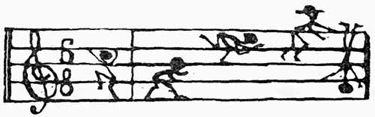
"They're holding camp-meeting in Hickory Swamp," O, let my people go;" De preacher's so dark dat he carry um lamp," O, let my people go." De brudders am singing dis jubilee tune," O, let my people go;" Two dollars a year for de Weekly Tribune," O, let my people go!"
As the strain died away in the distance, the adjutant slapped his left leg.
"Why," said he, dreamily, "that must be Greeley down there."
"No!" says Villiam, solemnly, "it is one of the wronged children of tyranny warbling the suppressed hymn of his injured people. It is a sign," says Villiam, trembling with bravery, "that the Southern Confederacy is somewhere around; for when you hear the squeak of the agonized rat," said Villiam, philosophically, "you may be sure that the sanguinary terrier is on the war-path."
Scarcely had he spoken, my boy, when there emerged from the edge of the wood before us a rebel company, headed by an officer of hairy countenance and much shirt collar. This officer's face was a whisker plantation, through which his eyes peeped forth like two snakes coiled up in a window-brush. His dress was shoddy, his air was toddy, and a yard of valuable stair-carpet enveloped his manly shoulders.
"Halt!" said he to his file of reptiles, whose general effect was that of a congress of rag-merchants just come in from a happy speculation in George-Law muskets.
"Sir," said the officer, bowing in a graceful semicircle, "I am somewhat in the First Family way, own a plantation, drink but little water at home, and have the honor to be Captain Munchausen, of the Southern Confederacy."
"Dost fence?" says Villiam, grimly drawing his sword.
"Fence!" says Captain Munchausen, also drawing his disguised crowbar. "Didst ever hear, boy, or read, of that great fencer of the olden time, the Chevalier St. George?"
"Often," says Villiam, in a tone that was as plainly the echo of a lie as is that of the delicate female eater of slate-pencils, when she says that she never could bear pork and beans.
"Well," says Captain Munchausen, haughtily, "the chevalier was so extremely jealous of my superior skill, that he actually went and died nearly a hundred years before I was born."
"Soap," says Villiam, like one talking in his sleep, "is sometimes made with powerful lie."
"By Chivalry!" says Captain Munchausen, cholerically; "I swear, I never told a single lie in all my life."
"A single lie!" says Villiam, abstractedly; "ah, no! for the lies of the Southern Confederacy are all married, and have large families."
This domestic speech, my boy, was too much for Munchausen. Asking one of the rag merchants to hold his three-ply overcoat, and carefully removing his fragmentary cap, that none of the cold potatoes should spill out of it, he planted the remains of his right boot slightly in advance of the skeleton of his left, and thundered:
"'Sblood!"
Quick as the lightning leaps along the cloud did Captain Villiam Brown send the great toe of his dexter foot to meet that of his foe; his Damascus blade lay across the opposing brand, and he whispered:
"'Sdeath!"
It was a beautiful sight—by Minerva it was!
"Stop!" says Villiam, suddenly hauling in his weapon again; "it shall never be said that I took advantage of a foeman."
As he uttered these memorable words, my boy, this ornament of the service plucked an infant demijohn from his fearless bosom and magnanimously passed it to his antagonist.
A soft commotion was visible in the whiskers of Captain Munchausen—the suburb of a smile as it were; a cavern opened in their midst, the vessel ascended curvilinearly thereto, and the sound was as the trickling of water down a mountain gulch.
The adjutant took his seat on the sleeping body of the band, and with pencil and paper prepared to record the combat. The opposing champions faced each other, and as Villiam once more raised his blade he smiled horribly.
Then, my boy, was witnessed a scene to make old Charlemagne's paladins dance High-jinks in their graves, and call all the Arturian knights to life again. Carte et tierce! but it was a spectacle for Hector and Achilles. With swords pointed straight at each other's noses did the valorous heroes skip wildly back, and then as wildly forward. Slam! bang! crack! smack! right and left! over and under! parry, feint, and première force! Now did they hop fierily along on opposite sides of the road, eyeing each other like demoniac Thomas Cats upon the moonlit fence. Ever and anon did they dart furiously to the centre, cutting the blessed atmosphere to invisible splinters, and slaying imaginary legions.
But a crisis was at hand! In one of his terrible chops, the cool and collected Villiam brought his deadly weapon down full upon the knuckles of the enemy. But for the fact that Villiam's sword was not quite as sharp as the side of an ordinary three-story house, Munchausen's hand would never more have wielded trenchant blade. As it was, he hastily dashed his brand to the ground, crammed his knuckles into his mouth, struck up an impassioned dance, and mumbled, in extreme agitation:
"Golfire your cursed abolition soul!"
It was beautiful, my boy, to see how the calm Villiam leaned upon his sword and smiled.
"Ah!" says Villiam, "so perish the foes of the Union, the Constitution, and the Enforcement of the Laws. I have bruised the Confederacy.—Adjutant!" says Villiam, in a sudden burst of pardonable exultation, "score one for the United States of America!"
Now it happened, my boy, that, as Villiam said this, he turned to where the adjutant was sitting, and bent down to give particular directions. His body was thus made to assume somewhat of the shape of the letter U, the curve being sharply toward the enemy. In an instant Captain Munchausen regained his sword, grasped it after the manner of a flail, and, with a prodigious spank, applied it to the unguarded portion of my hero's anatomy.
High sprang the almost assassinated Villiam into the air, with sparks pouring from his eyes, and Union oaths hissing from his working jaws.
"Adjutant!" roared Captain Munchausen, "score one for the Southern Confederacy!"
No sooner had Villiam reached the ground and picked up the cork that had fallen from his bosom as he ascended, than he plunged rampagiously at his adversary, and aimed a blow at his head that must have taken it off had Captain Munchausen been about a yard taller. As it was, the stroke mercilessly split the air, and caused my hero to spin like a mighty top.
In vain did the shameless Confederate swordsman endeavor to get in a hit as Villiam went round; the sword of the Union met him at every turn, and right quickly was the avenging blade humming around his head again. Inspired with the strength of Hercules, the endurance of Prometheus, and the fire of Pluto, the gorgeous Villiam Brown went at his work once more, like a feller of great trees, and in another moment his awful blade twanged upon the foeman's head.
Down went Captain Munchausen singing inverted psalms, with a whole nest of rockets exploding in his brain. Pale turned his rag merchants at the sight, and one of them immediately deserted to our side and swore that he had always been a Union man.
Villiam leaned upon his blade, and kindly remarked:
"His head is broken; I heard it crack."
"'Tis false!" says Captain Munchausen, gloomily; "that is an old crack—I've had it ever since I was a boy."
"Ah!" says Villiam, airily, "I'm afraid my blow has caused more than one funeral in the inseck kingdom, for the cut went right through the hair. Have a comb?" says Villiam, pleasantly.
Captain Munchausen made no reply, my boy, but motioned for his men to bear him from the field. It was noticed however, that, as he was being carried into the wood, he asked a gentleman in remarkable tatters, to take him to the last ditch.
As the Southern Confederacy disappeared, Captain Villiam Brown hammered his sword straight with a bit of stone, forced it into its scabbard, and turned majestically to Company 3, Regiment 5, Mackerel Brigade, several members of which were engaged in the athletic game of pitch-penny.
"Let the band be awakened," says Villiam.
A Mackerel at once proceeded to break the slumbers of the orchestra, by shaking a bottle near his ear—that experiment having never been known to fail in the case of a pronounced musical character.
"Ha!" says Villiam, with much spirit, "we will march to the national airs of our distracted country!"
After sounding several cat-calls on his night-key bugle, in the manner of all great instrumentalists who wish to know about their instruments being in tune, the band struck up "Ale to the Chief," and we marched to quarters like so many heroes of ancient Rum.
Shall treason triumph in our land, my boy, while there's a sword to wave? I think not, my boy, I think not. Though Columbia did not rule the wave, her champions would see to it that she never waived the rule.
Yours, for the Star-Spangled,
Orpheus C. Kerr.
LETTER XXXIX.
SHOWING HOW A REBEL WAS REDUCED, AND CONVERTED TO "RECONSTRUCTION," BY THE VALOROUS ORANGE COUNTY HOWITZERS.
Washington, D.C., April 13th, 1862.
The stirring times are come again, the maddest of the year, and I am beginning to believe, my boy, that what is to be will be as what has been has. Though still without my Gothic charger, Pegasus, that symmetrical racer having been borrowed for a writing-desk by a Secretary of the Fronterior, I am enabled to keep up communications with the Mackerel corpse dammee down the river, and ten thousand star-spangled banners flash through my veins as I relate the recent great artillery expedition of the Orange County Howitzers.
It seems, my boy, that an intellectual member of the Mackerel Brigade got tired of investing Yorktown, and wandered away in pursuit of adventure. As he peregrinated in the neighborhood of a rebel domicil, he beheld what he took for the bird of our country, stalking out of the barnyard, and was taking measures to confiscate it, when the proprietor made his appearance, and says he:
"Hessian, spare that goose!"
The Mackerel chap gave a tragic start, and says he:
"'Tis the Eagle I would rescue, Horatio; the bird celebrated by my brother, the Congressman, in all his speeches."
"Well," says the foul traitor, "it is undoubtedly what the Congressman takes for an Eagle, as I am aware that Congressmen generally treat the American Eagle as if he were a goose; but as that gander happens to belong to one of the very First Families of Virginia, and cost me four shillings, it becomes my painful duty to resist your habeas corpus act." And with that he drove the beautiful bird into the barnyard, and locked the gate.
Fired to fury by this insult from one of those whom our army had come to protect, the Mackerel chap went immediately back to quarters, and appealed to his comrades for vengeance.
That gifted officer Samyule Sa-mith, heard his burning words, and says he:
"The cannon of the Union shall speak in this matter. Let the Orange County Howitzers get ready for action, and I will lead them against the Philistine."
Instantly arose the notes of dreadful preparation; the guns were mobilized, six English gentlemen in the hosiery business were invited to view the coming battle, and just as the moon rose above the trees, the artillery started for the rebel stronghold.
Arriving before the offending house, the howitzers were placed in line, and all got ready for the bombardment. It was just possible, my boy, that two men might have marched into that house, and captured the misguided Confederacy without slaughter. You may be unable to see what use there was in bringing artillery and forming in line of battle; but you are very ignorant, my boy; you know nothing about strategy and war.
"Soldiers," says Samyule, "remember that the eyes of the whole world are upon you at this moment, and endeavor to hit the house as often as possible. We will fire one round without ball," says Samyule, "to see if the powder is first-class."
Now it chanced that while the loading-up was going on, the gallant Lieutenant Lemons got his legs wonderfully entangled in the lanyard of his piece, and kept turning the howitzer around in a manner strongly expressive of nervous agitation. Suddenly he stepped across to where Samyule was standing, and whispered in his ear.
"O, I see," says Samyule, kindly, "you were educated at West Point, and want to know which end of the cannon ought to be pointed at the enemy. Well," says Samyule, instructively, "you'd better point the end with a hole in it."
Everything being in readiness, my boy, the combined battery launched its thunders on the air, creating a great sensation in the neigboring hen-roosts, and causing a large rooster to fall from a branch in the midst of his refreshing slumbers.
"Now, that the powder has sustained its reputation," says Samyule, impressively, "let the two-inch balls be hurled at the enemy's works."
As the house was full ten yards off, this second discharge failed to hit it; but it brought the Southern Confederacy to the window in his night-cap, and says he:
"There's no use of my trying to sleep, if you chaps keep making such a noise down there."
"Unhappy man," says Samyule, solemnly, "we come here to reduce you, and will listen to nothing but unconditional surrender."
The Confederacy gaped, and says he:
"I'm very sleepy, and can't talk to you now; but I'll call over in the morning."
And he shut the window, and went back to bed. A frown was observed to steal over the face of Samyule. He has a peculiar countenance, my boy, and a frown affects it strangely. Take his mouth and moustache together, and they remind you of a mouse sunning himself on the edge of his hole; and when the frown comes on, the mouse acts as though he had a stomach-ache.
"Comrades," says Samyule, "the enemy requires another round, and we must do it on the square. Fire!"
Like four-and-twenty thunder-storms the howitzers roared together, and had not the Orange County veterans forgotten to put in any balls, there is reason to believe that some windows would have been broken. Another discharge, however, was more successful, as it knocked the top off the chimney.
The Southern Confederacy appeared at the window again, and says he:
"If you fellows don't quit that racket down there, you'll irritate me pretty soon."
This significant remark caused a sudden cessation of the bombardment, and Samyule hastily called a council of war.
"Gentlemen," says Samyule, "a new issue has arisen. If we irritate the Southern Confederacy, all hopes of future Union and reconstruction may be destroyed."
A chap who was a conservative democrat suddenly flamed up at this, and says he:
"The abolitionists caused this terrible war, and it is our business, as no-party men, to finish it Constitutionally. If we irritate this man, no power on earth will ever make him submit to reconstruction. Ask him."
Here the democratic chap took a large taste of tobacco, and sighed for his country.
"Mr. Davis," says Samyule to the Confederacy at the window, "if we do not irritate you, will you consent to be reconstructed?"
"Reconstructed!" says the Confederacy, thoughtfully; "reconstructed! Ah!" says he, "you mean, will I consent to be born again?"
"Yes," says Samyule, metaphysically; "will you consent to be borne again, as we have borne with you heretofore?"
The Confederacy thought awhile, and then says he:
"Consider me reconstructed."
As that was all the Constitution asked, of course there was no more to be done, and the Orange County Howitzers returned to their original position in the mire, the English gentlemen remarking that the appearance and discipline of our troops were satisfactory to Albion.
Fighting according to the Constitution, my boy, is such an admirable way of preventing carnage, that some doctor ought to take out a patent for it as a cheap medicine.
Yours to come, and
Orpheus C. Kerr.
LETTER XL.
RENDERING TRIBUTE OF ADMIRATION TO THE WOMEN OF AMERICA, WITH A REMINISCENCE OF HOBBS & DOBBS, ETC.
Washington, D.C., April 18th, 1862.
Having a leisure hour at my disposal, my boy, and being reminded of infatuating crinoline by the reception of certain bird-like notes in chirography strongly resembling the exquisite edging on delicious pantalettes, I turn my attention to that beautiful creation which is fearfully and wonderfully maid, and wears distracting gaiters.
Woman, my boy, at her worst, is a source of real happiness to the sterner sex. There's a chap in the Mackerel Brigade who got very melancholy one day after receiving a letter from home, wherein he was affectionately called "a unnatural and wicious creetur" for not sending his better-half a new dress and some hair-pins. Seeing his affliction, and divining its cause, another Mackerel stepped up to him, and says he:
"Is it the old woman which is on a tare?"
The married chap groaned, and says he:
"She's mad as a hornet. I do believe," says the married chap, turning very pale, "that she'll take away my night-key, and teach my babes to call me the Old File."
"Well," says the comforting Mackerel, "then why did you get married? Why didn't you stay a single bachelor like me, and enjoy the pursuit of happiness in the Fire Department?"
"Happiness!" says the married chap, "why it was expressly to enjoy happiness that I wedded. Step this way," says the married chap, with a horrible smile, leading his consoler aside, "ain't the women of America mortal?"
"Yes," says the Mackerel thoughtfully.
"And don't they die?"
"Yes," says the Mackerel. "That is to say," added the Mackerel, contemplatively, "they sometimes die when there's new and expensive tombstones in fashion."
"Peter Perkins!" says the married chap, with a smile of wild bliss, "I wouldn't miss the happiness I shall feel when my angel returns to her native hevings, for the sake of being twenty bachelors. No!" says the married chap, clutching his bosom, "I've lived on the thought of that air bliss ever since the morning my female pardner threw my box of long-sixes out of the window, and called in the police because I brought a waluable terrier home with me." Here the married chap uncorked his canteen and eyed it with speechless fury.
Tears came to the eyes of the unwomantic Mackerel; he extended his hand, and says he:
"Say no more, Bobby—say no more. If you ain't got the correck idea of Heaven there's no such place on the map."
I give you this touching conversation between two of nature's noblemen, my boy, that you may appreciate that beautiful dispensation of Providence which endows woman with the slighter failings of humanity, yet gives her the power to brighten the mind of inferior man with glorious visions of joy beyond the grave.
My arm has been strengthened in this war, my boy, by the inspiration of woman's courage, and aided by her almost miraculous foresight. Only yesterday, a fair girl of forty-three summers, thoughtfully sent me a box, containing two gross of assorted fish-hooks, three cook-books, one dozen of Tubbses best spool-cotton, three door-plates, a package of patent geranium-roots, two yards of Brussels carpet, Rumford's illustrated work on Perpetual Intoxication, ten bottles of furniture-polish, and some wall-paper. Accompanying these articles, so valuable to a soldier on the march, was a note, in which the kind-hearted girl said that the things were intended for our sick and wounded troops, and were the voluntary tributes of a loyal and dreamy-souled woman. I tried a dose of the furniture-polish, my boy, on a chap that had the measles, and he has felt so much like a sofa ever since, that a coroner's jury will sit on him to-morrow.
The remainder of this susceptible young creature's note, my boy, was calculated to move a heart of stone. She asked if it hurt much to be killed, and said she should think the President might sue Jeff Davis, or commit habeas corpus or some other ridiculous thing, to stop this dreadful, spirit-agonizing war. She said that her deepest heart-throbs and dream-yearnings were for the crimson-consecrated Union, and that she had lavished her most harrowing hope-sobs for its heaven-triumph. She said that she had a friend, named Smith, in the army, and wished I could find him out, and tell him that the human heart, though repining at the absence of the beloved object, may be coldly proud as a scornful statute to the stranger's eye, but pines like a soul-murdered water-lily on the lovely stream of its twilight-brooding contemplations.
Anxious to oblige her, my boy, I asked the General of the Mackerel Brigade if he knew a soldier "of the name of Smith?"
The General thought awhile, and says he:
"Not one. There are many of the name of Sa-mith," says the general, screening his eye from the sun with a bottle, "and the Smythes are numerous; but the Smiths all died as soon as the Prince of Wales came to this country."
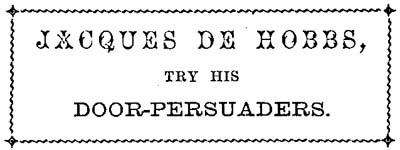
This is an age of great aristocracy, my boy, and the name of Smith is confined to tombstones. I once knew a chap named Hobbs, who made knobs, and had a partner named Dobbs; and he never could get married until he changed his title; for what sensitive and delicately-nerved female would marry a man whose business-card read, "Try Hobbs & Dobbs' Knobs?" Finally, he called himself De Hobbs, and wedded a Miss Podger—pronounced Po-gshay. After that, he cut his partner, ordered his friends to cease calling him Jack, and in compliance with the wishes of his wife's family, got out a business-card like this:
But, to return to the women of America, there was one of them came out to our camp not long ago, my boy, with six Saratoga trunks full of moral reading for our troops. She was distributing the cheerful works among the veterans, when she happened to come across Private Jinks, who had just got his rations, and was swearing audibly at the collection of wild beasts he had found in one of his biscuits.
"Young man," says she, in a vinegar manner, "do you want to be damned?"
Private Jinks reflected a moment, and says he:
"Really, mem, I don't know enough about horses to say."
The literary agent was greatly shocked, but recovered in time to hand the warrior a small book, and told him to read it and be saved.
It was a small and enlivening volume, my boy, written by a missionary lately served up for breakfast by the Emperor of Glorygoolia, and entitled "The Fire that Never is Quenched."
Jinks looked at the book, and says he:
"What district is that fire in?"
The daughter of the Republic bit off a small piece of cough candy, and says she:
"It's down below, young man, where you bid fair to go."
"And will it never be put out?" says Private Jinks.
The deeply-affected crinoline shook her head until all her combs rattled, and says she:
"No, young man; it will burn, and burn, young man."
"Then I'm safe enough!" says Private Jinks, slapping his knee; "for I'm a member of Forty Hose, and if that air fire is to keep burning, they'll have to have a paid Fire Department down there, and shut us fellows out."
The daughter of the Republic instantly left him, my boy; and when next I saw her, she was arguing with one of the chaplains, who pretended to believe that firemen sometimes went to Heaven.
Woman, my boy, is an angel in disguise; and if she had wings what a rise there would be in bonnets!
Yours, for the next Philharmonic,
Orpheus C. Kerr.
LETTER XLI.
CITING A NOTABLE CASE OF VOLUNTEER SURGERY, AND GIVING AN OUTLINE SKETCH OF "COTTON SEMINARY."
Washington, D.C., April 25th, 1862.
There is a certain something about a sick-room, my boy, that makes me think seriously of my latter end, and recognize physicians as true heroes of the bottle-field. The subdued swearing of the sufferer on his bed, the muffled tread of the venerable nurse, as she comes into the room to make sure that the brandy recommended by the doctor is not too mild for the patient, the sepulchral shout of the regimental cat as she recognizes the tread of Jacob Barker, the sergeant's bull-terrier, outside; all these are things to make the spectator remember that we are but dust, and that to return to dust is our dustiny.
Early in the week, my boy, a noble member of the Pennsylvania Mud-larks was made sick in a strange manner. A draft of picked men from certain regiments was ordered for a perilous expedition down the river. You may be aware, my boy, that a draft is always dangerous to delicate constitutions; and, as the Mud-lark happened to burst into a profuse perspiration about the time he found himself standing in this draft, he, of course, took such a violent cold that he had to be put to bed directly. I went to see him, my boy; and whilst he was relating to me some affecting anecdotes of the time when he used to keep a bar, a member of the Medical Staff of the United States of America came in to see the patient.
This venerable surgeon first deposited a large saw, a hatchet, and two pick-axes on the table, and then says he:
"How do you find yourself, boy?"
The Mud-lark took a small chew of tobacco with a melancholy air, and says he:
"I think I've got the guitar in my head, Mr. Saw-bones, and am about to join the angel choir."
"I see how it is," says the surgeon, thoughtfully; "you think you've got the guitar, when it's only the drum of your ear that is affected. Well," says the surgeon, with sudden pleasantness, as he reached after his saw and one of the pick-axes, "I must amputate your left leg at once."
The Mud-lark curled himself up in bed like a wounded anaconda, and says he:
"I don't see it in that light."
"Well," says the surgeon, in a sprightly manner, "then suppose I put a fly-blister on your stomick, and only amputate your right arm?"
The surgeon was formerly a blacksmith, my boy, and got his diploma by inventing some pills with iron in them. He proved that the blood of six healthy men contained enough iron to make six horse-shoes, and then invented the pills to cure hoarseness.
The sick chap reflected on what his medical adviser had said, and then says he:
"Your words convince me that my situation must be dangerous. I must see some relative before I permit myself to be dissected."
"Whom would you wish me to send for?" says the surgeon.
"My grandmother, my dear old grandmother," said the Mud-lark, with much feeling.
The surgeon took me cautiously aside, and says he:
"My poor patient has a cold in his head, and his life depends, perhaps, on the gratification of his wishes. You have heard him ask for his grandmother," says the surgeon, softly, "and as his grandmother lives too far away to be sent for, we must practice a little harmless deception. We must send for Secretary Welles of the Navy Department, and introduce him as the grandmother. My patient will never know the difference."
I took the hint, my boy, and went after the Secretary; but the latter was so busy examining a model of Noah's Ark that he could not be seen. Happily, however, the patient recovered while the surgeon was getting his saw filed, and was well enough last night to reconnoitre in force.
The Mackerel Brigade being still in quarters before Yorktown, I am at leisure to stroll about the Southern Confederacy, my boy; and on Thursday I paid a visit to Cotton Seminary, just beyond Alexandria, where the Southern intellect is taught to fructify and expand. This celebrated institution of learning is all on one floor, with a large chimney and heavy mortgage upon it, and a number of windows supplied with ground glass—or, rather, supplied with a certain openness as regards the ground.
Upon entering this majestic edifice, the master, Prex Peyton, descended at once from the barrel on which he was seated, and gave me a true Virginian welcome:
"Though you may be a Lincoln horde," says he, in a manorial manner, "the republic of intellect recognizes you only as a man. The Southern mind knows how to recognize a soul apart from its outer circumstances; for what say the logicians? Deus est anima brutorem! Take a seat on yonder barrel, friend Hessian, and you shall hear the wisdom of the youthful minds. First class in computation stand up."
As I took a seat, my boy, the first class in computation came to the front; and it is my private impression, my boy—my private impression—that each child's father was the owner of a rag plantation at some period of his life.
"Boys," says the master, "how is the table of Confederate money divided?"
"Into pounds, shillings, and pence."
"Right. Now, Master Mason, repeat the table."
Master Mason, who was a germ of a first family, took his fingers out of his mouth, and says he:
"Twenty pounds of Confederate bonds make one shilling, twenty shillings make one penny, six pennies one drink."
"That's right, my pretty little cherubs," says the master. "Now go and take your seats, and study your bowie-knife exercises. Class in Geography, stand up."
The class in geography consisted of one small Southern Confederacy, my boy, with a taste for tobacco.
"Master Wise," says the master, confidently, "can you tell us where Africa is?"
Master Wise sniffed intelligently, and says he:
"Africa is situated at the corner of Spruce and Nassau streets, and is bounded on the north by Greeley, on the south by Slavery, on the east by Sumner, and on the west by Lovejoy."
"Very true, my bright little fellow," says the master; "now go back to your chawing."
"You see, friend Hessian," says the master, turning to me, "how much superior Southerners are, even as children, to the depraved Yankees. In my teaching experience, I have known scholars only six years old to play poker like old members of the church, and a pupil of mine euchred me once in ten minutes."
I thanked him for his courtesy, and was proceeding to the door, when I observed four boys in one corner, with their mouths so distorted that they seemed to have subsisted upon a diet of persimmons all their lives.
"Venerable pundit," says I, in astonishment, "how came the faces of those offspring so deformed?"
"O!" says the master, complacently, "that class has been studying Carlyle's works."
I retired from Cotton Seminary, my boy, with a firm conviction of the utility of popular education, and a hope that the day might come when a Professorship of Old Sledge would be created in the New York University.
Yours, for a higher civilization,
Orpheus C. Kerr.
LETTER XLII.
REVEALING A NEW BLOCKADING IDEA, INTRODUCING A GEOMETRICAL STEED, AND NARRATING THE WONDERFUL EXPLOITS OF THE MACKEREL SHARPSHOOTER AT YORKTOWN.
Washington, D.C., May 2d, 1862.
Speaking of the patriarch of the Navy Department, my boy, they say that the respected Ancient has under consideration a new and admirable plan for making the blockade efficient. The idea is, to furnish all the naval captains with spectacles made of looking-glass, so that when they are asleep, on the quarterdeck, their glasses will reflect the figure of any rebel craft that may be trying to slip by. These spectacles could all be ready in twenty years; and when the Secretary told a Congressman of the plan, the latter thought carefully over the suggestion, "as dripping with coolness it rose from the Welles," and says he:
"My dear madam, the idea lacks but one thing—the looking-glass spectacles ought to be supplied with a comb and brush, so that the captain could fix himself up after capturing the pirate. Ah, madam," says the Congressman, hastily picking up the Jack of Clubs, which he had accidentally pulled out with his pocket-handkerchief, "you will rank next to Mary, the mother of Washington, in the affections of future generations."
The mother of Washington, my boy!—the mother of Washington!—why, the Secretary is already celebrated as the grandmother of Washington—city.
On the occasion of my last visit to Yorktown, my boy, I found the Mackerel Brigade so well up in animal spirits that each chap was equal to a pony of brandy, and capable of capturing any amount of glass artillery. At the present time, my boy, the brigade is formed in the shape of a clam-shell, with the right resting on a beer wagon, and the left on a traveling free-lunch saloon. I was examining the new battery of the Orange County Howitzers—whose guns have such large touch-holes that the chaps keep their crackers and cheese in them when not in action—and was also overhearing the remarks of a melancholy Mackerel concerning what he wished to be done with his effects in case he should perish with old age before the battle commenced—when I beheld Captain Villiam Brown, approaching me on the most geometrical beast I ever saw—an animal even richer in sharp corners, my boy, than my own gothic steed, Pegasus.
"Ha!" says Villiam, hastily swallowing something that brought tears to his eyes, and taking a bit of lemon-peel to clear his voice, "you are admiring my Arabian courser, and wondering whether it is one of the three presented to Secretary Seward by the Emperor of Egypt."
"You speak truly, my Bayard," says I; "that superb piece of horseflesh looks like the original plan of the city of Boston—there's so many bisecting angles about him."
"Ah!" says Villiam, with an agreeable smile, "in the words of the anthem of childhood—
"'The angles told me so.'"
Villiam's idea of angels, my boy, constitutes a theory of theology in itself.
"What call you the charger?" says I.
"Euclid," says Villiam, pausing for a moment, to catch the gurgle of a canteen just reversed. "Ah!" says Villiam, recovering his presence of mind, "this here marvel of natural history is a guaranteed 2.40."
"No!" says I.
"Yes," says Villiam, calculatingly, "this superb animal is a sure 2.40—he cost me just Two dollars and Forty cents. But come with me," said Villiam, proudly, "and see the sharpshooter contingent I have just organized to aid in the suppression of this here unnatural rebellion."
I followed the splendidly-mounted warrior, my boy, to a spot not far from the nearest point of the enemy's lines, where I found a lengthy Western chap polishing a rifle with a powerful telescope on the end of it. He had just been organized, and was preparing to make some carnage.
"Now then, Ajack," said Villiam, classically, "let us see you pick off that Confederacy over there, which looks like a mere fly at this distance."
The sinewy sharpshooter sprang to his feet, called a drummer-boy to hold his chew of tobacco, looked at the rebel gunner through his telescope, shut up the telescope, took aim with both eyes shut, turned away his head, and fired!
I must say, my boy, that I at first thought the Confederacy was not hit at all, inasmuch as he only scratched one of his legs and squinted along his gun; but Villiam soon showed me how exquisitely accurate the sharpshooter's aim had been.
"The bullet struck him," says Villiam, confidently, "and would have reached his heart, but for the Bible given him by his mother when he left home, which arrested its fatal progress. Let us hope," says Villiam, seriously, "that he will henceforth search the Scriptures, and be a dutiful son."
I felt the tears spring to my eyes, for I once had a mother myself. I couldn't help it, my boy—I couldn't help it.
The second shot of the unerring rifleman was aimed at a hapless contraband, who had been sent out to the end of a gun by the enemy, to see that the ball did not roll out before the gunner had time to pull the trigger. Crack! went the deadly weapon of the sharpshooter, and down went the unhappy African—to his dinner.
"Ah!" says Villiam, skeptically, "do you think you hit him, Ajack?"
"Truelie, stranger," responded the unmoved marksman, sententiously. "He will die at twenty minutes past three this afternoon."
Sick of this dreadful slaughter, my boy, I turned from the spot with Villiam, and presently overtook the general of the Mackerel Brigade, who was seated on a fence by the roadside, trying to knock the cork out of a bottle with a piece of rock. We saluted, and went on to the camp.
Sharpshooters, my boy, are a source of much pain to hostile gunners, and if one of them should happen to put a bullet through the head of navigation, it would certainly cause the tide to fall.
Yours, take-aimiably,
Orpheus C. Kerr.
LETTER XLIII.
CONCERNING MARTIAL LITERATURE: INTRODUCING A DIDACTIC POEM BY THE "ARKANSAW TRACT SOCIETY," AND A BIOGRAPHY OF GARIBALDI FOR THE SOLDIER.
Washington, D.C., May 7th, 1862.
Southern religious literature, my boy, is admirably calculated to improve the morals of race-courses, and render dog-fights the instruments of wholesome spiritual culture.
On the person of a high-minded Southern Confederacy captured the other day by the Mackerel pickets, I found a moral work which had been issued by the Arkansaw Tract Society for the diffusion of religious thoughts in the camp, and was much improved by reading it. The pure-minded Arkansaw chap who got it up, my boy, remarked in pallid print, that every man "should extract a wholesome moral from everything whatsomedever," and then went on to say that there was an excellent moral in the beautiful Arkansaw nursery tale of
THE BEWITCHED TARRIER. Sam Johnson was a cullud man, Who lived down in Judee; He owned a rat tan tarrier That stood 'bout one foot three; And the way that critter chawed up rats Was gorjus for to see. One day this dorg was slumberin' Behind the kitchen stove, When suddenly a wicked flea— An ugly little cove— Commenced upon his faithful back With many jumps to rove. Then up arose that tarrier, With frenzy in his eye, And waitin' only long enough To make a touchin' cry, Commenced to twist his head around, Most wonderfully spry. But all in vain; his shape was sich, So awful short and fat— And though he doubled up hisself, And strained hisself at that, His mouth was half an inch away From where the varmint sat. The dorg sat up an awful yowl And twisted like an eel, Emitting cries of misery At ev'ry nip he'd feel, And tumblin' down and jumpin' up, And turnin' like a wheel. But still that most owdacious flea Kept up a constant chaw Just where he couldn't be scratched out By any reach of paw. But always half an inch beyond His wictim's snappin' jaw. Sam Johnson heard the noise, and came To save his animile; But when he see the crittur spin— A barkin' all the while— He dreaded hiderfobia, And then began to rile. "The pup is mad enough," says he, And luggin' in his axe, He gev the wretched tarrier A pair of awful cracks, That stretched him out upon the floor, As dead as carpet-tacks. moral. Take warnin' by this tarrier, Now turned to sassidge meat; And when misfortin's flea shall come Upon your back to eat, Beware, or you may die because You can't make both ends meet.
The Arkansaw Tract Society put a note at the bottom of this moral lyric, my boy, stating that the "wicked flea here mentioned is the same varmint which is mentioned in Scripture as being so bold; 'the wicked flea, when no man pursueth but the righteous, is as bold as a lion.'"
Speaking of literature, my boy, I am happy to say that the members of the Mackerel Brigade have been inspired to emulate great examples by the biographies of great soldiers which have been sent to the camp for their reading by the thoughtful women of America. For instance, here we have the
LIFE OF GENERAL GARIBALDI.
BY THE NOBLEST RUM 'UN OF THE MALL.
CHAPTER I.
HIS BIRTH.
At that period of the world's history when the Past immediately preceded the Present, and the Future was yet to come, there existed in a small town of which the houses formed a part, a rich but respectable couple. Owing to a combination of circumstances, their first son was a boy of the male gender, who inherited the name of his parents from the moment of his birth, and who is the subject of our story. When he was about five hours old, his male parent said to him:
"My boy, do you know me?"
In an instant the eyes of the child flashed Jersey lightning, he ceased sucking his little fistesses, his hair would have stood on end if there had been any on his head, and he exclaimed in tones of thunder-r-r:
"Viva Liberte et Maccaroni!"
Mr. Garibaldi instantly clasped the little cherubim to his stomach, while Mrs. Garibaldi waved the tri-colored flag above them both, and requested the chambermaid to bring her a little more of that same burning-fluid, with plenty of sugar in it.
Thus was Garibaldi ushered into the world; and the burning fluid is for sale by all respectable druggists and grocers throughout the country, with S. O. P. on the wrapper.
CHAPTER II.
HIS EDUCATION.
On arriving at years of indiscretion, our hero began to display a tendency to "seven-up," Old Sledge, and other card-inal virtues, calculated to fit him for playing his cards right in future years. Just about this time, too, his parents resolved to send him to school, and it is as the young scholar we must now regard him.
Behold him, then, at his tasks, in a red shirt amputated at the neck, and two yellow patches (the badge of Sardinia) flaming from the background of his seat of learning. He readily mastered the Greek verbs and roots, comprehended liquorice root, studied geography, etymology, sycorax, and mahogany; could decline to conjugate the verb toby, and quickly knew enough about algebra to prove that X plus Y, not being equal to Z, is minus any dinner at noon, and plus one of the tightest applications of birch that ever produced the illusion of a red-hot stove in immediate contact with the human body.
CHAPTER III.
GARIBALDI GOES TO SEA.
Just before the breaking-out of the rebellion at Rome, the trade in garlic and domestic fleas took a sudden start, and the Po was crowded with vessels of all nations—especially the halluci-nations. One day, young Garibaldi was in the act of stabbing a barrel of molasses to the heart with a quill, on Pier 4, P. R. (Po River), when he was descried by the captain of a fishing-smack, detailed by Government to watch the motions of the English fleet.
"Boy, ahoy!" says the Captain.
The future liberator of Italy dropped his murderous quill, wiped his nose with a pine shaving, and answered, in trumpet-tones:
"You're another!"
So delighted was the captain with this noble reply, that he flogged the whole starboard watch at the gunwales, ordered a preventer backstay on the kedge-anchor, leaped ashore to where Garibaldi was standing, and offered to make him familiar with the seas, and a second Cæsar. Garibaldi replied that he had already been half-seas over, but would not object to another cruise. He said he had traveled half-seas over, "on his face," and would now travel the other half on a vessel. He went. The vessel proved to be a vessel of wrath, and Garibaldi became so familiar with the cat-o-nine-tails, that he soon mused upon a plan for deserting the ship.
CHAPTER IV.
HE FIGHTS FOR ROME.
All seas are liable to commotions, hence it is not strange that the Holy See encountered a storm about the time that it occurred. For some weeks, certain pure spirits had been fomenting the small beer of civil war, and in spite of vaticanation, it broke out at last, and was a rash proceeding. Garibaldi was sent for by the Goddess of Liberty to lead the insurrectionary forces, while the liberty of the goddess was endangered by the leadership of the commander of the French troops aiding the Pope. Our hero had but a handful of patriots on hand and on foot to fight with him; but he determined to struggle to the last and perish in the attempt, even though he should lose his life by it. The Frenchman had an immense array of tried soldiers on the qui vive and on horseback; but Garibaldi was not dismayed, and kept his courage up to the "sticking" point by hoping for aid. Alas! the only aid they received was lemonade and cannonade—but not a brigade. They fought with the French, and were whipped like blazes. Hinc illa slacryma!
CHAPTER V.
GARIBALDI IN AMERICA.
After wandering about Italy as an exile for some months, the bold patriot came to America and opened a cigar shop. The writer remembers entering his shop one day to purchase a genuine meerschaum, and discovering, afterwards, that it was made of plaster of Paris, and smelt—when heated—like ancient sour-krout flavored with lamp-oil. Garibaldi also sold the finest Habana cigars ever made on Staten Island, one brand of which was so strong in its integrity that it once defeated dishonesty, thus:
One night, while Garibaldi was praying for his beloved Italy, at the house of a friend, a burglar broke into his store, with the intention of robbing it. The scoundrel broke open the till, took out all the city money (he refused to take anything but current funds), and then broke open a box of the cigars strong in their integrity, intending to have a quiet smoke before he left. Alas! for him.
When Garibaldi opened the store in the morning, he found the burglar laying on his back, with a cigar in his mouth, and too weak to move! In the attempt to smoke the cigar, he had drawn his back bone clear through until it caught on his breast bone, and the back of his head was just breaking through the roof of his mouth, when the patriot found him. He was taken to the police-office, and discharged by the first alderman that came along. Such is life!
When the Emperor of France commenced his war with Austria, Garibaldi suddenly appeared at one of the elbows of the Mincio, and having passed around the Great Quadrilateral, headed a select body of Alpine shepherds, and charged the Austrians more than they could pay. All the world knows how that war ended. The emperors of France and Austria signed a treaty by which each was compelled to go back to his own country, tell his subjects that it was "all right," and set all the wise men of the nation to discover what he had been fighting about. Sardinia was not asked to give an opinion. About this time Garibaldi was left out in the cold.
CHAPTER VI.
OUR HERO IN SICILY.
As we look abroad upon the vast nations of the earth, and remember that if they were all destroyed, not one of them would be left, the mind involuntarily conceives an idea, and becomes conscious of the pregnant fact, that "what is to be will be, as what has been, was." So when we look upon families, the thought forces itself upon us that if there were no births there would be no children: without fathers there could be no mothers; and if the entire household should be swept away by disease, they would cease to live. So it is also, when we look upon an individual. Our intellect tells us that if he dies in infancy he will not live to be a man; and if he never does anything, he will surely do nothing.
This metaphysical line of thought is particularly natural in the case of Garibaldi. Look at him as he now stands, with one foot on Sicily and the other in a boot. Had he not been educated, he would have been uneducated; had he not gone to sea he would never have been a sailor; had he not fought for Rome, he would have laid down arms in her cause; were he not now fighting for Italian independence, he would be otherwise engaged!
Thus the aspect presented by Garibaldi throughout his career, leads our thoughts into all the deep meanderings of the German mind, and teaches us to perceive that "whatever is, is right," as whatever is not, is wrong.
Enraged at the impotent conclusion of the French-and-Austrian war, Garibaldi determined to prosecute hostilities on his own individual curve. In consequence of the high price of ferriage on the Mincio, he moved down toward Palermo, and there called to his standard all Italians favorable to the immediate emancipation of Sicily and the removal of all duties on Maccaroni. Immediately the wildest enthusiasm raged among the friends of freedom. Six patriots attacked the fortress of Messalina, and were immediately placed in prison, with chains around their necks, and Tupper's poems in their pockets.
By degrees, Garibaldi made ready to capture Palermo; he laid in a stock of cannon and woolen stockings, he harangued his warriors, and told them the day was theirs if they won it; he invited all the reporters to a banquet. Then he went and took Palermo.
How did he take it?
I know not; there are more things in heaven and earth than are dreamed of in ordinary philosophy: all I know is, that he took Palermo.
Having brought my history down to this point, I deem it proper to pause in my task until the future shall have revealed what takes place hereafter; and the past shall have ceased to interfere so outrageously with the present, that its limits can only be distinguished through the bottom of a tumbler. Liberty is the normal condition of the Italian, and while Garibaldi leads, the cry will be: "Liberty or death, with a preference for the former." Already the day-star of freedom gilds the horizon of beautiful Naples, and if it should not happen to be proved a comet by some evil-minded astronomer, Italy may yet be as free as New York itself, and pay a war-tax of not more than some millions a year.
This finely-written life of the great Italian patriot had such an effect upon the Mackerels, my boy, that they all wished to live like Garibaldi—hence, they are in no hurry to die for their country.
Lives of great men all remind us, my boy, that we may make our lives sublime; but I never read one yet, that gave instructions for making our deaths sublime—to ourselves.
Yours, for continued respiration,
Orpheus C. Kerr.
LETTER XLIV.
SHOWING HOW THE GREAT BATTLE OF PARIS WAS FOUGHT AND WON BY THE MACKEREL BRIGADE, AIDED AND ABETTED BY THE IRON-PLATED FLEET OF COMMODORE HEAD.
Washington, D.C., May 10th, 1862.
I have just returned, my boy, from witnessing one of the most tremendous battles of modern times, and shall see star-spangled banners in every sunset for six months to come.
Hearing that the Southern Confederacy had evacuated Yorktown, for the reason that the Last Ditch had moved on the first of May to a place where there would be less rent from our cannon, I started early in the week for the quarters of the valorous and sanguinary Mackerel Brigade, expecting that it had gone toward Richmond for life, liberty, and the pursuit of happiness.
On reaching the Peninsula, however, I learned that the Mackerel "corpse dammee" had been left behind to capture the city of Paris in co-operation with a squadron.
Reaching the stamping-ground, my boy, I beheld a scene at once unique and impressive. Each individual Mackerel was seated on the ground, with a sheet of paper across his knees and an ink-bottle beside him, writing like an inspired poet.
I approached Captain Villiam Brown, who was covering some bare spots on his geometrical steed Euclid, with pieces scissored out of an old hair-trunk, and says I:
"Tell me, my noble Hector, what means this literary scene which mine eyes behold?"
"Ah!" says Villiam, setting down his glue-pot, "we are about to engage in a skrimmage from which not one may come out alive. These heroic beings," says Villiam, "are ready to die for their country at sight, and you now behold them making their wills. We shall march upon Paris," says Villiam, "as soon as I hear from Sergeant O'Pake, who has been sent to destroy a mill-dam belonging to the Southern Confederacy. Come with me, my nice little boy, and look at the squadron to take part in the attack."
This squadron, my boy, consisted of one twenty-eight-inch row-boat, mounting a twelve-inch swivel, and commanded by Commodore Head, late of the Canal-boat Service. It is iron-plated after a peculiar manner. When the ingenious chap who was to iron-plate it commenced his work, Commodore Head ordered him to put the plates on the inside of the boat, instead of outside, as in the case of the Monitor and Galena.
"What do you mean?" says the contractor.
"Why," says the commodore, "ain't them iron plates intended to protect the crew?"
"Yes," says the contractor.
"Well, then, you poor ignorant cuss," says the commodore, in a great passion, "what do you want to put the plates on the outside for? The crew won't be on the outside—will it? The crew will be on the inside—won't it? And how are you going to protect the crew on the inside by putting iron plates on the outside?"
Such reasoning, my boy, was convincing, and the Mackerel Squadron is plated inside.
While I was contemplating this new triumph of American naval architecture, and wondering what they would say about it in Europe, an orderly rode up and handed a scrap of paper to Villiam.
"Ha!" says Villiam, perusing the message, and then passing it to me, "the veteran O'Pake has not deceived the United States of America."
The message was directed to the General of the Mackerel Brigade, my boy, and read as follows:
"General:—In accordance with your orders, I have destroyed the mill d—n.
"O'Pake."
"And now," says Villiam, returning his canteen to his bosom and pulling out his ruffles, "the United States of America will proceed to capture Paris with great slaughter. Let the Brigade form in marching order, while the fleet proceeds around by water, after the manner of Lord Nelson."
The Mackerel Brigade was quickly on the march, headed by the band, who played an entirely new version of "Hail Columbia" on his key bugle. Tramp, tramp, tramp! and we found ourselves in position before Paris.
MAP OF THE WORLD, SHOWING THE POSITION OF THE MACKEREL BRIGADE AT THE GREAT BATTLE OF PARIS.
Paris, my boy, was a city of two houses previous to the recent great fire, which destroyed half of it, and we found it fortified with a strong picket-fence and counterscarp earthworks, from the top of which frowned numerous guns of great compass.
The Mackerel Brigade was at once formed in line-of-battle-order—the line being not quite as straight as an ordinary Pennsylvania railroad—while the fleet menaced the water-front of the city from Duck Lake.
You may not be able to find Duck Lake on the maps, my boy, as it is only visible after a heavy rain.
Previous to the attack, a balloon, containing a Mackerel chap, and a telescope shaped like a bottle, was sent up to reconnoitre.
"Well," says Villiam to the chap when he came down, "what is the force of the Confederacy?"
The chap coughed respectfully, and says he:
"I could only see one Confederacy, which is an old woman!"
"Scorpion!" says Villiam, his eyes flashing like the bottoms of two reversed tumblers, "I believe you to be an accursed abolitionist. Go instantly to the rear," says Villiam, fiercely, "and read the Report of the Van Wyck Investigating Committee."
It was a terrible punishment, my boy, but the example was needed for the good of the service.
The Orange County Howitzers now advanced to the front, and poured a terrible fire in the direction of a point about half way between the nearest steeple and the meridian, working horrible carnage in a flock of pigeons that happened to be passing at the time.
"Splendid, my glorious Prooshians!" says Villiam, just escaping a fall from his saddle by the convulsive start of Euclid, that noble war-horse having been suddenly roused from a pleasant doze by the firing—"Splendid, my artillery darlings. Only," says Villiam, thoughtfully, "as the sun is a friendly power, don't aim at him so accurately next time."
Meantime, Company 3, Regiment 5, had advanced from the right, and were just about to make a splendid bayonet-charge, by the oblique, over the picket-fence and earthwork, when the concealed Confederacy suddenly opened a deadly fire of old shoes, throwing the Mackerels into great confusion.
Almost simultaneously, a large potato struck the fleet on Duck Lake on the nose, so intensely exciting him that he incontinently touched off his swivel, to the great detriment of the surrounding country.
This was a critical moment, my boy; the least trifle on either side would have turned the scale, and given the victory to either party. Villiam Brown had just assumed the attitude in which he desired Frank Leslie's Illustrated Artist to draw him, when a familiar domestic utensil came hissing through the lurid air from the rebel works, and exploded in two pieces at his feet.
"Ha!" says Villiam, eyeing the fragments with great pallor, "they have commenced to throw shell."
In another moment that incomparable officer was at the head of a storming party; and as the fleet opened fire on the cabbage-patch in the rear of the enemy's position, an impetuous charge was precipitated in front.
Though met by a perfect hail of turnips, stove-covers, and kindling-wood, the Mackerels went over the fence like a fourth-proof avalanche, and hemmed in the rebel garrison with walls of bayonets.
"Surrender to the Union Anaconda and the United States of America," thundered Villiam.
"You're a nasty, dirty creetur," responded the garrison, who was an old lady of venerable aspect.
"Surrender, or you're a dead man, my F. F. Venus," says Villiam, majestically.
The old lady replied with a look of scorn, my boy, walked deliberately toward the road, and when last seen was proceeding in the direction of Richmond under a green silk umbrella and a heavy press of snuff.
Now it happened, just after we had formally taken possession of the city, while the band was playing martial airs, and the fleet winding up his chronometer, that the General of the Mackerel Brigade made his appearance on the field, and was received with loud cheers by those who believed that he brought their pay back with him.
"My children," says the general, with a paternal smile, "don't praise me for an achievement in which all have won such imperishable laurels. I have only done my jooty."
This speech, my boy, made a great impression upon me on account of its touching modesty. War, my boy, is calculated to promote an amount of bashful modesty never equaled except in Congress, and I have known brigadiers so self-deprecatory that they lived in a state of perpetual blush—especially at the ends of their noses.
Yours, inadequately,
Orpheus C. Kerr.
LETTER XLV.
EXEMPLIFYING THE INCONSISTENCY OF THE CONSERVATIVE ELEMENT, AND SETTING FORTH THE MEASURES ADOPTED BY CAPTAIN VILLIAM BROWN IN HIS MILITARY GOVERNMENT OF PARIS.
Washington, D.C., May 18th, 1862.
Suffer me, my boy, to direct your attention to the Congress of our once distracted country, which is now shedding a beautiful lustre over the whole nation, and exciting that fond emotion of admiration which inclines the human foot to perform a stern duty. "Congress," says Captain Samyule Sa-mith, nodding to the bar-keeper, and designating a particular bottle with his finger—"Congress," says he, "is a honor and a ornament to our bleeding land. The fortunes of war may fluctuate, the rose may fade; but Congress is ever stable. Yes," says Samyule, in a beautiful burst of enthusiasm, softly stirring the Oath in his tumbler with a toothpick, "Congress is stable—in short, a stable full of mules."
The Conservatives from the Border States, my boy, look upon the Southern Confederacy as a brother, whom it is our duty to protect against the accursed designs of the fiendish Abolitionists, who would make this war one of bloodshed. They ignore all party feeling, support the Constitution as it was, in contra-distinction to what it is, and object to any Confiscation measure calculated to irritate our misguided brothers and sisters in that beautiful land where
The suitor he goes to the planter so grand, And "Give me your daughter," says he, "For each unto other we've plighted our loves— I love her and so she loves me," Says he, "And married we're wishing to be." The planter was deeply affected indeed, Such touching devotion to see; "The giving I couldn't afford; but I'll sell Her for six hundred dollars to thee," I love her and so she loves me," Says he, "Her mother was worth that to me."
Which I quote from a sweet ballad I recently found among some rebel leave-ings at Yorktown.
These conservative patriots, my boy, remind me of a chap I once knew in the Sixth Ward. A high moral chap, my boy, and full of venerable dignity. One night the virtuous cuss doing business next door to him, having just got a big insurance on his stock, and thinking himself safe for a flaming speculation, set fire to his own premises and then called "Murder" on the next corner. Out came the whole Fire Department, only stopping to have two fights and a scrimmage on the way, and pretty soon the water was pouring all over every house in the street except the one on fire. The high moral chap stuck his head out of the window, and says he:
"This here fire ain't in my house, and I don't want no noise around this here residence."
Upon this, some of our gallant firemen, who had just been into a fashionable drinking-shop not more than two blocks off, to see if any of the sparks had got in there, called to the chap to let them into his house, so that they might get at the conflagration more easily.
"Never!" said the chap, shaking his nightcap convulsively; "I didn't set fire to Joneses, and I can't have no Fire Department running around my entries."
"See here, old blue-pills," says one of the firemen, pleasantly, "if you don't let us in, your own crib will go to blazes in ten minutes."
But the dignified chap only shut down the window and went to bed again, saying his prayers backwards. I would not accuse a noble Department of violence, my boy, but in about three minutes there was a double back-action machine standing in that chap's front entry, with three-inch streams out of all the back windows. The fire was put out with only half a hose company killed and wounded, and next day there was a meeting to see what should be done with the incendiary when he was caught. The high moral chap was at that meeting very early, and says he:
"Let me advise moderation in this here unhappy matter. I feel deeply interested," says the chap, with tears; "for I assisted to put out the conflagration by permitting the use of my house by the firemen. I almost feel," says the genial chap, "like a fellow fireman myself."
At this crisis, a chap who was assistant engineer, and also Secretary to the Board of Education, arose, and says he:
"What are yer coughin' about, old peg-top? Didn't me and the fellers have to cave in your door with a night-key wrench—sa-a-ay? What are yer gassin' about, then? You did a muchness—you did! Yes—slightually—in a horn. Now," says the gallant fireman, with an agreeable smile, "if you don't jest coil in yer hose and take the sidewalk very sudden, it'll be my duty, as a member of the Department, to bust yer eye."
I commend this chaste and rhetorical remark, my boy, to the attention of Border State Conswervatives.