Front matter (continued 3)
Reading edition
Yours, for high old art,
Orpheus C. Kerr.
LETTER XXIV.
NARRATING THE MACKEREL BRIGADE'S MANNER OF CELEBRATING CHRISTMAS, AND NOTING A DEADLY AFFAIR OF HONOR BETWEEN TWO WELL-KNOWN OFFICERS.
Washington, D.C., December 26th, 1861.
A Merry Christmas and Happy New Year, my boy, and the same to yourself. The recurrence of these gay old annuals makes me feel as ancient as the First Families of Virginia, and as grave as a church-yard. How well I remember my first Christmas! Early in the morning, my dignified paternal presented me with a beautiful spanking, and then my maternal touched me up with her slipper to stop my crying. Sensible people are the women of America, my boy; they slap a boy on his upper end, which makes him howl, and then hit him on the other end to stop his noise. There's good logic in the idea, my boy. That first Christmas of mine was memorable from the fact that my present was a drum, on which I executed a new opera of my own composition with such good effect, that in the evening, a deputation of superannuated neighbors and old maids waited on my father with a petition that he would send me to sea immediately.
But to return to the present, suffer me to observe that last Wednesday was celebrated by the Mackerel Brigade in a manner worthy of the occasion. Two hundred turkeys belonging to the Southern Confederacy were served up for dinner, and from what I tasted, I am satisfied that they belonged to the First Families. They were very tough, my boy.
In the evening, there was a ball, to which a number of the women of America were invited. Captain Villiam Brown came up from Accomac on purpose to attend, and looked, as the General of the Mackerel Brigade genteelly expressed it, like a bag of indigo that had been out without an umbrella in a hard shower of brass buttons. The general has an acute perception of the Beautiful, my boy.
Villiam took the Oath six times, and then took a survey of the festive scene through the bottom of a tumbler. The first person he recognized was the youngest Miss Muggins, waltzing like a deranged balloon with Captain Bob Shorty. Captain Bob was spinning around like a dislocated pair of tongs, and smirked like a happy fiend. Villiam gave one stare, put the tumbler in his pocket, and then made a bee-line for the pair.
"Miss Muggins," says he, "you'll obleege me by dropping that air mass of brass buttons and moustaches, and dancing with me."
"I beg your parding, sir," says Miss Muggins, with dignity, "but I chooses my own company."
"Villiam," says Captain Bob Shorty, "if you don't take that big nose of yours away, it will be my painful duty to set it a little further back in your repulsive countenance."
Then Villiam was mad. He hastily buttoned his coat up to the neck, took a bite of tobacco, and says he:
"Captain Shorty, we have lived like br-r-others; I have borrowed many a quarter of you; and you promised that when I died, you would wrap me up in the American flag. But now you are mine enemy, and—ha! ha!—I am yours. Wilt fight?"
'Twas enough!
"I wilt," responded Captain Bob Shorty. And in ten minutes' time these desperate men stood face to face on the banks of the Potomac, the ghastly moon looking solemnly down upon them through a rift of floating shrouds; and one of the First Families of Virginia pickets squinting at them from a neighboring bush. Villiam's second was Colonel Wobert Wobinson of the Western Cavalry, Captain Bob Shorty's was Samyule Sa-mith. The fifth of the party was a fat surgeon from St. Louis, who stood with his sleeves rolled up and a big jack-knife in his hand. The surgeon also had a stomach pump with him, my boy, and twelve boxes of anti-bilious pills. The weapons were pistols, and the distance seventy paces.
Captain Villiam Brown was observed to shiver, as he took his place, and was so cold, that he took aim at the surgeon instead of his antagonist. The surgeon called his attention to this little error; and he immediately rectified his mistake by pointing his weapon point-blank at Samyule Sa-mith.
"You blood-thirsty cuss!" shouted Samyule, with great emotion, "what are you pointing at me for?"
"I was thinking of my poor grandmother," said Villiam, feelingly; and immediately fired at the moon.
Simultaneously, Captain Bob Shorty sent his bullet skimming along the ground, in the direction of Washington, and said that he wanted to go home.
The surgeon decided that nobody was hurt; and the two infuriated principals commenced to reload their pistols, with horrible calmness.
Now it came to pass, that while Captain Villiam Brown was stooping down fixing his weapon, his hand became unsteady, and he pulled the trigger, without meaning to. Bang! went the concern, and whiz! went the ball right between the legs of Colonel Wobert Wobinson, causing that noble officer to skip four times, and swear awfully.
"Treachery!" says Captain Bob Shorty, spinning around in great excitement, and letting drive at Samyule Sa-mith who happened to be nearest.
"Gaul darn ye!" screamed Samyule, turning purple in the face, "you've gone and shot all the rim of my cap off."
"I couldn't help it," says Bob, looking into the barrel of his pistol with great intensity of gaze.
At this moment, Villiam, who had loaded up again, tried to put the hammer of his weapon down on the cap; but his hand slipped, and the charge exploded, barking the shins of the fat surgeon, and sending a bullet clean through his stomach-pump.
The surgeon just took a seat, my boy, rubbed his shins half a second, took four boxes of pills, and then began to cuss! Marshal Rynders can cuss some, my boy, but that fat surgeon could beat him and all the Custom-House together.
But suddenly a strange sound reduced all else to silence. It came first like the rumbling of a barrel of potatoes, and then grew into a fiendish chuckle. It was found to proceed from a neighboring bush, and on proceeding thither the party beheld a sight to make the pious weep. Rolling about in the brush was one of the First Families of Virginia pickets, kicking his heels in the air, and laughing himself right straight into apoplexy.
"O Lord!" says he, going into a fresh convulsion, "take me prisoner and hang me for a rebel, but I never did see such a good one as that air gay old duel. If you'd kept on," says the picket, turning purple in the face, "I really reckon I should a busted myself."
Captain Villiam Brown was greatly scandalized at this unseemly mirth, my boy, and requested the surgeon to cut the picket's head off; but Colonel Wobert Wobinson interposed, and the laughing chap was only made prisoner.
"And now, Villiam," says Captain Bob Shorty, "we've had the satisfaction of gentlemen, and can be friends again. I spurns Miss Muggins. The American flag is my only bride, and as for you!—well, I think rather more of you than I do of my own father."
"Come to my arms!" exclaimed Villiam, falling upon his neck, and improving the opportunity to take the Oath from his canteen.
It was an affecting sight, my boy; and as those two noble youths walked amicably back to the camp together, the fat surgeon remarked to Samyule Sa-mith that they reminded him of Damon and Pythias just returned from the Syracuse Convention.
Yours, for the Code,
Orpheus C. Kerr.
LETTER XXV.
PRESENTING THE CHAPLAIN'S NEW YEAR POEM, AND REPORTING THE SINGULAR CONDUCT OF THE GENERAL OF THE MACKEREL BRIGADE ON THE DAY HE CELEBRATED.
Washington, D.C., January 2d, 1862.
Another year, my boy, has dawned upon a struggle in which the hopes of freedom and integrity all over the world are breathlessly involved; and if the day-star of Liberty is destined to go down into the ocean wave, what is to become of the unoffending negroes? I extract this beautiful passage, my boy, from the forthcoming speech of a fat Congressman, who is a friend to the human race, and charges the Administration with imbecility and with mileage. I conversed with him the other evening, and, after discussing various topics, asked him what he thought of the Washington statue as it stood? He winked three times, and then says he:
"The only Washington statue I know anything about, is statu quo."
The chaplain of the Mackerel Brigade joined seriously in our staff festivities on New Year's eve, my boy; but as midnight approached he grew very silent, and at a quarter of twelve he arose from his seat by the fire and asked permission to read something which he had written.
"I would not retard your inevitable inebriation," says he to us, as he drew a manuscript from one of his pockets, "but it is only fitting that we should pay some regard to
"THE DYING YEAR. "Dying at last, Old Year! Another stroke of yonder clock, and thou Wilt pass the threshold of the world we see Into the world where Yesterday and Now Blend with the hours of the No More To Be. "I saw the moon last night Rise like a crown from the dim mountain's head, And to the Council of the Stars take way; For thou, the king, though kinsman of the dead, Swayed still the sceptre of Another Day. "I see the moon to-night, Sightless and misty as a mourner's eye, Behind a vail; or, like a coin to seal The lids of Time's last-born to majesty, Touched with the darkness of a hidden Leal. "Mark where yon shadow crawls By slow degrees beneath the window-sill, Timed by the death-watch, ticking slow and dull; The tide of night is rising, black and still— Old Year, thou diest when 'tis at its full! "Ay! moan and moan again, And shake all Nature in thine agony, And tear the ermine robes that mock thee now Like gilded fruit upon a blasted tree; To-morrow comes! To-morrow, where are Thou? "Wouldst thou be shrived, Old Year? Thou subtle sentence of delusive Time, Framed but to deepen all the mystery Of Life's great purpose! Come, confess the crime, And man's Divinity shall date from thee! "Speak to my soul, Old Year; Let but a star leave its bright eminence In thy death-struggle, if this deathless Soul Holds its own destiny and recompense In the grand mast'ry of a God's control! "No sound, no sign from thee? And must I live, not knowing why I live, Whilst Thou and years to come pass by me here With faces hid, refusing still to give The one poor word that bids me cease to fear? "That word, I charge thee, speak! Quick! for the moments tremble on the verge Of the black chasm where lurks the midnight spell, And solemn winds already chant thy dirge— Give Earth its Heaven, or Hell a deeper Hell! "Speak! or I curse thee here! I'll call it yea if but a withered twig, Tossed by the wind, falls rattling on the roof; I'll call it yea, if e'en a shutter creak, Breathe but on me, and it shall stand for proof! "Too late! The midnight bell— The crawling shadow at its witching flood, With the deep gloom of the Beyond is wed, And I, unanswered, sit within and brood, And thou, Old Year, art silent—Thou art dead!"
When the chaplain finished his reading, my boy, I told him that he must excuse the party for going to sleep, as they were really very tired.
On New Year's day, my boy, the General of the Mackerel Brigade desired me to make a few calls with him; and appeared at my lodgings in a confirmed state of kid gloves, which he bought for the express purpose of making a joke.
"A happy New Year to you, my Duke of Wellington," says I. "You look as frisky as a spring lamb."
Immediately a look of intense meaning came over his Corinthian face, and he remarked, with awful solemnity:
"Thunder! you might better call me a goat, my Prushian blue, seeing that I've got a couple of kids on hand just now."
The joke was a good article in the glove line, my boy, and I don't think that the general had been studying over it more than four hours before we met.
We made our first call at a house where the ladies were covered with smiles as with a garment; and remarked that the day was fine. The general smiled in return, until his profile reminded me of a cracked tea-pot; and says he: "Ladies, allow me to tender the compliments of the season. In this wine," says he, "which I hold in my hand, I behold the roses of your cheeks when you blush, and the sparkle of your eyes when you laugh. Let us hope that another New Year will find our unhappy country free from her enemies, and the curse of African slavery blotted out of the map."
I whispered to the general that slavery wasn't on the map at all; and he confidentially informed me, that I be dam.
We then repaired to a house where the ladies had a very happy expression of countenance, and told us that it was a pleasant day. The general accidentally filled a wine glass with the deuce of the grape, and says he: "Ladies, suffer me to articulate the compliments of the season. This aromatic beverage," says he, "is but a liquid presentment of your blushes and glances. Let us trust that within a year our country will resume the blessings of peace, and the unhappy bondman will be obliterated from the map."
One of the ladies said, "te-he."
Another said that she felt "he! he! he!"
"I believe her, my boy!"
As we returned to the street, I told the general that he'd better leave out the map at the next place, and he said that he'd do it if he was'nt afraid that Congress would'nt confirm his appointment, if he did.
We then visited a family where the ladies had faces beaming with happiness, and observed that it was really a beautiful day. The general happened to be placed near a cut-glass goblet, and says he: "Ladies, in compliance with the day we celebrate, I offer the compliments of the season. This mantling nectar," says he, "blushes like women and glitters like her orbs. Let us pray that in the coming twelve months, the stars and stripes will be re-established, and the negro removed from the map."
He also said hic, my boy; and one of the ladies wanted "to know what that meant?"
I told her that Hic was a Latin term from Cicero de Officiis, and meant Hic jacet—hear lies.
"O!" says she, "te-he-he!"
On reaching the sidewalk this time, my boy, the general clasped my hand warmly, and said he'd never forget me. He said I was his dear friend, and must never leave him; and I said I wouldn't.
We then called at a house where the ladies all smiled upon us, and remarked that we were having charming weather. The general raised a glass, and says he:
"Ge-yurls, I am an old man; but you are the complimens of season. You are blushing like the wine-glass, and also your sparkles. On another New Year's day let our banner—certainly let us all do it. And the negro slavery blot out the map."
As he uttered these feeling words, my boy, he bowed to me and kissed my hand. After which he looked severely at his pocket-handkerchief, and tried to leave the room by way of the fire-place.
I asked him if he hadn't better take some soda; and he said, that if I would come and live with him he would tell me how he came to get married. He said he loved me.
Shortly after this we called at a residence where the ladies all looked very happy and said that it was a fine day. The general threw all the strength of his face into one eye, and says he:
"Ladles, we are compl'm'ns, and you are the negroes on the map. This year—pardon me, I should intro-interror-oduce my two friends who is drunk—this year I say, our country may be hap—"
Here the general turned suddenly to me with tears in his eyes, and asked me to promise that I would never, never leave him. He said that I was a gen'l'm'n, and ought to give up drinking. I conducted him tenderly to the hall, where he embraced me passionately, and invited me to call and see him.
As soon as he had made a few remarks to a lamp-post, requesting it to call at Willard's as it went home, and tell his wife that he was well, I took his arm, and we moved on at right angles.
It is worthy of remark that at our next calling-place the ladies all beamed with joy, and told us that it was a delightful day. The general took a looking-glass for a window, and stood still before it, until I tapped him on the shoulder.
"D'you zee that drunken fool standing there in the street?" says he, pointing at the mirror. "It's Lord Lyons, s'drunk as a fool."
I told him that he saw only his own figure in the glass, and he said he would see me safe home if I would go right away. Chancing at the moment to catch sight of a wine-glass, my boy, he walked toward it in a circle, and hastily filled the outside of it from an empty decanter. Then balancing himself on one foot, and placing his disengaged hand on a pyramid of blanc mange to support himself, he said impressively:
"Ladles, and gentle-lemons, the army will move on the first of May, and—"
Here the general went down under the table like a stately ship foundering at sea, and was heard to ask the wine-cooler to tell his family that he died for his country.
Owing to the very hilly nature of the street, my boy, I was obliged to accompany the general home in a hack; and as we rolled along towards the hotel, he disclosed to me an agitated history of his mother's family.
When last I saw him he was trying to make out why the chambermaid had put four pillows on his bed, and endeavoring to lift off the two extra ones without disturbing the others.
Candidly speaking, my boy, this New-Year's-calls business is not a sensible calling, and simply amounts to a caravan of monkeys attending a menagerie of trained crinoline.
Yours, philosophically,
Orpheus C. Kerr.
LETTER XXVI.
GIVING THE PARTICULARS OF A FALSE ALARM, AND A BIOGRAPHICAL SKETCH OF THE OFFICER COMMANDING.
Washington, D.C., January 11th, 1862.
Scarce had the glorious sun shot up the dappled orient on Monday morn, my boy, when the Commander-in-Chief of the Mackerel Brigade received a telegraphic dispatch which reads as follows:
"General Frost has appeared near Centreville, and is now covering the wood and road in our rear."
It bore no signature, my boy; but the general believed the danger to be imminent, and ordered Captain Bob Shorty to take ten thousand men, and make a reconnoissance towards Centreville.
"Bob, my cherub," says he, "if you can get behind the rebel Frost, and take the whole Confederacy prisoners, don't administer the Oath until the Eagle of America is avenged."
Bob smiled like a happy oyster, and says he:
"Domino!"
'Twas nigh upon the hour of noon when Captain Bob Shorty and his veterans approached the beautiful village of Centreville. Cross-trees had been placed under the horses of the cavalry to keep them from falling down, and the infantry were arranging themselves so that the bayonets of the front rank shouldn't stick into the rear rank's eyes every time they turned a corner, when a solitary contraband might have been seen eating hoe-cake by the solemn road-side.
"Confederate," said Captain Bob Shorty, approaching him with his sword very much between his legs, "hast seen the rebel Frost and his myrmidions? I come to give him battle, having heard that he was hereabouts."
The Ethiopian took a pentagonal bite of hoe-cake, and says he:
"Tell Massa Lincon that the frost war werry thick last night, but hab gone by this time."
Captain Bob Shorty took off his cap, my boy, looked carefully into it, put it on again, and frowned awfully.
"Comrades," says he, addressing the troops, "you have all heard of a big thing on Snyder. You now behold it before you. This here reconnoissance," says he, "is what the French would call a few-paw. We must turn it into a foraging expedition. Charge on yonder hay-stack, and remember me in your prayers!"
'Twas early eve, my boy, when that splendid army returned to Potomac's shore, with two hay-stacks for the horses, and ten Confederate chickens for supper.
Nobody hurt on our side.
I inclose the following brief sketch of the gallant soldier who commanded in this brilliant affair.
CAPTAIN ROBERT SHORTY.
This brave young officer was born in the Sixth Ward of New York, and was twenty-one years old upon arriving of age. When but a lad, he studied tobacco and the girls, and ran to fires for his health. When eligible to the right of franchise, he voted seven times in one day, and attracted so much attention from the authorities that his parents resolved to make a lawyer of him. On the breaking out of the war with Mexico, he offered his services to the Government as a major-general, but, for some reason, was not accepted. He will probably be sent to supersede General Halleck, in Missouri, as soon as any one of St. Louis writes to ask the President for another change.
The general was so pleased when he heard of this spirited action, my boy, that he offered to review the Mackerel Brigade the next morning, and privately informed me that he considered the Southern Confederacy doomed to expire in less than three months. He said that it was already tottering to its fall, which must take place in the Spring.
Perhaps so, my boy—perhaps so!
Yours, for the flag,
Orpheus C. Kerr.
LETTER XXVII.
TOUCHING INCIDENTALLY UPON THE CHARACTER OF ARMY FOOD, AND CELEBRATING THE GREAT DIPLOMATIC EXPLOIT OF CAPTAIN VILLIAM BROWN AT ACCOMAC.
Washington, D.C., January 19th, 1862.
In the early part of the week I resolved to go down to Accomac, on a flying visit to Captain Villiam Brown and the Conic Section of the Mackerel Brigade. Accordingly, I went to the shoemaker's after my gothic steed Pegasus. The shoemaker, had said, my boy, that there was enough loose leather hanging about the architectural animal to make me a nice pair of slippers, and I gave him permission to cut them out. The operation only made the Morgan's back look a little more like the roof of a barn; but I like him all the better for that, because he sheds the rain easier.
The General of the Mackerel Brigade at first intended to accompany me to Accomac; and says he to Samyule Sa-mith, the orderly, says he: "Samyule! just step down to the anatomical museum of the Western chaps, and buy me the best horse you can find in the collection. Here's a dollar and half—fifty cents for the horse and a dollar for your trouble."
Samyule came back in about forty minutes, and says he:
"Colonel Wobert Wobinson, of the Western Cavalry, says I must come again this afternoon, as he don't know whether there'll be any horses left or not."
"Thunder!" says the General. "How left?"
"Vy," says Samyule, "he can't tell whether any horses will be left until the boys have had their dinner, can he!"
"Ah!" says the General, contemplatively, "I forgot the beef-soup recommended by the doctors. It will be a pleasant change for the boys," says he, "from the mutton that was so plenty just after them mules died."
Speaking of dinner, my boy; let me tell you about a curious occurrence in our camp lately. Just after a load of rations had come in, a New York chap says to me, says he:
"I'm glad they're going to put down the Russ pavement here pretty soon; for it's getting damp as thunder."
"Id-jut!" said I, sarcastically, "where have you seen any Russ pavement?"
He just took me softly by the arm, my boy, and led me a little way, and pointed, and says he:
"If you'll just look there, you'll see some of the blocks."
"Why," says I, "those are army biscuit for the men."
"Biscuit!" says he, rubbing his stomach, and turning up his eyes like a cat with the apoplexy—"if them's biscuit, Bunker Hill Monument must be built of flour—that's all."
And he went out and took the Oath.
On arriving at Accomac, my boy, I asked a blue-and-gold picket where Villiam Brown was, and he said that he was in the library.
The library was used by the former occupants of the residence as a hen-house, and contains two volumes—Hardee abridged, and "Every Man His Own Letter-Writer," Seward's edition.
I found Captain Villiam Brown seated on what was formerly a Shanghai's nest, my boy, with his feet out of the window, and his head against a roost. He was studying the last-named book, and sipping Old Bourbon the Oath, in the intervals. The intervals were numerous.
"Son of the Eagle," says I, "you remind me of Sir Walter Scott, at Abbotsford."
Villiam looked abstractedly at me, at the same time moving the tumbler a little further from my hand, and says he:
"I've been in the agonies of diplomacy, but feel much better." "Ha!" says Villiam, beaming like a new comet, "I've preserved our foreign relations peaceful, without humbling the United States of America."
I asked an explanation, and he informed me that on the evening before, one of his men had boarded an Accomac scow in Goose Creek, and captured two oppressed negroes, named Johnson and Peyton, who were carrying news to the enemy. "At first," says Villiam, sternly, "I thought of letting them off with hanging, but I soon felt that they deserved something worse, and so—" says Villiam, with a malignant scowl that made my blood run cold—"and so, I sentenced them to read Sumner's speech on the Trent affair."
On the following morning there came the following letter from the righteously-exasperated citizens of Accomac, which Villiam labeled as
DOCKYMENT I.
Sweet Villiam—Sir:—I am instructed by the neutral Government of Accomac to assure the United States of America, that the feeling at present existing between the two Governments is of such a cordial nature, that love itself never inspired more heaving emotions in the buzzums of conglomerated youth.
Therefore, the outrage committed by the United States of America on the flag of Accomac, in removing from its protection two gentlemen named Johnson and Peyton, is something for demons to rejoice over. The daughter of the latter gentleman has already slapped her mother in the face, and bared her buzzum to the breeze.
I am instructed by the government of Accomac to demand the instant return of the two gentlemen, together with an ample apology for the base deed, and the amount of that little bill for forage.
Again assuring you of the cordial feeling existing between the two countries, and the passionate affection I feel for yourself, I am, dear sir, most truly, dear sir, as ever, respected sir, your attached
William Goat.
On receiving this communication from Mr. Goat, my boy, Captain Villiam Brown removed Lieutenant Thomas Jenks from the command of the artillery, and ordered six reviews of the troops without umbrellas. He then had a small keg of the Oath rolled into the library, rumpled up his hair, shut one eye, and replied to Mr. Goat with
DOCKYMENT II.
Lord Goat—Sir:—I take much felicity in receiving your lordship's note, which shows that the neutral Government of Accomac and the United States of America still cherish the feelings that do credit to Anglo-Saxon hearts of the same parentage.
The two black beings, at present stopping in the barn attached to the present head-quarters, were contraband of war; but were, nevertheless, engaged in the peaceful occupation of asking the protection of your lordship's government.
Were I to decide this question in favor of the United States of America, I should forever forfeit the right of every American citizen to treat niggers as sailable articles, since I would thereby deny their right to sail. The Congress of the United States of America has been fighting for this right for more than a quarter of a century, and I cannot find it in me heart to debar it of that divine privilege for the future.
I might cite Wheaton, Story, Bulwer, Kent, Marryat, Sheridan, and Busteed, to sustain my position, were I familiar with those international righters.
Therefore I am compelled to humble your lordship's government by returning the two black beings aforesaid, and beg leave to assure your lordship that I am your lordship's only darling,
Villiam Brown, Eskevire, Captain Conic Section, Mackerel Brigade.
After reading this able and brilliant document, my boy, I told Villiam that I thought he had made a very good point about negroes always being "sailable articles," and he said that was diplomacy.
"Ah!" says he, sadly, "my father always said that if you could not get over a rail fence by high-jump-acy, there was nothing like dip-low-macy. My dad was a natural statesman. Ah!" says Villiam, in a fine burst of filial emotion, "I wonder where the durned old fool is now."
This idea plunged him into such a depth of reverie, that I left him without another word, mounted Pegasus, and ambled reflectively back to the Capitol.
Diplomacy brings out the intellect of a nation, my boy, and is a splendid thing to use until we get our navy finished.
Yours, in memory of Metternich,
Orpheus C. Kerr.
LETTER XXVIII.
CONCERNING THE CONTINUED INACTIVITY OF THE POTOMAC ARMY, AND SHOWING HOW IT WAS POETICALLY CONSTRUED BY A THOUGHTFUL RADICAL.
Washington, D.C., January 30th, 1862.
Notwithstanding the hideous howlings of the Black Republicans, my boy, and the death of six Confederate pickets from old age, the Army of the Potomac will not commence the forward movement until the mud subsides sufficiently to show where some of the camps are. The Mackerel Brigade dug out a regiment yesterday, near Alexandria; but there's no use of continuing the business without a dredging-machine.
I was talking to Captain Bob Shorty, on Tuesday, respecting the inactivity of the army, and says he:
"It's all very well to talk about making an advance, my beauty; but I've known one of the smartest men in the country to fail in it."
"What mean you, fellow?" says I.
"Why," says he, "you know Simpson, your uncle?"
"I believe you, my boy!" says I.
"Well!" says Captain Bob Shorty, "that air Simpson is one of the smartest old cusses in the country—yet there ain't no 'On to Richmond' about him. I asked him once, myself, to make an advance. I asked him to make an advance on my repeater, and he said he couldn't."
This argument, my boy, exposes thoroughly the base disloyalty and fiendish designs of the newspaper brigadiers who are constantly urging McClellan to advance—advance! Let them all be sent to Fort Lafayette, and the moral effect on this cursed rebellion will be such that it will utterly collapse in two hours and forty-three minutes.
The serious New Haven chap, of whom I spoke to you some time ago, takes a "radical" view of our long halt, and gives his ideas in
THE MIDNIGHT WATCH. Soldier, soldier, wan and gray, Standing there so very still, On the outpost looking South, What is there to-night to kill? Through the mist that rises thick From the noisome marsh around, I can see thee like a shade Cast from something underground. And I know that thou art old, For thy features, sharp, and thin, Cut their lines upon the shroud Damply folding thee within. Fit art thou to watch and guard O'er the brake and o'er the bog; By the glitter of thine eyes Thou canst pierce a thicker fog. Tell me, soldier, grim and old, If thy tongue is free to say, What thou seest looking South, In that still and staring way? Yonderward the fires may glow Of a score of rebel camps; But thou canst not see their lights, Through the chilling dews and damps. Silent still, and motionless? Get thee to the tents behind, Where the flag for which we fight Plays a foot-ball to the wind. Get thee to the bankments high, Where a thousand cannon sleep, While the call that bids them wake Bids a score of millions weep. Thou shalt find an army there, Working out the statesman's plots, While a poison banes the land, And a noble nation rots. Thou shalt find a soldier-host Tied and rooted to its place, Like a woman cowed and dumb, Staring Treason in the face. Dost thou hear me? Speak, or move! And if thou wouldst pass the line, Give the password of the night— Halt! and give the countersign. God of Heaven! what is this Sounding through the frosty air, In a cadence stern and slow, From the figure looming there! "Sentry, thou hast spoken well"— Through the mist the answer came— "I am wrinkled, grim, and old, May'st thou live to be the same! "Thou art here to keep a watch Over prowlers coming nigh; I can show thee, looking South, What is hidden from thine eye. "Here, the loyal armies sleep; There, the foe awaits them all; Who can tell before the time Which shall triumph, which shall fall? "O, but war's a royal game, Here a move and there a pause; Little recks the dazzled world What may be the winner's cause. "In the roar of sweating guns, In the crash of sabres crossed, Wisdom dwindles to a fife, Justice in the smoke is lost. "But there is a mightier blow Than the rain of lead and steel, Falling from a heavier hand Than the one the vanquished feel. "Let the armies of the North Rest them thus for many a night; Not with them the issue lies, 'Twixt the powers of Wrong and Right. "Through the fog that wraps us round I can see, as with a glass, Far beyond the rebel hosts Fires that cluster, pause, and pass. "From the wayside and the wood, From the cabin and the swamp, Crawl the harbingers of blood, Black as night, with torch and lamp. "Now they blend in one dense throng; Hark! they whisper, as in ire— Catch the word before it dies— Hear the horrid murmur—'Fire!' "Mothers, with your babes at rest, Maidens in your dreaming-land— Brothers, children—wake ye all! The Avenger is at hand. "Born by thousands in a flash, Angry flames bescourge the air, And the howlings of the blacks Fan them to a fiercer glare. "Crash the windows, burst the doors, Let the helpless call for aid; From the hell within they rush On the negro's reeking blade. "Through the flaming doorway arch, Half-dressed women frantic dart; Demon! spare that kneeling girl— God! the knife is in her heart. "By his hair so thin and gray Forth they drag the aged sire; First, a stab to stop his pray'r— Hurl him back into the fire. "What! a child, a mother's pride, Crying shrilly with affright! Dash the axe upon her skull, Show no mercy—she is white. "Louder, louder roars the flame, Blotting out the Southern home, Fainter grow the dying shrieks, Fiercer cries of vengeance come. "Turn, ye armies, where ye stand, Glaring in each others' eyes; While ye halt, a cause is won; While ye wait, a despot dies. "Greater victory has been gained Than the longest sword secures, And the Wrong has been washed out With a purer blood than yours." Soldier, by my mother's pray'r! Thou dost act a demon's part; Tell me, ere I strike thee dead, Whence thou comest, who thou art. Back! I will not let thee pass— Why, that dress is Putnam's own! Soldier, soldier, where art thou? Vanished—like a shadow gone!
The Southern Confederacy may come to that yet, my boy, if it don't take warning in time from its patron Saint. I refer to Saint Domingo, my boy,—I refer to Saint Domingo.
Yours, musingly,
Orpheus C. Kerr.
LETTER XXIX.
INTRODUCING A VERITABLE "MUDSILL," ILLUSTRATING YANKEE BUSINESS TACT, NOTING THE DETENTION OF A NEWSPAPER CHARTOGRAPHIST, AND SO ON.
Washington, D.C., February 2d, 1862.
I never really knew what the term "mudsill" meant, my boy, until I saw Captain Bob Shorty on Tuesday. I was out in a field, just this side of Fort Corcoran, trimming down the ears of my gothic steed Pegasus, that he might look less like a Titanic rabbit, when I saw approaching me an object resembling a brown-stone monument. As it came nearer, I discovered an eruption of brass buttons at intervals in front, and presently I observed the lineaments of a Federal face.
"Strange being!" says I, taking down a pistol from the natural rack on the side of my steed, and at the same time motioning toward my sword, which I had hung on one of his hip bones, "Art thou the shade of Metamora, or the disembodied spirit of a sand-bank?"
"My ducky darling," responded the æolian voice of Captain Bob Shorty, "you behold a mudsill just emerged from a liquified portion of the sacred soil. The mud at present inclosing the Mackerel Brigade is unpleasant to the personal feelings of the corps, but the effect at a distance is unique. As you survey that expanse of mud from Arlington Heights," continued Captain Bob Shorty, "with the veterans of the Mackerel Brigade wading about in it up to their chins, you are forcibly reminded of a limitless plum-pudding, well stocked with animated raisins."
"My friend," says I, "the comparison is apt, and reminds me of Shakspeare's happier efforts. But tell me, my Pylades, has the dredging for those missing regiments near Alexandria proved successful?"
Captain Bob Shorty shook the mire from his ears, and then, says he:
"Two brigades were excavated this morning, and are at present building a raft to go down to Washington after some soap. Let us not utter complaints against the mud," continued Captain Bob Shorty, reflectively, "for it has served to develop the genius of New England. We dug out a Yankee regiment from Boston first, and the moment those wooden-nutmeg chaps got their breath, they went to work at the mud that had almost suffocated them, mixed up some spoiled flour with it, and are now making their eternal fortunes by peddling it out for patent cement."
This remark of the captain's, my boy, shows that the spirit of New England still retains its natural elasticity, and is capable of greater efforts than lignum vitæ hams and clocks made of barrel hoops and old coffee-pots. I have heard my ancient grandfather relate an example of this spirit during the war of 1812. He was with a select assortment of Pequog chaps at Bladensburg, just before the attack on Washington, and word came secretly to them that the Britishers down in the Chesapeake were out of flour, and would pay something handsome for a supply. Now, these Pequog chaps had no flour, my boy; but that didn't keep them out of the speculation. They went into the nearest graveyard, dug up all the tombstones, and put them into an old quartz-crushing machine, pounded them to powder, sent the powder to the coast, and sold it to the Britishers for the very best flour, at twelve dollars and a half a barrel!
And can such a people as this be conquered by a horde of godless rebels? Never! I repeat it, sir—never! Should the Jeff. Davis mob ever get possession of Washington, the Yankees would build a wall around the place, and invite the public to come and see the menagerie, at two shillings a head.
On Wednesday, some of our dryest pickets caught a shabby, long-haired chap loafing around the camps with a big block and sheet of paper under his arm, and brought him before the general of the Mackerel Brigade.
"Well, Samyule," says the general to one of the pickets, "what is your charge against the prisonier?"
"He is a young man which is a spy," replied Samyule, holding up the sheet of paper; "and I take this here picture of his to be the Great Seal of the Southern Confederacy."
"Why thinkest thou so, my cherub? and what does the work of art represent?" inquired the general.
"The drawing is not of the best," responded Samyule, closing one eye, and viewing the picture critically; "but I should say that it represented a ham, with a fiddle laid across it, and beefsteaks in the corners."
"Miserable vandal!" shouted the long-haired chap, excitedly, "you know not what you say. I am a Federal artist; and that picture is a map of the coast of North Carolina, for a New York daily paper."
"Thunder!" says the general—"if that's a map, a patent gridiron must be a whole atlas."
I believe him, my boy!
As a person of erudition, it pleased me greatly, my boy, to observe that our more moral New York regiments cultivate a taste for reading, and are even so literary that they can't so much as light their pipes without a leaf out of a hymn-book. I was talking to an angular-shaped chap from Montgomery county the other day about this, and says he:
"Talk about reading! Why, there's fifty newspapers sent in a wrapper to our officers alone, every day. There's ten each of the Tribune and Times, ten each of the Boston Post and Gazette, ten of the Montgomery Democrat, and one New York Herald."
"Look here! my second Washington," says I, "your story don't hang together. You say you have fifty papers daily; but according to my account that copy of the Herald makes fifty-one."
"Did I not tell you that they came in a wrapper?" says the chap, with great dignity.
"You did," says I.
"Well," says he, "the Herald is the wrapper."
This morning, my boy, I went with Colonel Wobert Wobinson to look at some new horses he had just imported from the Erie Canal stables for the Western cavalry, and was much pleased with the display of bone-work. One animal, in particular, interested me greatly; he was born in 1776, had both of his hind-legs broken on the frontier, in one of the battles of 1812, and lost both his eyes and his tail at the taking of Mexico. The colonel stated that he had selected this splendid animal for his own use in the field.
Another fine calico animal of the stud was attached to the suite of Washington at the famous crossing of the Delaware, and is said to have surprised the Hessians at Trenton as much as the army did. Previous to losing his teeth he was sold to a Western dealer in hides for three dollars; and the dealer, being an enthusiastic Union man, has let the Government have the animal for one hundred and ten dollars.
A mousseline-de-laine mare also attracted my notice. She was sired by the favorite racer of the Marquis de Lafayette, and has been damned by everybody attempting to drive her. The pretty beast comes from the celebrated Bone Mill belonging to the Erie Canal, and only cost the Government two hundred dollars.
Believing that the public funds are being judiciously expended, my boy, I remain,
Fondly thine own,
Orpheus C. Kerr.
LETTER XXX.
DESCRIPTION OF THE GORGEOUS FÊTE AT THE WHITE HOUSE, INCLUDING THE OBSERVATIONS OF CAPTAIN VILLIAM BROWN: WITH SOME NOTE OF THE TOILETTES, CONFECTIONS, AND PUNCH.
Washington, D.C., February 7th, 1862.
Notwithstanding your general ignorance of Natural History, my boy, you may be aware that when the eagle is wounded by the huntsman, instead of seeking some thick-set tree or dismal swamp, there to die like a common bird, he soars straight upward in the full eye of the sun, and bathes in all the glories of noonday, while his eyes grow dull with agony, and his talons are stiffening in death; nor does he fall from the dazzling empyrean until the last stroke of fate hurls him downward like a thunderbolt.
Our Union, my boy—our Land of the Eagle—is stricken sorely, and perhaps to death; but like the proud bird of Jove, it disdains to grow morbid in its agonies; and the occasional sighs of its patient struggling millions, are lost in sounds of death-defying revelry at the dauntless capital.
All the best-looking uniforms in the army were invited to Mrs. Lincoln's ball at the White House on Wednesday, and of course I was favored, together with the general of the Mackerel Brigade, and Captain Villiam Brown, of Accomac. My ticket, my boy, was as aristocractic as a rooster's tail at sunrise:
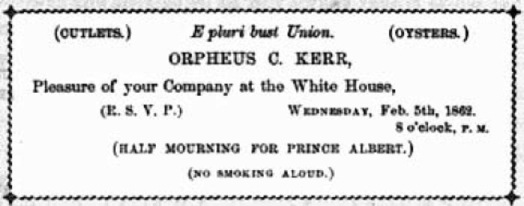
At an early hour on the evening of the fête, the general of the Mackerel Brigade came to my room in a perfect perspiration of brass buttons and white kids, and I asked him what "no smoking aloud" meant.
"Why," says he, putting his wig straight and licking a stray drop of brandy from one of his gloves, "it means that if you try to 'smoke' any of the generals at the ball as to the plan of the campaign, you mustn't do it 'aloud.' Thunder!" says the general, in a fine glow of enthusiasm, "the only plan of the campaign that I know anything about, is the rata-plan."
Satisfied with the general's explanation, I proceeded with my toilet, and presently beamed upon him in such a resplendent conglomeration of ruffles, brass buttons, epaulettes and Hungarian pomade, that he said I reminded him of a comet just come out of a feather-bed, with its tail done up in papers.
"My Magnus Apollo," says he, "the way you bear that white cravat shows you to be of rich but genteel parentage. Any man," says he, "who can wear a white cravat without looking like a coachman, may pass for a gentleman-born. Two-thirds of the clergymen who wear it look like footmen in their grave-clothes."
We then took a hack to the White House, my boy, and on arriving there were delighted to find that the rooms were already filling with statesmen, miss-statesmen, mrs-statesmen, and officers, who had so much lace and epaulettes about them that they looked like walking brass-founderies with the front-door open.
The first object that attracted my special attention, however, was a thing that I took for a large and ornamental pair of tongs leaning against a mantel, figured in blue enamel, with a life-like imitation of a window-brush on top. I directed the general's attention to it, and asked him if that was one of the unique gifts presented to the Government by the late Japanese embassy?
"Thunder!" says the general, "that's no tongs. It's the young man which is Captain Villiam Brown, of Accomac. Now that I look at him," says the general, thoughtfully, "he reminds me of an old-fashioned straddle-bug."
Stepping from one lady's dress to another, until I reached the side of the Commander of the Accomac, I slapped him on the back, and says I:
"How are you, my blue-bird; and what do you think of this brilliant assemblage?"
"Ha!" says Villiam, starting out of a brown study, and putting some cloves in his mouth, to disguise the water he'd drank on his way from Accomac—"I was just thinking what my poor old mother would say if she could see me and the other snobs here to-night. When I look on the women of America around me to-night," says Villiam, feelingly, "and see how much they've cut off from the tops of their dresses, to make bandages for our wounded soldiers, I can't help feeling that their 'neck-or-nothing' appearance—so far from being indelicate, is a very delicate proof of their devoted love of Union."
"I agree with you, my azure humanitarian," says I. "There's precious little waist about such dresses."
Villiam closed one eye, turned his head one-side like a facetious canary, and says he:
"Now lovely woman scants her dress, with bandages the sick to bless; and stoops so far to war's alarms, her very frock is under arms!"
I believe him, my boy!
Returning to the General, we took a turn in the East Room, and enjoyed the panorama of youth, beauty, and whiskers, that wound its variegated length before us.
The charming Mrs. L——, of Illinois, was richly attired in a frock and gloves, and wore a wreath of flowers from amaranthine bowers. She was affable as an angel with a new pair of wings, and was universally allowed to be the most beautiful woman present.
The enthralling Miss C——, from Ohio, was elegantly clad in a dress, and wore number-four gaiters. So brilliant was her smile, that when she laughed at one of Lord Lyons' witicisms, all one corner of the room was wrapped in a glare of light, and several nervous dowagers cried "Fire!" Her beauty was certainly the most beautiful present.
The fascinating Miss L——, of Pennsylvania, was superbly robed in an attire of costly material, with expensive flounces. She wore two gloves and a complete pair of ear-rings, and spoke so musically that the leader of the Marine Band thought there was an æolian harp in the window. She was certainly the most beautiful woman present.
The bewitching Mrs. G——, from Missouri, was splendidly dressed in a breastpin and lace flounces, and wore her hair brushed back from a forehead like Mount Athos. Her eyes reminded one of diamond springs sparkling in the shade of whispering willows. She was decidedly the finest type of beauty present.
The President wore his coat and whiskers, and bowed to all salutations like a graceful door-hinge.
There was a tall Western Senator present, who smiled so much above his stomach, that I was reminded of the beautiful lines:
"As some tall cliff that lifts its awful form, Swells from the vale, and midway leaves the storm; Though round its base a country's ruin spread, Eternal moonshine settles on its head."
Upon going into the supper-room, my boy, I beheld a paradise of eatables that made me wish myself a knife and pork, with nothing but a bottle of mustard to keep me company. There were oysters à la fundum; turkeys à la ruffles; chickens à la Methusaleh; beef à la Bull Run; fruit à la stumikake; jellies à la Kallararmorbus; and ices à la aguefitz.
The ornamental confectionary was beautifully symbolical of the times. At one end of the table, there was a large lump of white candy, with six carpet-tacks lying upon it. This represented the "Tax on Sugar." At the other end was a large platter, containing imitation mud, in which two candy brigadiers were swimming towards each other, with their swords between their teeth. This symbolized "War."
These being very hard times, my boy, and the Executive not being inclined to be too expensive in its marketing, a most ingenious expedient was adopted to make it appear that there was just twice as much of certain costly delicacies on the table as there really was. About the centre of the table lay a large mirror, and on this were placed a few expensive dishes. Of course, the looking-glass gave them a double effect. For instance, if there was a pound of beefsteak on the plate, it produced another pound in the glass, and the effect was two pounds.
When economy can be thus artistically blended with plentitude, my boy, money ceases to be king, and butcher-bills dwindle. Hereafter, when I receive for my rations a pint of transparent coffee and two granite biscuit, I shall use a looking-glass for a plate.
It was the very which-ing hour of the night when the general and myself left the glittering scene, and we had to ask several patrols "which" way to go.
On parting with my comrade-in-arms, says I:
"General, the ball is a success."
He looked at me in three winks, and says he:
"It was a success—particularly the bowl of punch!"
Yours, for soda-water,
Orpheus C. Kerr.
LETTER XXXI.
TREATING OF THE GREAT MILITARY ANACONDA, AND THE MODERN XANTIPPE.
Washington, D.C., February 16th, 1862.
There is still much lingual gymnastics, my boy, concerning the recent fête sham-pate at the White House; but Colonel Wobert Wobinson, of the Western Cavalry, has extinguished the grumblers by proving that the entertainment was strictly Constitutional. He profoundly observes, my boy, that it comes under the head of that clause of the Constitution which secures to the people of America the "pursuit of happiness;" and, as he justly remarks, if you stop the "pursuit of happiness," where's the Instrument of our Liberties?
It pleases me greatly to announce, my boy, that the General of the Mackerel Brigade believes in McClellan, and gorgeously defends him against the attacks of that portion of the depraved press which has friends dying of old age in the Army of the Potomac.
"Thunder!" says he to Captain Bob Shorty, stirring the Oath in his tumbler with a tooth-brush—"the way Little Mac is devoting himself to the military squelching of this here unnatural rebellion, is actually outraging his physical nature. He reviews his staff twice a day, goes over the river every five minutes, studies international law six hours before dinner, takes soundings of the mud every time the dew falls, and takes so little sleep, that there's two inches of dust on one of his eye-balls. Would you believe it," says the General, placing the tumbler over his nose to keep off a fly, "his devotion is such that his hair is turning gray and will probably dye!"
Captain Bob Shorty whistled. I do not mean to say that he intended to be musically satirical, my boy; but if I should hear such a canary-bird remark after I'd told a story, somebody would go home with his eyes done up in rainbows.
"Permit me," says Captain Bob Shorty, hurling what remained of the Oath into the aperture under his moustache. "You convince me that Little Mac's devotion is extraordinary," continued Captain Bob Shorty, dreamily; "but he don't come up to a chap I once knew, which was a editor. Talk about devotion! and outraging nature!" says Captain Bob Shorty, spitting with exquisite accuracy into the eyes of the regimental cat, "why, that ere editor threw body, soul, and breeches into his work; and so completely identified himself with a free and enlightened press, that his first child was a newsboy."
The General of the Mackerel Brigade arose from his seat, my boy, wound up his watch, brushed off his boots, threw the cat out of the window, and then says he:
"Robert, name of Shorty, did you ever read in the Bible about Ananias, who was struck dead for telling a telegraph?"
"I heard about him," says Captain Bob Shorty, "when I was but a innocent lamb, and wore my mother's slipper on my back about as often as she wore it on her foot."
"Well," says the general, with the air of a thoughtful parent, "it's my opinion that if you'd been Ananias, the same streak of lightning would have buried you and paid the sexton."
From this logical and vivid conversation, my boy, you will understand that our leading military men have perfect faith in the genius of McClellan, and believe that he is equal to fifty yards of the Star-Spangled Banner. His great anaconda has gathered itself in a circle around the doomed rabbit of rebellion, and if the rabbit swells he's a goner.
This great anaconda, my boy, may remind hellish readers of the anaconda once seen by a chap of my acquaintance living in the Sixth Ward. This chap, my boy, came tearing into a place where they kept the Oath on tap, and says he:
"I've just seen an anaconda down Broadway."
"Anna who?" says a red-nosed Alderman, dipping his finger into the water on the stove to see if it was warm enough to melt some brandy-refined sugar.
"I said Anaconda, you ignorant cuss," says the chap.
"Was it the real insect?" says the Alderman.
"It was a real, original, genuine Anaconda," says the chap.
"Ah!" says the Alderman, "somebody's been stuffin' you."
"No, sir!" says the chap, "but somebody's been stuffin' the Anaconda, though."
He'd been to the Museum.
If there should be among your unfortunate readers, my boy, any persons of such depraved minds as to perceive a likeness between this Anaconda and that Anaconda, may they be sent to Fort Lafayette, and compelled to read Tupper's poems until the rabbit of rebellion is reduced to his last quarter!
Early this morning a couple of snuff-colored pickets brought a female Southern Confederacy into camp, stating that she had called them nasty things and spit all over their guns. She said that she wanted to see the loathsome creature that commanded them, and her eyes flashed so when they took her by the arm, that her vail took fire twice, and her eyebrows smoked repeatedly.
The General of the Mackerel Brigade received her courteously, only poking her in the ribs to see if she had any Armstrong guns concealed about her. Says he:
"Have I the honor of addressing the wife of the Southern Confederacy?"
The female confederacy drew herself up as proudly as the First Family of Virginia when the butcher's bill comes to be paid, and replied, in soprano of great compass:—
"I am that injured woman, you ugly swine."
The General bowed until his lips touched a pewter mug on the table, and then says he:
"My dear madam, your words touch a tender chord in my heart, and it will give me pleasure to serve you. Your words, madam," continued the general, with visible emotion, "are precisely those which my beloved wife not unfrequently addresses to me. Ah! my wife! my wifey!" says the general, hysterically, "how often have you patted me on my head, and told me that my face looked like a chunk of beeswax with three cracks in it."
The wife of the Southern Confederacy sneered audibly, and called for a fan. There being no fan nearer than the office of Secretary Welles, she used a small whisk-broom. Says she:
"Miserable hireling of a diabolical Lincoln, your wife is nothing to me. She is a creature! I do not come here to hear her wrongs, but to express the undying wish that you and all your horde may be welcomed with muddy hands to hospitable graves. All I want is to be let alone."
"My dear Mrs. S. C.," says the general, with a touch of brass and irony, "it is a matter of the utmost indifference to me whether you are 'to be let alone,' or with the next house and lot."
"I insist upon being let alone," screamed the female Confederacy, spitting angrily.
"I am not touching you," says the general.
"All I want is to be let alone," shrieked the exasperated lady; "and I will be let alone!"
The General of the Mackerel Brigade hastily wiped his mouth with a bottle, and then says he:
"Madam, if sandwiches are not plenty where you come from, it ain't for the want of tongue."
On hearing this gastronomic remark, my boy, the injured wife of the Southern Confederacy swept from the room like an insulted Minerva, and departed for Secessia. It was observed that she frowned like a thunder-cloud at every Federal she passed, excepting one picket. Him she smiled on. She had detected him in the act of admiring her ankles as she picked her way through the mud.
Woman, my boy, has really many sweet qualities; and if her head is sometimes in the wrong, she has always a reserve of genuine goodness of heart in the neighborhood of her gaiters.
Yours, for the Sex,
Orpheus C. Kerr.
LETTER XXXII.
COMMENCING WITH A BURST OF EXULTATION OVER NATIONAL VICTORIES, REFERRING TO A SENATORIAL MISTAKE, DEPICTING A WELL-KNOWN CHARACTER, AND REPORTING THE RECONNOISSANCE OF THE WESTERN CENTAURS.
Washington, D.C., February 21st, 1862.
Now swells Columbia's bosom with a pride, that sets her eyes ablaze with living fire; and, with her arms upreaching to the skies, she draws in air new crowns with stars adorned, to ring the temples of her conquering chiefs. Far in the West, she sees the livid sparks struck by Achilles from the hostile sword, and in the South beholds how Ajax bold defies the lightning of the rebel guns. Then clasping to her breast the flag we love, and donning swift Minerva's gleaming helm, she stands where Morn's first glories kiss the hills, and breathes the pæan of a fame redeemed!
Three cheers for the chaps who pocketed Fort Donelson & Co., my boy, and may the rebels never have an easier boat to row than Roanoke. The other day I was talking with a New England Senator about the taking of the fort, and says I:
"It was a gay victory, my learned Theban; but it makes me mad when I think how that slippery rascal, Floyd, found an egress down the river."
The Senator pulled up his collar, my boy, observed to the tumbler-sergeant that he would take the same with a little more sugar in it, and then says he:
"In that observation you sum up the whole cause of this unnatural strife. It is, indeed, the negro, whose wrongs are now being revenged upon us by an inscrutable Whig Providence; and if the Government does not speedily strike the fetters from the slave, that slave may yet be used to fight horribly against us. I shall cite the significant fact you mention in my next exciting speech."
I opened my eyes at this outburst until they looked like the bottoms of two quart bottles beaming in the sunshine, and then says I:
"You talk as fluently as a Patent Office Report, my worthy Nestor; but I don't exactly perceive what my remark has to do with the colored negro."
"Why," says he, "didn't you say that the traitor Floyd found a negress down the river?"
For an instant, my boy, I felt very dizzy, and was obliged to lean my head against a tumbler for a moment.
"Your ears, my friend," says I, "are certainly long enough to hear correctly what is said to you; but this time you've made a slight mistake. I said that Floyd had found an egress down the river."
The Senator looked at me for a moment, and says he:
"Sold by a soldier! Good morning."
I wonder how those nice, pleasant, gentlemanly chaps down in South Carolina enjoy Uncle Samuel's latest hit? I can fancy their damaging effects, my boy, upon the constitution of
THE SOUTH CAROLINA GENTLEMAN. Down in the small Palmetto State, the curious ones may find A ripping, tearing gentleman, of an uncommon kind— A staggering, swaggering sort of chap, who takes his whiskey straight, And frequently condemns his eyes to that ultimate vengeance which a clergyman of high standing has assured us must be the sinner's fate; A South Carolina gentleman, One of the present time. You trace his genealogy, and not far back you'll see A most undoubted octoroon, or mayhap a mustee; And if you note the shaggy locks that cluster on his brow, You'll find that every other hair is varied with a kink, that seldom denotes pure Caucasian blood; but, on the contrary, betrays an admixture with a race not particularly popular now— This South Carolina gentleman, One of the present time. He always wears a full-dress coat—pre-Adamite in cut— With waistcoat of the loudest style, through which his ruffles jut. Six breastpins deck his horrid front: and on his fingers shine Whole invoices of diamond rings, which would hardly pass muster with the Original Jacobs in Chatham street, for jewels gen-u-ine— This South Carolina gentleman, One of the present time. He chews tobacco by the pound, and spits upon the floor, If there is not a box of sand behind the nearest door; And when he takes his weekly spree, he clears a mighty track Of everything that bears the shape of whisky-skin, gin-and-sugar, brandy-sour, peach-and-honey, irrepressible cocktail, rum-and-gum, and luscious apple-jack— This South Carolina gentleman, One of the present time. He looks on grammar as a thing beneath the notice quite Of any Southern gentleman whose grandfather was white; And as for education—why, he'll plainly set it forth, That such d—d nonsense never troubles the heads of the Chivalry; though it may be sufficiently degrading to merit the personal attention of the poor wretches unfortunate enough to make their living at the North— This South Carolina gentleman, One of the present time. He licks his niggers daily, like a true American; And "takes the devil out of them" by this sagacious plan. He tries his bowie knives upon the fattest he can find; And if the darkey winces, why—he is immediately arrested at the instance of the First Families in the neighborhood, on a charge of conversing with a fiendish abolitionist, and conspiring to poison all the wells in the State with strychnine, and arm the slaves of the adjoining plantations with knives and pistols; for all of which he is very properly sentenced to five hundred lashes—after which to prison he's consigned (by) This South Carolina gentleman, One of the present time. If for amusement he's inclined, he coolly looks about For a parson of the Methodists, or some poor peddler lout; And having found him, has him hung from some majestic tree— Then calls his numerous family to enjoy with him the instructive and entertaining spectacle of a "suspected abolitionist" receiving his just reward at the hands of an incensed com-mu-ni-ty— This South Carolina gentleman, One of the present time. He takes to euchre kindly, too, and plays an awful hand, Especially when those he tricks his style don't understand; And if he wins, why then he stoops to pocket all the stakes; But if he loses, then he says unto the unfortunate stranger, who has chanced to win: "It's my opinion that you are a cursed abolitionist; and if you don't leave South Carolina in one hour, you will be hung like a dog." But no offer to pay his loss he makes— This South Carolina gentleman, One of the present time. Of course he's all the time in debt to those who credit give— Yet manages upon the best the market yields to live; But if a Northern creditor asks him his bill to heed, This honorable gentleman instantly draws two bowie-knives and a pistol, dons a blue cockade, and declares, that in consequence of the repeated aggressions of the North, and its gross violations of the Constitution, he feels that it would utterly degrade him to pay any debt whatever; and that, in fact, he has at last determined to Secede!— This South Carolina gentleman, One of the present time. And when, at length, to Charleston of the other world he goes, He leaves his children mortgages, with all their other woes. As slowly fades the vital spark, he doubles up his fists, And softly murmurs through his teeth: "I die under a full conviction of my errors in life, and freely forgive all men; but still I only hope that somewhere on the other side of Jordan I may just come across some ab-o-li-tion-ists!!"— This South Carolina gentleman, One of the present time.
Yesterday afternoon, my boy, Colonel Wobert Wobinson, of the Western Centaurs, ordered Captain Samyule Sa-mith to make a reconnoissance toward Flint Hill with a company of skeleton cavalry, having learned that several bushels of oats were stored there.
Samyule drew up his company in line against a fence, and then says he:
"Comrades, we go upon a mission that is highly dangurious, and America expects every hoss to do his duty. If we meet the rebels," continued Samyule, impressively, "they will try hard to capture some of our hosses; for they're badly off for gridirons down there, and three or four of our spirited animals would supply them for the season. If any of you see them coming after the hardware, just put your gridirons on a gallop and fall back."
At the conclusion of this speech, Private Peter Jenkins observed that he'd been falling back ever since he got his horse; for which he was sentenced to laugh at all the colonel's jokes for a week.
Would that I possessed the fiery pen of bully Homer, to describe the gallant advance of that splendid corps, as it trotted fiercely on to victory or death. At its head was Captain Samyule Sa-mith, mounted on a horse of some degree of merit, his coat-tails flapping behind him like banners at half-mast, and his form bouncing about in the saddle like an inspired jumping-jack. There was Lieutenant Tummis Kagcht, recently of the German navy, riding an animal with prows as sharp as a yacht and that was broadside to the road at least half the time. There was private Peter Jenkins, seated directly over the tail of a yellow-enameled charger, that walked at right-angles with the fences, and never stopped to take breath until it had gone three yards.
There was Sergeant O'Pake, late of Italy, who bestrode a sorrel, whose side was full of symmetrical gutters to carry the rain off, and who kept his octagon head directly under the right arm of the horseman ahead of him. There was private Nick O'Demus, with his sabre tucked neatly into the eyes of his neighbor, managing an anatomical curiosity that walked half of the time on his hind-legs, and creaked when it came to ruts in the road.
Onward, right onward, went this glittering cavalcade, my boy, until they came to an outskirt of Flint Hill, where a solitary remnant of a First Family might have been seen sitting on a fence, eating a sandwich.
"Tr-r-aitor!" shouted Captain Samyule Sa-mith, in tones of milk-souring thunder, "where is the rest of the Confederacy, and what do you think of the news from Fort Donelson?"
The Confederacy hiccupped gloomily, my boy, as he took an impression of its front teeth on the sandwich, and says he:
"The melancholy days are come—the saddest of the year."
"That's very true," said Samyule, pleasantly, "and proves you to be a person of some eddication. But tell me, sweet hermit of the dale," pursued Samyule, "where are the oats we have heard about?"
The solitary Confederacy checked a rising cough with another bite at his ration, and says he:
"You have the oats already; for they were eaten last night by six Confederate chickens, and my slave, Mr. Johnson, sold them chickens to a prospecting detachment of the Mackerel Brigade this morning. Don't talk to me any more," continued the Confederacy, sadly, "for I am very miserable, and haven't seen a quarter in six months."
Samyule seemed touched, and put his hand half-way into his pocket, but remembered his probable children, and refrained from romantic generosity.
"Let me see Mr. Johnson," says he, reflectively, "and I will question him concerning the South."
The Confederacy indulged in a plaintive cat-call, whereupon there emerged from an adjacent clump of bushes a beautiful black being, richly attired in a heavy seal-ring and a red neck-tie. It was Mr. Johnson.
"You have sent for me," says Mr. Johnson, with much dignity, "and I have come. If you do not want me, I will return."
"You have seen the tragic Forrest?" said Samyule.
"The forest is my home," replied Mr. Johnson, "and in its equal shade my humble hut stands sacredly embowered. As the gifted Whittier might say:
"There lofty trees uprear in pillared state, And crystal streams the thirsty deer elate; While through the halls that base the dome of leaves Fall sunshine-harvests spread in golden sheaves. "There toy the birds in sweet seclusion blest, To leap the branches or to build the nest, While from their throats the grateful song outpoured Wakes woodland orchestras to praise the Lord. "There walks the wolf, no longer driven wild By panting hounds and huntsman blood-defiled; But tamed to kindness, seeketh peacefully The soothing shelter of a hollow tree. "Who would be free, and tow'r above his race, In the full freedom spurning man and place, Deep in the forest let him rear his clan Where God himself stands face to face with man."
Just as the oppressed African finished this rhythmical statement of his platform, my boy, a huge horse-fly, alighting on the nose of Captain Samyule Sa-mith, awoke that hero from the refreshing slumber into which he had fallen.
"Tell me, Johnson," says he, "how you got your eddication, for I thought that persons from Afric's sunny mountain went to school about as often as a cat goes to sea."
Mr. Johnson placed his hand upon his breast with much stateliness, and says he: "I entered Yale College as a Spaniard, and having graduated with all honors, returned to my master, and was at once employed in cotton culture. I am contented and happy, and have never seen an uncomfortable day since my wife was sold. Go, stranger, and tell your people that the South may be overwhelmed, but she can never be conquered while Johnson has a seal ring to his back."
On hearing this speech, my boy, Samyule said:
"About face! skeletons;" and the gridiron cavalry returned to camp in a brown study.
The intelligence of the southern slaves is really wonderful, my boy, and if it should ever come to a head, look out for a rise in wool.
Yours, contemplatively,
Orpheus C. Kerr.
LETTER XXXIII.
EXEMPLIFYING THE TERRIBLE DOMESTIC EFFECTS OF MILITARY INACTIVITY ON THE POTOMAC, AND DESCRIBING THE METAPHYSICAL CAPTURE OF FORT MUGGINS.
Washington, D.C., March 3d, 1862.
I know a man, my boy, who was driven to lunacy by reliable war news. He was in the prime of life when the war broke out, and took such an interest in the struggle that it soon became nearly equal to the interest on his debts. With all the enthusiasm of vegetable youth he subscribed for all the papers, and commenced to read the reliable war news. In this way he learned that all was quiet on the Potomac, and immediately went to congratulate his friends, and purchase six American flags. On the following morning he wrapt himself in the banner of his country and learned from all the papers that all was quiet on the Potomac. His joy at once became intense; he hoisted a flag on the lightning-rod of his domicil, purchased a national pocket-handkerchief, bought six hand-organs that played the Star-Spangled Banner, and drank nothing but gunpowder tea. In the next six months, however, there was a great change in our military affairs; the backbone of the rebellion was broken, the sound of the thunder came from all parts of the sky, and fifty-three excellent family journals informed the enthusiast that all was quiet on the Potomac. He now became fairly mad with bliss, and volunteered to sit up with a young lady whose brother was a soldier. On the following morning he commenced to read Bancroft's History of the United States, with Hardee's Tactics appended, only pausing long enough to learn from the daily papers that all was quiet on the Potomac. Thus, in a fairy dream of delicious joy, passed the greater part of this devoted patriot's life; and even as his hair turned gray, and his form began to bend with old age, his eye flashed in eternal youth over the still reliable war news. At length there came a great change in the military career of the Republic; the rebellion received its death-wound, and Washington's Birthday boomed upon the United States of America. It was the morning of that glorious day, and the venerable patriot was tottering about the room with his cane, when his great-grandchild, a lad of twenty-five, came thundering into the room with forty-three daily papers under his arm.
"Old man!" says he, in a transport, "there's great news."
"Boy, boy!" says the aged patriot, "do not trifle with me. Can it be that—"
"Bet your life—"
"Is it then a fact that—"
"Yes—"
"Am I to believe that—"
"All is quiet on the Potomac!"
It was too much for the venerable Brutus; he clutched at the air, spun once on his left heel, sang a stave of John Brown's body, and stood transfixed with ecstacy.
"Thank Heving," says he, "for sparing me to see this day!"
After which he became hopelessly insane, my boy, and raved so awfully about all our great generals turning into Mud-larks that his afflicted family had to send him to the asylum.
This veracious and touching biography will show you how dangerous to public health is reliable war news, and convince you that the Secretary's order to the press is only a proper insanitary measure.
I am all the more resigned to it, my boy, because it affects me so little that I am even able to give you a strictly reliable account of a great movement that lately took place.
I went down to Accomac early in the week, my boy, having heard that Captain Villiam Brown and the Conic Section of the Mackerel Brigade were about to march upon Fort Muggins, where Jeff Davis, Beauregard, Mason, Slidell, Yancey, and the whole rebel Congress were believed to be intrenched. Mounted on my gothic steed Pegasus, who only blew down once in the whole journey, I repaired to Villiam's department, and was taking notes of the advance, upon a sheet of paper spread on the ground, when the commander of Accomac approached me, and says he:
"What are you doing, my bantam?"
"I'm taking notes," says I, "for a journal which has such an immense circulation among our gallant troops that when they begin to read it in the camps, it looks, from a distance, as though there had just been a heavy snow-storm."
"Ah!" says Villiam, thoughtfully, "newspapers and snow-storms are somewhat alike; for both make black appear white. But," said Villiam philosophically, "the snow is the more moral; for you can't lie in that with safety, as you can in a newspaper. In the language of General Grant at Donelson," says Villiam, sternly: "I propose to move upon your works immediately."
And with that he planted one of his boots right in the middle of my paper.
"Read that ere Napoleonic dockyment," says Villiam, handing me a scroll. It was as follows:
EDICK.
Having noticed that the press of the United States of America is making a ass of itself, by giving information to the enemy concerning the best methods of carrying on the strategy of war, I do hereby assume control of all special correspondents, forbidding them to transact anything but private business; neither they, nor their wives, nor their children, to the third and fourth generation.
I. It is ordered, that all advice from editors to the War Department, to the general commanding, or the generals commanding the armies in the field, be absolutely forbidden; as such advice is calculated to make the United States of America a idiot.
II. Any newspaper publishing any news whatever, however obtained, shall be excluded from all railroads and steamboats, in order that country journals, which receive the same news during the following year, may not be injured in cirkylation.
III. This control of special correspondents does not include the correspondent of the London Times, who wouldn't be believed if he published all the news of the next Christian era. By order of
Villiam Brown, Eskevire, Captain Conic Section, Mackerel Brigade.
I had remounted Pegasus while reading this able State paper, my boy, and had just finished it, when a nervous member of the advance-guard accidentally touched off a cannon, whose report was almost immediately answered by one from the dense fog before us.
"Ha!" says Captain Villiam Brown, suddenly leaping from his steed, and creeping under it—to examine if the saddle-girth was all right—"the fort is right before us in the fog, and the rebels are awake. Let the Orange County Company advance with their howitzers, and fire to the north-east."
The Orange County Company, my boy, instantly wheeled their howitzers into position, and sent some pounds of grape toward the meridian, the roar of their weapons of death being instantaneously answered by a thundering crash in the fog.
Company 3, Regiment 5, Mackerel Brigade, now went forward six yards at double-quick, and poured in a rattling volley of musketry, dodging fearlessly when exactly the same kind of a volley was heard in the fog, and wishing that they might have a few rebels for supper.
"Ha!" says Captain Villiam Brown, when he noticed that nobody seemed to be killed yet; "Providence is on our side, and this here unnatural rebellion is squelched. Let the Anatomical Cavalry charge into the fog, and demand the surrender of Fort Muggins," continued Villiam, compressing his lips with mad valor, "while I repair to that tree back there, and see if there is not a fiendish secessionist lurking behind it."
The Anatomical Cavalry immediately dismounted from their horses, which were too old to be used in a charge, and gallantly entered the fog, with their sabres between their teeth, and their hands in their pockets—it being a part of their tactics to catch a rebel before cutting his head off.
In the meantime, my boy, the Orange County howitzers and the Mackerel muskets were hurling a continuous fire into the clouds, stirring up the angels, and loosening the smaller planets. Sturdily answered the rebels from the fog-begirt fort; but not one of our men had yet fallen.
Captain Villiam Brown was just coming down from the top of a very tall tree, whither he had gone to search for masked batteries, when the fog commenced lifting, and disclosed the Anatomical Cavalry returning at double-quick.
Instantly our fire ceased, and so did that of the rebels.
"Does the fort surrender to the United States of America?" says Villiam, to the captain of the Anatomicals.
The gallant dragoon, sighed, and says he:
"I used my magnifying glass, but could find no fort."
At this moment, my boy, a sharp sunbeam cleft the fog as a sword does a vail, and the mist rolled away from the scene in two volumes, disclosing to our view a fine cabbage-patch, with a dense wood beyond.
Villiam deliberately raised a bottle to his face, and gazed through it upon the unexpected prospect.
"Ha!" says he sadly, "the garrison has cut its way through the fog and escaped, but Fort Muggins is ours! Let the flag of our Union be planted on the ramparts," says Villiam, with much perspiration, "and I will immediately issue a proclamation to the people of the United States of America."
Believing that Villiam was somewhat too hasty in his conclusions, my boy, I ventured to insinuate that what he had taken for a fort in the fog, was really nothing but a cabbage inclosure, and that the escaped rebels were purely imaginary.
"Imaginary!" says Villiam, hastily placing his canteen in his pocket. "Why, didn't you hear the roar of their artillery?"
"Do you see that thick wood yonder?" says I.
Says he, "It is visible to the undressed eye."
"Well," says I, "what you took for the sound of rebel firing, was only the echo of your own firing in that wood."
Villiam pondered for a few moments, my boy, like one who was considering the propriety of saying nothing in as few words as possible, and then looked angularly at me, and says he:
"My proclamation to the press will cover all this, and the news of this here engagement will keep until the war is over. Ah!" says Villiam, "I wouldn't have the news of this affair published on any account; for if the Government thought I was trying to cabbage in my Department, it would make me Minister to Russia immediately."
As the Conic Section of the Mackerel Brigade returned slowly to head-quarters, my boy, I thought to myself: How often does man, after making something his particular forte, discover at last that it is only a cabbage-patch, and hardly large enough at that for a big hog like himself!
Yours, philanthropically,
Orpheus C. Kerr.
LETTER XXXIV.
BEGINNING WITH A LAMENTATION, BUT CHANGING MATERIALLY IN TONE AT THE DICTUM OF JED SMITH.
Washington, D.C., March 8th, 1862.
Two days ago, my boy, a letter from the West informed me that an old friend of mine had fallen in battle at the very moment of victory. One by one, my boy, I have lost many friends since the war began, and know how to bear the stroke; but what will they say in that home to which the young soldier wafted a nightly prayer? Thither, alas! he goes
NO MORE. Hushed be the song and the love-notes of gladness That broke with the morn from the cottager's door— Muffle the tread in the soft stealth of sadness, For one who returneth, whose chamber-lamp burneth No more. Silent he lies on the broad path of glory, Where withers ungarnered the red crop of war. Grand is his couch, though the pillows are gory, 'Mid forms that shall battle, 'mid guns that shall rattle No more. Soldier of Freedom, thy marches are ended— The dreams that were prophets of triumph are o'er— Death with the night of thy manhood is blended— The bugle shall call thee, the fight shall enthrall thee No more. Far to the Northward the banners are dimming, And faint comes the tap of the drummers before; Low in the tree-tops the swallow is skimming; Thy comrades shall cheer thee, the weakest shall fear thee No more. Far to the Westward the day is at vespers, And bows down its head, like a priest, to adore; Soldier, the twilight for thee has no whispers, The night shall forsake thee, the morn shall awake thee No more. Wide o'er the plain, where the white tents are gleaming, In spectral array, like the graves they're before— One there is empty, where once thou wert dreaming Of deeds that are boasted, of One that is toasted No more. When the Commander to-morrow proclaimeth A list of the brave for the nation to store, Thou shalt be known with the heroes he nameth, Who wake from their slumbers, who answer their numbers No more. Hushed be the song and the love-notes of gladness That broke with the morn from the cottager's door— Muffle the tread in the soft stealth of sadness, For one who returneth, whose chamber-lamp burneth No more.
To escape my own thoughts, I went over into a camp of New England chaps, yesterday, my boy, and one of the first high-privates my eyes rested on was Jed Smith, of Salsbury. He winked to the chaps lounging near him, when he noted my doleful look, and says he:
"You're mopish, comrade. Hez caliker proved deceitful?"
"No," says I, indifferently. "Calico rather shuns me, as a general thing, my Down-easter, on account of my plain speaking."
This startled him, my boy, as I expected it would, and says he:
"That's jest like the mock-modesty of the wimmin folks all the world over, and a body might think they had the hull supply and nothin' shorter; but I tell ye it's the heartiest sow that makes the least noise, and half this here modesty is all sham. Onct in a while these here awful modest critters git shook down a bit, I guess; and gheewhillikins! ef it don't do me good to see it. I recollect I was goin' down from Augusty some two years ago, in the old stage that Sammy Tompkins druv, and we had one of the she-critters aboard—and she was a scrouger, I tell ye! Bonnet red as a blaze, and stuck all over with stiff geeranium blows, a hump like a Hottentot gal, and sich ankles! but hold your horses, I'm gettin' ahead of time. We was awful crowded, and no mistake—piled right on top of each other, like so many layers of cabbage; and the way that gal squealed when we struck a rut, was a caution to screech owls. And she was takin' up her sheer of the coach, too, I guess; and kind of stretched her walkin' geer way under the seat in front of her, and out t'other side, just to brace herself agin the diffikilties of travel. It being pretty bad goin' down in them parts, she had on a pair of her brother's butes, and they was what she wouldn't have had seen if she'd knowed it. One of the fellers on the middle seat was Zeb Green—gone to glory some time ago—and when he spied them butes, he winked to me, and sung out:
"Gheewhillikins! who owns these ere big trotters?"
"Now, ye see, the she-critter was one of yer modest ones, and she wouldn't have owned up for the world, after that. Says she:
"'I guess they ain't mine.'
"Zeb see her game in a twinklin', and he was a tall one for a lark; so says he:
"'I rayther guess there's petticuts goes with them mud mashers.'
"The gal she flamed up at that, and says she:
"'I guess you're barkin' up the wrong saplin', Major, and yer must have a most audacious turkey on, not to know yer own butes.'
"Sich lyin' tuk Zeb all aback for a minute; but he combed up his bristles again, and tried her on another trail.
"'Now, you don't mean to come for to insinuate that them ere's my butes, and I not know it?' says he:
"She was in for it then, and wouldn't back down; so says she:
"'In course I do, Major, and you'd better look out fur your own leather.'
"Zeb took a chaw of his terbacky, and says he:
"'Well, if you says it's so, I'm bound to swaller the oyster; but I'll be dod-rotted if my bute-maker won't hev to shave my last next winter.'
"I seen right off that Zeb was up to the biggest kind of a spree, and I knew them butes was the gist of it; cause ye see the she-critter couldn't hull 'em in nohow, after what she'd said.
"We went wrigglin' along for a while as still as cats in a milk-house, and the butes stayed where they was. But pretty soon Zeb began to grow uneasy like, and screwed up his ugly nose, like as if he was took with the pangs, and the doctor gone a courtin'.
"'Gheewhillikins!' says he, at last, 'I shan't stand this here much longer, if there is company in the parlor!'
"We all looked at him, and says one feller:
"'I guess, Major, you're took putty bad.'
"Zeb gave his phizog another twist, an' says he:
"'You'd better believe it, squire. I've got corns on them ere feet of mine that'd make a preacher swear, and them butes pinch like all tarnation.'
"I see right off how the smoke was blowin', and says I:
"'Off with 'em, Zeb! We're all in the family, and won't mind you.'
"That was all the old he-one was waitin' fur; and as quick as I said it, he had one of that modest gal's feet in his hand, and twisted off the bute in a twinklin'!! We all see a perfect Wenus of a foot, and a golfired ankle, and then it was jerked away quicker'n a flash, and the critter screamed like a rantankerous tom-cat with his tail under a cheese-knife!
"'Murder!—you nasty thing,' says she, 'give me my bute.'
"With that, me, and Zeb, and the hull bilin' of us roared right out; and says Zeb, says he, as he handed her the bute with a killin' bow—says he:
"'Young woman, I guess I've taken your modesty, as the wimmen call it, down a peg. You sed them was my butes, and in course I had a right to shed 'em; but ef they're your'n now, why keep 'em to yourself, for massy's sake!'
"That settled the gal down some, I tell ye; and it give her such a turn that her putty face was like a rose when we stopt at the Red Tavern."
We were so much pleased with this story, my boy, that we entreated the opponent of mock modesty to spin us another.
"Well, feller citizens," says he, "I don't mind if I do tell ye about
"A JOFIRED WAGON-TRADE
"I onct made down in Texas. You see I was doin' a right smart chance of trade down in that deestrict with clocks, fur caps, Ingin meal, and other necessaries of life; and onct in a while I went it blind on a spekullation, when there was a chance to get a bargain, and pay fifty per cent. on a stiff swindle. They was an old chap of a half breed they called Uncle Johnny, down there, and somehow he got wind of my pertikler cuteness, and he guessed he could run a pretty sharp saw on me, if he only got a sight.
"I heerd he was after me, and thinks I 'you'll get a roastin', my boy, ef you pick up this hot-chestnut;' but I was consated beyond my powers then, and he was jist one huckleberry above my tallest persimmon. We cum together one night at Bill Crown's tavern, and the fust thing the old cuss said was:
"'Jerewsalem crickets! I'm like a fellow jist out of a feather bed and no mistake. I tell ye that 'ere wagging uv mine rides jist about as slick as a railroad of grease, and if it warn't so allfired big, I wouldn't sell it for its weight in Orleans bank notes.'
"I kinder thought I smelt a putty big bed-bug; but I glimpsed outer the door, and there stood the wagon under the shed, and lookin' orful temptin'. It war a big four wheel consarn, with a canvas top, and about as putty a consarn for family use as ever I sot my winkers on. Thinks I:
"'You don't fetch me this time, hoss; for I'll be jist a neck ahead of you!'
"So I stood a minit, and then says I:
"'Without lookin' nor nuthin', Uncle Johnny, I'll jest give you $50 for that 'ere hearse.'
"He kinder blinked around, and says he:
"'I'd rather sell my grandmother; but the consarn's yourn, cunnel. Show yer hand.'
"He was too willin' to suit me; but the game was outer cover, and I wouldn't back down. So I give him the rags, and went out to look at my bargain. Would you 'bleave it, the old varmint had jist fetched that ere wagon down to the shed, and sot it up end on, so that I didn't see how the fore-wheels wasn't thar! Fact! They had marvelled, and the fore-axles was restin' on two hitchin' stakes: Jist as I got through cussin,' I heerd a jofired larfin, and thar was the robber and his friends standin' in the door, splittin' their sides at me. Thinks I, 'I went cheap, then, my beauty; but look out for a hail-storm when the wind's up next time.' I borreyed a horse, and took that ar bargain to my shanty; and then I sot down and went to thinkin'. Fur two days I war as melancholy as a chicken in gooseberry time, tryin' to hit some plan to get even with the cuss. All to onct somethin' struck me, and I felt better. Ye see there was great talk down thar jist then, about the doctor's gig what they heard tell on, but not a one was there in the hull deestrict. I'd seen one up in York, and thinks I, 'Ef I don't make a doctor's two-wheeler outer that ere wagon, then bleed me to death with a oyster-knife!' So I jist got a big saw, and went to work quiet like, and cut that ere wagon right in two in the middle—cover and all. Then I took the shafts and fastened them onto the hind part, and rigged up a dash-board. And then I took part of the cut-off piece for a seat, and painted the hull thing with black paint; and dod-rot me if ef I didn't hev a doctor's gig as rantankerous as you please! I knew it would fetch a thunderin' price fur its novelty to any one; but I was after Uncle Johnny, and nobody else. One night I druv down to the tavern at a tearin' rate, and the fust feller I see was hisself, a standin' in the door, and sippin' kill-me-quick. He was kinder took down when he see me comin' it so piert in my new two-wheeler, and some of his friends inside axed him what was the matter. He kept as still as a mouse in a pantry until I come up, and then says he: