Chapter II · Athens
Reading edition
Exceptional position of Athens.
Of all the tyrants of the seventh and sixth centuries none are so well known to us as those who reigned at Athens. No other city has left us so clear a picture of the state of things not only during the tyranny but also immediately before and after it. Solon lived to see Peisistratus make himself supreme. Herodotus, born a Persian subject about 484 B.C., must have had opportunities of questioning first-hand authorities on the later years of the Athenian tyranny, while his younger contemporary Thucydides was in a particularly favoured position for getting information on this subject through his relationship with the Philaidae, of whose rivalry with the Peisistratidae there will be occasion to speak later in this chapter[180].
This comparative abundance of information is the reason why Athens has been made the starting-point of this enquiry. But even so our knowledge is meagre enough. And there is a special reason for using it with caution. So far in the history of the world there has been only one Athens. The developments that took place in the city during the first two centuries of the democracy are without parallel. Can we be certain that Athens was not already unique in the period immediately preceding? One point in which the Athenian tyranny was exceptional meets us at the first glance. |Athens before the establishment of the tyranny.| With the single exception of Samos, all the other famous tyrannies of the earlier type, at least in the Aegean area, arose in the seventh century. But apart from this fact it will be found that the tyranny at Athens in the sixth century followed the same course as it appears to have done at places like Corinth and Argos, Sardis and Miletus in the seventh. The more highly developed an organism is, the longer it 34takes to reach maturity. This is perhaps the reason why Athens in the sixth century appears in some respects to be a hundred years behind some of the cities whom she was destined so completely to eclipse.
Athens was not exclusively commercial. Her large territory made her partly agricultural. To this fact may be due her failure to compete commercially in the seventh century with cities like Aegina and Corinth[181]. Hence too the late rise of the tyranny. It appears only when the commercial and industrial element had got the upper hand. There was indeed the attempt of Cylon, who conspired to make himself tyrant within a generation of the first appearance of tyranny on the mainland of Greece[182]. But Cylon failed because, though wealthy (ὀλυμπιονίκης) and influential (δυνατός), he could not possibly, in the Athens of his day, be the leader of any dominant organized commercial activity. He was merely an ambitious member of the aristocracy (τῶν πάλαι εὐγενής), connected with the great band of merchant princes only by marriage[183]. The attempt and its result are both what might have been expected from the position of Athens at the time.
Soon after Cylon’s attempt Athens began to rival Corinth in the pottery trade, and the influence of the rich city merchants and exporters doubtless increased. But even in pottery the great vogue of Attic ware was still to come, and Solon’s measures for encouraging the growth of olives and the export of olive oil also belong to this period[184]: the importance of the landed aristocracy who owned the olive yards must have increased almost equally. No merchant therefore attempted by means of the wealth that he had amassed or the labour that he employed to seize the tyranny. The landed aristocracy were also wealthy and they too employed much labour, and it so happened that the best part of the Attic plain, where lay their estates, was situated round the city, as Cylon discovered to his cost when he seized the Acropolis. Tyranny was almost impossible.
35The leading man at Athens was not a mere millionaire, as in the more exclusively trading states. Solon had indeed some experience of trade[185], but he was essentially a politician with a gift for finance, not a financier or merchant with political ambitions. He became not a tyrant but a lawgiver.
Peisistratus makes himself tyrant by organizing a new party.
Solon tried to provide for the difficulties that he saw resulting from the existence of two evenly matched parties, the landowners of the plain and the traders of the coast. The tyranny arose from the political organization of a new interest by Peisistratus, who, to quote the exact words of Herodotus:
While the coast men of Athens and those of the plain were at strife ... having formed designs on (καταφρονήσας) the tyranny, proceeded to raise (ἤγειρε) a third faction[186].
Some ancient writers represent Peisistratus as owing his tyranny to his gifts as an orator or demagogue[187]. Reasons are given in Chapter I for not accepting this view, and also for not believing that it was mainly as a successful soldier that Peisistratus secured the throne[188]. It was as founder and leader of the “third faction” of Herodotus that Peisistratus made himself tyrant, and he seems largely to have built up his influence with them by rendering them aid, doubtless financial[189].
To understand the position of Peisistratus and to ascertain the basis of his power it is obviously of the first importance that we should know who precisely were the men who made up this third faction. Unfortunately this question cannot be answered directly 36from the information that has come down to us. So before sifting the evidence that bears on it, it will be well to examine some later and better known phases of the tyrant’s career.
How Peisistratus “rooted” his power.
After the tyrant had first established himself he is reported to have been twice banished and twice restored. After his second restoration “he proceeded to root his tyranny with many mercenaries, and with revenues of money, of which part was gathered from the home country, part from the river Strymon[190].”
The Strymon (Struma) flows through the famous mining district which was afterwards annexed by Philip of Macedon, and brought him his enormous wealth. It is scarcely conceivable that Peisistratus’ revenues from this region came from any other source than the mines[191]. Hence Guiraud, in his interesting but sober account of ancient Greek industry, has already been led to suggest that Peisistratus’ Attic revenues were derived from a similar source, and that he worked the mines of Laurium[192].
How he secured his second restoration.
Peisistratus was not using revenues from mines for the first time in his career, when he proceeded to “root his tyranny” in the manner just described. He had already used the same means to compass his second restoration. When driven from Athens for the second time he had “proceeded to the parts round Pangaion, where he made money, and having hired soldiers he went back to Eretria, and in the eleventh year made his first attempt to recover his position by force[193].” Herodotus appears to think that all the period of exile was spent at Eretria; but he too states it to have been spent in collecting money (ἕως ... τὰ χρήματα ἤγειρε). The result was that “he now held the tyranny securely[194].” Mt Pangaion is the name of the great 37mining district to the East of the lower Strymon. The mention of it confirms the view that Peisistratus had a personal connexion with the Thracian mines. Eretria, on the West coast of Euboea, is an obvious place from which to swoop down on East Attica, but on the other hand in Euboea too there were mining districts[195], and Eretria had a settlement just to the East of Mount Pangaion, if Svoronos is right in his very plausible identification of the modern Kavalla with the “Skabala: a place of the Eretrians” of Stephanus Byzantinus[196].
About the tyrant’s first restoration there is only a story in Herodotus which the historian himself describes as a “very silly business.” Its consideration is best left over till we have dealt with his original seizure of the throne. If for this earlier stage of his career the evidence is less specific, we must not be surprised. Like Augustus, Peisistratus was careful, especially at first, to observe the outward forms of the constitution which he overthrew, so that the realities of the situation would not be patent to everybody[197].
The “Hillmen” through whom Peisistratus made himself tyrant
The party through which Peisistratus made himself tyrant is called by Herodotus the Ὑπεράκριοι[198]. The Aristotelian Constitution of Athens calls them the Διάκριοι[199], Plutarch sometimes Διακριεῖς sometimes Ἔπακροι[200]. The English terminology is equally fluctuating. Hill, Mountain, and Upland have all been used.
Modern historians have mostly explained the party as made up of small farmers, agricultural labourers, herdsmen and the like, and have generally assigned them to one special district, the mountainous region of North and North-east Attica[201]. But this view, as shown below in detail in an appendix[202], is based on a misunderstanding of the texts that are quoted in its support, and is at variance with all the ancient evidence, whether as regards the political propensities 38of agricultural labourers or the state of cultivation of the Attic mountains. It takes no account of the facts just brought forward as to how the tyrant regained and maintained his power.
were probably the miners of the Laurium district
In a paper that I published in 1906[203] these facts were made the basis of a new explanation of the Hillmen of Peisistratus. According to the view there put forward the most important section of Peisistratus’ followers were the miners who worked the famous silver mines of South Attica, and it was as leader of this mining population that Peisistratus raised himself to the tyranny. At the time this view was little more than a conjecture, topographically dubious. Of the only two places, Plotheia and Semachidai, known to have been situated in the Hill Country, Plotheia had been shown by tombstones to lie somewhere between Marathon and Kephisia[204], and as this fact seemed to confirm the theory of an exclusively Northern Hill Country, Semachidai, for the site of which as within the limits of the three trittyes of its tribe no evidence was available, was placed up in the North in the inland trittys. But that this location was wrong is made practically certain by the discovery of an inscription, published in 1910 by the Greek scholar Oikonomos, that bears directly on the point. |which was certainly part of the Hill Country| It dates from 349–8 B.C. and defines the position of various mining concessions. One of them is described as near Laurium and bordered on the South by the road leading past Rhagon to Laurium and the Semacheion[205].
The Semacheion is convincingly explained by Oikonomos as the shrine of Semachos, who gave his name to the deme Semachidai[206]. From this fact he proceeds quite logically to argue that we must decide on a more Southerly position for that deme than those proposed by Milchhoefer and Loeper[207], “since the mine to the South of which Semachidai lay, was situated in the neighbourhood 39of Laurium[208].” Semachidai belonged to the tribe Antiochis[209]. In the electoral organization of Cleisthenes the coast trittys of the tribe Antiochis occupied the Western part of the mining district, including the villages of Amphitrope (Metropisi), Besa, and Anaphlystus. Thus Oikonomos’ conclusions are confirmed by the fact that his Semacheion falls within the borders of Antiochis. But whereas technically this mining district formed the coast trittys of the tribe, we have the evidence of Philochorus, writing early in the third century B.C., that it was spoken of as part of the Epakria or hill country[210].
How suitable this name was may be illustrated from the Semacheion inscription itself, in which the sites of mining claims are three times defined by reference to a ridge or hill crest (λόφος)[211].
As seen from C.I.A. II. 570, the Epakria of 400 B.C. was a religious organization[212], apparently with only a local political significance. |and probably the Hill Country par excellence.| This fact makes it probable that the name was already ancient, and that Plutarch and the Lexicon Seguerianum were right in equating it with Diakria and Hyperakria[213]. There is indeed the possibility of a confusion 40of names. But on the other hand the names suggest a common origin. They are all compounds of ἄκρον. It is curious that nobody in recent times seems to have asked what was the ordinary connotation of ἄκρον to the Athenian of antiquity[214]. There seems little doubt as to what it was.
In Attica the ἄκρον par excellence was Sunium. Already in the Odyssey Sunium is the ἄκρον Ἀθηνῶν[215]. The same phrase reappears in Aristophanes[216]. Strabo refers to Sunium as τὸ τῆς Ἀττικῆς ἄκρον[217]. Some early scholars recognized this fact. Palmerius explained the Diakrioi as the people living between the two capes, Sunium and Cynosura, and the Hyperakrioi as those who dwelt beyond Sunium, “beyond” being used presumably from the point of view of those coming by sea from Athens[218]. Albertus held that the Diakrioi were so called because they lived “in promontoriis Atticae[219].”
Plato indeed in the Critias[220] speaks of Πάρνηθος τῶν ἄκρων; but for the Athenians the peaks of Parnes are ἄκρα with a local qualification, not simply τὸ ἄκρον or τὰ ἄκρα; just as we in England speak of the peaks of Snowdon or Skiddaw, but apply the word unqualified to the heights of Derbyshire. The unqualified expression applied to the Northern heights of Attica was “the land of the mountain (ἡ ὀρεινή)[221],” not “the land of the ἄκρον.” The name Diakria appears therefore to be derived geographically not from Mount Parnes but from Cape Sunium[222].
41Herodotus, as already noticed, gives the Sunium district another name. He calls the country between Sunium, Thoricus, and Anaphlystus, i.e. the Laurium mining district, by the name of the γουνὸς Σουνιακός[223]. But as in the same sentence he speaks of the ἄκρη of this district, his allusion is less of a difficulty to regarding this district as the original Diakria than it is to the orthodox view, which identifies it with the Paralia (Coast). Especially is this so if we assume that by his days the name Diakria had spread Northward beyond the mining region, so that a new name was wanted for the Southern apex of the peninsula. This assumption is of course only a reversal of the current view, that extends the name indefinitely Southwards from Parnes.
It has sometimes been forgotten in the discussion of these names that we are dealing with common nouns that were used by the Greeks with different connotations at different places and periods like the English downs or forest[224]. Epakria appears to have been used in more than one sense even within the limits of Attica[225]. Possibly the name was applied at large to any region of ἄκρα. If we prefer to assume that it spread from a single district the balance of probabilities points to the name having spread Northwards from the district round Sunium.
From yet another point of view the words Diakria, Hyperakria, Epakria favour the mining interpretation. The inhabitants of El Dorado of Greek legend, the land of the Golden Fleece, are said to have occupied the ἄκρα of the Caucasus[226].
42
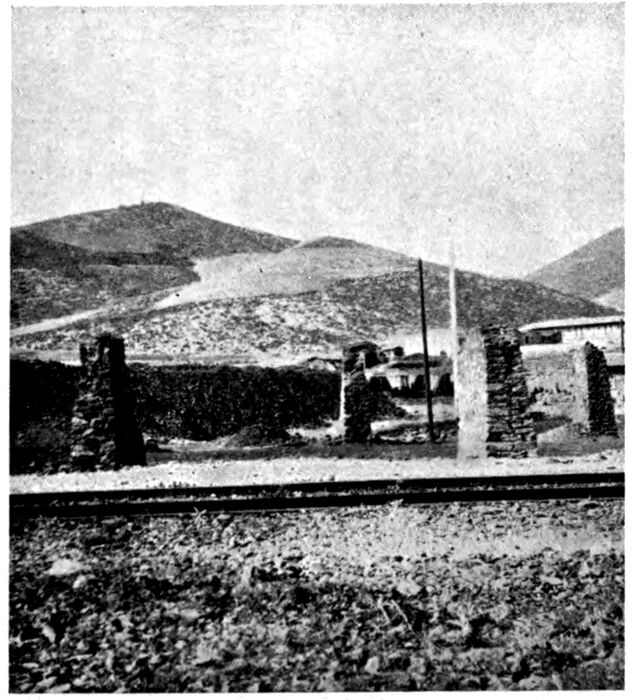
Fig. 1. Lophos Loutrou from Daskalio station.
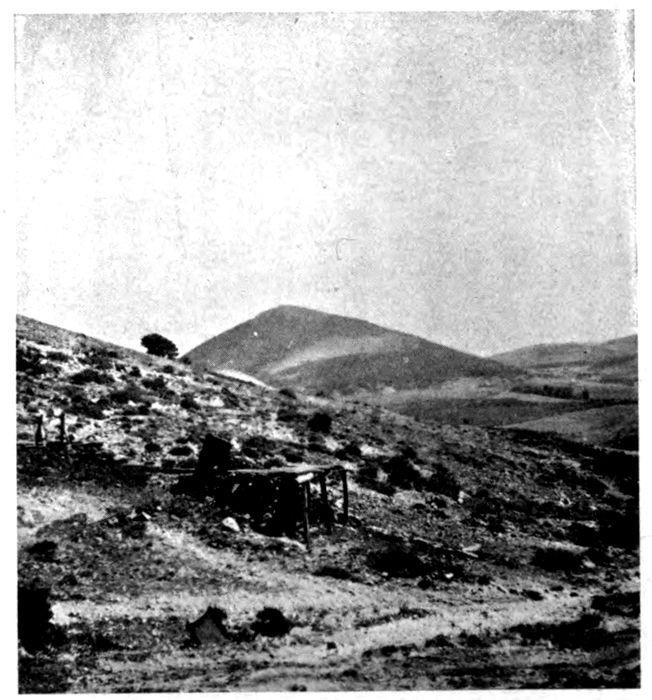
Fig. 2. On the road from Daskalio station to Plaka.
43
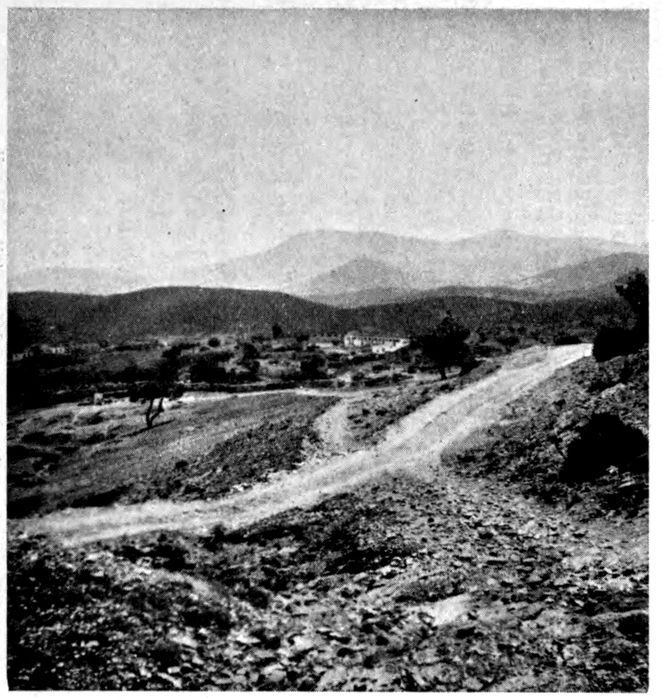
Fig. 3. Kamaresa.
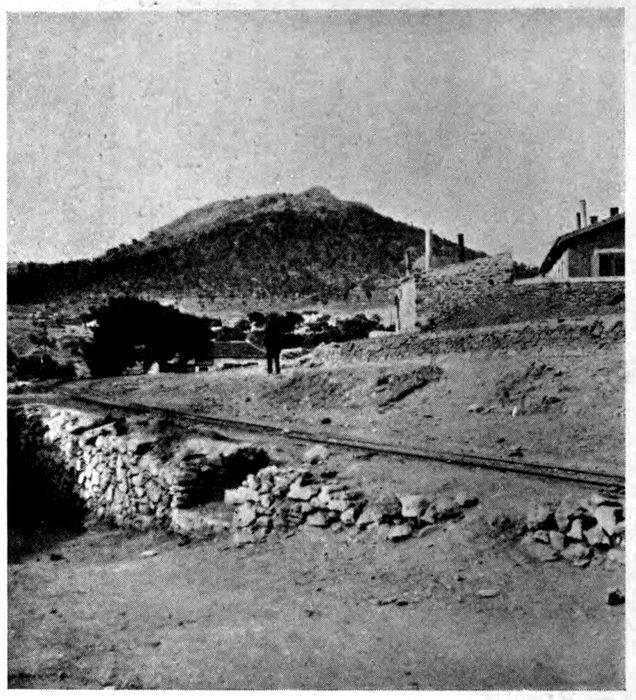
Fig. 4. Kitsovouno from Kamaresa.
Views in the Laurium mining district.
44The ἄκρα of the Caucasus are of course not capes but peaks. Trinakria on the other hand is the land of the three capes. It is important to remember that the word ἄκρον has no equivalent in English. It means peak or height as well as cape or headland. To attempt to keep these two meanings separate is to commit a mental mistranslation. Though Sunium is the ἄκρον par excellence, the whole Σουνιακὸς γουνός abounds in ἄκρα, or as the inscriptions call them, λόφοι (crests, ridges)[227]. Bursian describes the hills of Laurium (Lauriongebirge) as a continuous mountain chain, and includes it with Parnes, Brilessos, and Hymettos among the main ridges (grössere Gebirgszüge) of Attica[228]. The writer has spent some days walking in the mining district. The sea is always near, and glimpses of it may be had frequently. But it is the hills that dominate the landscape, not the sea. More particularly is this the case in the district that was most mined in the sixth century, where the ground varies in height from 170 m. to 370 m. (550–1200 feet), and lies well inland[229].
In the light of this probability that the Diakrioi occupied the mining district of Attica, and of the fact that their name means hill men, it is interesting to note that the Idaean Dactyls, who “are said to have been the first miners,” are stated also to have been men of the mountains[230], and that in German and Welsh the words for miners (Bergleuten, gwyr y mynyddau) mean literally “hill men.”
The Greek word Diakrioi would have a peculiar appropriateness for miners. The ἄκρον is precisely the part of a hill that the farmer has least use for. Miners on the other hand preferred to carry on their smelting operations on the hill tops, because a better draught is thus secured[231].
45It has been pointed out by Milchhoefer[232] that the mining district is considerably broken up by the Cleisthenic division of Attica into trittyes. Milchhoefer’s arrangement of the trittyes in the mining district has been convincingly simplified by Loeper[233], but Loeper himself leaves the mines divided between three trittyes of three different tribes. We may therefore still follow Milchhoefer in thinking that Cleisthenes took special precautions to break up this district. The same fact is noticed by Milchhoefer about the district round Plotheia, the Northern deme already noticed as belonging to the Epakria. Here too the Russian scholar has simplified, but here too only to a limited extent. “In a breaking up like this of the old hill country of the Peisistratids” Milchhoefer sees unmistakable signs of “measures directed against the Peisistratids.” Now that we have as good reason for seeing Peisistratan hill country round Laurium as round Plotheia, we must either reject Milchhoefer altogether, or, more probably, see in both districts centres of Peisistratan influence, of which the Southernmost was the more important. Mining operations in antiquity were conducted on a large scale. Forty thousand workers were employed in mines near Carthagena[234].
Athenaeus[235] speaks of tens of thousands of chained slaves as working in the Laurium mines and losing their lives in an unsuccessful revolt at the time of the second slave war in Sicily (103–99 B.C.). Of the 20,000 who deserted to Decelea when it was occupied by the Spartans in 413 B.C. it is not unlikely that large numbers were miners from Laurium[236].
But what was the state of the Laurium district in the days of Peisistratus?
The mines were almost certainly in full work at this period,
46The mines of Laurium do not appear in history till 484 B.C.[237], when Themistocles persuaded the Athenians to devote the profits from them to the building of a navy. The Constitution of Athens speaks of a discovery of mines in that year. This however is probably rather loose language. The writer’s words are “on the discovery of the mines at Maronea.” The “discovery” of 484 B.C. was of the mines in this particular part of the Laurium district, or rather, in all probability, of an extraordinarily rich vein in this particular part. “The disposition of the strata” (at Maronea) “is such that the richest are not those that could be first reached.... Some centuries of search and effort were therefore necessary in order to suspect their existence and to reach their level” (i.e. of the rich veins “discovered” in 484)[238].
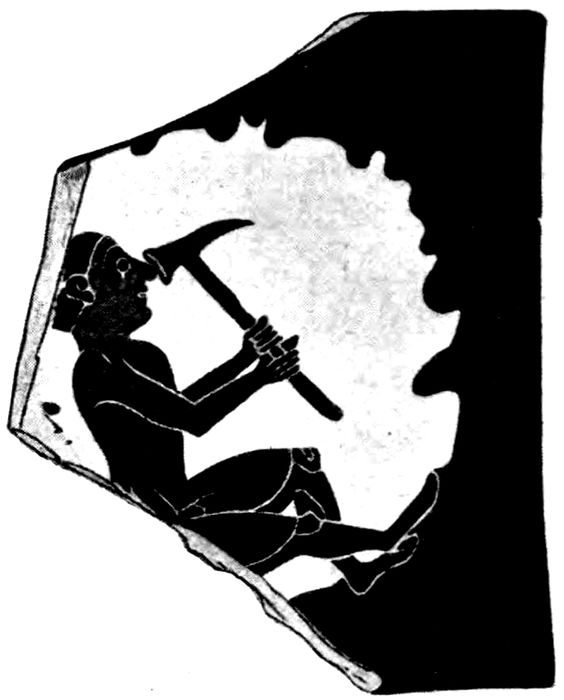
Fig. 5. Corinthian terra cotta tablet depicting a miner at work.
Plutarch says that before this time the Athenians were in the habit of distributing the Laurium revenues among themselves, and that Themistocles had the courage to persuade them to give the habit up[239]. This agrees with Xenophon where he declares that “no one even attempts to say from what period people have tried to work them[240].” The mines of Lydia, Cyprus, and Spain all appear to have been developed in the seventh century B.C.[241]. The Siphnian mines were at full work about 525 B.C.[242]. Mining operations are depicted on several Corinthian clay tablets, that cannot be later than the early part of the sixth century[243]. One of them is here reproduced (fig. 5).
47Herodotus says nothing about the date of discovery of the Attic mines in his account of the proceedings of 484 B.C.[244]. It would not be like him to keep silence about an epoch-making discovery, or even a phenomenal “rush,” if any had occurred just at this time. Elsewhere he tells us that the Siphnians were already distributing among themselves the money from their mines about the year 525 B.C.[245].
Modern writers have been inclined to talk of the great “rush” of 484[246]. But against the silence of Herodotus they can set only the reference in the Constitution of Athens to the “discovery” at Maronea, which has been discussed already. What made the great impression at this time was probably not so much the output as the employment of the output on the building of a fleet. That surely is the point of the contemporary allusion in the Persae of Aeschylus. The chorus of Persian elders tells the Persian queen about the Athenians’
Fount of silver, treasure of the land[247]
just after mentioning the prowess of the Athenian troops, and just before explaining the weapons that they use.
The idea proposed in 484 by Themistocles was not original. Seven years earlier the Thasians had used the revenues from their mines to build a fleet against the Persians[248]. It was doubtless the success of the Athenian fleet in a supreme crisis that caused the Athenians to remember with such pride this triumph of the voluntary system.
There can therefore be no question that the mines were worked in the sixth century[249]. But if we are to understand the position of the leader of the mining interests at that period, we must learn something about the conditions and position of the miners.
and the miners free men, good material for a political faction.
The leaders of the Plain and Coast had a powerful body of citizens behind their backs. The mines on the other hand, at least from the time of Xenophon, were worked almost exclusively by slaves[250].
In the fourth century very occasionally poor citizens 48worked their own allotments[251]. Skilled work like smelting seems always to have been done by free men. The tombstone of “Atotes the miner,” carved in letters of the second half of the fourth century, declares that he was a Paphlagonian “of the root of Pylaimenes, who fell slain by the hand of Achilles,” and boasts of his unrivalled skill[252]. But there is no recorded instance of a citizen working in a mine for wages[253]. This however does not prove that they did not do so in the days of Peisistratus, when, as pointed out in the introductory chapter, the conditions of labour must have been very different from what they became in the fifth and fourth centuries, and industrial slavery had scarcely yet begun. A fragment of Solon suggests that it was quite usual in his days for citizens to work with their own hands, though whether for pay or on their own account is not stated and no particular occupations are specified[254].
About ten years after Solon’s legislation the Athenians are found resolving “on account of their factions to elect ten archons, five from the nobility (Eupatridai), three from the farmers (agroikoi), two from the craftsmen (demiourgoi)[255].” The equation of these three groups of archons with the three factions of the Plain, Coast, and Hill is more than doubtful[256]. The farmers par excellence are 49naturally located in the plain: also it is doubtful whether Peisistratus had already “raised the third faction” twenty years before he became tyrant, and over fifty before his death. The two different sets of names point in themselves to two different groupings of the population. Solon’s quadruple division into pentekosiomedimnoi, hippeis, zeugitai, and thetes proves a certain fluidity and tendency to cross grouping. But in any case the two craftsman magistrates prove that craftsmen or artizans were already an important element in the free population.
In this matter of free labour in an industry such as mining, fifth century Phrygia is perhaps a better guide than the Attica of Nikias or Demosthenes as to the state of things in Attica during the sixth century. In Phrygia a generation after the Samian tyrant Polycrates, who died about 522 B.C., Pythes was working mines with citizen labour[257]. Even in Athens in the early days of Pericles the earlier conditions seem still to have prevailed. “Each trade τέχνη had its body of (free) labourers organized (τὸν θητικὸν ὄχλον συντεταγμένον)” to carry out the great public works that were financed from the Delian treasury. A long list of the trades thus organized ends with miners[258].
Considering the evidence already adduced for equating the sixth century miners at Laurium with the presumably free Diakrioi, may we not use the notices already quoted about the latter as being of impure race and a mob of hirelings[259], and infer that in the sixth century the mines of Laurium were worked by free men, partly of foreign extraction and mainly working for hire?
This is of course conjecture. But it produces for the first time a picture of the Diakrioi that harmonizes with the notices in question. Alien shepherds and alien small farmers are most unlikely in autochthonous Attica.
Outlander miners on the other hand have always been familiar, wherever there have been mines to work. When mining operations were resumed at Laurium some thirty years ago, the immediate result was a very mixed population, the local supply of labour being 50supplemented from France, Italy, and Turkey. One of the ancient gold mines near Philippi bore the significant name of the asylum[260]. In the Laurium district itself in ancient times the people of at least one deme, Potamioi, were famous for their readiness to admit foreigners to citizenship[261]. Potamioi is placed by Loeper right in the centre of the mining district, well away from the sea[262], and very near the probable site of Maronea[263]. A member of the deme Semachidai is found sharing a tombstone with two strangers from Sinope[264]. We have just had occasion to notice a Paphlagonian miner, though of a later date, and we shall see in a moment that in the sixth century the mines of Laurium were worked in close connexion with those of Thrace. There are no records of specific Thracians employed in the Attic mines during the sixth century. We only know that just after the Persians conquered Thrace, at the close of the reign of Hippias, there was a large Greek element in the mining population near the Strymon[265]. But in the fifth century we have a famous case of a Thracian mine-owner settling in Athens in the person of Thucydides, whose father was a Thracian, and whose Thracian mines probably lost him his command in the Athenian navy, and turned a second-rate admiral into the greatest of historians[266]. 51Nikias hired out a thousand hands whom he owned in the mines to Sosias the Thracian[267].
This ends our examination of the various steps by which Peisistratus made himself tyrant, effected his second restoration, and finally rooted his power. In all three cases the evidence points to the conclusion that the secret of the tyrant’s power was his control of mines either in Attica or Thrace. To complete the enquiry it is necessary now to examine the accounts of his first restoration. As observed already, this event is recorded only in anecdotal form. As independent evidence it would hardly be worth considering. All that is here claimed for it is that it can be so interpreted as to corroborate the conclusions already reached.
The strange story of Peisistratus’ first restoration
According to the story Peisistratus persuaded the Athenians to take him back by dressing up a stately woman named Phye to personate Athena and order his recall[268]. It is generally agreed that this story will not do as it stands. Various attempts have been made to explain it away[269], but all of them are equally unconvincing. Perhaps the reason is that all alike are based on some single unessential detail of the story. None of them interprets it in the light of the better known parts of the tyrant’s career, and more particularly of the matter of fact accounts of his second restoration. Beloch indeed, like the Russian Hirschensohn, believes that there was only one restoration, with which the Phye story and the account of Peisistratus’ return from the Thracian mining district are both to be connected[270]. He notes that the cause of banishment is the same 52in both cases; that the chronology is suspiciously symmetrical; that Polyaenus combines incidents from the two restorations; and that Eusebius[271] and Jerome[272] both make Peisistratus begin his second reign about the time that Herodotus begins his third, while neither of them mentions a third reign at all. Note too that corresponding to Phye in the first restoration we have in the second a “sacred procession” from the temple of Athena Pallenis conducted by an Acarnanian soothsayer[273].
These points are not convincing. Similar improbabilities, and repetitions and chronological symmetries can often be discovered in narratives of the most unquestionable authenticity[274]. The fact that Polyaenus combines the two accounts proves nothing, unless we assume him to be incapable of confusing two similar events. Further, Beloch is forced to make the marriage of Peisistratus with Megacles’ daughter precede his first exile, since he sees that the childlessness of the marriage led to the breach with the Coast[275]. In this he goes dead against the tradition on a point where there is no reason to suspect it.
What Beloch’s arguments do emphasize is the fact that the situations during Peisistratus’ two periods of exile were in some ways very similar. The sameness of the two situations may in fact be the reason why so little has been remembered about the earlier. It raises the question whether the tyrant mined and coined during his first exile. There is no certainty that he did either, but the probability is that he did both. As regards Thrace we know that Miltiades, probably with Peisistratus’ permission and approval[276], had settled in the Gallipoli peninsula soon after the tyranny was first established at Athens[277]. Thrace is the one region that we can be sure that the tyrant must have considered as a possible place of exile. |is connected by Babelon with the Athena-head coins of Athens| As regards the coinage it has been suggested on the high authority of Babelon[278], that the famous series with the owl on one side, and the head of Athena on the other (fig. 6), which remained for centuries the coin 53types of the city, was actually started to commemorate the help that the tyrant claimed to have received from his patron goddess at the time of his first restoration.
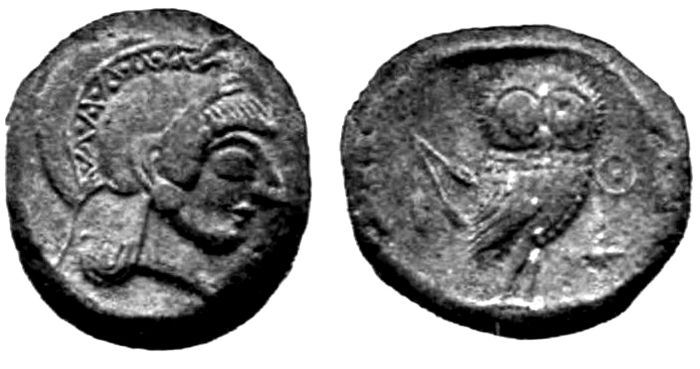
Fig. 6. Coin of Athens with Athena and owl.
The evidence is not conclusive. The arguments for and against this date are based on a few literary references that are too vague to be of much use, on points of style and technique from which it is notoriously dangerous to draw conclusions, on a comparison of the coin and pottery statistics from Naukratis which it is no less dangerous to use as evidence, on a hoard found in 1886 among the pre-Persian remains on the Athenian Acropolis which, as far as the circumstances of the find are concerned, may have been lost or deposited there long before the catastrophe, and only establish a terminus ante quem that nobody would think of disputing, and on certain alliance coins (Athens-Lampsacus, Athens-Sparta?, Athens and the Thracian Chersonese)[279]. These last look more promising at first sight, but only the Athens-Lampsacus coins can be dated with any certainty, and they, unfortunately, are very small, and may have been struck under difficulties, so that it is not easy to be sure of their chronological position in the Athenian series.
We are driven back therefore on to the impressions of experts, most of whom agree with Babelon that the owl-Athena series cannot begin either much before or much after 550 B.C.[280]. That is to say that this double type was certainly in vogue when the tyrant 54secured his second restoration by means of his Thracian silver[281], and “rooted his tyranny” in revenues derived “partly from the river Strymon, partly from home.”
nicknamed (probably just about this time) girl, virgin, Pallas.
Pieces with the double type were sometimes colloquially called girls (κόραι), sometimes virgins (παρθένοι), sometimes by the virgin goddess’ own name of Pallas (Παλλάδες)[282]. Sometimes they got their nickname from the reverse type, and were called owls[283]. “Virgin” is used by Euripides, “girl” by Hyperides, “Pallas” by Eubulus, “owl” by Aristophanes. “Owl” is said by the Aristophanes Scholiast to have been applied to the tetradrachms; the “girl” of Hyperides is some smaller coin[284]. In the fifth and fourth centuries therefore the bird name, and the virgin goddess names seem to have been used side by side, like our sovereign and crown, to indicate two different denominations. When the names were first used is nowhere stated. The most likely time for a type to give rise to a nickname is when the type itself is still a novelty. If this holds good for the coins of Athens, the nicknames Pallas, virgin, and girl go back to the time of Peisistratus. The owl had already appeared on earlier issues, stamped on the reverse with a simple incuse[285], and would therefore at this time attract less attention than the Athena head.
Is it possible that we have here the clue to the Phye story? The details about her being dressed up in full armour and placed in a chariot are not the essence of the story: they all appear in Herodotus in quite a different setting, as part of the ritual of the worship of Athena in North Africa by Lake Tritonis[286]. It can hardly be 55doubted that one of these passages is plagiarized from the other, and it is scarcely less certain that Phye is indebted to the ritual of Lake Tritonis and not vice versa.
Was the Athena who restored Peisistratus the lady of the coins?
The kernel of the Phye story lies in the tradition that Peisistratus was restored by a woman, “as Herodotus says, from the deme of the Paianians, but as some say, a Thracian flower girl from the deme of Kollytos[287].” In fact Phye, the human goddess four cubits high, said by some to come from Attica, and by others from Thrace, who brought Peisistratus back to Athens for the first time, bears a suspicious likeness to the coins called sometimes girls and sometimes goddesses, derived some from Attica, and some from Thrace, with which Peisistratus secured his second return, and finally established his power.
Assume for the moment that they were indeed identical, and it is easy to see how the Phye story may have arisen. Peisistratus certainly claimed to rule by the grace of Athena. Everyone is agreed in inferring from the Phye story that he attributed his restoration to the intervention of the goddess. After the citizens had fulfilled Solon’s prophecy, and “consented to ruin their great city, induced by money[288],” what more natural than that one of the tyrant’s opponents should sarcastically agree that it was indeed Athena who had restored Peisistratus: on which another might comment that it was not the virgin goddess of Athens who had restored the tyrant, but an alien being of quite a different order, a Thracian flower girl. |cp. (i) details in the story that suggest a derivation from the coins,| The name of flower girl (στεφανόπωλις) is never applied to Athenian drachmae. If we accepted Head’s early dating for the Athena type, and assumed a Peisistratan date for certain Athenian coins[289] where the goddess has had her hair done by a κεροπλάστης[290] in corkscrew curls (fig. 7a) that suggest an early date[291], and wears the garland (στέφανος) of olive leaves (fig. 7a, b) that appears regularly on coins of the fifth century, we might find in flower girl (lit. garland 56seller, στεφανόπωλις) an allusion to this detail. The garland seller may often have advertised her garlands by wearing one herself[292].
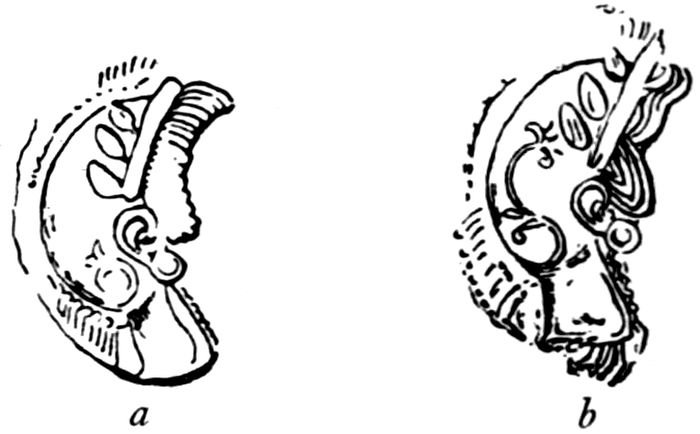
Fig. 7. Athenian coins: the wreath on the head of Athena.
Numismatists however are now unanimous in making the earliest στέφανοι on Athenian coins later than Peisistratus[293]. To describe the coins as flower girls would however be natural enough on the simple supposition that Athenian flower girls had no high moral reputation[294], and further perhaps that the business was in the hands of Thracians, just as that of organ-grinding in England is in the hands of Italians. Or conceivably στεφανόπωλις on our present hypothesis is to be explained by reference to the phrase δραχμαὶ (τοῦ) Στεφανηφόρου (drachmae of the garland bearer)[295], applied at Athens to coins fresh from the mint, such as must have been put into circulation in large quantities when Peisistratus returned after his money-making in the districts round Mt Pangaion.
57How readily to the Greek the garland suggested the flower girl is seen from an explanation in the Lexicon Seguerianum of a certain “garland-bearing hero (στεφανηφόρος ἥρως).” It runs: “Either because the hero is so called, or by way of nickname, because he had many garlands round him, or because garlands were sold near him[296].” The coins themselves, especially when the garland was the new feature, may possibly have been sometimes called garland bearers (στεφανηφόροι), as is shown to be possible by the analogy of such descriptive coin names as “chest bearer (κιστοφόρος)[297]” and “harp bearer (κιθαρηφόρος)[298].”
(ii) attested instances of Jeu de mot on coin types,
Such bitter jesting is quite in keeping with the Greek language; the Greeks were particularly fond of attributing appropriate life and action to types of living things that figured on their coins[299].
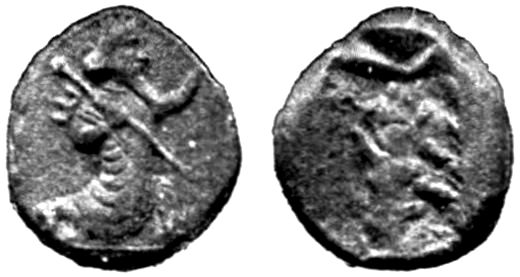
Fig. 8. Persian “archer.”
The best known instance of a play on such a nickname is that of Agesilaus of Sparta, who complained that he had been driven out of Asia by thirty thousand of the Great King’s archers, a colloquial name for the Persian gold stater or Daric (fig. 8), derived from its type[300].
In Athens itself we find Euripides, in a fragment of the Sciron, playing on the double meaning of “virgin,” as also on that of “pony” (πῶλος), the colloquial name of the Corinthian drachma, that bore on one side the image of the winged steed Pegasus:
Some you will secure if you offer a pony,
others with a pair of horses, while others are brought
on four horses, all of silver; and they love
the maidens from Athens when you bring plenty of them.
58The reverse type of the Athenian drachma is punned upon by Aristophanes, who speaks of the owls of Laurium nesting in the purses of the Athenians and hatching small change[301]. In 404 B.C., during the final operations against Athens, Gylippus, the hero of the siege of Syracuse, misappropriated a large amount of Athenian coin, and hid it under the tiles of his roof. The theft was revealed by a servant, who informed the ephors that “there were many owls nesting under the tiles[302].”
These examples are enough to show that there is nothing improbable in the suggestion that the Phye story grew out of a remark made by the tyrant’s enemies about his silver drachmae. Our explanation is of course pure conjecture, and even at that it has one weak point. The statement that Phye was a Thracian, so essential to our interpretation, does not appear in Herodotus, according to whom she came from the Paianian deme in Attica[303].
Can this omission be accounted for?
There is an anecdote told by Herodotus in quite another connexion[304] which suggests that it can.
(iii) the story of the dressed-up woman
In the days just after King Darius had made his conquests in Thrace (about 512 B.C.), there lived on the banks of the Strymon two brothers named Pigres and Mantyes, who wished to become tyrants of the land in which they lived. To carry out this aim “they went to Sardis, taking with them their sister, who was tall and handsome.” Then waiting till Darius was sitting in state before the city, having dressed up their sister as well as they possibly could, they sent her for water with a pitcher on her head and leading a horse with her hand and spinning flax. She was noticed by the king, but the result was that he sent an expedition to her country, and deported her people to Asia.
59The Strymon and Pangaion mines are at this period, before the expansion of Macedonia, naturally described as Thracian[305]. But in the days of King Darius, who began his reign about five years after the death of Peisistratus, part of the country round Mt Pangaion[306], and part of the banks of the Strymon[307] were occupied by another race called Paionians. It was to this latter race that Pigres and Mantyes belonged. |who caused Hippias to lose his throne| They failed to secure the tyranny that they sought; but the expedition sent by Darius to deport the Paionians to Asia probably caused Hippias to lose his.
as a result of losing his Paionian (Thracian) possessions.
It can scarcely be an accident that the tyranny at Athens ended almost immediately after the removal of one of its two roots, the mines of the country of the Thracians and Paionians[308].
Thus we find the restoration of the tyranny at Athens and its abolition both ascribed to the dressing up of a tall handsome woman[309]. It is hardly conceivable that both these events were brought about by the same “primitive and excessively simple” means. The Paionian dressing up has every appearance of being the original[310].
60It is possible that the whole Phye story arose at the time of the Paionian incident, just as the good stories about some of the bad Roman emperors must have first had a circulation only after the emperor had ceased to reign. When Hippias had lost his Thracian and Paionian mines, and consequently his throne, it might be said with additional point that the Athena who had restored the father had now deserted the son[311].
If the Paionian story is contemporary, as it well may be without being either true or original, it accounts for the appearance in the Peisistratus story of a dressed-up woman. Further we have brought the story down to a period in the history of Athenian coinage when the garland may already have made its first appearance on the head of Athena[312], in which case “Thracian garland seller” becomes an effective description of the type.
Thus the whole story, as it appears in the Aristotelian Constitution of Athens, has been accounted for. In this, as in the account of Peisistratus’ second exile, the author of the treatise seems to be following a better authority than Herodotus. Herodotus’ deviations appear to be attempts at rationalistic explanation in the best Herodotean style. From Herodotus’ account of Peisistratus’ second exile it is plain that he knew nothing of the tyrant’s connexions with Thrace, of which we are informed in the Aristotelian treatise. According to Herodotus the whole period of the second exile was spent in Euboea. Hence the Thracian reference had to be rationalized away. But a fact mentioned by Herodotus in another connexion[313] 61points to Hippias having maintained some sort of position in the North Aegean till the end of his reign. When in 510 B.C. he was banished, a home was offered him by the king of Macedon.
Thrace and Paionia might be used indifferently in the original account, the latter being the more accurate name, the former the more popular. Herodotus takes Paionian as a corruption of Paianian, and Thracian as a popular version of Paionian. That Herodotus himself was personally responsible for the emendation Paianian is made probable by the words of the Constitution of Athens, “as Herodotus says, a Paianian, as some say, a Thracian.” The Paionians are made by Herodotus[314] to recognize their own name in the paian or war-cry of their enemies. Only the verb appears in the anecdote, and that in the form παιωνίζω, but Herodotus must have been equally familiar with the forms in -α-, παιανίζω, παιάν, and the anecdote shows how ready he would be to equate Paionian with Paianian. I am dealing here with pure speculation, but so too has been every one else who has tried to explain away this “extraordinarily silly business[315].” The explanation just offered is at least in harmony with the rest of our knowledge about both Peisistratus and Thrace.
Greeks were certainly capable of misunderstanding a jeu de mot based on a coin type. Mention has been made already of Aristophanes’ invocation of the “owls of Laurium” to nest in his purse[316]. A Scholiast on the Knights has turned these owls of silver into real birds. “The owl,” he says, “is the sacred bird of Athena, that haunts Laurium in Attica[317].”
The tyrant Histiaeus and the Thracian mines.
Whatever the truth of these speculations there is no doubt that the Greeks of the end of the sixth century were fully alive to the political possibilities of the Thracian mines. Just after the Persian conquest of Thrace and Paionia Histiaeus of Miletus, one of the Persian king’s Greek vassals, almost succeeded in securing from the Great King possession of Myrcinus, a mining centre in the very district from which Peisistratus had got so much of his wealth[318]. He was in fact granted the gift by Darius, who however was persuaded by the 62far-sighted Megabazus to recall it. What alarms the Persian statesman is the prospect of an able Greek like Histiaeus establishing himself in a place where there are silver mines and forests suitable for ship-timber and a large mixed population. He prophecies that this population will quickly become the employees of the new owner and do his bidding day and night[319].
The Myrcinus incident is bound up in the narrative of Herodotus with the story of Pigres and Mantyes and their efforts to become tyrants of the Paionians[320]. Herodotus says definitely that Histiaeus did not aim at establishing a tyranny at Myrcinus[321]. But this statement seems to be simply an inference from the fact that Histiaeus was already tyrant of his own city of Miletus. Even if it is correct, the protests of Megabazus and their effect on Darius, who at once removed Histiaeus to a sort of honourable captivity in Persia, sufficiently show that according to Herodotus himself Myrcinus would have made Histiaeus in the eyes of Darius and Megabazus a different and altogether more dangerous sort of ruler[322].
It was still comparatively recently that Peisistratus had “rooted” his power at Athens partly on revenues from the river Strymon. When Histiaeus’ activities near that river so greatly alarmed the Persians, it is hard to believe that they were not thinking largely of the Peisistratids. Thus we have a confirmation of the view that the Peisistratids’ Thracian revenues had been derived from the silver mines, and the large mixed population that worked them.
Labour and commerce under the tyranny.
When once established Peisistratus certainly set himself to secure control of a large amount of labour by the public works that he promoted. Kallirrhoe (the Fair Spring), the best source of the Athenian water supply, was improved by him into Enneakrounos (the Nine Fountains)[323]. The building that shelters the actual jets is depicted on a black figure vase[324]. Like Polycrates and the seventh century 63tyrants, he was a great builder; the group of Athena slaying a giant, excavated on the Acropolis in the eighties of the last century[325], probably belongs to the temple that he built to Athena[326]; his temple of the Olympian Zeus was not completed till the time of Hadrian. Like Periander of Corinth, he severely repressed idleness[327]. To Aristophanes, writing just a century after the fall of the tyranny, the Athens of Hippias appeared as a city of labourers[328].
Beloch well insists on the acute commercial instinct of Peisistratus in getting a footing on the coast of the Hellespont by the seizure of Sigeium[329]. Hippias not only kept his hold on the town to the last, and eventually retired there, but actively developed his father’s line of policy by forming a close personal connexion with the tyrants of Lampsacus[330], and effecting a reconciliation with the Philaids, his rivals on the European side of the strait[331].
Financial troubles of the tyranny before its overthrow.
According to the pseudo-Aristotelian Oeconomica, Hippias on one occasion called in the Attic coinage at a fixed valuation, and then reissued the same money[332]. Some scholars have tried to explain away this last statement, and assume a change in the type[333]. But if, as 64is natural to suppose, χαρακτήρ in this passage means type, then the Greek implies that no such change was made. The other actions of Hippias recorded in the same passage are confiscations of property (front doors, projecting top stories of houses, etc.), sold again, with no alteration whatever, to the original owners. Six and Babelon[334] maintain that χαρακτήρ means denomination, and that Hippias proceeded to give the name of didrachm to a piece that had been previously a drachm. They quote with some effect the statement of the Aristotelian Constitution of Athens[335], ἦν ὁ ἀρχαῖος χαρακτὴρ δίδραχμον. Their arguments, though plausible, are not decisive: but whatever the explanation of these particular words, the whole passage makes it fairly certain that the step was an attempt to avert a financial crisis by some desperate manipulation of the coinage. It points to a serious threat of approaching insolvency, such as must have been the inevitable result of the loss of the Thracian mines[336].
The Alcmaeonid opposition to the house of Peisistratus.
No aspect of the tyranny at Athens can be adequately examined without some reference to the remarkable family that from first to last with only one brief lapse led the opposition to the tyranny[337], and after its overthrow played the principal part in moulding the destinies of the democracy. In the earlier part of the sixth century the Alcmaeonidae had become extremely rich. That is the fact that emerges from the story of Alcmaeon and the king of Lydia told in Herodotus[338]. They were at the head of the faction of the shore, and Meyer is probably right when he says that their “enormous” wealth was due to trade with Lydia[339]. The fall of Lydia must have meant heavy losses to the family[340]. It is probably no accident that Peisistratus appears to have “rooted” his tyranny only after his rivals had suffered this great financial blow.
Nor is it probably a pure coincidence that as the Peisistratids secured their power by a mixture of commercial enterprise and political intrigue, so it was by a mixture of political intrigue and 65commercial enterprise that they were finally driven out, through the Alcmaeonidae undertaking the contract for rebuilding the temple at Delphi[341].
This building operation was regarded by the Athenian informant of Herodotus as an expensive but effective way of purchasing divine favour[342]. But the Aristotelian Constitution of Athens says otherwise: “the Alcmaeonidae secured the contract for building the temple at Delphi, and made a fortune as the result[343].” The two versions may not be so contradictory as they at first sight appear. A way of reconciling them is suggested by Philochorus (early third century B.C.), who makes the Alcmaeonids accept the contract, make their money, successfully attack the Peisistratids, and then give rich thank-offerings to the Delphic god[344]. Isocrates and Demosthenes confirm the statement that Cleisthenes organized the expulsion of the Peisistratids with money secured from Delphi, but both regard the money as a loan[345].
But Delphi recalls yet another field of Alcmaeonid activities. According to the official Delphic records not Solon[346], but Alcmaeon, the paternal grandfather of the Athenian Cleisthenes, was the Athenian general in the “sacred” war which early in the sixth century was waged by the Amphictyons, and particularly Athens 66and Sicyon, against the people of the Delphic port of Krisa. The significance of this war is discussed below in the chapter where Sicyon is dealt with in detail. Here it is enough to notice that Cleisthenes of Athens was, through his mother, the grandson of his namesake the tyrant of Sicyon who took so prominent a part in this “sacred” war. He was probably also his heir[347]. In the days of Hippias Sicyon seems to have been still under a tyrant, but not of the house to which Cleisthenes belonged. His name was Aeschines. Evidence has been adduced by De Gubernatis[348] for believing that this Aeschines was an ally of Hippias of Athens. As we shall see below when dealing with Sicyon, his attitude towards Delphi was a pivotal point in the policy of the Sicyonian Cleisthenes, and in his later years Sicyon and Delphi became deadly rivals. Athens can hardly have kept out of the feud. We know little of the course of events, and the history of recent years shows how idle it would be to assume that internal revolutions are always reflected in foreign politics. But we may be sure that both in Athens and Sicyon an anti-Delphic policy would have its opponents as well as its supporters[349]. It is quite conceivable that the Athenian Cleisthenes had once aimed at a union of central Greece with Athens, Sicyon, and Delphi as the three chief states of the union and Cleisthenes himself as the chief statesman, controlling the immense treasure of the oracle and basing on it a tyranny over the two other cities, with Sicyon controlling the trade of the Peloponnesus and the far West while Athens did the like for the Northern trade and developed with the Persian empire those friendly relations which the Alcmaeonidae were still suspected of favouring at the time of the battle of Marathon. If this is all speculation it at least recalls the fact that the received accounts of Cleisthenes are all centred on what he did in Athens in the few years following the fall of Hippias. That indeed is practically all that is known about the second founder of the Athenian democracy; but considering his varied antecedents and his remarkable ancestry it is well to consider how small a chapter 67this must have been in what was probably a long[350] as well as an eventful life. But to return to the short chapter about which something is known we find that the way Cleisthenes secured his position against the banished tyrant was by outbidding him. “He enfranchised many foreigners and slaves and metics[351].” The Peisistratids had ruled Athens as masters. Cleisthenes, by the stroke of genius so excellently epitomized by Herodotus, “took the people into partnership[352].”
It was this memorable partnership that dealt the cause of tyranny at Athens its final blow. Cimon indeed appears to have tried to make himself all-powerful in the state by the lavish outlay of his enormous wealth. But the result was only to cement the partnership between his Alcmaeonid rival and the people. The army, the navy, and the civil service became paid professions, or at least paid occupations, and the state, with Pericles at its head, perhaps the largest and most popular employer of the free population. Individuals of outstanding wealth were more and more kept in their political place by having to perform expensive liturgies. To make a public display of wealth became a perilous thing; anyone who did so was suspected of aiming at the tyranny and dealt with by ostracism or other effective means.
68