Chapter VIII · THE ORCHESTRA
Reading edition
The Orchestra as an instrument; instruments of the Sixteenth Century,—Chitaroni, theorbo, lutes; Claudio Monteverde (1567-1643); Marc Antonio Ingegneri; Orchestra of Orfeo; Chitaroni; Il Combattimento di Tancredi e Clorinda; Incoronazione di Poppea; Adrianna; Vergilio Mazzocchi (1593-1646), and his music school; Stefano Landi; Orchestras in Rome; Orchestras in Venice; Antonio Cesti and his opera, “Il Pomo d’ Oro”; Cardinal Mazarin; growing popularity of the violin; the first French Orchestra—the Twenty-four Violins of the King; Bocan’s playing; anecdote of Cardinal Richelieu; Louis XIV and his magnificence; Twenty-four Violins of the King; amateur orchestras; instrumental musicians; Jean Baptiste Lully (1632-1687); La Grande Mademoiselle; the “Petits Violons”; Lully and Molière; death of Lully; Lully, the first real conductor; Lully’s Orchestra; Descoteaux, the famous flute-player and tulip-fancier; Philbert; quotation from La Bruyère; La Bas, the bassoon-player; Verdier; Jean Baptiste Marchand, the lute-player; Teobaldo di Gatti, the basse de viole; Jean François Lalouette; Pascal Collasse; Marin Marais; La Londe, the violinist; pay-roll of Lully’s men; Orchestra of Charles II of England; Thomas Baltzar of Lübeck; music in England in the Seventeenth Century; quotation from Anthony Wood; quotation from Dr. Burney; Corelli; Amati and Stradivari; development of the violin; Giovanni Baptista Bassani; Corelli’s great vogue; Geminiani’s estimate of Corelli; Corelli’s Orchestra and conducting; Corelli’s compositions and their influence on violin-playing; Alessandro Scarlatti, “the Father of Classical Music”; Francischello’s violoncello-playing; importance of strings in Scarlatti’s compositions; Domenico Scarlatti, originator of the Sonata form; Rameau and what he did to develop the Orchestra; the North-German Chorale; Johann Sebastian Bach, the “Musicians’ Musician”; Bach’s contribution to the Orchestra; Handel and his treatment of instruments; Handel’s Orchestra; Handel’s conducting; Handel’s use of the horn, violoncello, bassoon and kettledrums; neutral tints of the Orchestra of Bach and Handel; Handel’s great use of crescendo and diminuendo; Gluck’s devotion to Handel; Gluckists and Piccinists; Gluck’s contribution to the Orchestra; Gluck’s dramatic sense; Gluck’s ballet-music; Haydn; Prince Esterhazy; the second and “magnificent Prince Esterhazy”; “Papa Haydn,” the “Father of the Orchestra”; Haydn’s Orchestra; Haydn’s knowledge of the kettledrums; quotation from Stendhal; how Haydn composed; Dr. Burney’s estimation of Haydn and his new style of music; a modern critic on Haydn’s style; Mozart, the supreme genius; Stendhal on Mozart; Mozart’s gift to the Orchestra,—tone-color; influence of Mozart and Haydn upon each other; the Mannheim Orchestra; Mozart’s love of the clarinet; Mozart’s conducting; Mozart’s first composition; Beethoven s admiration for Mozart; an early appreciation of Beethoven (1818); Beethoven’s unhappy life; Orchestra of the Elector of Cologne in 1791 in which Beethoven played; Beethoven’s improvization; Beethoven in Vienna; the Lichnowskys; a Beethoven concert in 1795; Beethoven at the piano; appearance of Beethoven; Mozart’s and Beethoven’s Orchestra; Beethoven’s Symphonies; Beethoven’s treatment of instruments; Beethoven’s enrichment of the Orchestra; Beethoven, the last great classic and prophet of the New Era; Classic and Romantic contrasted; the Romantic School; Carl Maria von Weber; Weber as conductor of the Dresden Orchestra; Weber’s development of the woodwind; Weber’s fondness for the clarinet and horn; Weber, a painter of Nature; Schubert’s gifts to the Orchestra; Schubert’s Symphonies; Mendelssohn’s grace, charm and brightness of spirit; Mendelssohn’s happy life and varied accomplishments; Mendelssohn’s orchestration; Mendelssohn’s conducting; “Music of the Future” and its three great exponents,—Berlioz, Liszt and Wagner; Romantic Movement of 1830; Berlioz, a follower of Beethoven, Weber and Gluck; Berlioz’s love for the colossal; Heine on Berlioz; Berlioz’s volcanic temperament; Berlioz, the “Father of Modern Orchestration,” Berlioz, a forerunner of Wagner; Wagner’s confessed indebtedness to Berlioz; monster concerts; Berlioz’s symphonies; Paganini’s gift to Berlioz; Franz Liszt, a favorite of fortune; Liszt’s education; Liszt in Paris; the Romantic Movement; Liszt impressed by Paganini; phenomenal concert-tours; Liszt’s generosity; Liszt in Weimar; Liszt becomes an Abbé; Finck on Liszt’s genius; Liszt, a follower of Berlioz; the Symphonic Poem; Liszt’s orchestration; Franz Liszt, a wonderful spirit; Richard Wagner; Liszt’s aid to Wagner; Wagner’s dream fulfilled; Wagner’s introduction of the Symphonic Orchestra into the opera; Wagner’s treatment of instruments; Wagner’s orchestration and Wagner’s Orchestra; Wagner’s novel effects; Richard Strauss; Strauss’s life and education; novel use of instruments; complex and gigantic effects; Tschaikowsky; his education and career; Orchestra and scoring of Tschaikowsky; the “Casse Noisette Suite” (Nut-cracker Suite); Tschaikowsky’s love for Mozart; French composers and symphonic music; Saint-Saëns; French composers return to national fountains of inspiration; modern French composers; Debussy and his music; Debussy’s orchestral effects; Debussy’s Orchestra,—a melodious atmosphere and musical web; Debussy’s opalescent effects; Debussy’s love of water—sea, fountains and silvery rain; L’Après Midi d’un faune; Debussy’s Nocturnes; Catholic tastes of American audiences; Symphony Orchestra and Orchestra of the Eleventh Century compared.
Now that we have become acquainted with all the instruments in the Orchestra, we must turn our attention to the Orchestra itself.
We must consider the Orchestra as one great instrument on which the conductor plays.
The Orchestra is made up of all these varied instruments, which, as we have seen, have been brought to perfection during centuries of use and experiment,—instruments of long ancestry and historical interest, instruments that have figured in song and story and romance.
The Orchestra is, therefore, a very unique instrument itself.
It holds within itself nearly every kind of tone from the deepest rumble of the bass tuba and growl of the double-bass to the cool, flowing notes of the clarinet and bassoon and to the penetrating call of the flute, the cry of the violin and scream of the piccolo. It holds within itself every kind of vibration from bowed, or plucked, strings, and air blown upon quivering reeds, or through pipes, or tubes, or horns; it has every kind of thump on tightly-stretched skin; it has every kind of rattle, clang and clash; and every kind of sharp blow, from the heavy stroke on the steel rod to the silvery notes of bells, or the brilliant, fiery sparks from the triangle.
But there is one thing more that we have not yet taken into consideration,—and that is the human element.
What would these instruments be if there were no musicians to play them?
Is there anything more melancholy than a case full of musical instruments hanging lifeless and silent in a museum?
We recall the striking illustration Shakespeare makes of unused instruments in his Richard the Second, where the Duke of Norfolk, being banished, breaks forth with:
“A heavy sentence, my most sovereign liege, And all unlook’d for from your highness’ mouth. The language I have learn’d these forty years, My native English, now I must forego: And now my tongue’s use is to me no more Than an unstringed viol, or a harp; Or like a cunning instrument cased up, Or, being open, put into his hands That knows no touch to tune the harmony.”
In addition to the rich and varied instrumental material, we have ninety personalities possessed of brains, emotions and artistic ideals and aspirations.
We call the Orchestra an instrument, or even a machine; but let us think for a moment of these intelligent personalities behind their instruments, or merged into their instruments, and we shall realize what a sensitive organization a Symphony Orchestra is.
The Orchestra is a corporate body that is ruled by the Conductor. His is the power that holds all these forces together; he it is who guides these ninety men through the mazes of the vast musical composition, or fabric of woven melodies and harmonies, the patterns and colors of which he will place before our auditory nerves, which will carry to and impress upon our brains the musical forms and figures that also charm our senses; and to do this the Conductor must understand the technique of his Orchestra every bit as thoroughly as each man knows the technique of his instrument.
The Orchestra began to be an instrument just about the time that Gasparo di Salò (see page 21) fixed the form of the violin.
Let us look for a moment at the instruments that were in use at the beginning of the Sixteenth Century—the instruments that formed an Orchestra in Shakespeare’s time—the Orchestra of the Renaissance. Whether in Italy, France, or England, it was the same.
“We are in a small square chamber, panelled and floored with oak. It has a table with two silver candle-sticks, a couple of chairs and a few dozen books arranged on a sort of dresser. In the window is a settle, and on it a jumbled heap of music. We turn it over and see that it is almost all manuscript—single-line parts of madrigals, ballets and canzonets. But there are one or two printed books, such as Mr. Anthony Munday’s Banquet of Dainty Conceits, published in 1588, and some later things, such as Mr. Peter Philips’s Madrigals that came out four years ago. Here is even a proof-copy of Mr. Morley’s new five-part Ballets. Clearly the owner of this room is an advanced thinker. That locked case opposite, of stamped Spanish leather, evidently contains his favorite gamba.[29]
“However, we must not loiter any longer in this room. We had better make our way into the corridor, go down the staircase, and walk through the great gallery that runs the whole length of the building. We are now in the East Wing, where apparently the musicians have their quarters. In the main room the logs are blazing; and on the table are scraps of lute-tablature altered and re-altered, with odds and ends of minnikins—the thin top-strings of the lute. There has evidently been a rehearsal here.
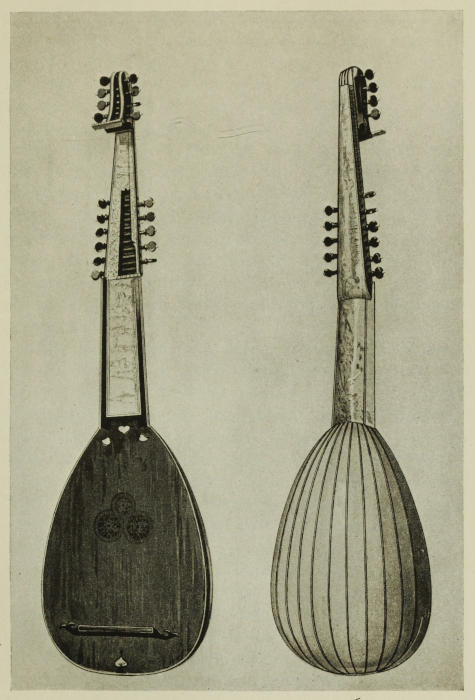
THEORBO MADE IN PADUA IN 1629
“Near the fireplace are the lutenists’ boxes. We notice on them French and Italian, as well as English, names. If we open any of the boxes we shall find inside them some very lovely instruments. Their vaulted bodies are built up of strips of pine and cedar, and there are exquisite purflings and ornaments of ebony, ivory and silver. In front is at least one beautifully carved and inlaid ‘rose’; while the necks are all ‘fretted,’ semitone by semitone. Each lute has twelve strings of catgut tuned in six unison-pairs. But if we touch two or three lutes in succession, we shall see that all players do not adopt the same tuning. The average lutenist seems to prefer for his six pairs of strings a system of fourths joined by a third in the middle.
“The instruments are made in three chief sizes, but the tenor-lute, or theorbo, from Padua,[30] appears to be a favorite. If we take up one of these lutes and pass our hands across its strings, we shall become aware of a deliciously tender harmony. The instrument has no strength—only a sort of melancholy quietude. And this is due, in some measure, to the length of the strings. For much tension is out of the question in an instrument whose bridge is merely glued to the belly.
“Here is a tall lute case in the corner, reaching almost to the ceiling. From its appearance it has travelled far, over rough roads. Its owner’s name suggests Italy. Let us take it out very gingerly. It is the latest thing in lutes—a big Roman Chitarone,[31] or archlute, or bass-lute, with seventeen strings—practically two instruments in one. For besides the usual pairs-of-strings that run up to the lower ‘nut,’ there is a second series of single-strings stretched to a second nut at the lute head. These are the newly invented diapasons, a set of bass-strings which hang free of the fingerboard and can therefore only be plucked to give the one note of their full vibrating length. This addition is naturally a great advantage in consort, or ensemble, playing; for it extends the compass diatonically downwards.
“Before we leave the rehearsal room for Lord Strange’s performance in the Hall we shall make free to open the huge oak cupboard that runs across the upper part of the room. This is a boarded chest, as they call it; and we know very well that we shall find inside a set of six viols. They are heavy and cumbersome instruments and they run downwards like a Noah’s Ark procession from No. 1, the big Double-Bass, to No. 6, the High Treble. The favorite is No. 2, the Bass Viol, or Gamba. That is viola da gamba (leg-viol). The Italians also used the names da spalla (the shoulder) and da braccio (arm) for the next two smaller viols. It is doubtless a choice specimen of this instrument which was under lock and key in the other room. It may have been made by Gasparo di Salò.[32] For the Italians are rapidly coming to the fore as viol-makers; and a new man, Andreas Amati,[33] is manufacturing a very small instrument, which he calls a violino, or violin. But the Queen’s violists probably regard this as a rather cheap and not quite worthy attempt.
“The tone of the viols is sombre and somewhat nasal. It lacks brightness altogether. Excellent for arpeggios and quiet vocal passages, the instruments are apt to sulk unless continually coaxed by the bow. And the bow unfortunately has to be used with considerable caution. For the true viols have no fewer than six strings apiece. And in their tuning they follow the irregularities of the lutes by using a series of fourths joined together by a third. But the makers are beginning to see the necessity of reducing the number throughout the whole Viol Family; for the difficulties of bowing are very great. Accordingly they are just introducing a modified type of instrument with five strings. They call these quintons; and those players who use them are adopting a tuning which gives them perfect fifths, at any rate, in the lower part of their compass. This is interesting. For it shows that some change is in the air. We should like to have ten minutes’ private conversation on the subject with Signor Amati. If we did, he would first warn us that what he was about to say must not on any account be repeated to his best customers, the violists. Then he would probably give it as his opinion that his new violino with its simple regular tuning in fifths and its lovely caressing tone-quality is worth all the viols that have ever been made; and that all the talk about ‘vulgarizing’ and ‘popularizing’ is nothing more than professional stupidity.”[34]
Orchestral music begins in Italy. It also begins with the dawn of the Opera. We must first remember that the Italians always cared more for solo-singing than for chorus-singing. It was just the same with their instrumental music. Instruments playing solo, or holding a dialogue together, with brilliant improvisations, occupied a much higher place in the Italian taste than harmonies produced by a number of instruments playing together. In other words, the Italians preferred monodic music to polyphonic music. So we find in the first operas, or plays interspersed with music, that the only instruments that were welcomed were the clavecin, the organ, the chitarone, and the lyre.
Now that combination is not as thin, nor as simple, as we might think. The clavecin and organ could supply both bass and treble. The chitarone, as we have just seen on page 137, was a big bass-lute known also as the archlute, with two sets of strings: one reaching all the way down the enormously long neck; the other, and shorter, reaching only about a third the way down. Each set of strings had separate pegs.
The lyre was very complicated. It was a kind of viol with twelve, or fourteen, strings, tuned either in fourths or fifths, alternately ascending and descending. This very singular way of tuning permitted the performer to find all kinds of chords in all kinds of positions beneath his fingers.
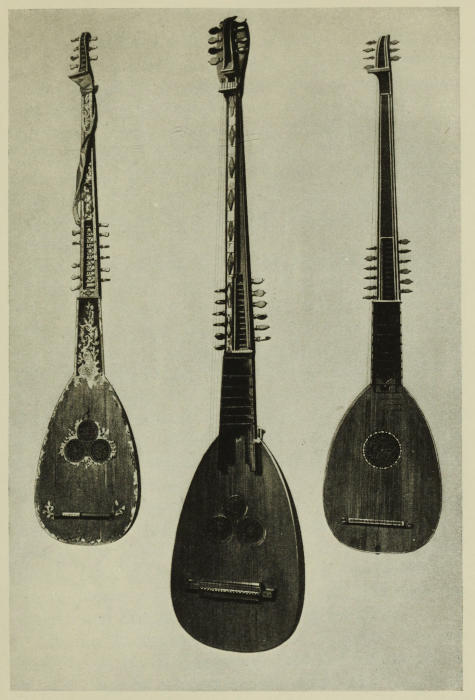
THREE CHITARONI
Seventeenth Century
The composer carried his melodies, however, on a very simple bass. If the opera had “symphonies,” that is to say instrumental interludes, and ballet-music, the composer would often indicate in his score “at this place the instruments can play”; and the musicians selected what they pleased. As time wore on, if the composer indicated a place for one or two violins to play, he would give them a little theme; and the players worked it up and elaborated it to suit their fancy and according to their skill. Very often, indeed, they added a brilliant musical divertissement. The scores of the earliest Italian operas have very little accompaniment save two or three violins above a bass played on the theorbo, or clavecin.
At the beginning of the Seventeenth Century a change took place in music. A great many of the old kinds of wind instruments and the grave old viols began to disappear. They were too old-fashioned for the New Art of the time. The famous opera of Orfeo by Monteverde (1607) is, perhaps, the last of the great operas of that period that contained all that was considered in those days the rich voices of the Orchestra. Orfeo is a landmark in musical history for many reasons. We shall presently see that it is also the starting-point of our modern Orchestra.
And who was this Monteverde to whom we look back through three hundred years of musical history? One of the most interesting facts about him is that he was born in Cremona, that famous “violin town,”[35] where music was literally in the air, although the Amatis and Stradivaris were not yet working.
Claudio Monteverde was born in 1567. He was a contemporary of Gasparo di Salò and Maggini.[36] At an early age he was an expert violist and was taken into the service of the Duke of Mantua. The Duke’s Court was the centre of every luxury and elegance in Lombardy and music had long been one of the arts beloved there.[37] The Mantuan collection of instruments was famous; and the Duke, like all other noble princes of the time, had his own band of private musicians. At their head for his Maestro di Capella, he had a very learned musician named Marc Antonio Ingegneri; and young Monteverde was put under him at once to finish and perfect his musical education.
Ingegneri, however, was unusually fond of counterpoint and of writing fugues and Monteverde cared very little about polyphonic music. And we can imagine, therefore, that when at the age of sixteen he burst forth with a beautiful Book of Madrigals—madrigals were all the rage in those days—his artistic nature sought relief from studies that he thought horribly dry and tiresome, but which undoubtedly did him a lot of good. This set of madrigals was so well received that he followed it with four more books of this lovely, lyrical form. Then in 1603 Ingegneri died and Monteverde was chosen to succeed him. He had been superintending the music at the Court of Mantua for four years and providing brilliant entertainments and concerts of all kinds when the Duke’s son, Francesco di Gonzaga, married Margharita, Infanta of Savoy. It was a brilliant alliance; and the Duke of Mantua, wishing to celebrate it in royal style, charged Monteverde to write the most splendid opera possible and to stage it in the most magnificent manner. So Monteverde composed Orfeo. This was one of the most popular of all subjects. It seems as if every Italian composer had to write the search of Orpheus for his beloved Eurydice. Ever since Dante had drawn his fantastic scenes of the Inferno, Italian audiences had thrilled to stage pictures of the lower regions for three hundred years! But it was strange that Monteverde should have picked out this subject; for while he was writing his opera his own lovely wife died and he was in bitter grief for her. So, perhaps, one reason that Monteverde’s Orfeo is so vital a work lies in the fact that the composer was singing of his own despair.
We often see in histories of music that Monteverde astonished the musical world with a novel Orchestra in Orfeo and that he introduced a great many new instruments into his score.
Nothing of the kind! What Monteverde called for in his Orchestra of Orfeo was exactly what the Court of Mantua had been accustomed to see and to hear. There was not a single new instrument of any kind whatsoever!
Now this is what he had: an Orchestra of forty instruments. As instruments of the piano class he had two clavicembali, two organi di legno (little organs with flute tones) and a regale (little organ). As instruments of sustaining bass—bass continuo—he had two double-bass viols, three violas da gamba and two chitaroni (deep lutes). As instruments for string ensemble he had two little violins à la française, or pochettes, ten violas da braccio (soprano, alto, tenor and bass), and ordinary violins (such as Gasparo di Salò and Maggini were making). As wind instruments he had a clarino (shrill trumpet) (see page 110); three trompettes with sordini; four trumpets and two cornets à bouquin; flutes, both shrill and deep; and two oboes. He also had an arpa doppia (double harp).
First of all, as was usual in those days, the trumpets gave a fanfare, or “flourish,” to announce the beginning of the drama. Then came the introduction. Though called a “Toccata,” it was very nearly a real overture. It had to be repeated three times before the rising of the curtain. The organ, clavecin and chitaroni seem always to have accompanied the singers; the ritournellas, which marked the entrance of the singers, were usually played by two solo instruments—the little tiny “French violins,” or the little flutes, on a continued bass from some of the bass instruments; and in the “symphonies” two groups of instruments were used—first, a group of violins in five parts, viole di brazzo (ten in number) supported by the bass of double-bass viols, clavecins, or chitaroni. Then a group of seven instruments (five trombones and two cornets). The “symphonies” were very short—just an air played through once; but they are very sweetly harmonized and resemble dance-tunes.
The groups of instruments were intended to express, accompany and even symbolize each personage in the drama. Orfeo was, therefore, not an innovation; it was the highest expression of the end of a period—the crowning-point of the music of the Italian Renaissance.
There were several new ideas in Orfeo, however, even if the instruments of the Orchestra were just those of the Italian Renaissance. In one place, for instance, two violins were allowed to play independently of the viols; and that was absolutely novel. The fact is Monteverde was new, if his Orchestra was not; and his originality was going to express itself more fully in after years as we shall presently see.
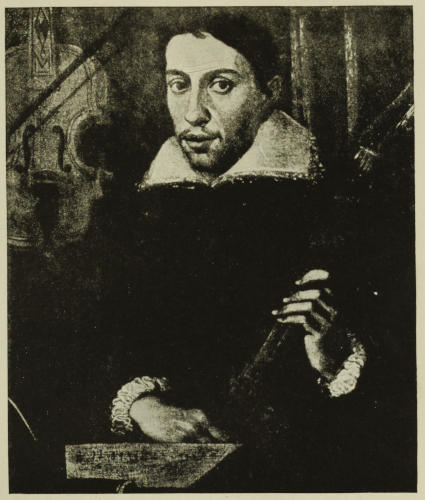
CLAUDIO MONTEVERDE
Let us run through the arrangement of Act III. The curtain rises on the Infernal Regions with scenery painted in the magnificent style of the Italian painters of the period—Titian, Tintoret, Correggio—any of the great masters we may like to think of—and with many ingenious mechanical devices; for these brilliant Italians were very well accustomed to getting up pageants and festas. The trombone, cornet and organ play large and sombre chords to evoke the idea of Hades. Orpheus enters and tries to conquer the Powers of Darkness with all the resources of his art. The first couplet of his song is accompanied by the organo di legno (organ with the flute tones) and the chitaroni; and when Orpheus begins to sing, the two violins play. At the second couplet, after a ritournella by the violins, two cornets take their places and play; and at the third couplet, when Orpheus sings “Where Eurydice is, is paradise for me,” the double harp plays graceful arpeggios. Then Orpheus sings some very elaborate vocalizations accompanied by two violins and a basso da braccio (a deep violin). When Orpheus bids Charon, the ferryman, let him pass over the river Styx, the string-quartet plays chords; and, finally, when Orpheus is triumphant, the whole Orchestra bursts forth in one grand finale.
Orfeo was a truly wonderful work. It was startling in many ways; but its Orchestra was conservative. The instruments played together in families. There was no attempt to mingle all their voices together, nor to combine instruments except at the very end when the curtain was falling.
It is not Orfeo, therefore, that marks the beginning of our modern Orchestra, but an opera that Monteverde brought out twenty years later called Il Combattimento di Tancrede e Clorinda.
In the Combat of Tancred and Clorinda, to give the opera its English name, Monteverde used a very different Orchestra from the one he had used in Orfeo. Here he has two violins, two viols (tenor and bass) and the contrabasso da gamba. At this very moment—the year 1627—the violin took root in the Orchestra. In ten years’ time it became the leading instrument.[38] By 1639 there were no more players on the viol in Italy that amounted to anything. From 1634 the violoncello was also established as an orchestral instrument.
Truly, a great change had taken place! Monteverde’s Orchestra—we can now call it so—had become one in which the violins and the instruments of the piano class—the clavecin, etc.—form the new body of the Orchestra.
When Monteverde wanted certain effects, he now used special timbres, or kinds of voices: trumpets and drums for triumphal scenes; cornets and trombones for fantastic scenes; and flutes for pastoral scenes. Such was the Orchestra that Monteverde used in his celebrated opera, the Incoronazione di Poppea, which he brought out in 1642, at the end of his life, and which the Orchestras of Venice followed for years.
Another thing that Monteverde did that was new in the Coronation of Poppea was to make his violins describe the excitement of the combat by a long tremolo, using the passage exactly as we do to-day. It was so novel that the violinists refused to play it. But they had to!
Monteverde also did not hesitate to introduce an instrumental intermezzo in the midst of a tragic scene.
Monteverde was a painter of life. His music was vital and vivid and in spirit much like that of the great Italian portrait-painters who were his contemporaries. He saw his characters and he explained them in musical language; and he made his Orchestra help him to do so. And he did this, moreover, in such an artistic way that Wagner thought him worthy of copying nearly three hundred years later.
Monteverde stands forever as one of the greatest figures in musical history.
After the representation of Orfeo, Monteverde continued to compose; and in 1608 he brought out an opera called Adrianna, which aroused the whole of Italy to enthusiasm. Then he produced a number of ballets and comedies. In 1612 he went to Venice, for he had been appointed maestro di capella in the beautiful church of St. Mark’s. The people went wild over him. He was honored in every way; and his music travelled into Germany, Holland, France, and England and was studied by all the leading musicians.
After the terrible epidemic of the Plague in 1630, which carried off fifty thousand persons in sixteen months in Italy alone, Monteverde entered the Church; but this did not prevent him from composing dramatic works and madrigals (which he still loved to write) on love and war. He saw the first public opera-house opened in Venice in 1637, which was an important musical event, and he died in 1643, at the age of seventy-six.
After Orfeo, Monteverde gave up his “noisy Orchestra,” as it was considered. He now simplified it. He weeded out the old instruments whose tones did not harmonize with the new instruments—for the Brescian and Cremonese-makers were very busy in these days turning out new models; and, as he lived in the region of the great violin-makers, Monteverde saw every new model as it left the hands of Maggini or Amati.[39] The idea had dawned upon him of mixing his instruments—our modern Orchestra was beginning!
We must not imagine, however, that Monteverde was the only great musician of the day, though he was the most popular composer in Europe.
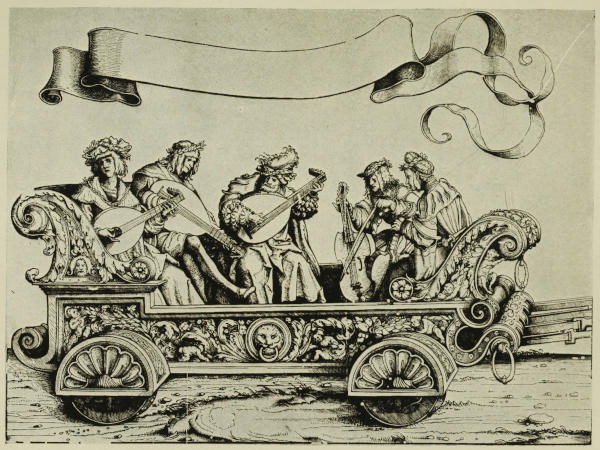
CAR OF MUSICIANS. TRIUMPH OF MAXIMILIAN
By Albrecht Dürer, about 1518
Florence, Venice and Rome, to say nothing of all the smaller cities, had their operas, ballets and musical-contests. Rome was very active. And, moreover, there was a great musical educator in Rome, whose name was Vergilio Mazzocchi (1593-1646), who was one of Monteverde’s contemporaries. He was maestro di capella in St. John Lateran’s and in St. Peter’s. It will give us an idea of how seriously music was studied in those days if we remember what Mazzocchi required and what extraordinarily proficient pupils he sent out from his school. They could sing, play instruments, compose and write musical dramas and ballets; they could read music at sight and copy it; and they were also well trained in literature. Few of us would care for a day like this:—
In the morning—“an hour to singing difficult exercises; an hour to the study of literature; an hour to practise singing before a mirror so as not to make disgraceful faces. In the evening—half an hour to theory; half an hour to the study of counterpoint; an hour to composition; and an hour to literature.” The rest of the day was devoted to practice on the clavecin, to composing for pleasure, and taking a walk in the open air. Pupils were also sent to the theatre and concerts, so that they could hear and study celebrated singers and performers; and they had to write an account of their impressions! Poor young things! A busy schedule for work and pleasure!
About this time an opera by Stefano Landi was produced in Rome (1632). It was called S. Alessio; and the libretto was written by Giulio Rospigliosi, from the Golden Legend. This work is very important in musical history, not only because it has a double chorus and a double Orchestra, but because the second act opens with a real overture in three movements. It begins with a rapid Fugato in 4-time; then comes a majestic Adagio in 3-time; and then another rapid Fugato in 4-time. The “sinfonia,” or “symphony,” introducing Act I, is in five movements,—a theme treated in fugue and counterpoint; a little piece described as an “echo”; a short, slow number in 3-time; and a rapid Fugato. The orchestral score is written in five instrumental parts: (1)-(3) violins; (4) harps, lutes, theorbos, violoncello and bass viol; and (5), clavicembali.
Music in Rome was kept almost exclusively for the wealthy and aristocratic circles. At the Barberini Theatre, which could easily seat 3,500 persons, only guests were admitted who had invitations. The public was not allowed to see one of these fine operas! Woe betide anyone who tried to get admittance! On one occasion in 1639 the Cardinal Antonio Barberini chased out of the opera-house with his stick a nice-looking and well-dressed young man, because he had not sufficient rank to come there!
In Venice matters were different. The public was not only allowed to attend, but the director of the opera-house would even permit gondoliers to sit in the boxes when the owners were absent. Consequently, the Venetians were very well educated in artistic music. Many beautiful works were given there. And the Venetian Orchestras were of the very best.
Mr. Goldschmidt, who examined the scores of 112 of these old operas in the Library of St. Mark’s, found that the main support of the Orchestra was the clavecin, which usually accompanied the singers; that the violins were in general charge of the ritournelles and the entr’actes; that the trumpets played in the overtures and marches and often with the voices; that the cornets, trombones and bassoons were used for fantastic effects; that horns, drums, and other instruments of percussion were used; and that flutes were not as popular as they were in France.
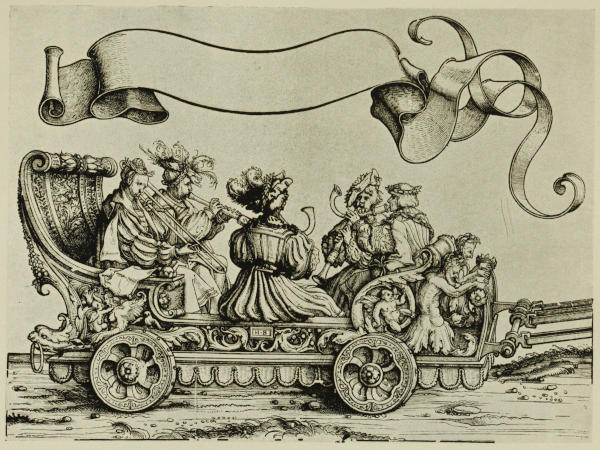
CAR OF MUSICIANS. TRIUMPH OF MAXIMILIAN
By Albrecht Dürer, about 1518
Can we not see in these old Venetian Orchestras of three hundred years ago some ideas gradually approaching towards our own?
Let us turn to Vienna, which was the great centre of the Central Empire. One work will suffice to show that there was splendid music in that brilliant capital. In 1666 Antonio Cesti, one of the members of the Papal Choir in Rome and then maestro di capella for the Emperor Ferdinand III, in Vienna, wrote for the Emperor’s wedding festivities an opera called Il Pomo d’oro. It was described as a “dramatic festa.” The theatre seated 5000 persons. The Orchestra was separated from the last row of chairs by a wide space and the conductor, who was the composer of the work, sat at the cembalo, with his thirty musicians around him. His Orchestra consisted of six violins; twelve alto violas; tenor; bass; contrabass; two flutes; trumpets; two cornets; three trombones; a bassoon; and a little organ.
The strings seem to have played most of the accompaniments to the voices; the flutes were used for the pastoral scenes; the trumpets for the great choral scenes; and the cornets and trombones for the infernal regions,—of course, they had to have infernal regions!
An overture preceded each act. The opera was a magnificent spectacle. By turns heaven and hell were represented; there were tempests on the sea; there were battles on the land; towns were besieged with armed elephants; and there were gardens and lovely landscapes and superb costumes. And the Orchestra had to be worthy to accompany all this stupendous stage-setting.
An idea of the Orchestras of the Renaissance may be had by looking at the three pictures facing pages 148, 150 and 152, representing the Triumph of Maximilian by Albrecht Dürer.
The Emperor Maximilian, who stood at the head of the old Roman Empire and the German nation, took a childish delight in the glorification of his own person. Instead of having a Triumphal Arch in marble erected, he engaged Dürer in 1512 to make a record of his fame in engravings. There was to be a Triumphal Arch and a Triumphal Procession followed by a Triumphal Car in which the Emperor and his whole family were to appear. Maximilian died in 1518. Dürer, to honor his memory, brought out the Triumphal Procession in eight large plates, three of which are represented in this book. They show exactly the kinds of instruments that were used in the Orchestras in Rome, Florence, Venice and Vienna, of which we have been talking; but they give the Spirit of the Renaissance as interpreted by the German mind.
Cardinal Mazarin, who brought so many Italian tastes into France when he became Prime Minister to the Queen Mother, Anne of Austria, also introduced the Italian Opera. In 1643 he sent to Rome for musicians.
It is very interesting to note the growing taste in France for “Strings.” Like Italy, France had lost all pleasure in the big, bass woodwind instruments; and as for brass instruments, they were not tolerated. All had gone. Germany and Spain kept wind instruments in their Orchestras; but in France and Italy the bowed strings were growing in favor every day. Sometimes in church the cornet was played to mingle with the voices, but nowhere else.
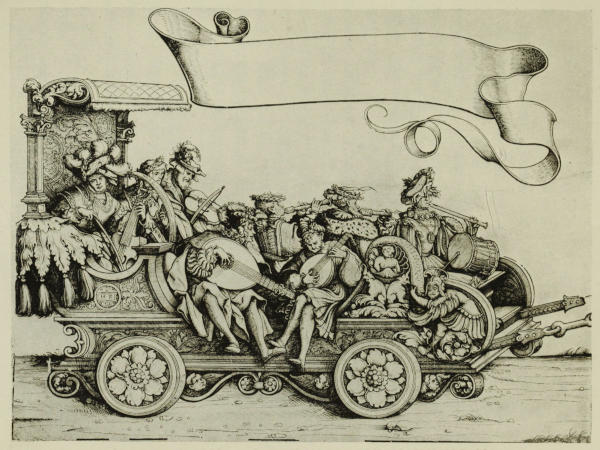
CAR OF MUSICIANS. TRIUMPH OF MAXIMILIAN
By Albrecht Dürer, about 1518
The only instruments that French ears cared to listen to were Strings (including the whole Violin Family), oboes and flutes. France always loved the flute, which was comparatively little cared for in Italy, where it was chiefly used in operas, as we have observed, for pastoral scenes.
The violin was becoming more and more popular every day. In every kind of music it took the lead. It had been so much used for dance-music that it had developed into a supple and graceful instrument and one that gave itself most willingly to many delicate shades of expression in the hands of a good player. The violin was often combined with the clavecin and theorbo.
The combination was delicate and charming, rich and beautiful.
The old author of the Comparison of Italian with French Music says: “I beg to remark that with its four or five strings, the violin makes you feel certain passions in the most striking manner, for it expresses them in a way peculiar to itself. It really does not matter if it has four strings, or five strings. The Italians tune their five strings in fourths, we tune our four strings in fifths; and it comes to the same thing. The violin mounted in either way is always the perfection of music.”[40]
About this time the first real French Orchestra came into existence. We may almost consider it as an ancestor of our own, as we shall presently see. This was the famous “Twenty-Four Violins of the King.” Although it originated in the days of Louis XIII, it is more identified with the reign of his successor, Louis XIV.
The “Twenty-Four Violins” were the best performers of the period and they are constantly spoken of in the Memoirs and Journals of the day. One of them, for instance, Jacques Cordier, called Bocan, was dancing-master at the Court of France, as well as violinist, and followed Henrietta Maria, the King’s daughter, to England when she married Charles I. When the Revolution broke out and Charles was beheaded, Bocan returned to France and to the King’s household. He was one of the best violinists of his day.
“The sound of his violin is ravishing,” writes Mersenne (who wrote a book about the instruments of his time); “he plays perfectly, just as sweetly as he wishes; and he makes use of a kind of trembling sound, which charms our spirits.”
This was evidently the vibrato, which is produced by oscillating the finger rapidly upon a note without allowing it to leave the string; and it does produce “a kind of trembling sound.” The old writer described it exactly.
Bocan played on that memorable evening when the Cardinal de Richelieu danced a Sarabande for the Queen Mother, Anne of Austria. At this moment the great Prime Minister of France was taking part in all the momentous affairs of Europe; and we get a glimpse of him in a play hour that few of his contemporaries had. The Comte de Brienne wrote of it in his Memoirs:
“Richelieu,” he says, “was dressed in trousers of green velvet. On his garters were silver bells and he had castanets in his hands. He danced a Sarabande, which Bocan played. The violinist and a few spectators were hidden behind a screen where we could see the antics of the dancer. We nearly split our sides laughing; and I declare that now, even after fifty years, I nearly die laughing when I think of it.”
When Louis XIV ascended the throne the “Twenty-Four Violins” became the finest and most celebrated Orchestra in Europe. Though founded, as we have said, in the former reign, the “Twenty-Four Violins” is particularly the Orchestra of Louis XIV, the magnificent “Sun-King.” In the superb palaces of Versailles and Marly Louis XIV blazed with all the glory that is possible to mortals. Magnificent furniture, magnificent paintings, magnificent gardens, magnificent fountains, magnificent costumes, magnificent ladies, magnificent gentlemen, magnificent feasts and magnificent operas, plays and concerts!
Everything “the Grand Monarch” had was the very best that could be found; for in his reign France was the leading Power in Europe. So, of course, he had the finest Orchestra.
The “Twenty-Four Violins” surpassed everything of the kind that had been known up to that time. They represented the greatest heights to which brilliancy and sonority could attain.
The “Twenty-Four Violins” played in the Court entertainments; they played in the churches; they played in the gardens; they played on the lawns; and they played for the King and his Court to dance. They also frequently took part in the Court Ballets, when they were dressed in peculiar costumes with masques worn hind part before, so that they gave the ludicrous appearance of playing behind their backs. They played in the gilded and tapestry-hung galleries and Salons of Versailles and Marly and at the banquets of the King. And whenever they appeared they excited the greatest admiration.
Although they were called the Twenty-Four Violins, the whole violin family was represented. There were violins, altos, tenors, basses and double-bass viols; and they played in four-part, or five-part harmony.
“All these parts sounding together,” wrote Mersenne, “make a symphony so precise and agreeable that whoever hears the ‘Twenty-Four Violins’ of the King play all kinds of airs and dances, confesses willingly that he never heard such suave and delicious harmonies before.”
Mersenne also remarked that the deeper instruments, particularly the basses, were much more sonorous and stronger in tone than the violins.
We know of some of their names. There was Constantin; there was Lazarin; there was Bocan;[41] there was Foucard; and there was Léger.
“What could be more elegant than Constantin’s playing?” cries Mersenne. “What could be warmer and more fiery than Bocan’s style? What could be more ingenious and delicate than the diminutions of Lazarin and Foucard? And if you add Léger’s bass above Constantin’s part, you will hear the most perfect harmony.”
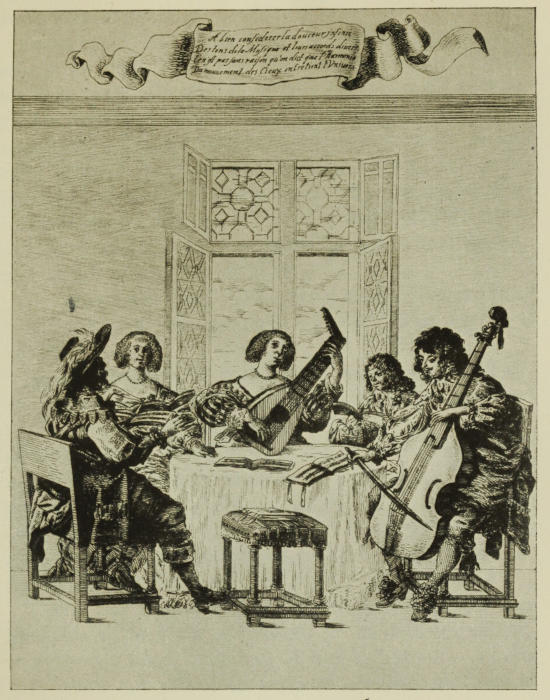
CHAMBER MUSIC IN 1635
By Abraham Bosse
Perhaps, if we could hear the gentlemen represented on page 160 draw his bow, we should think his tone very thin and we might not be at all enthusiastic over the style of his playing; but we must remember our ears hear very differently from those that listened to Bocan and Constantin and have been educated along other lines. But certainly the contemporaries of the “Twenty-Four Violins” considered that they were supreme artists. And literature is full of allusions to them.
We also know that Guillaume Dumanoir was first a member and than conductor of the “Twenty-Four Violins.”
Sometimes the King sent his “Twenty-Four Violins” to play for his great princes and favorite courtiers. We learn from a contemporary poem that at a superb dinner given by Cardinal Mazarin in 1660, “the feast was fine, joy universal and the ‘Twenty-Four Violins’ played while we ate melons, pâtés, tarts, biscuit and dishes of delicious fruit piled up like obelisks. We enjoyed ourselves immensely while they played a thousand beautiful airs.”
There was hardly a great gentleman who did not have his little band of violins, or his string-quartet, to entertain his friends and to amuse himself. Those who could not afford to support an Orchestra, or a quartet, would hire one on occasions.
There were many associations of musicians in the big cities like Paris and London (survivals of the old minstrel guilds) and in small towns throughout Europe where there were violinists, clavecinists, organists, flute-players and a few players of old instruments—like the lute—so fast becoming obsolete—ready to accept engagements. Such men carried the growing taste for instrumental music, and the latest compositions as well, to remote towns and country-houses. They were really preparing the ground for us to-day, though they did not know it.
At this period Jean-Baptiste Lully comes on the centre of the stage.
When we think of the magnificent reign of Louis XIV—he of the long, curling wig, the hooked nose, the supercilious smile, the long robes and the high-heeled and diamond-buckled pumps—we think of the men who made his century so great. We think of the great artists, Lepautre and Bérain; we think of the architect, Mansart; we think of the great furniture-maker, Boulle; we think of the landscape-gardener, Lenôtre; we think of the great ministers, Condé and Colbert; we think of the great generals, Turenne and Fontenoy; we think of the story-writers, Perrault and La Fontaine; we think of the essayists, La Bruyère and Bossuet; we think of the dramatists, Racine and Molière; and we think of the musician, Jean-Baptiste Lully.
Jean-Baptiste Lully was not a Frenchman. His name was Lulli and he was born in Florence in 1632. He was of humble origin and was taught by an old Franciscan monk to play the guitar and to sing. Lulli was unusually clever. He attracted the attention of the Chevalier de Guise, who was visiting Italy; and this gentleman was so fascinated with him that he took him to France and handed him on to Mademoiselle de Montpensier, the daughter of Gaston d’Orléans, that eccentric person who is known in history as “La Grande Mademoiselle.”
La Grande Mademoiselle, like every other person of place and wealth, had her own Orchestra; and Lully (as his name was now written) was given a place in it as one of the violins, while the Comte de Nogent, who became interested in him, saw that he had lessons. La Grande Mademoiselle gave very brilliant ballets and concerts at the Tuileries; but when the Royal Army occupied Paris, she was banished to her old Château de Saint-Fargeau, which was quite far in the country. Lully went with the rest of the household; and when he was not playing in the Orchestra, or dancing in the ballet, he was employed as page. Some say, indeed, he even served in the kitchen.
Lully, full of tricks and mischief and fun, composed a satirical song on his mistress, La Grande Mademoiselle, who was a tempting subject for a young boy’s wit. But La Grande Mademoiselle heard the song; and she very naturally dismissed him from her household. But this disgrace did not affect Lully. In fact, it helped him in his career; for he very soon got a place in the Twenty-Four Violins,—and there he was in the King’s private band! And La Grande Mademoiselle had to see and hear him play very frequently.
La Grande Mademoiselle does not refer to Lully’s insolence in her Memoirs. Her version is as follows: “He did not want to stay in the country and asked for his dismissal. I gave it to him and he has since made his fortune, for he was a very great dancer.”
Lully was as clever as he was musically gifted. It was not long before he had charge of all the “King’s Music,” which consisted of the Chamber Music, the Chapel Music and the Grande Écurie (the Stable). The latter comprised the music for hunting and processions and out-of-door fêtes. The famous “Twenty-Four Violins” played at dinner, at the Court balls, and gave concerts for the Court, as we have seen.
In 1655 the King created a new Orchestra especially for Lully called the “Petits Violons.” At first it consisted of sixteen players, but soon it was increased to twenty-one. This Orchestra played at the Court balls, at the morning toilet (or lever) of the King, at the dinner (or grand couvert) and on various other occasions. Some persons thought it played even better than the “Twenty-Four.” Lully composed a great number of dances for it—sarabandes, gigues, chaconnes, etc., which delighted the King and his Court. Sometimes the two Orchestras played together under Lully’s guiding hand.
Jean-Baptiste Lully now became the most important musician in Europe. After a time he felt that the violin, which he played so well, was beneath his dignity, so he gave it up and devoted himself to the harpsichord. He staged and danced in ballets for the Court; wrote operas to the poetic libretti of Quinault and produced them with superb scenery; and he composed all the musical interludes for all of Molière’s plays!
He also played in several of Molière’s comedies. He took the part of the physician in Pourceaugnac and he played the comical Muphti in Le Bourgeois Gentilhomme.
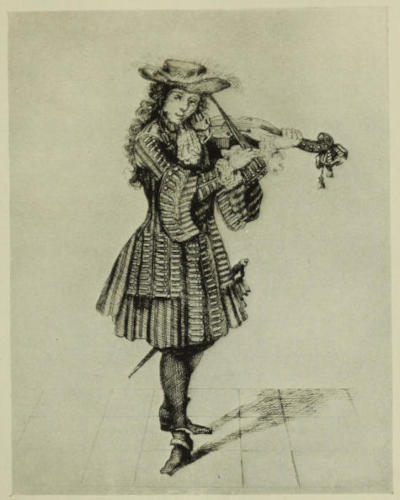
ONE OF THE TWENTY-FOUR VIOLINS OF THE KING, 1688
Lully ruled like a king.
Lully was the King of Music, not only in France, but in all of Europe in those grand days when France stood at the head of all nations in wealth and power under her “Sun-King.”
One day in 1687, while conducting a Te Deum in honor of the King’s recovery from an illness, Lully, “the better to demonstrate his zeal,” the contemporary account relates, “he himself beat the time with the cane he used for this purpose, and he struck himself in the heat of action a blow upon the end of his foot. This caused a small blister.”[42] The quack doctor who was summoned was incompetent and Lully died from blood-poisoning. He left four houses in Paris and a large fortune.
His portraits, which represent him in the big flowing curls of the day—much like the King’s own wig—and with large heavy features, are said by contemporaries to flatter him.
Lully was an undoubted genius and he was always clever. We sometimes wonder if he did not know what he was doing when he wrote his satirical song on “Big Mademoiselle,” who had plenty of enemies ready to laugh at her expense.
Lully always knew how to attract attention to himself and he never seems to have made a mistake.
I think we may call him the first real conductor of an Orchestra. Certain it is that Lully was the first to gather together a virtuoso Orchestra and train it by methods that approach those of to-day.
Lully’s Orchestra is, therefore, of the greatest interest to us. So let us stop and examine it: “Lully got together the best Orchestra of his time in Europe. It is perhaps an exaggeration to say that he was the first man to train an Orchestra in France and that before him (accordingly to Perrault) musicians did not know how to play from score and had to learn their parts by heart. But he certainly did improve instrumental execution, especially with regard to the violin, and he created traditions in the conducting of Orchestras, which rapidly became classic and were followed in France and even served as a model in Europe. Among the many foreigners who came to Paris to study was an Alsatian, named Georges Muffat, who especially admired the perfect discipline and strict time of Lully’s Orchestra. He said that Lully’s method was characterized by trueness of tone, by smoothness and evenness of execution, by clean attack and by the way the bows of the whole Orchestra bit into the first chord, that famous ‘first stroke of the bow,’ as well as by the irresistible ‘go,’ the well-defined rhythm and the delightful combination of vigor and flexibility, of grace and vivacity. But of all these qualities, the best was the rhythm.”[43]
Robert Eitner called it an “incisive and expressive rhythm.” Others tell us that Lully thought quite as much of delicacy of expression; for there are many marks on his scores, such as “Play softly—almost without touching the notes” and “Do not take off the sordini until you are told to.”
Lully’s Orchestra showed off splendidly in his operas.
“The Orchestra had for its chief instruments: violins in five parts, which played the ritournelles, doubled the choruses and beautified the solos with their harmonies. In excited airs expressing quick passion, the voice was accompanied by two violins which played a very elaborate part and when the passion abated returned to their ordinary recitative. Flutes, usually straight flutes and flutes à bec, though sometimes ‘transverse,’ or ‘German,’ were much used by Lully. Sometimes they played in unison with other instruments. Sometimes they formed separate ‘concerts’ and sometimes they were combined with the trumpets and violins. The trumpets had a magnificent rôle. They played alone in three, or five, parts with the drums. Lully also employed oboes, bassoons, and instruments of percussion, and in his ballets he made a great use of the tambour de basque, (tambourine), castanets and drums. He also introduced bag-pipes, guitars and hunting-horns (in La Princesse d’Élide); the charcoal-burner’s whistle (in Acis); and, like the composer of Siegfried, he did not fear the sound of the forge and the noise of anvils (in Isis). The characteristic trait of the Orchestra (and one essentially French) is that Lully rarely employed it all at once. He divided his Orchestra into groups that have conversations with one another, or with the voices. This system puts lots of light into the picture, as it were, and the air circulates freely. Strangers were always struck by this.
“Lully’s Orchestra was large. It was carefully recruited and trained by him. The violins were extraordinary, especially in ‘the first stroke of the bow.’ People came from Italy, England and Germany to hear Lully’s Orchestra. Everybody admired his correctness, rhythm, the perfection of his ensemble; and, above all, the sweetness, preciseness and smoothness of his violins.”[44]
And now let us see what a contemporary has to say:
“Lully would have nothing but good instrumentalists. He tested them first by making them play Les songes funestes from Atys. It was a nimble hand that he demanded. After all, ease of execution was a reasonable qualification to require. He supervised all the rehearsals; and he had so nice an ear that from the far end of the theatre he could detect a violinist who played a wrong note. And he would run up to the man and say, ‘You did that. It is not in your part.’ The artists knew him and they tried to do their work well. The instrumentalists particularly never dared to embellish their parts, for he would not allow any more liberties from them than he would from the singers. He thought it far from proper that they should assume a greater knowledge than his own and add what notes they pleased to their tablature. If this happened he became angry and would make lively corrections. More than once he broke a violin on the back of a man who was not playing to his taste. But when the rehearsal was over, Lully would send for the man, pay him three times the value of his instrument and take him out to dine.”
This characteristic little picture well shows the methods of the conductor.
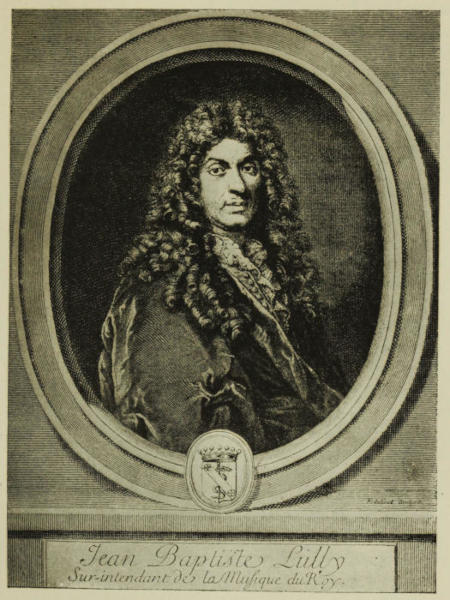
JEAN BAPTISTE LULLY
Now these were neither ordinary men, nor ordinary musicians, whom Lully was accustomed to strike with their instruments. Some of them were indeed famous in their art and friendships. It only proves how supreme Lully was that they would submit to his temper and rude treatment. Evidently it was a distinction to play in Lully’s Orchestra. So they put up with anything at rehearsals.
Take, for instance, Descoteaux, one of the most famous flute-players of the time. Descoteaux was a great friend of Boileau, Molière and La Fontaine. He lived to be very old, and Marais (the viola da gamba of Lully’s Orchestra) speaks of him in his Journal in 1723 as follows: “During the fêtes I saw Descoteaux, whom I thought was dead. It was he who carried the German flute to its highest point and who brought to perfection the pronunciation of words in singing according to the rules of grammar. The value of literature he understood better than anybody. He sang words very correctly. Descoteaux had the love of flowers to a supreme degree and he was one of the greatest amateur florists in Europe. He lives in the Luxembourg, where they have given him a little garden, which he cultivates himself. La Bruyère has not forgotten to include him in his Caractères and that fad of his for tulips, to which he gave names as he pleased. He wants to be a philosopher now and talk Descartes; but it is quite enough to be such a musician and such a florist.”
Thirty years before, when the tulip mania had spread from Holland throughout Europe, causing people to win and lose large sums—fortunes indeed—upon choice bulbs—and to spend time and money on the production of new species—(a fad so well described in Dumas’s novel of The Black Tulip), La Bruyère wrote of Descoteaux in De la Mode (1691). He did not mention Descoteaux by name; but everybody knew for whom the pen-portrait was intended. Descoteaux had his garden then in the faubourg Saint-Antoine.
Here is La Bruyère’s picture of Lully’s first flute: “The florist has a garden in a faubourg. He runs to it at break of day and he visits it before he goes to bed. We see him as if he were planted and had taken root in the middle of his tulips and before the Solitaire. He opens his eyes wide; he rubs his hands with delight; he goes closer to look at it; he kisses it; his heart swells with joy, for he thinks he has never seen it look so beautiful. Then he leaves it for the Orientale. From the Orientale, he goes to the Veuve (the widow); then he goes to the Drap d’or (Cloth of Gold); then he goes to Agathe; and then he goes back to the Solitaire, where he takes root again. There he stands or sits, rapt, and forgets all about his dinner. How beautiful her shading, her stripes, her satiny, oily skin! How lovely her chalice! He gazes upon her, admiring God and nature in her; and he would not give up that tulip bulb for a thousand écus. But he will be glad to give it away for nothing when tulips go out of fashion and pinks come in. This sensible man, who has a soul and a religion, as well as a fad, returns home fatigued but very contented; for he has seen his tulips!”
Descoteaux was a great virtuoso. So was Philbert, who was also a member of Lully’s Orchestra. Descoteaux and Philbert often played together; and they often played with Vizé, who was just as celebrated on the theorbo and guitar as they were on the flute.
Philbert was famous for his gayety, his wit and his talent for mimicry. He saw the ridiculous in everything and everybody; and he burlesqued everything and everybody to make his friends scream with laughter.
In his chapter on Des Femmes, La Bruyère touches him off under the name of Dracon. Addressing Lélie, he says: “But you have Dracon, the flute-player! No one else in his profession can puff out his cheeks so decently in blowing into an oboe, or a flageolet. The number of instruments that he can make talk is infinite! Pleasanter still, he can make children and young women laugh! Who can eat and drink more than Dracon at a single meal? Dracon enlivens a whole company, and he is always the last to get up!”
Poor Dracon had a sad love-story. A woman fell in love with him—not an unusual thing to happen with Philbert—but she poisoned her husband so that nothing might stand in the way of marrying him. At the last moment she confessed her crime; and she was hanged and burned in the old Place de Grève in Paris. Philbert was perfectly innocent; but he, doubtless, suffered terribly—poor fellow!
An artist’s life is not always a happy one!
Both Descoteaux and Philbert were great favorites of Louis XIV. As the Philidor and Hotteterre families were renowned for their skill on the flute, oboe and bassoon, some of them, undoubtedly, played in Lully’s Orchestra. These families were famous in musical Paris for generations.
One of the bassoons was La Bas. He married an opera-singer, named Mlle. Le Rochois. The marriage was somewhat unusual. Mr. Bassoon wrote his promise to marry the lady on the back of a card—the Queen of Spades (Pique Dame) and then he tried to get out of it; but the lady showed the Queen of Spades to Lully; and Lully made Mr. Bassoon keep his promise.
Conductors have many duties!
One of the first violins, Verdier, was also the husband of an opera-singer; but we do not know the story of his marriage.
Then there was Jean Baptiste Marchand, who played the lute and also the violin. He wrote such a fine Mass that it was performed in the noble old cathedral of Notre-Dame of Paris.
Then there was Teobaldo di Gatti, a native of Florence, who was so charmed with the “symphonies” in some of Lully’s operas that he had heard (and perhaps played in) that he went to Paris in 1676 especially to see Lully. As soon as he arrived, he hurried to call on the great composer and conductor and told him why he had taken the journey. Lully was highly flattered; and, after hearing him play, he recognized his ability and gave him a place in the Orchestra at once. And here Teobaldo, the basse de viol, played for fifty years! He died in 1727, playing in the Orchestra up to the last. Teobaldo was a very well-known figure in Paris; and everybody went to hear his opera, Scylla, when it was performed in Paris.
Perhaps the best musicians in all this Orchestra of virtuosi were the two violinists, Lalouette and Collasse, and the bass violist, Marais, whose snap-shot of a fellow-member is quoted on page 165. Each of these three artists became Lully’s assistant conductor.
Jean François Lalouette, the first of Lully’s conductors, was born in 1615. He studied the violin under Guy Leclerc (one of the Twenty-Four Violins) and began to play under Lully when he was only twenty. First he played among the violins; and then Lully made him his secretary and put him to writing recitatives. He also instrumented some of Lully’s operas. But when he boasted that he had composed the best parts of Lully’s opera of Isis, Lully discharged him. Lalouette then devoted himself to composition. Finally, he became maître de chapelle at Notre-Dame, Paris. He died in 1728. When Lalouette was dismissed in 1677, Lully gave his place to Pascal Collasse.
Collasse was born in Rheims in 1649. At an early age he was taken to Paris, where he became a chorister at St. Paul’s and a pupil of Lully. He was more fortunate than Lalouette, for he stayed with Lully until the latter’s death and completed his operas that were left unfinished.
Marin Marais was conductor at the same time as Collasse. Perhaps they alternated, perhaps there was so much to do that two were kept busy. It looks as if Lully only conducted when he wanted to—perhaps on a first performance of one of his operas. At any rate, Marais and Collasse worked together. Marais was a Parisian and was born in 1656. He sang in the choir of Sainte-Chapelle and took lessons on the basse de viole[45] with Sainte-Colombe. At the end of six months Sainte-Colombe, seeing that his pupil was likely to surpass him, told him that he could teach him nothing more. But this did not satisfy Marais; for he loved the basse de viole passionately and wanted to perfect himself by learning from this master. At that time Sainte-Colombe used to practise in his garden in a little shed he had built around a mulberry-tree where he could be undisturbed. Marais hid behind the shed and listened to his master practise some very difficult passages and bowings that Sainte-Colombe wished to keep for himself. This did not last long because Sainte-Colombe found it out. The next time he heard Marais he congratulated him on his progress. Moreover, one day when Marais was playing for a company of great distinction, Sainte-Colombe, who happened to be present, was asked what he thought of Marais. He replied that “there were always pupils who could surpass their master, but that nobody would ever be found who could surpass Marais.”
Marais became the best performer on the basse de viole of his time. It was Marais who gave the instrument a seventh string and it was he who wrapped the three lowest strings with wire. In 1685 he was soloist in the King’s Chamber Music and he also played in Lully’s Orchestra. Lully gave him lessons in composition. In 1686 he published a collection of pieces for the basse de viole. An Idylle Dramatique came out in the Mercure de Paris in 1693.
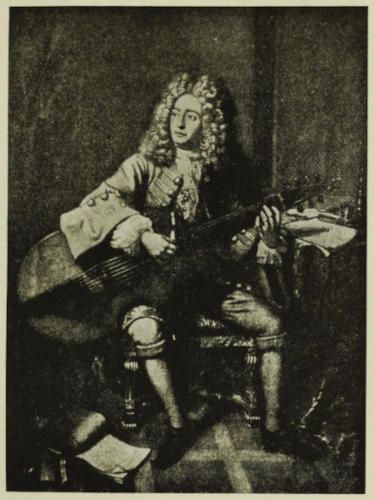
MARIN MARAIS
Marais wrote a great deal of music for the strings. “We know,” writes a contemporary, “the fecundity and beauty of the genius of this musician by the number of works that he composed. They are astounding in taste and variety. His great knowledge appears in all his works; but particularly in two pieces: one, in his fourth book called the Labyrinth, where, after having gone through various scales and touched on diverse dissonances, and marked his way by grave tones and then by lively and animated ones, describing the uncertainty of a man who is going through a labyrinth, he comes out happily in a graceful and natural Chaconne. But he astonished connoisseurs still more by a piece called the Scale—La Gamme—a symphonic composition which mounts insensibly through all the notes in the octave and then descends again with harmonious and beautiful melodies through all the musical scales.”[46]
Marais also wrote several operas, one of which, Alcyone (1706), had in it a storm that the people of the time thought perfectly terrific; for the drums rolled continually; the violins played on the highest string—the chanterelle; the oboes screamed; and the bass viols and bassoons added to the horrors in depicting the agitated sea and the whistling wind.
Many were shocked!
In 1725 Marais, very old, lived in a house in the rue de Lourcine and devoted himself to the cultivation of flowers. He also rented a room and gave lessons two or three times a week to talented pupils.
Marais died in 1728.
Then there was La Londe, who began life as a valet de chambre to the Maréchale de Grammont. He was very talented and became one of the best violinists in Europe. Then there was another violinist known as Baptiste. It is supposed that he was Baptiste Anet, a pupil of Corelli. We know of a few other names: Nicholas Baudry, dessus de violon; Julien Bernier, German flute; Bernard Alberty, theorbo; Jean Théobalde, basse de violon; and Jean Rabel, clavecin. There was also connected with the Orchestra Jean Fischer (born in Swabia in 1650), who came to Paris when very young and belonged to Lully’s orchestral family as a music-copyist.
An old document came to light in Paris several years ago that gave the pay-roll of Lully’s Orchestra. Here it is:
Batteur de mesure 1,000 livres
10 instruments de petit chœur à 6,000 6,000 ”
12 dessus de violon à 400 4,800 ”
8 basses à 400 3,200 ”
2 quintes à 400 800 ”
2 tailles à 400 800 ”
2 hautes contres à 400 1,200 ”
3 hautbois flutes ou basson à 400 3,200 ”
1 timbalier à 150 150 ”
21,150 livres
This shows that there were forty men in the Orchestra and that the average pay was 400 livres. We also learn that the clavecin player received 600 livres. The ten instruments that had the biggest salary were, of course, Lully’s pet Petits Violons.[47]
The Abbé Raguenet, in comparing the Italian and French Orchestras of the time, says: “Besides all the instruments they have in Italy, we still have the oboes, which, with their equally soft and piercing tones have such advantage over the violins in ‘airs of movement,’ and also the flutes such as the illustrious Philbert,[48] Philidor, Descoteaux[49] and the Hotteterres know how to make wail in a manner so touching and to make sigh so amorously in our tender airs.”
How we wish that we could go to one of the King’s Little Suppers at Marly and hear a concert by this famous Orchestra! How we should like to hear Descoteaux and Philbert play a duet on their flutes, or hear the whole Orchestra play a Sarabande, or a Courante, under Lully’s careful conducting!
Charles II of England had not been on the throne very long before he created an Orchestra of Twenty-Four Violins like that he had heard so many times with delight at the Court of Louis XIV.
The chief violinist and leader of this organization was Thomas Baltzar of Lübeck.
“His Majesty, who was a brisk and airy prince, coming to the crown in the flower and vigor of his age was soon, if I may so say,” says Burney, “tired with the grave and solemn way which had been established by Tallis, Byrd and others, ordered the composers of his Chapel to add symphonies with instruments to their anthems; and thereupon established a select number of his private music to play the symphony and ritournelles which he had appointed.
“The old way of consorts was laid aside by the prince immediately after his restoration when he established his band of Twenty-Four Violins after the French model; and the style of Musick has changed accordingly. So that French Musick became in general use at Court and in the theatres. Indeed, performers on the violin had a lift into credit before this period when Baltzar, a Swede, came over and did wonders upon it by swiftness and double stops. But his hand was accounted hard and rough, though he made amends for that by often tuning in the lyre way and playing lessons conformable to it, which were very harmonious.
“During the first years of King Charles’s reign all the Musick in favor with the beau-monde was in the French style, which at that time was rendered famous throughout Europe by the works of Baptiste Lully, a Frenchified Italian and master of the Court Musick at Paris, who enriched the French Musick by Italian harmony which greatly improved their melody. His style was theatrical; and the pieces called branles, or ouvertures, consisting of an entrée and a courante will ever be admired as the most stately and complete mouvements in Musick. All the composers in London strove hard to imitate Lully’s vein. However, the whole tendency of the air affected the foot more than the ear; and no one could listen to an entrée with its starts and leaps without expecting a dance to follow.
“The French instrumental music, however, did not make its way so fast as to bring about a revolution all at once; for during a great part of this King’s reign the old Musick was still used in the country and in many private meetings in London; but the treble viol was discarded and the violin took its place.
“It may be ascribed to the peculiar pleasure which King Charles II received from the gay and sprightly sound of the violin that this instrument was introduced at Court and the houses of the nobility and gentry for other purposes than country-dances and festive mirth. Hitherto there seems to have been no public concerts and in the Musick of the chamber, in the performance of Fancies on instruments which had taken the place of vocal madrigals and motets the violin had no admission, the whole business having been done by viols.
“The use of the violin and its kindred instruments, the tenor and violoncello, in Court was doubtless brought from Italy to France and from France to England; for Charles II, who, during the Usurpation had spent a considerable time on the Continent, where he heard nothing but French Musick, upon his return to England, in imitation of Louis XIV, established a band of violins, tenors and basses, instead of the viols, lutes and cornets of which the Court band used to consist.”
Anthony Wood, that quaint old English writer, also throws a light on the question of violin-playing in England at that time.
“The gentlemen in private meetings,” he writes, “which A. W. frequented, played three, four and five parts with viols as treble viol, tenor, counter-tenor and bass, with an organ, virginal or harpsicon, joined with them; and they esteemed a violin to be an instrument only belonging to a common fiddler and could not endure that it should come among them for fear of making their meetings to be vaine and fiddling. But after the Restoration of Charles I, viols began to be out of fashion and only violins used, as treble violin, tenor and bass violin; and the King, according to the French mode, would have Twenty-Four Violins playing before him while he was at meals, as being more airy and brisk than viols.”
Then he goes on to tell us something about the chief violinist.
“Tho. Baltzar, a Lübecker born, and the most famous artist for the violin that the world had yet produced, was now in Oxford; and this day, July 24, A. W. was with him and Mr. Ed. Low, lately organist of Christ Church, at the house of Will Ellis, A. W. did then and there to his very great astonishment hear him play on the violin. He then saw him run up his fingers to the end of the fingerboard of the violin and run them back insensibly and all with alacrity and in very good time, which he, nor any in England, saw the like before. A. W. entertained him and Mr. Low with what the house could then afford and afterwards he invited them to the tavern; but they being engaged to go to other company, he could no more hear him play, or see him play at that time. Afterwards he came to one of the weekly meetings at Mr. Ellis’s house and he played to the wonder of all the auditory; and exercising his finger and instrument several ways to the utmost of his force. Wilson, thereupon, the public professor, the greatest judge of music that ever was, did, after his humorsome way, stoop down to Baltzar’s feet to see whether he had a hoof on, that is to say to see whether he was a devil or not, because he acted beyond the parts of man.”
Burney goes on to say:
“We are able to ascertain the time when concerts consisting of two treble violins, a tenor and a bass violin, or violoncello, came into practice; that they had their origin in Italy can scarce admit of a question; and it is no less certain that they were adopted by the French.
“Indeed the idea of a performance where the instruments for the bass and intermediate parts were in number so disproportionate to the treble, seems to be absurd; and there is reason to suspect that the song ‘Four and Twenty Fiddlers all in a row,’ in D’Urfey’s Pills to Purge Melancholy, was written in ridicule of that band of twenty-four violins, which, as the French writers assert, was the most celebrated of any in Europe.”
This old song begins:
“Four and twenty Fiddlers all in a Row; And there was fiddle fiddle and twice fiddle fiddle. ’Cause ’twas my Lady’s Birthday, Therefore we kept holiday, And all went to be merry. “Four and twenty Drummers all in a Row, And there was tantarra rara, tan, tantarra. Rara, rara, rara rar, there was rub, etc. “Four and twenty Tabors and Pipers all in a Row And there was whif and dub, And tantarra rara, etc.”
and goes on in the same way for several verses.
The next name of importance after Lully is that of Corelli.
We must not imagine that Corelli suddenly appeared like a great shining star in a dark night. No artist ever leaps suddenly upon an astonished world. Every artist builds on the works of those who have gone before him.
To understand Corelli, we must go back a little and recall something that we have already noticed; and that is the importance of the work of the Italian violin-makers.
Let us then fix it in our minds that when Corelli was born, in 1653, Nicolò Amati had already made a great number of fine violins and that Stradivari was working all through Corelli’s life and that he outlived him. So that the question of violin-playing was the chief one that engaged the attention of the composers of Corelli’s time. They were all working on the question of how to play the new instrument, just as the makers had been, and were still working on the technique of the instrument itself. Amati and Stradivari, like those who had gone before them, were trying for tone. The composers were now trying to show off the voice, or tone, of the new instrument to the best advantage.
This question is of the greatest importance for us to remember, because the violin is the very foundation of our modern Orchestra.
At first the violin was the prima-donna of the Orchestra; but eventually the other members of the Violin Family—viola, violoncello and double-bass—also became singers. In short, the Violin Family became the very backbone of the Orchestra.
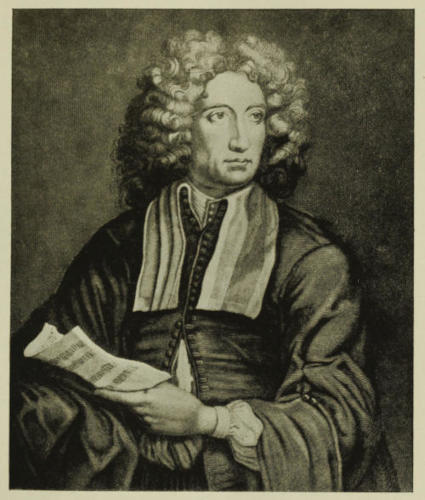
ARCANGELO CORELLI
Corelli had much to do with making this the case.
Before Corelli was born in Fusignano in 1653, the Italian composers, particularly those who were attached to the cathedrals and private Orchestras of the wealthy princes and lords of Lombardy—Brescia, Cremona, Mantua and Padua—who were right in the midst of the activities of violin-making, had been writing sonatas, “Flowers” and dances of all kinds for the new violin, to be accompanied by the spinet, the organ, or two or three other stringed-instruments. Their compositions gradually grew more elaborate as they discovered the possibilities of the last new model sent from the workshop of Gasparo di Salò, Maggini, Amati, or Stradivari. There was a great deal more Italian music—and good music, too—composed at that time than most people have any idea of.
Arcangelo Corelli studied the violin under Giovanni Battista Bassani, a musician who is almost forgotten to-day, but who was a great violinist, a composer, a conductor of the Cathedral-music, first in Bologna and afterwards in Ferrara; and he was particularly happy in his writings for the string-quartet. Bassani was about the same age as Corelli; and to his pure instrumental style and knowledge of counterpoint Corelli and modern music owe not a little.
After studying the violin with this master, Corelli went to Rome and studied with Matteo Simonelli, who had had a splendid musical education.
Corelli travelled in Germany and was for a time attached to the Court of the Elector of Bavaria. Then he went to Paris in 1672, and, returning to Italy, settled in Rome. He became a favorite in society and lived in the household of the splendid Cardinal Pietro Ottoboni, taking charge of that prince’s music. His regular Monday concerts were a feature of the social and artistic life in Rome.
Pupils swarmed to him. One of them was Geminiani. Corelli became one of the great personages of Rome. When Christina of Sweden went to Rome, Corelli conducted an Orchestra of a hundred and fifty men in her palace. When he died in 1713 he was buried in the Pantheon, not far from Raphael. For years after his death a musical service was held annually at his tomb, where some of his compositions were piously played by his pupils.
Geminiani’s estimate of Corelli’s character seems very just. He said: “His merit was not depth of learning, like that of Alessandro Scarlatti; nor a great fancy, nor rich invention in melody or harmony, but a nice ear and most delicate taste, which led him to select the most pleasing harmonies and melodies and to construct the parts so as to produce the most delightful effect upon the ear.”
At the time of Corelli’s greatest reputation Geminiani asked Scarlatti what he thought of him. Scarlatti answered that “he found nothing greatly to admire in his composition, but was extremely struck with the manner in which he played his concertos and his nice management of his band and uncommon accuracy of the whole performance gave the concertos an amazing effect; and that, even to the eye as well as the ear”; for, continued Geminiani, “Corelli regarded it as essential to the ensemble of a band that their bows should all move exactly together, all up or all down; so, that at his rehearsals, which constantly preceded every public performance of his concertos, he would immediately stop the band if he discovered one irregular bow.”
“There can be no doubt that above all Corelli was a great violin-player and that all he wrote grew out of the very nature of his instrument. In his Chamber-Sonatas and Concerto-Grossi he must be considered the founder of the style of orchestral writing on which the future development is based; while in the Sonatas (op. 5) which have merely an accompanying fundamental bass, he gives a model for the solo sonata; and, thereby, for all writing for the violin as a solo-instrument.
“All his works are characterized by conciseness and lucidity of thought and form, and by a dignified, almost aristocratic, bearing. The slow movements show genuine pathos as well as grace, and bring out in a striking manner the singing-power of the violin.
“Corelli’s Gavottes, Sarabandes and other pieces with the form and rhythm of dances, do not materially differ from similar productions of his immediate predecessors and contemporaries, although, like everything that he wrote, they are distinguished by great earnestness and dignity of style and are especially well adapted to the instrument. He was not so much an innovator as a reformer; he did not introduce new striking effects; it cannot be denied that his technique was a limited one—he never goes beyond the third position—but, by rigidly excluding everything that appeared to him contrary to the nature of the instrument, and by adopting and using in the best possible way everything in the existing technique which he considered conformable to the nature of the violin, he not only hindered a threatened development in the wrong direction, but also gave to this branch of art a sound and solid basis, which his successors could, and did, build upon successfully.”[50]
Burney tells us that “After the publication of Corelli’s works, the violin seems to have increased in favor all over Europe. There was hardly a town in Italy, about the beginning of the present century (the Eighteenth), where some distinguished performer on that instrument did not reside.”
The next link in our chain is Scarlatti.
Alessandro Scarlatti was born in Trapani, Sicily, in 1659. We find him at a comparatively early age settled in Naples, where he was celebrated as a singer, and a performer on the harp and the harpsichord and as a composer of operas. He was the chief of the Neapolitan School. Modern critics have proved that on his ideas the great Gluck built his musical edifice.
Scarlatti was a prolific composer. He wrote one hundred and fifteen operas and two hundred masses, besides oratorios, cantatas and other works.
He is of importance to the Orchestra because of the new way he wrote for the instruments. He made the accompaniment of vocal recitative of new importance and gave the Orchestra a great part to do throughout the entire opera. The strings formed the groundwork of his Orchestra; and he also used oboes, flutes, bassoons, trumpets, drums and horns (the latter an innovation).
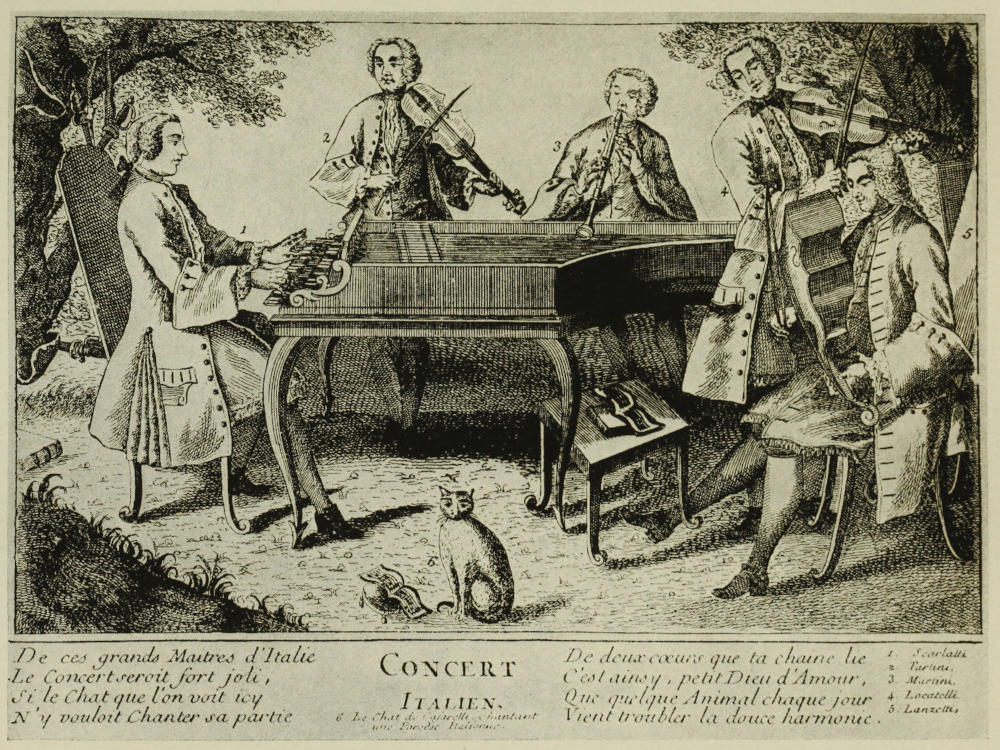
CONCERT BY SCARLATTI, TARTINI, MARTINI, LOCATELLI, AND LANZETTI
Scarlatti was the creator of modern opera, and the “Father of Classical Music,” the forerunner of Gluck, Mozart and Haydn and many others. Dr. Burney put the debt that great composers owe to Scarlatti concisely when he said: “I find part of Scarlatti’s property among the stolen goods of all the best composers of the first forty years of the present century.”
With regard to his treatment of the violoncello, Dr. Burney says:
“The violoncello parts of many of his cantatas were so excellent that whoever was able to do them justice was thought a supernatural being. Geminiani used to relate that Francischello, a celebrated performer on the violoncello at the beginning of this century, accompanied one of these cantatas at Rome so admirably, while Scarlatti was at the harpsichord, that the company, being good Catholics and living in a country where miraculous powers have not yet ceased, were firmly persuaded it was not Francischello who had played the violoncello, but an angel that had descended and assumed his shape.”
Scarlatti also divided his strings into four parts and carefully balanced with them the wind instruments that he used; but the strings were the most important and stood out in relief against the wind; or, if we prefer to think of the matter another way, the wind was subordinate to the strings.
Very little is known regarding his private life.
His son, Domenico, was also a prolific composer and was a famous player on the harpsichord (Gravicembalo). To him is due the original idea of the form of the Sonata which Haydn afterwards perfected. Domenico Scarlatti is remembered, too, for his “Cat’s Fugue,” written on the notes that his favorite cat touched one day when she walked down the keys of the harpsichord.
Next in line comes Rameau, who was born in Dijon, in 1683, just two years before Bach. He was at the height of his fame when Mozart was born. Rameau came of a musical family, showed his talent early, played the clavecin at seven and studied the violin and organ. Eventually he settled in Paris. First he wrote little musical comedies, and, finally, operas—Hippolyte et Arcie, Les Indes Galantes, Castor et Pollux are some of them—and ballets, which as M. Choquet truly says, “contain beauties which defy the caprices of fashion and will command the respect of true artists for all time.” Rameau died in 1774. Rameau looked very much like Voltaire. He always used the violin when composing. Rameau’s new ideas of orchestration created animosity among the followers of Lully.
What did Rameau do for the Orchestra?
He gave to the different members of the Orchestra an individual rôle; he extended the technique of the violins; he made an increasing use of arpeggios; and he was the first to use pizzicato chords with all the strings at once. He also made a delicate and light use of the woodwind.
Every day Rameau is taking a larger place in Music. French critics consider him the most French of all their composers.
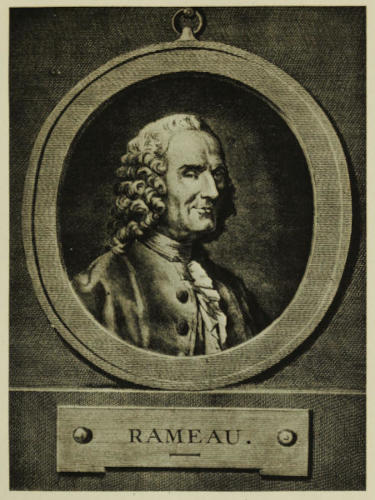
RAMEAU
By Restout
While the Italian Renaissance had developed the opera, the dance and music that delighted the drawing-room, under the bright skies of Italy, in the colder North, under the influence of stern Martin Luther, the Chorale, or hymn-tune, had arisen to supply the needs of the new Lutheran religion. The Chorale is austere and solemn, although melodious. It was largely owing to these chorales that the new Reformed religion made its way so rapidly among the people of Northern Germany. The sources of these Chorales were various: some came from old church-hymns; others, from folk-songs. A good example is the “Old Hundredth Tune” beginning “Praise God from whom all blessings flow.”
The custom of playing these Chorales on the organ with elaborate accompaniments and treating them also as themes for fugues and counterpoint was a special fancy of the German organists.
Germany had the finest organists in Europe in the Seventeenth Century; and there was no greater one among them than Johann Sebastian Bach.
Moreover, no one understood the Chorale better, or made more use of it, than Bach.
Bach’s life was uneventful. He was born in 1685 in Eisenach, near the Wartburg (celebrated for the legend of Tannhäuser), was organist at Weimar and Kapellmeister at Cothen for the Prince Leopold and Cantor of the Thomas School in Leipzig from 1723 until his death in 1750. He was also organist and director of the two chief churches in Leipzig.
Bach wrote every form of music except the opera. His industry was prodigious. “In Bach’s hands the music of the period marked its climax of expression, the Chorale was idealized to its highest pitch, the combination of Orchestra, chorus and solo voices in the Passions, the B-minor mass and the Church Cantatas became pillars of the house of musical art for all time, the principle of equal temperament[51] was fixed for good in Clavichord work, the violin became a solo instrument which could speak unaided for itself, and the organ came finally into its own. All this immense range of work was accomplished by an unobtrusive, unadvertising man of the highest moral force and of simple, deeply religious and deep-feeling character, a personality who would have considered it the highest possible tribute to be called the worthy father of a devoted family.”[52]
When Bach and his son, Philipp Emmanuel, went to work to draw their family tree, they found they had fifty-three musicians to hang on the boughs.
The whole Bach family played the organ and every other keyboard instrument. They were all marvellous players of the harpsichord.
Bach’s contribution to the development of the Orchestra is that he treated each separate instrument lovingly and as if it were an individual, so that he prepared the way for the occasional solos in orchestral compositions. He wrote for a great many instruments that were rapidly going out of fashion, such as the oboe d’amore, the oboe di caccia, the viola d’amore and the viola da gamba.
Bach stands at the parting of the ways of ancient music and modern music. Bach is the bridge between the Old and the New. He is often called the “musicians’ musician.”
Bach’s four Overtures for Orchestra are usually spoken of as Suites; but they are compositions on the Lully type. Critics have pointed out that Bach uses instruments to get the effect of fulness rather than color.
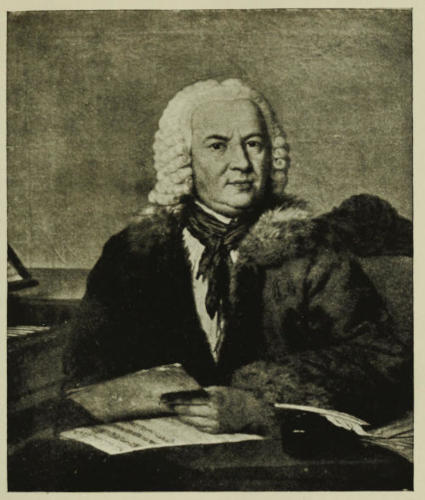
JOHANN SEBASTIAN BACH
By Lissewsky
Bach’s compositions for a solo violin, unaccompanied, are the most stupendous works ever written by anybody for a single instrument. Great players have always delighted in mastering their technical difficulties, which are very great.
Handel was born the same year as Bach, in 1685, though he seems a little nearer to us somehow. While Bach was living his quiet, uneventful life, Handel was gaining experience in the world. He was a native of Saxony and was the son of a surgeon, who considered music a degrading business. We know under what difficulties little Handel practised the spinet in the garret. The Duke of Saxe-Wessenfels heard him play and persuaded his father to let him follow the bent of his genius. Handel played in the Orchestra in the Opera House of Hamburg, “the Northern Venice,” a cosmopolitan city where the people had the best of music.
Then Handel travelled in Italy, where he met the famous Alessandro Scarlatti[53] and had his opera of Agrippina performed. Then he went to the Court of Hanover to become Kapellmeister.
But Handel wanted a larger field for his activity, and so he went to London in 1710 and brought out several operas. Queen Anne was reigning at this time and her Court was famous for its brilliant literary men—Pope, Addison, Steele, Sheridan and many others; and Handel’s music pleased many of the Court, as well as the Queen herself. In 1713 he wrote a Birthday Ode for her, which delighted Her Majesty. It was literally “to the Queen’s taste.”
But Queen Anne died in 1714; and a strange thing happened for Handel—the Elector of Hanover, his old patron, was called to the British throne as George I. Handel now became director of the King’s Music.
In 1717 he left George I to become Chapel-master for the Duke of Chandos, who had a palace at Cannons, not far from London, where he lived in great magnificence. For instance, he had a guard of a hundred Swiss soldiers and a chapel like those of Italy. His Orchestra was of the best.
Handel stayed at Cannons three years and then he became director of the Italian opera in London, where he produced one opera after another, some of which brought forth witty satires from Addison and Steele, but all of which attracted large audiences. Most of them were on mythological subjects, were written in the Italian style and were superbly staged. Occasionally, a beautiful aria from one or another of these operas appears on a programme to-day; and it is so noble and lovely that we long to hear the old operas themselves. As a rule, these arias are accompanied by several instruments supporting one that plays an obbligato part; and these show what Handel did to develop and exhibit the technique of various instruments.
The last years of his life were devoted to composing the magnificent oratorios of Saul, Samson, The Messiah and Israel in Egypt.
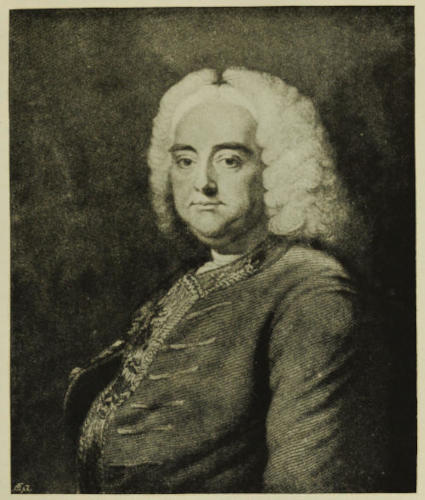
HANDEL
By Thomson
Handel became a naturalized English subject and lived far into the reign of George II. When he died in 1751, he was buried in Westminster Abbey.
Handel’s contribution toward building up our modern Orchestra is that he helped make it more solid, more sonorous and more vital.
The balance of Handel’s Orchestra was very different from ours, because of the overwhelming number of woodwind instruments. If he had twenty-five strings, he would sometimes have as many as five oboes and five bassoons! The clarinet had not then come into use, and some stringed and some woodwind instruments that Handel used became obsolete after his death. Handel was particularly fond of the oboe: it is often conspicuous in his scores.
Handel made his Orchestra a very strong ally of his operas and his oratories. He conducted seated at the clavier, or organ, and accompanied the singers with the most marvellous art possible to imagine, following their fancies and pleasures and whims; and then, when they had finished, he would improvise to suit his own taste. His audience was always enraptured.
It is little wonder, therefore, that Handel’s orchestration sounds scanty to our ears, if his works are played from the original scores; for we miss the filling in of all this elaborate work done on the spur of the moment and in all the excitement and exhilaration of the concert-hall before the audience who had learned what to expect.
We are told that when Handel conducted one of his oratorios the chorus had their leaders who listened to the organ from which they took their cues. The Orchestra was divided into three sections. Section No. I was the Concertino, consisting of a first and second violin and a solo violoncello. Section No. II was the Concerto Grossi, consisting of eight first violins, eight second violins, six violas, four to six violoncellos and four double basses. Section No. III was the Ripienist, or the supplementary band, consisting of six first violins, six second violins, four violas, three to four violoncellos and three basses. This Ripienist band was employed to fill in the harmonies, or to support the solos, and the concertante parts.
The picture facing this page, taken from an old print in the British Museum, represents Handel seated at the clavecin (a cembalo with two keyboards), of which the lid is raised. On his right hand is the violoncellist. Before his eye are two violins and two flutes. The solo singers are near him, on his left, close to the clavecin. The rest of the instrumentalists are behind him, out of sight. “Thus his directions and his glances would control the Concertino who would transmit, in their turn the chief conductor’s wishes to the Concerto Grossi and they, in their turn, to the Ripienists. In place of the quasi-military discipline of the modern Orchestra, controlled under the bâton of a chief conductor the different bodies of the Handelian Orchestra governed one another with elasticity; and it was the incisive rhythm of the cembalo that put the whole mass into motion.”[54]
We rarely hear any of Handel’s music with exactly the Orchestra for which he wrote. All conductors realize the difficulty of having anyone improvise on the organ, or piano, to fill in the bald and empty spaces. Moreover, it would confuse the singers and terrify the audience. Improvising at concerts has gone out of fashion.
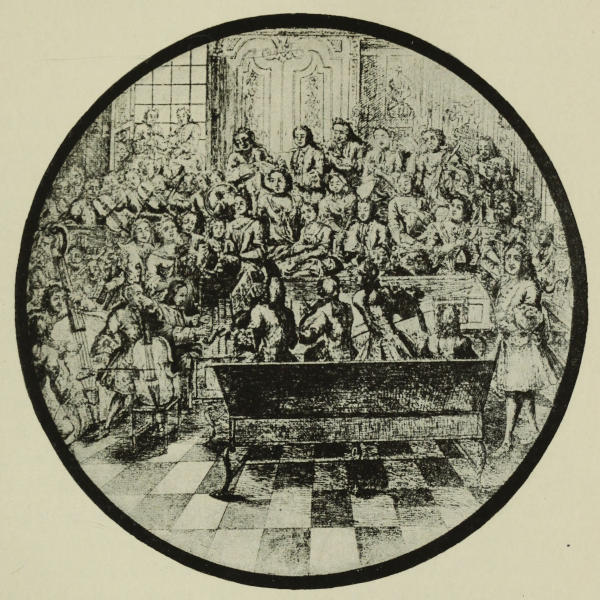
HANDEL CONDUCTING THE ORCHESTRA
Handel at the Cembalo
This was even realized in Mozart’s day; and so Mozart wrote those beautiful “additional accompaniments” to The Messiah, which give to that oratorio no little of its grace and nobility. Mozart, as we know, was a genius in instrumentation and even in his day people demanded something different from the Handelian concert.
Handel, however, was always seeking for novel effects. He was one of the first to introduce the horn into the Orchestra and he was “the first to assert the expressive personality of the violoncello.”[55] He also appreciated the fantastic and lugubrious quality of the bassoons; experimented with all kinds of instruments; and used the kettledrums as a solo for Jupiter’s oath in Semele. This was so unusual and so startling that Sheridan in his burletta on Jupiter had a pistol fired suddenly, upon which one of the characters exclaims: “This hint I took from Handel!”