Chapter VIII · THE ORCHESTRA (continued 3)
Reading edition
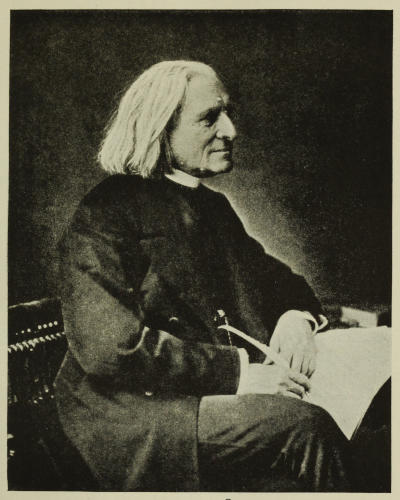
LISZT IN 1875
Photograph taken in Budapest
In 1849 his career as a virtuoso-pianist practically came to an end and he settled in Weimar. He soon made this town the centre of a brilliant artistic life.
Professional and amateur musicians flocked there to study under the generous master who gave instruction to talented pupils without remuneration. Others came to hear rare and new works performed under his bâton at the Court Theatre of which he was conductor. His splendid interpretations of Lohengrin and Tannhäuser contributed no little in establishing Wagner’s reputation at a time when he greatly needed such endorsement as Liszt was able to give.
In 1861 Liszt left Weimar and went to Rome, where he took minor orders in 1865. Subsequently he was known as the Abbé Liszt.
The last years of his life were divided between Rome, Weimar and Buda-Pesth, an active and influential force in musical art until his sudden death at Bayreuth in 1886.
There are two great paradoxes in the career of Liszt. The first is that just as Rossini, the most popular opera composer of his day, ceased writing operas thirty-nine years before his death, so Liszt, the greatest and most adored pianist of all times, ceased playing in public (except for an occasional charitable purpose) about the same number of years before his end came. He had with his inimitable art familiarized concert-goers with nearly all the best compositions for the piano created by other masters. He had transcribed for the same instrument a large number of songs, operatic melodies and orchestral works (the number of these transcriptions at his death was 371) thereby vastly increasing their vogue. He also wrote altogether 160 original compositions for the pianoforte, many of them as new in form as in substance; unique among them being the fifteen Hungarian Rhapsodies—collections of Magyar melodies with gipsy ornaments molded by him into works of art, after the manner of epic poets. But—and here lies the second paradox—Liszt, the greatest of all pianists was not satisfied with the piano. In many of his pieces for it he endeavored to impart orchestral power and variety of tonal effect; and finally, when he became conductor at Weimar, in 1849, he transferred his attention chiefly to the Orchestra. Of his thirty-four orchestral works the most important are the Faust and Dante Symphonies and thirteen Symphonic Poems, in which he deviated from the old symphonic form in a spirit similar to Wagner’s operatic reforms—abolishing unconnected movements and allowing the underlying poetic idea to shape the form of the music.[79]
Liszt linked himself with Berlioz when he heard the Symphonie fantastique. He took up the cause of Berlioz and became his champion. But independently of Berlioz, Liszt was imbued with the Romantic Movement of 1830. To such a genius and man of the world who came in contact with all the great intellects of the day, it soon became natural to him to make art human and emotional.
Therefore in both his playing and his composition Liszt departed from the Classic ideals of an earlier period and became an expression of his own time. In his endeavor to depict and express emotions, ideas, scenes of nature and even events, he felt that the old Classic forms were suited only to music that was purely music and nothing else. In the new paths that the “Music of the Future” had made for itself a new form was needed to express sensations and ideas of a new age of keener observation, intense sentiment and passionate enthusiasm. Consequently Liszt invented the Symphonic Poem, in which the movements are not divided as in the regular Symphony but lead into one another.
In his orchestration Liszt followed Beethoven, Berlioz and Wagner. It is always rich and heavy and full of color. Liszt makes great use of the harp and his Hungarian blood shows itself in his marvellous and stirring rhythms.
“Concerning so prodigious an activity, so far-seeing an intelligence, so all-embracing a mind, so complete a musical organization, so ardent an imagination, so enthusiastic a nature, so unselfish a character, anything that may be said must seem inadequate.
“The spirit of Franz Liszt soared far above the petty meannesses of life. His influence has been great and far-reaching, and if he has left a priceless artistic legacy to the world, he has also given it a magnificent and unique example of benevolence and self-abnegation and realised to the fullest extent his own motto, Génie oblige!”
The third and greatest member of this remarkable trio, Richard Wagner, seems to have gathered up all that was best in the music that preceded him and having assimilated it in the crucible of his mind, gave it forth again, fresh, new and vital.
Wagner was born in Leipzig in 1803 and died in Venice, in 1883. His career as a musician began in 1833, after he had taken part in the Revolutionary politics of 1830.
His early life was spent in struggling with poverty and composing operas, which were not successful. He acquired greater fame as a conductor than as a composer. Called to be conductor of the Dresden Orchestra in 1842, he began his work by conducting works of Berlioz, who was then making a tour in Germany. (See page 251.) Berlioz speaks gratefully of Wagner’s “zeal and good will” in this matter and also of the success of Rienzi and The Flying Dutchman in Dresden.
The active part he took in Revolutionary politics offended the Court; and Wagner, compelled to flee, hastened to Liszt in Weimar. Liszt got him a passport under a fictitious name; and Wagner hurried to Paris and thence to Zürich, where he finished Lohengrin and sent it to Liszt to produce in Weimar.
The first half of Wagner’s life was singularly unhappy; the last was singularly happy. He had the good fortune to attract the interest of the young King of Bavaria, Ludwig II, who became his patron and turned Wagner’s dreams into realities.
After forty years of struggle and disappointment, Wagner had his own theatre at Bayreuth, where his works were given under ideal conditions. The Bayreuth Opera House was opened in 1876, with a great performance of the Nibelungen Ring; and the greatest artists of the day played in the Orchestra of which Wilhelmj was the first violinist. In the meanwhile, Tristan had been splendidly performed in Munich in 1865 and Die Meistersinger in 1868.
One of Wagner’s great ideas was to make the Orchestra a vital part of his music dramas. In other words he carried the Symphony-Orchestra into the opera.
Wagner is the greatest master of orchestration that the world has ever seen.
“Wagner treats every instrument with the same certainty of touch as if he had played it himself. He knows, as no one else knows, how to avail himself of its resources, and he demands nothing of it beyond what is entirely within its capacity.
“Notwithstanding the large number of performers he requires, he never has recourse to complicated methods in his orchestration. The combinations are always clear and simple, resulting in a sonority that is both plain and powerful. The Leitmotive (guiding themes) ceaselessly move about the whole Orchestra, passing from one desk to another; but, nevertheless, each one has a fondness for one special instrument, or one group of instruments, which agrees with its character, on which it is first heard and to which it returns whenever it must be heard again with preponderating importance. Sometimes we recognize it from its very first note by means of this characteristic timbre.
“Wagner developed the art of orchestration, of orchestral coloring to a point before unknown, a point which is apparently its final limit; but in art there is no limit, its progress is endless. I will not name the person, but it seems to me that there is now among French composers one who has surpassed Wagner in this very respect. Wagner, however, in addition to the new combinations that he devised among the various instruments of the classic Orchestra, introduced new elements, notably tubas, a family intermediate between horns and trumpets, and the bass trumpet which figures in nearly all of his scores, and singularly enriches the group of brasses without rendering his instrumentation any more noisy.”[80]
“Wagner is a supreme master of instrumentation, of orchestral color. His Orchestra differs from Beethoven’s in the quality of tone emitted; over and above effects of richness obtained by the more elaborate treatment of the inner part of the string-quartet, the frequent subdivision of violins, violas, violoncellos, the use of chromatics in horn and trumpet-parts, etc. There is a peculiar charm in the very sound of Wagner’s woodwind and brass. It is fuller than Beethoven’s, though singularly pure. And the reason for this is not far to seek. Wagner rarely employs instruments unknown to Beethoven, but he completes each group or family of wind-instruments with a view to getting full chords from each group.
“Thus the two clarinets of Beethoven’s Orchestra are supplemented by a third clarinet and a bass-clarinet if need be; the two oboes by a third oboe, or a cor anglais (alto oboe); the two bassoons by a third bassoon and a double-bassoon; the two trumpets by a third trumpet and a bass trumpet, etc. The results got by the use of these additional instruments are of greater significance than at first appears, since each set of instruments can thus produce complete chords and can be employed in full harmony without mixture of timbre unless the composer so chooses.
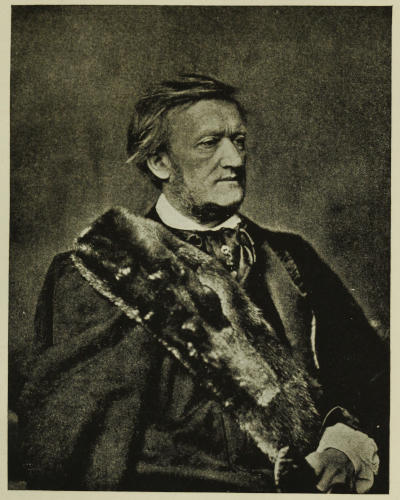
WAGNER
Photograph taken in Munich
“To account for the exceptional array of extra instruments in the scores of the Nibelungen Ring it is enough to say that they are used as special means to special ends.
“Thus at the opening of the Rheingold, the question is what sound will best prepare for and accord with dim twilight and waves of moving water? The soft notes of the horns might be a musician’s answer; but to produce the full, smooth wavelike motion upon the notes of a single chord, the usual two, or four, horns are not sufficient, Wagner takes eight, and the unique and beautiful effect is secured.
“Again, in the next scene, the waves change to clouds: from misty mountain heights the gods behold Walhalla in the glow of the morning sun. Here subdued, solemn sound is required. How to get it? Use brass instruments piano. But the trumpets, trombones and tuba of Wagner’s usual Orchestra cannot produce enough of it. He, therefore, supplements them by other instruments of their family: a bass trumpet, two tenor and two bass tubas, a contrabass trombone and a contrabass tuba. Then the full band of thirteen brass instruments is ready for one of the simplest and noblest effects of sonority in existence.
“At the close of the Rheingold, Donner with his thunder-hammer clears the air of mist and storm-clouds; a rainbow spans the valley of the Rhine and over this glistening bridge the gods pass to Walhalla. What additional sounds shall accompany the glimmer and glitter of this scene? The silvery notes of harps might do it; but the sounds of a single harp would appear trivial, or would hardly be audible against the full Orchestra. Wagner takes six harps, writes a separate part for each, and the desired effect is forthcoming.”[81]
It might seem that after Wagner nothing more could be done with the Orchestra. But the progress of Music, like all other arts, never ceases. We have three more great names to consider—Richard Strauss, Tschaikowsky and Debussy.
“Richard Strauss is an intellectual musician. Saint-Saëns pointed out long ago the master part harmony would play in the music of the future, and Strauss realized the theory that melody is no longer sovereign in the kingdom of tone. His master works are architectural marvels. In structure, in rhythmical complexity, in striking harmonies, ugly, bold, brilliant, dissonantal, his symphonic poems are without parallel. Berlioz never dared, Liszt never invented such marvels of polyphony, a polyphony beside which even Wagner’s is child’s play and Bach’s is rivalled. And this learning, this titanic brushwork on vast and sombre canvases are never for formal music’s sake; indeed, one may ask if it is indeed music and not a new art. It is always intended to mean something, say something, paint someone’s soul. It is an attempt to make the old absolute music new and articulate.
“The greatest technical master of the Orchestra, making of it a vibrating dynamic machine, a humming mountain of fire, Richard Strauss, by virtue of his musical imagination, is painter-poet and psychologist. He describes, comments and narrates in tones of jewelled brilliancy; his Orchestra flashes like a canvas of Monet,—the divided tones and the theory of complementary colors (over-tones) have their analogues in the manner with which Strauss intricately divides his various instrumental choirs: setting one group in opposition, or juxtaposition, to another; producing the most marvellous, unexpected effects by acoustical mirroring and transmutation of motives; and almost blinding the brain when the entire battery of reverberation and repercussion is invoked. If he can paint sunshine and imitate the bleating of sheep, he can also draw the full-length portrait of a man. This he proves with his Don Quixote, wherein the noble dreamer and his earthly squire are heard in a series of adventures terminating with the death of the rueful knight—one of the most poignant pages in musical literature.”[82]
Richard Strauss was born in Munich, in 1864. His father, Franz Strauss, was first horn-player in the Court Orchestra and could play almost every orchestral instrument. He was an extraordinary musician. Once when playing under Wagner’s bâton, the composer said to him: “Strauss, you can’t be such an anti-Wagnerite as I hear. You play my music so beautifully!” “What has that got to do with it?” the horn-player replied.
Richard early showed his great genius. He played the piano at the age of four and began to compose at the age of six. While at school he had lessons on the piano and violin and studied composition.
“My father kept me very strictly to the old masters,” says Strauss, “in whose compositions I had a thorough grounding. You cannot appreciate Wagner and the moderns unless you pass through a grounding in the Classics. Young composers bring me voluminous manuscripts for my opinion on their productions. In looking at them, I generally find that they want to begin where Wagner left off. I say to all such: ‘My good young man, go home and study the works of Bach, the symphonies of Haydn, Mozart and Beethoven, and when you have mastered these art works come to me again.’ Without thoroughly understanding the significance of the development from Haydn via Mozart and Beethoven to Wagner, these young students cannot appreciate at their proper worth either the music of Wagner, or of his predecessors. ‘What an extraordinary thing for Richard Strauss to say,’ these young men remark; but I only give them the advice gained by my own experience.”
Strauss early attracted the attention of Hans von Bülow, who played his Serenade for wind instruments (op. 7) at Meiningen. In 1885 Strauss was chosen to succeed von Bülow as conductor of that famous Orchestra. In 1885 he became third Kapellmeister in Munich, and, in 1889, assistant Kapellmeister at Weimar. Later he returned to Munich as Court Kapellmeister; and three years later he was made general music director. For a little while he was conductor of the Berlin Philharmonic Orchestra and in 1899 was made Kapellmeister at the Berlin Royal Opera, which position he still holds.
“If the now childish simplicity of Schubert’s orchestration proved a stumbling block to the Viennese Orchestra only fifty odd years ago, and furthermore Wagner’s Tristan and Isolde shared the same fate at a still more recent date, it will not be difficult to realise that Strauss fifteen years ago taxed the virtuosity of the performers with passages that are no longer dreaded.
“The flexibility of execution that formerly was expected only of a first violinist is now imposed upon all five sections of the string band and each member finds before him the pages of what looks like a concerto. To the woodwind are assigned passages that Wagner would have hesitated to write. What Strauss demands from them, Beethoven might have demanded from the strings. Most prominent of all is the attention bestowed upon the deployment of the brass as initiated by Wagner. The trumpets are treated with unprecedented freedom, and are expected to perform passages either of flowing melody, or of rhythmic intricacy in the fastest of tempi. The horns are taught to display the agility of violoncellos. In four-part writing, the fourth horn is much used as a deep bass instrument absolutely apart from the three upper horns. The trombones are employed as much for unallied melodic utterance as for combined harmonic effects, and the intricacy of their parts constantly necessitates the use of three staves in the score. Incidental mention might also be made of such devices for acquiring weird tonal tints as obtained from muted trombones. Similar to Wagner’s procedure in the Overture to the Meistersinger, the tubas—and particularly the tenor tuba—are constantly detached from their conventional association with the trombones, for the purpose of giving expression to flowing cantilena.
“Novelty in the use of instruments of percussion is restricted to rhythmic peculiarities and original combinations with other instruments of more variable pitch; for Wagner’s general method of handling the battery cannot be improved upon.
“In a word, the three choirs of the Orchestra have advanced one step higher. The string-band has become so many virtuoso soloists. The woodwind replace the strings and are themselves replaced by the brass. The battery has acquired prominence such as the Classicists allowed to the trumpets and trombones.
“Strauss advances yet farther by making permanent Wagner’s occasional incorporation into the Orchestra of a second harp, an E-flat clarinet, a double quartet of horns, five instead of four trumpets, and a tenor tuba in addition to a bass tuba. The occasional addition of unusual instruments, such as an oboe d’amore and saxophones, is required.”[83]
In 1864 one of the chief critics of Russia pointed out Tschaikowsky as “the future star of Russian music.” His prediction was verified. Tschaikowsky is now ranked with the great masters. His great popularity in this country is largely due to Mr. Walter Damrosch, who invited him to take part in a series of festival concerts in 1891 at the opening of Carnegie Hall in New York. Here Tschaikowsky conducted several of his works, many of which were already known and loved by concert-goers.
We are all familiar now with Tschaikowsky’s great sweeps of tone; dark, melancholy harmonies; and strange, barbaric rhythms.
“Tschaikowsky is eclectic, and many cosmopolitan woofs run through the fabric of his music. Italy influenced, then Germany, then France; and, in his later day, he let lightly fall the reins on the neck of his Pegasus and was much given to joyously riding in the fabled country of ballet, pantomime, and other delightful places.”[84]
This is perfectly true, but beyond and above all else Tschaikowsky is Russian.
“Like most Slavs,” writes Ernest Newman, “he drew sustenance more from France than Germany. Brahms he thought dull; Wagner he never really understood. He loved music, he said, that came from the heart, that expressed ‘a deep humanity,’ like Grieg’s. To the delicate brain and nerves of the modern man he added the long-accumulated eruptive passions of his race. He takes the language made by the great Germans and uses it to express the complex pessimism of another culture. The color of life in his music ranges from pale gray to intense black, with here and there a note of angry scarlet tearing through the mass of cloud.”
Peter Ilich Tschaikowsky was born in 1840 in Votinsk in the government of Viatka, where his father was inspector of the government mines, soon removing to Petrograd, where the boy received his education. He studied music, played the piano well, and composed light music; but with him at this time music was merely an accomplishment and a social pleasure. In 1861 he began to study music seriously and gave up his work to face poverty for the sake of art. In 1865 he completed his course at the Conservatory, where he had attracted the admiration of Anton Rubinstein with whom he studied orchestration. As an instance of his industry Rubinstein’s story may be quoted. “Once at the composition class,” said Rubinstein, “I set him to write out contrapuntal variations on a given theme, and I mentioned that in this class of work not only quality but quantity was of importance. I thought perhaps he would write about a dozen variations. But not at all. At the next class I received over two hundred. To examine all these would have taken me more time than it took him to write them.”
When Nicholas Rubinstein organized the Conservatory in Moscow in 1866, he gave Tschaikowsky the chair of professor of harmony. He spent much time in composing and Nicholas Rubinstein brought out his works at the concerts of the Russian Musical Society. Tschaikowsky’s life is in his works. Whether in Petrograd, Moscow, in his country home, in Paris, or travelling, he was always composing; and, consequently, his list of works is long.
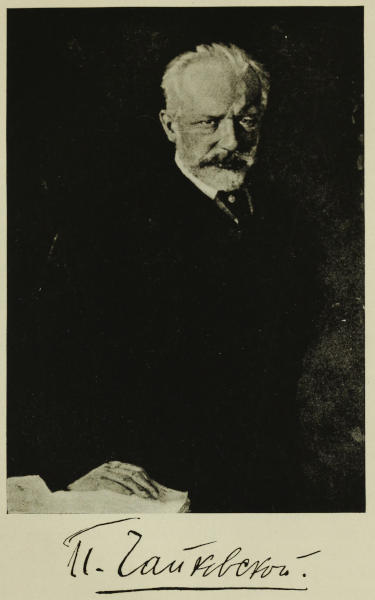
TSCHAIKOWSKY
Photograph taken in Petrograd
Although Tschaikowsky wrote light operas, he is chiefly known for his orchestral music—his magnificent symphonies and his symphonic poems. So immense are these works in their effect that the hearer often imagines that Tschaikowsky called for an orchestra with as many additional instruments, new and old, as Richard Strauss. This is not the case, however. For instance, in the Symphonie pathetique he has the Beethoven orchestra with the addition of the bass tuba.
“A remarkable feature of his scoring is the extreme modern effect secured with comparatively modest means. He expressed himself in a language of profound pathos which was in part due to the embodiment of weird and gloomy orchestration. He made prominent use of low woodwind, which were constantly combined with the violas, and he evinced peculiar predilection for clarinets in their low range and bassoons in their upper range.”[85]
In the Casse Noisette Suite (Nut-cracker Suite), which is so charming in its playfulness, his instrumentation is particularly novel. In it he introduced the celesta (see page 128).
Tschaikowsky should be described as a follower of Berlioz, Liszt, and Mozart. He was particularly devoted to Mozart as his fourth orchestral suite, entitled Mozartiana plainly shows. In a preface to this work Tschaikowsky says: “A large number of the most admirable compositions of Mozart are, for some inexplicable reason, hardly known not only to the public but even to the majority of musicians.”
Tschaikowsky died of cholera in Petrograd in 1893.
We have seen that in the days of Berlioz the French public cared more for operatic than for symphonic music. After Berlioz, composers devoted much more thought to the Orchestra; and French music now contains a long list of masterpieces and admirable works.
Orchestral concerts under the direction of Habeneck and Pasdeloup and afterwards under Lamoureux and Colonne did much to make symphonic music popular in Paris.
The greatest name in the development of Orchestral music since Berlioz is that of Saint-Saëns, whose orchestration, although rich and elaborate, is always clear and polished to the last degree. The exquisite Symphonic Poem, called Le Rouet d’Omphale, may be taken as an example. It is not merely a beautiful piece of descriptive writing, but it is beautifully scored.
Camille Saint-Saëns is the oldest living French composer. He was born in 1835 in Paris and early showed his great talent for music. At the age of seven he began to study the piano with Stamaty and harmony with Maleden. In 1846, at the age of eleven, he appeared at a concert in the Salle Pleyel; and a year later entered the Conservatory. Here he made a name for himself. His Symphony, composed at the age of sixteen, was successfully performed. In 1858 he became organist at the Madeleine in Paris and astonished everyone by his feats of improvisation. Meantime, he continued composing. He has produced an immense number of works that include every kind of composition from operas to chamber-music, songs and pieces for the harp.
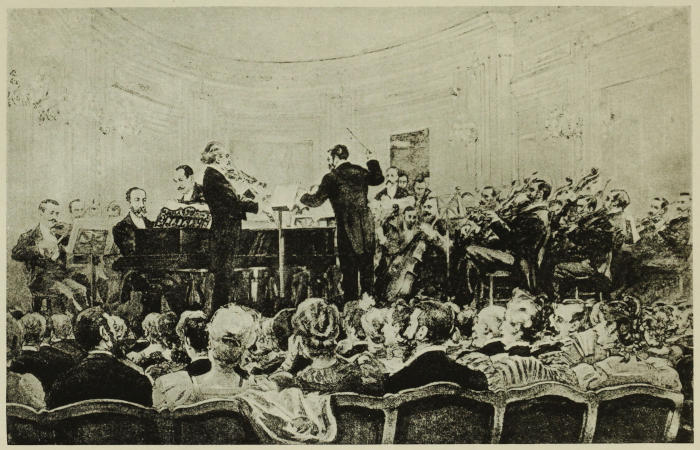
SAINT-SAËNS’ FESTIVAL CONCERT
Paris, 1896
Saint-Saëns has also been an extensive traveller and has spent much time in Algiers. He is an incomparable pianist, a fine musical critic, and an excellent writer. Saint-Saëns is another instance of the general culture required of the modern musician—the type that came into existence after the Revolution of 1830 (see page 244).
Saint-Saëns was made an officer of the Legion d’Honneur in 1884. On June 2, 1896, the fiftieth anniversary of his first public appearance was celebrated in the Salle Pleyel, on which occasion Taffanel conducted the orchestra and Sarasate played a sonata by Saint-Saëns (see illustration facing 268), with the composer at the piano. At the age of seventy he came to America and astonished his audiences by playing his five piano concertos, accompanied by Walter Damrosch and the New York Symphony Orchestra, with marvellous skill and the fire of youth.
Debussy is a modern of the moderns; and, moreover, he has led music into a new path.
Debussy is, however, but one of a group of French musicians who, for the last thirty or forty years, have been developing French music more according to the traditional taste of their nation than it had been since the days of Rameau. In fact, these musicians have carried music back to its fountain head; and we may say that the same spirit that characterized the works of the trouvères of the Fifteenth Century (music such as is being played by King René’s musicians in our frontispiece); the same spirit that was expressed in the music of the French Renaissance; the same spirit that was heard in the operas and ballets of Lully and Rameau lives again, though in a new form.
Of all these modern French composers—Gabriel Fauré, Maurice Ravel, Albert Roussel, Emmanuel Chabrier, Vincent d’Indy, Ernest Chausson, Henri Duparc, Paul Dukas, Florent Schmitt, Déodat de Séverac, and Ernest Satie—Claude Debussy is the leading spirit; and, perhaps, the greatest genius.
Claude Achille Debussy was born at Saint-Germain-en-Laye, in 1862. He entered the Conservatory in Paris at the age of twelve and studied under Albert Lavignac, Marmontel, Durand, and Guiraud. In 1884 he took the prix de Rome; and from the Eternal City he went to Russia. On his return to Paris he became one of the frequent guests at those famous soirées of Mallarmé, where painters, poets, sculptors, and musicians gathered.
His piano works, songs, instrumental pieces, and orchestral compositions, such as L’Après midi d’un faune, were admired by many persons on their first hearing; but his audience was comparatively small until the opera of Pelleas et Mélisande made him known throughout the world. Here was an entirely new idea in music. The Orchestra did not annotate, nor emphasize the actions of the persons on the stage, but it became a soft, melodious atmosphere, a delicious web of harmony enfolding the entire work. It was like nothing that had ever been written.
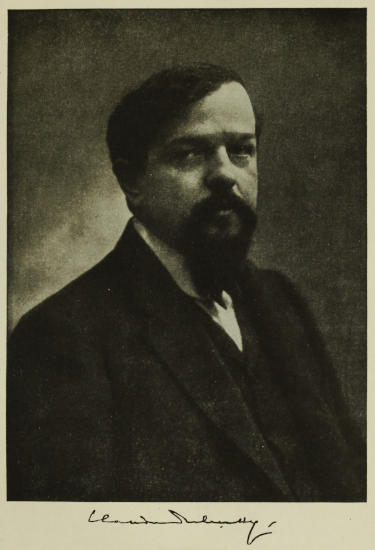
DEBUSSY
Photograph taken in Paris
One idea of Debussy’s in orchestral writing is to get the greatest effect with the simplest means. To produce these effects Debussy employs many old scales and harmonic chords. His instrumentation, therefore, seems diaphanous, ethereal, and suffused with delicate, opalescent colors. He is in sympathy with the impressionists in painting and the symbolists in poetry. The fluid quality of his music lends itself to the description of water. His works are full of the sound of water—the sea, fountains, and silvery rain falling upon dim gardens. He creates a sense of mystery and atmospheric beauties as no one else has ever done.
In the Afternoon of a Faun:
“The ascending and descending introductory bars given out by an unaccompanied flute convey an idea of pastoral charm. A characteristic bucolic horn motive follows, and the first theme is repeated with muted string accompaniment. The whole scoring of the composition is of cobweb delicacy. The Orchestra is composed of three flutes, oboes, clarinets, four horns, two harps, antique cymbals, and strings. The principal themes are given by clarinets, oboes, and harps respectively. A scale of whole tones is heard on the clarinet; this leads to another section marked più animato, in which the oboe voices the principal theme. These subjects are all interwoven with and linked to other themes. They are heard sometimes as solos, sometimes concerted. The rhythm of the whole work is free and varied. The strings, muted or otherwise, are often used as a kind of background to the wind solos, which is most effective. A veil of palpitating heat seems to be suffused over the composition and corresponds to the glow of Eastern sunlight in the poem and also to the remote, visionary nature of the poet’s imagery and fancies. The tone poem also recalls the golden noon of an Idyl of Theocritus. All through the piece the composer preserves this feeling of elusiveness, of mirage: he attains it by the use of delicate unusual harmonies and by the silvery, web-like tracery of his phrases. The frequent use of the scale of whole tones and the unresolved dissonances produce a distinct charm of their own. The chords are of an exceeding richness and present a depth of glowing color. The interspersed solos for violin, oboe, clarinet, cor anglais, resemble dainty broidery, and portray intimately the ramifications of doubt and longing in the faun’s mind, which he likens to a multitude of branches with slender pointed sprays and sprigs.”[86]
Debussy thus explains some of his titles: “The title of Nocturnes is to be interpreted in a wider sense than that usually given, and most especially it should be understood as having a decorative meaning. Therefore, the usual form of Nocturne has not been considered, and the word should be accepted as signifying in the fullest manner diversified impressions.
“Nuages (clouds)—the unchanging aspect of the sky and the slow, solemn movement of the clouds dissolving in gray tints lightly touched with white.
“Fêtes (festivities)—the restless dancing rhythm of the atmosphere interspersed with sudden flashes of light. There is also an incidental procession (a dazzling imaginary vision) passing through and mingling with the aërial revelry; but the background of uninterrupted festivity is persistent with its blending of music and luminous dust participating in the universal rhythm of all things.
“Sirénes (sirens)—the sea and its perpetual rhythm, and then amid waves silvered by moonbeams are heard the laughter and mysterious song of passing sirens.”
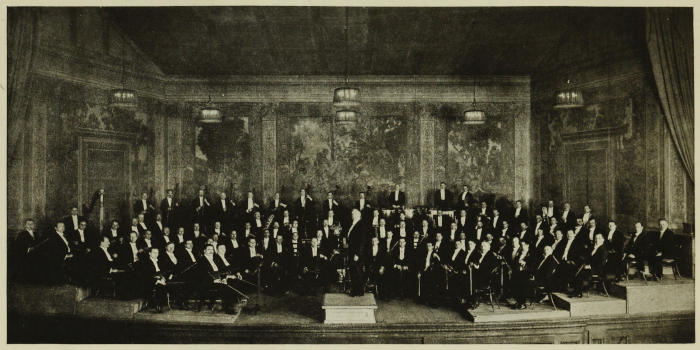
ORCHESTRA OF THE SYMPHONY SOCIETY OF NEW YORK
Walter Damrosch conducting
Some critics have called Debussy a revolutionist. They are wrong. Debussy’s musical ancestors are Rameau and Couperin; and his works show us that “revolution is merely evolution made clear for all to see.”
Such is the French music of the present—beautiful, refined, clear, polished, delicate, enchanting!
We, in our great country, like to hear all schools of music, and our wonderful orchestras are able to play equally well the works of all composers and of all schools and nationalities. Some of us prefer the French, some of us the Russian, and some of us the German Schools; but our taste is broad and cultured, and we wish to hear the various ways in which the musical minds of the day are expressing themselves.
What an advance since the days of “a consort of lutes, or viols”! What a development since the Fifteenth Century, when gentle ladies played the psaltérion and flute and vielle, as seen in our frontispiece! But to appreciate the evolution of the Orchestra, let us look at the picture of an Orchestra of the Eleventh Century (facing page 274), the earliest known representation of any Orchestra, taken from the capital of a column of a church near Rouen, and then compare it with the picture of the Symphony Society of New York (facing page 272).
Between these two Orchestras, separated by a period of eight hundred years, we can realize the progress of “music’s ever welling spring, which has flowed through the centuries until it has become an ocean.”