Chapter VIII · THE ORCHESTRA (continued 2)
Reading edition
Handel was considered horribly noisy in his day. His friend, Goupy, the artist, made a caricature that doubtless amused Handel, who saw himself represented at the organ as a huge, unwieldy figure with a boar’s head and enormous tusks (referring to his violent temper) and the room full of horns, trumpets and kettledrums, while a donkey is also present braying loudly and in the distance a battery of artillery is ready for action.
It is noticeable, too, in Handel’s Orchestra, as in Bach’s, that we get no (or very little) tone-color. Handel’s Orchestra is neutral in tint. The organ and the keyboard idea is still prevailing—all the instruments combine, as it were, to produce the one hue.
“But great painter as Handel was, he did not work so much through the brilliancy, variety and novelty of his tone-colors as by the beauty of his designs and his effects of light and shade. With a voluntarily restrained palette and by satisfying himself with the sober colors of the strings, he yet was able to produce surprising and thrilling effects. Volbach has shown that he did not contrast and mix his strings but divided the same family of instruments into different groups. In the introduction to Esther (1732), the violins are divided into five groups, in the Resurrection (1708) into four groups. The violas are sometimes divided into two, the second group being reinforced by the third violin, or the violoncellos. On the other hand, when Handel wanted to do so, he reduced his instrumental forces by suppressing the viola and the second violin, whose places were taken by the clavecin. All his orchestral art is the true instinct of balance and economy, which, with the most restricted means in managing a few colors yet knows how to obtain as powerful impressions as our musicians to-day with their crowded palettes.
“One is prone to accept too readily the idea that expressive nuance is the privilege of modern musical art and that Handel’s Orchestra knew only the great theatrical contrasts between force and sweetness, or loudness and softness. It is nothing of the kind. The range of Handel’s nuances is extremely varied. We find with him pianissimo, piano, mezzo piano, mezzo forte, un poco più F., un poco F., forte, fortissimo. We never find the orchestral crescendo and decrescendo, which hardly appears marked until the time of Jomelli and the school of Mannheim; there is no doubt, however, but that it was practised long before it was marked in the music. The President of Brosses wrote in 1739 from Rome: ‘The voices like the violins used with light and shade with unconscious swelling of sound, which augments the force from note to note, even to a very high degree since its use as a nuance is extremely sweet and touching.’ And endless examples occur in Handel of long crescendi and diminuendi without their expression being marked in the scores. Another kind of crescendo and diminuendo—made on the same note—was very common in the time of Handel. His friend, Geminiani, helped to set the fashion.
“As Geminiani explains it: ‘The sound ought to commence softly and should swell out in a gradual fashion to about half its value. Then, it should diminish to the end. The movement of the bow should continue without interruption.’”[56]
Padre Martini said that Gluck combined in the music-drama “all the finest qualities of Italian and many of those of French music with the great beauties of the German orchestra.”
Gluck began where Handel left off. Handel had already treated mythological subjects. He had also written an Alceste and an Armida before Gluck appeared on the scene. Handel (who is said not to have liked Gluck at all) was Gluck’s chosen master on account of “the wonderful beauties of his melodies, the grandeur of his style and his rhythms like armies on the march.”
Gluck not only followed Handel, but he adored him. He kept Handel’s portrait over his bed!
“Gluck gave the Orchestra a new life, assigning the first place to it in some cases, letting it express the feeling that captivates the listener. With him violins, oboes and trombones are not merely sonorous agents; they are living entities, personages of action. Through the Orchestra he adds dazzling beauty to a temple scene, or a scene in the Elysian Field; and by little touches on certain instruments here and there he can make us feel the mystery of the infernal regions. Gluck’s great gift to the Orchestra was to make it speak.”[57]
Christoph Willibad Gluck was born near Neumarkt in the Upper Palatinate (Austria) in 1714. He was educated in music in Prague and in Vienna; and fortunately attracted the attention of Prince Melzi, who took him to Milan to direct his private Orchestra. We all know how his successful operas in Vienna prepared the way for still greater triumphs in Paris, where Gluck enjoyed the patronage of the Queen Marie Antoinette, who, being an Austrian, had known and loved Gluck’s works in Vienna.
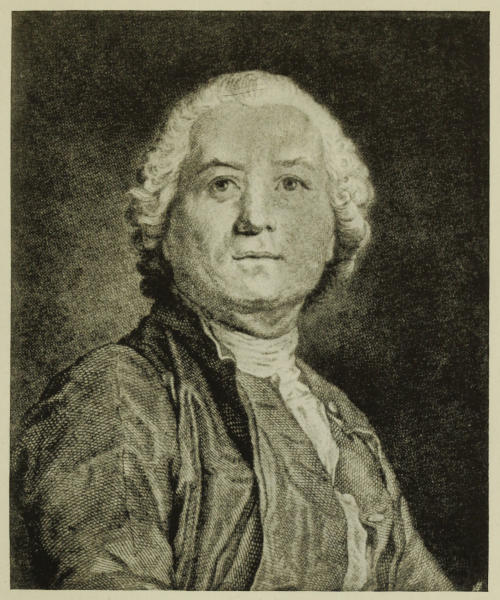
GLUCK
By Duplessis
All the histories and memoirs of the time speak of the quarrel between the followers of Gluck and Piccini. Piccini represented the old Italian style and Gluck stood for the new dramatic style—the latest thing out it happened to be. The Piccinists accused Gluck of composing operas with little melody, no truth to nature, little elegance or refinement, and a noisy Orchestra. “Gluck’s modulations,” they said, “were awkward and he had no originality, no finish, no polish.” In short, Gluck was everything that was abominable.
Dr. Burney informs us that: “No door in Paris was opened to a visitor without the question being asked—‘Monsieur, are you a Picciniste, or a Gluckiste?’”
The Piccinists are forgotten: the Gluckists still live. We are among them; for, to our way of thinking, nothing more noble and inspired than Orfeo was ever written. And if polish and elegance are to be found anywhere in music, they appear in the scores of Gluck.
“Yet, if he had merely carried to perfection the work begun by Lully and Rameau; if his efforts had been limited to removing the harpsichord from the Orchestra, introducing the harp and trombones, employing the clarinets, scoring with skill and effect, giving more importance and interest to the overture and using with such magic effect the artifice of momentary pauses to vary or emphasize speech in music,—if he had done no more than this, he would have earned our gratitude, but he would not in that case have been one of the monarchs of art.
“What then did he accomplish that was so extraordinary?
“He grasped the idea that the mission of music was not merely to afford gratification to the senses, and he proved that the expression of moral qualities is within its reach. He disdained all such tricks of the trade as do not appeal to the heart—in fact, he preferred the Muses to the Sirens. He aimed at depicting historic, or legendary, characters and antique social life; and in his works of genius he put into the mouths of each of his heroes accents suited to their sentiments and to the spirit of the time in which they lived. He made use of the Orchestra to add to the force of a dramatic situation, or (in one noble instance) to contrast external repose with the internal agitation of a remorseful conscience. In a word, all his French operas show him to have been a noble musician, a true poet and a deep thinker.”
Gluck also contributed to the development of the ballet and made the dance a vital part of the story of the opera, as, for instance, the ballet of the Spirits of the Blest in Orfeo.
His ballet-music is very beautiful in form and melody and choice of instruments that play it.
“With Gluck,” says Romain Rolland, “the ballet lost some of the delightful exuberance it had had in Rameau’s operas; but what it lost in originality and richness, it gained in simplicity and purity; and the dance airs in Orfeo are like classic bas-reliefs, the frieze of a Greek Temple.”
“To think,” said Beethoven in his last days, looking at a picture of Haydn’s birthplace, “that so great a man should have first seen the light in a peasant’s wretched cottage!”
Haydn’s career once again proves that genius finds its level in the world. Haydn was born of poor parents in Rohrau, a small Austrian village near the borders of Hungary, in 1732. We all know how as a child he sang in the choir at St. Stephen’s in Vienna and played the kettledrums, piano and violin. At an early age he began to compose; and when he was about thirty he became assistant director of music in Prince Esterhazy’s house at Eisenstadt.
The story of Haydn’s entering into the service of one of the most important princes in Europe is interesting.
Haydn had attracted the attention of Prince Esterhazy by one of his symphonies; and friends of Haydn’s arranged that he should compose a symphony to be performed at Eisenstadt on the Prince’s birthday.
“Haydn executed it and it is worthy of him. The day of the ceremony having arrived, the Prince, seated on his throne and surrounded by his court, attended at the usual concert. Haydn’s symphony was begun. Scarcely had the performers got to the middle of the first Allegro, than the Prince interrupted them and asked who was the author of that fine composition.
“‘Haydn,’ replied Friedberg, and he made the poor young man, all trembling, come forward.
“‘What!’ exclaimed Prince Esterhazy, ‘is it this Moor’s music?’ (Haydn’s complexion, it must be confessed, gave some room for this sarcasm.) ‘Well, Moor,’ he said, ‘from henceforth you remain in my service. What is your name?’
“‘Joseph Haydn.’
“‘Surely I remember the name. You are now engaged to me. Go and dress yourself like a professor. Do not let me see you any more in this trim. You cut a pitiful figure. Get a new coat, a wig and buckles, a collar and red heels to your shoes; and I particularly desire that your shoes may be high, in order that your stature may correspond to your intelligence. You understand me? Go your way and everything will be given to you.’
“Haydn kissed the Prince’s hand, and retired to a corner of the Orchestra, a little grieved at being obliged to hide his natural hair and youthful figure. The next morning he appeared at his Highness’s Levee imprisoned in the grave costume which had been ordered. He had the title of Second Professor of Music, but his new comrades called him simply the Moor.”[58]
In 1762 Prince Nicolaus Esterhazy succeeded his brother and Haydn soon became head of the entire music of the household. The “Magnificent Prince Esterhazy,” as he was called, now turned an old hunting-lodge into a splendid residence, making it a miniature Versailles. The house was not only palatial, but there were deer-parks, gardens, hot-houses, summer-houses, temples, grottoes, “hermitages,” two theatres equipped with scenery and also a chapel. The musical establishment was large. The Prince paid big salaries and the musicians were engaged for several years at a time. There was a large opera company, a large Orchestra and individual solo players on certain instruments. Haydn had charge of it all. He was on friendly terms with Prince Esterhazy himself, for whose viola di bardone, or baryton, he had to write a new piece every day. Haydn lived at “Esterhazy,” as the place was called, until Prince Nicolaus died in 1790. Then he went to Vienna, where he died in 1809.
Haydn was fortunate in having such a patron as Prince Esterhazy; for, of course, he had no trouble in getting his works performed. For thirty years he had an opera-house, an Orchestra—and both of the best—and a cultivated audience as well; for Prince Esterhazy entertained royal and noble personages and amateurs from every nook and corner of Europe.
When Haydn first went to Eisenstadt the Orchestra numbered eighteen instruments, six violins, viola, violoncello, double-bass, flute, two oboes, two bassoons and four horns. Then it was enlarged to twenty-two and twenty-four instruments, including trumpets and kettledrums. There was a great advance in the Orchestra of Esterhazy as the years rolled by; and the last symphonies that Haydn wrote are very much richer than his early ones.
Haydn represents the Orchestra in the same way that Gluck represents the music-drama, Bach the organ and Handel the oratorio. He has been called the “Father of the Orchestra”; and the name, “Papa Haydn,” that Mozart gave to him, has been affectionately retained by posterity.
Haydn fixed the form of the quartet and the Symphony. Mozart and Beethoven were his actual pupils as well as followers. Yet from Mozart, Haydn learned much in the way of writing for instruments. Haydn left the Orchestra in shape for Beethoven to carry still farther.
Haydn’s Orchestra consisted of the string-quartet, two flutes, two oboes, two clarinets, two bassoons, two horns, two trumpets and kettledrums.
His practical knowledge of the kettledrums made him very partial to them; and he was the first to give this instrument an individuality and artistic part in the Orchestra.
Haydn introduced a loud blow on the kettledrum in the Surprise Symphony to startle and wake up the audience. “Here all the women will scream,” he laughingly said when he wrote the part.
Regarding Haydn’s quartets we have the following clever and humorous analysis by Stendhal:
“An intelligent woman said that when she heard a quartet of Haydn’s she fancied herself present at the conversation of four agreeable persons. She thought that the first violin had the air of an eloquent man of genius of middle age who supported a conversation, the subject of which he had suggested. In the second violin she recognized a friend of the first, who sought by all possible means to display himself to advantage, seldom thought of himself and kept up the conversation rather by assenting to what was said by the others than by advancing any ideas of his own. The alto was a grave, learned and sententious man. He supported the discourse of the first violin by laconic maxims, striking for their truth. The bass was a worthy old lady, rather inclined to chatter, who said nothing of much consequence, and yet was always desiring to put in a word. But she gave an additional grace to the conversation, and while she was talking, the others had time to breathe. It was, however, evident that she had a secret inclination for the alto, which she preferred to the other instruments.”
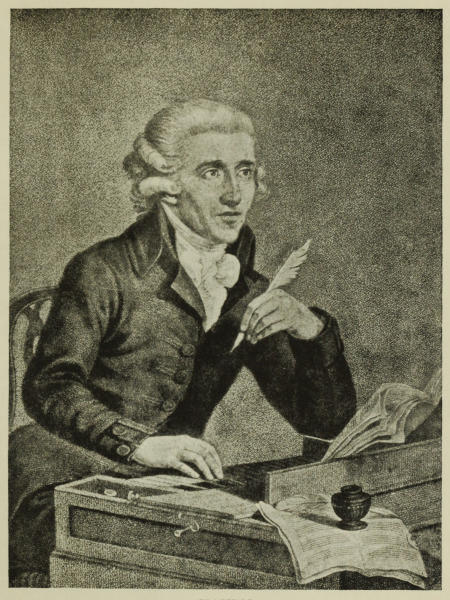
HAYDN
By Gutenbrunn
Stendhal, who knew Haydn well, also writes:
“You must know, my friend, that before Haydn, no man had conceived the idea of an Orchestra composed of eighteen kinds of instruments. He is the inventor of prestissimo, the very idea of which made the old square toes of Vienna shudder. In music, as in everything else, we have little conception of what the world was a hundred years back; the Allegro, for instance, was only an Andantino.
“In instrumental music Haydn has revolutionized the details as well as the masses. It is he who has obliged the wind instruments to execute pianissimo.
“In the same way as Leonardo da Vinci sketched in a little book which he always carried with him the singular faces he met with, Haydn also carefully noted down the passages and ideas which came into his head. When he was in good spirits and happy he hastened to his little table and wrote subjects for airs and minuets. Did he feel himself disposed to tenderness and melancholy, he noted down themes for Andantes and Adagios; and, afterwards, in composing, when he wanted a passage of such a character, he had recourse to his note-book.
“Haydn, like Buffon, thought it necessary to have his hair put in the same nice order, as if he were going out, and dressed himself with a degree of magnificence. Frederick II had sent him a diamond ring; and Haydn confessed that, often, when he sat down to his piano, if he had forgotten to put on his ring, he could not summon a single idea. The paper on which he composed must be of the finest and whitest possible; and he wrote with so much neatness and care that the best copyist could not have surpassed him in the regularity and clearness of his characters. It is true that his notes had such little heads and slender tails that he used, very properly, to call them his flies’ legs.
“It is said that no man had such a knowledge of the various effects and relations of colors and the contrasts which they were capable of forming as Titian. Haydn, likewise, possessed an incredible acquaintance with each of the instruments which composed his Orchestra. As soon as his imagination supplied him with a passage, a chord, or a single note, he immediately saw by what instrument it should be executed, in order to produce the most sonorous and agreeable effect. If any doubt arose during the composition of a symphony, his situation at Eisenstadt enabled him easily to resolve it. He rang his bell in the way agreed on to announce a rehearsal; the performers repaired to the rehearsing-room. He made them execute the passage which he had in his mind in two or three different ways; and, having made his choice, he dismissed them and returned to resume his composition.
“Sometimes he supposed that one of his friends, the father of a numerous family, ill provided with the goods of fortune, was embarking for America in the hope of improving his circumstances. The first events of the voyage formed the symphony. It began with the departure. A favorable breeze gently agitated the waves. The ship sailed smoothly out of the port; while on shore the family of the voyager followed him with tearful eyes and his friends made signals of farewell. The vessel had a prosperous voyage and reached at length an unknown land. A savage music, dances and barbarous cries were heard towards the middle of the symphony. The fortunate navigator made advantageous exchanges with the natives of the country, loaded his vessel with rich merchandise and at length set sail for Europe with a prosperous wind. Here the first part of the symphony returned. But soon the sea begins to be rough, the sky grows dark and a dreadful storm confounds together all the chords and accelerates the time. Everything is in disorder on board the vessel. The cries of the sailors, the roaring of the waves, and the whistling of the wind, carry the melody of the chromatic scale to the highest degree of the pathetic. Diminished and excited chords, modulations, succeeded by semitones, describe the terror of the mariners.
“But, gradually, the sea becomes calm, favorable breezes swell the sails and port is reached. The happy father casts anchor in the midst of the congratulations of his friends and the joyful cries of his children and of their mother, whom he at length embraces safe on shore. Everything at the end of the symphony is happiness and joy.
“I cannot recollect to which of the symphonies this little romance served as a clue. I know that he mentioned it to me, as well as to Professor Pichl, but I have totally forgotten it.
“For the subject of another symphony, Haydn had imagined a sort of dialogue between Jesus Christ and an obstinate sinner, and afterwards followed the parable of the Prodigal Son.
“From these little romances were taken the names by which our composer sometimes designated his symphonies. Without the knowledge of this circumstance, one is at a loss to understand the meaning of the titles The Fair Circassian, Roxalana, The Hermit, The Enamoured Schoolmaster, The Persian, The Poltroon, The Queen, Laudohn, all which names indicate the little romance which guided the composer. I wish the names of Haydn’s symphonies had been retained instead of the numbers.”
When Dr. Burney had nearly finished his immense History of Music he wrote the following words:
“I am now happily arrived at that part of my narrative where it is necessary to speak of Haydn, the admirable and matchless Haydn! from whose productions I have received more pleasure late in my life, when tired of most other Music, than I ever received in the most ignorant and rapturous part of my youth, when everything was new and the disposition to be pleased undiminished by criticism, or satiety.
“The first time I met with his name in the German catalogues of Music is in that of Breitkopf of Leipzig, 1763, to a Divertimento a Cembalo, 3 Concerti a Cembalo, 6 Trios, 8 Quados, or Quartets, and 6 Symphonies in four. The chief of his early music was for the Chamber. He is said at Vienna to have composed before 1782 a hundred and twenty-four pieces for the baryton, for the use of his prince, who is partial to that instrument and a great performer upon it. Besides his numerous pieces for instruments he has composed many operas for the Esterhazy theatre and Church Music that has established his reputation as a deep contrapuntist.
“His innumerable symphonies, quartets and other instrumental pieces, which are so original and so difficult, have the advantage of being rehearsed and performed at Esterhazy under his own direction, by a band of his own forming, who have apartments in the palace and practise from morning to night in the same room, according to Fischer’s account, like the students in the conservatories of Naples.
“Ideas so new and varied were not at first so universally admired in Germany as at present. The critics in the northern parts of the empire were up in arms. And a friend at Hamburg wrote me word in 1772 that ‘the genius, fine ideas and fancy of Haydn, Ditters and Filtz were praised, but their mixture of serious and comic was disliked, particularly as there is more of the latter than the former in their works; and as for rules, they knew but little of them.’ This is a censure which the admirable Haydn has long since silenced; for he is now as much respected by professors for his science as invention. Indeed his compositions are in general so new to the player and hearer that they are equally unable, at first, to keep pace with his inspiration. But it may be laid down as an axiom in Music that whatever is easy is old, and what the hand, eye and ear are accustomed to; and, on the contrary, what is new is, of course, difficult, and not only scholars but professors have it to learn. The first exclamation of an embarrassed performer and a bewildered hearer is, that the Music is very odd, or very comical; but the queerness and the comicality cease, when, by frequent repetition, the performer and hearer are at their ease. There is a general cheerfulness and good humor in Haydn’s Allegros which exhilarate every hearer. But his Adagios are often so sublime in ideas and the harmony in which they are clad that though played by inarticulate instruments they have a more pathetic effect on my feelings than the finest opera air united with the most exquisite poetry. He has likewise movements that are sportive, folâtres, and even grotesque, for the sake of variety; but they are only the entremets, or rather intermezzi, between the serious business of his other movements.”
Haydn’s Symphonies are to-day considered very simple and easy, so it is interesting to learn from Dr. Burney that a hundred years ago they were thought difficult and full of new effects and violent contrasts.
What would Dr. Burney have thought of Richard Strauss!
And now let us place by the side of Dr. Burney’s criticism one by a writer of to-day, which will show us how Haydn is regarded at the present time.
“Of Haydn’s general style as a composer it is hardly necessary to speak. To say that a composition is ‘Haydnish’ is to express in one word what is well understood by all intelligent amateurs. Haydn’s music is like his character—clear, straightforward, fresh and winning, without the slightest trace of affectation, or morbidity. Its perfect transparency, its firmness of design, its fluency of instrumental language, the beauty and inexhaustible invention of its melody, its studied moderation, its child-like cheerfulness—these are some of the qualities which mark the style of this most genial of all the great composers.”[59]
Mozart was, perhaps, the greatest musical genius that ever lived. There was no branch of music in which he did not shine. His life was short. He only lived thirty-five years, but every moment of it was full of music and experience.
Wolfgang Amadeus Mozart was born in Salzburg in 1756 and died in Vienna in 1791. He picked out chords on the harpsichord when he was only a baby and began to compose when he was but four years old. His sister was also a musical genius; and his father, Leopold Mozart, a violinist of reputation, took these two children on concert tours throughout Europe. They visited all the German cities, Paris and London, and in 1769-1770 they travelled through Italy, where Mozart performed in Rome the great feat of writing from memory Allegri’s famous Miserere performed in the Sistine Chapel during Passion Week.
In reviewing Mozart’s life it seems almost impossible that anyone could have composed so many works, travelled so much and lived so much in the world besides. His long list of compositions includes operas, church-music, pieces for the piano, chamber-music, concertos for nearly every kind of known instrument; and for the Orchestra there is an astonishing number of works, among which forty-nine Symphonies are included!
Such genius cannot be accounted for, nor explained: it has to be accepted. We cannot stop to talk of his many great works. We can only say that the older one grows and the more musical knowledge and experience one has, the more one appreciates the charm and greatness of Mozart.
Mozart had the gift of beauty and grace; and those two qualities blended together produce that quality so hard to define and so easy to feel,—charm. Mozart has charm.
Whatever Mozart does, he, like Raphael, to whom he has been compared, is always beautiful. He is sunny and fresh and smiling, clear and delightful. His melodies, moreover, are like a never-failing spring,—they flow from an inexhaustible source.
Stendhal wrote in 1808:
“Like Raphael, Mozart embraced his art in its whole extent. Raphael appears to have been unacquainted with one thing only,—the mode of painting figures on a ceiling in contracted proportion, or what is termed foreshortening. As for Mozart, I am not aware of any department in which he has not excelled: operas, symphonies, songs, airs for dancing,—he is great in everything. The most remarkable circumstance in his music, independently of the genius displayed in it, is the novel way in which he employs the Orchestra, especially the wind instruments. He draws surprising effects from the flute, an instrument of which Cimarosa hardly ever made any use. He enriches the accompaniment with all the beauties of the finest symphonies.”
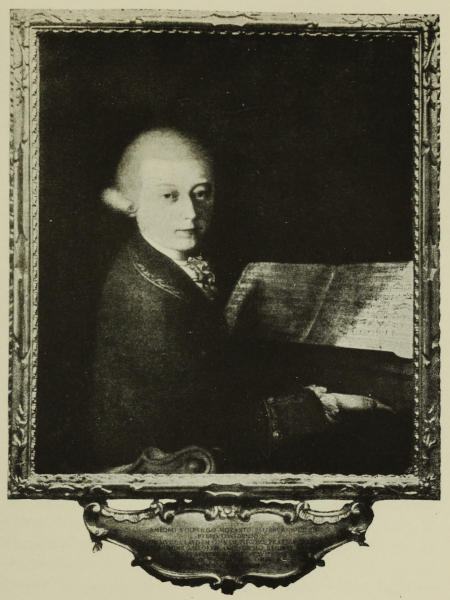
MOZART
By Cignaroli
What did Mozart do towards the development of our modern Orchestra? The question is easily answered. Mozart gave the Orchestra tone-color.
We have seen that Bach’s Orchestra and Handel’s Orchestra were both neutral in tint; or, if we prefer, black and white. The instruments all played their separate parts, but their individual voices had as yet hardly been discovered. It is true that Bach and Handel had written solo parts for various instruments, but, as a general thing, the melodies could be sung by one instrument as well as any other. But Mozart had very different ideas regarding instruments. To him a violin was a violin, a flute was a flute, a bassoon was a bassoon and a clarinet was a clarinet. Each instrument had to speak for itself and with its own true voice, or tone-color. Mozart originated what we may call an orchestral palette.
We have all seen a painter’s palette, with the colors arranged in groups of reds and blues and greens, and so on, in their different gradations, or shades. Mozart’s orchestral palette was arranged similarly, only instead of paints he grouped his instruments—his strings, his woodwind, his brass—as he pleased; and he mixed these tone-colors or conspicuously exhibited one of these splendid hues, keeping the others subordinate as an accompaniment.
We all know that light—perfectly white light—can be divided into the seven colors of the rainbow and that all the manifold and varied tints that we see in the world of nature—in sky and earth and sea—in every flower and every fleeting hue that falls upon it—comes from those seven colors. Now Bach and Handel and all the other composers who lived before Mozart had never thought of music as anything but white, so to speak. It was Mozart who broke up this white light into its prismatic hues. It was Mozart who brought the new beauty of color into music.
Although Mozart learned much from Haydn, Haydn learned more from Mozart. When Haydn wrote his first Symphony, Mozart was three years old. Mozart died while Haydn was enjoying his London triumphs. Haydn’s last Symphonies show the influence of Mozart, though Haydn never reached Mozart’s glowing and brilliant color.
It is singular to remember that Mozart wrote his first Symphony only five years after Haydn wrote his first; but then Mozart was only eight years old! It was, however, a real symphony, in three movements and scored for the usual Orchestra of two violins, viola, bass (violoncello), two oboes and two horns.
Mozart had a very great advantage over Haydn in having heard so much music and so many different Orchestras. At this time there were a great many fine Orchestras in Europe and Mozart heard them all. Particularly notable was that of Mannheim, where Mozart first heard clarinets. “Oh, if we only had clarinets!” he wrote home in 1778. “You cannot think what a splendid effect a symphony makes with flutes, oboes and clarinets!”
The Mannheim Orchestra was generally considered the best in Europe, though some critics thought those of Munich and Vienna were better.
“The excellence of the Mannheim Orchestra—whose performances excited as much admiration among contemporaries as those of the Paris Orchestra under Habeneck’s conductorship at a later date—gained for it the honor of taking a regular share in the Elector’s concerts. The Orchestra contained some of the first artists and virtuosi of the day, such as Cannabich, Toeschi, Cramer, Stamitz and Fränzel among the violins, Wendling as a flute-player, Le Brun and Ramm as oboists, Ritter as bassoonist and Lang as horn-player. But its fame rested chiefly on the excellent discipline of the Orchestra, which, among so many first-rate artists, it was no easy task to maintain. The Kapellmeister at the time of Mozart’s visit was Christian Cannabich (1731-1798), who had succeeded Stamitz in 1775. His compositions were, doubtless, overrated by his contemporaries; but he was admirable as a solo violinist and still better as an orchestral leader, besides being an excellent teacher. The majority of the violinists in the Mannheim Orchestra had issued from his school and to this was mainly owing the uniformity of their execution and delivery. Cannabich, who was more of an organizer than an originator, had experimented with every condition and device for producing instrumental effects and he laid special stress on technical perfection of execution in order to be certain of having good ensemble players.”[60]
Mozart had much to do in raising the standard of the Vienna Orchestra on his return home.
From this time forward the clarinet became conspicuous in Mozart’s compositions.
We get a glimpse of Mozart conducting in 1789 from Jahn. He was in Leipzig:
“At the rehearsal for this concert he took the tempo of the first Allegro of his symphony so fast that the Orchestra was very soon in hopeless confusion. Mozart stopped, told the players what was wrong and began again as fast as before, doing all he could to keep the Orchestra together and stamping the time with his foot so energetically that his steel shoe-buckle snapped in two. He laughed at this; and, as they still dragged, he began a third time. The musicians, now having become impatient, worked in desperation; and at last the movement went right. ‘It was not caprice;’ he explained afterwards to some musical friends, to whom he had been holding forth on the subject of too rapid tempo, ‘but I saw at once that most of the players were advanced in years and there would have been no end to the dragging if I had not worked them up into a rage so that they did their best out of pure spite.’ The rest of the symphony he took in moderate time; and after the song had been rehearsed he praised the accompaniment of the Orchestra and said it would be unnecessary to rehearse his concerto: ‘The parts are correctly written out, you play accurately and so do I.’ The result showed that his confidence was not misplaced.”
Mozart is interesting to us in many periods; but we like best to think of him as the tiny prodigy, who was caressed and admired by all the world and who wrote the most delightful, childish letters home inquiring if “Master Canary still sang in G-sharp” and sending “A thousand kisses to Miss Bimberl” (the dog). We like, too, the story of his first composition, as related by an eye-witness:
“Mozart’s father, returning from church one day with a friend, found his son aged five, busy writing.
“‘What are you doing there, my little boy?’ he asked.
“‘I am composing a concerto for the harpsichord, and have almost got to the end of the first part.’
“‘Let me see your fine scrawl.’
“‘No; I have not finished it yet.’
“The father, however, took the paper and showed his friend the sheet full of notes, which could hardly be deciphered for the blots of ink.
“The two friends at first laughed heartily at this scribbling; but after a little time when the father had looked at it with more attention, his eyes were fastened on the paper, and at length, overflowed with tears of joy and wonder.
“‘Look, my friend,’ he said, ‘look. Everything is composed according to rule. It is a pity that the piece cannot be made any use of; but it is too difficult. Nobody would be able to play it.’
“‘It is a concerto,’ replied his little son, ‘and must be studied until it can be played properly. This is the way it should be played.’”
This was the beginning of Mozart’s composition. He wrote no less than six hundred and thirty-six works!
And to his name we will add this tribute:
“I have always been one of the greatest admirers of Mozart and I shall remain so until my last breath,—Beethoven.”
When Mozart heard the boy Beethoven play during his first visit to Vienna in 1787 he said to his friends: “Pay attention to him he will make a noise in the world some day, or other.”
It seems strange to find an English musician writing the following just appreciation of Beethoven in 1818, while the great genius was still living:
“Beethoven’s genius seems to anticipate a future age. In one comprehensive view, he surveys all that science has hitherto produced, but regards it only as the basis of that superstructure which harmony is capable of raising. He measures the talents and resources of every preceding artist, and, as it were, collects into a focus their scattered rays. He discovers that Haydn and Mozart alone have followed nature, yet he explores the hidden treasures of harmony with a vigor superior to either. In sacred music he is pre-eminently great. The dark tone of his mind is in unison with that solemn style which the service of the church requires; and the gigantic harmony which he wields enables him to excite by sounds, a terror hitherto unknown.”
Yes; Beethoven had a dark nature; or, at least, dark clouds frequently floated across his mind. He had everything to make him morose. His life was exceptionally unhappy: he had an unfortunate love-affair; the nephew in whom he placed all his hopes disappointed him; and, finally, he became totally deaf.
“His whole life is like a stormy day. At the beginning—a fresh, clear morning, perhaps a languid breeze, scarcely a breath of air. But there is always in the still air a secret menace, a dark foreboding. Large shadows loom and pass; tragic rumblings; murmuring awesome silences—the furious gusts of the winds of the Eroica and the C-minor.”[61]
Ludwig van Beethoven was of Flemish-Dutch origin as the “van” shows. He was, however, born in Bonn in 1770, his birthplace a bare attic. His father was a lazy tenor and his mother a servant. His childhood was most unhappy. Beethoven was marked for sorrow from his earliest years.
He was compelled to practise the violin and harpsichord by his good-for-nothing father, who made him earn his own living, and he soon lost his mother, whom he adored.
In 1787 he visited Vienna and had some lessons from Mozart. In 1788, when but seventeen, Beethoven was playing in the Orchestra of the Elector of Cologne at Bonn.
We get a good idea of what a fine German Orchestra was in 1791 from Charles Louis Junker, who described it in that year, and Beethoven, too, who was then twenty:
“The Elector remained a considerable time at Mergentheim and had some twenty of his band with him. I heard the most exquisite music and made the acquaintance of some first-rate artists.
“On the first day I heard the musical performance, which took place regularly while the Elector dined. There were two oboes, two clarinets, two flageolets, and two horns. These eight players may fairly be called masters in their art. Soon after the musical performance during dinner the play began. It was King Theodor, with music by Paisiello.
“The Orchestra was capital, the piani, forti and crescendi being exceedingly well observed. Herr Ries, the expert score-reader and player at sight, conducted with the violin. He is worthy of being placed beside Cannabich.[62] His firm, vigorous lead inspires every player with life and spirit.
“The arrangement of the Orchestra was such as I had not seen elsewhere, but I thought it very convenient. Herr Ries stood on a raised platform in the middle of the theatre, and close to the stage where he could be seen by everyone. Immediately below and behind him were a counter violinist and violoncellist; on his right were the first violins, with the second violins opposite them; behind the violins the violas, with the clarinets opposite; behind the violas the counter violin and violoncello; and, last of all, the trumpets. On the conductor’s left were the wind instruments; the oboes with the flageolets opposite and flutes and horns. It would be difficult to find an Orchestra where the violins and basses were so perfect.
“I also heard one of the greatest pianists—the dear, good Beethoven. I heard him improvise. In fact, I, myself, was asked to give him a theme. The greatness of this gentle man as a virtuoso may, I think, be estimated by the almost inexhaustible wealth of his imagination, the skill of his execution and the thorough originality of his expression. I did not find him deficient in any of the attributes of a great artist. In addition to his fluent execution he is suggestive, expressive, telling—in a word he touches the heart, and he is as good in adagio as in allegro. The clever artists of this Orchestra are his admirers one and all and listen intently when he plays. But he is modest and quite unassuming.
“The members of this band are, almost without exception in the prime of early manhood and well-educated. They have a splendid physique and, attired in the scarlet and gold uniform of the Prince, their appearance is very striking.
“We have perhaps been accustomed to regard the Electorate of Cologne as a dark land into which rays of enlightenment had never penetrated; but a visit to the Elector’s Court would soon alter this opinion. I found the members of the Orchestra men of very liberal and sound understanding.
“The Elector, the most humane and best of princes, is not only a performer, but an enthusiastic lover of music. At the concert I went to he was the most attentive listener present.”
Beethoven saw Haydn when the latter stopped in Bonn on his way to and from London. In 1792 Beethoven submitted a cantata to Haydn. Haydn praised it and encouraged Beethoven to go on with his studies. After a time the Elector sent Beethoven to Vienna, the main reason being that he should study with Haydn. One of his friends, on parting, advised him to “Labor assiduously and receive Mozart’s spirit from the hands of Haydn.”
Beethoven was then twenty-two. He never returned. Vienna was thenceforth his home.
Beethoven took lessons with Haydn for nearly two years and then went to another master, Albrechtsberger, a very strict contrapuntist, who took great pains with Beethoven but evidently did not think much of him, for he said to a friend: “Have nothing to do with Beethoven. He has learned nothing and will never do anything in decent style.”
Among Beethoven’s friends in Vienna were the Prince and Princess Lichnowsky, who had been patrons of Mozart. They supported a Quartet and an Orchestra and gave musical parties on a large scale. Their Friday evenings were famous.
Music in Vienna was at that time chiefly dependent upon the patronage of the wealthy; for concerts were not paying and they were usually organized for some benevolent purpose.
The Lichnowskys offered Beethoven a home in their palace and a yearly allowance. For ten years, or more, it was at Prince Lichnowsky’s house that almost all of Beethoven’s works were first performed.
He was free to come and go as he pleased and had plenty of time to study and compose. Here he had a great deal of pleasure with the famous Quartet, first known as the Schuppanzigh and afterwards as the Rasoumoffsky.
Notwithstanding his uncouth ways and his passionate temper, Beethoven was a favorite in Vienna society. Haydn called him the Grand Mogul and considered him more of a pianist than a composer.
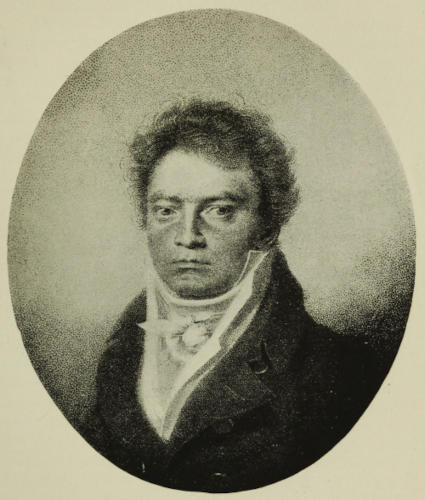
BEETHOVEN
By Lebronne
“His manner was often abrupt and even aggressive. Perhaps he sometimes appeared so when nothing was further from his intention. A man with the C-minor Symphony ringing in his head might well be excused some forgetfulness of the smaller conventions.
“Hitherto Beethoven’s playing in Vienna had been restricted to the drawing-rooms of his personal friends. It was not till the year 1795 that the public whose curiosity must have been considerably excited by reports of the achievements of the young pianist from Bonn, had an opportunity of witnessing his powers. At the annual concert given at the Burg Theatre, for the benefit of the widows and orphans of musicians, the composer made his first public appearance. Salieri, as usual, conducted, and the programme included, besides an operetta composed by one of his pupils, a ‘Pianoforte Concerto in C-major by L. van Beethoven.’
“On this, as on several other occasions, Beethoven caused something like a panic among his friends by postponing the completion of his composition till the last moment. Two days before the date of the performance the Concerto was still in an unfinished state; one cause of the delay being an attack of the colic, a malady to which the composer was subject. Wegeler was at hand to doctor him as well as he could; and while Beethoven, working at high pressure, filled sheet after sheet of music-paper, they were passed over to four copyists who attended in the next room. Next day at rehearsal a fresh contretemps arose. There was found to be a difference of half a tone between the pitch of the pianoforte and that of the other instruments. To save a general retuning Beethoven seated himself at the piano without hesitation, and played the whole Concerto in C-sharp—not an entirely unprecedented feat, but, nevertheless, one that gives an idea of his thorough mastery over technical difficulties.”[63]
In 1796 Beethoven visited Dresden, Leipzig and Berlin.
In 1800 he left the Lichnowsky house and took lodgings for himself. Thenceforward he spent his summers in the country. He was now deaf.
In 1803 Beethoven gave an important concert in the Theater-an-der-Wien, the programme consisting of the oratorio The Mount of Olives, the Piano Concerto in C-minor and the Second Symphony, which was dedicated to Prince Lichnowsky. The final rehearsal took place at eight o’clock in the morning. “A terrible rehearsal,” Ries[64] recorded, “and by half-past two everybody was tired out and more or less discontented. But the genial Lichnowsky, who was present from the beginning, had brought some huge baskets laden with meat, wine and bread-and-butter, and he was soon hard at work, pressing the good things upon each tired musician with both his friendly hands. After this all went well.”
“We are told that Beethoven’s attitude at the piano was perfectly quiet and dignified, with no approach to grimace except to bend down a little towards the keys as his deafness increased. This is remarkable because as a conductor his motions were most extravagant. At a pianissimo he would crouch down so as to be hidden by the desk, and then as the crescendo increased would gradually rise, beating all the time, until at the fortissimo he would spring into the air with his arms extended as if wishing to float on the clouds. When, as was sometimes the case after he became deaf, he lost his place and these motions did not coincide with the music, the effect was very unfortunate, though not so unfortunate as it would have been had he himself been aware of the mistake. In the Orchestra, as at the piano, he was urgent in demanding expression, exact attention to piano and forte and the slightest shades of nuance and to tempo rubato. Generally speaking, he was extremely courteous to the band, though there were now and then exceptions.”[65]
“Beethoven was short and thick-set, broad shouldered and of athletic build. A big face, ruddy in complexion—except towards the end of his life, when his color became sickly and yellow, especially in the winter after he had been remaining indoors far from the fields. He had a massive and rugged forehead, extremely black and extraordinarily thick hair through which it seemed the comb had never passed, for it was always very rumpled, veritable bristling ‘serpents of Medusa.’ His eyes shone with prodigious force. It was one of the chief things one noticed on first encountering him, but many were mistaken in their color. When they shone out in dark splendor from a sad and tragic visage, they generally appeared black; but they were usually a bluish gray. Small and very deep set, they flashed fiercely in moments of passion or warmth, and dilated in a peculiar way under the influence of inspiration, reflecting his thoughts with a marvellous exactness. Often they inclined upwards with a melancholy expression. His nose was short and broad with the nostrils of a lion; the mouth refined, with the lower lip somewhat prominent. He had very strong jaws, which would easily break nuts, and a large indentation in his chin imparted a curious irregularity to the face. ‘He had a charming smile,’ said Moscheles, ‘and in conversation a manner often lovable and inviting confidence; on the other hand his laugh was most disagreeable, loud, discordant and strident’—the laugh of a man unused to happiness. His usual expression was one of melancholy. Rellstab in 1825 said that he had to summon up all his courage to prevent himself from breaking into tears when he looked into Beethoven’s ‘tender eyes with their speaking sadness.’ Braun von Braunthal met him at an inn a year later. Beethoven was sitting in a corner with closed eyes, smoking a long pipe—a habit which grew on him more and more as he approached death. A friend spoke to him. He smiled sadly, drew from his pocket a little note-tablet, and in a thin voice which frequently sounded cracked notes, asked him to write down his request.
“His face would suddenly become transfigured, maybe in the access of sudden inspiration which seized him at random, even in the street, filling the passers-by with amazement, or it might be when great thoughts came to him suddenly when seated at the piano. The muscles of his face would stand out; his veins would swell; his wild eyes would become doubly terrible. His lips trembled, he had the manner of a wizard controlling the demons which he had invoked. A Shakespearean visage—King Lear, so Sir Julius Benedict described it.”[66]
Beethoven’s compositions are far too numerous to mention here. We shall only speak of the Symphonies.
Beethoven’s very first Symphony showed he was master of the Orchestra.
The Orchestra left by Mozart and Haydn consisted of the four stringed instruments, two flutes, two oboes, two bassoons, two horns, two trumpets, kettledrums and, occasionally, two clarinets. Neither Mozart nor Haydn ever used trombones in their Symphonies. Haydn had used as an exceptional matter in his Military Symphony a big drum, a triangle and cymbals.
The First Symphony is written for two drums (in C and G), two trumpets, two horns, two flutes, two oboes, two clarinets, two bassoons, first and second violins, violas and basso. There are one flute and one clarinet more than Mozart used in his Jupiter Symphony. One flute only is used in the Andante.
Beethoven also for the first time in the history of the Orchestra tuned the kettledrums in the key of the dominant instead of in the key of the movement.
In the Second Symphony the Orchestra is still the ordinary Haydn-Mozart Orchestra without trombones, but with the addition of clarinets.
In the Eroica (the Third) Symphony we find something new—three horns. It was, perhaps, the first appearance of three horns in the Orchestra. In passing, we may recall that in 1805 when Prince Lobkowitz was entertaining Prince Louis Ferdinand of Prussia at his castle in Bohemia, to honor his guest, who was a remarkable musician and connoisseur, Lobkowitz ordered a performance of the new Eroica, by his Orchestra which always attended him. When the Symphony was finished Louis Ferdinand begged to have it repeated, and on the second performance begged to hear it again. “Certainly,” replied Lobkowitz, “only we must first give the Orchestra some supper!”
In the Fourth Symphony only one flute is used. It is scored for two drums, two trumpets, two horns, one flute, two oboes, two clarinets, two bassoons, first and second violins, violas, violoncello and double-bass.
This Symphony, lovely as it is, was severely criticised. No one was more satirical than Weber, who was then a young man. He wrote a sketch in which he imagined himself as seeing in a dream all the instruments of the Orchestra grouped around the violins. The double-bass speaks: “I have just come from the rehearsal of a Symphony by one of our newest composers; and though, as you know, I have a tolerably strong constitution, I could only just hold out. Five minutes more would have shattered my frame and burst the sinews of my body. I have been made to caper about like a wild goat and to turn myself into a mere fiddle to execute the no-ideas of Mr. Composer. I’d sooner be a dancing master’s kit at once.”
The first violoncello (bathed in perspiration) says that for his part he is too tired to speak, and can recollect nothing like the warming he has just had since he played in Cherubini’s last opera. The second violoncello is of the opinion that the Symphony is a musical monstrosity, revolting alike to the nature of the instruments and the expression of thought and with no purpose but that of perpetually “showing-off.” The conductor enters and threatens if they are not quiet to make them play the Eroica Symphony; and then he makes a speech, telling the instruments that the time has gone by for clearness and force, spirit and fancy, works like those of Gluck and Haydn and Mozart; and that here is the latest Vienna recipe for a Symphony: “First a slow movement full of short, disjointed, unconnected ideas, at the rate of three or four notes per quarter of an hour; then a mysterious roll of the drum and passage of the violas, seasoned with the proper quantity of pauses and ritardandos; and to end all a furious finale, in which the only requisite is that there should be no ideas for the hearer to make out, but plenty of transitions from one key to another—on to the new note at once, never mind modulating—above all things, throw rules to the winds, for they only hamper a genius.”
“At this point,” says Weber, “I woke in a dreadful fright. I was on the road to become either a great composer, or a lunatic.”
The Fifth Symphony is scored for two drums, two trumpets, two horns, two flutes, one flute piccolo, two oboes, two clarinets, two bassoons, three trombones, first and second violins, violoncellos, basses and contra-fagotto (double-bassoon).
The piccolo, trombones and double-bassoon here make their first appearance in the symphonies. Beethoven had long known the double-bassoon, for there was one in the Orchestra of the Elector of Cologne.
The C-minor Symphony is of all Beethoven’s works the most popular. It was the work that made him known to the whole world.
Berlioz tells an anecdote of how the C-minor impressed Lesueur, one of Berlioz’s masters, at the Paris Conservatoire when it was first played in Paris. “After the performance,” Berlioz says, “I hurried to see the effect the work had had upon him and to hear his judgment on it. I found him in the passage, red as fire and walking furiously fast. ‘Well, my dear master,’ said I—
“‘Ouf!’ was his reply, ‘I must get out into the air. It is astonishing, wonderful. It has excited and overcome me so that in trying to put my hat on I could hardly find my head. Don’t stop me now, but come to me to-morrow.’
“Early next morning I called on him and we at once rushed into the subject. At length I succeeded in making him repeat the confession of his emotion at the performance, but then with a violent shake of his head and a peculiar smile he said: ‘All the same, such music as that ought not to be made.’ To which I answered: ‘All right, dear master, there’s no fear of much being made like it.’”
The Pastoral Symphony (the Sixth) calls for two flutes, one piccolo, two oboes, two clarinets, two horns, two bassoons, two trumpets, two drums, alto and tenor trombones, first and second violins, viola, violoncellos and basses. The trumpets and trombones are used in the Storm only (fourth movement). In the Andante (second movement) there are two solo violoncellos (with sordini); the other violoncellos play with the double-basses.
The Seventh Symphony is composed for two flutes, two oboes, two clarinets, two bassoons, two horns, two trumpets, two drums, first and second violins, viola, violoncello and double-basses. The drums are tuned in E and A except in the Scherzo, where they are tuned in F and A.
This Symphony was first performed in the University of Vienna at a concert for the benefit of soldiers wounded at the Battle of Hanau (Oct. 30, 1813), where the Austrians and Bavarians tried to cut off Napoleon’s retreat from Leipzig.
Beethoven conducted. Some of the most famous musicians and composers played in the Orchestra. There was Schuppanzigh, Romberg, Spohr, Mayseder and the famous double-bass, Dragonetti (see page 70); Meyerbeer and Hummel played the kettledrums; Moscheles, the cymbals and old Salieri “gave time to the drums and salvos,” says a contemporary, who continued:
“At this concert I first saw Beethoven conduct. Often as I had heard of it, it surprised me extremely. He was accustomed to convey the marks of expression to the Orchestra by the most peculiar motions of his body. Thus at a sforzando he tore his arms, which were before crossed on his breast, violently apart. At a piano he crouched down, bending lower the softer the tone. At the crescendo he raised himself by degrees until at the forte he sprang up to his full height; and without knowing it would often at the same time shout aloud.”
The Eighth Symphony has two drums in F and C, two trumpets in F, two horns in F, two flutes, two clarinets, two oboes, two bassoons, first and second violins, violas, violoncello and double-bass. In the Finale the drums are for the first time tuned in octaves. It was first performed in the Great Redoutensaal, Vienna, on Feb. 27, 1814. The Seventh Symphony was also on the programme and received the most applause.
There is a tremendous gap between the Eighth and the Ninth Symphonies. Even Beethoven, Titan that he was and with an orchestra that had developed marvellously under his magic hands, felt that instruments were not sufficient to express the ultimate climax of this mighty work, and, therefore, added human voices to swell the joyous uproar of the last movement. The Ninth was first performed at the Kärnthnerthor Theatre, Vienna, May 7, 1824. The house was crowded. All the principal musicians, professional and amateur, were present. “In a letter to Schindler, quoted by Lenz, he calls the day Fracktag, because he had the bore of putting on a smarter coat than usual. On this occasion it was a green coat, and he probably also wore a three-cornered cocked hat. The preparations had somewhat upset him, and his dress had to be discussed with Schindler in one of the conversation-books. His deafness had by this time become total, but that did not keep him out of the Orchestra. He stood by the side of Umlauf, the conductor, to indicate the times of the various movements. The house was tolerably full, though not crowded, and his reception was all that his warmest friends could desire. To use Schindler’s expression it was more than Imperial. Three successive bursts of applause were the rule for the Imperial Family and he had five! After the fifth, the Commissary of Police interfered and called for silence! Beethoven acknowledged the applause by a bow. The Scherzo was so completely interrupted—at the Ritmo di tre battute, where the drums give the motif—that it had to be begun again. A great deal of emotion was naturally enough visible in the Orchestra; and we hear of such eminent players as Mayseder and Böhm even weeping.
“At the close of the performance an incident occurred which must have brought the tears to many an eye in the room. The master, though placed in the midst of this confluence of music, heard nothing of it at all and was not even sensible of the applause of the audience at the end of his great work, but continued standing with his back to the audience and beating the time, till Fräulein Ungher, who had sung the contralto part, turned him, or induced him to turn round and face the people, who were still clapping their hands and giving way to the greatest demonstrations of pleasure. His turning round and the sudden conviction thereby forced on everybody that he had not done so before because he could not hear what was going on, acted like an electric shock on all present, and a volcanic explosion of sympathy and admiration followed, which was repeated again and again and it seemed as if it would never end.”[67]
The score comprises two flutes, two oboes, two clarinets, two bassoons, four horns, two trumpets, two drums, first and second violins, violas, violoncellos and basses. In some of the movements three trombones, a double bassoon, a piccolo, triangle, cymbals and big drum are called for.
“These great works he did as no one ever did and probably no one ever will. But of orchestral music he wrote no more after the Ninth Symphony. Music will advance in richness, scope and difficulty; but such music as Beethoven’s great instrumental works, in which thought, emotion, melody and romance combine with extraordinary judgment and common sense and a truly wonderful industry to make a perfect whole, can hardly any more be written. The time for such an event, such a concurrence of the man and the circumstances will not again arrive. There can never be a second Beethoven, or a second Shakespeare. However much Orchestras may improve and execution increase, Beethoven’s Symphonies will always remain at the head of music as Shakespeare’s plays are at the head of the literature of the modern world—‘Age cannot wither them, nor custom stale their infinite variety.’”[68]
In every way possible Beethoven discovered and brought forward the capacities of each individual instrument. Each instrument in the Orchestra was enriched under Beethoven’s touch and given a new standing, a new dignity. The viola, the violoncello, the double-bass, the horn, the trombone and the kettledrum were all brought forward and turned into solo instruments. The clarinet, too, became firmly established as a leading voice.
No composer before him had ever made the instruments converse as did Beethoven. No composer had ever made the strings so flexible, so humorous, so pathetic, so gay, so languorous. Besides, Beethoven was the first to take the violins up into the highest register—into the ethereal domain where Wagner followed.
“When an idea comes to me,” said Beethoven, “I hear it on an instrument, never on a voice.”
“Beethoven is the prophet of the new era which the Nineteenth Century ushered in for mankind. As things must be felt before they can be acted out, so they must be expressed in the indefinite emotional forms of music before they can be uttered and definitely imaged forth in words or pictorial shapes. Beethoven is the forerunner of Shelley and Whitman among the poets, of J. W. Turner and J. F. Millet among the painters. He is the great poet who holds Nature by the one hand and Man by the other. Within that low-statured, rudely outlined figure which a century ago walked hatless through the fields near Mödling or sat oblivious in some shabby restaurant at Vienna, dwelt an emotional giant—a being who—through his outer life by deafness, disease, business-worries, poverty, was shattered as it were into a thousand squalid fragments—in his great heart embraced all mankind, with piercing insight penetrated intellectually through all falsehoods to the truth and already in his art-work gave outline to the religious, the human, the democratic yearnings, the loves, the comradeship, the daring individualities, and all the heights and depths of feeling of a new dawning era of society. He was, in fact, and he gave utterance to, a new type of man. What that struggle must have been between his inner and outer conditions—of his real self with the lonely and mean surroundings in which it was embodied—we only know through his music.”[69]
Beethoven was the last great Classical composer.
With Weber we enter a new school of music—the Romantic; and Carl Maria von Weber stands at the head of this Romantic School.
The word Classical is used in two ways: one, to define old works which have held their place in general estimation for a long time; and the other to describe works, written according to strict ideas of form, usually in the Sonata and Symphonic style. The great classical masters are Bach, Handel, Haydn, Mozart and Beethoven. The word Romantic is used to define the works of the composers who came directly after the Classical composers and who wished to write in freer form, permitting more play for the imagination.
The great Romantics are Weber, Schubert, Mendelssohn, Schumann and Chopin.
“Widely as the composers of this new school differed in other respects, they were alike in their susceptibility to the tone of thought and feeling which so deeply colored the romantic literature of their time. None of them were strangers to that weariness, approaching to disgust, of the actual world around them and those yearnings to escape from it which pursued so many of the finest minds of the generation to which they belonged. To such men it was a relief and delight to live in an ideal world as remote as possible from the real one.
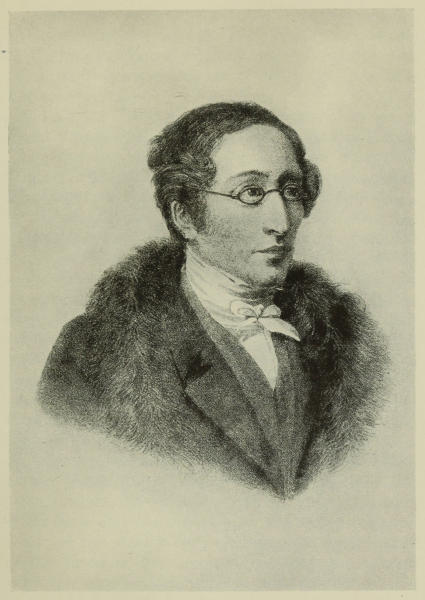
C. M. VON WEBER
By Schimon
“Some took refuge in mediæval legends, where no border divided the natural from the supernatural one; some, in the charms and solitudes of nature; and others in the contemplation of peace and beatitude beyond the grave.”[70]
Of all the German musicians of the Nineteenth Century none exercised a greater influence than Weber. “The historian of German music in the Nineteenth Century will have to make Weber his starting-point. His influence was even greater than that of Beethoven, for deeply imbued though Beethoven was with the modern spirit of that time, he adhered as a rule to the traditions of the Eighteenth Century. These Weber casts aside and starts after fresh ideals. He was far less perfect in form than Beethoven, nor was he his equal in power; but in originality he has never been surpassed by any musician, ancient or modern. The germs of life he scattered broadcast; and the whole of German Opera down to Wagner’s latest works is evolved from Weber’s spirit. Even the concert-music of other masters such as Mendelssohn and Schumann profited by his suggestiveness. Without Weber Mendelssohn’s Midsummer Night’s Dream Music, Walpurgis Nacht, Concert-Overtures and Pianoforte Concertos; Schumann’s Paradise and the Peri, Pilgrimage of the Rose and concert-ballads; the entire variation music of the present day; choruses for men’s voices; certain forms of the German Lied; even the modern technique of pianoforte playing; and, most of all, the present development of orchestration are inconceivable.”[71]
Weber, like Bach, came of a musical family; but, unlike most of the great composers who had, heretofore appeared, Weber was of noble ancestry.
Weber was a cultivated man of the world as well as a musician. His birth gave him a place in the best society and his cultivation, which was learned from men rather than books—he lived a wandering life in his youth—was wide and embraced literature and several arts.
Carl Maria von Weber was born in Vienna in 1786. He was a delicate, nervous child whose health was not improved by his father’s desire to make him a musical prodigy like Mozart, of whom he was a cousin. Weber was sadly overtaxed. Among his masters were Michael Haydn, brother of the great Haydn, and the Abbé Vogler, a fashionable composer and organist of Vienna and a man of wit, culture and social position. By 1810, when his true musical life may be said to begin, Weber had brought out several operas. In Mannheim he produced his first Symphony. In 1811 he started on his tour through Germany and Switzerland, at first alone and then in company with Baermann, the celebrated clarinet-player. Weber’s visit to Berlin in 1812 was very important. After many concert-tours Weber became conductor of the theatre in Prague. In 1816 the King of Saxony called him to Dresden.
It is interesting to catch a glimpse of Weber on his first appearance as Kapellmeister here, as related by his son:
“After a few words of pleasant and friendly greeting and assurances of his goodwill and interest to all, he terminated with the astounding declaration: ‘In return I expect explicit obedience. I shall be just but pitilessly severe with all who need severity, myself among the number.’ Such expressions had never before been heard by any of the company. For many generations gentle wishes, not commands, had been the order of the day. At first all stood aghast and dumb. On leaving the theatre at least two-thirds of the company declared themselves against the ‘impertinent young musical director.’ The members of the Orchestra were all indignant. Never had the most celebrated of kapellmeisters ever dared to address this celebrated Orchestra. And yet, in a short time, some of the bitterest enemies of this hour became Weber’s staunchest friends, supporters and admirers.
“There are still living many old members of the Dresden Orchestra who can remember the appearance of Weber on this memorable occasion. He stood before them a little, narrow-chested man, with long arms and a thin, pale face, from which his eyes gleamed forth in lightning flashes through his spectacles. When he was pleased a smile, which was positively enchanting, played over his otherwise serious mouth. When affected by the occurrences of the moment, he bent his head gently sideways with an air of peculiar tenderness and earnestness. He wore a blue frock coat with metal buttons, tight pantaloons and Hessian boots with tassels. A scrupulously clean white cravat with embroidered ends, in which was stuck a handsome diamond pin, encircled his neck. Over all he carried a tawny colored cloak with several capes, a broad round hat on his head. Nothing in his whole attire indicated any artistic pretension or affectation; and, in the streets, or in a room, he might have been easily overlooked. Once noticed, however, Weber was sure to charm and captivate by his air of intellectual refinement and elegance of manner.”
Der Freischütz was performed in Berlin in 1821; Euryanthe in Vienna in 1823; and Oberon in London in 1826, the year of Weber’s death.
Though Weber’s works for the Orchestra are comparatively unimportant, the instrumentation of his operas, so dramatic, so original and so poetic, has had great effect on modern orchestral writers.
Weber’s instrumentation was founded on Beethoven’s. He introduced no new instruments. What he did was to develop the woodwind and make new and lovely combinations. For the clarinet he had a special fondness.
After Mozart introduced the clarinet into the Orchestra, it rapidly became a favorite solo-instrument. At the beginning of the Nineteenth Century Germany had two splendid clarinet-players,—Hermstedt of Sondershausen, for whom Spohr composed, and Baermann of Munich, with whom Weber gave concerts, as we have seen,[72] and wrote special music. Weber learned much from the latter about the resources of this instrument; and Weber is the composer, par excellence, of the clarinet.
Next to the clarinet, Weber loved the horns. He made them most poetic. With Beethoven four horns and three trombones had been exceptional. With Weber this number became the rule.
Weber was also fond of subdividing the violins.
“As an interpreter of nature Weber’s position in the dramatic world is like that of Beethoven in the Symphony. Nobody has ever depicted with the same truth as he a sultry moonlight night the stillness broken only by the nightingale’s trill and the solemn murmur of the trees, as in Agathe’s grand scene in Der Freischütz; or a gruesome night scene in the gloomy forest ravine such as that in the Finale of the 2d Act. With this descriptive faculty went hand in hand consummate skill in orchestration. There is something original and intoxicating in the sound he brings out of the Orchestra, a complete simplicity combined with perfect novelty. He was able, as it were, to transport himself into the soul of the instruments and make them talk to us like human beings, each in its own language, each speaking when it alone has power to lay bare the very heart of the action.
“The phrase ‘local coloring’ in music may be defined as that which conjures up before our minds the associations connected with certain scenes, races and epochs. In the Freischütz the prevailing color was derived from the life of the German foresters and huntsmen; in Preciosa we have the charm of the south in lovely Spain, then the type of all that was romantic, with the picturesque life of the roving gipsy. Euryanthe takes us back to the Middle Ages and the palmy days of French chivalry which reappear to some extent in Oberon mingled with scenes from Oriental life and from fairyland. Weber’s melody, the chords of his harmony, the figures employed, the effects of color so totally unexpected—all combine to waft us with mysterious power into an unknown land.”[73]
Schubert’s gift to the Orchestra was his novel way of writing for the trombones and for his use of the woodwind. He gave a conversational treatment of oboe, flute and clarinet. This does not mean to say that he did not also write beautifully for the strings.
No composer ever lived more entirely in his music than Schubert. There is not much to say about his life. He was born in Vienna; he lived there all his life; and he died there at the age of thirty-one. He earned a scanty living; he found it hard to get his compositions published; he had no wealthy patrons like Handel, Haydn, Gluck, Mozart and Beethoven; he had no pleasures, no triumphs such as Weber and Mendelssohn enjoyed. Schubert’s life was dull and commonplace. Yet between the years of his birth and death—1797-1828—he produced an astounding number of works. He wrote 650 songs (the extraordinary Erl-King when he was only eighteen), ten Symphonies (of which the eighth is the Unfinished), many operettas, piano-music and a great deal of orchestral and chamber-music and compositions for special instruments.
Salieri, the old rival of Mozart, was the first to recognize Schubert’s genius. “He can do everything,” he exclaimed, “he is a genius. He composes songs, masses, operas, quartets—whatever you can think of.” In 1822 Schubert met both Beethoven and Weber. Beethoven he adored. Schubert was a singer, violinist and pianist.
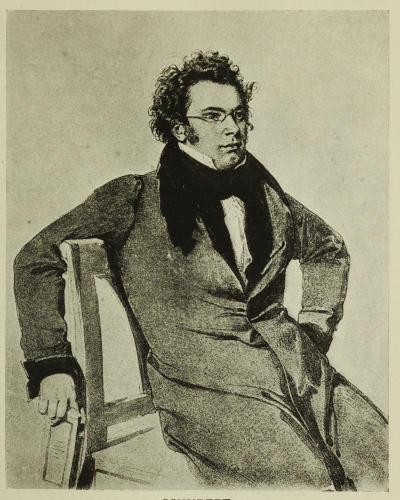
SCHUBERT
By Rieder
Schubert’s first Symphony in D is dated 1813; the Second in B-flat is dated 1814; the Third in D, in 1815; the Fourth in C-minor (described by the composer as “the Tragic”) is dated 1816; and scored for two violins, viola, violoncello and bass, two flutes, two oboes, two clarinets, two bassoons, four horns, two trumpets and drums.
The Fifth Symphony, known as the “Symphony without trumpets and drums,” is scored for two violins, viola, violoncello, double-bass, flute, two oboes, two bassoons and two horns. It is dated 1816. Up to this point Schubert’s Symphonies show the influence of Haydn, Mozart and Beethoven. Now came the true Schubert style with the Sixth, the C-major Symphony, which is regarded as Schubert’s masterpiece. It is scored for two violins, viola, violoncello and double-bass; two flutes, two oboes, two clarinets, two bassoons, two horns, two trumpets, and drums. This work was first performed in Vienna in 1828, but it was not heard in Paris and London until 1856. In 1842 Habeneck rehearsed it in Paris, but the Orchestra refused to play it; and when Mendelssohn put it into rehearsal in London the Philharmonic Orchestra laughed at the triplets in the last movement, and Mendelssohn, very indignant, withdrew it. Sir Augustus Manns, who introduced the work in England in 1856, remembers hearing at the end of the first movement the principal horn call out to one of the first violins: “Tom, have you been able to discover a tune yet?” “I have not,” was Tom’s reply.
The B-minor, the Unfinished, was written in 1822, before the C-major. The Unfinished we may note, was composed before Beethoven’s Ninth and the C-major Symphony after it.
Perhaps Mendelssohn’s most characteristic orchestral work is to be found in the Midsummer Night’s Dream music, the oratorio of Elijah and the Overture to Melusine. Of course, his Symphonies—the Reformation, which appeared in 1830, two years after Schubert’s C-major, the Italian in 1831 and the Scotch in 1842, contain beautiful work especially for the woodwind.
With his suave, graceful, sunny and charming melodies, it was only natural that Mendelssohn’s instrumentation should be delicate.
In the world of pictures we often turn from the deep, rich colors of Titian, Rembrandt and Velasquez to enjoy the softer hues of Chardin, Watteau and Fragonard. It is the same in music. Refreshing it is to turn from the dark, heavy colors of Beethoven, or the glowing hues of Weber and Wagner to the opalescent tints of delightful, fanciful, poetic Mendelssohn.
Mendelssohn’s life was happy from beginning to end; and this joy bubbles up in his music. The world gave him much; and he gave the world much in return.
Born in Hamburg in 1809, he spent his early years in Berlin, where his family removed. He had a childhood almost unparalleled in the annals of music for happiness. He conducted a little Orchestra in his father’s house every Sunday morning, where many of his early compositions were performed, among them the Overture to the Midsummer Night’s Dream, which he wrote when he was only seventeen. As pianist, organist, conductor and composer, Mendelssohn had one triumph after another. He made nine visits to London, where he stood next to Handel in popular affection.
In 1835 he became conductor of the Gewandhaus concerts in Leipzig and he established the Conservatory of Music in that city. He died in Leipzig in 1847.
Mendelssohn has suffered somewhat from the high position the English have given him in music; but he has a place that is quite his own. He followed in the footsteps of Weber rather than in those of Beethoven; and, though he has no tragic depths, he has given the world lyric compositions of great beauty and the greatest oratorios since Handel’s.
Mendelssohn sketched and painted well; he had a love for literature; he wrote charming letters; and he was altogether a delightful person.
Mendelssohn’s orchestration is noted for its perfect balance, its clarity and its polish. He seems to have cared less for the brass than the other groups. His violin concerto, ranking next to Beethoven’s, shows his sympathy for the violin. The viola is also well treated in all his works. The violoncello obbligato in the accompaniment to the solo “It is enough” in Elijah proves that this instrument was a favorite. The clarinet passages in the Overture to Melusine and the use of the horns in the Notturno in A Midsummer Night’s Dream exhibit his poetic and romantic touch in the highest degree.
Many persons have left snap-shots of happy Mendelssohn, Sir Julius Benedict, a pupil of his, wrote enthusiastically: “It would be a matter of difficulty to decide in what quality Mendelssohn excelled the most,—whether as composer, pianist, organist, or conductor of an Orchestra. Nobody, certainly, ever knew better how to communicate—as if by an electric fluid—his own conception of a work to a large body of performers. It was highly interesting, on such an occasion, to contemplate the anxious attention manifested by a body of sometimes more than five hundred singers and performers, watching every glance of Mendelssohn’s eye and following, like obedient spirits, the magic wand of this musical Prospero. Once, while conducting a rehearsal of Beethoven’s Eighth Symphony, the admirable Allegretto in B-flat, not going at first to his liking, he remarked, smilingly that he knew every one of the gentlemen engaged was capable of performing and even composing a scherzo of his own, but that just now he wanted to hear Beethoven’s, which he thought had some merits. It was cheerfully repeated. ‘Beautiful! Charming!’ cried Mendelssohn, ‘but still too loud in two or three instances. Let us take it again from the middle.’ ‘No, no,’ was the general reply of the band, ‘the whole piece over again, for our satisfaction;’ and then they played it with the utmost delicacy and finish, Mendelssohn laying aside his bâton and listening with evident delight to the perfect execution. ‘What would I have given,’ he exclaimed, ‘if Beethoven could have heard his own composition so well understood and so magnificently performed.’”
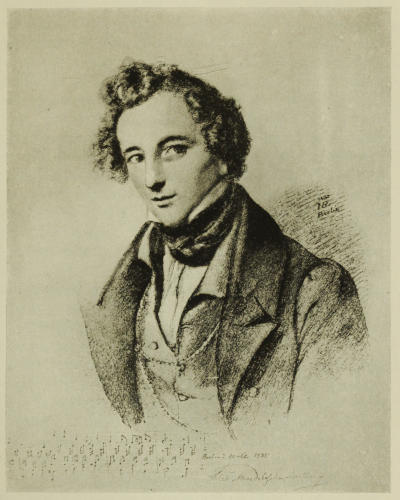
MENDELSSOHN
By Bendemann
Another admirer wrote: “When once his fine, firm hand grasped the bâton, the electric fire of Mendelssohn’s nature seemed to stream out through it and be felt at once by singers, orchestra and audience. Mendelssohn conducted not only with his bâton, but with his whole body. At the outset, when he took his place at the music-stand, his countenance was wrapped in deep and almost solemn earnestness. You could see at a glance that the temple of music was a holy place to him. As soon as he had given the first beat, his face lighted up, every feature was aflame and the play of countenance was the best commentary on the piece. Often the spectator could anticipate from his face what was to come. The fortes and crescendos he accompanied with an energetic play of features and the most forcible action; while the decrescendos and pianos he used to modulate with a motion of both hands till they slowly sank to almost perfect silence. He glanced at the most distant performers when they should strike in, and often designated the instant when they should pause, by a characteristic movement of the hand, which will not be forgotten by those who ever saw it.”
Contemporary with Mendelssohn, though they seem much nearer to us than he, are three great geniuses of the Nineteenth Century,—Berlioz, Liszt and Wagner. Though all three were admirers of the Classic masters, they formed an entirely new school of music, which was called “The Music of the Future.”
It is hard to say to which of these men Music owes the most; for while Wagner was certainly the greatest composer, Berlioz daringly led the way into these new regions where Wagner followed, and Liszt, with his extraordinary influence, his generosity of spirit, his untiring zeal in producing Wagner’s works as well as his lavish gifts to Wagner in times of trouble, was not the least important of the three in making Music what it is to-day. Moreover, Liszt’s own compositions helped to establish in the affections of the public this Music of the Future that became the Music of the Present and that is rapidly taking its place in the Music of the Past ranking as Classic in the first meaning of the word (see page 232).
To understand how Music departed from the old roads and took a new path, we must remember that in 1830 with the Revolution that sent Charles IX from the French throne, a new spirit came into the world of literature, art and music. It is known as the Romantic Movement. Writers and painters, full of the excitement of the period and joy at the triumph of republican ideas, sought to portray nature and human nature in truer lines and colors than the traditional rules and measurements of the Classic period.
There was a great outburst of literature in France—Gautier, Flaubert, de Musset, de Vigny and Victor Hugo are a few of the names that rise to one’s lips when the Romantic Movement is mentioned. Painters, too, were numerous. There was but one French composer—Berlioz. Just what Victor Hugo expressed in literature, just what Delacroix expressed in painting, Berlioz expressed in music; and Berlioz stands alone, a solitary figure.
“Berlioz’s early influences were as much literary as musical. His reading was mainly romantic; his musical gods were Beethoven, Weber and Gluck, whose orchestral writings influenced him most. He knew little of Beethoven’s piano writings and did not like Bach. Into the intellectual world of the Beethoven symphony and the operas of Gluck and Weber, he breathed the newer, more nervous life of the French Romanticists. Color and sensation became as important as form and the pure idea. These influences and his literary instincts led him to graft the programme form on the older symphony. All his music aims at something concrete. Instead of the abstract world of the classical symphonists he gives us definite emotions, or paints definite scenes. His own words: ‘I have taken up music where Beethoven left it’ indicate his position. He is the real beginner of that interpenetration of music and the poetic idea which has transformed modern art.”[74]
Berlioz’s temperament was like a volcano bursting continually into fire and flame and his mind took delight in everything of enormous magnitude. He loved to think of the Pyramids of Egypt, of huge lonely mountains, of great seas, the bursting of thunderbolts and the howl of tempests. Everything with him appeared in colossal proportions; and, consequently, much of his music seemed to the people of his time, even more than to us to-day, to have been written for the ears of giants and Titans and not for men and women of ordinary build.
Heine appreciated this phase of the extravagant Berlioz. “A colossal nightingale, a lark the size of an eagle,” he wrote of him, “such as once existed in the primæval world. Yes, the music of Berlioz, in general seems to me primitive almost antediluvian; it sets me dreaming of gigantic species of extinct animals, of mammoths, of fabulous empires with fabulous sins, of all kinds of impossibilities piled one on top of the other. These magic accents recall to us Babylon, the hanging-gardens of Semiramis, the marvels of Nineveh, the audacious edifices of Mizraim such as are shown in the pictures of the English painter Martin.”
This is all true, but it represents only one side of Berlioz.
Berlioz could be exquisite and dainty as well as colossal and terrific, as we hear in the Queen Mab Scherzo from the Roméo et Juliette Symphony, and the Dance of the Sylphs from the Damnation of Faust.
Berlioz is called the “Father of Modern Orchestration.” To appreciate the magnitude of his work, we must forget all our modern music for a moment and remember what the Orchestra was like when Berlioz, a country boy of eighteen, arrived in Paris in 1821.
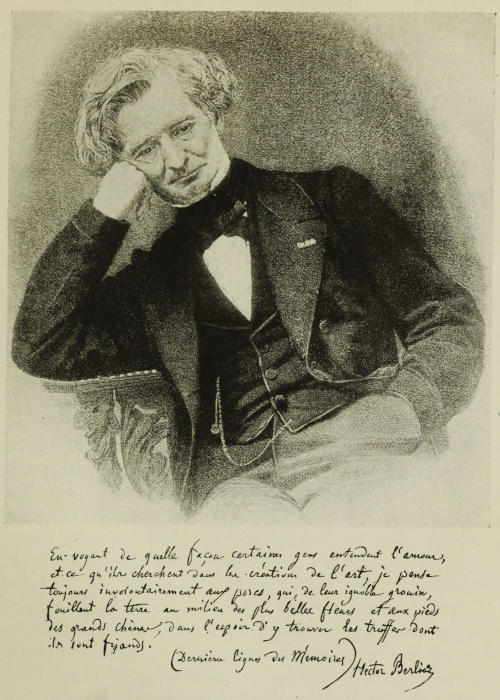
BERLIOZ
By Fischer
Berlioz “is one of the most remarkable phenomena in the history of music. In his earliest years, as in his latest, Berlioz was himself, a solitary figure, owing practically nothing to other people’s music, an artist we may say, without ancestry and without posterity. Mozart builds upon Haydn and influences Beethoven; Beethoven imitates Mozart and in turn influences the practice of all later symphonists; Wagner learns from Weber and gives birth to a host of imitators. But with Berlioz—and it is a point to be insisted on—there is no one whose speech he tried to copy in his early years and there is no one since who speaks with his voice. How many things in the early Beethoven were made in the factory of Mozart! How many times does the early Wagner speak with the voice of Weber! But who can turn over the scores of Berlioz’s early works and find a single phrase that can be fathered upon any previous, or contemporary, writer? There was never any one, before his time or since, who thought and wrote just like him; his musical style especially is absolutely his own. Now and then in L’Enfance du Christ he suggests Gluck—not in the turn of his phrases but in the general atmosphere of an aria; but apart from this it is the rarest thing for him to remind us of any other composer. His melody, his harmony, his rhythm, are absolutely his own.”[75]
In nothing did the originality of Berlioz show itself more strikingly than in his treatment of the Orchestra.
So many of his ideas and effects were used, and carried still further, by Wagner that some of the richness and beauty of tone of the modern Orchestra that we usually give to Wagner belongs rightfully to Hector Berlioz. For instance, Berlioz discovered the value of pianissimo brass effects; he discovered the ethereal charm of harmonies on divided violins; he discovered the true worth of the viola; he introduced the harp into the Symphony Orchestra; he grouped instruments into families and got from them rich chords in different shades of the same tone-color; he advocated the tuba as a substitution for the coarser ophicleide; he made many experiments with the kettledrums and other instruments of percussion; he divided the strings into many parts (one of his scores calls for five double-basses); and he also advocated the sunken and hidden Orchestra, which Wagner realized in his theatre of Bayreuth.
Wagner frankly confesses his debt to this French genius. “Berlioz was diabolically clever,” he wrote: “I made a minute study of his instrumentation as early as 1840 in Paris and I have often taken up his scores since. I profited greatly both as regards what to do and what to leave undone.”
It is absurd to say that without Berlioz there would have been no Wagner; but it is no exaggeration to say that without Berlioz there might have been a Wagner very different from the one we know.
“Berlioz’s startling originality as a musician rests upon a physical and mental organization very different from, and in some respects superior to, that of other eminent masters,—a most ardent nervous temperament; a gorgeous imagination, incessantly active, heated at times to the verge of insanity; an abnormally subtle and acute sense of hearing; the keenest intellect, of a disserting analyzing turn; the most violent will, manifesting itself in a spirit of enterprise and daring equalled only by its tenacity of purpose and indefatigable perseverance.
“From a technical point of view certain of Berlioz’s attainments are phenomenal. The gigantic proportions, the grandiose style, the imposing weight of those long and broad harmonic and rhythmical progressions towards some end afar off, the exceptional means employed for exceptional ends—in a word, the colossal cyclopean aspect of certain movements are without parallel in musical art.
“The originality and inexhaustible variety of rhythms and the surpassing perfection of his instrumentation are points willingly conceded by Berlioz’s staunchest opponents. As far as the technique of instrumentation is concerned, it may truly be asserted that he treats the Orchestra with the same supreme daring and absolute mastery with which Paganini treated the violin and Liszt the pianoforte. No one before him had so clearly realized the individuality of each particular instrument, its resources and capabilities. In his works the equation between a particular phrase and a particular instrument is invariably perfect; and over and above this, his experiments in orchestral color, his combination of single instruments with others so as to form groups, and again his combination of several separate groups of instruments with one another are as novel and as beautiful as they are uniformly successful.”[76]
Berlioz wrote a Treatise on Instrumentation, which he curiously numbered among his works as opus 10.
Hector Berlioz was born in La Cote Saint-André, near Grenoble, in 1803, and died in Paris in 1869. His father, Dr. Louis Berlioz, wanted him to be a physician and sent him to Paris at the age of eighteen to study medicine. But medicine was against his will, and it was not long before Berlioz abandoned these studies and entered the Paris Conservatory as a pupil of Lesueur. Soon his parents stopped his allowance; and the young man was forced to earn his living by singing in the chorus of an obscure theatre. He was not popular in the Conservatory: his character and his genius were too original. However, in 1830 he obtained the prix de Rome, that envied purse enabling the winner to study in Italy. On returning to Paris, he earned his living by his pen—he was a brilliant journalist—and gave concerts of his works as he finished their composition.
His monster concerts and the huge Orchestra he required were subject to ridicule and caricature. The comic papers were full of illustrated jokes at his expense.
“I am so sorry to hear that your husband has become deaf. How did it happen?” one sympathetic lady says to a friend, who replies, “Well, you see he would go to that last concert of Berlioz!”
Another picture shows two street venders looking at one of their tribe flaunting a rich dress. “How did she become so rich?” one asks the other; and the latter explains: “Why, she sells cotton at the door of Berlioz’s concerts for people to stuff in their ears!”
Berlioz’s symphony Harold in Italy, written in 1834, at Paganini’s request for a solo part in which he could exhibit his fine Stradivari viola, attracted some attention when it was performed at the Conservatory. His dramatic symphony Roméo et Juliette, performed at the Conservatory in 1839, won him fresh laurels. It was dedicated to Paganini, who having heard the Fantastic Symphony and Harold in Italy given under Berlioz’s direction at a concert in Paris in 1838, dropped on his knees before the composer, kissed his hand and the next day sent him a cheque for twenty thousand francs ($4,000). Berlioz spent much time polishing this score; and of all his compositions he preferred the Adagio (love scene) of Roméo et Juliette Symphony.
Berlioz’s life was comparatively uneventful. His operas, Benvenuto Cellini and Béatrice et Bénédict (Much Ado about Nothing) and his two works on the Trojan War were unsuccessful. His gigantic works such as the Damnation of Faust and Requiem were also failures. His success was gained outside of his beloved Paris in 1843 and 1847, when he gave concerts in Germany and Russia. His extraordinary reception amazed his own countrymen, with whom Berlioz was never popular.
In 1852 he became Librarian at the Paris Conservatory. France gave him the cross of the Legion of Honor and other countries bestowed decorations upon him.
“Liszt was at first a pianist, the most extraordinary and fascinating ever known, and one of the most wonderful of improvisators. Yielding to the taste of the time, he composed Fantasias, arrangements, or paraphrases, upon fashionable operas, bristling with difficulties of execution so extreme that no one but himself could attempt to play them.
“It was not until a later period that he began really to compose and then he brought into his work the quality of mysticism which was in his own nature.”[77]
Franz Liszt (1811-1886), is another phenomenon in musical history. He was great as a pianist, great as a composer, great as a conductor, great as a man, great as a friend. In looking over his life it seems incredible that any man could have accomplished so much and in so many varied directions.
All the good fairies of fortune presided over his career from his earliest hours. He was born at Raiding in Hungary, in 1811, the son of Adam Liszt, an official in the Imperial service of Prince Nicolaus Esterhazy (the patron of Haydn) and amateur musician, who taught his son so well that at the age of nine years he appeared at a concert in Œdenburg. Soon afterwards several Hungarian noblemen subscribed a sum to provide for his education for six years. Young Franz studied with Czerny and Salieri (Mozart’s rival) in Vienna and in 1823 played before Beethoven, who embraced him on the stage. In that year “the little Liszt” was taken to Paris by his father and there he had the best instruction. After the death of his father in 1827, he supported himself and his mother in Paris, by teaching and giving concerts.
He lived in Paris in the early days of the Romantic Movement[78] and was brought into relation with all the great artists, writers, poets and musicians of the day. Paganini’s magical playing inspired in him the ambition to do for the pianoforte what Paganini had done for the violin. How well he accomplished his desire we all know.
For many years Liszt travelled through Europe giving concerts everywhere and always with phenomenal success. His concert-tours, which extended from Spain and England to Russia and Hungary, were really triumphal progresses. Much of his money he gave away—sometimes to relieve suffering brought about by some great calamity, sometimes to help needy brother artists, sometimes for the cause of music, particularly for “the Music of the Future.”