Front matter
Reading edition
Cover
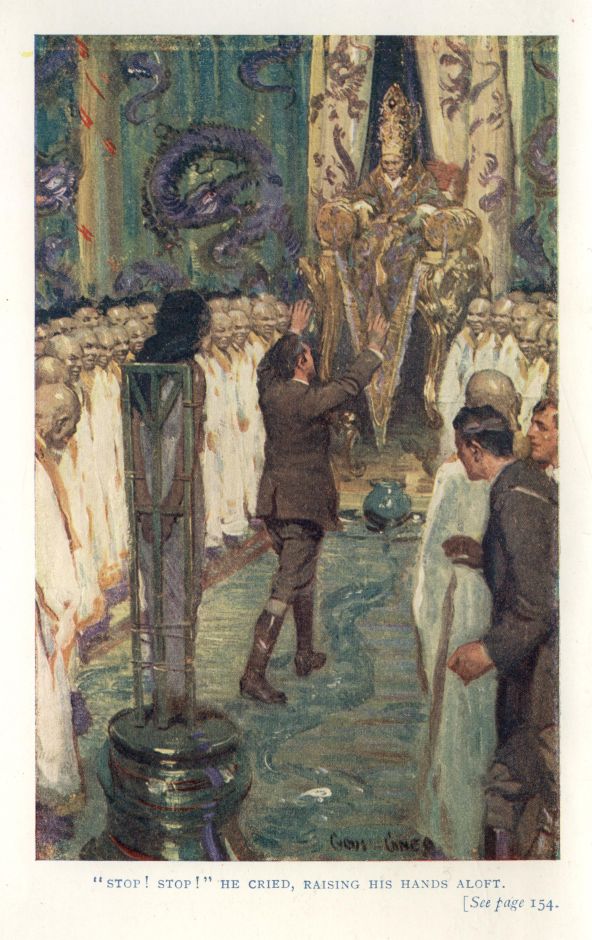
"STOP! STOP!" HE CRIED, RAISING HIS HANDS ALOFT. See page 154.
THE OLD MAN OF THE MOUNTAIN
BY
HERBERT STRANG
FRONTISPIECE IN COLOUR BY CYRUS CUNEO BLACK-AND-WHITE ILLUSTRATIONS BY RENÉ BULL
LONDON HENRY FROWDE HODDER AND STOUGHTON
First printed in 1916
PRINTED IN GREAT BRITAIN BY R. CLAY AND SONS, LTD., BRUNSWICK STREET, STAMFORD STREET, S.E., AND BUNGAY, SUFFOLK.
CONTENTS
CHAPTER I
OUT OF THE NIGHT
CHAPTER II
A COUNCIL OF WAR
CHAPTER III
THE REFUGEES
CHAPTER IV
MORE MYSTERY
CHAPTER V
THE EYE
CHAPTER VI
THE IRON SHUTTER
CHAPTER VII
EUTHANASIA
CHAPTER VIII
THE LAW OF THE EYE
CHAPTER IX
THE MONSTER ON THE WALL
CHAPTER X
THE UNDERWORLD
CHAPTER XI
ALCHEMY
CHAPTER XII
EXPLANATIONS AND DISCOVERIES
CHAPTER XIII
A DRY BONE
CHAPTER XIV
HEAD COOK
CHAPTER XV
THE MOLES
CHAPTER XVI
THE HOLE IN THE WALL
CHAPTER XVII
THE CARNIVORE
CHAPTER XVIII
UNDER THE STARS
CHAPTER XIX
THE FIGHT IN THE PAGODA
CHAPTER XX
BURSTING THE BONDS
CHAPTER XXI
DOOM
LIST OF ILLUSTRATIONS
COLOUR FRONTISPIECE BY CYRUS CUNEO
"STOP! STOP!" HE CRIED, RAISING HIS HANDS ALOFT (See p. 154) Frontispiece
LINE DRAWINGS BY RENÉ BULL
THE MAN DANGLED A FOUR-INCH CENTIPEDE BEFORE HIS EYES. "IT HAD CHEEK TO CRAWL UP HONOURABLE BACK!" HE SAID
AS THEY APPROACHED, THE MAN TRIED TO RISE, UTTERED A FAINT CRY, THEN FELL FORWARD WITH A MOAN
THE TERRIFIED CHINAMAN RACED UP THE HILL, THE ELEPHANT, SCREAMING SHRILLY, CLOSE BEHIND HIM. FORRESTER THREW UP HIS RIFLE AND FIRED, BUT ON THAT TOUGH HIDE THE BULLET HAD NO EFFECT
AS THE OLD MAN WAS LED FORWARD, THE NAGAS POINTED TO HIM WITH WILD EXCITEMENT, CONTINUALLY EXCLAIMING, "THE EYE! THE EYE!"
THE FLAME GLINTED FOR A MOMENT ON A DARK FACE PEERING DOWN UPON THEM OVER THE TOP OF THE SHUTTER
A FEW YARDS AWAY, THEY CAME UPON HAMID GUL, LYING WITH RELAXED LIMBS ON THE GROUND
HIS LIPS MOVED, AND IN SPITE OF THEMSELVES THEY STARTED AS THEY HEARD HIS FIRST WORDS: "WHAT BRINGS YOU STRIPLINGS HERE?"
"IT SAVES FROM THE EYE, SAHIB"
THE MUTE IMMOBILE FIGURE MERELY RAISED AN ARM AND POINTED DOWNWARDS AT THE STAIRWAY
A SHAFT OF PALE GREEN LIGHT, BLINDING IN ITS BRILLIANCE, SHOT UP TO THE ROOF
FORRESTER MET HIM AT THE ENTRANCE OF THE CAVE
HE SHOOK IT: SOME OF THE POWDERY CONTENTS FELL TO THE FLOOR
MACKENZIE MET HAMID IN THE ENCLOSURE WHERE HE WAS DIGGING TRUFFLES
ON LIFTING HIMSELF, HE SAW HAMID CROUCHING BENEATH THE SHELTER OF THE EMBANKMENT
THERE HE SAW THE PRIEST, PEERING UP TOWARDS THE HOLE IN WHICH THE LADDER RESTED
A RUSH OF HOT BLOOD MADE HIM DIZZY, AND HE ALMOST SWOONED WHEN HE HEARD A WHISPER IN OLD MAC'S WELL-KNOWN VOICE
HE SPRANG TO THE WALL, AND RAISED HIS SPEAR TO MEET THE EXPECTED ATTACK
FORRESTER STOOD IN THE DOORWAY, IN FULL VIEW OF THE PRIESTS
TAILPIECE
CHAPTER I
OUT OF THE NIGHT
"Jolly good curry!" said Bob Jackson, looking up over his spoon. "What do you say, Mac?"
"Ay," responded Alan Mackenzie, in a drawl. He was a man of few words.
"Your Hamid is certainly a treasure of a cook," Jackson went on. "Has he done you yet, Dick?"
"Probably, but I haven't found him out, so it doesn't matter," answered Dick Forrester, the third of the party. "It shows you!"
"What?" asked Mackenzie, who always required statements in full.
"Why, you owl, that it's sometimes better to rely on your instincts than on the advice of kind busybodies. When I came through Calcutta, everybody advised me to wait till I got up country before engaging a man, told me the casuals of the Calcutta hotels were sharks ready to prey on any griffin, and so on. But I came across Hamid, liked the look of him----"
"You've a rummy taste in looks," interposed Jackson, with a laugh. "What with his crooked nose and his one eye, he can't pass for a beauty."
"And that's a fact," said Mackenzie, solemnly.
"Well, anyway, I took him on, and that's three years ago, and I've had no reason to regret it."
"He's a champion cook, at any rate," said Jackson.
"He is that," added Mackenzie, with emphasis.
At this moment the man in question entered with the next course, and further discussion of his qualities was impossible.
The three young fellows were taking their evening meal in a tent pitched near the bank of a stream some twenty miles north of Dibrugarh on the Brahmaputra. They were almost the same age, Mackenzie, the eldest, having recently completed his twenty-first year. Three years before, they had met as strangers on the deck of the liner conveying them to Calcutta, and had struck up one of those shipboard friendships which seldom last. In their case it was otherwise. All three were learning tea-planting in Assam, and, as the "gardens" on which they were severally engaged were many miles apart, their opportunities of foregathering were not very frequent. But they met as often as they could for sport in the form of snipe-shooting, boar-hunting, and other avocations that diversify the monotony of a planter's life, and they had become good comrades, knit one to another closely by the bonds of mutual trust and knowledge.
Three months' leave was now due to each of them. Forrester intended to go home: the others had arranged to make an extended tour in Northern India, and see Delhi, Lahore, and other cities of old renown. But it happened that, a few days before they were to start, they heard that a tiger had been doing mischief in a village some thirty miles from their stations. Fired by the news, they got permission from their managers to make a dash for the scene. Elephants were out of the question. They made the journey on foot, with four coolies to carry the baggage, Forrester's bearer, Hamid Gul--the man whom he had picked up in Calcutta, and who added to his many accomplishments a considerable skill in cooking--and a veteran shikari named Sher Jang, whose services they had often employed in their sporting expeditions. Sher Jang, with the aid of local talent, tracked the animal to its haunt in the jungle; after a few crowded moments it fell to the white men's guns; and its skin, already stripped from the carcase by the deft shikari, now lay stretched on the sward near the tent.
"Excuse, sahib!" said Hamid Gul, as he passed behind his master's chair after handing round the cutlets. He had been so long accustomed to use English of a sort with globe-trotters that he seldom spoke Hindustani with his master, like the average native servant.
"What is it?" asked Forrester.
The man's reply was to dangle a four-inch centipede before his eyes.
"It had cheek to crawl up honourable back, sahib," he explained.
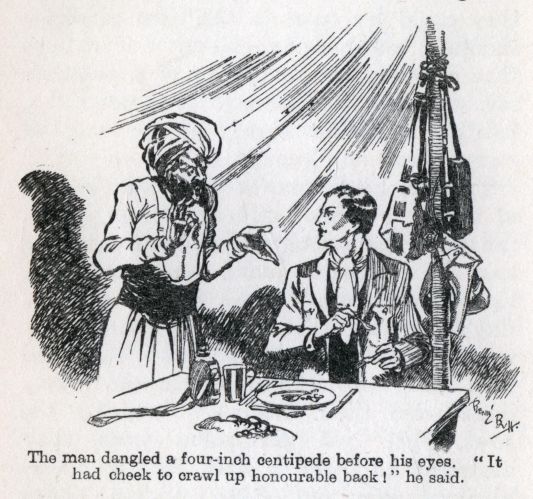
The man dangled a four-inch centipede before his eyes. "It had cheek to crawl up honourable back!" he said.
"Kill the beast!" said Forrester.
Hamid dropped the centipede, settled it with his heel, and moved silently out of the tent.
"I can stand mosquitoes, but centipedes make me squirm," said Forrester. "If you know any sound more horrid than the plop of a centipede falling from the roof to the floor, tell me."
"To me the drone of a mosquito is ten times worse," said Jackson. "Apparently they don't like you, but they can never have enough of me, the brutes!"
"Soft and sweet!" murmured Mackenzie.
"What's the tiger-skin worth, Dick?" asked Jackson, ignoring the Scotsman's jibe.
"I don't know; but a goodish sum, probably. A man-eater's skin is usually mangy, but old Sher says that this is in good condition. Look out, Bob!"
Jackson ducked his head, already warned by a booming noise like the hum of an aeroplane engine that a beetle had flown in at the door. They watched the insect whirling about, until it came blindly in contact with the tent pole, and fell to the ground. There it lay on its back, spinning round and round with ever-increasing uproar, until Mackenzie picked it up, and flung it out--into the face of Hamid, approaching with the dessert.
The three men soon finished their meal, and, taking their camp chairs, went out into the open. When they were seated, Hamid came up with a brass salver filled with glowing charcoal, and presented to each a pair of small silver tongs with which to lift a ruddy chip for lighting his pipe. He prided himself on keeping up old customs. Then, with a good-night salaam, he passed into the tent to clear away.
It was a glorious night. The candlelight from the open tent paled in the rays of the moon, soaring aloft in a cloudless sky. A faint breeze stirred the feathery tops of the jungle grass, and ruffled the glassy surface of the rivulet. From the distance came the piercing lugubrious notes of bull frogs; the air sang with the hum of innumerable insects; ever and anon a bat flitted past like a shadow. At one side of the tent, on an upturned tub, sat Sher Jang, the shikari, smoking a long pipe, and gazing solemnly into space. A few yards away the coolies squatted round their camp fire, replete from their unaccustomed meal of tiger's meat, which they had devoured in the joyous belief that it would endue them with a ferocious courage.
The white men puffed away in silence, thinking over the day's sport, dreaming, maybe, of the anticipated delights of the approaching holiday. Hamid noiselessly finished his work, and then crouched with his pipe on a mat by the tent, studiously ignoring Sher Jang, as a cat ignores the dog on the hearthrug.
Thus half an hour passed. Then Mackenzie's cutty dropped from his mouth, and he snored.
"Hullo, Mac, it's time you turned in!" said Forrester, shaking him by the arm.
"Ay," said Mackenzie, sleepily. "Where's my pipe?"
"At your feet."
The Scotsman picked it up, stood erect, yawned, stretched himself, then suddenly dropped his hands to his sides.
"What's yon?" he said.
His companions sprang up. They, too, had heard a rustling in the jungle close at hand--a sound louder than the swish and scrape of the grass in the breeze. Sher Jang came up to them silently, and handed them their rifles. They heard the sound again, and stood in line, peering into the thicket up-stream, their fingers on the triggers.
The rustle ceased.
"Is it a tiger?" Forrester whispered in Hindustani to the shikari.
"No, sahib; tigers make no noise. It may be a bear."
"Or a native?" suggested Jackson.
"No, sahib; badmashes might prowl at dawn, but not in the night. I think it is a bear."
The rustle recommenced, and drew nearer and nearer. The white men waited with bated breath, ready to fire the instant the beast showed itself. Hamid had not moved; he was no sportsman, and trusted the sahibs to preserve him from harm. The coolies had run behind the tent.
Moment by moment the sound grew louder. Sher Jang gazed impassively into the jungle; he was too old a hand to show any feeling; but the young planters were tingling with excitement, drew quick breaths, and itched for action. All at once the long grass parted, and in the flicker of the firelight they saw a form emerge.
"Great Scott!" ejaculated Forrester.
They lowered their rifles, and stood for a moment in hesitation. Then all three hastened forward, wondering, alarmed. The form was that of a man, clothed in European style. But he was not walking erect, as men walk. He was creeping slowly, painfully, on all fours. Seeing them advancing towards him, he uttered a faint cry and tried to rise, only to fall forward with a moan. They came to him, and lifted him to his feet.
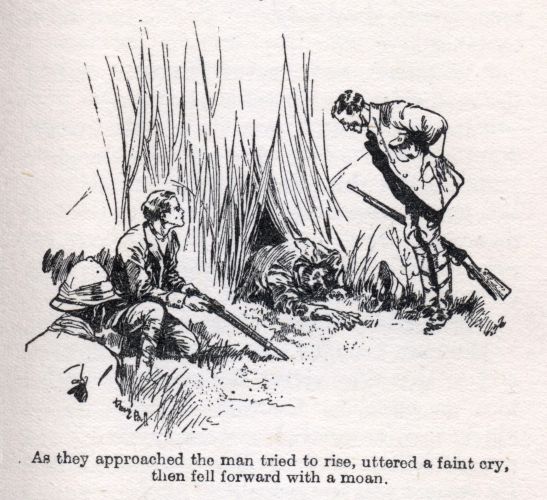
As they approached, the man tried to rise, uttered a faint cry, then fell forward with a moan.
"Pull--yourself--together--man!" he murmured, brokenly. "Pull--yourself--together!"
"What is it, sir?" asked Forrester, feeling the man shiver in his sodden clothes.
"Hoots, man!" exclaimed Mackenzie, "get him to the fire. He's fair wandered."
Acting on this practical suggestion, they led the stranger to the fire. The shikari meanwhile remained fixedly on guard, his eyes never quitting the jungle, his ears alert for further sounds.
"A blanket, Hamid!" Forrester shouted.
The man brought a blanket from the tent, and in this they rolled the stranger, setting him as close to the fire as they dared. Mackenzie unscrewed a brandy flask, and poured a little of the liquor between his lips. He gasped and lay quite still, his eyes staring without seeing. Every now and then his body twitched convulsively.
"The fever, sahib," said Hamid.
"A bad attack, too," said Forrester. "Quick! A rubber sheet, a pillow, and my bottle of quinine."
In a few minutes the stranger had been dosed with quinine and made comfortable. As yet he was unable to talk. Enveloped in the blanket, only his face was now visible--the face of a man about thirty-five, refined of feature, with thick brown beard and moustache, matted with damp and dirt. The sun-tanned cheeks were sunken, the eyes within their hollow sockets blazed with the fire of fever. They watched him anxiously, their concern for his pitiable condition mingled with curiosity. How came this man to be wandering alone and unarmed in the jungle?
"Poor body!" muttered Mackenzie. "Did you notice his hands?"
"They shook like a leaf," replied Jackson.
"Ay, but the blood!"
"Was there blood on them?"
"Ay, on the palms."
"Torn by thorns as he crawled along," said Forrester. "He saw the glow of our fire, no doubt, and staggered towards it; you remember he said, 'Pull yourself together!' He has been pulling himself together for days, by the look of him--and it came to crawling at the last! No sign of pursuit, Sher?" he asked, as the shikari came up.
"No, sahib, there is no sound."
"Give him another dose," said Mackenzie.
After the brandy and quinine had been poured between the sick man's lips, his eyes closed and he seemed to sleep.
"We must take turns to watch him during the night," said Forrester, "and get him to my bungalow as quickly as we can to-morrow."
"If he's not away!" said Mackenzie, gloomily. "I'm no liking the looks of him."
"We'll hope for the best. Malcolm has pulled through many bad cases. We'll dose him every hour or so. I'll take first watch; you fellows turn in. I'll call one of you in three hours."
Soon the camp slept; only Forrester remained awake. He sat beside the invalid, bending forward to catch any sign of change upon the fever-flushed countenance. He rose once to replenish the fire, and once to brush away a small beetle that was crawling on the blanket. The eerie wail of a jackal broke in presently upon the lesser sounds of the night; but that was so commonly heard in Assam that Forrester scarcely noticed it.
In an hour he repeated the dose of medicine, and started involuntarily when the sick man, opening his eyes, uttered a name.
"Beresford!"
Feeble as his voice was, there was in it a note of eagerness and relief. For a moment Forrester thought of encouraging the delusion, but it flashed upon him that the man might not have been alone after all. Was his companion lost in the jungle? Leaning forward, he said, quietly:--
"My name is not Beresford, it is Forrester."
At first the man appeared not to have understood, but after a few moments a look of dread gathered in his eyes, and he struggled to get up. Gently pressing him down Forrester said, in slow, clear tones:--
"You are with friends. You came towards our light, you remember. Won't you lie still and collect yourself, and tell me about it? 'Pull yourself together,' you know?"
"Pull yourself together!" the man repeated, like a child.
He lay back and closed his eyes, reopening them presently and turning them upon the fire.
"A light!" he muttered, eagerly. "My last chance! Pull yourself--ah! they've got him!" He shuddered, then with a sudden lapse into partial consciousness, he went on: "There's no time to lose. They've got him! Don't you hear? They've got him! The shutter! I came on for help. One company will do it; but hurry them, for heaven's sake! Take your hand off me, you hound!"
Then followed a bewildering jumble of Hindustani and a language of which Forrester was ignorant. Taking a cup, Forrester hastened to the stream, filled it with water, and, returning, bathed the stranger's burning brow. The raving ceased. After a brief silence the weak voice again spoke coherently, though the speaker, as the words showed, did not realise his position.
"Don't wait for me. In the hills--four days; nights are better; you won't meet men by night. But march day and night; there's no time to lose, I tell you."
"How shall we find the way?" asked Forrester, in the quiet tone he had employed before.
"I'll show you," said the man, eagerly, trying again to rise. "No, I'm dead beat," he added, falling back. "I'll follow you up. I made a jotting; you can't miss them. What are you waiting for?"
"The paper. Where is it?"
The man wriggled within the blanket, and a look of agony distorted his face as he felt his helplessness.
Forrester quickly loosed the wrappings.
"Which pocket?" he asked.
But a stream of incoherent babbling poured from the exhausted man's lips. He lay passive as Forrester felt in his breast pocket and drew forth a small leather case. Opening it, Forrester discovered a folded paper lying loose. He spread it out, and saw what at first seemed to be nothing but a smudge. But when he held the paper nearer to the firelight, he distinguished a design. It was disappointing, puzzling. A pencil line slanted from the left-hand top corner to the middle of the sheet, then branched horizontally to the right. The pencil marks had rubbed and smudged in the man's pocket, but looking at them closely, Forrester made out a few words in addition to the line. At the angle he read "Camel's Hump," at the end on the right, "Monkey Face." There was nothing more.
CHAPTER II
A COUNCIL OF WAR
Forrester sat musing on what he had learnt from the sick man's broken phrases and the scrap of paper. It was little enough. The stranger's companion, Beresford, had been captured, presumably by natives, at a spot four days' march distant in the hills. His friend had come alone over at least a hundred miles of wild country to seek help. The pencil line traced his course; the names no doubt roughly described conspicuous natural features that would serve as landmarks on his return. But who were the captors? Where was the place of durance? What did he mean by "the shutter"? In what direction lay the point on the route called "Monkey Face"? Without answers to these questions it seemed to Forrester that nothing could be attempted on behalf of the prisoner.
A glance at the invalid showed that he was either asleep or fallen into a stupor. Forrester rose, and paced to and fro, half inclined to wake his friends before the time. The dismal hoot of an owl close at hand, several times repeated, jarred his nerves; by the natives the bird was suspected of possessing the power to scent out those about to die. Though scouting such superstitions, Forrester felt oppressed and uneasy, so that it was with real relief he heard, as he passed the tent, Mackenzie's voice rasp out from the interior:--
"De'il take the fowl!"
"You're awake, Mac?" he said, putting his head in.
"Who could sleep through yon soul-terrifying clamour?"
"Neither soft nor sweet," murmured Jackson. "How is he, Dick?"
"Asleep now, but he's been talking. As you're awake, get up, and I'll tell you."
Throwing rugs about them, they joined him, and all three returned to the fire. Forrester repeated the man's words, and showed them the paper.
"He's not daft, think ye, with his camels and monkeys?" said Mackenzie.
"He was sane enough when he drew this diagram," Forrester replied.
They examined it in turn.
"I say, here's a word you've missed," said Jackson, suddenly. "It's very faint, and badly smudged. I can hardly make it out, but it's 'Falls,' isn't it?"
They scrutinised the paper eagerly in the firelight.
"You're right," said Forrester. "That's his starting-point, by the look of it: some waterfall or other."
The stranger's pocket-book was lying on the ground where Forrester had placed it after removing the paper. Mackenzie picked it up.
"Don't you think we might?" he asked.
"It's the only way," said Jackson. "Find out who he is, and make inquiries about him as soon as we get back."
Mackenzie opened the case. From one of its pockets he drew forth a roll of rouble notes, from another a couple of letters addressed to Captain Redfern at Peshawar, and finally a small note-book.
"There's his name," said Forrester. "The note-book may help us."
He found, however, on opening this, that the leaves contained nothing but jottings of words and phrases in unfamiliar tongues, with their English equivalents. There was no clue to his destination or the object of his journey, no mention of his companion.
"We're not much forarder," said Forrester. "The only thing to do is to get home as quickly as possible to-morrow, and wire through to Sadiya or Calcutta. Somebody will know something about him."
They talked for a few minutes longer; then Forrester and Jackson returned to the tent, leaving Mackenzie to take his spell of watching.
The camp was astir early. While the coolies were packing up, and Hamid was preparing breakfast, Forrester sent Sher Jang to the village half a mile away to enlist carriers for the sick man. In an hour the shikari returned with four lithe, well-developed young Mishmis, whose only clothing was a loin-cloth of bark and strips of bamboo coiled about their arms and legs. The villagers' gratitude for the destruction of the man-eater disposed them to undertake any service for their deliverers, especially when that service was to be rewarded with pay.
After breakfast, a litter was quickly constructed of a blanket and two bamboo stalks cut from the border of the stream. On this they placed Captain Redfern; he was still unconscious, and neither spoke nor stirred; and by eight o'clock the caravan was in movement.
Their way led them through the village. Here they waited to receive the thanks of the head-man, who presented them with a number of fowls in token of his gratitude. A crowd of men gathered around the litter, chattering excitedly in sing-song tones. Sher Jang presently drew Forrester aside.
"They talk of prisoners, sahib," he said in a whisper. "There are two strangers; may one of them be the captain sahib's friend?"
"Ask the head-man," said Forrester, eagerly.
The shikari's question seemed to cause the head-man some embarrassment. At first he denied that there was any truth in his young men's gossip, but on Sher Jang's insisting, with threats which Forrester would hardly have countenanced, he confessed that two strangers had indeed been brought into the village the night before. A party of the villagers had been away on an excursion some fifteen miles across the Brahmaputra. (He did not disclose the object of the expedition, but the shikari guessed that it was not unconnected with head hunting.) They were marching through the jungle when suddenly they heard a rustle and hid themselves. Two men came in sight, not naked Abors, as they had expected to see, but strangers, clothed. They had captured them without difficulty, for the men bore no weapons and one of them had lost his right arm, and brought them back to the village.
"Where are they?" asked Forrester, when Sher Jang repeated this story to him.
"In the moshup," the head-man replied, pointing to a spacious building in the heart of the village. It was built on piles, the walls and the sloping roof made of plantain leaves laid one upon another like the tiles of a European house. There the affairs of the community were discussed by day, and the unmarried men slept at night.
"Let me see them," said Forrester, hoping that by some strange coincidence Captain Redfern's friend, having escaped from captivity, had wandered in much the same direction.
The head-man besought the sahib not to be angry with him. The presence of the strangers was a trouble to him, for he did not know what to do with them. He could not speak their speech, and he was afraid. His young men ought not to have laid hands on men who were clothed. Forrester cut short his apologies, promising that he should suffer no harm; whereupon the head-man sent a messenger to the building aforesaid, to bring forth the prisoners.
The Englishmen awaited their coming with mingled hope and anxiety. By and by two figures emerged from the building.
"Chinamen, by Jinks!" Jackson ejaculated.
Disappointed at the dashing of their hopes, the three were no longer much interested in the Mishmis' prisoners, through whom their journey was being delayed. But they could not help remarking a certain strangeness in the Chinamen's manner of approach. They did not hasten across the open space with the eager gait of men to whom had come sudden deliverance from a terrible fate (for there was not much doubt that the villagers would ultimately have solved their dilemma by adding the Chinamen's heads to their collection). After leaving the moshup, and perceiving the unmistakable forms of Englishmen in the distance, the two men halted and appeared to consult together. Then they advanced slowly, one before the other, in the manner of a shepherd driving a solitary sheep.
The first comer was a young man, well grown, but curiously slack in his gait and bearing. His head hung forward a little; his arms drooped limply at his sides; and in his eyes, as he drew nearer, the Englishmen discerned a languorous and sleepy expression. The second man presented a striking contrast. His age was between fifty and sixty, but he was upright as a dart; and his features, his eyes, his whole mien bespoke energy and determination. The right sleeve of his coat was empty, and lay pinned across his breast.
Escorted by a noisy crowd of the villagers, the Chinamen came up to the Englishmen, and bowed in salutation. Then, before Forrester could utter a word, the younger man began to speak in a breathless, jumpy fashion, strangely unlike the stolidity which is usually associated with the Chinese.
"We ask your assistance, gentlemen," he said in good English; only his reedy tone, the usual difficulty with the letter "r," and a certain formality of phrase proclaimed him a Chinaman. "Being accused of sedition we were on our way from Yunan to Tibet with a small caravan; but a week ago we were pursued by Government troops, and with difficulty escaped, leaving our men and stores behind us."
This was uttered rapidly, as if he were repeating a lesson. At the end of the sentence he glanced timidly at the elder man, who had stood the while gazing unswervingly upon his companion. In his eyes there was a hard, metallic glitter, under which the younger man appeared to droop. Turning again to the Englishmen he went on:--
"Driven from our course by the presence of regular troops near the frontier, we diverged to the south-west towards the borders of Assam. But when we were making our way north-west again towards Tibet, we fell into the hands of these people, and we thank you very much for rescuing us from our terrible plight."
"That's all right," said Forrester, with the Englishman's usual anxiety to avoid any display of feeling. "Does your friend speak English?"
"No," returned the man with a momentary energy. "I myself----"
He broke off suddenly, with a look of apprehension at his companion, who had not spoken, but whose eyes had never left the young man's face. Hurriedly he went on:--
"These people searched us, but did not find the little gold we carry, and the bundle of notes they found have no value for them, though they have not returned them to us. There is plenty of money to pay our way if we are assured of safety, and we ask to be allowed to accompany you until we can resume our journey."
"By all means," said Forrester. "I will get your notes back. I suggest that you make a small present to the head-man, and he will no doubt let you come with us without any bother."
A brief conversation ensued between Forrester and the head-man, through Sher Jang. The notes were surrendered; a few coins were given to the Mishmi; the Chinamen attached themselves to the Englishmen's party, and the march was resumed.
"He talks fine," said Mackenzie to Forrester, "but there's something fishy about yon Chinkies."
"The elder man has told the other not to give too much away, I think," said Forrester. "But they needn't be afraid of us. Political refugees are safe with Englishmen."
"Man, maybe they're murderers," said Mackenzie.
"You had better look out then," replied Forrester, with a laugh.
"Anyway, there's a hang-dog look about the youngster," said Jackson. "He's like a puppy afraid of a whipping."
More than once during the journey they tried to converse with the young Chinaman, but failed to draw more than a word or two from him. The elder man kept close to his side, and the Englishmen, finding that their well-meant remarks tended only to increase the young man's painful nervousness, gave up the attempt and left the Chinamen to themselves.
It was drawing towards sunset when they reached the plantation on which Forrester was employed. The long march through the hot and humid air had tired them all, and the condition of the sick man had become alarming. With the planter's traditional hospitality, the manager, Mr. Paterson, at once arranged to receive the captain in the bungalow he shared with Forrester, and offered to accommodate the Chinamen for the night in one of his godowns. At the instance of the elder man the younger politely, but with evident reluctance, declined this offer, preferring to push on to Dibrugarh, only a few miles away. The Englishmen did not press them; they were anxious to have as soon as possible the opinion of Dr. Malcolm, the medical officer of the gardens, on the invalid's chances of recovery.
"Eh, man, it's a verra bad case," said the bluff Scots surgeon after making his examination. "Malaria is bad enough, as ye know, but I would not say but this is jungle fever. However, never say die; I'll do what I can."
Early next morning Forrester rode over to Dibrugarh, and telegraphed to a military friend of Mr. Paterson's in Calcutta, asking if anything was known of Captain Redfern. The manager had advised this course in preference to communicating with officials, as likely to avoid red tape and save time. In a few hours the answer came:--
Redfern Captain Bengal Fusiliers on furlough exploring buried cities Chinese Turkestan with Beresford archaeologist.
Forrester was not very strong in geography, but he knew that Chinese Turkestan must be at least a thousand miles from Dibrugarh. What had brought the explorers so far from the scene of their labours? The pressing question, however, was the whereabouts of Beresford. Without loss of time Forrester took the first train for Sadiya, the frontier village where resided the Political Officer whose duty was to keep an eye on the hill tribes.
"Your man is where he had no business to be," said that gentleman when he had heard Forrester's scanty story. "He has been collared, I should think, by the hillmen somewhere south of Tibet--quite beyond my jurisdiction."
"Do you know anything of a waterfall a hundred miles or so north?" asked Forrester.
"There are falls in plenty, no doubt," was the reply; "but the country on the right bank of the Brahmaputra up there is practically unexplored. Part of the course of the Brahmaputra itself is unknown."
"Before he became delirious Redfern talked of sending up a column to rescue his friend."
"My dear fellow, he was talking through his hat. It's entirely out of the question. The Government won't run the risk of provoking a general rising of the hillmen whenever a roving explorer has come to grief in a district where he has no earthly right to be. It would mean one of those little frontier wars that cost no end of money and set the Labour Members barking."
"But surely something ought to be done--can be done for an Englishman," Forrester persisted.
"I'll communicate with headquarters and let you know the result; but I promise you it's no good. The country is a sort of no man's land. Representations at Lhasa and at Pekin would be equally useless; China and Tibet would both wash their hands of the matter. Besides, Government wheels move slowly, the man would be done for before any move could be made; he may be done for already. I'm sorry for him, but he has only himself to blame."
Forrester went away very indignant at what he regarded as official callousness, yet recognising the soundness of the Political Officer's contention. He remembered the Abor expedition, in which a large military force had been engaged for six months in making its way through the jungle to exact retribution for the murder of two Englishmen. Remembering, too, the uncertainty of Beresford's whereabouts, he was forced to admit that the Government might reasonably hesitate to commit themselves to an enterprise of which the end could not be foreseen.
When he returned to the plantation, and told his friends the results of his journey, Jackson, who was excitable and quick-tempered, stamped up and down the room, abusing Governments and Political Officers and mankind generally. Mackenzie, on the other hand, sat placidly smoking his pipe, silent and thoughtful. In the course of a few minutes, when Jackson had blown off steam, the Scotsman said quietly:--
"Now ye've done blethering, Bob, listen to me. We'll do it ourselves."
"What?"
"Ay!"
"What do you mean, Mac?" asked Forrester.
"I'm telling you. A score or two of the Assam Light Horse----"
"Oh, rats!" cried Jackson, impatiently. "If the Government won't undertake it, d'you suppose they'll let a lot of amateurs go careering about? They'd expect to have to send a Field Force to bring us off. It's absurd."
"Don't blow my head off. I've another proposition. I'm not particular about my leave. Let the three of us see what we can do."
"D'you mean it, Mac?" cried Forrester.
"Ay!"
CHAPTER III
THE REFUGEES
The credit of the arrangements made during the next two days must be divided between Mackenzie and Sher Jang. The former showed a capacity for organisation which his friends had not suspected.
"Just ye listen to me," he said, when they were discussing the proposal he had sprung upon them. "If I tell ye nothing, ye'll no have to tell fibs, d'ye ken? The least wee bit suspicion, and our leave will be stopped. All ye need to know is that before we start for our holiday in earnest we're going on a private hunting expedition, which will be perfectly true. Sher Jang and I between us will make things ready."
"That's the longest speech I've ever heard from your lips, Mac," said Forrester with a laugh.
"Maybe," Mackenzie replied.
He was not the man to let grass grow under his feet. Within an hour Sher Jang set off to interview certain Nagas of his acquaintance--active forest-bred natives who had served from time to time as beaters in hunting expeditions, and were to be depended on for nerve and steadiness. The shikari's mission was to engage half a dozen as carriers for such stores as it would be necessary to take. They would be armed in case of difficulties with the natives they might encounter on the way, though Mackenzie hoped that no hostility would be aroused by the passage of what was ostensibly a hunting party.
Meanwhile, Mackenzie himself sought out in Dibrugarh a local native contractor, whom he engaged to deliver a carefully calculated quantity of food within two days at a village about twelve miles north of the Brahmaputra. He went about among his acquaintances, trying discreetly to pick up any information they might possess about the country northward; but none of them had travelled more than a score of miles in that direction, so that his cautious inquiries had little result. As Captain Redfern was still in the delirium of fever, it became clear that the leaders of the expedition would have to rely on themselves to discover the place of Beresford's captivity. They anticipated little difficulty in locating the spots Redfern had marked as "Camel's Hump" and "Monkey Face," because in the country through which they were going the mountains rose to a height of many thousands of feet, and eminences so distinctive as to invite special names would no doubt be conspicuous at a very great distance.
On the appointed day the three young fellows set off with Sher Jang and Hamid Gul. Their departure awakened no suspicion, but only a mild envy among those whose holidays were still to come. Arriving at the rendezvous, they found the half-dozen Nagas awaiting them, and the Assamese contractor with the supplies. On entering the village, Jackson turned round with a start.
"What's up, Bob?" Forrester asked, noticing a strange look of bewilderment in his friend's eyes.
"Nothing. I don't know," Jackson replied, slowly. "I had the rummiest feeling--just as if some one were calling me."
Forrester laughed.
"Nerves, old chap," he said.
They went on together, thinking no more of the matter. The Nagas soon shouldered their loads, which consisted of a light camp equipment and a quantity of food. Forrester was about to give the order to start when there came from a hut on the far side of the village the two Chinamen with whom they were already acquainted, followed by two Nagas carrying packages. The men approached in the same order as on the occasion of their first meeting, and the younger man looked more miserable than ever. Coming up to the Englishmen, he addressed them haltingly, in the manner of one performing a distasteful duty against his will.
"I make humble excuses, gentlemen," he said, "but I beg a favour. Learning that you were travelling in this direction, we ask that you will permit us to accompany you and enjoy the benefit of your protection until our ways part."
"I wish to goodness the fellow wouldn't look as if he were going to snivel," Jackson whispered to Mackenzie.
"All right; don't apologise," said Forrester. "We're in rather a hurry; I hope we shan't walk you off your legs."
The Chinaman thanked him, and fell back with his one-armed friend, whose eyes had been bent steadily upon his face. Mackenzie went up to the Assamese contractor.
"Ye blethering idiot!" he said. "Didn't I tell you to hold your tongue?"
The Assamese cringed and rubbed his hands together deprecatingly. He explained that the Chinese gentlemen had lodged in his house, and he had only mentioned casually that he was providing stores for a hunting party. It was an honour he much appreciated.
"Eh! Get out!" Mackenzie exclaimed in disgust. "A man that cannot hold his tongue is a very pitiful body. We must get away at once," he added, addressing his friends. "If this wretched creature has been talking, the authorities have maybe got wind of it, and they'll be sending after us."
To avoid the risk of being stopped, they wasted not a minute. The company formed up in marching order and set off. Forrester and Mackenzie led the way with Sher Jang; the Nagas followed: then Hamid Gul and the Chinamen with their retainers, Jackson bringing up the rear. The Nagas, sturdy little fellows about five feet high, brown of skin, with bright eyes tinged with smoke, stepped out cheerfully under their loads. These were carried in conical-shaped baskets slung from their shoulders, and kept in position by a band of plaited cane round the forehead.
The way led through open grass land amid trailing creepers and patches of bog. Insects buzzed around, darting in to sting, and leeches clung to the clothes of the white men and the bare bodies of the natives, and could only be dislodged by the lighted tip of a cigarette. Streams had to be forded, through beds of rushes and bamboo rising to a height of eight or nine feet. The air was hot and moist, and the white men, lightly clad though they were, were soon dripping with perspiration; but they held gamely on until near mid-day, when they took a light meal, resting afterwards for a couple of hours.
During the afternoon, Mackenzie noticed that the Chinamen had pushed forward beyond their allotted position, and, outstripping the Nagas, had closed up within a few yards of the leaders.
"Get back to your place," he said.
The men at once fell back, and for the rest of the day the order was unbroken.
"You spoke rather sharply, Mac," said Forrester.
"Ay. The beggars wanted to hear our talk."
"D'you think so? They carry no loads, and, of course, walk faster than the Nagas."
"That's true, but I don't trust 'em."
"They only want company, I fancy. The poor wretches won't feel safe until they reach Tibet. I've read of Chinese torture, and if they're political refugees they'll be in mortal terror of falling into the hands of their enemies."
"Maybe," Mackenzie replied. "They've a long road to go."
"Look here, you're suspicious," said Forrester. "What's in your mind?"
"Nothing in particular. But I don't like 'em too near."
Towards nightfall they encamped in a fairly open space, and Mackenzie assigned to the Chinamen a position well out of hearing.
On the following day they found marching more difficult. The country rose gradually, presenting many sharp ascents and declivities, jungle alternating with stretches of bare stony ground. As they pursued their toilsome way they realised the stupendous exertions that Captain Redfern must have made in travelling alone, unarmed, and without provisions except such edible plants as he could find in this trackless country. They met no men; Sher Jang turned aside whenever he saw human tracks. But they sighted elephants, wild boars, and other game which appealed to their sporting instincts. They would not delay, however, to try their skill: on the way back, perhaps, when their errand was completed, they might secure trophies of the chase.
Late in the afternoon of the second day they made their camp on a rocky hillside within a few hundred yards of a small mountain stream, which swirled its impetuous way between grassy banks. One of the Nagas descended the slope to fetch water for cooking; the white men, weary with the day's march, were reclining near their tent, smoking in silence.
They were suddenly disturbed by a shout from below, an agonised cry for help. It was followed by a shrill sound which the white men had never heard before, but which caused the shikari to spring to his feet in excitement.
"Elephant, sahib!" he cried.
Almost at the same moment the Naga, his eyes distended with terror, broke out of the long grass at the edge of the stream, and ran up the slope towards the camp. A few yards behind him came a huge elephant, its trunk uplifted, filling the air with its squeals of rage.
The white men seized their guns. But between them and the elephant were the Nagas, who, on the first alarm, rushed helter-skelter towards the tent. It was impossible to fire without hitting them. Heedless of the white men's shouts, they did not turn aside and so allow a clear space for shooting.
"We must cut and run," cried Forrester.
The three turned among the terrified natives, and the whole party scattered in all directions up the hill. The elephant charged on, crashed into the tent and levelled it with the ground, and rushed with infuriated bellowings in pursuit of the fugitives.
In the haste and excitement of the moment, Forrester had taken no heed of the rest of the party. The appearance of the monstrous beast was so sudden and unexpected, the fury of its thunderous onset so alarming, that dismay and confusion might have been forgiven to the most experienced of hunters. But he became aware that in the dispersion of the party, the young Chinaman, whether by accident or design, was within a few feet of him, making, like himself, for the shelter of a belt of trees a little above them. They entered it almost side by side, and Forrester, gathering his wits, began to dodge in and out among the trees, knowing that the elephant would be at a great disadvantage in following him by reason of its unwieldy bulk.
For a few moments he was too much preoccupied to think of the Chinaman. But the thuds of the great hoofs growing fainter, he stood still and looked to see what had become of the young man. To his horror he saw that the youth had run straight through the copse to a clear rocky space beyond, where the elephant, with a speed which its lumbering frame little promised, was rapidly overtaking him. Divided between alarm for the Chinaman's safety and annoyance at his stupidity, Forrester sprinted through the copse, hoping at least to divert the beast and give the fugitive a chance.
The Chinaman's luck was against him. Ignorant of the fact that elephants have difficulty in running obliquely up a slope, he was racing straight up hill, the animal, screaming shrilly, only a dozen yards behind. Forrester perceived that in a very few moments the hapless youth must inevitably be run down and trampled to death unless the elephant were checked at once. He stopped short, threw up his rifle and fired. The bullet had as little effect on the tough hide as a pea might have had. Neither the report nor the impact caused the elephant to swerve.
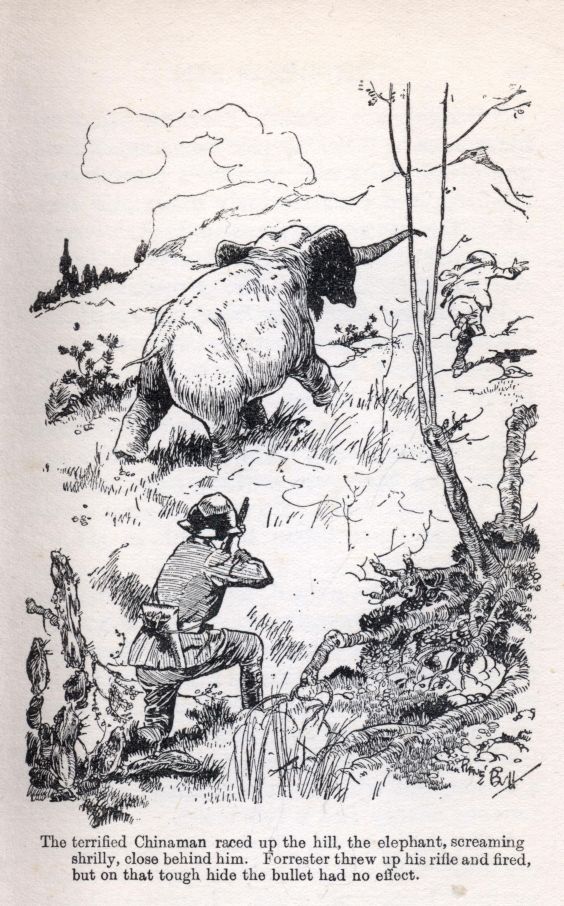
The terrified Chinaman raced up the hill, the elephant, screaming shrilly, close behind him. Forrester threw up his rifle and fired, but on that tough hide the bullet had no effect.
"Behind the ear!" Forrester said to himself, as he lifted the rifle for a second shot, and steadied himself to take a careful aim. He fired, and could scarcely believe his eyes when the huge creature stumbled forward, recovered itself, then rolled over sideways and lay stretched upon the ground.
Breathless, quivering from his exertions, Forrester stood gazing upon the inert lump. He was barely conscious of the shouts of his party beyond the copse and higher up the hill. But in a moment he was roused from his brief abstraction. The young Chinaman, seeing that there was nothing more to fear, had hastened back. He came eagerly up to his rescuer, and began to speak in a low, agitated voice.
"Sir--sir," he gulped, trying to regain his breath; and Forrester was amazed at the change that had come over him. Gone was the languid droop, the timid mien, the furtive cringing expression of the eye. The lad stood erect; his eyes shone; words flowed from his lips, not in the sing-song of one repeating a lesson, but with the modulations of spontaneous energy and a full heart.
"Sir, sir," he said, "twice you have saved my life. Will you not help me again? Save me from I know not what. I am not what I seem, the servant of that horrible man. We are not refugees. My father is a mandarin, the governor of Szechuan; I am his eldest son. Six months ago that man, Wen Shih, entered my father's service; he was a diligent servant, and was trusted by all. He gained my confidence; we were much together. One day he bade me come with him a journey, and I came, and I cannot get away. Where we go I know not, but I fear, I fear! He holds me, he commands me, he--he is calling me!"
At these last words his tone fell to a murmur, his jaw dropped, and a look of terror came into his eyes.
"Go on; tell me more," said Forrester, taking the Chinaman by the arm.
"He is calling me," the youth murmured again, though his elder companion was not within sight, nor could his voice be heard. He turned slowly about, and with head hung forward and arms outstretched before him, in the attitude of a man groping in the dark, he staggered rather than walked back towards the camp.
CHAPTER IV
MORE MYSTERY
Forrester's attention was diverted from the Chinaman by the appearance of his friends, whom the sound of his lucky shot had drawn through the copse.
"By Jinks!" Jackson cried as they came up, "you killed him!"
"I never made such a fluke in my life," Forrester replied. "Come and have a look at him."
They found that the bullet, entering behind the ear, had passed clean through the animal's brain.
"You must take his tusks," Jackson went on. "It would be simply idiotic not to carry home the trophies of your first elephant. That's a job for Sher Jang."
"Where is he?" Forrester asked.
"Ay, where?" Mackenzie echoed. "He's a queer sort of shikari to run from an elephant."
"We can't fling a stone at him over that," Forrester remarked, with a laugh. "Let's get back to camp, and send him up. I dare say the men would relish elephant meat for supper."
As they turned towards the camp, the Chinaman's strange words recurred to Forrester's mind.
"I say, you fellows, there is something mighty queer about those Chinamen," he said. "The youngster was running with me, and after I had shot the elephant he began to tell me things--not in what Bob calls his snivelling style; he seemed a new man altogether. He said they're not political refugees at all."
"Eh! I thought as much," Mackenzie put in. "They're criminals."
"I don't know. He said the elder man was a servant in his father's house, and his father is a mandarin, governor of some place or other. The servant has some sort of a hold over the fellow. But just as he was getting to the most interesting part of his story, he suddenly broke off, whispered that the man was calling him, and looked as terrified as if he'd seen a ghost. I asked him to go on, but he turned away, stretched out his hands like that," he illustrated the gesture, "and began to stumble back like a blind man. Didn't you see him as you came through the copse?"
"I caught sight of him, but didn't notice him particularly," said Jackson. "What do you make of it? Is he cracked?"
"Upon my word I should have thought so, only he spoke sensibly enough. I'll see if I can get more out of him presently. The other man doesn't know English, so the young one can tell us anything he likes without his being any the wiser."
On emerging from the copse they saw that the Nagas had collected in a group up the hill, evidently awaiting assurance that all danger was past. Hamid Gul was helping Sher Jang to re-erect the flattened tent. Near by, the elder Chinaman sat cross-legged on a rock, and the younger stood before him in the attitude of a suppliant.
As the three men approached the tent, Sher Jang came to them.
"I have shot the elephant," Forrester said to him. "Go up presently and cut him up. We'll keep the tusks. Why didn't you come with me?"
"I watched, sahib," the man replied.
"But watching is not work for a shikari."
"Sometimes it is, sahib. Why did not the stranger yonder run with the rest?"
"What do you mean?"
"He sat on the rock where he sits now, sahib. The elephant passed within a few feet of him, but he did not move. He sat there, and his eyes were fixed like glass. I thought: why is he so still, like a Buddha in stone? And I stayed to watch him; it seemed good to me, sahib."
"And what did you see?"
"No more than I have said, sahib, except that presently the young stranger came back like a blind beggar feeling his way through the bazar. Then the elder man smiled, and his smile was like the grin of a tiger. That is all, sahib."
"Well, get the tent up. Is the pole broken?"
"We have spliced it with rope, sahib. That simpleton," indicating Hamid, "wrung his hands and declared the pole useless, but I showed him the way."
The three men went on towards the Chinamen. At their approach the elder man rapped out a few words in a stern and peremptory tone to his companion, then rose to his feet with a respectful salutation to the white men. Forrester acknowledged it, and, turning at once to the younger man, asked him to continue the story he had so abruptly broken off. A pitiful look of distress came into the lad's eyes; his lips moved, but not a sound issued from them.
"Come, there's nothing to be afraid of," Forrester urged. "You may speak quite freely."
"Forget what I said, sir," the lad muttered. "It was false. I beg you think no evil of my kind friend."
His voice hardly rose above a whisper; every word seemed to be wrung from him.
"But surely there is something in it," Forrester persisted. "Was your friend a servant in your father's house? You did not invent that?"
The lad cast a look at his companion that might have been interpreted as terror or anxiety. The elder man did not return the glance, but stood beside him with a mien suggesting patient forbearance or even absence of mind.
"I do not know what I said," the young man replied slowly, like one talking in his sleep. "I was excited after the great peril I had escaped, my mind was troubled, and my tongue spoke foolishness. Pardon me, I pray you."
Seeing that nothing more was to be got out of the lad, Forrester turned away with his companions.
"There's some mystery here," he said, when they were out of earshot. "What's the matter, Bob?" he asked, noticing a strange look in Jackson's face.
"I don't know: I feel as if this were all a dream--a queer sort of fuzzy feeling in my head."
"I feel puzzled enough," said Forrester. "Why should the fellow make out that he was telling lies? It looks as if he's mortally afraid of the other man, but I can't make it out, for the chap doesn't know English, and wouldn't understand, whatever was said. What do you say, Mac?"
"There's no call to say anything," Mackenzie replied.
"There's the canny Scot," Forrester said with a laugh. "You'll think all the more, I suppose."
"I'm thinking they're worth watching," was Mackenzie's answer.
Next morning a slight change was made in the order of the march. Mackenzie asked Jackson to go ahead with Forrester, while he brought up the rear.
"I don't mind, but what's your reason?" Jackson asked.
"I just wish to contemplate the Chinkies from the rear," was the reply.
Whatever the result of his examination was, Mackenzie said nothing about it.
Towards mid-day the snow-clad peaks of a mountain range opened up ahead of the party; although in the clear atmosphere they seemed to be only a few miles distant, the nearest was probably fifty miles away. The intervening country was a series of undulations, bare stretches of rock, here and there deeply fissured, alternating with thickly wooded valleys and dense jungle. Ever since they left Dibrugarh the party had been steadily climbing, and the higher they rose, the less their progress was impeded by undergrowth; and the lower temperature made their exertions less fatiguing. But the white men were more and more impressed with the courage and endurance which Captain Redfern had shown in traversing this wild region.
They kept a keen look-out for hills answering to the names he had given them, for they had no other landmarks by which to direct their course. It was impossible to believe that they were peaks of the snowy range so far ahead: four days would not have sufficed for the covering of so immense a distance. Forrester was already feeling very doubtful of the possibility of distinguishing the hills, when Sher Jang suddenly pointed to the eastern end of a smaller range that crossed the prospect perhaps twenty miles away. It was a precipice falling away abruptly to the general level from a height of two or three thousand feet, and the contours of the scarp bore a strong resemblance to a monkey's face. Forrester swept his eyes along the range from east to west, and gave a cry of delight when he distinguished at the western end a rounded eminence shaped like the hump of a camel.
"We're on the right track," he said. "We shall have to round that range, then cut away northward to find the falls. Probably they won't be so easy to discover."
"It will be to-morrow night before we reach the Camel's Hump," said Jackson. "The falls can't be more than a day's march farther, or Redfern couldn't possibly have done it in four days."
"We go slower than he did, owing to our baggage. If we only came across some natives we might ask them the way, but the whole country seems to be uninhabited."
When they halted to form camp, Mackenzie said:--
"Just now I caught the young Chinky talking to Hamid Gul, and I stopped it. Hamid told me the fellow asked where we were going, and why we didn't look for game. I got up to them in time to prevent the answer."
"They were very natural questions," said Forrester. "We are supposed to be a hunting party."
"Ay, and the Chinkies are supposed to be political refugees, but I have my doubts. I would like well to see the back of them. Have you had any return of that fuzzy feeling, Bob?"
"No. You haven't had it?"
"Not I. What about you, Dick?"
"D'you think it's catching?" Forrester asked with a laugh. "My head's perfectly clear, thanks."
But a couple of hours later, when all three were sitting smoking at the door of the tent, Forrester suddenly stood up, looked round him with an air of perplexity, then took a step in the direction of the spot where the Chinamen were reclining. Mackenzie grasped his coat, and pulled him back into his seat.
"What are ye about, man?" he asked.
For a moment Forrester was silent, then he said:--
"It's very queer. I felt as if I must walk over there, goodness knows what for. The feeling has gone now. What's wrong with me?"
"Malaria, as like as not," said Mackenzie. "Here, take a stiff dose of quinine. We don't want an invalid on our hands."
Forrester had no return of his strange vertigo, if such it were, and after supper he laughed at himself for his momentary weakness.
By the afternoon of the next day they had worked round the Camel's Hump, and, turning northwards, saw stretched out before them a tract of dense scrub, beyond which in the far distance towered the peaks of the snowy range. They decided to continue their march until sunset, hoping that somewhere amid the scrub a suitable camping place would offer itself. So difficult was the passage now, that the party became more split up than had hitherto been the case; but there was no danger of anyone straying, since the order had been given that those behind should not turn aside from the tracks of those who had preceded them.
In course of time Sher Jang reached a fairly open space, and a halt was called. The Nagas straggled in, Hamid Gul followed them and Mackenzie appeared last of all. For a few moments his companions were too much occupied to notice a diminution of their party, but presently Forrester, after a look around, cried:--
"Where are the Chinkies, Mac?"
"Aren't they here?" Mackenzie asked in return.
"You ought to know--you were contemplating their backs," Jackson remarked.
There was no sign of them. Forrester called up their Naga carriers, and Sher Jang questioned them. The men could give no information. Once or twice they had lost sight of the Chinamen as the scrub hid them from view. They had thought nothing of that.
The three white men looked at each other.
CHAPTER V
THE EYE
Forrester was the first to break the silence.
"They've gone a little out of the way," he suggested. "By the time we've got the tent up, they'll be here."
But minutes passed, and the men did not appear.
"We had better go and look for them," said Jackson.
"It's a good riddance," Mackenzie replied.
"But we can't leave them in the lurch," said Forrester. "They've absolutely no defence against wild beasts. Come along! We three will go with Sher Jang back into the scrub and beat it. We mustn't lose touch with each other. Every man give a coo-ee every few seconds."
The suggestion was carried out. The four men scattered, and worked back through the scrub until daylight was almost gone. No trace of the Chinamen could be discovered. Forrester called to his companions to join him.
"It's my belief they've done a bolt," he said. "They couldn't possibly have missed the track. But where can they have gone? Tibet is still very far off, and they run no end of risks going through the country unarmed."
"D'you think they've got friends in this neighbourhood?" Jackson asked.
"Eh, what use is it talking?" Mackenzie replied. "They're gone, and for my part I don't wish to see them again."
"All the same, it's queer their going away suddenly without their carriers, and not saying a word," Forrester remarked. "They were polite enough in asking to be allowed to join us."
"Ay, there's something mysterious about them; we must be on our guard," said Mackenzie. "It's not very likely they're in league with the natives of these parts, but you never can tell."
"I'd give something to learn the history of that one-armed fellow," said Jackson, reflectively.
Next day, on emerging from the tract of scrub, the party found themselves on a bare rocky ridge below which stretched a broad and densely wooded valley. On the farther side the ground rose steeply to the foot-hills of the snowy range. The hollows were clothed with vegetation, which formed dark green patches amid bare brown spaces of rock.
"Which way are we to go now?" Forrester said, as they halted on the ridge to survey the country.
"Camel's Hump and Monkey Face are clean out of sight," said Jackson, after a glance behind. "All we can do is to make straight for the north. The falls must be part of a river, and when we get a bit higher we may see it winding through the country. If it's of any size, we must work up its course until we find the falls."
"Ay, there's nothing else for it," said Mackenzie. "I'm beginning to think we've tackled a tough job."
"I've thought that for some time," said Forrester. "However, we'll go through with it. The first thing now is to cross this valley. Lead the way, Sher Jang."
To descend the precipitous slope through entangling undergrowth that reminded them of bramble bushes in England was a long and arduous undertaking. The surface of the ground was so irregular that they dared not take a step without first probing the bushes for a foothold. Every few yards there was the risk of a sprained ankle or a broken neck. It was mid-day before they reached the bottom, and then the ascent on the farther side was even more toilsome, though less dangerous.
As the day drew on, the air became sultry and oppressive, portending a storm, and the party pushed on as rapidly as possible in order to fix their camp before the rain began. Late in the afternoon, Sher Jang suddenly halted in a clump of woodland, and pointed to some tree-stumps on which there were clear marks of axes.
"There are men hereabout, sahib," he said to Forrester.
"Thank goodness!" Mackenzie ejaculated. "Now, perhaps, we will find someone who'll tell us the road."
"Keep a look-out, though," said Jackson. "We don't want to tumble into a hornets' nest."
They advanced cautiously, noting as they proceeded more stumps, and at one spot a pile of newly felled logs. The trees grew thickly, and to a considerable height, so that they marched in a dim twilight. Presently, almost without warning, they came to a wide open space, on the far side of which a number of small, dark-skinned, half-naked people were gathered about cooking-pots. Behind them, a line of grass huts stood at the fringe of the woodland. Forrester called a halt at the edge of the clearing, intending to discover from his Naga carriers whether they could identify the people. But some slight sound must have been heard by the natives, for they suddenly sprang up; the women and children rushed into the huts, and the men seized their long bows and arrows, and stood facing the quarter from which they had heard the alarming sound.
Trusting in the appearance of a white man to allay their fears, Forrester stepped forward out of the gloom of the forest. His action had an effect exactly the contrary of what he intended. At the first sight of him the little men uttered a wild howl, and fled among the trees, followed by the women and children, who streamed out of their huts with screams of fright.
"They take you for a bogey-man, Dick," said Jackson. "Evidently they have never seen a white man before."
"What shall we do?" Forrester asked of Sher Jang.
The shikari suggested that the Nagas might be able to communicate with the natives, and reassure them. Accordingly the head carrier, dropping his burden, stepped forth into the clearing, and shouted "He-hoh! He-huh!" in a tone that might have been heard half a mile away. Some time elapsed before his shouts had any result; then a few of the men came slinking back, dodging from tree to tree with the utmost wariness.
The Naga spread his arms to show that he carried no weapon; then squatted in the middle of the clearing and began to talk in a musical sing-song, every now and then waving his hand in the direction of his employers. What he said they did not know, nor did Sher Jang, though he could speak to him in his own tongue; but it was clear that he had managed to make himself understood by the villagers, for these came dropping back by twos and threes, until apparently the whole population was once more assembled.
Forrester sent the Naga to them with a number of slight gifts, and through him asked to be allowed to camp in the clearing for the night. After some discussion among themselves, this permission was granted, provided the strangers would remain on the opposite side. Some of them plucked up courage to cross the clearing and watch the erection of the tent, and the other movements of the white men; and, finding that they were not molested, they squatted in a ring on the ground, following every operation with a lively curiosity that found expression in monosyllabic cries and clicking noises in-their throats.
When the white men had eaten their supper, they decided to profit by the friendliness of these peaceable villagers. To hold a palaver would be a difficult matter, since Sher Jang had to interpret Forrester to the Naga, and the Naga to translate to the village head-man. But the opportunity of gaining some clue to their destination was too good to be neglected. It was a strange scene in that forest glade, illuminated by the camp fires on opposite sides. The three white men sat in front of the tent, their followers ranging themselves on the wings. A few yards in front of them the chief men of the village crouched in a half circle. Behind stood the rest of the community, young and old, gazing wide-eyed over the heads of the men. Everybody, white and brown, old and young, men and women, smoked a pipe. Sher Jang and the Naga stood between the white men and the villagers, the former imperturbable as ever, the latter assuming a comical air of importance, and turning now and again to his friends for admiration. The conversation took the form of question and answer.
"Do they know of a waterfall hereabouts?" Forrester asked.
"Yes," was the reply. "There is a little fall close at hand; but it is nothing to the fall yonder in the mountains, where the river pours from the clouds into the depths of the earth."
"Have they ever been there?"
"No, but they have seen it afar off."
"Do they know whether men live in its neighbourhood?"
At this question the little man hesitated, and spoke a few words to his companions. Then he admitted that there were men living near the waterfall.
"Why haven't they ever been there, then?" asked Forrester.
"They have never dared."
"Are the men enemies of theirs?"
This question again was not answered as promptly as the others. The reply came at last that the men were not exactly enemies, but there was the Eye.
"What does he mean? What is the Eye?" Forrester asked.
"What is the Eye?"
The Naga repeated the question. The villager hesitated. At this moment there was a slight rumble of thunder in the distance, and the man started backward, spreading his arms. A second and a louder rumble followed, and then a lightning flash. The man and his companions bent forward, till their heads touched the ground, covering their eyes with their hands. In tones of awe a few words fell from their lips.
"What do they say?" Forrester asked.
"That is the Eye, sahib," Sher Jang replied, after questioning the Naga.
Then the thunder pealed directly overhead, clap succeeding clap, and sheets of lightning moment by moment threw a blinding glare over the clearing.
The women fled screaming into their huts, the men cowered on the ground, and showed signs of abject terror, uttering piteous cries which the white men, though they did not understand the words, recognised as appeals for mercy. The little spokesman addressed a word or two to the Naga interpreter, then rushed back across the clearing with his friends. All disappeared into their dwellings.
"What did he say?" Forrester asked.
"'He speaks! He speaks!'"
"They take the thunder to be the voice of an angry god," Jackson suggested.
"Maybe," said Mackenzie, "but our Nagas aren't afraid, and they are akin to these people."
"It's because they have had dealings with white men, perhaps," said Forrester. "It's only the untutored savage who is likely to cherish such a superstition. Anyhow, it's clear that we shan't get anything more out of them to-night. We had better try again in the morning."
The tempest heralded by the thunder and lightning soon broke over the camp. Rain fell in floods, quenching the fires in a few seconds, and turning the hollow centre of the glade into a lake. The travellers, accustomed to the torrential rains of north-eastern India, had brought oil-skins and rubber sheeting; but even these did not avail to protect them thoroughly from the terrific downpour. Their native followers sought a partial shelter in the forest, where they remained until the violence of the storm abated. The Englishmen spent an uncomfortable night on the sodden ground, and dosed themselves with quinine to ward off the malarial fever that so often ensues on exposure to the damp in tropical climes.
The morning broke fair and sunny, and a fierce cold wind blew down from the mountains. With the change of weather the villagers had regained their courage, and crowded about the travellers with the same curiosity as they had shown the evening before. Some of the men fraternised with the Naga carriers, exchanging food with them, and talking freely.
"I daresay we shall be able to persuade them to guide us to the fall," Forrester remarked, watching them as he sat at breakfast with his friends.
"But the man said they had never dared to go there, because of the Eye, whatever that is," said Jackson.
"Well, they will at least put us in the right direction," said Forrester. "If they bring us within sight of it, that will be enough."
"What are they saying to our Nagas?" said Mackenzie. "Look at them!"
The faces of the carriers wore an expression of uneasiness, and they glanced at their employers with the sidelong stealth of men conscious of a fault.
"You had better ask about guiding us at once," said Jackson.
Forrester sent Sher Jang for the spokesman of the previous evening and the Naga who had interpreted. A bargain was soon struck. In return for a few trifling articles of the camp equipage, the villager agreed to guide the party in the direction of the waterfall. Part of the payment was handed over at once, and the customary preparations for marching were made. But, when Forrester gave the order to shoulder loads, to his astonishment the Nagas made no movement. They stood back with an air of sullen obstinacy, muttering under their breath.
"What does this mean?" Forrester asked Sher Jang.
"They say they will go no farther, sahib," the shikari replied.
"Nonsense! What's the matter with them?"
"They engaged for the job," Mackenzie added. "Tell them they'll lose their pay if they back out."
But the Nagas treated with equal indifference all that was said to them. When Sher Jang threatened them with the loss of their pay, one of them blurted out that they would carry the baggage back for nothing, rather than go farther northward.
"But why is it?" Forrester cried in exasperation. "What has upset them? What are they scared of?"
"They say the Eye, sahib," Sher Jang replied, after he had questioned the men.
"The Eye again!"
"That is what they were colloguing about just now, no doubt," said Mackenzie.
"Tell them it's all a pack of nonsense, Sher Jang," said Forrester. "There is no eye that can do them any harm, and our guns will protect them."
The Nagas' response to this was to shout to the villagers who stood looking on. Two of these ran across the clearing, and entered one of the huts.
"They say you shall see, sahib," Sher Jang explained.
"It is some ridiculous superstition, I suppose," said Forrester. "We shall have to squash it somehow, or we are dished."
In a few moments the villagers emerged from the hut, leading an old man whose long hair and beard betokened the neglect of all tendance. His right arm was missing, and his eyes had the dull, pathetic, wistful look of the half-witted. His guides brought him up to within a few yards of the white men, and the Nagas pointed to him with wild excitement, continually exclaiming:--
"The Eye! The Eye!"
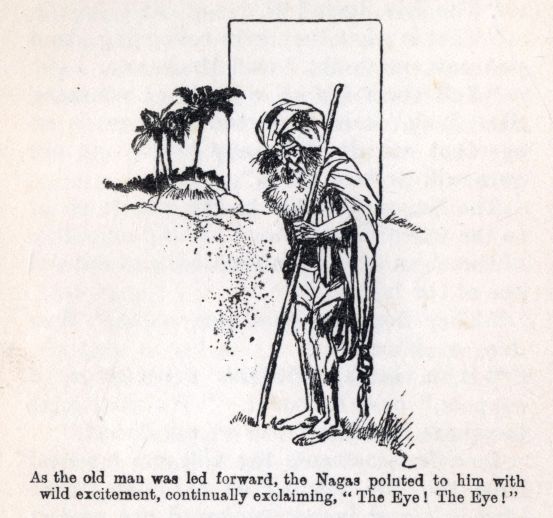
As the old man was led forward, the Nagas pointed to him with wild excitement, continually exclaiming, "The Eye! The Eye!"
Forrester asked Sher Jang to get from the people an explanation of the connection of this old man with the Nagas' refusal to march. The story, as told by the villager through the Naga head-man, was that the one-armed greybeard had been a brave warrior in his youth, and was one of a war party who, many years before, had ventured beyond the great waterfall. Of them all, only he had returned, without his right arm. When his people asked him what had happened to his companions, and how he had lost his arm, his only answer was "The Eye!" Ever since, his mind had been a blank. He could tell them nothing, had no recollection of what had happened; and the people had kept him with them, showing him the veneration which simple races often pay to the half-witted.
The white men were mystified. The story seemed incredible, yet there was the man in proof of it.
"None of the people have ever been beyond the fall since?" asked Forrester.
"None of us," was the reply, "but we have seen men go sometimes, and we have never known them to return. Yes: there was one who returned. He was fair of skin like these lords, and wore clothes like them. There were two who went, but only one returned. Some of our people saw him hasting by the lake near the fall, and the little men were running after him, but he escaped them, and went into the forest."
"Who are the little men?" Forrester asked.
"They are men like monkeys," replied the man, holding his hand about four feet from the ground to indicate their height. "They are the men who take the wood from us."
On further questioning, the men explained that the country beyond the falls was destitute of large trees, and the little men paid the villagers for timber cut in the forest. This timber was conveyed to a certain spot some distance short of the waterfall, and removed thence by the little men to their home in the mountains, which the villagers had never beheld.
"How long ago was the white man seen?" Forrester asked.
The man held up his hands with fingers outspread.
"Redfern, to a certainty!" Jackson exclaimed. "We must go on, and get to the bottom of this mystery. It's horrible to think of what may possibly happen to Beresford."
"Ay, there's something uncanny beyond," Mackenzie said, thoughtfully.
"Whatever they mean by the Eye, it is clear that something gruesome goes on among the little men," said Forrester. "There's nothing for it but to forge ahead, and tackle them if there's the ghost of a chance for us. What do you say? Are you game to stick to it, even if we can't persuade the Nagas to come?"
"Ay, I'm for going on," said Mackenzie.
"I too," said Jackson. "We can but try, and I don't suppose the little men, whoever they are, have rifles. Let us start at once."
CHAPTER VI
THE IRON SHUTTER
"You come with us, Sher Jang?" asked Forrester.
"Sahib, I am your servant," the man replied, simply.
"And you, Hamid?"
The cook pulled nervously at his beard, turned up the whites of his eyes, shot a savage glance at the shikari, then said in a voice which all his resolution could not prevent from trembling:--
"Sir, I step out like a man. One volunteer is worth tons of pressed beef."
"Which means that without these idiotic carriers we shall have to travel light," said Forrester. "Just put up enough food for two days; we'll carry it somehow among us. We must leave the tent with the Nagas. They had better remain here until we return."
"Can't we take more grub?" Jackson asked.
"If we don't do it in two days we shan't do it at all, so it's useless overloading ourselves. We risk losing the tent, of course, but that can't be helped."
Their preparations were quickly made, and they set off while the morning was still young. Hamid Gul carried his cooking utensils, plates, knives and forks, and other articles; Sher Jang shouldered some blankets, in which he had wrapped a quantity of ammunition, and the three white men divided the food among them. Each of the party had his rifle slung behind his back.
Their guides, a dozen of the villagers, harnessed themselves to tree trunks, which they dragged through the wood and down the rocky slope beyond. It had been arranged before they started that the white men should follow at some little distance, so that the natives, in case of need, might repudiate knowledge of them, and escape all responsibility for bringing the strangers to the neighbourhood of the falls.
At the foot of the slope they came to a rivulet. Without the Naga head-man Sher Jang could not hold any oral communication with the villagers; but they managed to convey to him the information that the smaller falls of which they had spoken were a little way down-stream; the larger falls lay a much greater distance in the other direction. Some minutes were occupied in forming the balks of timber into a raft. When this was done half the party of natives swam to the farther bank, carrying ropes attached to the raft, and then the two sections hauled their wares against the sluggish current, tramping along towpaths which must have been trodden by several generations of their forebears.
The view ahead was shut out by the trees that grew almost to the edge of the winding stream; but it was not long before the white men, walking about half a mile behind their guides, were aware of a dull rumble that grew louder moment by moment as they proceeded.
"That's the fall!" cried Jackson. "We can't be far away."
"A pretty big one, by the sound of it," Forrester remarked. "Small falls make a sort of crash--this is more of a roar. Perhaps we shall find a second Niagara."
"I'm fair flummoxed!" said Mackenzie, inconsequently.
"What about?"
"About yon Eye. You see, these folks were terrified by the storm: 'He speaks,' they said. Well, that was the thunder. By what the philosophers call parity of reasoning, the Eye is lightning. Well, lightning can take off a man's arm, and strike him daft or dead; but what about the little men up yonder? Are they scunnered at the Eye, too? What has the Eye to do with Beresford?"
"Trust a Scot to ask questions!" said Jackson. "But you won't reason it out, Mac; you'll just have to wait, like an Englishman."
"Och, man! I want facts. Give me facts, and I'll draw my own conclusions."
"Well, this row is a fact, and a stunning one," said Forrester. "It's time we caught sight of the fall that's making such an uproar."
But they marched on for a couple of hours without seeing any sight of a waterfall, or even any quickening of the current. The noise had gradually increased to a stupendous din, and thoughts of their ultimate errand were overborne by excitement as they looked eagerly ahead for the mass of falling water. At last the belt of forest land came to an abrupt end, and they gazed forth over a wide rocky plain, in the midst of which was an immense lake that appeared to be considerably below the level of the surrounding country. From it ran the stream whose course they were following, and a larger stream far to the right.
Beyond the plain rose the mountains, towering up peak behind peak to the summits of the snowy range in the remote distance. The three men halted involuntarily, struck both by the majesty of the scene and by the deafening roar which almost drowned their voices.
"Man, it's grand!" Mackenzie shouted.
"But where is it?" Forrester bawled in his ear.
They looked all around, but saw nothing to account for the thunderous noise. The sky was overcast, and a layer of mist obscured the lower foothills, though the heights beyond heaved their grey masses in clear undulations miles above. As they stood, a sunbeam stole through the clouds, and a rainbow flung its gay arch across the plain directly ahead of them.
"There's rain over there," said Jackson, at the top of his voice.
"Only mist!" Forrester cried in reply.
For a few moments they gazed mutely upon a sight that never loses its interest and wonder. Then Mackenzie smote his thigh, and cried like one in ecstasy:--
"Man--it's the Fall!"
The mist was rolling away as the sun gathered strength, yet the rainbow did not fade, but shone more brightly than ever over a space of perhaps one-eighth of a mile. And then the onlookers saw that what had hitherto seemed to them a part of the bank of mist was in reality a gigantic torrent of water, mingled with spray thrown up hundreds of feet from the unseen bottom. They watched it in silent awe. The villagers had described it as falling from the clouds into the depths of the earth. Their words appeared to be literally true. An eighth of a mile in width, the torrent poured over the edge of a tableland--a single huge step in the ascent to the plateaux of Tibet. Mist still hung above it, the enormous screen of spray concealed its lower part, and at the distance they still were from it the spectators could only just distinguish the movement of the mighty volume of water.
It had been arranged with their guides that they should remain on the spot where they first caught sight of the fall until the men had delivered their timber and returned. The delay gave them an opportunity of taking a meal. As they ate they amused themselves by guessing at the height of the fall. Forrester suggested that it was as high as St. Paul's; Jackson thought this estimate too low; and Mackenzie astonished the others by declaring that he wouldna wonder but it was fully as high as Ben Lomond.
It was three hours before the natives returned, and the white men, setting forth impatiently at length to skirt the lake and reach the foot of the hills on the western side of the fall, found to their amazement that they had nearly two miles to go before they came level with it. Then they were struck dumb by the full magnificence of the scene. The spray itself, rising like steam from a gigantic cauldron, attained to the height of St. Paul's. The two Englishmen were prepared to admit that the top of the fall was even higher than the summit of Ben-Lomond; but Mackenzie's calculating eye gauged more nearly to the truth.
"I would say it's two thousand feet, or a wee bit more," he said, and his friends laughed at the incongruous use of the word "wee" in such a connection.
They found that the scarp over which the torrent poured extended for miles on each side. It appeared to be almost perpendicular, though away to the left it became more broken. On the right, except for one or two steep and rugged spurs, it was one continuous wall of rock.
The path they had followed round the western shore of the lake brought them to a small wooden bridge spanning an inflowing stream. It somewhat resembled the bridge delineated in the well-known willow pattern. To this the raft of timber was moored. Evidently it was part of the plan for maintaining the secrecy of the hill community that purchasers and vendors should come into contact as seldom as possible; or perhaps the woodcutters' own fear of the Eye kept them from approaching nearer to the dwelling of the "little men." No doubt the timber would presently be fetched, and drawn along the stream into the lake, and thence to its destination.
The three men looked around for some signs of human habitation, but discovered none. A rough roadway, however, led from the bridge along the base of the precipice towards the fall, which appeared to be about half a mile distant. After a brief consultation they decided to make their way along this road. To be prepared for possible danger they first laid down their impedimenta and unslung their rifles. Then they set off, Forrester leading with the shikari.
After a while the path rose somewhat steeply on the face of the cliff, and they soon saw that it passed underneath the fall itself, the torrent of water forming a gigantic arch. When they arrived beneath this they found themselves in a dim twilight, the glassy sea-green surface of the watery arch reflecting a pallid hue upon their faces. They were perfectly dry, except for some flecks of spray dashed upon them from the base of the fall. At this spot they were three or four hundred feet above the surface of the lake, which boiled and foamed like an angry sea immensely magnified. The din was terrific; even the loudest shout would scarcely have been audible.
At their first entrance into this segmental tunnel Hamid Gul shrank back, appalled by the noise, the falling water, and the immense, tattered sheet of spray that rose from the seething cauldron hundreds of feet below. But seeing that his employers were pressing forward he pulled himself together, and hurried on close at Mackenzie's heels. The width of the path had diminished to a bare three feet, and as the party crept along it they instinctively clung to the wall of rock on their left hand. A strange attraction was exercised by the smooth arch of falling water; on their right, inducing the same kind of vertigo which most people experience when looking down from giddy heights.
So they passed through the furlong of tunnel. A hundred yards or so beyond the eastern end the path began to slope downwards as steeply as it had ascended on the other side, and within a short space the party found themselves once more almost on a level with the lake. Then the path came to an abrupt end, disappearing into the water that washed the base of the perpendicular cliff. Here they halted; it seemed that they could go no farther, that they must retrace their steps and explore in the other direction.
They could not make themselves heard one by another, but Mackenzie signed to the rest to stand fast; he remembered that beyond the bridge behind them there was no road except that which skirted the lake, and drew the reasonable inference that the path by which they had come must, after all, lead somewhere. It occurred to him to test the depth of the water. Finding that it was no more than two feet, he took off his boots, rolled up his putties, and started to wade. In a few seconds he turned and beckoned to his companions. They followed his example, and on joining him found that he had come to a sharp corner of the precipice, which was cut at this point by an extraordinary rift. At the entrance it was perhaps forty feet wide. The sides were straighter and even nearer to the perpendicular than the face of the cliff bordering the lake. They gazed upwards in astonishment at the immense height. The top was so far above them that the sides seemed almost to touch, leaving only a narrow slit. Peering into the cleft, they saw nothing beyond the first hundred yards or so. Little light filtered through the opening at the top, and the floor of the rift was illuminated more and more faintly as the sides converged.
Our party stood there in mute amazement. Mackenzie was the only one of them who knew anything of geology: a Scot always knows something of everything; and he surmised that the rift was the result of some Titanic disruption of the earth in an age long past. It was as though the mass of solid rock had been rent asunder by a gigantic wedge, impelled by a Cyclopean hammer--such a hammer as Thor wields in the Norse myths.
It seemed of little use to enter the rift. No mortal men could make that their abode. But on passing beyond the entrance they soon found that further passage along the edge of the lake was impossible. The water still came right up to the face of the cliff, and the pathway--if it was a pathway--which they were treading sank ever deeper beneath the surface. There was nothing for it but to hark back, unless they were prepared to swim. Jackson suggested that possibly some side path branched from the rift, leading by a steep zigzag ascent to the summit of this strange precipice.
Retracing their steps accordingly, they turned into the rift, donned their boots, and marched forward. The floor sloped gently upwards, the walls converged until the space between them was barely half what it had been at the entrance. Pressing on, they became aware that the rift was not straight, as they had believed. A sharp bend brought them upon a sight that caused them to halt, peer nervously upward and in front, and tighten their grasp upon their rifles. Three canoes lay tandem against the right-hand side of the rift--harmless objects in themselves, but rather perturbing as indications that men were somewhere in the neighbourhood. They were obviously intended for transporting persons across the lake without the necessity of making the passage under the fall. In the dim light they would scarcely have been visible from the entrance, even had the rift been straight; the bend effectually concealed them.
Once more the party halted. Shut in as they were by the high, close walls, the sound of the waterfall came to them now only as a dull rumble; but when they spoke it was in whispers. Apart from the risk of being heard by an unseen enemy, there was an atmosphere of mystery and awesomeness that weighed oppressively on their minds.
"What are we to do?" asked Jackson.
"Go on!" Forrester replied, firmly. "We can hardly be seen. The sides are so smooth and straight that no one could perch anywhere to molest us, except at the corners. We must be on our guard there."
"But surely no one can live here! Nothing could grow; there doesn't even appear to be moss on the rock, and the air's as stuffy as in a cave."
"Man, don't argufy!" said Mackenzie. "Straight ahead!"
They continued their course. Every now and again the rift turned sharply to one side or the other, and the smooth floor, unimpeded by loose rocks or boulders, always ascended, more and more steeply as they advanced. Strangely enough, the higher they went the stuffier the air became, and the deeper their sense of oppression, or rather, perhaps, of nervous strain. Mackenzie, who had once been down a coal-mine in Lanarkshire, suspected the presence of poisonous gases.
"There can't be fire-damp," he murmured, "but it may be carbonic acid. Bide a wee while I strike a match."
But this fear was dispelled when the flame burned brightly for a second or two. He extinguished it abruptly.
"Hoots! I'm an ass!" he said. "Someone may have seen the light; and if there are men about, I'd rather see them first than they us."
"My skin is tingling just as if I'd got a grip of the terminals of a battery," Jackson remarked.
"It's uncanny, and that's a fact," said Mackenzie. "But look, man! What's that?" he added, in a startled whisper, clutching Forrester by the arm with one hand, and pointing ahead with the other.
His comrades closed upon him, and peered into the semi-obscurity, their heads almost touching. A little to one side of them stood Sher Jang, impassive as ever, though he held his rifle with both hands, and his muscles were as taut as a bent spring. Behind, Hamid Gul's one eye bulged from its socket as he tiptoed to look over his master's shoulder.